Triangle Inequalities
The student is able to (I can):
• Analyze the relationship between the angles of a triangle
and the lengths of the sidesand the lengths of the sides
• Determine allowable lengths for sides of triangles
If two sides of a triangle are not congruent,
then the larger angle is opposite the longer
side.
If two angles of a triangle are not
congruent, then the longer side is opposite
the larger angle.
AT > AC → m∠C > m∠T
m∠C > m∠T → AT > AC
A
C
T
m∠C > m∠T → AT > AC
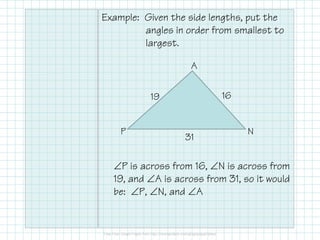
Example: Given the side lengths, put the
angles in order from smallest to
largest.
A
19 16
∠P is across from 16, ∠N is across from
19, and ∠A is across from 31, so it would
be: ∠P, ∠N, and ∠A
P N
31
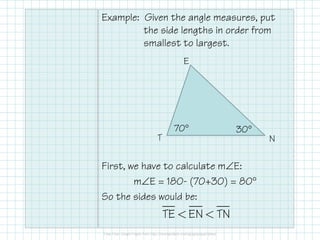
Example: Given the angle measures, put
the side lengths in order from
smallest to largest.
E
First, we have to calculate m∠E:
m∠E = 180- (70+30) = 80°
So the sides would be:
T N
70° 30°
TE EN TN< <
Triangle Inequality Theorem
The sum of any two side lengths of a
triangle is greater than the third side
length.
Example:
1. Which set of lengths forms a triangle?
4, 5, 10 7, 9, 124, 5, 10 7, 9, 12
4 + 5 < 10 7 + 9 > 12
Note: To find a range of possible third
sides given two sides, subtract for
the lower bound and add for the
upper bound.
Examples:
2. What is a possible third side for a
triangle with sides 8 and 14?triangle with sides 8 and 14?
14 — 8 = 6 lower bound
14 + 8 = 22 upper bound
The third side can be between 6 and 22.
3. What is the range of values for the
third side of a triangle with sides 11 and
19?
19 — 11 = 8 lower bound
19 + 11 = 30 upper bound
8 < x < 308 < x < 30

2.5.5 Triangle Inequalities

  • 1.
    Triangle Inequalities The studentis able to (I can): • Analyze the relationship between the angles of a triangle and the lengths of the sidesand the lengths of the sides • Determine allowable lengths for sides of triangles
  • 2.
    If two sidesof a triangle are not congruent, then the larger angle is opposite the longer side. If two angles of a triangle are not congruent, then the longer side is opposite the larger angle. AT > AC → m∠C > m∠T m∠C > m∠T → AT > AC A C T m∠C > m∠T → AT > AC
  • 3.
    Example: Given theside lengths, put the angles in order from smallest to largest. A 19 16 ∠P is across from 16, ∠N is across from 19, and ∠A is across from 31, so it would be: ∠P, ∠N, and ∠A P N 31
  • 4.
    Example: Given theangle measures, put the side lengths in order from smallest to largest. E First, we have to calculate m∠E: m∠E = 180- (70+30) = 80° So the sides would be: T N 70° 30° TE EN TN< <
  • 5.
    Triangle Inequality Theorem Thesum of any two side lengths of a triangle is greater than the third side length. Example: 1. Which set of lengths forms a triangle? 4, 5, 10 7, 9, 124, 5, 10 7, 9, 12 4 + 5 < 10 7 + 9 > 12
  • 6.
    Note: To finda range of possible third sides given two sides, subtract for the lower bound and add for the upper bound. Examples: 2. What is a possible third side for a triangle with sides 8 and 14?triangle with sides 8 and 14? 14 — 8 = 6 lower bound 14 + 8 = 22 upper bound The third side can be between 6 and 22.
  • 7.
    3. What isthe range of values for the third side of a triangle with sides 11 and 19? 19 — 11 = 8 lower bound 19 + 11 = 30 upper bound 8 < x < 308 < x < 30