LEARNING OUTCOMES
1. Statethe definition of carbon compound
2. Identify different types of carbon compounds
3. Explains homologous series
4. Construct molecular formula and structural formula, and name the members of the
homologous series
5. Describe physical properties of the compounds in a homologous series
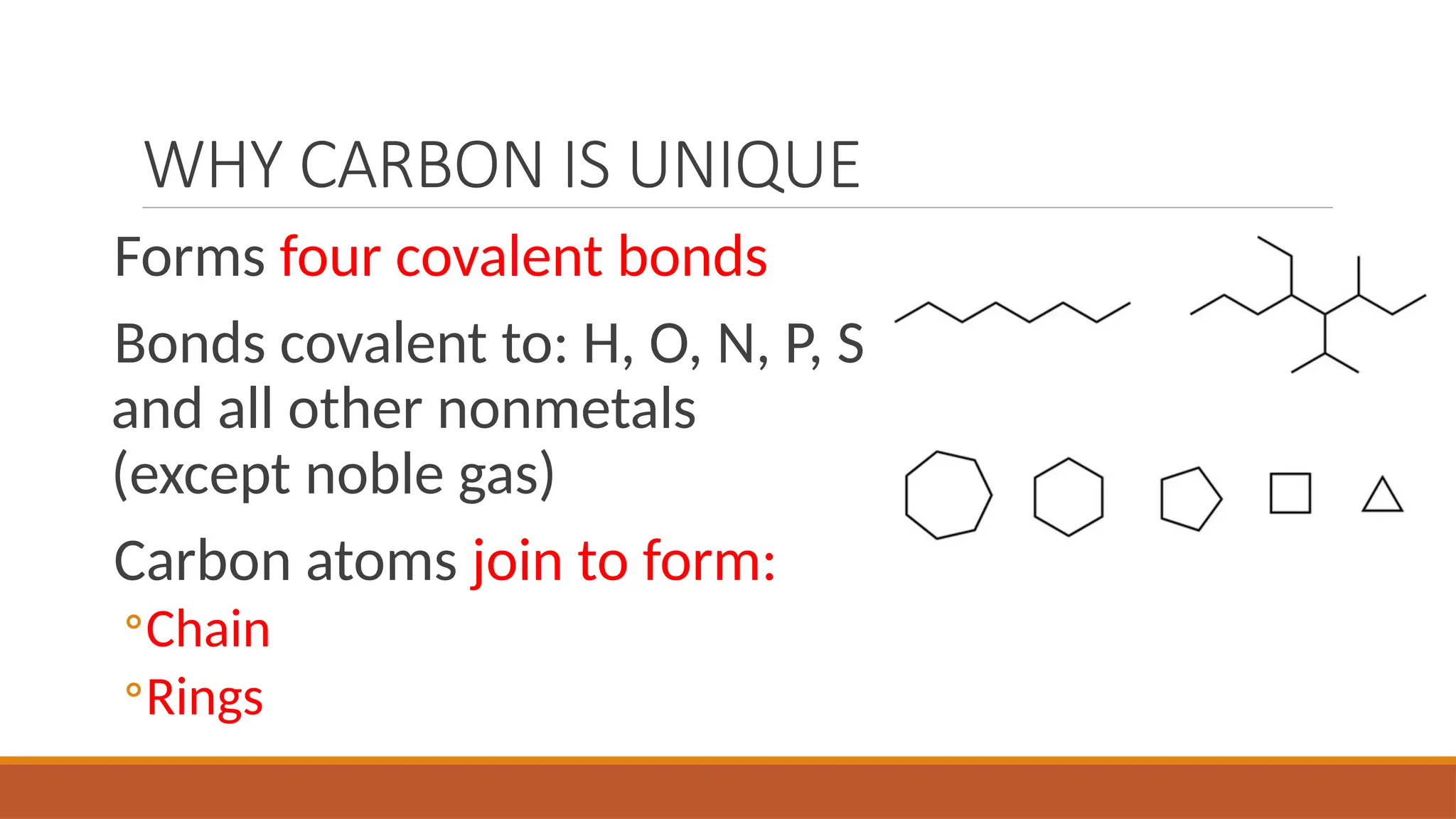
WHY CARBON ISUNIQUE
Forms four covalent bonds
Bonds covalent to: H, O, N, P, S
and all other nonmetals
(except noble gas)
Carbon atoms join to form:
◦Chain
◦Rings
5.
WHY CARBON ISUNIQUE
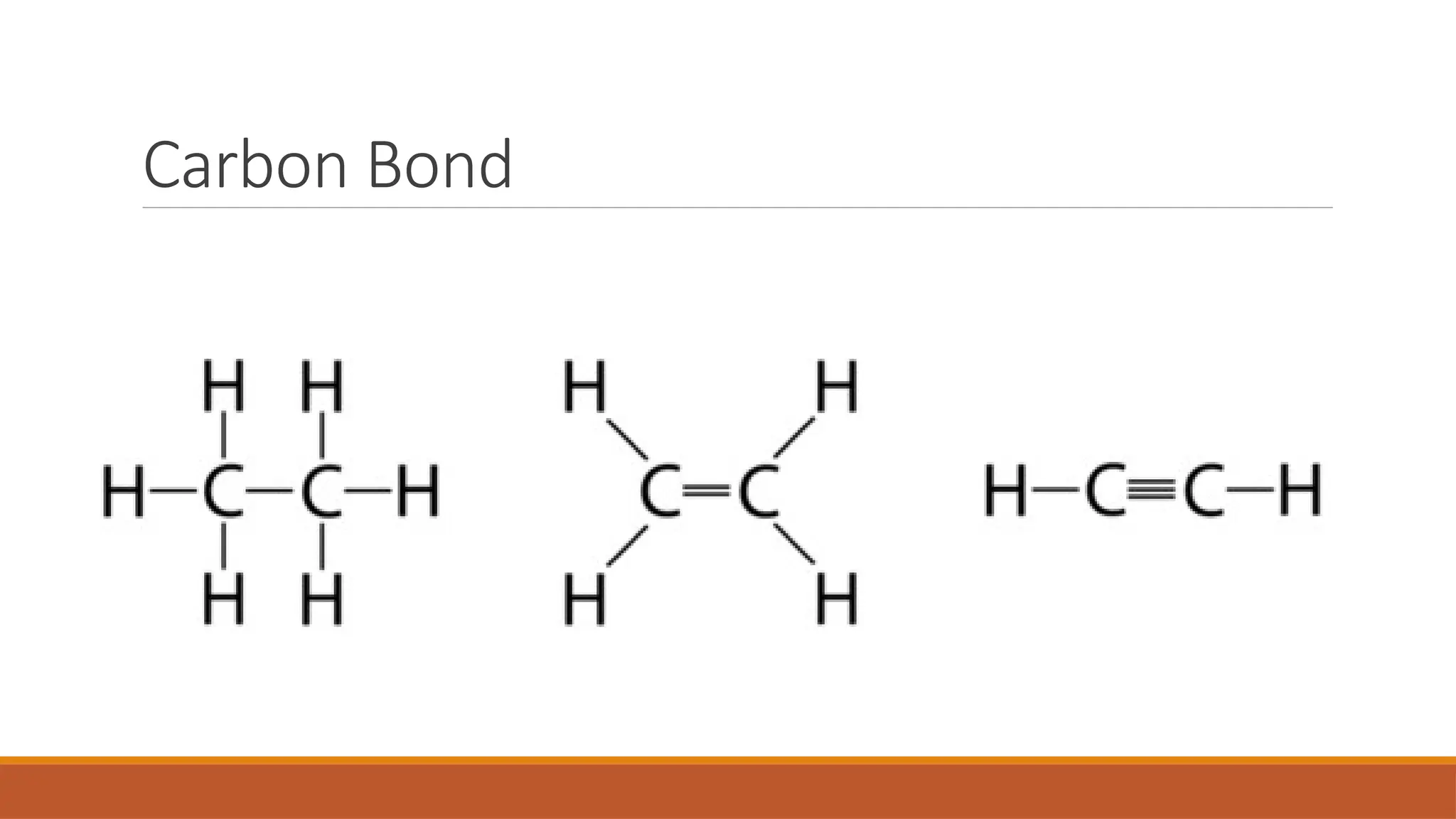
Carbon can form multiple bonds to itself; oxygen and
nitrogen to give large variety of compounds
The number of compound is so large that a separate
branch of chemistry – organic chemistry is devoted to
the study of these compound
Carbon atoms able to form long chains of carbon atom.
This property is known as catenation
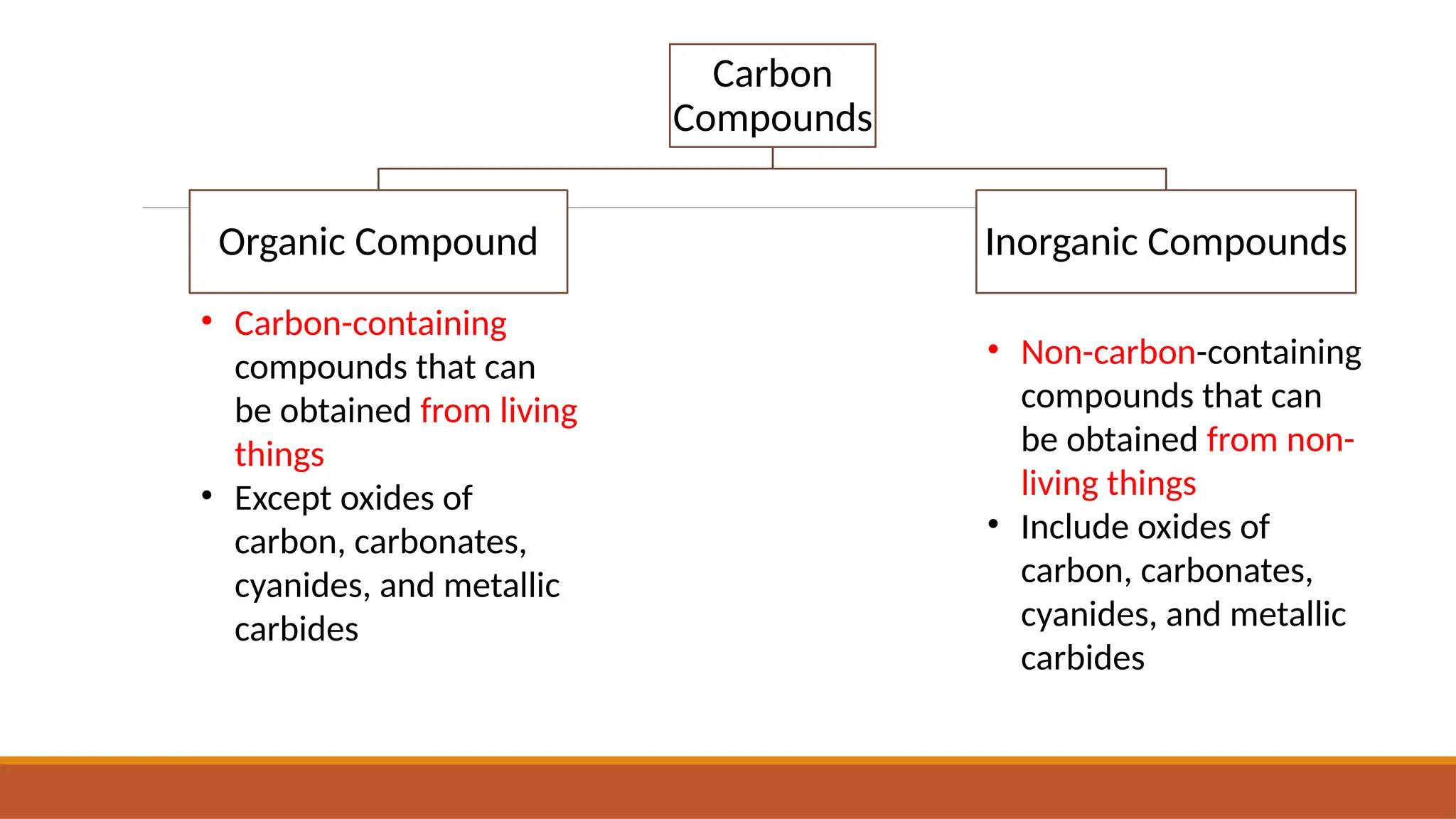
Carbon
Compounds
Organic Compound InorganicCompounds
• Carbon-containing
compounds that can
be obtained from living
things
• Except oxides of
carbon, carbonates,
cyanides, and metallic
carbides
• Non-carbon-containing
compounds that can
be obtained from non-
living things
• Include oxides of
carbon, carbonates,
cyanides, and metallic
carbides
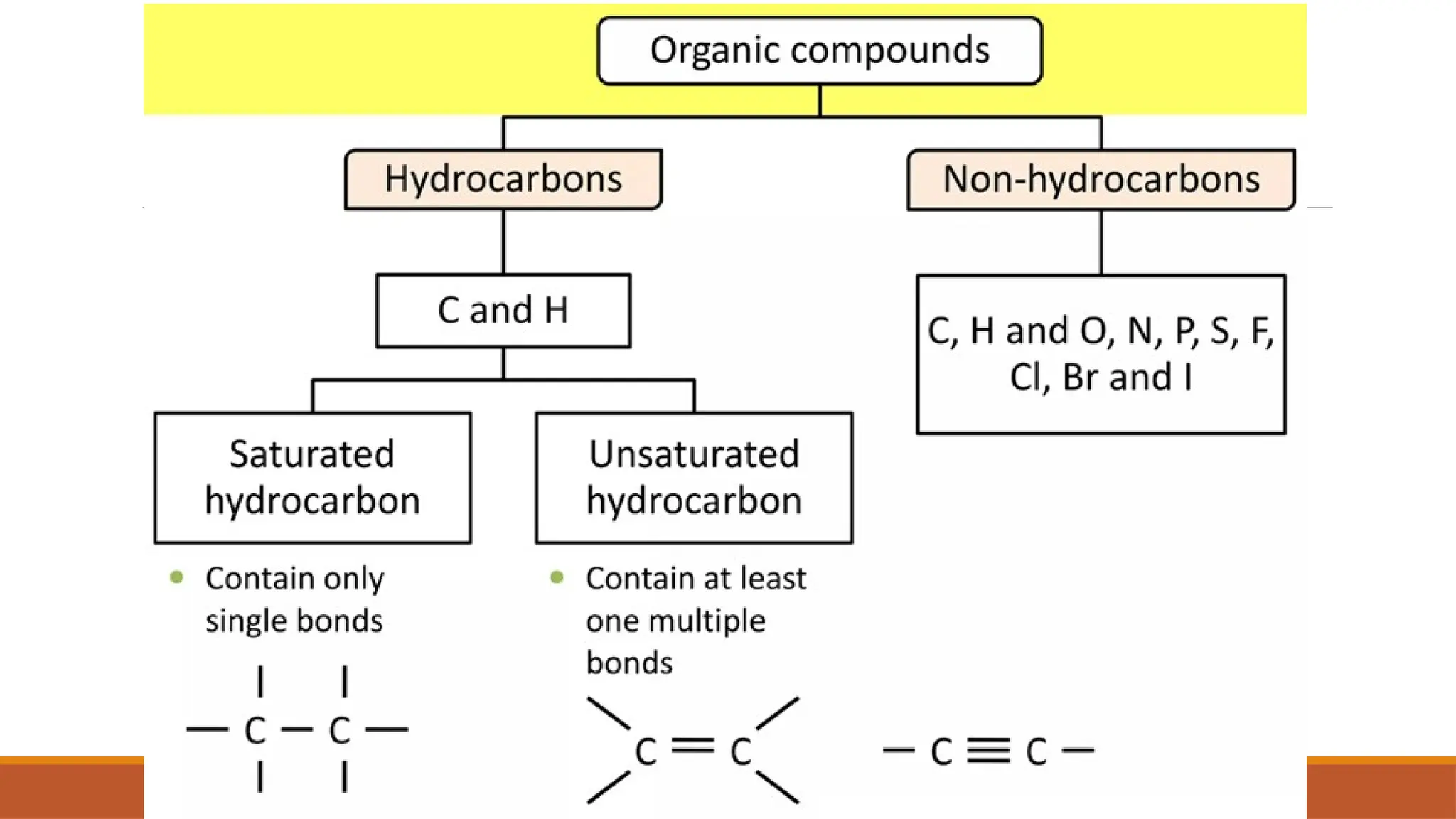
HYDROCARBON
The simplest organiccompounds:
◦Containing only carbon and hydrogen
It can be separated intro three main groups:
1. Saturated
2. Unsaturated
3. Aromatic
11.
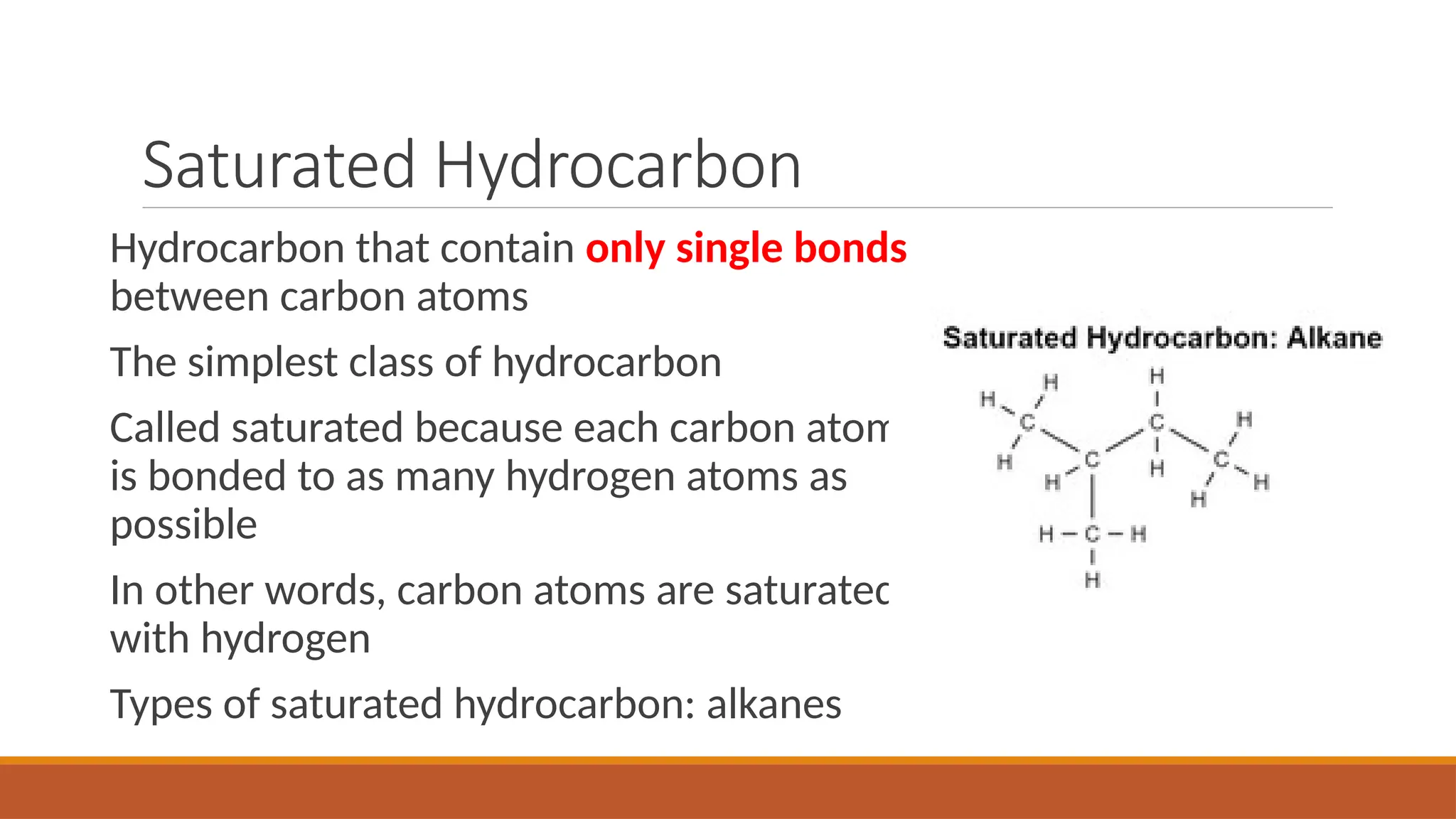
Saturated Hydrocarbon
Hydrocarbon thatcontain only single bonds
between carbon atoms
The simplest class of hydrocarbon
Called saturated because each carbon atom
is bonded to as many hydrogen atoms as
possible
In other words, carbon atoms are saturated
with hydrogen
Types of saturated hydrocarbon: alkanes
12.
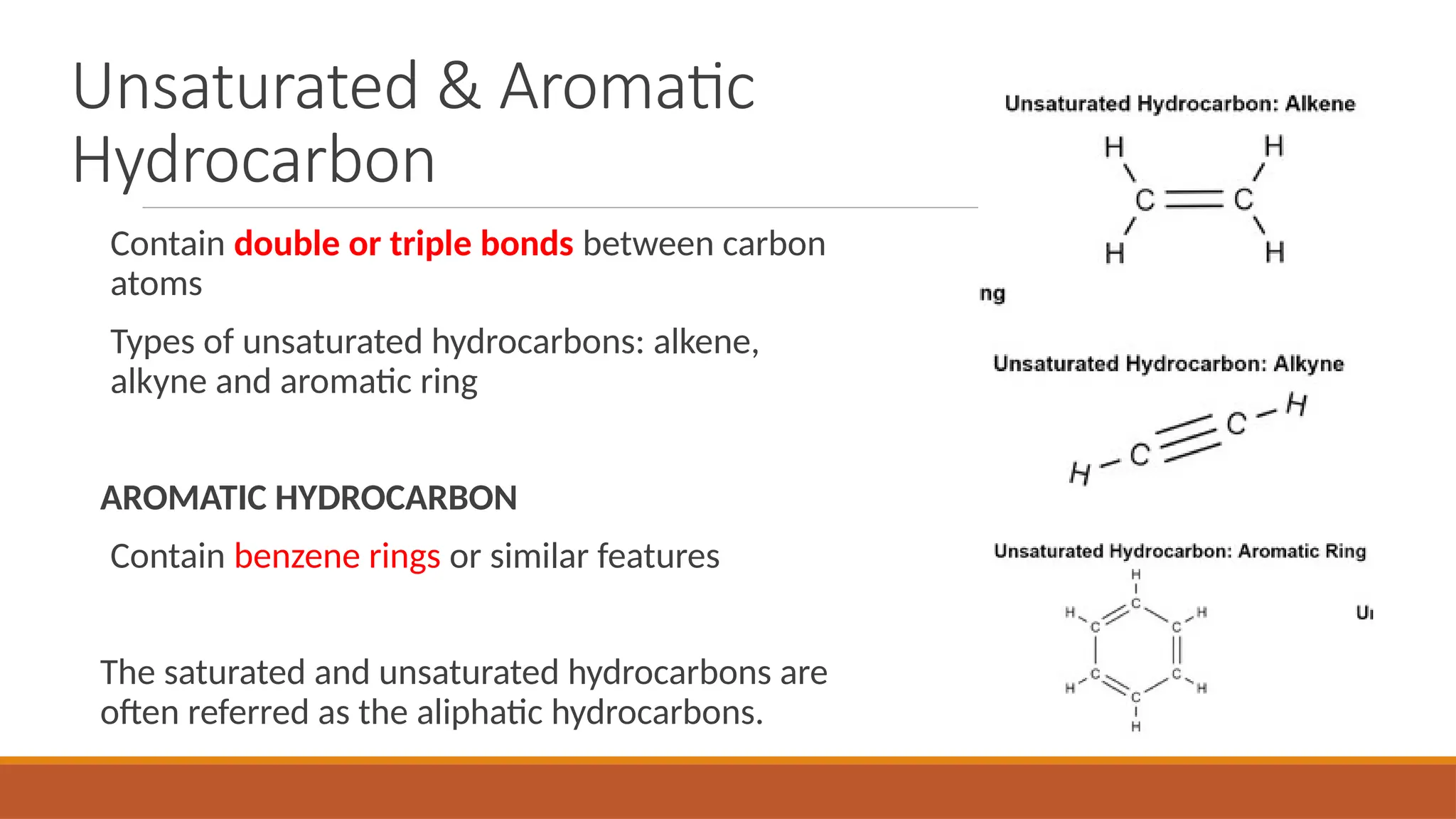
Contain double ortriple bonds between carbon
atoms
Types of unsaturated hydrocarbons: alkene,
alkyne and aromatic ring
AROMATIC HYDROCARBON
Contain benzene rings or similar features
The saturated and unsaturated hydrocarbons are
often referred as the aliphatic hydrocarbons.
Unsaturated & Aromatic
Hydrocarbon
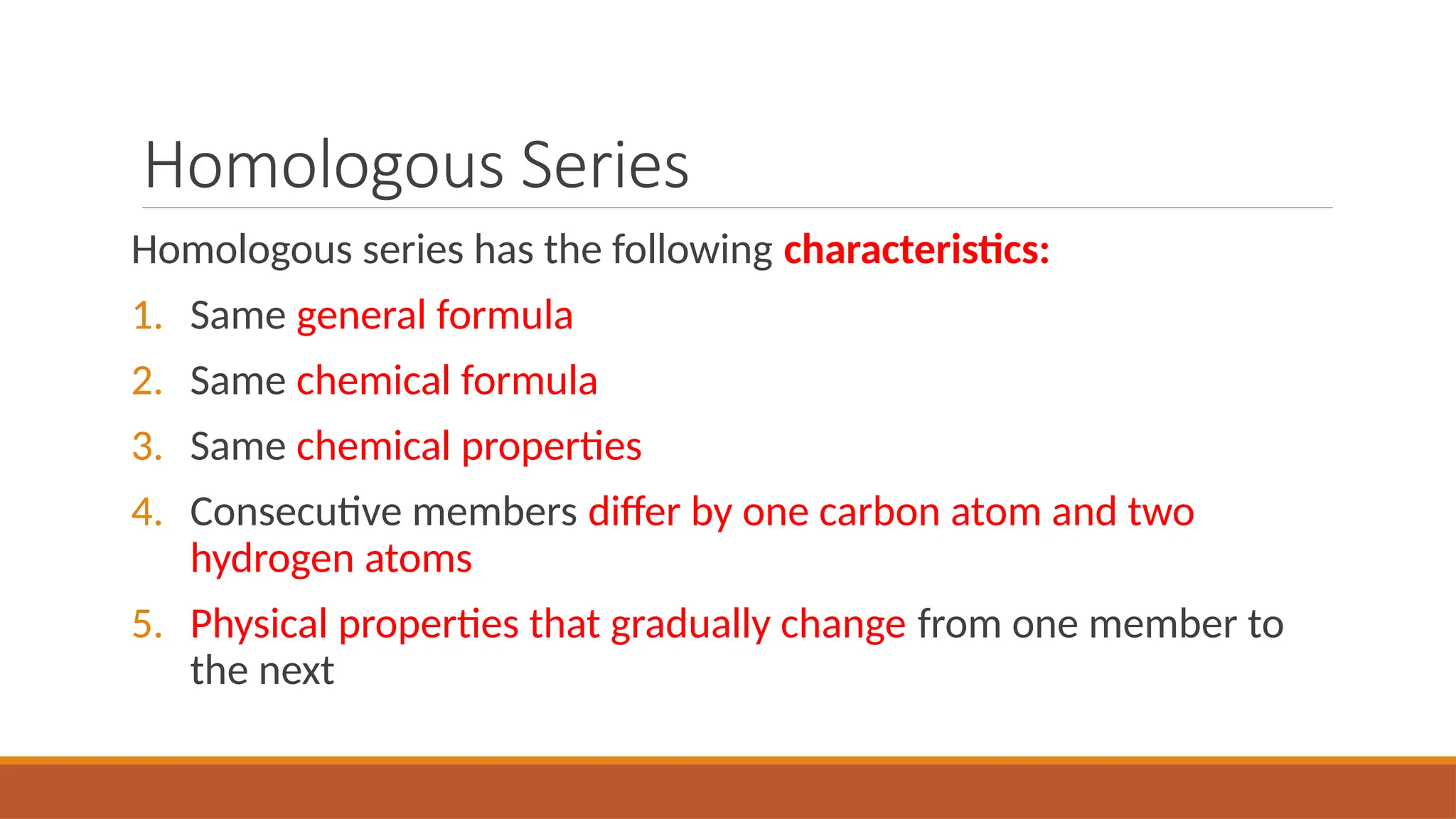
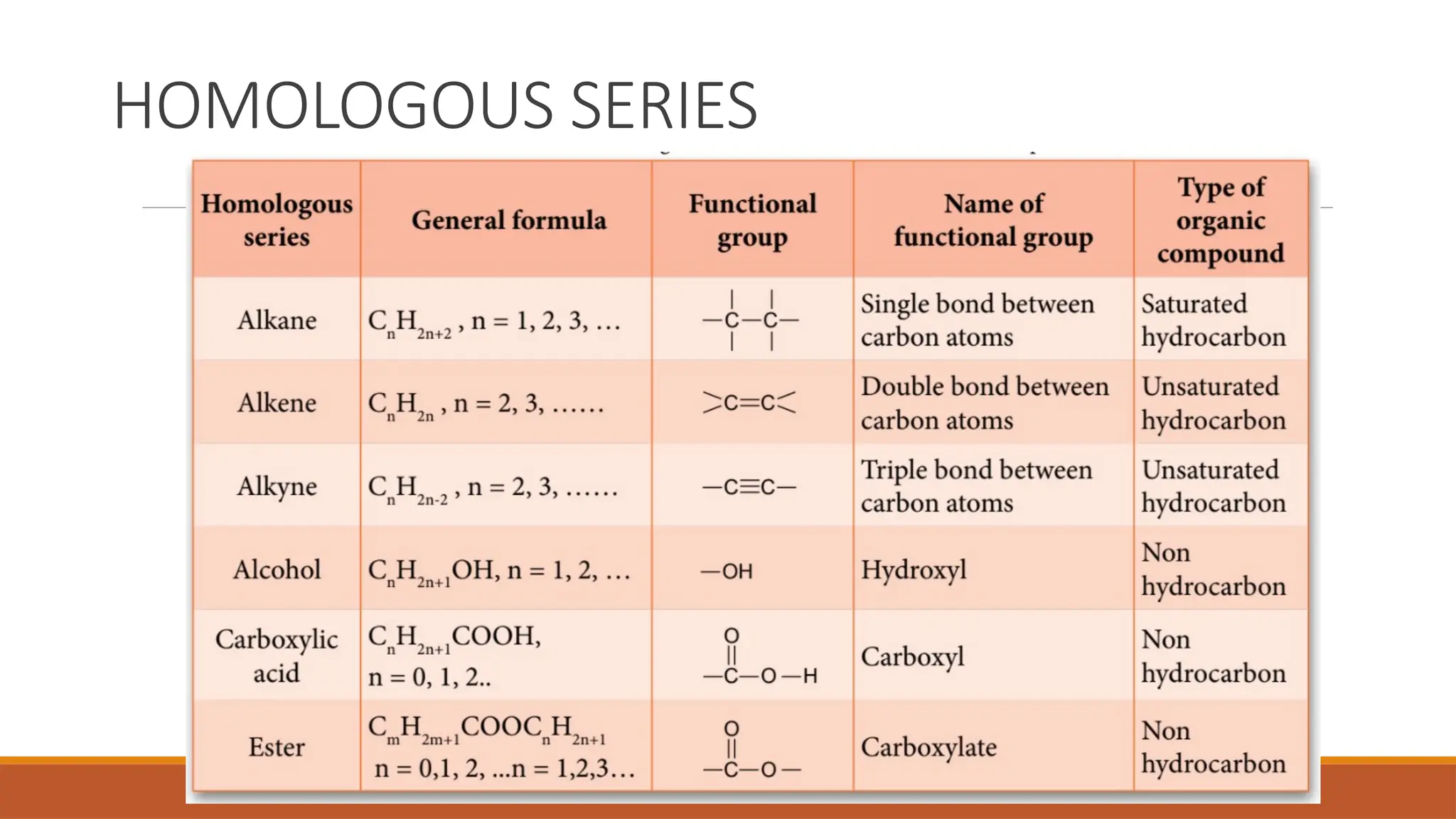
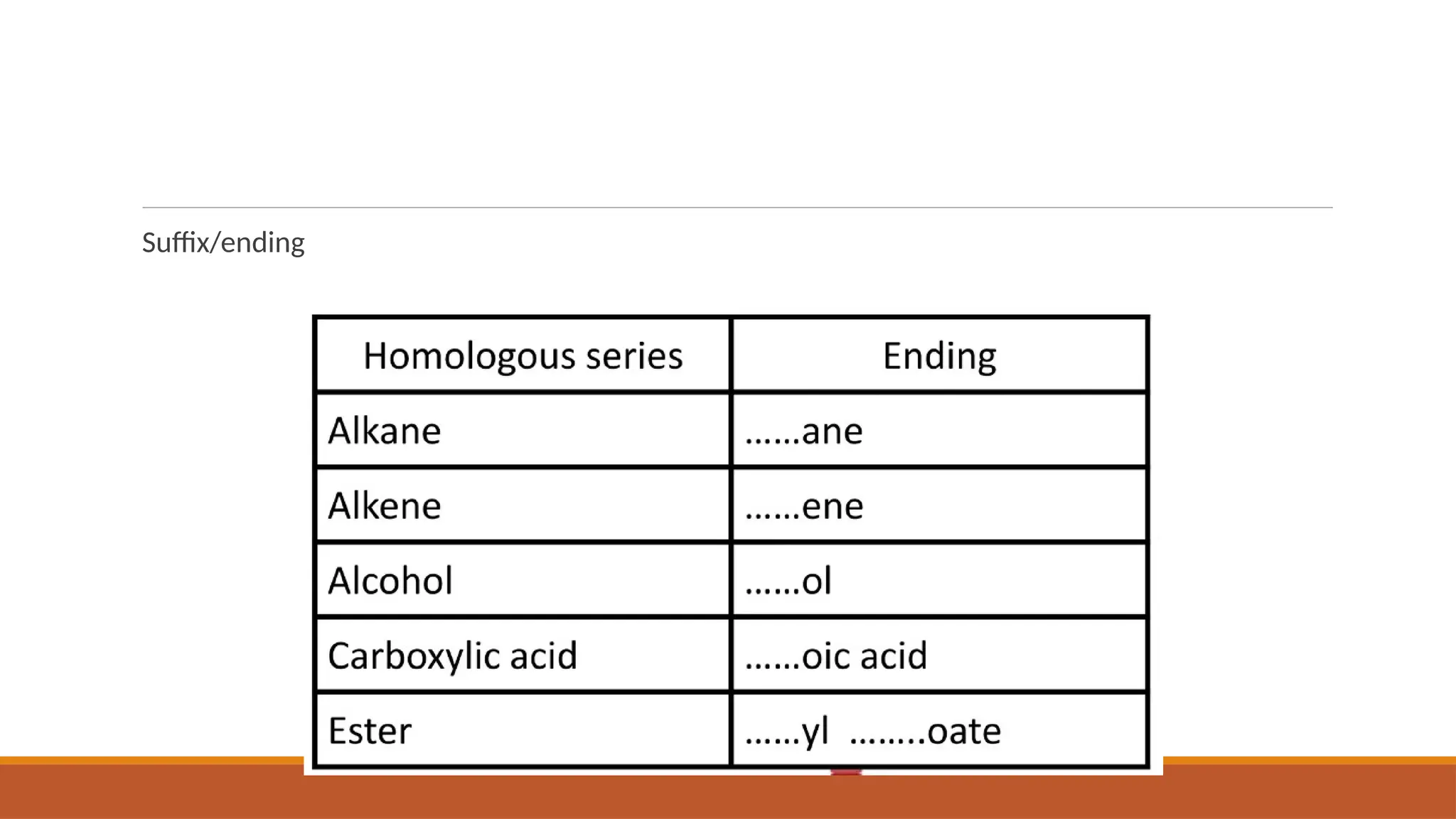
Homologous Series
Homologous serieshas the following characteristics:
1. Same general formula
2. Same chemical formula
3. Same chemical properties
4. Consecutive members differ by one carbon atom and two
hydrogen atoms
5. Physical properties that gradually change from one member to
the next
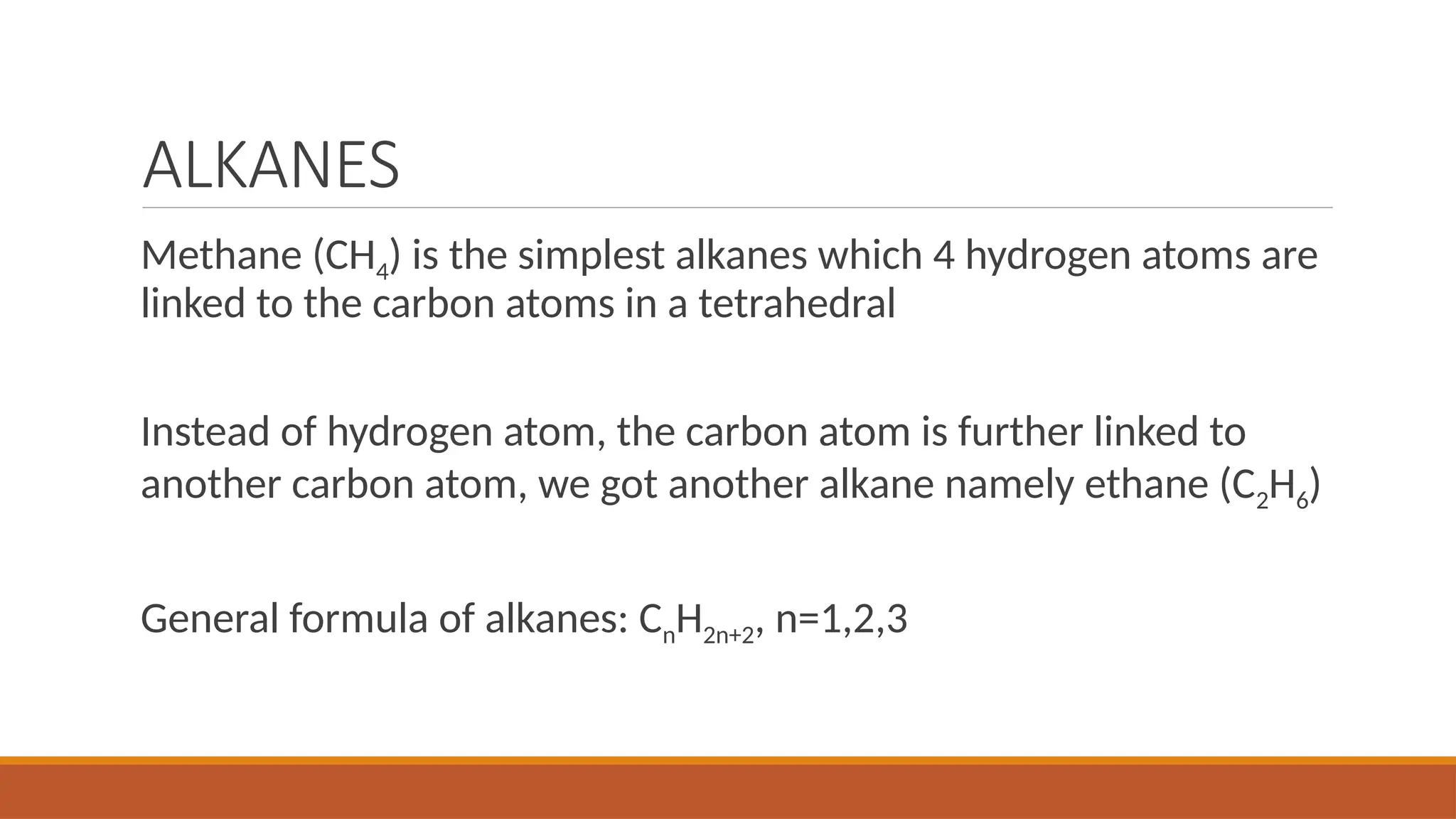
ALKANES
Methane (CH4) isthe simplest alkanes which 4 hydrogen atoms are
linked to the carbon atoms in a tetrahedral
Instead of hydrogen atom, the carbon atom is further linked to
another carbon atom, we got another alkane namely ethane (C2H6)
General formula of alkanes: CnH2n+2, n=1,2,3
21.
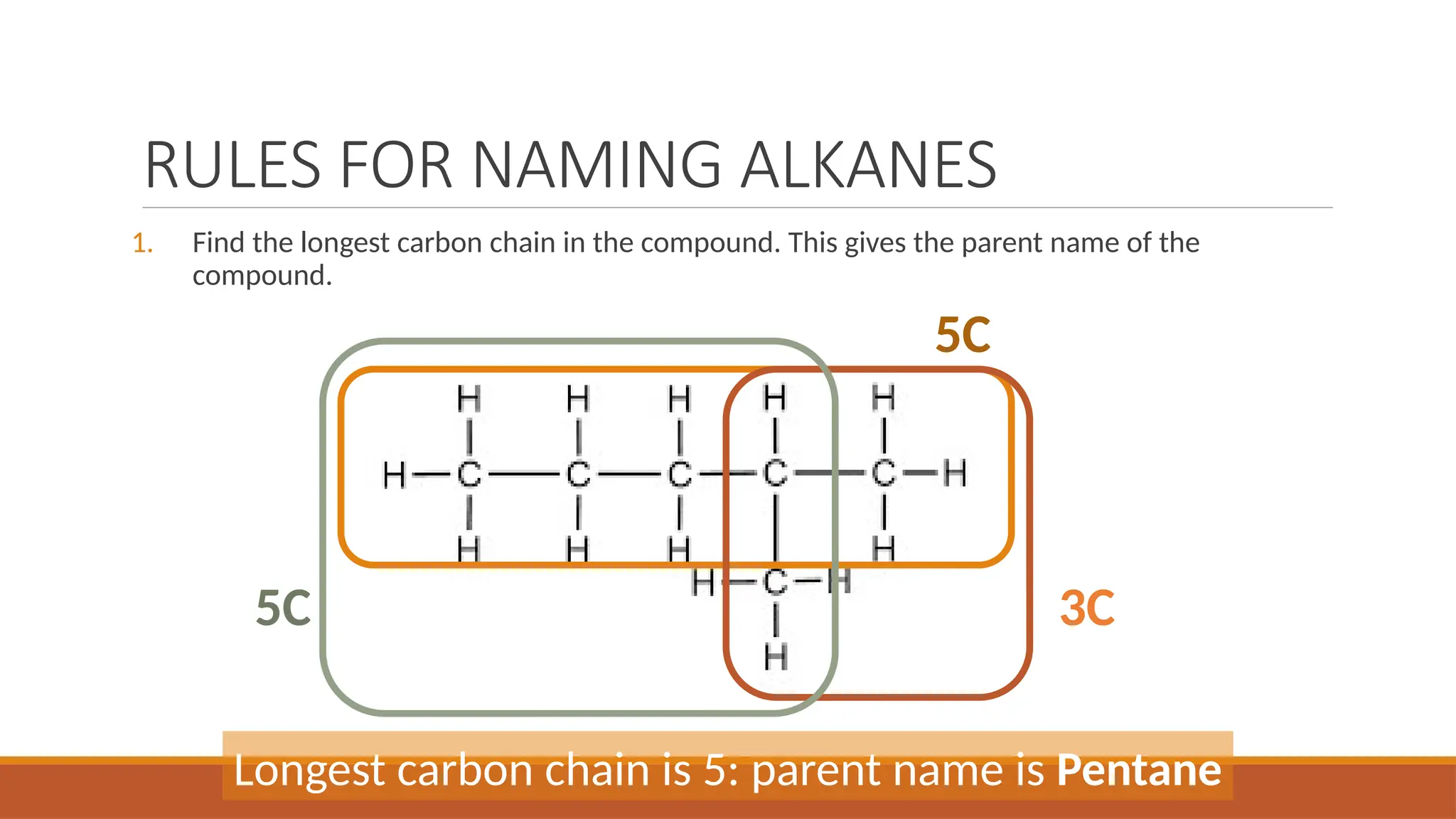
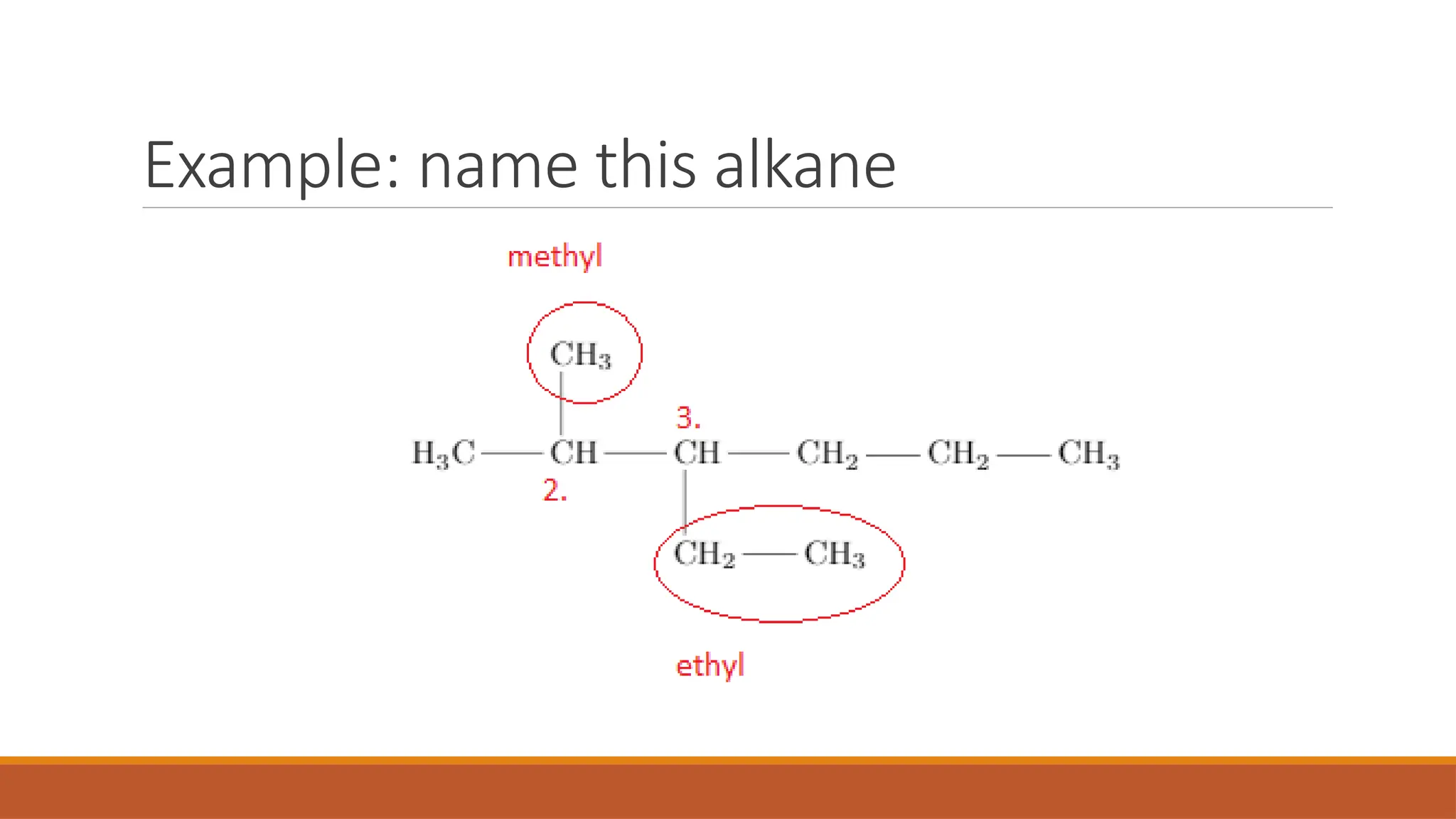
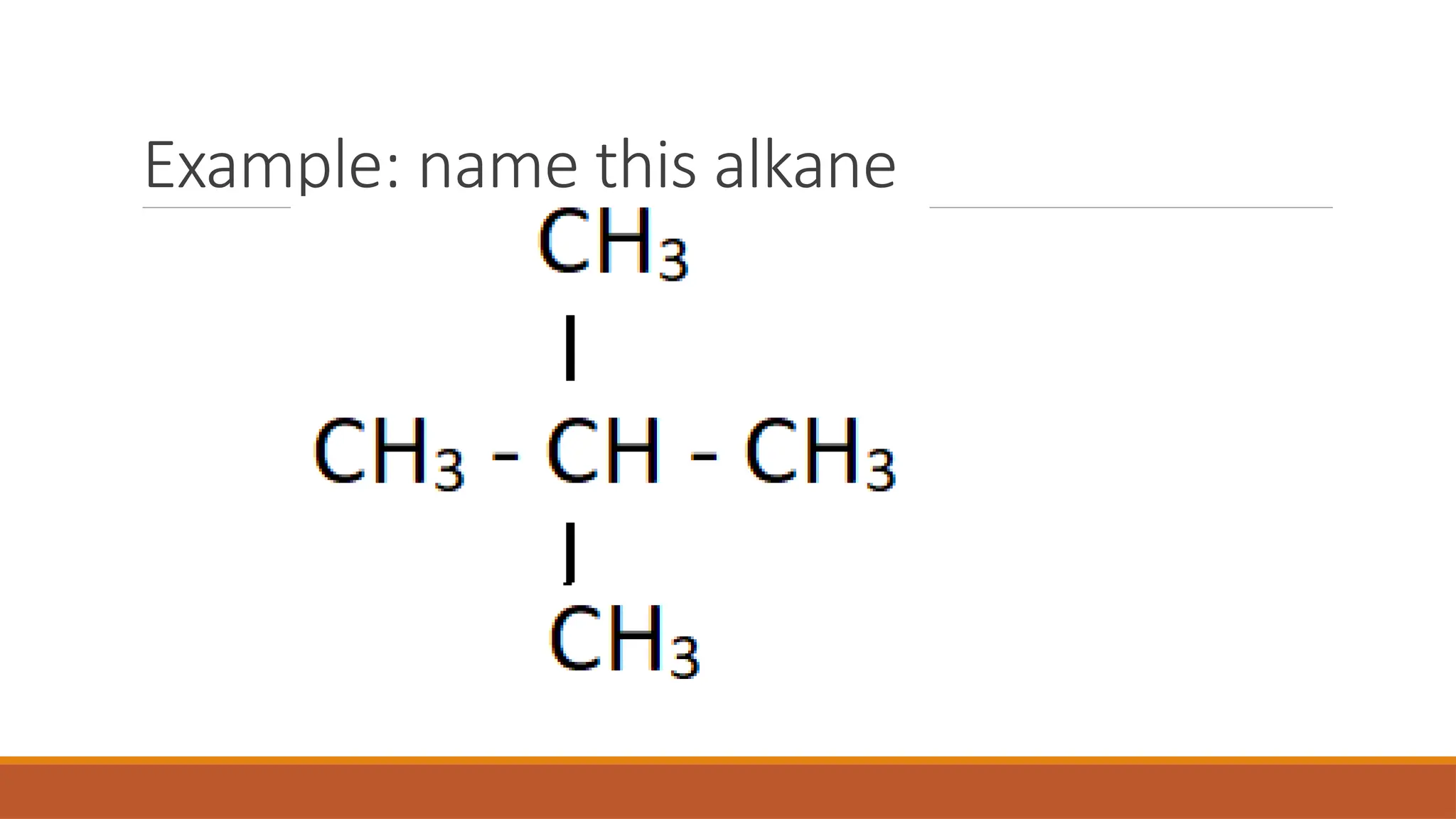
RULES FOR NAMINGALKANES
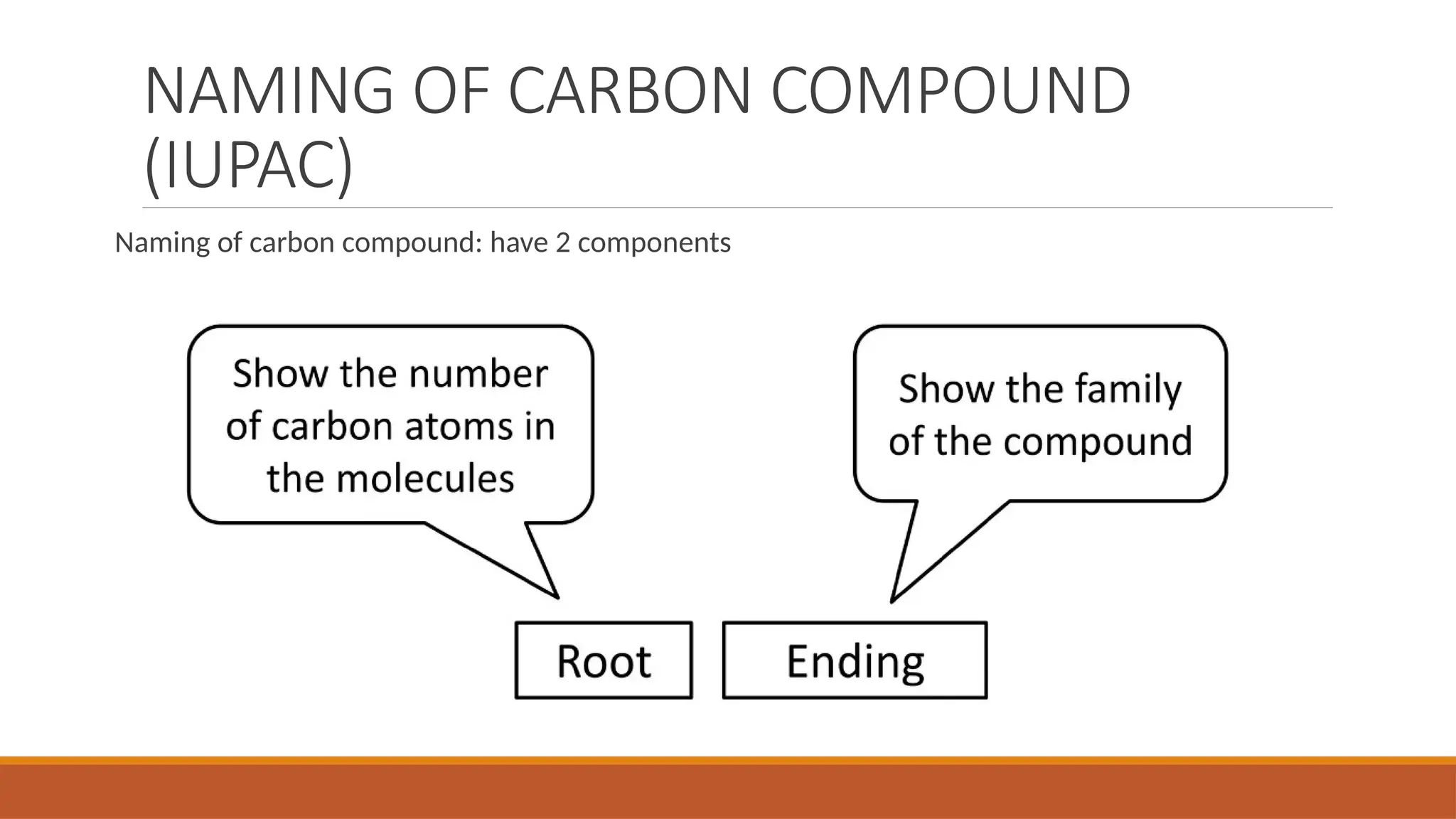
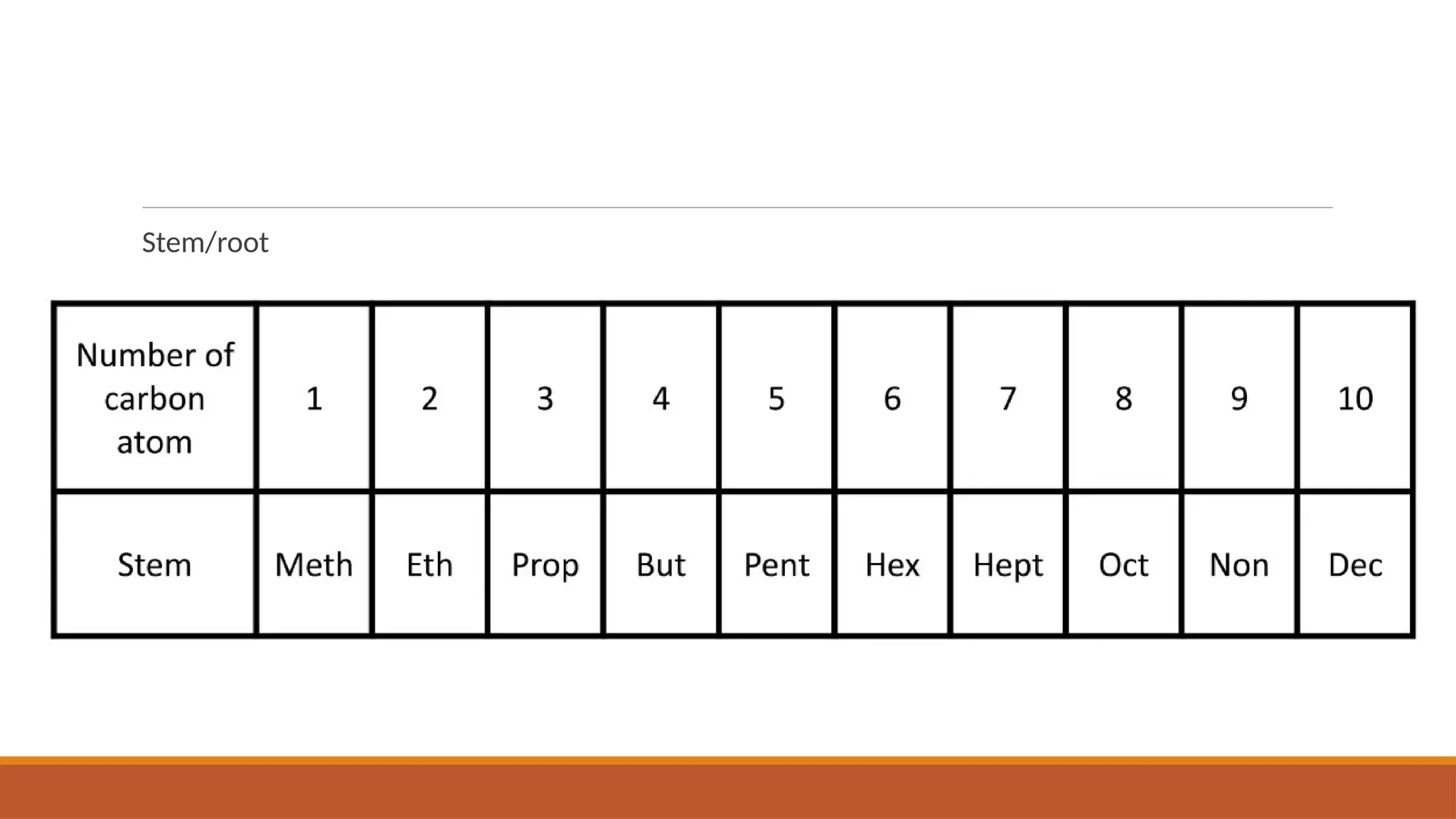
1. Find the longest carbon chain in the compound. This gives the parent name of the
compound.
5C
5C
3C
Longest carbon chain is 5: parent name is Pentane
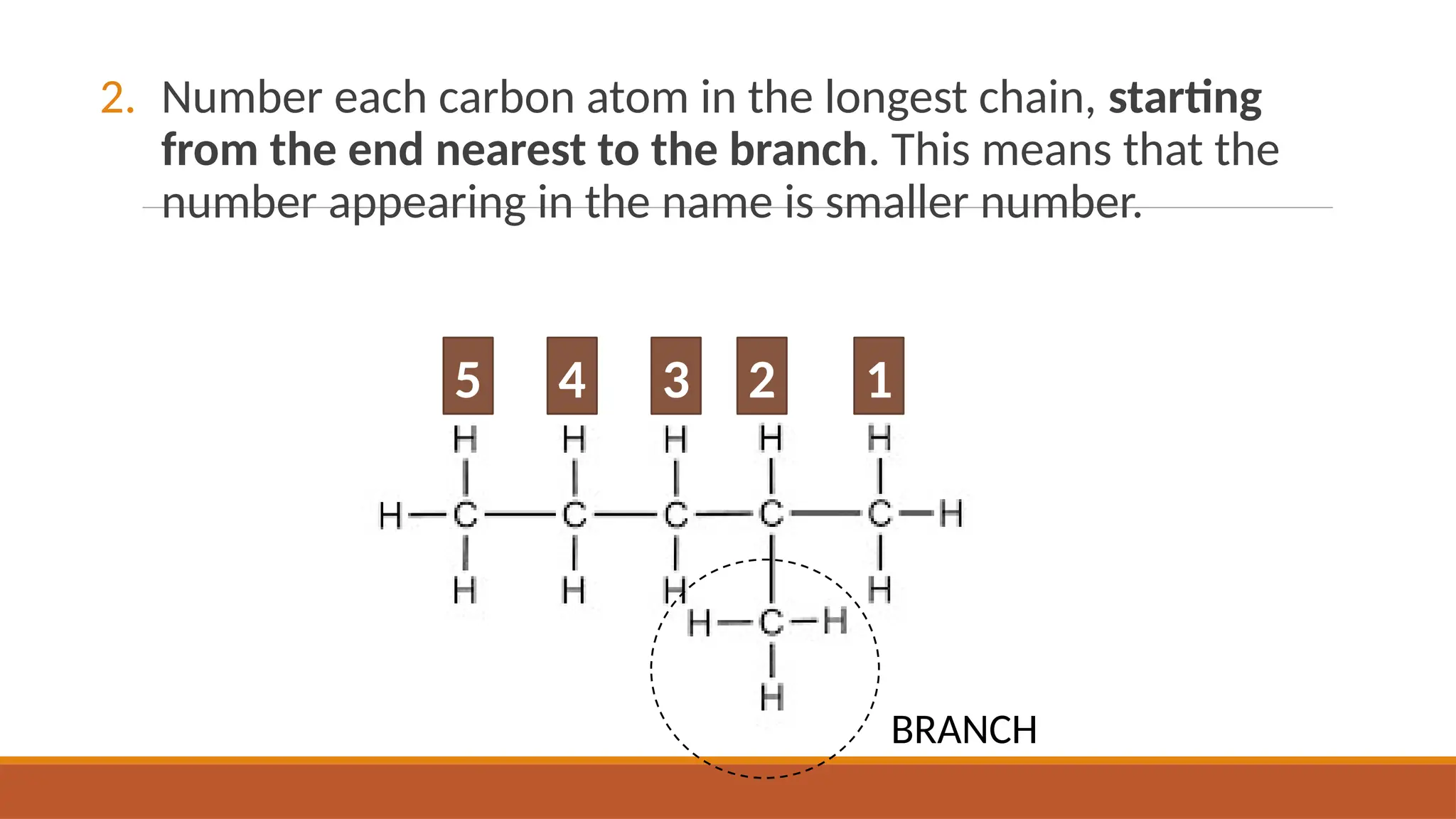
22.
2. Number eachcarbon atom in the longest chain, starting
from the end nearest to the branch. This means that the
number appearing in the name is smaller number.
1
2
3
4
5
BRANCH
23.
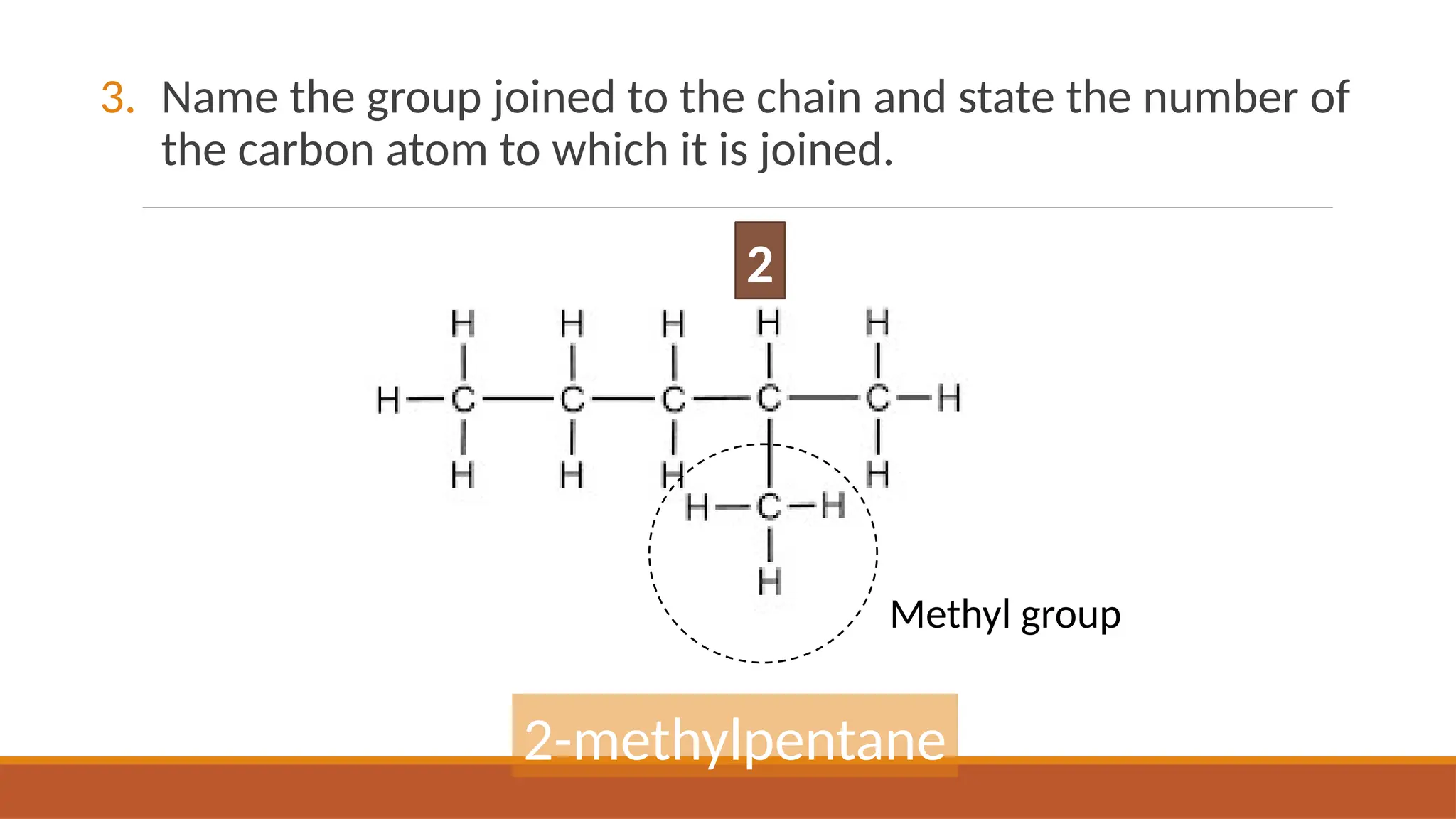
3. Name thegroup joined to the chain and state the number of
the carbon atom to which it is joined.
2
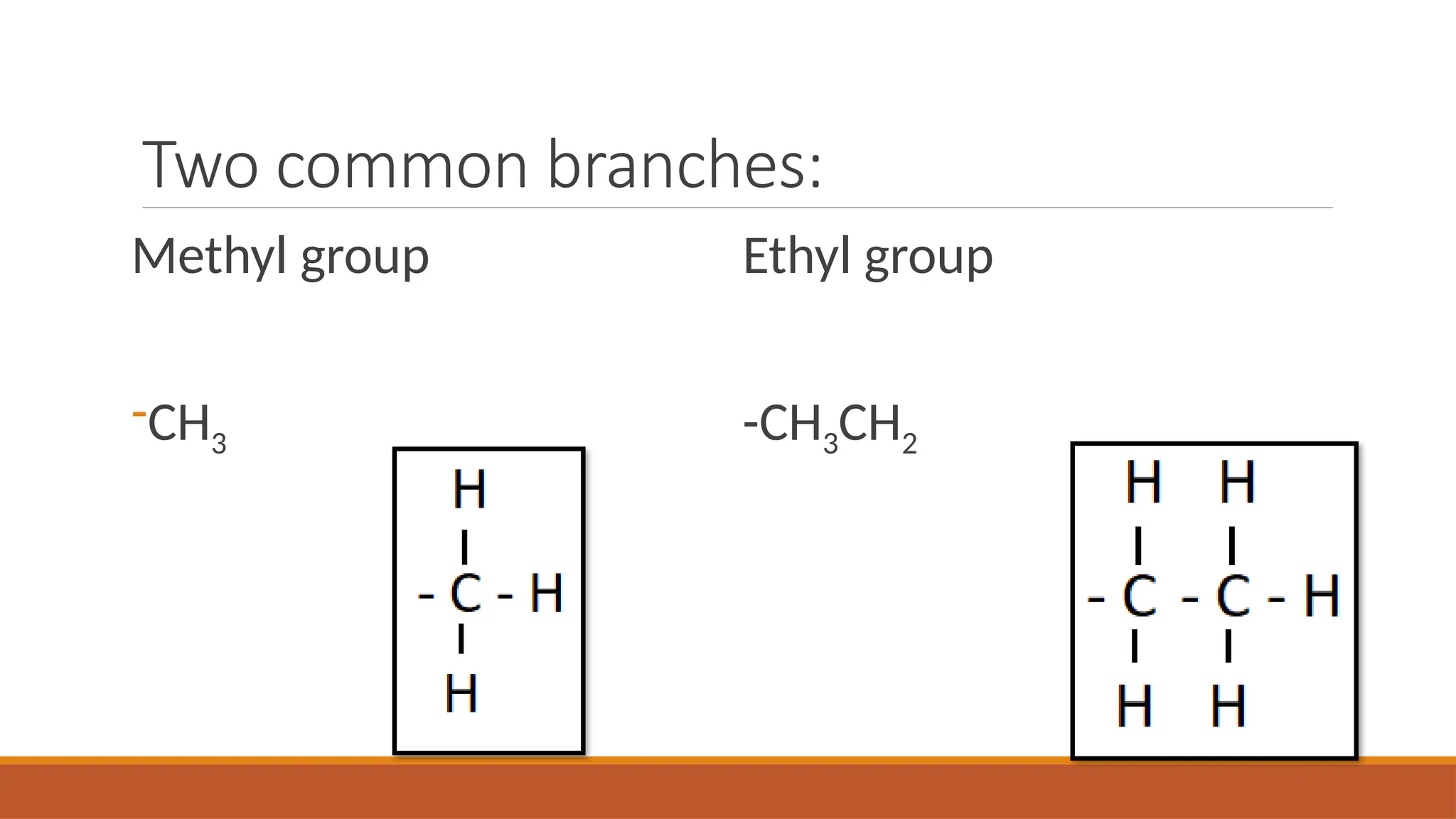
Methyl group
2-methylpentane
24.
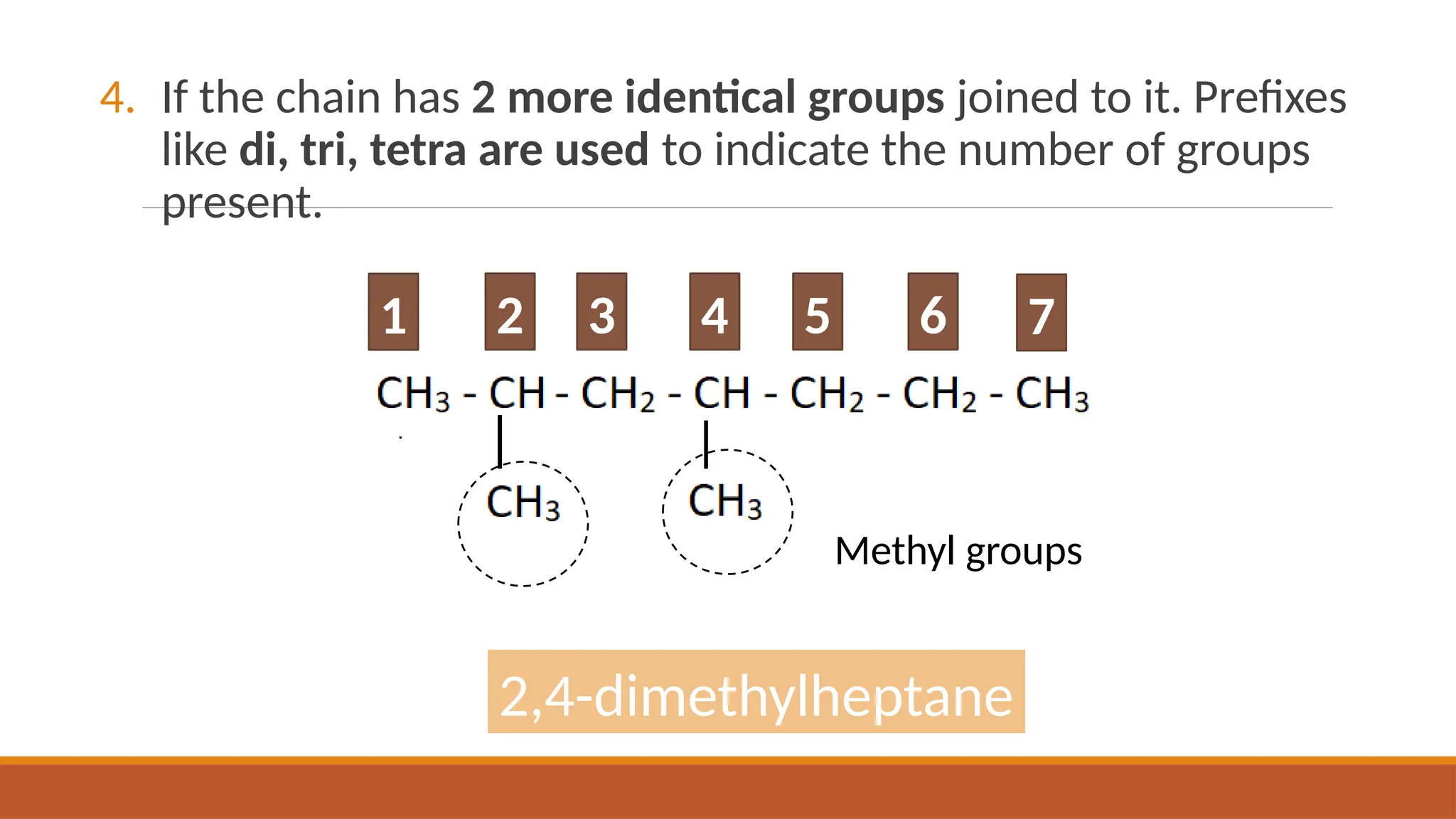
4. If thechain has 2 more identical groups joined to it. Prefixes
like di, tri, tetra are used to indicate the number of groups
present.
2
Methyl groups
2,4-dimethylheptane
1 3 4 5 6 7
25.
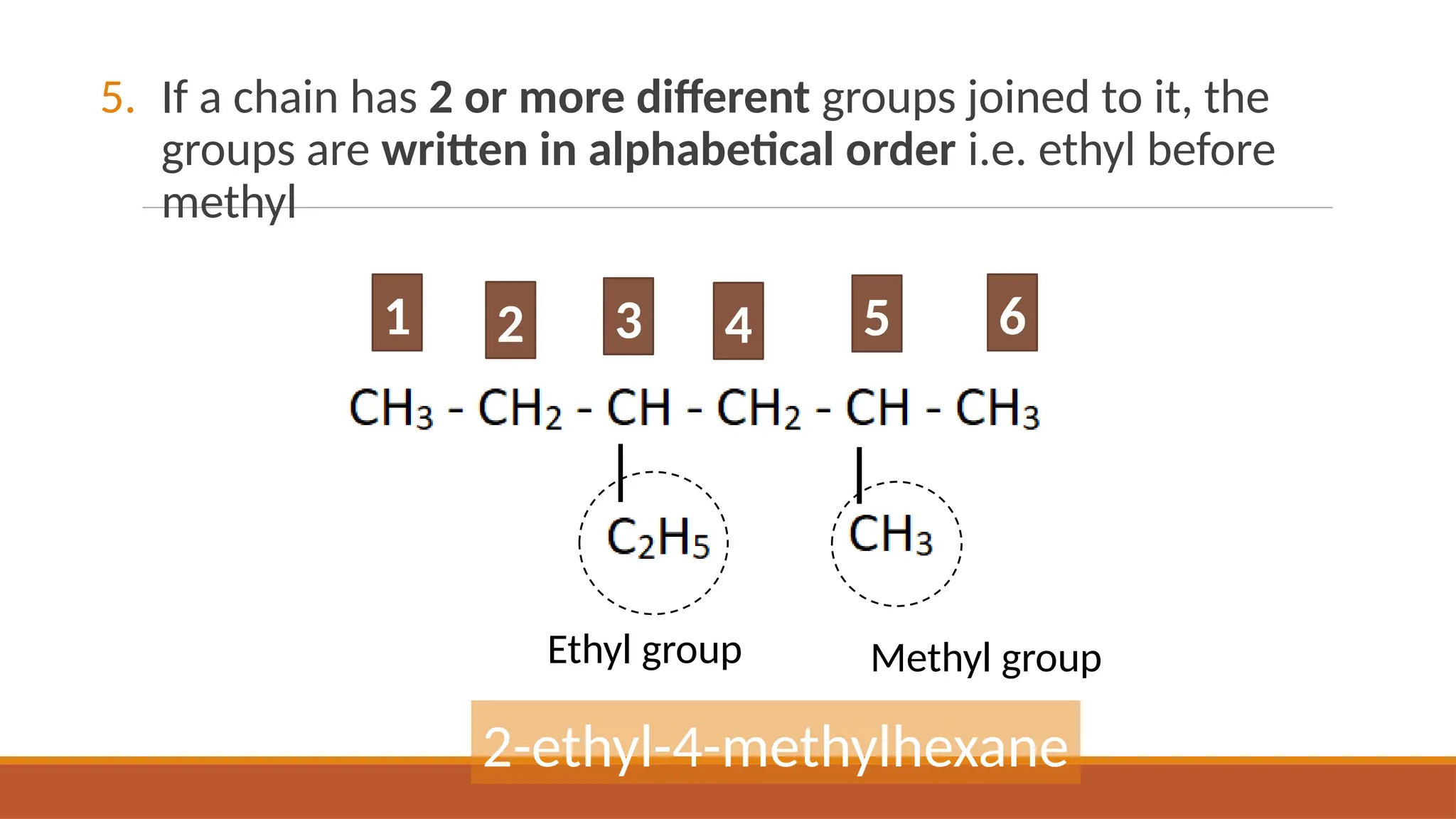
5. If achain has 2 or more different groups joined to it, the
groups are written in alphabetical order i.e. ethyl before
methyl
5
Methyl group
2-ethyl-4-methylhexane
6
4
3
2
1
Ethyl group
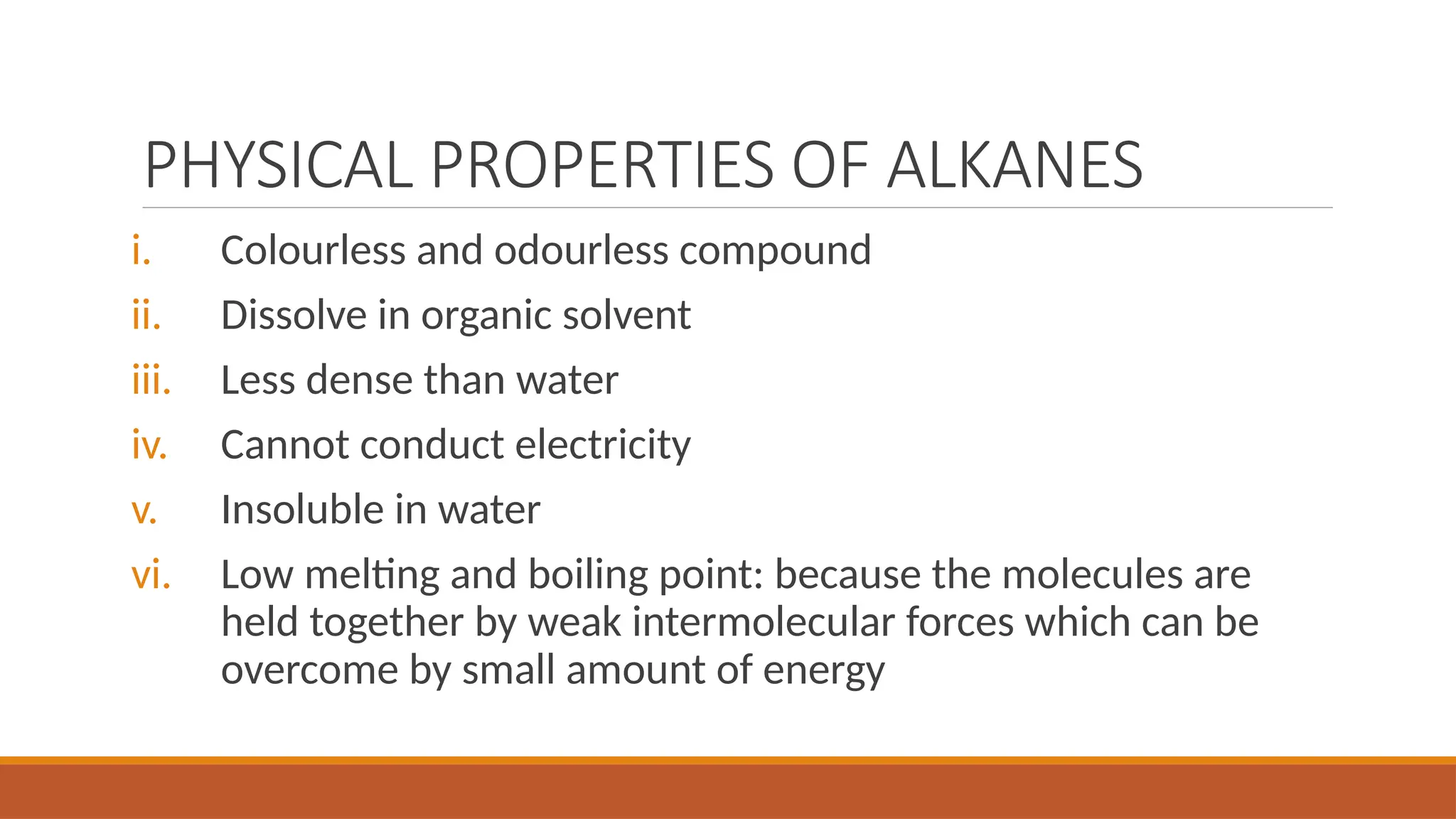
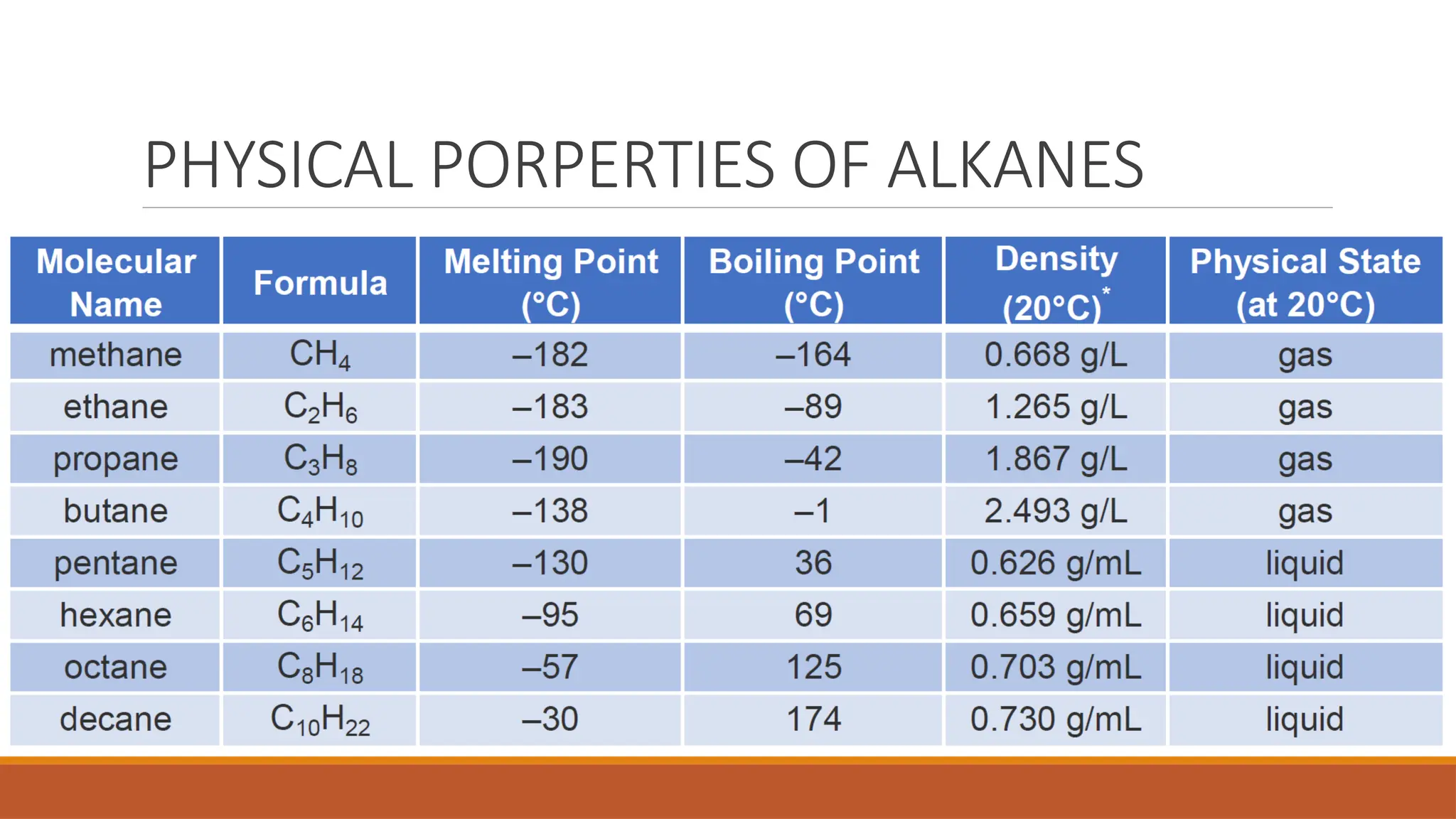
PHYSICAL PROPERTIES OFALKANES
i. Colourless and odourless compound
ii. Dissolve in organic solvent
iii. Less dense than water
iv. Cannot conduct electricity
v. Insoluble in water
vi. Low melting and boiling point: because the molecules are
held together by weak intermolecular forces which can be
overcome by small amount of energy
CHEMICAL REACTIONS OFALKANES
All alkanes have similar chemical properties because
they belong to the same homologous series
Alkanes are unreactive; they do not react with most
chemicals
They undergo two main types of reaction:
◦Combustion (complete & incomplete)
◦Substitution reaction
32.
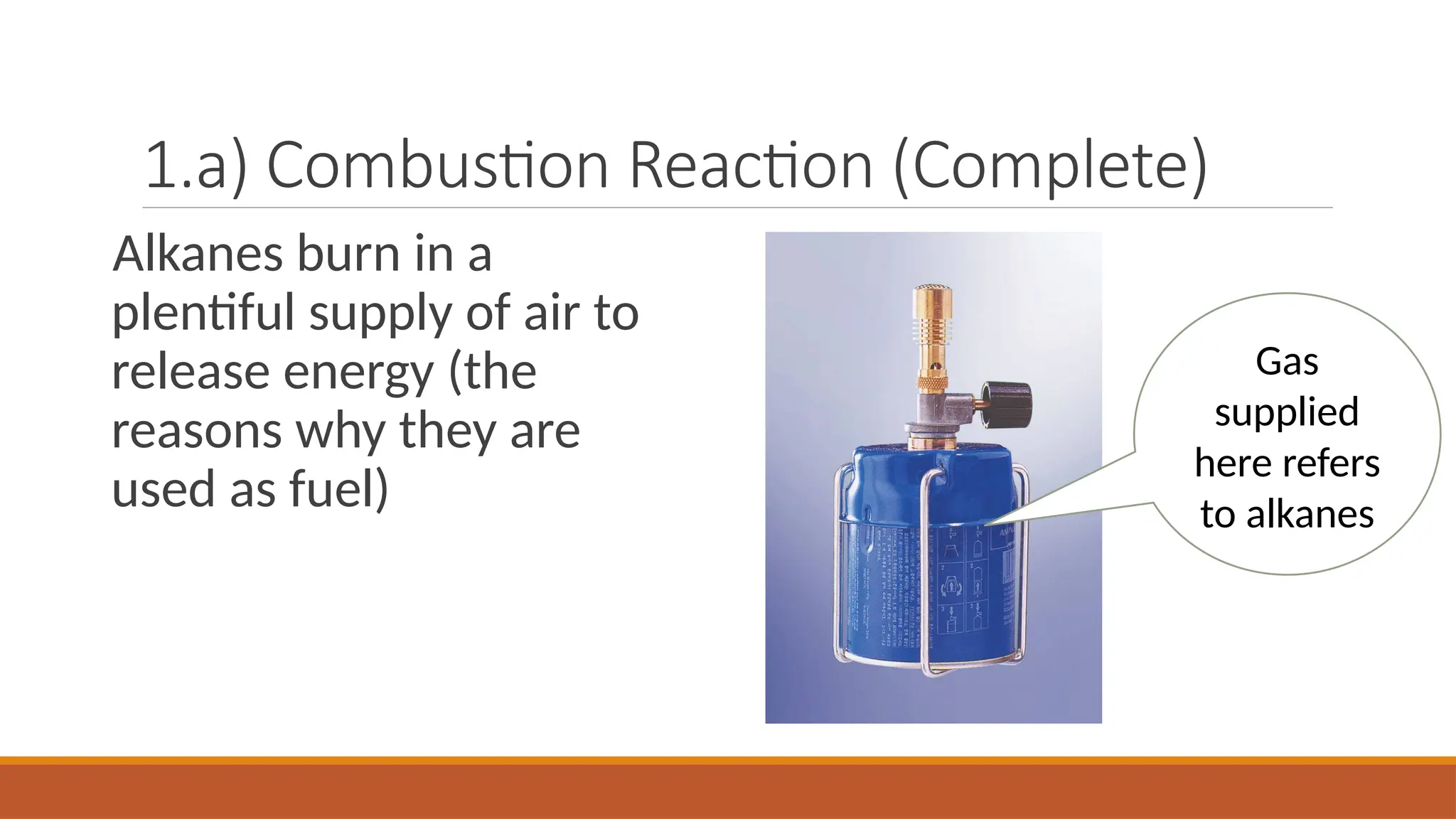
1.a) Combustion Reaction(Complete)
Alkanes burn in a
plentiful supply of air to
release energy (the
reasons why they are
used as fuel)
Gas
supplied
here refers
to alkanes
33.
1.a) Combustion (Complete)
Burning(properly called combustion) also produces:
◦CO2
◦Water vapour (H2O)
◦Heat
Lets observe what happened when you light a
Bunsen burner!
34.
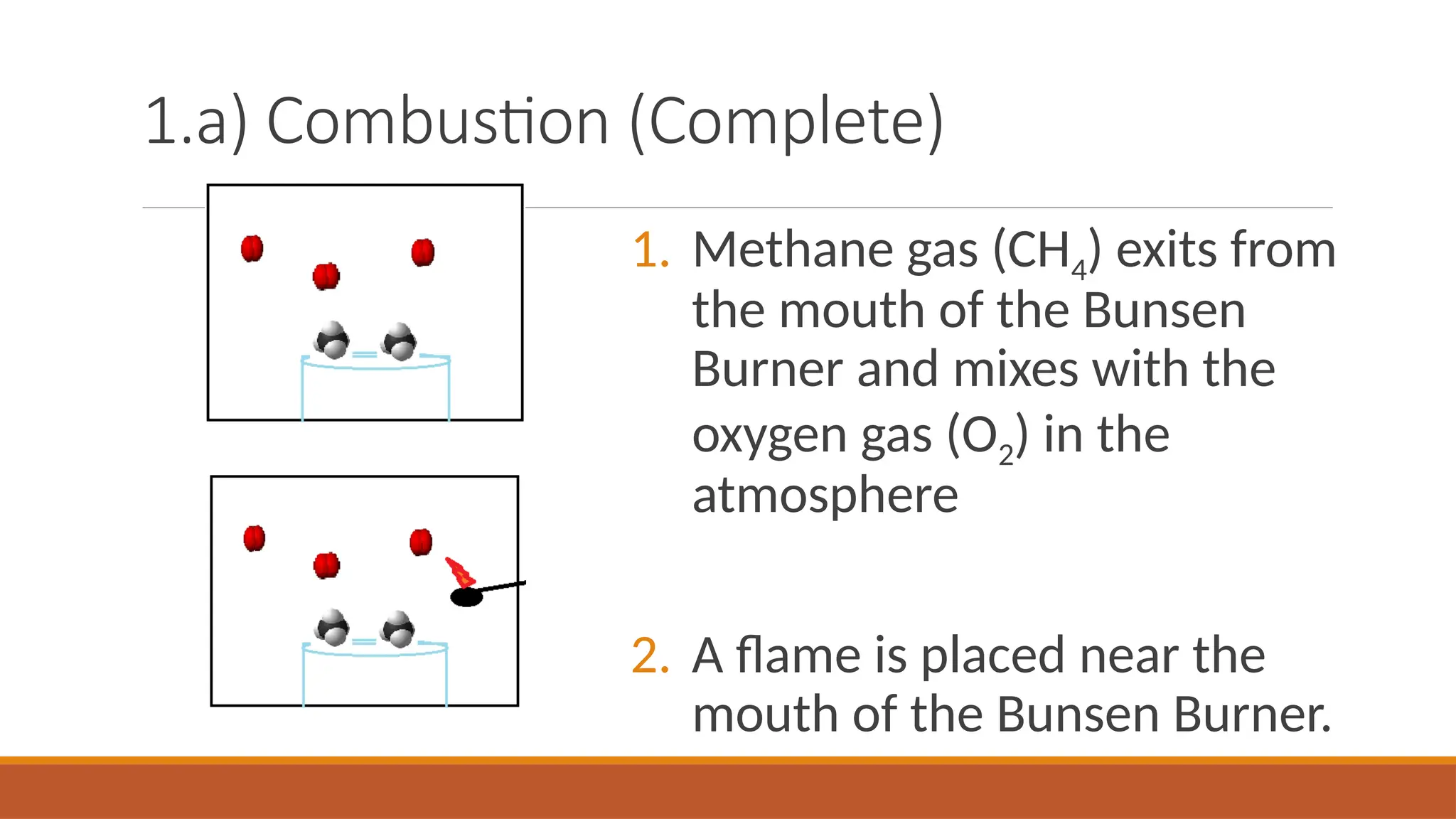
1.a) Combustion (Complete)
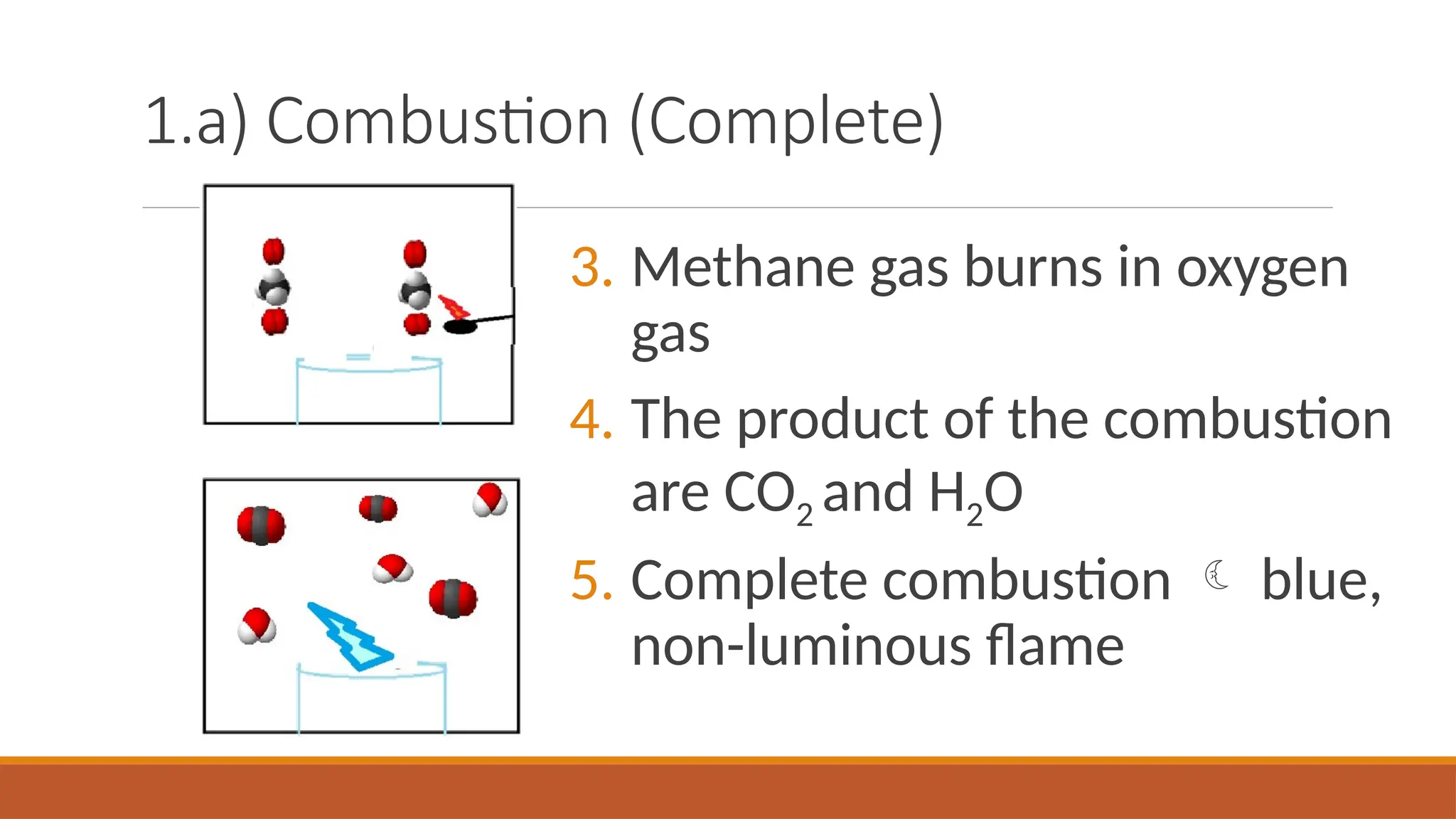
1.Methane gas (CH4) exits from
the mouth of the Bunsen
Burner and mixes with the
oxygen gas (O2) in the
atmosphere
2. A flame is placed near the
mouth of the Bunsen Burner.
35.
1.a) Combustion (Complete)
3.Methane gas burns in oxygen
gas
4. The product of the combustion
are CO2 and H2O
5. Complete combustion blue,
non-luminous flame
36.
1.a) Combustion (Complete)
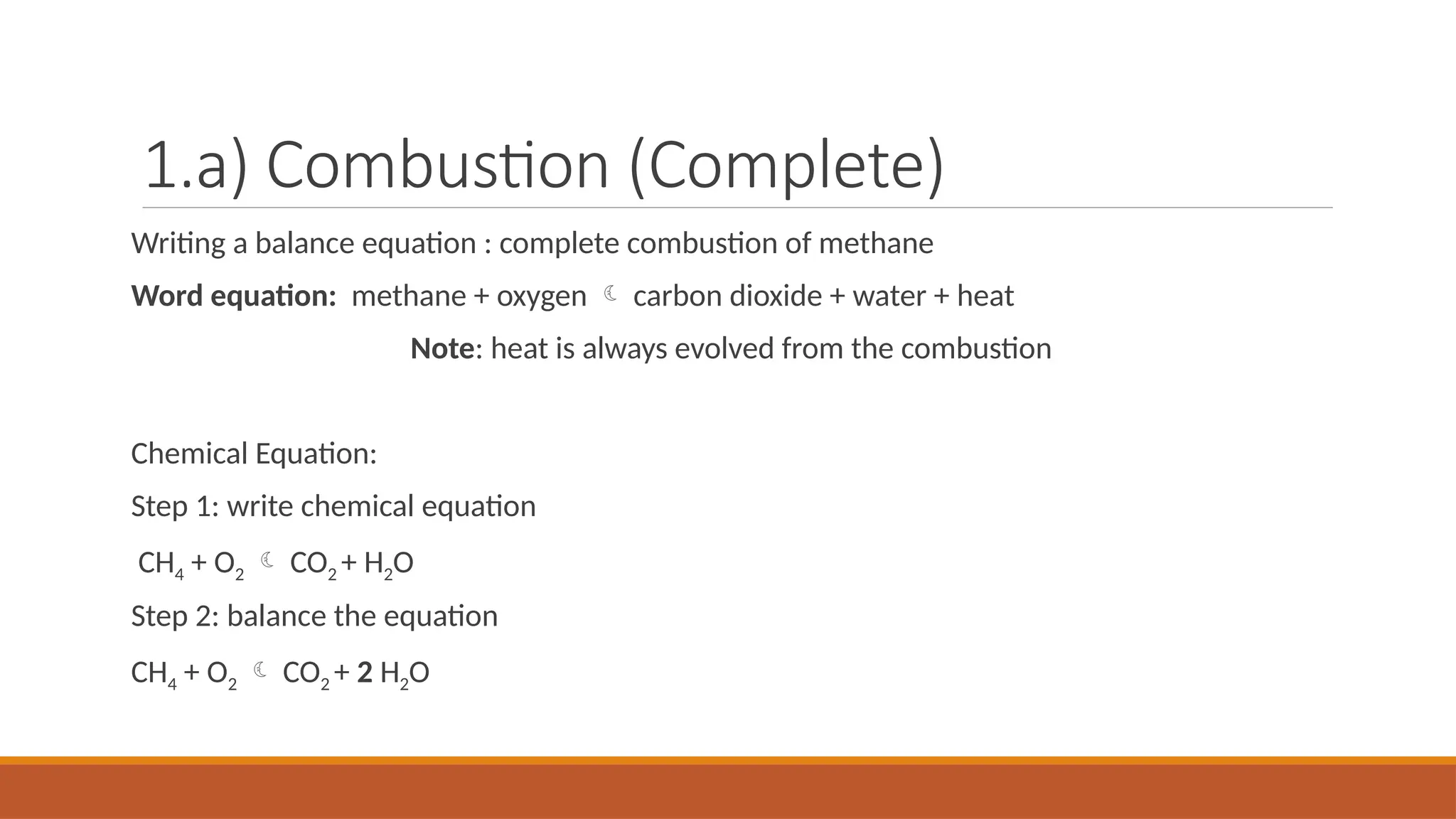
Writinga balance equation : complete combustion of methane
Word equation: methane + oxygen carbon dioxide + water + heat
Note: heat is always evolved from the combustion
Chemical Equation:
Step 1: write chemical equation
CH4 + O2 CO2 + H2O
Step 2: balance the equation
CH4 + O2 CO2 + 2 H2O
37.
1.b) Combustion (Incomplete)
Someimportant pointers on complete combustion
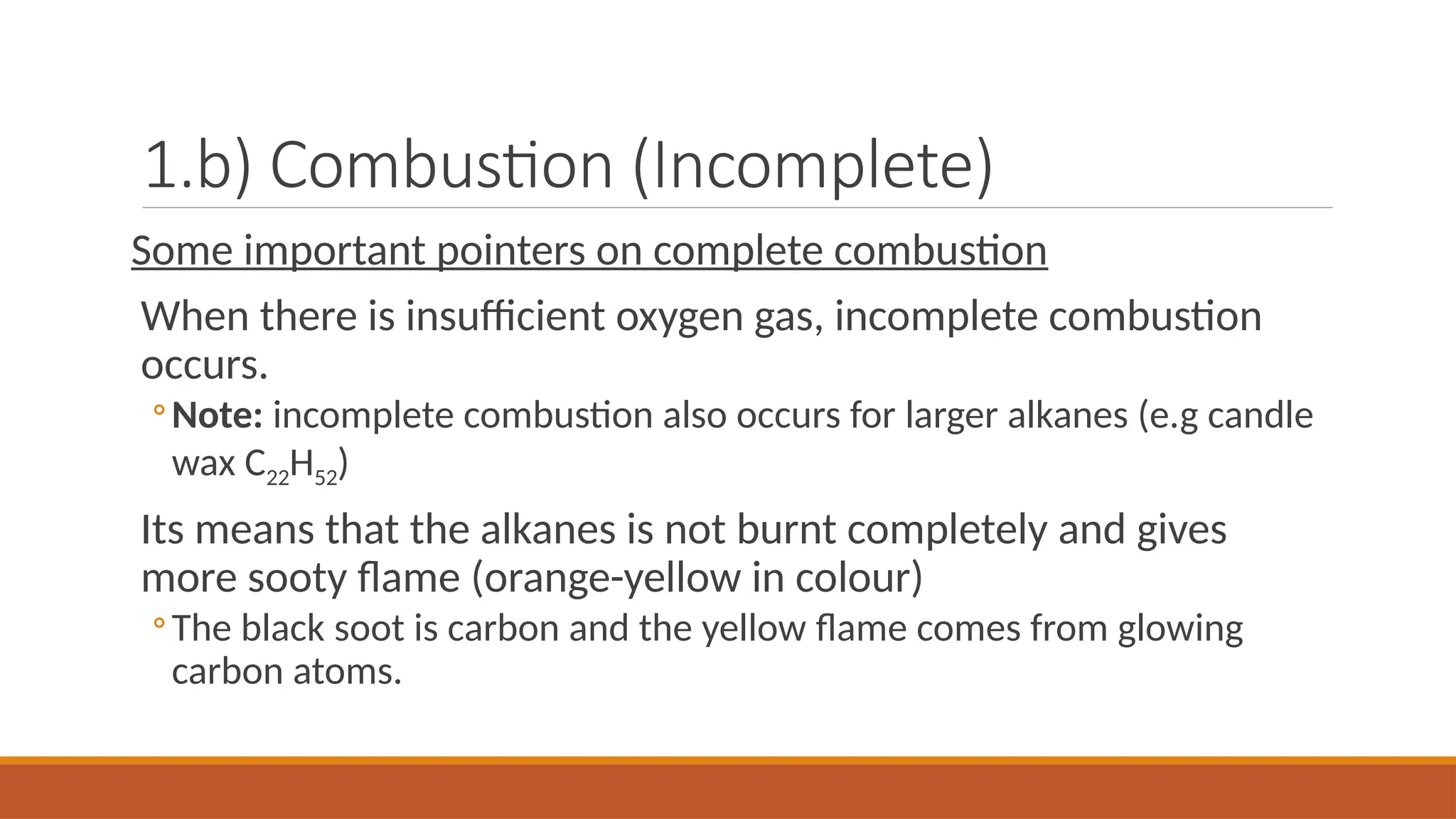
When there is insufficient oxygen gas, incomplete combustion
occurs.
◦Note: incomplete combustion also occurs for larger alkanes (e.g candle
wax C22H52)
Its means that the alkanes is not burnt completely and gives
more sooty flame (orange-yellow in colour)
◦The black soot is carbon and the yellow flame comes from glowing
carbon atoms.
38.
1.b) Combustion (Incomplete)
Whathappen if there is insufficient Oxygen?
The possible balanced chemical equation for the
incomplete combustion of methane gas is:
CH4 + O2 C + 2H2O [carbon only]
2CH4 + 3O2 2CO+ 4H2O [carbon monoxide only]
4CH4 + 5O2 2CO2 + 2C + 8H2O [mixture of both]
39.
2. Substitution Reaction
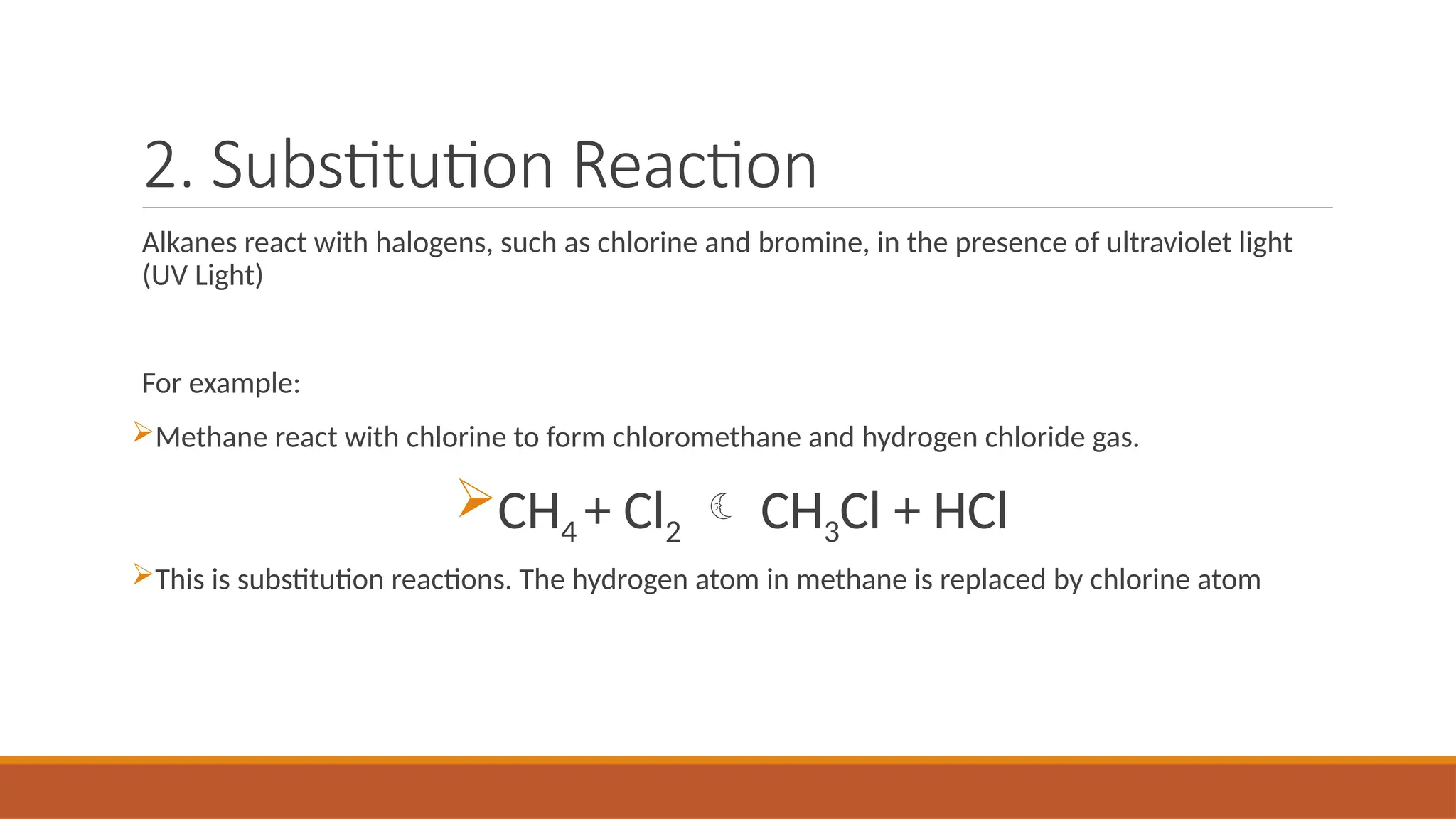
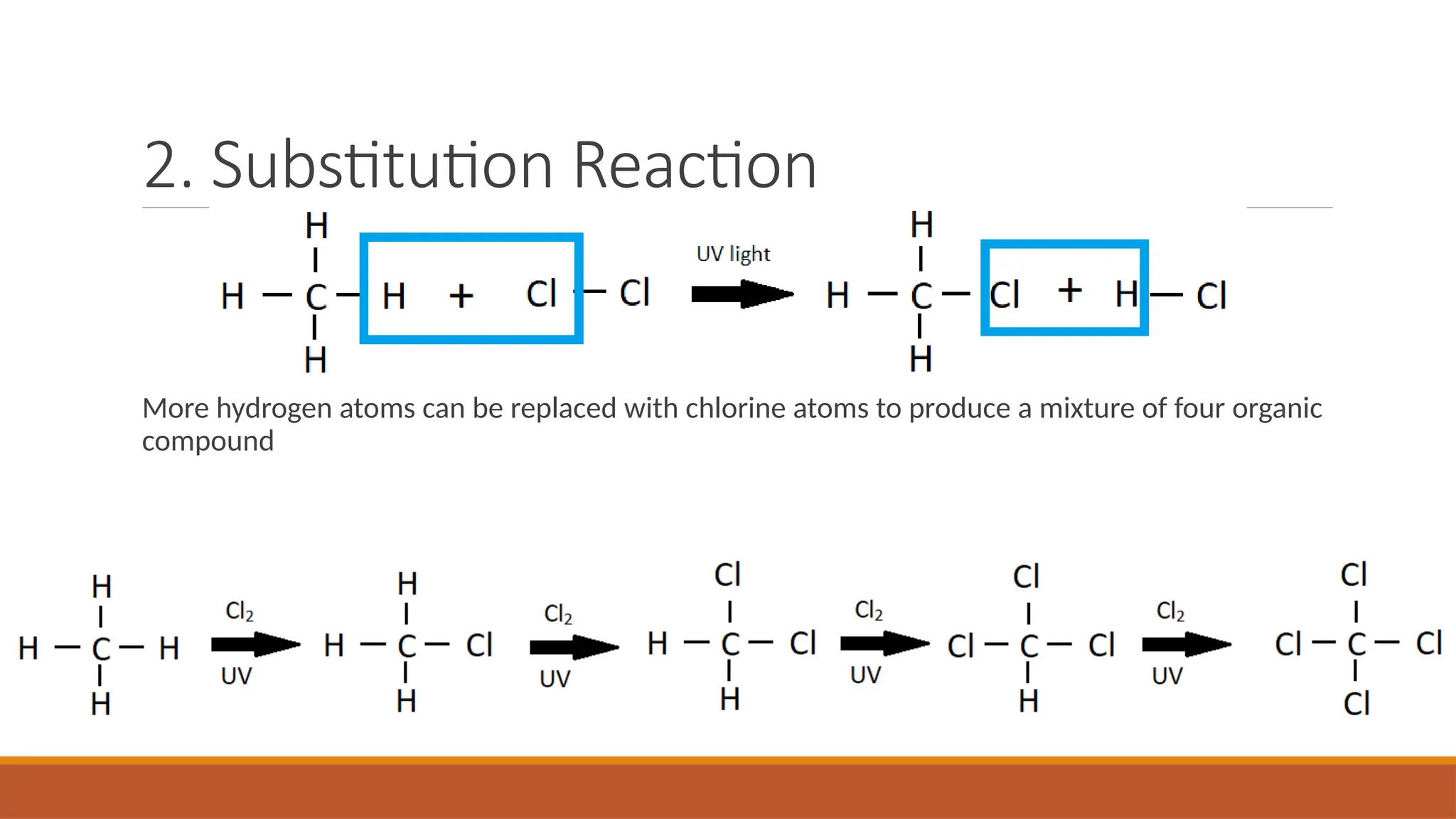
Alkanesreact with halogens, such as chlorine and bromine, in the presence of ultraviolet light
(UV Light)
For example:
Methane react with chlorine to form chloromethane and hydrogen chloride gas.
CH4 + Cl2 CH3Cl + HCl
This is substitution reactions. The hydrogen atom in methane is replaced by chlorine atom
40.
2. Substitution Reaction
Morehydrogen atoms can be replaced with chlorine atoms to produce a mixture of four organic
compound
41.
2. Substitution Reaction
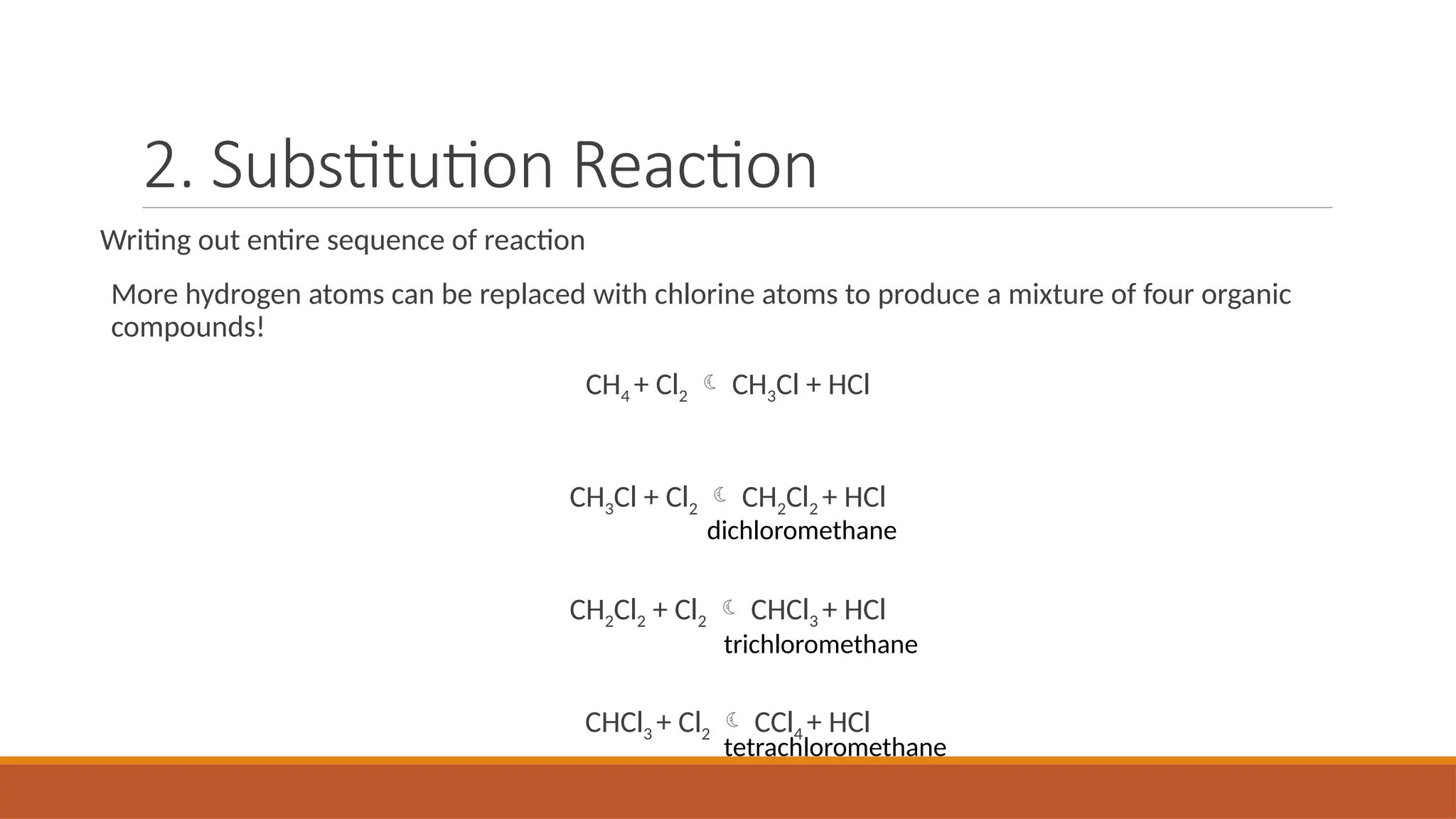
Writingout entire sequence of reaction
More hydrogen atoms can be replaced with chlorine atoms to produce a mixture of four organic
compounds!
CH4 + Cl2 CH3Cl + HCl
CH3Cl + Cl2 CH2Cl2 + HCl
CH2Cl2 + Cl2 CHCl3 + HCl
CHCl3 + Cl2 CCl4 + HCl
dichloromethane
trichloromethane
tetrachloromethane
ALKENES
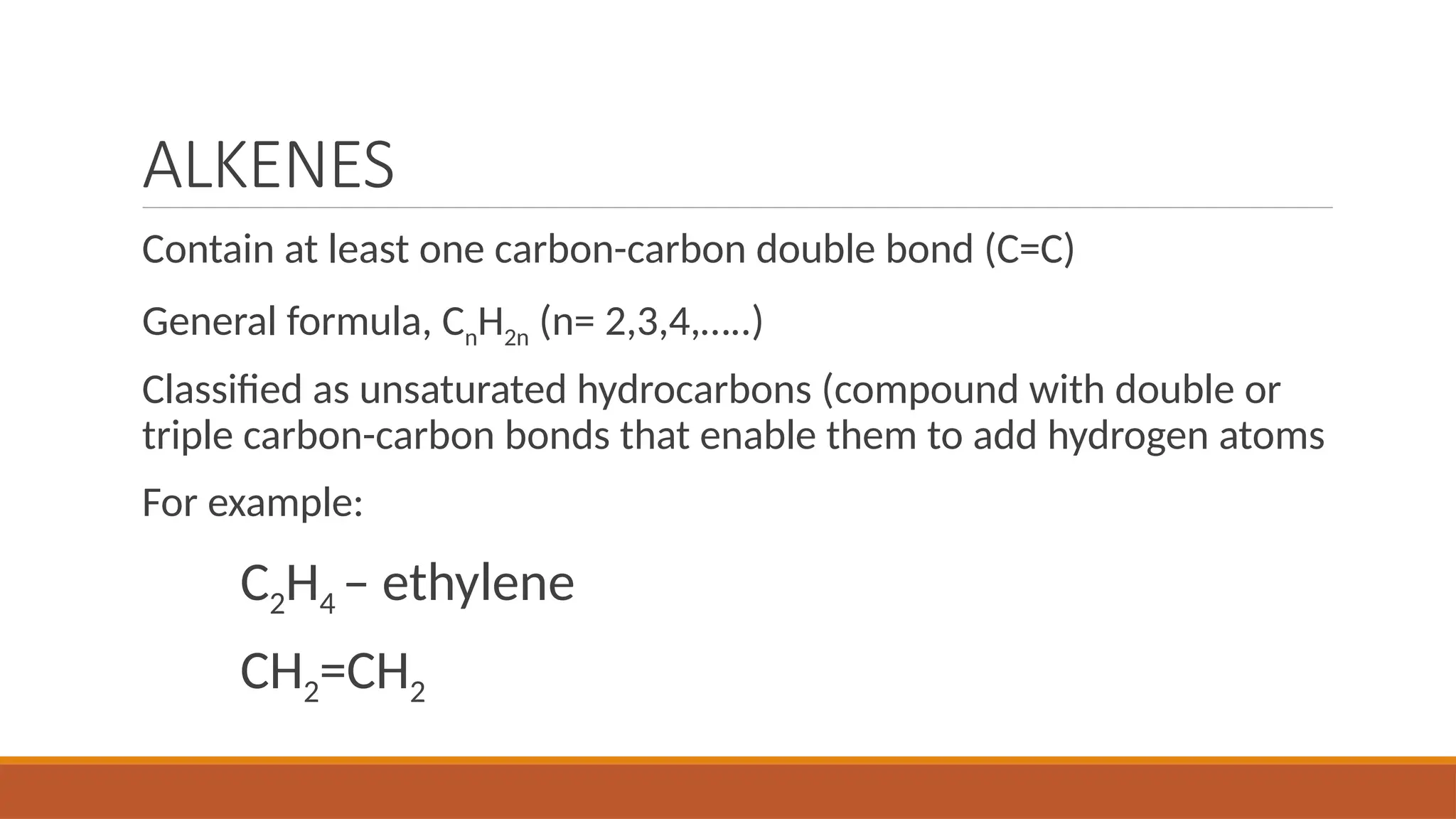
Contain at leastone carbon-carbon double bond (C=C)
General formula, CnH2n (n= 2,3,4,…..)
Classified as unsaturated hydrocarbons (compound with double or
triple carbon-carbon bonds that enable them to add hydrogen atoms
For example:
C2H4 – ethylene
CH2=CH2
44.
Naming Alkenes
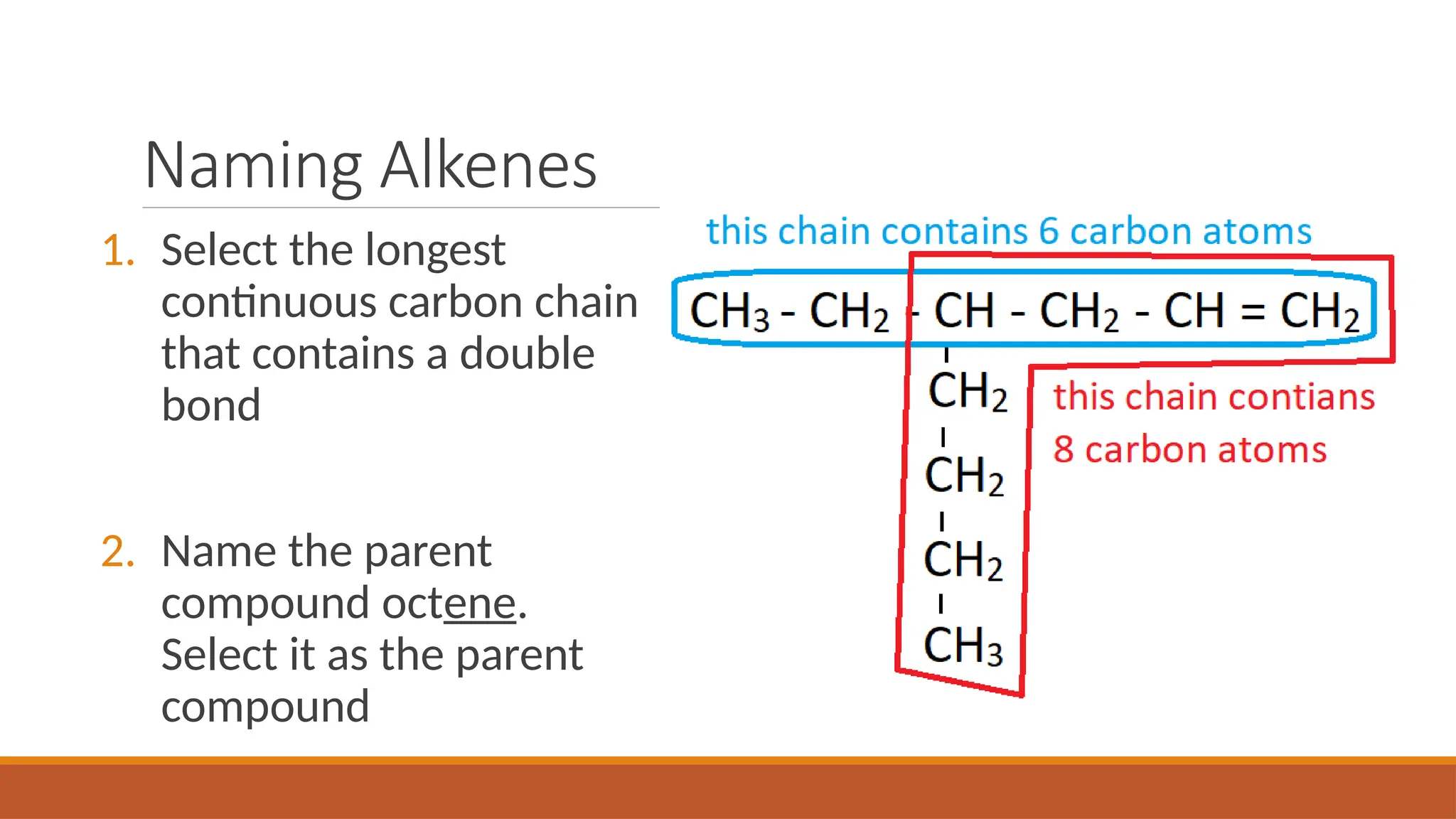
1. Selectthe longest
continuous carbon chain
that contains a double
bond
2. Name the parent
compound octene.
Select it as the parent
compound
45.
Naming Alkenes
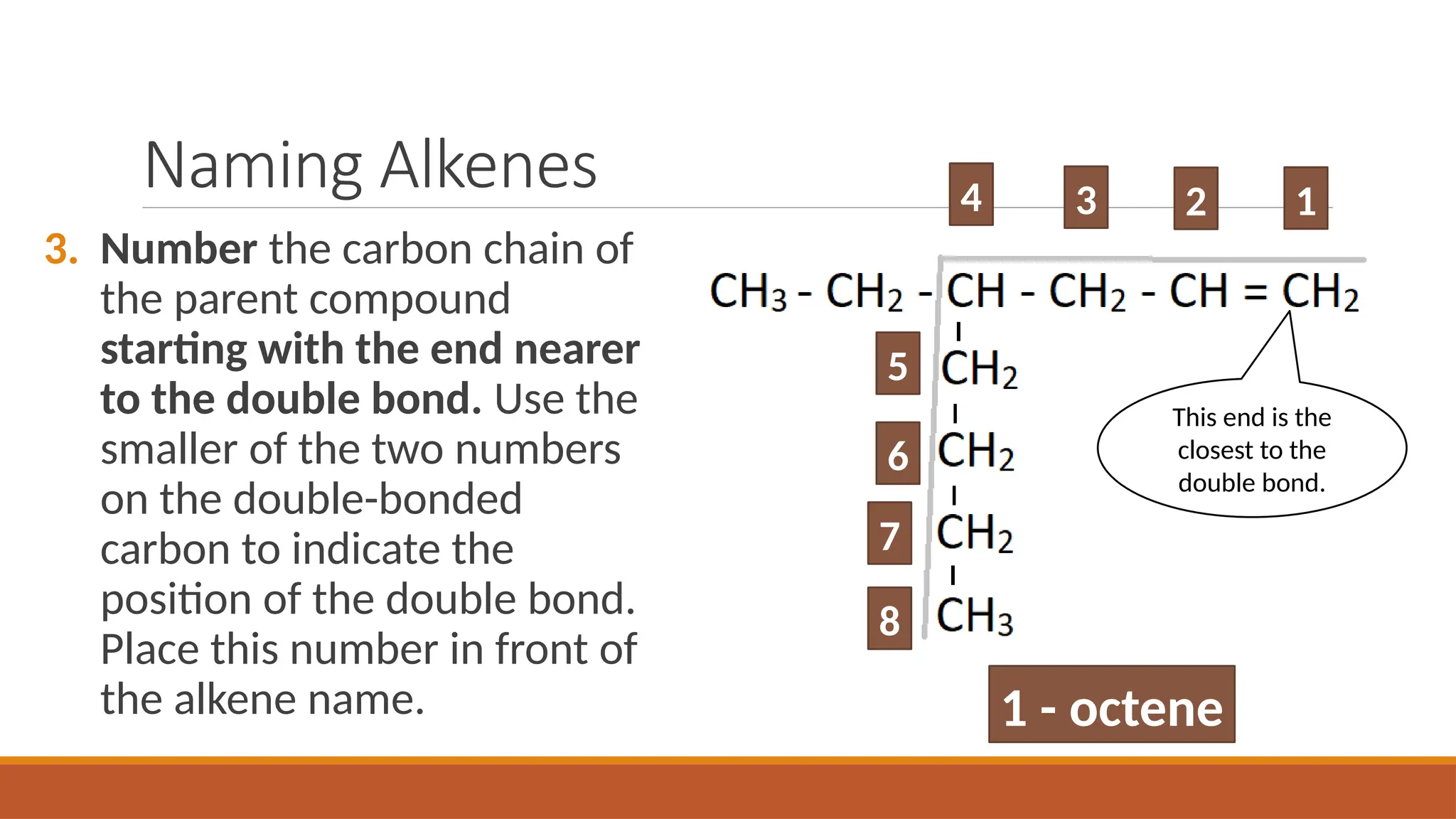
3. Numberthe carbon chain of
the parent compound
starting with the end nearer
to the double bond. Use the
smaller of the two numbers
on the double-bonded
carbon to indicate the
position of the double bond.
Place this number in front of
the alkene name.
This end is the
closest to the
double bond.
1
2
3
4
5
6
7
8
1 - octene
46.
Naming Alkenes
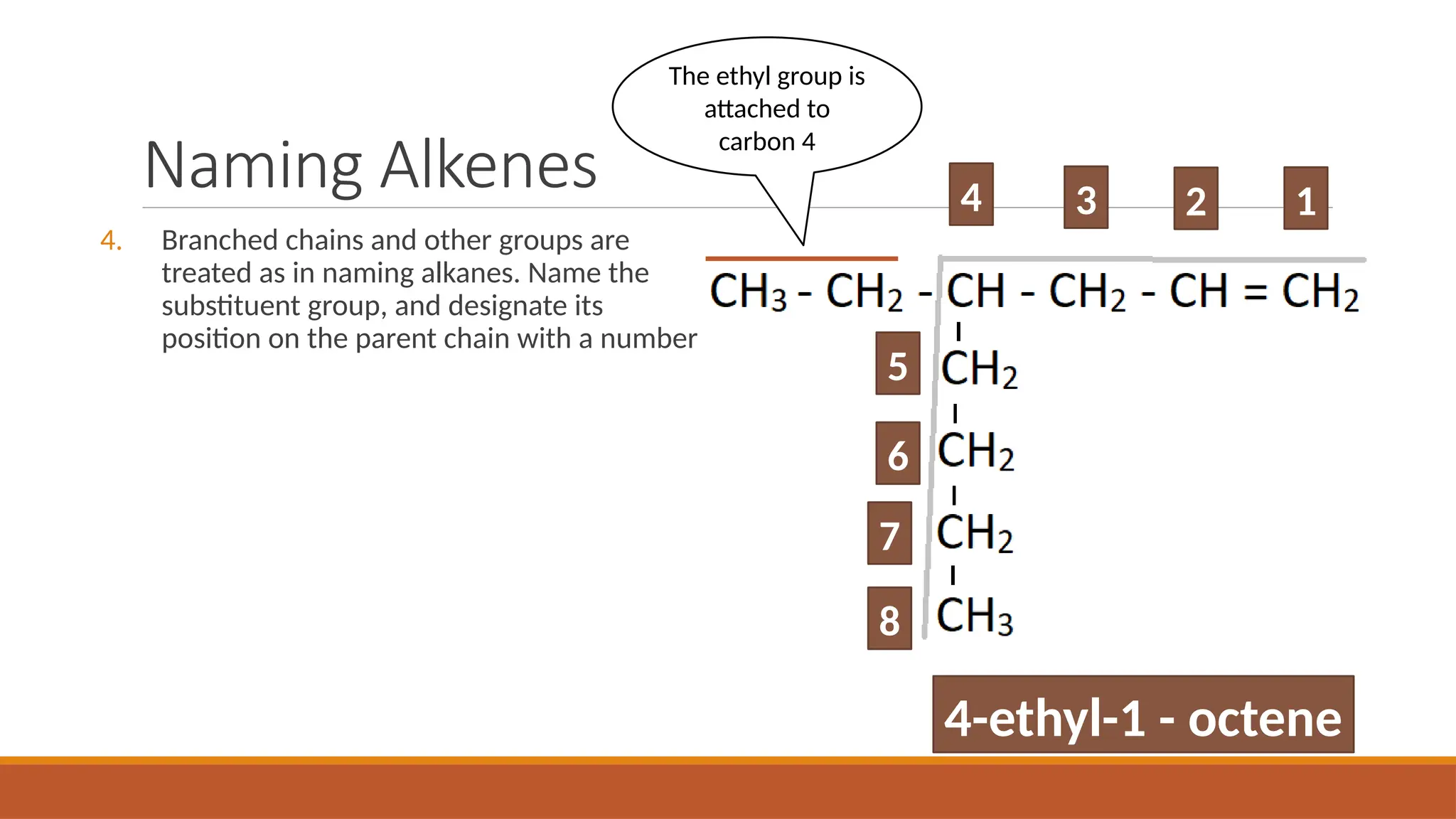
4. Branchedchains and other groups are
treated as in naming alkanes. Name the
substituent group, and designate its
position on the parent chain with a number
1
2
3
4
5
6
7
8
4-ethyl-1 - octene
The ethyl group is
attached to
carbon 4
47.
Naming Alkenes
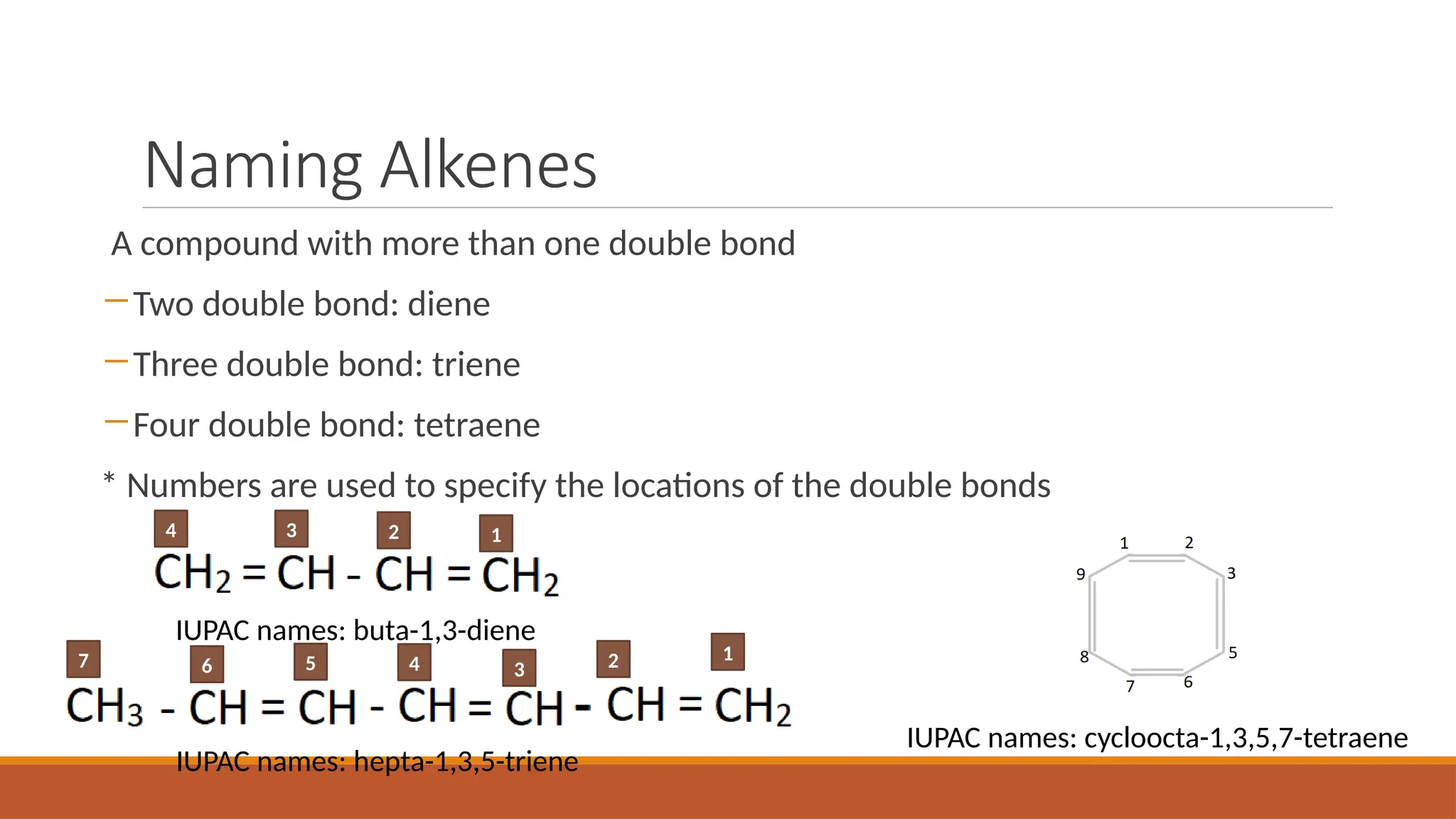
A compoundwith more than one double bond
―Two double bond: diene
―Three double bond: triene
―Four double bond: tetraene
* Numbers are used to specify the locations of the double bonds
IUPAC names: buta-1,3-diene
IUPAC names: hepta-1,3,5-triene
1
2
3
4
1
2
3
4
5
6
7
IUPAC names: cycloocta-1,3,5,7-tetraene
48.
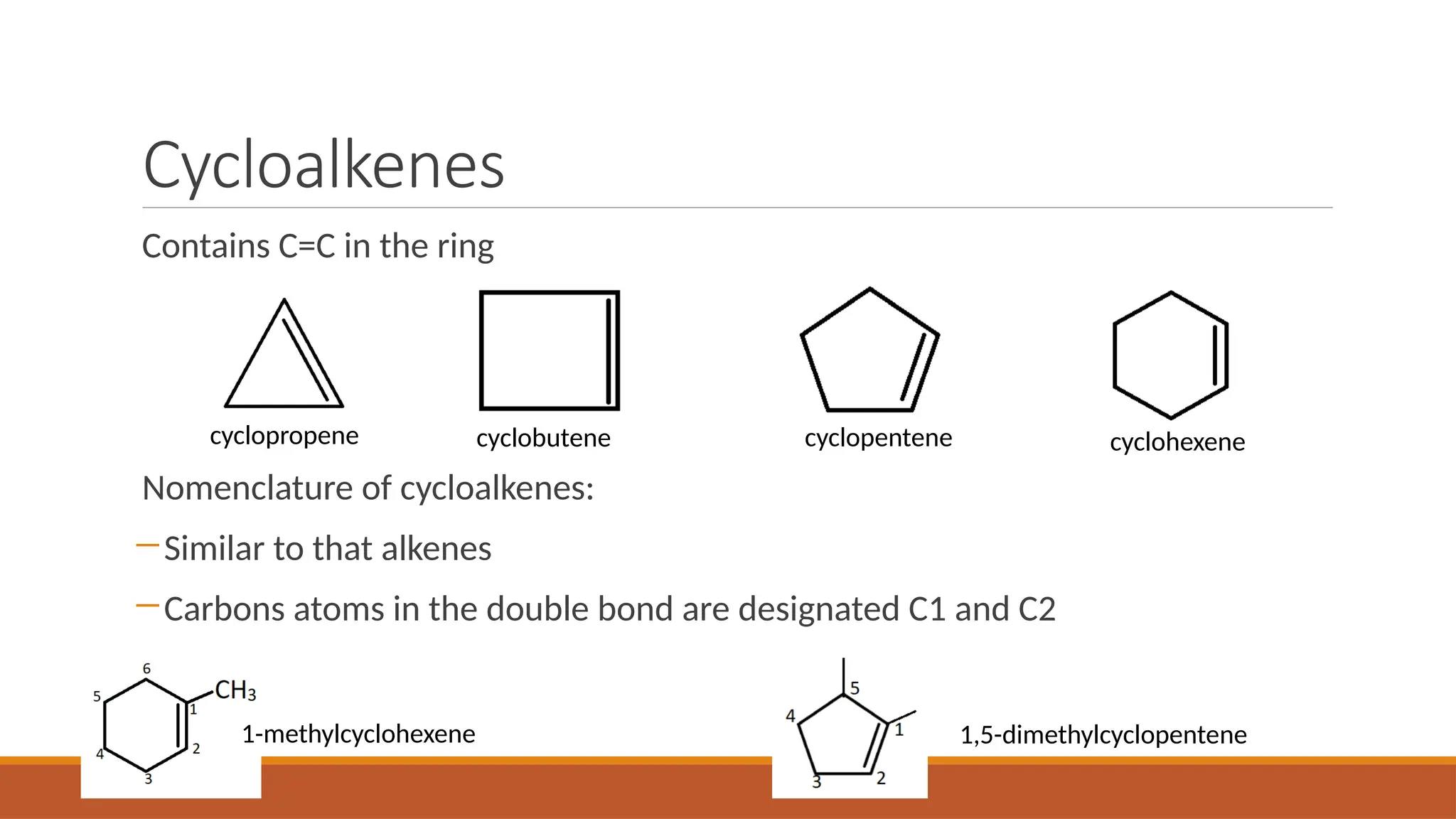
Cycloalkenes
Contains C=C inthe ring
Nomenclature of cycloalkenes:
―Similar to that alkenes
―Carbons atoms in the double bond are designated C1 and C2
cyclopropene cyclobutene cyclopentene cyclohexene
1-methylcyclohexene 1,5-dimethylcyclopentene
49.
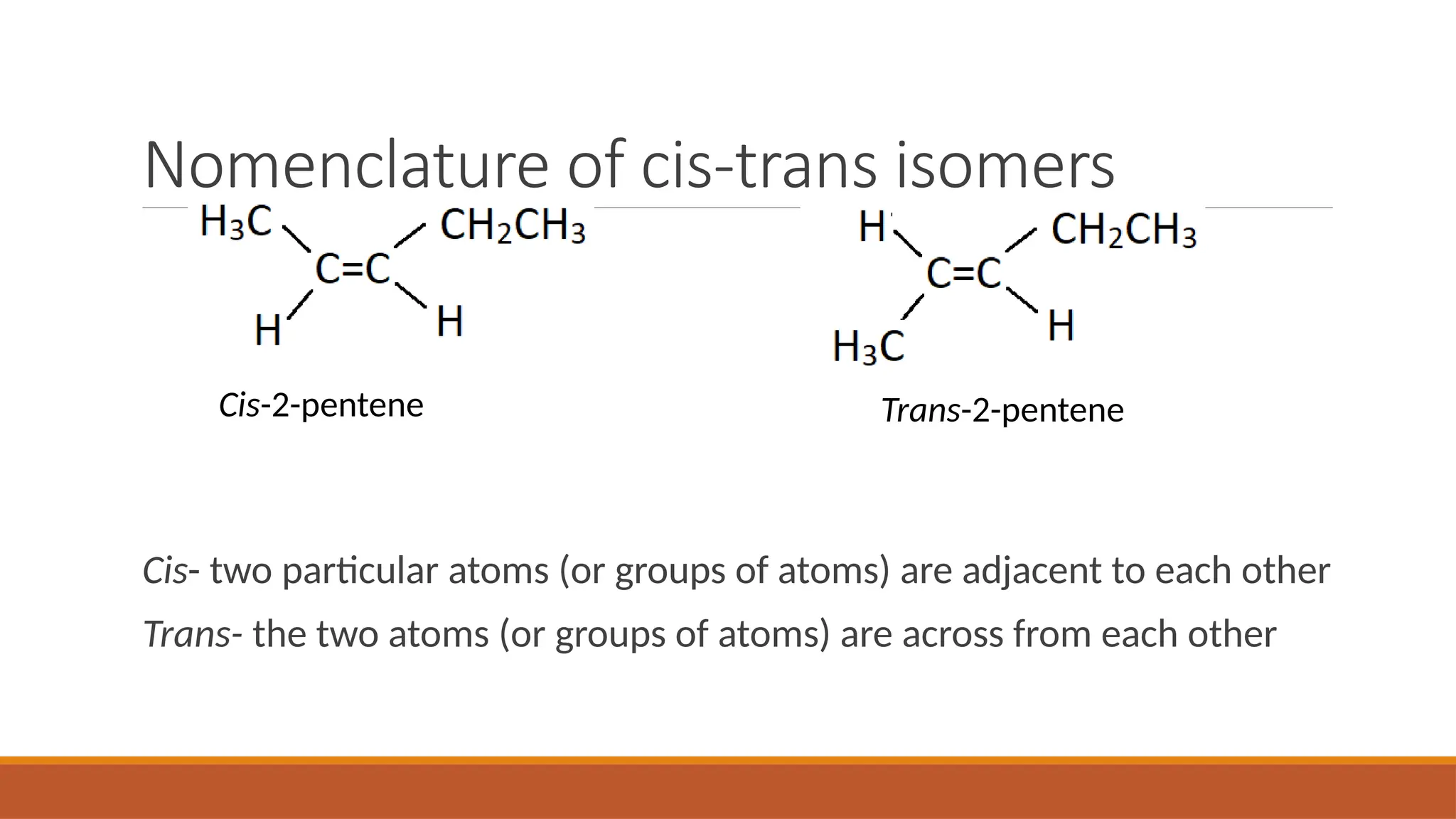
Nomenclature of cis-transisomers
Cis- two particular atoms (or groups of atoms) are adjacent to each other
Trans- the two atoms (or groups of atoms) are across from each other
Cis-2-pentene Trans-2-pentene
50.
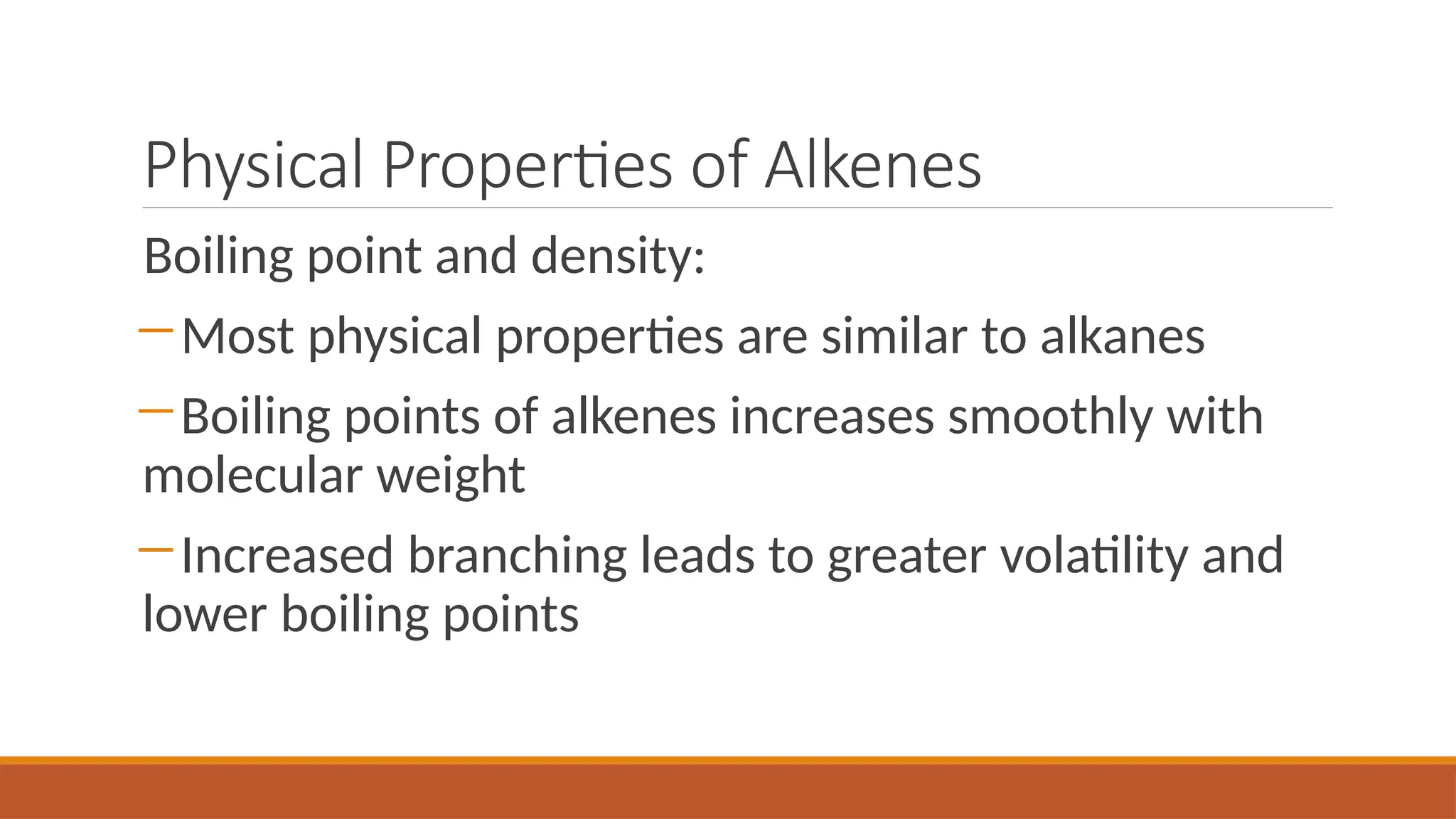
Physical Properties ofAlkenes
Boiling point and density:
―Most physical properties are similar to alkanes
―Boiling points of alkenes increases smoothly with
molecular weight
―Increased branching leads to greater volatility and
lower boiling points
51.
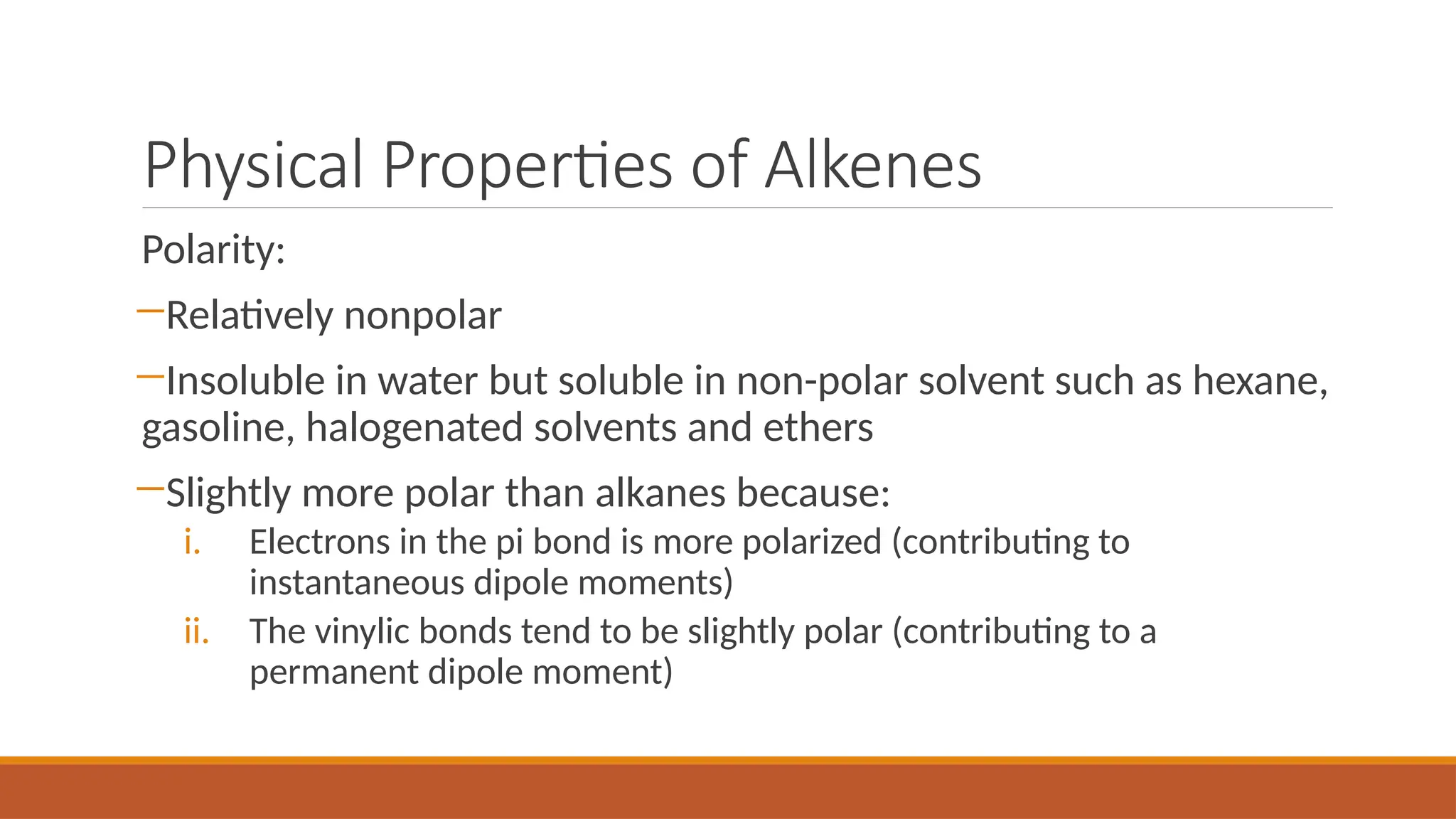
Physical Properties ofAlkenes
Polarity:
―Relatively nonpolar
―Insoluble in water but soluble in non-polar solvent such as hexane,
gasoline, halogenated solvents and ethers
―Slightly more polar than alkanes because:
i. Electrons in the pi bond is more polarized (contributing to
instantaneous dipole moments)
ii. The vinylic bonds tend to be slightly polar (contributing to a
permanent dipole moment)
ALKYNES
Contain triple bond
Generalformula : CnHn-2. (n=2,3,4,….)
Two elements of unsaturated for each triple bond
Some reactions resemble the reactions of alkenes,
like addition and oxidation
Some reactions are specific to alkynes
54.
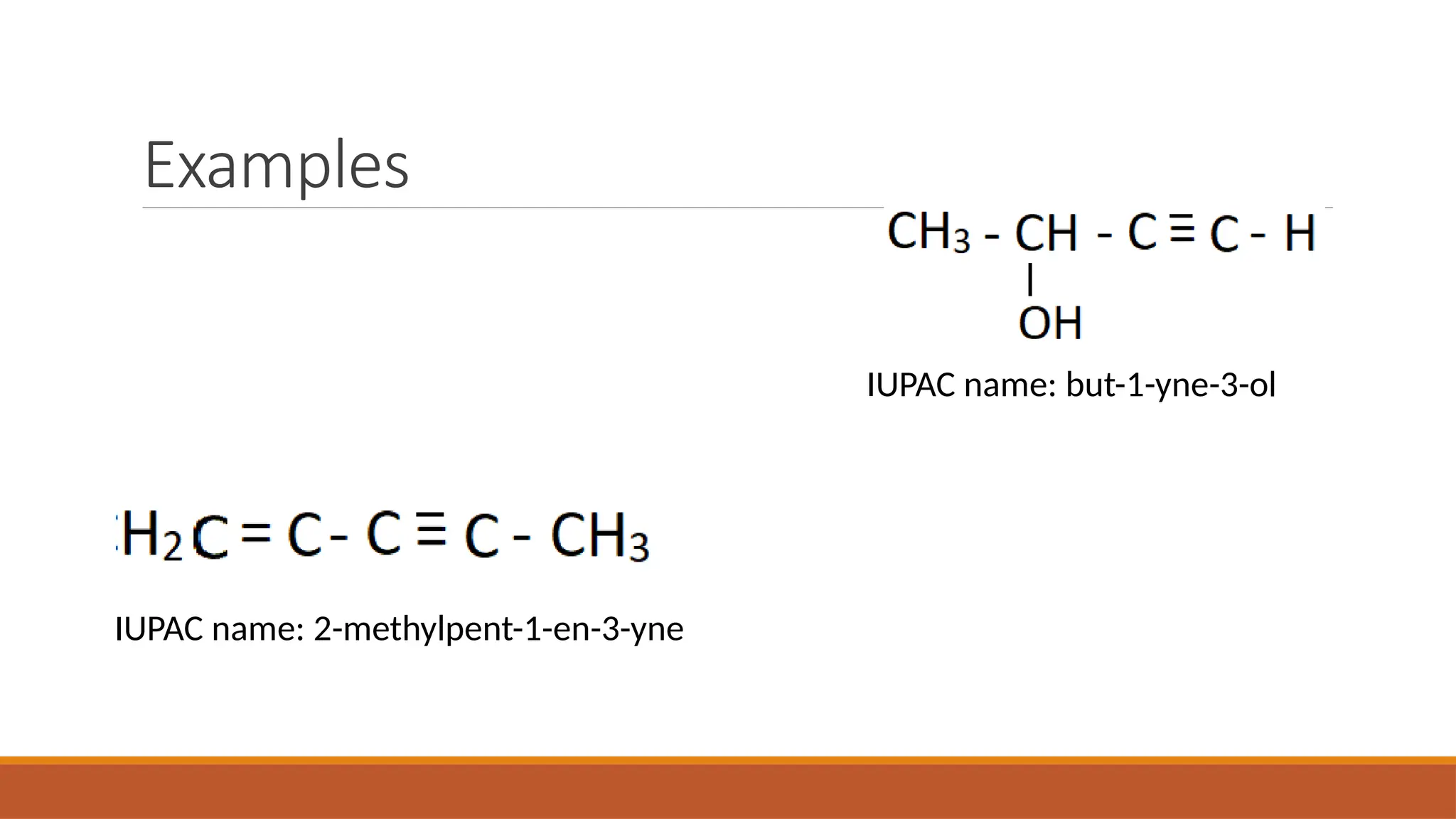
RULES FOR NAMINGALKANES
1. Find the longest carbon chain containing the triple
bond. This gives the parent name of the compound.
2. Change –ane ending to –yne
3. Number the chain, starting at the end closest to the
triple bond
4. Give branches or other substituents a number to
locate their position.


![1.b) Combustion (Incomplete)
What happen if there is insufficient Oxygen?
The possible balanced chemical equation for the
incomplete combustion of methane gas is:
CH4 + O2 C + 2H2O [carbon only]
2CH4 + 3O2 2CO+ 4H2O [carbon monoxide only]
4CH4 + 5O2 2CO2 + 2C + 8H2O [mixture of both]](https://image.slidesharecdn.com/introductiontocarboncompound-250708015132-6d1e7b20/75/CHAPTER-2-INTRODUCTION-TO-CARBON-COMPOUND-38-2048.jpg)



![Chemistry ail shashank [hydrocarbons]](https://cdn.slidesharecdn.com/ss_thumbnails/chemistryailshashankhydrocarbons-210105031943-thumbnail.jpg?width=640&height=640&fit=bounds)


