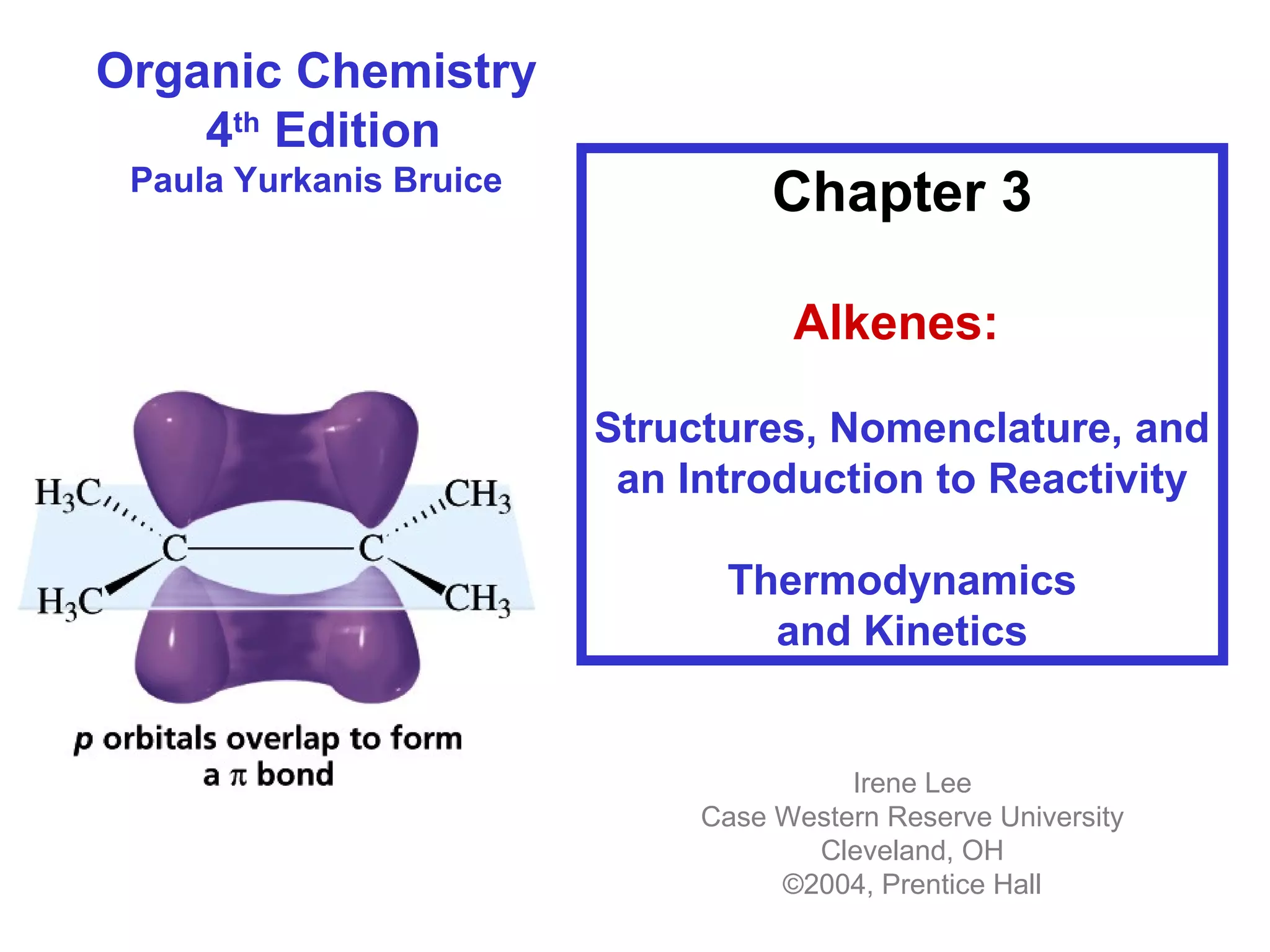
Organic Chemistry
4th
Edition
Paula Yurkanis Bruice
Chapter 3
Alkenes:
Structures, Nomenclature, and
an Introduction to Reactivity
Thermodynamics
and Kinetics
Irene Lee
Case Western Reserve University
Cleveland, OH
©2004, Prentice Hall
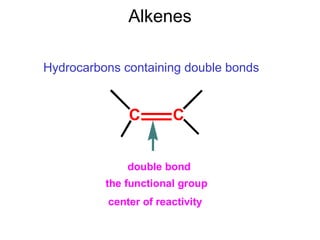
Hydrocarbons containing double bonds
C C
double bond
the functional group
center of reactivity
Alkenes
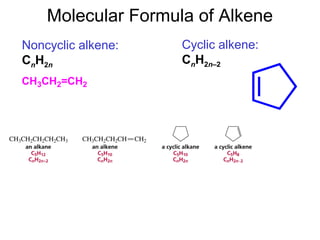
Noncyclic alkene:
CnH2n
Cyclic alkene:
CnH2n–2
Molecular Formula of Alkene
CH3CH2=CH2
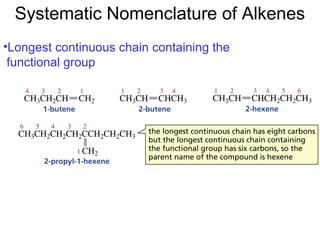
Systematic Nomenclature of Alkenes
•Longest continuous chain containing the
functional group
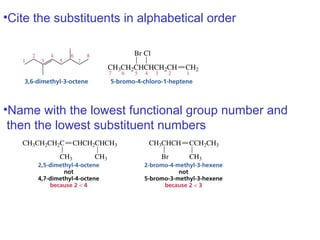
•Cite the substituents in alphabetical order
•Name with the lowest functional group number and
then the lowest substituent numbers
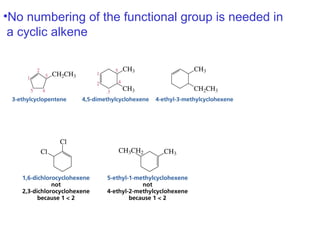
•No numbering of the functional group is needed in
a cyclic alkene
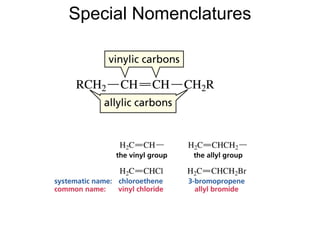
Special Nomenclatures
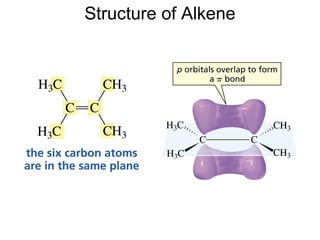
Structure of Alkene
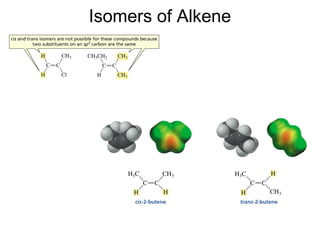
Isomers of Alkene
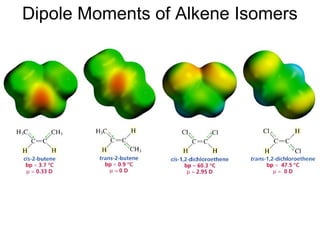
Dipole Moments of Alkene Isomers
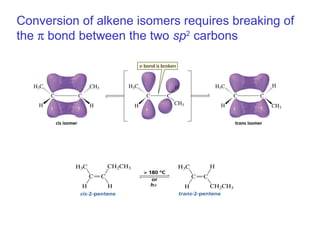
Conversion of alkene isomers requires breaking of
the π bond between the two sp2
carbons
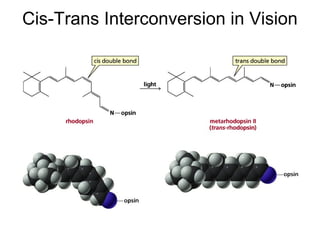
Cis-Trans Interconversion in Vision
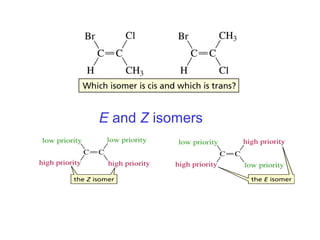
E and Z isomers
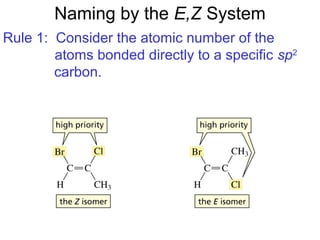
Naming by the E,Z System
Rule 1: Consider the atomic number of the
atoms bonded directly to a specific sp2
carbon.
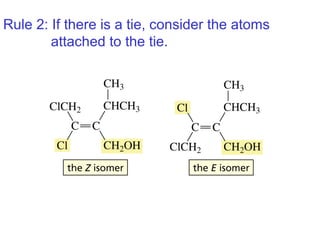
Rule 2: If there is a tie, consider the atoms
attached to the tie.
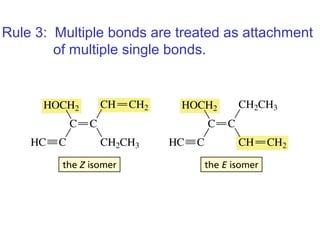
Rule 3: Multiple bonds are treated as attachment
of multiple single bonds.
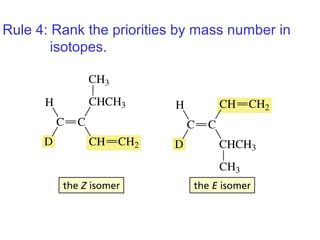
Rule 4: Rank the priorities by mass number in
isotopes.
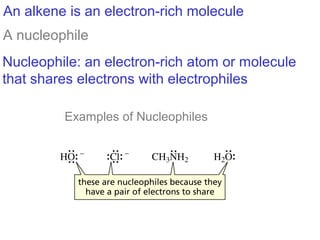
An alkene is an electron-rich molecule
Nucleophile: an electron-rich atom or molecule
that shares electrons with electrophiles
Examples of Nucleophiles
A nucleophile
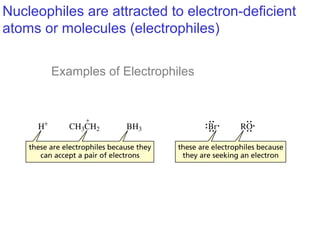
Nucleophiles are attracted to electron-deficient
atoms or molecules (electrophiles)
Examples of Electrophiles
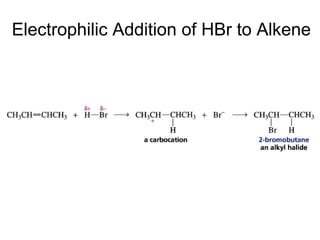
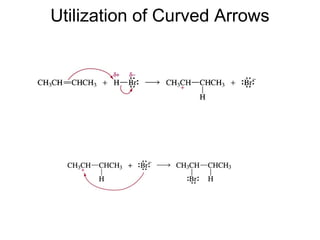
Electrophilic Addition of HBr to Alkene
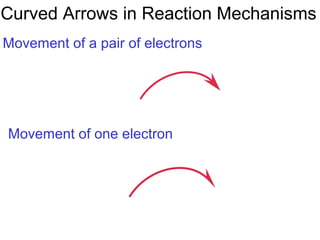
Curved Arrows in Reaction Mechanisms
Movement of a pair of electrons
Movement of one electron
Utilization of Curved Arrows
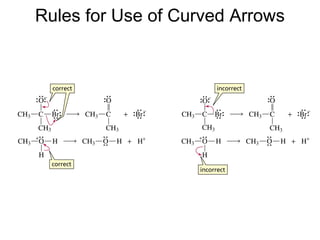
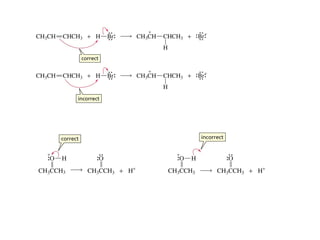
Rules for Use of Curved Arrows
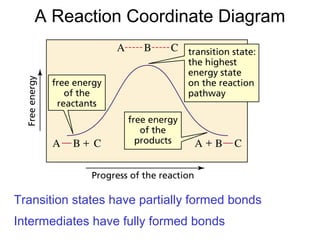
A Reaction Coordinate Diagram
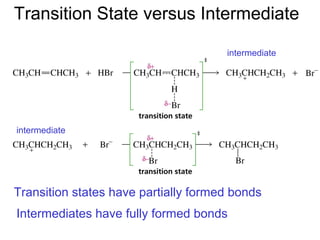
Transition states have partially formed bonds
Intermediates have fully formed bonds
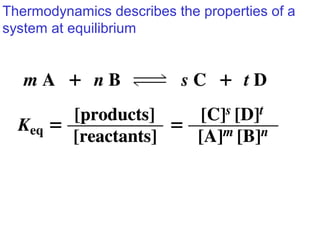
Thermodynamics describes the properties of a
system at equilibrium
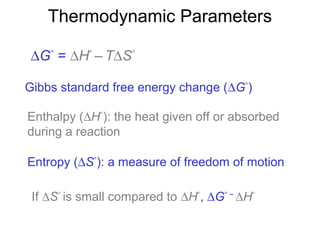
Thermodynamic Parameters
Gibbs standard free energy change (∆G°
)
Enthalpy (∆H°
): the heat given off or absorbed
during a reaction
Entropy (∆S°
): a measure of freedom of motion
∆G°
= ∆H°
– T∆S°
If ∆S°
is small compared to ∆H°
, ∆G° ~
∆H°
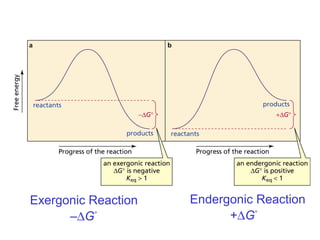
Exergonic Reaction
–∆G°
Endergonic Reaction
+∆G°
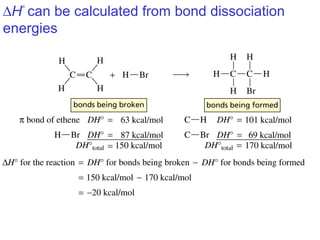
∆H°
can be calculated from bond dissociation
energies
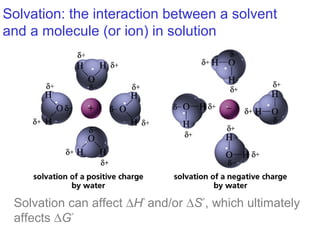
Solvation: the interaction between a solvent
and a molecule (or ion) in solution
Solvation can affect ∆H°
and/or ∆S°
, which ultimately
affects ∆G°
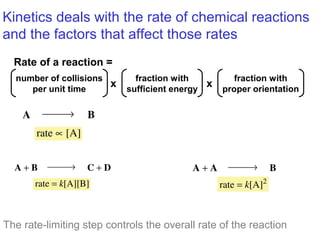
Kinetics deals with the rate of chemical reactions
and the factors that affect those rates
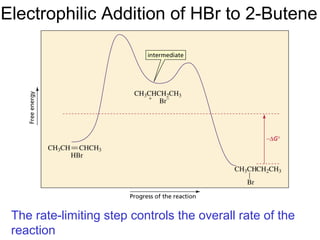
The rate-limiting step controls the overall rate of the reaction
Rate of a reaction =
number of collisions
per unit time
fraction with
sufficient energy
fraction with
proper orientation
x x
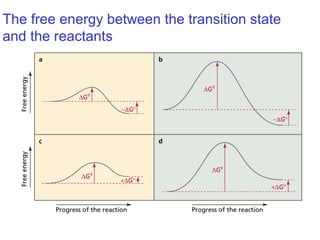
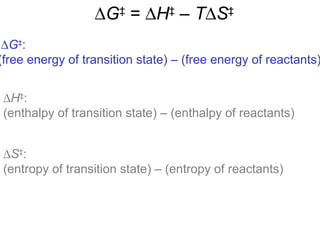
The free energy between the transition state
and the reactants
∆G‡
:
(free energy of transition state) – (free energy of reactants)
∆G‡
= ∆H‡
– T∆S‡
∆H‡
:
(enthalpy of transition state) – (enthalpy of reactants)
∆S‡
:
(entropy of transition state) – (entropy of reactants)
Rates and Rate Constants
First-order reaction
A B
rate = k[A]
Second-order
reaction
A + B C + D
rate = k[A][B]
The Arrhenius Equation
k = Ae
–Ea/RT
Ea = ∆H‡
+ RT
Rate Constants and the Equilibrium
Constant
A B
k1
k–1
Keq = k1/k–1 = [B]/[A]
Transition State versus Intermediate
Transition states have partially formed bonds
Intermediates have fully formed bonds
intermediate
intermediate
Electrophilic Addition of HBr to 2-Butene
The rate-limiting step controls the overall rate of the
reaction

Chapter 3 Alkenes: Structures, Nomenclature, and an Introduction to Reactivity Thermodynamics and Kinetics