AROMATIC
HYDROCARBONS
AROMATIC
HYDROCARBONS
• An unsaturated cyclic hydrocarbon
that does not readily undergo
addition reactions.
• Aromatic Ring System-the functional
group present in aromatic
compounds.
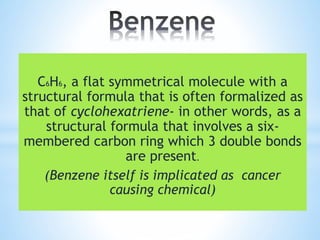
C6H6, a flat symmetrical molecule with a
structural formula that is often formalized as
that of cyclohexatriene- in other words, as a
structural formula that involves a six-
membered carbon ring which 3 double bonds
are present.
(Benzene itself is implicated as cancer
causing chemical)
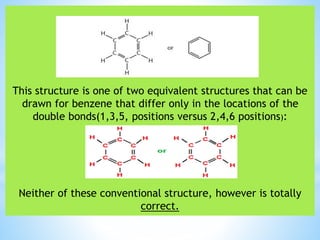
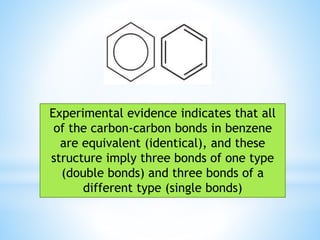
This structure is one of two equivalent structures that can be
drawn for benzene that differ only in the locations of the
double bonds(1,3,5, positions versus 2,4,6 positions):
Neither of these conventional structure, however is totally
correct.
Experimental evidence indicates that all
of the carbon-carbon bonds in benzene
are equivalent (identical), and these
structure imply three bonds of one type
(double bonds) and three bonds of a
different type (single bonds)
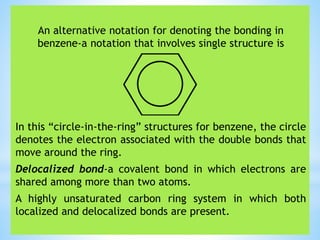
An alternative notation for denoting the bonding in
benzene-a notation that involves single structure is
In this “circle-in-the-ring” structures for benzene, the circle
denotes the electron associated with the double bonds that
move around the ring.
Delocalized bond-a covalent bond in which electrons are
shared among more than two atoms.
A highly unsaturated carbon ring system in which both
localized and delocalized bonds are present.
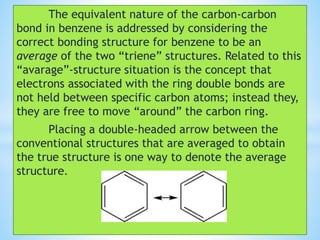
The equivalent nature of the carbon-carbon
bond in benzene is addressed by considering the
correct bonding structure for benzene to be an
average of the two “triene” structures. Related to this
“avarage”-structure situation is the concept that
electrons associated with the ring double bonds are
not held between specific carbon atoms; instead they,
they are free to move “around” the carbon ring.
Placing a double-headed arrow between the
conventional structures that are averaged to obtain
the true structure is one way to denote the average
structure.
Physical Properties
• Insoluble in water
• Good solvents for nonpolar material
• Less dense than water
• volatile
• Colorless, flammable liquid (burns with a sooty
flame due to incomplete combustion
• Several aromatic hydrocarbons are toxic
Sources
• At one time, coal tar the main source of
aromatic hydrocarbon but now its petroleum
due to a high temperature with special catalyst
• Toluene from heptane
• Situation in which a person can be exposed to
low level benzene vapors , benzene inhalation
can cause nausea and respiratory problems
• Inhaling gasoline vapors while refueling on
automobile(gasoline contain about 2% (v/v)
C6H6.
• Being around a cigarette smoker
Benzene undergoes substitution reactions.
-Characterized by different atoms or groups of atoms replacing
hydrogen atoms in a hydrocarbon molecule.
2 Important types of substitution reaction for benzene and
other aromatic hydrocarbons:
• Alkylation-An alkyl group(R--) from an alkyl chloride (R—Cl)
substitutes for a hydrogen atom on the benzene ring.
(most important industrial reaction of benzene)
• Halogenation- (bromination or chlorination)
Examples:
Naphthalene
Anthracene
Phenanthrene
All three are solids at room temperature.
2 carbon rings that share a pair of carbon atoms ,an
aromatic hydrocarbon whose structure contains two or
more rings fused together.
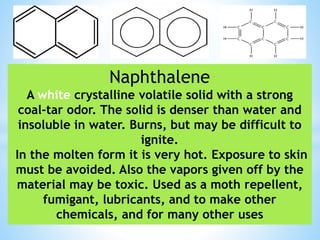
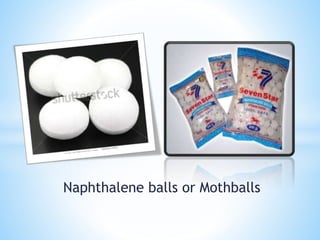
Naphthalene
A white crystalline volatile solid with a strong
coal-tar odor. The solid is denser than water and
insoluble in water. Burns, but may be difficult to
ignite.
In the molten form it is very hot. Exposure to skin
must be avoided. Also the vapors given off by the
material may be toxic. Used as a moth repellent,
fumigant, lubricants, and to make other
chemicals, and for many other uses
Naphthalene balls or Mothballs
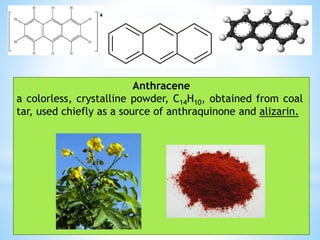
Anthracene
a colorless, crystalline powder, C14H10, obtained from coal
tar, used chiefly as a source of anthraquinone and alizarin.
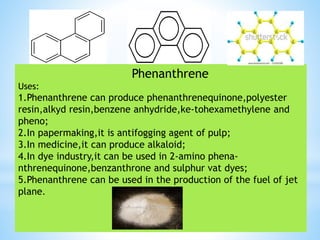
Phenanthrene
Uses:
1.Phenanthrene can produce phenanthrenequinone,polyester
resin,alkyd resin,benzene anhydride,ke-tohexamethylene and
pheno;
2.In papermaking,it is antifogging agent of pulp;
3.In medicine,it can produce alkaloid;
4.In dye industry,it can be used in 2-amino phena-
nthrenequinone,benzanthrone and sulphur vat dyes;
5.Phenanthrene can be used in the production of the fuel of jet
plane.
A number of fused-ring aromatic hydrocarbons are
known to be carcinogens-that is, to cause cancer.
Three of the most potent carcinogens are:
• 1,2-Benzanthracene
• 1,2,5,6-Dibenzanthracene
• 3,4-Benzpyrene
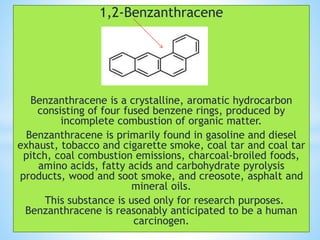
1,2-Benzanthracene
Benzanthracene is a crystalline, aromatic hydrocarbon
consisting of four fused benzene rings, produced by
incomplete combustion of organic matter.
Benzanthracene is primarily found in gasoline and diesel
exhaust, tobacco and cigarette smoke, coal tar and coal tar
pitch, coal combustion emissions, charcoal-broiled foods,
amino acids, fatty acids and carbohydrate pyrolysis
products, wood and soot smoke, and creosote, asphalt and
mineral oils.
This substance is used only for research purposes.
Benzanthracene is reasonably anticipated to be a human
carcinogen.
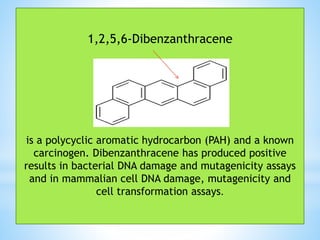
1,2,5,6-Dibenzanthracene
is a polycyclic aromatic hydrocarbon (PAH) and a known
carcinogen. Dibenzanthracene has produced positive
results in bacterial DNA damage and mutagenicity assays
and in mammalian cell DNA damage, mutagenicity and
cell transformation assays.
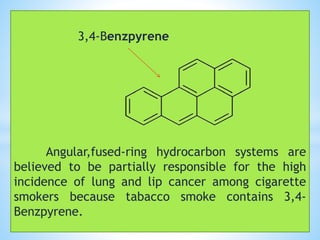
3,4-Benzpyrene
Angular,fused-ring hydrocarbon systems are
believed to be partially responsible for the high
incidence of lung and lip cancer among cigarette
smokers because tabacco smoke contains 3,4-
Benzpyrene.
Carcinogenic fused-ring aromatic
hydrocarbons share some structural features.
They also contain four or more fused rings,
and they all have the same “angle” in the
series of rings.
Fused-ring aromatic hydrocarbons are often
formed when hydrocarbon materials are
heated to high temperatures.
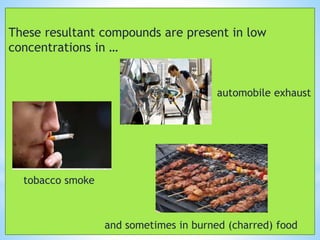
These resultant compounds are present in low
concentrations in …
automobile exhaust
tobacco smoke
and sometimes in burned (charred) food
Prepared by: MADONNA MIRAFLOR PAJO
SOGOD NATIONAL HIGH SCHOOL

Aromatic hydrocarbons

  • 1.
  • 2.
    AROMATIC HYDROCARBONS • An unsaturatedcyclic hydrocarbon that does not readily undergo addition reactions. • Aromatic Ring System-the functional group present in aromatic compounds.
  • 3.
    C6H6, a flatsymmetrical molecule with a structural formula that is often formalized as that of cyclohexatriene- in other words, as a structural formula that involves a six- membered carbon ring which 3 double bonds are present. (Benzene itself is implicated as cancer causing chemical)
  • 4.
    This structure isone of two equivalent structures that can be drawn for benzene that differ only in the locations of the double bonds(1,3,5, positions versus 2,4,6 positions): Neither of these conventional structure, however is totally correct.
  • 5.
    Experimental evidence indicatesthat all of the carbon-carbon bonds in benzene are equivalent (identical), and these structure imply three bonds of one type (double bonds) and three bonds of a different type (single bonds)
  • 6.
    An alternative notationfor denoting the bonding in benzene-a notation that involves single structure is In this “circle-in-the-ring” structures for benzene, the circle denotes the electron associated with the double bonds that move around the ring. Delocalized bond-a covalent bond in which electrons are shared among more than two atoms. A highly unsaturated carbon ring system in which both localized and delocalized bonds are present.
  • 7.
    The equivalent natureof the carbon-carbon bond in benzene is addressed by considering the correct bonding structure for benzene to be an average of the two “triene” structures. Related to this “avarage”-structure situation is the concept that electrons associated with the ring double bonds are not held between specific carbon atoms; instead they, they are free to move “around” the carbon ring. Placing a double-headed arrow between the conventional structures that are averaged to obtain the true structure is one way to denote the average structure.
  • 8.
    Physical Properties • Insolublein water • Good solvents for nonpolar material • Less dense than water • volatile • Colorless, flammable liquid (burns with a sooty flame due to incomplete combustion • Several aromatic hydrocarbons are toxic
  • 9.
    Sources • At onetime, coal tar the main source of aromatic hydrocarbon but now its petroleum due to a high temperature with special catalyst • Toluene from heptane • Situation in which a person can be exposed to low level benzene vapors , benzene inhalation can cause nausea and respiratory problems • Inhaling gasoline vapors while refueling on automobile(gasoline contain about 2% (v/v) C6H6. • Being around a cigarette smoker
  • 10.
    Benzene undergoes substitutionreactions. -Characterized by different atoms or groups of atoms replacing hydrogen atoms in a hydrocarbon molecule. 2 Important types of substitution reaction for benzene and other aromatic hydrocarbons: • Alkylation-An alkyl group(R--) from an alkyl chloride (R—Cl) substitutes for a hydrogen atom on the benzene ring. (most important industrial reaction of benzene) • Halogenation- (bromination or chlorination)
  • 11.
    Examples: Naphthalene Anthracene Phenanthrene All three aresolids at room temperature. 2 carbon rings that share a pair of carbon atoms ,an aromatic hydrocarbon whose structure contains two or more rings fused together.
  • 12.
    Naphthalene A white crystallinevolatile solid with a strong coal-tar odor. The solid is denser than water and insoluble in water. Burns, but may be difficult to ignite. In the molten form it is very hot. Exposure to skin must be avoided. Also the vapors given off by the material may be toxic. Used as a moth repellent, fumigant, lubricants, and to make other chemicals, and for many other uses
  • 13.
  • 14.
    Anthracene a colorless, crystallinepowder, C14H10, obtained from coal tar, used chiefly as a source of anthraquinone and alizarin.
  • 15.
    Phenanthrene Uses: 1.Phenanthrene can producephenanthrenequinone,polyester resin,alkyd resin,benzene anhydride,ke-tohexamethylene and pheno; 2.In papermaking,it is antifogging agent of pulp; 3.In medicine,it can produce alkaloid; 4.In dye industry,it can be used in 2-amino phena- nthrenequinone,benzanthrone and sulphur vat dyes; 5.Phenanthrene can be used in the production of the fuel of jet plane.
  • 16.
    A number offused-ring aromatic hydrocarbons are known to be carcinogens-that is, to cause cancer. Three of the most potent carcinogens are: • 1,2-Benzanthracene • 1,2,5,6-Dibenzanthracene • 3,4-Benzpyrene
  • 17.
    1,2-Benzanthracene Benzanthracene is acrystalline, aromatic hydrocarbon consisting of four fused benzene rings, produced by incomplete combustion of organic matter. Benzanthracene is primarily found in gasoline and diesel exhaust, tobacco and cigarette smoke, coal tar and coal tar pitch, coal combustion emissions, charcoal-broiled foods, amino acids, fatty acids and carbohydrate pyrolysis products, wood and soot smoke, and creosote, asphalt and mineral oils. This substance is used only for research purposes. Benzanthracene is reasonably anticipated to be a human carcinogen.
  • 18.
    1,2,5,6-Dibenzanthracene is a polycyclicaromatic hydrocarbon (PAH) and a known carcinogen. Dibenzanthracene has produced positive results in bacterial DNA damage and mutagenicity assays and in mammalian cell DNA damage, mutagenicity and cell transformation assays.
  • 19.
    3,4-Benzpyrene Angular,fused-ring hydrocarbon systemsare believed to be partially responsible for the high incidence of lung and lip cancer among cigarette smokers because tabacco smoke contains 3,4- Benzpyrene.
  • 20.
    Carcinogenic fused-ring aromatic hydrocarbonsshare some structural features. They also contain four or more fused rings, and they all have the same “angle” in the series of rings. Fused-ring aromatic hydrocarbons are often formed when hydrocarbon materials are heated to high temperatures.
  • 21.
    These resultant compoundsare present in low concentrations in … automobile exhaust tobacco smoke and sometimes in burned (charred) food
  • 22.
    Prepared by: MADONNAMIRAFLOR PAJO SOGOD NATIONAL HIGH SCHOOL