2.2.1
Ionic Bonding
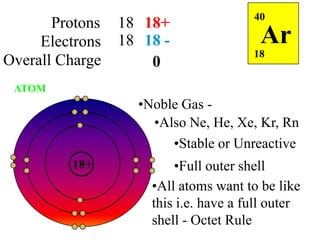
Protons
Electrons
Overall Charge

18 18+
18 18 0

40

Ar
18

ATOM

•Noble Gas •Also Ne, He, Xe, Kr, Rn
•Stable or Unreactive
18+

•Full outer shell
•All atoms want to be like
this i.e. have a full outer
shell - Octet Rule
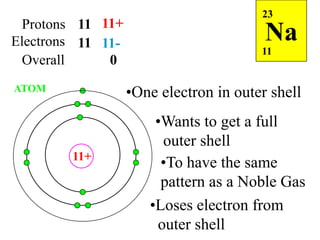
Protons 11 11+
Electrons 11 11Overall
0

23

Na
11

•One electron in outer shell

ATOM

11+

•Wants to get a full
outer shell
•To have the same
pattern as a Noble Gas
•Loses electron from
outer shell
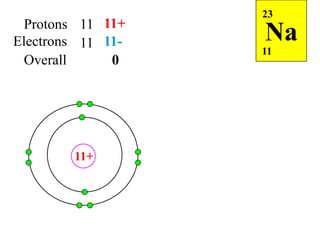
Protons 11 11+
Electrons 11 11Overall
0

11+

23

Na
11
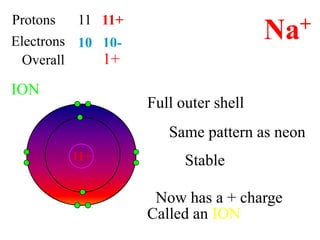
Protons

11 11+

+
Na

Electrons 10 101+
Overall

ION

Full outer shell

Same pattern as neon
11+

Stable
Now has a + charge
Called an ION
Where has the electron gone?
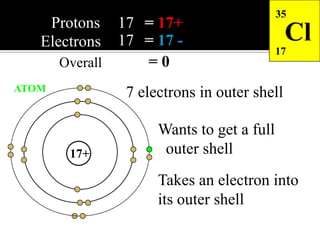
Protons
Electrons

17 = 17+
17 = 17 =0
Overall

ATOM

35

Cl
17

7 electrons in outer shell

17+

Wants to get a full
outer shell
Takes an electron into
its outer shell
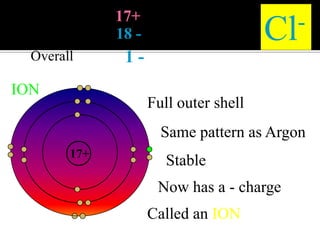
Protons
Electrons

17 17+
18 18 -

Overall

1-

ION

Cl
Full outer shell

Same pattern as Argon
17+

Stable
Now has a - charge
Called an ION
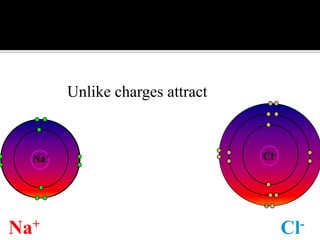
Unlike charges attract

Na+

Na+

Cl-

Cl-
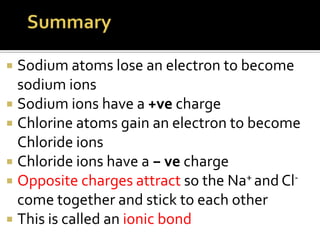
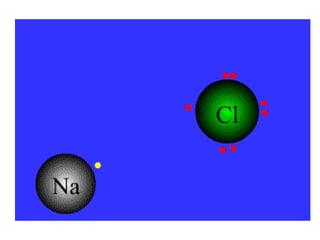
Sodium atoms lose an electron to become
sodium ions
 Sodium ions have a +ve charge
 Chlorine atoms gain an electron to become
Chloride ions
 Chloride ions have a − ve charge
 Opposite charges attract so the Na+ and Clcome together and stick to each other
 This is called an ionic bond

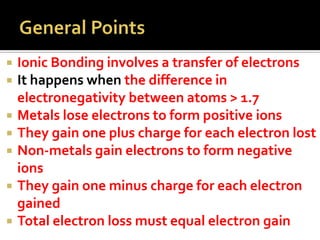
Ionic Bonding involves a transfer of electrons
It happens when the difference in
electronegativity between atoms > 1.7
 Metals lose electrons to form positive ions
 They gain one plus charge for each electron lost
 Non-metals gain electrons to form negative
ions
 They gain one minus charge for each electron
gained
 Total electron loss must equal electron gain


 Atoms in the same group [column]
 Have the same outer electron

configuration.
 Have the same valence electrons.
 Easily found by looking up the group
number on the periodic table.
 Group 2A - Be, Mg, Ca, etc. 2 valence electrons
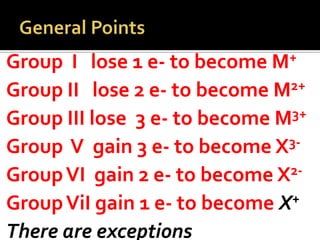
+
M

Group I lose 1 e- to become
2+
Group II lose 2 e- to become M
3+
Group III lose 3 e- to become M
3Group V gain 3 e- to become X
Group VI gain 2 e- to become X2Group ViI gain 1 e- to become X+
There are exceptions
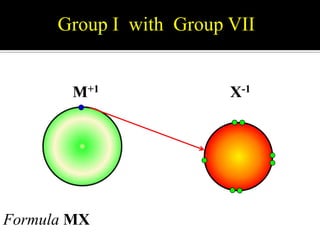
Group I with Group VII

M +1

Formula MX

X-1
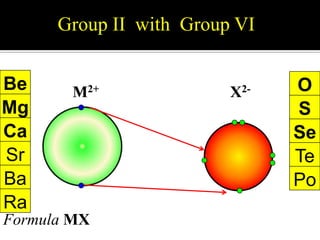
Group II with Group VI
Be
Mg
Ca
Sr
Ba
Ra

M 2+

Formula MX

X2-

O
S
Se
Te
Po
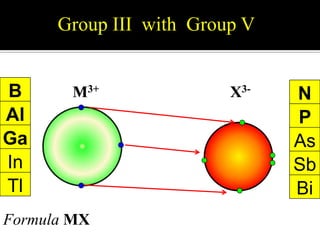
Group III with Group V

B
Al
Ga
In
Tl

M 3+

Formula MX

X3-

N
P
As
Sb
Bi
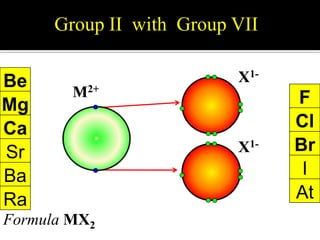
Group II with Group VII
Be
Mg
Ca
Sr
Ba
Ra

M 2+

Formula MX2

X1-

X1-

F
Cl
Br
I
At
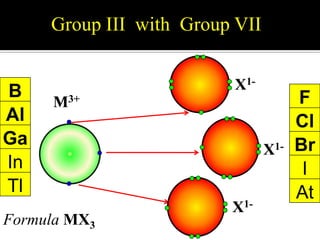
Group III with Group VII

B
Al
Ga
In
Tl

X1M 3+

Formula MX3

X1-

X1-

F
Cl
Br
I
At
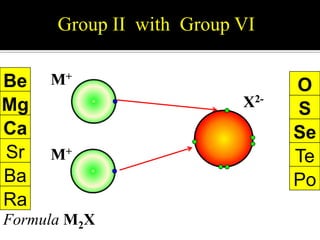
Group II with Group VI
Be
Mg
Ca
Sr
Ba
Ra

M+
X2M+

Formula M2X

O
S
Se
Te
Po
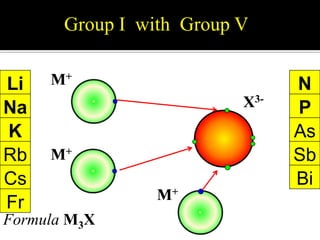
Group I with Group V
Li
Na
K
Rb
Cs
Fr

M+
X3M+

Formula M3X

M+

N
P
As
Sb
Bi
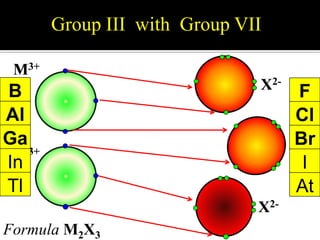
Group III with Group VII
M 3+

B
Al
Ga
M 3+
In
Tl

X2-

X2-

Formula M2X3

F
Cl
Br
X2I
At
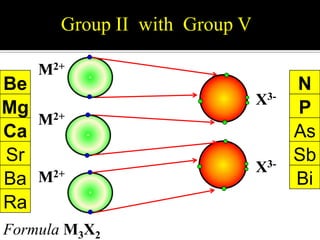
Group II with Group V
M 2+

Be
Mg 2+
M
Ca
Sr
M 2+
Ba
Ra
Formula M3X2

X3-

X3-

N
P
As
Sb
Bi










Aluminium :oxygen •
Magnesium :nitrogen
Barium: Arsenic
•
Aluminium :Iodine
Gallium :Sulphur
•
Barium :Oxygen
Sodium :Fluorine
•

Draw diagrams – outer
shell only required
Show electron movement
with arrows
Show atoms with charge
and number
Write formula [without
charges] and name

2.2.1 ionic bonding_form_v (1)

  • 1.
  • 2.
    Protons Electrons Overall Charge 18 18+ 1818 0 40 Ar 18 ATOM •Noble Gas •Also Ne, He, Xe, Kr, Rn •Stable or Unreactive 18+ •Full outer shell •All atoms want to be like this i.e. have a full outer shell - Octet Rule
  • 3.
    Protons 11 11+ Electrons11 11Overall 0 23 Na 11 •One electron in outer shell ATOM 11+ •Wants to get a full outer shell •To have the same pattern as a Noble Gas •Loses electron from outer shell
  • 4.
    Protons 11 11+ Electrons11 11Overall 0 11+ 23 Na 11
  • 5.
    Protons 11 11+ + Na Electrons 10101+ Overall ION Full outer shell Same pattern as neon 11+ Stable Now has a + charge Called an ION
  • 6.
    Where has theelectron gone?
  • 7.
    Protons Electrons 17 = 17+ 17= 17 =0 Overall ATOM 35 Cl 17 7 electrons in outer shell 17+ Wants to get a full outer shell Takes an electron into its outer shell
  • 8.
    Protons Electrons 17 17+ 18 18- Overall 1- ION Cl Full outer shell Same pattern as Argon 17+ Stable Now has a - charge Called an ION
  • 9.
  • 10.
    Sodium atoms losean electron to become sodium ions  Sodium ions have a +ve charge  Chlorine atoms gain an electron to become Chloride ions  Chloride ions have a − ve charge  Opposite charges attract so the Na+ and Clcome together and stick to each other  This is called an ionic bond 
  • 12.
    Ionic Bonding involvesa transfer of electrons It happens when the difference in electronegativity between atoms > 1.7  Metals lose electrons to form positive ions  They gain one plus charge for each electron lost  Non-metals gain electrons to form negative ions  They gain one minus charge for each electron gained  Total electron loss must equal electron gain  
  • 13.
     Atoms inthe same group [column]  Have the same outer electron configuration.  Have the same valence electrons.  Easily found by looking up the group number on the periodic table.  Group 2A - Be, Mg, Ca, etc. 2 valence electrons
  • 14.
    + M Group I lose1 e- to become 2+ Group II lose 2 e- to become M 3+ Group III lose 3 e- to become M 3Group V gain 3 e- to become X Group VI gain 2 e- to become X2Group ViI gain 1 e- to become X+ There are exceptions
  • 15.
    Group I withGroup VII M +1 Formula MX X-1
  • 16.
    Group II withGroup VI Be Mg Ca Sr Ba Ra M 2+ Formula MX X2- O S Se Te Po
  • 17.
    Group III withGroup V B Al Ga In Tl M 3+ Formula MX X3- N P As Sb Bi
  • 18.
    Group II withGroup VII Be Mg Ca Sr Ba Ra M 2+ Formula MX2 X1- X1- F Cl Br I At
  • 19.
    Group III withGroup VII B Al Ga In Tl X1M 3+ Formula MX3 X1- X1- F Cl Br I At
  • 20.
    Group II withGroup VI Be Mg Ca Sr Ba Ra M+ X2M+ Formula M2X O S Se Te Po
  • 21.
    Group I withGroup V Li Na K Rb Cs Fr M+ X3M+ Formula M3X M+ N P As Sb Bi
  • 22.
    Group III withGroup VII M 3+ B Al Ga M 3+ In Tl X2- X2- Formula M2X3 F Cl Br X2I At
  • 23.
    Group II withGroup V M 2+ Be Mg 2+ M Ca Sr M 2+ Ba Ra Formula M3X2 X3- X3- N P As Sb Bi
  • 24.
           Aluminium :oxygen • Magnesium:nitrogen Barium: Arsenic • Aluminium :Iodine Gallium :Sulphur • Barium :Oxygen Sodium :Fluorine • Draw diagrams – outer shell only required Show electron movement with arrows Show atoms with charge and number Write formula [without charges] and name