Redox Reactions.
Oxidation
Reduction
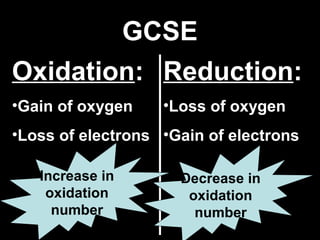
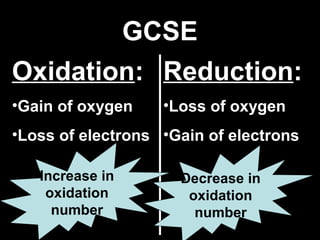
GCSE
Oxidation:
•Gain of oxygen
•Loss of electrons
Reduction:
•Loss of oxygen
•Gain of electrons
Increase in
oxidation
number
Decrease in
oxidation
number
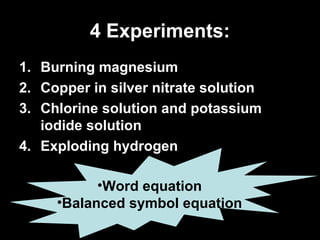
4 Experiments:
1. Burning magnesium
2. Copper in silver nitrate solution
3. Chlorine solution and potassium
iodide solution
4. Exploding hydrogen
•Word equation
•Balanced symbol equation
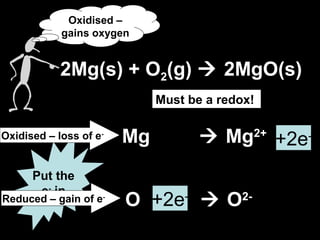
2Mg(s) + O2(g)  2MgO(s)
Oxidised –
gains oxygen
Must be a redox!
Mg  Mg2+
O  O2-
Put the
e-
in.
+2e-
+2e-
Oxidised – loss of e-
Reduced – gain of e-
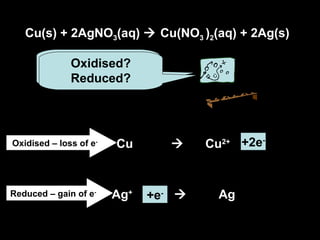
Cu(s) + 2AgNO3(aq)  Cu(NO3 )2(aq) + 2Ag(s)
Ag+
 Ag
Cu  Cu2+
Complete the
half-equations
+e-
+2e-
Oxidised?
Reduced?
Oxidised – loss of e-
Reduced – gain of e-
Try Question 1.
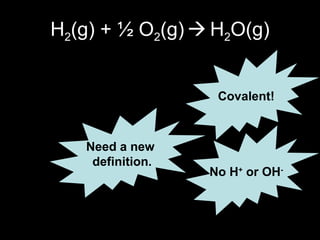
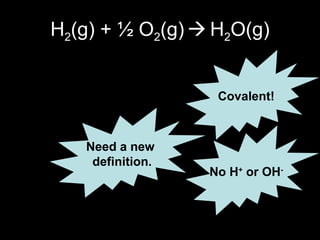
H2(g) + ½ O2(g)  H2O(g)
Covalent!
No H+
or OH-
Need a new
definition.
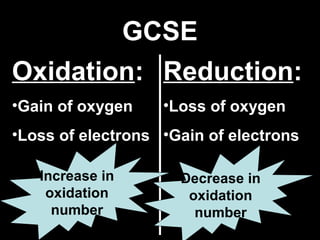
GCSE
Oxidation:
•Gain of oxygen
•Loss of electrons
Reduction:
•Loss of oxygen
•Gain of electrons
Increase in
oxidation
number
Decrease in
oxidation
number
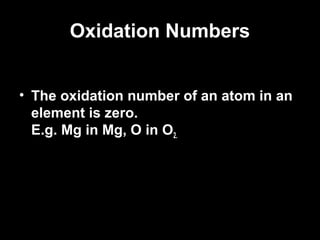
Oxidation Numbers
• The oxidation number of an atom in an
element is zero.
E.g. Mg in Mg, O in O2.
Oxidation Numbers
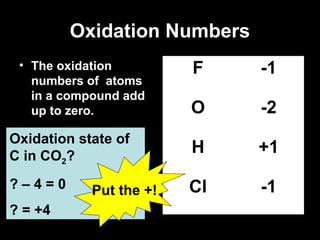
• The oxidation
numbers of atoms
in a compound add
up to zero.
F -1
O -2
H +1
Cl -1
Oxidation state of
C in CO2?
? – 4 = 0
? = +4
Put the +!
Oxidation Numbers
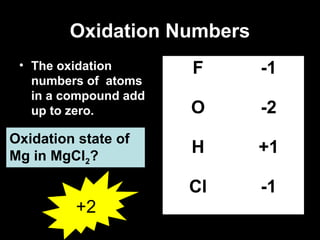
• The oxidation
numbers of atoms
in a compound add
up to zero.
F -1
O -2
H +1
Cl -1
Oxidation state of
Mg in MgCl2?
+2
Oxidation Numbers
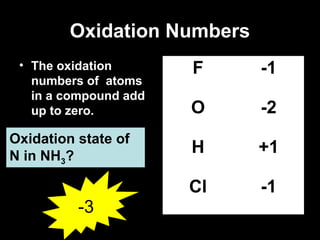
• The oxidation
numbers of atoms
in a compound add
up to zero.
F -1
O -2
H +1
Cl -1
Oxidation state of
N in NH3?
-3
Oxidation Numbers
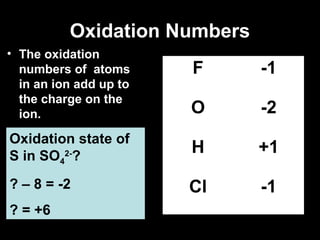
• The oxidation
numbers of atoms
in an ion add up to
the charge on the
ion.
F -1
O -2
H +1
Cl -1
Oxidation state of
S in SO4
2-
?
? – 8 = -2
? = +6
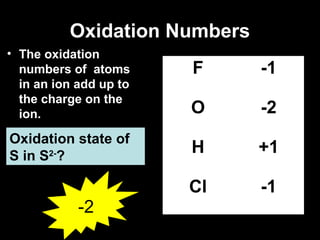
Oxidation Numbers
• The oxidation
numbers of atoms
in an ion add up to
the charge on the
ion.
F -1
O -2
H +1
Cl -1
Oxidation state of
S in S2-
?
-2
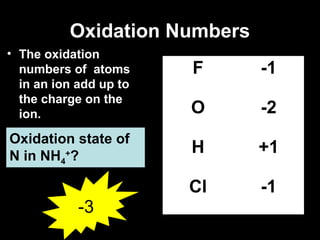
Oxidation Numbers
• The oxidation
numbers of atoms
in an ion add up to
the charge on the
ion.
F -1
O -2
H +1
Cl -1
Oxidation state of
N in NH4
+
?
-3
Try Question 2.
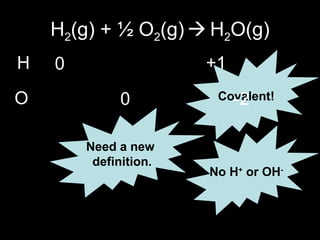
H2(g) + ½ O2(g)  H2O(g)
Covalent!
No H+
or OH-
Need a new
definition.
GCSE
Oxidation:
•Gain of oxygen
•Loss of electrons
Reduction:
•Loss of oxygen
•Gain of electrons
Increase in
oxidation
number
Decrease in
oxidation
number
H2(g) + ½ O2(g)  H2O(g)
Covalent!
No H+
or OH-
Need a new
definition.
+10
-20O
H
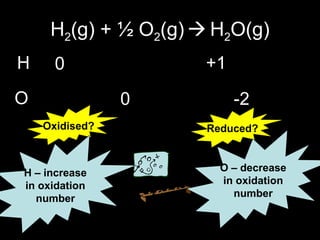
H2(g) + ½ O2(g)  H2O(g)
+10
-20O
H
Oxidised?
H – increase
in oxidation
number
Reduced?
O – decrease
in oxidation
number
Try Question 3.
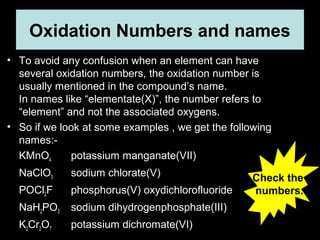
Oxidation Numbers and namesOxidation Numbers and names
• To avoid any confusion when an element can have
several oxidation numbers, the oxidation number is
usually mentioned in the compound’s name.
In names like “elementate(X)”, the number refers to
“element” and not the associated oxygens.
• So if we look at some examples , we get the following
names:-
KMnO4 potassium manganate(VII)
NaClO3 sodium chlorate(V)
POCl2F phosphorus(V) oxydichlorofluoride
NaH2PO3 sodium dihydrogenphosphate(III)
K2Cr2O7 potassium dichromate(VI)
Check the
numbers.
Try any 3 in Question 7.
Well done!
This powerpoint was kindly donated to
www.worldofteaching.com
http://www.worldofteaching.com is home to over a
thousand powerpoints submitted by teachers. This is a
completely free site and requires no registration. Please
visit and I hope it will help in your teaching.

Redox reactions

  • 1.
  • 2.
    GCSE Oxidation: •Gain of oxygen •Lossof electrons Reduction: •Loss of oxygen •Gain of electrons Increase in oxidation number Decrease in oxidation number
  • 3.
    4 Experiments: 1. Burningmagnesium 2. Copper in silver nitrate solution 3. Chlorine solution and potassium iodide solution 4. Exploding hydrogen •Word equation •Balanced symbol equation
  • 4.
    2Mg(s) + O2(g) 2MgO(s) Oxidised – gains oxygen Must be a redox! Mg  Mg2+ O  O2- Put the e- in. +2e- +2e- Oxidised – loss of e- Reduced – gain of e-
  • 5.
    Cu(s) + 2AgNO3(aq) Cu(NO3 )2(aq) + 2Ag(s) Ag+  Ag Cu  Cu2+ Complete the half-equations +e- +2e- Oxidised? Reduced? Oxidised – loss of e- Reduced – gain of e-
  • 6.
  • 7.
    H2(g) + ½O2(g)  H2O(g) Covalent! No H+ or OH- Need a new definition.
  • 8.
    GCSE Oxidation: •Gain of oxygen •Lossof electrons Reduction: •Loss of oxygen •Gain of electrons Increase in oxidation number Decrease in oxidation number
  • 9.
    Oxidation Numbers • Theoxidation number of an atom in an element is zero. E.g. Mg in Mg, O in O2.
  • 10.
    Oxidation Numbers • Theoxidation numbers of atoms in a compound add up to zero. F -1 O -2 H +1 Cl -1 Oxidation state of C in CO2? ? – 4 = 0 ? = +4 Put the +!
  • 11.
    Oxidation Numbers • Theoxidation numbers of atoms in a compound add up to zero. F -1 O -2 H +1 Cl -1 Oxidation state of Mg in MgCl2? +2
  • 12.
    Oxidation Numbers • Theoxidation numbers of atoms in a compound add up to zero. F -1 O -2 H +1 Cl -1 Oxidation state of N in NH3? -3
  • 13.
    Oxidation Numbers • Theoxidation numbers of atoms in an ion add up to the charge on the ion. F -1 O -2 H +1 Cl -1 Oxidation state of S in SO4 2- ? ? – 8 = -2 ? = +6
  • 14.
    Oxidation Numbers • Theoxidation numbers of atoms in an ion add up to the charge on the ion. F -1 O -2 H +1 Cl -1 Oxidation state of S in S2- ? -2
  • 15.
    Oxidation Numbers • Theoxidation numbers of atoms in an ion add up to the charge on the ion. F -1 O -2 H +1 Cl -1 Oxidation state of N in NH4 + ? -3
  • 16.
  • 17.
    H2(g) + ½O2(g)  H2O(g) Covalent! No H+ or OH- Need a new definition.
  • 18.
    GCSE Oxidation: •Gain of oxygen •Lossof electrons Reduction: •Loss of oxygen •Gain of electrons Increase in oxidation number Decrease in oxidation number
  • 19.
    H2(g) + ½O2(g)  H2O(g) Covalent! No H+ or OH- Need a new definition. +10 -20O H
  • 20.
    H2(g) + ½O2(g)  H2O(g) +10 -20O H Oxidised? H – increase in oxidation number Reduced? O – decrease in oxidation number
  • 21.
  • 22.
    Oxidation Numbers andnamesOxidation Numbers and names • To avoid any confusion when an element can have several oxidation numbers, the oxidation number is usually mentioned in the compound’s name. In names like “elementate(X)”, the number refers to “element” and not the associated oxygens. • So if we look at some examples , we get the following names:- KMnO4 potassium manganate(VII) NaClO3 sodium chlorate(V) POCl2F phosphorus(V) oxydichlorofluoride NaH2PO3 sodium dihydrogenphosphate(III) K2Cr2O7 potassium dichromate(VI) Check the numbers.
  • 23.
    Try any 3in Question 7.
  • 24.
  • 25.
    This powerpoint waskindly donated to www.worldofteaching.com http://www.worldofteaching.com is home to over a thousand powerpoints submitted by teachers. This is a completely free site and requires no registration. Please visit and I hope it will help in your teaching.