Table of electrovalencies
 This is a simple way to learn how to write
chemical formulae. There are other ways to
work them out but this is simple although it does
involve some learning by heart
 On a graph page at the back of your practical
notebooks draw lines on all the red [or heavier]
lines.

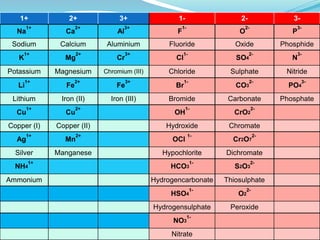
 Head the columns +1, +2, +3, blank, -1, -2, -3.
 Enter the appropriate radical(ion) and its charge
in each square as shown in the next slide
1+
Na

1+

Sodium
1+

K

Potassium
Li

1+

Lithium
1+

Cu

Copper (I)
1+

Ag

Silver
1+

NH4

Ammonium

2+
Ca

2+

Calcium
2+

Mg

Magnesium
Fe

2+

Iron (II)
2+

Cu

Copper (II)
2+

Mn

Manganese

3+
Al

3+

Aluminium
Cr

3+

Chromium (III)

Fe

3+

Iron (III)

1-

2-

1-

3-

2-

3-

F

O

P

Fluoride

Oxide

Phosphide

Cl

1-

2-

Chloride
Br

1-

N

Sulphate

Nitride

2-

3-

CO3

Bromide
1-

OH

Hydroxide
1-

OCl

3-

SO4

Hypochlorite
1-

PO4

Carbonate

Phosphate

2-

CrO2

Chromate
2-

Cr2O7

Dichromate
2-

HCO3

S2O3

Hydrogencarbonate

Thiosulphate

1-

2-

HSO4

O2

Hydrogensulphate

Peroxide

1-

NO3
P J Jackson

Nitrate

3
How to learn the Table
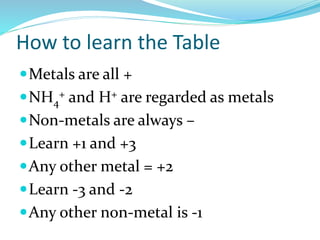
 Metals are all +

 NH4+ and H+ are regarded as metals
 Non-metals are always –
 Learn +1 and +3
 Any other metal = +2
 Learn -3 and -2

 Any other non-metal is -1
Using the Table
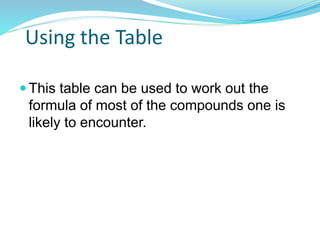
 This table can be used to work out the

formula of most of the compounds one is
likely to encounter.
 Positive ion [metal] goes first
 Negative ion [non-metal] or radical goes

second
 Multiply each ion [radical] by the smallest
possible integer to make the total of + and
– the same
 Place this number as a subscript after each
ion. If the ion is complex [i.e. a radical] put
it in brackets and put the subscript outside
the brackets
P J Jackson

6
Examples
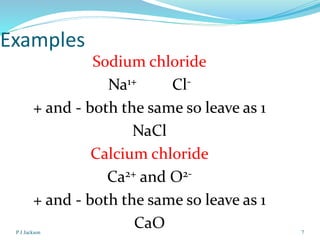
Sodium chloride
Na1+
Cl+ and - both the same so leave as 1
NaCl
Calcium chloride
Ca2+ and O2+ and - both the same so leave as 1
CaO

P J Jackson

7
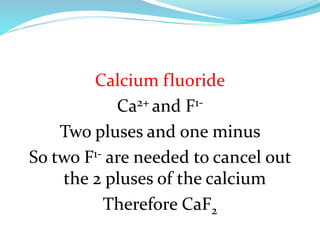
Calcium fluoride
Ca2+ and F1Two pluses and one minus
So two F1- are needed to cancel out
the 2 pluses of the calcium
Therefore CaF2
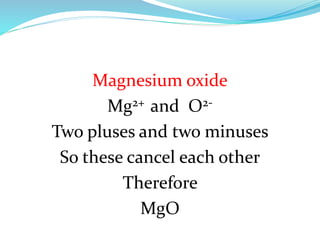
Magnesium oxide
Mg2+ and O2Two pluses and two minuses
So these cancel each other
Therefore
MgO
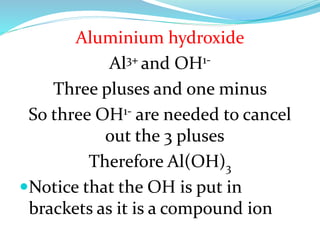
Aluminium hydroxide
Al3+ and OH1Three pluses and one minus
So three OH1- are needed to cancel
out the 3 pluses
Therefore Al(OH)3
Notice that the OH is put in
brackets as it is a compound ion
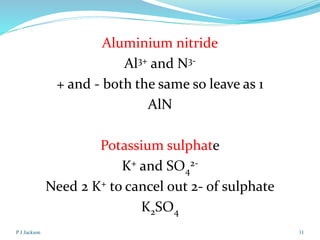
Aluminium nitride
Al3+ and N3+ and - both the same so leave as 1
AlN
Potassium sulphate
K+ and SO42Need 2 K+ to cancel out 2- of sulphate
K2SO4
P J Jackson

11
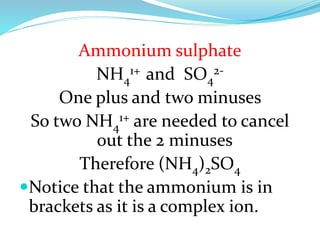
Ammonium sulphate
NH41+ and SO42One plus and two minuses
So two NH41+ are needed to cancel
out the 2 minuses
Therefore (NH4)2SO4
Notice that the ammonium is in
brackets as it is a complex ion.
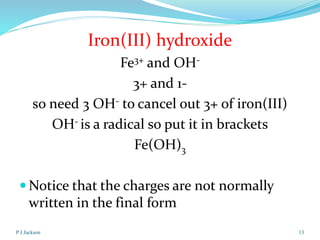
Iron(III) hydroxide
Fe3+ and OH3+ and 1so need 3 OH- to cancel out 3+ of iron(III)
OH- is a radical so put it in brackets
Fe(OH)3
 Notice that the charges are not normally

written in the final form
P J Jackson

13
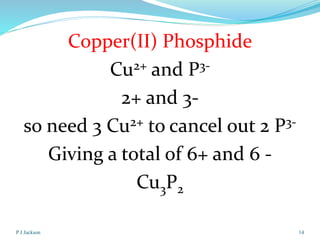
Copper(II) Phosphide
Cu2+ and P32+ and 32+ to cancel out 2 P3so need 3 Cu
Giving a total of 6+ and 6 Cu3P2
P J Jackson

14
Chromium carbonate
Cr3+ and CO32Three pluses and two minus
So two Cr3+ [6+]are needed to cancel out
the 3 CO32- [6-]
Therefore Cr2(CO3)3
Notice that as before the CO3 is put in
brackets as it is a compound ion
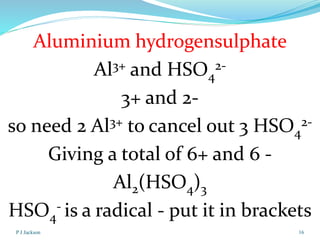
Aluminium hydrogensulphate
Al3+ and HSO423+ and 23+ to cancel out 3 HSO 2so need 2 Al
4
Giving a total of 6+ and 6 Al2(HSO4)3
HSO4- is a radical - put it in brackets
P J Jackson

16
Essential to know
 Sulphates [SO42- ]
 Sulphites [SO32-]
 Hydroxides [OH-1]

 Carbonates [CO32-]
 Hydrogencarbonates [HCO31-]

 Nitrates [NO31-]
 Of the first 36 elements – excluding the d-

block elements – where they exist
P J Jackson

17
Positive ions
 Lost electrons

 One positive charge for each electron lost
 If doing s,p,d,f . electron pattern then put

in square brackets with charge outside
 The pattern inside the bracket will be of
the nearest Noble gas [He, Ne or Ar]
 Only required for first 20 elements
P J Jackson

18
Negative Ions
Gain electrons
One negative charge for each electron

gained
If doing s,p,d,f . electron pattern the
put in square brackets with charge
outside
The pattern inside the bracket will be
of the nearest Noble gas [He, Ne or Ar]
Only required for first 20 elements
P J Jackson

19
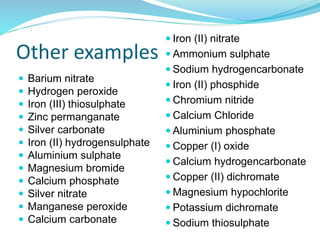
Other examples













Barium nitrate
Hydrogen peroxide
Iron (III) thiosulphate
Zinc permanganate
Silver carbonate
Iron (II) hydrogensulphate
Aluminium sulphate
Magnesium bromide
Calcium phosphate
Silver nitrate
Manganese peroxide
Calcium carbonate

 Iron (II) nitrate
 Ammonium sulphate
 Sodium hydrogencarbonate
 Iron (II) phosphide

 Chromium nitride
 Calcium Chloride
 Aluminium phosphate
 Copper (I) oxide
 Calcium hydrogencarbonate
 Copper (II) dichromate
 Magnesium hypochlorite

 Potassium dichromate
 Sodium thiosulphate

2.1.1 compounds simple_chemical_formulae

  • 1.
  • 2.
     This isa simple way to learn how to write chemical formulae. There are other ways to work them out but this is simple although it does involve some learning by heart  On a graph page at the back of your practical notebooks draw lines on all the red [or heavier] lines.  Head the columns +1, +2, +3, blank, -1, -2, -3.  Enter the appropriate radical(ion) and its charge in each square as shown in the next slide
  • 3.
    1+ Na 1+ Sodium 1+ K Potassium Li 1+ Lithium 1+ Cu Copper (I) 1+ Ag Silver 1+ NH4 Ammonium 2+ Ca 2+ Calcium 2+ Mg Magnesium Fe 2+ Iron (II) 2+ Cu Copper(II) 2+ Mn Manganese 3+ Al 3+ Aluminium Cr 3+ Chromium (III) Fe 3+ Iron (III) 1- 2- 1- 3- 2- 3- F O P Fluoride Oxide Phosphide Cl 1- 2- Chloride Br 1- N Sulphate Nitride 2- 3- CO3 Bromide 1- OH Hydroxide 1- OCl 3- SO4 Hypochlorite 1- PO4 Carbonate Phosphate 2- CrO2 Chromate 2- Cr2O7 Dichromate 2- HCO3 S2O3 Hydrogencarbonate Thiosulphate 1- 2- HSO4 O2 Hydrogensulphate Peroxide 1- NO3 P J Jackson Nitrate 3
  • 4.
    How to learnthe Table  Metals are all +  NH4+ and H+ are regarded as metals  Non-metals are always –  Learn +1 and +3  Any other metal = +2  Learn -3 and -2  Any other non-metal is -1
  • 5.
    Using the Table This table can be used to work out the formula of most of the compounds one is likely to encounter.
  • 6.
     Positive ion[metal] goes first  Negative ion [non-metal] or radical goes second  Multiply each ion [radical] by the smallest possible integer to make the total of + and – the same  Place this number as a subscript after each ion. If the ion is complex [i.e. a radical] put it in brackets and put the subscript outside the brackets P J Jackson 6
  • 7.
    Examples Sodium chloride Na1+ Cl+ and- both the same so leave as 1 NaCl Calcium chloride Ca2+ and O2+ and - both the same so leave as 1 CaO P J Jackson 7
  • 8.
    Calcium fluoride Ca2+ andF1Two pluses and one minus So two F1- are needed to cancel out the 2 pluses of the calcium Therefore CaF2
  • 9.
    Magnesium oxide Mg2+ andO2Two pluses and two minuses So these cancel each other Therefore MgO
  • 10.
    Aluminium hydroxide Al3+ andOH1Three pluses and one minus So three OH1- are needed to cancel out the 3 pluses Therefore Al(OH)3 Notice that the OH is put in brackets as it is a compound ion
  • 11.
    Aluminium nitride Al3+ andN3+ and - both the same so leave as 1 AlN Potassium sulphate K+ and SO42Need 2 K+ to cancel out 2- of sulphate K2SO4 P J Jackson 11
  • 12.
    Ammonium sulphate NH41+ andSO42One plus and two minuses So two NH41+ are needed to cancel out the 2 minuses Therefore (NH4)2SO4 Notice that the ammonium is in brackets as it is a complex ion.
  • 13.
    Iron(III) hydroxide Fe3+ andOH3+ and 1so need 3 OH- to cancel out 3+ of iron(III) OH- is a radical so put it in brackets Fe(OH)3  Notice that the charges are not normally written in the final form P J Jackson 13
  • 14.
    Copper(II) Phosphide Cu2+ andP32+ and 32+ to cancel out 2 P3so need 3 Cu Giving a total of 6+ and 6 Cu3P2 P J Jackson 14
  • 15.
    Chromium carbonate Cr3+ andCO32Three pluses and two minus So two Cr3+ [6+]are needed to cancel out the 3 CO32- [6-] Therefore Cr2(CO3)3 Notice that as before the CO3 is put in brackets as it is a compound ion
  • 16.
    Aluminium hydrogensulphate Al3+ andHSO423+ and 23+ to cancel out 3 HSO 2so need 2 Al 4 Giving a total of 6+ and 6 Al2(HSO4)3 HSO4- is a radical - put it in brackets P J Jackson 16
  • 17.
    Essential to know Sulphates [SO42- ]  Sulphites [SO32-]  Hydroxides [OH-1]  Carbonates [CO32-]  Hydrogencarbonates [HCO31-]  Nitrates [NO31-]  Of the first 36 elements – excluding the d- block elements – where they exist P J Jackson 17
  • 18.
    Positive ions  Lostelectrons  One positive charge for each electron lost  If doing s,p,d,f . electron pattern then put in square brackets with charge outside  The pattern inside the bracket will be of the nearest Noble gas [He, Ne or Ar]  Only required for first 20 elements P J Jackson 18
  • 19.
    Negative Ions Gain electrons Onenegative charge for each electron gained If doing s,p,d,f . electron pattern the put in square brackets with charge outside The pattern inside the bracket will be of the nearest Noble gas [He, Ne or Ar] Only required for first 20 elements P J Jackson 19
  • 20.
    Other examples             Barium nitrate Hydrogenperoxide Iron (III) thiosulphate Zinc permanganate Silver carbonate Iron (II) hydrogensulphate Aluminium sulphate Magnesium bromide Calcium phosphate Silver nitrate Manganese peroxide Calcium carbonate  Iron (II) nitrate  Ammonium sulphate  Sodium hydrogencarbonate  Iron (II) phosphide  Chromium nitride  Calcium Chloride  Aluminium phosphate  Copper (I) oxide  Calcium hydrogencarbonate  Copper (II) dichromate  Magnesium hypochlorite  Potassium dichromate  Sodium thiosulphate