Chemical Equations
Section 3.5
Chemical Equations
• A chemical equation is a way of representing a chemical change.
• It shows reactants and products.
• To balance an equation means to change the numbers of each
molecule involved, so that the same number of atoms of each
element appear on the reactants side and on the products side.
• Chemical equations balance on an atomic level, not molecular.
• You cannot change the formula of a substance, i.e. if the equation
has NH3 you cannot change this you can only put a number in front
of it, 2NH3, increasing the number of N’s and the number of H’s.
• Never change the subscripts (small numbers).
• It is possible to write balanced equations for lots of reactions but
that does not mean that the reaction actually takes place.
Formation of Water

(Oxygen does not exist as single atoms)

(This reaction does not take place)
Balancing an Equation
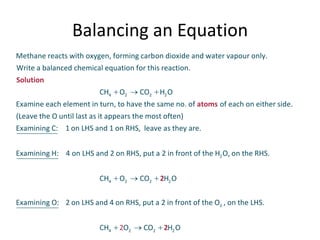
Methane reacts with oxygen, forming carbon dioxide and water vapour only.
Write a balanced chemical equation for this reaction.
Solution
CH4 O2
CO2 H2 O
Examine each element in turn, to have the same no. of atoms of each on either side.
(Leave the O until last as it appears the most often)
Examining C: 1 on LHS and 1 on RHS, leave as they are.
Examining H: 4 on LHS and 2 on RHS, put a 2 in front of the H2 O, on the RHS.
CH4

O2

CO2

2H2 O

Examining O: 2 on LHS and 4 on RHS, put a 2 in front of the O2 , on the LHS.
CH4

2O2

CO2

2H2 O
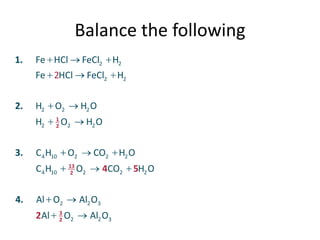
Balance the following
1.

Fe HCl

FeCl2 H2

Fe 2HCl
2.

O2

H2
3.

H2

1
2

FeCl2 H2
H2 O

O2

H2 O

O2

C 4 H10
4.

C 4 H10

13
2

Al O2
2Al

3
2

CO2

O2

4CO2

Al2 O3
O2

H2 O

Al2 O3

5H2 O
Balancing Redox Equations
• In working out what is oxidised and what is
reduced in a reaction, it is important to
remember that oxidation numbers are not a
charge.
• Write the oxidation numbers below each atom
to which it applies, as shown in the examples.
H2 O
1

2

Cr2 O7 2
6

2

OH
2

1

• Oxidation is an increase in oxidation number.
• Reduction is a decrease in oxidation number.
Balance the following redox equation
Cr2 O72
1.

Fe2

H

Cr 3

Fe3

H2O

Cr2 O7 2

Fe2

H

Cr 3

Fe3

3

3

H2 O

6

2.

2

2

Cr2 6e

2Cr 3

Fe2

Fe3

6e
6e

2Cr 3
6Fe3

3

e

Cr2

2

Cr2 6Fe2

e

3

Balance the half equations.

2Cr 3

4. Cr2 O72

6Fe2

H

Cr2 O72

6Fe2

14H

Write down half equations of what is oxidised
and reduced.
Attach subscripts to atoms oxidised and reduced
and balance the half equations.

3

6

3

6Fe2

5.

1

Fe3

6

2

1

Cr 3

Cr 3e
Fe2

3.

2

Assign oxidation numbers to all
the atoms in the equation.

6Fe3

2Cr 3

6Fe3

2Cr 3

6Fe3

H2 O
7H2 O

Attach species that were attached to the oxidised
and reduced atoms.

Include all the original species and complete the
balancing by inspection.
Calculations using Chemical Equations
• A balanced equation for a chemical reaction
gives the relative amounts of each reactant
and each product involved in the reaction.
• If the amount of one substance is known,
based on the molar ratios in the equation, the
amounts (masses, particles or volume)of other
substances can be calculated.
• Make sure to always work in moles.
A dry - cleaning fluid composed of carbon and chlorine was found to have the
composition 14.5% C, 85.5% Cl. What is the empirical formula of this compound?
Element Percentage
C

14.5%

Cl

85.5%

CCl2

Percentage
Ar
14.5
1.208
12
85.5
2.408
35.5

Simplest
Ratio
1
2

3.5 chemical equations

  • 1.
  • 2.
    Chemical Equations • Achemical equation is a way of representing a chemical change. • It shows reactants and products. • To balance an equation means to change the numbers of each molecule involved, so that the same number of atoms of each element appear on the reactants side and on the products side. • Chemical equations balance on an atomic level, not molecular. • You cannot change the formula of a substance, i.e. if the equation has NH3 you cannot change this you can only put a number in front of it, 2NH3, increasing the number of N’s and the number of H’s. • Never change the subscripts (small numbers). • It is possible to write balanced equations for lots of reactions but that does not mean that the reaction actually takes place.
  • 3.
    Formation of Water (Oxygendoes not exist as single atoms) (This reaction does not take place)
  • 4.
    Balancing an Equation Methanereacts with oxygen, forming carbon dioxide and water vapour only. Write a balanced chemical equation for this reaction. Solution CH4 O2 CO2 H2 O Examine each element in turn, to have the same no. of atoms of each on either side. (Leave the O until last as it appears the most often) Examining C: 1 on LHS and 1 on RHS, leave as they are. Examining H: 4 on LHS and 2 on RHS, put a 2 in front of the H2 O, on the RHS. CH4 O2 CO2 2H2 O Examining O: 2 on LHS and 4 on RHS, put a 2 in front of the O2 , on the LHS. CH4 2O2 CO2 2H2 O
  • 5.
    Balance the following 1. FeHCl FeCl2 H2 Fe 2HCl 2. O2 H2 3. H2 1 2 FeCl2 H2 H2 O O2 H2 O O2 C 4 H10 4. C 4 H10 13 2 Al O2 2Al 3 2 CO2 O2 4CO2 Al2 O3 O2 H2 O Al2 O3 5H2 O
  • 6.
    Balancing Redox Equations •In working out what is oxidised and what is reduced in a reaction, it is important to remember that oxidation numbers are not a charge. • Write the oxidation numbers below each atom to which it applies, as shown in the examples. H2 O 1 2 Cr2 O7 2 6 2 OH 2 1 • Oxidation is an increase in oxidation number. • Reduction is a decrease in oxidation number.
  • 7.
    Balance the followingredox equation Cr2 O72 1. Fe2 H Cr 3 Fe3 H2O Cr2 O7 2 Fe2 H Cr 3 Fe3 3 3 H2 O 6 2. 2 2 Cr2 6e 2Cr 3 Fe2 Fe3 6e 6e 2Cr 3 6Fe3 3 e Cr2 2 Cr2 6Fe2 e 3 Balance the half equations. 2Cr 3 4. Cr2 O72 6Fe2 H Cr2 O72 6Fe2 14H Write down half equations of what is oxidised and reduced. Attach subscripts to atoms oxidised and reduced and balance the half equations. 3 6 3 6Fe2 5. 1 Fe3 6 2 1 Cr 3 Cr 3e Fe2 3. 2 Assign oxidation numbers to all the atoms in the equation. 6Fe3 2Cr 3 6Fe3 2Cr 3 6Fe3 H2 O 7H2 O Attach species that were attached to the oxidised and reduced atoms. Include all the original species and complete the balancing by inspection.
  • 8.
    Calculations using ChemicalEquations • A balanced equation for a chemical reaction gives the relative amounts of each reactant and each product involved in the reaction. • If the amount of one substance is known, based on the molar ratios in the equation, the amounts (masses, particles or volume)of other substances can be calculated. • Make sure to always work in moles.
  • 9.
    A dry -cleaning fluid composed of carbon and chlorine was found to have the composition 14.5% C, 85.5% Cl. What is the empirical formula of this compound? Element Percentage C 14.5% Cl 85.5% CCl2 Percentage Ar 14.5 1.208 12 85.5 2.408 35.5 Simplest Ratio 1 2