Module-II
Linear Modulation
Prof. Dr. G.Aarthi,
Associate Professor, SENSE
 Text books:
 Electronic communication systems-George Kennedy
AM generation
• AM expression
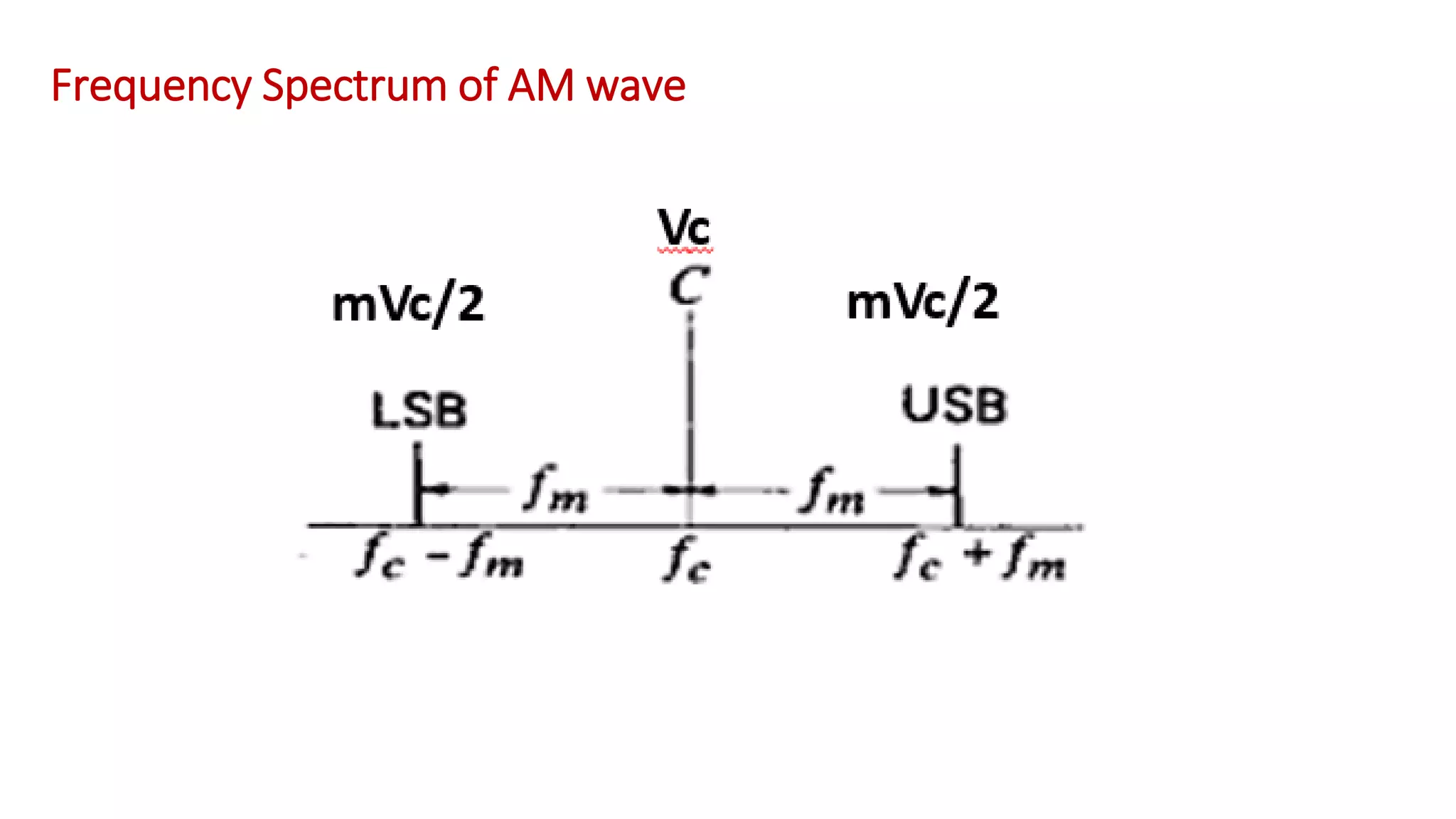
• Frequency Spectrum of AM wave
• Power calculation
• Current calculation
• Modulation index
• Problems
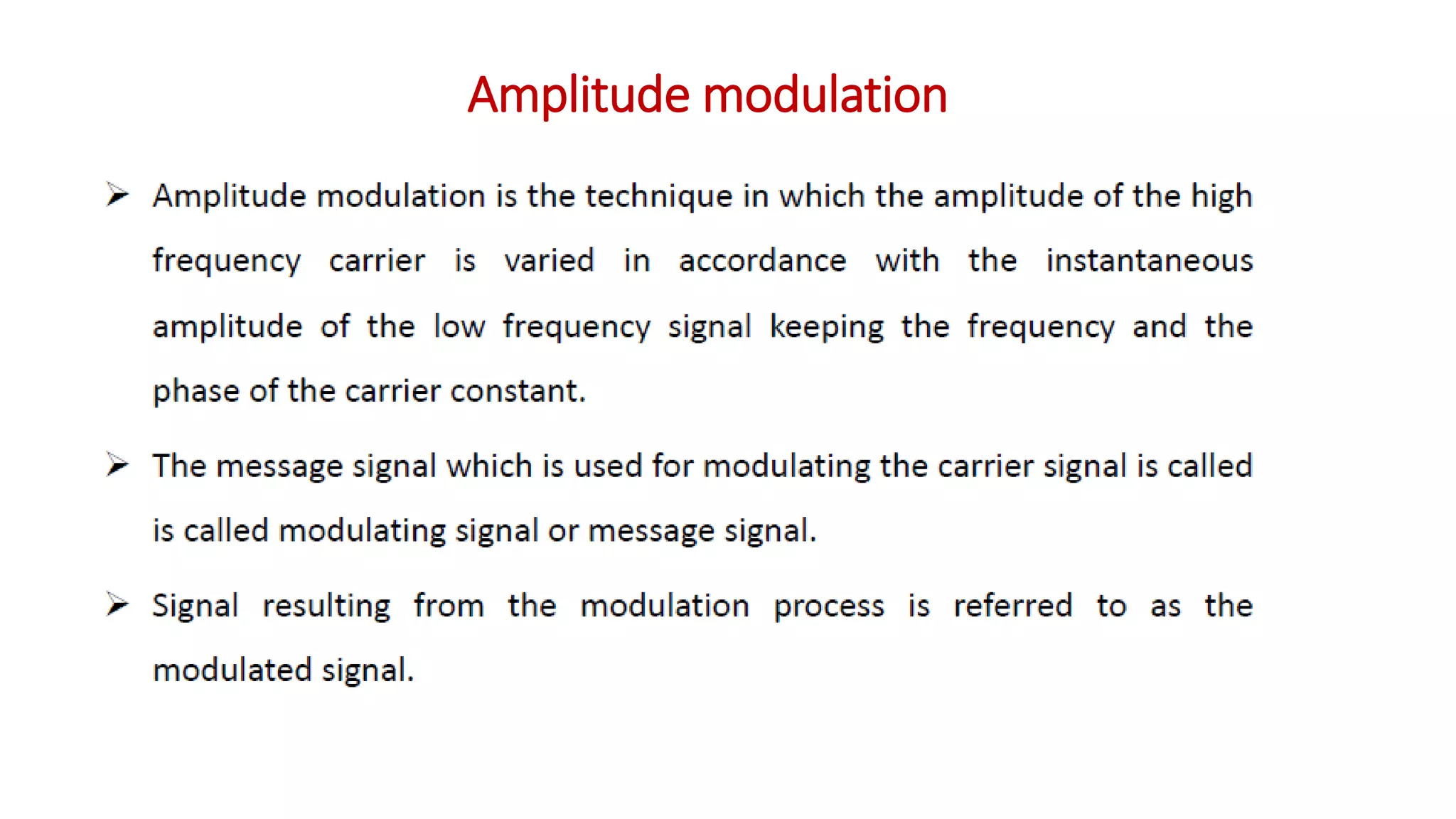
Amplitude modulation
• The amplitude of a carrier signal is made proportional to the instantaneous
amplitude of the modulating voltage
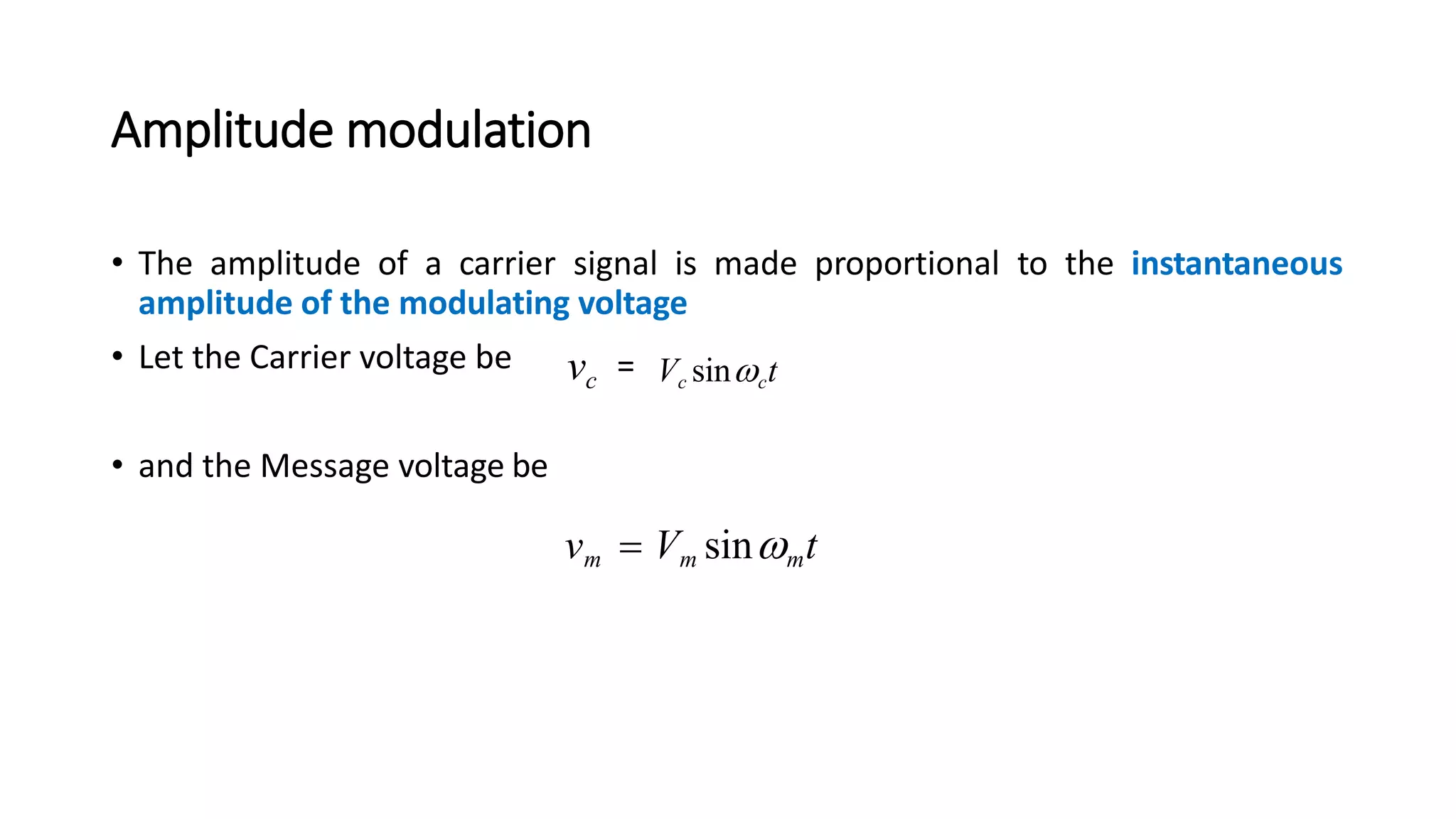
• Let the Carrier voltage be
• and the Message voltage be
=
vc Vc sinct
vm  Vm sinmt
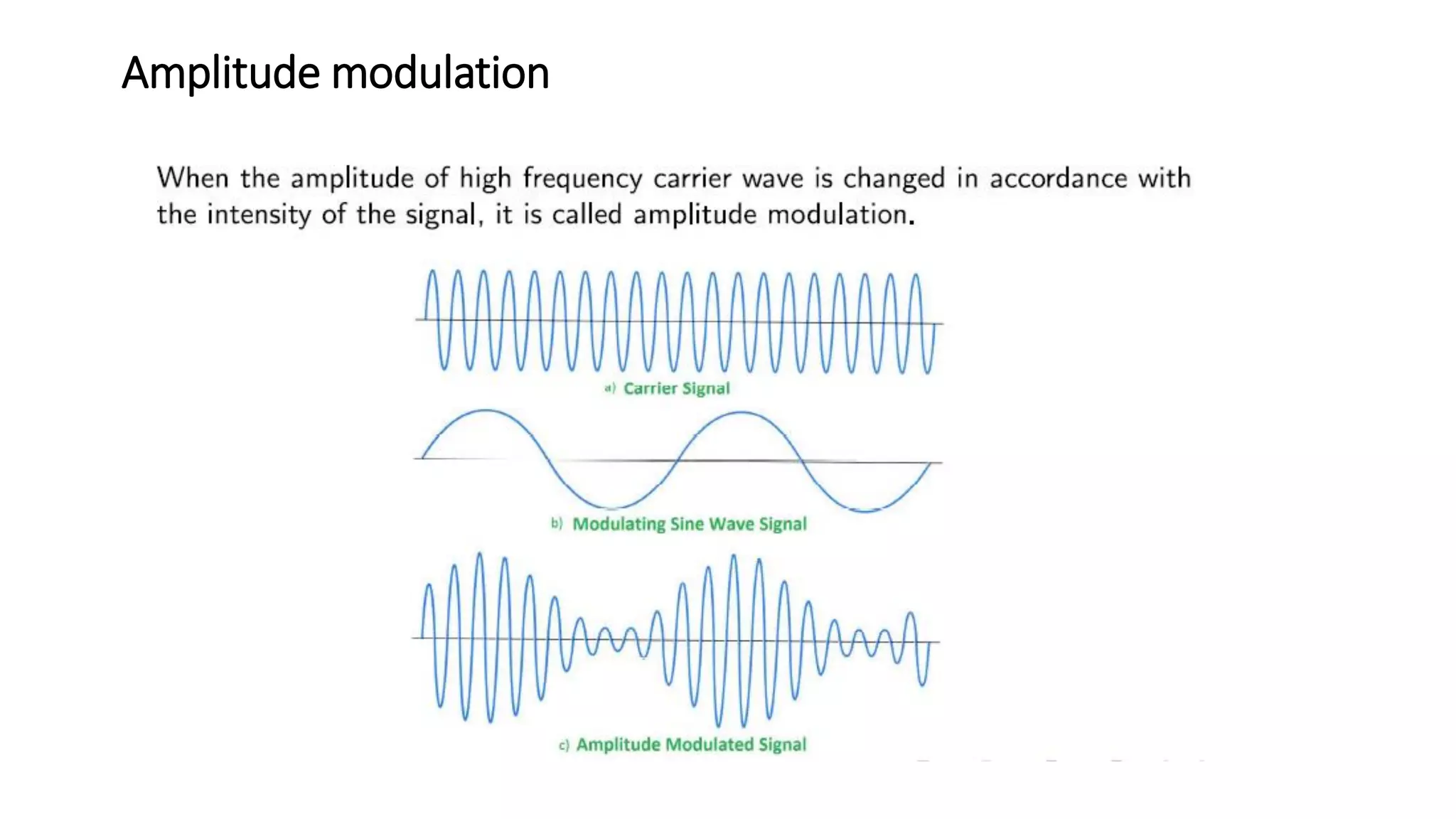
Amplitude modulation
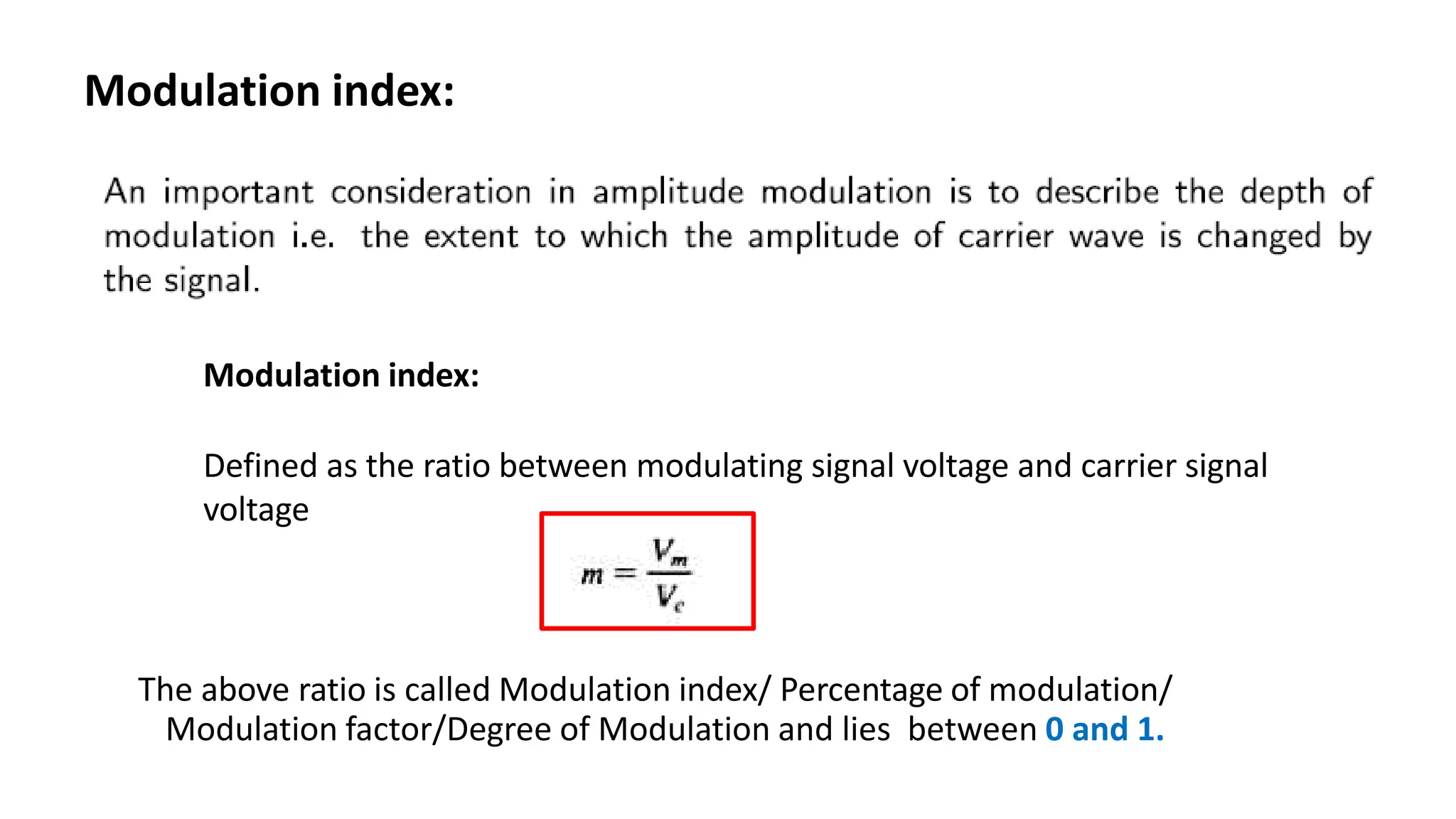
Modulation index:
Modulation index:
Defined as the ratio between modulating signal voltage and carrier signal
voltage
The above ratio is called Modulation index/ Percentage of modulation/
Modulation factor/Degree of Modulation and lies between 0 and 1.
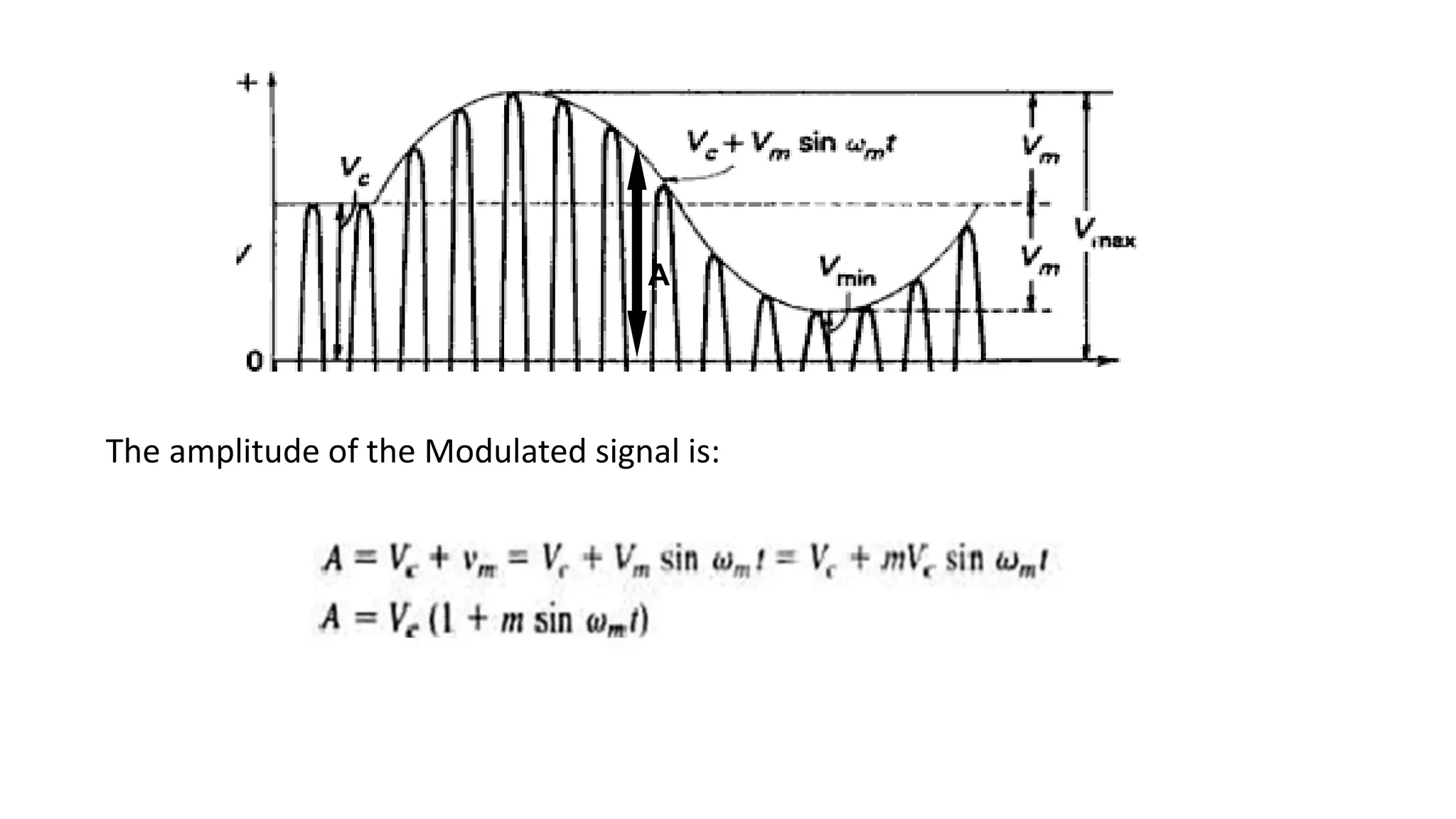
The amplitude of the Modulated signal is:
A
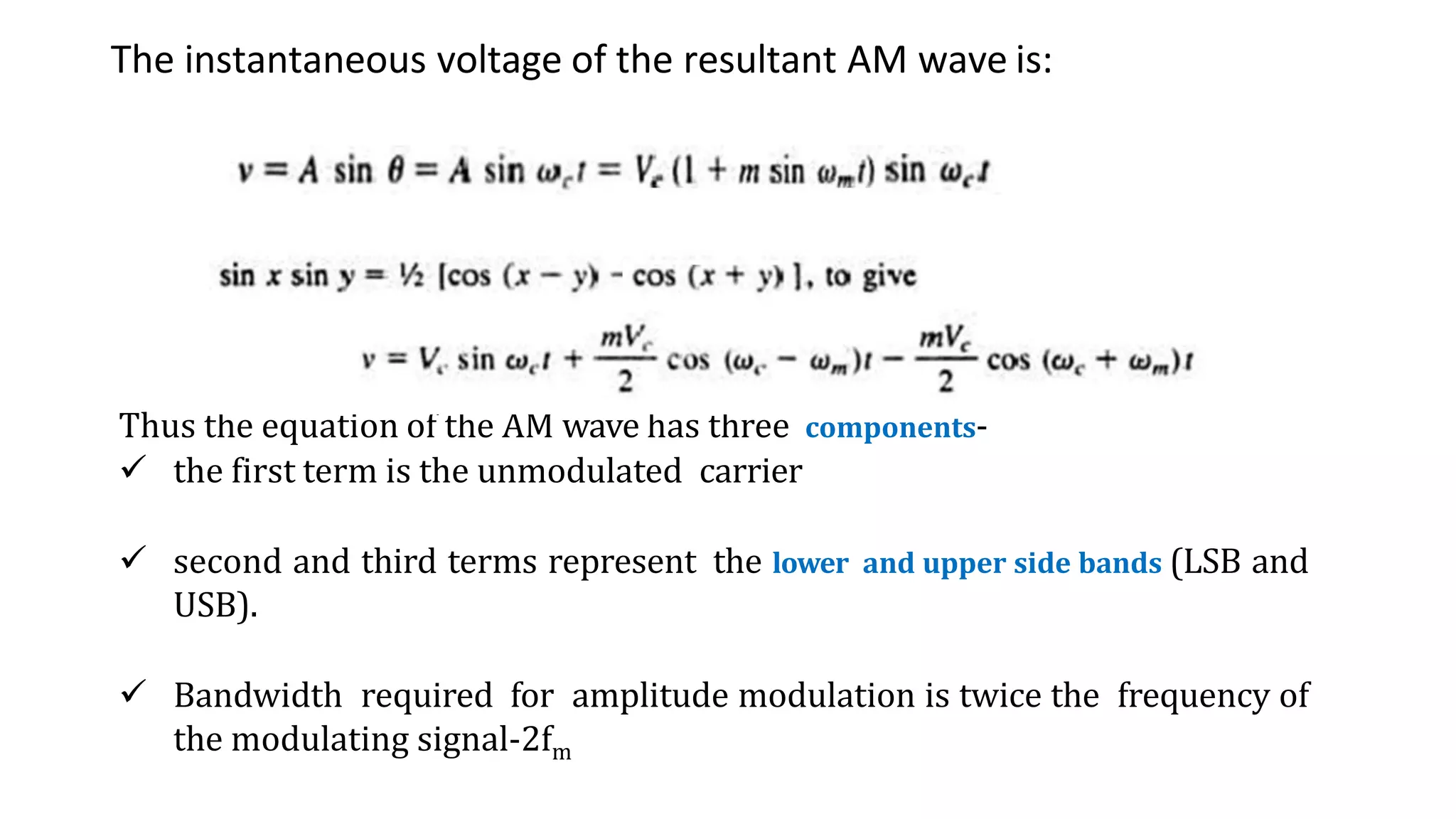
The instantaneous voltage of the resultant AM wave is:
Thus the equation of the AM wave has three components-
 the first term is the unmodulated carrier
 second and third terms represent the lower and upper side bands (LSB and
USB).
 Bandwidth required for amplitude modulation is twice the frequency of
the modulating signal-2fm
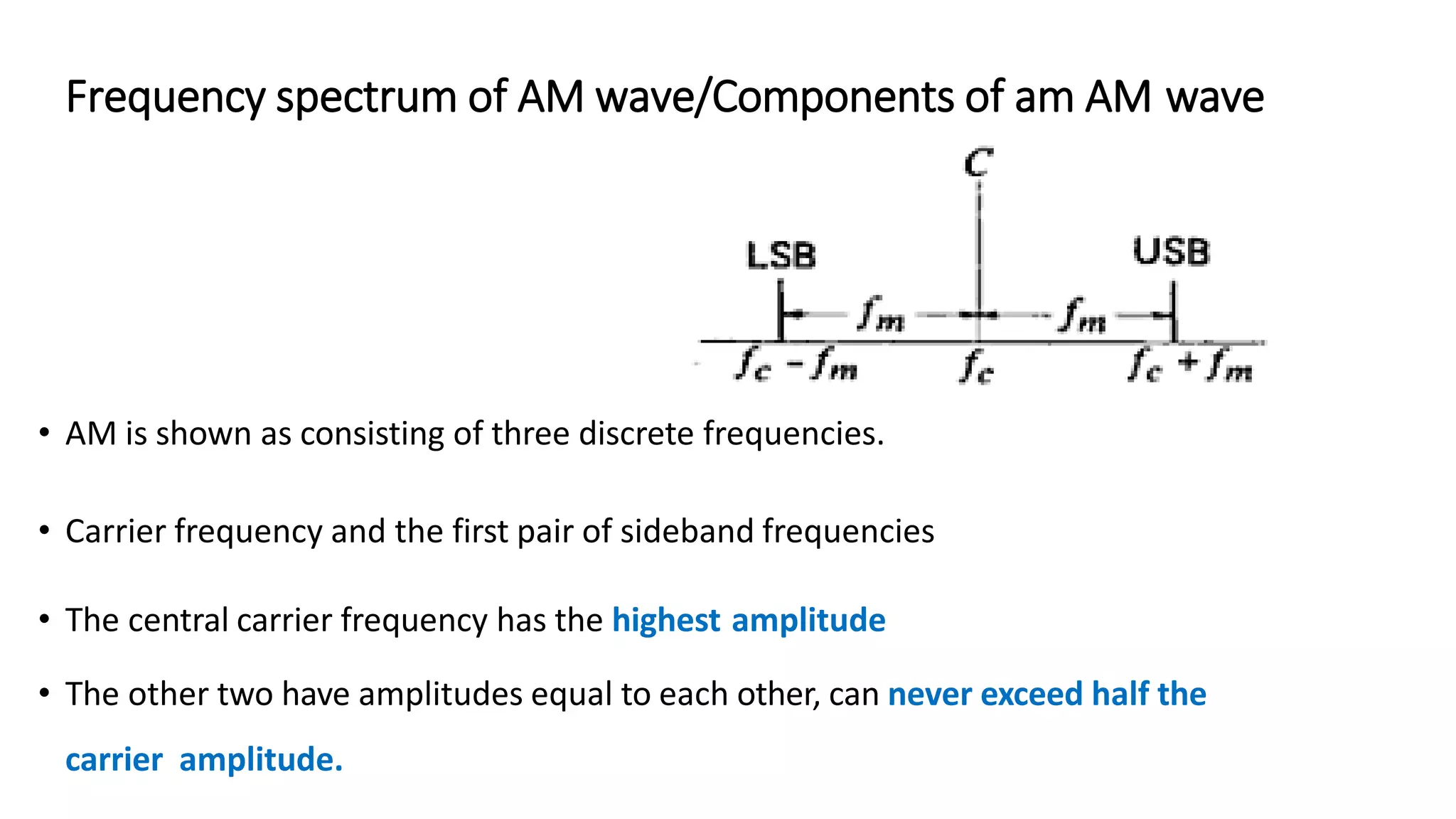
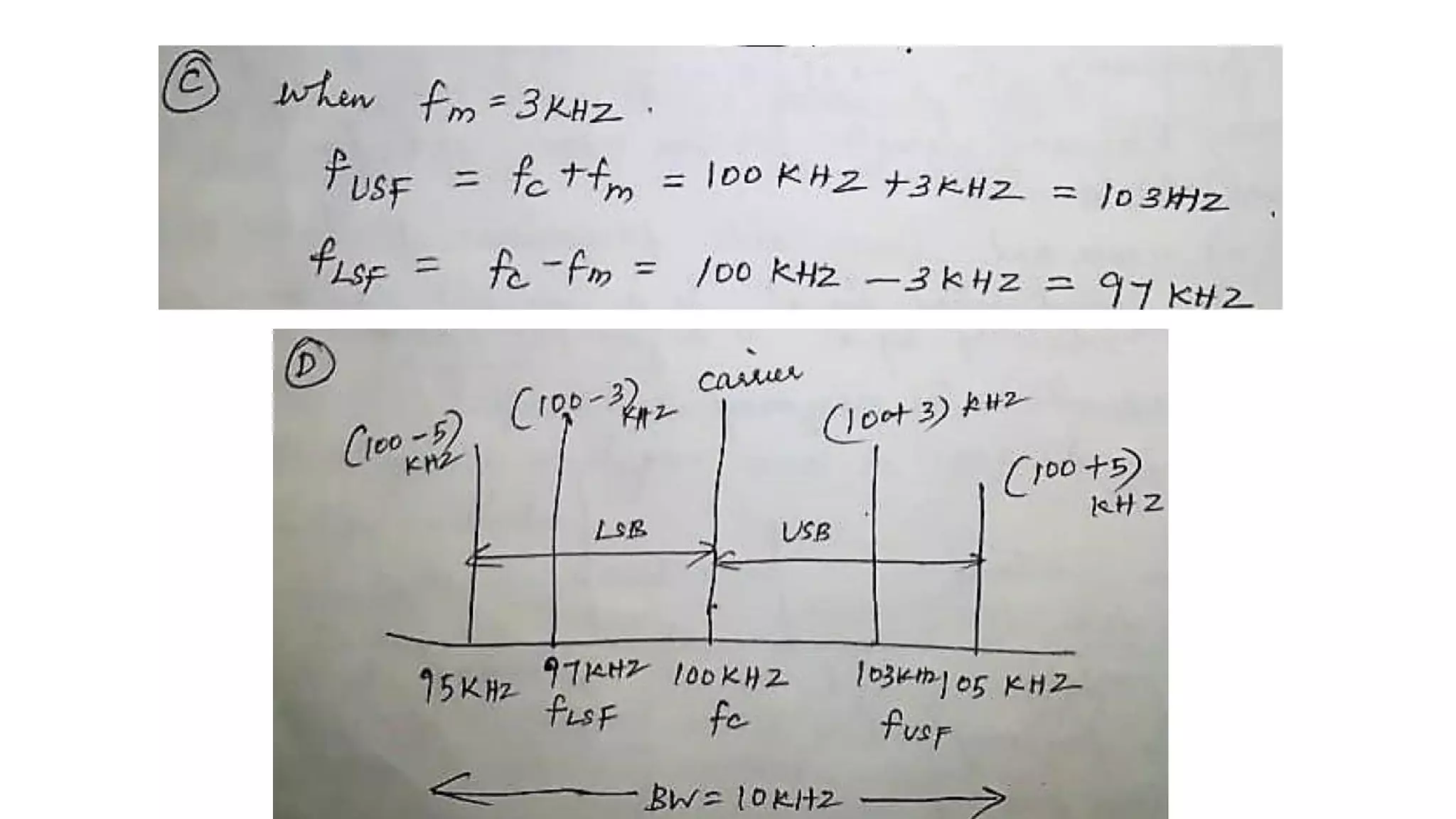
Frequency spectrum of the AM wave/Components of am
AM wave
• Frequencies present in an AM wave:
Carrier frequency and the first pair of sideband frequencies
Frequency spectrum of AM wave/Components of am AM wave
• AM is shown as consisting of three discrete frequencies.
• Carrier frequency and the first pair of sideband frequencies
• The central carrier frequency has the highest amplitude
• The other two have amplitudes equal to each other, can never exceed half the
carrier amplitude.
Frequency spectrum of AM wave/Components of am AM wave
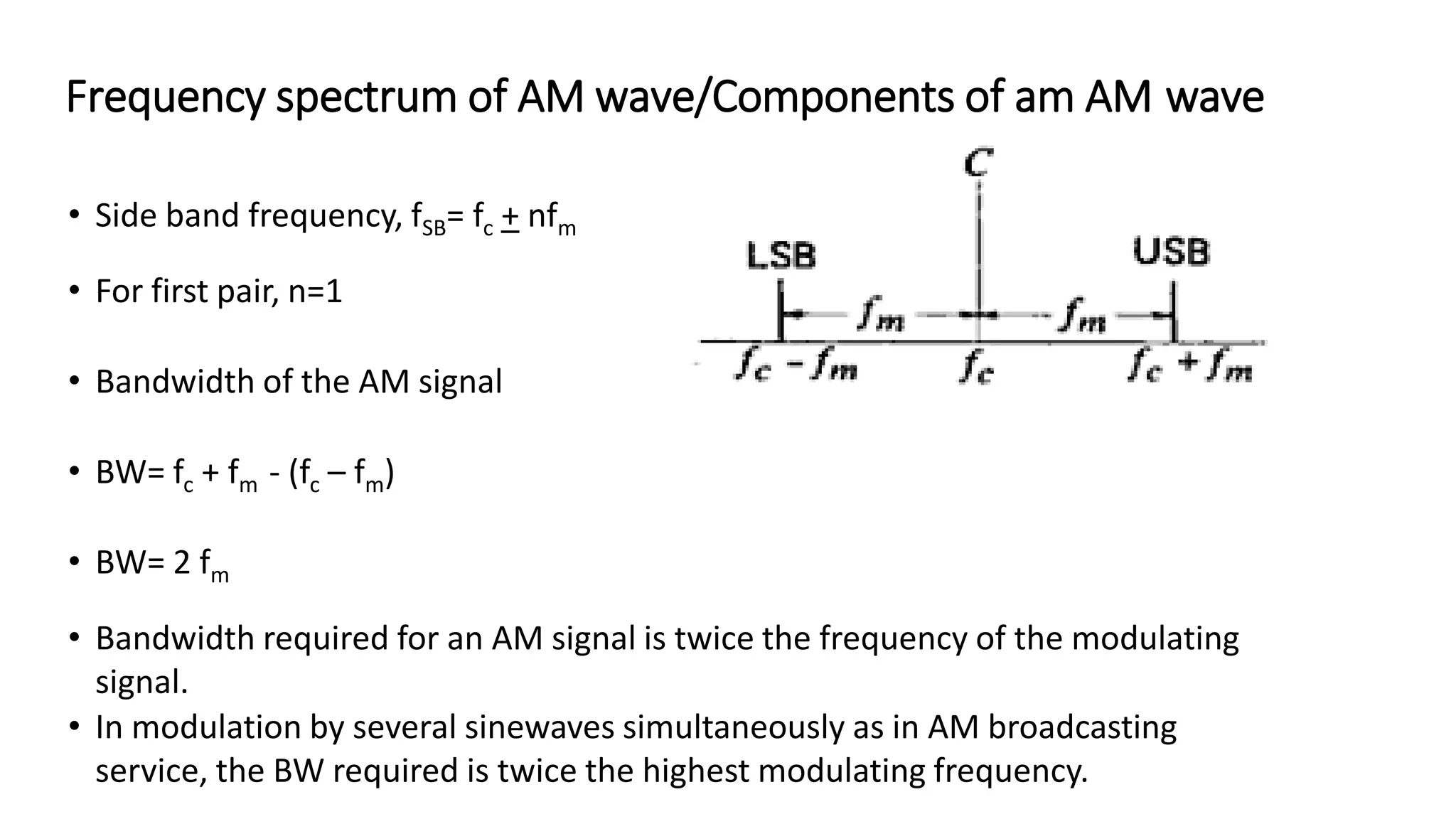
• Side band frequency, fSB= fc + nfm
• For first pair, n=1
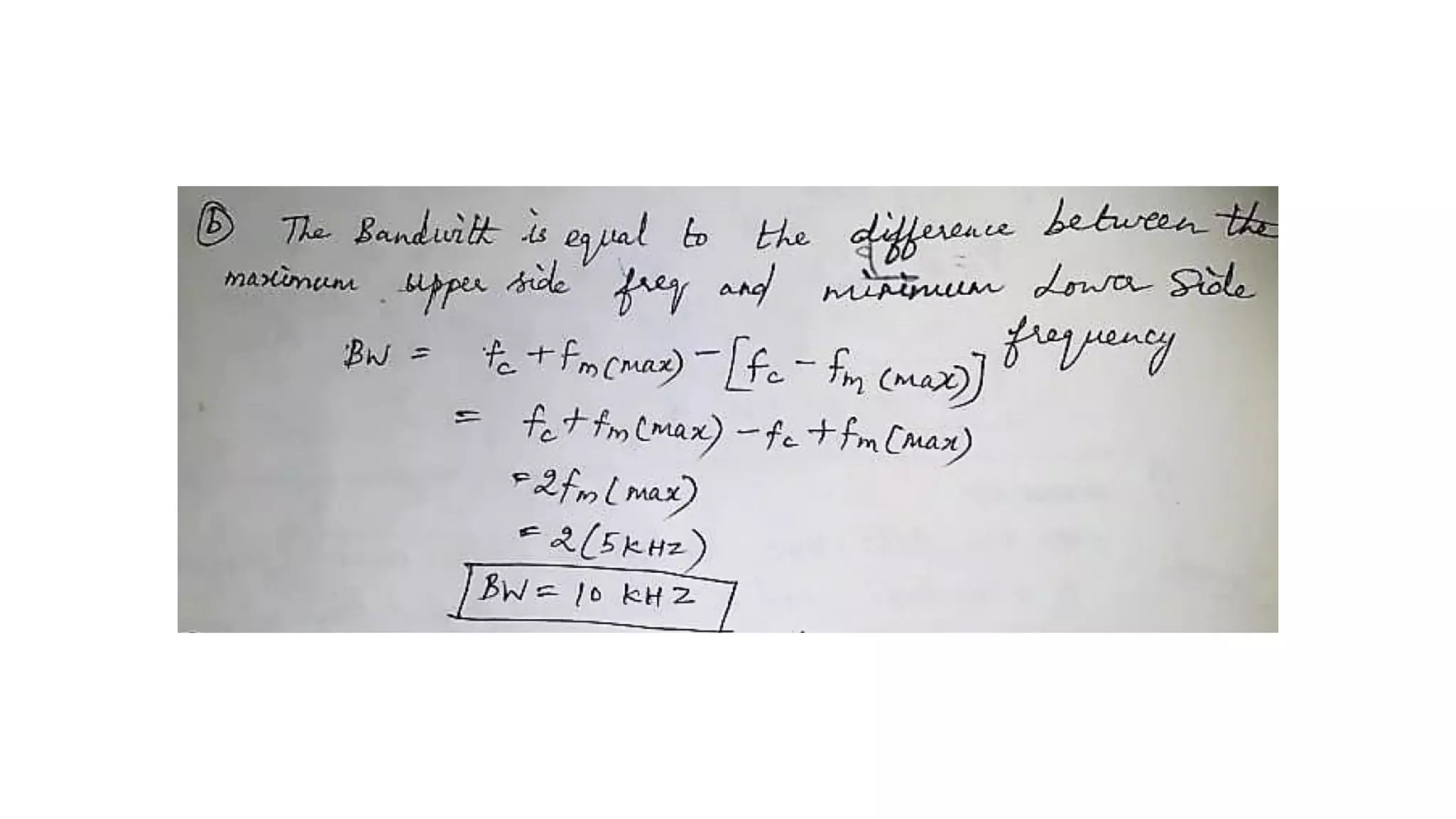
• Bandwidth of the AM signal
• BW= fc + fm - (fc – fm)
• BW= 2 fm
• Bandwidth required for an AM signal is twice the frequency of the modulating
signal.
• In modulation by several sinewaves simultaneously as in AM broadcasting
service, the BW required is twice the highest modulating frequency.
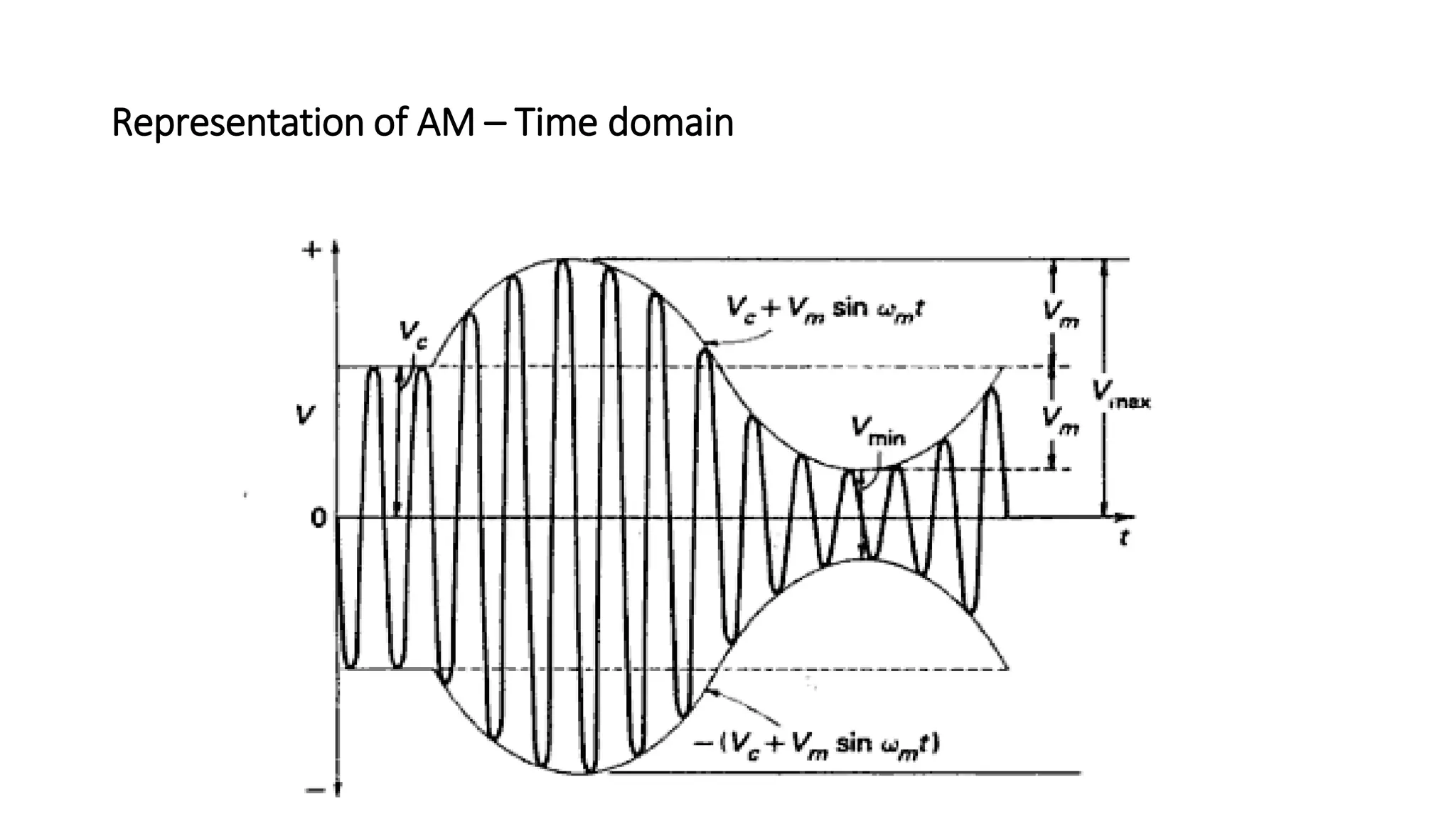
Representation of AM – Time domain
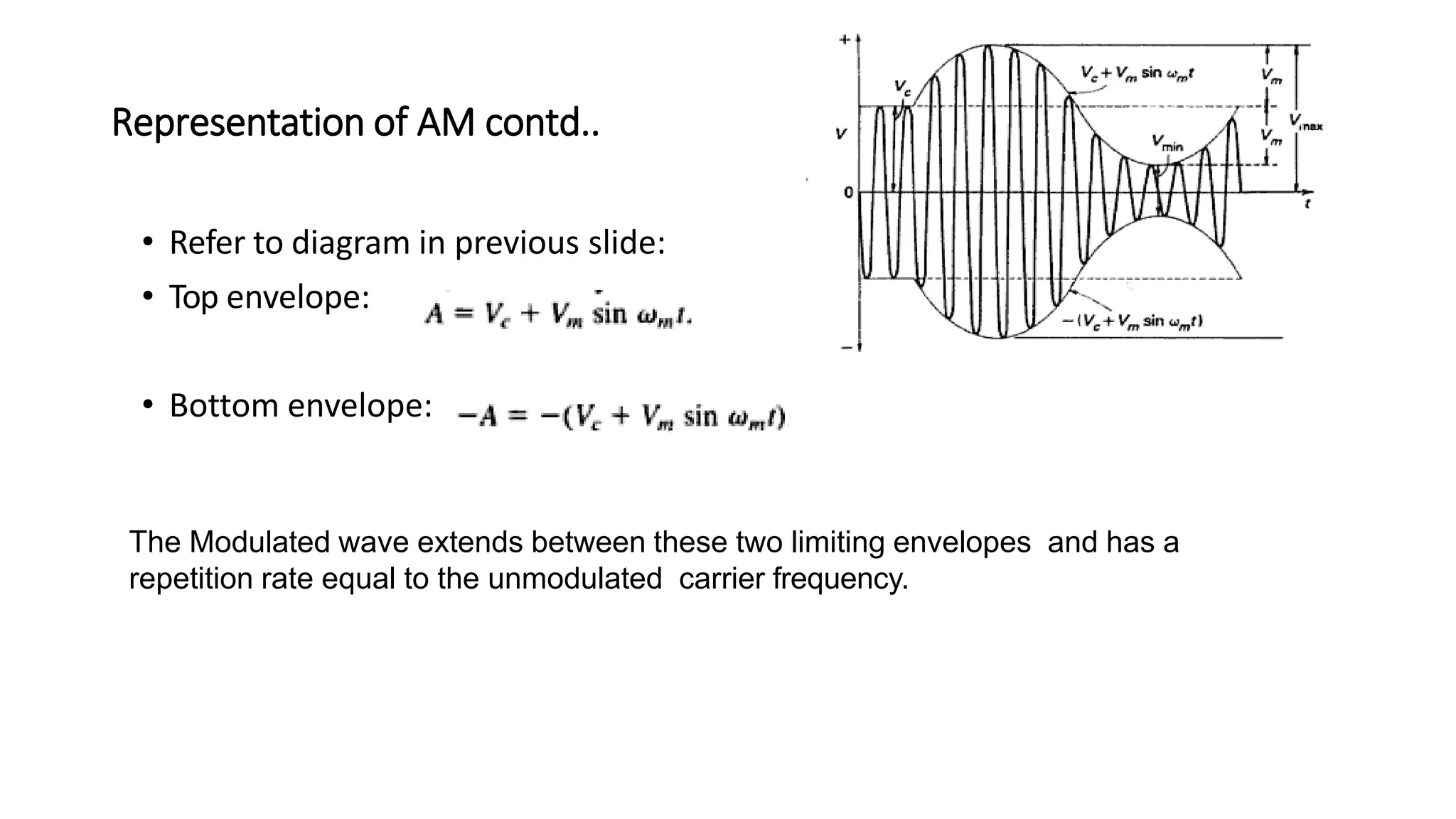
Representation of AM contd..
• Refer to diagram in previous slide:
• Top envelope:
• Bottom envelope:
The Modulated wave extends between these two limiting envelopes and has a
repetition rate equal to the unmodulated carrier frequency.
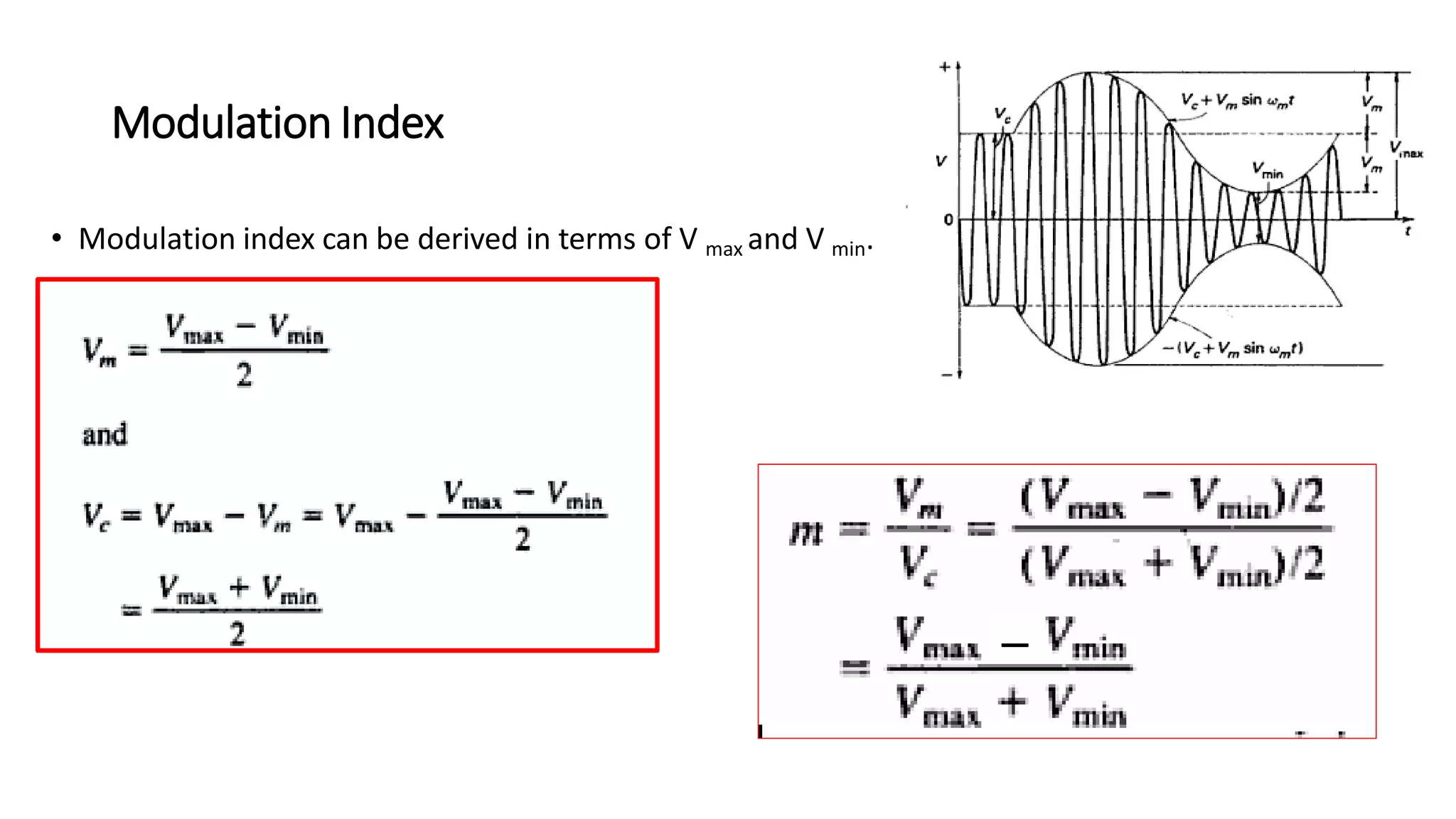
Modulation Index
• Modulation index can be derived in terms of V max and V min.
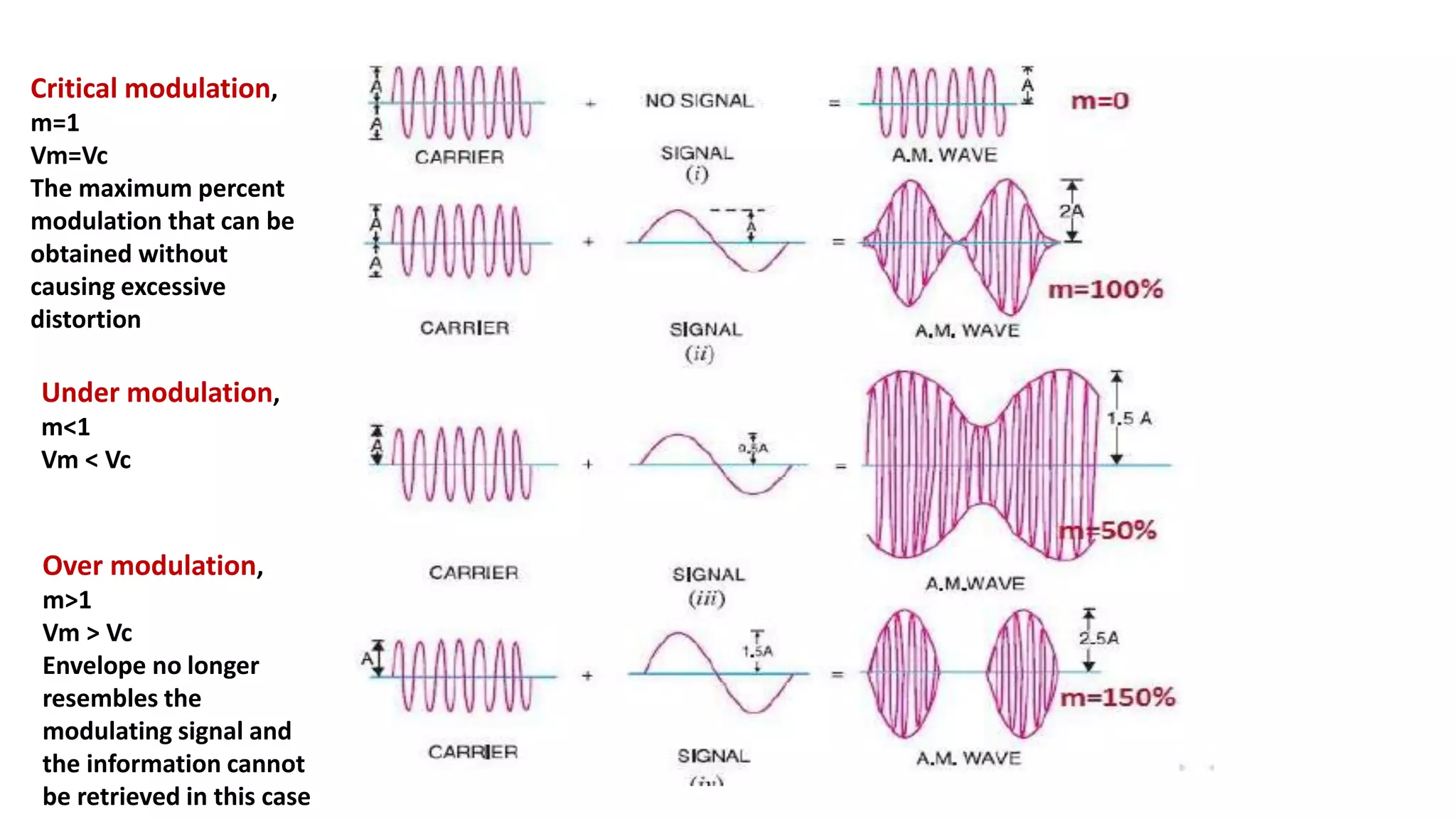
Critical modulation,
m=1
Vm=Vc
The maximum percent
modulation that can be
obtained without
causing excessive
distortion
Under modulation,
m<1
Vm < Vc
Over modulation,
m>1
Vm > Vc
Envelope no longer
resembles the
modulating signal and
the information cannot
be retrieved in this case
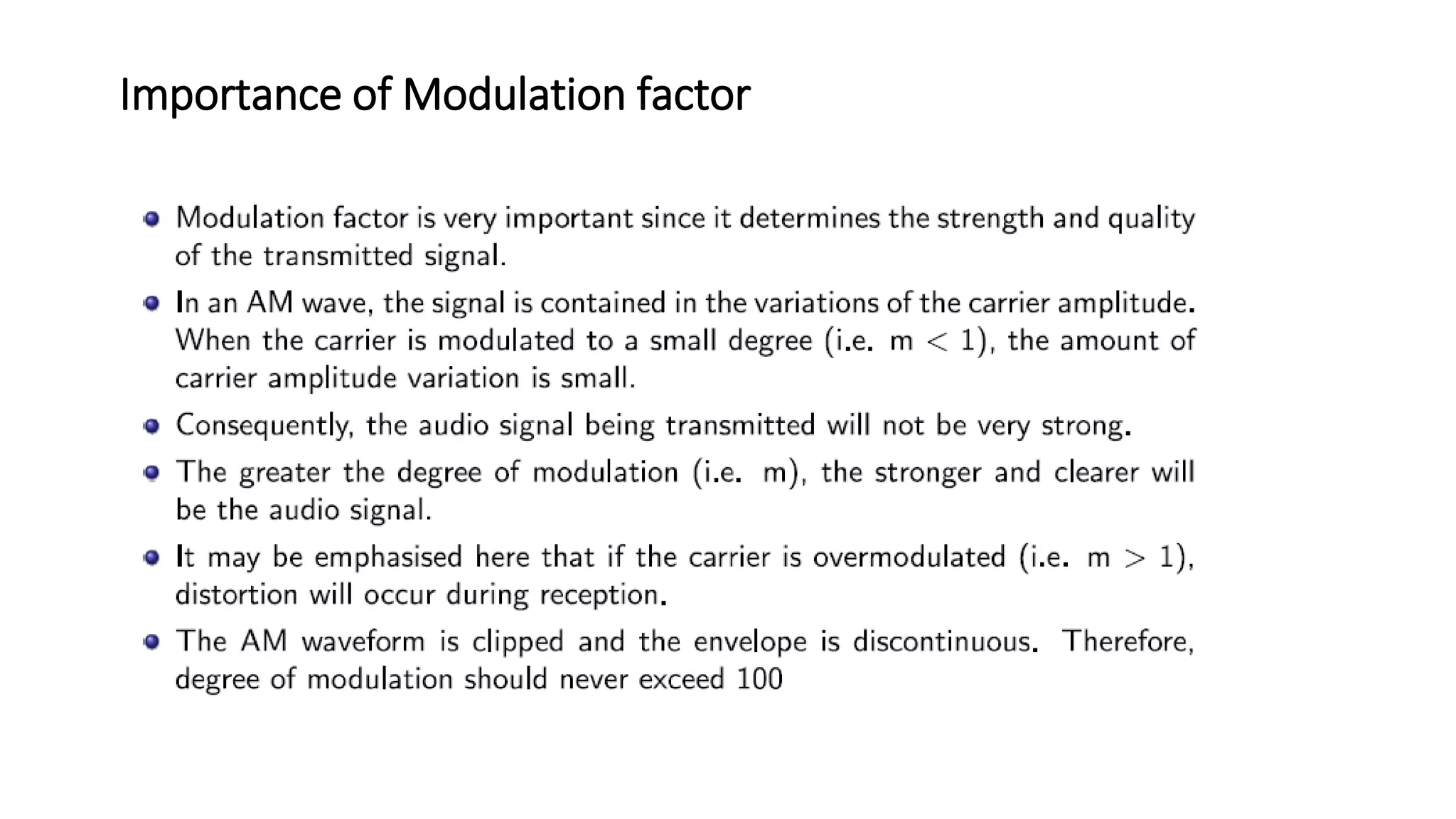
Importance of Modulation factor
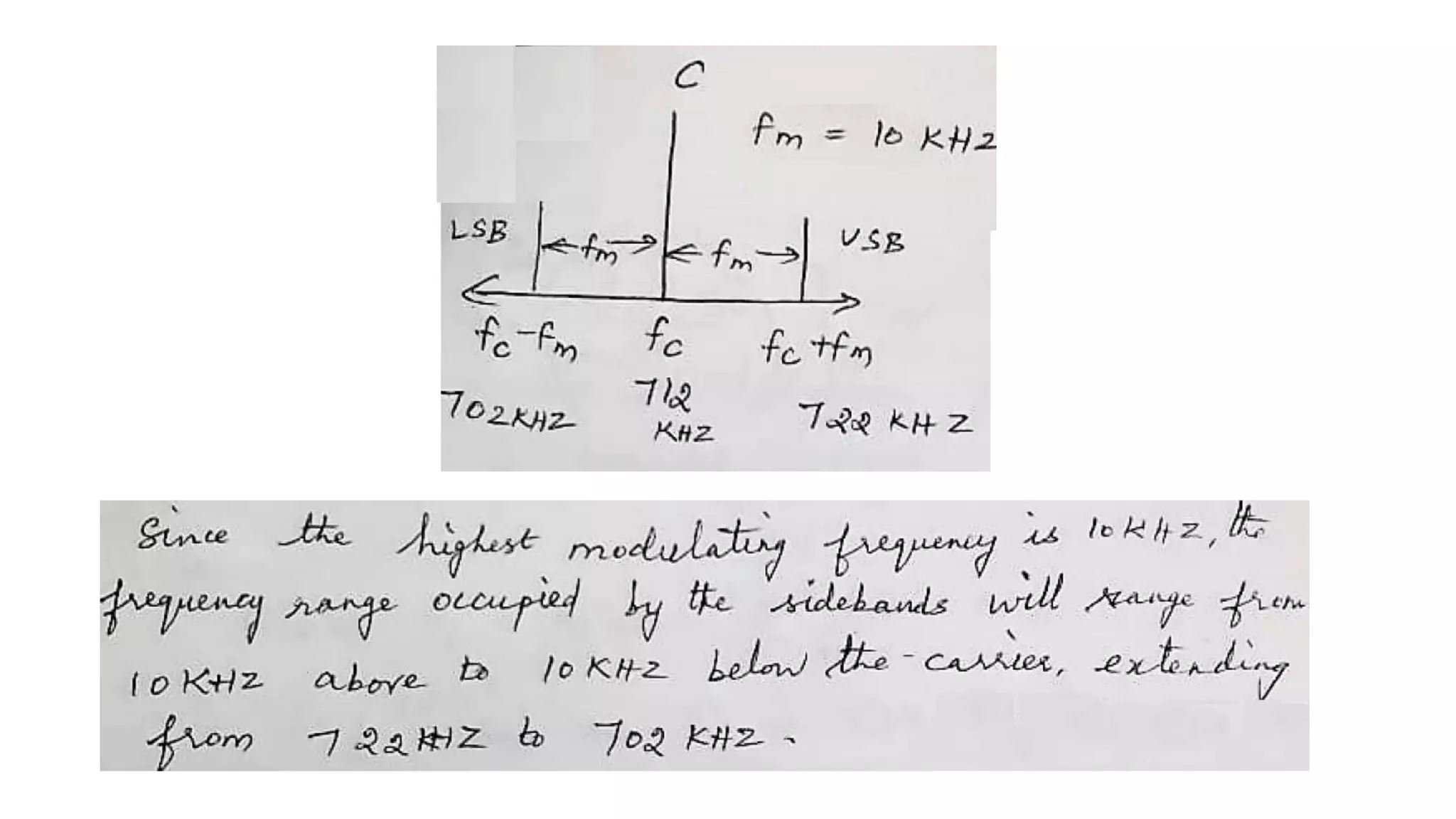
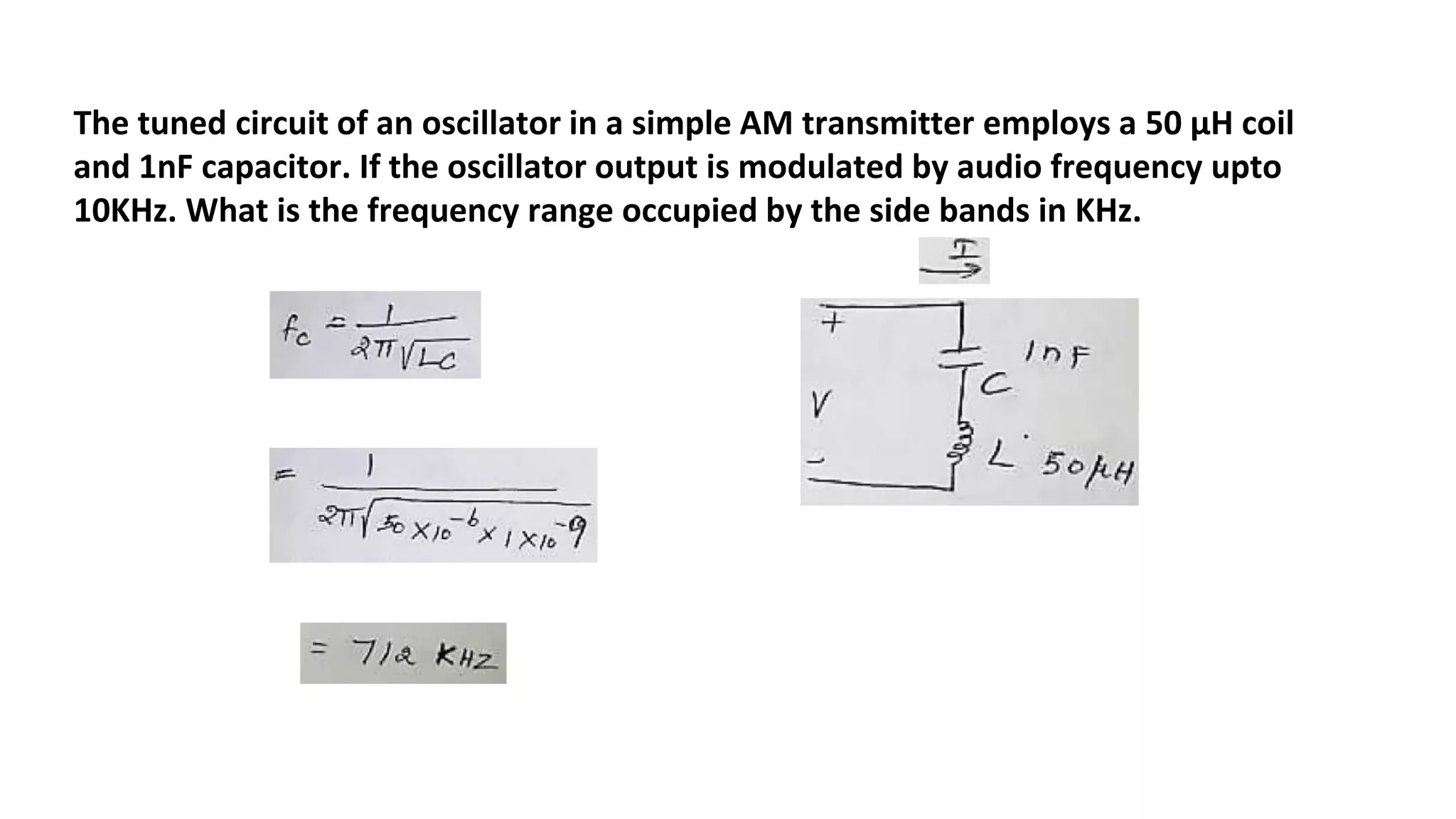
The tuned circuit of an oscillator in a simple AM transmitter employs a 50 μH coil
and 1nF capacitor. If the oscillator output is modulated by audio frequency upto
10KHz. What is the frequency range occupied by the side bands in KHz.
Power relations in AM wave
• The modulated wave contains extra energy in the two sidebands.
• Since amplitude of sidebands depend on the modulation index, it is anticipated
that total power will also depend on the modulation index.
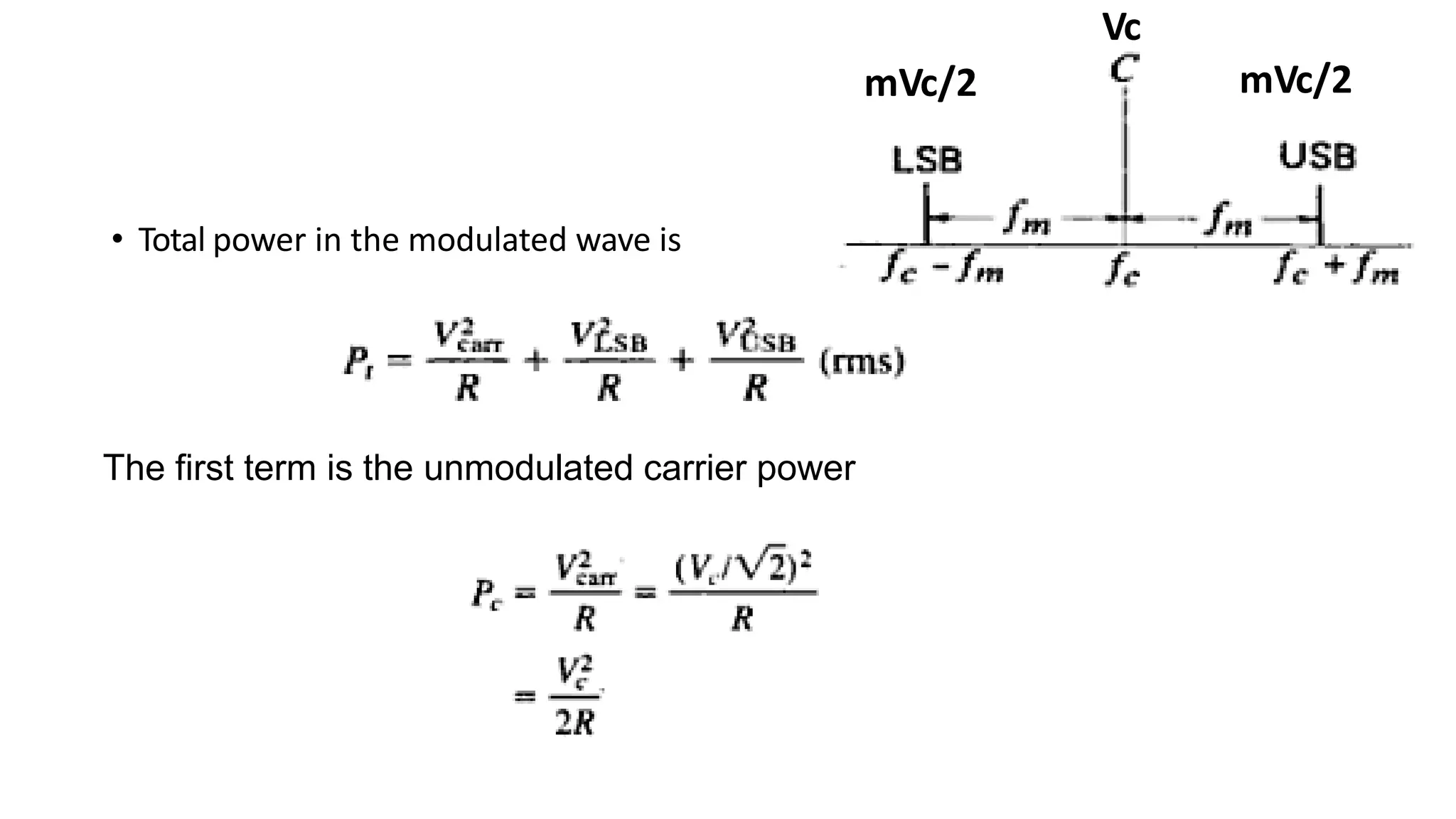
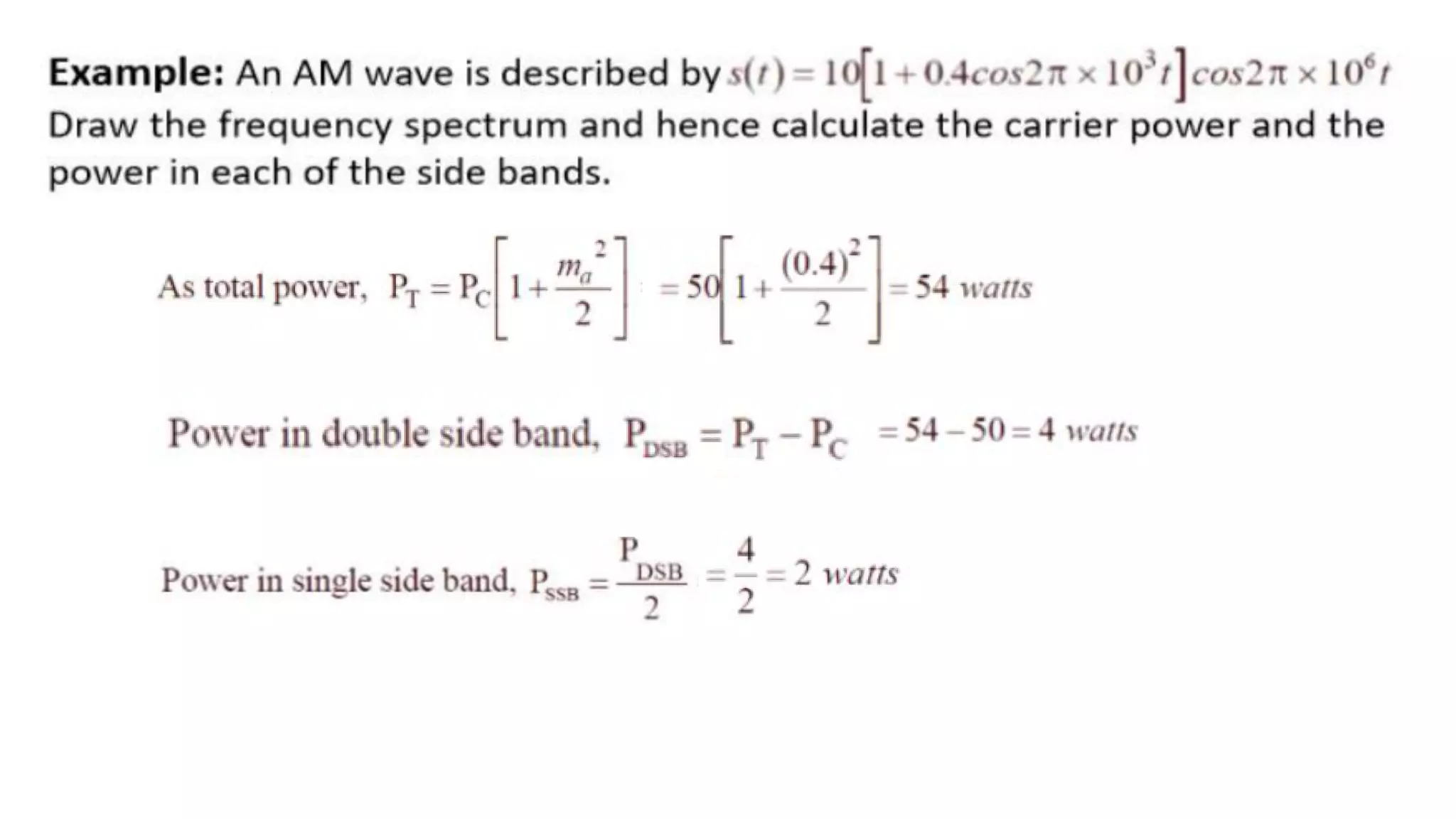
• Total power in the modulated wave is
The first term is the unmodulated carrier power
mVc/2 mVc/2
Vc
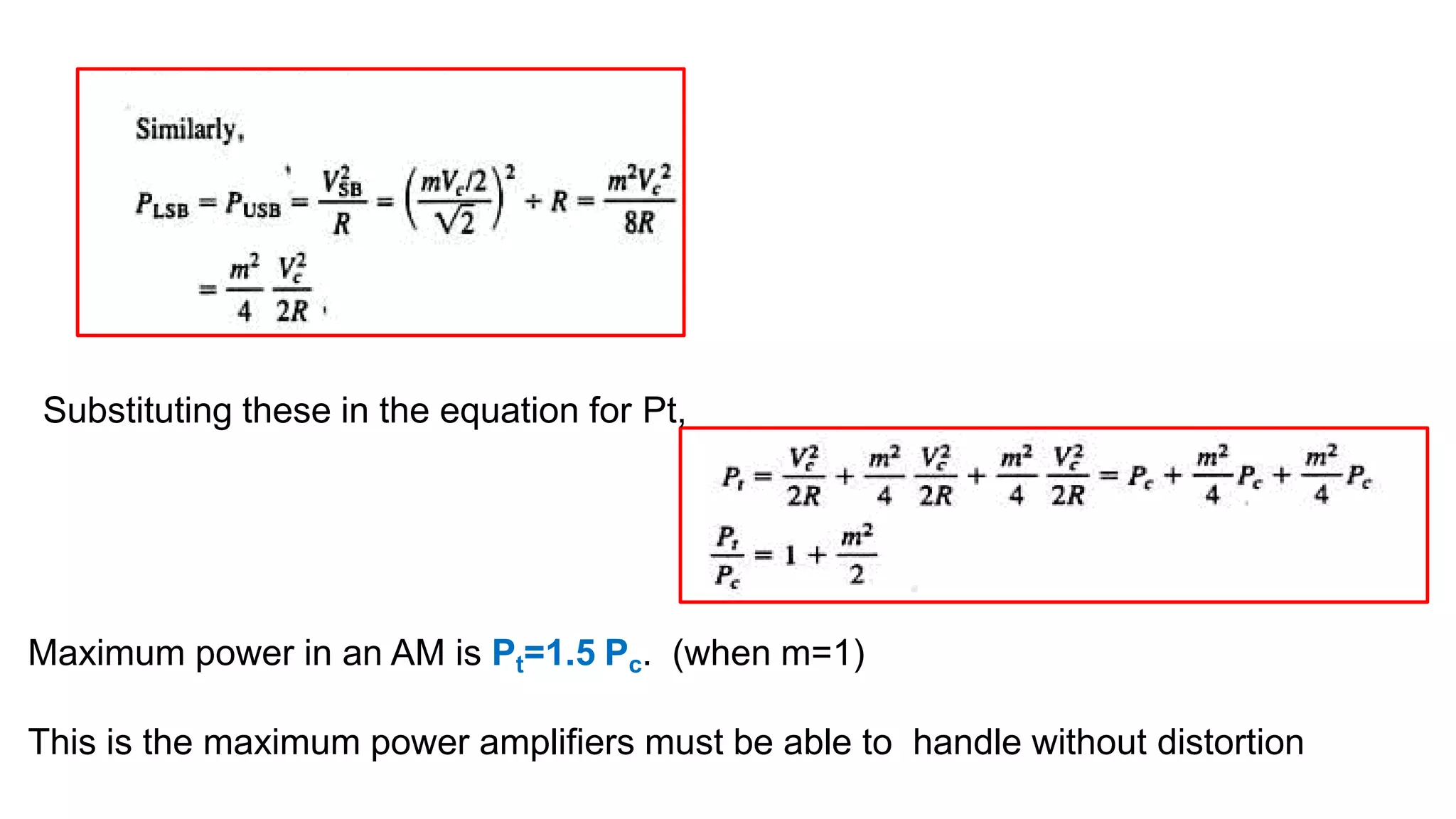
Substituting these in the equation for Pt,
Maximum power in an AM is Pt=1.5 Pc. (when m=1)
This is the maximum power amplifiers must be able to handle without distortion
Current relations:
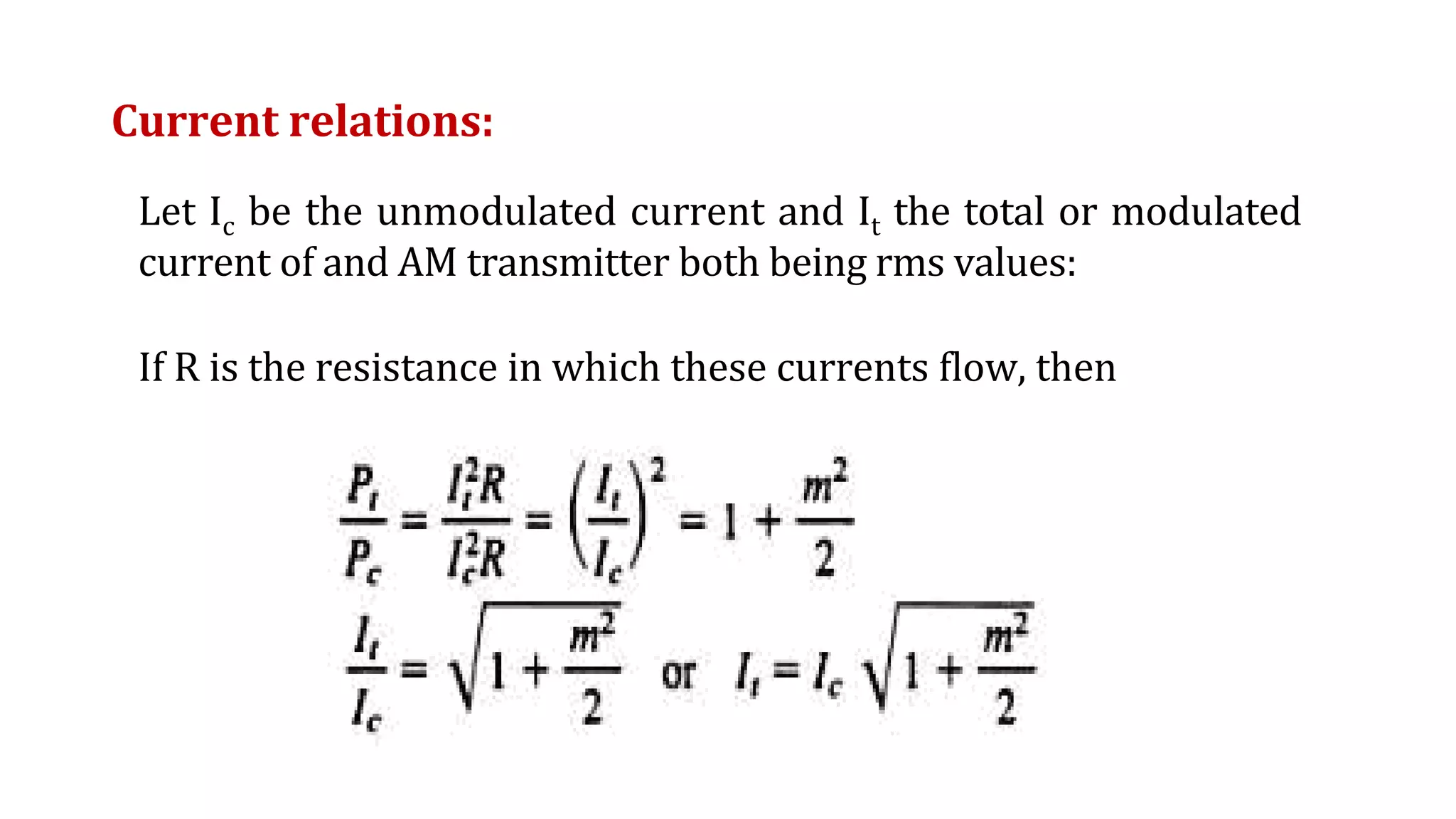
Let Ic be the unmodulated current and It the total or modulated
current of and AM transmitter both being rms values:
If R is the resistance in which these currents flow, then
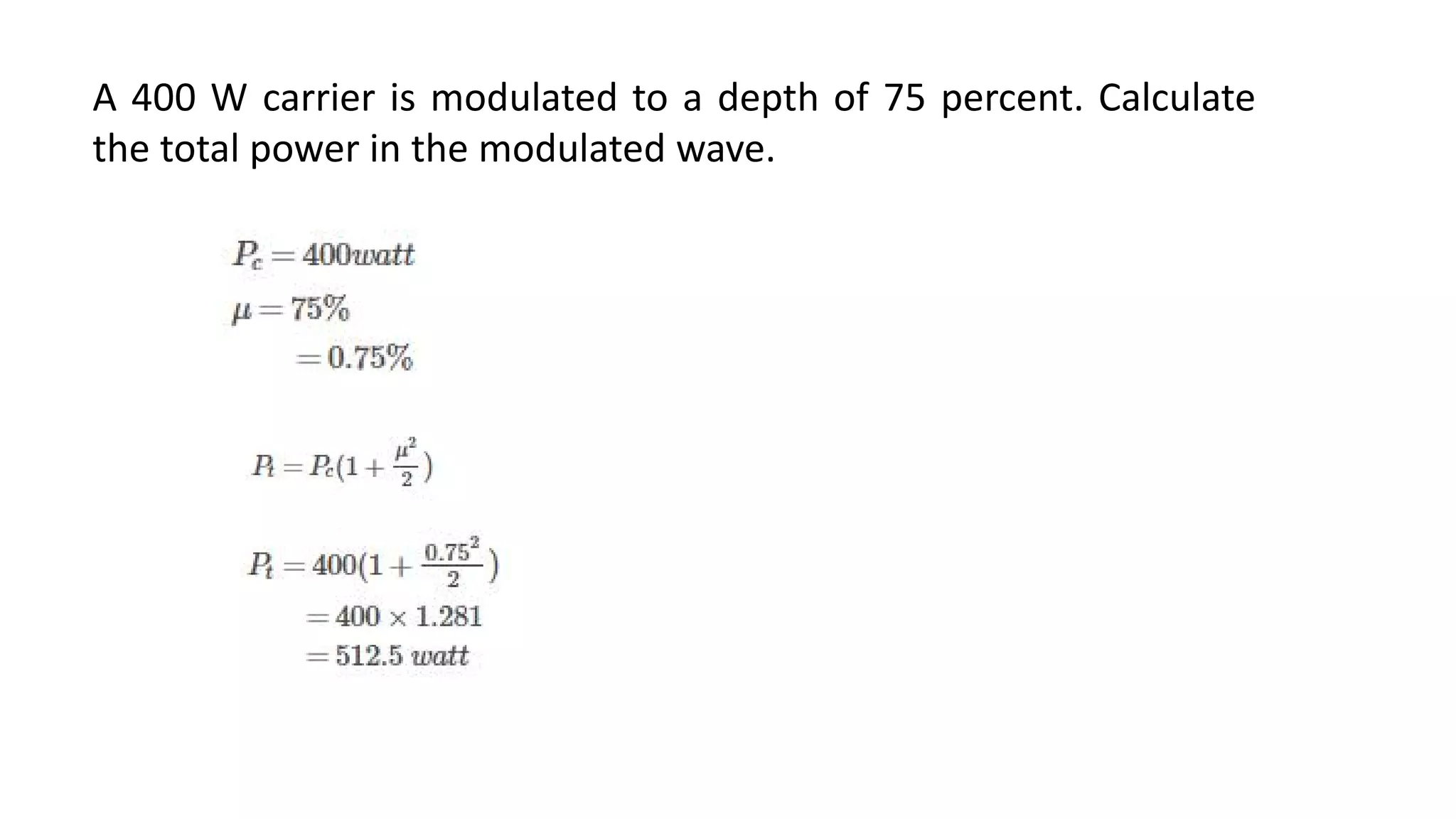
A 400 W carrier is modulated to a depth of 75 percent. Calculate
the total power in the modulated wave.
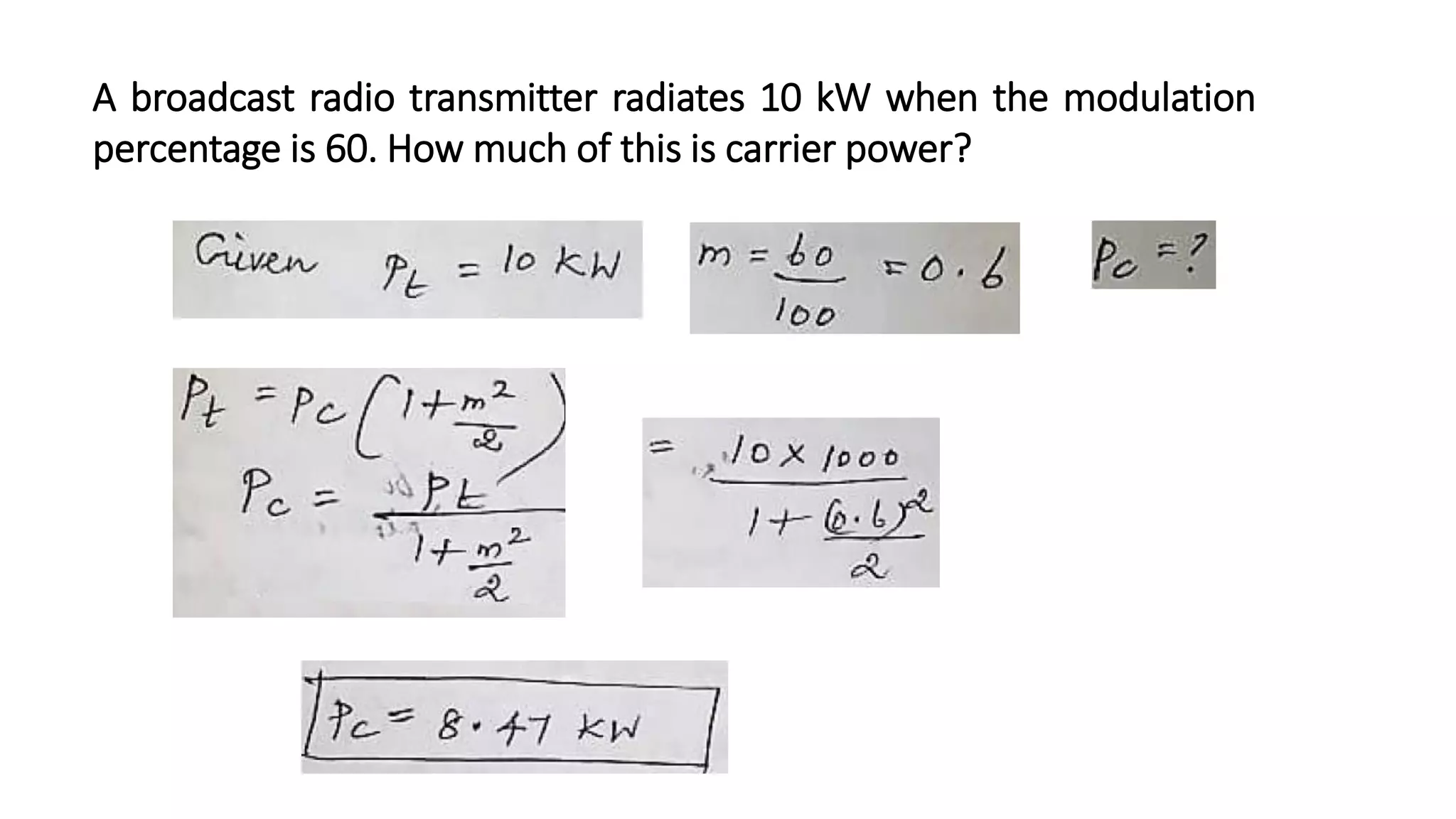
A broadcast radio transmitter radiates 10 kW when the modulation
percentage is 60. How much of this is carrier power?
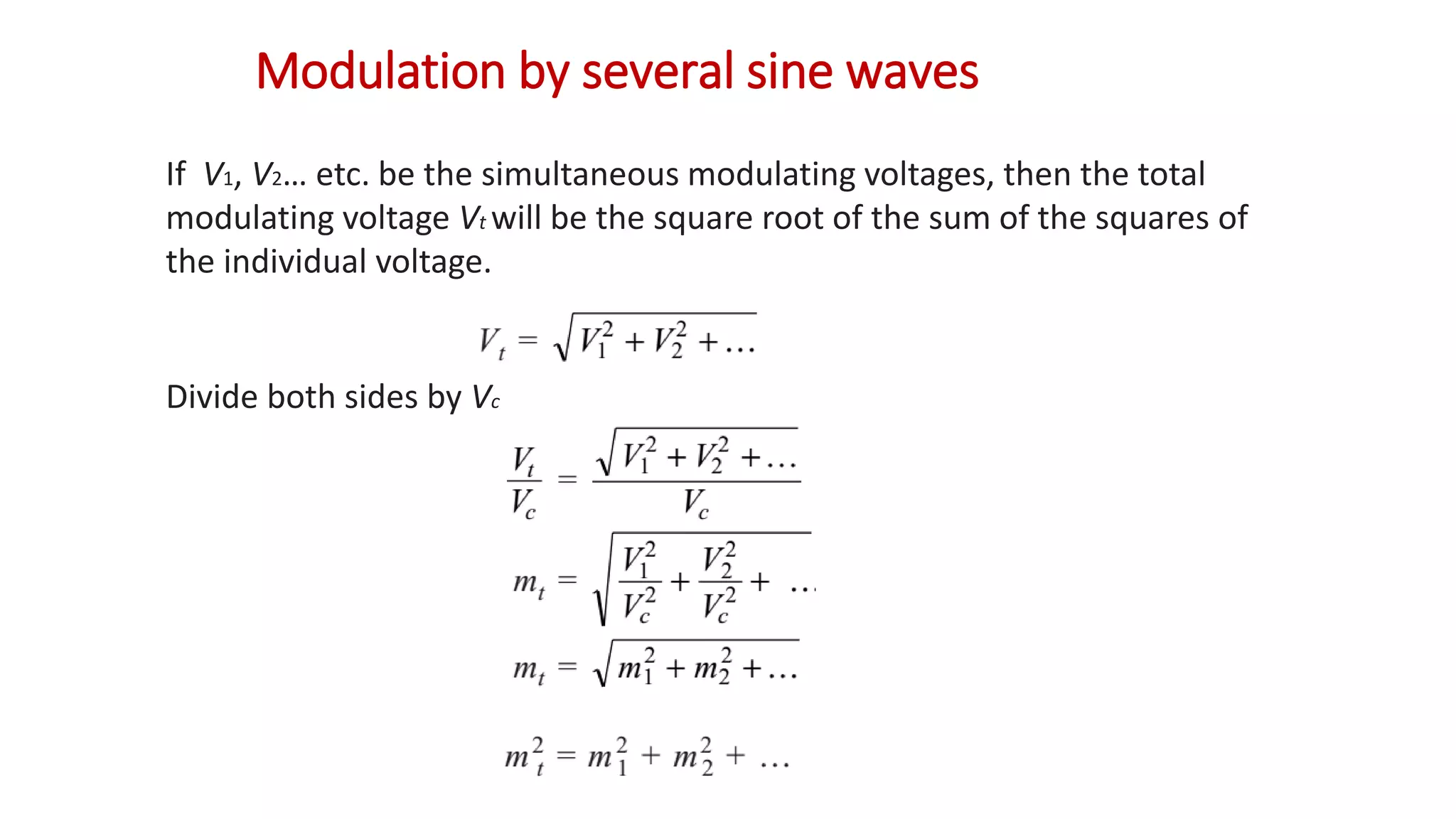
Modulation by several sine waves
If V1, V2… etc. be the simultaneous modulating voltages, then the total
modulating voltage Vt will be the square root of the sum of the squares of
the individual voltage.
Divide both sides by Vc
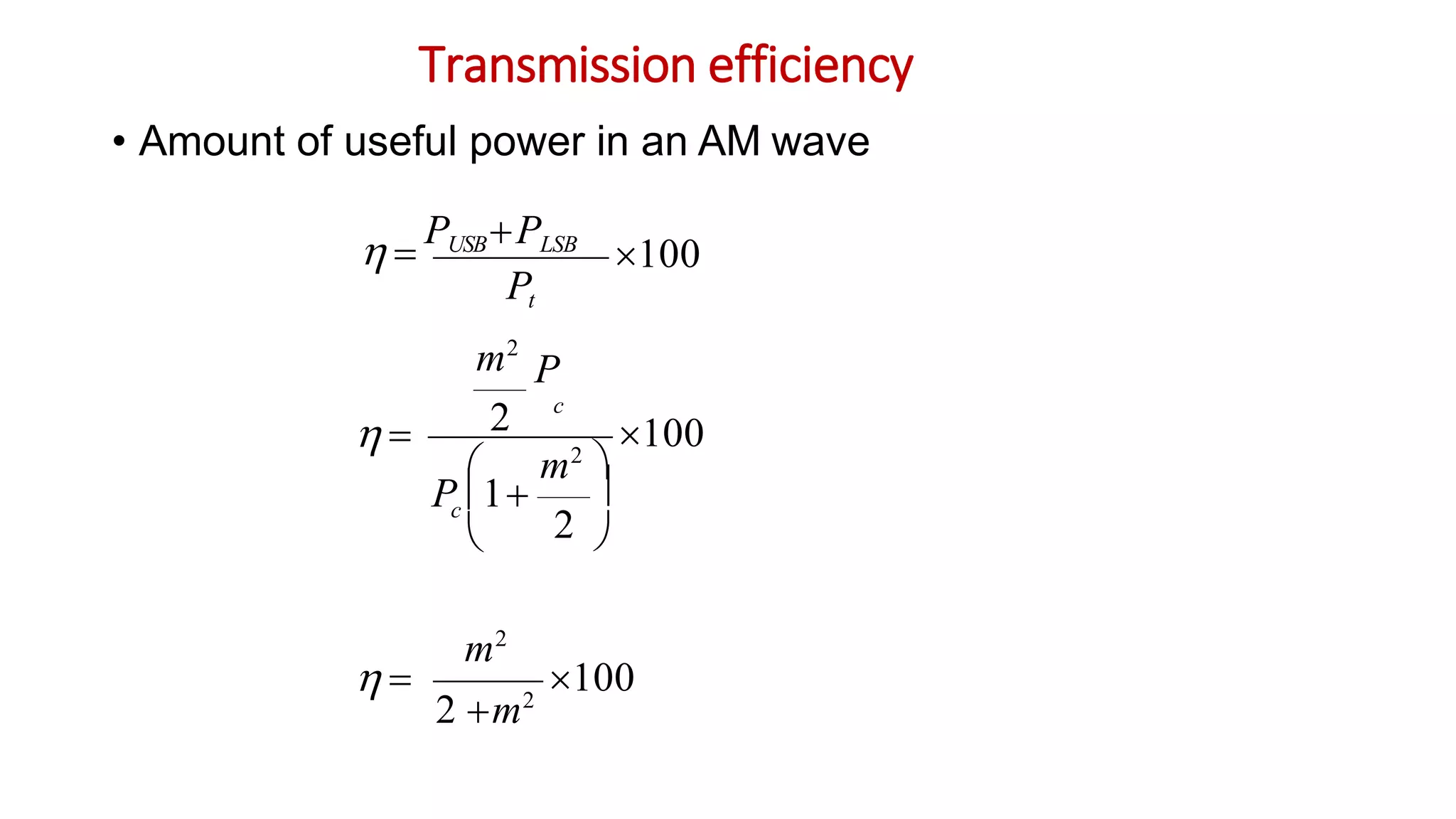
Transmission efficiency
• Amount of useful power in an AM wave
100
Pt
 
PUSBPLSB
100
2
m2
P
2 c




 m2

P 1
 
c
100
2 m2
m2
 
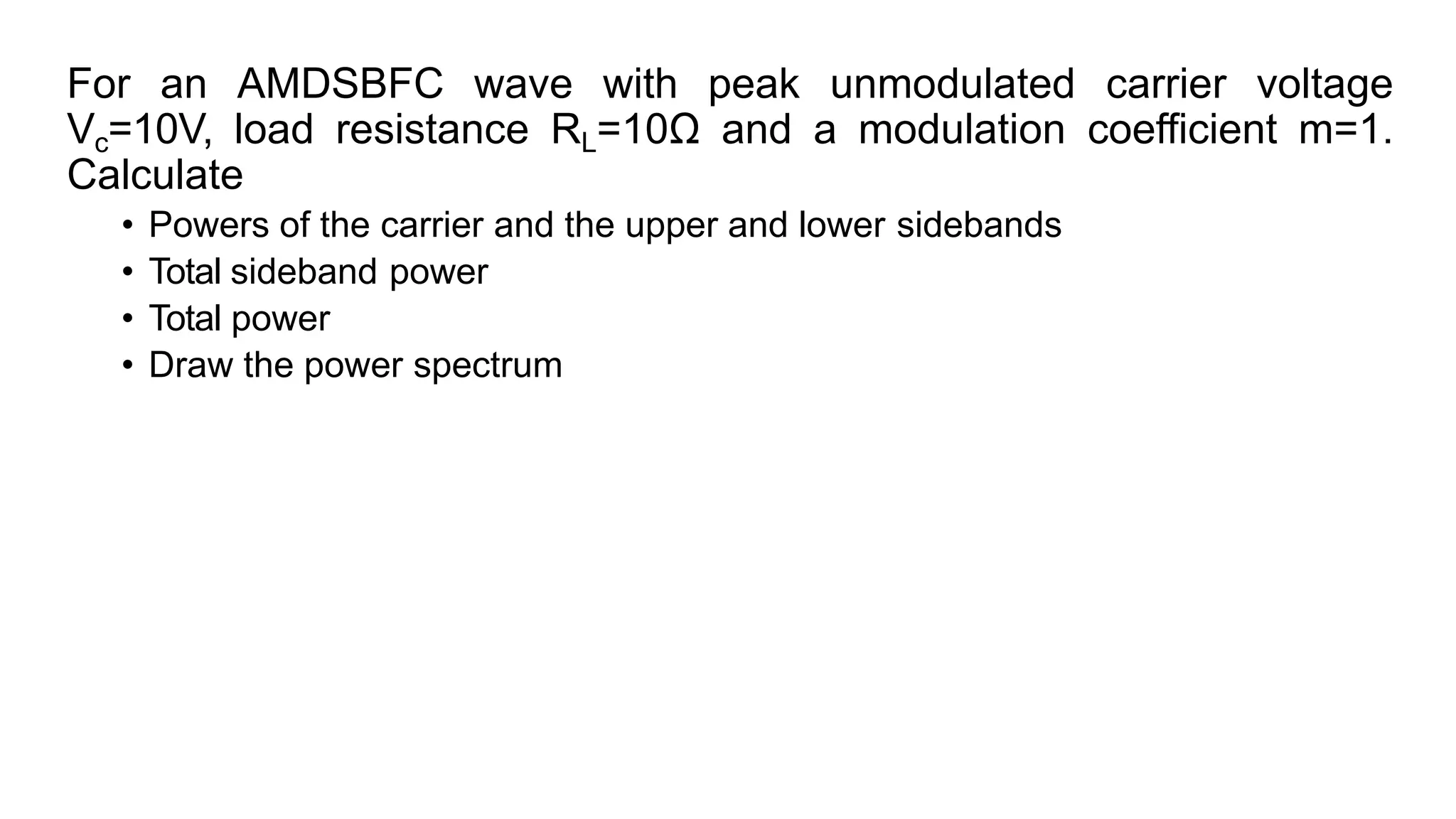
For an AMDSBFC wave with peak unmodulated carrier voltage
Vc=10V, load resistance RL=10Ω and a modulation coefficient m=1.
Calculate
• Powers of the carrier and the upper and lower sidebands
• Total sideband power
• Total power
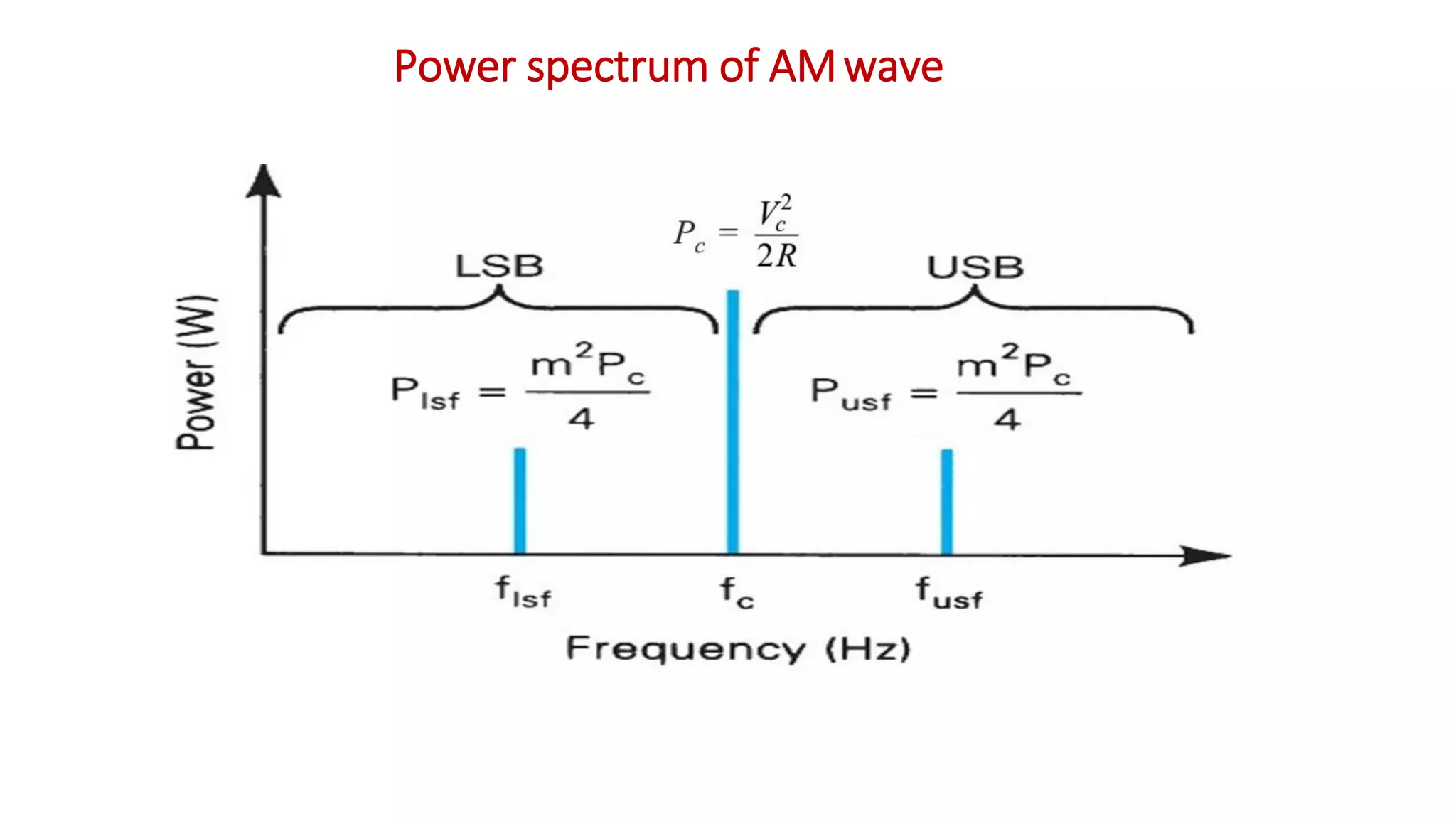
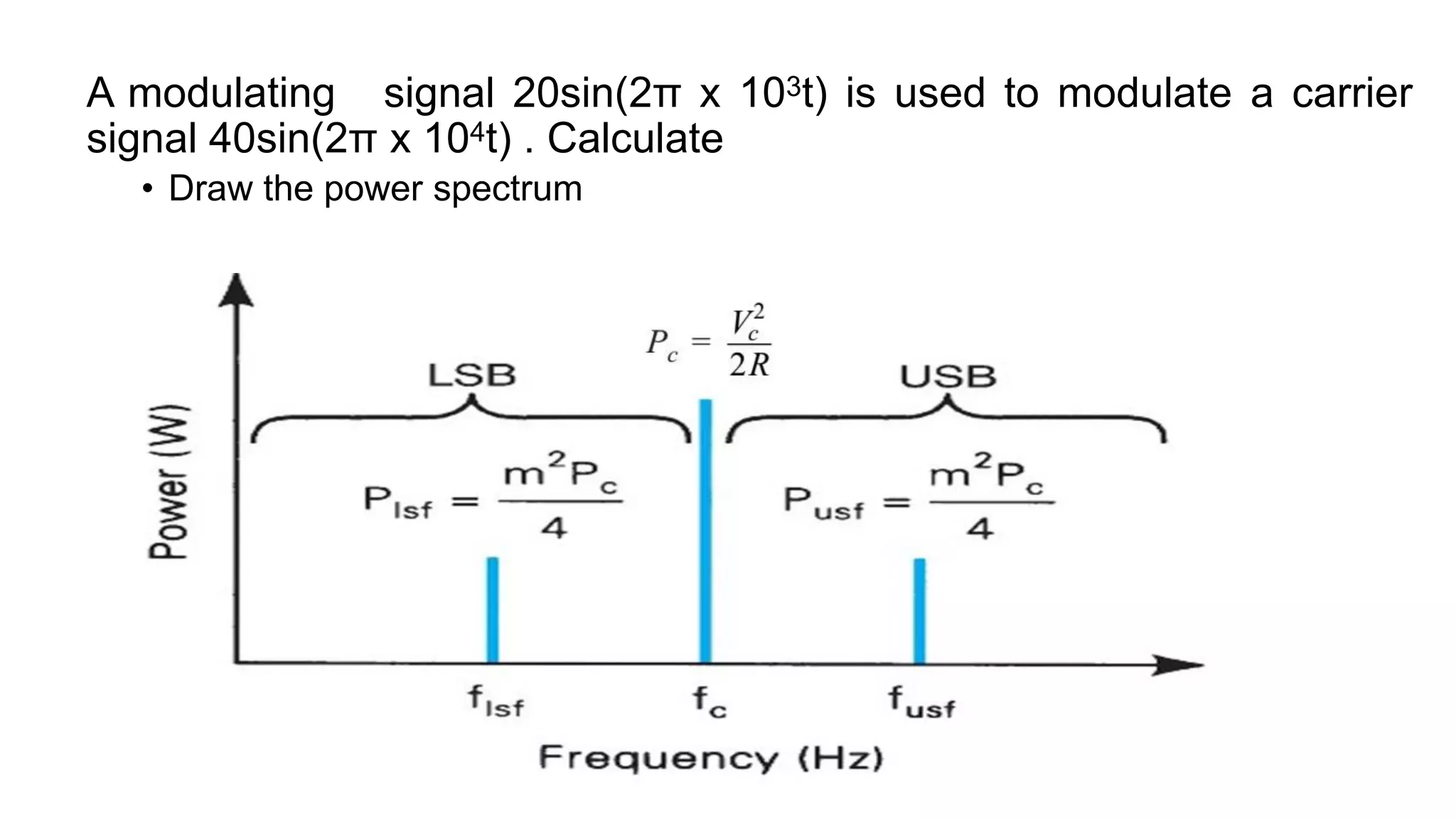
• Draw the power spectrum
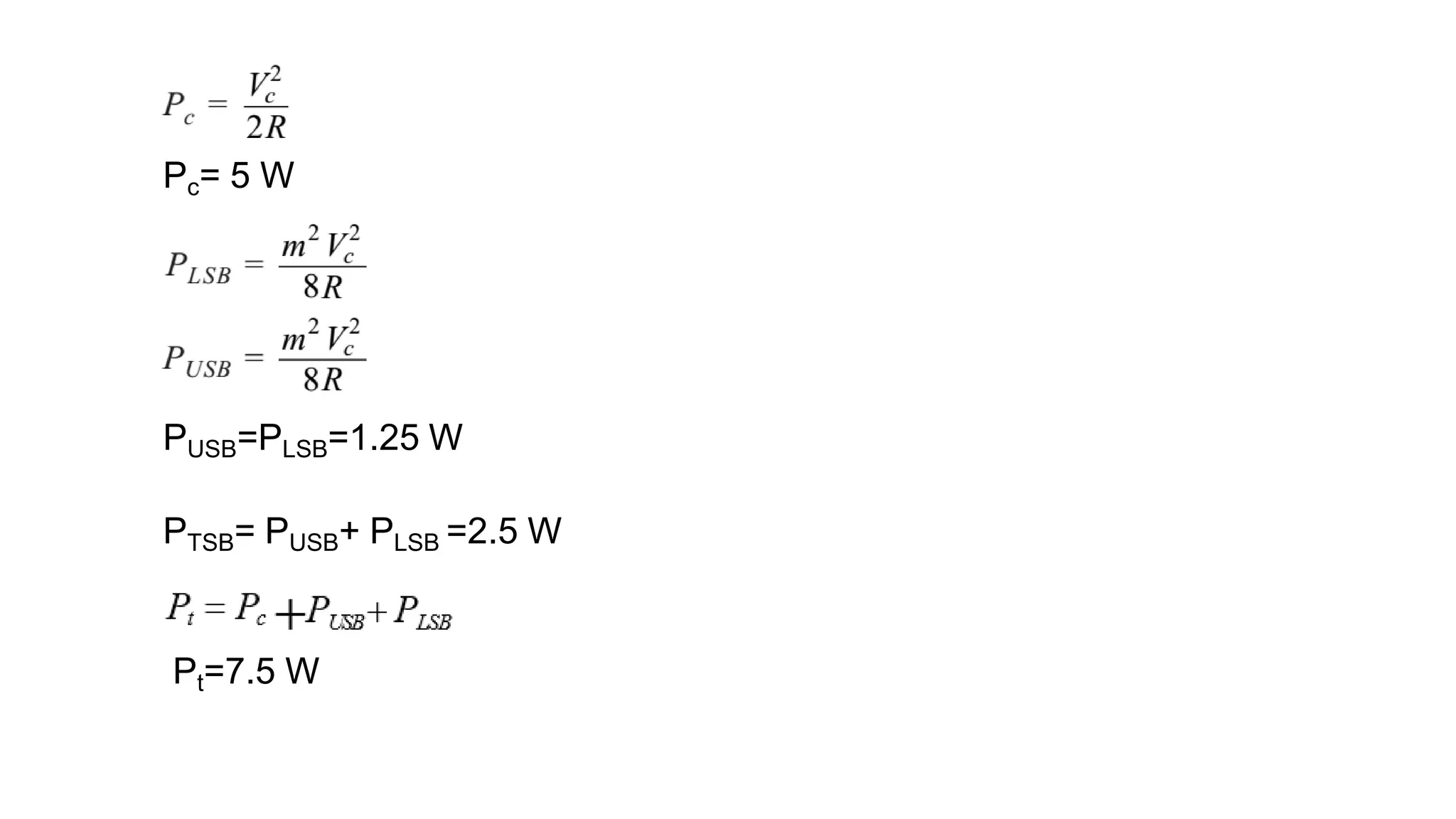
Pc= 5 W
PUSB=PLSB=1.25 W
PTSB= PUSB+ PLSB =2.5 W
Pt=7.5 W
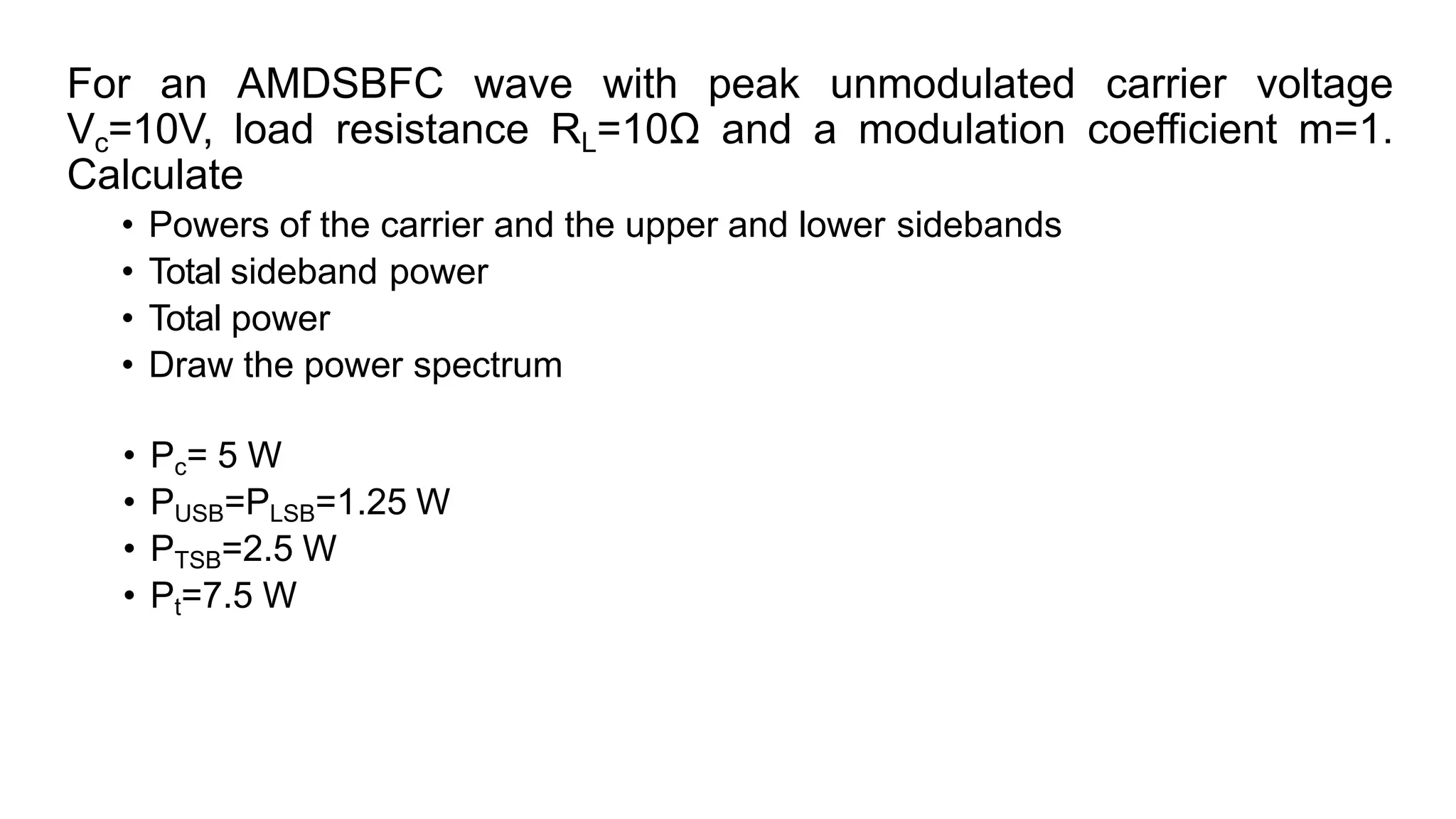
For an AMDSBFC wave with peak unmodulated carrier voltage
Vc=10V, load resistance RL=10Ω and a modulation coefficient m=1.
Calculate
• Powers of the carrier and the upper and lower sidebands
• Total sideband power
• Total power
• Draw the power spectrum
• Pc= 5 W
• PUSB=PLSB=1.25 W
• PTSB=2.5 W
• Pt=7.5 W
Power spectrum of AMwave
Frequency Spectrum of AM wave
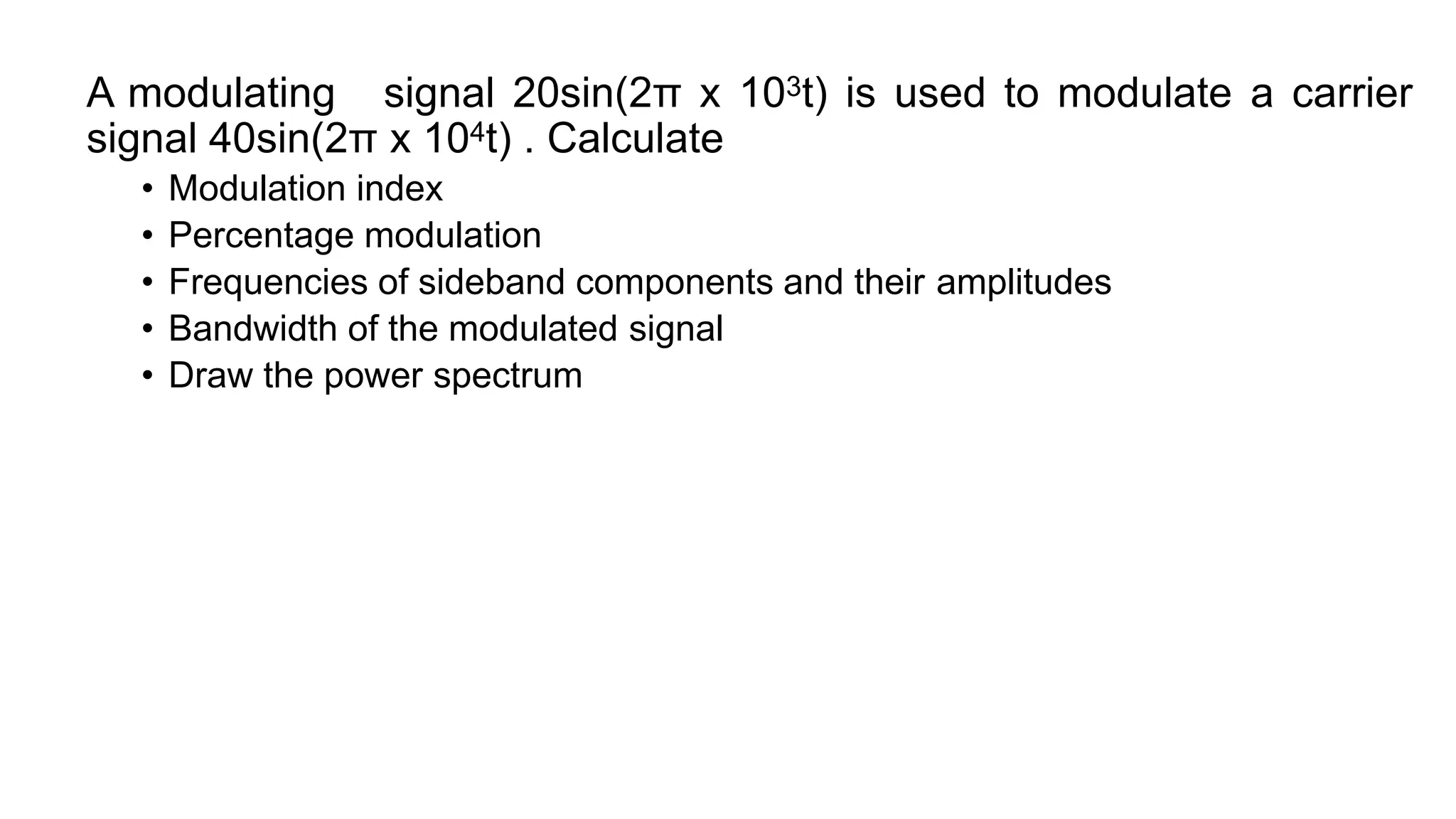
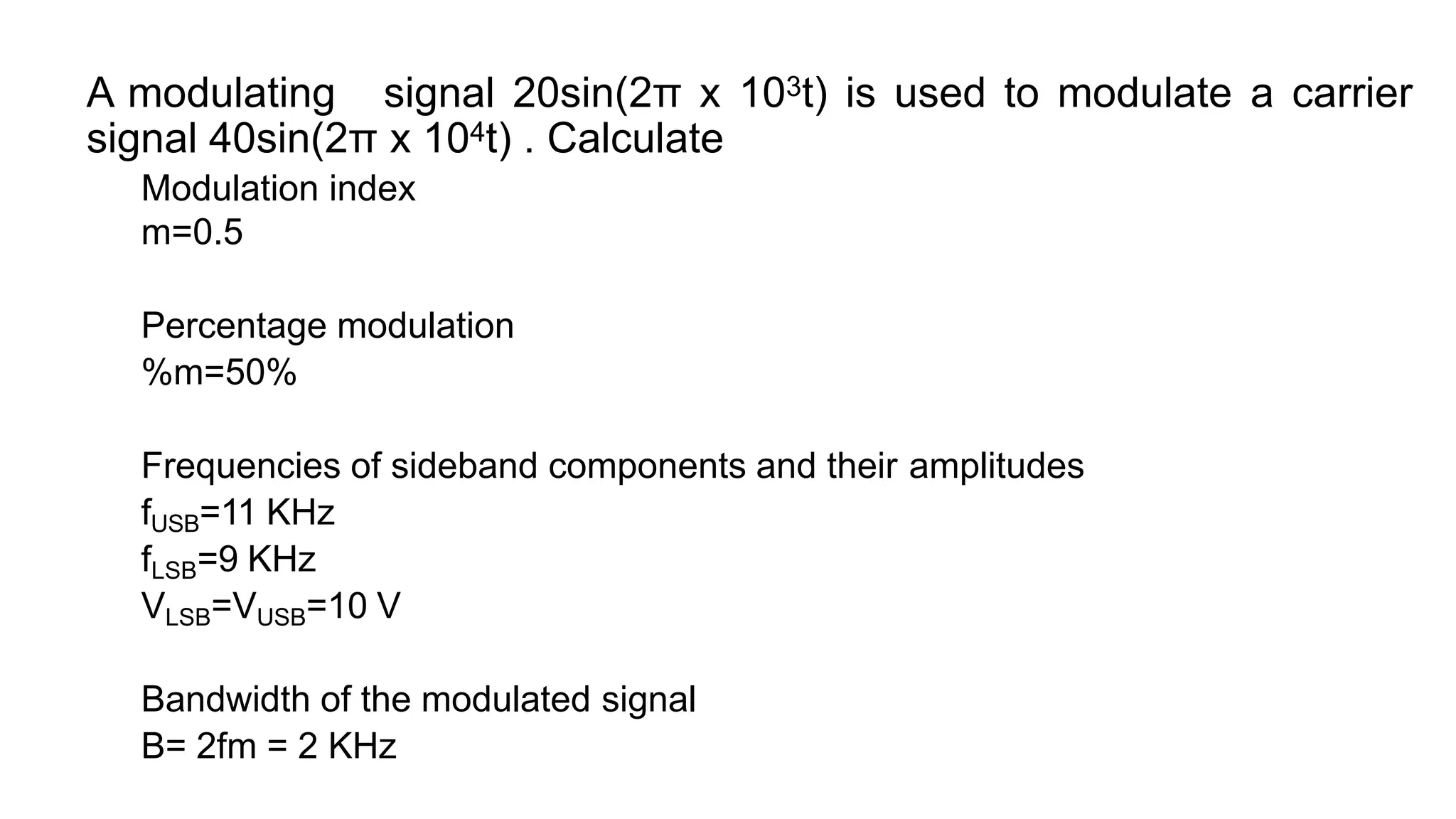
A modulating signal 20sin(2π x 103t) is used to modulate a carrier
signal 40sin(2π x 104t) . Calculate
• Modulation index
• Percentage modulation
• Frequencies of sideband components and their amplitudes
• Bandwidth of the modulated signal
• Draw the power spectrum
A modulating signal 20sin(2π x 103t) is used to modulate a carrier
signal 40sin(2π x 104t) . Calculate
Modulation index
m=0.5
Percentage modulation
%m=50%
Frequencies of sideband components and their amplitudes
fUSB=11 KHz
fLSB=9 KHz
VLSB=VUSB=10 V
Bandwidth of the modulated signal
B= 2fm = 2 KHz
A modulating signal 20sin(2π x 103t) is used to modulate a carrier
signal 40sin(2π x 104t) . Calculate
• Draw the power spectrum
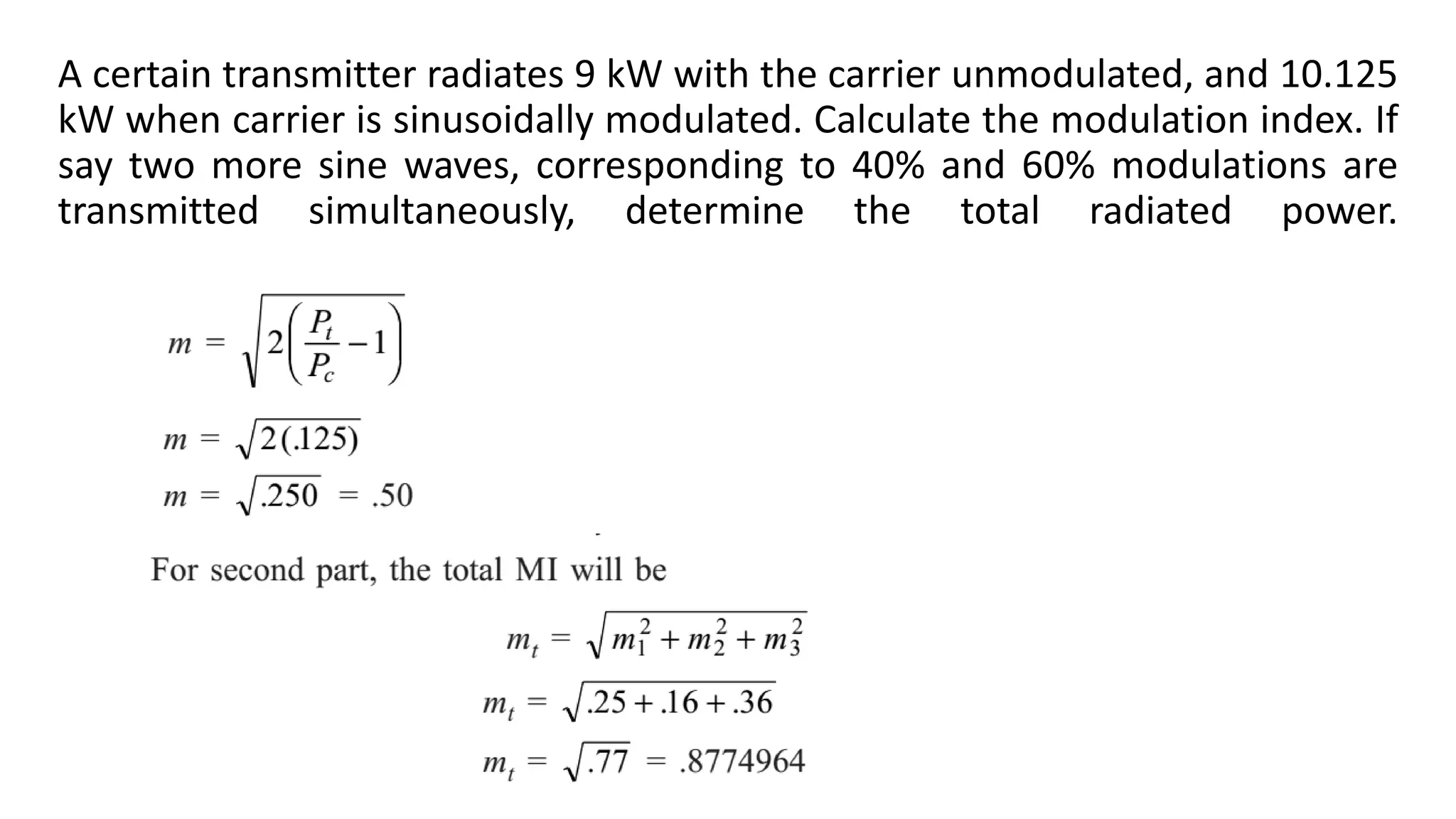
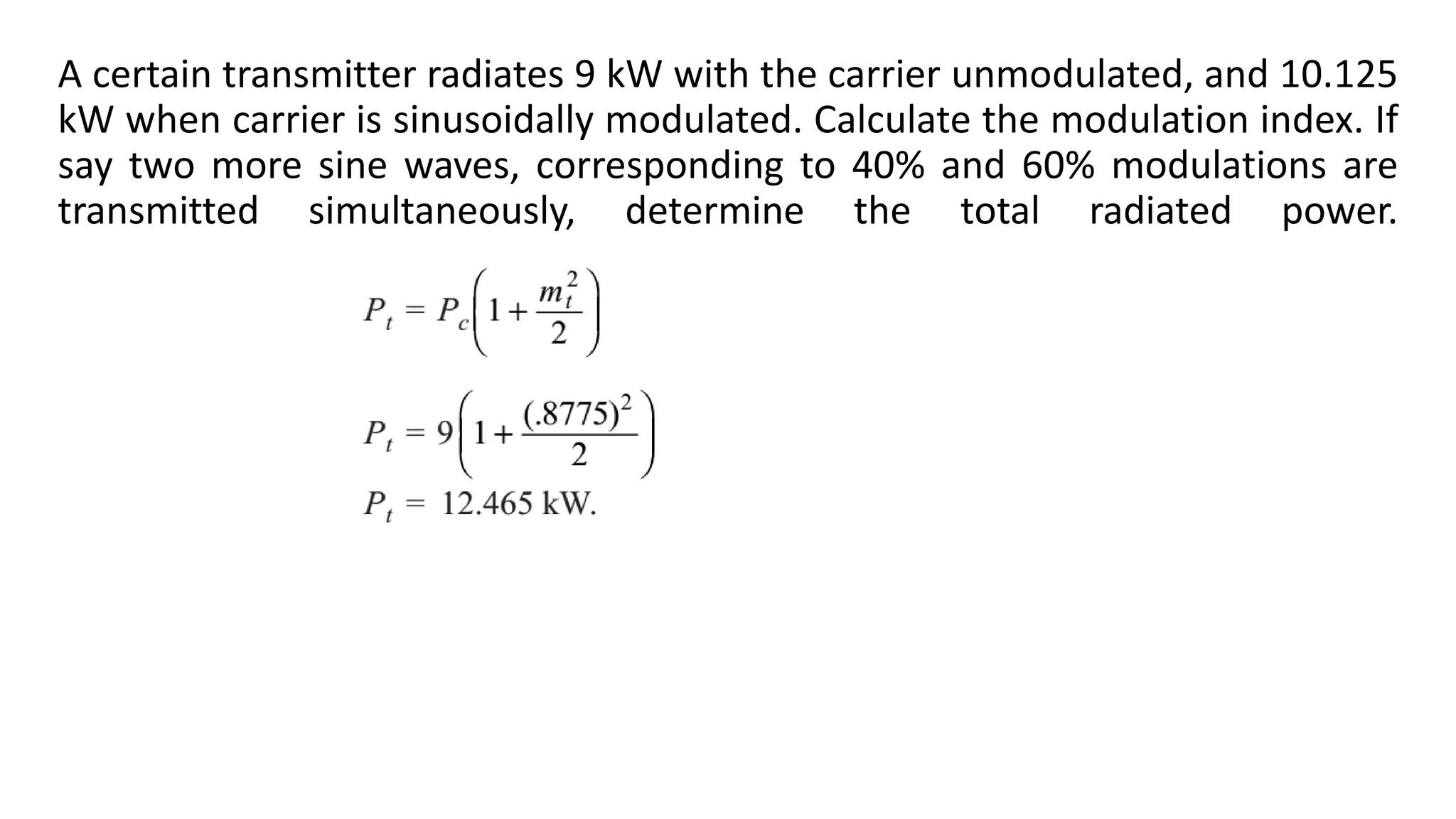
A certain transmitter radiates 9 kW with the carrier unmodulated, and 10.125
kW when carrier is sinusoidally modulated. Calculate the modulation index. If
say two more sine waves, corresponding to 40% and 60% modulations are
transmitted simultaneously, determine the total radiated power.
A certain transmitter radiates 9 kW with the carrier unmodulated, and 10.125
kW when carrier is sinusoidally modulated. Calculate the modulation index. If
say two more sine waves, corresponding to 40% and 60% modulations are
transmitted simultaneously, determine the total radiated power.
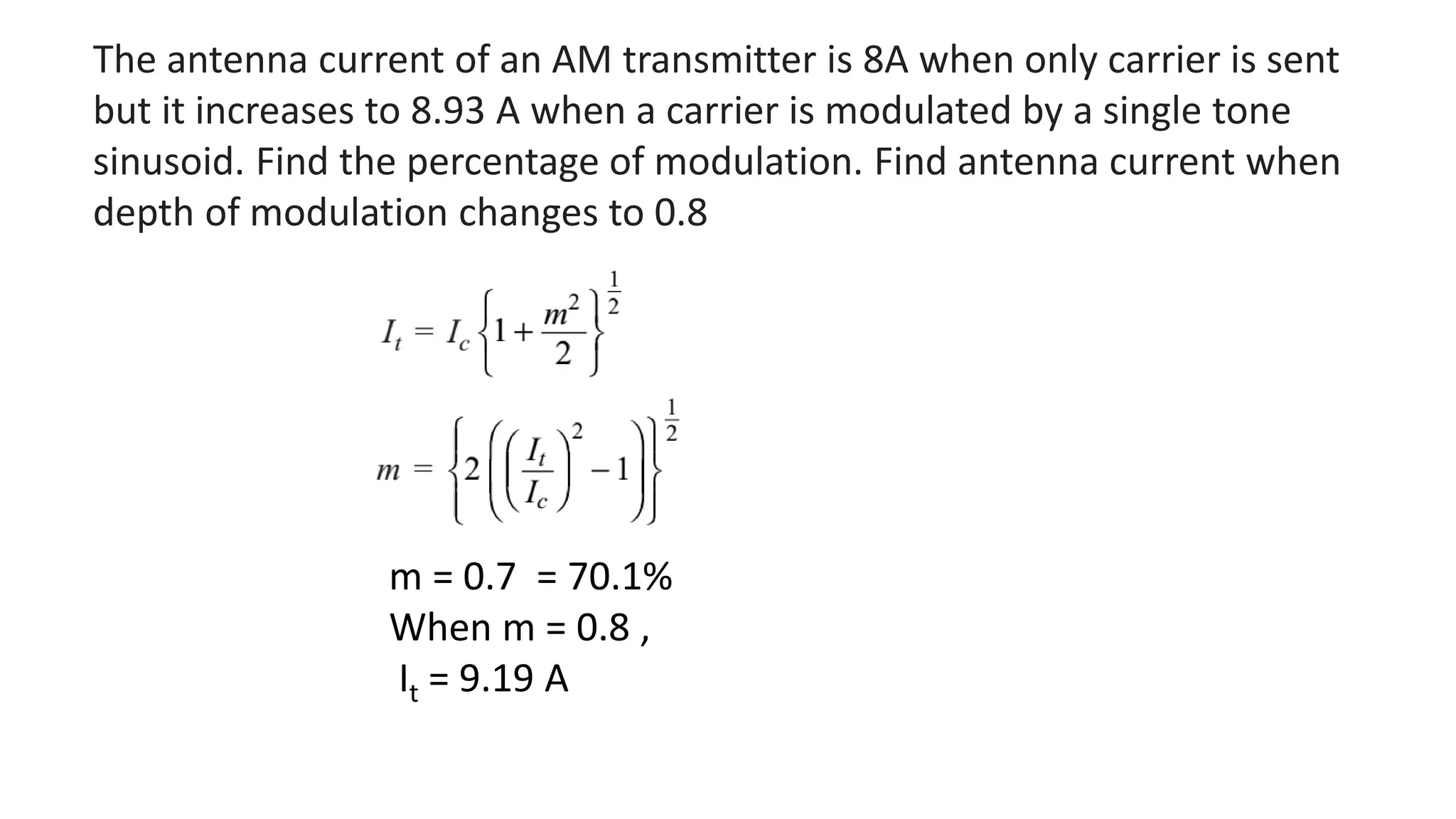
The antenna current of an AM transmitter is 8A when only carrier is sent
but it increases to 8.93 A when a carrier is modulated by a single tone
sinusoid. Find the percentage of modulation. Find antenna current when
depth of modulation changes to 0.8
m = 0.7 = 70.1%
When m = 0.8 ,
It = 9.19 A
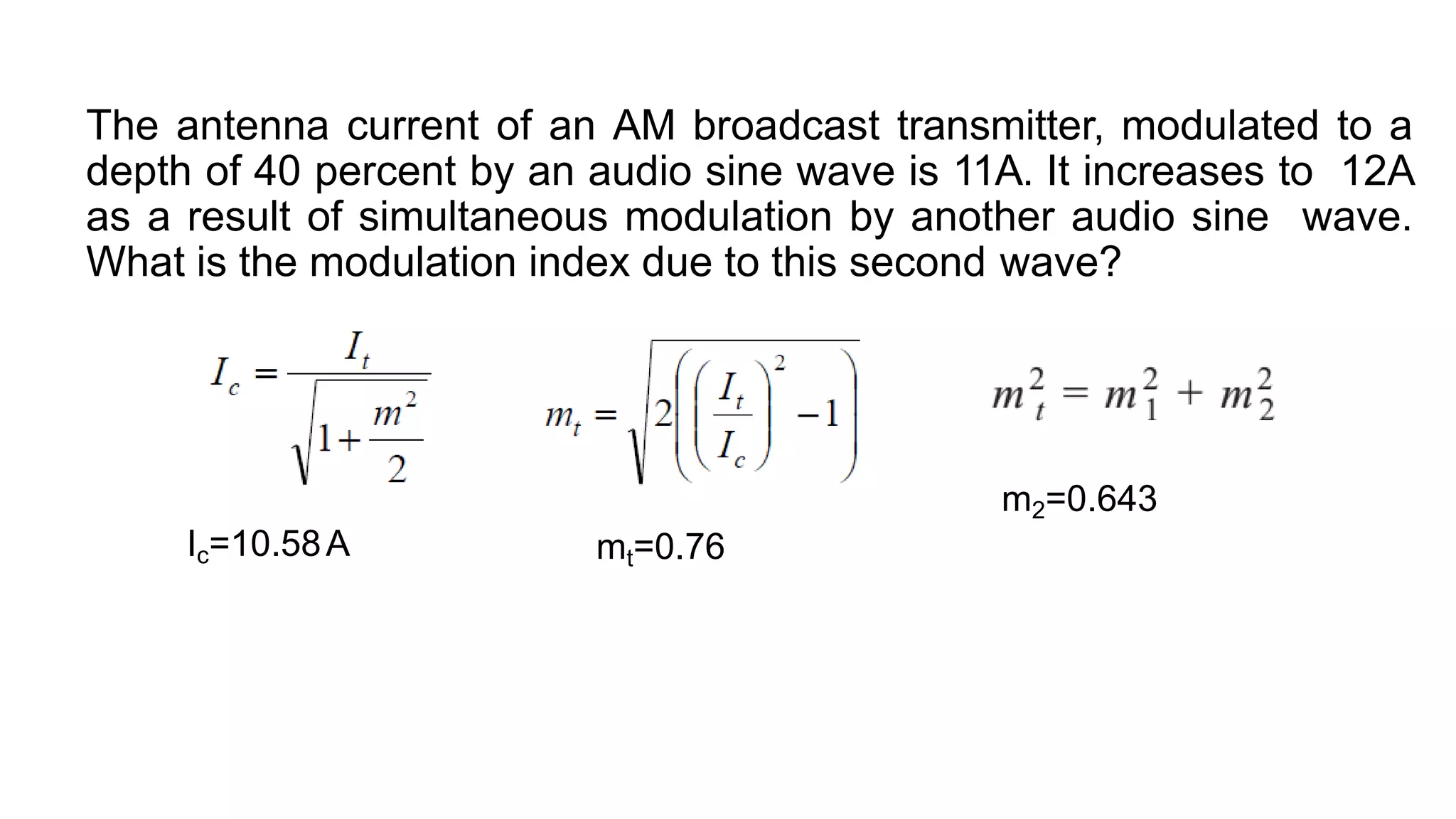
The antenna current of an AM broadcast transmitter, modulated to a
depth of 40 percent by an audio sine wave is 11A. It increases to 12A
as a result of simultaneous modulation by another audio sine wave.
What is the modulation index due to this second wave?
Ic=10.58A mt=0.76
m2=0.643
2 Amplitude_Modulation.pdf

2 Amplitude_Modulation.pdf

  • 1.
    Module-II Linear Modulation Prof. Dr.G.Aarthi, Associate Professor, SENSE
  • 2.
     Text books: Electronic communication systems-George Kennedy
  • 3.
    AM generation • AMexpression • Frequency Spectrum of AM wave • Power calculation • Current calculation • Modulation index • Problems
  • 4.
  • 5.
    Amplitude modulation • Theamplitude of a carrier signal is made proportional to the instantaneous amplitude of the modulating voltage • Let the Carrier voltage be • and the Message voltage be = vc Vc sinct vm  Vm sinmt
  • 6.
  • 7.
    Modulation index: Modulation index: Definedas the ratio between modulating signal voltage and carrier signal voltage The above ratio is called Modulation index/ Percentage of modulation/ Modulation factor/Degree of Modulation and lies between 0 and 1.
  • 8.
    The amplitude ofthe Modulated signal is: A
  • 9.
    The instantaneous voltageof the resultant AM wave is: Thus the equation of the AM wave has three components-  the first term is the unmodulated carrier  second and third terms represent the lower and upper side bands (LSB and USB).  Bandwidth required for amplitude modulation is twice the frequency of the modulating signal-2fm
  • 10.
    Frequency spectrum ofthe AM wave/Components of am AM wave • Frequencies present in an AM wave: Carrier frequency and the first pair of sideband frequencies
  • 11.
    Frequency spectrum ofAM wave/Components of am AM wave • AM is shown as consisting of three discrete frequencies. • Carrier frequency and the first pair of sideband frequencies • The central carrier frequency has the highest amplitude • The other two have amplitudes equal to each other, can never exceed half the carrier amplitude.
  • 12.
    Frequency spectrum ofAM wave/Components of am AM wave • Side band frequency, fSB= fc + nfm • For first pair, n=1 • Bandwidth of the AM signal • BW= fc + fm - (fc – fm) • BW= 2 fm • Bandwidth required for an AM signal is twice the frequency of the modulating signal. • In modulation by several sinewaves simultaneously as in AM broadcasting service, the BW required is twice the highest modulating frequency.
  • 13.
    Representation of AM– Time domain
  • 14.
    Representation of AMcontd.. • Refer to diagram in previous slide: • Top envelope: • Bottom envelope: The Modulated wave extends between these two limiting envelopes and has a repetition rate equal to the unmodulated carrier frequency.
  • 15.
    Modulation Index • Modulationindex can be derived in terms of V max and V min.
  • 16.
    Critical modulation, m=1 Vm=Vc The maximumpercent modulation that can be obtained without causing excessive distortion Under modulation, m<1 Vm < Vc Over modulation, m>1 Vm > Vc Envelope no longer resembles the modulating signal and the information cannot be retrieved in this case
  • 17.
  • 19.
    The tuned circuitof an oscillator in a simple AM transmitter employs a 50 μH coil and 1nF capacitor. If the oscillator output is modulated by audio frequency upto 10KHz. What is the frequency range occupied by the side bands in KHz.
  • 21.
    Power relations inAM wave • The modulated wave contains extra energy in the two sidebands. • Since amplitude of sidebands depend on the modulation index, it is anticipated that total power will also depend on the modulation index.
  • 22.
    • Total powerin the modulated wave is The first term is the unmodulated carrier power mVc/2 mVc/2 Vc
  • 23.
    Substituting these inthe equation for Pt, Maximum power in an AM is Pt=1.5 Pc. (when m=1) This is the maximum power amplifiers must be able to handle without distortion
  • 24.
    Current relations: Let Icbe the unmodulated current and It the total or modulated current of and AM transmitter both being rms values: If R is the resistance in which these currents flow, then
  • 25.
    A 400 Wcarrier is modulated to a depth of 75 percent. Calculate the total power in the modulated wave.
  • 26.
    A broadcast radiotransmitter radiates 10 kW when the modulation percentage is 60. How much of this is carrier power?
  • 31.
    Modulation by severalsine waves If V1, V2… etc. be the simultaneous modulating voltages, then the total modulating voltage Vt will be the square root of the sum of the squares of the individual voltage. Divide both sides by Vc
  • 32.
    Transmission efficiency • Amountof useful power in an AM wave 100 Pt   PUSBPLSB 100 2 m2 P 2 c      m2  P 1   c 100 2 m2 m2  
  • 33.
    For an AMDSBFCwave with peak unmodulated carrier voltage Vc=10V, load resistance RL=10Ω and a modulation coefficient m=1. Calculate • Powers of the carrier and the upper and lower sidebands • Total sideband power • Total power • Draw the power spectrum
  • 34.
    Pc= 5 W PUSB=PLSB=1.25W PTSB= PUSB+ PLSB =2.5 W Pt=7.5 W
  • 35.
    For an AMDSBFCwave with peak unmodulated carrier voltage Vc=10V, load resistance RL=10Ω and a modulation coefficient m=1. Calculate • Powers of the carrier and the upper and lower sidebands • Total sideband power • Total power • Draw the power spectrum • Pc= 5 W • PUSB=PLSB=1.25 W • PTSB=2.5 W • Pt=7.5 W
  • 36.
  • 37.
  • 38.
    A modulating signal20sin(2π x 103t) is used to modulate a carrier signal 40sin(2π x 104t) . Calculate • Modulation index • Percentage modulation • Frequencies of sideband components and their amplitudes • Bandwidth of the modulated signal • Draw the power spectrum
  • 39.
    A modulating signal20sin(2π x 103t) is used to modulate a carrier signal 40sin(2π x 104t) . Calculate Modulation index m=0.5 Percentage modulation %m=50% Frequencies of sideband components and their amplitudes fUSB=11 KHz fLSB=9 KHz VLSB=VUSB=10 V Bandwidth of the modulated signal B= 2fm = 2 KHz
  • 40.
    A modulating signal20sin(2π x 103t) is used to modulate a carrier signal 40sin(2π x 104t) . Calculate • Draw the power spectrum
  • 41.
    A certain transmitterradiates 9 kW with the carrier unmodulated, and 10.125 kW when carrier is sinusoidally modulated. Calculate the modulation index. If say two more sine waves, corresponding to 40% and 60% modulations are transmitted simultaneously, determine the total radiated power.
  • 42.
    A certain transmitterradiates 9 kW with the carrier unmodulated, and 10.125 kW when carrier is sinusoidally modulated. Calculate the modulation index. If say two more sine waves, corresponding to 40% and 60% modulations are transmitted simultaneously, determine the total radiated power.
  • 43.
    The antenna currentof an AM transmitter is 8A when only carrier is sent but it increases to 8.93 A when a carrier is modulated by a single tone sinusoid. Find the percentage of modulation. Find antenna current when depth of modulation changes to 0.8 m = 0.7 = 70.1% When m = 0.8 , It = 9.19 A
  • 44.
    The antenna currentof an AM broadcast transmitter, modulated to a depth of 40 percent by an audio sine wave is 11A. It increases to 12A as a result of simultaneous modulation by another audio sine wave. What is the modulation index due to this second wave? Ic=10.58A mt=0.76 m2=0.643