ECE2006
DIGITAL SIGNAL PROCESSING
FALL SEMESTER_2021
13-08-2021 DSP_FALL 2021 Dr S KALAIVANI 1
ECE2006_COURSE OBJECTIVES
■ To summarize and analyze the concepts of signals, systems in time
and frequency domain with corresponding transformations.
■ To design the analog and digital IIR, FIR filters.
■ To learn diverse structures for realizing digital filters.
■ Usage of appropriate tools for realizing signal processing modules
13-08-2021 DSP_FALL 2021 Dr S KALAIVANI 2
Course Outcomes:
1. Comprehend, classify and analyze the signals and systems, also, transform
the time domain signals and response of the system to frequency domain
2. Able to simplify Fourier transform computations using fast algorithms
3. Comprehend the various analog filter design techniques and their digitization.
4. Able to design digital filters.
5. Able to realize digital filters using delay elements, summer, etc
6. Able to realize lattice filters using delay elements, ladders, summers, etc.
7. Able to analyze and exploit the real-time signal processing
application8.Design and implement systems using the imbibed signal
processing concepts
13-08-2021 DSP_FALL 2021 Dr S KALAIVANI 3
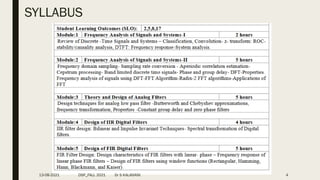
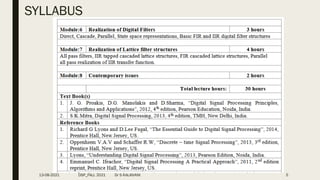
SYLLABUS
13-08-2021 DSP_FALL 2021 Dr S KALAIVANI 4
SYLLABUS
13-08-2021 DSP_FALL 2021 Dr S KALAIVANI 5
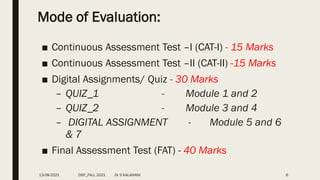
Mode of Evaluation:
■ Continuous Assessment Test –I (CAT-I) - 15 Marks
■ Continuous Assessment Test –II (CAT-II) -15 Marks
■ Digital Assignments/ Quiz - 30 Marks
– QUIZ_1 - Module 1 and 2
– QUIZ_2 - Module 3 and 4
– DIGITAL ASSIGNMENT - Module 5 and 6
& 7
■ Final Assessment Test (FAT) - 40 Marks
13-08-2021 DSP_FALL 2021 Dr S KALAIVANI 6
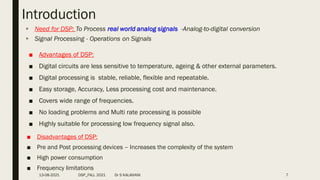
Introduction
 Need for DSP: To Process real world analog signals -Analog-to-digital conversion
 Signal Processing - Operations on Signals
■ Advantages of DSP:
■ Digital circuits are less sensitive to temperature, ageing & other external parameters.
■ Digital processing is stable, reliable, flexible and repeatable.
■ Easy storage, Accuracy, Less processing cost and maintenance.
■ Covers wide range of frequencies.
■ No loading problems and Multi rate processing is possible
■ Highly suitable for processing low frequency signal also.
■ Disadvantages of DSP:
■ Pre and Post processing devices – Increases the complexity of the system
■ High power consumption
■ Frequency limitations
13-08-2021 DSP_FALL 2021 Dr S KALAIVANI 7
8
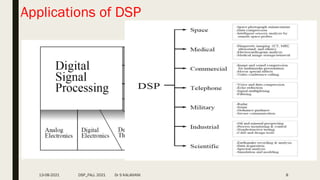
Applications of DSP
13-08-2021 DSP_FALL 2021 Dr S KALAIVANI
9
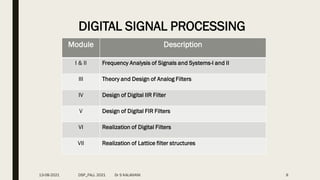
DIGITAL SIGNAL PROCESSING
Module Description
I & II Frequency Analysis of Signals and Systems-I and II
III Theory and Design of Analog Filters
IV Design of Digital IIR Filter
V Design of Digital FIR Filters
VI Realization of Digital Filters
VII Realization of Lattice filter structures
13-08-2021 DSP_FALL 2021 Dr S KALAIVANI
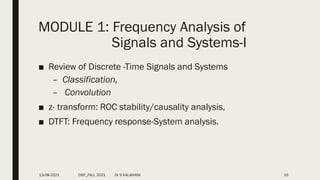
MODULE 1: Frequency Analysis of
Signals and Systems-I
■ Review of Discrete -Time Signals and Systems
– Classification,
– Convolution
■ z- transform: ROC stability/causality analysis,
■ DTFT: Frequency response-System analysis.
13-08-2021 DSP_FALL 2021 Dr S KALAIVANI 10
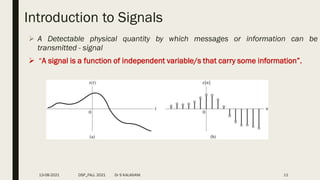
Introduction to Signals
 A Detectable physical quantity by which messages or information can be
transmitted - signal
 “A signal is a function of independent variable/s that carry some information”.
13-08-2021 DSP_FALL 2021 Dr S KALAIVANI 11
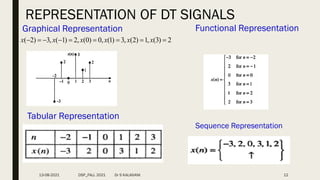
REPRESENTATION OF DT SIGNALS
Graphical Representation
2
)
3
(
,
1
)
2
(
,
3
)
1
(
,
0
)
0
(
,
2
)
1
(
,
3
)
2
( 







 x
x
x
x
x
x
Functional Representation
Sequence Representation
Tabular Representation
13-08-2021 DSP_FALL 2021 Dr S KALAIVANI 12
1. Unit Impulse Signal
2. Unit Step Signal
3. Unit Ramp Signal
4. Sinusoidal Signal
5. Exponential Signal
13
BASIC SIGNALS 0
0
0
1
]
[



n
for
n
for
n

0
0
0
1
]
[



n
for
n
for
n
u
0
0
0
]
[



n
for
n
for
n
n
r
)
cos(
]
[ 
 
 n
A
n
x
T
F 

 2
2 



n
a
n
x n

 ;
]
[
13-08-2021 DSP_FALL 2021 Dr S KALAIVANI
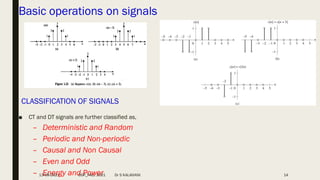
■ CT and DT signals are further classified as,
– Deterministic and Random
– Periodic and Non-periodic
– Causal and Non Causal
– Even and Odd
– Energy and Power 14
CLASSIFICATION OF SIGNALS
Basic operations on signals
13-08-2021 DSP_FALL 2021 Dr S KALAIVANI
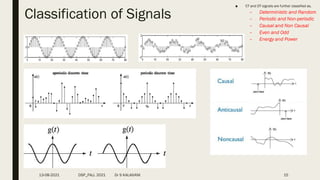
Classification of Signals
■ CT and DT signals are further classified as,
– Deterministic and Random
– Periodic and Non-periodic
– Causal and Non Causal
– Even and Odd
– Energy and Power
13-08-2021 DSP_FALL 2021 Dr S KALAIVANI 15
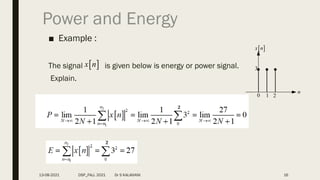
■ Example :
The signal is given below is energy or power signal.
Explain.
16
Power and Energy
 
x n
 
x n
3
0 1
n
2
13-08-2021 DSP_FALL 2021 Dr S KALAIVANI
• Systems process input signals to produce output signals
– Continuous/Discrete
– Linear/Non linear
– Causal/Non Causal
– Stable/Unstable
– Dynamic/Static
– Time variance/Time invariant
17
Classification of Systems
 Causal: a system is causal if the output at a time, only depends on input values up to that time.
 Linear: a system is linear if the output of the scaled sum of two input signals is the equivalent scaled
sum of outputs
 Time-invariance: a system is time invariant if the system’s output is the same, given the same input
signal, regardless of time.
 A system is called stable in the bounded-input bounded-output (BIBO) sense if every bounded input
sequence produces a bounded output sequence
 A system is called memoryless /Static if the output y[n] at every value of n depends only on the
present input values of n
13-08-2021 DSP_FALL 2021 Dr S KALAIVANI
Ex. Y[n]=x[-n]
13-08-2021 DSP_FALL 2021 Dr S KALAIVANI 18
MODULE 1: Frequency Analysis of
Signals and Systems-I
■ Review of Discrete -Time Signals and Systems
– Classification,
– Convolution
■ z- transform: ROC stability/causality analysis,
■ DTFT: Frequency response-System analysis.
13-08-2021 DSP_FALL 2021 Dr S KALAIVANI 19
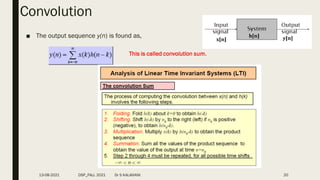
Convolution
■ The output sequence y(n) is found as,
This is called convolution sum.
DSP_FALL 2021 Dr S KALAIVANI 20
13-08-2021
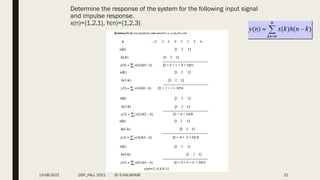
Determine the response of the system for the following input signal
and impulse response.
x(n)={1,2,1}, h(n)={1,2,3}
21
13-08-2021 DSP_FALL 2021 Dr S KALAIVANI
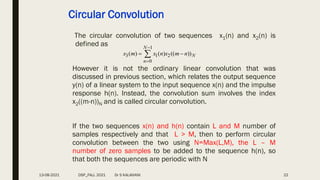
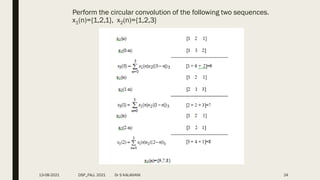
Circular Convolution
The circular convolution of two sequences x1(n) and x2(n) is
defined as
However it is not the ordinary linear convolution that was
discussed in previous section, which relates the output sequence
y(n) of a linear system to the input sequence x(n) and the impulse
response h(n). Instead, the convolution sum involves the index
x2((m-n))N and is called circular convolution.
If the two sequences x(n) and h(n) contain L and M number of
samples respectively and that L > M, then to perform circular
convolution between the two using N=Max(L,M), the L – M
number of zero samples to be added to the sequence h(n), so
that both the sequences are periodic with N
1
3 1 2
0
( ) ( ) (( ))
N
N
n
x m x n x m n


 

22
13-08-2021 DSP_FALL 2021 Dr S KALAIVANI
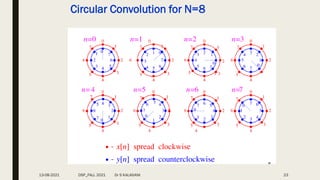
Circular Convolution for N=8
23
13-08-2021 DSP_FALL 2021 Dr S KALAIVANI
Perform the circular convolution of the following two sequences.
x1(n)={1,2,1}, x2(n)={1,2,3}
24
13-08-2021 DSP_FALL 2021 Dr S KALAIVANI
Ex.1 Find the linear and circular (7-point) convolution of the
given sequences
x[n]={1, 2, 7, -2, 3, -1, 5} and h[n]={-1, 3, 5, -3, 1}
■ Linear Convolution:
y[n]={-1, 1, 4, 30, 21, -19, 20, -1, 31, -15,5}
■ Circular Convolution:
x[n]={1, 2, 7, -2, 3, -1, 5}
h[n]={-1, 3, 5, -3, 1, 0, 0}
y[n]={-2, 32,-12,35,21,20}
13-08-2021 DSP_FALL 2021 Dr S KALAIVANI 25
MODULE 1: Frequency Analysis of
Signals and Systems-I
■ Review of Discrete -Time Signals and Systems
– Classification,
– Convolution
■ z- transform: ROC stability/causality analysis,
■ DTFT: Frequency response-System analysis.
13-08-2021 DSP_FALL 2021 Dr S KALAIVANI 26
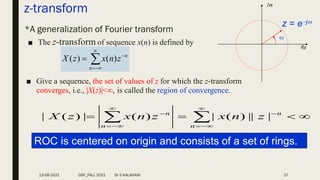
z-transform
*A generalization of Fourier transform
■ The z-transform of sequence x(n) is defined by






n
n
z
n
x
z
X )
(
)
(
Re
Im
z = ej

■ Give a sequence, the set of values of z for which the z-transform
converges, i.e., |X(z)|<, is called the region of convergence.



 









n
n
n
n
z
n
x
z
n
x
z
X |
||
)
(
|
)
(
|
)
(
|
ROC is centered on origin and consists of a set of rings.
13-08-2021 DSP_FALL 2021 Dr S KALAIVANI 27
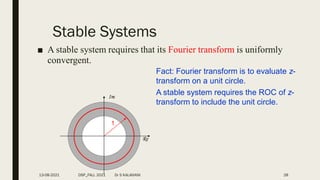
Stable Systems
■ A stable system requires that its Fourier transform is uniformly
convergent.
Re
Im
1
Fact: Fourier transform is to evaluate z-
transform on a unit circle.
A stable system requires the ROC of z-
transform to include the unit circle.
13-08-2021 DSP_FALL 2021 Dr S KALAIVANI 28
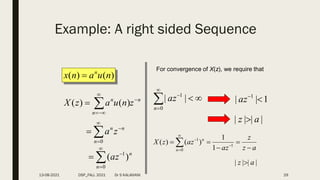
Example: A right sided Sequence
)
(
)
( n
u
a
n
x n

n
n
n
z
n
u
a
z
X 




 )
(
)
(





0
n
n
n
z
a





0
1
)
(
n
n
az
For convergence of X(z), we require that






0
1
|
|
n
az 1
|
| 1


az
|
|
|
| a
z 
a
z
z
az
az
z
X
n
n




 



 1
0
1
1
1
)
(
)
(
|
|
|
| a
z 
13-08-2021 DSP_FALL 2021 Dr S KALAIVANI 29
a
a
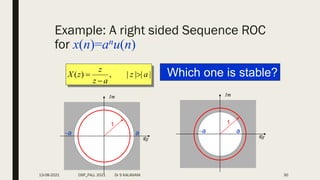
Example: A right sided Sequence ROC
for x(n)=anu(n)
|
|
|
|
,
)
( a
z
a
z
z
z
X 


Re
Im
1
a
a
Re
Im
1
Which one is stable?
13-08-2021 DSP_FALL 2021 Dr S KALAIVANI 30
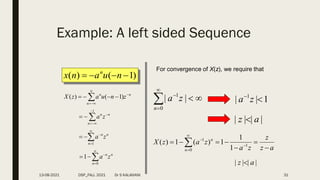
Example: A left sided Sequence
)
1
(
)
( 


 n
u
a
n
x n
n
n
n
z
n
u
a
z
X 



 


 )
1
(
)
(
For convergence of X(z), we require that






0
1
|
|
n
z
a 1
|
| 1


z
a
|
|
|
| a
z 
a
z
z
z
a
z
a
z
X
n
n






 



 1
0
1
1
1
1
)
(
1
)
(
|
|
|
| a
z 
n
n
n
z
a 






1
n
n
n
z
a






1
n
n
n
z
a






0
1
13-08-2021 DSP_FALL 2021 Dr S KALAIVANI 31
a
a
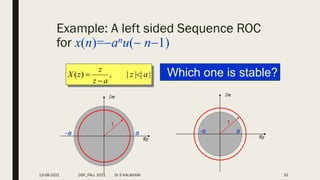
Example: A left sided Sequence ROC
for x(n)=anu( n1)
|
|
|
|
,
)
( a
z
a
z
z
z
X 


Re
Im
1
a
a
Re
Im
1
Which one is stable?
13-08-2021 DSP_FALL 2021 Dr S KALAIVANI 32
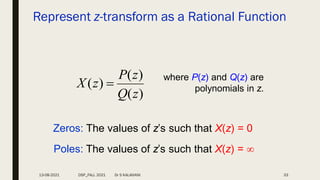
Represent z-transform as a Rational Function
)
(
)
(
)
(
z
Q
z
P
z
X 
where P(z) and Q(z) are
polynomials in z.
Zeros: The values of z’s such that X(z) = 0
Poles: The values of z’s such that X(z) = 
13-08-2021 DSP_FALL 2021 Dr S KALAIVANI 33
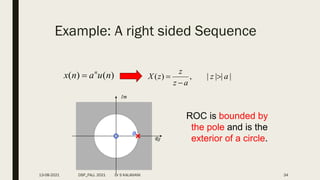
Example: A right sided Sequence
)
(
)
( n
u
a
n
x n
 |
|
|
|
,
)
( a
z
a
z
z
z
X 


Re
Im
a
ROC is bounded by
the pole and is the
exterior of a circle.
13-08-2021 DSP_FALL 2021 Dr S KALAIVANI 34
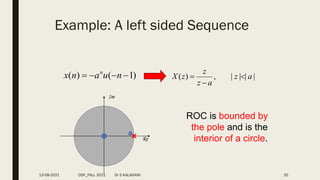
Example: A left sided Sequence
)
1
(
)
( 


 n
u
a
n
x n
|
|
|
|
,
)
( a
z
a
z
z
z
X 


Re
Im
a
ROC is bounded by
the pole and is the
interior of a circle.
13-08-2021 DSP_FALL 2021 Dr S KALAIVANI 35
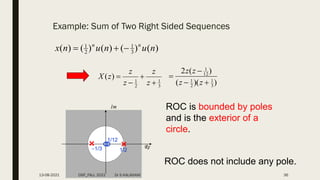
Example: Sum of Two Right Sided Sequences
)
(
)
(
)
(
)
(
)
( 3
1
2
1
n
u
n
u
n
x n
n



3
1
2
1
)
(




z
z
z
z
z
X
Re
Im
1/2
)
)(
(
)
(
2
3
1
2
1
12
1




z
z
z
z
1/3
1/12
ROC is bounded by poles
and is the exterior of a
circle.
ROC does not include any pole.
13-08-2021 DSP_FALL 2021 Dr S KALAIVANI 36
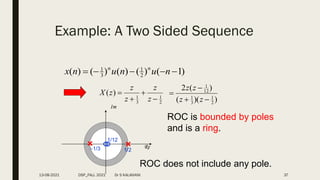
Example: A Two Sided Sequence
)
1
(
)
(
)
(
)
(
)
( 2
1
3
1




 n
u
n
u
n
x n
n
2
1
3
1
)
(




z
z
z
z
z
X
Re
Im
1/2
)
)(
(
)
(
2
2
1
3
1
12
1




z
z
z
z
1/3
1/12
ROC is bounded by poles
and is a ring.
ROC does not include any pole.
13-08-2021 DSP_FALL 2021 Dr S KALAIVANI 37
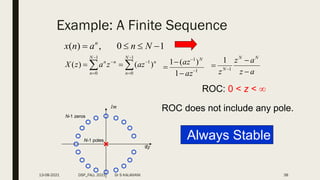
Example: A Finite Sequence
1
0
,
)
( 


 N
n
a
n
x n
n
N
n
n
N
n
n
z
a
z
a
z
X )
(
)
( 1
1
0
1
0







 

Re
Im
ROC: 0 < z < 
ROC does not include any pole.
1
1
1
)
(
1





az
az N
a
z
a
z
z
N
N
N


 1
1
N-1 poles
N-1 zeros
Always Stable
13-08-2021 DSP_FALL 2021 Dr S KALAIVANI 38
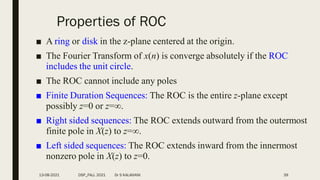
Properties of ROC
■ A ring or disk in the z-plane centered at the origin.
■ The Fourier Transform of x(n) is converge absolutely if the ROC
includes the unit circle.
■ The ROC cannot include any poles
■ Finite Duration Sequences: The ROC is the entire z-plane except
possibly z=0 or z=.
■ Right sided sequences: The ROC extends outward from the outermost
finite pole in X(z) to z=.
■ Left sided sequences: The ROC extends inward from the innermost
nonzero pole in X(z) to z=0.
13-08-2021 DSP_FALL 2021 Dr S KALAIVANI 39
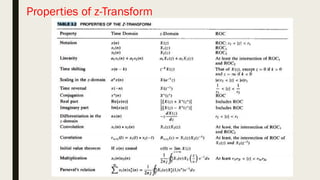
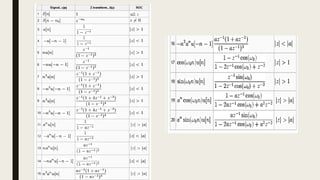
Properties of z-Transform
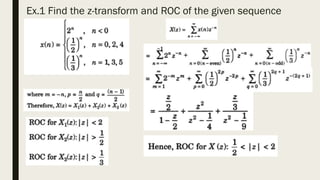
Ex.1 Find the z-transform and ROC of the given sequence
INVERSE Z-TRANSFORM
Partial Fraction Method
13-08-2021 DSP_FALL 2021 Dr S KALAIVANI 43
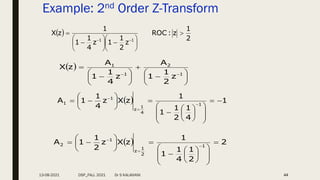
Example: 2nd Order Z-Transform
44
 
2
1
z
:
ROC
z
2
1
1
z
4
1
1
1
z
X
1
1


















 

















 1
2
1
1
z
2
1
1
A
z
4
1
1
A
z
X
  1
4
1
2
1
1
1
z
X
z
4
1
1
A 1
4
1
z
1
1 
























 


  2
2
1
4
1
1
1
z
X
z
2
1
1
A 1
2
1
z
1
2 























 


13-08-2021 DSP_FALL 2021 Dr S KALAIVANI
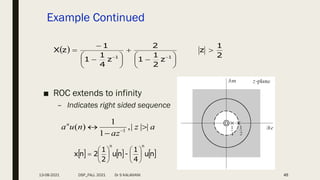
Example Continued
■ ROC extends to infinity
– Indicates right sided sequence
45
 
2
1
z
z
2
1
1
2
z
4
1
1
1
z
X
1
1




















     
n
u
4
1
-
n
u
2
1
2
n
x
n
n













a
z
az
n
u
an
|
|
|
,
1
1
)
( 1


 
13-08-2021 DSP_FALL 2021 Dr S KALAIVANI
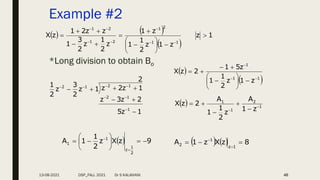
Example #2
*Long division to obtain Bo
46
   
 
1
z
z
1
z
2
1
1
z
1
z
2
1
z
2
3
1
z
z
2
1
z
X
1
1
2
1
2
1
2
1























1
z
5
2
z
3
z
2
1
z
2
z
1
z
2
3
z
2
1
1
1
2
1
2
1
2














 
 
1
1
1
z
1
z
2
1
1
z
5
1
2
z
X















  1
2
1
1
z
1
A
z
2
1
1
A
2
z
X 
 




  9
z
X
z
2
1
1
A
2
1
z
1
1 











    8
z
X
z
1
A
1
z
1
2 




13-08-2021 DSP_FALL 2021 Dr S KALAIVANI
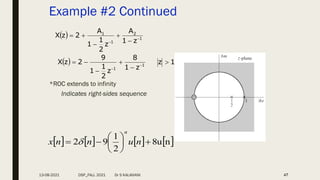
Example #2 Continued
*ROC extends to infinity
Indicates right-sides sequence
47
  1
z
z
1
8
z
2
1
1
9
2
z
X 1
1





 

       
n
8u
2
1
9
2 







 n
u
n
n
x
n

  1
2
1
1
z
1
A
z
2
1
1
A
2
z
X 
 




13-08-2021 DSP_FALL 2021 Dr S KALAIVANI
Example 3: Find the signal corresponding to the z-transform
48
2
1
3
z
z
3
2
z
)
z
(
X 





Solution:   
5
.
0
z
1
z
z
5
.
0
z
5
.
0
z
5
.
1
z
5
.
0
z
z
3
2
z
)
z
(
X 2
3
2
1
3








 


   5
.
0
z
4
1
z
1
z
1
z
3
5
.
0
z
1
z
z
5
.
0
z
)
z
(
X
2
2










5
.
0
z
z
)
4
(
1
z
z
z
1
3
)
z
(
X







or 1
1
1
z
5
.
0
1
1
4
z
1
1
z
3
)
z
(
X 








  ]
n
[
u
5
.
0
4
]
n
[
u
]
1
n
[
]
n
[
3
]
n
[
x
n








13-08-2021 DSP_FALL 2021 Dr S KALAIVANI
Partial Fraction Method:
Example 4: Find the signal corresponding to the z-transform
49
  2
1
1
z
2
.
0
1
z
2
.
0
1
1
)
z
(
Y





Solution:
  2
3
2
.
0
z
2
.
0
z
z
)
z
(
Y



    2
2
2
2
.
0
z
1
.
0
2
.
0
z
75
.
0
2
.
0
z
25
.
0
2
.
0
z
2
.
0
z
z
z
)
z
(
Y









 2
2
.
0
z
z
1
.
0
2
.
0
z
z
75
.
0
1
z
z
25
.
0
)
z
(
Y






 2
1
1
2
.
0
1
.
0
1
1
z
2
.
0
1
z
2
.
0
z
2
.
0
1
1
75
.
0
z
2
.
0
1
1
25
.
0










      ]
n
[
u
2
.
0
n
5
.
0
]
n
[
u
2
.
0
75
.
0
]
n
[
u
2
.
0
25
.
0
]
n
[
y
n
n
n





13-08-2021 DSP_FALL 2021 Dr S KALAIVANI
INVERSE Z-TRANSFORM
Power Series Expansion Method
13-08-2021 DSP_FALL 2021 Dr S KALAIVANI 50
Inverse Z-Transform by Power Series Expansion
■ The z-transform is power series
■ In expanded form
■ Causal/Right sided sequence:
■ Non-Causal/Left sided sequence:
51
   






n
n
z
n
x
z
X
            
 







 
 2
1
1
2
z
2
x
z
1
x
0
x
z
1
x
z
2
x
z
X
        



 
 2
1
2
1
0 z
x
z
x
x
z
X
      1
2
1
2 z
x
z
x
z
X 



 




x[n] ->co-eff of NEGATIVE powers of ‘z’
x[n] ->co-eff of POSITIVE powers of ‘z’
13-08-2021 DSP_FALL 2021 Dr S KALAIVANI
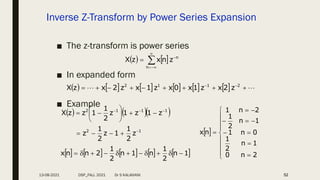
Inverse Z-Transform by Power Series Expansion
■ The z-transform is power series
■ In expanded form
■ Example
52
   






n
n
z
n
x
z
X
            
 







 
 2
1
1
2
z
2
x
z
1
x
0
x
z
1
x
z
2
x
z
X
    
1
2
1
1
1
2
z
2
1
1
z
2
1
z
z
1
z
1
z
2
1
1
z
z
X


















         
1
n
2
1
n
1
n
2
1
2
n
n
x 










 



















2
n
0
1
n
2
1
0
n
1
1
n
2
1
2
n
1
n
x
13-08-2021 DSP_FALL 2021 Dr S KALAIVANI
Power Series Method
Example 1: Determine the z-transform of RSS
53
2
1
z
5
.
0
z
5
.
1
1
1
)
z
(
X 




By dividing the numerator of X(z) by its
denominator, we obtain the power series
...
z
z
z
z
1
z
z
1
1 4
16
31
3
8
15
2
4
7
1
2
3
2
2
1
1
2
3














 x[n] = [1, 3/2, 7/2, 15/8, 31/16,…. ]
13-08-2021 DSP_FALL 2021 Dr S KALAIVANI
Power Series Method
Example 2:Determine the z-transform of
54
2
1
1
z
z
2
2
z
4
)
z
(
X 






By dividing the numerator of X(z) by its
denominator, we obtain the power series
 x[n] = [2, 1.5, 0.5, 0.25, …..]
13-08-2021 DSP_FALL 2021 Dr S KALAIVANI
MODULE 1: Frequency Analysis of
Signals and Systems-I
■ Review of Discrete -Time Signals and Systems
– Classification,
– Convolution
■ z- transform: ROC stability/causality analysis,
■ DTFT: Frequency response-System analysis.
13-08-2021 DSP_FALL 2021 Dr S KALAIVANI 55
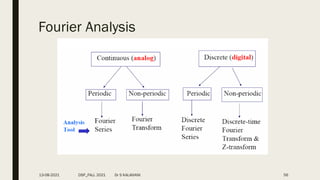
Fourier Analysis
56
13-08-2021 DSP_FALL 2021 Dr S KALAIVANI
■ We have seen that periodic signals can be represented
with the Fourier series
■ Can aperiodic signals be analyzed in terms of frequency
components?
■ Yes, and the Fourier transform provides the tool for this
analysis
■ The major difference w.r.t. the line spectra of periodic
signals is that the spectra of aperiodic signals are defined
for all real values of the frequency variable not just for a
discrete set of values
Fourier Transform

13-08-2021 DSP_FALL 2021 Dr S KALAIVANI 57
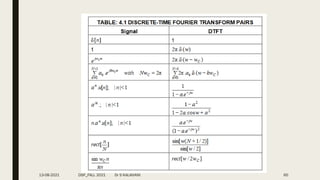
The Discrete-Time Fourier Transform
■ The discrete-time Fourier transform (DTFT) or, simply, the Fourier
transform of a discrete–time sequence x[n] is a representation of
the sequence in terms of the complex exponential sequence
where is the real frequency variable.
■ The discrete-time Fourier transform of a sequence x[n] is
defined by
 
j x
e 


 
j
X e 
  [ ]
j j n
n
X e x n e
 



 
 
j x
e 

 
j
X e 
DSP_FALL 2021 Dr S KALAIVANI Discrete-Time Signals in the Transform-Domain 58
The Discrete-Time Fourier Transform
■ Convergence Condition:
If x[n] is an absolutely summable sequence, i.e.,
Thus the equation is a sufficient condition for the existence of
the DTFT.
 
     
n
j j n
n n
if x n
then X e x n e x n
 


 

 
 
   

 
13-08-2021 DSP_FALL 2021 Dr S KALAIVANI 59
13-08-2021 DSP_FALL 2021 Dr S KALAIVANI 60
MODULE 1: Frequency Analysis of
Signals and Systems-I
■ Review of Discrete -Time Signals and Systems
– Classification,
– Convolution
■ z- transform: ROC stability/causality analysis,
■ DTFT: Frequency response-System analysis.
61
13-08-2021 DSP_FALL 2021 Dr S KALAIVANI
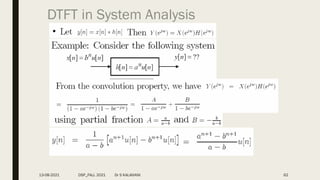
DTFT in System Analysis
13-08-2021 DSP_FALL 2021 Dr S KALAIVANI 62
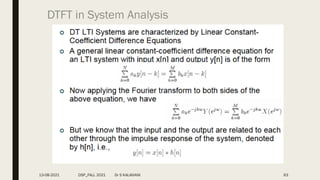
13-08-2021 DSP_FALL 2021 Dr S KALAIVANI 63
DTFT in System Analysis
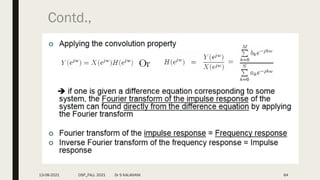
Contd.,
13-08-2021 DSP_FALL 2021 Dr S KALAIVANI 64
Ex. A discrete-time LTI system has impulse response h[n],Find
the output y[n] due to input x[n].
13-08-2021 DSP_FALL 2021 Dr S KALAIVANI 65
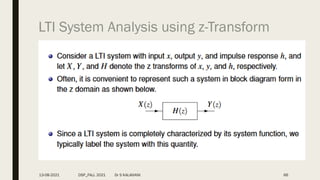
LTI System Analysis using z-Transform
13-08-2021 DSP_FALL 2021 Dr S KALAIVANI 66
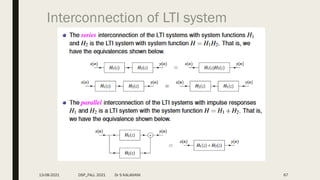
Interconnection of LTI system
13-08-2021 DSP_FALL 2021 Dr S KALAIVANI 67
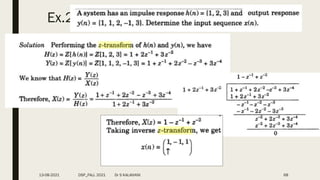
Ex.2
13-08-2021 DSP_FALL 2021 Dr S KALAIVANI 68
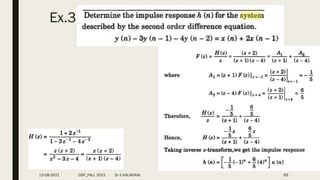
Ex.3
13-08-2021 DSP_FALL 2021 Dr S KALAIVANI 69
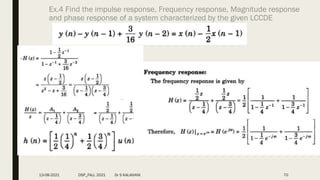
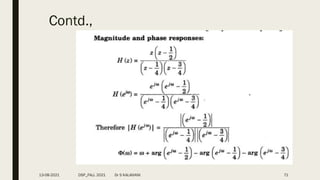
Ex.4 Find the impulse response, Frequency response, Magnitude response
and phase response of a system characterized by the given LCCDE
13-08-2021 DSP_FALL 2021 Dr S KALAIVANI 70
Contd.,
13-08-2021 DSP_FALL 2021 Dr S KALAIVANI 71
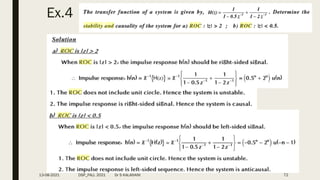
Ex.4
13-08-2021 DSP_FALL 2021 Dr S KALAIVANI 72
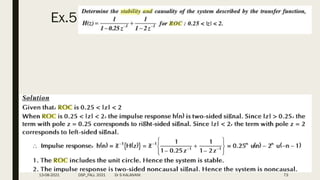
Ex.5
13-08-2021 DSP_FALL 2021 Dr S KALAIVANI 73

Module 1 (1).pdf

  • 1.
    ECE2006 DIGITAL SIGNAL PROCESSING FALLSEMESTER_2021 13-08-2021 DSP_FALL 2021 Dr S KALAIVANI 1
  • 2.
    ECE2006_COURSE OBJECTIVES ■ Tosummarize and analyze the concepts of signals, systems in time and frequency domain with corresponding transformations. ■ To design the analog and digital IIR, FIR filters. ■ To learn diverse structures for realizing digital filters. ■ Usage of appropriate tools for realizing signal processing modules 13-08-2021 DSP_FALL 2021 Dr S KALAIVANI 2
  • 3.
    Course Outcomes: 1. Comprehend,classify and analyze the signals and systems, also, transform the time domain signals and response of the system to frequency domain 2. Able to simplify Fourier transform computations using fast algorithms 3. Comprehend the various analog filter design techniques and their digitization. 4. Able to design digital filters. 5. Able to realize digital filters using delay elements, summer, etc 6. Able to realize lattice filters using delay elements, ladders, summers, etc. 7. Able to analyze and exploit the real-time signal processing application8.Design and implement systems using the imbibed signal processing concepts 13-08-2021 DSP_FALL 2021 Dr S KALAIVANI 3
  • 4.
  • 5.
  • 6.
    Mode of Evaluation: ■Continuous Assessment Test –I (CAT-I) - 15 Marks ■ Continuous Assessment Test –II (CAT-II) -15 Marks ■ Digital Assignments/ Quiz - 30 Marks – QUIZ_1 - Module 1 and 2 – QUIZ_2 - Module 3 and 4 – DIGITAL ASSIGNMENT - Module 5 and 6 & 7 ■ Final Assessment Test (FAT) - 40 Marks 13-08-2021 DSP_FALL 2021 Dr S KALAIVANI 6
  • 7.
    Introduction  Need forDSP: To Process real world analog signals -Analog-to-digital conversion  Signal Processing - Operations on Signals ■ Advantages of DSP: ■ Digital circuits are less sensitive to temperature, ageing & other external parameters. ■ Digital processing is stable, reliable, flexible and repeatable. ■ Easy storage, Accuracy, Less processing cost and maintenance. ■ Covers wide range of frequencies. ■ No loading problems and Multi rate processing is possible ■ Highly suitable for processing low frequency signal also. ■ Disadvantages of DSP: ■ Pre and Post processing devices – Increases the complexity of the system ■ High power consumption ■ Frequency limitations 13-08-2021 DSP_FALL 2021 Dr S KALAIVANI 7
  • 8.
    8 Applications of DSP 13-08-2021DSP_FALL 2021 Dr S KALAIVANI
  • 9.
    9 DIGITAL SIGNAL PROCESSING ModuleDescription I & II Frequency Analysis of Signals and Systems-I and II III Theory and Design of Analog Filters IV Design of Digital IIR Filter V Design of Digital FIR Filters VI Realization of Digital Filters VII Realization of Lattice filter structures 13-08-2021 DSP_FALL 2021 Dr S KALAIVANI
  • 10.
    MODULE 1: FrequencyAnalysis of Signals and Systems-I ■ Review of Discrete -Time Signals and Systems – Classification, – Convolution ■ z- transform: ROC stability/causality analysis, ■ DTFT: Frequency response-System analysis. 13-08-2021 DSP_FALL 2021 Dr S KALAIVANI 10
  • 11.
    Introduction to Signals A Detectable physical quantity by which messages or information can be transmitted - signal  “A signal is a function of independent variable/s that carry some information”. 13-08-2021 DSP_FALL 2021 Dr S KALAIVANI 11
  • 12.
    REPRESENTATION OF DTSIGNALS Graphical Representation 2 ) 3 ( , 1 ) 2 ( , 3 ) 1 ( , 0 ) 0 ( , 2 ) 1 ( , 3 ) 2 (          x x x x x x Functional Representation Sequence Representation Tabular Representation 13-08-2021 DSP_FALL 2021 Dr S KALAIVANI 12
  • 13.
    1. Unit ImpulseSignal 2. Unit Step Signal 3. Unit Ramp Signal 4. Sinusoidal Signal 5. Exponential Signal 13 BASIC SIGNALS 0 0 0 1 ] [    n for n for n  0 0 0 1 ] [    n for n for n u 0 0 0 ] [    n for n for n n r ) cos( ] [     n A n x T F    2 2     n a n x n   ; ] [ 13-08-2021 DSP_FALL 2021 Dr S KALAIVANI
  • 14.
    ■ CT andDT signals are further classified as, – Deterministic and Random – Periodic and Non-periodic – Causal and Non Causal – Even and Odd – Energy and Power 14 CLASSIFICATION OF SIGNALS Basic operations on signals 13-08-2021 DSP_FALL 2021 Dr S KALAIVANI
  • 15.
    Classification of Signals ■CT and DT signals are further classified as, – Deterministic and Random – Periodic and Non-periodic – Causal and Non Causal – Even and Odd – Energy and Power 13-08-2021 DSP_FALL 2021 Dr S KALAIVANI 15
  • 16.
    ■ Example : Thesignal is given below is energy or power signal. Explain. 16 Power and Energy   x n   x n 3 0 1 n 2 13-08-2021 DSP_FALL 2021 Dr S KALAIVANI
  • 17.
    • Systems processinput signals to produce output signals – Continuous/Discrete – Linear/Non linear – Causal/Non Causal – Stable/Unstable – Dynamic/Static – Time variance/Time invariant 17 Classification of Systems  Causal: a system is causal if the output at a time, only depends on input values up to that time.  Linear: a system is linear if the output of the scaled sum of two input signals is the equivalent scaled sum of outputs  Time-invariance: a system is time invariant if the system’s output is the same, given the same input signal, regardless of time.  A system is called stable in the bounded-input bounded-output (BIBO) sense if every bounded input sequence produces a bounded output sequence  A system is called memoryless /Static if the output y[n] at every value of n depends only on the present input values of n 13-08-2021 DSP_FALL 2021 Dr S KALAIVANI
  • 18.
    Ex. Y[n]=x[-n] 13-08-2021 DSP_FALL2021 Dr S KALAIVANI 18
  • 19.
    MODULE 1: FrequencyAnalysis of Signals and Systems-I ■ Review of Discrete -Time Signals and Systems – Classification, – Convolution ■ z- transform: ROC stability/causality analysis, ■ DTFT: Frequency response-System analysis. 13-08-2021 DSP_FALL 2021 Dr S KALAIVANI 19
  • 20.
    Convolution ■ The outputsequence y(n) is found as, This is called convolution sum. DSP_FALL 2021 Dr S KALAIVANI 20 13-08-2021
  • 21.
    Determine the responseof the system for the following input signal and impulse response. x(n)={1,2,1}, h(n)={1,2,3} 21 13-08-2021 DSP_FALL 2021 Dr S KALAIVANI
  • 22.
    Circular Convolution The circularconvolution of two sequences x1(n) and x2(n) is defined as However it is not the ordinary linear convolution that was discussed in previous section, which relates the output sequence y(n) of a linear system to the input sequence x(n) and the impulse response h(n). Instead, the convolution sum involves the index x2((m-n))N and is called circular convolution. If the two sequences x(n) and h(n) contain L and M number of samples respectively and that L > M, then to perform circular convolution between the two using N=Max(L,M), the L – M number of zero samples to be added to the sequence h(n), so that both the sequences are periodic with N 1 3 1 2 0 ( ) ( ) (( )) N N n x m x n x m n      22 13-08-2021 DSP_FALL 2021 Dr S KALAIVANI
  • 23.
    Circular Convolution forN=8 23 13-08-2021 DSP_FALL 2021 Dr S KALAIVANI
  • 24.
    Perform the circularconvolution of the following two sequences. x1(n)={1,2,1}, x2(n)={1,2,3} 24 13-08-2021 DSP_FALL 2021 Dr S KALAIVANI
  • 25.
    Ex.1 Find thelinear and circular (7-point) convolution of the given sequences x[n]={1, 2, 7, -2, 3, -1, 5} and h[n]={-1, 3, 5, -3, 1} ■ Linear Convolution: y[n]={-1, 1, 4, 30, 21, -19, 20, -1, 31, -15,5} ■ Circular Convolution: x[n]={1, 2, 7, -2, 3, -1, 5} h[n]={-1, 3, 5, -3, 1, 0, 0} y[n]={-2, 32,-12,35,21,20} 13-08-2021 DSP_FALL 2021 Dr S KALAIVANI 25
  • 26.
    MODULE 1: FrequencyAnalysis of Signals and Systems-I ■ Review of Discrete -Time Signals and Systems – Classification, – Convolution ■ z- transform: ROC stability/causality analysis, ■ DTFT: Frequency response-System analysis. 13-08-2021 DSP_FALL 2021 Dr S KALAIVANI 26
  • 27.
    z-transform *A generalization ofFourier transform ■ The z-transform of sequence x(n) is defined by       n n z n x z X ) ( ) ( Re Im z = ej  ■ Give a sequence, the set of values of z for which the z-transform converges, i.e., |X(z)|<, is called the region of convergence.               n n n n z n x z n x z X | || ) ( | ) ( | ) ( | ROC is centered on origin and consists of a set of rings. 13-08-2021 DSP_FALL 2021 Dr S KALAIVANI 27
  • 28.
    Stable Systems ■ Astable system requires that its Fourier transform is uniformly convergent. Re Im 1 Fact: Fourier transform is to evaluate z- transform on a unit circle. A stable system requires the ROC of z- transform to include the unit circle. 13-08-2021 DSP_FALL 2021 Dr S KALAIVANI 28
  • 29.
    Example: A rightsided Sequence ) ( ) ( n u a n x n  n n n z n u a z X       ) ( ) (      0 n n n z a      0 1 ) ( n n az For convergence of X(z), we require that       0 1 | | n az 1 | | 1   az | | | | a z  a z z az az z X n n           1 0 1 1 1 ) ( ) ( | | | | a z  13-08-2021 DSP_FALL 2021 Dr S KALAIVANI 29
  • 30.
    a a Example: A rightsided Sequence ROC for x(n)=anu(n) | | | | , ) ( a z a z z z X    Re Im 1 a a Re Im 1 Which one is stable? 13-08-2021 DSP_FALL 2021 Dr S KALAIVANI 30
  • 31.
    Example: A leftsided Sequence ) 1 ( ) (     n u a n x n n n n z n u a z X          ) 1 ( ) ( For convergence of X(z), we require that       0 1 | | n z a 1 | | 1   z a | | | | a z  a z z z a z a z X n n             1 0 1 1 1 1 ) ( 1 ) ( | | | | a z  n n n z a        1 n n n z a       1 n n n z a       0 1 13-08-2021 DSP_FALL 2021 Dr S KALAIVANI 31
  • 32.
    a a Example: A leftsided Sequence ROC for x(n)=anu( n1) | | | | , ) ( a z a z z z X    Re Im 1 a a Re Im 1 Which one is stable? 13-08-2021 DSP_FALL 2021 Dr S KALAIVANI 32
  • 33.
    Represent z-transform asa Rational Function ) ( ) ( ) ( z Q z P z X  where P(z) and Q(z) are polynomials in z. Zeros: The values of z’s such that X(z) = 0 Poles: The values of z’s such that X(z) =  13-08-2021 DSP_FALL 2021 Dr S KALAIVANI 33
  • 34.
    Example: A rightsided Sequence ) ( ) ( n u a n x n  | | | | , ) ( a z a z z z X    Re Im a ROC is bounded by the pole and is the exterior of a circle. 13-08-2021 DSP_FALL 2021 Dr S KALAIVANI 34
  • 35.
    Example: A leftsided Sequence ) 1 ( ) (     n u a n x n | | | | , ) ( a z a z z z X    Re Im a ROC is bounded by the pole and is the interior of a circle. 13-08-2021 DSP_FALL 2021 Dr S KALAIVANI 35
  • 36.
    Example: Sum ofTwo Right Sided Sequences ) ( ) ( ) ( ) ( ) ( 3 1 2 1 n u n u n x n n    3 1 2 1 ) (     z z z z z X Re Im 1/2 ) )( ( ) ( 2 3 1 2 1 12 1     z z z z 1/3 1/12 ROC is bounded by poles and is the exterior of a circle. ROC does not include any pole. 13-08-2021 DSP_FALL 2021 Dr S KALAIVANI 36
  • 37.
    Example: A TwoSided Sequence ) 1 ( ) ( ) ( ) ( ) ( 2 1 3 1      n u n u n x n n 2 1 3 1 ) (     z z z z z X Re Im 1/2 ) )( ( ) ( 2 2 1 3 1 12 1     z z z z 1/3 1/12 ROC is bounded by poles and is a ring. ROC does not include any pole. 13-08-2021 DSP_FALL 2021 Dr S KALAIVANI 37
  • 38.
    Example: A FiniteSequence 1 0 , ) (     N n a n x n n N n n N n n z a z a z X ) ( ) ( 1 1 0 1 0           Re Im ROC: 0 < z <  ROC does not include any pole. 1 1 1 ) ( 1      az az N a z a z z N N N    1 1 N-1 poles N-1 zeros Always Stable 13-08-2021 DSP_FALL 2021 Dr S KALAIVANI 38
  • 39.
    Properties of ROC ■A ring or disk in the z-plane centered at the origin. ■ The Fourier Transform of x(n) is converge absolutely if the ROC includes the unit circle. ■ The ROC cannot include any poles ■ Finite Duration Sequences: The ROC is the entire z-plane except possibly z=0 or z=. ■ Right sided sequences: The ROC extends outward from the outermost finite pole in X(z) to z=. ■ Left sided sequences: The ROC extends inward from the innermost nonzero pole in X(z) to z=0. 13-08-2021 DSP_FALL 2021 Dr S KALAIVANI 39
  • 40.
  • 42.
    Ex.1 Find thez-transform and ROC of the given sequence
  • 43.
    INVERSE Z-TRANSFORM Partial FractionMethod 13-08-2021 DSP_FALL 2021 Dr S KALAIVANI 43
  • 44.
    Example: 2nd OrderZ-Transform 44   2 1 z : ROC z 2 1 1 z 4 1 1 1 z X 1 1                                       1 2 1 1 z 2 1 1 A z 4 1 1 A z X   1 4 1 2 1 1 1 z X z 4 1 1 A 1 4 1 z 1 1                                2 2 1 4 1 1 1 z X z 2 1 1 A 1 2 1 z 1 2                             13-08-2021 DSP_FALL 2021 Dr S KALAIVANI
  • 45.
    Example Continued ■ ROCextends to infinity – Indicates right sided sequence 45   2 1 z z 2 1 1 2 z 4 1 1 1 z X 1 1                           n u 4 1 - n u 2 1 2 n x n n              a z az n u an | | | , 1 1 ) ( 1     13-08-2021 DSP_FALL 2021 Dr S KALAIVANI
  • 46.
    Example #2 *Long divisionto obtain Bo 46       1 z z 1 z 2 1 1 z 1 z 2 1 z 2 3 1 z z 2 1 z X 1 1 2 1 2 1 2 1                        1 z 5 2 z 3 z 2 1 z 2 z 1 z 2 3 z 2 1 1 1 2 1 2 1 2                   1 1 1 z 1 z 2 1 1 z 5 1 2 z X                  1 2 1 1 z 1 A z 2 1 1 A 2 z X          9 z X z 2 1 1 A 2 1 z 1 1                 8 z X z 1 A 1 z 1 2      13-08-2021 DSP_FALL 2021 Dr S KALAIVANI
  • 47.
    Example #2 Continued *ROCextends to infinity Indicates right-sides sequence 47   1 z z 1 8 z 2 1 1 9 2 z X 1 1                 n 8u 2 1 9 2          n u n n x n    1 2 1 1 z 1 A z 2 1 1 A 2 z X        13-08-2021 DSP_FALL 2021 Dr S KALAIVANI
  • 48.
    Example 3: Findthe signal corresponding to the z-transform 48 2 1 3 z z 3 2 z ) z ( X       Solution:    5 . 0 z 1 z z 5 . 0 z 5 . 0 z 5 . 1 z 5 . 0 z z 3 2 z ) z ( X 2 3 2 1 3                5 . 0 z 4 1 z 1 z 1 z 3 5 . 0 z 1 z z 5 . 0 z ) z ( X 2 2           5 . 0 z z ) 4 ( 1 z z z 1 3 ) z ( X        or 1 1 1 z 5 . 0 1 1 4 z 1 1 z 3 ) z ( X            ] n [ u 5 . 0 4 ] n [ u ] 1 n [ ] n [ 3 ] n [ x n         13-08-2021 DSP_FALL 2021 Dr S KALAIVANI
  • 49.
    Partial Fraction Method: Example4: Find the signal corresponding to the z-transform 49   2 1 1 z 2 . 0 1 z 2 . 0 1 1 ) z ( Y      Solution:   2 3 2 . 0 z 2 . 0 z z ) z ( Y        2 2 2 2 . 0 z 1 . 0 2 . 0 z 75 . 0 2 . 0 z 25 . 0 2 . 0 z 2 . 0 z z z ) z ( Y           2 2 . 0 z z 1 . 0 2 . 0 z z 75 . 0 1 z z 25 . 0 ) z ( Y        2 1 1 2 . 0 1 . 0 1 1 z 2 . 0 1 z 2 . 0 z 2 . 0 1 1 75 . 0 z 2 . 0 1 1 25 . 0                 ] n [ u 2 . 0 n 5 . 0 ] n [ u 2 . 0 75 . 0 ] n [ u 2 . 0 25 . 0 ] n [ y n n n      13-08-2021 DSP_FALL 2021 Dr S KALAIVANI
  • 50.
    INVERSE Z-TRANSFORM Power SeriesExpansion Method 13-08-2021 DSP_FALL 2021 Dr S KALAIVANI 50
  • 51.
    Inverse Z-Transform byPower Series Expansion ■ The z-transform is power series ■ In expanded form ■ Causal/Right sided sequence: ■ Non-Causal/Left sided sequence: 51           n n z n x z X                          2 1 1 2 z 2 x z 1 x 0 x z 1 x z 2 x z X                2 1 2 1 0 z x z x x z X       1 2 1 2 z x z x z X           x[n] ->co-eff of NEGATIVE powers of ‘z’ x[n] ->co-eff of POSITIVE powers of ‘z’ 13-08-2021 DSP_FALL 2021 Dr S KALAIVANI
  • 52.
    Inverse Z-Transform byPower Series Expansion ■ The z-transform is power series ■ In expanded form ■ Example 52           n n z n x z X                          2 1 1 2 z 2 x z 1 x 0 x z 1 x z 2 x z X      1 2 1 1 1 2 z 2 1 1 z 2 1 z z 1 z 1 z 2 1 1 z z X                             1 n 2 1 n 1 n 2 1 2 n n x                                 2 n 0 1 n 2 1 0 n 1 1 n 2 1 2 n 1 n x 13-08-2021 DSP_FALL 2021 Dr S KALAIVANI
  • 53.
    Power Series Method Example1: Determine the z-transform of RSS 53 2 1 z 5 . 0 z 5 . 1 1 1 ) z ( X      By dividing the numerator of X(z) by its denominator, we obtain the power series ... z z z z 1 z z 1 1 4 16 31 3 8 15 2 4 7 1 2 3 2 2 1 1 2 3                x[n] = [1, 3/2, 7/2, 15/8, 31/16,…. ] 13-08-2021 DSP_FALL 2021 Dr S KALAIVANI
  • 54.
    Power Series Method Example2:Determine the z-transform of 54 2 1 1 z z 2 2 z 4 ) z ( X        By dividing the numerator of X(z) by its denominator, we obtain the power series  x[n] = [2, 1.5, 0.5, 0.25, …..] 13-08-2021 DSP_FALL 2021 Dr S KALAIVANI
  • 55.
    MODULE 1: FrequencyAnalysis of Signals and Systems-I ■ Review of Discrete -Time Signals and Systems – Classification, – Convolution ■ z- transform: ROC stability/causality analysis, ■ DTFT: Frequency response-System analysis. 13-08-2021 DSP_FALL 2021 Dr S KALAIVANI 55
  • 56.
  • 57.
    ■ We haveseen that periodic signals can be represented with the Fourier series ■ Can aperiodic signals be analyzed in terms of frequency components? ■ Yes, and the Fourier transform provides the tool for this analysis ■ The major difference w.r.t. the line spectra of periodic signals is that the spectra of aperiodic signals are defined for all real values of the frequency variable not just for a discrete set of values Fourier Transform  13-08-2021 DSP_FALL 2021 Dr S KALAIVANI 57
  • 58.
    The Discrete-Time FourierTransform ■ The discrete-time Fourier transform (DTFT) or, simply, the Fourier transform of a discrete–time sequence x[n] is a representation of the sequence in terms of the complex exponential sequence where is the real frequency variable. ■ The discrete-time Fourier transform of a sequence x[n] is defined by   j x e      j X e    [ ] j j n n X e x n e          j x e     j X e  DSP_FALL 2021 Dr S KALAIVANI Discrete-Time Signals in the Transform-Domain 58
  • 59.
    The Discrete-Time FourierTransform ■ Convergence Condition: If x[n] is an absolutely summable sequence, i.e., Thus the equation is a sufficient condition for the existence of the DTFT.         n j j n n n if x n then X e x n e x n                   13-08-2021 DSP_FALL 2021 Dr S KALAIVANI 59
  • 60.
    13-08-2021 DSP_FALL 2021Dr S KALAIVANI 60
  • 61.
    MODULE 1: FrequencyAnalysis of Signals and Systems-I ■ Review of Discrete -Time Signals and Systems – Classification, – Convolution ■ z- transform: ROC stability/causality analysis, ■ DTFT: Frequency response-System analysis. 61 13-08-2021 DSP_FALL 2021 Dr S KALAIVANI
  • 62.
    DTFT in SystemAnalysis 13-08-2021 DSP_FALL 2021 Dr S KALAIVANI 62
  • 63.
    13-08-2021 DSP_FALL 2021Dr S KALAIVANI 63 DTFT in System Analysis
  • 64.
  • 65.
    Ex. A discrete-timeLTI system has impulse response h[n],Find the output y[n] due to input x[n]. 13-08-2021 DSP_FALL 2021 Dr S KALAIVANI 65
  • 66.
    LTI System Analysisusing z-Transform 13-08-2021 DSP_FALL 2021 Dr S KALAIVANI 66
  • 67.
    Interconnection of LTIsystem 13-08-2021 DSP_FALL 2021 Dr S KALAIVANI 67
  • 68.
  • 69.
  • 70.
    Ex.4 Find theimpulse response, Frequency response, Magnitude response and phase response of a system characterized by the given LCCDE 13-08-2021 DSP_FALL 2021 Dr S KALAIVANI 70
  • 71.
  • 72.
  • 73.