AMPLITUDE
MODULATION
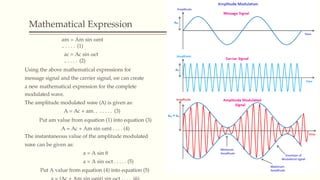
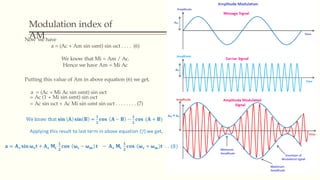
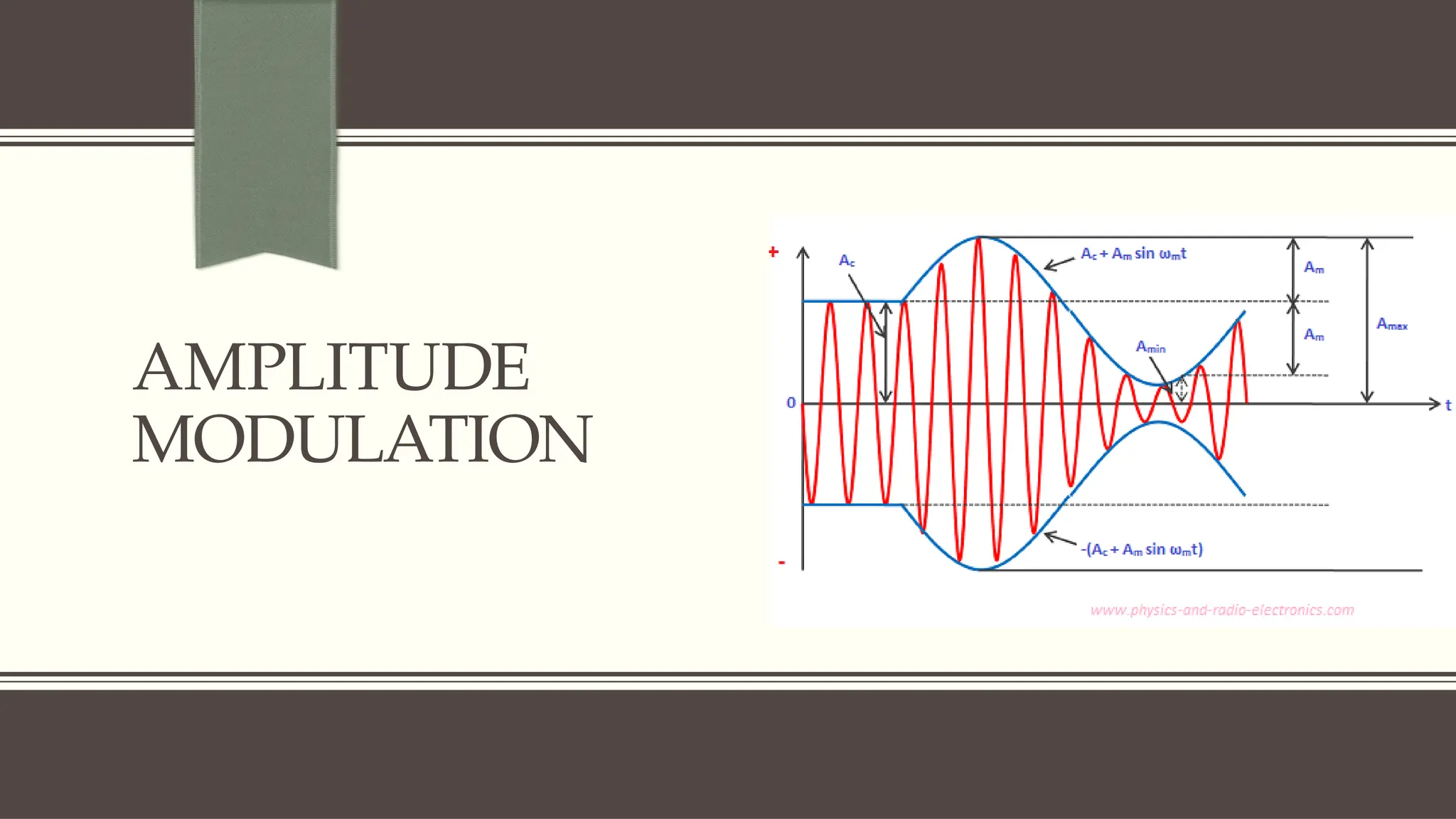
Amplitude Modulation
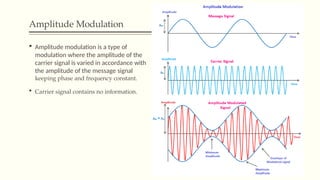
 Amplitude modulation is a type of
modulation where the amplitude of the
carrier signal is varied in accordance with
the amplitude of the message signal
keeping phase and frequency constant.
 Carrier signal contains no information.
Mathematical Expression
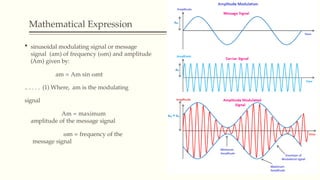
 sinusoidal modulating signal or message
signal (am) of frequency (ωm) and amplitude
(Am) given by:
am = Am sin ωmt
.. . . . . (1) Where, am is the modulating
signal
Am = maximum
amplitude of the message signal
ωm = frequency of the
message signal
Mathematical Expression
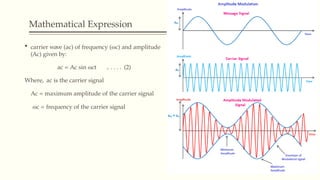
 carrier wave (ac) of frequency (ωc) and amplitude
(Ac) given by:
ac = Ac sin ωct .. . . . . (2)
Where, ac is the carrier signal
Ac = maximum amplitude of the carrier signal
ωc = frequency of the carrier signal
Modulation index of
AM
 Modulation index or modulation depth describes how the
amplitude, frequency or phase of the carrier signal and
message signal affects the amplitude, frequency or phase
of the modulated signal.
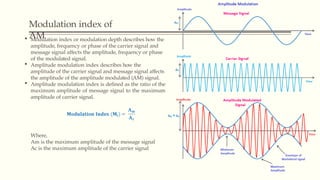
 Amplitude modulation index describes how the
amplitude of the carrier signal and message signal affects
the amplitude of the amplitude modulated (AM) signal.
 Amplitude modulation index is defined as the ratio of the
maximum amplitude of message signal to the maximum
amplitude of carrier signal.
Where,
Am is the maximum amplitude of the message signal
Ac is the maximum amplitude of the carrier signal
Mathematical Expression
am = Am sin ωmt
.. . . . . (1)
ac = Ac sin ωct
.. . . . . (2)
Using the above mathematical expressions for
message signal and the carrier signal, we can create
a new mathematical expression for the complete
modulated wave.
The amplitude modulated wave (A) is given as:
A = Ac + am. . . . . . . (3)
Put am value from equation (1) into equation (3)
A = Ac + Am sin ωmt . . . . (4)
The instantaneous value of the amplitude modulated
wave can be given as:
a = A sin θ
a = A sin ωct . . . . . (5)
Put A value from equation (4) into equation (5)
Modulation index of
AM
Now we have
a = (Ac + Am sin ωmt) sin ωct . . . . (6)
We know that Mi = Am / Ac.
Hence we have Am = Mi Ac
Putting this value of Am in above equation (6) we get,
a = (Ac + Mi Ac sin ωmt) sin ωct
= Ac (1 + Mi sin ωmt) sin ωct
= Ac sin ωct + Ac Mi sin ωmt sin ωct . . . . . . . . (7)
Equation of AM Wave
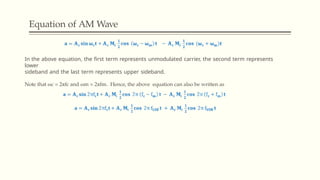
In the above equation, the first term represents unmodulated carrier, the second term represents
lower
sideband and the last term represents upper sideband.
Note that ωc = 2πfc and ωm = 2πfm. Hence, the above equation can also be written as
Equation of AM Wave
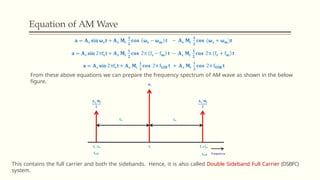
From these above equations we can prepare the frequency spectrum of AM wave as shown in the below
figure.
This contains the full carrier and both the sidebands. Hence, it is also called Double Sideband Full Carrier (DSBFC)
system.
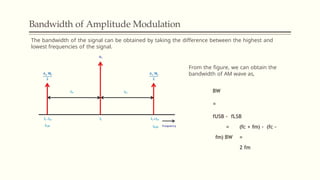
Bandwidth of Amplitude Modulation
The bandwidth of the signal can be obtained by taking the difference between the highest and
lowest frequencies of the signal.
From the figure, we can obtain the
bandwidth of AM wave as,
BW
=
fUSB – fLSB
= (fc + fm) – (fc –
fm) BW =
2 fm
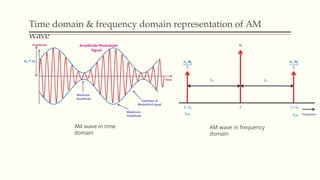
Time domain & frequency domain representation of AM
wave
AM wave in time
domain
AM wave in frequency
domain
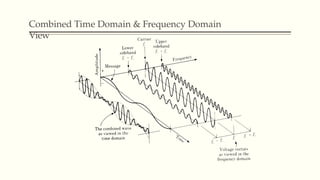
Combined Time Domain & Frequency Domain
View
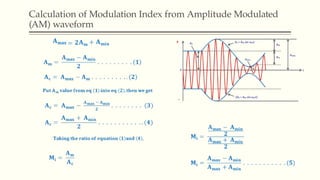
Calculation of Modulation Index from Amplitude Modulated
(AM) waveform
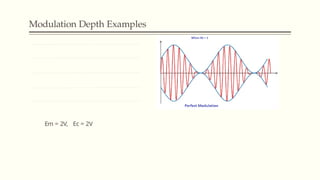
Modulation Depth Examples
Em = 2V, Ec = 2V
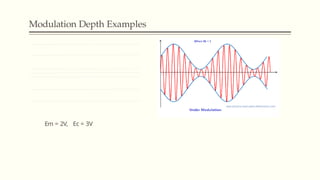
Modulation Depth Examples
Em = 2V, Ec = 3V
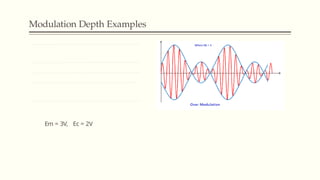
Modulation Depth Examples
Em = 3V, Ec = 2V
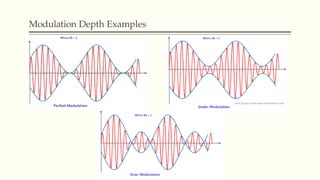
Modulation Depth Examples
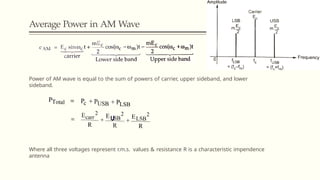
Average Power in AM Wave
Power of AM wave is equal to the sum of powers of carrier, upper sideband, and lower
sideband.
Where all three voltages represent r.m.s. values & resistance R is a characteristic impendence
antenna
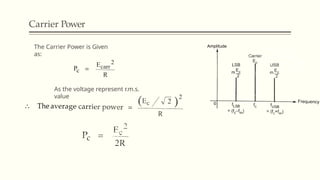
Carrier Power
The Carrier Power is Given
as:
As the voltage represent r.m.s.
value
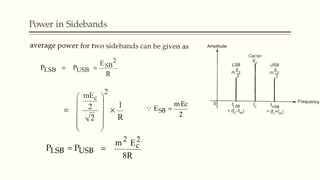
Power in Sidebands
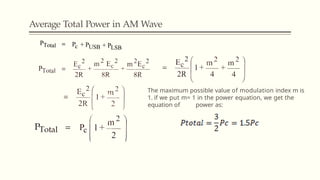
Average Total Power in AM Wave
The maximum possible value of modulation index m is
1. if we put m= 1 in the power equation, we get the
equation of power as:
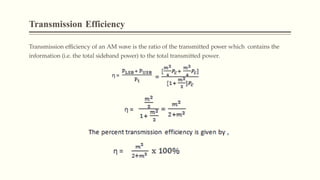
Transmission Efficiency
Transmission efficiency of an AM wave is the ratio of the transmitted power which contains the
information (i.e. the total sideband power) to the total transmitted power.
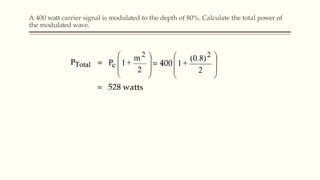
A 400 watt carrier signal is modulated to the depth of 80%. Calculate the total power of
the modulated wave.
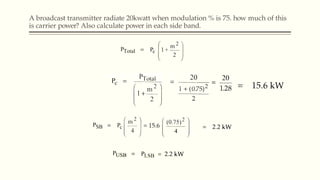
A broadcast transmitter radiate 20kwatt when modulation % is 75. how much of this
is carrier power? Also calculate power in each side band.
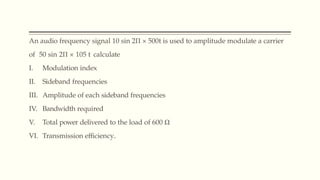
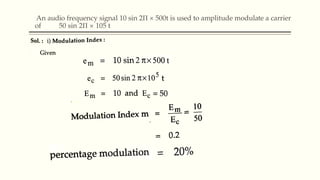
An audio frequency signal 10 sin 2Π × 500t is used to amplitude modulate a carrier
of 50 sin 2Π × 105 t calculate
I. Modulation index
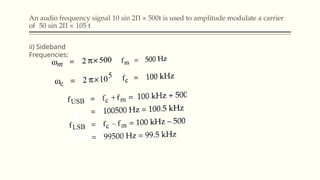
II. Sideband frequencies
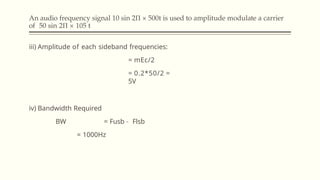
III. Amplitude of each sideband frequencies
IV. Bandwidth required
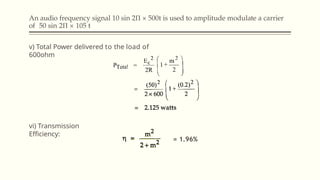
V. Total power delivered to the load of 600 Ω
VI. Transmission efficiency.
An audio frequency signal 10 sin 2Π × 500t is used to amplitude modulate a carrier
of 50 sin 2Π × 105 t
An audio frequency signal 10 sin 2Π × 500t is used to amplitude modulate a carrier
of 50 sin 2Π × 105 t
ii) Sideband
Frequencies:
An audio frequency signal 10 sin 2Π × 500t is used to amplitude modulate a carrier
of 50 sin 2Π × 105 t
iii) Amplitude of each sideband frequencies:
= mEc/2
= 0.2*50/2 =
5V
iv) Bandwidth Required
BW = Fusb – Flsb
= 1000Hz
An audio frequency signal 10 sin 2Π × 500t is used to amplitude modulate a carrier
of 50 sin 2Π × 105 t
v) Total Power delivered to the load of
600ohm
vi) Transmission
Efficiency:
= 1.96%
Reference:
https://www.physics-and-radio-electronics.com/blog/amplitude-
modulation/ Electronic communication system : Kennedy , Davis
Communication Engineering : Bakshi, Godse

Amplitude modulation waveforms process f

  • 1.
  • 2.
    Amplitude Modulation  Amplitudemodulation is a type of modulation where the amplitude of the carrier signal is varied in accordance with the amplitude of the message signal keeping phase and frequency constant.  Carrier signal contains no information.
  • 3.
    Mathematical Expression  sinusoidalmodulating signal or message signal (am) of frequency (ωm) and amplitude (Am) given by: am = Am sin ωmt .. . . . . (1) Where, am is the modulating signal Am = maximum amplitude of the message signal ωm = frequency of the message signal
  • 4.
    Mathematical Expression  carrierwave (ac) of frequency (ωc) and amplitude (Ac) given by: ac = Ac sin ωct .. . . . . (2) Where, ac is the carrier signal Ac = maximum amplitude of the carrier signal ωc = frequency of the carrier signal
  • 5.
    Modulation index of AM Modulation index or modulation depth describes how the amplitude, frequency or phase of the carrier signal and message signal affects the amplitude, frequency or phase of the modulated signal.  Amplitude modulation index describes how the amplitude of the carrier signal and message signal affects the amplitude of the amplitude modulated (AM) signal.  Amplitude modulation index is defined as the ratio of the maximum amplitude of message signal to the maximum amplitude of carrier signal. Where, Am is the maximum amplitude of the message signal Ac is the maximum amplitude of the carrier signal
  • 6.
    Mathematical Expression am =Am sin ωmt .. . . . . (1) ac = Ac sin ωct .. . . . . (2) Using the above mathematical expressions for message signal and the carrier signal, we can create a new mathematical expression for the complete modulated wave. The amplitude modulated wave (A) is given as: A = Ac + am. . . . . . . (3) Put am value from equation (1) into equation (3) A = Ac + Am sin ωmt . . . . (4) The instantaneous value of the amplitude modulated wave can be given as: a = A sin θ a = A sin ωct . . . . . (5) Put A value from equation (4) into equation (5)
  • 7.
    Modulation index of AM Nowwe have a = (Ac + Am sin ωmt) sin ωct . . . . (6) We know that Mi = Am / Ac. Hence we have Am = Mi Ac Putting this value of Am in above equation (6) we get, a = (Ac + Mi Ac sin ωmt) sin ωct = Ac (1 + Mi sin ωmt) sin ωct = Ac sin ωct + Ac Mi sin ωmt sin ωct . . . . . . . . (7)
  • 8.
    Equation of AMWave In the above equation, the first term represents unmodulated carrier, the second term represents lower sideband and the last term represents upper sideband. Note that ωc = 2πfc and ωm = 2πfm. Hence, the above equation can also be written as
  • 9.
    Equation of AMWave From these above equations we can prepare the frequency spectrum of AM wave as shown in the below figure. This contains the full carrier and both the sidebands. Hence, it is also called Double Sideband Full Carrier (DSBFC) system.
  • 10.
    Bandwidth of AmplitudeModulation The bandwidth of the signal can be obtained by taking the difference between the highest and lowest frequencies of the signal. From the figure, we can obtain the bandwidth of AM wave as, BW = fUSB – fLSB = (fc + fm) – (fc – fm) BW = 2 fm
  • 11.
    Time domain &frequency domain representation of AM wave AM wave in time domain AM wave in frequency domain
  • 12.
    Combined Time Domain& Frequency Domain View
  • 13.
    Calculation of ModulationIndex from Amplitude Modulated (AM) waveform
  • 14.
  • 15.
  • 16.
  • 17.
  • 18.
    Average Power inAM Wave Power of AM wave is equal to the sum of powers of carrier, upper sideband, and lower sideband. Where all three voltages represent r.m.s. values & resistance R is a characteristic impendence antenna
  • 19.
    Carrier Power The CarrierPower is Given as: As the voltage represent r.m.s. value
  • 20.
  • 21.
    Average Total Powerin AM Wave The maximum possible value of modulation index m is 1. if we put m= 1 in the power equation, we get the equation of power as:
  • 22.
    Transmission Efficiency Transmission efficiencyof an AM wave is the ratio of the transmitted power which contains the information (i.e. the total sideband power) to the total transmitted power.
  • 23.
    A 400 wattcarrier signal is modulated to the depth of 80%. Calculate the total power of the modulated wave.
  • 24.
    A broadcast transmitterradiate 20kwatt when modulation % is 75. how much of this is carrier power? Also calculate power in each side band.
  • 25.
    An audio frequencysignal 10 sin 2Π × 500t is used to amplitude modulate a carrier of 50 sin 2Π × 105 t calculate I. Modulation index II. Sideband frequencies III. Amplitude of each sideband frequencies IV. Bandwidth required V. Total power delivered to the load of 600 Ω VI. Transmission efficiency.
  • 26.
    An audio frequencysignal 10 sin 2Π × 500t is used to amplitude modulate a carrier of 50 sin 2Π × 105 t
  • 27.
    An audio frequencysignal 10 sin 2Π × 500t is used to amplitude modulate a carrier of 50 sin 2Π × 105 t ii) Sideband Frequencies:
  • 28.
    An audio frequencysignal 10 sin 2Π × 500t is used to amplitude modulate a carrier of 50 sin 2Π × 105 t iii) Amplitude of each sideband frequencies: = mEc/2 = 0.2*50/2 = 5V iv) Bandwidth Required BW = Fusb – Flsb = 1000Hz
  • 29.
    An audio frequencysignal 10 sin 2Π × 500t is used to amplitude modulate a carrier of 50 sin 2Π × 105 t v) Total Power delivered to the load of 600ohm vi) Transmission Efficiency: = 1.96%
  • 30.