Antenna
Measurements
[UNIT – 14 – As per the GTU Syllabus]
Brach: Electronics & Communication Engineering (11)
Semester: B.E (3rd year - 6th Semester)
Subject: Antenna and Wave Propagation (AWP)
GTU Subject Code: 2161003
Prepared By:-
Darshan Bhatt
Assistant Professor, EC Dept.
AIT, Ahmedabad, Gujarat
Content
◈ Introduction
◈ Experimental set ups for measurement of gain
◈ Experimental set ups for measurement of radiation pattern
◈ Experimental set ups for measurement of phase
◈ Experimental set ups for measurement of polarization
◈ Experimental set ups for measurement of terminal
impedance.
2
Introduction
◈ Antenna measurement techniques refers to the testing
of antennas to ensure that the antenna meets specifications or
simply to characterize it.
◈ Typical parameters of antennas are gain, bandwidth, radiation
pattern, beam width, polarization, and impedance.
◈ We will discuss some of the important parameters measurement
techniques in the upcoming sections.
3
Introduction
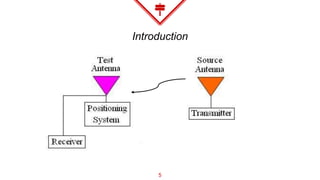
◈ Required Equipment in Antenna Measurement:
1. A source antenna and transmitter - This antenna will have a known pattern
that can be used to illuminate the test antenna.
2. A receiver system - This determines how much power is received by the test
antenna.
3. A positioning system - This system is used to rotate the test antenna relative to
the source antenna, to measure the radiation pattern as a function of angle.
4
Introduction
5
Introduction
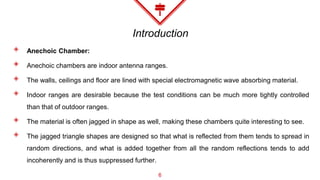
◈ Anechoic Chamber:
◈ Anechoic chambers are indoor antenna ranges.
◈ The walls, ceilings and floor are lined with special electromagnetic wave absorbing material.
◈ Indoor ranges are desirable because the test conditions can be much more tightly controlled
than that of outdoor ranges.
◈ The material is often jagged in shape as well, making these chambers quite interesting to see.
◈ The jagged triangle shapes are designed so that what is reflected from them tends to spread in
random directions, and what is added together from all the random reflections tends to add
incoherently and is thus suppressed further.
6
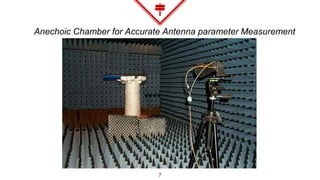
Anechoic Chamber for Accurate Antenna parameter Measurement
7
Experimental Setup for
Gain Measurement
1
8
Gain Measurement
◈ The most important figure of merit that describes the performance of a radiator is the
gain.
◈ The choice of either depends largely on the frequency of operation.
◈ Antenna gains are not usually measured at frequencies below 1 MHz.
◈ Usually there are two basic methods that can be used to measure the gain of an
electromagnetic radiator
 Absolute-gain
 Gain-transfer or gain-comparison
9
Gain Measurement
◈ The absolute-gain method is used to calibrate antennas that can then be used as
standards for gain measurements, and it requires no a priori knowledge of the gains of
the antennas.
◈ Gain-transfer methods must be used in conjunction with standard gain antennas to
determine the absolute gain of the antenna under test (AUT)
◈ The two antennas that are most widely used and universally accepted as gain standards
are
◈ Resonant λ/2 dipole
◈ Pyramidal horn antenna
10
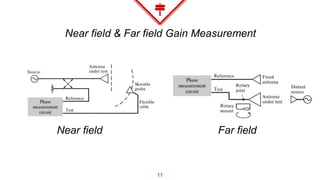
Near field & Far field Gain Measurement
11
Near field Far field
Absolute Gain Measurement
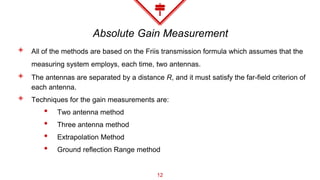
◈ All of the methods are based on the Friis transmission formula which assumes that the
measuring system employs, each time, two antennas.
◈ The antennas are separated by a distance R, and it must satisfy the far-field criterion of
each antenna.
◈ Techniques for the gain measurements are:
• Two antenna method
• Three antenna method
• Extrapolation Method
• Ground reflection Range method
12
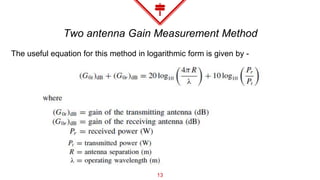
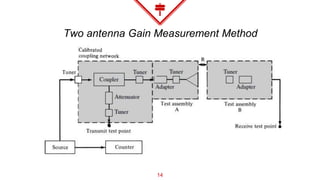
Two antenna Gain Measurement Method
13
The useful equation for this method in logarithmic form is given by -
Two antenna Gain Measurement Method
14
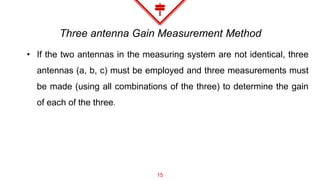
Three antenna Gain Measurement Method
15
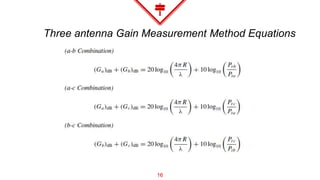
• If the two antennas in the measuring system are not identical, three
antennas (a, b, c) must be employed and three measurements must
be made (using all combinations of the three) to determine the gain
of each of the three.
Three antenna Gain Measurement Method Equations
16
Extrapolation Gain Measurement
◈ The extrapolation method is an absolute-gain method, which can be used with the
three-antenna method.
◈ It was developed to rigorously account for possible errors due to proximity,
multipath, and non identical antennas.
◈ If none of the antennas used in the measurements are circularly polarized, the
method yields the gains and polarizations of all three antennas.
◈ If only one antenna is circularly polarized, this method yields only the gain and
polarization of the circularly polarized antenna.
◈ The method fails if two or more antennas are circularly polarized.
17
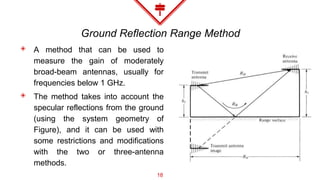
Ground Reflection Range Method
◈ A method that can be used to
measure the gain of moderately
broad-beam antennas, usually for
frequencies below 1 GHz.
◈ The method takes into account the
specular reflections from the ground
(using the system geometry of
Figure), and it can be used with
some restrictions and modifications
with the two or three-antenna
methods.
18
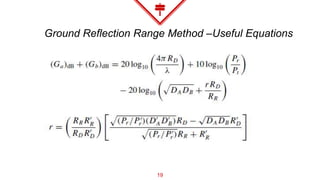
Ground Reflection Range Method –Useful Equations
19
Experimental Setup for radiation
pattern measurement
2
20
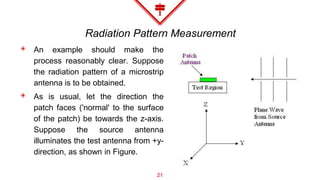
Radiation Pattern Measurement
◈ An example should make the
process reasonably clear. Suppose
the radiation pattern of a microstrip
antenna is to be obtained.
◈ As is usual, let the direction the
patch faces ('normal' to the surface
of the patch) be towards the z-axis.
Suppose the source antenna
illuminates the test antenna from +y-
direction, as shown in Figure.
21
Experimental Setup for Phase
measurement
3
22
Phase Measurement
23
Phase Measurement
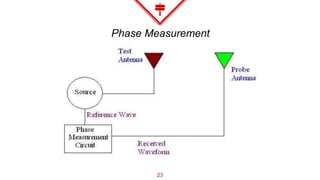
◈ The probe antenna should have good polarization purity, so that it can pick
up one component of the received field.
◈ To get the other orthogonal component, it could simply be rotated or another
probe antenna used.
◈ If the test antennas are very far from each other and the reference (source)
waveform can not be fed directly into the phase measurement circuit (this
happens at low frequencies and large outdoor ranges where many
wavelengths becomes a large distance), then a standard antenna with
known phase characteristics is used to transmit a wave, which is used to
compare with the received signal from the test antenna.
24
Experimental Setup for Polarization
measurement
4
25
Polarization Measurement
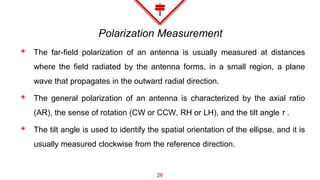
◈ The far-field polarization of an antenna is usually measured at distances
where the field radiated by the antenna forms, in a small region, a plane
wave that propagates in the outward radial direction.
◈ The general polarization of an antenna is characterized by the axial ratio
(AR), the sense of rotation (CW or CCW, RH or LH), and the tilt angle τ .
◈ The tilt angle is used to identify the spatial orientation of the ellipse, and it is
usually measured clockwise from the reference direction.
26
Polarization Measurement
◈ There are a number of techniques that can be used to measure the
polarization state of a radiator and they can be classified into three main
categories:
1. Those that yield partial polarization information.
2. Those that yield complete polarization in formation but require a
polarization standard for comparison. They are referred to as comparison
methods.
3. Those that yield complete polarization information and require no a priori
polarization knowledge or no polarization standard. They are designated
as absolute methods.
27
Polarization Measurement
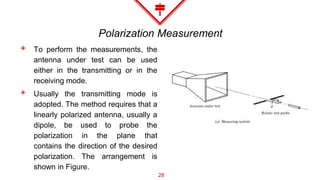
◈ To perform the measurements, the
antenna under test can be used
either in the transmitting or in the
receiving mode.
◈ Usually the transmitting mode is
adopted. The method requires that a
linearly polarized antenna, usually a
dipole, be used to probe the
polarization in the plane that
contains the direction of the desired
polarization. The arrangement is
shown in Figure.
28
Experimental set ups for
measurement of terminal impedance
5
29
Impedance Measurement
◈ Associated with an antenna, there are two types of impedances: a self and a
mutual impedance.
◈ When the antenna is radiating into an unbounded medium and there is no
coupling between it and other antennas or surrounding obstacles, the self-
impedance is also the driving-point impedance of the antenna.
◈ If there is coupling between the antenna under test and other sources or
obstacles, the driving-point impedance is a function of its self-impedance and
the mutual impedances between it and the other sources or obstacles. In
practice, the driving-point impedance is usually referred to as the input
impedance.
30
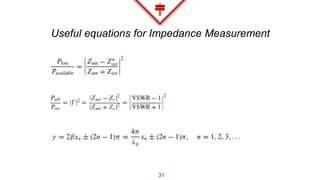
Useful equations for Impedance Measurement
31
References
◈ “Antenna theory – Analysis and Design”, 3rd edition by
Constantine A. Balanis, John Wiley and Sons publications
◈ www.antennatheory.com
32
Thank You

Antenna Measurements

  • 1.
    Antenna Measurements [UNIT – 14– As per the GTU Syllabus] Brach: Electronics & Communication Engineering (11) Semester: B.E (3rd year - 6th Semester) Subject: Antenna and Wave Propagation (AWP) GTU Subject Code: 2161003 Prepared By:- Darshan Bhatt Assistant Professor, EC Dept. AIT, Ahmedabad, Gujarat
  • 2.
    Content ◈ Introduction ◈ Experimentalset ups for measurement of gain ◈ Experimental set ups for measurement of radiation pattern ◈ Experimental set ups for measurement of phase ◈ Experimental set ups for measurement of polarization ◈ Experimental set ups for measurement of terminal impedance. 2
  • 3.
    Introduction ◈ Antenna measurementtechniques refers to the testing of antennas to ensure that the antenna meets specifications or simply to characterize it. ◈ Typical parameters of antennas are gain, bandwidth, radiation pattern, beam width, polarization, and impedance. ◈ We will discuss some of the important parameters measurement techniques in the upcoming sections. 3
  • 4.
    Introduction ◈ Required Equipmentin Antenna Measurement: 1. A source antenna and transmitter - This antenna will have a known pattern that can be used to illuminate the test antenna. 2. A receiver system - This determines how much power is received by the test antenna. 3. A positioning system - This system is used to rotate the test antenna relative to the source antenna, to measure the radiation pattern as a function of angle. 4
  • 5.
  • 6.
    Introduction ◈ Anechoic Chamber: ◈Anechoic chambers are indoor antenna ranges. ◈ The walls, ceilings and floor are lined with special electromagnetic wave absorbing material. ◈ Indoor ranges are desirable because the test conditions can be much more tightly controlled than that of outdoor ranges. ◈ The material is often jagged in shape as well, making these chambers quite interesting to see. ◈ The jagged triangle shapes are designed so that what is reflected from them tends to spread in random directions, and what is added together from all the random reflections tends to add incoherently and is thus suppressed further. 6
  • 7.
    Anechoic Chamber forAccurate Antenna parameter Measurement 7
  • 8.
  • 9.
    Gain Measurement ◈ Themost important figure of merit that describes the performance of a radiator is the gain. ◈ The choice of either depends largely on the frequency of operation. ◈ Antenna gains are not usually measured at frequencies below 1 MHz. ◈ Usually there are two basic methods that can be used to measure the gain of an electromagnetic radiator  Absolute-gain  Gain-transfer or gain-comparison 9
  • 10.
    Gain Measurement ◈ Theabsolute-gain method is used to calibrate antennas that can then be used as standards for gain measurements, and it requires no a priori knowledge of the gains of the antennas. ◈ Gain-transfer methods must be used in conjunction with standard gain antennas to determine the absolute gain of the antenna under test (AUT) ◈ The two antennas that are most widely used and universally accepted as gain standards are ◈ Resonant λ/2 dipole ◈ Pyramidal horn antenna 10
  • 11.
    Near field &Far field Gain Measurement 11 Near field Far field
  • 12.
    Absolute Gain Measurement ◈All of the methods are based on the Friis transmission formula which assumes that the measuring system employs, each time, two antennas. ◈ The antennas are separated by a distance R, and it must satisfy the far-field criterion of each antenna. ◈ Techniques for the gain measurements are: • Two antenna method • Three antenna method • Extrapolation Method • Ground reflection Range method 12
  • 13.
    Two antenna GainMeasurement Method 13 The useful equation for this method in logarithmic form is given by -
  • 14.
    Two antenna GainMeasurement Method 14
  • 15.
    Three antenna GainMeasurement Method 15 • If the two antennas in the measuring system are not identical, three antennas (a, b, c) must be employed and three measurements must be made (using all combinations of the three) to determine the gain of each of the three.
  • 16.
    Three antenna GainMeasurement Method Equations 16
  • 17.
    Extrapolation Gain Measurement ◈The extrapolation method is an absolute-gain method, which can be used with the three-antenna method. ◈ It was developed to rigorously account for possible errors due to proximity, multipath, and non identical antennas. ◈ If none of the antennas used in the measurements are circularly polarized, the method yields the gains and polarizations of all three antennas. ◈ If only one antenna is circularly polarized, this method yields only the gain and polarization of the circularly polarized antenna. ◈ The method fails if two or more antennas are circularly polarized. 17
  • 18.
    Ground Reflection RangeMethod ◈ A method that can be used to measure the gain of moderately broad-beam antennas, usually for frequencies below 1 GHz. ◈ The method takes into account the specular reflections from the ground (using the system geometry of Figure), and it can be used with some restrictions and modifications with the two or three-antenna methods. 18
  • 19.
    Ground Reflection RangeMethod –Useful Equations 19
  • 20.
    Experimental Setup forradiation pattern measurement 2 20
  • 21.
    Radiation Pattern Measurement ◈An example should make the process reasonably clear. Suppose the radiation pattern of a microstrip antenna is to be obtained. ◈ As is usual, let the direction the patch faces ('normal' to the surface of the patch) be towards the z-axis. Suppose the source antenna illuminates the test antenna from +y- direction, as shown in Figure. 21
  • 22.
    Experimental Setup forPhase measurement 3 22
  • 23.
  • 24.
    Phase Measurement ◈ Theprobe antenna should have good polarization purity, so that it can pick up one component of the received field. ◈ To get the other orthogonal component, it could simply be rotated or another probe antenna used. ◈ If the test antennas are very far from each other and the reference (source) waveform can not be fed directly into the phase measurement circuit (this happens at low frequencies and large outdoor ranges where many wavelengths becomes a large distance), then a standard antenna with known phase characteristics is used to transmit a wave, which is used to compare with the received signal from the test antenna. 24
  • 25.
    Experimental Setup forPolarization measurement 4 25
  • 26.
    Polarization Measurement ◈ Thefar-field polarization of an antenna is usually measured at distances where the field radiated by the antenna forms, in a small region, a plane wave that propagates in the outward radial direction. ◈ The general polarization of an antenna is characterized by the axial ratio (AR), the sense of rotation (CW or CCW, RH or LH), and the tilt angle τ . ◈ The tilt angle is used to identify the spatial orientation of the ellipse, and it is usually measured clockwise from the reference direction. 26
  • 27.
    Polarization Measurement ◈ Thereare a number of techniques that can be used to measure the polarization state of a radiator and they can be classified into three main categories: 1. Those that yield partial polarization information. 2. Those that yield complete polarization in formation but require a polarization standard for comparison. They are referred to as comparison methods. 3. Those that yield complete polarization information and require no a priori polarization knowledge or no polarization standard. They are designated as absolute methods. 27
  • 28.
    Polarization Measurement ◈ Toperform the measurements, the antenna under test can be used either in the transmitting or in the receiving mode. ◈ Usually the transmitting mode is adopted. The method requires that a linearly polarized antenna, usually a dipole, be used to probe the polarization in the plane that contains the direction of the desired polarization. The arrangement is shown in Figure. 28
  • 29.
    Experimental set upsfor measurement of terminal impedance 5 29
  • 30.
    Impedance Measurement ◈ Associatedwith an antenna, there are two types of impedances: a self and a mutual impedance. ◈ When the antenna is radiating into an unbounded medium and there is no coupling between it and other antennas or surrounding obstacles, the self- impedance is also the driving-point impedance of the antenna. ◈ If there is coupling between the antenna under test and other sources or obstacles, the driving-point impedance is a function of its self-impedance and the mutual impedances between it and the other sources or obstacles. In practice, the driving-point impedance is usually referred to as the input impedance. 30
  • 31.
    Useful equations forImpedance Measurement 31
  • 32.
    References ◈ “Antenna theory– Analysis and Design”, 3rd edition by Constantine A. Balanis, John Wiley and Sons publications ◈ www.antennatheory.com 32
  • 33.