Frequency Translation
UNIT-1
1
Introduction
 One of the basic problems of communication engineering
in the design and analysis of systems which allow many
individual messages to be transmitted simultaneously over
a single communication channel.
 A method by which such multiple transmissions are done
is known as multiplexing
 It may be achieved by translating each message to a
different position in the frequency spectrum.
2
Contd…
► Such multiplexing is called frequency multiplexing.
► Frequency multiplexing involves the use of an auxiliary
waveform, usually sinusoidal,called a carrier.
► The operation performed on the signal to achieve
frequency multiplexing result in the generation of
waveform which may be described as the carrier modified
in that its amplitude, frequency or phase varies with time
► Such a modified carrier is called a modulated carrier
3
Frequency Translation
 It is often advantageous and convenient to translate a signal
from one region in the frequency domain to another region
 The process of frequency translation is one in which the
original signal is replaced with a new signal whose spectral
range extends from f1’ tof2’ and which new signal bears,in
recoverable form, the same information as was borne by the
original signal.
4
Frequency Multiplexing
 Suppose that we have several different signals, all of which
encompass the same spectral range.
 Let it be required that all these signals be transmitted along a
single communications channel in such a manner that, at the
receiving end, the signals be separately recoverable and
distinguishable from each other.
 The single channel may be a single pair of wires or the free
space that separates one radio antenna from another.
 Such multiple transmissions, i.e., multiplexing, may be
achieved by translating each one of the original signals to a
different frequency range.
5
Contd…
 Suppose, say, that one signal is translated to the frequency range f1’ to f2’, the
second to the range f1" to f2”, and so on.
 If these new frequency ranges do not overlap, then the signal may be separated
at the receiving end by appropriate bandpass filters.
 The outputs of the filters are processed to recover the original signals.
Practicability of Antennas:
 When free space is the communications channel, antennas radiate and receive
the signal
6
Contd…
 It turns out that antennas operate effectively only when
their dimensions are of the order of magnitude of the
wavelength of the signal being transmitted.
 A signal of frequency 1 kHz (an audio tone) corresponds
to a wavelength of 300,000 m, an entirely impractical
length.
 The required length may be reduced to the point of
practicability by translating the audio tone to a higher
frequency.
7
Contd…
Narrowbanding:
 Returning to the matter of the antenna, just discussed,
suppose that we wanted to transmit an audio signal directly
from the antenna, and that the inordinate length of the
antenna were no problem
 We would still be left with a problem of another type
 Let us assume that the audio range extends from, say, 50 to
104 Hz.
 The ratio of the highest audio frequency to the lowest is
200.
8
Contd…
 Therefore, an antenna suitable for use at one end of the range
would be entirely too short or too long for the other end
 Suppose, however, that the audio spectrum were translated so
that it occupied the range, say, from (106 + 50) to (106 + 104)
Hz.
 Then the ratio of highest to lowest frequency would be only
1.01.
 Thus the processes of fre¬quency translation may be used to
change a “wideband” signal into a “ narrowband ” signal which
may well be more conveniently processed.
9
Contd…
 The terms “ wideband ” and “ narrowband ” are being used here to refer not
to an absolute range of frequencies but rather to the fractional change in
frequency from one band edge to the other.
Common Processing:
 It may happen that we have to process a number of signals similar in general
character but occupying different spectral ranges
 It will then be necessary, as we go from signal to signal, to adjust the
frequency range of our processing apparatus to correspond to the frequency
range of the signal to be processed
 If the processing apparatus is rather elaborate ,it may well be wiser to leave
the processing apparatus to operate in some fixed frequency range and instead
to translate the frequency range of each signal in turn to correspond to this
fixed frequency.
10
A method of Frequency Translation
 A signal may be translated to a new spectral range by multiplying
the signal with an auxiliary sinusoidal signal.
 To illustrate the process, let us consider initially that the signal is
sinusoidal in waveform and given by:
vm(t)=Am cosωmt=Amcos2πfmt (1a)
=
𝐴 𝑚
2
𝑒 𝑗𝜔 𝑚 𝑡
+ 𝑒−𝑗𝜔 𝑚 𝑡
=
𝐴 𝑚
2
𝑒 𝑗2𝜋𝑓 𝑚 𝑡
+ 𝑒−𝑗2𝜋𝑓 𝑚 𝑡
(1b)
in which Am is the constant amplitude and fm=wm/2π is the frequency.
11
Contd…
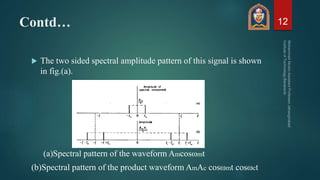
 The two sided spectral amplitude pattern of this signal is shown
in fig.(a).
(a)Spectral pattern of the waveform Amcosωmt
(b)Spectral pattern of the product waveform AmAc cosωmt cosωct
12
Contd…
 The pattern consists of two lines,each of amplitude Am/2 located at
f = fm and at f = -fm.
 Consider next the result of multiplication of vm(t) with an auxiliary
sinusoidal signal
vc (t)=Ac cos ωct=Ac cos 2πfct (2a)
=
𝐴 𝑐
2
𝑒 𝑗𝜔 𝑐 𝑡 + 𝑒−𝑗𝜔 𝑐 𝑡 =
𝐴 𝑐
2
𝑒 𝑗𝜋𝑓𝑐 𝑡 + 𝑒−𝑗2𝜋𝑓𝑐 𝑡 (2b)
In which Ac is the constant amplitude and fc is the frequency.
13
Contd…
Using the trigonometric identity
cosα.cosβ=
1
2
cos(α + β)+
1
2
cos(α - β),we have for the product
vm(t). vc(t)=
𝐴 𝑚 𝐴 𝑐
2
cos 𝜔𝑐 + 𝜔 𝑚 𝑡 + cos 𝜔𝑐 − 𝜔 𝑚 𝑡 (3a)
=
𝐴 𝑚 𝐴 𝑐
4
𝑒 𝑗 𝜔 𝑐+𝜔 𝑚 𝑡
+ 𝑒−j 𝜔 𝑐+𝜔 𝑚 𝑡
+ 𝑒 𝑗 𝜔 𝑐−𝜔 𝑚 𝑡
+ 𝑒−j 𝜔 𝑐−𝜔 𝑚 𝑡
(3b)
 The new spectral pattern is shown in fig.(b)
 Observe that the two original spectral lines have been translated,
both in the positive frequency direction by amount fc and also in the
negative frequency direction by the same amount.
14
Contd…
 There are now four spectral components resulting in two
sinusoidal waveforms, one of frequency fc+fm and the
other of frequency fc-fm.
 Note that the product signal has four spectral components
each of amplitude AmAc/4,there are only two frequencies,
and the amplitude of each sinusoidal component is AmAc/2
15
RECOVERY OF THE BASEBAND
SIGNAL
 Suppose a signal m(t) has been translated out of its
baseband through multiplication with cos ωct
 How is the signal to be recovered?
 The recovery may be achieved by a reverse translation,
which is accomplished simply by multiplying the
translated signal with cos ωct
 The difference-frequency signal obtained by multiplying
m(t).cos ωct by cos ωct, t is a signal whose spectral range
is back at baseband
16
Contd…
► Alternatively, we may simply note that
[m(t).cos ωct ] cos ωct = m(t).𝑐𝑜𝑠2 ωct
= m(t)(
1
2
+
1
2
cos 2ωct ) (1a)
=
𝑚(𝑡)
2
+
𝑚(𝑡)
2
cos 2ωct (1b)
 Thus, the baseband signal m(t) reappears.
17
Conclusion
 This feature of the process of translation by multiplication
may, depending on the application, a matter of
indifference, or even an adavantage.
 Hence this feature of the process is, of itself, neither an
advantage nor a disadvantage.
 It is, however, to be noted that there is no other operation
so simple which will accomplish frequency translation.
18
Thank You
19

Frequency translation

  • 1.
  • 2.
    Introduction  One ofthe basic problems of communication engineering in the design and analysis of systems which allow many individual messages to be transmitted simultaneously over a single communication channel.  A method by which such multiple transmissions are done is known as multiplexing  It may be achieved by translating each message to a different position in the frequency spectrum. 2
  • 3.
    Contd… ► Such multiplexingis called frequency multiplexing. ► Frequency multiplexing involves the use of an auxiliary waveform, usually sinusoidal,called a carrier. ► The operation performed on the signal to achieve frequency multiplexing result in the generation of waveform which may be described as the carrier modified in that its amplitude, frequency or phase varies with time ► Such a modified carrier is called a modulated carrier 3
  • 4.
    Frequency Translation  Itis often advantageous and convenient to translate a signal from one region in the frequency domain to another region  The process of frequency translation is one in which the original signal is replaced with a new signal whose spectral range extends from f1’ tof2’ and which new signal bears,in recoverable form, the same information as was borne by the original signal. 4
  • 5.
    Frequency Multiplexing  Supposethat we have several different signals, all of which encompass the same spectral range.  Let it be required that all these signals be transmitted along a single communications channel in such a manner that, at the receiving end, the signals be separately recoverable and distinguishable from each other.  The single channel may be a single pair of wires or the free space that separates one radio antenna from another.  Such multiple transmissions, i.e., multiplexing, may be achieved by translating each one of the original signals to a different frequency range. 5
  • 6.
    Contd…  Suppose, say,that one signal is translated to the frequency range f1’ to f2’, the second to the range f1" to f2”, and so on.  If these new frequency ranges do not overlap, then the signal may be separated at the receiving end by appropriate bandpass filters.  The outputs of the filters are processed to recover the original signals. Practicability of Antennas:  When free space is the communications channel, antennas radiate and receive the signal 6
  • 7.
    Contd…  It turnsout that antennas operate effectively only when their dimensions are of the order of magnitude of the wavelength of the signal being transmitted.  A signal of frequency 1 kHz (an audio tone) corresponds to a wavelength of 300,000 m, an entirely impractical length.  The required length may be reduced to the point of practicability by translating the audio tone to a higher frequency. 7
  • 8.
    Contd… Narrowbanding:  Returning tothe matter of the antenna, just discussed, suppose that we wanted to transmit an audio signal directly from the antenna, and that the inordinate length of the antenna were no problem  We would still be left with a problem of another type  Let us assume that the audio range extends from, say, 50 to 104 Hz.  The ratio of the highest audio frequency to the lowest is 200. 8
  • 9.
    Contd…  Therefore, anantenna suitable for use at one end of the range would be entirely too short or too long for the other end  Suppose, however, that the audio spectrum were translated so that it occupied the range, say, from (106 + 50) to (106 + 104) Hz.  Then the ratio of highest to lowest frequency would be only 1.01.  Thus the processes of fre¬quency translation may be used to change a “wideband” signal into a “ narrowband ” signal which may well be more conveniently processed. 9
  • 10.
    Contd…  The terms“ wideband ” and “ narrowband ” are being used here to refer not to an absolute range of frequencies but rather to the fractional change in frequency from one band edge to the other. Common Processing:  It may happen that we have to process a number of signals similar in general character but occupying different spectral ranges  It will then be necessary, as we go from signal to signal, to adjust the frequency range of our processing apparatus to correspond to the frequency range of the signal to be processed  If the processing apparatus is rather elaborate ,it may well be wiser to leave the processing apparatus to operate in some fixed frequency range and instead to translate the frequency range of each signal in turn to correspond to this fixed frequency. 10
  • 11.
    A method ofFrequency Translation  A signal may be translated to a new spectral range by multiplying the signal with an auxiliary sinusoidal signal.  To illustrate the process, let us consider initially that the signal is sinusoidal in waveform and given by: vm(t)=Am cosωmt=Amcos2πfmt (1a) = 𝐴 𝑚 2 𝑒 𝑗𝜔 𝑚 𝑡 + 𝑒−𝑗𝜔 𝑚 𝑡 = 𝐴 𝑚 2 𝑒 𝑗2𝜋𝑓 𝑚 𝑡 + 𝑒−𝑗2𝜋𝑓 𝑚 𝑡 (1b) in which Am is the constant amplitude and fm=wm/2π is the frequency. 11
  • 12.
    Contd…  The twosided spectral amplitude pattern of this signal is shown in fig.(a). (a)Spectral pattern of the waveform Amcosωmt (b)Spectral pattern of the product waveform AmAc cosωmt cosωct 12
  • 13.
    Contd…  The patternconsists of two lines,each of amplitude Am/2 located at f = fm and at f = -fm.  Consider next the result of multiplication of vm(t) with an auxiliary sinusoidal signal vc (t)=Ac cos ωct=Ac cos 2πfct (2a) = 𝐴 𝑐 2 𝑒 𝑗𝜔 𝑐 𝑡 + 𝑒−𝑗𝜔 𝑐 𝑡 = 𝐴 𝑐 2 𝑒 𝑗𝜋𝑓𝑐 𝑡 + 𝑒−𝑗2𝜋𝑓𝑐 𝑡 (2b) In which Ac is the constant amplitude and fc is the frequency. 13
  • 14.
    Contd… Using the trigonometricidentity cosα.cosβ= 1 2 cos(α + β)+ 1 2 cos(α - β),we have for the product vm(t). vc(t)= 𝐴 𝑚 𝐴 𝑐 2 cos 𝜔𝑐 + 𝜔 𝑚 𝑡 + cos 𝜔𝑐 − 𝜔 𝑚 𝑡 (3a) = 𝐴 𝑚 𝐴 𝑐 4 𝑒 𝑗 𝜔 𝑐+𝜔 𝑚 𝑡 + 𝑒−j 𝜔 𝑐+𝜔 𝑚 𝑡 + 𝑒 𝑗 𝜔 𝑐−𝜔 𝑚 𝑡 + 𝑒−j 𝜔 𝑐−𝜔 𝑚 𝑡 (3b)  The new spectral pattern is shown in fig.(b)  Observe that the two original spectral lines have been translated, both in the positive frequency direction by amount fc and also in the negative frequency direction by the same amount. 14
  • 15.
    Contd…  There arenow four spectral components resulting in two sinusoidal waveforms, one of frequency fc+fm and the other of frequency fc-fm.  Note that the product signal has four spectral components each of amplitude AmAc/4,there are only two frequencies, and the amplitude of each sinusoidal component is AmAc/2 15
  • 16.
    RECOVERY OF THEBASEBAND SIGNAL  Suppose a signal m(t) has been translated out of its baseband through multiplication with cos ωct  How is the signal to be recovered?  The recovery may be achieved by a reverse translation, which is accomplished simply by multiplying the translated signal with cos ωct  The difference-frequency signal obtained by multiplying m(t).cos ωct by cos ωct, t is a signal whose spectral range is back at baseband 16
  • 17.
    Contd… ► Alternatively, wemay simply note that [m(t).cos ωct ] cos ωct = m(t).𝑐𝑜𝑠2 ωct = m(t)( 1 2 + 1 2 cos 2ωct ) (1a) = 𝑚(𝑡) 2 + 𝑚(𝑡) 2 cos 2ωct (1b)  Thus, the baseband signal m(t) reappears. 17
  • 18.
    Conclusion  This featureof the process of translation by multiplication may, depending on the application, a matter of indifference, or even an adavantage.  Hence this feature of the process is, of itself, neither an advantage nor a disadvantage.  It is, however, to be noted that there is no other operation so simple which will accomplish frequency translation. 18
  • 19.