ECE-DEPARTMENT
1. SHIVA SHANKER BEERAVELLI : 10T81A0448
2. PALUSA KRANTHI KUMAR GOUD : 10T81A0417
3. G.SHIVA NARAYANA REDDY : 10T81A0449
4. SHEELAM RAMU : 10T81A0431
Internal Guide:
Mr.K.ASHOK KUMAR
Assoc. Prof & HOD-ECE
A MINI-PROJECT
ON
IMPLEMENTATION OF
HYBRID CELLULAR AUTOMATA AS A TEST
PATTERN GENERATER & RESPONSE COMPACTOR
FOR BIST
CONTENTS:
 Objective
 Working Principles
 Diagrammatic View
 Advantages /Disadvantages With Examples
 Applications in Real Time Scenario
 Future Extension of the Project
 Summary
 References /Bibliography
 WHY TESTING IS IMPORTANT IN VLSI
DESIGN ?
 Specifications
 Code designing
 Code verification
 RTL designing
 Simulation
 Synthesis
 Fabrication
TESTING
 packing
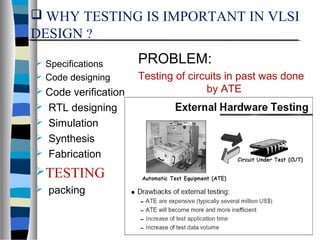
PROBLEM:
Testing of circuits in past was done
by ATE
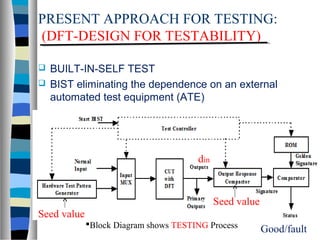
PRESENT APPROACH FOR TESTING:
(DFT-DESIGN FOR TESTABILITY)
 BUILT-IN-SELF TEST
 BIST eliminating the dependence on an external
automated test equipment (ATE)
Block Diagram shows TESTING Process
Seed value
Seed value
din
Good/fault
MAIN OBJECTIVE:
 To construct the TPG
 To construct the ORA
Using CELLULAR AUTOMATA (CA)
Pseudo random
generator
CELLULAR AUTOMATA:
 Cellular automata is collection of cells with regular
collections.
Working Principles/Rules:
 Each cell connects to its local neighbors by using
rule 90 and rule150.
Flip-flops
 Rule 90:  Rule 150:
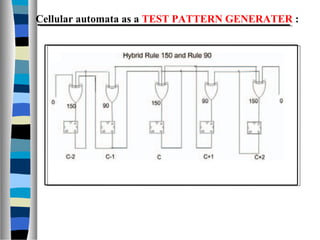
 Transition function [rule 90] : Xc(t+1) = Xc-1(t) xor Xc+1(t).
 Transition function [rule 150]: Xc(t+1) = Xc-1(t) xor Xc(t) xor Xc+1(t).
C-1 : past
C : present
C+1 : future
Diagrammatic View:
Cellular automata as a TEST PATTERN GENERATER :
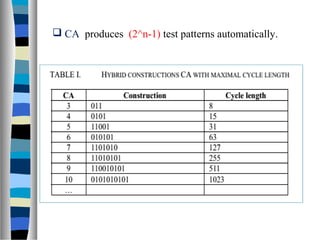
 CA produces (2^n-1) test patterns automatically.
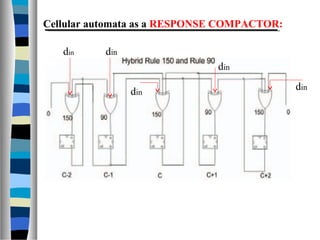
Cellular automata as a RESPONSE COMPACTOR:
din din
din
din
din
 Lower cost of test, since the need for external electrical
testing using an ATE will be reduced, if not eliminated.
 better fault coverage, since special test structures can be
incorporated onto the chips.
 easier customer support.
 capability to perform tests outside the production electrical
testing environment.
 Shorter test times if the BIST can be designed to test more
structures in parallel.
Advantages:
 additional silicon area and fob processing requirements .
 additional pin requirements.(since the BIST circuitry need a way to
interface with the outside world to be effective)
 possibly bigger package size
Disadvantages:
 Integrated circuit manufacture :BIST is used to make faster,
less-expensive integrated circuit manufacturing tests.
 Computers(pc’s test itself at startup)
 Medicine (medical devices test themselves to assure continued
safety )
 Military (used in missiles where the bist is computer c
controlled)
Applications in Real Time Scenario :
Future Extension of the Project:
•Built-In Self-Repair (BISR).
•Transparent BIST for RAMs.
•Programmable memory BIST.
References /Bibliography:
1. Bushnell and Agrawal, “Essentials of Electronic Testing for
Digital, Memory & Mixed-Signal VLSI Circuits” New York:
Kluwer Academic Publishers, 2002
2. Serra, M.; Slater, T.; Muzio, J.C.; Miller, D.M., “The
analysis of one-dimensional linear cellular automata and
their aliasing properties, IEEE Transactions on, Volume: 9 ,
Issue: 7 , July 1999, Pages:767 – 778.
3. Jianbing Zhao., “A Novel FPGA Manufacture-oriented
Interconnect Fault Test,” 9th International Conference on
Solid-State and Integrated-Circuit Technology, 2008
cellular automata as a test pattern generator and output response compactor for bist

cellular automata as a test pattern generator and output response compactor for bist

  • 1.
    ECE-DEPARTMENT 1. SHIVA SHANKERBEERAVELLI : 10T81A0448 2. PALUSA KRANTHI KUMAR GOUD : 10T81A0417 3. G.SHIVA NARAYANA REDDY : 10T81A0449 4. SHEELAM RAMU : 10T81A0431 Internal Guide: Mr.K.ASHOK KUMAR Assoc. Prof & HOD-ECE
  • 2.
    A MINI-PROJECT ON IMPLEMENTATION OF HYBRIDCELLULAR AUTOMATA AS A TEST PATTERN GENERATER & RESPONSE COMPACTOR FOR BIST
  • 3.
    CONTENTS:  Objective  WorkingPrinciples  Diagrammatic View  Advantages /Disadvantages With Examples  Applications in Real Time Scenario  Future Extension of the Project  Summary  References /Bibliography
  • 4.
     WHY TESTINGIS IMPORTANT IN VLSI DESIGN ?  Specifications  Code designing  Code verification  RTL designing  Simulation  Synthesis  Fabrication TESTING  packing PROBLEM: Testing of circuits in past was done by ATE
  • 5.
    PRESENT APPROACH FORTESTING: (DFT-DESIGN FOR TESTABILITY)  BUILT-IN-SELF TEST  BIST eliminating the dependence on an external automated test equipment (ATE) Block Diagram shows TESTING Process Seed value Seed value din Good/fault
  • 6.
    MAIN OBJECTIVE:  Toconstruct the TPG  To construct the ORA Using CELLULAR AUTOMATA (CA) Pseudo random generator
  • 7.
    CELLULAR AUTOMATA:  Cellularautomata is collection of cells with regular collections. Working Principles/Rules:  Each cell connects to its local neighbors by using rule 90 and rule150. Flip-flops
  • 8.
     Rule 90: Rule 150:  Transition function [rule 90] : Xc(t+1) = Xc-1(t) xor Xc+1(t).  Transition function [rule 150]: Xc(t+1) = Xc-1(t) xor Xc(t) xor Xc+1(t). C-1 : past C : present C+1 : future Diagrammatic View:
  • 9.
    Cellular automata asa TEST PATTERN GENERATER :
  • 10.
     CA produces(2^n-1) test patterns automatically.
  • 11.
    Cellular automata asa RESPONSE COMPACTOR: din din din din din
  • 12.
     Lower costof test, since the need for external electrical testing using an ATE will be reduced, if not eliminated.  better fault coverage, since special test structures can be incorporated onto the chips.  easier customer support.  capability to perform tests outside the production electrical testing environment.  Shorter test times if the BIST can be designed to test more structures in parallel. Advantages:
  • 13.
     additional siliconarea and fob processing requirements .  additional pin requirements.(since the BIST circuitry need a way to interface with the outside world to be effective)  possibly bigger package size Disadvantages:
  • 14.
     Integrated circuitmanufacture :BIST is used to make faster, less-expensive integrated circuit manufacturing tests.  Computers(pc’s test itself at startup)  Medicine (medical devices test themselves to assure continued safety )  Military (used in missiles where the bist is computer c controlled) Applications in Real Time Scenario :
  • 15.
    Future Extension ofthe Project: •Built-In Self-Repair (BISR). •Transparent BIST for RAMs. •Programmable memory BIST.
  • 17.
    References /Bibliography: 1. Bushnelland Agrawal, “Essentials of Electronic Testing for Digital, Memory & Mixed-Signal VLSI Circuits” New York: Kluwer Academic Publishers, 2002 2. Serra, M.; Slater, T.; Muzio, J.C.; Miller, D.M., “The analysis of one-dimensional linear cellular automata and their aliasing properties, IEEE Transactions on, Volume: 9 , Issue: 7 , July 1999, Pages:767 – 778. 3. Jianbing Zhao., “A Novel FPGA Manufacture-oriented Interconnect Fault Test,” 9th International Conference on Solid-State and Integrated-Circuit Technology, 2008