Presented by
ADEKUNLE ONAOPEPO HUSAMAT
1
 INTRODUCTION
 BACKGROUND
 SYNTAX
 COMPONENTS
 BEHAVIOUR
 VARIANTS
 APPLICATIONS
 CASE STUDIES
 LEVEL OF KNOWLEDGE
 ADVANTAGES
 DRAWBACKS
 REFERENCES
OVERVIEW
2
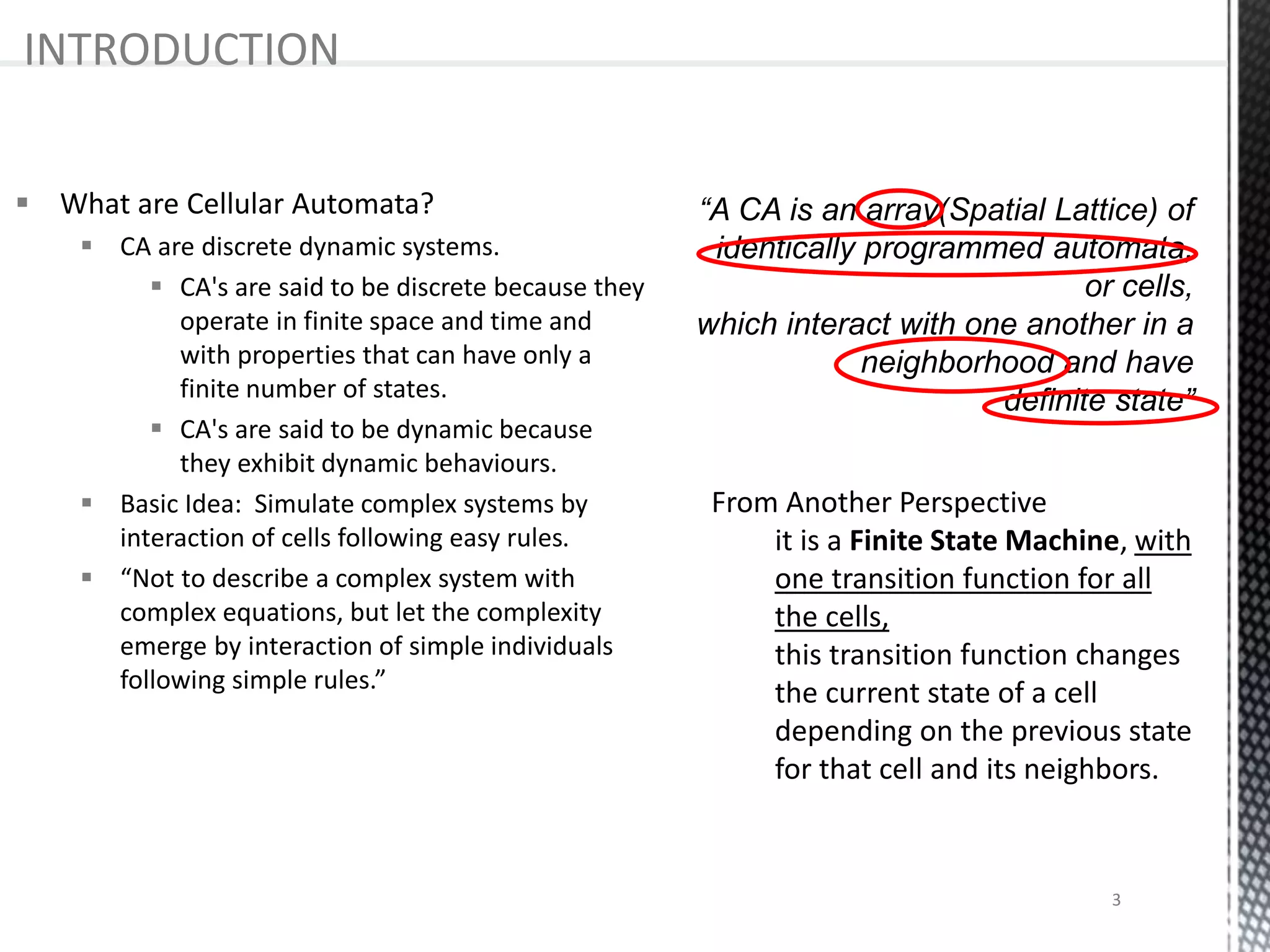
 What are Cellular Automata?
 CA are discrete dynamic systems.
 CA's are said to be discrete because they
operate in finite space and time and
with properties that can have only a
finite number of states.
 CA's are said to be dynamic because
they exhibit dynamic behaviours.
 Basic Idea: Simulate complex systems by
interaction of cells following easy rules.
 “Not to describe a complex system with
complex equations, but let the complexity
emerge by interaction of simple individuals
following simple rules.”
INTRODUCTION
From Another Perspective
it is a Finite State Machine, with
one transition function for all
the cells,
this transition function changes
the current state of a cell
depending on the previous state
for that cell and its neighbors.
3
BACKGROUND
4
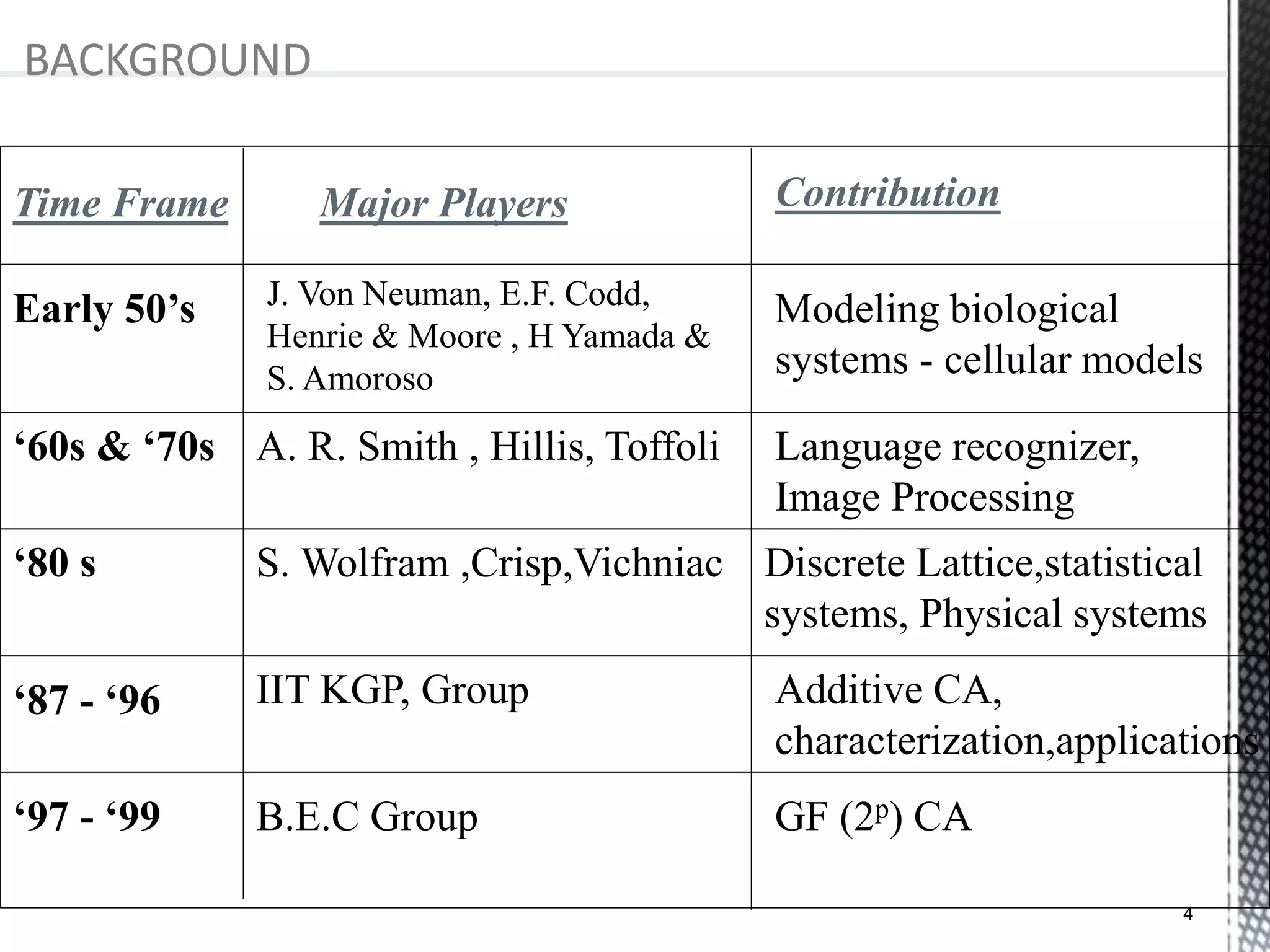
Time Frame Major Players Contribution
Early 50’s J. Von Neuman, E.F. Codd,
Henrie & Moore , H Yamada &
S. Amoroso
Modeling biological
systems - cellular models
‘60s & ‘70s A. R. Smith , Hillis, Toffoli Language recognizer,
Image Processing
‘80 s S. Wolfram ,Crisp,Vichniac Discrete Lattice,statistical
systems, Physical systems
‘87 - ‘96 IIT KGP, Group Additive CA,
characterization,applications
‘97 - ‘99 B.E.C Group GF (2p) CA
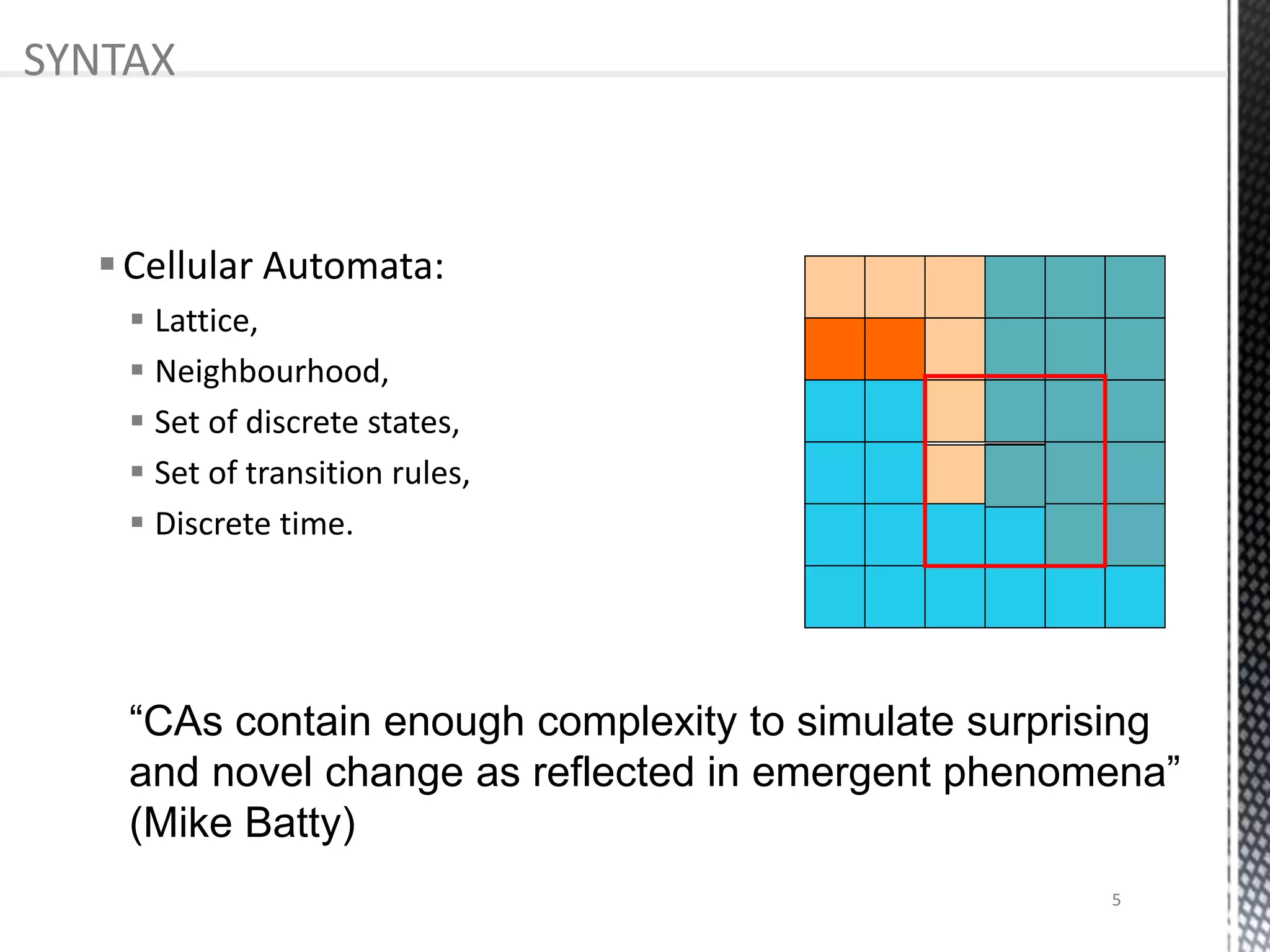
Cellular Automata:
 Lattice,
 Neighbourhood,
 Set of discrete states,
 Set of transition rules,
 Discrete time.
“CAs contain enough complexity to simulate surprising
and novel change as reflected in emergent phenomena”
(Mike Batty)
SYNTAX
5
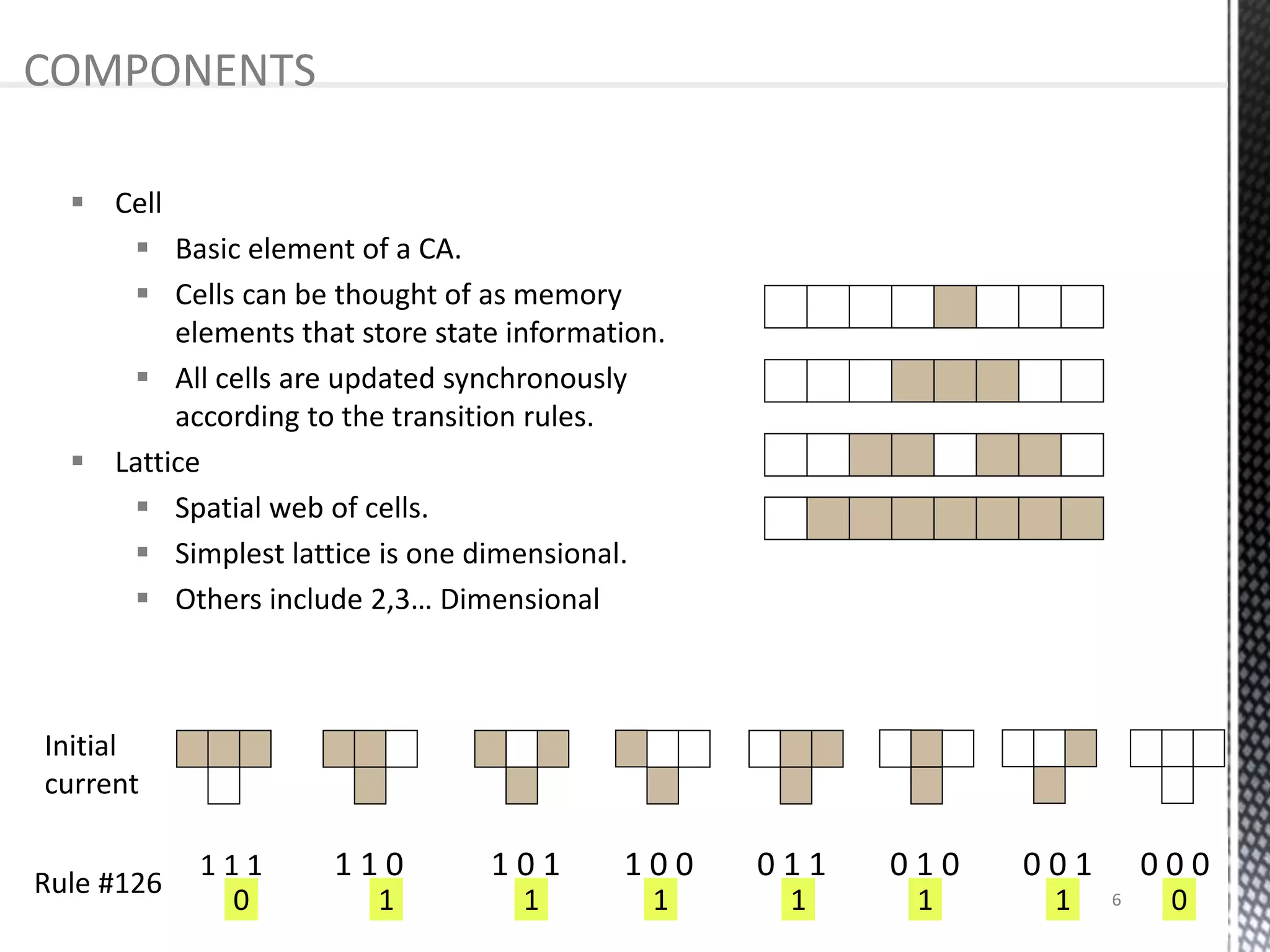
 Cell
 Basic element of a CA.
 Cells can be thought of as memory
elements that store state information.
 All cells are updated synchronously
according to the transition rules.
 Lattice
 Spatial web of cells.
 Simplest lattice is one dimensional.
 Others include 2,3… Dimensional
COMPONENTS
Initial
current
1 1 1 1 1 0 1 0 1 1 0 0 0 1 1 0 1 0 0 0 1 0 0 0
0 1 1 1 1 1 1 0
Rule #126 6
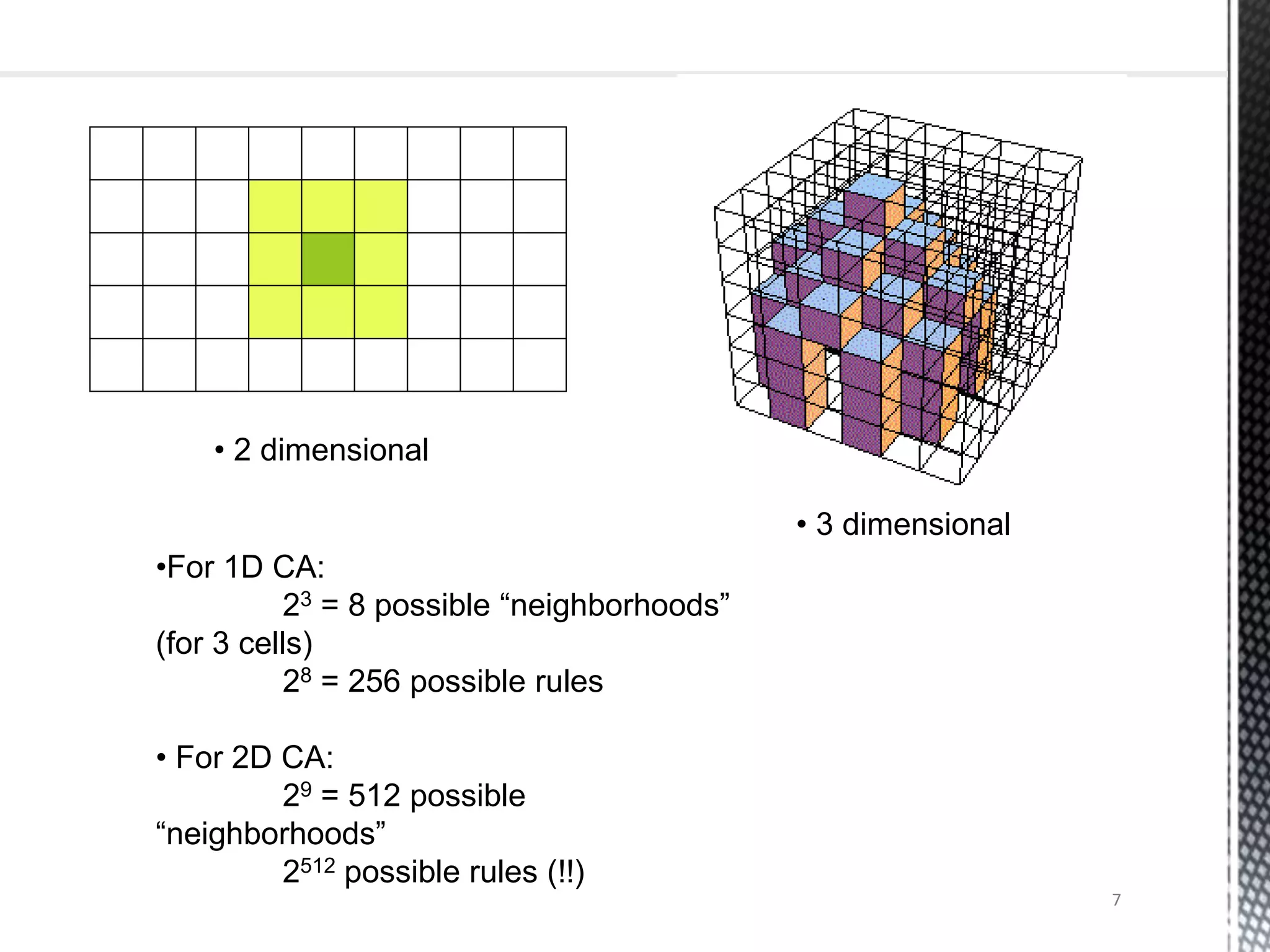
• 2 dimensional
• 3 dimensional
•For 1D CA:
23 = 8 possible “neighborhoods”
(for 3 cells)
28 = 256 possible rules
• For 2D CA:
29 = 512 possible
“neighborhoods”
2512 possible rules (!!)
7
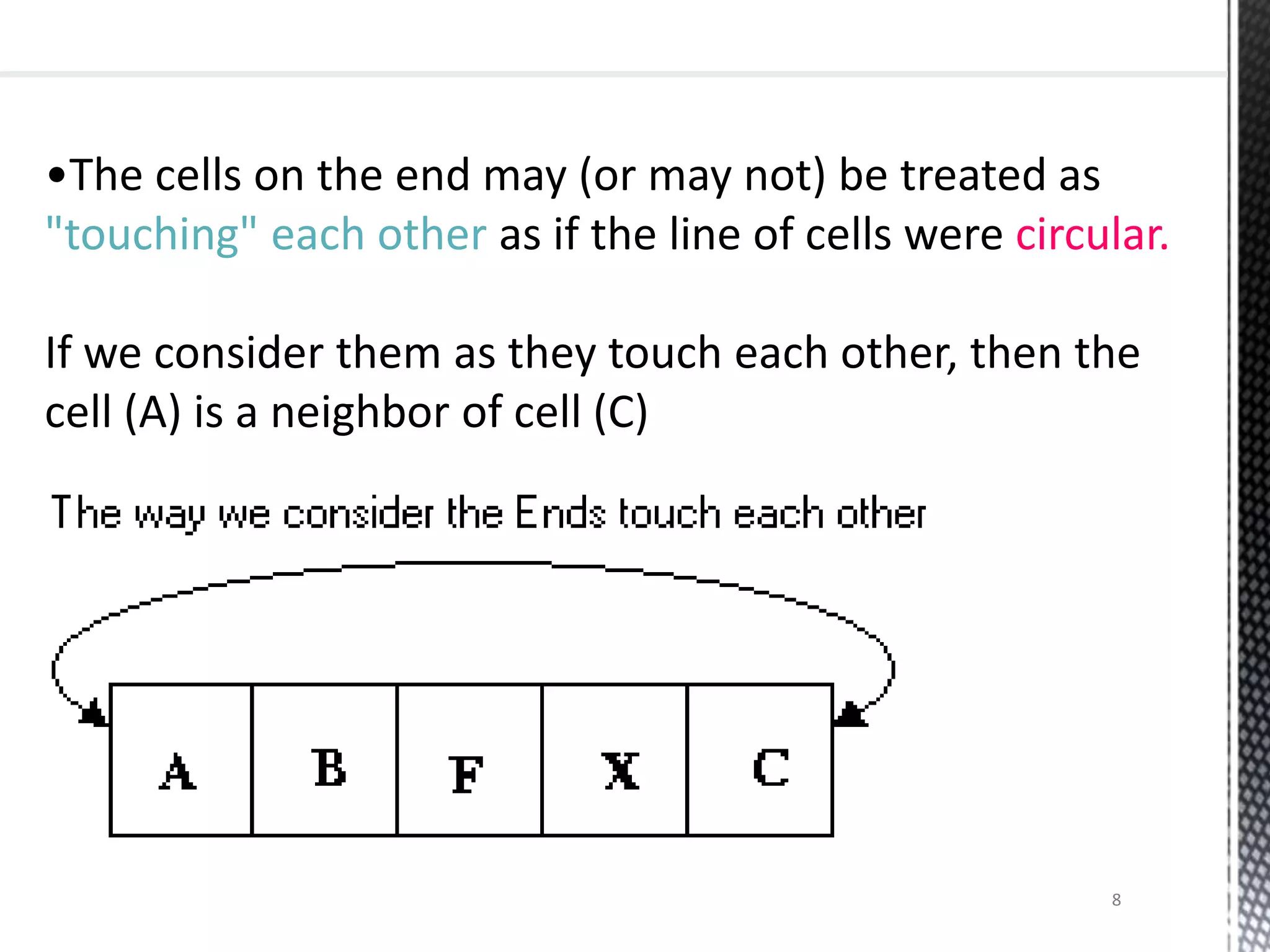
•The cells on the end may (or may not) be treated as
"touching" each other as if the line of cells were circular.
If we consider them as they touch each other, then the
cell (A) is a neighbor of cell (C)
8
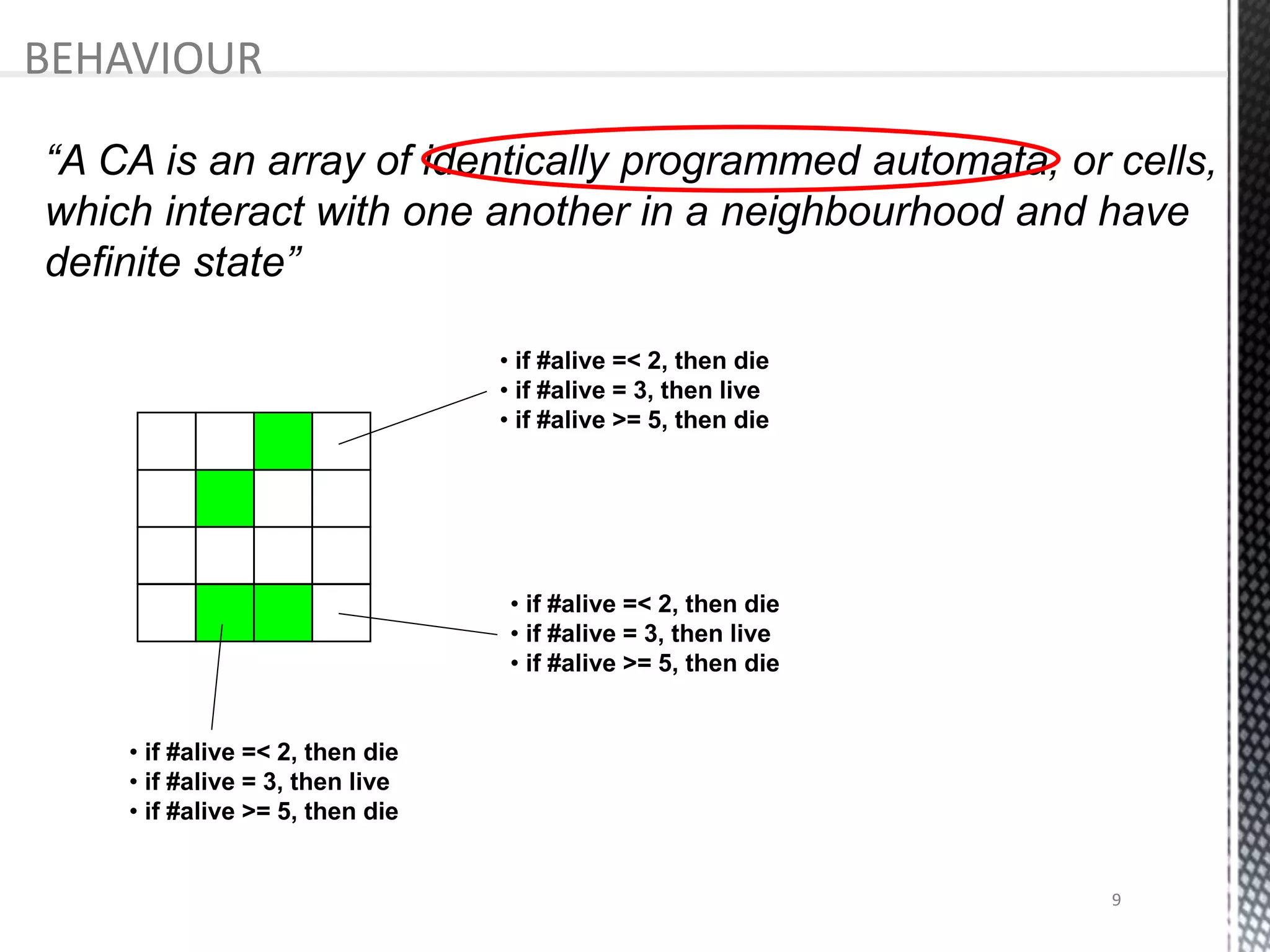
• if #alive =< 2, then die
• if #alive = 3, then live
• if #alive >= 5, then die
• if #alive =< 2, then die
• if #alive = 3, then live
• if #alive >= 5, then die
• if #alive =< 2, then die
• if #alive = 3, then live
• if #alive >= 5, then die
“A CA is an array of identically programmed automata, or cells,
which interact with one another in a neighbourhood and have
definite state”
BEHAVIOUR
9
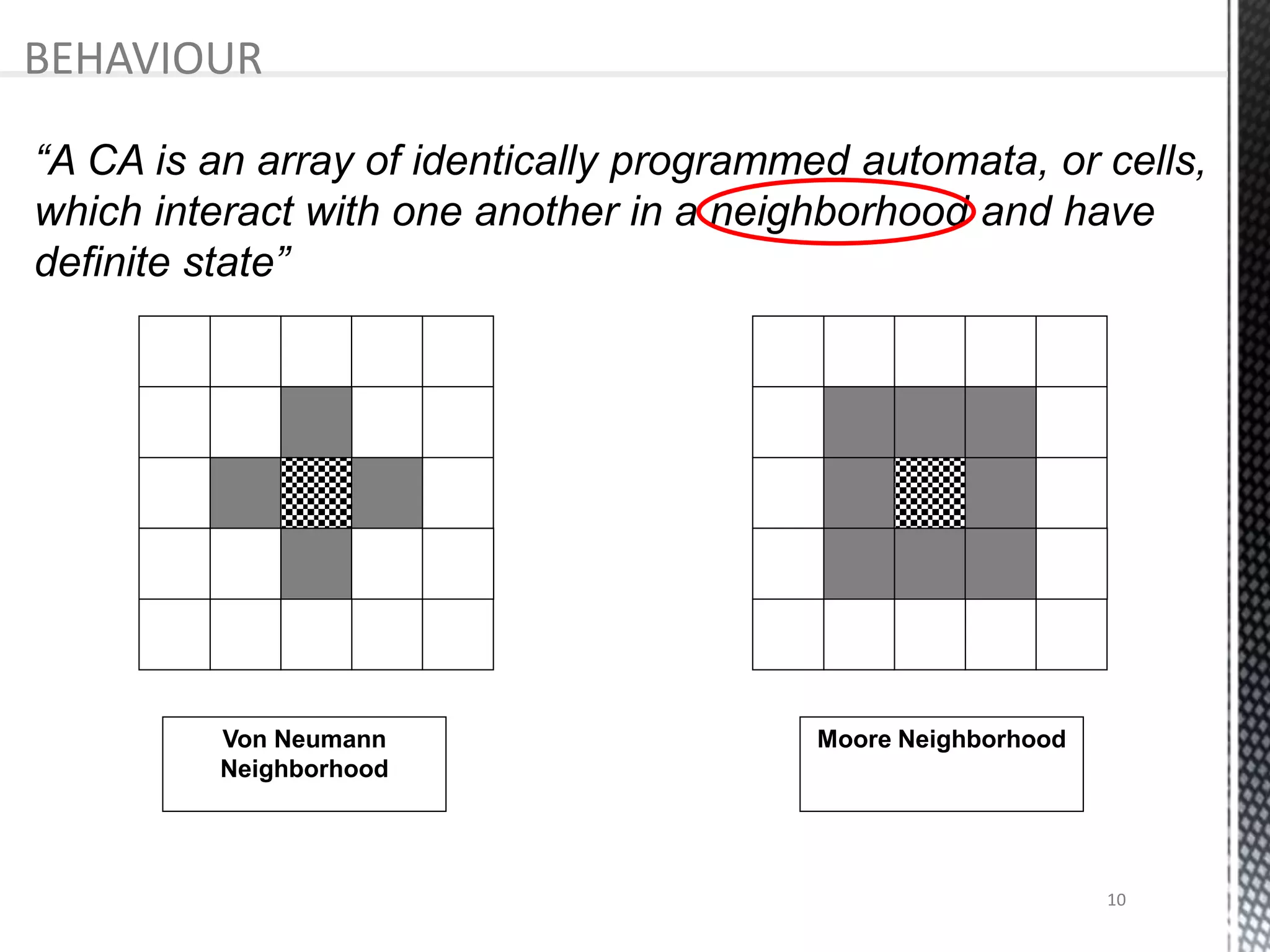
“A CA is an array of identically programmed automata, or cells,
which interact with one another in a neighborhood and have
definite state”
BEHAVIOUR
Von Neumann
Neighborhood
Moore Neighborhood
10
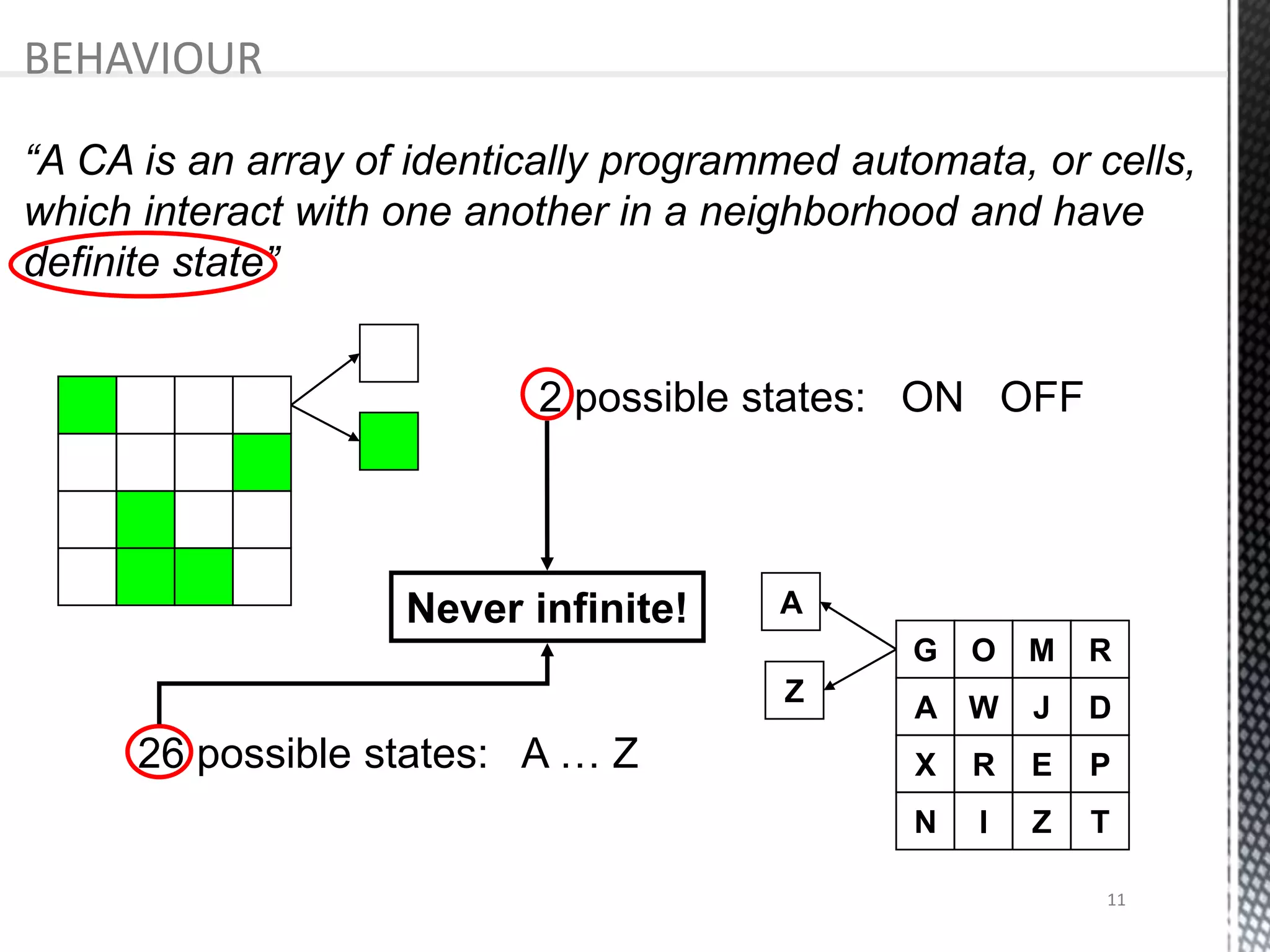
“A CA is an array of identically programmed automata, or cells,
which interact with one another in a neighborhood and have
definite state”
2 possible states: ON OFF
O
W JA
R
I T
D
G M
X E
N Z
R
P
A
Z
26 possible states: A … Z
Never infinite!
BEHAVIOUR
11
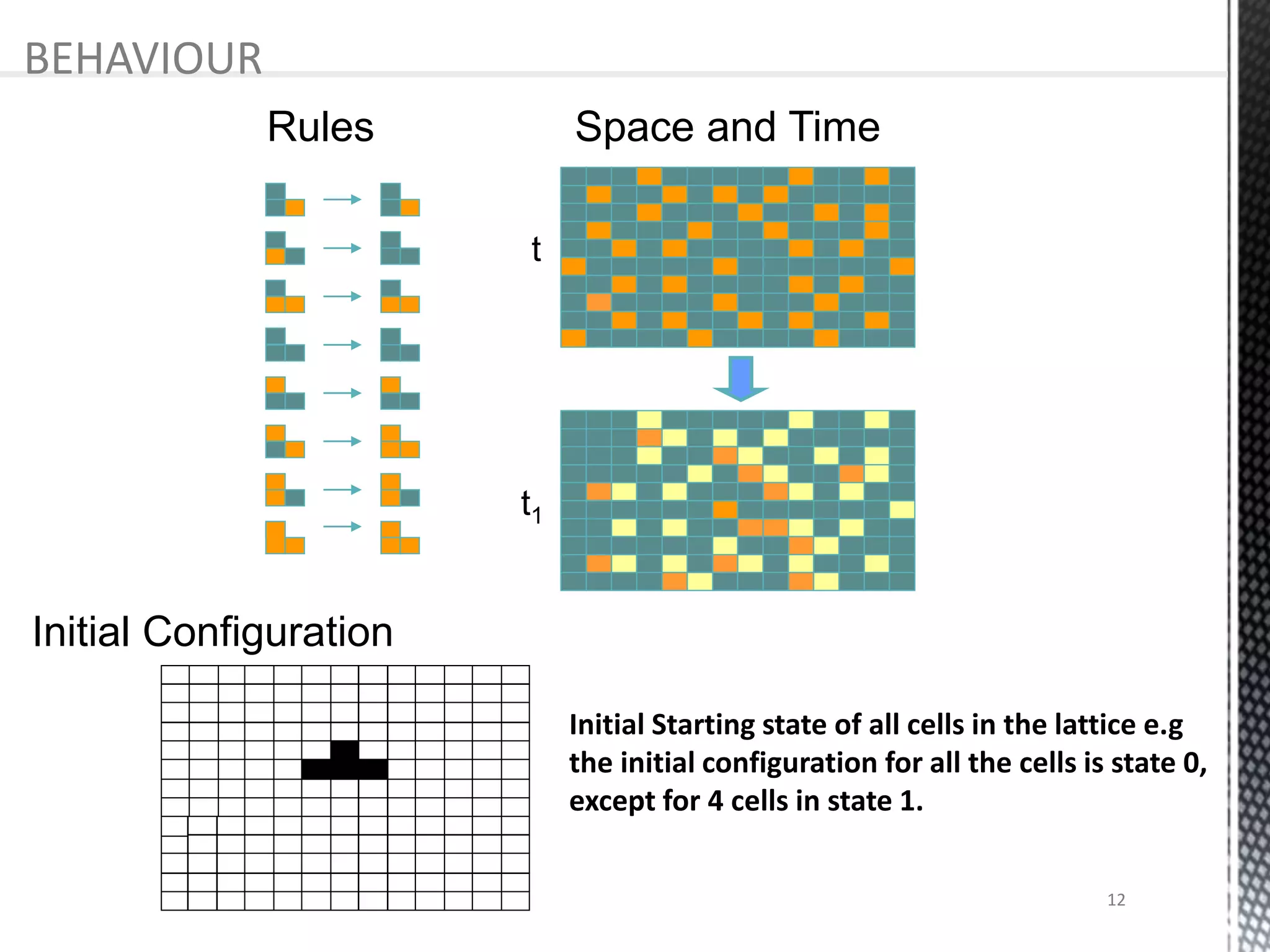
Rules Space and Time
t
t1
BEHAVIOUR
Initial Configuration
Initial Starting state of all cells in the lattice e.g
the initial configuration for all the cells is state 0,
except for 4 cells in state 1.
12
 Asynchronous CA
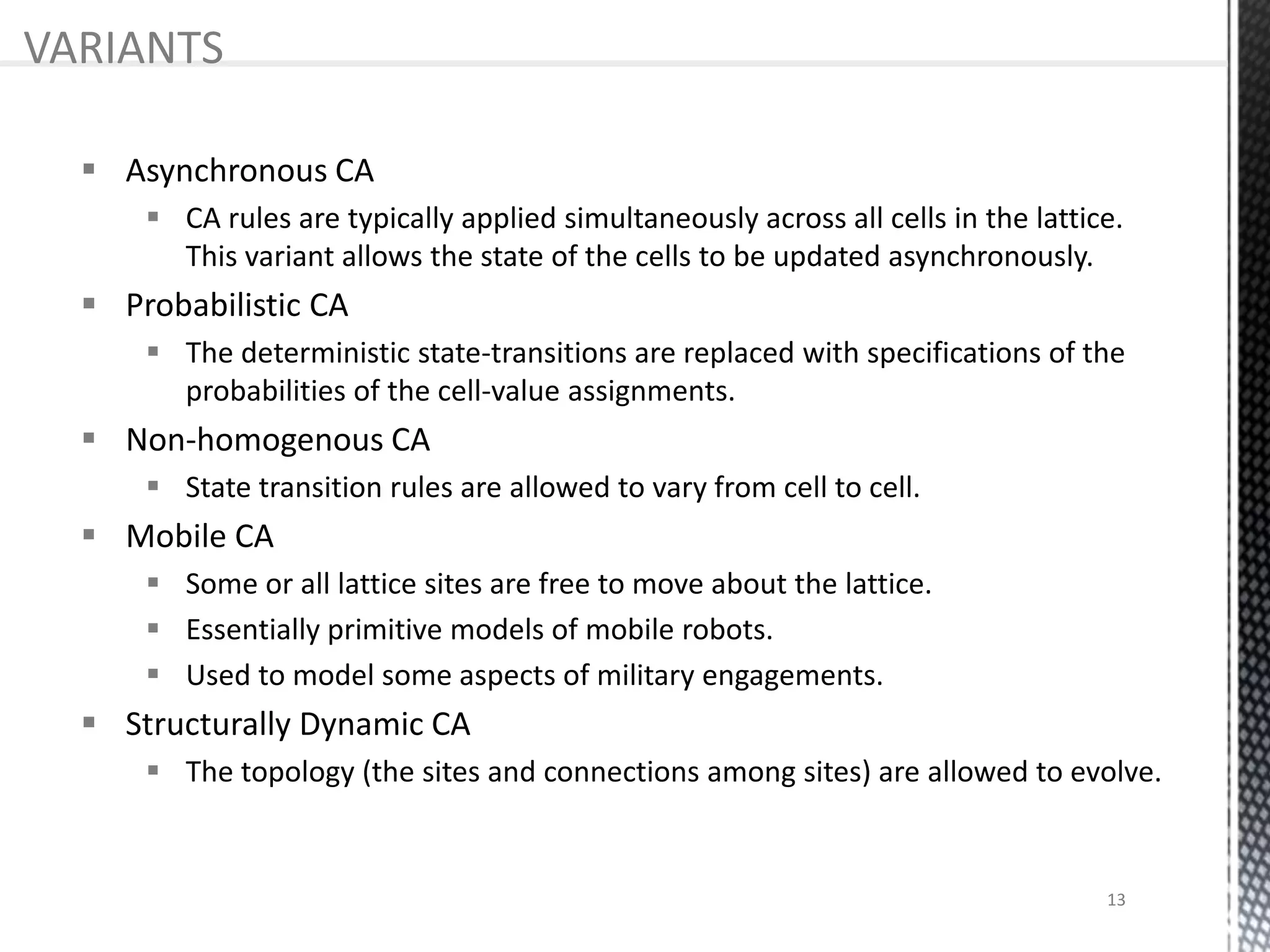
 CA rules are typically applied simultaneously across all cells in the lattice.
This variant allows the state of the cells to be updated asynchronously.
 Probabilistic CA
 The deterministic state-transitions are replaced with specifications of the
probabilities of the cell-value assignments.
 Non-homogenous CA
 State transition rules are allowed to vary from cell to cell.
 Mobile CA
 Some or all lattice sites are free to move about the lattice.
 Essentially primitive models of mobile robots.
 Used to model some aspects of military engagements.
 Structurally Dynamic CA
 The topology (the sites and connections among sites) are allowed to evolve.
VARIANTS
13
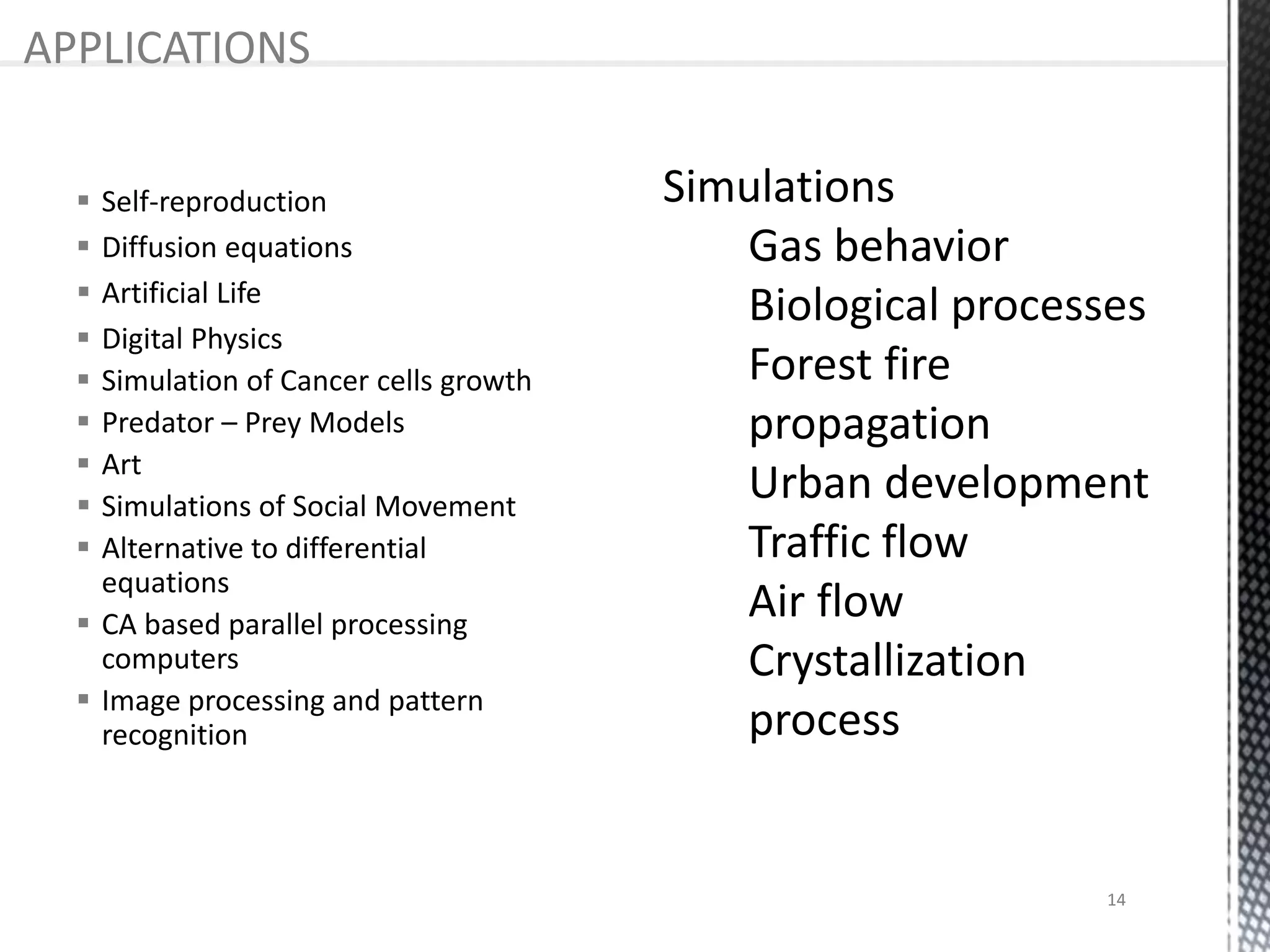
 Self-reproduction
 Diffusion equations
 Artificial Life
 Digital Physics
 Simulation of Cancer cells growth
 Predator – Prey Models
 Art
 Simulations of Social Movement
 Alternative to differential
equations
 CA based parallel processing
computers
 Image processing and pattern
recognition
APPLICATIONS
14
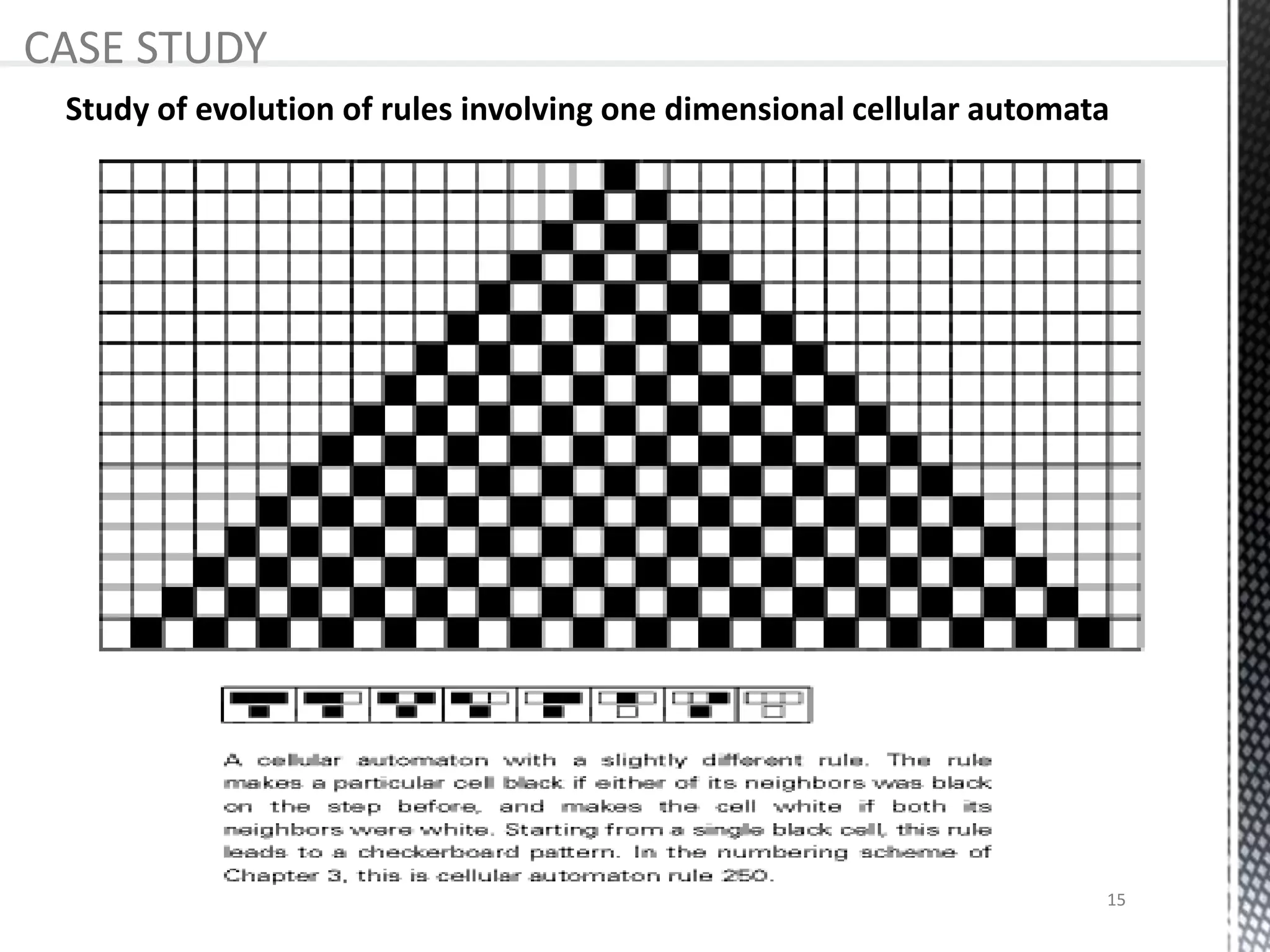
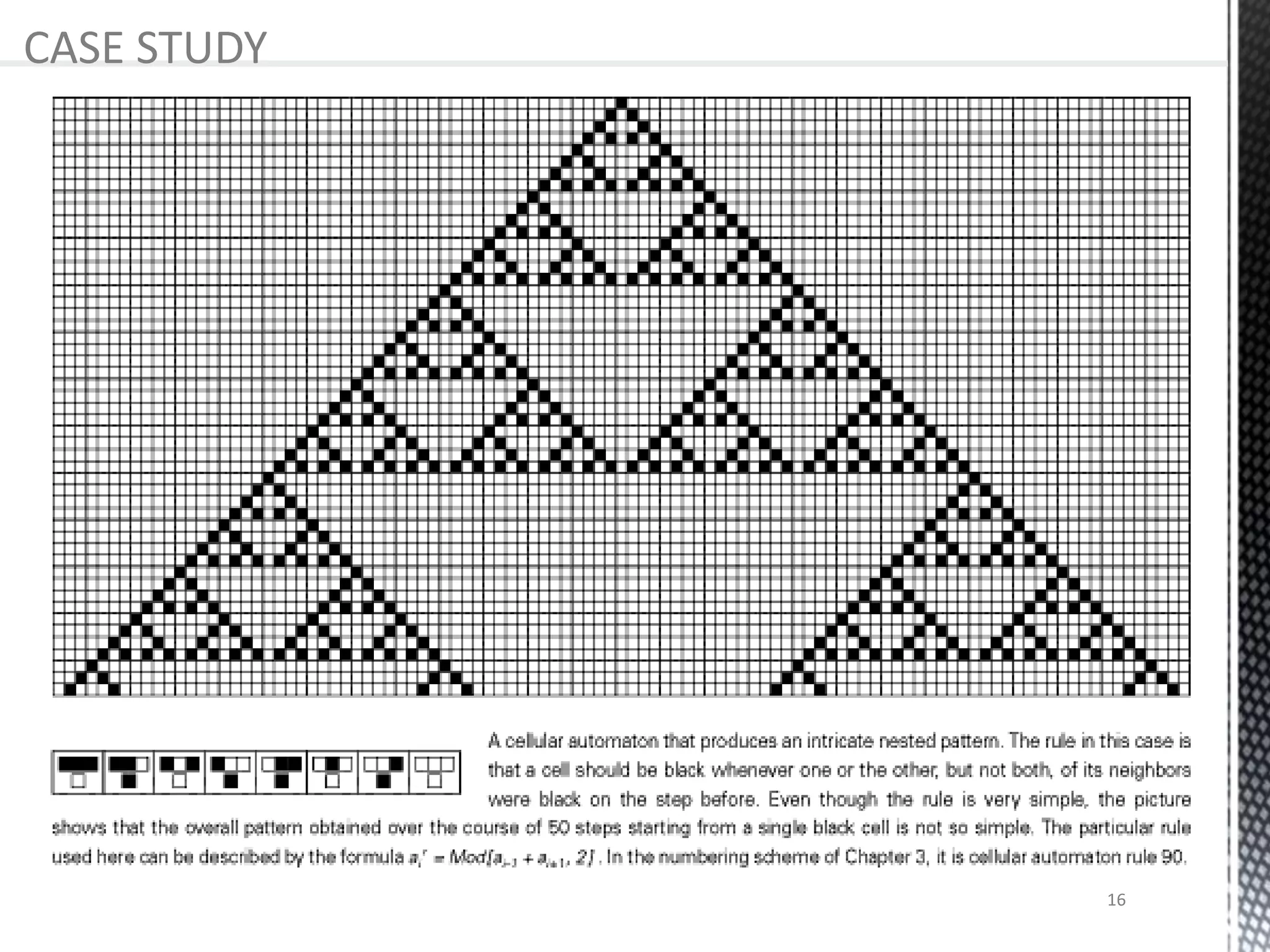
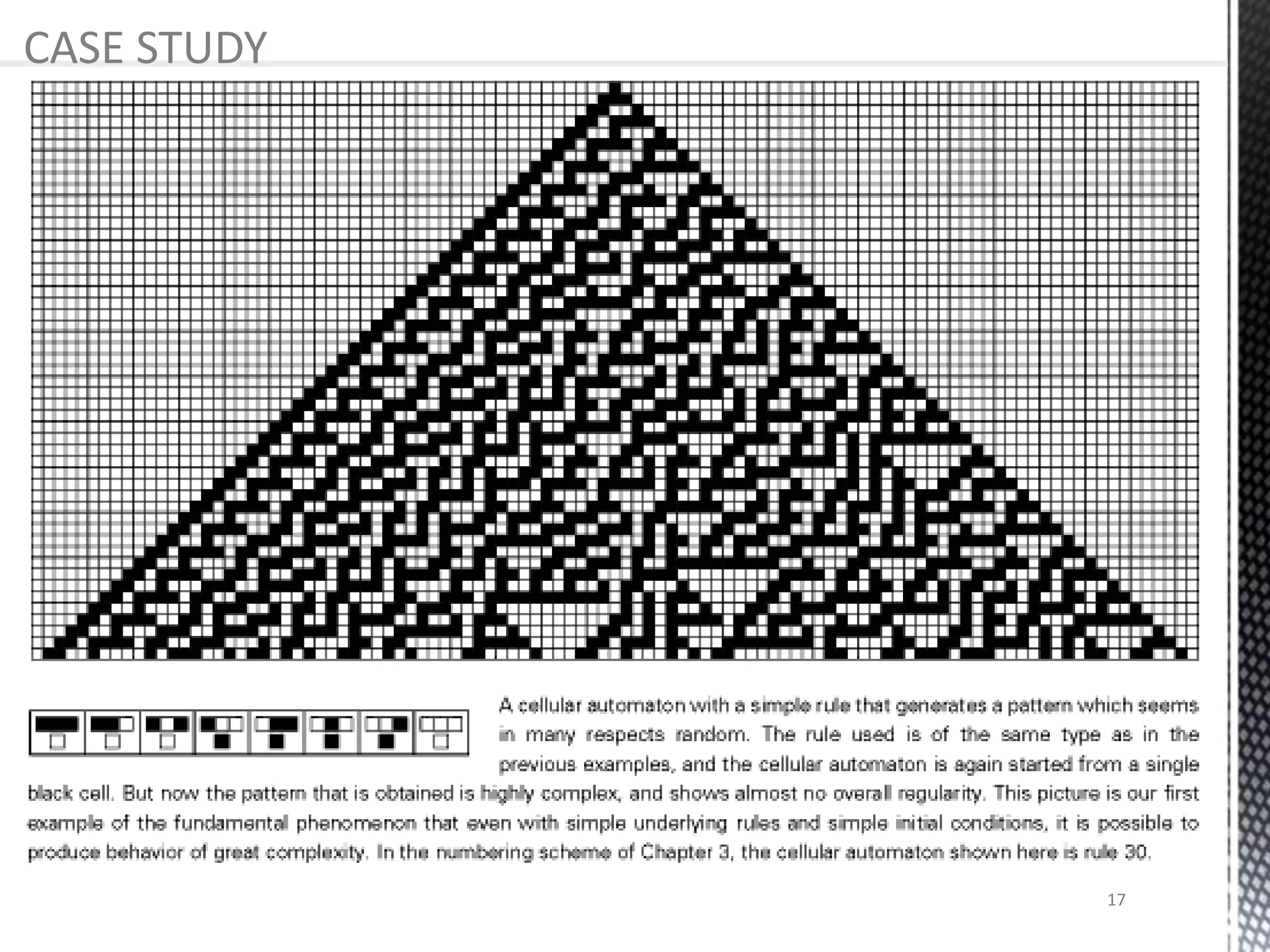
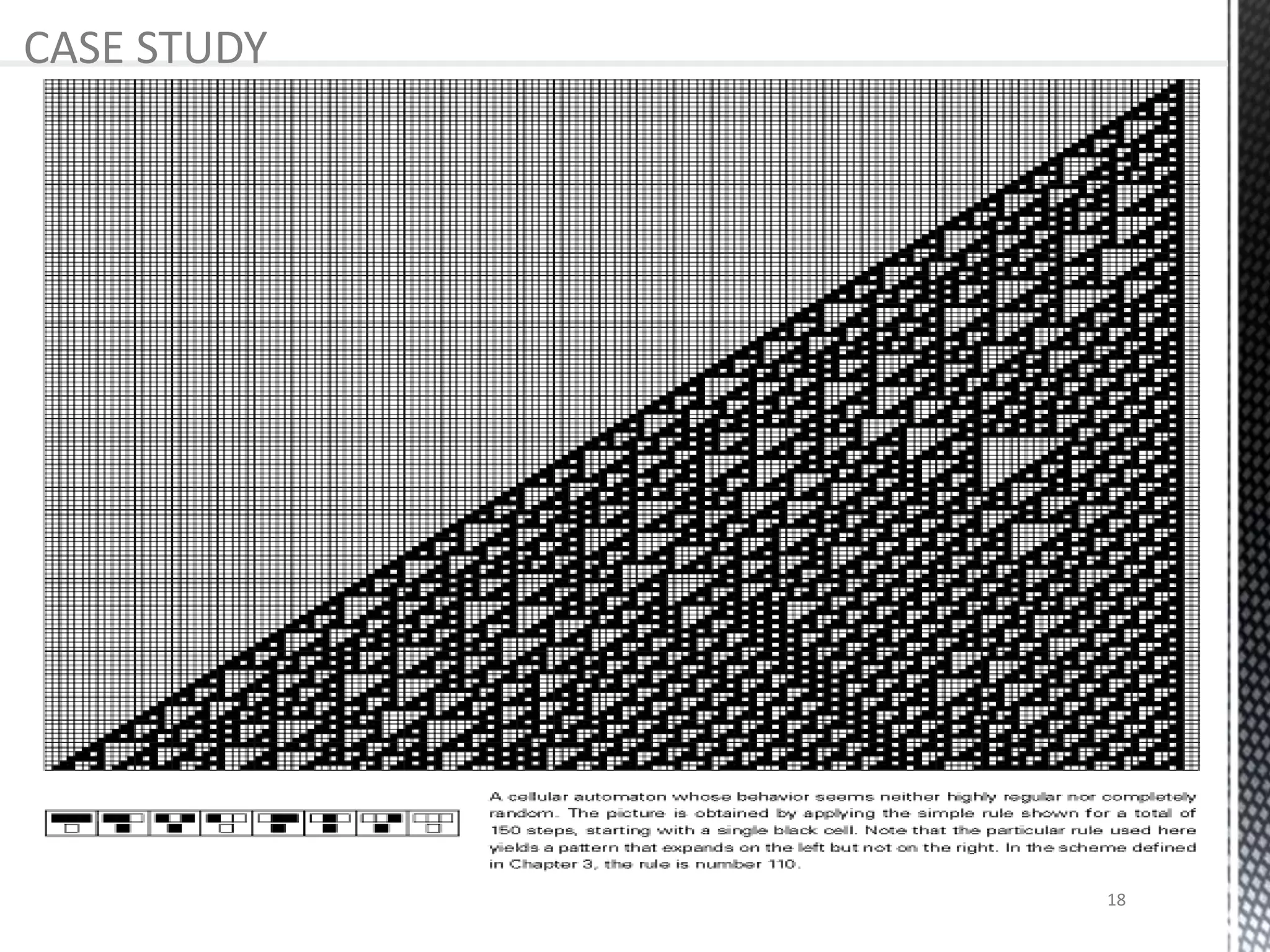
Study of evolution of rules involving one dimensional cellular automata
CASE STUDY
15
CASE STUDY
16
CASE STUDY
17
CASE STUDY
18
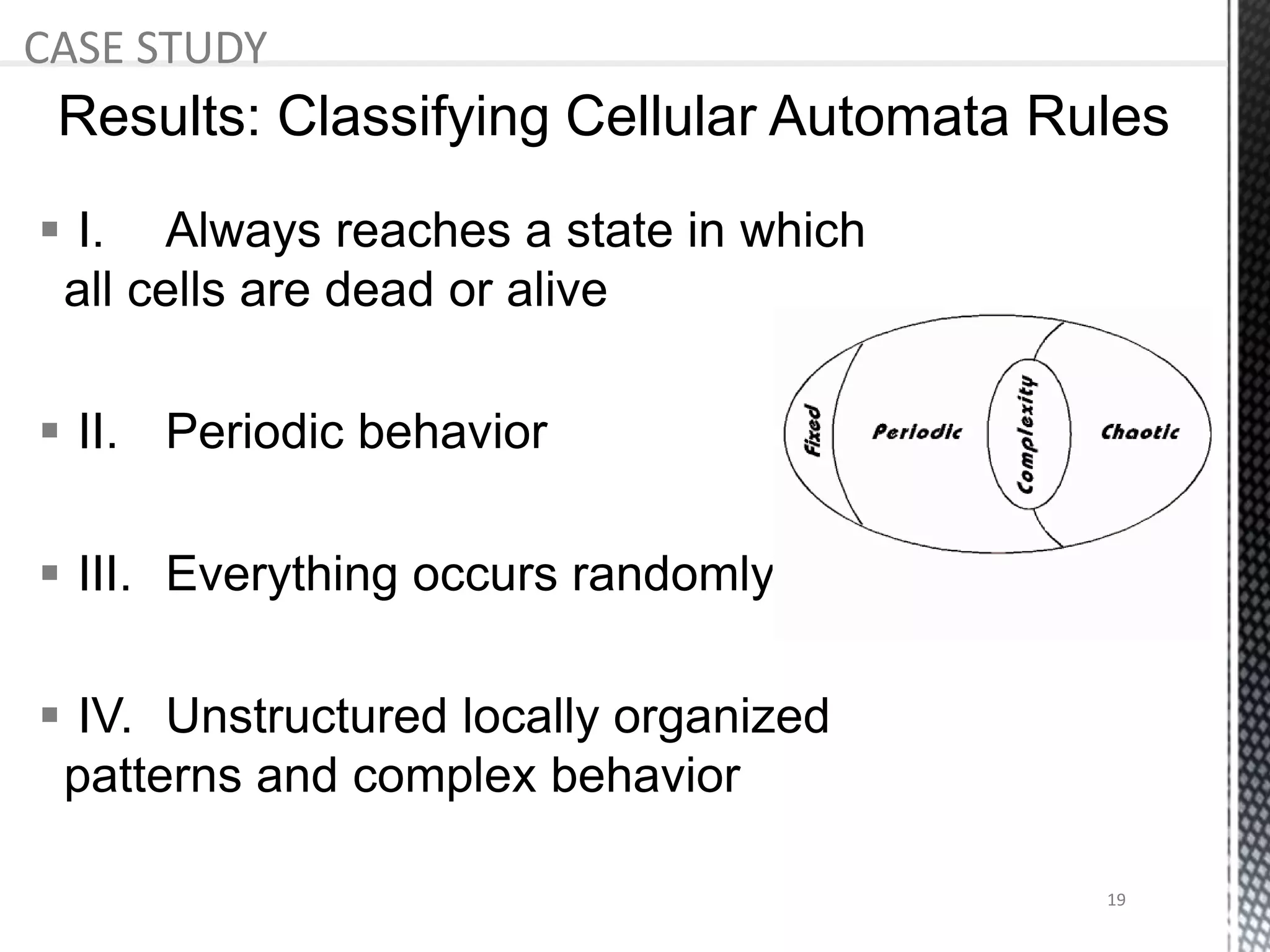
 I. Always reaches a state in which
all cells are dead or alive
 II. Periodic behavior
 III. Everything occurs randomly
 IV. Unstructured locally organized
patterns and complex behavior
Results: Classifying Cellular Automata Rules
CASE STUDY
19
CASE STUDY
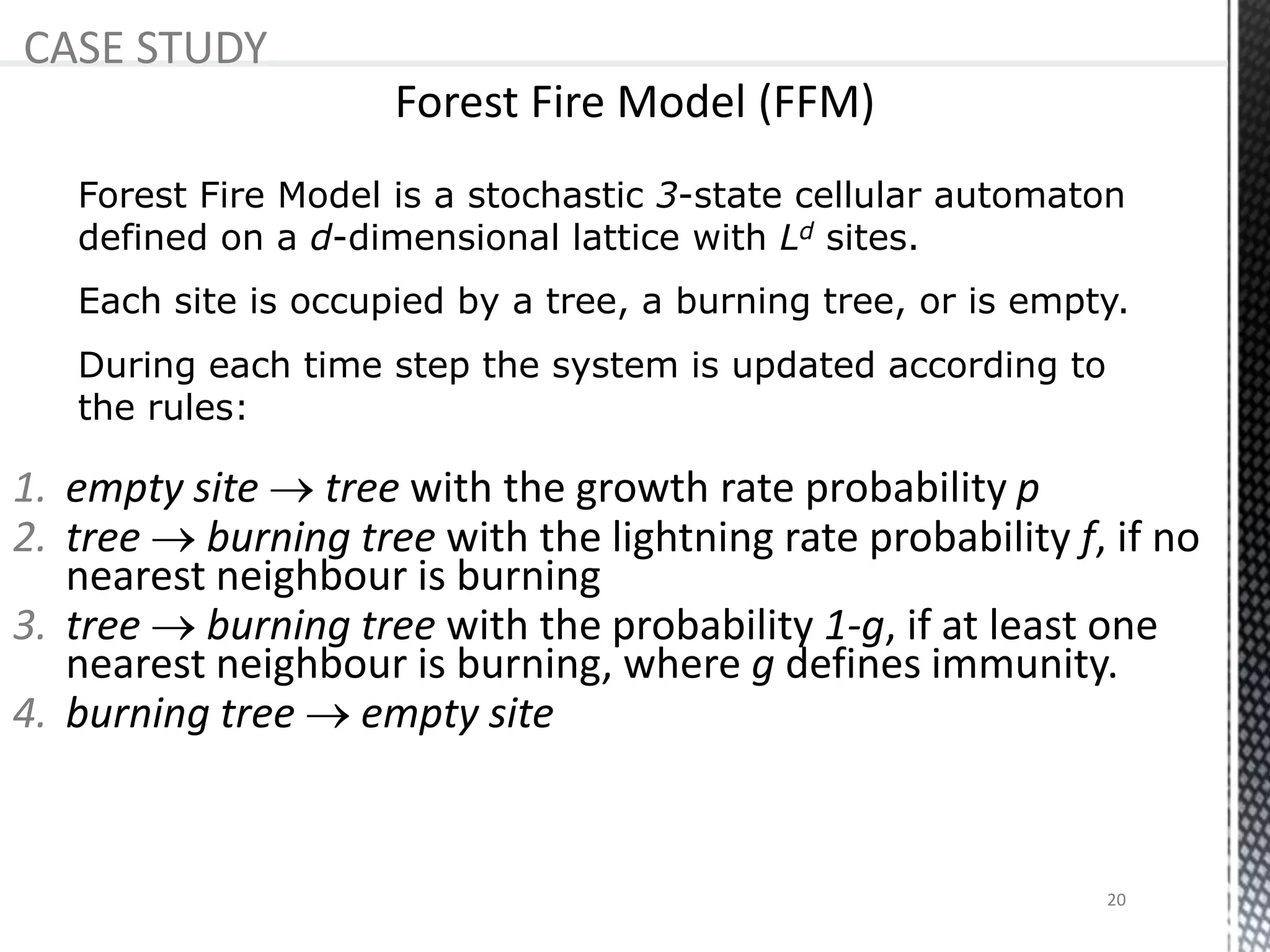
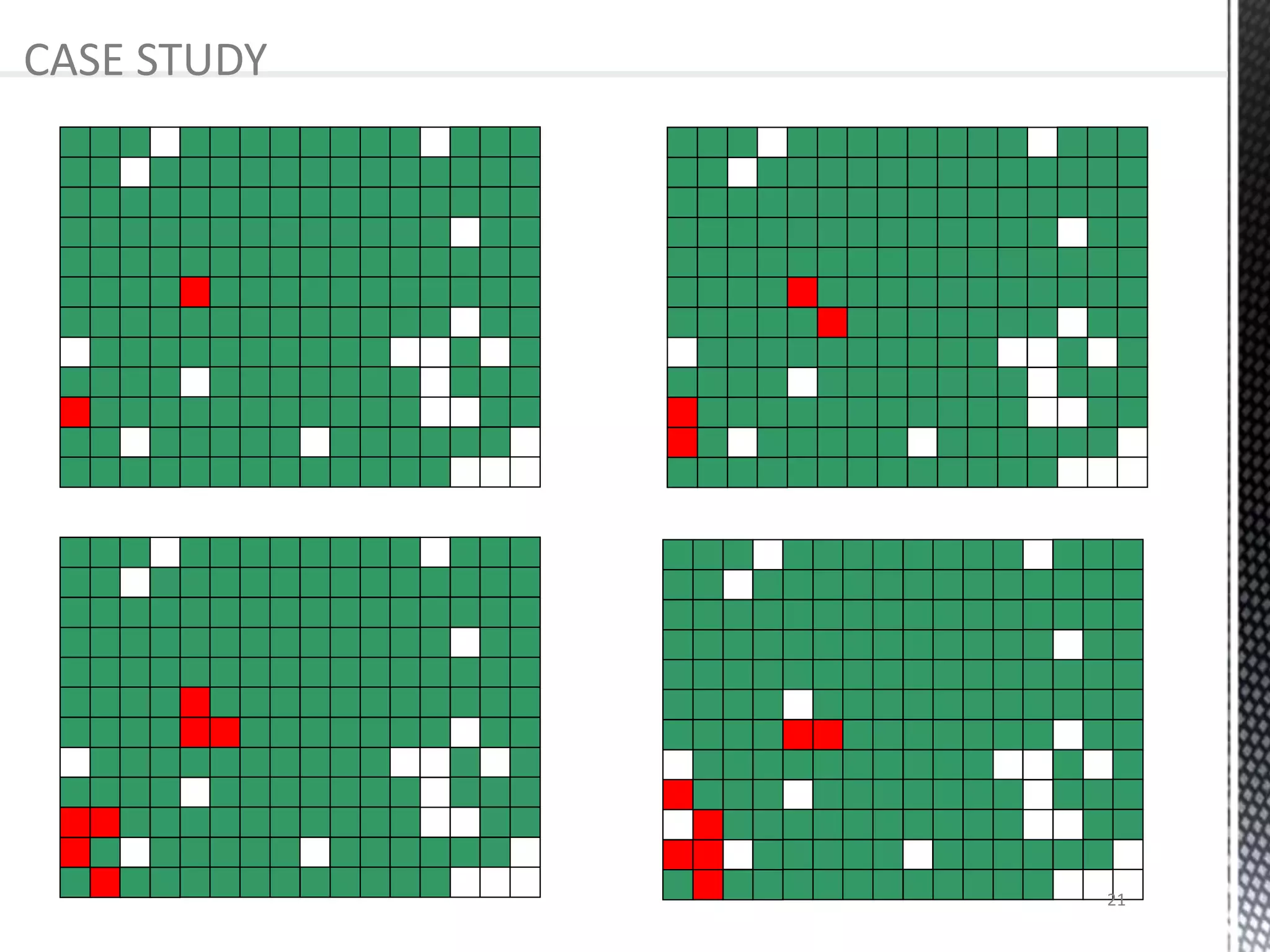
During each time step the system is updated according to
the rules:
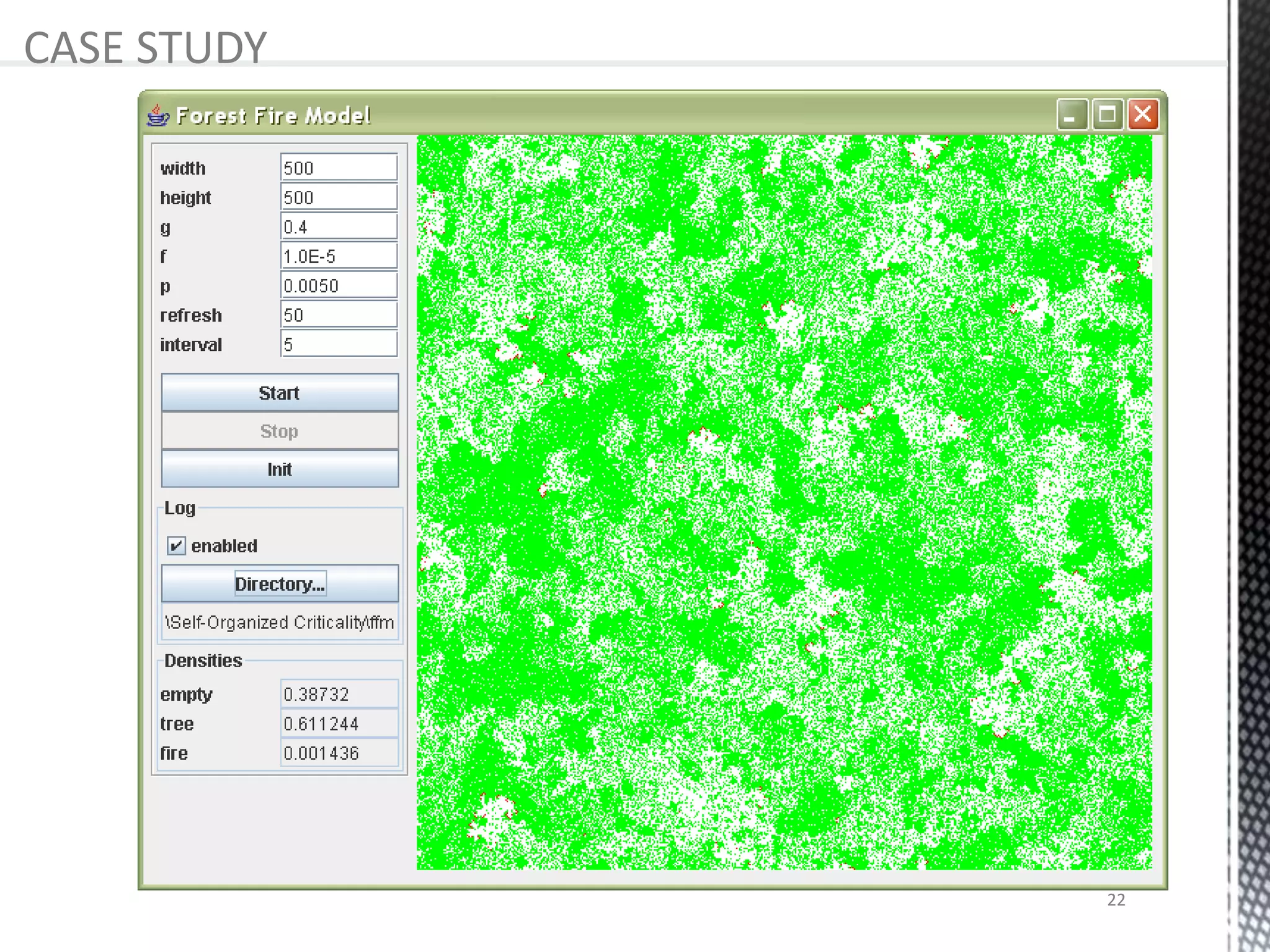
Forest Fire Model is a stochastic 3-state cellular automaton
defined on a d-dimensional lattice with Ld sites.
Each site is occupied by a tree, a burning tree, or is empty.
1. empty site  tree with the growth rate probability p
2. tree  burning tree with the lightning rate probability f, if no
nearest neighbour is burning
3. tree  burning tree with the probability 1-g, if at least one
nearest neighbour is burning, where g defines immunity.
4. burning tree  empty site
20
CASE STUDY
21
CASE STUDY
22
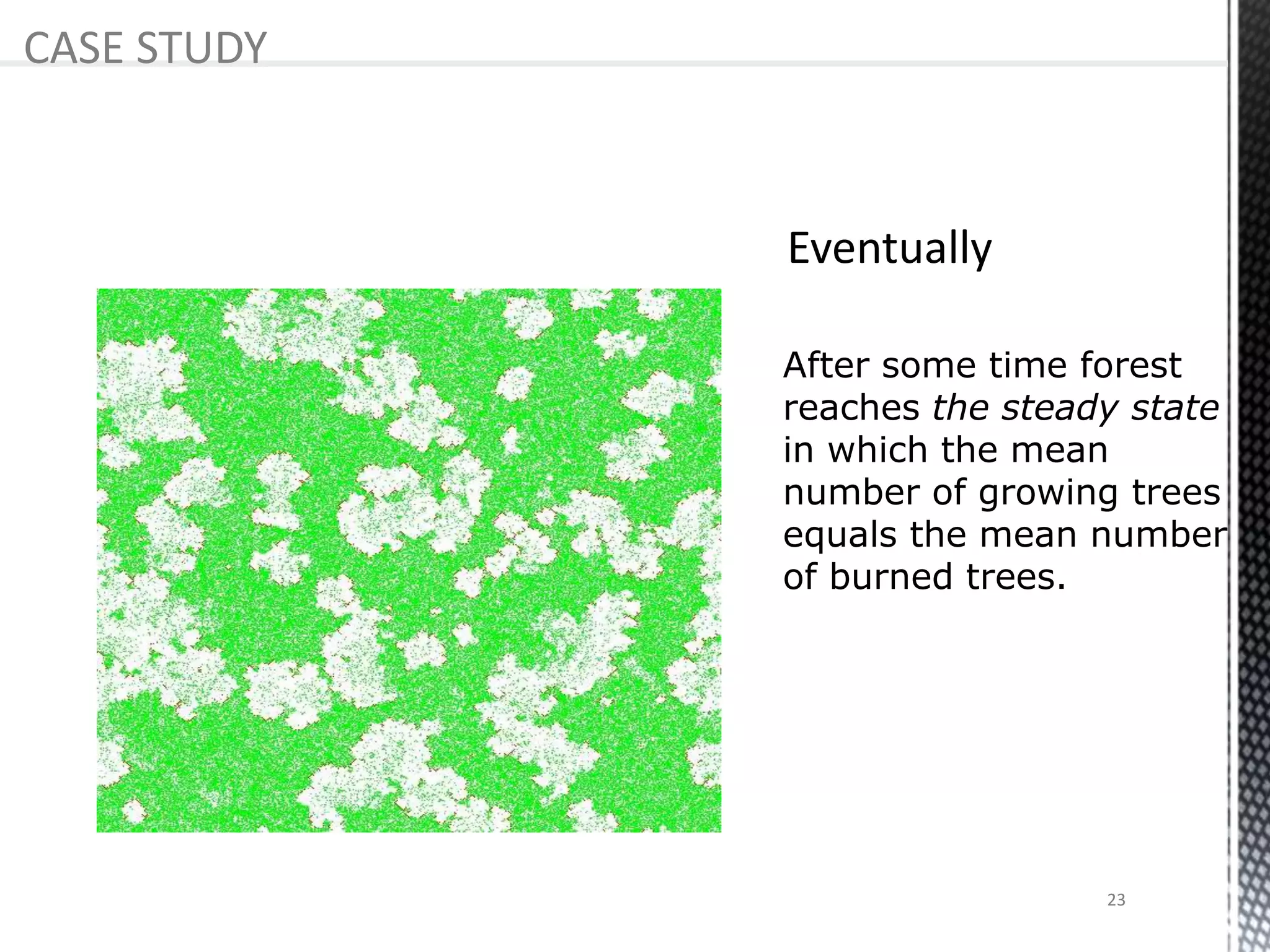
After some time forest
reaches the steady state
in which the mean
number of growing trees
equals the mean number
of burned trees.
CASE STUDY
23
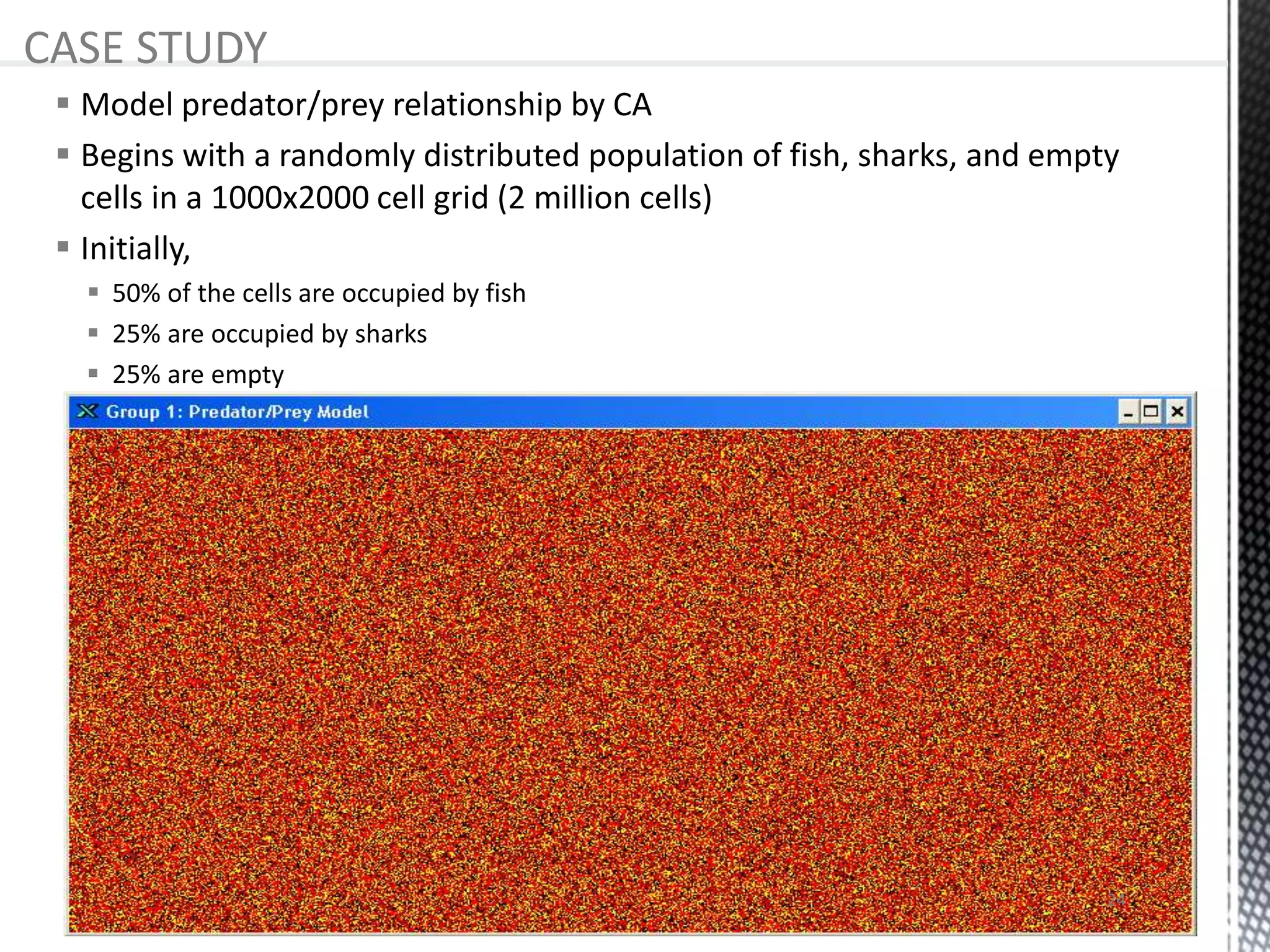
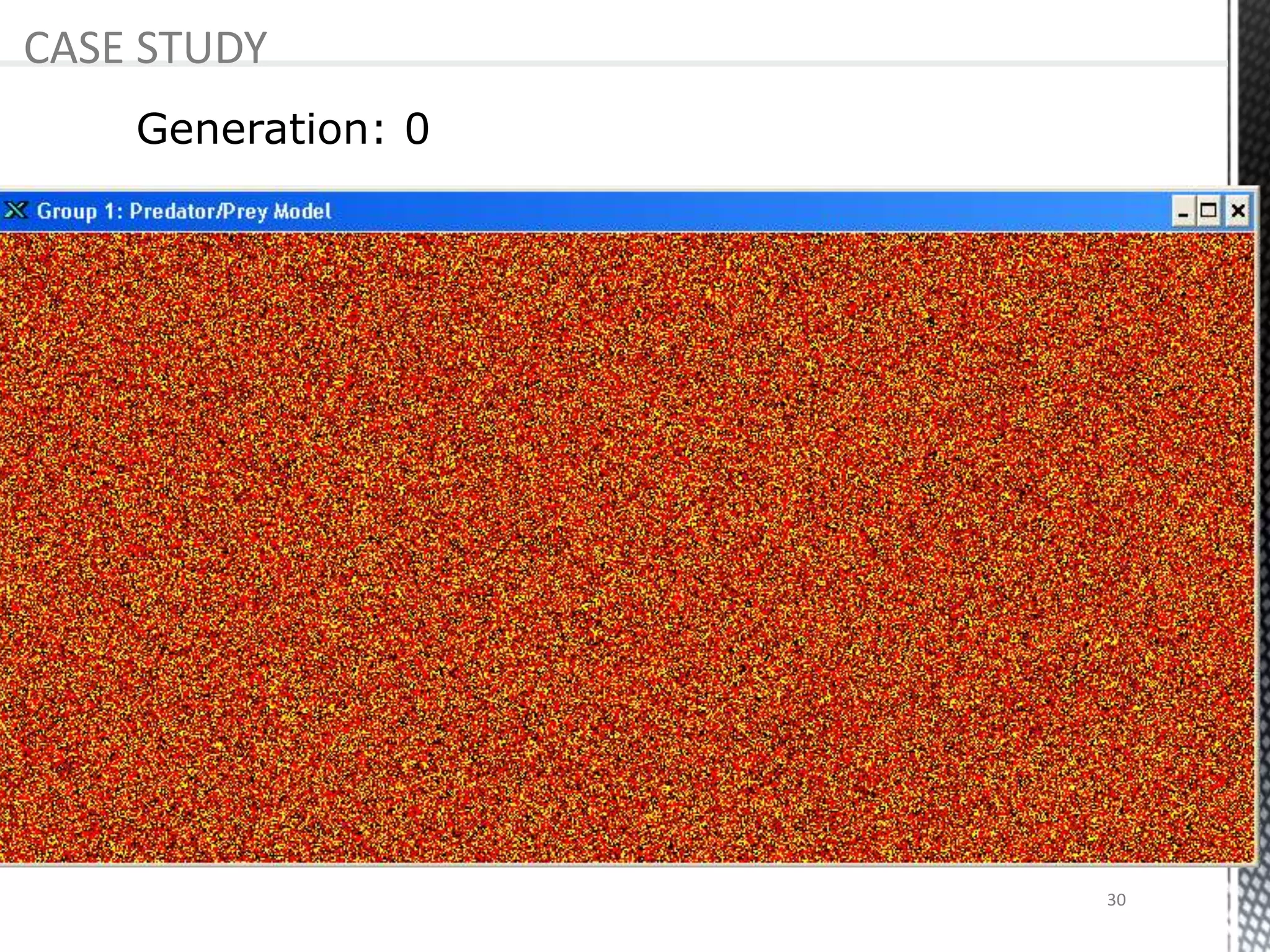
 Model predator/prey relationship by CA
 Begins with a randomly distributed population of fish, sharks, and empty
cells in a 1000x2000 cell grid (2 million cells)
 Initially,
 50% of the cells are occupied by fish
 25% are occupied by sharks
 25% are empty
CASE STUDY
24
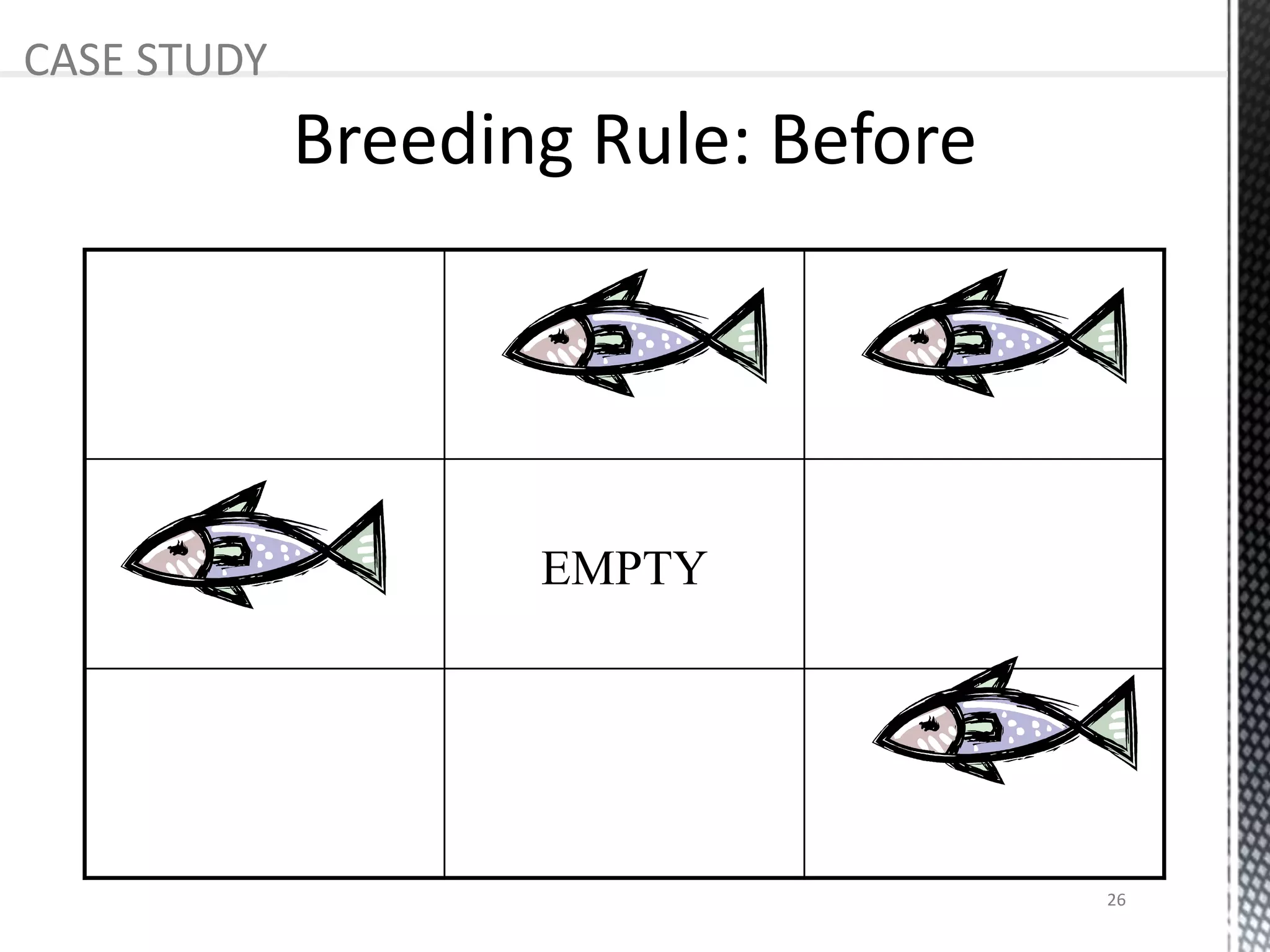
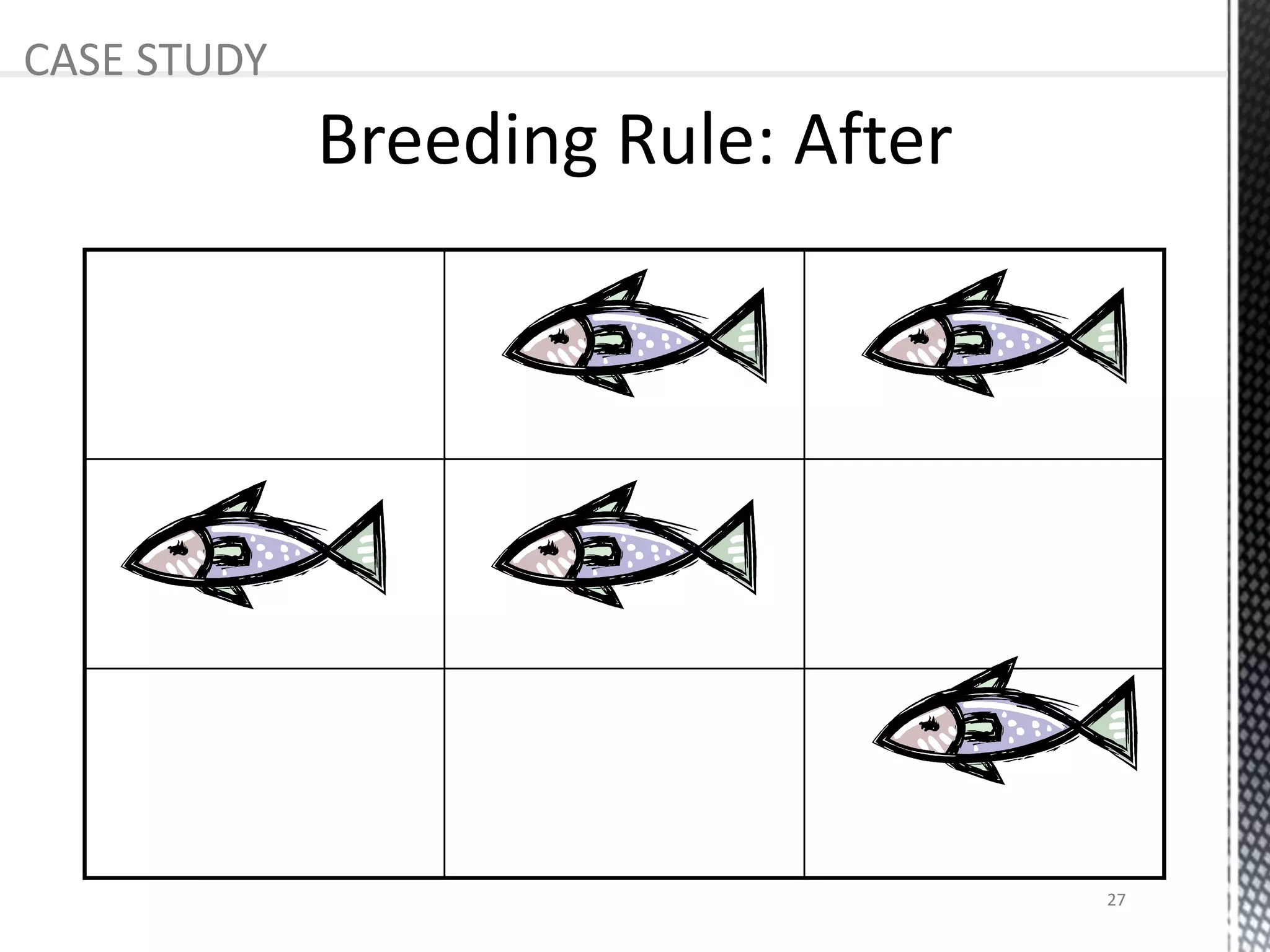
Breeding rule: if the current cell is empty
 If there are >= 4 neighbors of one species, and >= 3 of them are of
breeding age,
 Fish breeding age >= 2,
 Shark breeding age >=3,
and there are <4 of the other species:
then create a species of that type
 +1= baby fish (age = 1 at birth)
 -1 = baby shark (age = |-1| at birth)
CASE STUDY
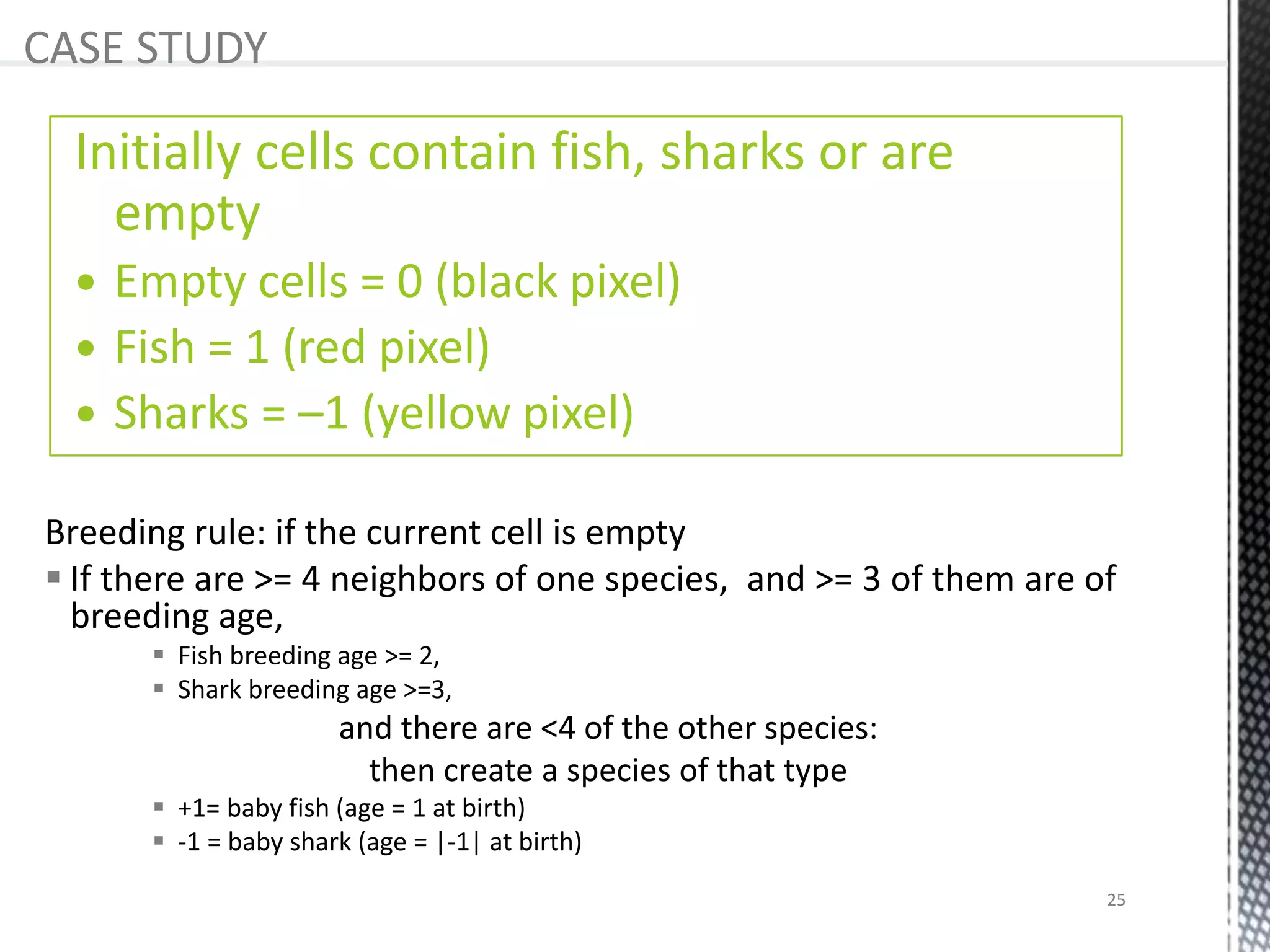
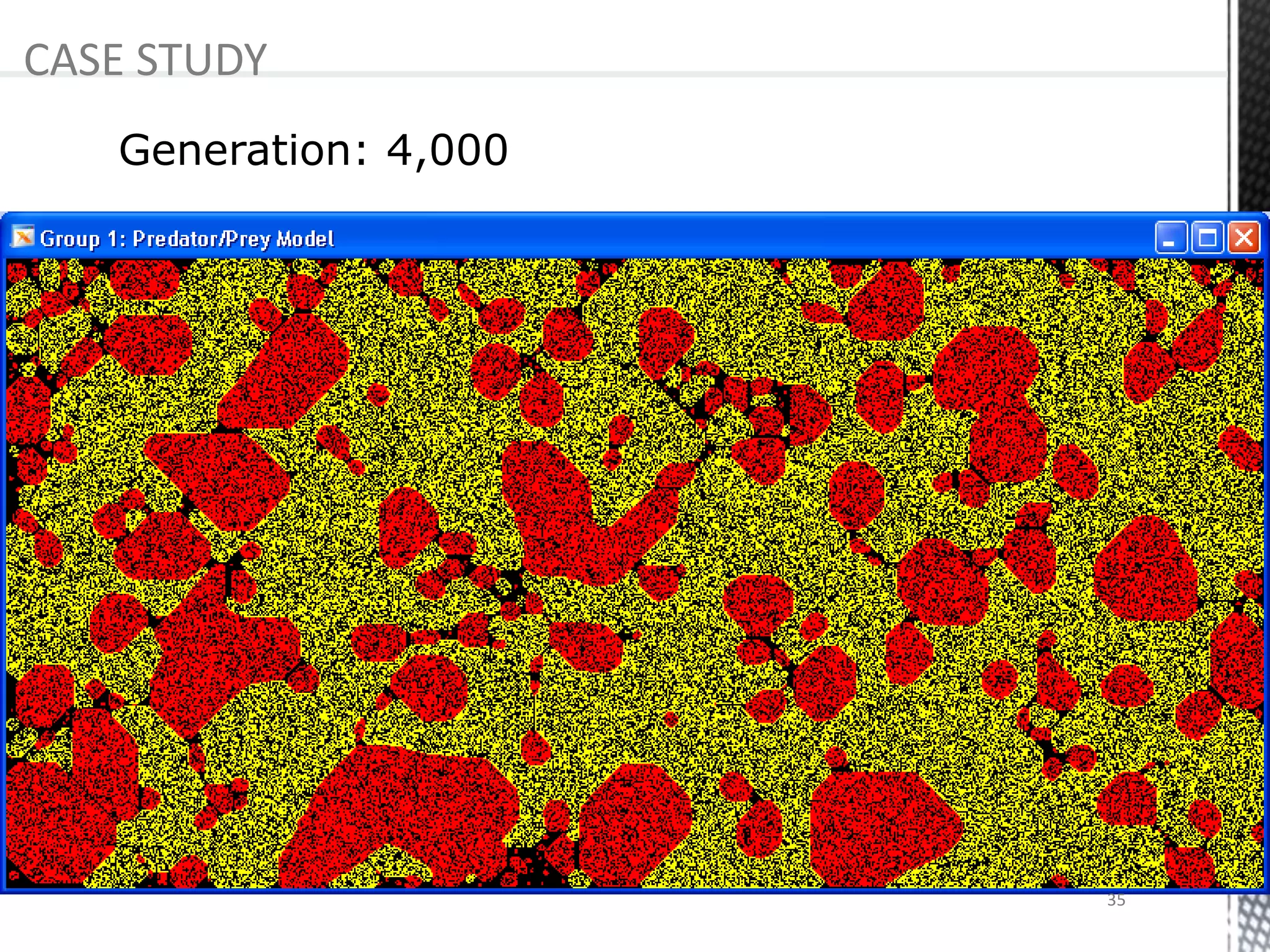
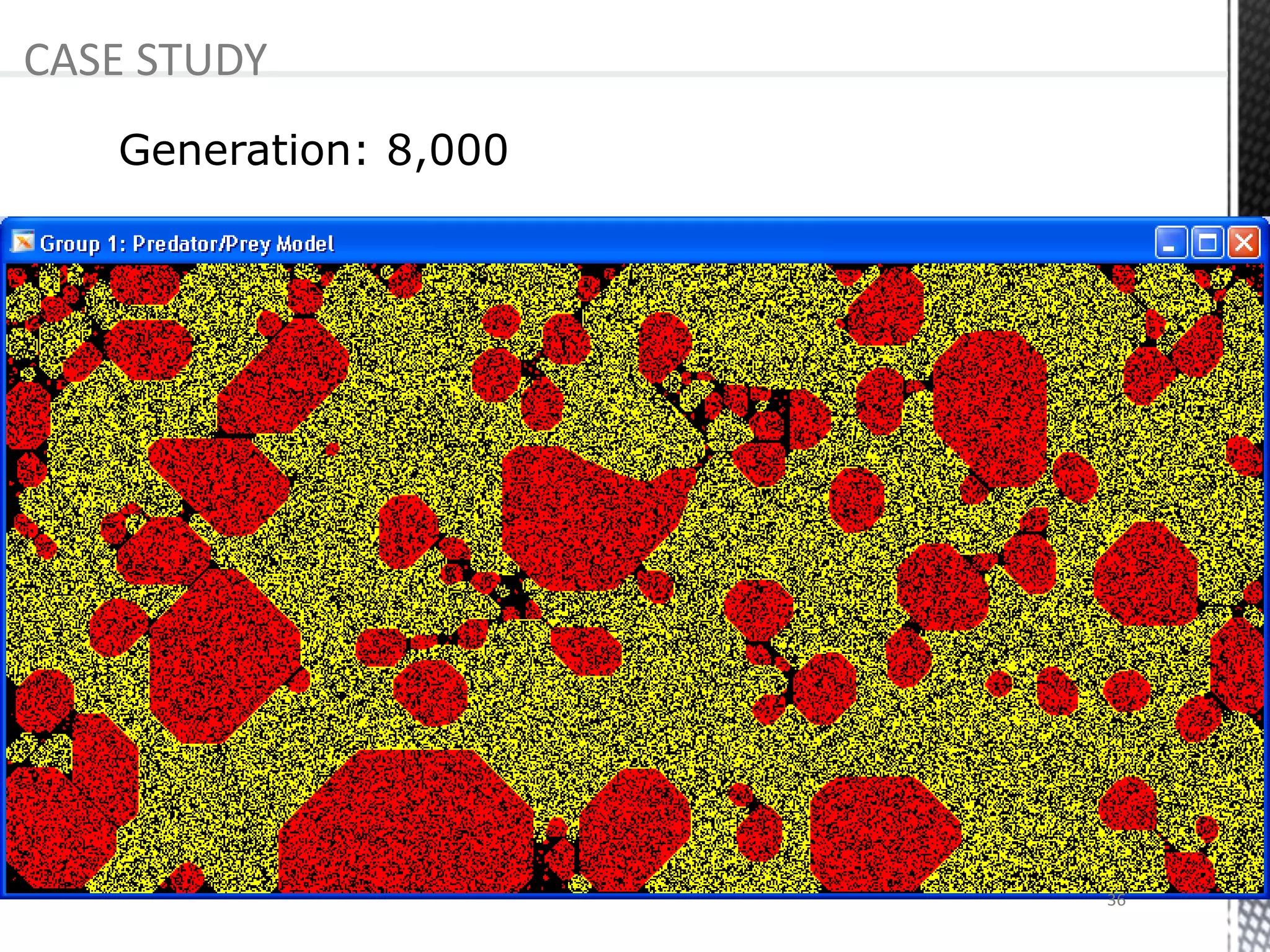
Initially cells contain fish, sharks or are
empty
 Empty cells = 0 (black pixel)
 Fish = 1 (red pixel)
 Sharks = –1 (yellow pixel)
25
EMPTY
CASE STUDY
26
CASE STUDY
27
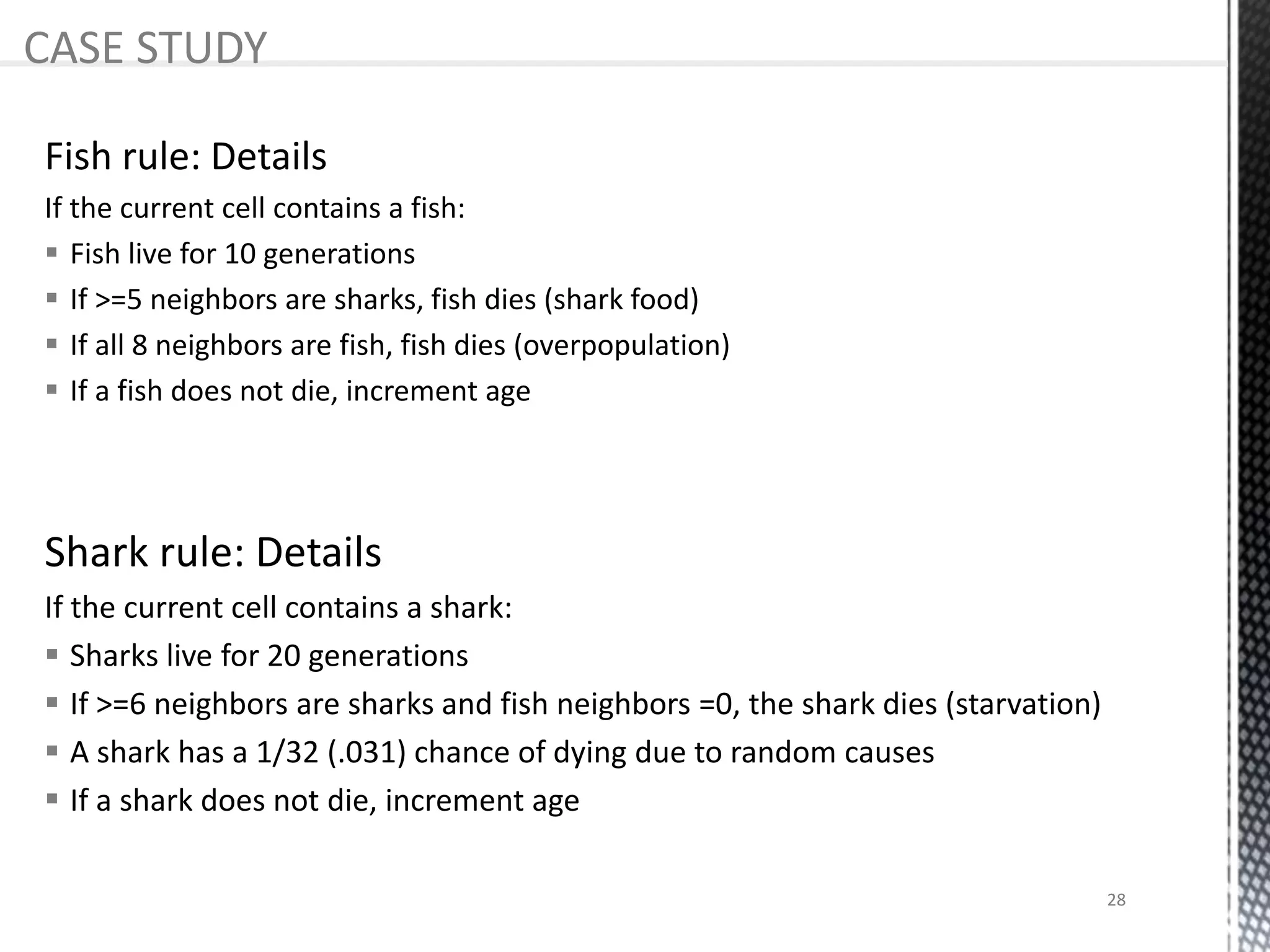
Shark rule: Details
If the current cell contains a shark:
 Sharks live for 20 generations
 If >=6 neighbors are sharks and fish neighbors =0, the shark dies (starvation)
 A shark has a 1/32 (.031) chance of dying due to random causes
 If a shark does not die, increment age
CASE STUDY
Fish rule: Details
If the current cell contains a fish:
 Fish live for 10 generations
 If >=5 neighbors are sharks, fish dies (shark food)
 If all 8 neighbors are fish, fish dies (overpopulation)
 If a fish does not die, increment age
28
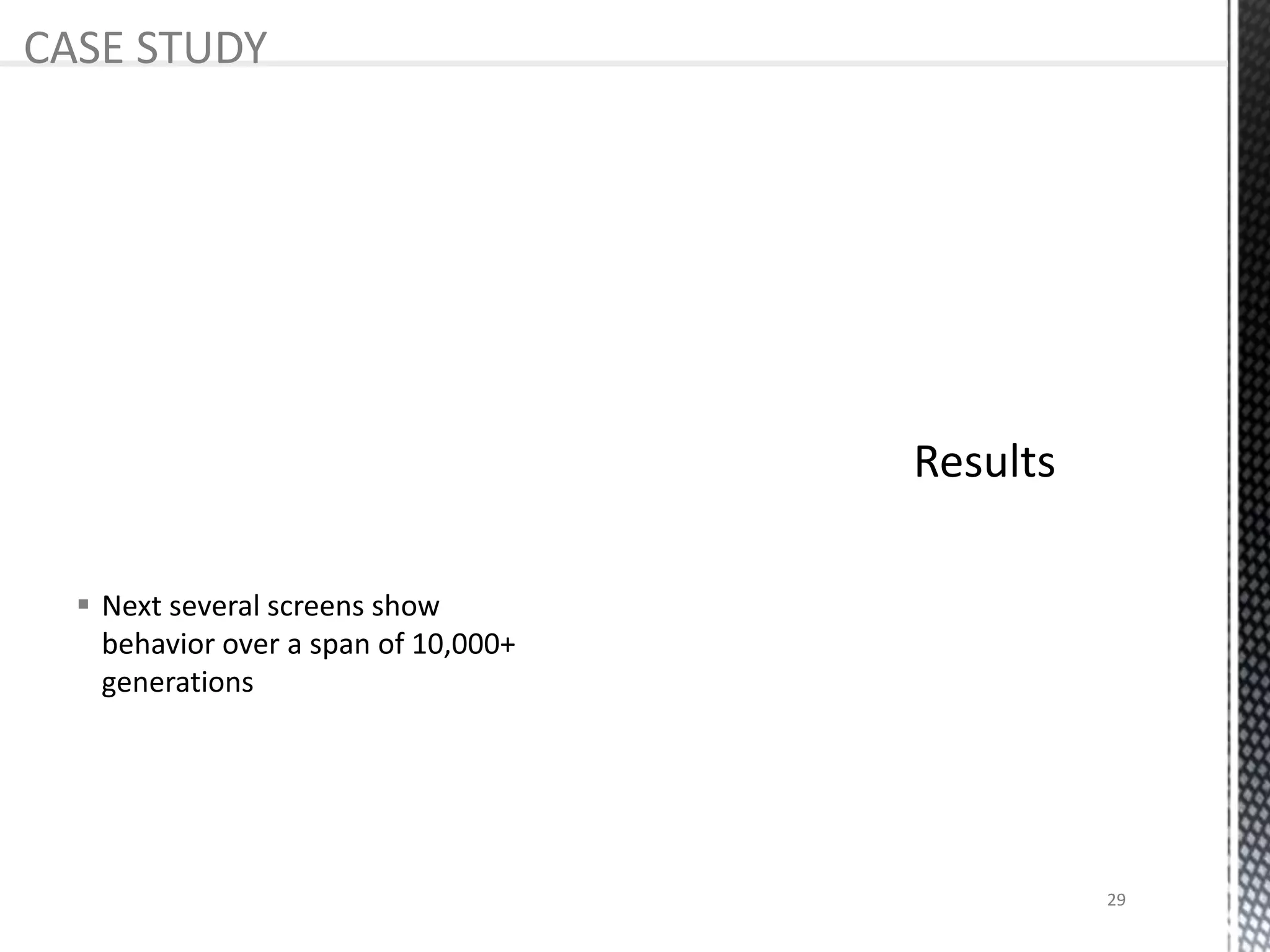
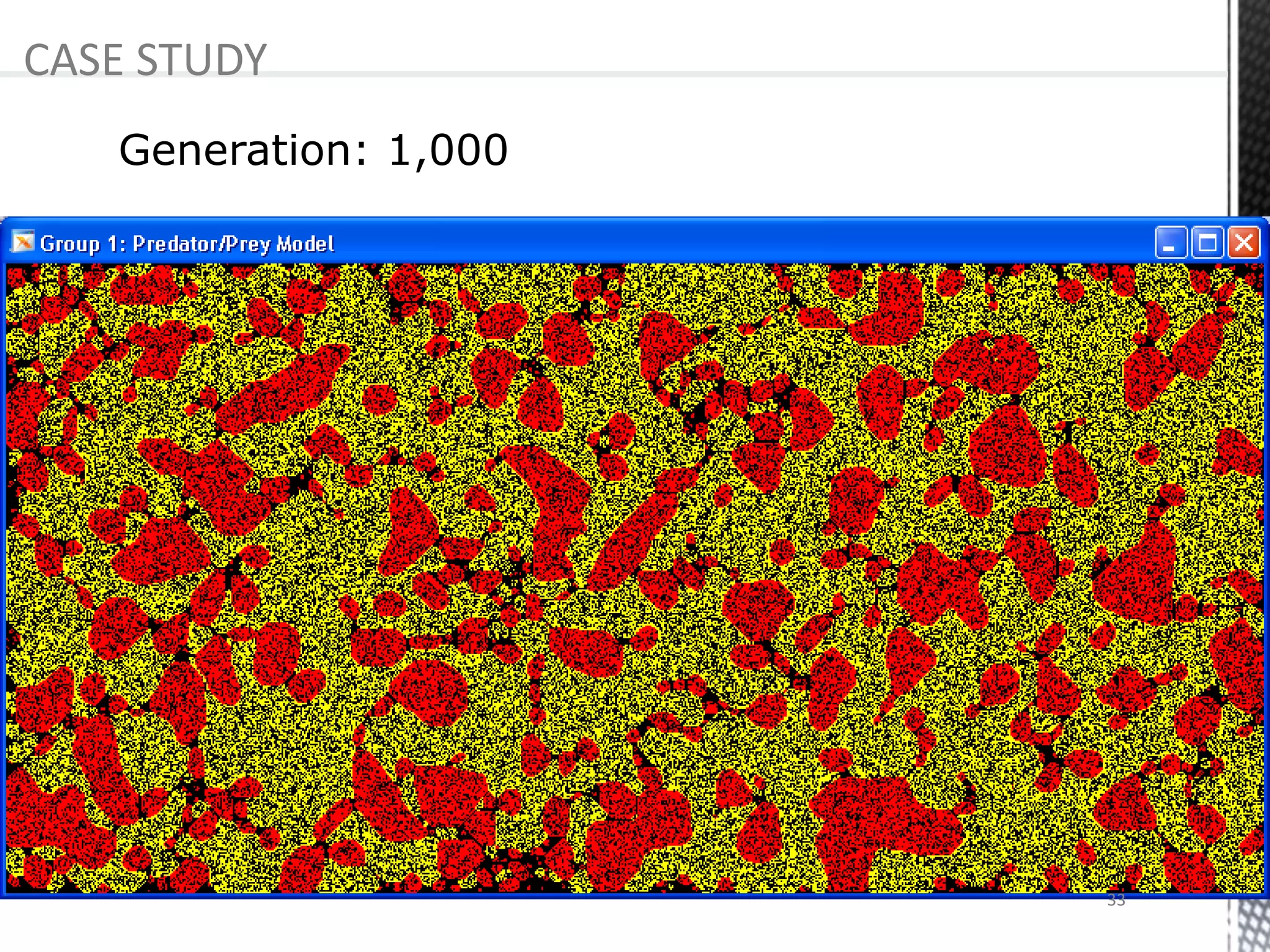
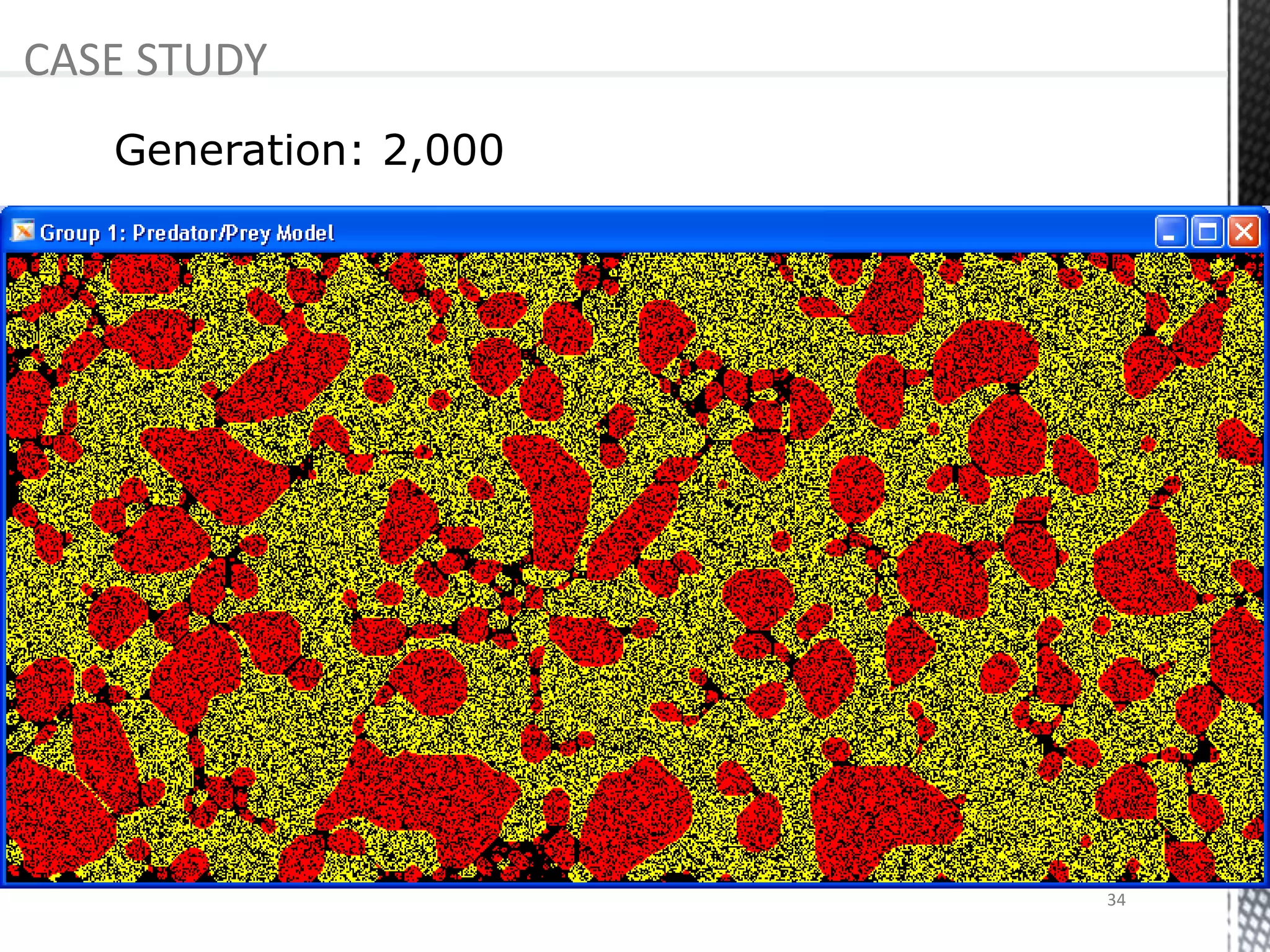
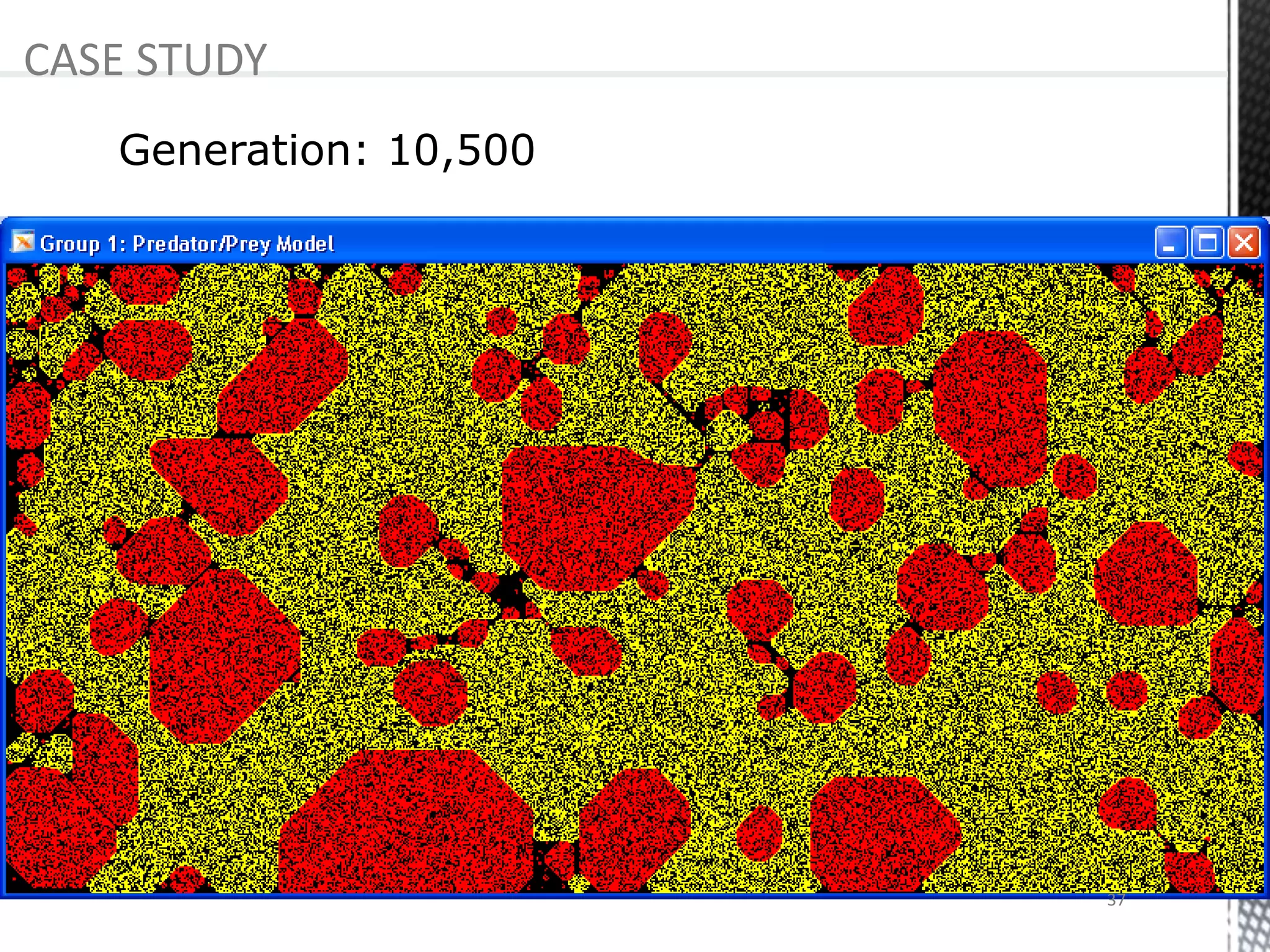
 Next several screens show
behavior over a span of 10,000+
generations
CASE STUDY
29
Generation: 0
CASE STUDY
30
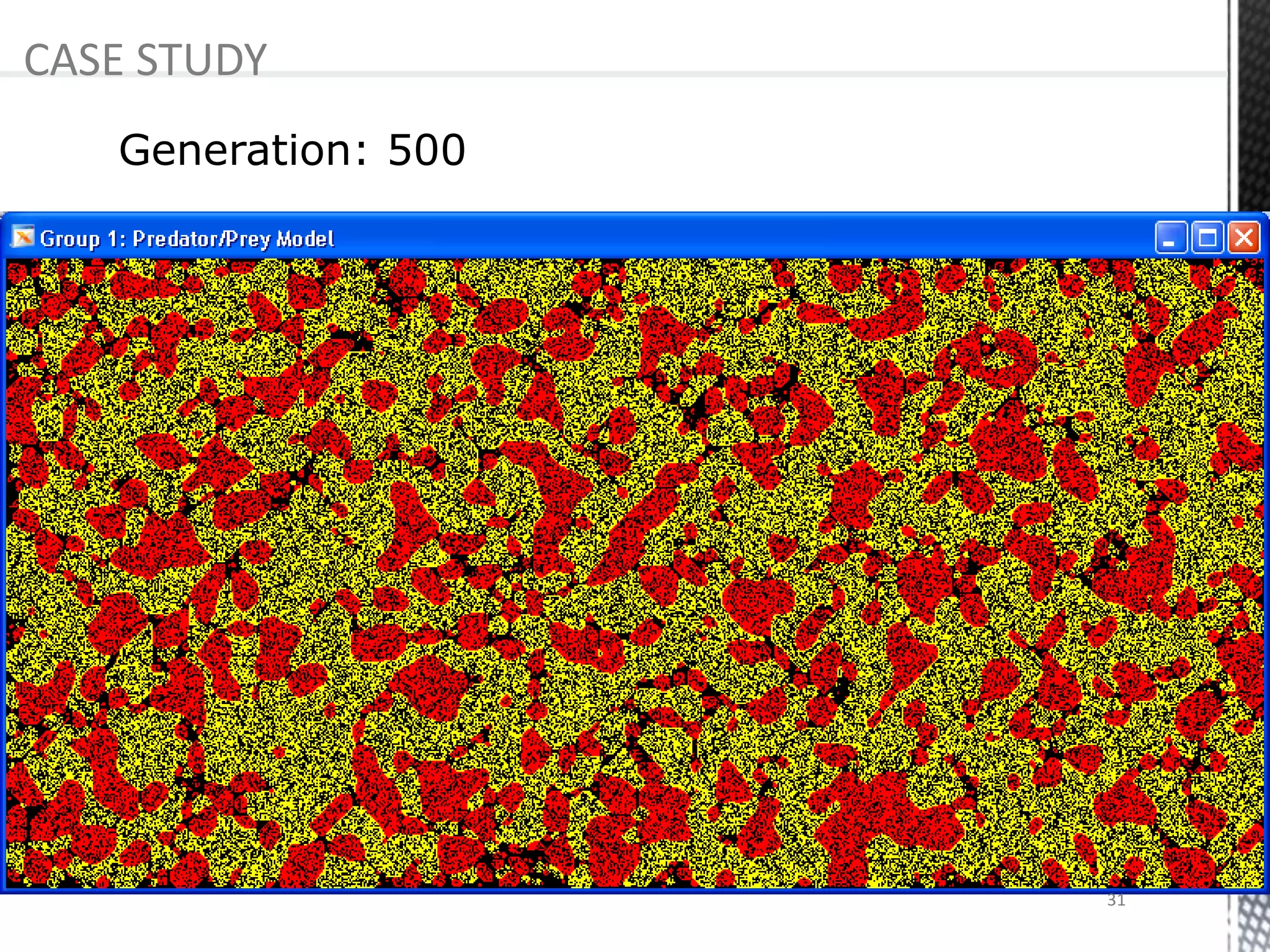
Generation: 500
CASE STUDY
31
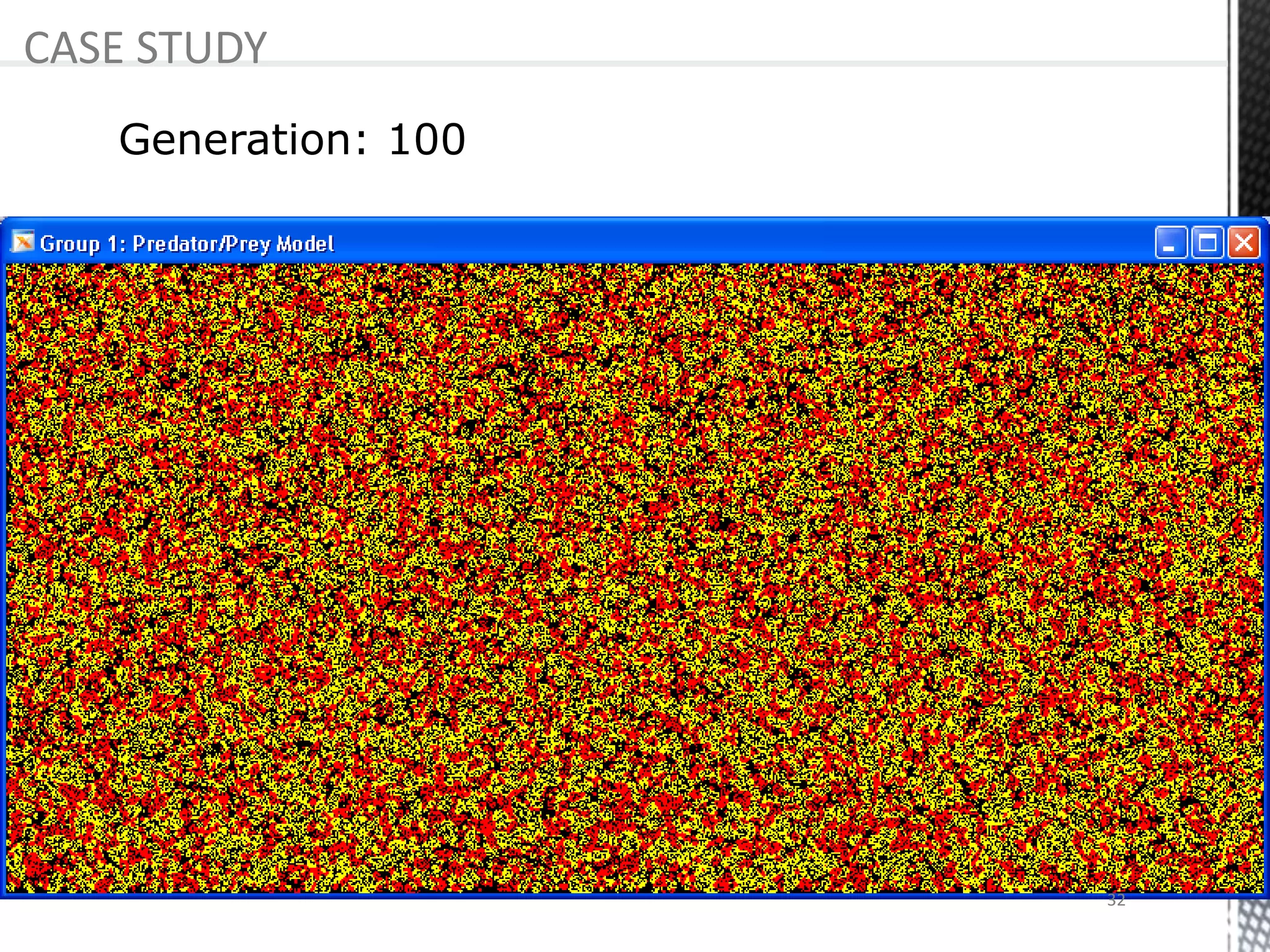
Generation: 100
CASE STUDY
32
Generation: 1,000
CASE STUDY
33
Generation: 2,000
CASE STUDY
34
Generation: 4,000
CASE STUDY
35
Generation: 8,000
CASE STUDY
36
Generation: 10,500
CASE STUDY
37
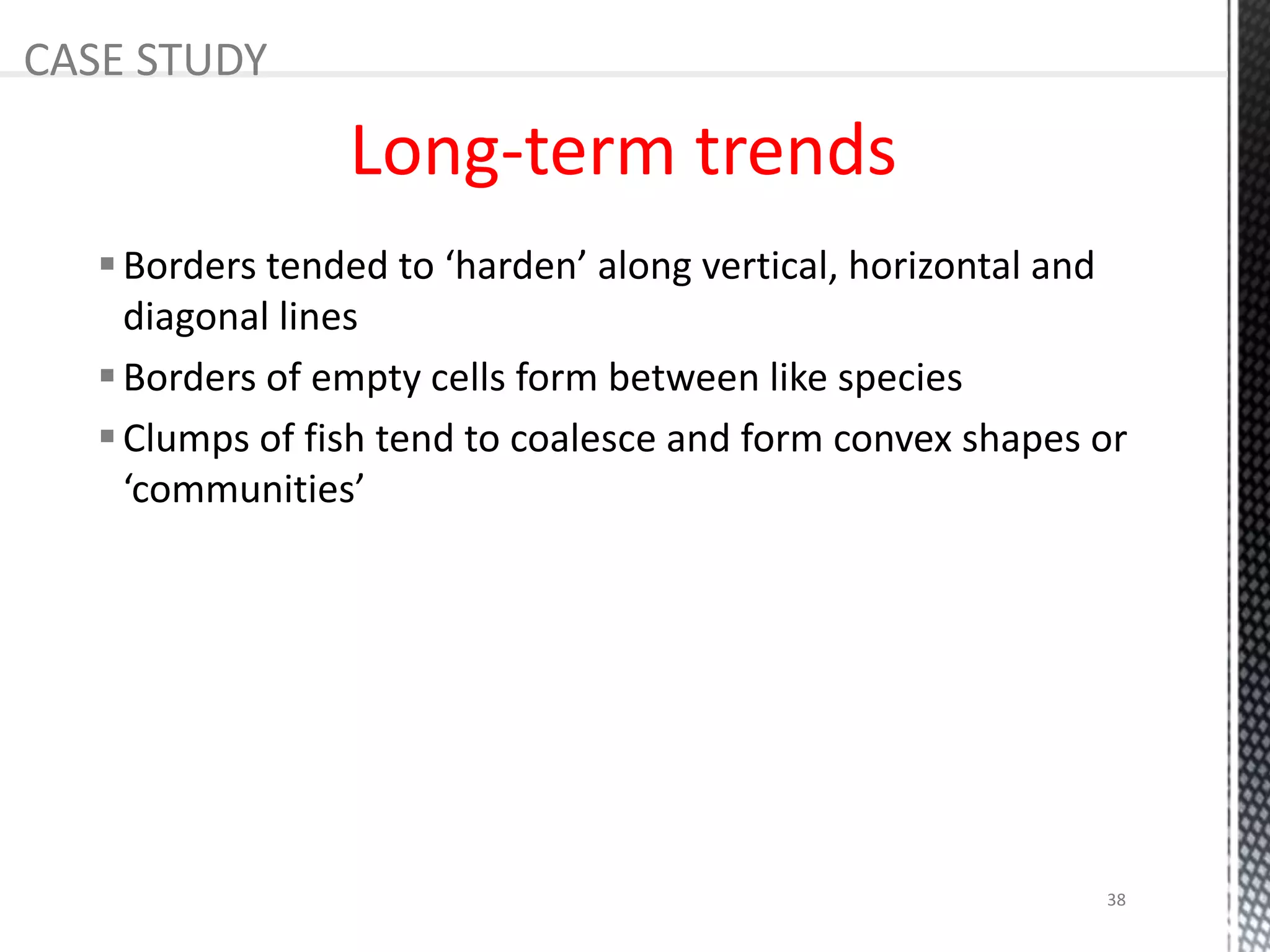
Borders tended to ‘harden’ along vertical, horizontal and
diagonal lines
Borders of empty cells form between like species
Clumps of fish tend to coalesce and form convex shapes or
‘communities’
Long-term trends
CASE STUDY
38
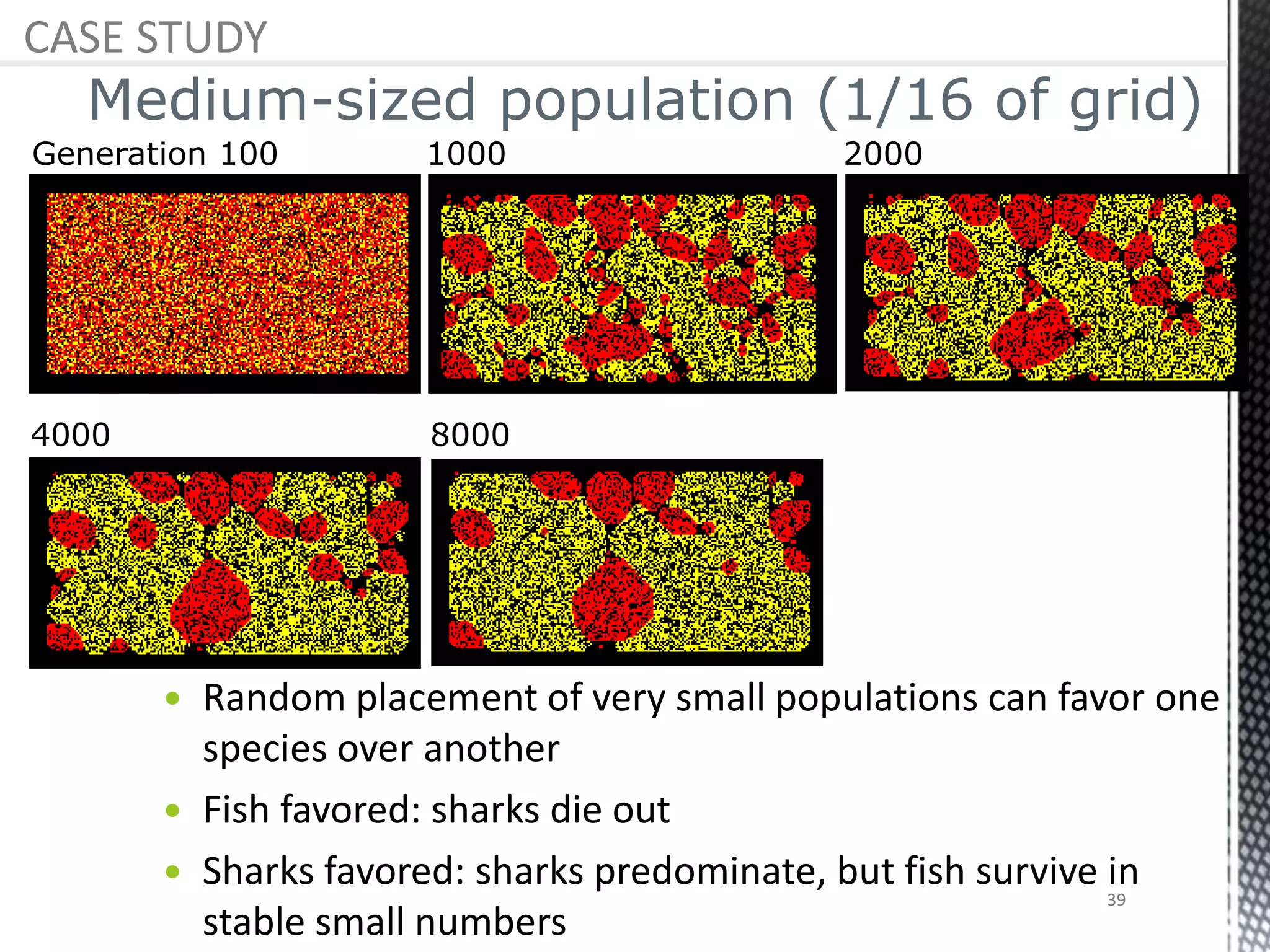
Generation 100 20001000
4000 8000
Medium-sized population (1/16 of grid)
 Random placement of very small populations can favor one
species over another
 Fish favored: sharks die out
 Sharks favored: sharks predominate, but fish survive in
stable small numbers
CASE STUDY
39
Cellular automata provides structural knowledge level
through the initial configuration of the system that evolved
Generative knowledge level is also provided by the
transition rule to generate next data set of the system
LEVEL OF KNOWLEDGE
40
 Powerful computation engines.
 Allow very efficient parallel computation
 Discrete dynamical system simulator.
 Allow for a systematic investigation of complex phenomena.
 Original models of fundamental physics.
 Instead of looking at the equations of fundamental physics, consider
modelling them with CA.
 Emergent behaviour of complex group from simple individual
behaviour can be studied.
 Simulation results are much more intuitive as it is well visually
represented
 Simple to Implement
ADVANTAGES
41
 Not suitable for systems that require synthesis.
 Since CA rules cannot be easily predict results
 Results may contain redundant information.
 Patterns which seem complex can be generated but are un-important
data as concerned with emergent behaviour of the actual system.
 It is not sometimes easy to obtain perfect rules governing
evolution of the system
 It is difficult to understand whether a CA model captures the dynamics of
the system being modelled fully or adds superfluous dynamics
DISADVANTAGES
42
 Wolfram, S.: A new kind of science. Wolfram Media, Inc. (2002)
 Adamatzky, A., Alonso-Sanz, R., Lawniczak, A., Juarez Martinez, G.,
Morita, K., Worsch,T. (eds.): AUTOMATA-2008 Theory and
Application of Cellular Automata (2008)
 http://cell-auto.com
 http://www.brainyencyclopedia.com/encyclopedia/c/ce/cellular
_automaton.html
 Debasis Das: A Survey on Cellular Automata and Its Applications
REFERENCES
43
44

Cellular automata : A simple Introduction

  • 1.
  • 2.
     INTRODUCTION  BACKGROUND SYNTAX  COMPONENTS  BEHAVIOUR  VARIANTS  APPLICATIONS  CASE STUDIES  LEVEL OF KNOWLEDGE  ADVANTAGES  DRAWBACKS  REFERENCES OVERVIEW 2
  • 3.
     What areCellular Automata?  CA are discrete dynamic systems.  CA's are said to be discrete because they operate in finite space and time and with properties that can have only a finite number of states.  CA's are said to be dynamic because they exhibit dynamic behaviours.  Basic Idea: Simulate complex systems by interaction of cells following easy rules.  “Not to describe a complex system with complex equations, but let the complexity emerge by interaction of simple individuals following simple rules.” INTRODUCTION From Another Perspective it is a Finite State Machine, with one transition function for all the cells, this transition function changes the current state of a cell depending on the previous state for that cell and its neighbors. 3
  • 4.
    BACKGROUND 4 Time Frame MajorPlayers Contribution Early 50’s J. Von Neuman, E.F. Codd, Henrie & Moore , H Yamada & S. Amoroso Modeling biological systems - cellular models ‘60s & ‘70s A. R. Smith , Hillis, Toffoli Language recognizer, Image Processing ‘80 s S. Wolfram ,Crisp,Vichniac Discrete Lattice,statistical systems, Physical systems ‘87 - ‘96 IIT KGP, Group Additive CA, characterization,applications ‘97 - ‘99 B.E.C Group GF (2p) CA
  • 5.
    Cellular Automata:  Lattice, Neighbourhood,  Set of discrete states,  Set of transition rules,  Discrete time. “CAs contain enough complexity to simulate surprising and novel change as reflected in emergent phenomena” (Mike Batty) SYNTAX 5
  • 6.
     Cell  Basicelement of a CA.  Cells can be thought of as memory elements that store state information.  All cells are updated synchronously according to the transition rules.  Lattice  Spatial web of cells.  Simplest lattice is one dimensional.  Others include 2,3… Dimensional COMPONENTS Initial current 1 1 1 1 1 0 1 0 1 1 0 0 0 1 1 0 1 0 0 0 1 0 0 0 0 1 1 1 1 1 1 0 Rule #126 6
  • 7.
    • 2 dimensional •3 dimensional •For 1D CA: 23 = 8 possible “neighborhoods” (for 3 cells) 28 = 256 possible rules • For 2D CA: 29 = 512 possible “neighborhoods” 2512 possible rules (!!) 7
  • 8.
    •The cells onthe end may (or may not) be treated as "touching" each other as if the line of cells were circular. If we consider them as they touch each other, then the cell (A) is a neighbor of cell (C) 8
  • 9.
    • if #alive=< 2, then die • if #alive = 3, then live • if #alive >= 5, then die • if #alive =< 2, then die • if #alive = 3, then live • if #alive >= 5, then die • if #alive =< 2, then die • if #alive = 3, then live • if #alive >= 5, then die “A CA is an array of identically programmed automata, or cells, which interact with one another in a neighbourhood and have definite state” BEHAVIOUR 9
  • 10.
    “A CA isan array of identically programmed automata, or cells, which interact with one another in a neighborhood and have definite state” BEHAVIOUR Von Neumann Neighborhood Moore Neighborhood 10
  • 11.
    “A CA isan array of identically programmed automata, or cells, which interact with one another in a neighborhood and have definite state” 2 possible states: ON OFF O W JA R I T D G M X E N Z R P A Z 26 possible states: A … Z Never infinite! BEHAVIOUR 11
  • 12.
    Rules Space andTime t t1 BEHAVIOUR Initial Configuration Initial Starting state of all cells in the lattice e.g the initial configuration for all the cells is state 0, except for 4 cells in state 1. 12
  • 13.
     Asynchronous CA CA rules are typically applied simultaneously across all cells in the lattice. This variant allows the state of the cells to be updated asynchronously.  Probabilistic CA  The deterministic state-transitions are replaced with specifications of the probabilities of the cell-value assignments.  Non-homogenous CA  State transition rules are allowed to vary from cell to cell.  Mobile CA  Some or all lattice sites are free to move about the lattice.  Essentially primitive models of mobile robots.  Used to model some aspects of military engagements.  Structurally Dynamic CA  The topology (the sites and connections among sites) are allowed to evolve. VARIANTS 13
  • 14.
     Self-reproduction  Diffusionequations  Artificial Life  Digital Physics  Simulation of Cancer cells growth  Predator – Prey Models  Art  Simulations of Social Movement  Alternative to differential equations  CA based parallel processing computers  Image processing and pattern recognition APPLICATIONS 14
  • 15.
    Study of evolutionof rules involving one dimensional cellular automata CASE STUDY 15
  • 16.
  • 17.
  • 18.
  • 19.
     I. Alwaysreaches a state in which all cells are dead or alive  II. Periodic behavior  III. Everything occurs randomly  IV. Unstructured locally organized patterns and complex behavior Results: Classifying Cellular Automata Rules CASE STUDY 19
  • 20.
    CASE STUDY During eachtime step the system is updated according to the rules: Forest Fire Model is a stochastic 3-state cellular automaton defined on a d-dimensional lattice with Ld sites. Each site is occupied by a tree, a burning tree, or is empty. 1. empty site  tree with the growth rate probability p 2. tree  burning tree with the lightning rate probability f, if no nearest neighbour is burning 3. tree  burning tree with the probability 1-g, if at least one nearest neighbour is burning, where g defines immunity. 4. burning tree  empty site 20
  • 21.
  • 22.
  • 23.
    After some timeforest reaches the steady state in which the mean number of growing trees equals the mean number of burned trees. CASE STUDY 23
  • 24.
     Model predator/preyrelationship by CA  Begins with a randomly distributed population of fish, sharks, and empty cells in a 1000x2000 cell grid (2 million cells)  Initially,  50% of the cells are occupied by fish  25% are occupied by sharks  25% are empty CASE STUDY 24
  • 25.
    Breeding rule: ifthe current cell is empty  If there are >= 4 neighbors of one species, and >= 3 of them are of breeding age,  Fish breeding age >= 2,  Shark breeding age >=3, and there are <4 of the other species: then create a species of that type  +1= baby fish (age = 1 at birth)  -1 = baby shark (age = |-1| at birth) CASE STUDY Initially cells contain fish, sharks or are empty  Empty cells = 0 (black pixel)  Fish = 1 (red pixel)  Sharks = –1 (yellow pixel) 25
  • 26.
  • 27.
  • 28.
    Shark rule: Details Ifthe current cell contains a shark:  Sharks live for 20 generations  If >=6 neighbors are sharks and fish neighbors =0, the shark dies (starvation)  A shark has a 1/32 (.031) chance of dying due to random causes  If a shark does not die, increment age CASE STUDY Fish rule: Details If the current cell contains a fish:  Fish live for 10 generations  If >=5 neighbors are sharks, fish dies (shark food)  If all 8 neighbors are fish, fish dies (overpopulation)  If a fish does not die, increment age 28
  • 29.
     Next severalscreens show behavior over a span of 10,000+ generations CASE STUDY 29
  • 30.
  • 31.
  • 32.
  • 33.
  • 34.
  • 35.
  • 36.
  • 37.
  • 38.
    Borders tended to‘harden’ along vertical, horizontal and diagonal lines Borders of empty cells form between like species Clumps of fish tend to coalesce and form convex shapes or ‘communities’ Long-term trends CASE STUDY 38
  • 39.
    Generation 100 20001000 40008000 Medium-sized population (1/16 of grid)  Random placement of very small populations can favor one species over another  Fish favored: sharks die out  Sharks favored: sharks predominate, but fish survive in stable small numbers CASE STUDY 39
  • 40.
    Cellular automata providesstructural knowledge level through the initial configuration of the system that evolved Generative knowledge level is also provided by the transition rule to generate next data set of the system LEVEL OF KNOWLEDGE 40
  • 41.
     Powerful computationengines.  Allow very efficient parallel computation  Discrete dynamical system simulator.  Allow for a systematic investigation of complex phenomena.  Original models of fundamental physics.  Instead of looking at the equations of fundamental physics, consider modelling them with CA.  Emergent behaviour of complex group from simple individual behaviour can be studied.  Simulation results are much more intuitive as it is well visually represented  Simple to Implement ADVANTAGES 41
  • 42.
     Not suitablefor systems that require synthesis.  Since CA rules cannot be easily predict results  Results may contain redundant information.  Patterns which seem complex can be generated but are un-important data as concerned with emergent behaviour of the actual system.  It is not sometimes easy to obtain perfect rules governing evolution of the system  It is difficult to understand whether a CA model captures the dynamics of the system being modelled fully or adds superfluous dynamics DISADVANTAGES 42
  • 43.
     Wolfram, S.:A new kind of science. Wolfram Media, Inc. (2002)  Adamatzky, A., Alonso-Sanz, R., Lawniczak, A., Juarez Martinez, G., Morita, K., Worsch,T. (eds.): AUTOMATA-2008 Theory and Application of Cellular Automata (2008)  http://cell-auto.com  http://www.brainyencyclopedia.com/encyclopedia/c/ce/cellular _automaton.html  Debasis Das: A Survey on Cellular Automata and Its Applications REFERENCES 43
  • 44.