Wireless Sensor Network 
And Its Application 
1 
Presented by 
Roma Vyas
Outline 
• Introduction 
• Sensor Node Components 
• Wireless Sensor Network 
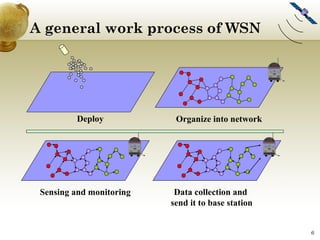
• A general work process of WSN 
• Sensor Networks Operating Systems 
• Wireless Sensor Networks Applications 
• Conclusion 
• References 
2
3 
sensor and Sensor Node 
• A sensor is a electronic device that measures a 
physical quantity and converts it into a signal which 
can be read by an observer or by an instrument. 
• Sensor Node : Basic unit in Sensor Network
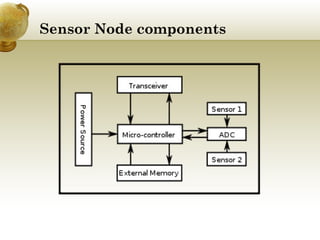
Sensor Node components
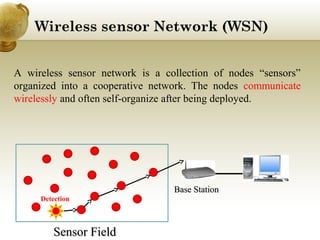
Wireless sensor Network (WSN) 
A wireless sensor network is a collection of nodes “sensors” 
organized into a cooperative network. The nodes communicate 
wirelessly and often self-organize after being deployed. 
SSeennssoorr FFiieelldd 
BBaassee SSttaattiioonn 
Detection
6 
A general work process of WSN 
Deploy Organize into network 
Sensing and monitoring Data collection and 
send it to base station
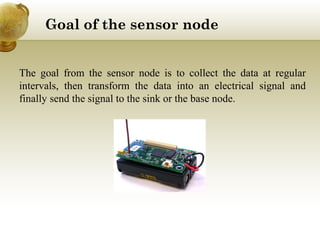
Goal of the sensor node 
The goal from the sensor node is to collect the data at regular 
intervals, then transform the data into an electrical signal and 
finally send the signal to the sink or the base node.
Sensor Networks Operating Systems 
• Sensor Network uses TinyOS. 
• It is a free open source operating system designed 
for wireless sensor networks. 
• It is an embedded operating system written in 
NesC programming language, developed in 1999. 
8
Need of TinyOS 
• Problems with traditional OS 
• Multithreaded Architecture not useful 
• Large Memory Footprint 
• Does not help to conserve energy and power 
• Requirements for Wireless Sensor Networks 
• Efficient utilization of energy and power 
• Small Footprint 
• Should support diversity in design and usage 
• More emphasis on Concurrent execution 
9 TinyOS
TinyOS Features 
• Component based architecture allows frequent changes 
while still keeping the size of code minimum. 
• Event based execution model means no user/kernel 
boundary and hence supports high concurrency. 
• It is power efficient as it makes the sensors sleep as soon 
as possible. 
• Has small footprint as it uses a non-preemtable FIFO 
task scheduling. 
10
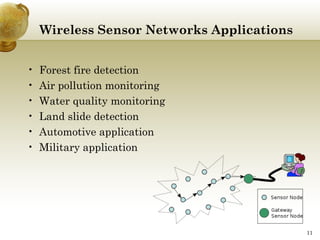
Wireless Sensor Networks Applications 
• Forest fire detection 
• Air pollution monitoring 
• Water quality monitoring 
• Land slide detection 
• Automotive application 
• Military application 
11
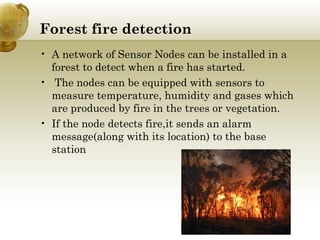
Forest fire detection 
• A network of Sensor Nodes can be installed in a 
forest to detect when a fire has started. 
• The nodes can be equipped with sensors to 
measure temperature, humidity and gases which 
are produced by fire in the trees or vegetation. 
• If the node detects fire,it sends an alarm 
message(along with its location) to the base 
station
Air pollution monitoring 
• Traditional air quality monitoring methods, such 
as building air quality monitoring stations, are 
typically expensive. 
• The solution to these is air quality monitoring 
system based on the technology of wireless sensor 
networks (WSNs). 
• Wireless sensor networks have been deployed in 
several cities to monitor the concentration of 
dangerous gases for citizens.
Water quality monitoring 
• Water quality monitoring involves analyzing 
water properties in dams, rivers, lakes & oceans, 
as well as underground water reserves. 
• Parameters considered include – temperature, 
turbidity and pH
Land slide Detection 
• A landslide detection system makes use of a 
wireless sensor network to detect the slight 
movements of soil and changes in various 
parameters that may occur before or during a 
landslide. 
• Through the data gathered it may be possible to 
know the occurrence of landslides long before it 
actually happens.
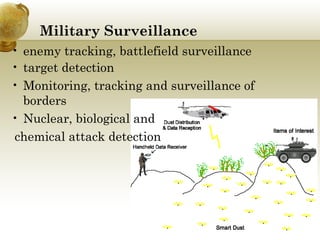
Military Surveillance 
16 
• enemy tracking, battlefield surveillance 
• target detection 
• Monitoring, tracking and surveillance of 
borders 
• Nuclear, biological and 
chemical attack detection
Eruption
FUTURE SCOPE 
18/09/14 Eisha Madhwal 18
19 
Conclusions 
• WSN are a widely applicable, major emerging 
technology. 
• WSN are getting smaller and faster, increasing their 
potential applications in commercial, industrial, and 
residential environments. 
• However, the limit of applications depends only upon 
the sensors used and the interpretation of the data 
obtained.
Thank You 
20

Wireless sensor network and its application

  • 1.
    Wireless Sensor Network And Its Application 1 Presented by Roma Vyas
  • 2.
    Outline • Introduction • Sensor Node Components • Wireless Sensor Network • A general work process of WSN • Sensor Networks Operating Systems • Wireless Sensor Networks Applications • Conclusion • References 2
  • 3.
    3 sensor andSensor Node • A sensor is a electronic device that measures a physical quantity and converts it into a signal which can be read by an observer or by an instrument. • Sensor Node : Basic unit in Sensor Network
  • 4.
  • 5.
    Wireless sensor Network(WSN) A wireless sensor network is a collection of nodes “sensors” organized into a cooperative network. The nodes communicate wirelessly and often self-organize after being deployed. SSeennssoorr FFiieelldd BBaassee SSttaattiioonn Detection
  • 6.
    6 A generalwork process of WSN Deploy Organize into network Sensing and monitoring Data collection and send it to base station
  • 7.
    Goal of thesensor node The goal from the sensor node is to collect the data at regular intervals, then transform the data into an electrical signal and finally send the signal to the sink or the base node.
  • 8.
    Sensor Networks OperatingSystems • Sensor Network uses TinyOS. • It is a free open source operating system designed for wireless sensor networks. • It is an embedded operating system written in NesC programming language, developed in 1999. 8
  • 9.
    Need of TinyOS • Problems with traditional OS • Multithreaded Architecture not useful • Large Memory Footprint • Does not help to conserve energy and power • Requirements for Wireless Sensor Networks • Efficient utilization of energy and power • Small Footprint • Should support diversity in design and usage • More emphasis on Concurrent execution 9 TinyOS
  • 10.
    TinyOS Features •Component based architecture allows frequent changes while still keeping the size of code minimum. • Event based execution model means no user/kernel boundary and hence supports high concurrency. • It is power efficient as it makes the sensors sleep as soon as possible. • Has small footprint as it uses a non-preemtable FIFO task scheduling. 10
  • 11.
    Wireless Sensor NetworksApplications • Forest fire detection • Air pollution monitoring • Water quality monitoring • Land slide detection • Automotive application • Military application 11
  • 12.
    Forest fire detection • A network of Sensor Nodes can be installed in a forest to detect when a fire has started. • The nodes can be equipped with sensors to measure temperature, humidity and gases which are produced by fire in the trees or vegetation. • If the node detects fire,it sends an alarm message(along with its location) to the base station
  • 13.
    Air pollution monitoring • Traditional air quality monitoring methods, such as building air quality monitoring stations, are typically expensive. • The solution to these is air quality monitoring system based on the technology of wireless sensor networks (WSNs). • Wireless sensor networks have been deployed in several cities to monitor the concentration of dangerous gases for citizens.
  • 14.
    Water quality monitoring • Water quality monitoring involves analyzing water properties in dams, rivers, lakes & oceans, as well as underground water reserves. • Parameters considered include – temperature, turbidity and pH
  • 15.
    Land slide Detection • A landslide detection system makes use of a wireless sensor network to detect the slight movements of soil and changes in various parameters that may occur before or during a landslide. • Through the data gathered it may be possible to know the occurrence of landslides long before it actually happens.
  • 16.
    Military Surveillance 16 • enemy tracking, battlefield surveillance • target detection • Monitoring, tracking and surveillance of borders • Nuclear, biological and chemical attack detection
  • 17.
  • 18.
    FUTURE SCOPE 18/09/14Eisha Madhwal 18
  • 19.
    19 Conclusions •WSN are a widely applicable, major emerging technology. • WSN are getting smaller and faster, increasing their potential applications in commercial, industrial, and residential environments. • However, the limit of applications depends only upon the sensors used and the interpretation of the data obtained.
  • 20.