The following slides show one of the 51
presentations that cover the AS
Mathematics core modules C1 and C2.
Demo DiscDemo Disc
““Teach A Level Maths”Teach A Level Maths”
Vol. 1: AS Core ModulesVol. 1: AS Core Modules
AS MathematicsAS Mathematics
26: Definite Integration26: Definite Integration
and Areasand Areas
© Christine Crisp
Definite Integration and Areas
Module C1
AQA Edexcel
OCR
MEI/OCR
Module C2
"Certain images and/or photos on this presentation are the copyrighted property of JupiterImages and are being used with
permission under license. These images and/or photos may not be copied or downloaded without permission from JupiterImages"
Definite Integration and Areas
0 1
23 2
+= xy
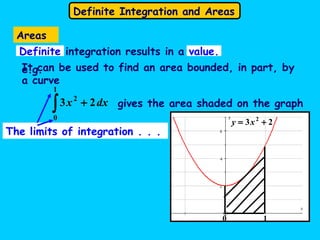
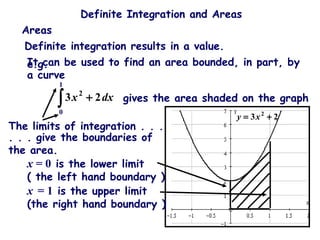
It can be used to find an area bounded, in part, by
a curve
e.g.
∫ +
1
0
2
23 dxx gives the area shaded on the graph
The limits of integration . . .
Definite integration results in a value.
Areas
Definite Integration and Areas
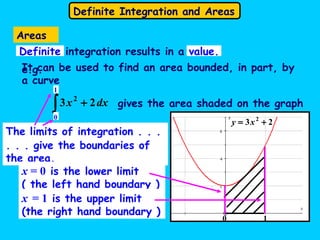
. . . give the boundaries of
the area.
The limits of integration . . .
0 1
23 2
+= xy
It can be used to find an area bounded, in part, by
a curve
Definite integration results in a value.
Areas
x = 0 is the lower limit
( the left hand boundary )
x = 1 is the upper limit
(the right hand boundary )
∫ + dxx 23 2
0
1
e.g.
gives the area shaded on the graph
Definite Integration and Areas
0 1
23 2
+= xy
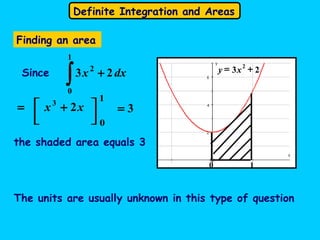
Finding an area
the shaded area equals 3
The units are usually unknown in this type of question
∫ +
1
0
2
23 dxxSince
3=
1
0



 xx 23
+=
Definite Integration and Areas
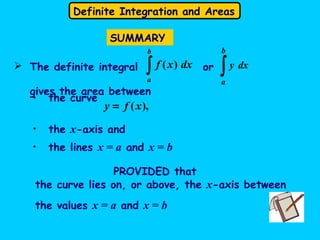
SUMMARY
• the curve
),(xfy =
• the lines x = a and x = b
• the x-axis and
PROVIDED that
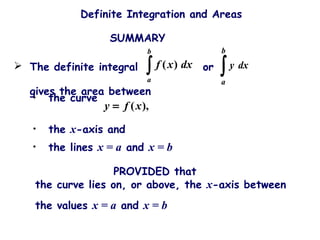
the curve lies on, or above, the x-axis between
the values x = a and x = b
 The definite integral or
gives the area between
∫
b
a
dxxf )(
∫
b
a
dxy
Definite Integration and Areas
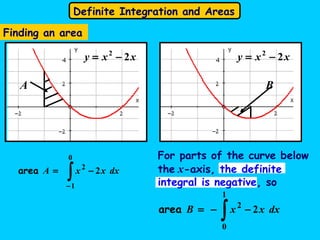
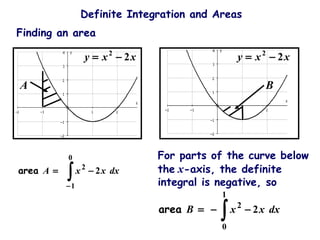
xxy 22
−=xxy 22
−=
Finding an area
∫−
−=
0
1
2
2 dxxxAarea
A B
∫ −−=
1
0
2
2 dxxxBarea
For parts of the curve below
the x-axis, the definite
integral is negative, so
Definite Integration and Areas
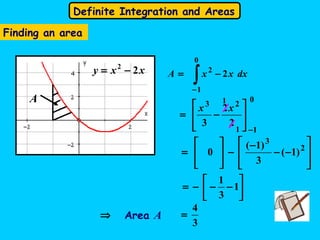
xxy 22
−=
A
Finding an area
∫−
−=
0
1
2
2 dxxxA








−=
−
2
2
3
23
0
1
xx








−−
−
−








= 2
3
)1(
3
)1(
0






−−−= 1
3
1
1
1
3
4
=Area A⇒
Definite Integration and Areas
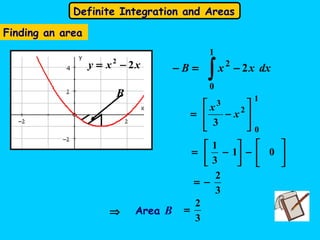
xxy 22
−=
B
Finding an area
∫ −=−
1
0
2
2 dxxxB








−= 2
3
1
0
3
x
x






−





−= 01
3
1
3
2
−=
3
2
=Area B⇒
Definite Integration and Areas
SUMMARY
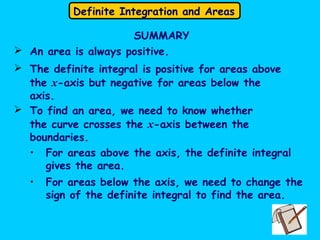
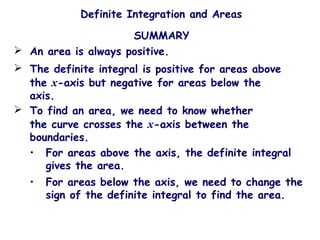
 An area is always positive.
 The definite integral is positive for areas above
the x-axis but negative for areas below the
axis.
 To find an area, we need to know whether
the curve crosses the x-axis between the
boundaries.
• For areas above the axis, the definite integral
gives the area.
• For areas below the axis, we need to change the
sign of the definite integral to find the area.
Definite Integration and Areas
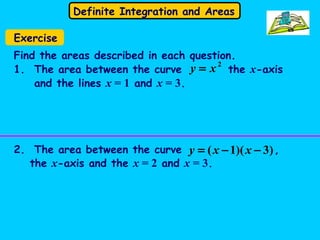
Exercise
Find the areas described in each question.
1. The area between the curve the x-axis
and the lines x = 1 and x = 3.
2
xy =
2. The area between the curve ,
the x-axis and the x = 2 and x = 3.
)3)(1( −−= xxy
Definite Integration and Areas
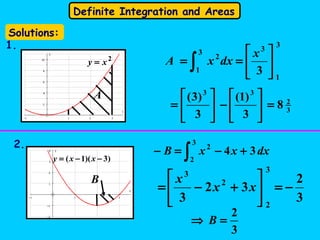
A
2
xy =
1.
B
)3)(1( −−= xxy
2.
Solutions:
3
1
3
1
3
2
3∫ 





==
x
dxxA
3
2
32
3
3
2
2
3
−=





+−= xx
x
∫ +−=−
3
2
2
34 dxxxB
3
2
=⇒ B
3
2
33
8
3
)1(
3
)3(
=





−





=
Definite Integration and Areas
Extension
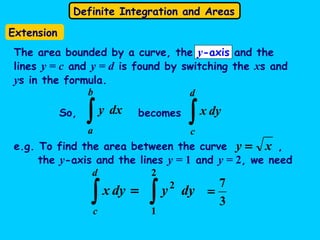
The area bounded by a curve, the y-axis and the
lines y = c and y = d is found by switching the xs and
ys in the formula.
So, becomes∫
b
a
dxy
∫ =
d
c
dyx
∫
d
c
dyx
e.g. To find the area between the curve ,
the y-axis and the lines y = 1 and y = 2, we need
xy =
3
7
=
∫
2
1
2
dyy
Definite Integration and Areas
2
2 xxy −=
xy =
Harder Areas
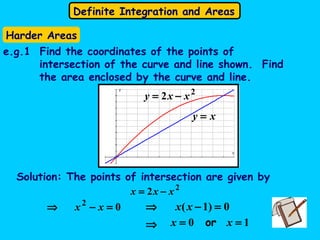
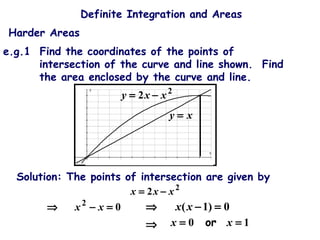
e.g.1 Find the coordinates of the points of
intersection of the curve and line shown. Find
the area enclosed by the curve and line.
2
2 xxx −=
Solution: The points of intersection are given by
02
=−⇒ xx 0)1( =−⇒ xx
10 == xx or⇒
Definite Integration and Areas
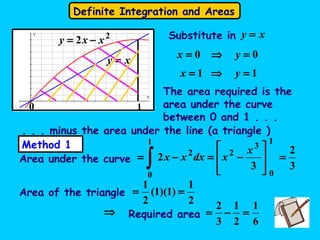
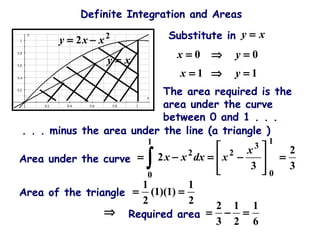
2
2 xxy −=
xy =
00 =⇒= yx
xy =Substitute in
11 =⇒= yx
The area required is the
area under the curve
between 0 and 1 . . .
. . . minus the area under the line (a triangle )
3
2
3
2
1
0
3
2
1
0
2
=








−=−=
∫
x
xdxxx
Area of the triangle
2
1
)1)(1(
2
1
==
Area under the curve
Required area
6
1
2
1
3
2
=−=⇒
Method 1
0 1
Definite Integration and Areas
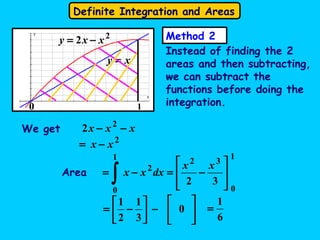
2
2 xxy −=
xy =
Instead of finding the 2
areas and then subtracting,
we can subtract the
functions before doing the
integration.
1
0
321
0
2
32 







−=−=
∫
xx
dxxxArea
We get
Method 2
xxx −− 2
2
2
xx −=






−





−= 0
3
1
2
1
6
1
=
0 1
Definite Integration and Areas
6=y
22
+= xy
Exercise
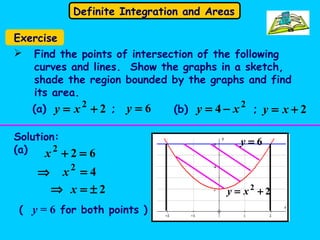
 Find the points of intersection of the following
curves and lines. Show the graphs in a sketch,
shade the region bounded by the graphs and find
its area.
22
+= xy 6=y(a) ; (b) ; 2+= xy2
4 xy −=
Solution:
(a) 622
=+x
42
=x⇒
2±=x⇒
( y = 6 for both points )
Definite Integration and Areas
6=y
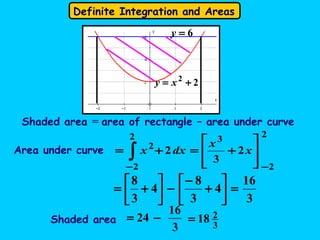
22
+= xy
Shaded area = area of rectangle – area under curve
3
16
4
3
8
4
3
8
=





+
−
−





+=
Area under curve
2
2
32
2
2
2
3
2
−− 







+=+= ∫ x
x
dxx
Shaded area
3
16
24 −=
3
218=
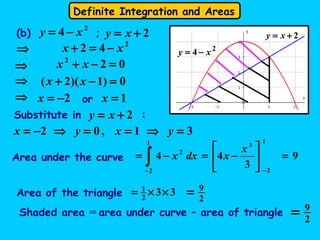
Definite Integration and Areas
2+= xy
2
4 xy −=
,02 =⇒−= yx
Area of the triangle
⇒ 2−=x 1=xor
Substitute in :2+= xy
31 =⇒= yx
Area under the curve
1
2
31
2
2
3
44
−−






−=−= ∫
x
xdxx 9=
332
1
××=
(b) ; 2+= xy
2
4 xy −=
022
=−+ xx⇒
0)1)(2( =−+ xx⇒
Shaded area = area under curve – area of triangle
2
9
=
2
9
=
2
42 xx −=+⇒
Definite Integration and Areas
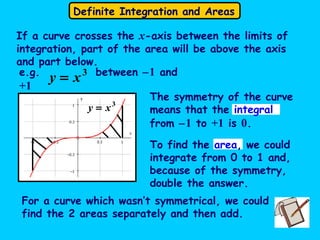
3
xy =
The symmetry of the curve
means that the integral
from −1 to +1 is 0.
If a curve crosses the x-axis between the limits of
integration, part of the area will be above the axis
and part below.
3
xy =e.g. between −1 and
+1
To find the area, we could
integrate from 0 to 1 and,
because of the symmetry,
double the answer.
For a curve which wasn’t symmetrical, we could
find the 2 areas separately and then add.
Definite Integration and Areas
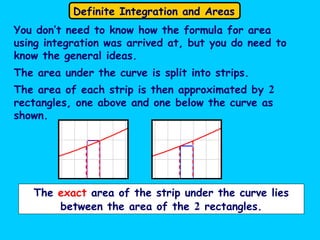
You don’t need to know how the formula for area
using integration was arrived at, but you do need to
know the general ideas.
The area under the curve is split into strips.
The area of each strip is then approximated by 2
rectangles, one above and one below the curve as
shown.
The exact area of the strip under the curve lies
between the area of the 2 rectangles.
Definite Integration and Areas
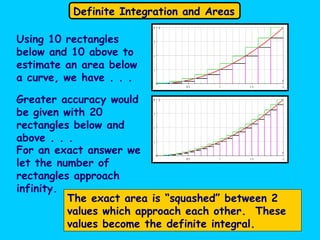
Using 10 rectangles
below and 10 above to
estimate an area below
a curve, we have . . .
Greater accuracy would
be given with 20
rectangles below and
above . . .
For an exact answer we
let the number of
rectangles approach
infinity.
The exact area is “squashed” between 2
values which approach each other. These
values become the definite integral.
Definite Integration and Areas
The following slides contain repeats of
information on earlier slides, shown without
colour, so that they can be printed and
photocopied.
For most purposes the slides can be printed
as “Handouts” with up to 6 slides per sheet.
Definite Integration and Areas
23 2
+= xy
. . . give the boundaries of
the area.
It can be used to find an area bounded, in part, by
a curve
Definite integration results in a value.
Areas
The limits of integration . . .
x = 0 is the lower limit
( the left hand boundary )
x = 1 is the upper limit
(the right hand boundary )
∫ + dxx 23 2
0
1
e.g.
gives the area shaded on the graph
Definite Integration and Areas
SUMMARY
• the curve
),(xfy =
• the lines x = a and x = b
• the x-axis and
PROVIDED that
the curve lies on, or above, the x-axis between
the values x = a and x = b
 The definite integral or
gives the area between
∫
b
a
dxxf )(
∫
b
a
dxy
Definite Integration and Areas
xxy 22
−=xxy 22
−=
Finding an area
∫−
−=
0
1
2
2 dxxxAarea
A B
∫ −−=
1
0
2
2 dxxxBarea
For parts of the curve below
the x-axis, the definite
integral is negative, so
Definite Integration and Areas
SUMMARY
 An area is always positive.
 The definite integral is positive for areas above
the x-axis but negative for areas below the
axis.
 To find an area, we need to know whether
the curve crosses the x-axis between the
boundaries.
• For areas above the axis, the definite integral
gives the area.
• For areas below the axis, we need to change the
sign of the definite integral to find the area.
Definite Integration and Areas
Harder Areas
e.g.1 Find the coordinates of the points of
intersection of the curve and line shown. Find
the area enclosed by the curve and line.
2
2 xxx −=
Solution: The points of intersection are given by
02
=−⇒ xx 0)1( =−⇒ xx
10 == xx or⇒
2
2 xxy −=
xy =
Definite Integration and Areas
2
2 xxy −=
xy =
00 =⇒= yx
xy =Substitute in
11 =⇒= yx
The area required is the
area under the curve
between 0 and 1 . . .
. . . minus the area under the line (a triangle )
3
2
3
2
1
0
3
2
1
0
2
=








−=−=
∫
x
xdxxx
Area of the triangle
2
1
)1)(1(
2
1
==
Area under the curve
Required area
6
1
2
1
3
2
=−=⇒

1545 integration-define

  • 1.
    The following slidesshow one of the 51 presentations that cover the AS Mathematics core modules C1 and C2. Demo DiscDemo Disc ““Teach A Level Maths”Teach A Level Maths” Vol. 1: AS Core ModulesVol. 1: AS Core Modules
  • 2.
    AS MathematicsAS Mathematics 26:Definite Integration26: Definite Integration and Areasand Areas © Christine Crisp
  • 3.
    Definite Integration andAreas Module C1 AQA Edexcel OCR MEI/OCR Module C2 "Certain images and/or photos on this presentation are the copyrighted property of JupiterImages and are being used with permission under license. These images and/or photos may not be copied or downloaded without permission from JupiterImages"
  • 4.
    Definite Integration andAreas 0 1 23 2 += xy It can be used to find an area bounded, in part, by a curve e.g. ∫ + 1 0 2 23 dxx gives the area shaded on the graph The limits of integration . . . Definite integration results in a value. Areas
  • 5.
    Definite Integration andAreas . . . give the boundaries of the area. The limits of integration . . . 0 1 23 2 += xy It can be used to find an area bounded, in part, by a curve Definite integration results in a value. Areas x = 0 is the lower limit ( the left hand boundary ) x = 1 is the upper limit (the right hand boundary ) ∫ + dxx 23 2 0 1 e.g. gives the area shaded on the graph
  • 6.
    Definite Integration andAreas 0 1 23 2 += xy Finding an area the shaded area equals 3 The units are usually unknown in this type of question ∫ + 1 0 2 23 dxxSince 3= 1 0     xx 23 +=
  • 7.
    Definite Integration andAreas SUMMARY • the curve ),(xfy = • the lines x = a and x = b • the x-axis and PROVIDED that the curve lies on, or above, the x-axis between the values x = a and x = b  The definite integral or gives the area between ∫ b a dxxf )( ∫ b a dxy
  • 8.
    Definite Integration andAreas xxy 22 −=xxy 22 −= Finding an area ∫− −= 0 1 2 2 dxxxAarea A B ∫ −−= 1 0 2 2 dxxxBarea For parts of the curve below the x-axis, the definite integral is negative, so
  • 9.
    Definite Integration andAreas xxy 22 −= A Finding an area ∫− −= 0 1 2 2 dxxxA         −= − 2 2 3 23 0 1 xx         −− − −         = 2 3 )1( 3 )1( 0       −−−= 1 3 1 1 1 3 4 =Area A⇒
  • 10.
    Definite Integration andAreas xxy 22 −= B Finding an area ∫ −=− 1 0 2 2 dxxxB         −= 2 3 1 0 3 x x       −      −= 01 3 1 3 2 −= 3 2 =Area B⇒
  • 11.
    Definite Integration andAreas SUMMARY  An area is always positive.  The definite integral is positive for areas above the x-axis but negative for areas below the axis.  To find an area, we need to know whether the curve crosses the x-axis between the boundaries. • For areas above the axis, the definite integral gives the area. • For areas below the axis, we need to change the sign of the definite integral to find the area.
  • 12.
    Definite Integration andAreas Exercise Find the areas described in each question. 1. The area between the curve the x-axis and the lines x = 1 and x = 3. 2 xy = 2. The area between the curve , the x-axis and the x = 2 and x = 3. )3)(1( −−= xxy
  • 13.
    Definite Integration andAreas A 2 xy = 1. B )3)(1( −−= xxy 2. Solutions: 3 1 3 1 3 2 3∫       == x dxxA 3 2 32 3 3 2 2 3 −=      +−= xx x ∫ +−=− 3 2 2 34 dxxxB 3 2 =⇒ B 3 2 33 8 3 )1( 3 )3( =      −      =
  • 14.
    Definite Integration andAreas Extension The area bounded by a curve, the y-axis and the lines y = c and y = d is found by switching the xs and ys in the formula. So, becomes∫ b a dxy ∫ = d c dyx ∫ d c dyx e.g. To find the area between the curve , the y-axis and the lines y = 1 and y = 2, we need xy = 3 7 = ∫ 2 1 2 dyy
  • 15.
    Definite Integration andAreas 2 2 xxy −= xy = Harder Areas e.g.1 Find the coordinates of the points of intersection of the curve and line shown. Find the area enclosed by the curve and line. 2 2 xxx −= Solution: The points of intersection are given by 02 =−⇒ xx 0)1( =−⇒ xx 10 == xx or⇒
  • 16.
    Definite Integration andAreas 2 2 xxy −= xy = 00 =⇒= yx xy =Substitute in 11 =⇒= yx The area required is the area under the curve between 0 and 1 . . . . . . minus the area under the line (a triangle ) 3 2 3 2 1 0 3 2 1 0 2 =         −=−= ∫ x xdxxx Area of the triangle 2 1 )1)(1( 2 1 == Area under the curve Required area 6 1 2 1 3 2 =−=⇒ Method 1 0 1
  • 17.
    Definite Integration andAreas 2 2 xxy −= xy = Instead of finding the 2 areas and then subtracting, we can subtract the functions before doing the integration. 1 0 321 0 2 32         −=−= ∫ xx dxxxArea We get Method 2 xxx −− 2 2 2 xx −=       −      −= 0 3 1 2 1 6 1 = 0 1
  • 18.
    Definite Integration andAreas 6=y 22 += xy Exercise  Find the points of intersection of the following curves and lines. Show the graphs in a sketch, shade the region bounded by the graphs and find its area. 22 += xy 6=y(a) ; (b) ; 2+= xy2 4 xy −= Solution: (a) 622 =+x 42 =x⇒ 2±=x⇒ ( y = 6 for both points )
  • 19.
    Definite Integration andAreas 6=y 22 += xy Shaded area = area of rectangle – area under curve 3 16 4 3 8 4 3 8 =      + − −      += Area under curve 2 2 32 2 2 2 3 2 −−         +=+= ∫ x x dxx Shaded area 3 16 24 −= 3 218=
  • 20.
    Definite Integration andAreas 2+= xy 2 4 xy −= ,02 =⇒−= yx Area of the triangle ⇒ 2−=x 1=xor Substitute in :2+= xy 31 =⇒= yx Area under the curve 1 2 31 2 2 3 44 −−       −=−= ∫ x xdxx 9= 332 1 ××= (b) ; 2+= xy 2 4 xy −= 022 =−+ xx⇒ 0)1)(2( =−+ xx⇒ Shaded area = area under curve – area of triangle 2 9 = 2 9 = 2 42 xx −=+⇒
  • 21.
    Definite Integration andAreas 3 xy = The symmetry of the curve means that the integral from −1 to +1 is 0. If a curve crosses the x-axis between the limits of integration, part of the area will be above the axis and part below. 3 xy =e.g. between −1 and +1 To find the area, we could integrate from 0 to 1 and, because of the symmetry, double the answer. For a curve which wasn’t symmetrical, we could find the 2 areas separately and then add.
  • 22.
    Definite Integration andAreas You don’t need to know how the formula for area using integration was arrived at, but you do need to know the general ideas. The area under the curve is split into strips. The area of each strip is then approximated by 2 rectangles, one above and one below the curve as shown. The exact area of the strip under the curve lies between the area of the 2 rectangles.
  • 23.
    Definite Integration andAreas Using 10 rectangles below and 10 above to estimate an area below a curve, we have . . . Greater accuracy would be given with 20 rectangles below and above . . . For an exact answer we let the number of rectangles approach infinity. The exact area is “squashed” between 2 values which approach each other. These values become the definite integral.
  • 24.
  • 25.
    Definite Integration andAreas The following slides contain repeats of information on earlier slides, shown without colour, so that they can be printed and photocopied. For most purposes the slides can be printed as “Handouts” with up to 6 slides per sheet.
  • 26.
    Definite Integration andAreas 23 2 += xy . . . give the boundaries of the area. It can be used to find an area bounded, in part, by a curve Definite integration results in a value. Areas The limits of integration . . . x = 0 is the lower limit ( the left hand boundary ) x = 1 is the upper limit (the right hand boundary ) ∫ + dxx 23 2 0 1 e.g. gives the area shaded on the graph
  • 27.
    Definite Integration andAreas SUMMARY • the curve ),(xfy = • the lines x = a and x = b • the x-axis and PROVIDED that the curve lies on, or above, the x-axis between the values x = a and x = b  The definite integral or gives the area between ∫ b a dxxf )( ∫ b a dxy
  • 28.
    Definite Integration andAreas xxy 22 −=xxy 22 −= Finding an area ∫− −= 0 1 2 2 dxxxAarea A B ∫ −−= 1 0 2 2 dxxxBarea For parts of the curve below the x-axis, the definite integral is negative, so
  • 29.
    Definite Integration andAreas SUMMARY  An area is always positive.  The definite integral is positive for areas above the x-axis but negative for areas below the axis.  To find an area, we need to know whether the curve crosses the x-axis between the boundaries. • For areas above the axis, the definite integral gives the area. • For areas below the axis, we need to change the sign of the definite integral to find the area.
  • 30.
    Definite Integration andAreas Harder Areas e.g.1 Find the coordinates of the points of intersection of the curve and line shown. Find the area enclosed by the curve and line. 2 2 xxx −= Solution: The points of intersection are given by 02 =−⇒ xx 0)1( =−⇒ xx 10 == xx or⇒ 2 2 xxy −= xy =
  • 31.
    Definite Integration andAreas 2 2 xxy −= xy = 00 =⇒= yx xy =Substitute in 11 =⇒= yx The area required is the area under the curve between 0 and 1 . . . . . . minus the area under the line (a triangle ) 3 2 3 2 1 0 3 2 1 0 2 =         −=−= ∫ x xdxxx Area of the triangle 2 1 )1)(1( 2 1 == Area under the curve Required area 6 1 2 1 3 2 =−=⇒