www.PinoyBIX.org
Presents:
GRAPHS OF SINE AND COSINE FUNCTIONS
credit: Shawna Haider
GRAPHS OF
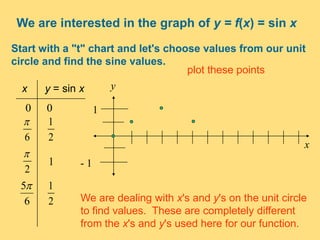
We are interested in the graph of y = f(x) = sin x
Start with a "t" chart and let's choose values from our unit
circle and find the sine values.
x y = sin x
6

0 0
2
1
2

1
6
5
2
1
We are dealing with x's and y's on the unit circle
to find values. These are completely different
from the x's and y's used here for our function.
x
y
1
- 1
plot these points
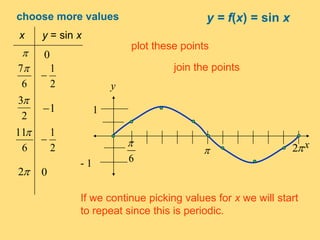
y = f(x) = sin xchoose more values
x y = sin x
6
7
 0
2
1

2
3
1
6
11
2
1

If we continue picking values for x we will start
to repeat since this is periodic.
x
y
1
- 1
plot these points
2 0
join the points
6

 2
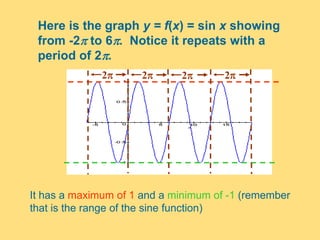
Here is the graph y = f(x) = sin x showing
from -2 to 6. Notice it repeats with a
period of 2.
It has a maximum of 1 and a minimum of -1 (remember
that is the range of the sine function)
2 22 2
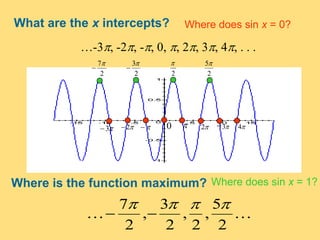
What are the x intercepts? Where does sin x = 0?
0  2 3 423
…-3, -2, -, 0, , 2, 3, 4, . . .
Where is the function maximum? Where does sin x = 1?
2

2
5
2
3

2
7


2
5
,
2
,
2
3
,
2
7 

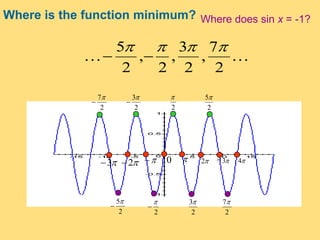
Where is the function minimum? Where does sin x = -1?
0  2 3 423
2

2
5
2
3

2
7


2
7
,
2
3
,
2
,
2
5 

2
5

2


2
3
2
7
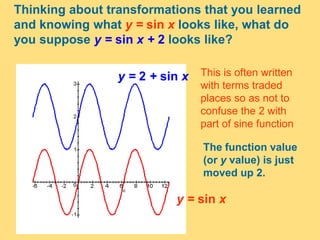
Thinking about transformations that you learned
and knowing what y = sin x looks like, what do
you suppose y = sin x + 2 looks like?
The function value
(or y value) is just
moved up 2.
y = sin x
y = 2 + sin x This is often written
with terms traded
places so as not to
confuse the 2 with
part of sine function
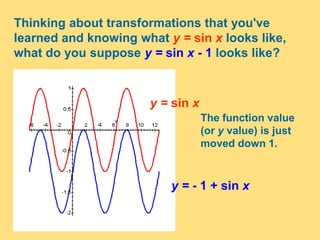
Thinking about transformations that you've
learned and knowing what y = sin x looks like,
what do you suppose y = sin x - 1 looks like?
The function value
(or y value) is just
moved down 1.
y = sin x
y = - 1 + sin x
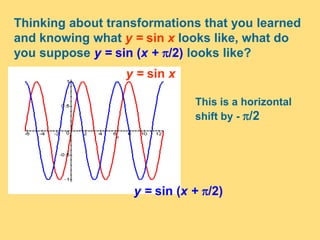
Thinking about transformations that you learned
and knowing what y = sin x looks like, what do
you suppose y = sin (x + /2) looks like?
This is a horizontal
shift by - /2
y = sin x
y = sin (x + /2)
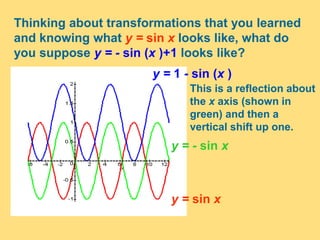
Thinking about transformations that you learned
and knowing what y = sin x looks like, what do
you suppose y = - sin (x )+1 looks like?
This is a reflection about
the x axis (shown in
green) and then a
vertical shift up one.
y = sin x
y = - sin x
y = 1 - sin (x )
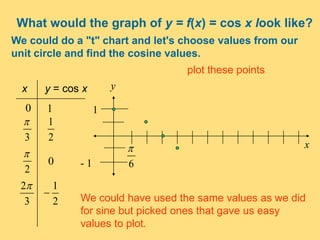
What would the graph of y = f(x) = cos x look like?
We could do a "t" chart and let's choose values from our
unit circle and find the cosine values.
x y = cos x
3

0 1
2
1
2

0
3
2
2
1
 We could have used the same values as we did
for sine but picked ones that gave us easy
values to plot.
x
y
1
- 1
plot these points
6

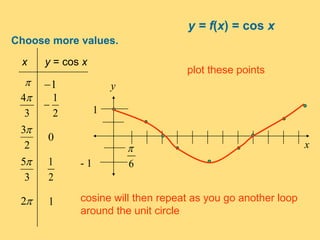
y = f(x) = cos x
Choose more values.
x y = cos x
3
4
 1
2
1

2
3
0
3
5
2
1
cosine will then repeat as you go another loop
around the unit circle
x
y
1
- 1
plot these points
6

2 1
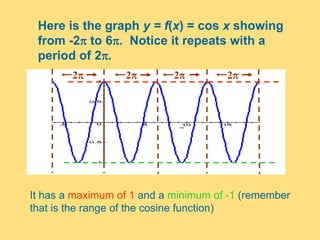
Here is the graph y = f(x) = cos x showing
from -2 to 6. Notice it repeats with a
period of 2.
It has a maximum of 1 and a minimum of -1 (remember
that is the range of the cosine function)
2 22 2
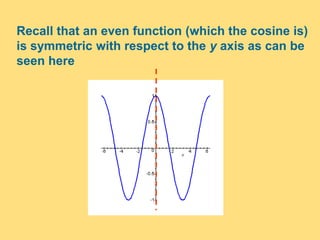
Recall that an even function (which the cosine is)
is symmetric with respect to the y axis as can be
seen here
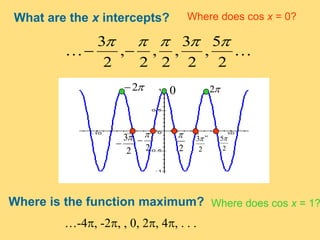
What are the x intercepts? Where does cos x = 0?
2

2
3
2
5
2


2
3

…-4, -2, , 0, 2, 4, . . .
Where is the function maximum? Where does cos x = 1?
0 22

2
5
,
2
3
,
2
,
2
,
2
3 

2

2
3
2
5
42


2
3

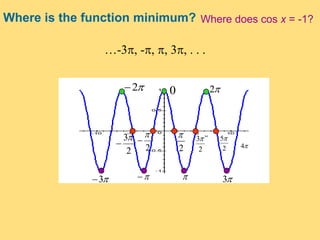
…-3, -, , 3, . . .
Where is the function minimum?
0 22
Where does cos x = -1?
 33
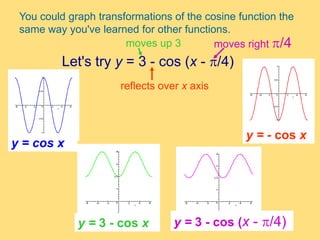
You could graph transformations of the cosine function the
same way you've learned for other functions.
Let's try y = 3 - cos (x - /4)
reflects over x axis
moves up 3 moves right /4
y = cos x
y = - cos x
y = 3 - cos x y = 3 - cos (x - /4)
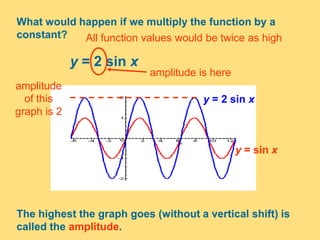
What would happen if we multiply the function by a
constant?
y = 2 sin x
All function values would be twice as high
y = 2 sin x
y = sin x
The highest the graph goes (without a vertical shift) is
called the amplitude.
amplitude
of this
graph is 2
amplitude is here
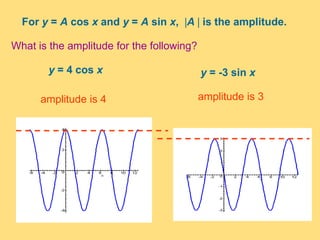
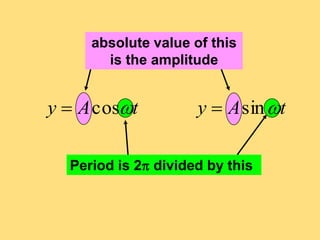
For y = A cos x and y = A sin x, A  is the amplitude.
y = 4 cos x y = -3 sin x
What is the amplitude for the following?
amplitude is 4 amplitude is 3
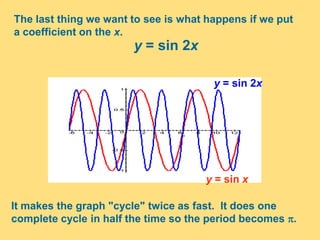
The last thing we want to see is what happens if we put
a coefficient on the x.
y = sin 2x
y = sin 2x
y = sin x
It makes the graph "cycle" twice as fast. It does one
complete cycle in half the time so the period becomes .
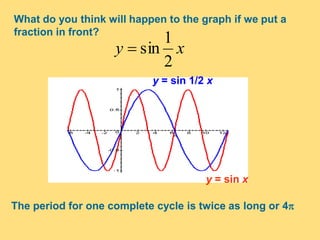
What do you think will happen to the graph if we put a
fraction in front?
y = sin 1/2 x
y = sin x
The period for one complete cycle is twice as long or 4
xy
2
1
sin
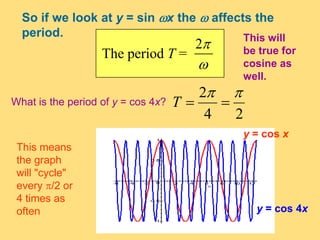
So if we look at y = sin x the  affects the
period.
The period T =

2 This will
be true for
cosine as
well.
What is the period of y = cos 4x?
24
2 
T
This means
the graph
will "cycle"
every /2 or
4 times as
often y = cos 4x
y = cos x
tAy cos tAy sin
absolute value of this
is the amplitude
Period is 2 divided by this
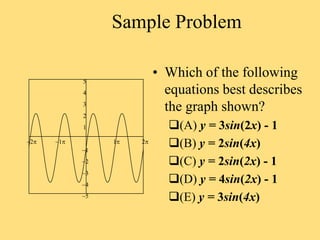
Sample Problem
• Which of the following
equations best describes
the graph shown?
(A) y = 3sin(2x) - 1
(B) y = 2sin(4x)
(C) y = 2sin(2x) - 1
(D) y = 4sin(2x) - 1
(E) y = 3sin(4x)
2 1 1 2
5
4
3
2
1
1
2
3
4
5
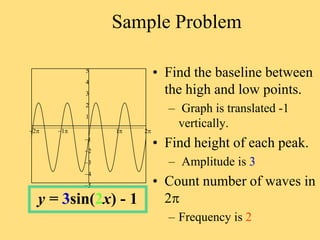
Sample Problem
• Find the baseline between
the high and low points.
– Graph is translated -1
vertically.
• Find height of each peak.
– Amplitude is 3
• Count number of waves in
2
– Frequency is 2
2 1 1 2
5
4
3
2
1
1
2
3
4
5
y = 3sin(2x) - 1
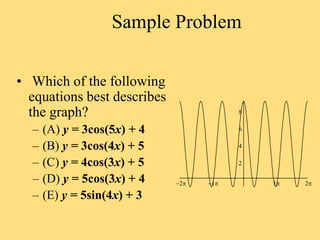
• Which of the following
equations best describes
the graph?
– (A) y = 3cos(5x) + 4
– (B) y = 3cos(4x) + 5
– (C) y = 4cos(3x) + 5
– (D) y = 5cos(3x) + 4
– (E) y = 5sin(4x) + 3
Sample Problem
2 1 1 2
8
6
4
2
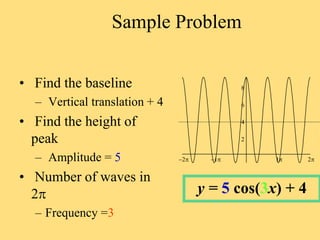
• Find the baseline
– Vertical translation + 4
• Find the height of
peak
– Amplitude = 5
• Number of waves in
2
– Frequency =3
Sample Problem
2 1 1 2
8
6
4
2
y = 5 cos(3x) + 4
Online Notes and Presentations
www.PinoyBIX.org
Visit:

Graphs of the Sine and Cosine Functions Lecture

  • 1.
    www.PinoyBIX.org Presents: GRAPHS OF SINEAND COSINE FUNCTIONS credit: Shawna Haider
  • 2.
  • 3.
    We are interestedin the graph of y = f(x) = sin x Start with a "t" chart and let's choose values from our unit circle and find the sine values. x y = sin x 6  0 0 2 1 2  1 6 5 2 1 We are dealing with x's and y's on the unit circle to find values. These are completely different from the x's and y's used here for our function. x y 1 - 1 plot these points
  • 4.
    y = f(x)= sin xchoose more values x y = sin x 6 7  0 2 1  2 3 1 6 11 2 1  If we continue picking values for x we will start to repeat since this is periodic. x y 1 - 1 plot these points 2 0 join the points 6   2
  • 5.
    Here is thegraph y = f(x) = sin x showing from -2 to 6. Notice it repeats with a period of 2. It has a maximum of 1 and a minimum of -1 (remember that is the range of the sine function) 2 22 2
  • 6.
    What are thex intercepts? Where does sin x = 0? 0  2 3 423 …-3, -2, -, 0, , 2, 3, 4, . . . Where is the function maximum? Where does sin x = 1? 2  2 5 2 3  2 7   2 5 , 2 , 2 3 , 2 7  
  • 7.
    Where is thefunction minimum? Where does sin x = -1? 0  2 3 423 2  2 5 2 3  2 7   2 7 , 2 3 , 2 , 2 5   2 5  2   2 3 2 7
  • 8.
    Thinking about transformationsthat you learned and knowing what y = sin x looks like, what do you suppose y = sin x + 2 looks like? The function value (or y value) is just moved up 2. y = sin x y = 2 + sin x This is often written with terms traded places so as not to confuse the 2 with part of sine function
  • 9.
    Thinking about transformationsthat you've learned and knowing what y = sin x looks like, what do you suppose y = sin x - 1 looks like? The function value (or y value) is just moved down 1. y = sin x y = - 1 + sin x
  • 10.
    Thinking about transformationsthat you learned and knowing what y = sin x looks like, what do you suppose y = sin (x + /2) looks like? This is a horizontal shift by - /2 y = sin x y = sin (x + /2)
  • 11.
    Thinking about transformationsthat you learned and knowing what y = sin x looks like, what do you suppose y = - sin (x )+1 looks like? This is a reflection about the x axis (shown in green) and then a vertical shift up one. y = sin x y = - sin x y = 1 - sin (x )
  • 12.
    What would thegraph of y = f(x) = cos x look like? We could do a "t" chart and let's choose values from our unit circle and find the cosine values. x y = cos x 3  0 1 2 1 2  0 3 2 2 1  We could have used the same values as we did for sine but picked ones that gave us easy values to plot. x y 1 - 1 plot these points 6 
  • 13.
    y = f(x)= cos x Choose more values. x y = cos x 3 4  1 2 1  2 3 0 3 5 2 1 cosine will then repeat as you go another loop around the unit circle x y 1 - 1 plot these points 6  2 1
  • 14.
    Here is thegraph y = f(x) = cos x showing from -2 to 6. Notice it repeats with a period of 2. It has a maximum of 1 and a minimum of -1 (remember that is the range of the cosine function) 2 22 2
  • 15.
    Recall that aneven function (which the cosine is) is symmetric with respect to the y axis as can be seen here
  • 16.
    What are thex intercepts? Where does cos x = 0? 2  2 3 2 5 2   2 3  …-4, -2, , 0, 2, 4, . . . Where is the function maximum? Where does cos x = 1? 0 22  2 5 , 2 3 , 2 , 2 , 2 3  
  • 17.
    2  2 3 2 5 42   2 3  …-3, -, ,3, . . . Where is the function minimum? 0 22 Where does cos x = -1?  33
  • 18.
    You could graphtransformations of the cosine function the same way you've learned for other functions. Let's try y = 3 - cos (x - /4) reflects over x axis moves up 3 moves right /4 y = cos x y = - cos x y = 3 - cos x y = 3 - cos (x - /4)
  • 19.
    What would happenif we multiply the function by a constant? y = 2 sin x All function values would be twice as high y = 2 sin x y = sin x The highest the graph goes (without a vertical shift) is called the amplitude. amplitude of this graph is 2 amplitude is here
  • 20.
    For y =A cos x and y = A sin x, A  is the amplitude. y = 4 cos x y = -3 sin x What is the amplitude for the following? amplitude is 4 amplitude is 3
  • 21.
    The last thingwe want to see is what happens if we put a coefficient on the x. y = sin 2x y = sin 2x y = sin x It makes the graph "cycle" twice as fast. It does one complete cycle in half the time so the period becomes .
  • 22.
    What do youthink will happen to the graph if we put a fraction in front? y = sin 1/2 x y = sin x The period for one complete cycle is twice as long or 4 xy 2 1 sin
  • 23.
    So if welook at y = sin x the  affects the period. The period T =  2 This will be true for cosine as well. What is the period of y = cos 4x? 24 2  T This means the graph will "cycle" every /2 or 4 times as often y = cos 4x y = cos x
  • 24.
    tAy cos tAysin absolute value of this is the amplitude Period is 2 divided by this
  • 25.
    Sample Problem • Whichof the following equations best describes the graph shown? (A) y = 3sin(2x) - 1 (B) y = 2sin(4x) (C) y = 2sin(2x) - 1 (D) y = 4sin(2x) - 1 (E) y = 3sin(4x) 2 1 1 2 5 4 3 2 1 1 2 3 4 5
  • 26.
    Sample Problem • Findthe baseline between the high and low points. – Graph is translated -1 vertically. • Find height of each peak. – Amplitude is 3 • Count number of waves in 2 – Frequency is 2 2 1 1 2 5 4 3 2 1 1 2 3 4 5 y = 3sin(2x) - 1
  • 27.
    • Which ofthe following equations best describes the graph? – (A) y = 3cos(5x) + 4 – (B) y = 3cos(4x) + 5 – (C) y = 4cos(3x) + 5 – (D) y = 5cos(3x) + 4 – (E) y = 5sin(4x) + 3 Sample Problem 2 1 1 2 8 6 4 2
  • 28.
    • Find thebaseline – Vertical translation + 4 • Find the height of peak – Amplitude = 5 • Number of waves in 2 – Frequency =3 Sample Problem 2 1 1 2 8 6 4 2 y = 5 cos(3x) + 4
  • 29.
    Online Notes andPresentations www.PinoyBIX.org Visit: