Area Under the Curve
What is “area under the curve?”The definite integral can be used to find the area between a graph curve and the ‘x’ axis, between two given ‘x’ values. This area is called the ‘area under the curve’ regardless of whether it is above or below the ‘x’ axis.
When the area is above the x axis, the area is positive. When the area is below the x axis, the area is negative.
Example problemy = x² - x – 2We need to create three separate integrals
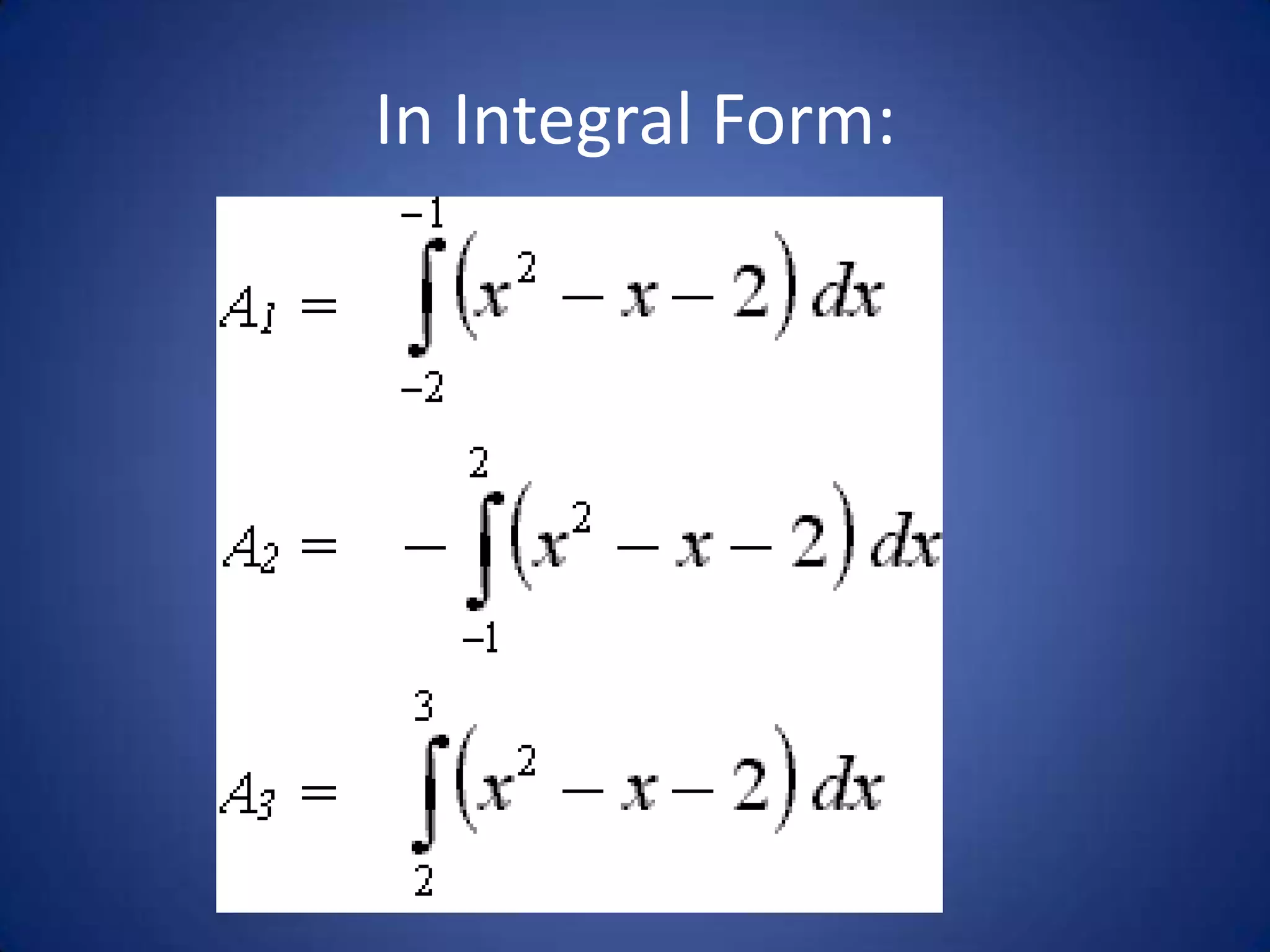
Finding the integralsThe zeros of the function f(x) that lie between -2 and 3 form the boundaries of the separate area segments, and these will be our integrals-2 < x < -1 -1 < x < 22 < x < 3
In Integral Form:
Integrate the equation using the general power rule:1/3x^3 – 1/2 x^2 – 2x
Plug in beginning points and endpoints for each of three intervals and subtract the beginning point from the end point.
Plug in numbers and solve1/3(-1)^3 – ½ (-1)^2 – 2(-1) – (1/3(-2)^3 – ½ (-2)^2 – 2(-2) = 1.83333 1/3(2)^3 – ½ (2)^2 – 2(2) – (1/3(-1)^3 – ½ (-1)^2 – 2(-1)) = 4.51/3(3)^3 – ½ (3)^2 – 2(3) – (1/3(2)^3 – ½ (2)^2 – 2(2)) = 1.83333
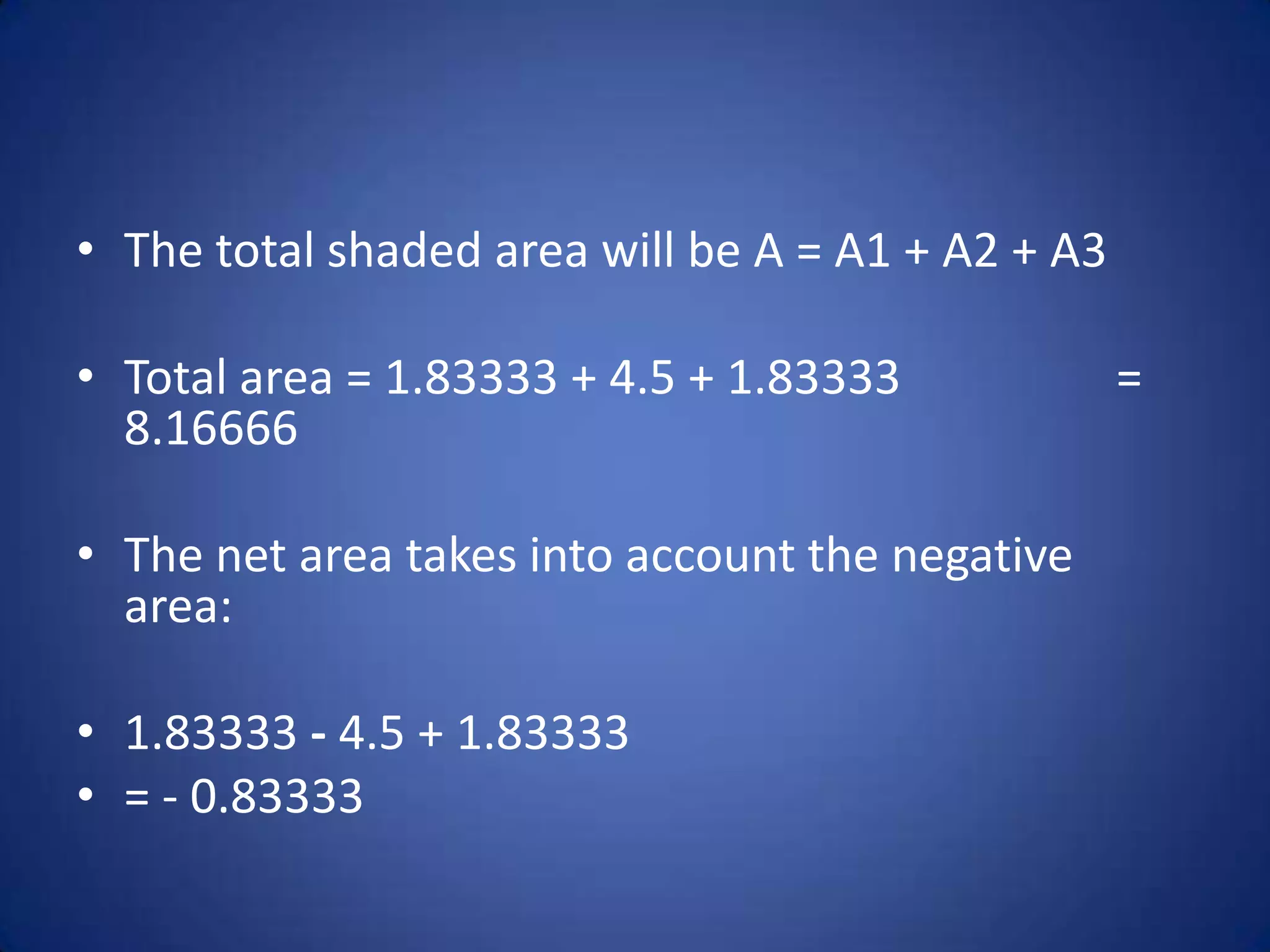
The total shaded area will be A = A1 + A2 + A3Total area = 1.83333 + 4.5 + 1.83333                  = 8.16666The net area takes into account the negative area:1.83333 - 4.5 + 1.83333                  = - 0.83333

Area Under the Curve

  • 1.
  • 2.
    What is “areaunder the curve?”The definite integral can be used to find the area between a graph curve and the ‘x’ axis, between two given ‘x’ values. This area is called the ‘area under the curve’ regardless of whether it is above or below the ‘x’ axis.
  • 3.
    When the areais above the x axis, the area is positive. When the area is below the x axis, the area is negative.
  • 4.
    Example problemy =x² - x – 2We need to create three separate integrals
  • 5.
    Finding the integralsThezeros of the function f(x) that lie between -2 and 3 form the boundaries of the separate area segments, and these will be our integrals-2 < x < -1 -1 < x < 22 < x < 3
  • 6.
  • 7.
    Integrate the equationusing the general power rule:1/3x^3 – 1/2 x^2 – 2x
  • 8.
    Plug in beginningpoints and endpoints for each of three intervals and subtract the beginning point from the end point.
  • 9.
    Plug in numbersand solve1/3(-1)^3 – ½ (-1)^2 – 2(-1) – (1/3(-2)^3 – ½ (-2)^2 – 2(-2) = 1.83333 1/3(2)^3 – ½ (2)^2 – 2(2) – (1/3(-1)^3 – ½ (-1)^2 – 2(-1)) = 4.51/3(3)^3 – ½ (3)^2 – 2(3) – (1/3(2)^3 – ½ (2)^2 – 2(2)) = 1.83333
  • 10.
    The total shadedarea will be A = A1 + A2 + A3Total area = 1.83333 + 4.5 + 1.83333                  = 8.16666The net area takes into account the negative area:1.83333 - 4.5 + 1.83333                  = - 0.83333