WAVES AND ONLINE MEDIA…
August 15, 2014
Displacement-time (s-t) graph of Point P
s-d graph s-t graph
(a)
(b)
(d)
(c) (e)
12.3 What are the terms used to describe waves?
Circular water waves
• Water waves are easily produced and
observed. By touching one point on
the surface, you can see the peaks of
the waves form circles and move
outwards from the source of
disturbance
• The line that joins all the peaks of a
wave or all identical points on a wave
is called the wavefront
• In the example at the right, the
wavefront is circular. The direction of
travel of circular waves is
perpendicular to the wavefront
12.3 What are the terms used to describe waves?
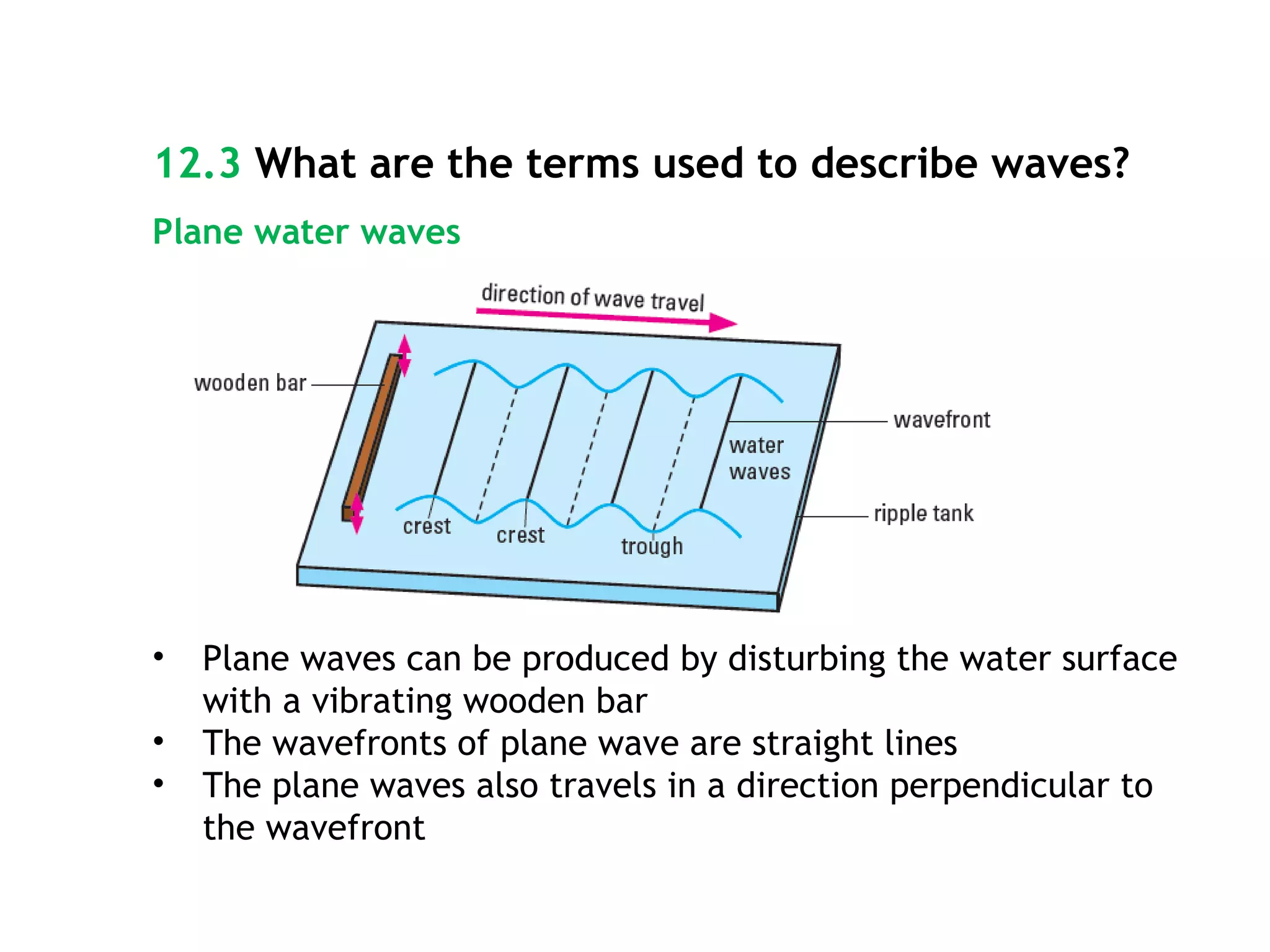
Plane water waves
• Plane waves can be produced by disturbing the water surface
with a vibrating wooden bar
• The wavefronts of plane wave are straight lines
• The plane waves also travels in a direction perpendicular to
the wavefront
WAVE PRODUCTION AND THE RIPPLE TANK
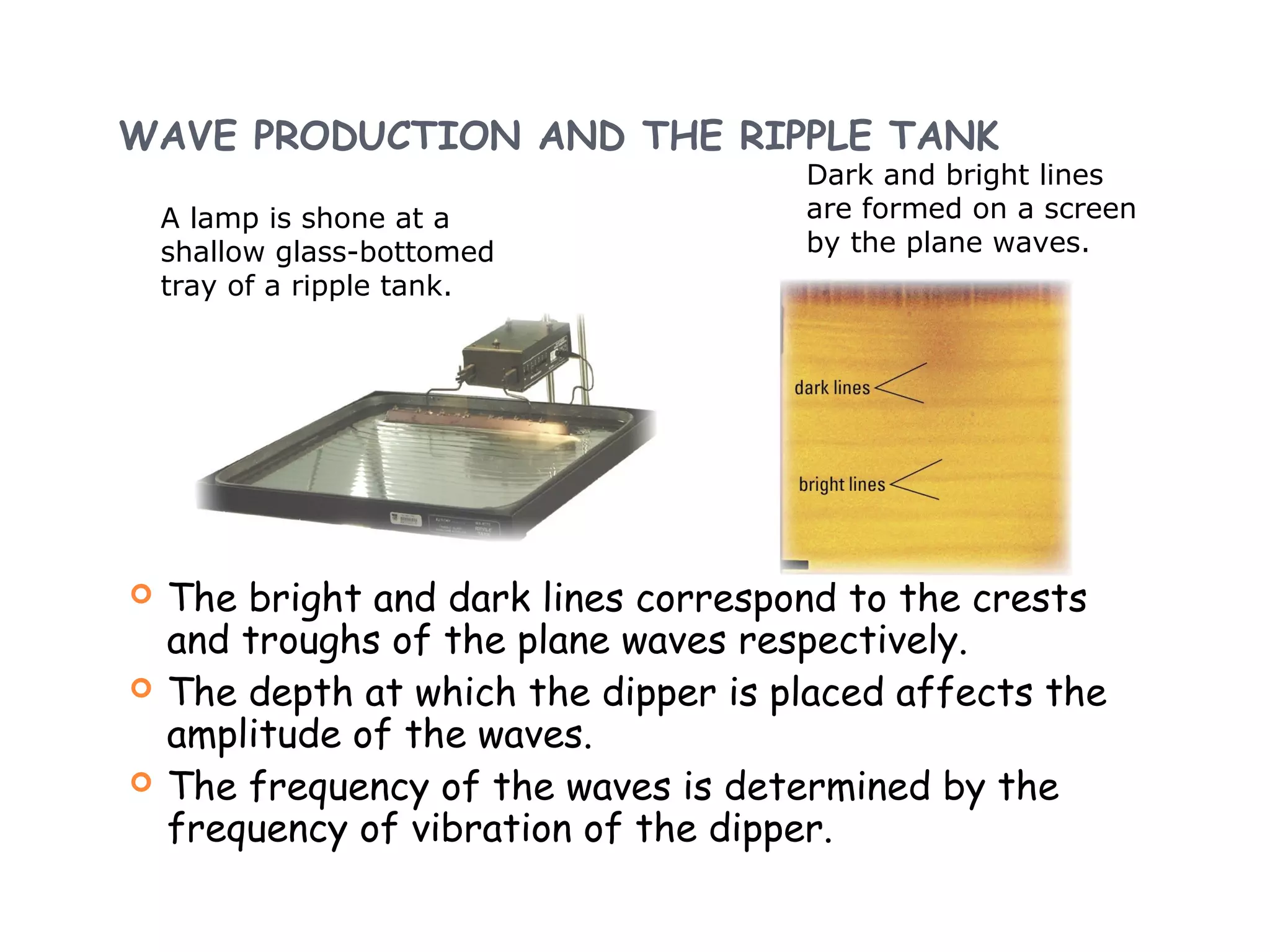
 The bright and dark lines correspond to the crests
and troughs of the plane waves respectively.
 The depth at which the dipper is placed affects the
amplitude of the waves.
 The frequency of the waves is determined by the
frequency of vibration of the dipper.
A lamp is shone at a
shallow glass-bottomed
tray of a ripple tank.
Dark and bright lines
are formed on a screen
by the plane waves.
WAVE PRODUCTION AND THE RIPPLE TANK
Refraction of waves and depth of ripple tank
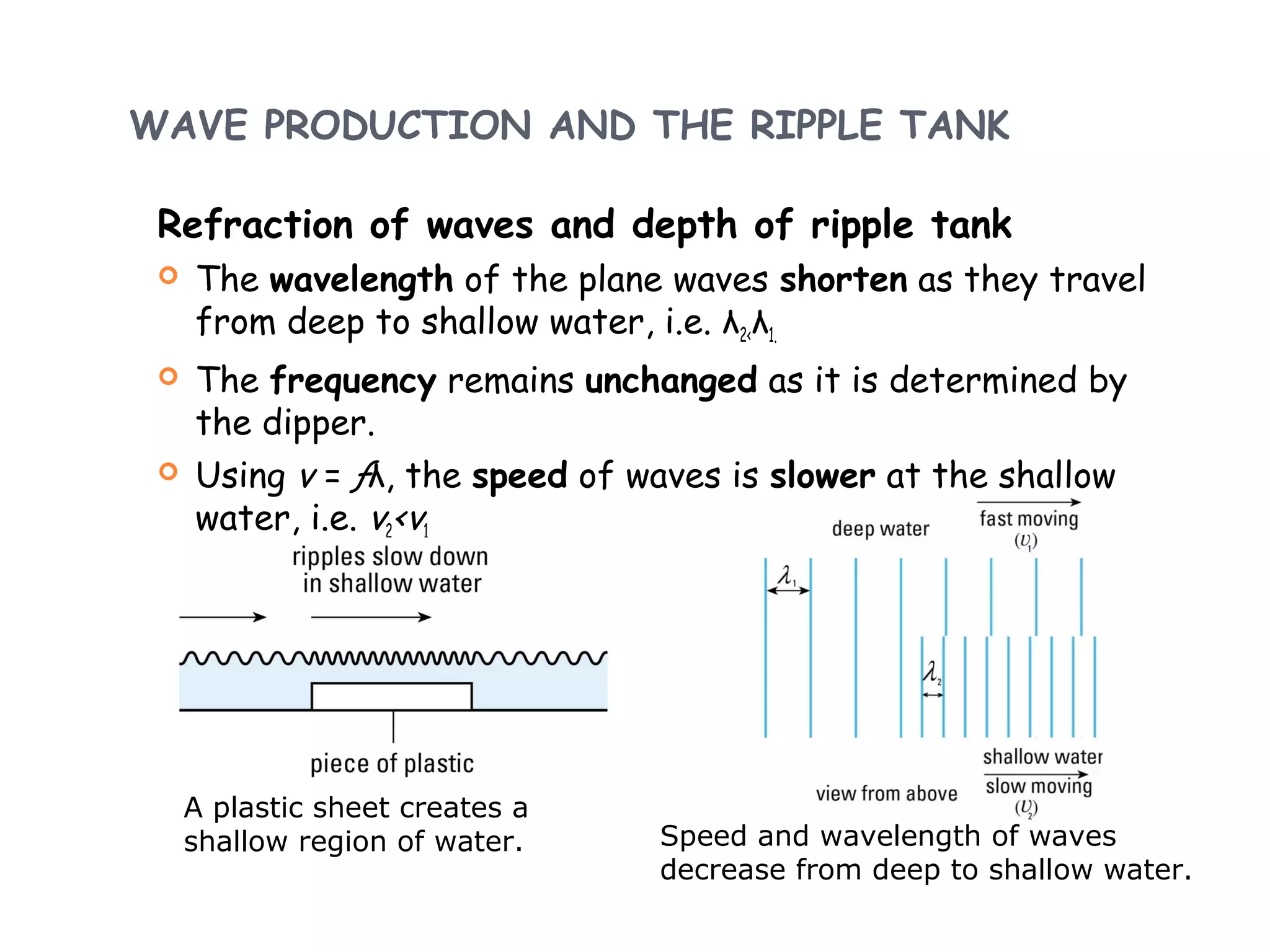
 The wavelength of the plane waves shorten as they travel
from deep to shallow water, i.e. λ2<λ1.
 The frequency remains unchanged as it is determined by
the dipper.
 Using v = ƒλ, the speed of waves is slower at the shallow
water, i.e. v2<v1
A plastic sheet creates a
shallow region of water. Speed and wavelength of waves
decrease from deep to shallow water.
WAVE PRODUCTION AND THE RIPPLE TANK
 Similar to light, when waves enter a region of
shallow water at an angle, the waves will refract.
If you place a plastic sheet at an angle, the change in
speed of the waves will cause them to bend.
WAVE PRODUCTION AND THE RIPPLE TANK
Reflection of waves
 A straight barrier standing upright in the water causes the
incoming waves to be reflected.
A straight barrier is placed at an angle to the straight
dipper. You can see the waves reflecting at equal
angles to the normal in the inset.
HTTP://EN.WIKIPEDIA.ORG/WIKI/WAVE_SHOALI

Refraction of water waves

  • 1.
  • 2.
    August 15, 2014 Displacement-time(s-t) graph of Point P s-d graph s-t graph (a) (b) (d) (c) (e)
  • 3.
    12.3 What arethe terms used to describe waves? Circular water waves • Water waves are easily produced and observed. By touching one point on the surface, you can see the peaks of the waves form circles and move outwards from the source of disturbance • The line that joins all the peaks of a wave or all identical points on a wave is called the wavefront • In the example at the right, the wavefront is circular. The direction of travel of circular waves is perpendicular to the wavefront
  • 4.
    12.3 What arethe terms used to describe waves? Plane water waves • Plane waves can be produced by disturbing the water surface with a vibrating wooden bar • The wavefronts of plane wave are straight lines • The plane waves also travels in a direction perpendicular to the wavefront
  • 5.
    WAVE PRODUCTION ANDTHE RIPPLE TANK  The bright and dark lines correspond to the crests and troughs of the plane waves respectively.  The depth at which the dipper is placed affects the amplitude of the waves.  The frequency of the waves is determined by the frequency of vibration of the dipper. A lamp is shone at a shallow glass-bottomed tray of a ripple tank. Dark and bright lines are formed on a screen by the plane waves.
  • 6.
    WAVE PRODUCTION ANDTHE RIPPLE TANK Refraction of waves and depth of ripple tank  The wavelength of the plane waves shorten as they travel from deep to shallow water, i.e. λ2<λ1.  The frequency remains unchanged as it is determined by the dipper.  Using v = ƒλ, the speed of waves is slower at the shallow water, i.e. v2<v1 A plastic sheet creates a shallow region of water. Speed and wavelength of waves decrease from deep to shallow water.
  • 7.
    WAVE PRODUCTION ANDTHE RIPPLE TANK  Similar to light, when waves enter a region of shallow water at an angle, the waves will refract. If you place a plastic sheet at an angle, the change in speed of the waves will cause them to bend.
  • 8.
    WAVE PRODUCTION ANDTHE RIPPLE TANK Reflection of waves  A straight barrier standing upright in the water causes the incoming waves to be reflected. A straight barrier is placed at an angle to the straight dipper. You can see the waves reflecting at equal angles to the normal in the inset.
  • 9.
  • 10.