By: Andrew Disharoon, Nathan Robertson, Nigel Long, Brandon HugginsDuality Of light
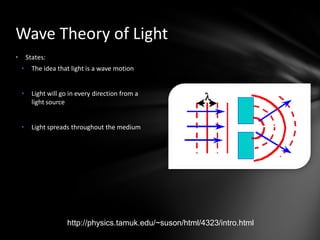
States:The idea that light is a wave motionLight will go in every direction from a light source Light spreads throughout the mediumWave Theory of Lighthttp://physics.tamuk.edu/~suson/html/4323/intro.html
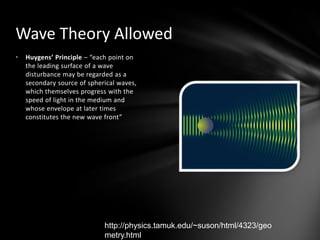
Huygens’ Principle – “each point on the leading surface of a wave disturbance may be regarded as a secondary source of spherical waves, which themselves progress with the speed of light in the medium and whose envelope at later times constitutes the new wave front”Wave Theory Allowedhttp://physics.tamuk.edu/~suson/html/4323/geometry.html
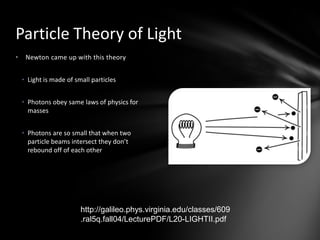
Newton came up with this theoryLight is made of small particlesPhotons obey same laws of physics for massesPhotons are so small that when two particle beams intersect they don’t rebound off of each otherParticle Theory of Lighthttp://galileo.phys.virginia.edu/classes/609.ral5q.fall04/LecturePDF/L20-LIGHTII.pdf
Later Max Planck said that particles have some wave like properties
This explains the wave-particle duality
Stating that light acts like waves in propagation, interference, and diffraction
But like particles when reacting with matter
Because of Planck quantum mechanics was createdParticle Theory Continued…http://physics.tamuk.edu/~suson/html/4323/intro.html
Planck’s ConstantPlanck's constant = 6.626068 × 10⁻³⁴ m2 kg / s = h
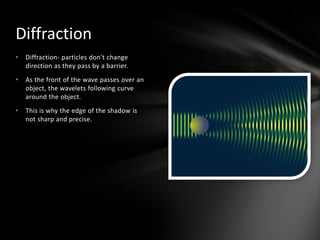
Planck’s constant was the result of experimentationDiffraction- particles don’t change direction as they pass by a barrier.
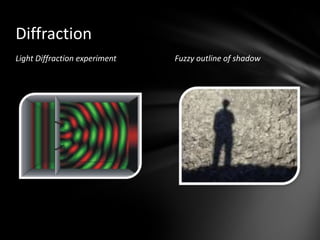
As the front of the wave passes over an object, the wavelets following curve around the object.
This is why the edge of the shadow is not sharp and precise.Diffraction
Light Diffraction experimentFuzzy outline of shadowDiffraction
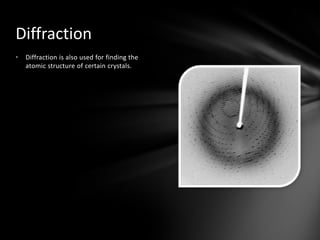
Diffraction is also used for finding the atomic structure of certain crystals.Diffraction
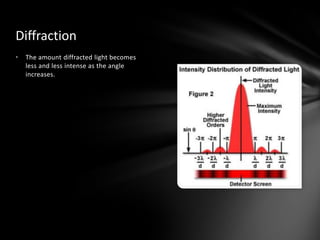
The amount diffracted light becomes less and less intense as the angle increases.Diffraction
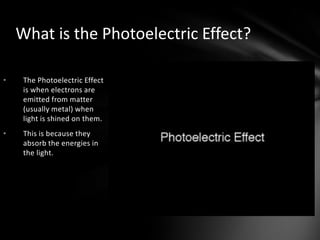
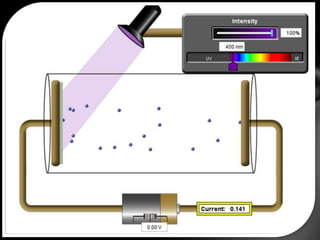
What is the Photoelectric Effect?The Photoelectric Effect is when electrons are emitted from matter (usually metal) when light is shined on them.
This is because they absorb the energies in the light.
The Photo Effect and The Wave TheoryThis Effect was discovered by Heinrich Hertz in 1887. At that time, the accepted theory of light was Maxwell’s wave theory.
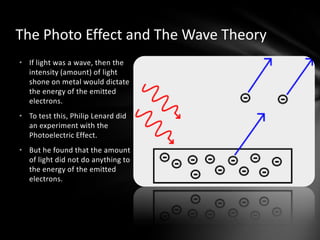
His theory was that light was a wave. The Photo Effect and The Wave TheoryIf light was a wave, then the intensity (amount) of light shone on metal would dictate the energy of the emitted electrons.
To test this, Philip Lenard did an experiment with the Photoelectric Effect.
But he found that the amount of light did not do anything to the energy of the emitted electrons.
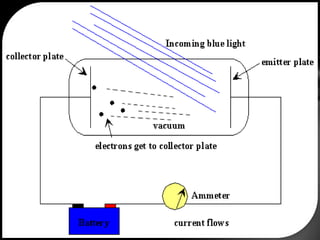
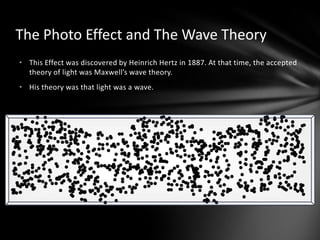
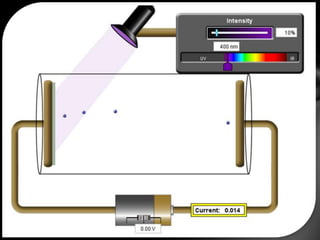
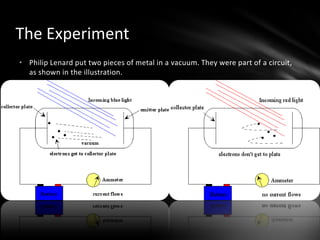
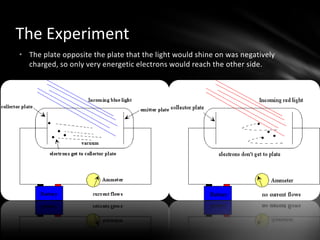
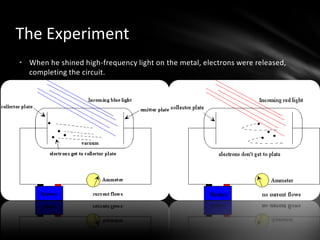
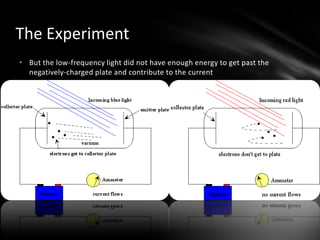
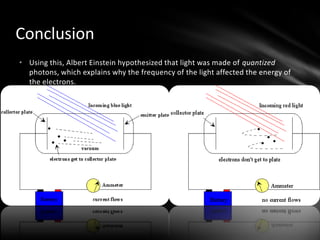
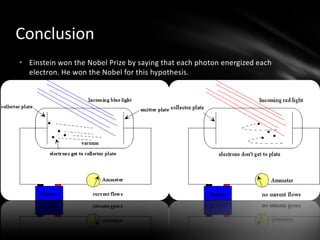
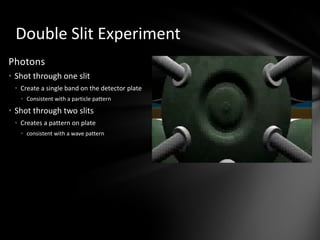
The ExperimentPhilip Lenard put two pieces of metal in a vacuum. They were part of a circuit, as shown in the illustration. The ExperimentThe plate opposite the plate that the light would shine on was negatively charged, so only very energetic electrons would reach the other side.The ExperimentWhen he shined high-frequency light on the metal, electrons were released, completing the circuit.The ExperimentBut the low-frequency light did not have enough energy to get past the negatively-charged plate and contribute to the currentConclusionUsing this, Albert Einstein hypothesized that light was made of quantized photons, which explains why the frequency of the light affected the energy of the electrons.ConclusionEinstein won the Nobel Prize by saying that each photon energized each electron. He won the Nobel for this hypothesis. PhotonsShot through one slit Create a single band on the detector plateConsistent with a particle patternShot through two slitsCreates a pattern on plate consistent with a wave patternDouble Slit Experiment
The photons could be interacting like particles in a wave. Double Slit Experiment
Single Photon

Final Physics Project

  • 1.
    By: Andrew Disharoon,Nathan Robertson, Nigel Long, Brandon HugginsDuality Of light
  • 2.
    States:The idea thatlight is a wave motionLight will go in every direction from a light source Light spreads throughout the mediumWave Theory of Lighthttp://physics.tamuk.edu/~suson/html/4323/intro.html
  • 3.
    Huygens’ Principle –“each point on the leading surface of a wave disturbance may be regarded as a secondary source of spherical waves, which themselves progress with the speed of light in the medium and whose envelope at later times constitutes the new wave front”Wave Theory Allowedhttp://physics.tamuk.edu/~suson/html/4323/geometry.html
  • 4.
    Newton came upwith this theoryLight is made of small particlesPhotons obey same laws of physics for massesPhotons are so small that when two particle beams intersect they don’t rebound off of each otherParticle Theory of Lighthttp://galileo.phys.virginia.edu/classes/609.ral5q.fall04/LecturePDF/L20-LIGHTII.pdf
  • 5.
    Later Max Plancksaid that particles have some wave like properties
  • 6.
    This explains thewave-particle duality
  • 7.
    Stating that lightacts like waves in propagation, interference, and diffraction
  • 8.
    But like particleswhen reacting with matter
  • 9.
    Because of Planckquantum mechanics was createdParticle Theory Continued…http://physics.tamuk.edu/~suson/html/4323/intro.html
  • 10.
    Planck’s ConstantPlanck's constant= 6.626068 × 10⁻³⁴ m2 kg / s = h
  • 11.
    Planck’s constant wasthe result of experimentationDiffraction- particles don’t change direction as they pass by a barrier.
  • 12.
    As the frontof the wave passes over an object, the wavelets following curve around the object.
  • 13.
    This is whythe edge of the shadow is not sharp and precise.Diffraction
  • 14.
    Light Diffraction experimentFuzzyoutline of shadowDiffraction
  • 15.
    Diffraction is alsoused for finding the atomic structure of certain crystals.Diffraction
  • 16.
    The amount diffractedlight becomes less and less intense as the angle increases.Diffraction
  • 17.
    What is thePhotoelectric Effect?The Photoelectric Effect is when electrons are emitted from matter (usually metal) when light is shined on them.
  • 18.
    This is becausethey absorb the energies in the light.
  • 19.
    The Photo Effectand The Wave TheoryThis Effect was discovered by Heinrich Hertz in 1887. At that time, the accepted theory of light was Maxwell’s wave theory.
  • 20.
    His theory wasthat light was a wave. The Photo Effect and The Wave TheoryIf light was a wave, then the intensity (amount) of light shone on metal would dictate the energy of the emitted electrons.
  • 21.
    To test this,Philip Lenard did an experiment with the Photoelectric Effect.
  • 22.
    But he foundthat the amount of light did not do anything to the energy of the emitted electrons.
  • 24.
    The ExperimentPhilip Lenardput two pieces of metal in a vacuum. They were part of a circuit, as shown in the illustration. The ExperimentThe plate opposite the plate that the light would shine on was negatively charged, so only very energetic electrons would reach the other side.The ExperimentWhen he shined high-frequency light on the metal, electrons were released, completing the circuit.The ExperimentBut the low-frequency light did not have enough energy to get past the negatively-charged plate and contribute to the currentConclusionUsing this, Albert Einstein hypothesized that light was made of quantized photons, which explains why the frequency of the light affected the energy of the electrons.ConclusionEinstein won the Nobel Prize by saying that each photon energized each electron. He won the Nobel for this hypothesis. PhotonsShot through one slit Create a single band on the detector plateConsistent with a particle patternShot through two slitsCreates a pattern on plate consistent with a wave patternDouble Slit Experiment
  • 25.
    The photons couldbe interacting like particles in a wave. Double Slit Experiment
  • 26.
  • 27.
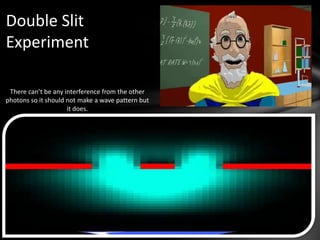
    Double Slit ExperimentTherecan’t be any interference from the other photons so it should not make a wave pattern but it does.