Physical optics(OPT 224)
Dr. Selassie Kojo Dzasimatu, OD, MGOA (MPhil Candidate, School of
Optometry and Vision Sciences)
Teaching Objectives
• Define transverse waves and their properties
• To describe water wave displacement on a sinusoid-like waveform as
a function of time and position.
• Describe how electromagnetic waves are similar to and different from
water waves.
• To explain principle of superposition and show how it is used to
combine two overlapping waves.
• To explain Huygens’ Principle and show how it is used to predict the
shape of succeeding wave fronts.
Learning Objectives
• Describe a wave front.
• Describe the relationship between light rays and wave fronts.
• Define phase angle and its relationship to a wave front.
• Calculate water wave displacement on a sinusoid-like waveform as a function of
time and position.
• Describe how electromagnetic waves are similar to and different from water
waves.
• State the principle of superposition and show how it is used to combine two
overlapping waves.
• State Huygens’ Principle and show how it is used to predict the shape of
succeeding wave fronts.
What are waves?
• Wave; a wave is an oscillating regular distortion through space time or
a disturbance which transfers particles of energy from one place to
another without transferring matter
• When a disturbance produces a wave in a medium, the particles of
the medium move or vibrate in back and forth motions as the wave
moves called oscillations.
• Key features: energy transfer, no net movement of matter
Types of waves
• Mechanical waves: need a medium to travel through
e.g sound waves, seismic waves, water waves
• Electromagntic waves: do not need a medium to pass through
e.g light waves, radio waves, x-rays
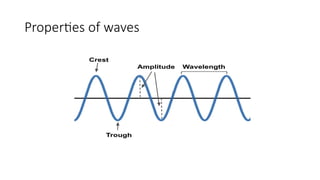
Properties of waves
Physical optics
• Geometrical optics was helpful in explaining the movement of light
through large objects like prisms, mirrors, lenses; interference, diffraction
etc are still present
• Geometrical optics is limited in explaining how light imaging occurs
through minute objects and apertures like the hair , small openings
• Only wave optics leads to the correct interpretation of such image
patterns
• Correct interpretation is due to interference, diffraction and polarization
• Wave fronts and wave motions
Understanding the Physics of waves
• Wave optics – light is treated as a series of moving electrical and
magnetic field oscillations
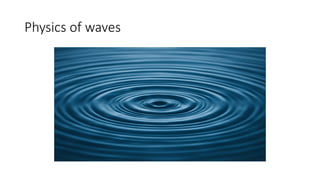
• Oscillations are rapid; water waves
• When waves oscillate, they generate wave fronts.
Physics of waves
Wave Fronts
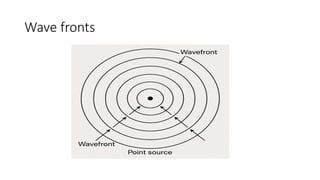
• a wave front is a locus of points along which all phases and displacements
are identical.
• A surface that connects all points in a wave or indicates when the wave
reaches its peak (crest) and through at the same time
• Key terms
• Phase: A stage in the cycle of the wave indicating peak moments and
throughs
• Oscillations; vibrations of particles in a wave
• Snapshot; point in time where position of points in time of the wave are
in sync
Wave fronts
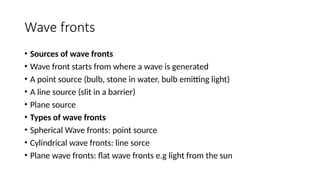
• Sources of wave fronts
• Wave front starts from where a wave is generated
• A point source (bulb, stone in water, bulb emitting light)
• A line source (slit in a barrier)
• Plane source
• Types of wave fronts
• Spherical Wave fronts: point source
• Cylindrical wave fronts: line sorce
• Plane wave fronts: flat wave fronts e.g light from the sun
Wave fronts
Wave Displacement
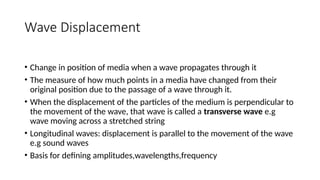
• Change in position of media when a wave propagates through it
• The measure of how much points in a media have changed from their
original position due to the passage of a wave through it.
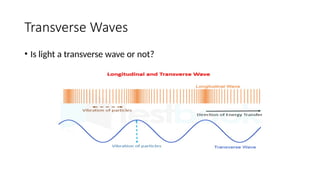
• When the displacement of the particles of the medium is perpendicular to
the movement of the wave, that wave is called a transverse wave e.g
wave moving across a stretched string
• Longitudinal waves: displacement is parallel to the movement of the wave
e.g sound waves
• Basis for defining amplitudes,wavelengths,frequency
Transverse Waves
• Is light a transverse wave or not?
Transverse waves
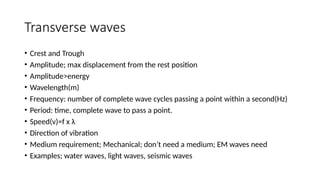
• Crest and Trough
• Amplitude; max displacement from the rest position
• Amplitude>energy
• Wavelength(m)
• Frequency: number of complete wave cycles passing a point within a second(Hz)
• Period: time, complete wave to pass a point.
• Speed(v)=f x λ
• Direction of vibration
• Medium requirement; Mechanical; don’t need a medium; EM waves need
• Examples; water waves, light waves, seismic waves
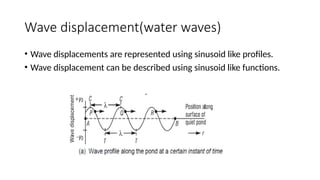
Wave displacement(water waves)
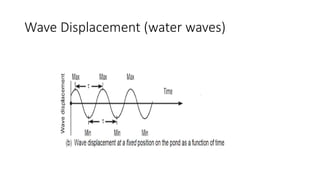
• Wave displacements are represented using sinusoid like profiles.
• Wave displacement can be described using sinusoid like functions.
Wave Displacement (water waves)
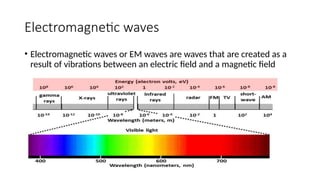
Electromagnetic waves
• Electromagnetic waves or EM waves are waves that are created as a
result of vibrations between an electric field and a magnetic field
Similarities between EM waves and water
waves
• Similarities
• Both are transverse waves
• Transfer Energy Without Matter
• Exhibit Common Wave Behaviors: Reflection, refraction,diffraction,interference
• Differences
• Medium requirement;
• Nature of disturbance;
• Speed;
• Source; accelerating charged particles,<>wind,stone drop etc
The mathematics of sinusoidal waveforms
• Circular water waves such as those shown in Figures 4-1a and 4-1b move outward from a bobbingcork at A.
The cork bobs up and down and back again—a complete cycle—once per second, andgenerates waves that
measure 10 cm from crest to crest. Some time after the wave motion has beenestablished, we begin to time
the motion with a stopwatch. At a certain time t = 10 s on the watch,we notice that the wave profile has the
shape shown below.
• What is the wave frequency f for this water wave?
• (b) What is its wavelength λ?
• (c) What is its wave speed v?
• (d) What is the phase angle φ for a wave front at position r = 102.5 cm at time t = 10 s?
• (e) What is the wave displacement y on the wave front at r = 102.5 cm?
• (f) What is the phase angle φ for a wave front at r = 107.5 cm at t = 10 s?
• (g) What is the wave displacement y on the wave front at r = 107.5 cm?
• (h) If we focus on the wave motion at the position r = 105 cm and let time vary, what kind of
motion do we observe?
Practice problem
• Practice Problem – Circular Water Waves
• A small pebble is dropped into a calm pond, creating circular ripples
that radiate outward from the impact point at location B. The pebble
completes a full cycle of vertical motion every 2 seconds and
generates waves with a distance of 20 cm between successive crests.
After a few moments, a stopwatch is started. At time t=12s, the water
surface is observed to have the profile shown below
Interaction of Light Waves
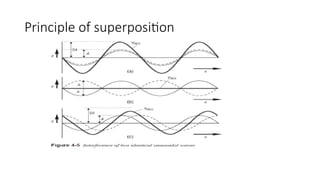
• What happens when two light waves pass a point at the same time?
• Principle of superposition:
• When two or more waves move simultaneously through a region of
space, each waveproceeds independently as if the other were not
present. The resulting wave “displacement”at any point and time is
the vector sum of the “displacements” of the individual waves.
Principle of superposition
• Holds for the following
• Water waves
• Mechanical waves: strings, springs
• Sounds waves in gas, liquids and solids
• EM waves in free space
Answer the following
• (a) What is the wave frequency for this water wave?
• (b) What is its wavelength λ in meters?
• (c) What is the wave speed v?
• (d) What is the phase angle ϕ for a wave front at position r=2.35 at time t=12
s?
• (e) What is the wave displacement y at position r=2.35 m?
• (f) What is the phase angle ϕ for a wave front at r=2.45 m at t=12 s?
• (g) What is the wave displacement y at r=2.45 m?
• (h) If we observe the wave at position r=2.40m and allow time to vary, what
type of motion is observed? Give the equation of motion.
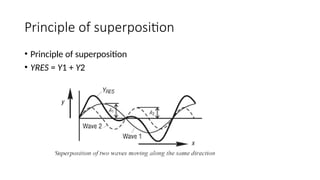
Principle of superposition
• Principle of superposition
• YRES = Y1 + Y2
Principle of superposition
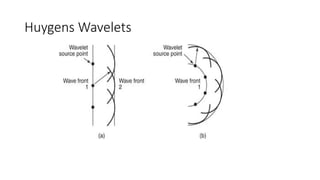
Huygens Principle
• Every point on a known wave front in a given medium can be treated
as a point source of secondary wavelets (spherical waves “bubbling”
out of the point, so to speak) which spread out in all directions with a
wave speed characteristic of that medium. The developing wavefront
at any subsequent time is the envelope of these advancing spherical
wavelets.
Huygens Wavelets
Envelope tangent
• The envelope is the smooth curve or surface that just touches (is
tangent to) a set of secondary wavelets generated from each point on
the current wavefront. This envelope represents the new wavefront
after a short time interval.
Importance of the envelope tangent
• Determines the Shape of the New Wavefront
• Visualizes Wave Propagation: It offers a geometric method to trace
how a wave travels through space. Without the envelope, there's no
clear way to define where the wavefront moves next.
• Explains Reflection and Refraction
• Accounts for Diffraction: When waves pass through a slit or around an
edge, the envelope of spherical wavelets shows how the wave bends
• Foundation for Wave Theory of Light
• Extends to 3D Wavefronts
Application
• Applications of Huygens’ Principle
• Reflection
When a wave hits a surface, Huygens’ principle explains how the angle of reflection equals
the angle of incidence.
• Refraction
It helps derive Snell's Law by showing how wavelets change speed when moving from one
medium to another (like air to water), bending the wavefront.
• Diffraction
It explains how waves bend around corners or pass through small openings—something ray
optics cannot explain.
• Interference
It supports the understanding of how overlapping wavelets create patterns of constructive
and destructive interference.

Transverse Waves 1-OPT 224-1.pptx for level 200

  • 1.
    Physical optics(OPT 224) Dr.Selassie Kojo Dzasimatu, OD, MGOA (MPhil Candidate, School of Optometry and Vision Sciences)
  • 2.
    Teaching Objectives • Definetransverse waves and their properties • To describe water wave displacement on a sinusoid-like waveform as a function of time and position. • Describe how electromagnetic waves are similar to and different from water waves. • To explain principle of superposition and show how it is used to combine two overlapping waves. • To explain Huygens’ Principle and show how it is used to predict the shape of succeeding wave fronts.
  • 3.
    Learning Objectives • Describea wave front. • Describe the relationship between light rays and wave fronts. • Define phase angle and its relationship to a wave front. • Calculate water wave displacement on a sinusoid-like waveform as a function of time and position. • Describe how electromagnetic waves are similar to and different from water waves. • State the principle of superposition and show how it is used to combine two overlapping waves. • State Huygens’ Principle and show how it is used to predict the shape of succeeding wave fronts.
  • 4.
    What are waves? •Wave; a wave is an oscillating regular distortion through space time or a disturbance which transfers particles of energy from one place to another without transferring matter • When a disturbance produces a wave in a medium, the particles of the medium move or vibrate in back and forth motions as the wave moves called oscillations. • Key features: energy transfer, no net movement of matter
  • 5.
    Types of waves •Mechanical waves: need a medium to travel through e.g sound waves, seismic waves, water waves • Electromagntic waves: do not need a medium to pass through e.g light waves, radio waves, x-rays
  • 6.
  • 7.
    Physical optics • Geometricaloptics was helpful in explaining the movement of light through large objects like prisms, mirrors, lenses; interference, diffraction etc are still present • Geometrical optics is limited in explaining how light imaging occurs through minute objects and apertures like the hair , small openings • Only wave optics leads to the correct interpretation of such image patterns • Correct interpretation is due to interference, diffraction and polarization • Wave fronts and wave motions
  • 8.
    Understanding the Physicsof waves • Wave optics – light is treated as a series of moving electrical and magnetic field oscillations • Oscillations are rapid; water waves • When waves oscillate, they generate wave fronts.
  • 9.
  • 10.
    Wave Fronts • awave front is a locus of points along which all phases and displacements are identical. • A surface that connects all points in a wave or indicates when the wave reaches its peak (crest) and through at the same time • Key terms • Phase: A stage in the cycle of the wave indicating peak moments and throughs • Oscillations; vibrations of particles in a wave • Snapshot; point in time where position of points in time of the wave are in sync
  • 11.
    Wave fronts • Sourcesof wave fronts • Wave front starts from where a wave is generated • A point source (bulb, stone in water, bulb emitting light) • A line source (slit in a barrier) • Plane source • Types of wave fronts • Spherical Wave fronts: point source • Cylindrical wave fronts: line sorce • Plane wave fronts: flat wave fronts e.g light from the sun
  • 12.
  • 13.
    Wave Displacement • Changein position of media when a wave propagates through it • The measure of how much points in a media have changed from their original position due to the passage of a wave through it. • When the displacement of the particles of the medium is perpendicular to the movement of the wave, that wave is called a transverse wave e.g wave moving across a stretched string • Longitudinal waves: displacement is parallel to the movement of the wave e.g sound waves • Basis for defining amplitudes,wavelengths,frequency
  • 14.
    Transverse Waves • Islight a transverse wave or not?
  • 15.
    Transverse waves • Crestand Trough • Amplitude; max displacement from the rest position • Amplitude>energy • Wavelength(m) • Frequency: number of complete wave cycles passing a point within a second(Hz) • Period: time, complete wave to pass a point. • Speed(v)=f x λ • Direction of vibration • Medium requirement; Mechanical; don’t need a medium; EM waves need • Examples; water waves, light waves, seismic waves
  • 16.
    Wave displacement(water waves) •Wave displacements are represented using sinusoid like profiles. • Wave displacement can be described using sinusoid like functions.
  • 17.
  • 18.
    Electromagnetic waves • Electromagneticwaves or EM waves are waves that are created as a result of vibrations between an electric field and a magnetic field
  • 19.
    Similarities between EMwaves and water waves • Similarities • Both are transverse waves • Transfer Energy Without Matter • Exhibit Common Wave Behaviors: Reflection, refraction,diffraction,interference • Differences • Medium requirement; • Nature of disturbance; • Speed; • Source; accelerating charged particles,<>wind,stone drop etc
  • 20.
    The mathematics ofsinusoidal waveforms • Circular water waves such as those shown in Figures 4-1a and 4-1b move outward from a bobbingcork at A. The cork bobs up and down and back again—a complete cycle—once per second, andgenerates waves that measure 10 cm from crest to crest. Some time after the wave motion has beenestablished, we begin to time the motion with a stopwatch. At a certain time t = 10 s on the watch,we notice that the wave profile has the shape shown below. • What is the wave frequency f for this water wave? • (b) What is its wavelength λ? • (c) What is its wave speed v? • (d) What is the phase angle φ for a wave front at position r = 102.5 cm at time t = 10 s? • (e) What is the wave displacement y on the wave front at r = 102.5 cm? • (f) What is the phase angle φ for a wave front at r = 107.5 cm at t = 10 s? • (g) What is the wave displacement y on the wave front at r = 107.5 cm? • (h) If we focus on the wave motion at the position r = 105 cm and let time vary, what kind of motion do we observe?
  • 21.
    Practice problem • PracticeProblem – Circular Water Waves • A small pebble is dropped into a calm pond, creating circular ripples that radiate outward from the impact point at location B. The pebble completes a full cycle of vertical motion every 2 seconds and generates waves with a distance of 20 cm between successive crests. After a few moments, a stopwatch is started. At time t=12s, the water surface is observed to have the profile shown below
  • 22.
    Interaction of LightWaves • What happens when two light waves pass a point at the same time? • Principle of superposition: • When two or more waves move simultaneously through a region of space, each waveproceeds independently as if the other were not present. The resulting wave “displacement”at any point and time is the vector sum of the “displacements” of the individual waves.
  • 23.
    Principle of superposition •Holds for the following • Water waves • Mechanical waves: strings, springs • Sounds waves in gas, liquids and solids • EM waves in free space
  • 24.
    Answer the following •(a) What is the wave frequency for this water wave? • (b) What is its wavelength λ in meters? • (c) What is the wave speed v? • (d) What is the phase angle ϕ for a wave front at position r=2.35 at time t=12 s? • (e) What is the wave displacement y at position r=2.35 m? • (f) What is the phase angle ϕ for a wave front at r=2.45 m at t=12 s? • (g) What is the wave displacement y at r=2.45 m? • (h) If we observe the wave at position r=2.40m and allow time to vary, what type of motion is observed? Give the equation of motion.
  • 25.
    Principle of superposition •Principle of superposition • YRES = Y1 + Y2
  • 26.
  • 27.
    Huygens Principle • Everypoint on a known wave front in a given medium can be treated as a point source of secondary wavelets (spherical waves “bubbling” out of the point, so to speak) which spread out in all directions with a wave speed characteristic of that medium. The developing wavefront at any subsequent time is the envelope of these advancing spherical wavelets.
  • 28.
  • 29.
    Envelope tangent • Theenvelope is the smooth curve or surface that just touches (is tangent to) a set of secondary wavelets generated from each point on the current wavefront. This envelope represents the new wavefront after a short time interval.
  • 30.
    Importance of theenvelope tangent • Determines the Shape of the New Wavefront • Visualizes Wave Propagation: It offers a geometric method to trace how a wave travels through space. Without the envelope, there's no clear way to define where the wavefront moves next. • Explains Reflection and Refraction • Accounts for Diffraction: When waves pass through a slit or around an edge, the envelope of spherical wavelets shows how the wave bends • Foundation for Wave Theory of Light • Extends to 3D Wavefronts
  • 31.
    Application • Applications ofHuygens’ Principle • Reflection When a wave hits a surface, Huygens’ principle explains how the angle of reflection equals the angle of incidence. • Refraction It helps derive Snell's Law by showing how wavelets change speed when moving from one medium to another (like air to water), bending the wavefront. • Diffraction It explains how waves bend around corners or pass through small openings—something ray optics cannot explain. • Interference It supports the understanding of how overlapping wavelets create patterns of constructive and destructive interference.