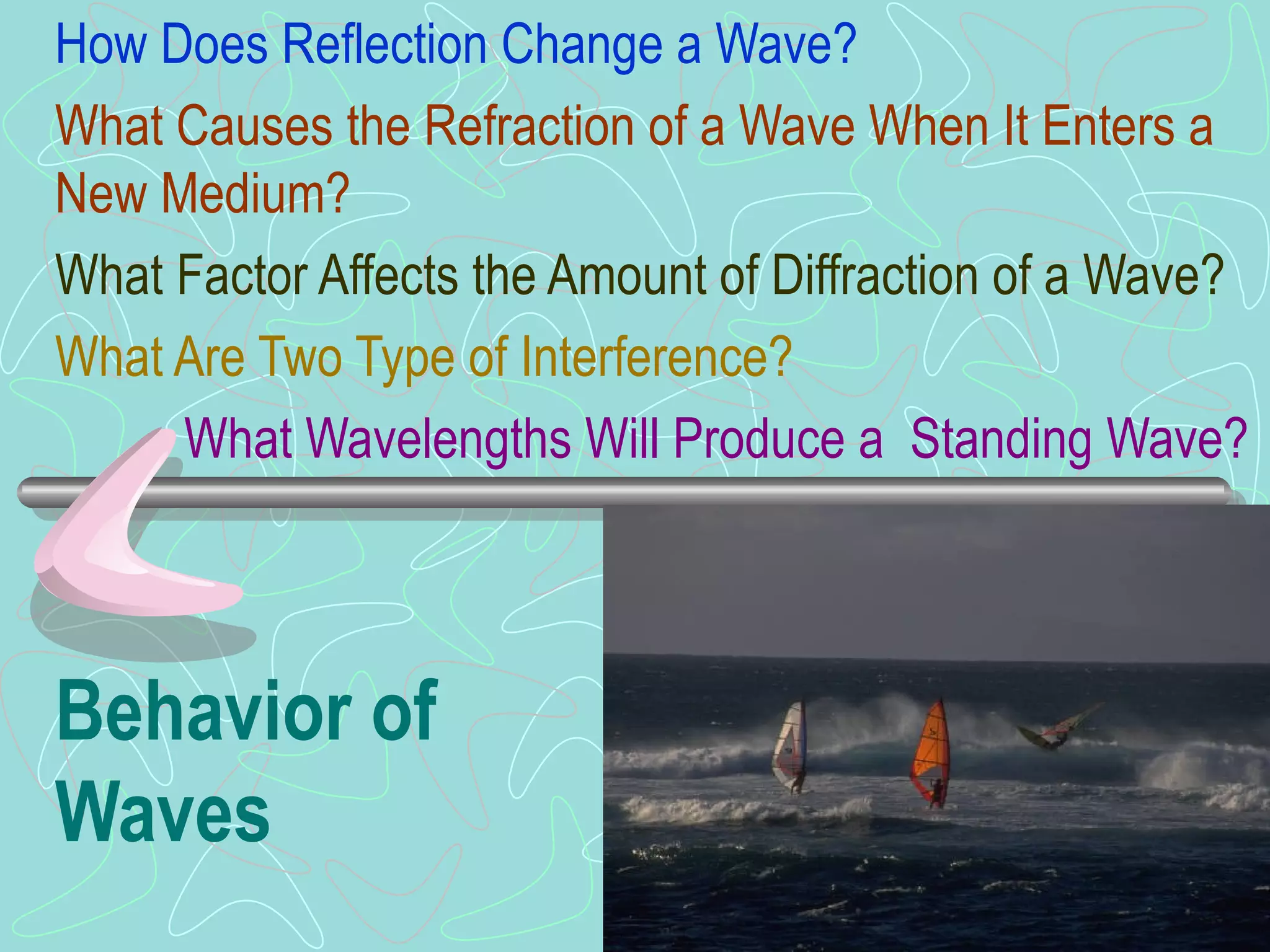
Behavior of Waves How Does Reflection Change a Wave? What Causes the Refraction of a Wave When It Enters a New Medium? What Factor Affects the Amount of Diffraction of a Wave? What Are Two Type of Interference? What Wavelengths Will Produce a  Standing Wave?
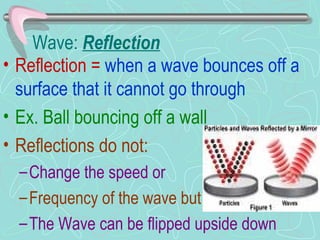
Wave:  Reflection Reflection =   when a wave bounces off a surface that it cannot go through   Ex. Ball bouncing off a wall Reflections do not: Change the speed or Frequency of the wave but The Wave can be flipped upside down
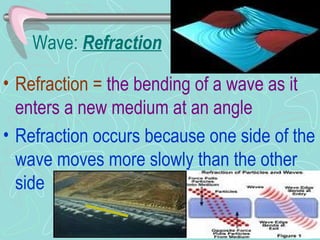
Wave:  Refraction Refraction =   the bending of a wave as it enters a new medium at an angle Refraction occurs because one side of the wave moves more slowly than the other side
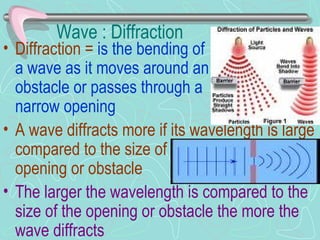
Wave : Diffraction Diffraction =   is the bending of  a wave as it moves around an  obstacle or passes through a  narrow opening A wave diffracts more if its wavelength is large compared to the size of  an opening or obstacle   The larger the wavelength is compared to the size of the opening or obstacle the more the wave diffracts
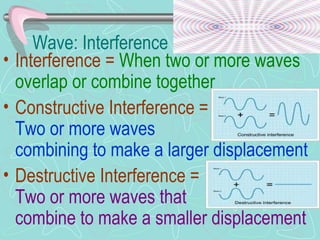
Wave: Interference Interference =   When two or more waves overlap or combine together Constructive Interference   =   Two or more waves  combining to make a larger displacement Destructive Interference   =   Two or more waves that  combine to make a smaller displacement
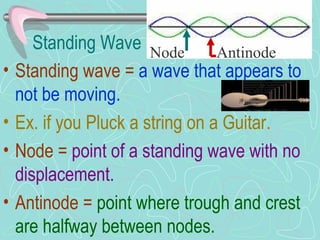
Standing Wave Standing wave =   a wave that appears to not be moving. Ex. if you Pluck a string on a Guitar. Node =   point of a standing wave with no displacement. Antinode =   point where trough and crest are halfway between nodes. Node  Antinode
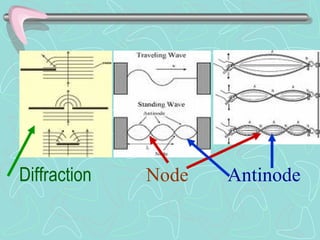
  Diffraction     Node   Antinode

17 3 Behavior Of Waves

  • 1.
    Behavior of WavesHow Does Reflection Change a Wave? What Causes the Refraction of a Wave When It Enters a New Medium? What Factor Affects the Amount of Diffraction of a Wave? What Are Two Type of Interference? What Wavelengths Will Produce a Standing Wave?
  • 2.
    Wave: ReflectionReflection = when a wave bounces off a surface that it cannot go through Ex. Ball bouncing off a wall Reflections do not: Change the speed or Frequency of the wave but The Wave can be flipped upside down
  • 3.
    Wave: RefractionRefraction = the bending of a wave as it enters a new medium at an angle Refraction occurs because one side of the wave moves more slowly than the other side
  • 4.
    Wave : DiffractionDiffraction = is the bending of a wave as it moves around an obstacle or passes through a narrow opening A wave diffracts more if its wavelength is large compared to the size of an opening or obstacle The larger the wavelength is compared to the size of the opening or obstacle the more the wave diffracts
  • 5.
    Wave: Interference Interference= When two or more waves overlap or combine together Constructive Interference = Two or more waves combining to make a larger displacement Destructive Interference = Two or more waves that combine to make a smaller displacement
  • 6.
    Standing Wave Standingwave = a wave that appears to not be moving. Ex. if you Pluck a string on a Guitar. Node = point of a standing wave with no displacement. Antinode = point where trough and crest are halfway between nodes. Node Antinode
  • 7.
    Diffraction Node Antinode