PHYSICS – General Wave Properties
LEARNING
OBJECTIVES
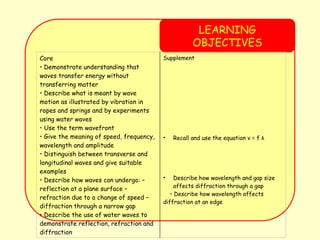
Core
• Demonstrate understanding that
waves transfer energy without
transferring matter
• Describe what is meant by wave
motion as illustrated by vibration in
ropes and springs and by experiments
using water waves
• Use the term wavefront
• Give the meaning of speed, frequency,
wavelength and amplitude
• Distinguish between transverse and
longitudinal waves and give suitable
examples
• Describe how waves can undergo: –
reflection at a plane surface –
refraction due to a change of speed –
diffraction through a narrow gap
• Describe the use of water waves to
demonstrate reflection, refraction and
diffraction
Supplement
• Recall and use the equation v = f λ
• Describe how wavelength and gap size
affects diffraction through a gap
• Describe how wavelength affects
diffraction at an edge
Waves
Waves
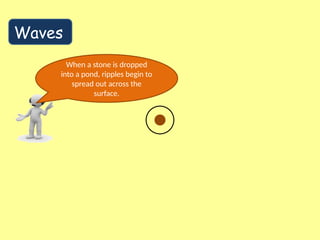
When a stone is dropped
into a pond, ripples begin to
spread out across the
surface.
Waves
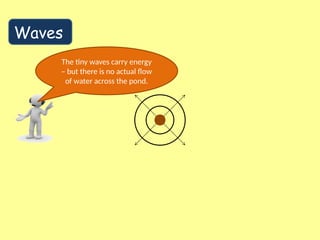
The tiny waves carry energy
– but there is no actual flow
of water across the pond.
Waves
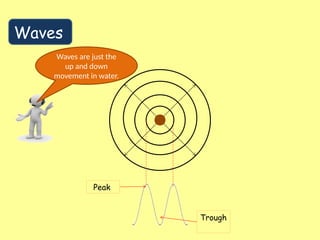
Waves are just the
up and down
movement in water.
Peak
Trough
Waves
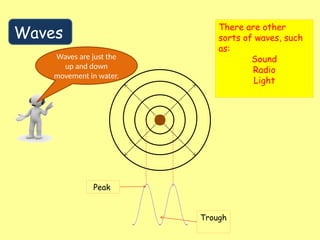
Waves are just the
up and down
movement in water.
Peak
Trough
There are other
sorts of waves, such
as:
Sound
Radio
Light
Waves
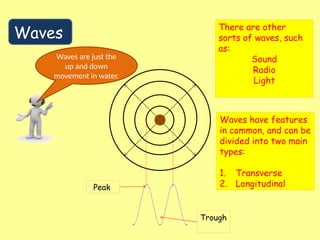
Waves are just the
up and down
movement in water.
Peak
Trough
There are other
sorts of waves, such
as:
Sound
Radio
Light
Waves have features
in common, and can be
divided into two main
types:
1. Transverse
2. Longitudinal
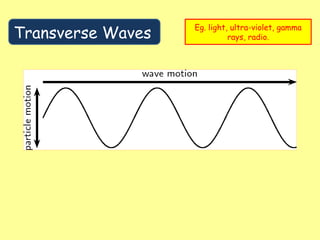
Transverse Waves
Eg. light, ultra-violet, gamma
rays, radio.
Transverse Waves
Eg. light, ultra-violet, gamma
rays, radio.
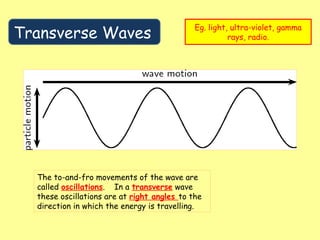
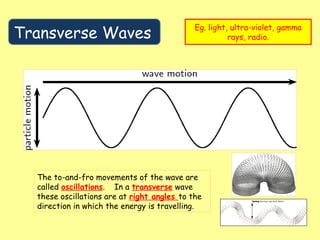
The to-and-fro movements of the wave are
called oscillations. In a transverse wave
these oscillations are at right angles to the
direction in which the energy is travelling.
Transverse Waves
Eg. light, ultra-violet, gamma
rays, radio.
The to-and-fro movements of the wave are
called oscillations. In a transverse wave
these oscillations are at right angles to the
direction in which the energy is travelling.
Transverse Waves
Eg. light, ultra-violet, gamma
rays, radio.
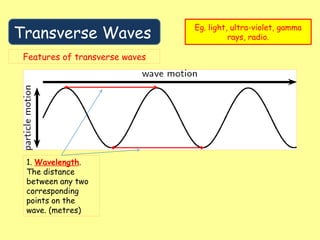
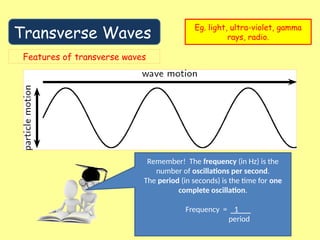
Features of transverse waves
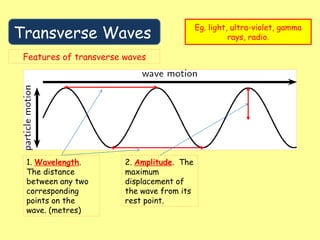
1. Wavelength.
The distance
between any two
corresponding
points on the
wave. (metres)
Transverse Waves
Eg. light, ultra-violet, gamma
rays, radio.
Features of transverse waves
1. Wavelength.
The distance
between any two
corresponding
points on the
wave. (metres)
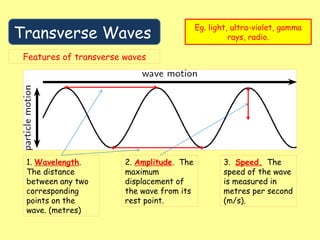
2. Amplitude. The
maximum
displacement of
the wave from its
rest point.
Transverse Waves
Eg. light, ultra-violet, gamma
rays, radio.
Features of transverse waves
1. Wavelength.
The distance
between any two
corresponding
points on the
wave. (metres)
2. Amplitude. The
maximum
displacement of
the wave from its
rest point.
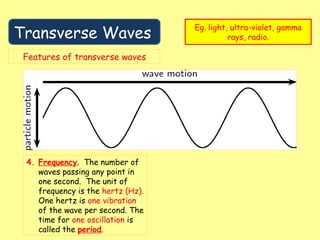
3. Speed. The
speed of the wave
is measured in
metres per second
(m/s).
Transverse Waves
Eg. light, ultra-violet, gamma
rays, radio.
Features of transverse waves
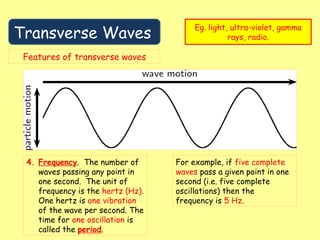
4. Frequency. The number of
waves passing any point in
one second. The unit of
frequency is the hertz (Hz).
One hertz is one vibration
of the wave per second. The
time for one oscillation is
called the period.
Transverse Waves
Eg. light, ultra-violet, gamma
rays, radio.
Features of transverse waves
4. Frequency. The number of
waves passing any point in
one second. The unit of
frequency is the hertz (Hz).
One hertz is one vibration
of the wave per second. The
time for one oscillation is
called the period.
For example, if five complete
waves pass a given point in one
second (i.e. five complete
oscillations) then the
frequency is 5 Hz.
Transverse Waves
Eg. light, ultra-violet, gamma
rays, radio.
Features of transverse waves
Remember! The frequency (in Hz) is the
number of oscillations per second.
The period (in seconds) is the time for one
complete oscillation.
Frequency = 1
period
Transverse Waves
Eg. light, ultra-violet, gamma
rays, radio.
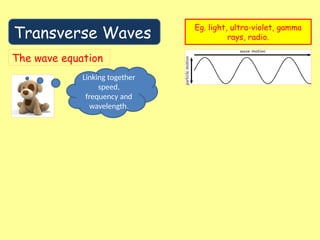
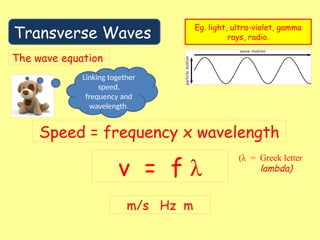
The wave equation
Linking together
speed,
frequency and
wavelength.
Transverse Waves
Eg. light, ultra-violet, gamma
rays, radio.
The wave equation
Linking together
speed,
frequency and
wavelength.
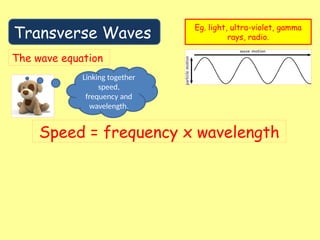
Speed = frequency x wavelength
Transverse Waves
Eg. light, ultra-violet, gamma
rays, radio.
The wave equation
Linking together
speed,
frequency and
wavelength.
Speed = frequency x wavelength
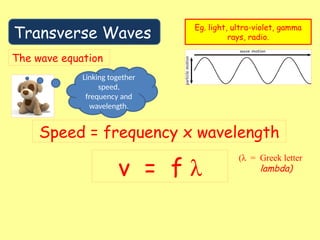
v = f λ
(λ = Greek letter
lambda)
Transverse Waves
Eg. light, ultra-violet, gamma
rays, radio.
The wave equation
Linking together
speed,
frequency and
wavelength.
Speed = frequency x wavelength
v = f λ
(λ = Greek letter
lambda)
m/s Hz m
Transverse Waves
Eg. light, ultra-violet, gamma
rays, radio.
The wave equation
Linking together
speed,
frequency and
wavelength.
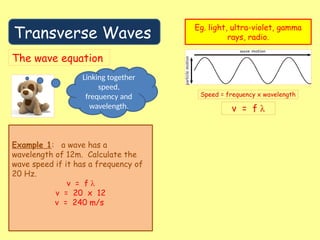
Example 1: a wave has a
wavelength of 12m. Calculate the
wave speed if it has a frequency of
20 Hz.
v = f λ
v = 20 x 12
v = 240 m/s
Transverse Waves
Eg. light, ultra-violet, gamma
rays, radio.
The wave equation
Linking together
speed,
frequency and
wavelength.
Example 1: a wave has a
wavelength of 12m. Calculate the
wave speed if it has a frequency of
20 Hz.
v = f λ
v = 20 x 12
v = 240 m/s
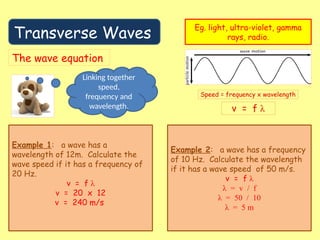
Example 2: a wave has a frequency
of 10 Hz. Calculate the wavelength
if it has a wave speed of 50 m/s.
v = f λ
λ = v / f
λ = 50 / 10
λ = 5 m
Transverse Waves
Eg. light, ultra-violet, gamma
rays, radio.
The wave equation
Linking together
speed,
frequency and
wavelength.
Example 1: a wave has a
wavelength of 12m. Calculate the
wave speed if it has a frequency of
20 Hz.
v = f λ
v = 20 x 12
v = 240 m/s
Example 2: a wave has a frequency
of 10 Hz. Calculate the wavelength
if it has a wave speed of 50 m/s.
v = f λ
λ = v / f
λ = 50 / 10
λ = 5 m
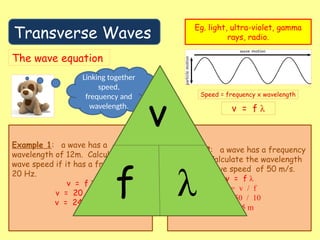
v
f λ
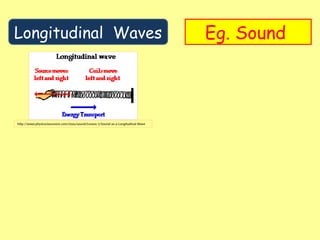
Longitudinal Waves Eg. Sound
http://www.physicsclassroom.com/class/sound/Lesson-1/Sound-as-a-Longitudinal-Wave
Longitudinal Waves Eg. Sound
http://www.physicsclassroom.com/class/sound/Lesson-1/Sound-as-a-Longitudinal-Wave
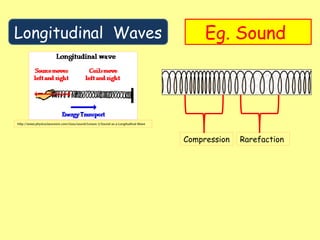
Compression Rarefaction
Longitudinal Waves Eg. Sound
http://www.physicsclassroom.com/class/sound/Lesson-1/Sound-as-a-Longitudinal-Wave
Compression Rarefaction
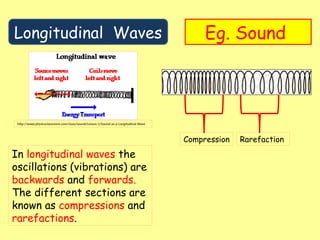
In longitudinal waves the
oscillations (vibrations) are
backwards and forwards.
The different sections are
known as compressions and
rarefactions.
Longitudinal Waves Eg. Sound
http://www.physicsclassroom.com/class/sound/Lesson-1/Sound-as-a-Longitudinal-Wave
Compression Rarefaction
In longitudinal waves the
oscillations (vibrations) are
backwards and forwards.
The different sections are
known as compressions and
rarefactions.
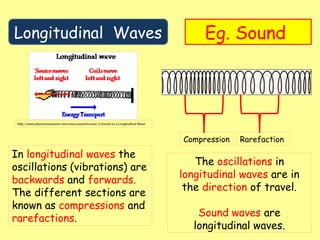
The oscillations in
longitudinal waves are in
the direction of travel.
Sound waves are
longitudinal waves.
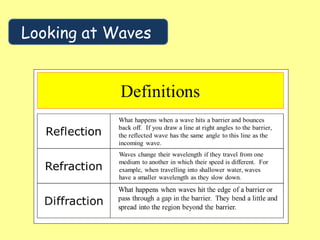
Looking at Waves
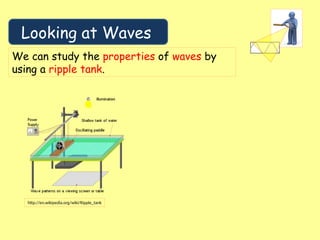
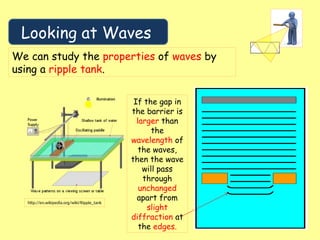
We can study the properties of waves by
using a ripple tank.
Looking at Waves
We can study the properties of waves by
using a ripple tank.
http://en.wikipedia.org/wiki/Ripple_tank
Looking at Waves
We can study the properties of waves by
using a ripple tank.
http://en.wikipedia.org/wiki/Ripple_tank
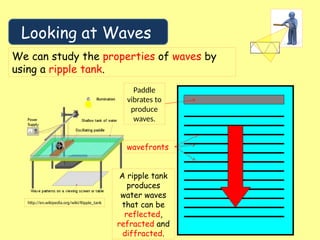
Paddle
vibrates to
produce
waves.
A ripple tank
produces
water waves
that can be
reflected,
refracted and
diffracted.
wavefronts
Looking at Waves
We can study the properties of waves by
using a ripple tank.
http://en.wikipedia.org/wiki/Ripple_tank
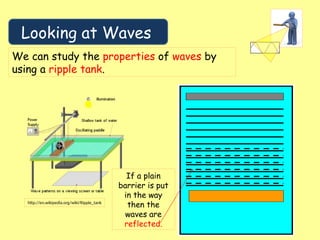
If a plain
barrier is put
in the way
then the
waves are
reflected.
Looking at Waves
We can study the properties of waves by
using a ripple tank.
http://en.wikipedia.org/wiki/Ripple_tank
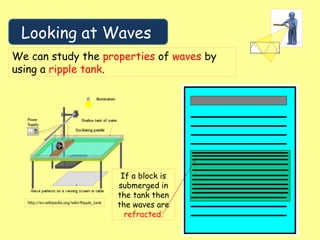
If a block is
submerged in
the tank then
the waves are
refracted.
Looking at Waves
We can study the properties of waves by
using a ripple tank.
http://en.wikipedia.org/wiki/Ripple_tank
If a block is
submerged in
the tank then
the waves are
refracted.
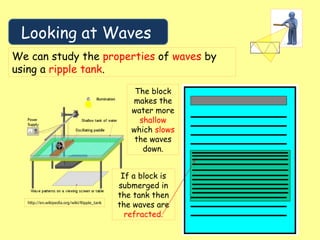
The block
makes the
water more
shallow
which slows
the waves
down.
Looking at Waves
We can study the properties of waves by
using a ripple tank.
http://en.wikipedia.org/wiki/Ripple_tank
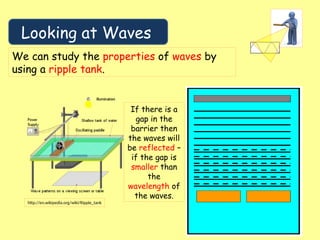
If there is a
gap in the
barrier then
the waves will
be reflected –
if the gap is
smaller than
the
wavelength of
the waves.
Looking at Waves
We can study the properties of waves by
using a ripple tank.
http://en.wikipedia.org/wiki/Ripple_tank
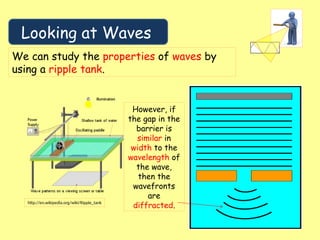
However, if
the gap in the
barrier is
similar in
width to the
wavelength of
the wave,
then the
wavefronts
are
diffracted.
Looking at Waves
We can study the properties of waves by
using a ripple tank.
http://en.wikipedia.org/wiki/Ripple_tank
If the gap in
the barrier is
larger than
the
wavelength of
the waves,
then the wave
will pass
through
unchanged
apart from
slight
diffraction at
the edges.
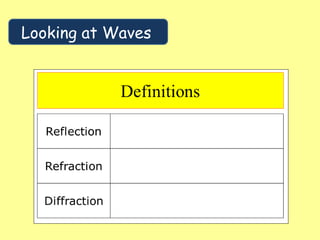
Looking at Waves
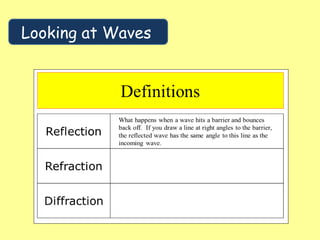
Looking at Waves
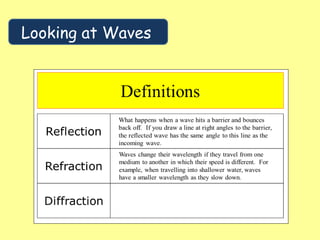
Looking at Waves
Looking at Waves
LEARNING
OBJECTIVES
Core
• Demonstrate understanding that
waves transfer energy without
transferring matter
• Describe what is meant by wave
motion as illustrated by vibration in
ropes and springs and by experiments
using water waves
• Use the term wavefront
• Give the meaning of speed, frequency,
wavelength and amplitude
• Distinguish between transverse and
longitudinal waves and give suitable
examples
• Describe how waves can undergo: –
reflection at a plane surface –
refraction due to a change of speed –
diffraction through a narrow gap
• Describe the use of water waves to
demonstrate reflection, refraction and
diffraction
Supplement
• Recall and use the equation v = f λ
• Describe how wavelength and gap size
affects diffraction through a gap
• Describe how wavelength affects
diffraction at an edge
PHYSICS – General Wave Properties

General Wave Properties great waves ppt.pptx

  • 1.
    PHYSICS – GeneralWave Properties
  • 2.
    LEARNING OBJECTIVES Core • Demonstrate understandingthat waves transfer energy without transferring matter • Describe what is meant by wave motion as illustrated by vibration in ropes and springs and by experiments using water waves • Use the term wavefront • Give the meaning of speed, frequency, wavelength and amplitude • Distinguish between transverse and longitudinal waves and give suitable examples • Describe how waves can undergo: – reflection at a plane surface – refraction due to a change of speed – diffraction through a narrow gap • Describe the use of water waves to demonstrate reflection, refraction and diffraction Supplement • Recall and use the equation v = f λ • Describe how wavelength and gap size affects diffraction through a gap • Describe how wavelength affects diffraction at an edge

  • 3.
  • 4.
    Waves When a stoneis dropped into a pond, ripples begin to spread out across the surface.
  • 5.
    Waves The tiny wavescarry energy – but there is no actual flow of water across the pond.
  • 6.
    Waves Waves are justthe up and down movement in water. Peak Trough
  • 7.
    Waves Waves are justthe up and down movement in water. Peak Trough There are other sorts of waves, such as: Sound Radio Light
  • 8.
    Waves Waves are justthe up and down movement in water. Peak Trough There are other sorts of waves, such as: Sound Radio Light Waves have features in common, and can be divided into two main types: 1. Transverse 2. Longitudinal
  • 9.
    Transverse Waves Eg. light,ultra-violet, gamma rays, radio.
  • 10.
    Transverse Waves Eg. light,ultra-violet, gamma rays, radio. The to-and-fro movements of the wave are called oscillations. In a transverse wave these oscillations are at right angles to the direction in which the energy is travelling.
  • 11.
    Transverse Waves Eg. light,ultra-violet, gamma rays, radio. The to-and-fro movements of the wave are called oscillations. In a transverse wave these oscillations are at right angles to the direction in which the energy is travelling.
  • 12.
    Transverse Waves Eg. light,ultra-violet, gamma rays, radio. Features of transverse waves 1. Wavelength. The distance between any two corresponding points on the wave. (metres)
  • 13.
    Transverse Waves Eg. light,ultra-violet, gamma rays, radio. Features of transverse waves 1. Wavelength. The distance between any two corresponding points on the wave. (metres) 2. Amplitude. The maximum displacement of the wave from its rest point.
  • 14.
    Transverse Waves Eg. light,ultra-violet, gamma rays, radio. Features of transverse waves 1. Wavelength. The distance between any two corresponding points on the wave. (metres) 2. Amplitude. The maximum displacement of the wave from its rest point. 3. Speed. The speed of the wave is measured in metres per second (m/s).
  • 15.
    Transverse Waves Eg. light,ultra-violet, gamma rays, radio. Features of transverse waves 4. Frequency. The number of waves passing any point in one second. The unit of frequency is the hertz (Hz). One hertz is one vibration of the wave per second. The time for one oscillation is called the period.
  • 16.
    Transverse Waves Eg. light,ultra-violet, gamma rays, radio. Features of transverse waves 4. Frequency. The number of waves passing any point in one second. The unit of frequency is the hertz (Hz). One hertz is one vibration of the wave per second. The time for one oscillation is called the period. For example, if five complete waves pass a given point in one second (i.e. five complete oscillations) then the frequency is 5 Hz.
  • 17.
    Transverse Waves Eg. light,ultra-violet, gamma rays, radio. Features of transverse waves Remember! The frequency (in Hz) is the number of oscillations per second. The period (in seconds) is the time for one complete oscillation. Frequency = 1 period
  • 18.
    Transverse Waves Eg. light,ultra-violet, gamma rays, radio. The wave equation Linking together speed, frequency and wavelength.
  • 19.
    Transverse Waves Eg. light,ultra-violet, gamma rays, radio. The wave equation Linking together speed, frequency and wavelength. Speed = frequency x wavelength
  • 20.
    Transverse Waves Eg. light,ultra-violet, gamma rays, radio. The wave equation Linking together speed, frequency and wavelength. Speed = frequency x wavelength v = f λ (λ = Greek letter lambda)
  • 21.
    Transverse Waves Eg. light,ultra-violet, gamma rays, radio. The wave equation Linking together speed, frequency and wavelength. Speed = frequency x wavelength v = f λ (λ = Greek letter lambda) m/s Hz m
  • 22.
    Transverse Waves Eg. light,ultra-violet, gamma rays, radio. The wave equation Linking together speed, frequency and wavelength. Example 1: a wave has a wavelength of 12m. Calculate the wave speed if it has a frequency of 20 Hz. v = f λ v = 20 x 12 v = 240 m/s
  • 23.
    Transverse Waves Eg. light,ultra-violet, gamma rays, radio. The wave equation Linking together speed, frequency and wavelength. Example 1: a wave has a wavelength of 12m. Calculate the wave speed if it has a frequency of 20 Hz. v = f λ v = 20 x 12 v = 240 m/s Example 2: a wave has a frequency of 10 Hz. Calculate the wavelength if it has a wave speed of 50 m/s. v = f λ λ = v / f λ = 50 / 10 λ = 5 m
  • 24.
    Transverse Waves Eg. light,ultra-violet, gamma rays, radio. The wave equation Linking together speed, frequency and wavelength. Example 1: a wave has a wavelength of 12m. Calculate the wave speed if it has a frequency of 20 Hz. v = f λ v = 20 x 12 v = 240 m/s Example 2: a wave has a frequency of 10 Hz. Calculate the wavelength if it has a wave speed of 50 m/s. v = f λ λ = v / f λ = 50 / 10 λ = 5 m v f λ
  • 25.
    Longitudinal Waves Eg.Sound http://www.physicsclassroom.com/class/sound/Lesson-1/Sound-as-a-Longitudinal-Wave
  • 26.
    Longitudinal Waves Eg.Sound http://www.physicsclassroom.com/class/sound/Lesson-1/Sound-as-a-Longitudinal-Wave Compression Rarefaction
  • 27.
    Longitudinal Waves Eg.Sound http://www.physicsclassroom.com/class/sound/Lesson-1/Sound-as-a-Longitudinal-Wave Compression Rarefaction In longitudinal waves the oscillations (vibrations) are backwards and forwards. The different sections are known as compressions and rarefactions.
  • 28.
    Longitudinal Waves Eg.Sound http://www.physicsclassroom.com/class/sound/Lesson-1/Sound-as-a-Longitudinal-Wave Compression Rarefaction In longitudinal waves the oscillations (vibrations) are backwards and forwards. The different sections are known as compressions and rarefactions. The oscillations in longitudinal waves are in the direction of travel. Sound waves are longitudinal waves.
  • 29.
    Looking at Waves Wecan study the properties of waves by using a ripple tank.
  • 30.
    Looking at Waves Wecan study the properties of waves by using a ripple tank. http://en.wikipedia.org/wiki/Ripple_tank
  • 31.
    Looking at Waves Wecan study the properties of waves by using a ripple tank. http://en.wikipedia.org/wiki/Ripple_tank Paddle vibrates to produce waves. A ripple tank produces water waves that can be reflected, refracted and diffracted. wavefronts
  • 32.
    Looking at Waves Wecan study the properties of waves by using a ripple tank. http://en.wikipedia.org/wiki/Ripple_tank If a plain barrier is put in the way then the waves are reflected.
  • 33.
    Looking at Waves Wecan study the properties of waves by using a ripple tank. http://en.wikipedia.org/wiki/Ripple_tank If a block is submerged in the tank then the waves are refracted.
  • 34.
    Looking at Waves Wecan study the properties of waves by using a ripple tank. http://en.wikipedia.org/wiki/Ripple_tank If a block is submerged in the tank then the waves are refracted. The block makes the water more shallow which slows the waves down.
  • 35.
    Looking at Waves Wecan study the properties of waves by using a ripple tank. http://en.wikipedia.org/wiki/Ripple_tank If there is a gap in the barrier then the waves will be reflected – if the gap is smaller than the wavelength of the waves.
  • 36.
    Looking at Waves Wecan study the properties of waves by using a ripple tank. http://en.wikipedia.org/wiki/Ripple_tank However, if the gap in the barrier is similar in width to the wavelength of the wave, then the wavefronts are diffracted.
  • 37.
    Looking at Waves Wecan study the properties of waves by using a ripple tank. http://en.wikipedia.org/wiki/Ripple_tank If the gap in the barrier is larger than the wavelength of the waves, then the wave will pass through unchanged apart from slight diffraction at the edges.
  • 38.
  • 39.
  • 40.
  • 41.
  • 42.
    LEARNING OBJECTIVES Core • Demonstrate understandingthat waves transfer energy without transferring matter • Describe what is meant by wave motion as illustrated by vibration in ropes and springs and by experiments using water waves • Use the term wavefront • Give the meaning of speed, frequency, wavelength and amplitude • Distinguish between transverse and longitudinal waves and give suitable examples • Describe how waves can undergo: – reflection at a plane surface – refraction due to a change of speed – diffraction through a narrow gap • Describe the use of water waves to demonstrate reflection, refraction and diffraction Supplement • Recall and use the equation v = f λ • Describe how wavelength and gap size affects diffraction through a gap • Describe how wavelength affects diffraction at an edge
  • 43.
    PHYSICS – GeneralWave Properties