Understanding Diffraction of Waves
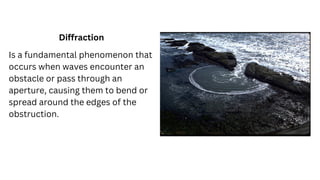
Is a fundamental phenomenon that
occurs when waves encounter an
obstacle or pass through an
aperture, causing them to bend or
spread around the edges of the
obstruction.
Diffraction
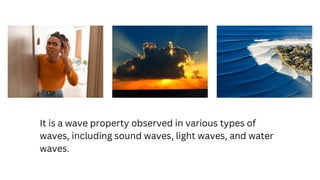
It is a wave property observed in various types of
waves, including sound waves, light waves, and water
waves.
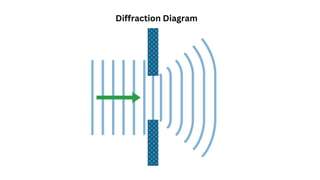
Diffraction Diagram
As the wavelength increases, the amount of
diffraction also increases. Conversely, shorter
wavelengths diffract less.
Relationship of Aperture size and Wavelength
to Diffraction
As the size of the gap or aperture through which
waves pass decreases, the diffraction effect
becomes more pronounced, resulting in wider
diffraction patterns and sharper interference
fringes.
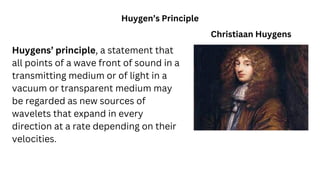
Huygens’ principle, a statement that
all points of a wave front of sound in a
transmitting medium or of light in a
vacuum or transparent medium may
be regarded as new sources of
wavelets that expand in every
direction at a rate depending on their
velocities.
Huygen’s Principle
Christiaan Huygens
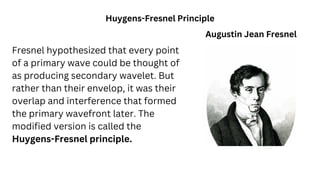
Fresnel hypothesized that every point
of a primary wave could be thought of
as producing secondary wavelet. But
rather than their envelop, it was their
overlap and interference that formed
the primary wavefront later. The
modified version is called the
Huygens-Fresnel principle.
Huygens-Fresnel Principle
Augustin Jean Fresnel
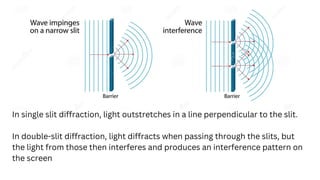
In single slit diffraction, light outstretches in a line perpendicular to the slit.
In double-slit diffraction, light diffracts when passing through the slits, but
the light from those then interferes and produces an interference pattern on
the screen
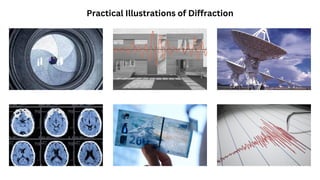
Practical Illustrations of Diffraction
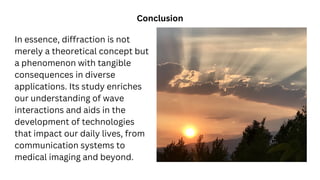
In essence, diffraction is not
merely a theoretical concept but
a phenomenon with tangible
consequences in diverse
applications. Its study enriches
our understanding of wave
interactions and aids in the
development of technologies
that impact our daily lives, from
communication systems to
medical imaging and beyond.
Conclusion

Diffraction Polines.pdf erwewrd..d,dm,mfmfmf

  • 1.
  • 2.
    Is a fundamentalphenomenon that occurs when waves encounter an obstacle or pass through an aperture, causing them to bend or spread around the edges of the obstruction. Diffraction
  • 3.
    It is awave property observed in various types of waves, including sound waves, light waves, and water waves.
  • 4.
  • 5.
    As the wavelengthincreases, the amount of diffraction also increases. Conversely, shorter wavelengths diffract less. Relationship of Aperture size and Wavelength to Diffraction As the size of the gap or aperture through which waves pass decreases, the diffraction effect becomes more pronounced, resulting in wider diffraction patterns and sharper interference fringes.
  • 6.
    Huygens’ principle, astatement that all points of a wave front of sound in a transmitting medium or of light in a vacuum or transparent medium may be regarded as new sources of wavelets that expand in every direction at a rate depending on their velocities. Huygen’s Principle Christiaan Huygens
  • 7.
    Fresnel hypothesized thatevery point of a primary wave could be thought of as producing secondary wavelet. But rather than their envelop, it was their overlap and interference that formed the primary wavefront later. The modified version is called the Huygens-Fresnel principle. Huygens-Fresnel Principle Augustin Jean Fresnel
  • 8.
    In single slitdiffraction, light outstretches in a line perpendicular to the slit. In double-slit diffraction, light diffracts when passing through the slits, but the light from those then interferes and produces an interference pattern on the screen
  • 9.
  • 10.
    In essence, diffractionis not merely a theoretical concept but a phenomenon with tangible consequences in diverse applications. Its study enriches our understanding of wave interactions and aids in the development of technologies that impact our daily lives, from communication systems to medical imaging and beyond. Conclusion