Engr. Lloyd O. Arenas EE, RME
Holy Trinity College of General Santos City
2023
Objectives
 Learn the basic characteristics of waves and use them
to solve simple problems.
What Are Waves?
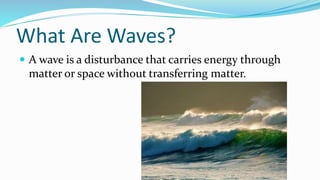
 A wave is a disturbance that carries energy through
matter or space without transferring matter.
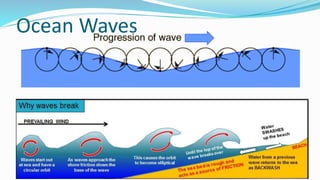
Ocean Waves
Wave Characteristics
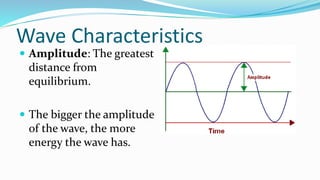
 Amplitude: The greatest
distance from
equilibrium.
 The bigger the amplitude
of the wave, the more
energy the wave has.
Wave Characteristics
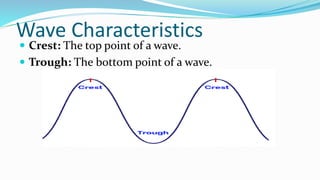
 Crest: The top point of a wave.
 Trough: The bottom point of a wave.
Wave Characteristics
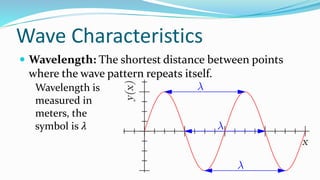
 Wavelength: The shortest distance between points
where the wave pattern repeats itself.
Wavelength is
measured in
meters, the
symbol is 𝜆
Wave Characteristics
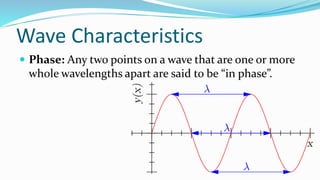
 Phase: Any two points on a wave that are one or more
whole wavelengths apart are said to be “in phase”.
Wave Characteristics
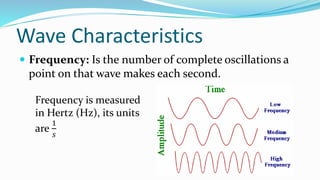
 Frequency: Is the number of complete oscillations a
point on that wave makes each second.
Frequency is measured
in Hertz (Hz), its units
are
1
𝑠
Wave Characteristics
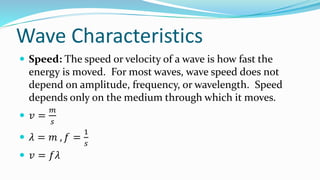
 Speed: The speed or velocity of a wave is how fast the
energy is moved. For most waves, wave speed does not
depend on amplitude, frequency, or wavelength. Speed
depends only on the medium through which it moves.
 𝑣 =
𝑚
𝑠
 𝜆 = 𝑚 , 𝑓 =
1
𝑠
 𝑣 = 𝑓𝜆
Wave Characteristics
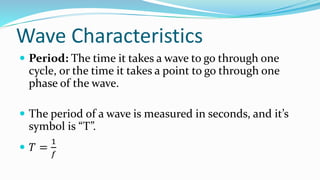
 Period: The time it takes a wave to go through one
cycle, or the time it takes a point to go through one
phase of the wave.
 The period of a wave is measured in seconds, and it’s
symbol is “T”.
 𝑇 =
1
𝑓
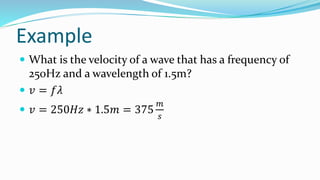
Example
 What is the velocity of a wave that has a frequency of
250Hz and a wavelength of 1.5m?
 𝑣 = 𝑓𝜆
 𝑣 = 250𝐻𝑧 ∗ 1.5𝑚 = 375
𝑚
𝑠
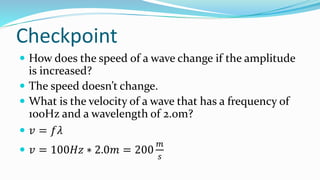
Checkpoint
 How does the speed of a wave change if the amplitude
is increased?
 The speed doesn’t change.
 What is the velocity of a wave that has a frequency of
100Hz and a wavelength of 2.0m?
 𝑣 = 𝑓𝜆
 𝑣 = 100𝐻𝑧 ∗ 2.0𝑚 = 200
𝑚
𝑠
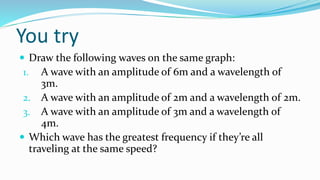
You try
 Draw the following waves on the same graph:
1. A wave with an amplitude of 6m and a wavelength of
3m.
2. A wave with an amplitude of 2m and a wavelength of 2m.
3. A wave with an amplitude of 3m and a wavelength of
4m.
 Which wave has the greatest frequency if they’re all
traveling at the same speed?
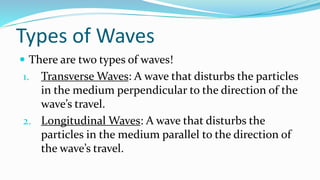
Types of Waves
 There are two types of waves!
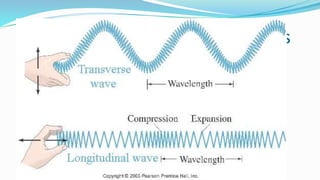
1. Transverse Waves: A wave that disturbs the particles
in the medium perpendicular to the direction of the
wave’s travel.
2. Longitudinal Waves: A wave that disturbs the
particles in the medium parallel to the direction of
the wave’s travel.
Transverse vs. Longitudinal Waves
Checkpoint
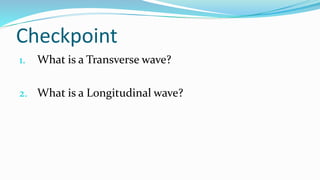
1. What is a Transverse wave?
2. What is a Longitudinal wave?
Slinky Demo
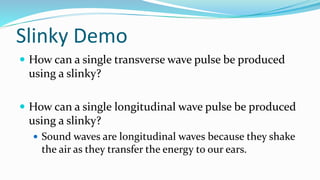
 How can a single transverse wave pulse be produced
using a slinky?
 How can a single longitudinal wave pulse be produced
using a slinky?
 Sound waves are longitudinal waves because they shake
the air as they transfer the energy to our ears.
Bellringer
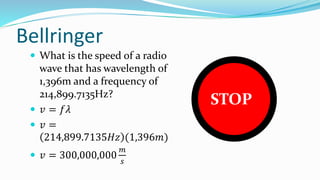
 What is the speed of a radio
wave that has wavelength of
1,396m and a frequency of
214,899.7135Hz?
 𝑣 = 𝑓𝜆
 𝑣 =
214,899.7135𝐻𝑧 (1,396𝑚)
 𝑣 = 300,000,000
𝑚
𝑠
DO
WORK
STOP
Objectives
 Learn about the different types of waves.
 Study, create, and destroy different wave types.
Waves at Boundaries
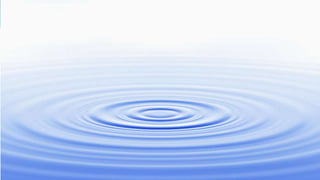
 What does the surface of water look like when you
drop a small rock in a calm bucket of water?
 What happens when the wave hits the walls?
 Splash Demo!!! Get your goggles!
Waves at Boundaries
 Recall that a wave’s speed depends on the medium it
passes through:
 Water depth
 Air temperature
 Tension, and mass
 A “Boundary” is when a wave goes from one medium
to another.
Waves at Boundaries
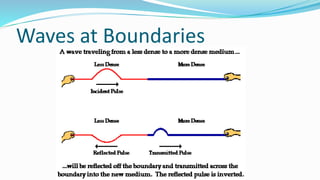
 There are three ways you’ll be interested in at
boundaries.
1. Incident Wave: A wave pulse that strikes the
boundary.
2. Reflected Wave: A wave that bounces backwards
after hitting the boundary.
3. Transmitted Wave: A wave that continue forward
after hitting the boundary.
Waves at Boundaries
Waves at Boundaries Demos
 Different Medium Demo:
 The incident energy is split between reflected and
transmitted energy.
 Rigid Boundaries Demo:
 All of the incident energy is turned into reflected
energy.
Checkpoint
1. How does the amplitude (energy) of a wave change
when it hits a rigid boundary like a wall?
2. How is the conservation of energy observable with a
single wave hitting a different medium?
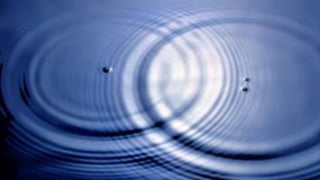
Waves in a Bucket
 What happens if you drop two rocks into a calm
bucket of water instead of just one?
 The waves seem to hit each other, but then just
continue on their way…weird?
Wave Interference
 When we had two particles (carts) and pushed them
into each other they collided and then stopped.
 When waves collide they temporarily interfere with
one another, but they do not stop each other.
Wave Interference
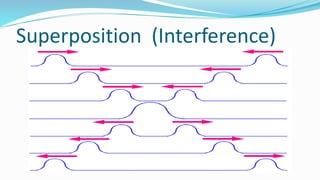
 The Principle of Superposition states that the
displacement of a medium caused by two or more
waves is the algebraic sum of the displacements caused
by the individual waves.
Superposition (Interference)
Now a super superposition demo!
1. Can we make two waves create a bigger wave?
2. Can we make two wave create a smaller wave?
3. Is there a limit to how many waves we can create?
Bellringer
 What is the speed of a radio
wave that has wavelength of
1,396m and a frequency of
214,899.7135Hz?
 𝑣 = 𝑓𝜆
 𝑣 =
214,899.7135𝐻𝑧 (1,396𝑚)
 𝑣 = 300,000,000
𝑚
𝑠
DO
WORK
STOP
Objectives
 Learn about the different types of interference,
practice solving problems that deal with it, and
demonstrate the different interference patterns with a
small group.
Types of Interference
 There are three types of interference
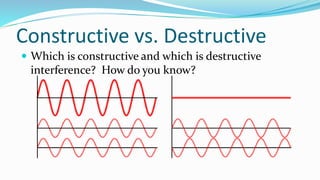
1. Constructive Interference: When the crest of a wave
meets a crest of another wave of the same frequency at
the same point.
2. Destructive Interference: When the crest of a wave
meets a trough of another wave of the same frequency at
the same point.
3. Different Amplitude: All other scenarios of waves
interference.
Constructive vs. Destructive
 Which is constructive and which is destructive
interference? How do you know?
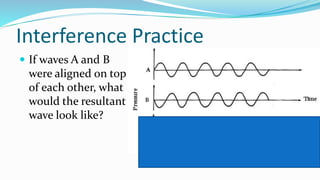
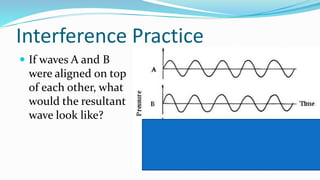
Interference Practice
 If waves A and B
were aligned on top
of each other, what
would the resultant
wave look like?
Interference Practice
 If waves A and B
were aligned on top
of each other, what
would the resultant
wave look like?
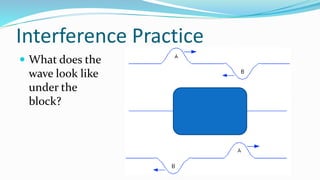
Interference Practice
 What does the
wave look like
under the
block?
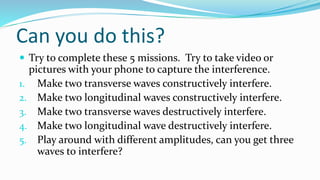
Can you do this?
 Try to complete these 5 missions. Try to take video or
pictures with your phone to capture the interference.
1. Make two transverse waves constructively interfere.
2. Make two longitudinal waves constructively interfere.
3. Make two transverse waves destructively interfere.
4. Make two longitudinal wave destructively interfere.
5. Play around with different amplitudes, can you get three
waves to interfere?
Objective
 Learn and be able to identify standing waves and their
properties.
Standing Waves
 When a wave appears to just move up and down
instead of transmitting energy side to side it is called a
standing wave.
 These waves appear to be standing still, hence
“Standing Wave”.
Standing Wave Demo
 What happens to the number of bumps as I increase
the frequency? Why?
 How does the wavelength change as I increase the
frequency?
 How does the speed of the waves change as I increase
the frequency?
Standing Waves
 Why must I keep oscillate my arm to generate a
standing wave?
 A standing wave is made up interfering waves moving
in opposite directions. Without this small input the
wave would die out.
Standing Waves
 Resonance is when a small energy input frequency is
continually applied to an object and it causes the object to
oscillate with greater and greater amplitude.
 Resonance is continual constructive interference.
 Every object has a resonance frequency.
 Swing-sets use resonance.
 Microwave ovens are the resonance frequency of water.
 Tesla found the resonance frequency of the Earth.
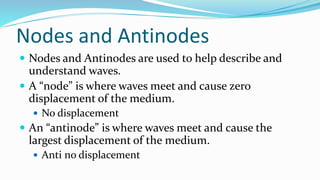
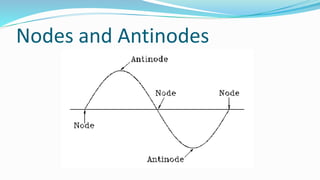
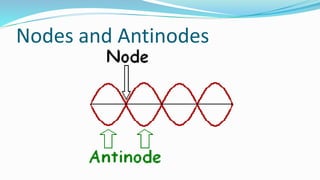
Nodes and Antinodes
 Nodes and Antinodes are used to help describe and
understand waves.
 A “node” is where waves meet and cause zero
displacement of the medium.
 No displacement
 An “antinode” is where waves meet and cause the
largest displacement of the medium.
 Anti no displacement
Nodes and Antinodes
Nodes and Antinodes
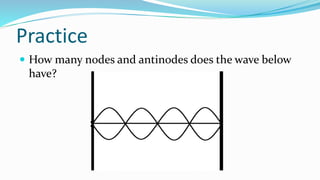
Practice
 How many nodes and antinodes does the wave below
have?
Bellringer – 2 mins to hand in
 What is a standing wave?
 What is an antinode?
 What is a node?
DO
WORK
STOP
Standing Waves
 What is a standing wave?
 How are standing waves created?
 What is an antinode?
 What is a node?
Standing Wave Simulator
 What does a standing longitudinal wave look like?
 https://phet.colorado.edu/en/simulation/normal-
modes
 Fixed end vs. open end. Destructive and Constructive
Interference
 https://phet.colorado.edu/en/simulation/wave-on-a-
string

Introduction to Waves Notes2.pptx

  • 1.
    Engr. Lloyd O.Arenas EE, RME Holy Trinity College of General Santos City 2023
  • 2.
    Objectives  Learn thebasic characteristics of waves and use them to solve simple problems.
  • 3.
    What Are Waves? A wave is a disturbance that carries energy through matter or space without transferring matter.
  • 4.
  • 5.
    Wave Characteristics  Amplitude:The greatest distance from equilibrium.  The bigger the amplitude of the wave, the more energy the wave has.
  • 6.
    Wave Characteristics  Crest:The top point of a wave.  Trough: The bottom point of a wave.
  • 7.
    Wave Characteristics  Wavelength:The shortest distance between points where the wave pattern repeats itself. Wavelength is measured in meters, the symbol is 𝜆
  • 8.
    Wave Characteristics  Phase:Any two points on a wave that are one or more whole wavelengths apart are said to be “in phase”.
  • 9.
    Wave Characteristics  Frequency:Is the number of complete oscillations a point on that wave makes each second. Frequency is measured in Hertz (Hz), its units are 1 𝑠
  • 10.
    Wave Characteristics  Speed:The speed or velocity of a wave is how fast the energy is moved. For most waves, wave speed does not depend on amplitude, frequency, or wavelength. Speed depends only on the medium through which it moves.  𝑣 = 𝑚 𝑠  𝜆 = 𝑚 , 𝑓 = 1 𝑠  𝑣 = 𝑓𝜆
  • 11.
    Wave Characteristics  Period:The time it takes a wave to go through one cycle, or the time it takes a point to go through one phase of the wave.  The period of a wave is measured in seconds, and it’s symbol is “T”.  𝑇 = 1 𝑓
  • 12.
    Example  What isthe velocity of a wave that has a frequency of 250Hz and a wavelength of 1.5m?  𝑣 = 𝑓𝜆  𝑣 = 250𝐻𝑧 ∗ 1.5𝑚 = 375 𝑚 𝑠
  • 13.
    Checkpoint  How doesthe speed of a wave change if the amplitude is increased?  The speed doesn’t change.  What is the velocity of a wave that has a frequency of 100Hz and a wavelength of 2.0m?  𝑣 = 𝑓𝜆  𝑣 = 100𝐻𝑧 ∗ 2.0𝑚 = 200 𝑚 𝑠
  • 14.
    You try  Drawthe following waves on the same graph: 1. A wave with an amplitude of 6m and a wavelength of 3m. 2. A wave with an amplitude of 2m and a wavelength of 2m. 3. A wave with an amplitude of 3m and a wavelength of 4m.  Which wave has the greatest frequency if they’re all traveling at the same speed?
  • 15.
    Types of Waves There are two types of waves! 1. Transverse Waves: A wave that disturbs the particles in the medium perpendicular to the direction of the wave’s travel. 2. Longitudinal Waves: A wave that disturbs the particles in the medium parallel to the direction of the wave’s travel.
  • 16.
  • 17.
    Checkpoint 1. What isa Transverse wave? 2. What is a Longitudinal wave?
  • 18.
    Slinky Demo  Howcan a single transverse wave pulse be produced using a slinky?  How can a single longitudinal wave pulse be produced using a slinky?  Sound waves are longitudinal waves because they shake the air as they transfer the energy to our ears.
  • 19.
    Bellringer  What isthe speed of a radio wave that has wavelength of 1,396m and a frequency of 214,899.7135Hz?  𝑣 = 𝑓𝜆  𝑣 = 214,899.7135𝐻𝑧 (1,396𝑚)  𝑣 = 300,000,000 𝑚 𝑠 DO WORK STOP
  • 20.
    Objectives  Learn aboutthe different types of waves.  Study, create, and destroy different wave types.
  • 21.
    Waves at Boundaries What does the surface of water look like when you drop a small rock in a calm bucket of water?  What happens when the wave hits the walls?  Splash Demo!!! Get your goggles!
  • 23.
    Waves at Boundaries Recall that a wave’s speed depends on the medium it passes through:  Water depth  Air temperature  Tension, and mass  A “Boundary” is when a wave goes from one medium to another.
  • 24.
    Waves at Boundaries There are three ways you’ll be interested in at boundaries. 1. Incident Wave: A wave pulse that strikes the boundary. 2. Reflected Wave: A wave that bounces backwards after hitting the boundary. 3. Transmitted Wave: A wave that continue forward after hitting the boundary.
  • 25.
  • 26.
    Waves at BoundariesDemos  Different Medium Demo:  The incident energy is split between reflected and transmitted energy.  Rigid Boundaries Demo:  All of the incident energy is turned into reflected energy.
  • 27.
    Checkpoint 1. How doesthe amplitude (energy) of a wave change when it hits a rigid boundary like a wall? 2. How is the conservation of energy observable with a single wave hitting a different medium?
  • 28.
    Waves in aBucket  What happens if you drop two rocks into a calm bucket of water instead of just one?  The waves seem to hit each other, but then just continue on their way…weird?
  • 30.
    Wave Interference  Whenwe had two particles (carts) and pushed them into each other they collided and then stopped.  When waves collide they temporarily interfere with one another, but they do not stop each other.
  • 31.
    Wave Interference  ThePrinciple of Superposition states that the displacement of a medium caused by two or more waves is the algebraic sum of the displacements caused by the individual waves.
  • 32.
  • 33.
    Now a supersuperposition demo! 1. Can we make two waves create a bigger wave? 2. Can we make two wave create a smaller wave? 3. Is there a limit to how many waves we can create?
  • 34.
    Bellringer  What isthe speed of a radio wave that has wavelength of 1,396m and a frequency of 214,899.7135Hz?  𝑣 = 𝑓𝜆  𝑣 = 214,899.7135𝐻𝑧 (1,396𝑚)  𝑣 = 300,000,000 𝑚 𝑠 DO WORK STOP
  • 35.
    Objectives  Learn aboutthe different types of interference, practice solving problems that deal with it, and demonstrate the different interference patterns with a small group.
  • 36.
    Types of Interference There are three types of interference 1. Constructive Interference: When the crest of a wave meets a crest of another wave of the same frequency at the same point. 2. Destructive Interference: When the crest of a wave meets a trough of another wave of the same frequency at the same point. 3. Different Amplitude: All other scenarios of waves interference.
  • 37.
    Constructive vs. Destructive Which is constructive and which is destructive interference? How do you know?
  • 38.
    Interference Practice  Ifwaves A and B were aligned on top of each other, what would the resultant wave look like?
  • 39.
    Interference Practice  Ifwaves A and B were aligned on top of each other, what would the resultant wave look like?
  • 40.
    Interference Practice  Whatdoes the wave look like under the block?
  • 41.
    Can you dothis?  Try to complete these 5 missions. Try to take video or pictures with your phone to capture the interference. 1. Make two transverse waves constructively interfere. 2. Make two longitudinal waves constructively interfere. 3. Make two transverse waves destructively interfere. 4. Make two longitudinal wave destructively interfere. 5. Play around with different amplitudes, can you get three waves to interfere?
  • 42.
    Objective  Learn andbe able to identify standing waves and their properties.
  • 43.
    Standing Waves  Whena wave appears to just move up and down instead of transmitting energy side to side it is called a standing wave.  These waves appear to be standing still, hence “Standing Wave”.
  • 44.
    Standing Wave Demo What happens to the number of bumps as I increase the frequency? Why?  How does the wavelength change as I increase the frequency?  How does the speed of the waves change as I increase the frequency?
  • 45.
    Standing Waves  Whymust I keep oscillate my arm to generate a standing wave?  A standing wave is made up interfering waves moving in opposite directions. Without this small input the wave would die out.
  • 46.
    Standing Waves  Resonanceis when a small energy input frequency is continually applied to an object and it causes the object to oscillate with greater and greater amplitude.  Resonance is continual constructive interference.  Every object has a resonance frequency.  Swing-sets use resonance.  Microwave ovens are the resonance frequency of water.  Tesla found the resonance frequency of the Earth.
  • 47.
    Nodes and Antinodes Nodes and Antinodes are used to help describe and understand waves.  A “node” is where waves meet and cause zero displacement of the medium.  No displacement  An “antinode” is where waves meet and cause the largest displacement of the medium.  Anti no displacement
  • 48.
  • 49.
  • 50.
    Practice  How manynodes and antinodes does the wave below have?
  • 51.
    Bellringer – 2mins to hand in  What is a standing wave?  What is an antinode?  What is a node? DO WORK STOP
  • 52.
    Standing Waves  Whatis a standing wave?  How are standing waves created?  What is an antinode?  What is a node?
  • 53.
    Standing Wave Simulator What does a standing longitudinal wave look like?  https://phet.colorado.edu/en/simulation/normal- modes  Fixed end vs. open end. Destructive and Constructive Interference  https://phet.colorado.edu/en/simulation/wave-on-a- string