What is a wave?
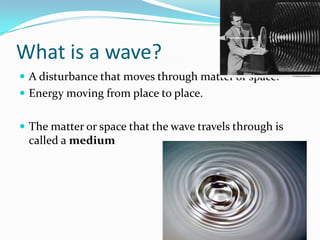
 A disturbance that moves through matter or space.
 Energy moving from place to place.


 The matter or space that the wave travels through is
 called a medium
Classification of waves
 There are two main categories of waves:
1.       Mechanical Waves (our focus now )
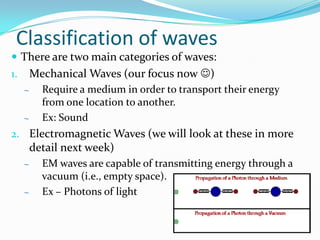
     ~     Require a medium in order to transport their energy
           from one location to another.
     ~     Ex: Sound
2. Electromagnetic Waves (we will look at these in more
         detail next week)
     ~     EM waves are capable of transmitting energy through a
           vacuum (i.e., empty space).
     ~     Ex – Photons of light
Mechanical Waves
     Two types of waves:
 1.   Longitudinal (aka Compressional)


•Longitudinal waves look like a slinky
•Direction of medium is parallel to the direction of wave
propagation (motion)
•Ex: Sound Waves - move air back and forth
Characteristics of a Longitudinal Wave

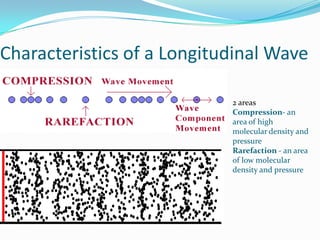
                            2 areas
                            Compression- an
                            area of high
                            molecular density and
                            pressure
                            Rarefaction - an area
                            of low molecular
                            density and pressure
Mechanical Waves
   Two types of waves:
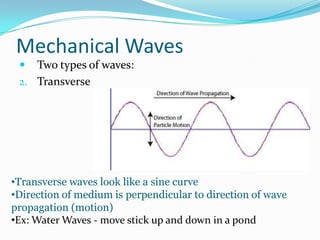
 2. Transverse


•Transverse waves look like a sine curve
•Direction of medium is perpendicular to direction of wave
propagation (motion)
•Ex: Water Waves - move stick up and down in a pond
Characteristics of a Transverse Wave
                            1)Crest- highest position
           Crest              of the wave
                            2) Trough- lowest
                              position of the wave
                            3) Wavelength- the
                              distance between two
                              ‘like’ points on a wave
                               (crest to crest; trough
                              to trough)
                            4) Amplitude- Height of
                   Trough
                              the wave (from origin
                              to crest or trough)
                            5) Frequency- The
                              number of crests that
                              pass by a point each
                              second.
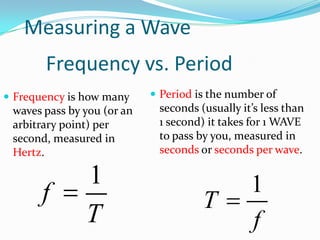
Measuring a Wave
       Frequency vs. Period
 Frequency is how many      Period is the number of
 waves pass by you (or an    seconds (usually it’s less than
 arbitrary point) per        1 second) it takes for 1 WAVE
 second, measured in         to pass by you, measured in
 Hertz.                      seconds or seconds per wave.

               1                                1
       f                              T
               T                                f
Measuring a Wave
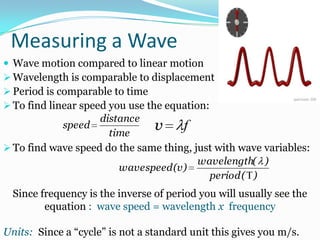
 Wave motion compared to linear motion
 Wavelength is comparable to displacement
 Period is comparable to time
 To find linear speed you use the equation:
                     distance
             speed
                       time
                                 v f
 To find wave speed do the same thing, just with wave variables:
                                          wavelength( )
                         wave speed (v)
                                             period ( )
  Since frequency is the inverse of period you will usually see the
         equation : wave speed = wavelength x frequency

Units: Since a “cycle” is not a standard unit this gives you m/s.
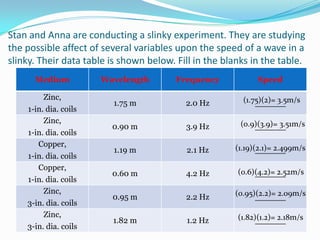
Stan and Anna are conducting a slinky experiment. They are studying
the possible affect of several variables upon the speed of a wave in a
slinky. Their data table is shown below. Fill in the blanks in the table.
      Medium           Wavelength        Frequency            Speed

         Zinc,                                           (1.75)(2)= 3.5m/s
                         1.75 m            2.0 Hz            ______
    1-in. dia. coils
         Zinc,                                           (0.9)(3.9)= 3.51m/s
                         0.90 m            3.9 Hz            ______
    1-in. dia. coils
       Copper,                                         (1.19)(2.1)= 2.499m/s
                         1.19 m            2.1 Hz             ______
    1-in. dia. coils
       Copper,
                         0.60 m            4.2 Hz       (0.6)(4.2)= 2.52m/s
                                                             ______
    1-in. dia. coils
         Zinc,                                         (0.95)(2.2)= 2.09m/s
                         0.95 m            2.2 Hz            ______
    3-in. dia. coils
         Zinc,                                          (1.82)(1.2)= 2.18m/s
                         1.82 m            1.2 Hz             ______
    3-in. dia. coils

Waves and vibrations

  • 2.
    What is awave?  A disturbance that moves through matter or space.  Energy moving from place to place.  The matter or space that the wave travels through is called a medium
  • 3.
    Classification of waves There are two main categories of waves: 1. Mechanical Waves (our focus now ) ~ Require a medium in order to transport their energy from one location to another. ~ Ex: Sound 2. Electromagnetic Waves (we will look at these in more detail next week) ~ EM waves are capable of transmitting energy through a vacuum (i.e., empty space). ~ Ex – Photons of light
  • 4.
    Mechanical Waves  Two types of waves: 1. Longitudinal (aka Compressional) •Longitudinal waves look like a slinky •Direction of medium is parallel to the direction of wave propagation (motion) •Ex: Sound Waves - move air back and forth
  • 5.
    Characteristics of aLongitudinal Wave 2 areas Compression- an area of high molecular density and pressure Rarefaction - an area of low molecular density and pressure
  • 6.
    Mechanical Waves  Two types of waves: 2. Transverse •Transverse waves look like a sine curve •Direction of medium is perpendicular to direction of wave propagation (motion) •Ex: Water Waves - move stick up and down in a pond
  • 7.
    Characteristics of aTransverse Wave 1)Crest- highest position Crest of the wave 2) Trough- lowest position of the wave 3) Wavelength- the distance between two ‘like’ points on a wave (crest to crest; trough to trough) 4) Amplitude- Height of Trough the wave (from origin to crest or trough) 5) Frequency- The number of crests that pass by a point each second.
  • 8.
    Measuring a Wave Frequency vs. Period  Frequency is how many  Period is the number of waves pass by you (or an seconds (usually it’s less than arbitrary point) per 1 second) it takes for 1 WAVE second, measured in to pass by you, measured in Hertz. seconds or seconds per wave. 1 1 f T T f
  • 9.
    Measuring a Wave Wave motion compared to linear motion  Wavelength is comparable to displacement  Period is comparable to time  To find linear speed you use the equation: distance speed time v f  To find wave speed do the same thing, just with wave variables: wavelength( ) wave speed (v) period ( ) Since frequency is the inverse of period you will usually see the equation : wave speed = wavelength x frequency Units: Since a “cycle” is not a standard unit this gives you m/s.
  • 10.
    Stan and Annaare conducting a slinky experiment. They are studying the possible affect of several variables upon the speed of a wave in a slinky. Their data table is shown below. Fill in the blanks in the table. Medium Wavelength Frequency Speed Zinc, (1.75)(2)= 3.5m/s 1.75 m 2.0 Hz ______ 1-in. dia. coils Zinc, (0.9)(3.9)= 3.51m/s 0.90 m 3.9 Hz ______ 1-in. dia. coils Copper, (1.19)(2.1)= 2.499m/s 1.19 m 2.1 Hz ______ 1-in. dia. coils Copper, 0.60 m 4.2 Hz (0.6)(4.2)= 2.52m/s ______ 1-in. dia. coils Zinc, (0.95)(2.2)= 2.09m/s 0.95 m 2.2 Hz ______ 3-in. dia. coils Zinc, (1.82)(1.2)= 2.18m/s 1.82 m 1.2 Hz ______ 3-in. dia. coils