Presented by,
Vishal.D.Patil,
Pharmaceutical chemistry
Dept,
Roll no-523
Guide:-Prof. M. S.
Phoujdar,
Dept-Pharmaceutical
chemistry
SINHGAD COLLEGE OF PHARMACY, VADGOAN, PUNE-41
Vishal.D.Patil
1
HECK REACTION, SUZUKI
COUPLING & SHARPLESS
EPOXIDATION
Contents
1. Coupling reaction
2. What are C-C
coupling reactions?
3. Main features of
cross coupling
4. Important coupling
reactions
5. Heck reaction
6. Suzuki coupling
7. Sharpless
epoxidation
Vishal.D.Patil 2
Coupling Reactions
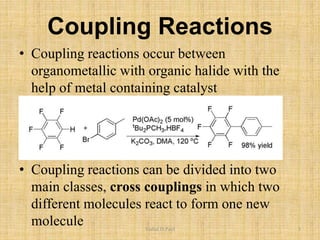
• Coupling reactions occur between
organometallic with organic halide with the
help of metal containing catalyst
• Coupling reactions can be divided into two
main classes, cross couplings in which two
different molecules react to form one new
molecule Vishal.D.Patil 3
• The other type of coupling is homocoupling,
in this reaction two similar molecules coupling
together to form a new molecule
New Trends in Cross-Coupling: Theory and Applications Thomas Colacot (Editor)
2014 Vishal.D.Patil 4
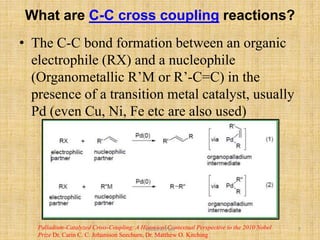
What are C-C cross coupling reactions?
• The C-C bond formation between an organic
electrophile (RX) and a nucleophile
(Organometallic R’M or R’-C=C) in the
presence of a transition metal catalyst, usually
Pd (even Cu, Ni, Fe etc are also used)
Palladium-Catalyzed Cross-Coupling: A Historical Contextual Perspective to the 2010 Nobel
Prize Dr. Carin C. C. Johansson Seechurn, Dr. Matthew O. Kitching
Vishal.D.Patil 5
Main features
Common metal used in this field is Pd, in
addition to Zn, Ni, Cu, B, and Sn
Most of coupling reactions are air and water
sensitive??
But, some coupling reactions can be carried
out in aqueous solutions
Palladium-Catalyzed Cross-Coupling: A Historical Contextual Perspective to the 2010 Nobel
Prize Dr. Carin C. C. Johansson Seechurn, Dr. Matthew O. KitchingVishal.D.Patil 6
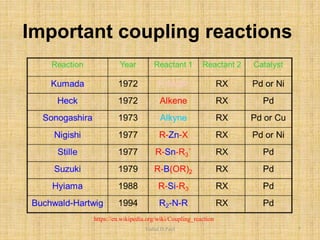
Important coupling reactions
https://en.wikipedia.org/wiki/Coupling_reaction
Vishal.D.Patil 7
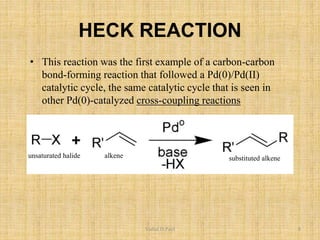
HECK REACTION
unsaturated halide alkene substituted alkene
Vishal.D.Patil 8
• This reaction was the first example of a carbon-carbon
bond-forming reaction that followed a Pd(0)/Pd(II)
catalytic cycle, the same catalytic cycle that is seen in
other Pd(0)-catalyzed cross-coupling reactions
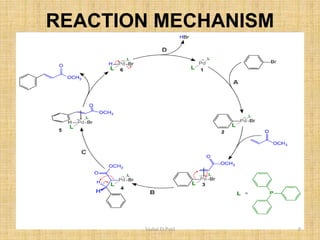
REACTION MECHANISM
Vishal.D.Patil 9
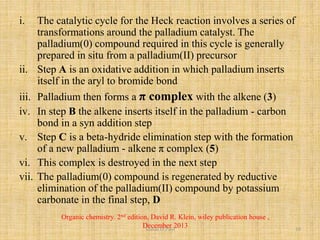
i. The catalytic cycle for the Heck reaction involves a series of
transformations around the palladium catalyst. The
palladium(0) compound required in this cycle is generally
prepared in situ from a palladium(II) precursor
ii. Step A is an oxidative addition in which palladium inserts
itself in the aryl to bromide bond
iii. Palladium then forms a π complex with the alkene (3)
iv. In step B the alkene inserts itself in the palladium - carbon
bond in a syn addition step
v. Step C is a beta-hydride elimination step with the formation
of a new palladium - alkene π complex (5)
vi. This complex is destroyed in the next step
vii. The palladium(0) compound is regenerated by reductive
elimination of the palladium(II) compound by potassium
carbonate in the final step, D
Organic chemistry. 2nd edition, David R. Klein, wiley publication house ,
December 2013Vishal.D.Patil 10
APPLICATIONS
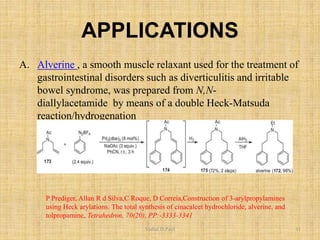
A. Alverine , a smooth muscle relaxant used for the treatment of
gastrointestinal disorders such as diverticulitis and irritable
bowel syndrome, was prepared from N,N-
diallylacetamide by means of a double Heck-Matsuda
reaction/hydrogenation
P Prediger, Allan R d Silva,C Roque, D Correia,Construction of 3-arylpropylamines
using Heck arylations. The total synthesis of cinacalcet hydrochloride, alverine, and
tolpropamine, Tetrahedron, 70(20), PP:-3333-3341
Vishal.D.Patil 11
Suzuki coupling
Vishal.D.Patil 12
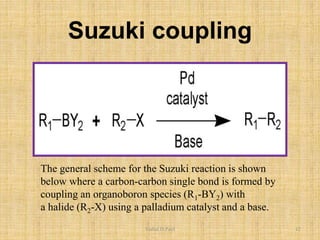
The general scheme for the Suzuki reaction is shown
below where a carbon-carbon single bond is formed by
coupling an organoboron species (R1-BY2) with
a halide (R2-X) using a palladium catalyst and a base.
REACTION MECHANISM
Vishal.D.Patil 13
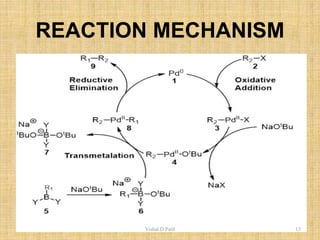
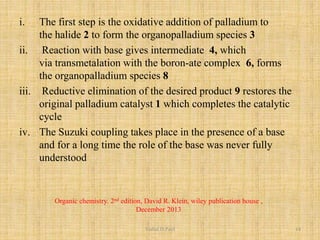
i. The first step is the oxidative addition of palladium to
the halide 2 to form the organopalladium species 3
ii. Reaction with base gives intermediate 4, which
via transmetalation with the boron-ate complex 6, forms
the organopalladium species 8
iii. Reductive elimination of the desired product 9 restores the
original palladium catalyst 1 which completes the catalytic
cycle
iv. The Suzuki coupling takes place in the presence of a base
and for a long time the role of the base was never fully
understood
Organic chemistry. 2nd edition, David R. Klein, wiley publication house ,
December 2013
Vishal.D.Patil 14
Application
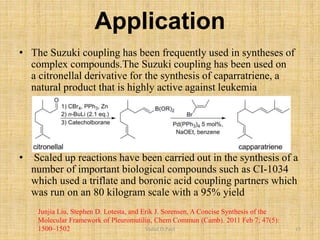
• The Suzuki coupling has been frequently used in syntheses of
complex compounds.The Suzuki coupling has been used on
a citronellal derivative for the synthesis of caparratriene, a
natural product that is highly active against leukemia
• Scaled up reactions have been carried out in the synthesis of a
number of important biological compounds such as CI-1034
which used a triflate and boronic acid coupling partners which
was run on an 80 kilogram scale with a 95% yield
Junjia Liu, Stephen D. Lotesta, and Erik J. Sorensen, A Concise Synthesis of the
Molecular Framework of Pleuromutilin, Chem Commun (Camb). 2011 Feb 7; 47(5):
1500–1502 Vishal.D.Patil 15
Epoxidation
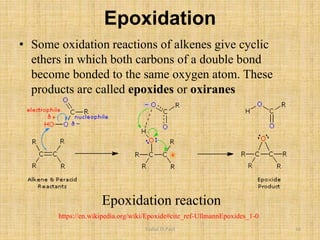
• Some oxidation reactions of alkenes give cyclic
ethers in which both carbons of a double bond
become bonded to the same oxygen atom. These
products are called epoxides or oxiranes
Epoxidation reaction
https://en.wikipedia.org/wiki/Epoxide#cite_ref-UllmannEpoxides_1-0
Vishal.D.Patil 16
Sharpless epoxidation
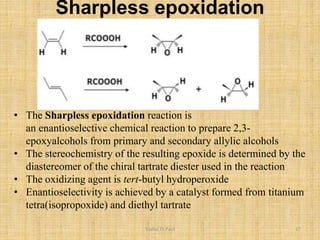
• The Sharpless epoxidation reaction is
an enantioselective chemical reaction to prepare 2,3-
epoxyalcohols from primary and secondary allylic alcohols
• The stereochemistry of the resulting epoxide is determined by the
diastereomer of the chiral tartrate diester used in the reaction
• The oxidizing agent is tert-butyl hydroperoxide
• Enantioselectivity is achieved by a catalyst formed from titanium
tetra(isopropoxide) and diethyl tartrate
Vishal.D.Patil 17
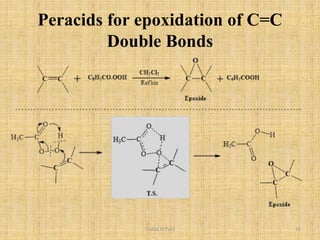
Peracids for epoxidation of C=C
Double Bonds
Vishal.D.Patil 18
Applications
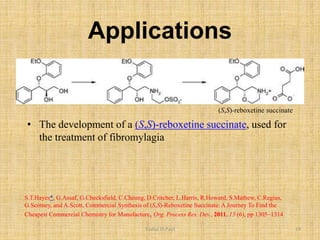
(S,S)-reboxetine succinate
S.T.Hayes*, G.Assaf, G.Checksfield, C.Cheung, D.Critcher, L.Harris, R.Howard, S.Mathew, C.Regius,
G.Scotney, and A.Scott, Commercial Synthesis of (S,S)-Reboxetine Succinate: A Journey To Find the
Cheapest Commercial Chemistry for Manufacture, Org. Process Res. Dev., 2011, 15 (6), pp 1305–1314
• The development of a (S,S)-reboxetine succinate, used for
the treatment of fibromylagia
Vishal.D.Patil 19
References
1. New Trends in Cross-Coupling: Theory and Applications Thomas Colacot (Editor)
2014
2. Palladium-Catalyzed Cross-Coupling: A Historical Contextual Perspective to the
2010 Nobel Prize Dr. Carin C. C. Johansson Seechurn, Dr. Matthew O. Kitching
3. https://en.wikipedia.org/wiki/Coupling_reaction
4. Organic chemistry. 2nd edition, David R. Klein, wiley publication house , December
2013
5. P Prediger, Allan R d Silva,C Roque, D Correia,Construction of 3-arylpropylamines
using Heck arylations. The total synthesis of cinacalcet hydrochloride, alverine, and
tolpropamine, Tetrahedron, 70(20), PP:-3333-3341
6. Junjia Liu, Stephen D. Lotesta, and Erik J. Sorensen, A Concise Synthesis of the
Molecular Framework of Pleuromutilin, Chem Commun (Camb). 2011 Feb 7;
47(5): 1500–1502
7. S.T.Hayes*, G.Assaf, G.Checksfield, C.Cheung, D.Critcher, L.Harris, R.Howard, S.
Mathew, C.Regius, G.Scotney, and A.Scott, Commercial Synthesis of (S,S)-
Reboxetine Succinate: A Journey To Find the Cheapest Commercial Chemistry for
Manufacture, Org. Process Res. Dev., 2011, 15 (6), pp 1305–1314
Vishal.D.Patil 20
Vishal.D.Patil 21

heck reaction, suzuki coupling and sharpless epoxidation

  • 1.
    Presented by, Vishal.D.Patil, Pharmaceutical chemistry Dept, Rollno-523 Guide:-Prof. M. S. Phoujdar, Dept-Pharmaceutical chemistry SINHGAD COLLEGE OF PHARMACY, VADGOAN, PUNE-41 Vishal.D.Patil 1 HECK REACTION, SUZUKI COUPLING & SHARPLESS EPOXIDATION
  • 2.
    Contents 1. Coupling reaction 2.What are C-C coupling reactions? 3. Main features of cross coupling 4. Important coupling reactions 5. Heck reaction 6. Suzuki coupling 7. Sharpless epoxidation Vishal.D.Patil 2
  • 3.
    Coupling Reactions • Couplingreactions occur between organometallic with organic halide with the help of metal containing catalyst • Coupling reactions can be divided into two main classes, cross couplings in which two different molecules react to form one new molecule Vishal.D.Patil 3
  • 4.
    • The othertype of coupling is homocoupling, in this reaction two similar molecules coupling together to form a new molecule New Trends in Cross-Coupling: Theory and Applications Thomas Colacot (Editor) 2014 Vishal.D.Patil 4
  • 5.
    What are C-Ccross coupling reactions? • The C-C bond formation between an organic electrophile (RX) and a nucleophile (Organometallic R’M or R’-C=C) in the presence of a transition metal catalyst, usually Pd (even Cu, Ni, Fe etc are also used) Palladium-Catalyzed Cross-Coupling: A Historical Contextual Perspective to the 2010 Nobel Prize Dr. Carin C. C. Johansson Seechurn, Dr. Matthew O. Kitching Vishal.D.Patil 5
  • 6.
    Main features Common metalused in this field is Pd, in addition to Zn, Ni, Cu, B, and Sn Most of coupling reactions are air and water sensitive?? But, some coupling reactions can be carried out in aqueous solutions Palladium-Catalyzed Cross-Coupling: A Historical Contextual Perspective to the 2010 Nobel Prize Dr. Carin C. C. Johansson Seechurn, Dr. Matthew O. KitchingVishal.D.Patil 6
  • 7.
  • 8.
    HECK REACTION unsaturated halidealkene substituted alkene Vishal.D.Patil 8 • This reaction was the first example of a carbon-carbon bond-forming reaction that followed a Pd(0)/Pd(II) catalytic cycle, the same catalytic cycle that is seen in other Pd(0)-catalyzed cross-coupling reactions
  • 9.
  • 10.
    i. The catalyticcycle for the Heck reaction involves a series of transformations around the palladium catalyst. The palladium(0) compound required in this cycle is generally prepared in situ from a palladium(II) precursor ii. Step A is an oxidative addition in which palladium inserts itself in the aryl to bromide bond iii. Palladium then forms a π complex with the alkene (3) iv. In step B the alkene inserts itself in the palladium - carbon bond in a syn addition step v. Step C is a beta-hydride elimination step with the formation of a new palladium - alkene π complex (5) vi. This complex is destroyed in the next step vii. The palladium(0) compound is regenerated by reductive elimination of the palladium(II) compound by potassium carbonate in the final step, D Organic chemistry. 2nd edition, David R. Klein, wiley publication house , December 2013Vishal.D.Patil 10
  • 11.
    APPLICATIONS A. Alverine ,a smooth muscle relaxant used for the treatment of gastrointestinal disorders such as diverticulitis and irritable bowel syndrome, was prepared from N,N- diallylacetamide by means of a double Heck-Matsuda reaction/hydrogenation P Prediger, Allan R d Silva,C Roque, D Correia,Construction of 3-arylpropylamines using Heck arylations. The total synthesis of cinacalcet hydrochloride, alverine, and tolpropamine, Tetrahedron, 70(20), PP:-3333-3341 Vishal.D.Patil 11
  • 12.
    Suzuki coupling Vishal.D.Patil 12 Thegeneral scheme for the Suzuki reaction is shown below where a carbon-carbon single bond is formed by coupling an organoboron species (R1-BY2) with a halide (R2-X) using a palladium catalyst and a base.
  • 13.
  • 14.
    i. The firststep is the oxidative addition of palladium to the halide 2 to form the organopalladium species 3 ii. Reaction with base gives intermediate 4, which via transmetalation with the boron-ate complex 6, forms the organopalladium species 8 iii. Reductive elimination of the desired product 9 restores the original palladium catalyst 1 which completes the catalytic cycle iv. The Suzuki coupling takes place in the presence of a base and for a long time the role of the base was never fully understood Organic chemistry. 2nd edition, David R. Klein, wiley publication house , December 2013 Vishal.D.Patil 14
  • 15.
    Application • The Suzukicoupling has been frequently used in syntheses of complex compounds.The Suzuki coupling has been used on a citronellal derivative for the synthesis of caparratriene, a natural product that is highly active against leukemia • Scaled up reactions have been carried out in the synthesis of a number of important biological compounds such as CI-1034 which used a triflate and boronic acid coupling partners which was run on an 80 kilogram scale with a 95% yield Junjia Liu, Stephen D. Lotesta, and Erik J. Sorensen, A Concise Synthesis of the Molecular Framework of Pleuromutilin, Chem Commun (Camb). 2011 Feb 7; 47(5): 1500–1502 Vishal.D.Patil 15
  • 16.
    Epoxidation • Some oxidationreactions of alkenes give cyclic ethers in which both carbons of a double bond become bonded to the same oxygen atom. These products are called epoxides or oxiranes Epoxidation reaction https://en.wikipedia.org/wiki/Epoxide#cite_ref-UllmannEpoxides_1-0 Vishal.D.Patil 16
  • 17.
    Sharpless epoxidation • TheSharpless epoxidation reaction is an enantioselective chemical reaction to prepare 2,3- epoxyalcohols from primary and secondary allylic alcohols • The stereochemistry of the resulting epoxide is determined by the diastereomer of the chiral tartrate diester used in the reaction • The oxidizing agent is tert-butyl hydroperoxide • Enantioselectivity is achieved by a catalyst formed from titanium tetra(isopropoxide) and diethyl tartrate Vishal.D.Patil 17
  • 18.
    Peracids for epoxidationof C=C Double Bonds Vishal.D.Patil 18
  • 19.
    Applications (S,S)-reboxetine succinate S.T.Hayes*, G.Assaf,G.Checksfield, C.Cheung, D.Critcher, L.Harris, R.Howard, S.Mathew, C.Regius, G.Scotney, and A.Scott, Commercial Synthesis of (S,S)-Reboxetine Succinate: A Journey To Find the Cheapest Commercial Chemistry for Manufacture, Org. Process Res. Dev., 2011, 15 (6), pp 1305–1314 • The development of a (S,S)-reboxetine succinate, used for the treatment of fibromylagia Vishal.D.Patil 19
  • 20.
    References 1. New Trendsin Cross-Coupling: Theory and Applications Thomas Colacot (Editor) 2014 2. Palladium-Catalyzed Cross-Coupling: A Historical Contextual Perspective to the 2010 Nobel Prize Dr. Carin C. C. Johansson Seechurn, Dr. Matthew O. Kitching 3. https://en.wikipedia.org/wiki/Coupling_reaction 4. Organic chemistry. 2nd edition, David R. Klein, wiley publication house , December 2013 5. P Prediger, Allan R d Silva,C Roque, D Correia,Construction of 3-arylpropylamines using Heck arylations. The total synthesis of cinacalcet hydrochloride, alverine, and tolpropamine, Tetrahedron, 70(20), PP:-3333-3341 6. Junjia Liu, Stephen D. Lotesta, and Erik J. Sorensen, A Concise Synthesis of the Molecular Framework of Pleuromutilin, Chem Commun (Camb). 2011 Feb 7; 47(5): 1500–1502 7. S.T.Hayes*, G.Assaf, G.Checksfield, C.Cheung, D.Critcher, L.Harris, R.Howard, S. Mathew, C.Regius, G.Scotney, and A.Scott, Commercial Synthesis of (S,S)- Reboxetine Succinate: A Journey To Find the Cheapest Commercial Chemistry for Manufacture, Org. Process Res. Dev., 2011, 15 (6), pp 1305–1314 Vishal.D.Patil 20
  • 21.