14. Liq. Ammonia
Dr. Shivendra Singh
UGC-NET-JRF, PhD- IIT Indore
Assistant Professor
shivendrasngh0@gmail.com
Webpage: https://sites.google.com/view/drshivendrasingh/home
Youtube: https://bit.ly/2YM0QG0
2
…Liquid ammonia
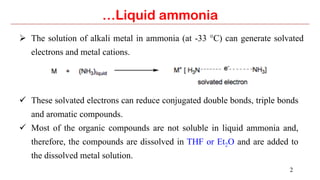
Ø  The solution of alkali metal in ammonia (at -33 °C) can generate solvated
electrons and metal cations.
ü  These solvated electrons can reduce conjugated double bonds, triple bonds
and aromatic compounds.
ü  Most of the organic compounds are not soluble in liquid ammonia and,
therefore, the compounds are dissolved in THF or Et2O and are added to
the dissolved metal solution.
3
…Liquid ammonia
Applications
1.  Reduction of Conjugated Dienes
2.  Reduction of α,β-Unsaturated Ketones
3.  Reduction of Aromatic Compounds (Birch Reduction)
4
…Liquid ammonia
1.  Reduction of Conjugated Dienes
Ø  The conjugated dienes are readily reduced to the corresponding 1,4-
dihydro compounds with dissolved metal ammonia reagents.
5
…Liquid ammonia
2. Reduction of α,β-Unsaturated Ketones
ü  The α,β-unsaturated ketones could be reduced to the corresponding
saturated carbonyl compounds or alcohols depending on the reaction
conditions with dissolved metal in ammonia.
ü  For examples, the α,β-unsaturated ketone, cyperone, when treated with
lithium in ammonia, it gives the corresponding saturated ketone but when
treated with lithium in ammonia and ethanol, a good proton source, it
gives the corresponding alcohol.
6
…Liquid ammonia
7
…Liquid ammonia
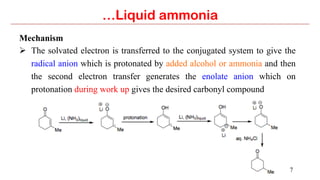
Mechanism
Ø  The solvated electron is transferred to the conjugated system to give the
radical anion which is protonated by added alcohol or ammonia and then
the second electron transfer generates the enolate anion which on
protonation during work up gives the desired carbonyl compound
8
…Liquid ammonia
3. Reduction of Aromatic Compounds (Birch Reduction)
Ø  The reduction of aromatic compounds to 1,4-cyclohexadiene compounds in
presence of alkali metal liquid ammonia and an alcohol is called Birch
reduction.
Ø  A variety of aromatic compounds containing electron donating or electron
withdrawing groups could be readily converted to the corresponding 1,4-
cyclohexadiene derivatives
9
…Liquid ammonia
Ø  The regioselectivity towards the products in Birch reduction of substituted aromatic
compound depends on the nature of the substituent.
Ø  For example, the electron donating substituent such as alkyl or alkoxy group remains
on the unreduced carbon where as the electron withdrawing groups such as carboxylic
acid or primary amide remains on reduced carbon almost exclusively
ü  The aldehydes and esters groups are in the electron donation side because these
are reduced to the corresponding alcohols in Birch condition before the reduction of
aromatic ring.
10
…Liquid ammonia
11
…Liquid ammonia
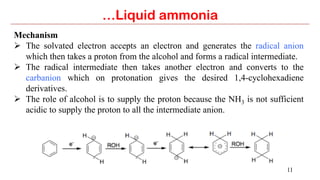
Mechanism
Ø  The solvated electron accepts an electron and generates the radical anion
which then takes a proton from the alcohol and forms a radical intermediate.
Ø  The radical intermediate then takes another electron and converts to the
carbanion which on protonation gives the desired 1,4-cyclohexadiene
derivatives.
Ø  The role of alcohol is to supply the proton because the NH3 is not sufficient
acidic to supply the proton to all the intermediate anion.
12
…Liquid ammonia
Applications
1.  Reduction of Conjugated Dienes
2.  Reduction of α,β-Unsaturated Ketones
3.  Reduction of Aromatic Compounds (Birch Reduction)

14. liq. ammonia

  • 1.
    14. Liq. Ammonia Dr.Shivendra Singh UGC-NET-JRF, PhD- IIT Indore Assistant Professor shivendrasngh0@gmail.com Webpage: https://sites.google.com/view/drshivendrasingh/home Youtube: https://bit.ly/2YM0QG0
  • 2.
    2 …Liquid ammonia Ø  Thesolution of alkali metal in ammonia (at -33 °C) can generate solvated electrons and metal cations. ü  These solvated electrons can reduce conjugated double bonds, triple bonds and aromatic compounds. ü  Most of the organic compounds are not soluble in liquid ammonia and, therefore, the compounds are dissolved in THF or Et2O and are added to the dissolved metal solution.
  • 3.
    3 …Liquid ammonia Applications 1.  Reductionof Conjugated Dienes 2.  Reduction of α,β-Unsaturated Ketones 3.  Reduction of Aromatic Compounds (Birch Reduction)
  • 4.
    4 …Liquid ammonia 1.  Reductionof Conjugated Dienes Ø  The conjugated dienes are readily reduced to the corresponding 1,4- dihydro compounds with dissolved metal ammonia reagents.
  • 5.
    5 …Liquid ammonia 2. Reductionof α,β-Unsaturated Ketones ü  The α,β-unsaturated ketones could be reduced to the corresponding saturated carbonyl compounds or alcohols depending on the reaction conditions with dissolved metal in ammonia. ü  For examples, the α,β-unsaturated ketone, cyperone, when treated with lithium in ammonia, it gives the corresponding saturated ketone but when treated with lithium in ammonia and ethanol, a good proton source, it gives the corresponding alcohol.
  • 6.
  • 7.
    7 …Liquid ammonia Mechanism Ø  Thesolvated electron is transferred to the conjugated system to give the radical anion which is protonated by added alcohol or ammonia and then the second electron transfer generates the enolate anion which on protonation during work up gives the desired carbonyl compound
  • 8.
    8 …Liquid ammonia 3. Reductionof Aromatic Compounds (Birch Reduction) Ø  The reduction of aromatic compounds to 1,4-cyclohexadiene compounds in presence of alkali metal liquid ammonia and an alcohol is called Birch reduction. Ø  A variety of aromatic compounds containing electron donating or electron withdrawing groups could be readily converted to the corresponding 1,4- cyclohexadiene derivatives
  • 9.
    9 …Liquid ammonia Ø  Theregioselectivity towards the products in Birch reduction of substituted aromatic compound depends on the nature of the substituent. Ø  For example, the electron donating substituent such as alkyl or alkoxy group remains on the unreduced carbon where as the electron withdrawing groups such as carboxylic acid or primary amide remains on reduced carbon almost exclusively ü  The aldehydes and esters groups are in the electron donation side because these are reduced to the corresponding alcohols in Birch condition before the reduction of aromatic ring.
  • 10.
  • 11.
    11 …Liquid ammonia Mechanism Ø  Thesolvated electron accepts an electron and generates the radical anion which then takes a proton from the alcohol and forms a radical intermediate. Ø  The radical intermediate then takes another electron and converts to the carbanion which on protonation gives the desired 1,4-cyclohexadiene derivatives. Ø  The role of alcohol is to supply the proton because the NH3 is not sufficient acidic to supply the proton to all the intermediate anion.
  • 12.
    12 …Liquid ammonia Applications 1.  Reductionof Conjugated Dienes 2.  Reduction of α,β-Unsaturated Ketones 3.  Reduction of Aromatic Compounds (Birch Reduction)