9. NBS
Dr. Shivendra Singh
UGC-NET-JRF, PhD- IIT Indore
Assistant Professor
shivendrasngh0@gmail.com
Webpage: https://sites.google.com/view/drshivendrasingh/home
Youtube: https://bit.ly/2YM0QG0
2
…N-Bromosuccinimide
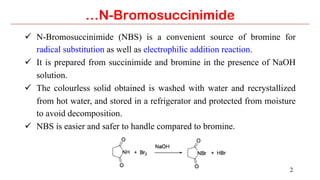
ü  N-Bromosuccinimide (NBS) is a convenient source of bromine for
radical substitution as well as electrophilic addition reaction.
ü  It is prepared from succinimide and bromine in the presence of NaOH
solution.
ü  The colourless solid obtained is washed with water and recrystallized
from hot water, and stored in a refrigerator and protected from moisture
to avoid decomposition.
ü  NBS is easier and safer to handle compared to bromine.
3
…N-Bromosuccinimide
Ø  Applications
1.  Allylic and Benzylic Brominations
2.  Alpha-bromination
3.  Addition reactions
4
…N-Bromosuccinimide
1. Allylic and Benzylic Brominations:
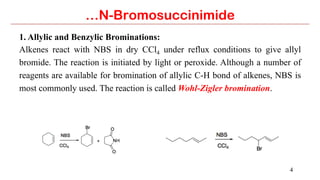
Alkenes react with NBS in dry CCl4 under reflux conditions to give allyl
bromide. The reaction is initiated by light or peroxide. Although a number of
reagents are available for bromination of allylic C-H bond of alkenes, NBS is
most commonly used. The reaction is called Wohl-Zigler bromination.
5
…N-Bromosuccinimide
6
…N-Bromosuccinimide
7
…N-Bromosuccinimide
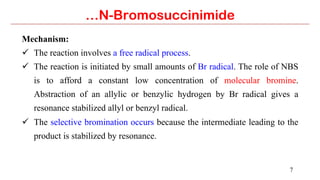
Mechanism:
ü  The reaction involves a free radical process.
ü  The reaction is initiated by small amounts of Br radical. The role of NBS
is to afford a constant low concentration of molecular bromine.
Abstraction of an allylic or benzylic hydrogen by Br radical gives a
resonance stabilized allyl or benzyl radical.
ü  The selective bromination occurs because the intermediate leading to the
product is stabilized by resonance.
8
…N-Bromosuccinimide
9
…N-Bromosuccinimide
10
…N-Bromosuccinimide
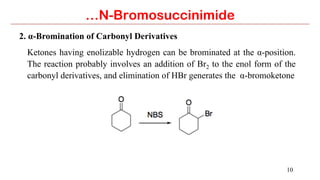
2. α-Bromination of Carbonyl Derivatives
Ketones having enolizable hydrogen can be brominated at the α-position.
The reaction probably involves an addition of Br2 to the enol form of the
carbonyl derivatives, and elimination of HBr generates the α-bromoketone
11
…N-Bromosuccinimide
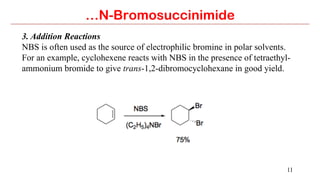
3. Addition Reactions
NBS is often used as the source of electrophilic bromine in polar solvents.
For an example, cyclohexene reacts with NBS in the presence of tetraethyl-
ammonium bromide to give trans-1,2-dibromocyclohexane in good yield.
12
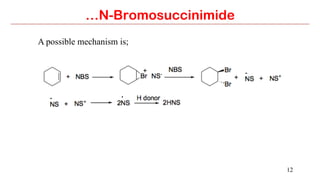
…N-Bromosuccinimide
A possible mechanism is;
13
…N-Bromosuccinimide
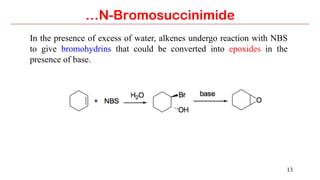
In the presence of excess of water, alkenes undergo reaction with NBS
to give bromohydrins that could be converted into epoxides in the
presence of base.

9. NBS

  • 1.
    9. NBS Dr. ShivendraSingh UGC-NET-JRF, PhD- IIT Indore Assistant Professor shivendrasngh0@gmail.com Webpage: https://sites.google.com/view/drshivendrasingh/home Youtube: https://bit.ly/2YM0QG0
  • 2.
    2 …N-Bromosuccinimide ü  N-Bromosuccinimide (NBS)is a convenient source of bromine for radical substitution as well as electrophilic addition reaction. ü  It is prepared from succinimide and bromine in the presence of NaOH solution. ü  The colourless solid obtained is washed with water and recrystallized from hot water, and stored in a refrigerator and protected from moisture to avoid decomposition. ü  NBS is easier and safer to handle compared to bromine.
  • 3.
    3 …N-Bromosuccinimide Ø  Applications 1.  Allylicand Benzylic Brominations 2.  Alpha-bromination 3.  Addition reactions
  • 4.
    4 …N-Bromosuccinimide 1. Allylic andBenzylic Brominations: Alkenes react with NBS in dry CCl4 under reflux conditions to give allyl bromide. The reaction is initiated by light or peroxide. Although a number of reagents are available for bromination of allylic C-H bond of alkenes, NBS is most commonly used. The reaction is called Wohl-Zigler bromination.
  • 5.
  • 6.
  • 7.
    7 …N-Bromosuccinimide Mechanism: ü  The reactioninvolves a free radical process. ü  The reaction is initiated by small amounts of Br radical. The role of NBS is to afford a constant low concentration of molecular bromine. Abstraction of an allylic or benzylic hydrogen by Br radical gives a resonance stabilized allyl or benzyl radical. ü  The selective bromination occurs because the intermediate leading to the product is stabilized by resonance.
  • 8.
  • 9.
  • 10.
    10 …N-Bromosuccinimide 2. α-Bromination ofCarbonyl Derivatives Ketones having enolizable hydrogen can be brominated at the α-position. The reaction probably involves an addition of Br2 to the enol form of the carbonyl derivatives, and elimination of HBr generates the α-bromoketone
  • 11.
    11 …N-Bromosuccinimide 3. Addition Reactions NBSis often used as the source of electrophilic bromine in polar solvents. For an example, cyclohexene reacts with NBS in the presence of tetraethyl- ammonium bromide to give trans-1,2-dibromocyclohexane in good yield.
  • 12.
  • 13.
    13 …N-Bromosuccinimide In the presenceof excess of water, alkenes undergo reaction with NBS to give bromohydrins that could be converted into epoxides in the presence of base.