10. Lead tetra acetate (Criegee Reagent)
Dr. Shivendra Singh
UGC-NET-JRF, PhD- IIT Indore
Assistant Professor
shivendrasngh0@gmail.com
Webpage: https://sites.google.com/view/drshivendrasingh/home
Youtube: https://bit.ly/2YM0QG0
2
…Lead tetra acetate (Criegee Reagent)
ü  Lead tetraacetate (LTA) is one of the powerful common oxidizing reagents
available with wide applications for organic synthesis.
ü  The reagent is very toxic, hygroscopic and turns brown due to lead dioxide
formation on exposure to air. Therefore, the reagent is to be handled with
extreme care in a chemical hood.
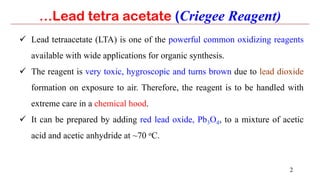
ü  It can be prepared by adding red lead oxide, Pb3O4, to a mixture of acetic
acid and acetic anhydride at ~70 oC.
3
…Lead tetra acetate
1. Reaction with Alcohols
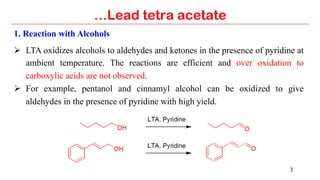
Ø  LTA oxidizes alcohols to aldehydes and ketones in the presence of pyridine at
ambient temperature. The reactions are efficient and over oxidation to
carboxylic acids are not observed.
Ø  For example, pentanol and cinnamyl alcohol can be oxidized to give
aldehydes in the presence of pyridine with high yield.
4
…Lead tetra acetate
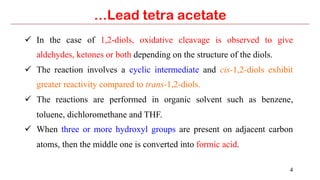
ü  In the case of 1,2-diols, oxidative cleavage is observed to give
aldehydes, ketones or both depending on the structure of the diols.
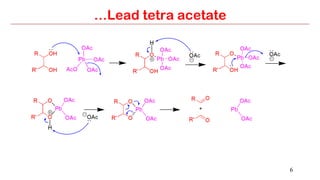
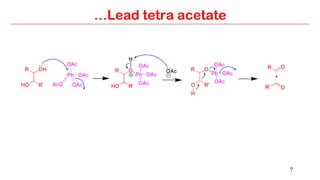
ü  The reaction involves a cyclic intermediate and cis-1,2-diols exhibit
greater reactivity compared to trans-1,2-diols.
ü  The reactions are performed in organic solvent such as benzene,
toluene, dichloromethane and THF.
ü  When three or more hydroxyl groups are present on adjacent carbon
atoms, then the middle one is converted into formic acid.
5
…Lead tetra acetate
Ø  Cis-diols are cleaved more readily compared to trans diols. Different mechanistic
interpretations are thus proposed for the two processes.
6
…Lead tetra acetate
7
…Lead tetra acetate
8
…Lead tetra acetate
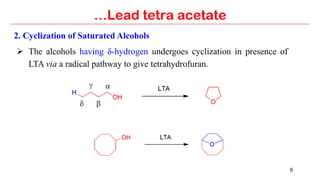
2. Cyclization of Saturated Alcohols
Ø  The alcohols having δ-hydrogen undergoes cyclization in presence of
LTA via a radical pathway to give tetrahydrofuran.
9
…Lead tetra acetate
.
.
a b c
d
10
…Lead tetra acetate
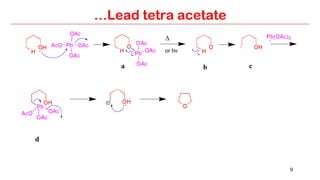
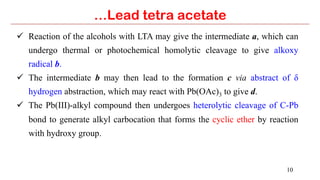
ü  Reaction of the alcohols with LTA may give the intermediate a, which can
undergo thermal or photochemical homolytic cleavage to give alkoxy
radical b.
ü  The intermediate b may then lead to the formation c via abstract of δ
hydrogen abstraction, which may react with Pb(OAc)3 to give d.
ü  The Pb(III)-alkyl compound then undergoes heterolytic cleavage of C-Pb
bond to generate alkyl carbocation that forms the cyclic ether by reaction
with hydroxy group.
11
…Lead tetra acetate
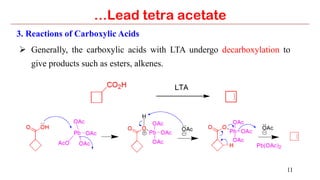
3. Reactions of Carboxylic Acids
Ø  Generally, the carboxylic acids with LTA undergo decarboxylation to
give products such as esters, alkenes.
12
…Lead tetra acetate
13
…Lead tetra acetate
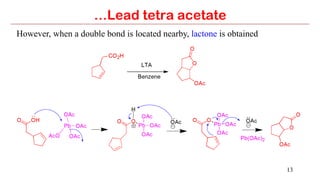
However, when a double bond is located nearby, lactone is obtained
14
…Lead tetra acetate
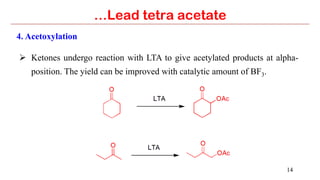
4. Acetoxylation
Ø  Ketones undergo reaction with LTA to give acetylated products at alpha-
position. The yield can be improved with catalytic amount of BF3.
15
…Lead tetra acetate
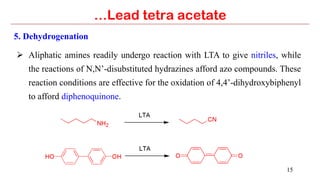
5. Dehydrogenation
Ø  Aliphatic amines readily undergo reaction with LTA to give nitriles, while
the reactions of N,N’-disubstituted hydrazines afford azo compounds. These
reaction conditions are effective for the oxidation of 4,4’-dihydroxybiphenyl
to afford diphenoquinone.
16
…Lead tetra acetate: Summary
Ø  Applications:
1.  Reaction with Alcohols
2.  Cyclization of Saturated Alcohols
3.  Reactions of Carboxylic Acids
4.  Acetoxylation
5.  Dehydrogenation

10. Lead tetra acetate

  • 1.
    10. Lead tetraacetate (Criegee Reagent) Dr. Shivendra Singh UGC-NET-JRF, PhD- IIT Indore Assistant Professor shivendrasngh0@gmail.com Webpage: https://sites.google.com/view/drshivendrasingh/home Youtube: https://bit.ly/2YM0QG0
  • 2.
    2 …Lead tetra acetate(Criegee Reagent) ü  Lead tetraacetate (LTA) is one of the powerful common oxidizing reagents available with wide applications for organic synthesis. ü  The reagent is very toxic, hygroscopic and turns brown due to lead dioxide formation on exposure to air. Therefore, the reagent is to be handled with extreme care in a chemical hood. ü  It can be prepared by adding red lead oxide, Pb3O4, to a mixture of acetic acid and acetic anhydride at ~70 oC.
  • 3.
    3 …Lead tetra acetate 1.Reaction with Alcohols Ø  LTA oxidizes alcohols to aldehydes and ketones in the presence of pyridine at ambient temperature. The reactions are efficient and over oxidation to carboxylic acids are not observed. Ø  For example, pentanol and cinnamyl alcohol can be oxidized to give aldehydes in the presence of pyridine with high yield.
  • 4.
    4 …Lead tetra acetate ü In the case of 1,2-diols, oxidative cleavage is observed to give aldehydes, ketones or both depending on the structure of the diols. ü  The reaction involves a cyclic intermediate and cis-1,2-diols exhibit greater reactivity compared to trans-1,2-diols. ü  The reactions are performed in organic solvent such as benzene, toluene, dichloromethane and THF. ü  When three or more hydroxyl groups are present on adjacent carbon atoms, then the middle one is converted into formic acid.
  • 5.
    5 …Lead tetra acetate Ø Cis-diols are cleaved more readily compared to trans diols. Different mechanistic interpretations are thus proposed for the two processes.
  • 6.
  • 7.
  • 8.
    8 …Lead tetra acetate 2.Cyclization of Saturated Alcohols Ø  The alcohols having δ-hydrogen undergoes cyclization in presence of LTA via a radical pathway to give tetrahydrofuran.
  • 9.
  • 10.
    10 …Lead tetra acetate ü Reaction of the alcohols with LTA may give the intermediate a, which can undergo thermal or photochemical homolytic cleavage to give alkoxy radical b. ü  The intermediate b may then lead to the formation c via abstract of δ hydrogen abstraction, which may react with Pb(OAc)3 to give d. ü  The Pb(III)-alkyl compound then undergoes heterolytic cleavage of C-Pb bond to generate alkyl carbocation that forms the cyclic ether by reaction with hydroxy group.
  • 11.
    11 …Lead tetra acetate 3.Reactions of Carboxylic Acids Ø  Generally, the carboxylic acids with LTA undergo decarboxylation to give products such as esters, alkenes.
  • 12.
  • 13.
    13 …Lead tetra acetate However,when a double bond is located nearby, lactone is obtained
  • 14.
    14 …Lead tetra acetate 4.Acetoxylation Ø  Ketones undergo reaction with LTA to give acetylated products at alpha- position. The yield can be improved with catalytic amount of BF3.
  • 15.
    15 …Lead tetra acetate 5.Dehydrogenation Ø  Aliphatic amines readily undergo reaction with LTA to give nitriles, while the reactions of N,N’-disubstituted hydrazines afford azo compounds. These reaction conditions are effective for the oxidation of 4,4’-dihydroxybiphenyl to afford diphenoquinone.
  • 16.
    16 …Lead tetra acetate:Summary Ø  Applications: 1.  Reaction with Alcohols 2.  Cyclization of Saturated Alcohols 3.  Reactions of Carboxylic Acids 4.  Acetoxylation 5.  Dehydrogenation