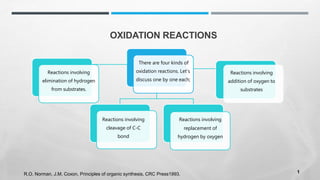
OXIDATION REACTIONS
COURSE CONTENT(WEEK-8+9)
CHEM-311
DR. EHSAN ULLAH MUGHAL
ASSOCIATE PROFESSOR
DEPARTMENT OF CHEMISTRY
UNIVERSITY OF GUJRAT
(H.H. CAMPUS)
2.
Table of Contents
Sr.No. Contents Slide No.
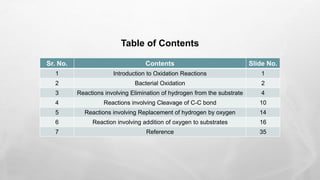
1 Introduction to Oxidation Reactions 1
2 Bacterial Oxidation 2
3 Reactions involving Elimination of hydrogen from the substrate 4
4 Reactions involving Cleavage of C-C bond 10
5 Reactions involving Replacement of hydrogen by oxygen 14
6 Reaction involving addition of oxygen to substrates 16
7 Reference 35
3.
OXIDATION REACTIONS
There arefour kinds of
oxidation reactions. Let’s
discuss one by one each;
Reactions involving
replacement of
hydrogen by oxygen
Reactions involving
elimination of hydrogen
from substrates.
Reactions involving
addition of oxygen to
substrates
Reactions involving
cleavage of C-C
bond
R.O. Norman, J.M. Coxon, Principles of organic synthesis, CRC Press1993. 1
4.
BACTERIAL OXIDATION
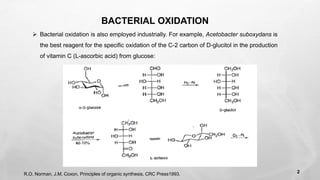
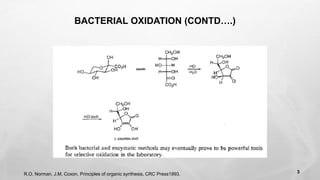
➢ Bacterialoxidation is also employed industrially. For example, Acetobacter suboxydans is
the best reagent for the specific oxidation of the C-2 carbon of D-glucitol in the production
of vitamin C (L-ascorbic acid) from glucose:
R.O. Norman, J.M. Coxon, Principles of organic synthesis, CRC Press1993. 2
1.REACTIONS
INVOLVING
ELIMINATION
OF HYDROGEN
FROM
SUBSTRATES
Oxidation ofalcohols
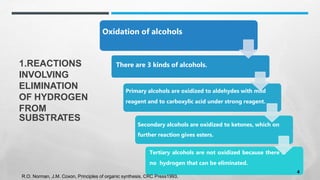
There are 3 kinds of alcohols.
Primary alcohols are oxidized to aldehydes with mild
reagent and to carboxylic acid under strong reagent.
Secondary alcohols are oxidized to ketones, which on
further reaction gives esters.
Tertiary alcohols are not oxidized because there is
no hydrogen that can be eliminated.
R.O. Norman, J.M. Coxon, Principles of organic synthesis, CRC Press1993.
4
7.
OXIDATION OF
ALCOHOLS
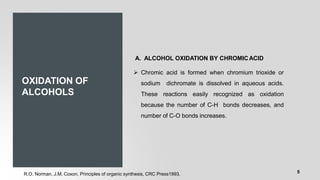
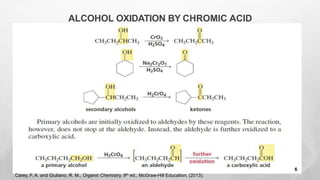
A. ALCOHOLOXIDATION BY CHROMICACID
➢ Chromic acid is formed when chromium trioxide or
sodium dichromate is dissolved in aqueous acids.
These reactions easily recognized as oxidation
because the number of C-H bonds decreases, and
number of C-O bonds increases.
R.O. Norman, J.M. Coxon, Principles of organic synthesis, CRC Press1993. 5
8.
ALCOHOL OXIDATION BYCHROMIC ACID
Carey, F. A. and Giuliano, R. M., Organic Chemistry, 9th ed., McGraw-Hill Education, (2013).
6
9.
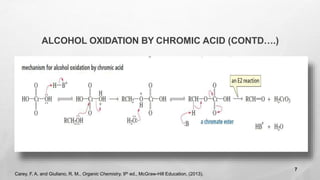
ALCOHOL OXIDATION BYCHROMIC ACID (CONTD….)
MECHANISM
Carey, F. A. and Giuliano, R. M., Organic Chemistry, 9th ed., McGraw-Hill Education, (2013).
7
➢ When certaintypes of compounds such as;
➢ [1,2-diols (vicinal diols), alkenes, and alkynes], are treated with
certain reagents, carbon-carbon bonds are cleaved, and carbon
oxygen bonds are formed. When we increase the number of C-O
bonds at the expense of C-C or C-H bonds, that’s referred to as
“oxidation“.
CLEAVAGE OF C-C BOND
R.O. Norman, J.M. Coxon, Principles of organic synthesis, CRC Press1993.
10
13.
EXAMPLES OF CLEAVAGEOF C-C BOND
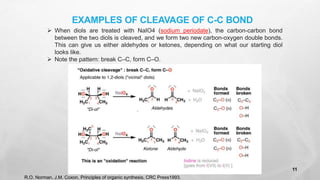
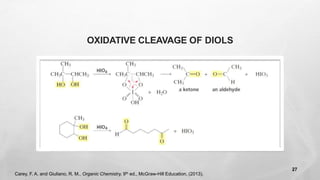
➢ When diols are treated with NaIO4 (sodium periodate), the carbon-carbon bond
between the two diols is cleaved, and we form two new carbon-oxygen double bonds.
This can give us either aldehydes or ketones, depending on what our starting diol
looks like.
➢ Note the pattern: break C–C, form C–O.
R.O. Norman, J.M. Coxon, Principles of organic synthesis, CRC Press1993.
11
14.
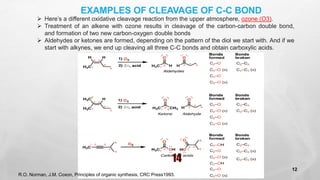
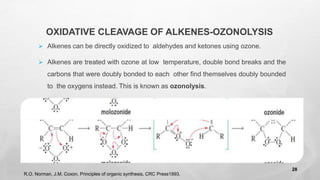
➢ Here’s adifferent oxidative cleavage reaction from the upper atmosphere, ozone (O3).
➢ Treatment of an alkene with ozone results in cleavage of the carbon-carbon double bond,
and formation of two new carbon-oxygen double bonds
➢ Aldehydes or ketones are formed, depending on the pattern of the diol we start with. And if we
start with alkynes, we end up cleaving all three C-C bonds and obtain carboxylic acids.
EXAMPLES OF CLEAVAGE OF C-C BOND
R.O. Norman, J.M. Coxon, Principles of organic synthesis, CRC Press1993.
14
12
15.
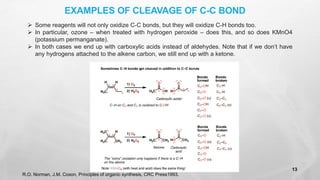
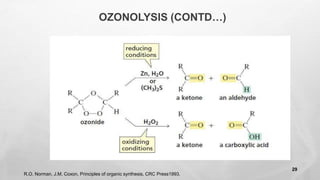
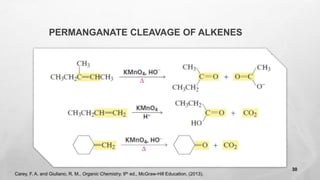
➢ Some reagentswill not only oxidize C-C bonds, but they will oxidize C-H bonds too.
➢ In particular, ozone – when treated with hydrogen peroxide – does this, and so does KMnO4
(potassium permanganate).
➢ In both cases we end up with carboxylic acids instead of aldehydes. Note that if we don’t have
any hydrogens attached to the alkene carbon, we still end up with a ketone.
EXAMPLES OF CLEAVAGE OF C-C BOND
R.O. Norman, J.M. Coxon, Principles of organic synthesis, CRC Press1993.
13
16.
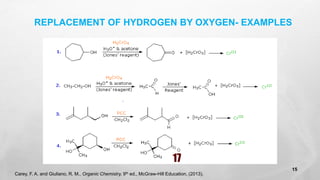
REPLACEMENT OF HYDROGENBY OXYGEN
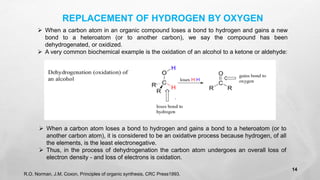
➢ When a carbon atom in an organic compound loses a bond to hydrogen and gains a new
bond to a heteroatom (or to another carbon), we say the compound has been
dehydrogenated, or oxidized.
➢ A very common biochemical example is the oxidation of an alcohol to a ketone or aldehyde:
➢ When a carbon atom loses a bond to hydrogen and gains a bond to a heteroatom (or to
another carbon atom), it is considered to be an oxidative process because hydrogen, of all
the elements, is the least electronegative.
➢ Thus, in the process of dehydrogenation the carbon atom undergoes an overall loss of
electron density - and loss of electrons is oxidation.
R.O. Norman, J.M. Coxon, Principles of organic synthesis, CRC Press1993.
14
17.
REPLACEMENT OF HYDROGENBY OXYGEN- EXAMPLES
Carey, F. A. and Giuliano, R. M., Organic Chemistry, 9th ed., McGraw-Hill Education, (2013).
17
15
18.
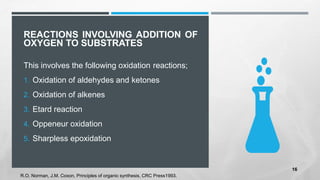
REACTIONS INVOLVING ADDITIONOF
OXYGEN TO SUBSTRATES
This involves the following oxidation reactions;
1. Oxidation of aldehydes and ketones
2. Oxidation of alkenes
3. Etard reaction
4. Oppeneur oxidation
5. Sharpless epoxidation
R.O. Norman, J.M. Coxon, Principles of organic synthesis, CRC Press1993.
16
19.
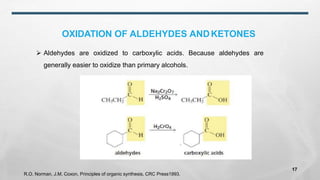
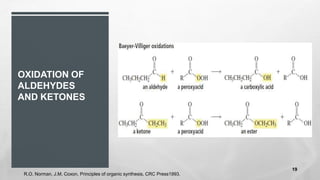
OXIDATION OF ALDEHYDESANDKETONES
➢ Aldehydes are oxidized to carboxylic acids. Because aldehydes are
generally easier to oxidize than primary alcohols.
R.O. Norman, J.M. Coxon, Principles of organic synthesis, CRC Press1993.
17
20.
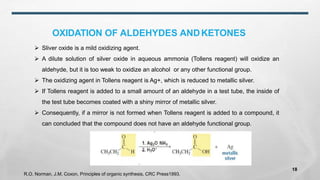
OXIDATION OF ALDEHYDESANDKETONES
➢ Sliver oxide is a mild oxidizing agent.
➢ A dilute solution of silver oxide in aqueous ammonia (Tollens reagent) will oxidize an
aldehyde, but it is too weak to oxidize an alcohol or any other functional group.
➢ The oxidizing agent in Tollens reagent is Ag+, which is reduced to metallic silver.
➢ If Tollens reagent is added to a small amount of an aldehyde in a test tube, the inside of
the test tube becomes coated with a shiny mirror of metallic silver.
➢ Consequently, if a mirror is not formed when Tollens reagent is added to a compound, it
can concluded that the compound does not have an aldehyde functional group.
R.O. Norman, J.M. Coxon, Principles of organic synthesis, CRC Press1993.
18
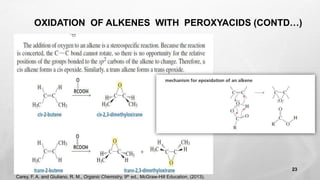
OXIDATION OF ALKENESWITH PEROXYACIDS (CONTD…)
Carey, F. A. and Giuliano, R. M., Organic Chemistry, 9th ed., McGraw-Hill Education, (2013).
23
26.
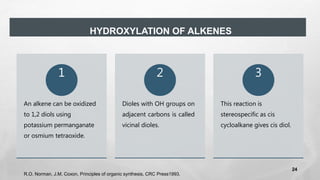
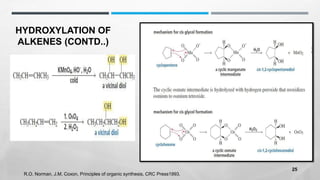
HYDROXYLATION OF ALKENES
1
Analkene can be oxidized
to 1,2 diols using
potassium permanganate
or osmium tetraoxide.
2
Dioles with OH groups on
adjacent carbons is called
vicinal dioles.
3
This reaction is
stereospecific as cis
cycloalkane gives cis diol.
R.O. Norman, J.M. Coxon, Principles of organic synthesis, CRC Press1993.
24
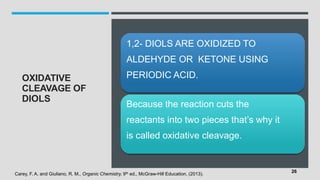
OXIDATIVE
CLEAVAGE OF
DIOLS
1,2- DIOLSARE OXIDIZED TO
ALDEHYDE OR KETONE USING
PERIODIC ACID.
Because the reaction cuts the
reactants into two pieces that’s why it
is called oxidative cleavage.
Carey, F. A. and Giuliano, R. M., Organic Chemistry, 9th ed., McGraw-Hill Education, (2013).
26
29.
OXIDATIVE CLEAVAGE OFDIOLS
Carey, F. A. and Giuliano, R. M., Organic Chemistry, 9th ed., McGraw-Hill Education, (2013).
27
30.
➢ Alkenes canbe directly oxidized to aldehydes and ketones using ozone.
➢ Alkenes are treated with ozone at low temperature, double bond breaks and the
carbons that were doubly bonded to each other find themselves doubly bounded
to the oxygens instead. This is known as ozonolysis.
OXIDATIVE CLEAVAGE OF ALKENES-OZONOLYSIS
R.O. Norman, J.M. Coxon, Principles of organic synthesis, CRC Press1993.
28
PERMANGANATE CLEAVAGE OFALKENES
Carey, F. A. and Giuliano, R. M., Organic Chemistry, 9th ed., McGraw-Hill Education, (2013).
30
33.
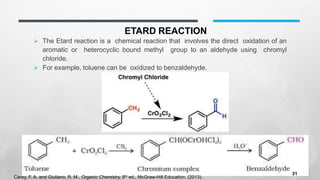
ETARD REACTION
➢ TheEtard reaction is a chemical reaction that involves the direct oxidation of an
aromatic or heterocyclic bound methyl group to an aldehyde using chromyl
chloride.
➢ For example, toluene can be oxidized to benzaldehyde.
Carey, F. A. and Giuliano, R. M., Organic Chemistry, 9th ed., McGraw-Hill Education, (2013).
31
34.
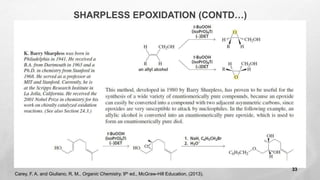
SHARPLESS
EPOXIDATION
The Sharplessepoxidation reaction is an
enantioselective chemical reaction to
prepare 2,3-epoxyalcohols from primary
and secondary allylic alcohols. The
stereochemistry of the resulting epoxide
is determined by the enantiomer of the
chiral tartrate diester employed in the
reaction.
R.O. Norman, J.M. Coxon, Principles of organic synthesis, CRC Press1993.
32
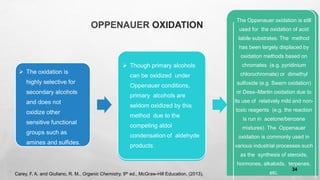
OPPENAUER OXIDATION
➢ Theoxidation is
highly selective for
secondary alcohols
and does not
oxidize other
sensitive functional
groups such as
amines and sulfides.
➢ Though primary alcohols
can be oxidized under
Oppenauer conditions,
primary alcohols are
seldom oxidized by this
method due to the
competing aldol
condensation of aldehyde
products.
The Oppenauer oxidation is still
used for the oxidation of acid
labile substrates. The method
has been largely displaced by
oxidation methods based on
chromates (e.g. pyridinium
chlorochromate) or dimethyl
sulfoxide (e.g. Swern oxidation)
or Dess–Martin oxidation due to
its use of relatively mild and non-
toxic reagents (e.g. the reaction
is run in acetone/benzene
mixtures). The Oppenauer
oxidation is commonly used in
various industrial processes such
as the synthesis of steroids,
hormones, alkaloids, terpenes,
etc.
Carey, F. A. and Giuliano, R. M., Organic Chemistry, 9th ed., McGraw-Hill Education, (2013).
34
37.
Reference
➢ Carey, F.A. and Giuliano, R. M., Organic Chemistry, 9th ed., McGraw-Hill
Education, (2013).
➢ R.O. Norman, J.M. Coxon, Principles of organic synthesis, CRC Press1993.
35
![➢ When certain types of compounds such as;
➢ [1,2-diols (vicinal diols), alkenes, and alkynes], are treated with
certain reagents, carbon-carbon bonds are cleaved, and carbon
oxygen bonds are formed. When we increase the number of C-O
bonds at the expense of C-C or C-H bonds, that’s referred to as
“oxidation“.
CLEAVAGE OF C-C BOND
R.O. Norman, J.M. Coxon, Principles of organic synthesis, CRC Press1993.
10](https://image.slidesharecdn.com/oxidationchem-311-250419185838-8a8d8d91/85/Oxidation-CHEM-311-pdf-12-320.jpg)