Dr. Shivendra Singh
UGC-NET-JRF, PhD- IIT Indore
Assistant Professor
shivendrasngh0@gmail.com
Webpage: https://sites.google.com/view/drshivendrasingh/home
Youtube: https://bit.ly/2YM0QG0
6. Fenton’s Reagent
…Fenton’s Reagent
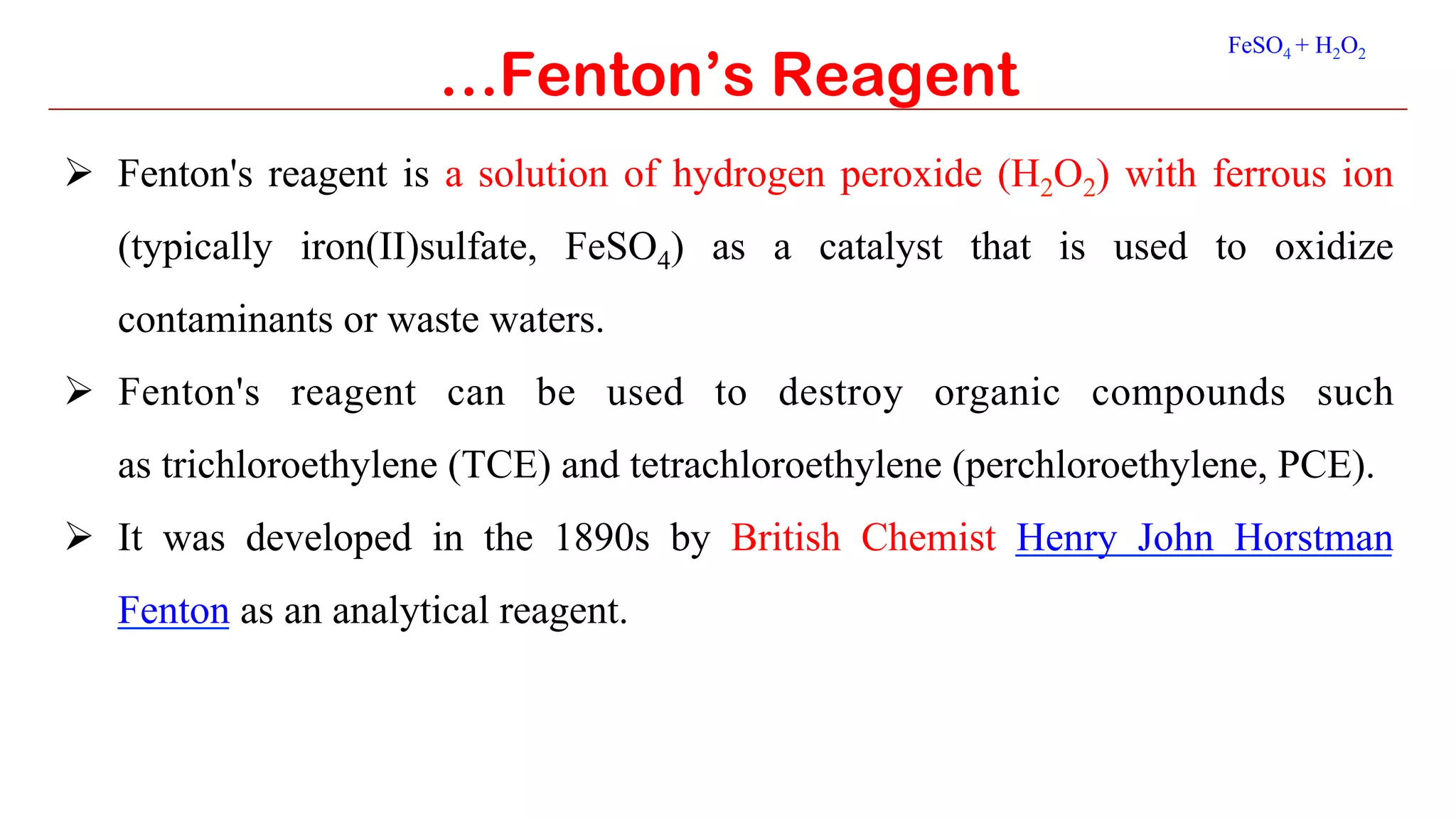
Ø  Fenton's reagent is a solution of hydrogen peroxide (H2O2) with ferrous ion
(typically iron(II)sulfate, FeSO4) as a catalyst that is used to oxidize
contaminants or waste waters.
Ø  Fenton's reagent can be used to destroy organic compounds such
as trichloroethylene (TCE) and tetrachloroethylene (perchloroethylene, PCE).
Ø  It was developed in the 1890s by British Chemist Henry John Horstman
Fenton as an analytical reagent.
FeSO4 + H2O2
…Fenton’s Reagent
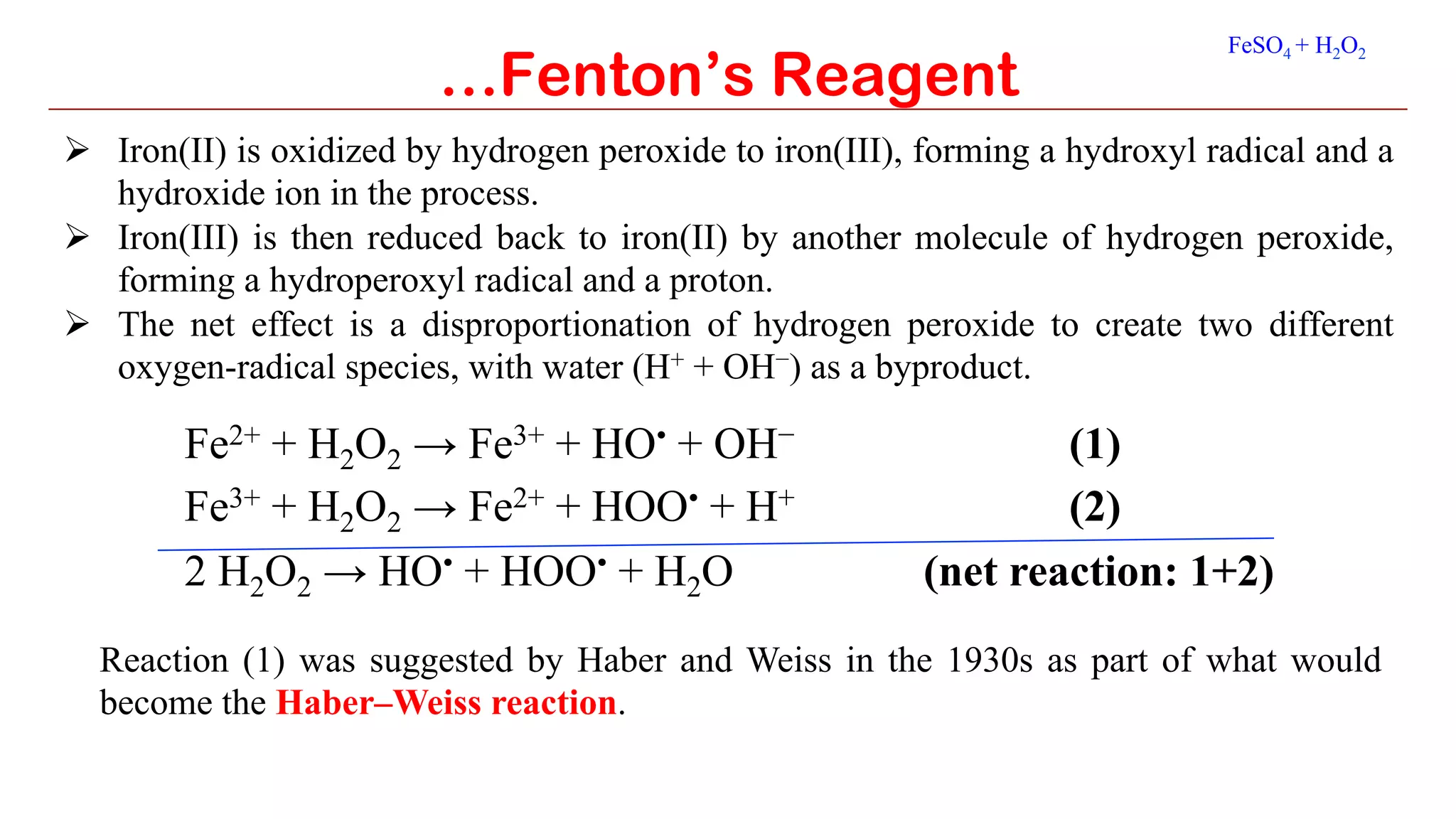
Ø  Iron(II) is oxidized by hydrogen peroxide to iron(III), forming a hydroxyl radical and a
hydroxide ion in the process.
Ø  Iron(III) is then reduced back to iron(II) by another molecule of hydrogen peroxide,
forming a hydroperoxyl radical and a proton.
Ø  The net effect is a disproportionation of hydrogen peroxide to create two different
oxygen-radical species, with water (H+ + OH−) as a byproduct.
Fe2+ + H2O2 → Fe3+ + HO• + OH− (1)
Fe3+ + H2O2 → Fe2+ + HOO• + H+ (2)
2 H2O2 → HO• + HOO• + H2O (net reaction: 1+2)
Reaction (1) was suggested by Haber and Weiss in the 1930s as part of what would
become the Haber–Weiss reaction.
FeSO4 + H2O2
…Fenton’s Reagent
Ø  The free radicals generated by this process then engage in secondary reactions.
For example, the hydroxyl is a powerful, non-selective oxidant.
Ø  Oxidation of an organic compound by Fenton's reagent is rapid and
exothermic and results in the oxidation of contaminants to primarily carbon
dioxide and water.
Ø  Iron(II) sulfate is typically used as the iron catalyst. The exact mechanisms
of the redox cycle are uncertain.
FeSO4 + H2O2
…Fenton’s Reagent: Applications
1. Fenton's reagent is used in organic synthesis for the hydroxylation of arenes
in a radical substitution reaction such as the classical conversion of benzene into
phenol.
C6H6 + FeSO4 + H2O2 → C6H5OH
Fe2+ + H2O2 → Fe3+ + HO• + OH−
Mechanism:
FeSO4 + H2O2
…Fenton’s Reagent
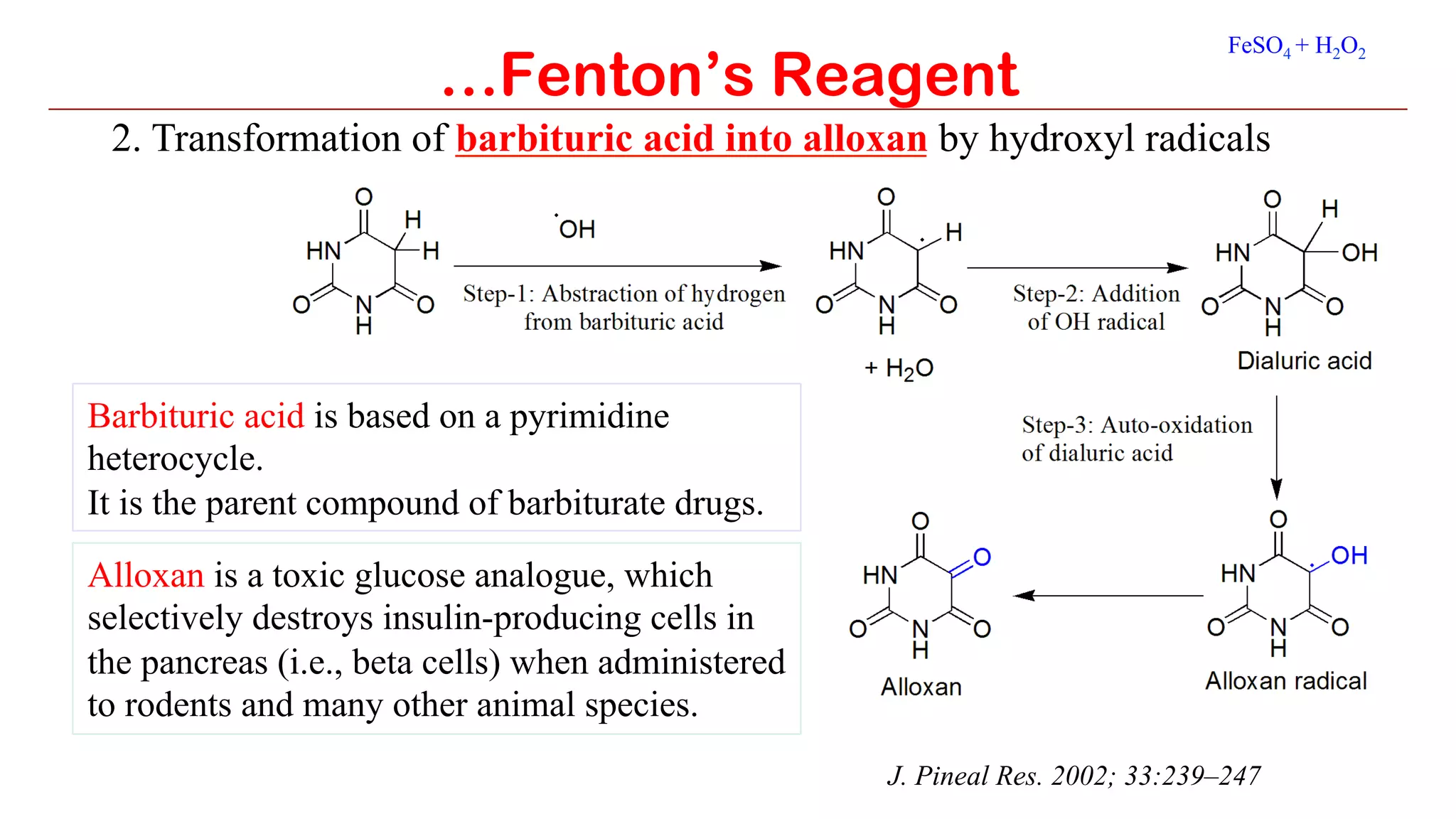
2. Transformation of barbituric acid into alloxan by hydroxyl radicals
J. Pineal Res. 2002; 33:239–247
Barbituric acid is based on a pyrimidine
heterocycle.
It is the parent compound of barbiturate drugs.
Alloxan is a toxic glucose analogue, which
selectively destroys insulin-producing cells in
the pancreas (i.e., beta cells) when administered
to rodents and many other animal species.
FeSO4 + H2O2
…Fenton’s Reagent
3. Glycerol on oxidation with Fenton’s reagent (H2O2 + FeSO4)
gives a mixture of glyceraldehyde & dihydroxyacetone. Mixture of
these two are known as Glycerose.
FeSO4 + H2O2
…Fenton’s Reagent
4. Conversion of tartaric acid into dihydroxy fumaric acid;
Ø  Tartaric acid is a white, crystalline organic acid that occurs naturally in many
fruits, most notably in grapes, but also in bananas, and citrus.
Ø  Its salt, potassium bitartrate, commonly known as cream of tartar, develops
naturally in the process of winemaking.
FeSO4 + H2O2
…Fenton’s Reagent
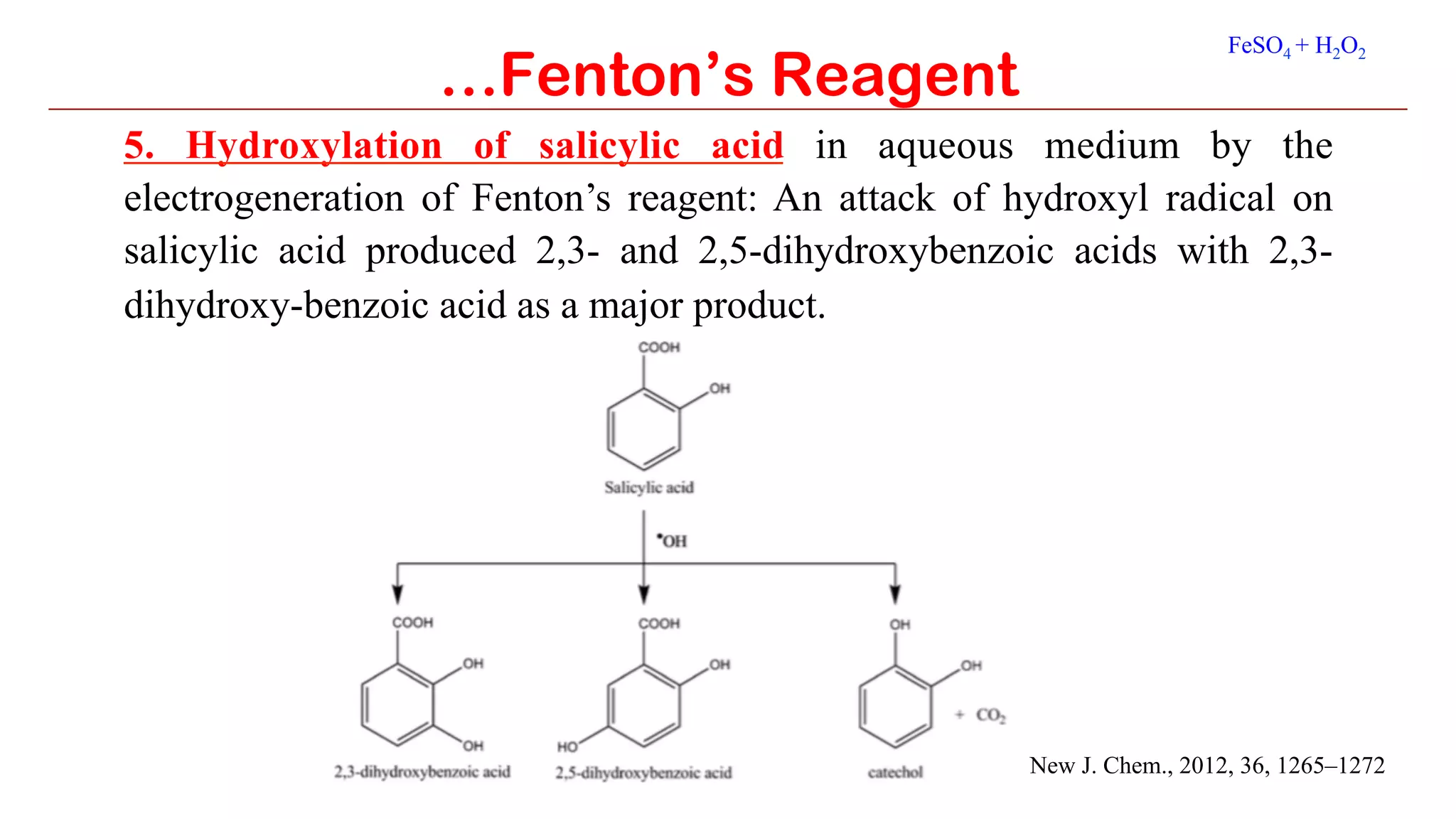
5. Hydroxylation of salicylic acid in aqueous medium by the
electrogeneration of Fenton’s reagent: An attack of hydroxyl radical on
salicylic acid produced 2,3- and 2,5-dihydroxybenzoic acids with 2,3-
dihydroxy-benzoic acid as a major product.
New J. Chem., 2012, 36, 1265–1272
FeSO4 + H2O2
…Fenton’s Reagent: Summary
1.  Hydroxylation of arenes.
2.  Barbituric acid into alloxan.
3.  Glycerol gives a mixture of glyceraldehyde & dihydroxyacetone
~ known as Glycerose.
4.  Tartaric acid into dihydroxy fumaric acid.
5.  Hydroxylation of salicylic acid.
FeSO4 + H2O2

6. fenton's reagents

  • 1.
    Dr. Shivendra Singh UGC-NET-JRF,PhD- IIT Indore Assistant Professor shivendrasngh0@gmail.com Webpage: https://sites.google.com/view/drshivendrasingh/home Youtube: https://bit.ly/2YM0QG0 6. Fenton’s Reagent
  • 2.
    …Fenton’s Reagent Ø  Fenton'sreagent is a solution of hydrogen peroxide (H2O2) with ferrous ion (typically iron(II)sulfate, FeSO4) as a catalyst that is used to oxidize contaminants or waste waters. Ø  Fenton's reagent can be used to destroy organic compounds such as trichloroethylene (TCE) and tetrachloroethylene (perchloroethylene, PCE). Ø  It was developed in the 1890s by British Chemist Henry John Horstman Fenton as an analytical reagent. FeSO4 + H2O2
  • 3.
    …Fenton’s Reagent Ø  Iron(II)is oxidized by hydrogen peroxide to iron(III), forming a hydroxyl radical and a hydroxide ion in the process. Ø  Iron(III) is then reduced back to iron(II) by another molecule of hydrogen peroxide, forming a hydroperoxyl radical and a proton. Ø  The net effect is a disproportionation of hydrogen peroxide to create two different oxygen-radical species, with water (H+ + OH−) as a byproduct. Fe2+ + H2O2 → Fe3+ + HO• + OH− (1) Fe3+ + H2O2 → Fe2+ + HOO• + H+ (2) 2 H2O2 → HO• + HOO• + H2O (net reaction: 1+2) Reaction (1) was suggested by Haber and Weiss in the 1930s as part of what would become the Haber–Weiss reaction. FeSO4 + H2O2
  • 4.
    …Fenton’s Reagent Ø  Thefree radicals generated by this process then engage in secondary reactions. For example, the hydroxyl is a powerful, non-selective oxidant. Ø  Oxidation of an organic compound by Fenton's reagent is rapid and exothermic and results in the oxidation of contaminants to primarily carbon dioxide and water. Ø  Iron(II) sulfate is typically used as the iron catalyst. The exact mechanisms of the redox cycle are uncertain. FeSO4 + H2O2
  • 5.
    …Fenton’s Reagent: Applications 1.Fenton's reagent is used in organic synthesis for the hydroxylation of arenes in a radical substitution reaction such as the classical conversion of benzene into phenol. C6H6 + FeSO4 + H2O2 → C6H5OH Fe2+ + H2O2 → Fe3+ + HO• + OH− Mechanism: FeSO4 + H2O2
  • 6.
    …Fenton’s Reagent 2. Transformationof barbituric acid into alloxan by hydroxyl radicals J. Pineal Res. 2002; 33:239–247 Barbituric acid is based on a pyrimidine heterocycle. It is the parent compound of barbiturate drugs. Alloxan is a toxic glucose analogue, which selectively destroys insulin-producing cells in the pancreas (i.e., beta cells) when administered to rodents and many other animal species. FeSO4 + H2O2
  • 7.
    …Fenton’s Reagent 3. Glycerolon oxidation with Fenton’s reagent (H2O2 + FeSO4) gives a mixture of glyceraldehyde & dihydroxyacetone. Mixture of these two are known as Glycerose. FeSO4 + H2O2
  • 8.
    …Fenton’s Reagent 4. Conversionof tartaric acid into dihydroxy fumaric acid; Ø  Tartaric acid is a white, crystalline organic acid that occurs naturally in many fruits, most notably in grapes, but also in bananas, and citrus. Ø  Its salt, potassium bitartrate, commonly known as cream of tartar, develops naturally in the process of winemaking. FeSO4 + H2O2
  • 9.
    …Fenton’s Reagent 5. Hydroxylationof salicylic acid in aqueous medium by the electrogeneration of Fenton’s reagent: An attack of hydroxyl radical on salicylic acid produced 2,3- and 2,5-dihydroxybenzoic acids with 2,3- dihydroxy-benzoic acid as a major product. New J. Chem., 2012, 36, 1265–1272 FeSO4 + H2O2
  • 10.
    …Fenton’s Reagent: Summary 1. Hydroxylation of arenes. 2.  Barbituric acid into alloxan. 3.  Glycerol gives a mixture of glyceraldehyde & dihydroxyacetone ~ known as Glycerose. 4.  Tartaric acid into dihydroxy fumaric acid. 5.  Hydroxylation of salicylic acid. FeSO4 + H2O2