Polynomial Functions
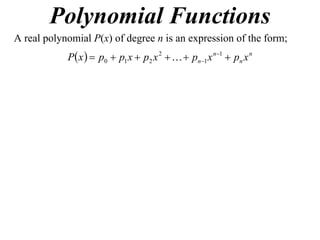
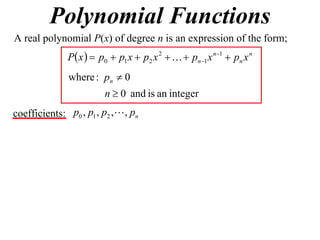
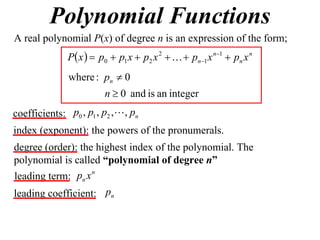
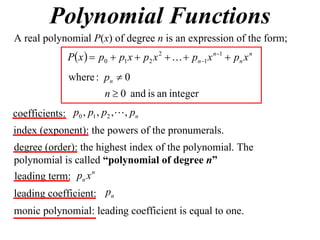
A real polynomial P(x) of degree n is an expression of the form;
            P x   p0  p1 x  p2 x 2    pn1 x n1  pn x n
Polynomial Functions
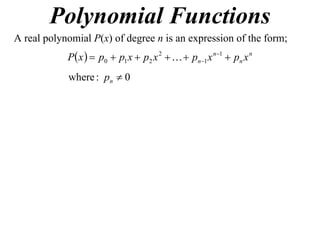
A real polynomial P(x) of degree n is an expression of the form;
            P x   p0  p1 x  p2 x 2    pn1 x n1  pn x n
            where : pn  0
Polynomial Functions
A real polynomial P(x) of degree n is an expression of the form;
            P x   p0  p1 x  p2 x 2    pn1 x n1  pn x n
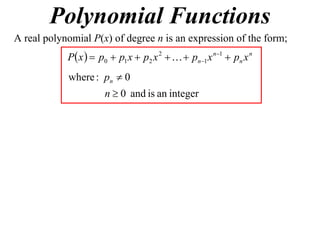
            where : pn  0
                      n  0 and is an integer
Polynomial Functions
A real polynomial P(x) of degree n is an expression of the form;
              P x   p0  p1 x  p2 x 2    pn1 x n1  pn x n
               where : pn  0
                        n  0 and is an integer
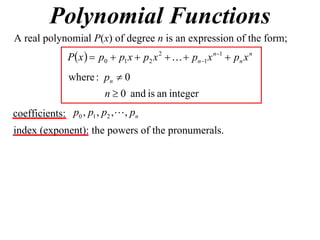
coefficients: p0 , p1 , p2 , , pn
Polynomial Functions
A real polynomial P(x) of degree n is an expression of the form;
              P x   p0  p1 x  p2 x 2    pn1 x n1  pn x n
               where : pn  0
                        n  0 and is an integer
coefficients: p0 , p1 , p2 , , pn
index (exponent): the powers of the pronumerals.
Polynomial Functions
A real polynomial P(x) of degree n is an expression of the form;
              P x   p0  p1 x  p2 x 2    pn1 x n1  pn x n
               where : pn  0
                        n  0 and is an integer
coefficients: p0 , p1 , p2 , , pn
index (exponent): the powers of the pronumerals.
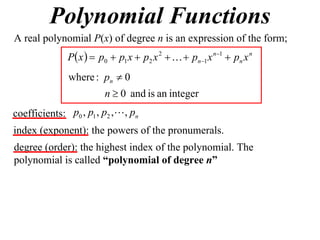
degree (order): the highest index of the polynomial. The
polynomial is called “polynomial of degree n”
Polynomial Functions
A real polynomial P(x) of degree n is an expression of the form;
              P x   p0  p1 x  p2 x 2    pn1 x n1  pn x n
               where : pn  0
                        n  0 and is an integer
coefficients: p0 , p1 , p2 , , pn
index (exponent): the powers of the pronumerals.
degree (order): the highest index of the polynomial. The
polynomial is called “polynomial of degree n”
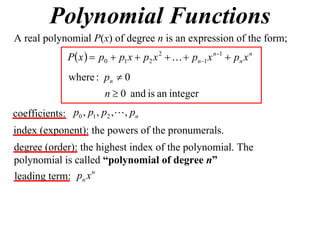
                   n
leading term: pn x
Polynomial Functions
A real polynomial P(x) of degree n is an expression of the form;
              P x   p0  p1 x  p2 x 2    pn1 x n1  pn x n
               where : pn  0
                        n  0 and is an integer
coefficients: p0 , p1 , p2 , , pn
index (exponent): the powers of the pronumerals.
degree (order): the highest index of the polynomial. The
polynomial is called “polynomial of degree n”
                   n
leading term: pn x
leading coefficient: pn
Polynomial Functions
A real polynomial P(x) of degree n is an expression of the form;
              P x   p0  p1 x  p2 x 2    pn1 x n1  pn x n
               where : pn  0
                        n  0 and is an integer
coefficients: p0 , p1 , p2 , , pn
index (exponent): the powers of the pronumerals.
degree (order): the highest index of the polynomial. The
polynomial is called “polynomial of degree n”
                   n
leading term: pn x
leading coefficient: pn
monic polynomial: leading coefficient is equal to one.
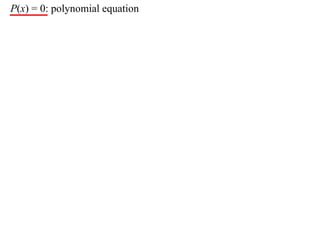
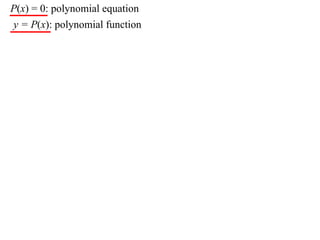
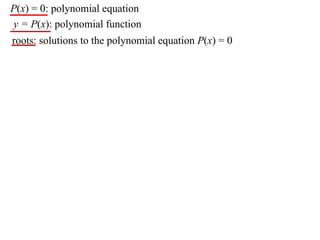
P(x) = 0: polynomial equation
y = P(x): polynomial function
P(x) = 0: polynomial equation
y = P(x): polynomial function
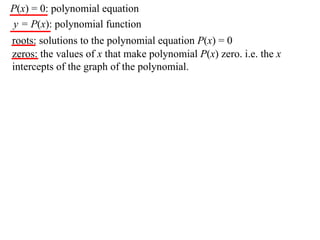
roots: solutions to the polynomial equation P(x) = 0
P(x) = 0: polynomial equation
y = P(x): polynomial function
roots: solutions to the polynomial equation P(x) = 0
zeros: the values of x that make polynomial P(x) zero. i.e. the x
intercepts of the graph of the polynomial.
P(x) = 0: polynomial equation
 y = P(x): polynomial function
  roots: solutions to the polynomial equation P(x) = 0
  zeros: the values of x that make polynomial P(x) zero. i.e. the x
  intercepts of the graph of the polynomial.
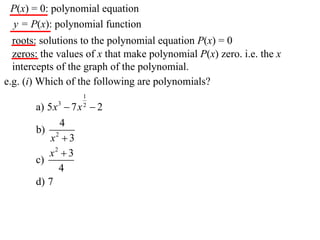
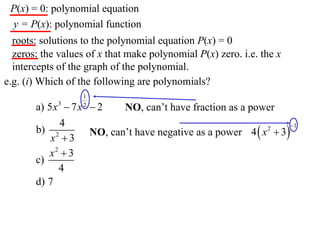
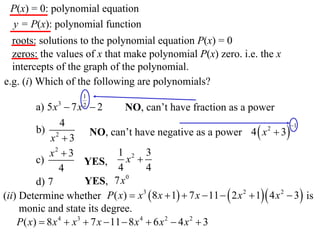
e.g. (i) Which of the following are polynomials?
                   1
       a) 5 x 3  7 x  2
                   2


              4
       b) 2
           x 3
          x2  3
       c)
              4
       d) 7
P(x) = 0: polynomial equation
 y = P(x): polynomial function
  roots: solutions to the polynomial equation P(x) = 0
  zeros: the values of x that make polynomial P(x) zero. i.e. the x
  intercepts of the graph of the polynomial.
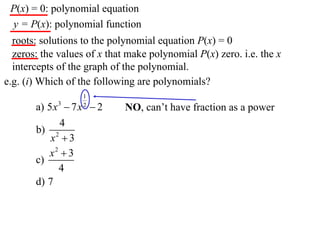
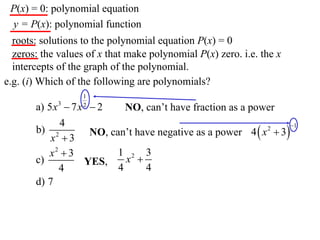
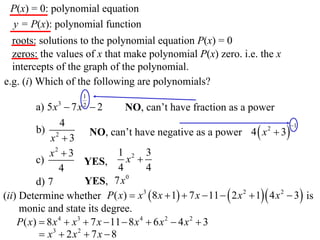
e.g. (i) Which of the following are polynomials?
                   1
       a) 5 x 3  7 x  2
                   2
                             NO, can’t have fraction as a power
              4
       b) 2
           x 3
          x2  3
       c)
              4
       d) 7
P(x) = 0: polynomial equation
 y = P(x): polynomial function
  roots: solutions to the polynomial equation P(x) = 0
  zeros: the values of x that make polynomial P(x) zero. i.e. the x
  intercepts of the graph of the polynomial.
e.g. (i) Which of the following are polynomials?
                   1
       a) 5 x 3  7 x  2
                   2
                             NO, can’t have fraction as a power
              4
                      NO, can’t have negative as a power 4  x  3
                                                                    1
       b) 2                                                   2
           x 3
          x2  3
       c)
              4
       d) 7
P(x) = 0: polynomial equation
 y = P(x): polynomial function
  roots: solutions to the polynomial equation P(x) = 0
  zeros: the values of x that make polynomial P(x) zero. i.e. the x
  intercepts of the graph of the polynomial.
e.g. (i) Which of the following are polynomials?
                   1
       a) 5 x 3  7 x  2
                   2
                              NO, can’t have fraction as a power
              4
                      NO, can’t have negative as a power 4  x  3
                                                                    1
       b) 2                                                   2
           x 3
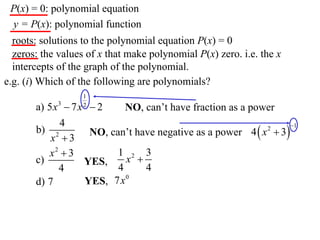
          x2  3            1 2 3
       c)            YES,     x 
              4             4     4
       d) 7
P(x) = 0: polynomial equation
 y = P(x): polynomial function
  roots: solutions to the polynomial equation P(x) = 0
  zeros: the values of x that make polynomial P(x) zero. i.e. the x
  intercepts of the graph of the polynomial.
e.g. (i) Which of the following are polynomials?
                   1
       a) 5 x 3  7 x  2
                   2
                              NO, can’t have fraction as a power
              4
                      NO, can’t have negative as a power 4  x  3
                                                                    1
       b) 2                                                   2
           x 3
          x2  3            1 2 3
       c)            YES,     x 
              4             4     4
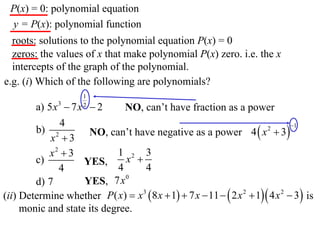
       d) 7          YES, 7x 0
P(x) = 0: polynomial equation
 y = P(x): polynomial function
  roots: solutions to the polynomial equation P(x) = 0
  zeros: the values of x that make polynomial P(x) zero. i.e. the x
  intercepts of the graph of the polynomial.
e.g. (i) Which of the following are polynomials?
                      1
        a) 5 x 3  7 x  2
                      2
                               NO, can’t have fraction as a power
               4
                       NO, can’t have negative as a power 4  x  3
                                                                                1
        b) 2                                                            2
            x 3
           x2  3            1 2 3
        c)            YES,     x 
               4             4     4
        d) 7          YES, 7x 0
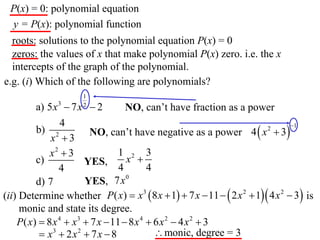
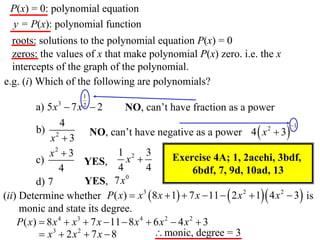
(ii) Determine whether P( x)  x 3  8 x  1  7 x  11   2 x 2  1 4 x 2  3 is
     monic and state its degree.
P(x) = 0: polynomial equation
 y = P(x): polynomial function
  roots: solutions to the polynomial equation P(x) = 0
  zeros: the values of x that make polynomial P(x) zero. i.e. the x
  intercepts of the graph of the polynomial.
e.g. (i) Which of the following are polynomials?
                      1
         a) 5 x 3  7 x  2
                      2
                                   NO, can’t have fraction as a power
                 4
                        NO, can’t have negative as a power 4  x  3
                                                                                1
         b) 2                                                           2
             x 3
             x2  3              1 2 3
         c)            YES,        x 
                4                4        4
         d) 7          YES, 7x 0
(ii) Determine whether P( x)  x 3  8 x  1  7 x  11   2 x 2  1 4 x 2  3 is
     monic and state its degree.
    P( x)  8 x 4  x3  7 x  11  8 x 4  6 x 2  4 x 2  3
P(x) = 0: polynomial equation
 y = P(x): polynomial function
  roots: solutions to the polynomial equation P(x) = 0
  zeros: the values of x that make polynomial P(x) zero. i.e. the x
  intercepts of the graph of the polynomial.
e.g. (i) Which of the following are polynomials?
                      1
         a) 5 x 3  7 x  2
                      2
                                   NO, can’t have fraction as a power
                 4
                        NO, can’t have negative as a power 4  x  3
                                                                                1
         b) 2                                                           2
             x 3
             x2  3              1 2 3
         c)            YES,        x 
                4                4        4
         d) 7          YES, 7x 0
(ii) Determine whether P( x)  x 3  8 x  1  7 x  11   2 x 2  1 4 x 2  3 is
     monic and state its degree.
    P( x)  8 x 4  x3  7 x  11  8 x 4  6 x 2  4 x 2  3
           x3  2 x 2  7 x  8
P(x) = 0: polynomial equation
 y = P(x): polynomial function
  roots: solutions to the polynomial equation P(x) = 0
  zeros: the values of x that make polynomial P(x) zero. i.e. the x
  intercepts of the graph of the polynomial.
e.g. (i) Which of the following are polynomials?
                      1
         a) 5 x 3  7 x  2
                      2
                                   NO, can’t have fraction as a power
                 4
                        NO, can’t have negative as a power 4  x  3
                                                                                1
         b) 2                                                           2
             x 3
             x2  3              1 2 3
         c)            YES,        x 
                4                4        4
         d) 7          YES, 7x 0
(ii) Determine whether P( x)  x 3  8 x  1  7 x  11   2 x 2  1 4 x 2  3 is
     monic and state its degree.
    P( x)  8 x 4  x3  7 x  11  8 x 4  6 x 2  4 x 2  3
           x3  2 x 2  7 x  8             monic, degree = 3
P(x) = 0: polynomial equation
 y = P(x): polynomial function
  roots: solutions to the polynomial equation P(x) = 0
  zeros: the values of x that make polynomial P(x) zero. i.e. the x
  intercepts of the graph of the polynomial.
e.g. (i) Which of the following are polynomials?
                      1
         a) 5 x 3  7 x  2
                      2
                                   NO, can’t have fraction as a power
                 4
                        NO, can’t have negative as a power 4  x  3
                                                                                1
         b) 2                                                             2
             x 3
             x2  3              1 2 3
         c)            YES,        x             Exercise 4A; 1, 2acehi, 3bdf,
                4                4        4              6bdf, 7, 9d, 10ad, 13
                                   0
         d) 7          YES, 7x
(ii) Determine whether P( x)  x 3  8 x  1  7 x  11   2 x 2  1 4 x 2  3 is
     monic and state its degree.
    P( x)  8 x 4  x3  7 x  11  8 x 4  6 x 2  4 x 2  3
           x3  2 x 2  7 x  8             monic, degree = 3

11X1 T13 01 polynomial definitions

  • 1.
  • 2.
    Polynomial Functions A realpolynomial P(x) of degree n is an expression of the form; P x   p0  p1 x  p2 x 2    pn1 x n1  pn x n
  • 3.
    Polynomial Functions A realpolynomial P(x) of degree n is an expression of the form; P x   p0  p1 x  p2 x 2    pn1 x n1  pn x n where : pn  0
  • 4.
    Polynomial Functions A realpolynomial P(x) of degree n is an expression of the form; P x   p0  p1 x  p2 x 2    pn1 x n1  pn x n where : pn  0 n  0 and is an integer
  • 5.
    Polynomial Functions A realpolynomial P(x) of degree n is an expression of the form; P x   p0  p1 x  p2 x 2    pn1 x n1  pn x n where : pn  0 n  0 and is an integer coefficients: p0 , p1 , p2 , , pn
  • 6.
    Polynomial Functions A realpolynomial P(x) of degree n is an expression of the form; P x   p0  p1 x  p2 x 2    pn1 x n1  pn x n where : pn  0 n  0 and is an integer coefficients: p0 , p1 , p2 , , pn index (exponent): the powers of the pronumerals.
  • 7.
    Polynomial Functions A realpolynomial P(x) of degree n is an expression of the form; P x   p0  p1 x  p2 x 2    pn1 x n1  pn x n where : pn  0 n  0 and is an integer coefficients: p0 , p1 , p2 , , pn index (exponent): the powers of the pronumerals. degree (order): the highest index of the polynomial. The polynomial is called “polynomial of degree n”
  • 8.
    Polynomial Functions A realpolynomial P(x) of degree n is an expression of the form; P x   p0  p1 x  p2 x 2    pn1 x n1  pn x n where : pn  0 n  0 and is an integer coefficients: p0 , p1 , p2 , , pn index (exponent): the powers of the pronumerals. degree (order): the highest index of the polynomial. The polynomial is called “polynomial of degree n” n leading term: pn x
  • 9.
    Polynomial Functions A realpolynomial P(x) of degree n is an expression of the form; P x   p0  p1 x  p2 x 2    pn1 x n1  pn x n where : pn  0 n  0 and is an integer coefficients: p0 , p1 , p2 , , pn index (exponent): the powers of the pronumerals. degree (order): the highest index of the polynomial. The polynomial is called “polynomial of degree n” n leading term: pn x leading coefficient: pn
  • 10.
    Polynomial Functions A realpolynomial P(x) of degree n is an expression of the form; P x   p0  p1 x  p2 x 2    pn1 x n1  pn x n where : pn  0 n  0 and is an integer coefficients: p0 , p1 , p2 , , pn index (exponent): the powers of the pronumerals. degree (order): the highest index of the polynomial. The polynomial is called “polynomial of degree n” n leading term: pn x leading coefficient: pn monic polynomial: leading coefficient is equal to one.
  • 11.
    P(x) = 0:polynomial equation
  • 12.
    P(x) = 0:polynomial equation y = P(x): polynomial function
  • 13.
    P(x) = 0:polynomial equation y = P(x): polynomial function roots: solutions to the polynomial equation P(x) = 0
  • 14.
    P(x) = 0:polynomial equation y = P(x): polynomial function roots: solutions to the polynomial equation P(x) = 0 zeros: the values of x that make polynomial P(x) zero. i.e. the x intercepts of the graph of the polynomial.
  • 15.
    P(x) = 0:polynomial equation y = P(x): polynomial function roots: solutions to the polynomial equation P(x) = 0 zeros: the values of x that make polynomial P(x) zero. i.e. the x intercepts of the graph of the polynomial. e.g. (i) Which of the following are polynomials? 1 a) 5 x 3  7 x  2 2 4 b) 2 x 3 x2  3 c) 4 d) 7
  • 16.
    P(x) = 0:polynomial equation y = P(x): polynomial function roots: solutions to the polynomial equation P(x) = 0 zeros: the values of x that make polynomial P(x) zero. i.e. the x intercepts of the graph of the polynomial. e.g. (i) Which of the following are polynomials? 1 a) 5 x 3  7 x  2 2 NO, can’t have fraction as a power 4 b) 2 x 3 x2  3 c) 4 d) 7
  • 17.
    P(x) = 0:polynomial equation y = P(x): polynomial function roots: solutions to the polynomial equation P(x) = 0 zeros: the values of x that make polynomial P(x) zero. i.e. the x intercepts of the graph of the polynomial. e.g. (i) Which of the following are polynomials? 1 a) 5 x 3  7 x  2 2 NO, can’t have fraction as a power 4 NO, can’t have negative as a power 4  x  3 1 b) 2 2 x 3 x2  3 c) 4 d) 7
  • 18.
    P(x) = 0:polynomial equation y = P(x): polynomial function roots: solutions to the polynomial equation P(x) = 0 zeros: the values of x that make polynomial P(x) zero. i.e. the x intercepts of the graph of the polynomial. e.g. (i) Which of the following are polynomials? 1 a) 5 x 3  7 x  2 2 NO, can’t have fraction as a power 4 NO, can’t have negative as a power 4  x  3 1 b) 2 2 x 3 x2  3 1 2 3 c) YES, x  4 4 4 d) 7
  • 19.
    P(x) = 0:polynomial equation y = P(x): polynomial function roots: solutions to the polynomial equation P(x) = 0 zeros: the values of x that make polynomial P(x) zero. i.e. the x intercepts of the graph of the polynomial. e.g. (i) Which of the following are polynomials? 1 a) 5 x 3  7 x  2 2 NO, can’t have fraction as a power 4 NO, can’t have negative as a power 4  x  3 1 b) 2 2 x 3 x2  3 1 2 3 c) YES, x  4 4 4 d) 7 YES, 7x 0
  • 20.
    P(x) = 0:polynomial equation y = P(x): polynomial function roots: solutions to the polynomial equation P(x) = 0 zeros: the values of x that make polynomial P(x) zero. i.e. the x intercepts of the graph of the polynomial. e.g. (i) Which of the following are polynomials? 1 a) 5 x 3  7 x  2 2 NO, can’t have fraction as a power 4 NO, can’t have negative as a power 4  x  3 1 b) 2 2 x 3 x2  3 1 2 3 c) YES, x  4 4 4 d) 7 YES, 7x 0 (ii) Determine whether P( x)  x 3  8 x  1  7 x  11   2 x 2  1 4 x 2  3 is monic and state its degree.
  • 21.
    P(x) = 0:polynomial equation y = P(x): polynomial function roots: solutions to the polynomial equation P(x) = 0 zeros: the values of x that make polynomial P(x) zero. i.e. the x intercepts of the graph of the polynomial. e.g. (i) Which of the following are polynomials? 1 a) 5 x 3  7 x  2 2 NO, can’t have fraction as a power 4 NO, can’t have negative as a power 4  x  3 1 b) 2 2 x 3 x2  3 1 2 3 c) YES, x  4 4 4 d) 7 YES, 7x 0 (ii) Determine whether P( x)  x 3  8 x  1  7 x  11   2 x 2  1 4 x 2  3 is monic and state its degree. P( x)  8 x 4  x3  7 x  11  8 x 4  6 x 2  4 x 2  3
  • 22.
    P(x) = 0:polynomial equation y = P(x): polynomial function roots: solutions to the polynomial equation P(x) = 0 zeros: the values of x that make polynomial P(x) zero. i.e. the x intercepts of the graph of the polynomial. e.g. (i) Which of the following are polynomials? 1 a) 5 x 3  7 x  2 2 NO, can’t have fraction as a power 4 NO, can’t have negative as a power 4  x  3 1 b) 2 2 x 3 x2  3 1 2 3 c) YES, x  4 4 4 d) 7 YES, 7x 0 (ii) Determine whether P( x)  x 3  8 x  1  7 x  11   2 x 2  1 4 x 2  3 is monic and state its degree. P( x)  8 x 4  x3  7 x  11  8 x 4  6 x 2  4 x 2  3  x3  2 x 2  7 x  8
  • 23.
    P(x) = 0:polynomial equation y = P(x): polynomial function roots: solutions to the polynomial equation P(x) = 0 zeros: the values of x that make polynomial P(x) zero. i.e. the x intercepts of the graph of the polynomial. e.g. (i) Which of the following are polynomials? 1 a) 5 x 3  7 x  2 2 NO, can’t have fraction as a power 4 NO, can’t have negative as a power 4  x  3 1 b) 2 2 x 3 x2  3 1 2 3 c) YES, x  4 4 4 d) 7 YES, 7x 0 (ii) Determine whether P( x)  x 3  8 x  1  7 x  11   2 x 2  1 4 x 2  3 is monic and state its degree. P( x)  8 x 4  x3  7 x  11  8 x 4  6 x 2  4 x 2  3  x3  2 x 2  7 x  8  monic, degree = 3
  • 24.
    P(x) = 0:polynomial equation y = P(x): polynomial function roots: solutions to the polynomial equation P(x) = 0 zeros: the values of x that make polynomial P(x) zero. i.e. the x intercepts of the graph of the polynomial. e.g. (i) Which of the following are polynomials? 1 a) 5 x 3  7 x  2 2 NO, can’t have fraction as a power 4 NO, can’t have negative as a power 4  x  3 1 b) 2 2 x 3 x2  3 1 2 3 c) YES, x  Exercise 4A; 1, 2acehi, 3bdf, 4 4 4 6bdf, 7, 9d, 10ad, 13 0 d) 7 YES, 7x (ii) Determine whether P( x)  x 3  8 x  1  7 x  11   2 x 2  1 4 x 2  3 is monic and state its degree. P( x)  8 x 4  x3  7 x  11  8 x 4  6 x 2  4 x 2  3  x3  2 x 2  7 x  8  monic, degree = 3