INTEGRATION 1
Module 1
SUB-TOPIC 1
Fundamentals in
Algebra
• To discuss the laws of exponents and radicals.
• To explain the properties of logarithms.
• To find unknown using quadratic equation.
• To expand binomial expression.
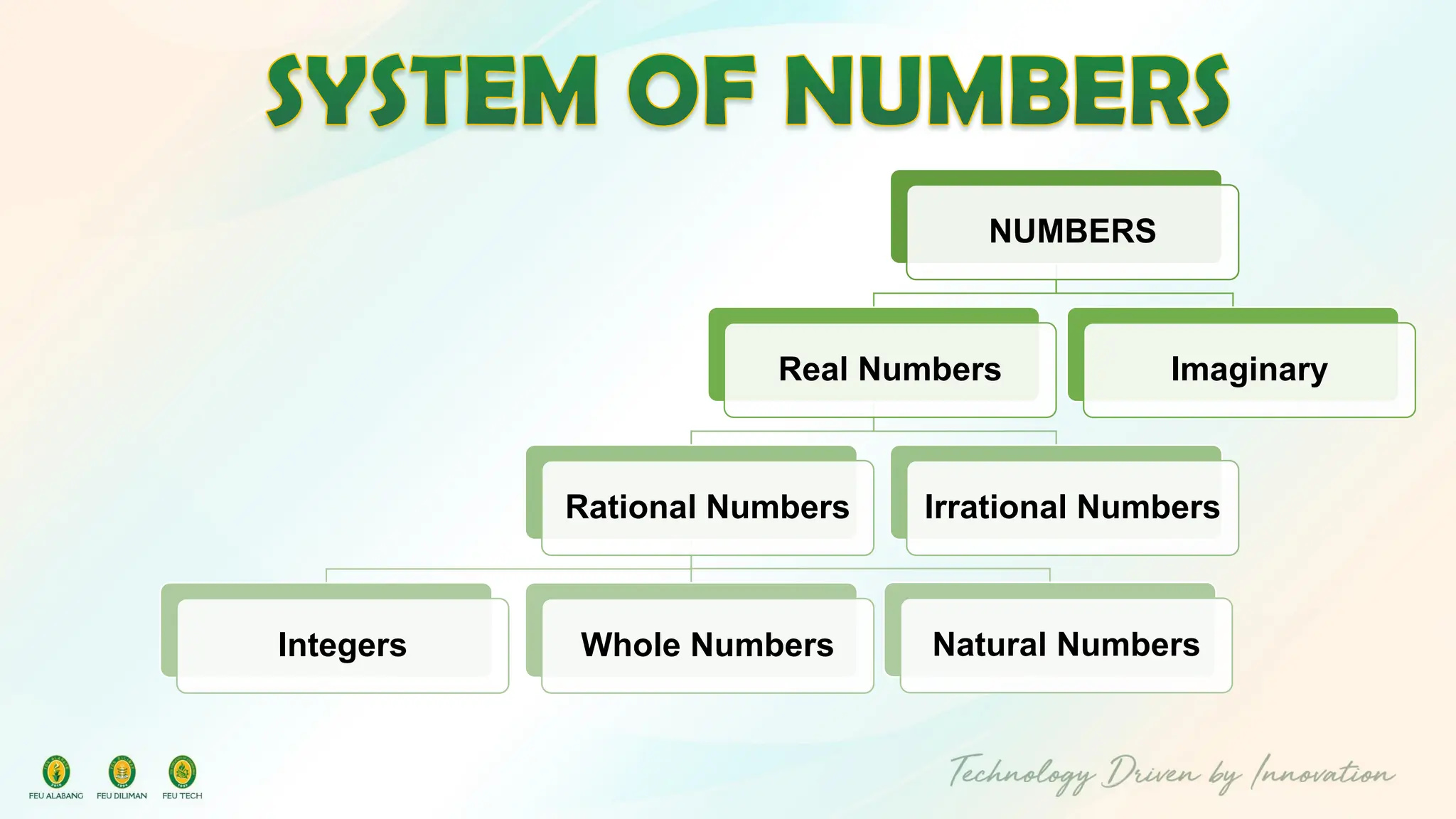
NUMBERS
Real Numbers
Rational Numbers
Integers Whole Numbers Natural Numbers
Irrational Numbers
Imaginary
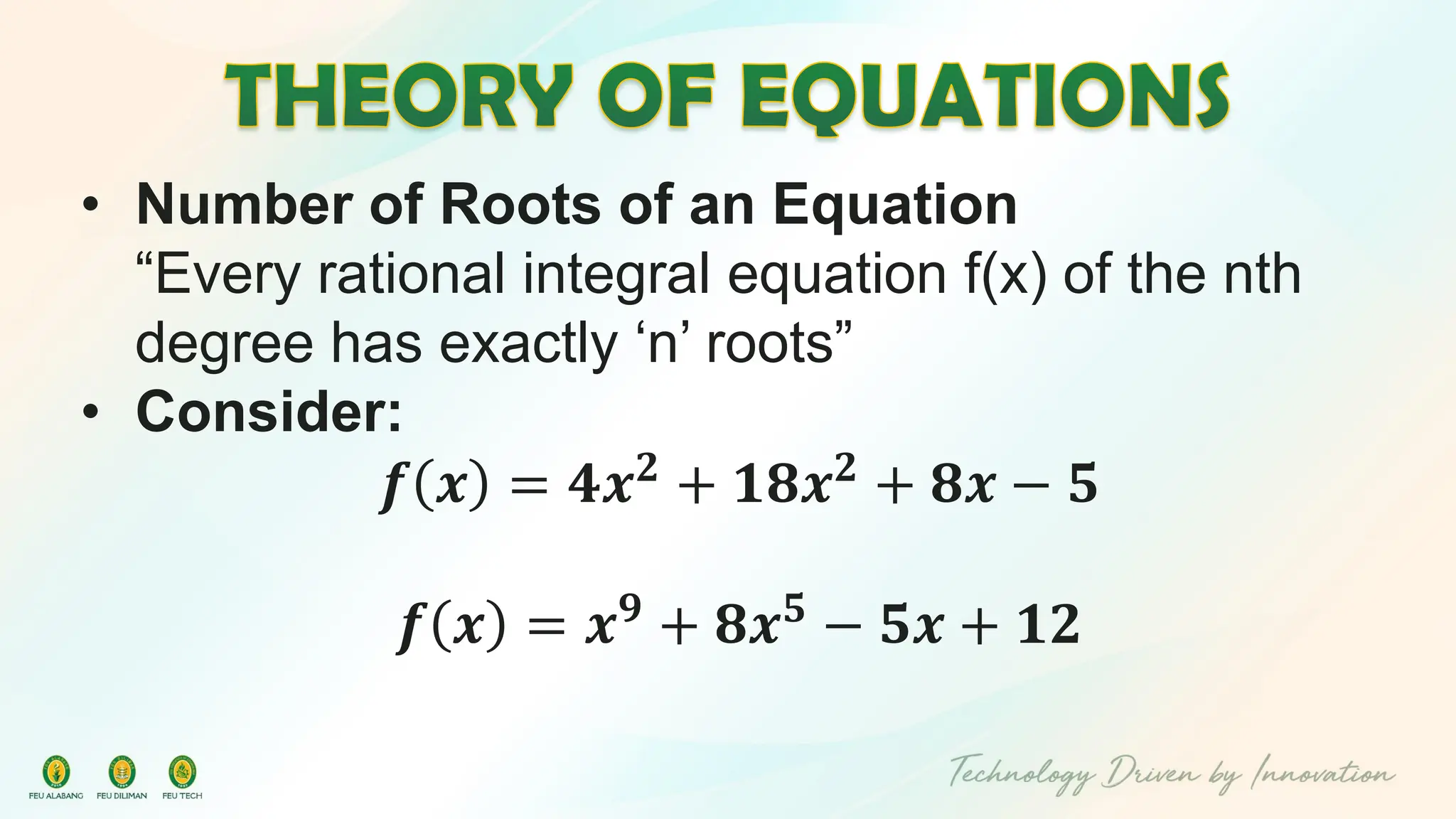
• Number of Roots of an Equation
“Every rational integral equation f(x) of the nth
degree has exactly ‘n’ roots”
• Consider:
𝒇 𝒙 = 𝟒𝒙𝟐
+ 𝟏𝟖𝒙𝟐
+ 𝟖𝒙 − 𝟓
𝒇 𝒙 = 𝒙𝟗
+ 𝟖𝒙𝟓
− 𝟓𝒙 + 𝟏𝟐
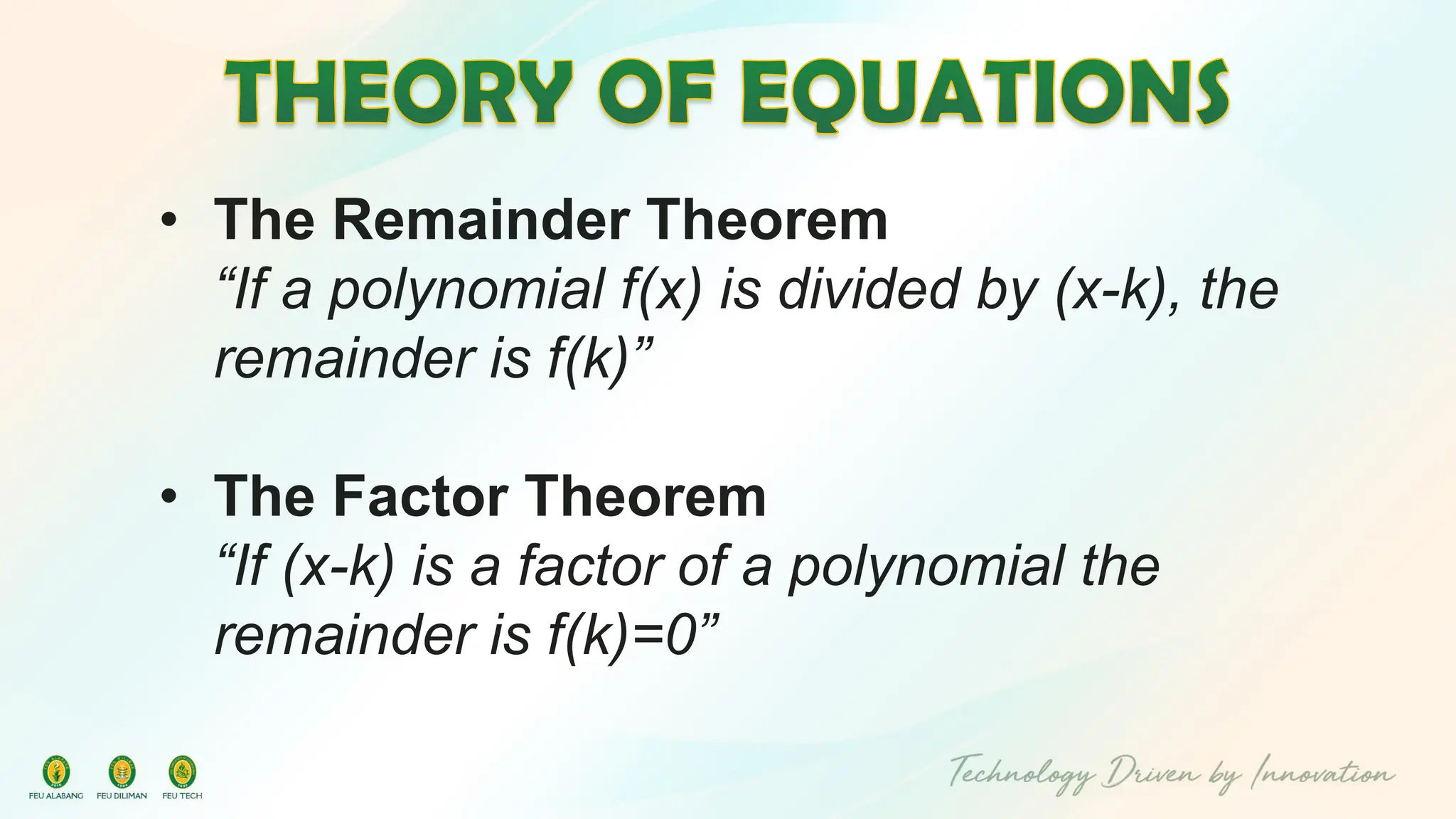
• The Remainder Theorem
“If a polynomial f(x) is divided by (x-k), the
remainder is f(k)”
• The Factor Theorem
“If (x-k) is a factor of a polynomial the
remainder is f(k)=0”
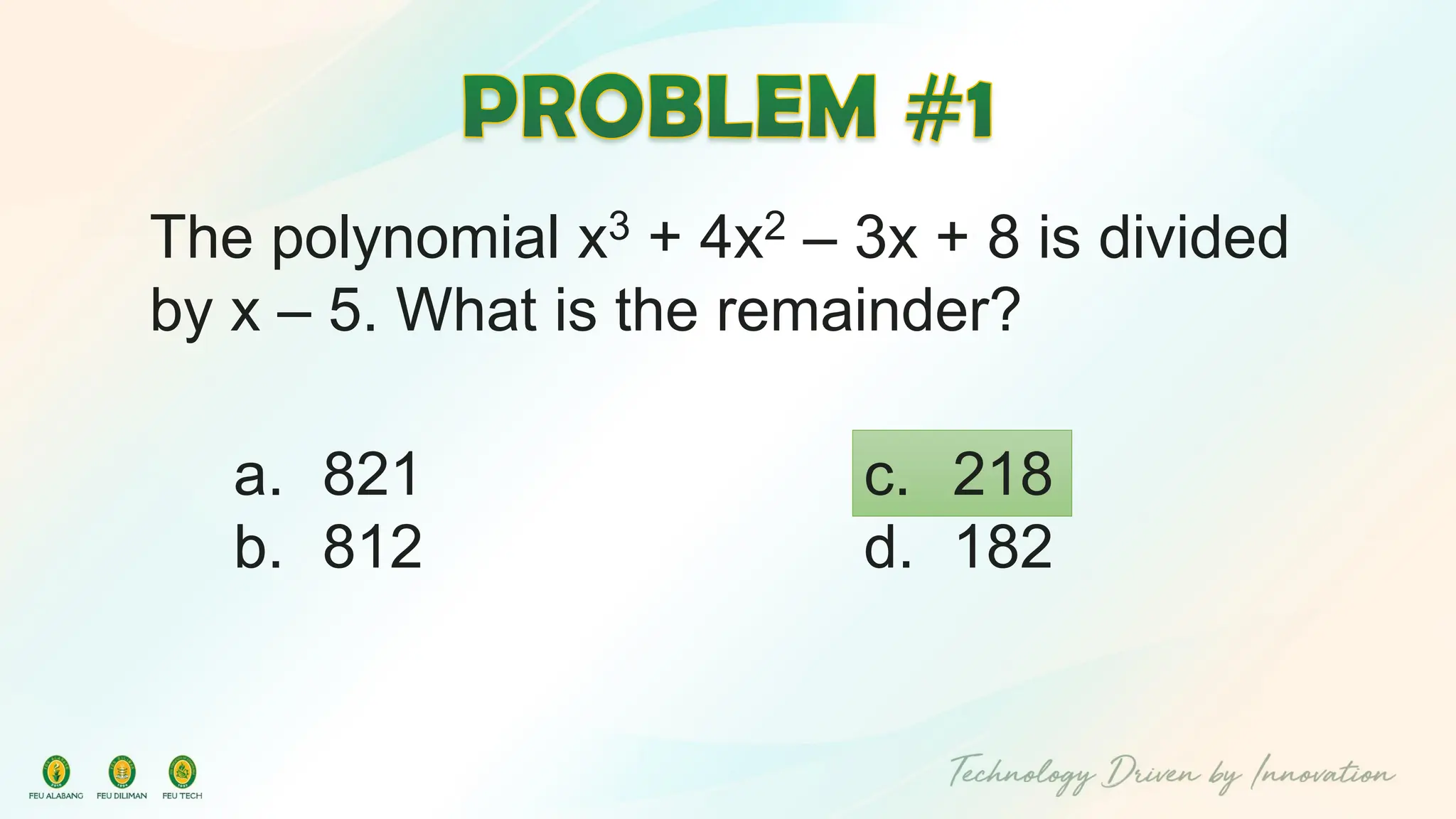
The polynomial x3 + 4x2 – 3x + 8 is divided
by x – 5. What is the remainder?
c. 218
d. 182
a. 821
b. 812
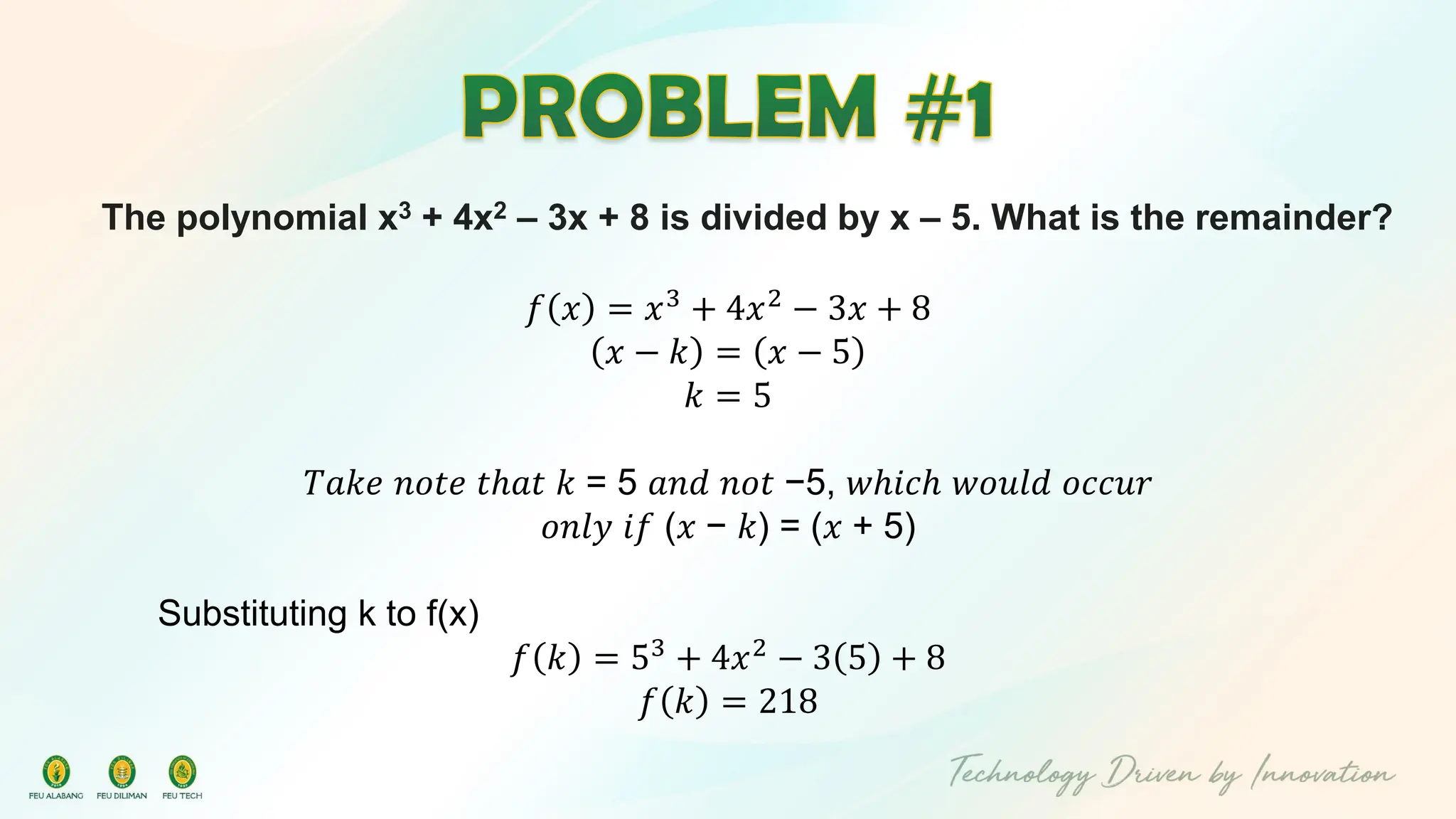
The polynomial x3 + 4x2 – 3x + 8 is divided by x – 5. What is the remainder?
𝑓 𝑥 = 𝑥3 + 4𝑥2 − 3𝑥 + 8
𝑥 − 𝑘 = 𝑥 − 5
𝑘 = 5
𝑇𝑎𝑘𝑒 𝑛𝑜𝑡𝑒 𝑡ℎ𝑎𝑡 𝑘 = 5 𝑎𝑛𝑑 𝑛𝑜𝑡 −5, 𝑤ℎ𝑖𝑐ℎ 𝑤𝑜𝑢𝑙𝑑 𝑜𝑐𝑐𝑢𝑟
𝑜𝑛𝑙𝑦 𝑖𝑓 (𝑥 − 𝑘) = (𝑥 + 5)
Substituting k to f(x)
𝑓 𝑘 = 53 + 4𝑥2 − 3 5 + 8
𝑓 𝑘 = 218
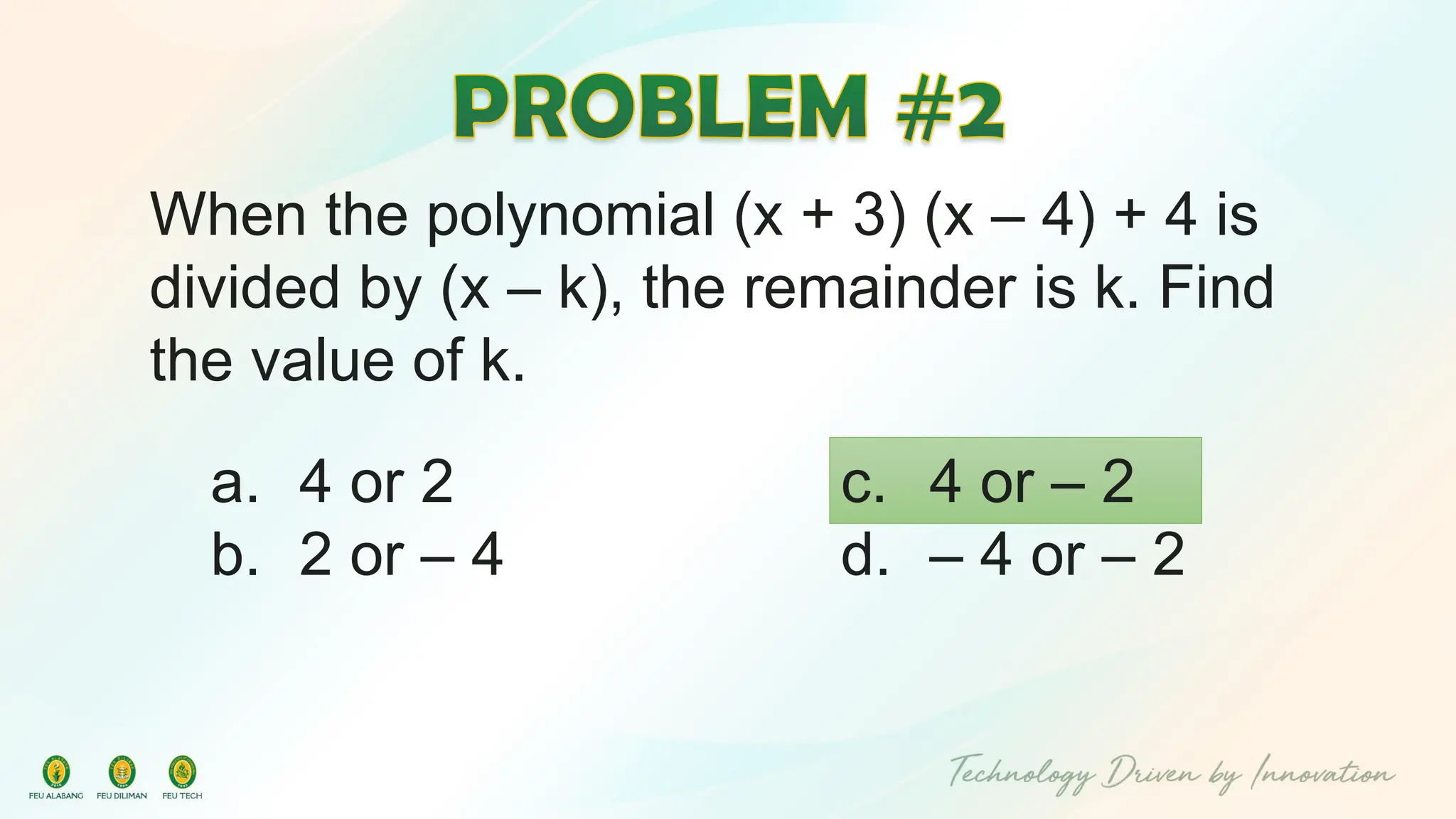
When the polynomial (x + 3) (x – 4) + 4 is
divided by (x – k), the remainder is k. Find
the value of k.
c. 4 or – 2
d. – 4 or – 2
a. 4 or 2
b. 2 or – 4
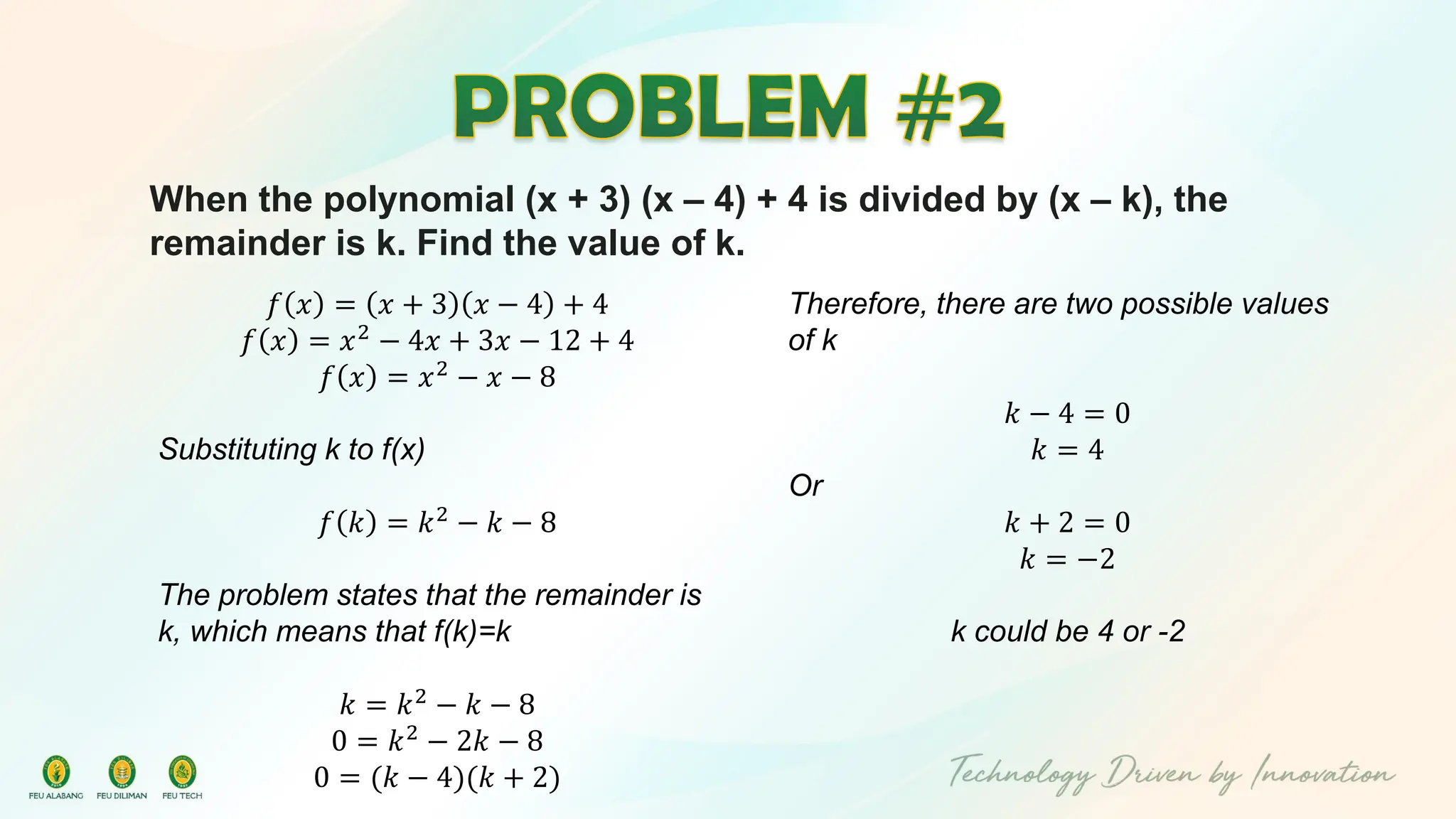
When the polynomial (x + 3) (x – 4) + 4 is divided by (x – k), the
remainder is k. Find the value of k.
𝑓 𝑥 = 𝑥 + 3 𝑥 − 4 + 4
𝑓 𝑥 = 𝑥2 − 4𝑥 + 3𝑥 − 12 + 4
𝑓 𝑥 = 𝑥2
− 𝑥 − 8
Substituting k to f(x)
𝑓 𝑘 = 𝑘2
− 𝑘 − 8
The problem states that the remainder is
k, which means that f(k)=k
𝑘 = 𝑘2 − 𝑘 − 8
0 = 𝑘2
− 2𝑘 − 8
0 = (𝑘 − 4)(𝑘 + 2)
Therefore, there are two possible values
of k
𝑘 − 4 = 0
𝑘 = 4
Or
𝑘 + 2 = 0
𝑘 = −2
k could be 4 or -2
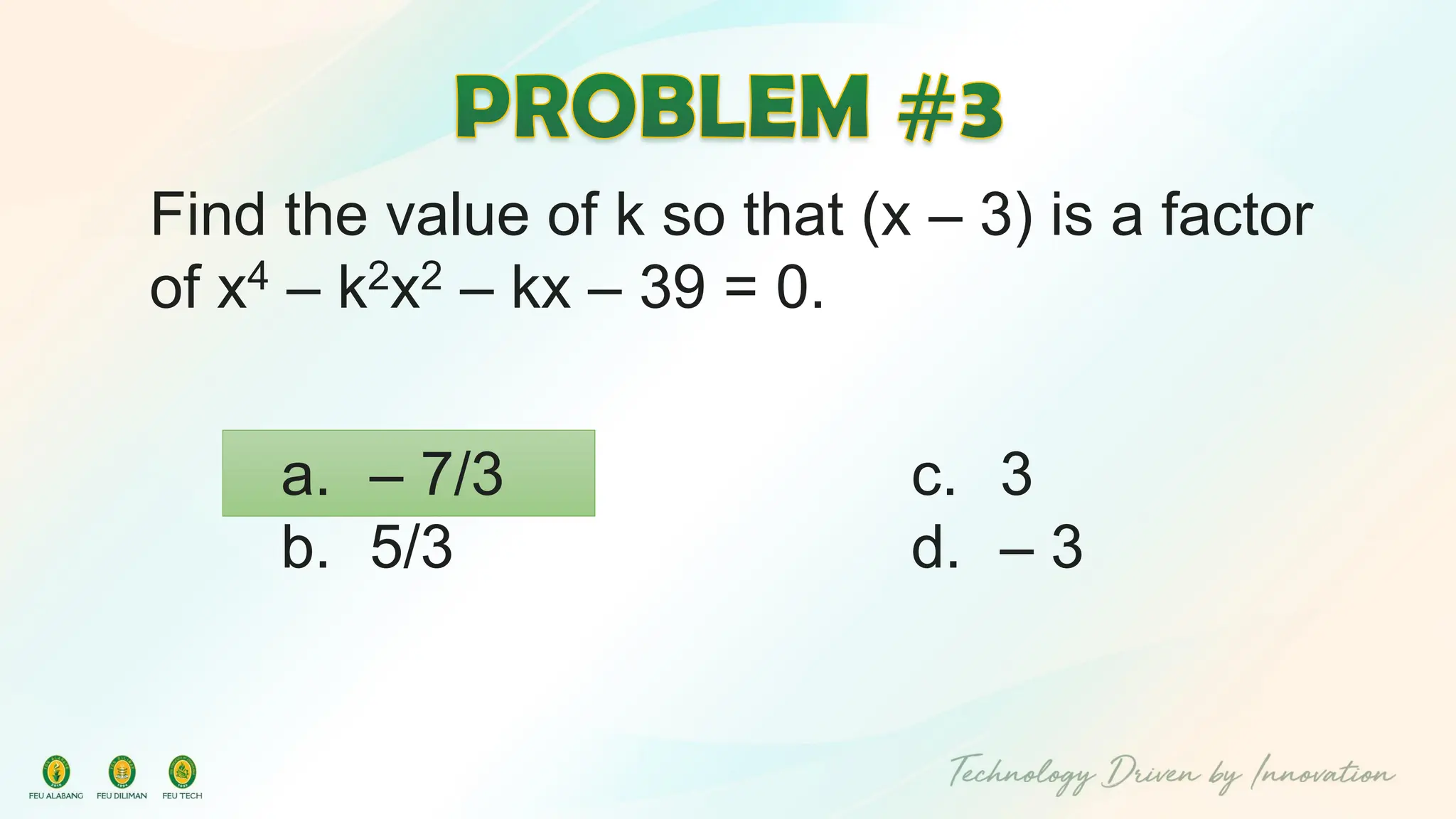
Find the value of k so that (x – 3) is a factor
of x4 – k2x2 – kx – 39 = 0.
c. 3
d. – 3
a. – 7/3
b. 5/3
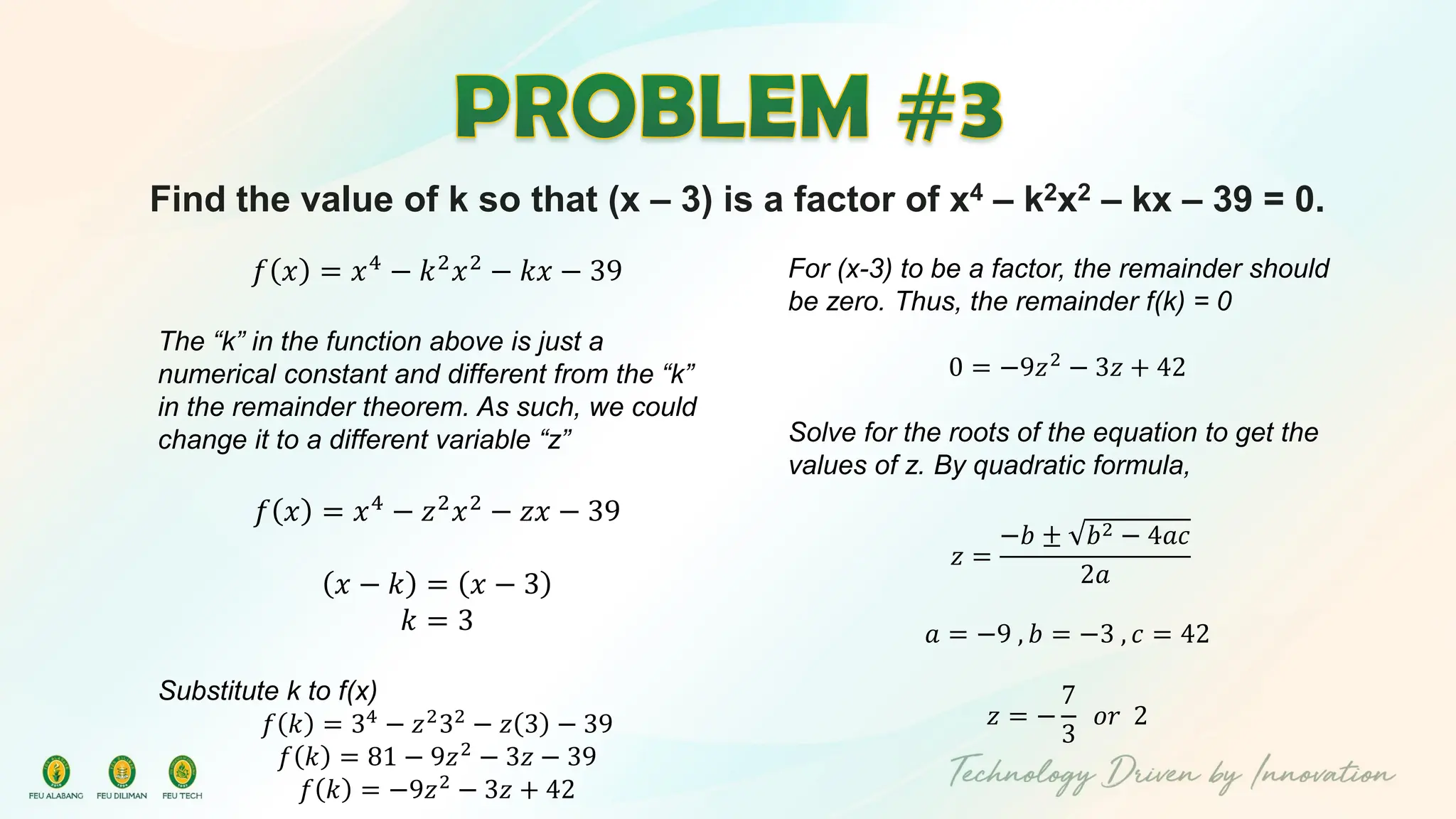
Find the value of k so that (x – 3) is a factor of x4 – k2x2 – kx – 39 = 0.
𝑓 𝑥 = 𝑥4 − 𝑘2𝑥2 − 𝑘𝑥 − 39
The “k” in the function above is just a
numerical constant and different from the “k”
in the remainder theorem. As such, we could
change it to a different variable “z”
𝑓 𝑥 = 𝑥4
− 𝑧2
𝑥2
− 𝑧𝑥 − 39
𝑥 − 𝑘 = 𝑥 − 3
𝑘 = 3
Substitute k to f(x)
𝑓 𝑘 = 34
− 𝑧2
32
− 𝑧 3 − 39
𝑓 𝑘 = 81 − 9𝑧2 − 3𝑧 − 39
𝑓 𝑘 = −9𝑧2
− 3𝑧 + 42
For (x-3) to be a factor, the remainder should
be zero. Thus, the remainder f(k) = 0
0 = −9𝑧2
− 3𝑧 + 42
Solve for the roots of the equation to get the
values of z. By quadratic formula,
𝑧 =
−𝑏 ± 𝑏2 − 4𝑎𝑐
2𝑎
𝑎 = −9 , 𝑏 = −3 , 𝑐 = 42
𝑧 = −
7
3
𝑜𝑟 2
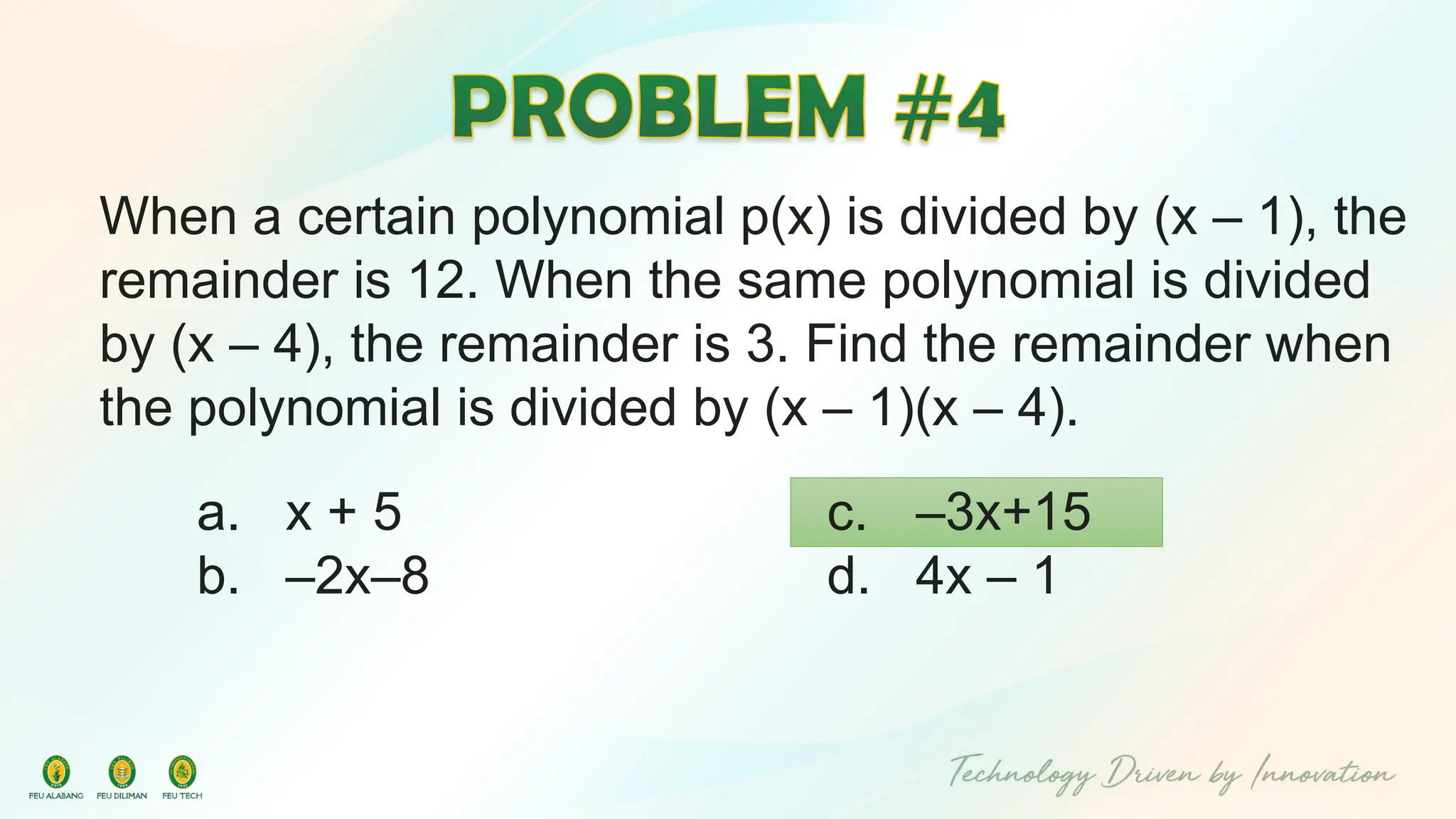
When a certain polynomial p(x) is divided by (x – 1), the
remainder is 12. When the same polynomial is divided
by (x – 4), the remainder is 3. Find the remainder when
the polynomial is divided by (x – 1)(x – 4).
c. –3x+15
d. 4x – 1
a. x + 5
b. –2x–8
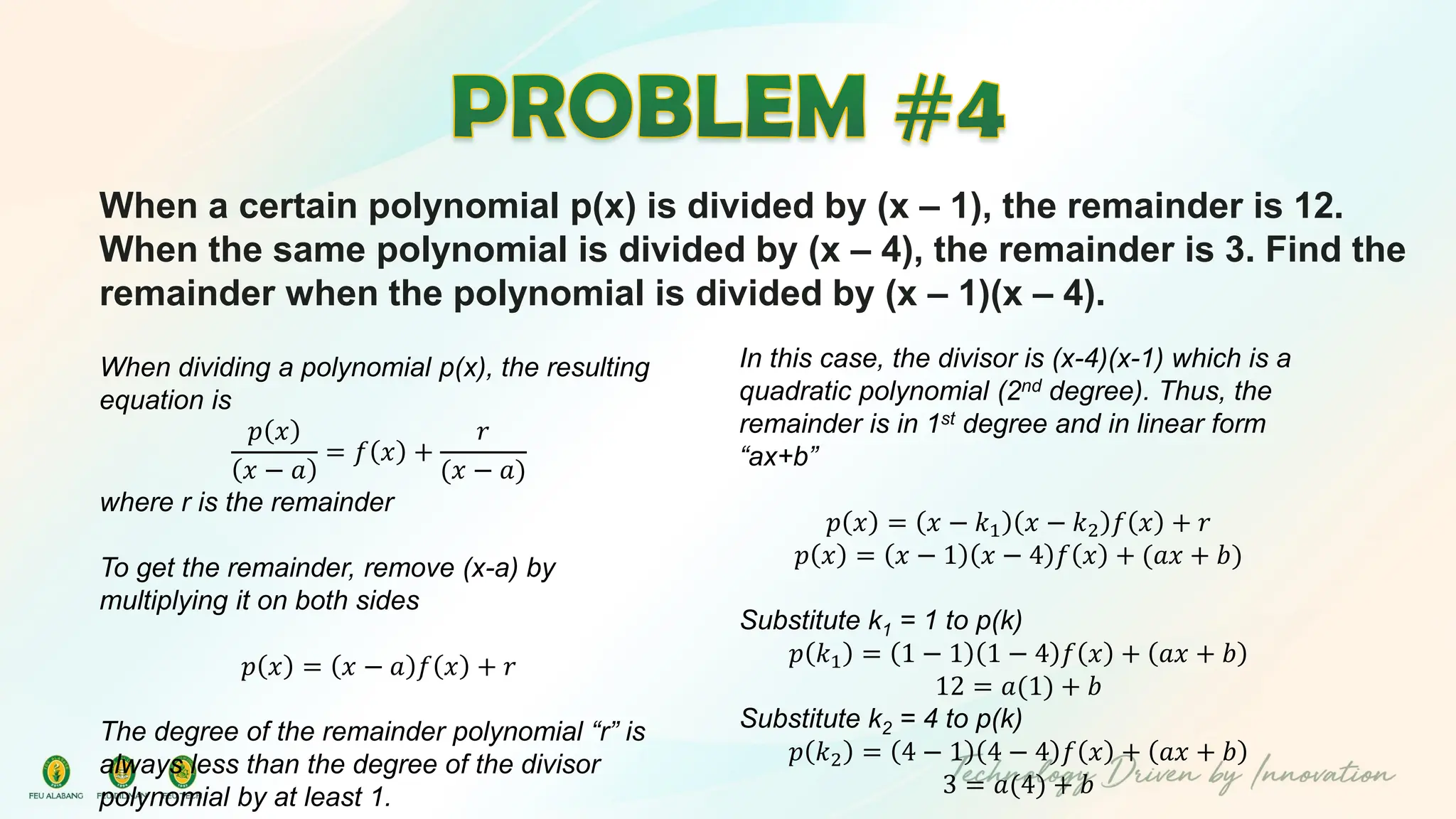
When a certain polynomial p(x) is divided by (x – 1), the remainder is 12.
When the same polynomial is divided by (x – 4), the remainder is 3. Find the
remainder when the polynomial is divided by (x – 1)(x – 4).
When dividing a polynomial p(x), the resulting
equation is
𝑝 𝑥
𝑥 − 𝑎
= 𝑓 𝑥 +
𝑟
(𝑥 − 𝑎)
where r is the remainder
To get the remainder, remove (x-a) by
multiplying it on both sides
𝑝 𝑥 = 𝑥 − 𝑎 𝑓 𝑥 + 𝑟
The degree of the remainder polynomial “r” is
always less than the degree of the divisor
polynomial by at least 1.
In this case, the divisor is (x-4)(x-1) which is a
quadratic polynomial (2nd degree). Thus, the
remainder is in 1st degree and in linear form
“ax+b”
𝑝 𝑥 = 𝑥 − 𝑘1 𝑥 − 𝑘2 𝑓 𝑥 + 𝑟
𝑝 𝑥 = 𝑥 − 1 𝑥 − 4 𝑓 𝑥 + (𝑎𝑥 + 𝑏)
Substitute k1 = 1 to p(k)
𝑝 𝑘1 = 1 − 1 1 − 4 𝑓 𝑥 + 𝑎𝑥 + 𝑏
12 = 𝑎(1) + 𝑏
Substitute k2 = 4 to p(k)
𝑝 𝑘2 = 4 − 1 4 − 4 𝑓 𝑥 + 𝑎𝑥 + 𝑏
3 = 𝑎(4) + 𝑏
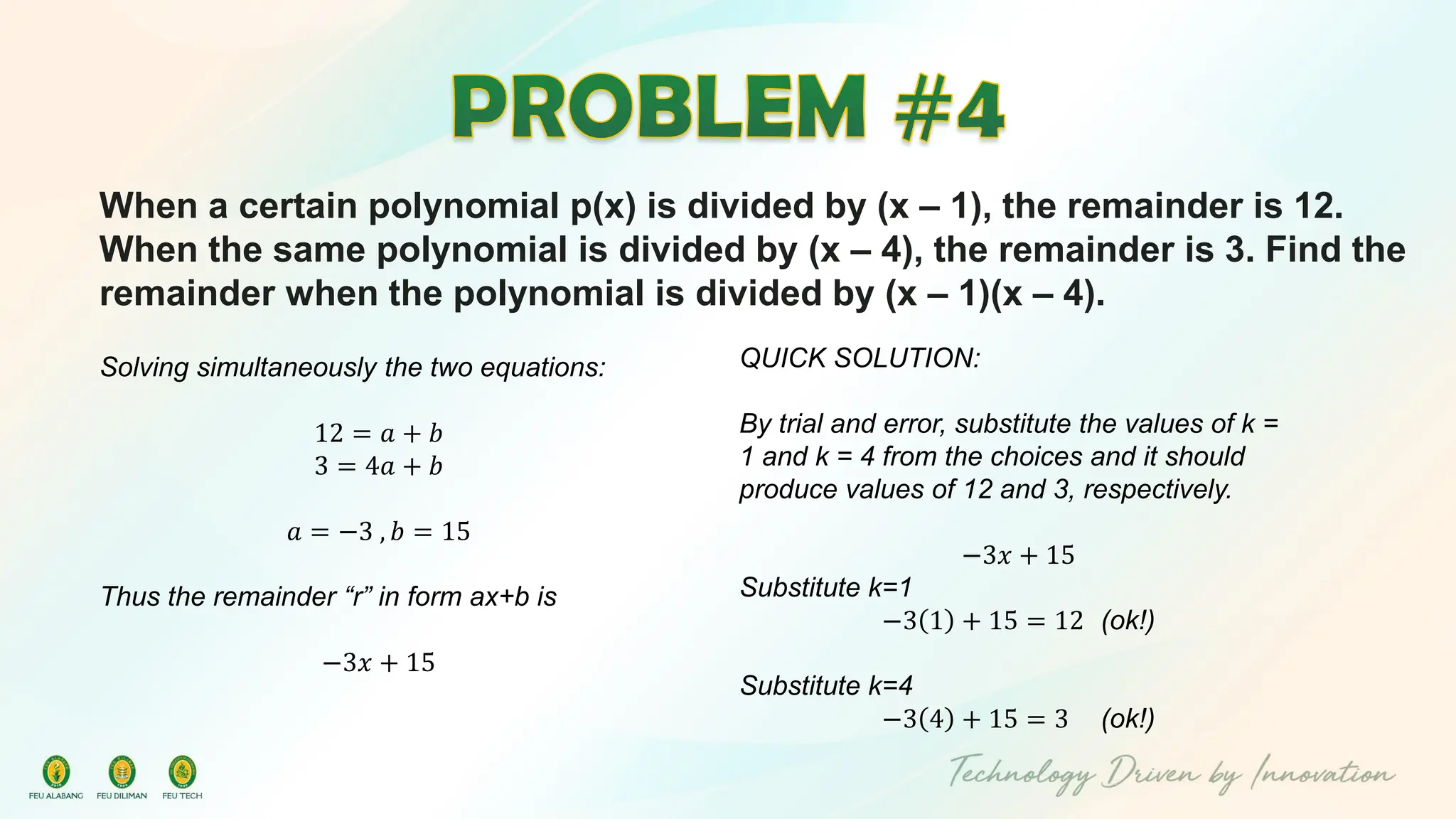
When a certain polynomial p(x) is divided by (x – 1), the remainder is 12.
When the same polynomial is divided by (x – 4), the remainder is 3. Find the
remainder when the polynomial is divided by (x – 1)(x – 4).
Solving simultaneously the two equations:
12 = 𝑎 + 𝑏
3 = 4𝑎 + 𝑏
𝑎 = −3 , 𝑏 = 15
Thus the remainder “r” in form ax+b is
−3𝑥 + 15
QUICK SOLUTION:
By trial and error, substitute the values of k =
1 and k = 4 from the choices and it should
produce values of 12 and 3, respectively.
−3𝑥 + 15
Substitute k=1
−3 1 + 15 = 12 (ok!)
Substitute k=4
−3 4 + 15 = 3 (ok!)
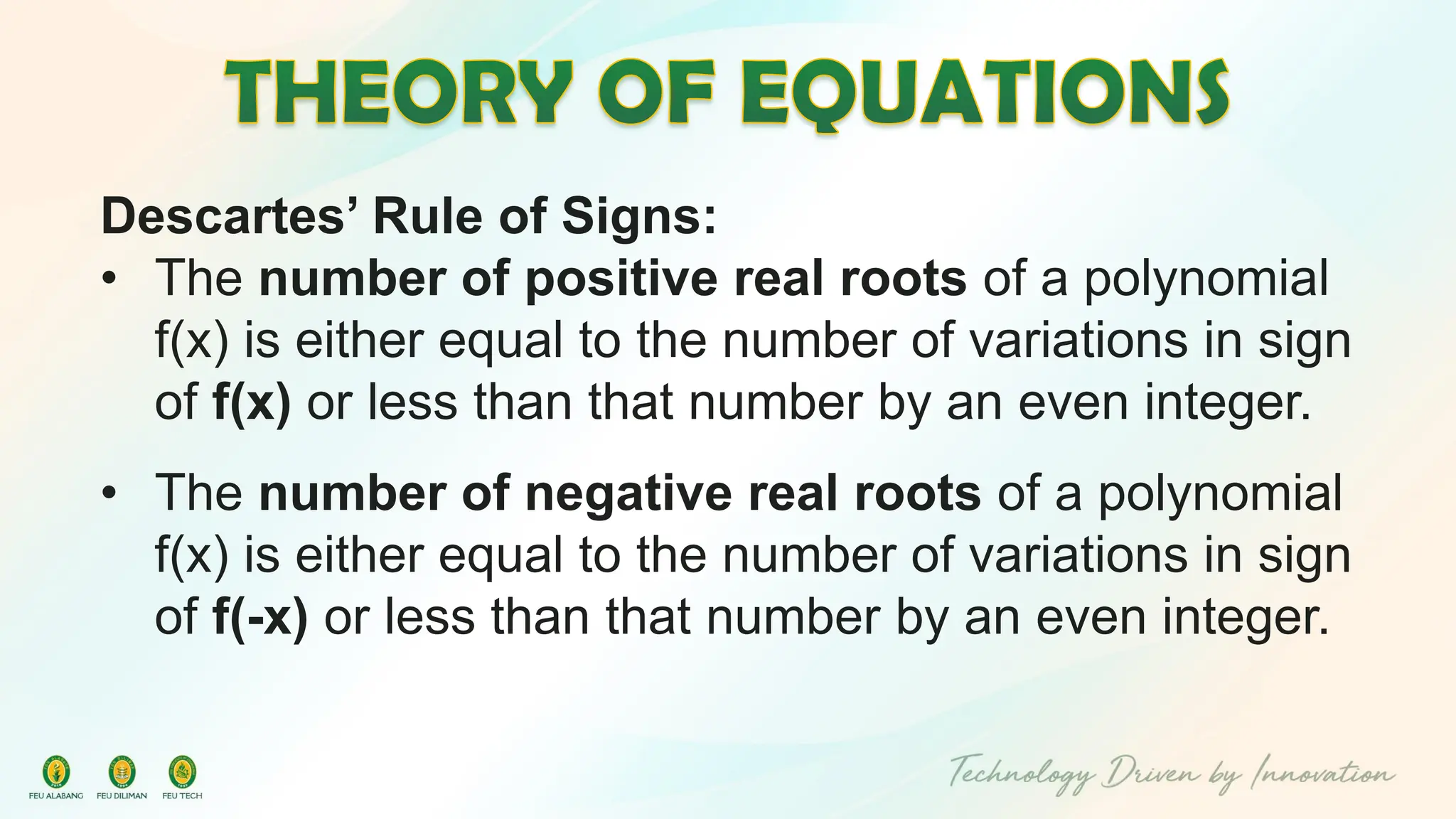
Descartes’ Rule of Signs:
• The number of positive real roots of a polynomial
f(x) is either equal to the number of variations in sign
of f(x) or less than that number by an even integer.
• The number of negative real roots of a polynomial
f(x) is either equal to the number of variations in sign
of f(-x) or less than that number by an even integer.
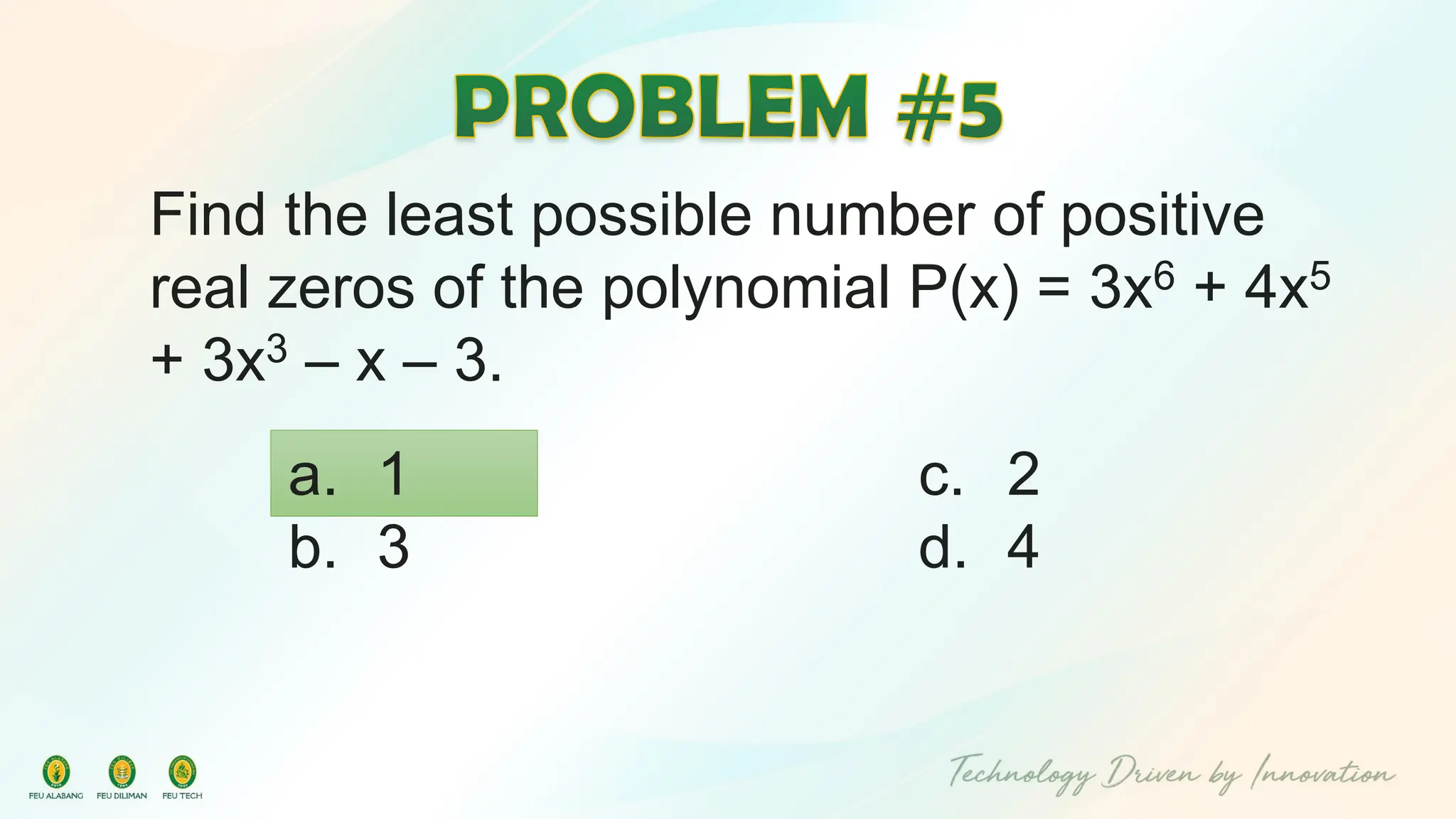
Find the least possible number of positive
real zeros of the polynomial P(x) = 3x6 + 4x5
+ 3x3 – x – 3.
c. 2
d. 4
a. 1
b. 3
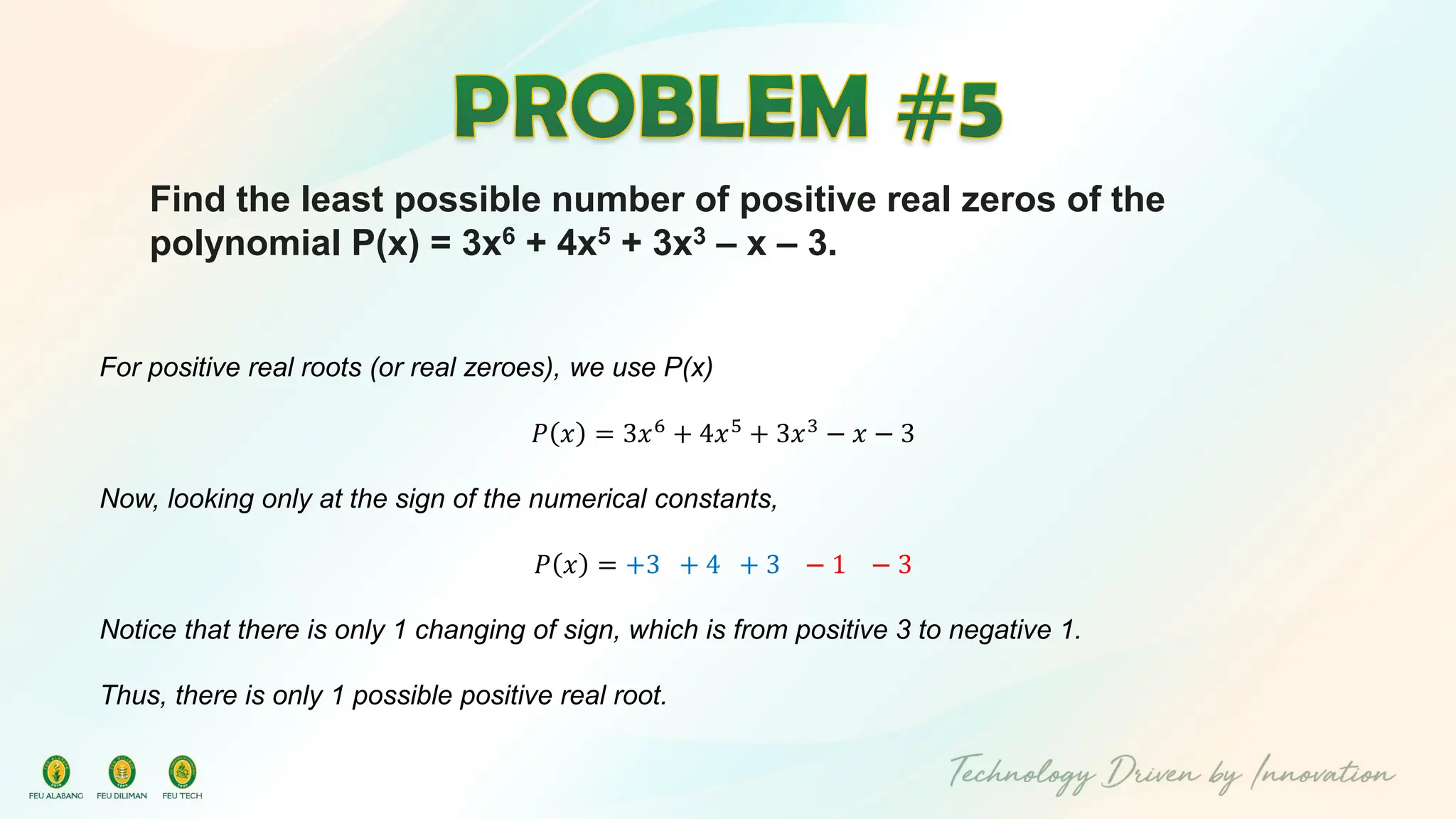
Find the least possible number of positive real zeros of the
polynomial P(x) = 3x6 + 4x5 + 3x3 – x – 3.
For positive real roots (or real zeroes), we use P(x)
𝑃 𝑥 = 3𝑥6 + 4𝑥5 + 3𝑥3 − 𝑥 − 3
Now, looking only at the sign of the numerical constants,
𝑃 𝑥 = +3 + 4 + 3 − 1 − 3
Notice that there is only 1 changing of sign, which is from positive 3 to negative 1.
Thus, there is only 1 possible positive real root.
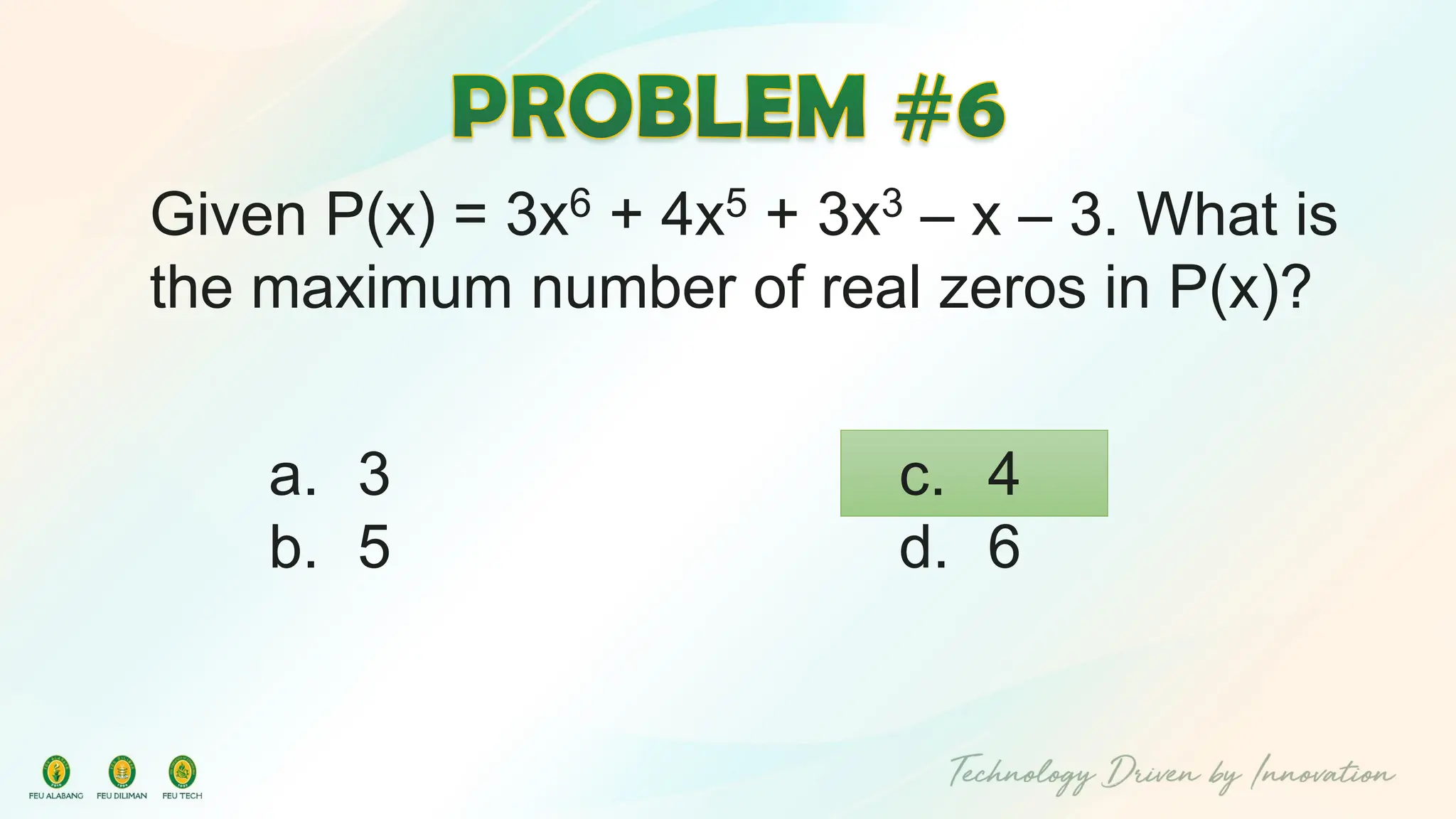
Given P(x) = 3x6 + 4x5 + 3x3 – x – 3. What is
the maximum number of real zeros in P(x)?
c. 4
d. 6
a. 3
b. 5
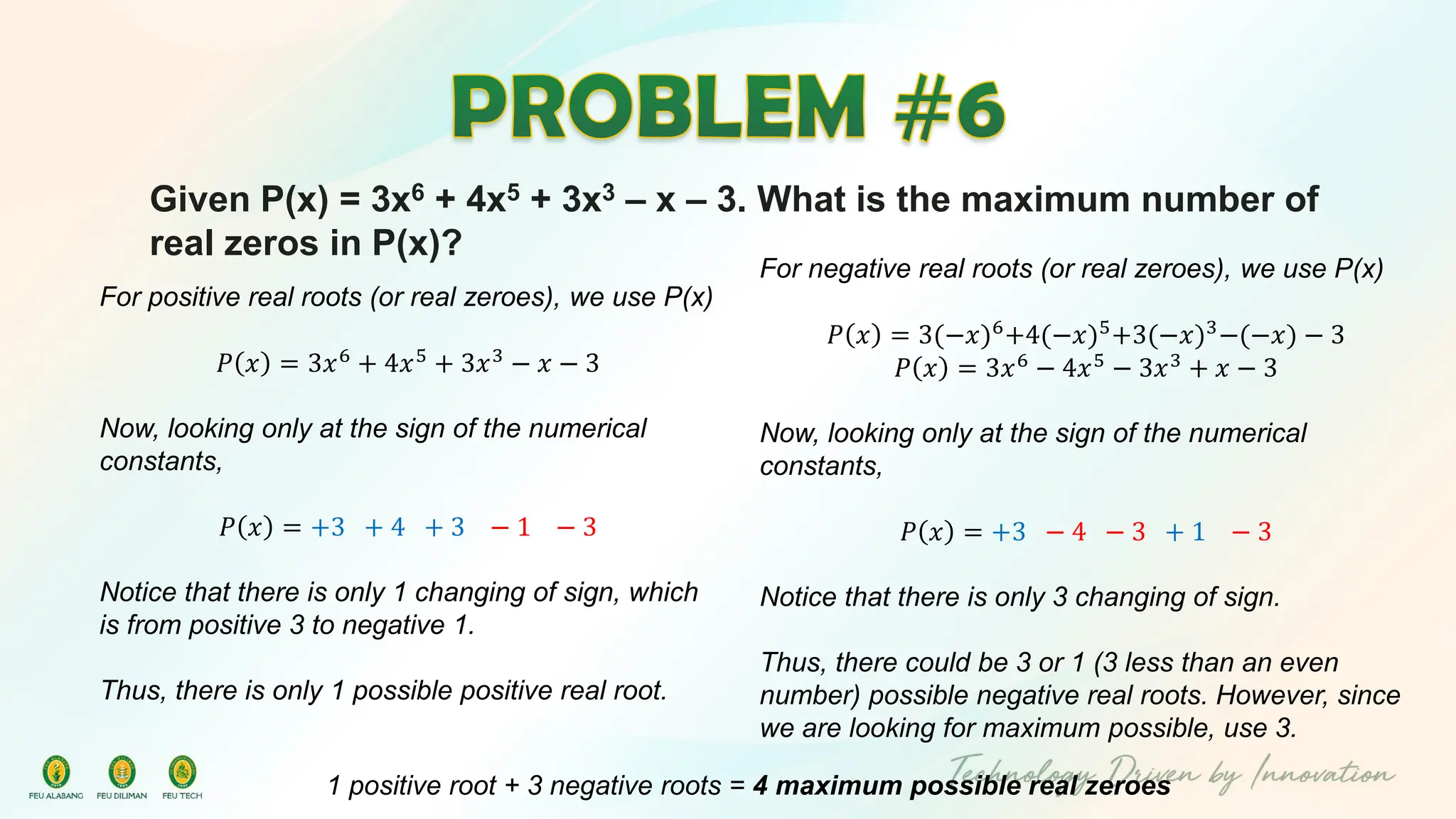
Given P(x) = 3x6 + 4x5 + 3x3 – x – 3. What is the maximum number of
real zeros in P(x)?
For positive real roots (or real zeroes), we use P(x)
𝑃 𝑥 = 3𝑥6 + 4𝑥5 + 3𝑥3 − 𝑥 − 3
Now, looking only at the sign of the numerical
constants,
𝑃 𝑥 = +3 + 4 + 3 − 1 − 3
Notice that there is only 1 changing of sign, which
is from positive 3 to negative 1.
Thus, there is only 1 possible positive real root.
For negative real roots (or real zeroes), we use P(x)
𝑃 𝑥 = 3(−𝑥)6
+4(−𝑥)5
+3(−𝑥)3
−(−𝑥) − 3
𝑃 𝑥 = 3𝑥6
− 4𝑥5
− 3𝑥3
+ 𝑥 − 3
Now, looking only at the sign of the numerical
constants,
𝑃 𝑥 = +3 − 4 − 3 + 1 − 3
Notice that there is only 3 changing of sign.
Thus, there could be 3 or 1 (3 less than an even
number) possible negative real roots. However, since
we are looking for maximum possible, use 3.
1 positive root + 3 negative roots = 4 maximum possible real zeroes
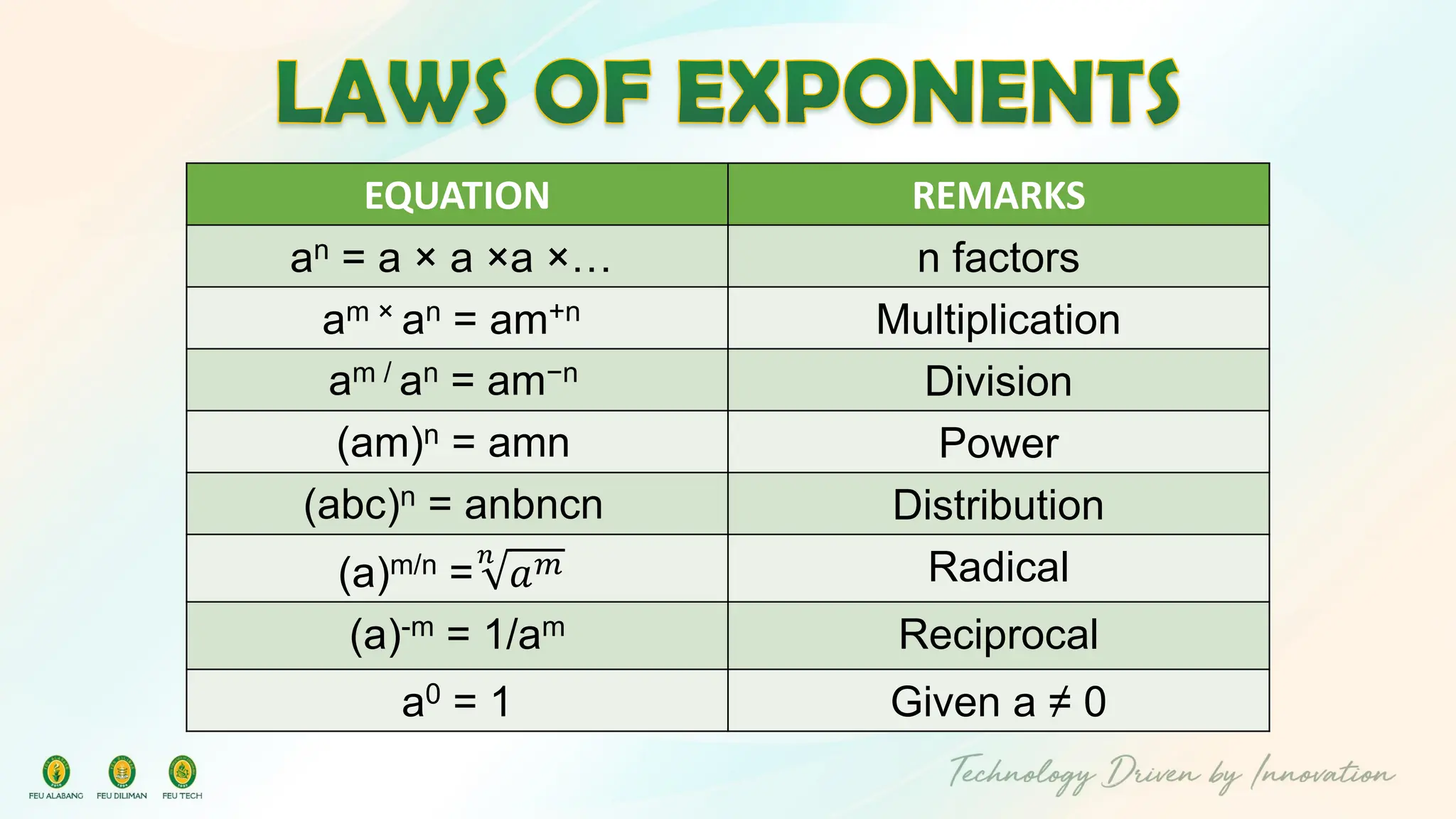
EQUATION REMARKS
an = a × a ×a ×… n factors
am × an = am+n Multiplication
am / an = am−n Division
(am)n = amn Power
(abc)n = anbncn Distribution
(a)m/n =
𝑛
𝑎𝑚 Radical
(a)-m = 1/am Reciprocal
a0 = 1 Given a ≠ 0
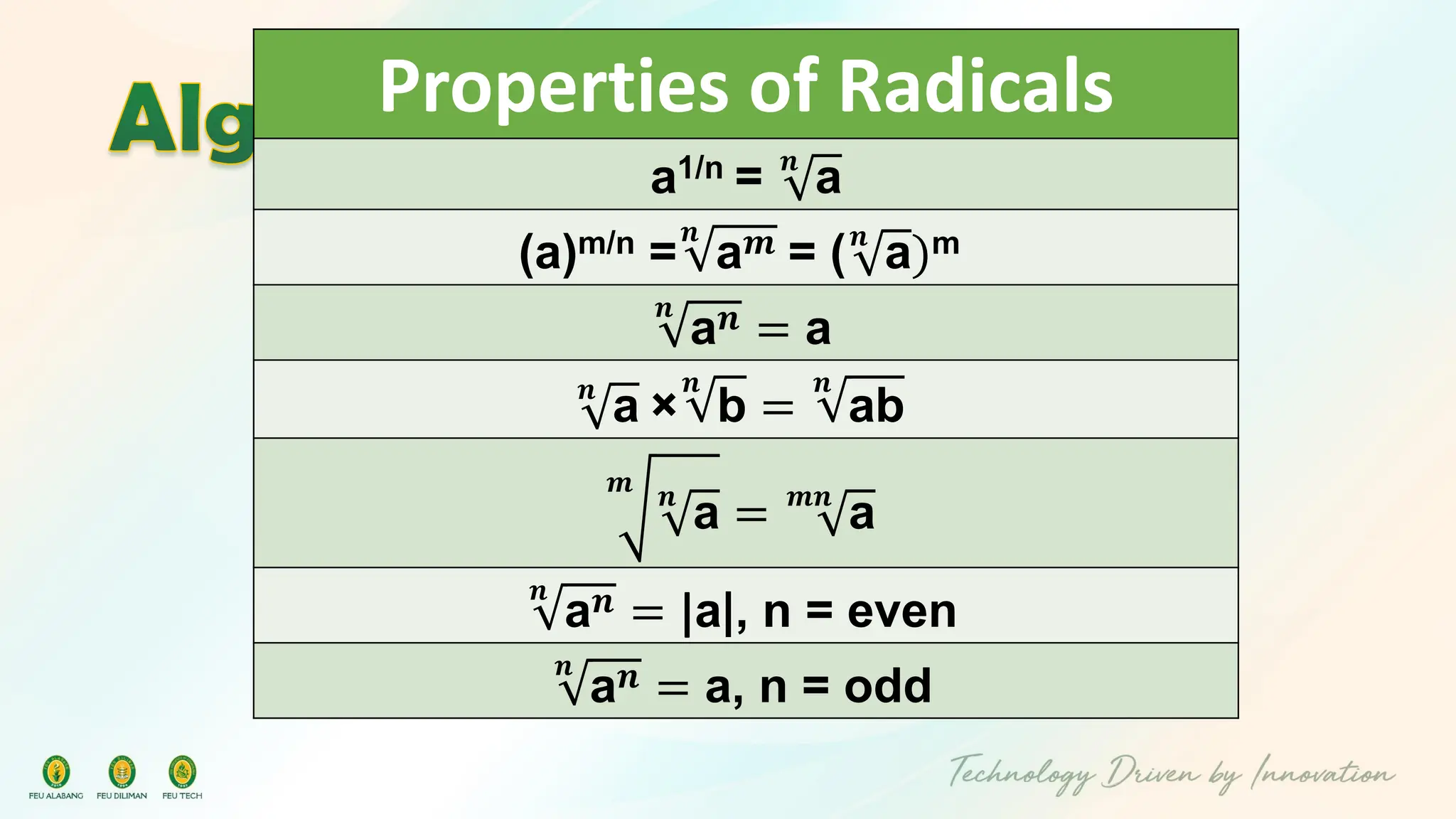
Properties of Radicals
a1/n = 𝒏
a
(a)m/n =
𝒏
a𝒎 = (𝒏
a)m
𝒏
a𝒏 = a
𝒏
a ×
𝒏
b =
𝒏
ab
𝒎 𝒏
a = 𝒎𝒏
a
𝒏
a𝒏 = |a|, n = even
𝒏
a𝒏 = a, n = odd
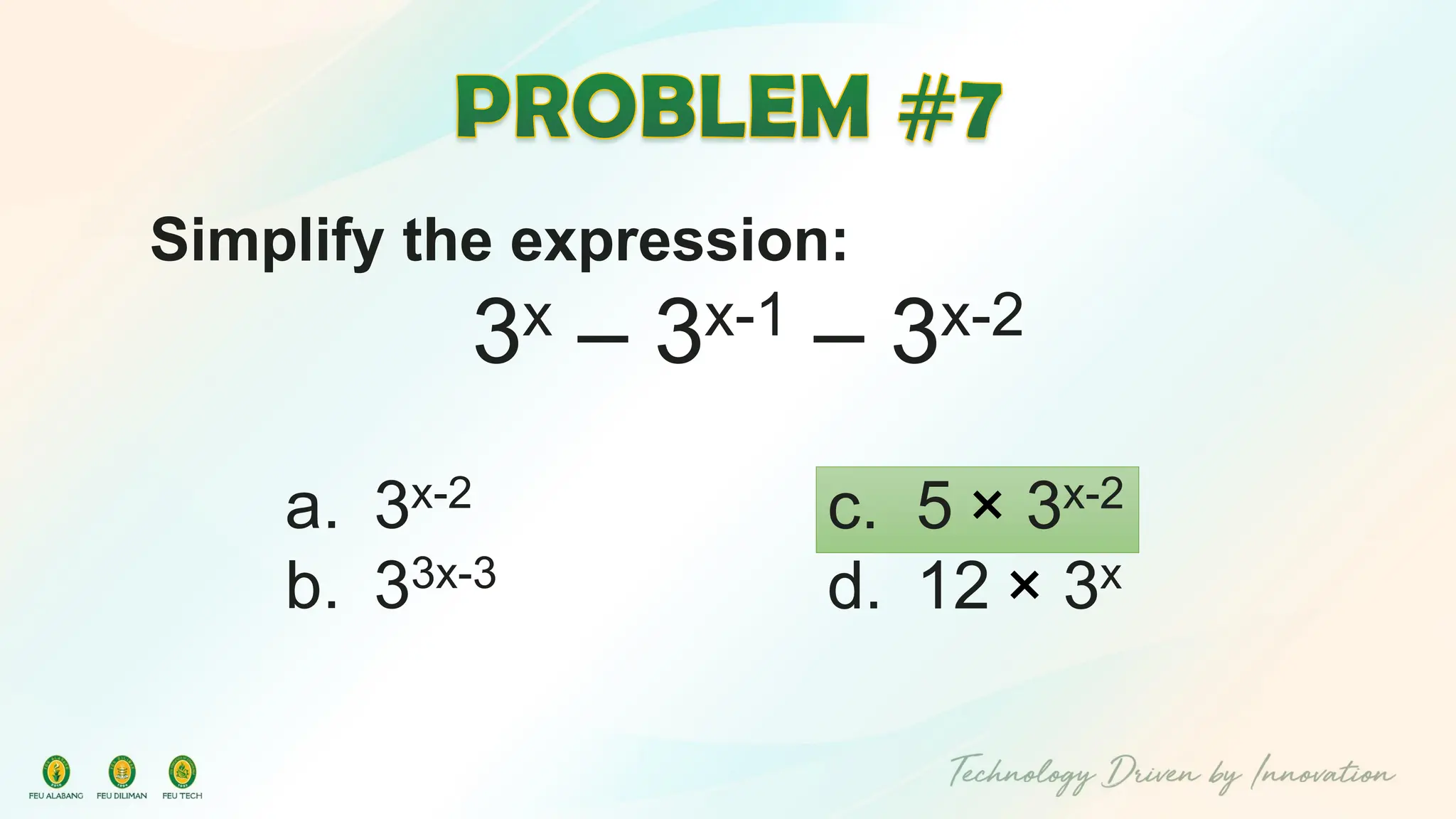
Simplify the expression:
3x – 3x-1 – 3x-2
c. 5 × 3x-2
d. 12 × 3x
a. 3x-2
b. 33x-3
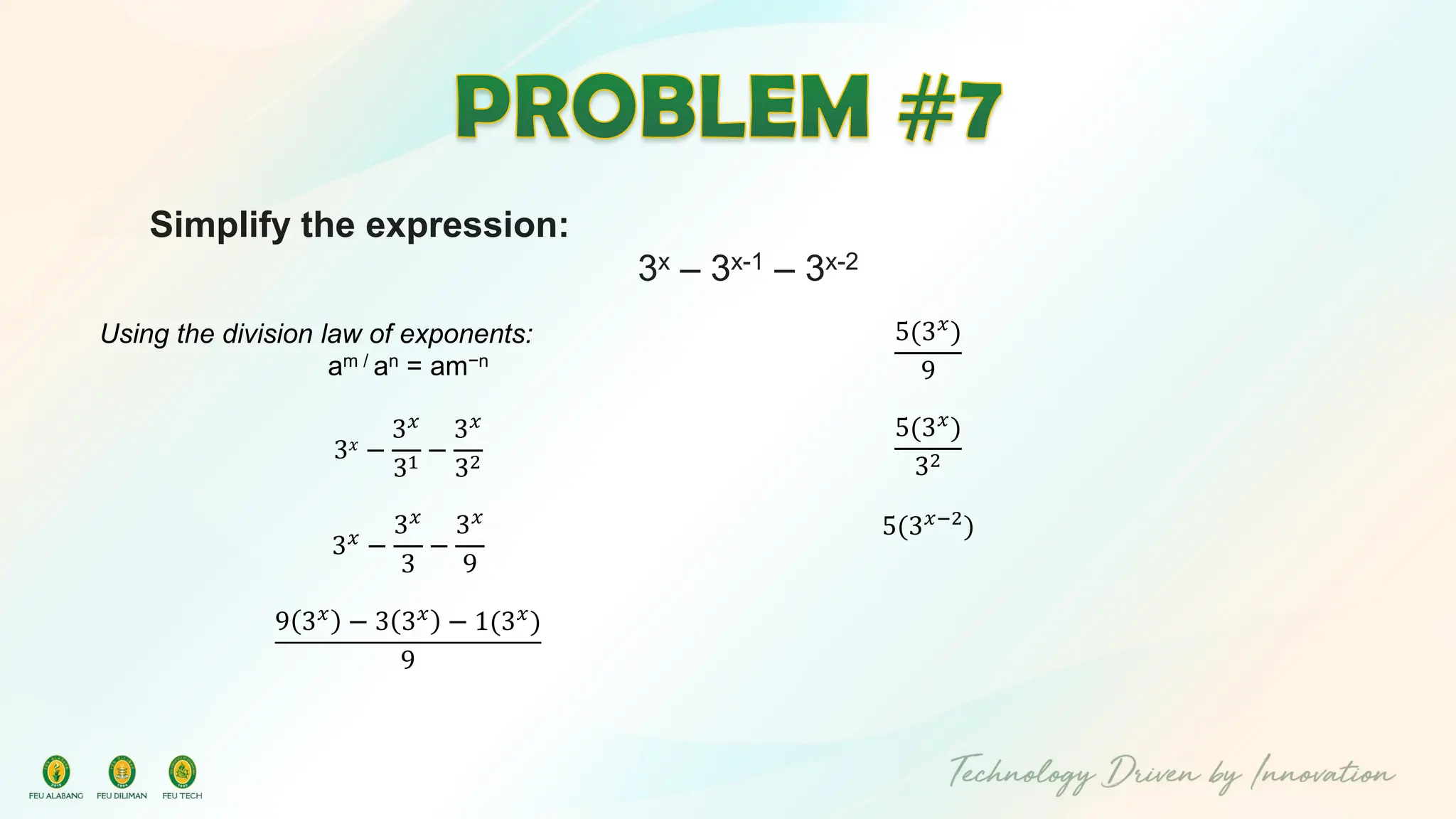
Simplify the expression:
3x – 3x-1 – 3x-2
Using the division law of exponents:
am / an = am−n
3𝑥 −
3𝑥
31 −
3𝑥
32
3𝑥 −
3𝑥
3
−
3𝑥
9
9 3𝑥
− 3 3𝑥
− 1(3𝑥
)
9
5(3𝑥
)
9
5(3𝑥)
32
5(3𝑥−2
)
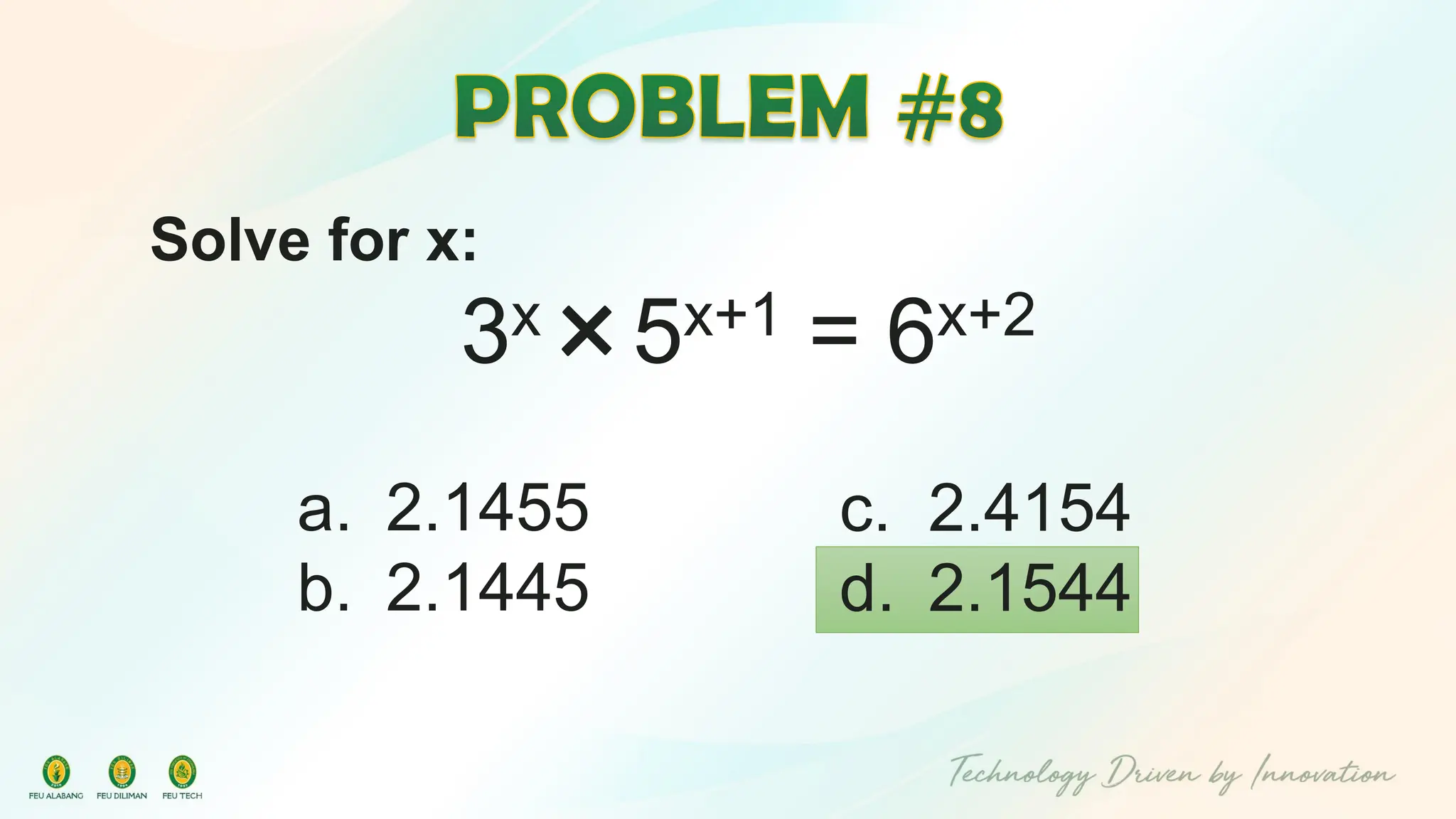
Solve for x:
3x×5x+1 = 6x+2
c. 2.4154
d. 2.1544
a. 2.1455
b. 2.1445
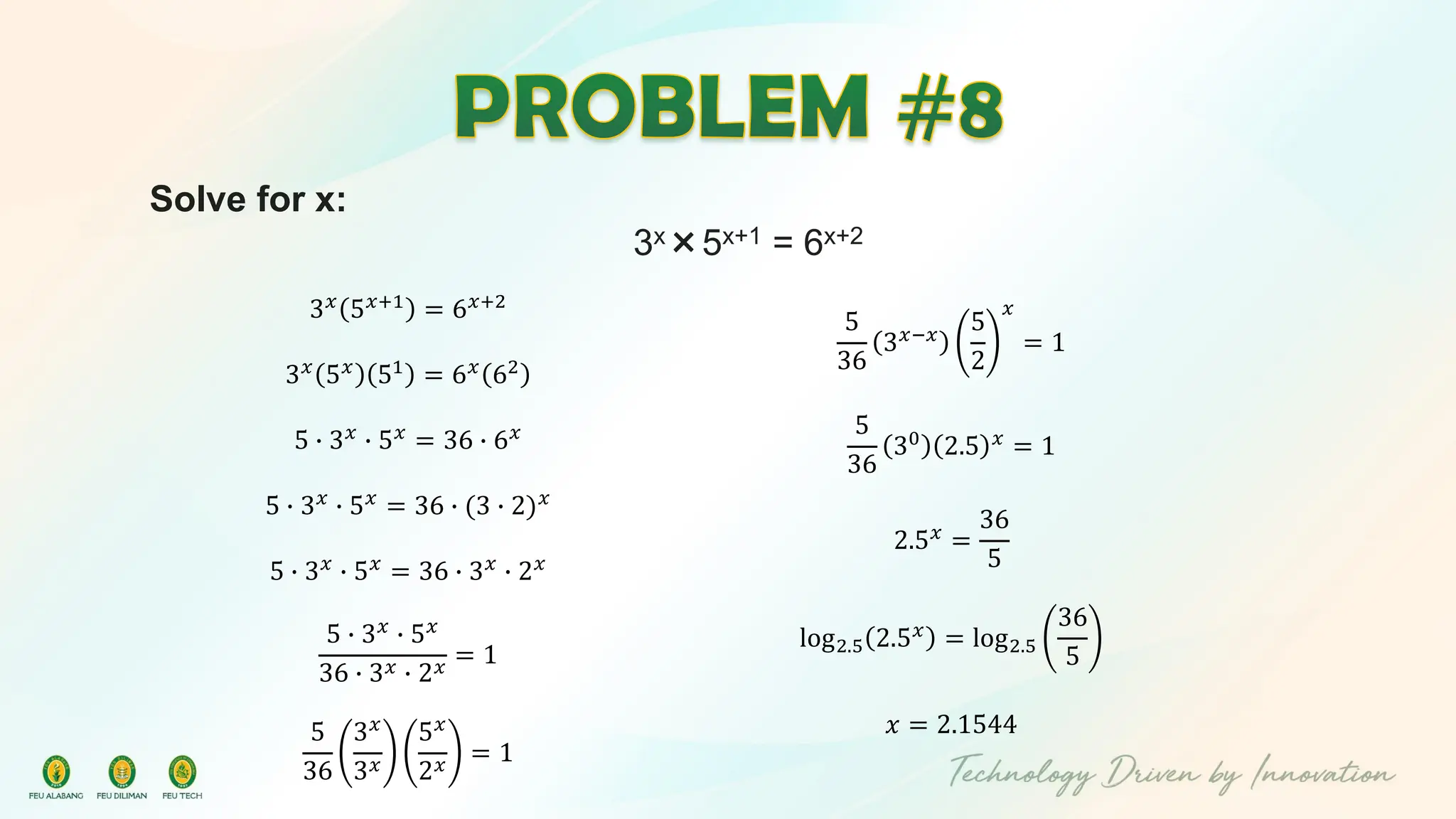
Solve for x:
3x×5x+1 = 6x+2
3𝑥
5𝑥+1
= 6𝑥+2
3𝑥 5𝑥 51 = 6𝑥 62
5 ∙ 3𝑥 ∙ 5𝑥 = 36 ∙ 6𝑥
5 ∙ 3𝑥
∙ 5𝑥
= 36 ∙ (3 ∙ 2)𝑥
5 ∙ 3𝑥
∙ 5𝑥
= 36 ∙ 3𝑥
∙ 2𝑥
5 ∙ 3𝑥
∙ 5𝑥
36 ∙ 3𝑥 ∙ 2𝑥
= 1
5
36
3𝑥
3𝑥
5𝑥
2𝑥
= 1
5
36
3𝑥−𝑥
5
2
𝑥
= 1
5
36
30
2.5 𝑥
= 1
2.5𝑥 =
36
5
log2.5 2.5𝑥
= log2.5
36
5
𝑥 = 2.1544
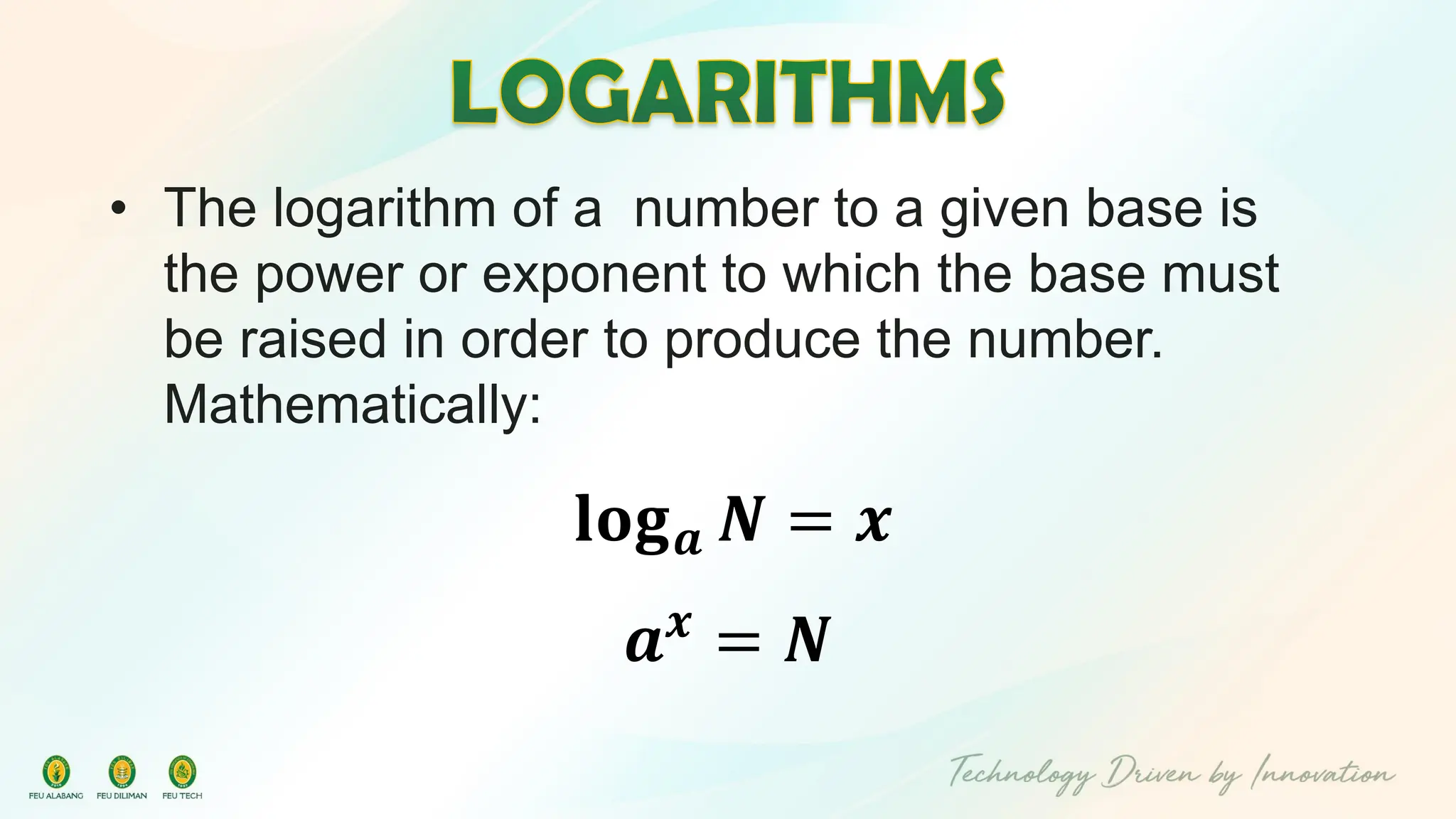
• The logarithm of a number to a given base is
the power or exponent to which the base must
be raised in order to produce the number.
Mathematically:
𝐥𝐨𝐠𝒂 𝑵 = 𝒙
𝒂𝒙
= 𝑵
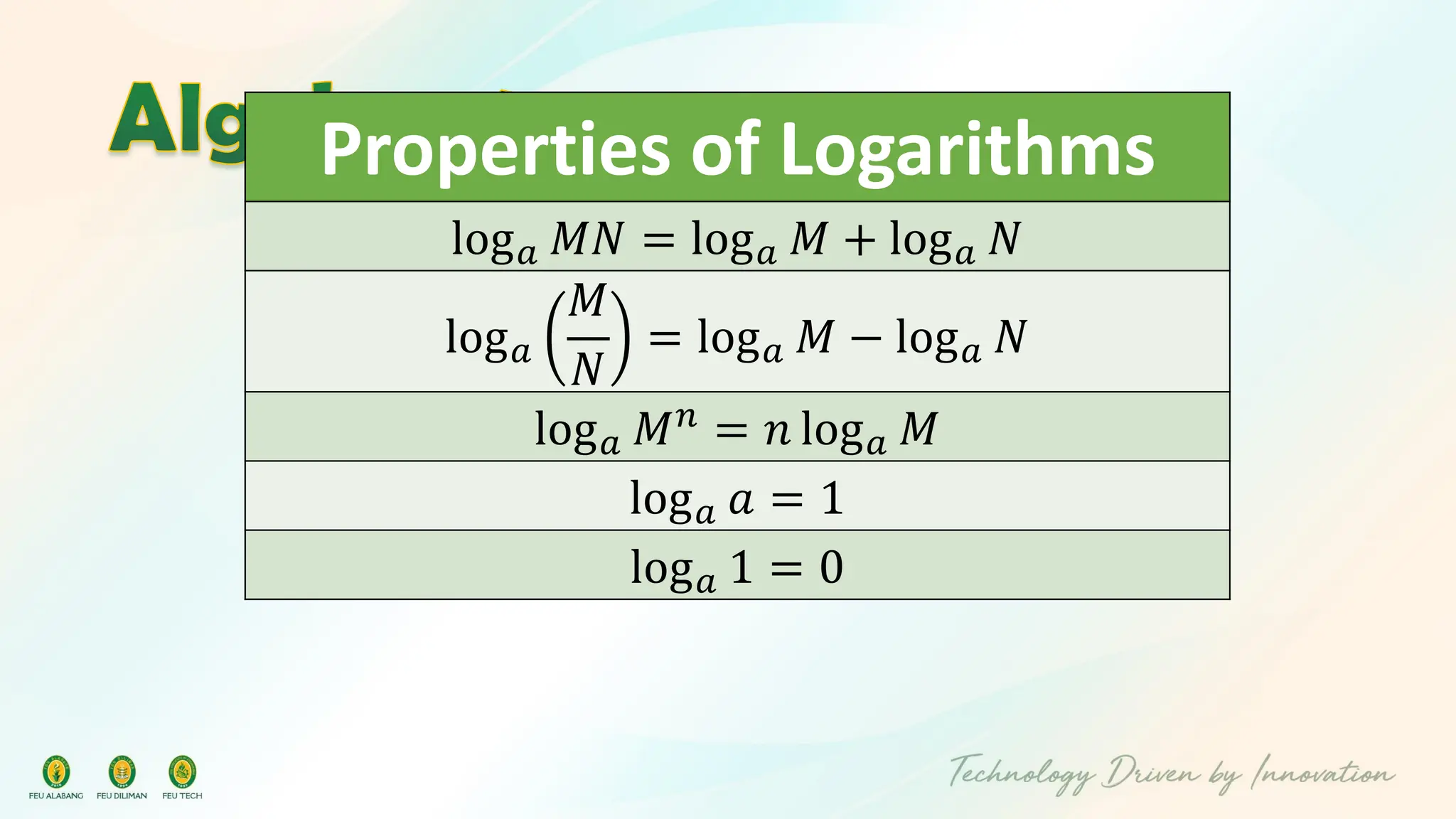
Properties of Logarithms
log𝑎 𝑀𝑁 = log𝑎 𝑀 + log𝑎 𝑁
log𝑎
𝑀
𝑁
= log𝑎 𝑀 − log𝑎 𝑁
log𝑎 𝑀𝑛
= 𝑛 log𝑎 𝑀
log𝑎 𝑎 = 1
log𝑎 1 = 0
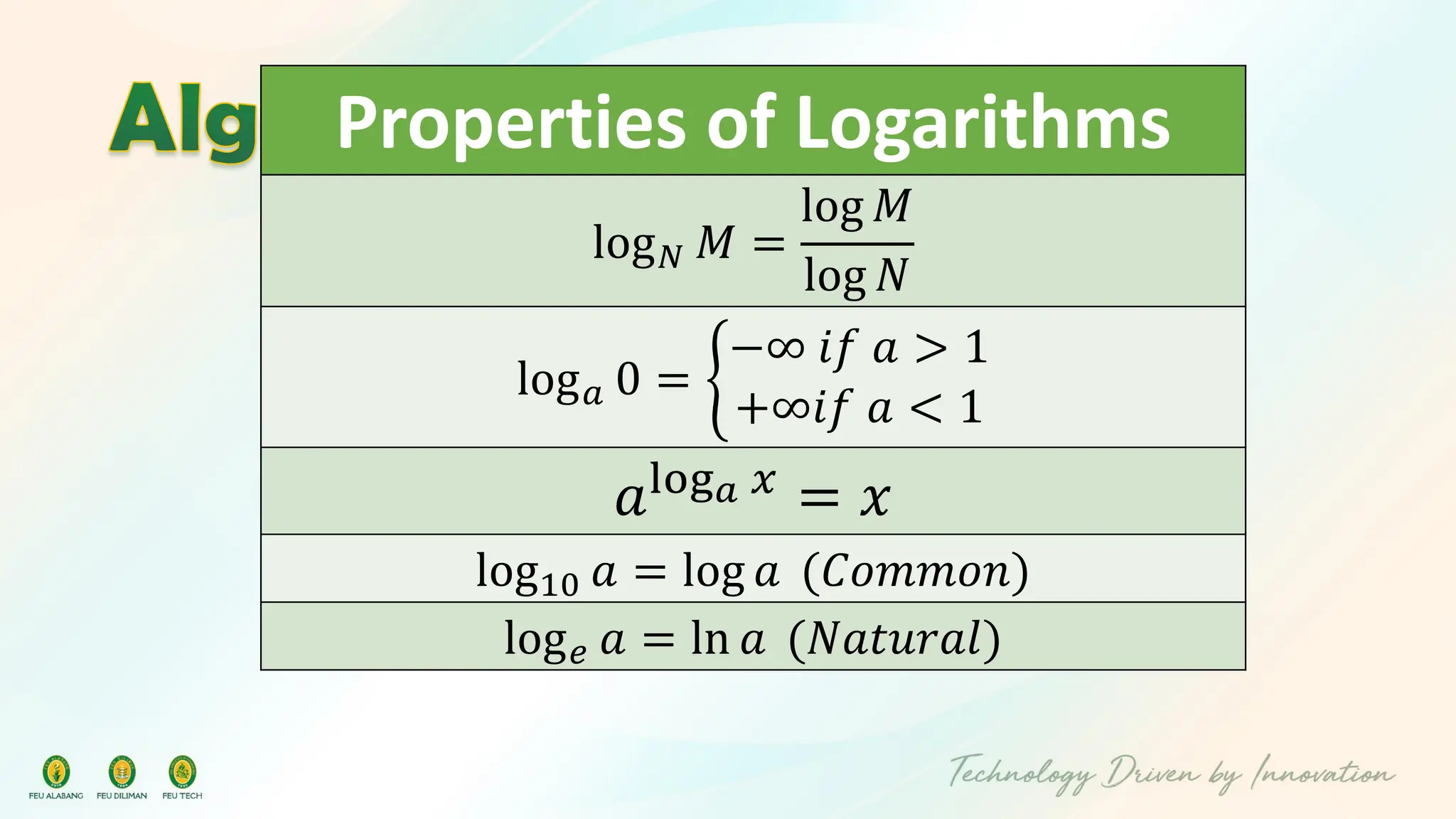
Properties of Logarithms
log𝑁 𝑀 =
log 𝑀
log 𝑁
log𝑎 0 = ቊ
−∞ 𝑖𝑓 𝑎 > 1
+∞𝑖𝑓 𝑎 < 1
𝑎log𝑎 𝑥
= 𝑥
log10 𝑎 = log 𝑎 (𝐶𝑜𝑚𝑚𝑜𝑛)
log𝑒 𝑎 = ln 𝑎 (𝑁𝑎𝑡𝑢𝑟𝑎𝑙)
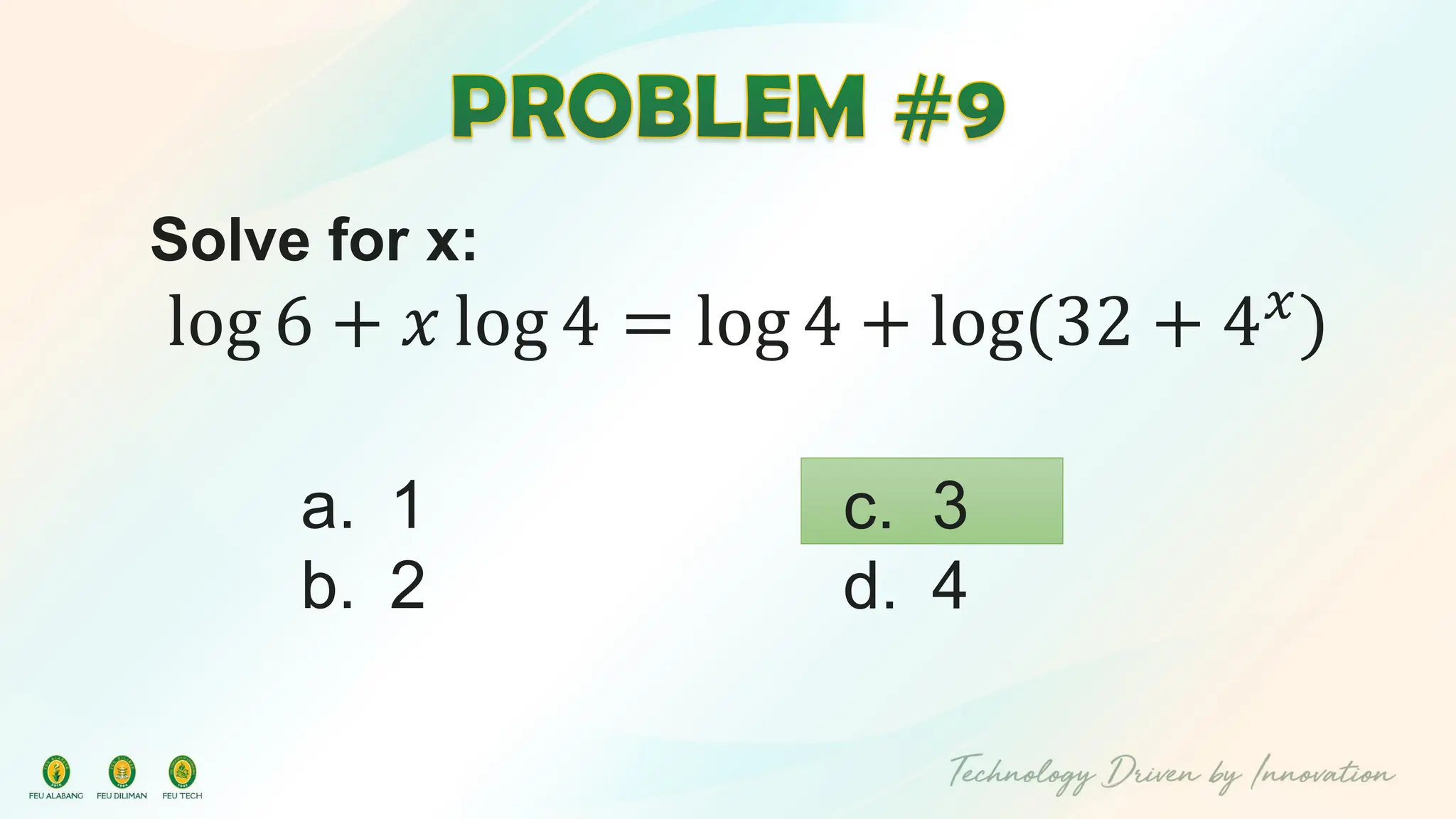
Solve for x:
log 6 + 𝑥 log 4 = log 4 + log(32 + 4𝑥
)
c. 3
d. 4
a. 1
b. 2
Solve for x:
log 6 + 𝑥 log 4 = log 4 + log(32 + 4𝑥)
log 6 + 𝑥 log 4 = log 4 + log 32 + 4𝑥
log 6 + log 4𝑥
= log 4 + log 32 + 4𝑥
log[6(4𝑥
)] = log[4(32 + 4𝑥
)]
6 4𝑥 = 4(32 + 4𝑥)
6 4𝑥 = 4 32 + 4(4𝑥)
6 4𝑥
− 4 4𝑥
= 128
2 4𝑥 = 128
4𝑥
= 64
Take logarithm on both sides:
log 4𝑥
= log 64
𝑥 log 4 = log 64
𝑥 =
log 64
log 4
𝑥 = 3
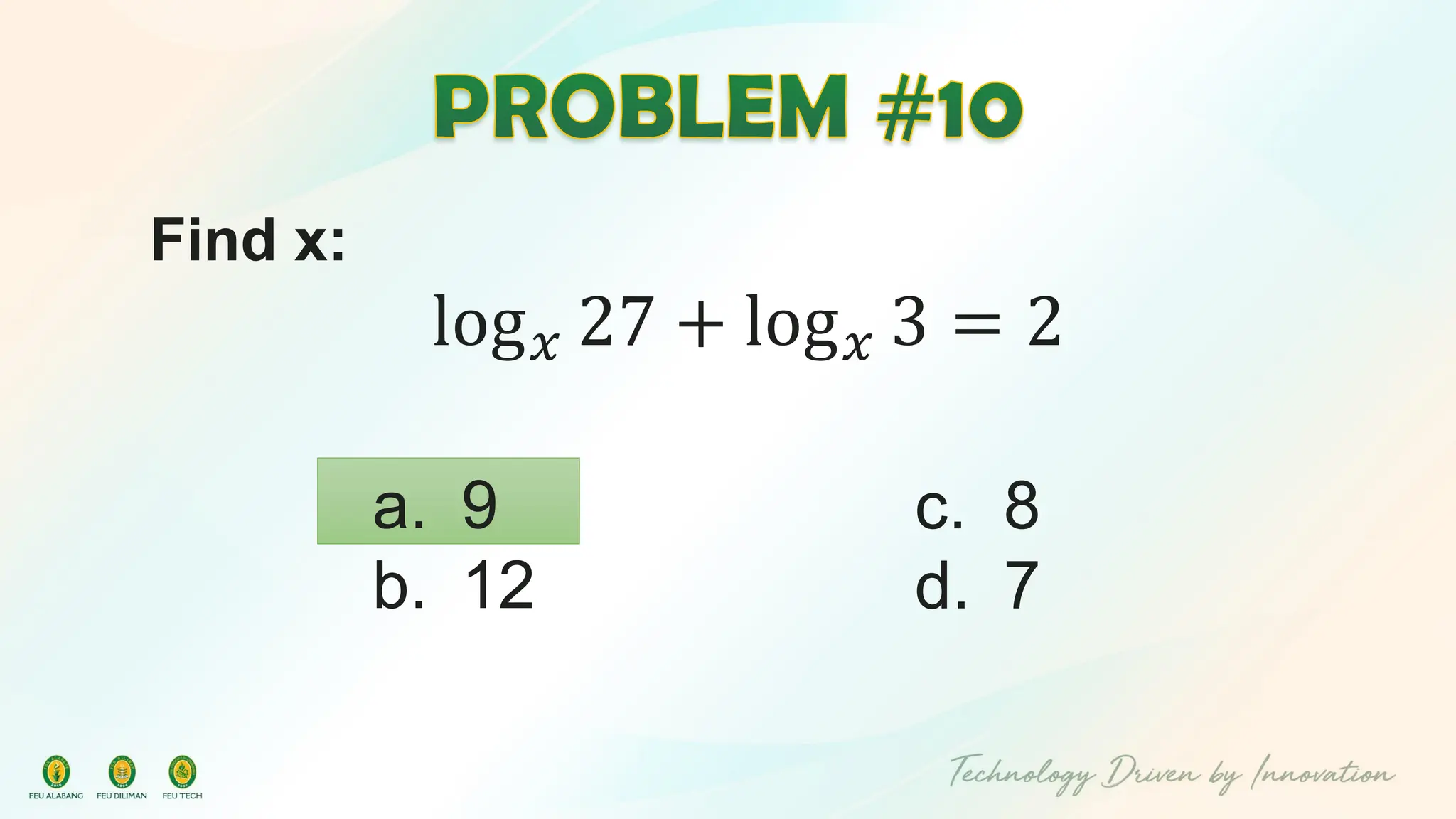
Find x:
log𝑥 27 + log𝑥 3 = 2
c. 8
d. 7
a. 9
b. 12
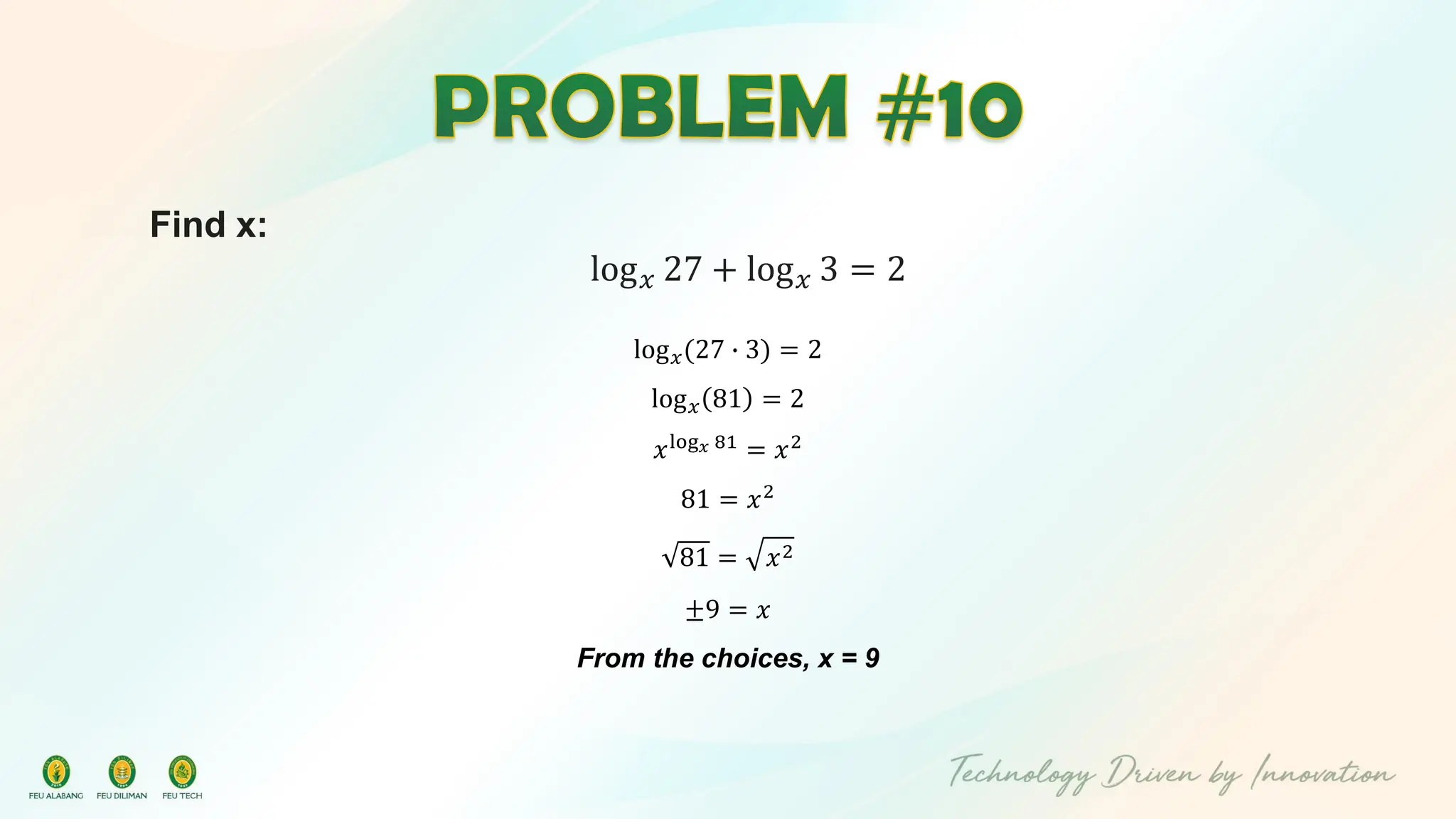
Find x:
log𝑥 27 + log𝑥 3 = 2
log𝑥(27 ∙ 3) = 2
log𝑥 81 = 2
𝑥log𝑥 81 = 𝑥2
81 = 𝑥2
81 = 𝑥2
±9 = 𝑥
From the choices, x = 9
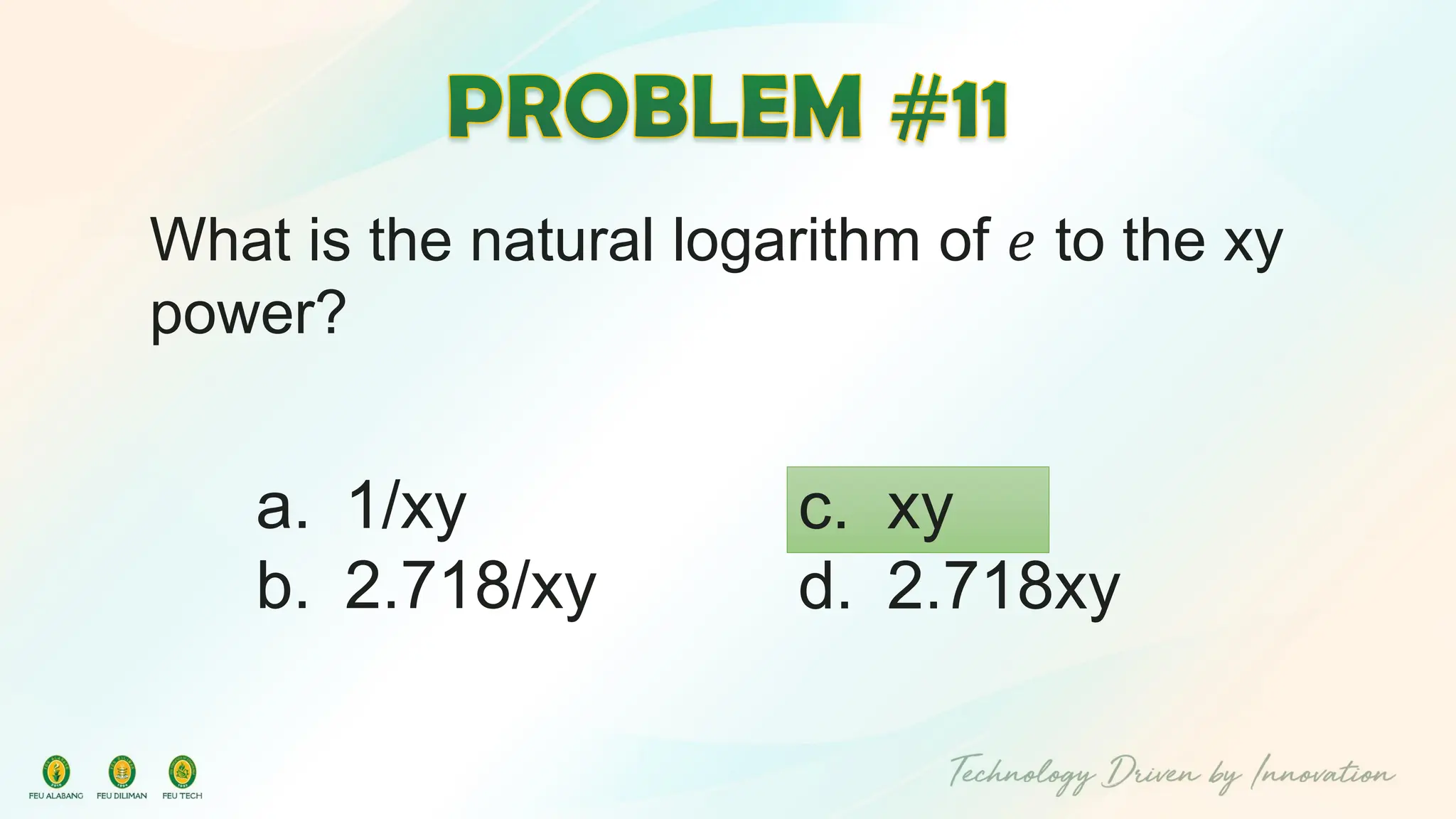
What is the natural logarithm of 𝑒 to the xy
power?
c. xy
d. 2.718xy
a. 1/xy
b. 2.718/xy
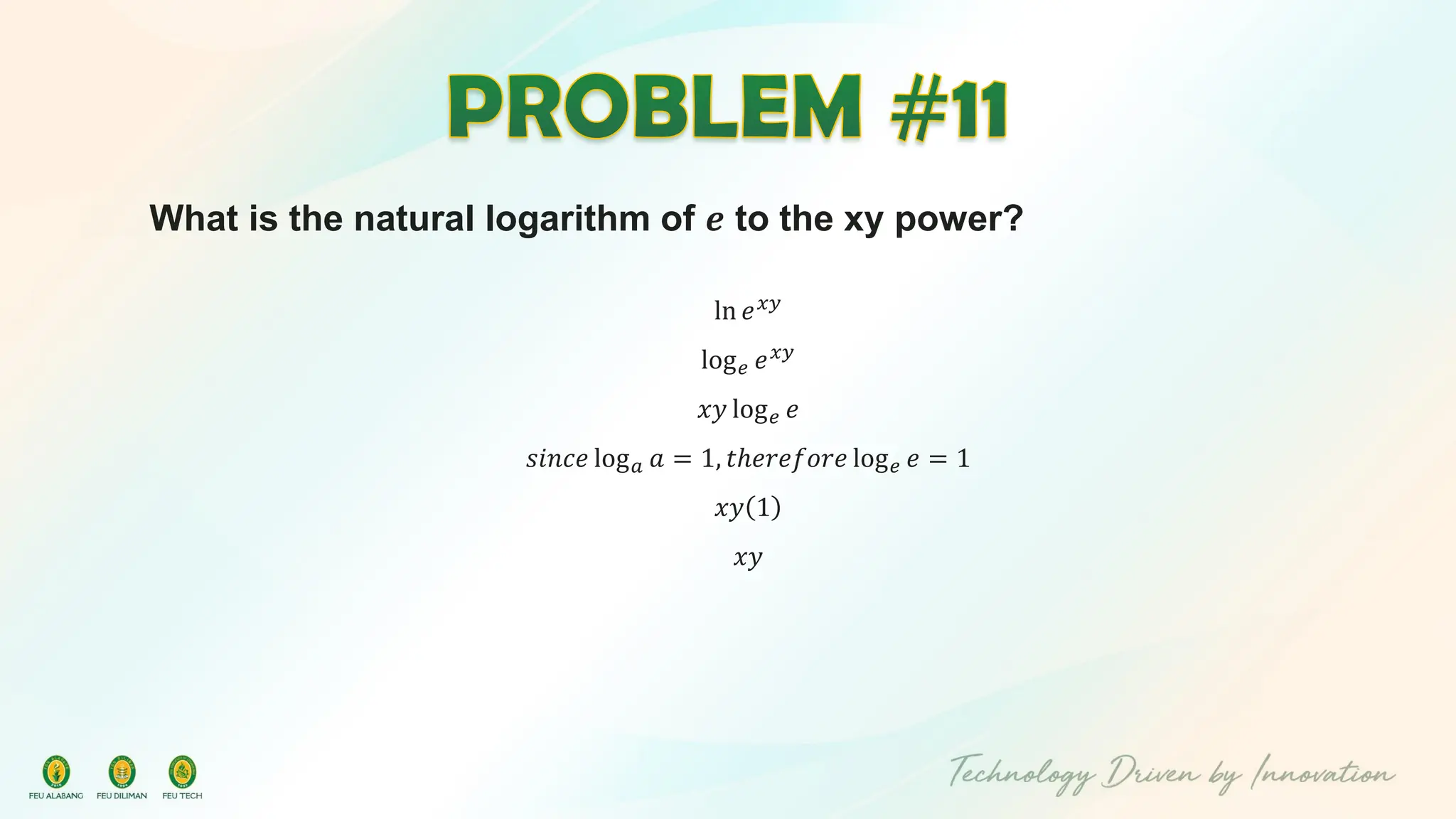
What is the natural logarithm of 𝒆 to the xy power?
ln 𝑒𝑥𝑦
log𝑒 𝑒𝑥𝑦
𝑥𝑦 log𝑒 𝑒
𝑠𝑖𝑛𝑐𝑒 log𝑎 𝑎 = 1, 𝑡ℎ𝑒𝑟𝑒𝑓𝑜𝑟𝑒 log𝑒 𝑒 = 1
𝑥𝑦 1
𝑥𝑦
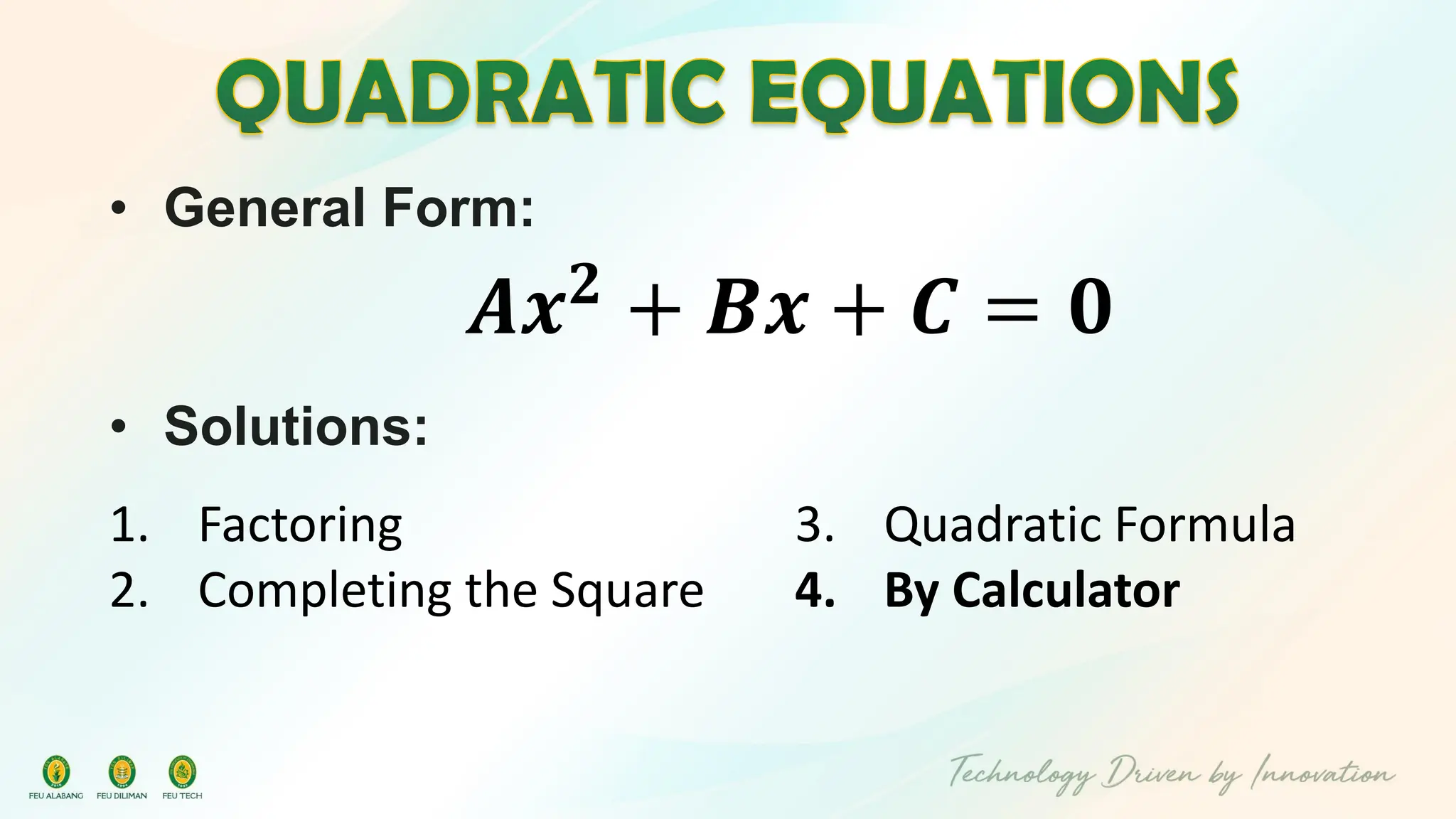
• General Form:
𝑨𝒙𝟐
+ 𝑩𝒙 + 𝑪 = 𝟎
• Solutions:
3. Quadratic Formula
4. By Calculator
1. Factoring
2. Completing the Square
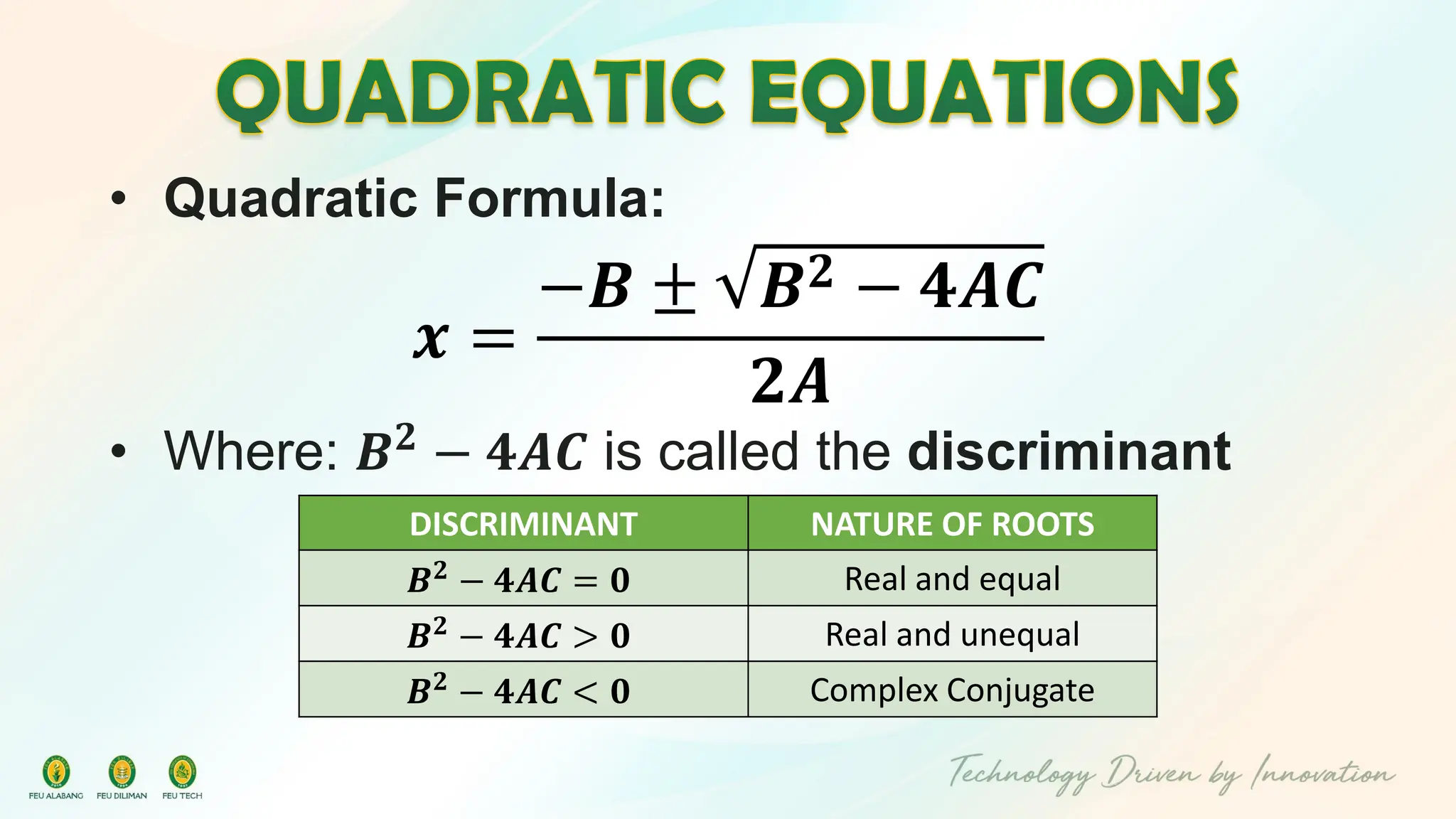
• Quadratic Formula:
𝒙 =
−𝑩 ± 𝑩𝟐 − 𝟒𝑨𝑪
𝟐𝑨
• Where: 𝑩𝟐
− 𝟒𝑨𝑪 is called the discriminant
DISCRIMINANT NATURE OF ROOTS
𝑩𝟐 − 𝟒𝑨𝑪 = 𝟎 Real and equal
𝑩𝟐 − 𝟒𝑨𝑪 > 𝟎 Real and unequal
𝑩𝟐 − 𝟒𝑨𝑪 < 𝟎 Complex Conjugate
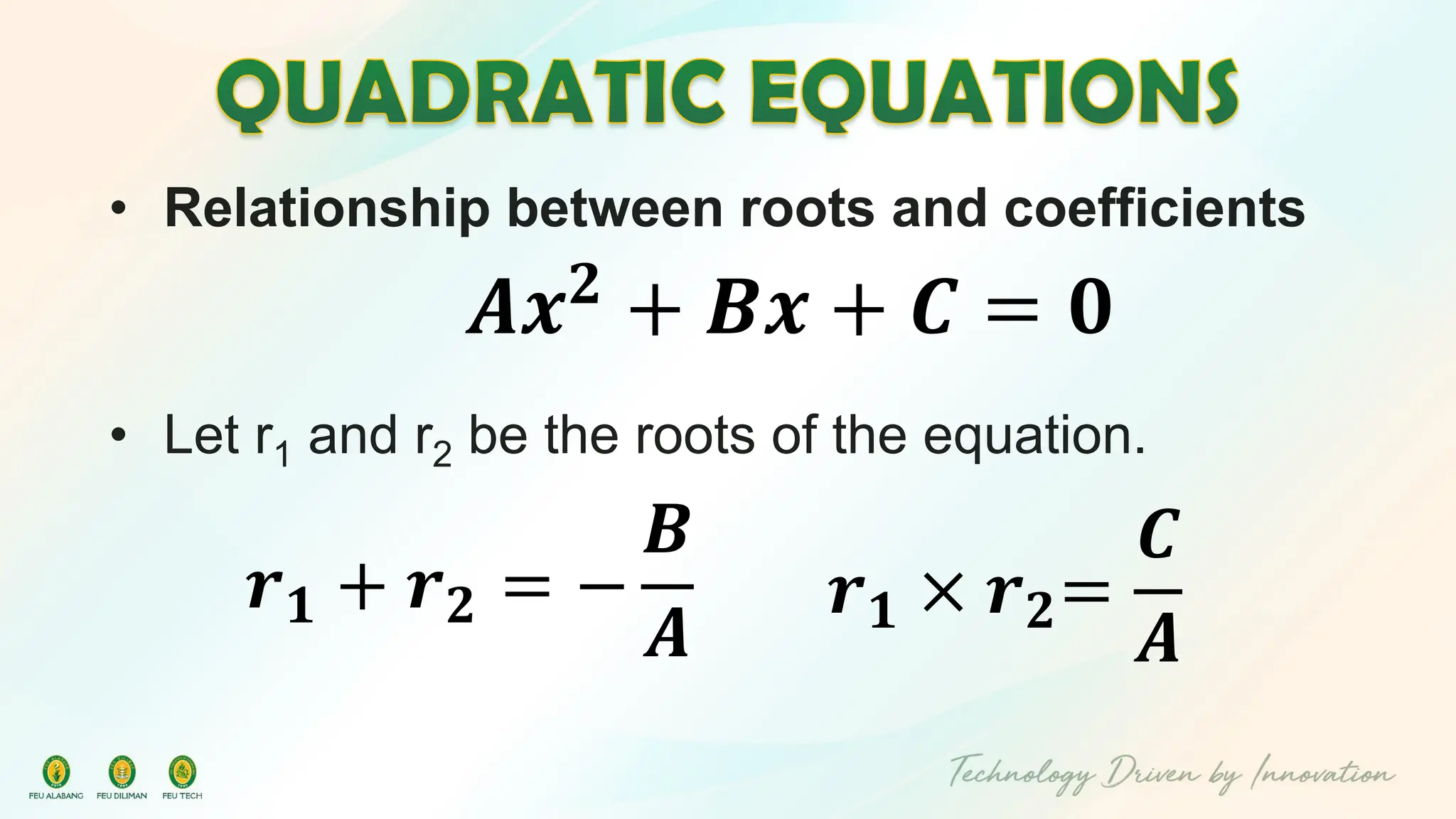
• Relationship between roots and coefficients
𝑨𝒙𝟐
+ 𝑩𝒙 + 𝑪 = 𝟎
• Let r1 and r2 be the roots of the equation.
𝒓𝟏 + 𝒓𝟐 = −
𝑩
𝑨
𝒓𝟏 × 𝒓𝟐=
𝑪
𝑨
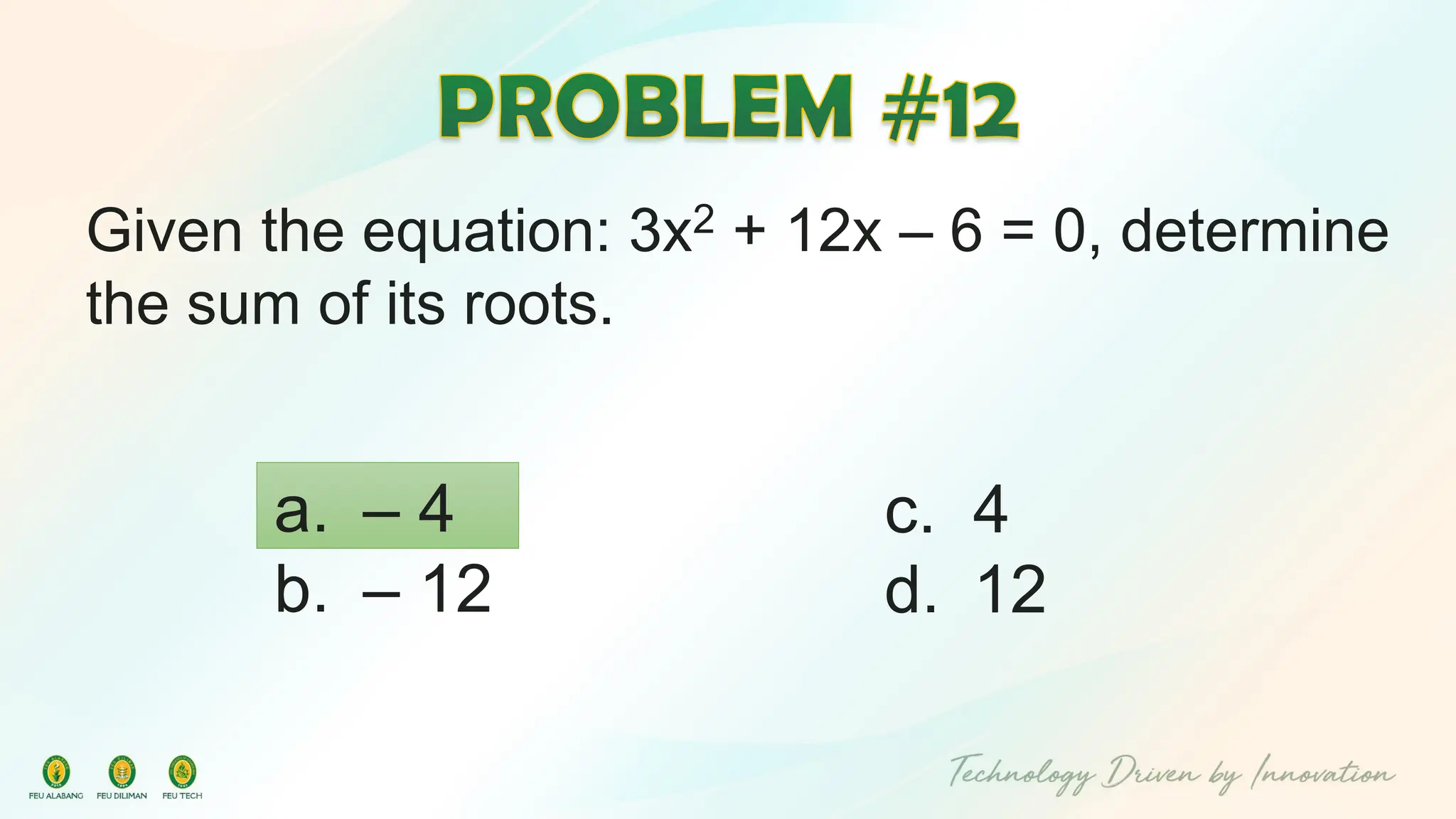
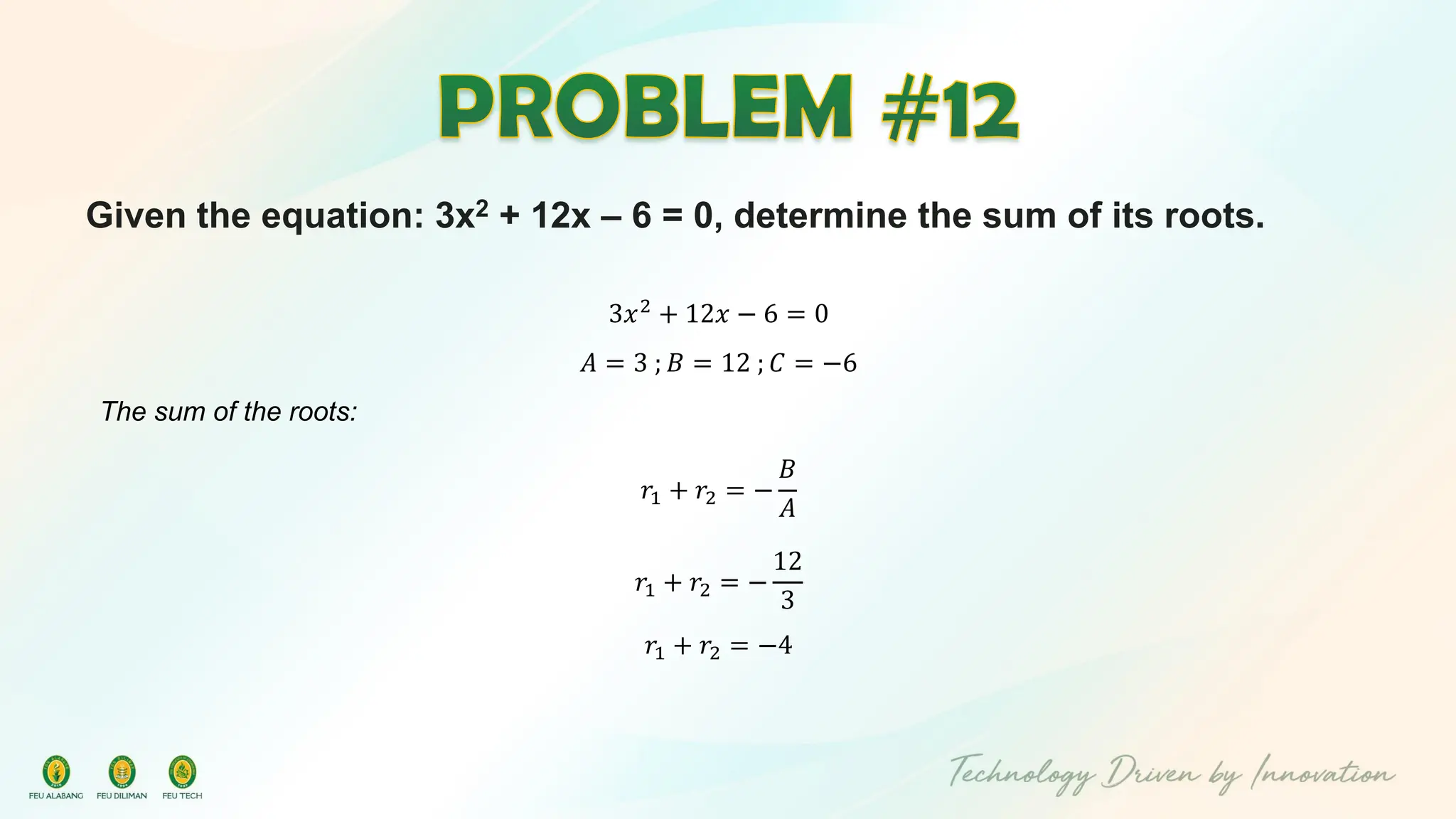
Given the equation: 3x2 + 12x – 6 = 0, determine
the sum of its roots.
c. 4
d. 12
a. – 4
b. – 12
Given the equation: 3x2 + 12x – 6 = 0, determine the sum of its roots.
3𝑥2
+ 12𝑥 − 6 = 0
𝐴 = 3 ; 𝐵 = 12 ; 𝐶 = −6
The sum of the roots:
𝑟1 + 𝑟2 = −
𝐵
𝐴
𝑟1 + 𝑟2 = −
12
3
𝑟1 + 𝑟2 = −4
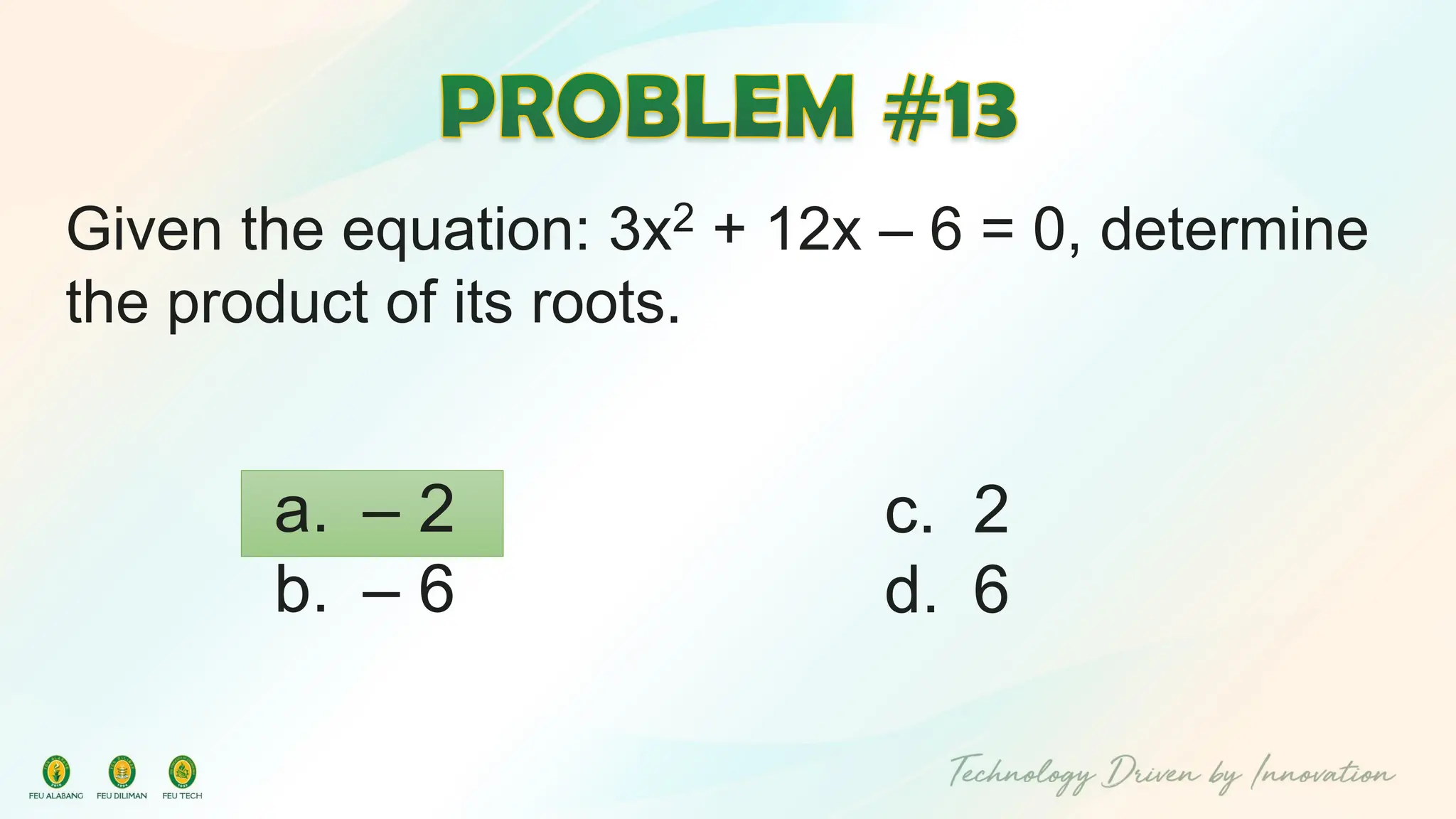
Given the equation: 3x2 + 12x – 6 = 0, determine
the product of its roots.
c. 2
d. 6
a. – 2
b. – 6
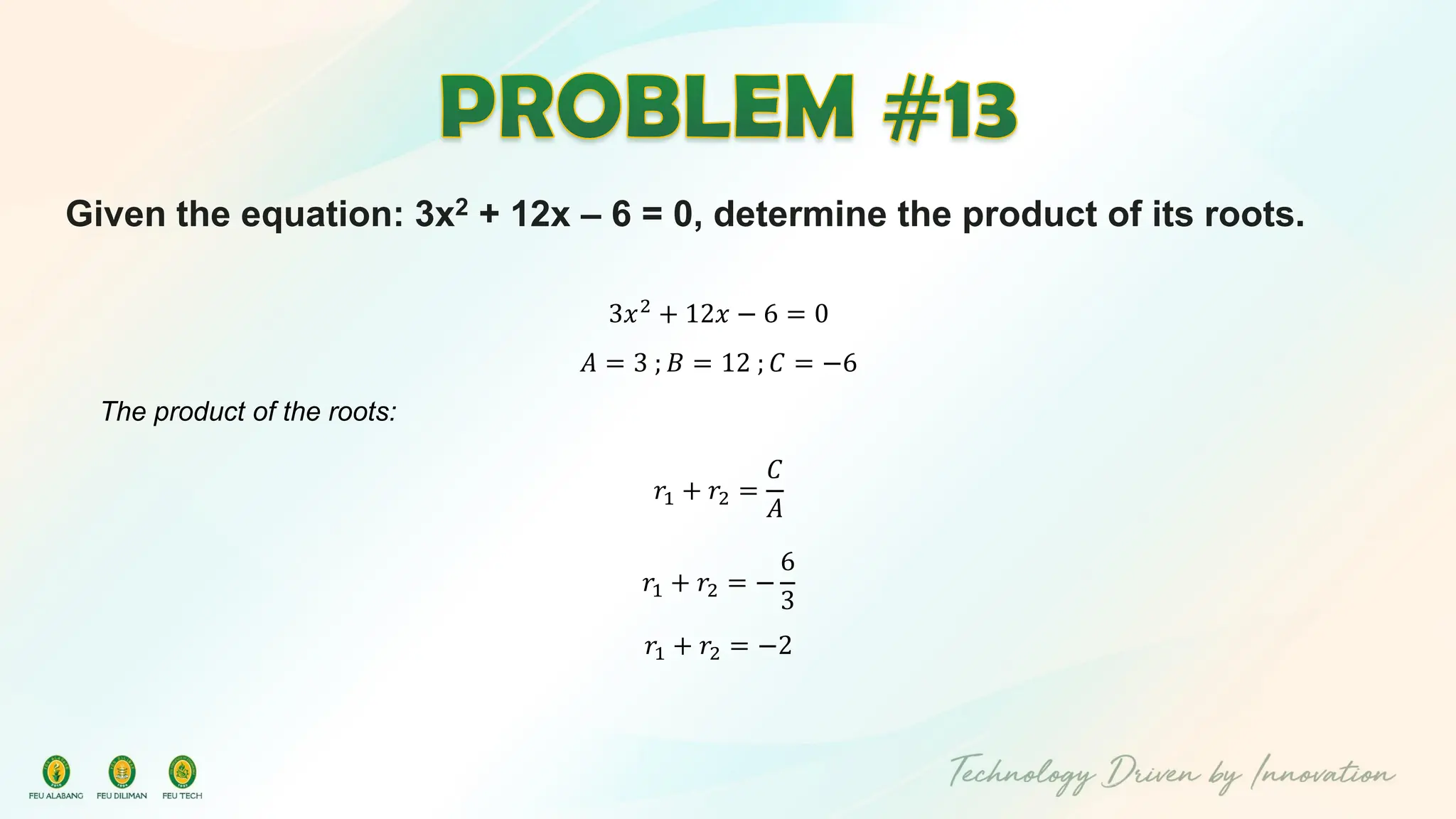
Given the equation: 3x2 + 12x – 6 = 0, determine the product of its roots.
3𝑥2
+ 12𝑥 − 6 = 0
𝐴 = 3 ; 𝐵 = 12 ; 𝐶 = −6
The product of the roots:
𝑟1 + 𝑟2 =
𝐶
𝐴
𝑟1 + 𝑟2 = −
6
3
𝑟1 + 𝑟2 = −2
The equation whose roots are reciprocals of the
roots of 2x2 – 3x – 5 = 0 is:
a. 5x2 + 3x – 2 = 0
b. 3x2 – 5x – 2 = 0
c. 5x2 – 2x – 3 = 0
d. 2x2 – 5x – 3 = 0
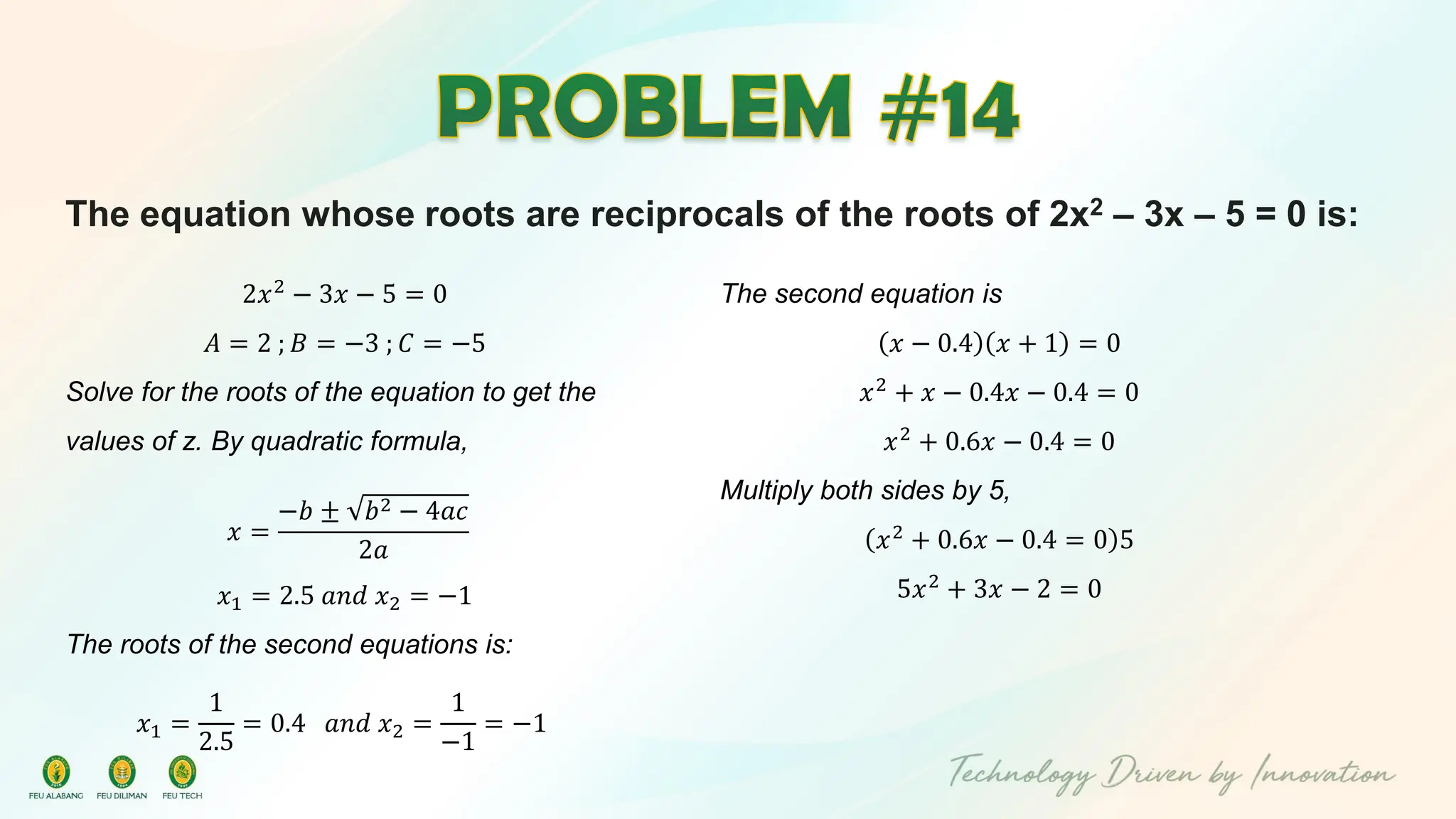
The equation whose roots are reciprocals of the roots of 2x2 – 3x – 5 = 0 is:
2𝑥2
− 3𝑥 − 5 = 0
𝐴 = 2 ; 𝐵 = −3 ; 𝐶 = −5
Solve for the roots of the equation to get the
values of z. By quadratic formula,
𝑥 =
−𝑏 ± 𝑏2 − 4𝑎𝑐
2𝑎
𝑥1 = 2.5 𝑎𝑛𝑑 𝑥2 = −1
The roots of the second equations is:
𝑥1 =
1
2.5
= 0.4 𝑎𝑛𝑑 𝑥2 =
1
−1
= −1
The second equation is
𝑥 − 0.4 𝑥 + 1 = 0
𝑥2 + 𝑥 − 0.4𝑥 − 0.4 = 0
𝑥2
+ 0.6𝑥 − 0.4 = 0
Multiply both sides by 5,
𝑥2 + 0.6𝑥 − 0.4 = 0 5
5𝑥2
+ 3𝑥 − 2 = 0
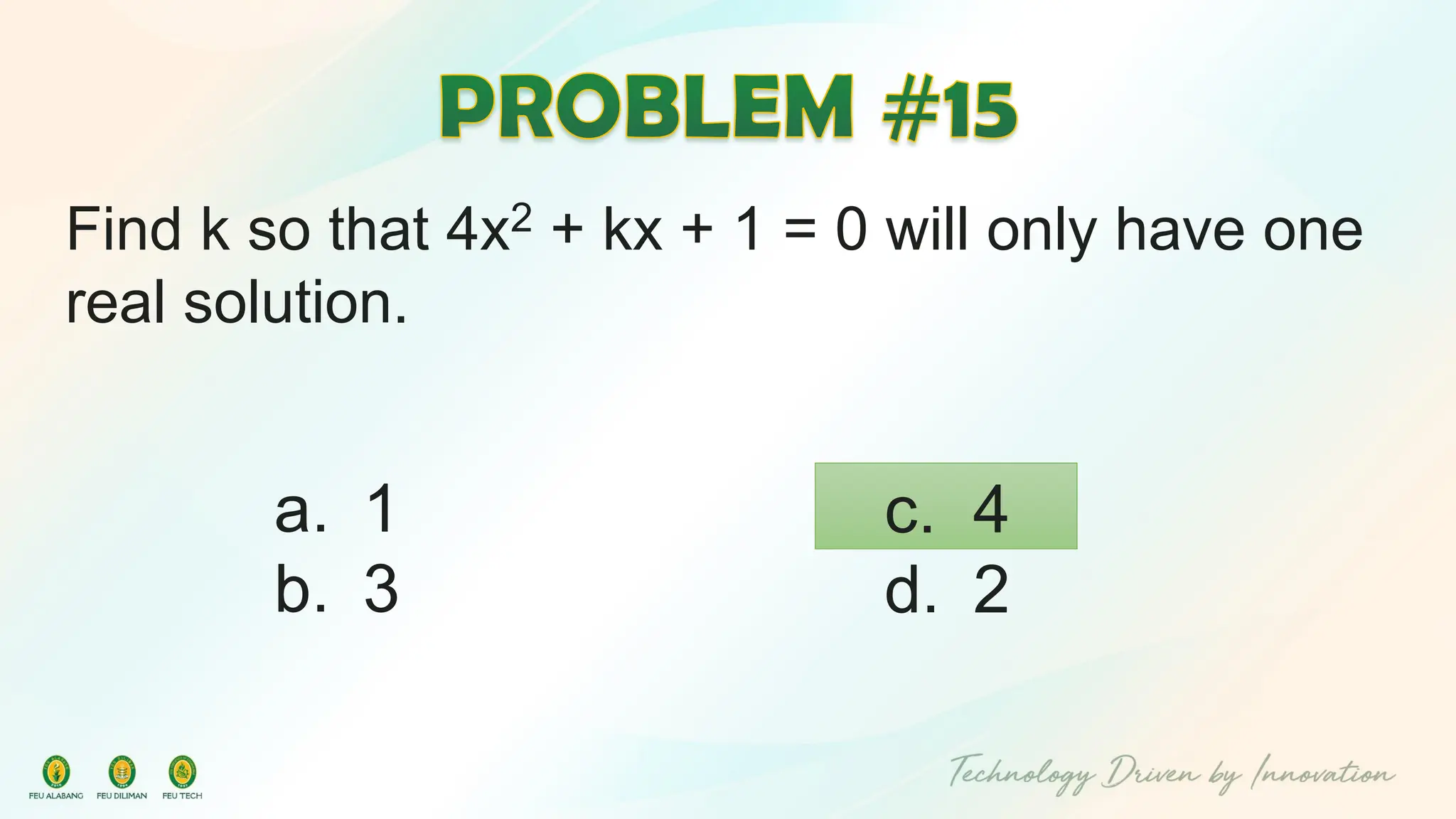
Find k so that 4x2 + kx + 1 = 0 will only have one
real solution.
c. 4
d. 2
a. 1
b. 3
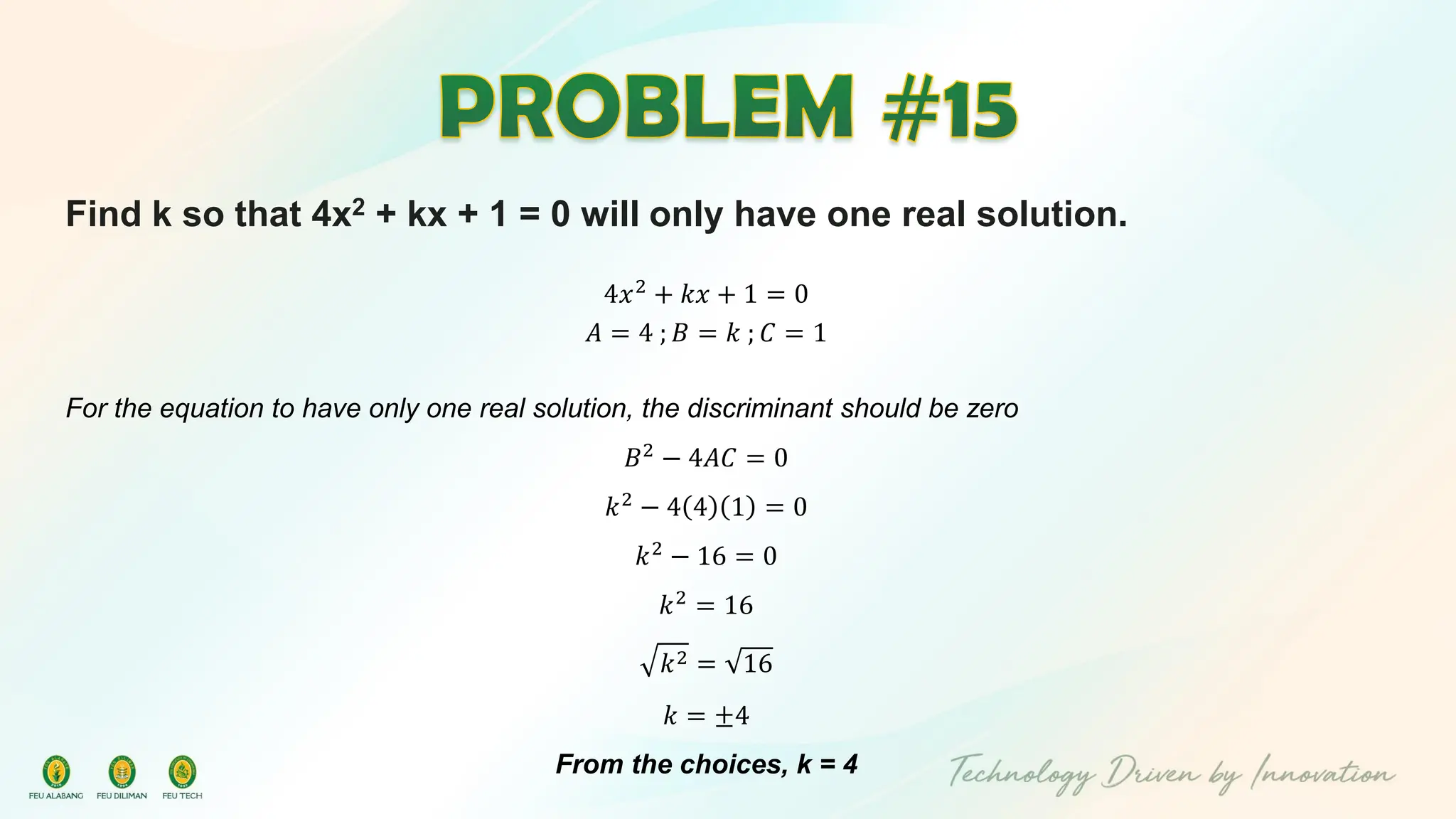
Find k so that 4x2 + kx + 1 = 0 will only have one real solution.
4𝑥2
+ 𝑘𝑥 + 1 = 0
𝐴 = 4 ; 𝐵 = 𝑘 ; 𝐶 = 1
For the equation to have only one real solution, the discriminant should be zero
𝐵2 − 4𝐴𝐶 = 0
𝑘2
− 4 4 1 = 0
𝑘2
− 16 = 0
𝑘2 = 16
𝑘2 = 16
𝑘 = ±4
From the choices, k = 4
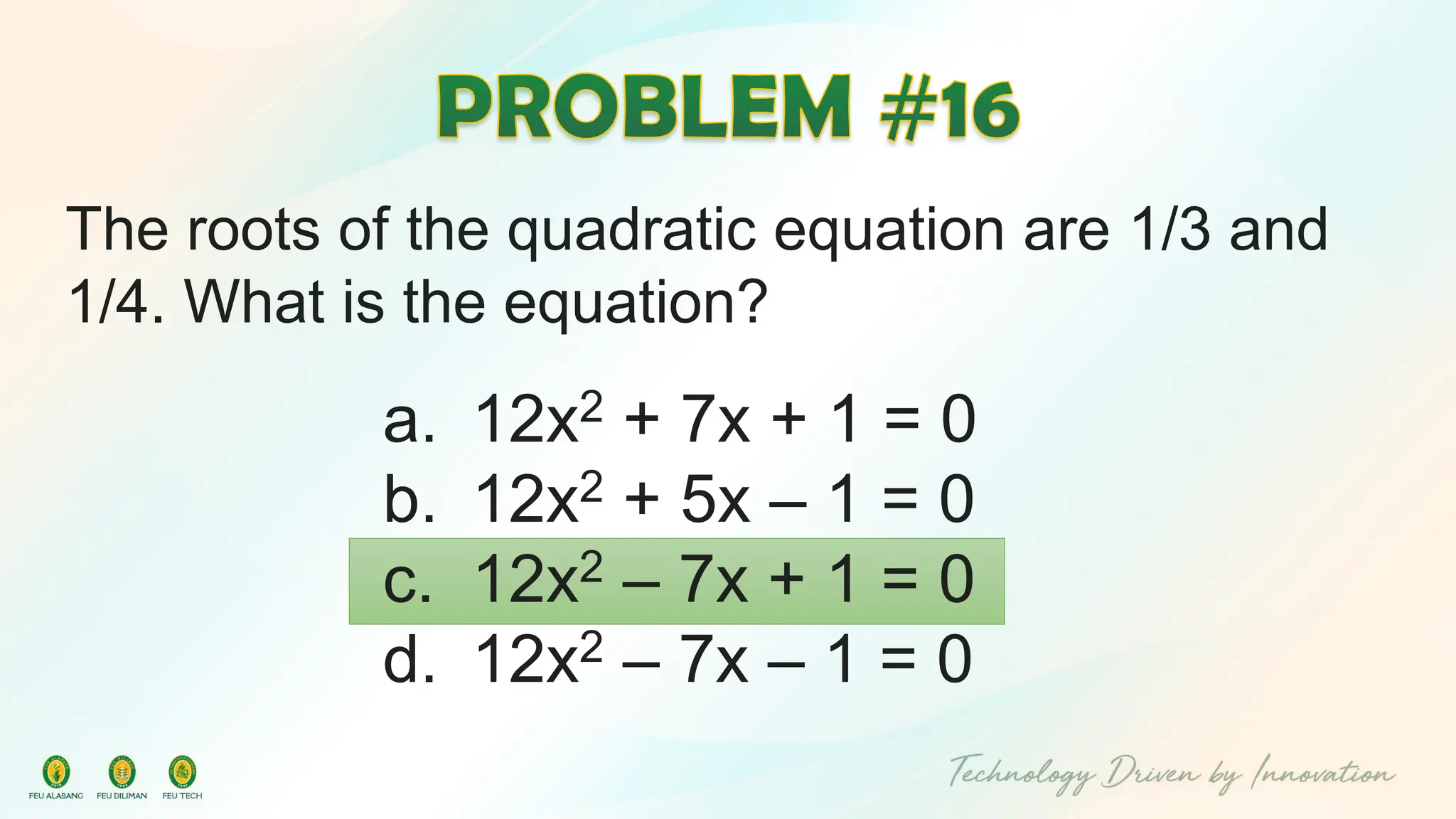
The roots of the quadratic equation are 1/3 and
1/4. What is the equation?
a. 12x2 + 7x + 1 = 0
b. 12x2 + 5x – 1 = 0
c. 12x2 – 7x + 1 = 0
d. 12x2 – 7x – 1 = 0
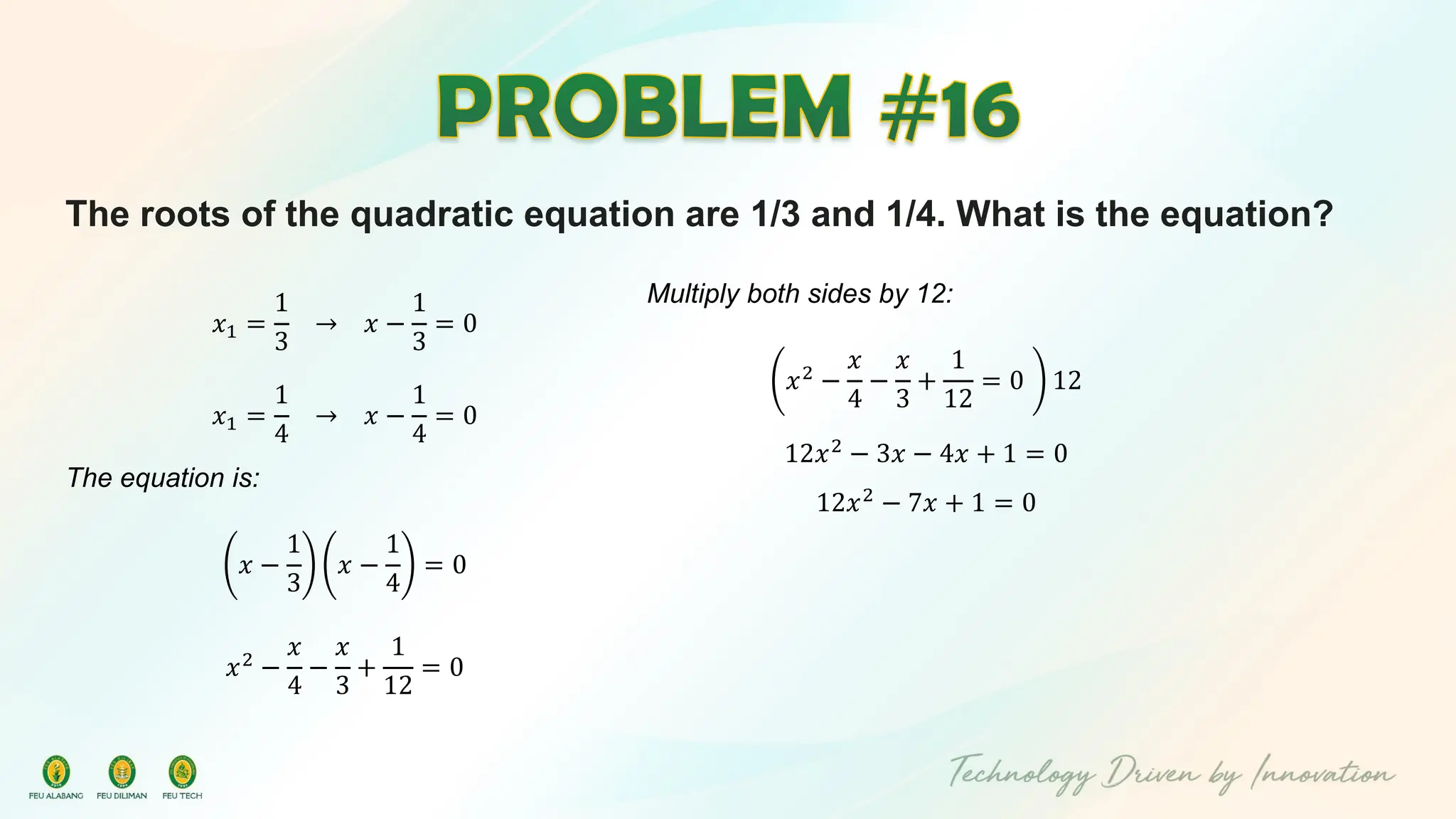
The roots of the quadratic equation are 1/3 and 1/4. What is the equation?
𝑥1 =
1
3
→ 𝑥 −
1
3
= 0
𝑥1 =
1
4
→ 𝑥 −
1
4
= 0
The equation is:
𝑥 −
1
3
𝑥 −
1
4
= 0
𝑥2 −
𝑥
4
−
𝑥
3
+
1
12
= 0
Multiply both sides by 12:
𝑥2
−
𝑥
4
−
𝑥
3
+
1
12
= 0 12
12𝑥2 − 3𝑥 − 4𝑥 + 1 = 0
12𝑥2
− 7𝑥 + 1 = 0
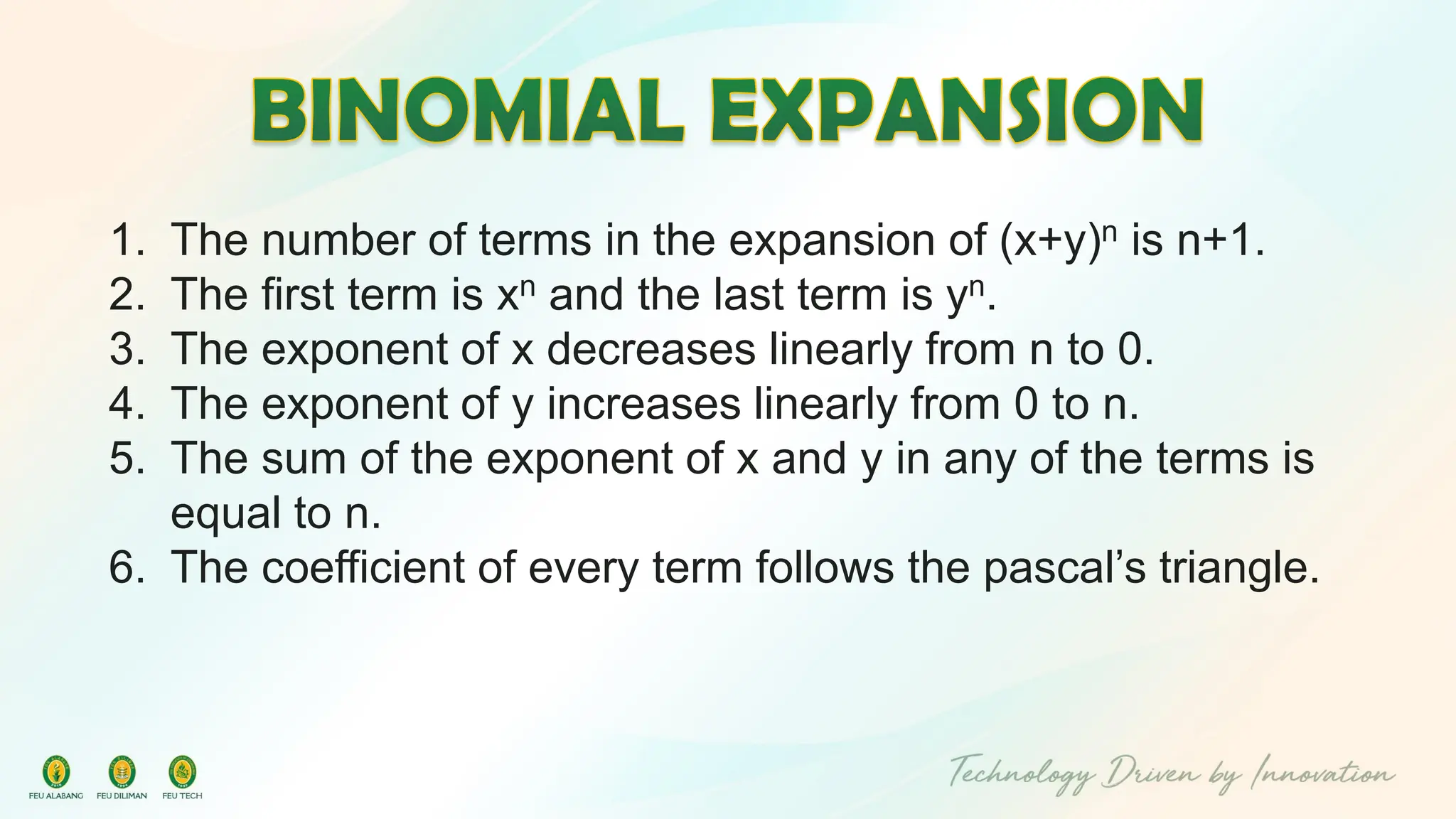
1. The number of terms in the expansion of (x+y)n is n+1.
2. The first term is xn and the last term is yn.
3. The exponent of x decreases linearly from n to 0.
4. The exponent of y increases linearly from 0 to n.
5. The sum of the exponent of x and y in any of the terms is
equal to n.
6. The coefficient of every term follows the pascal’s triangle.
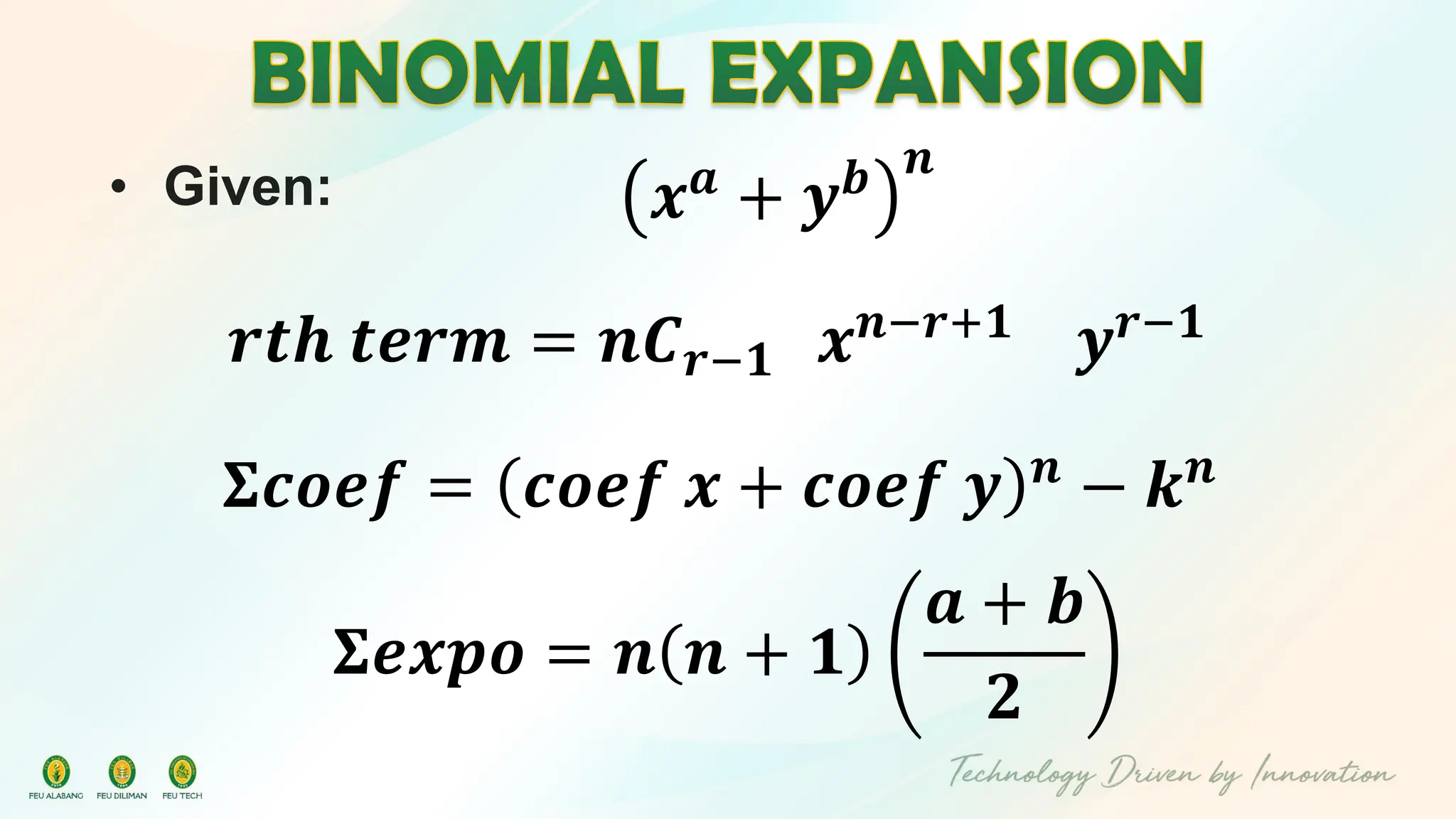
• Given:
𝒓𝒕𝒉 𝒕𝒆𝒓𝒎 = 𝒏𝑪𝒓−𝟏 𝒙𝒏−𝒓+𝟏 𝒚𝒓−𝟏
𝚺𝒄𝒐𝒆𝒇 = 𝒄𝒐𝒆𝒇 𝒙 + 𝒄𝒐𝒆𝒇 𝒚 𝒏 − 𝒌𝒏
𝚺𝒆𝒙𝒑𝒐 = 𝒏 𝒏 + 𝟏
𝒂 + 𝒃
𝟐
𝒙𝒂 + 𝒚𝒃 𝒏
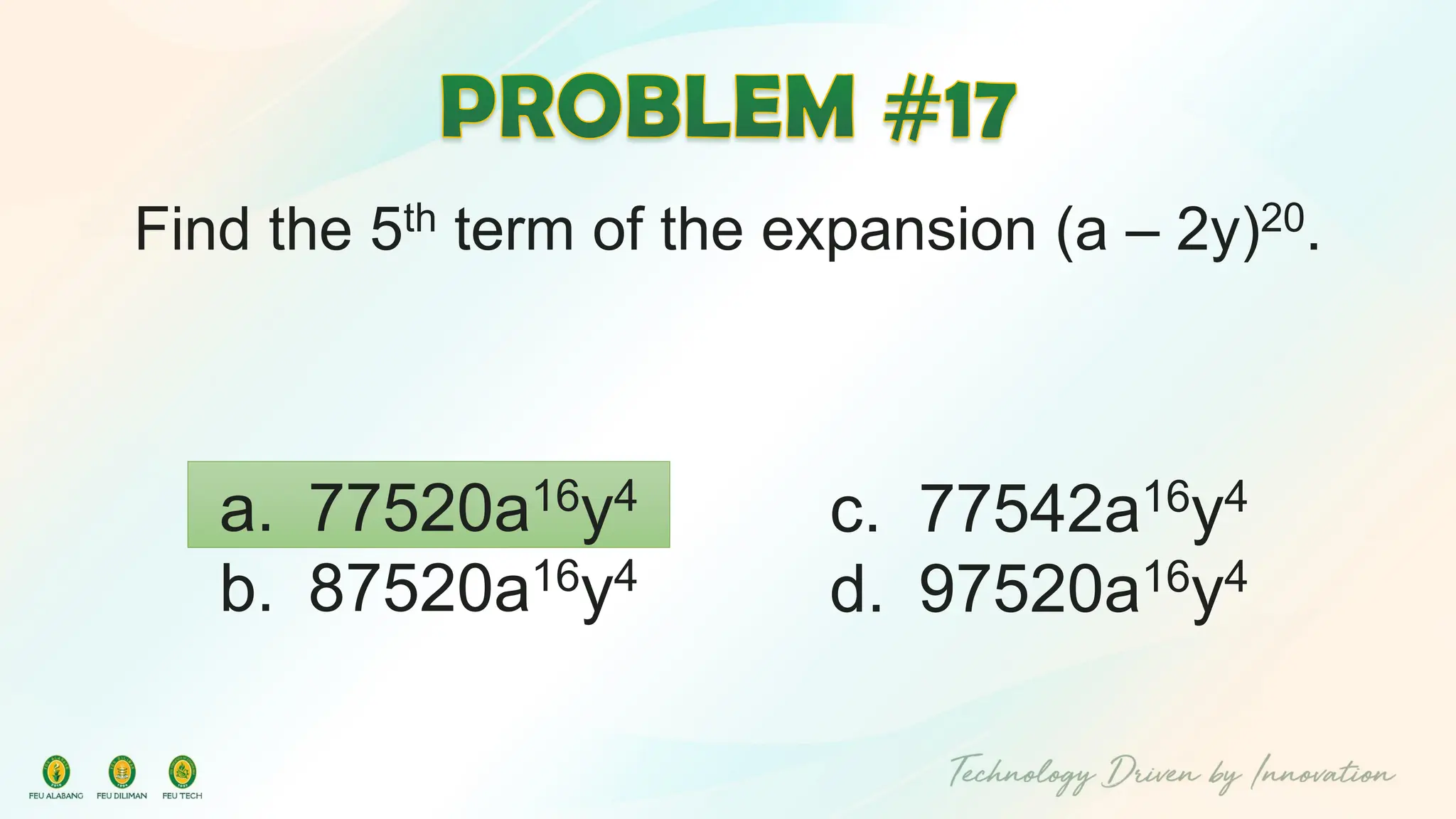
Find the 5th term of the expansion (a – 2y)20.
c. 77542a16y4
d. 97520a16y4
a. 77520a16y4
b. 87520a16y4
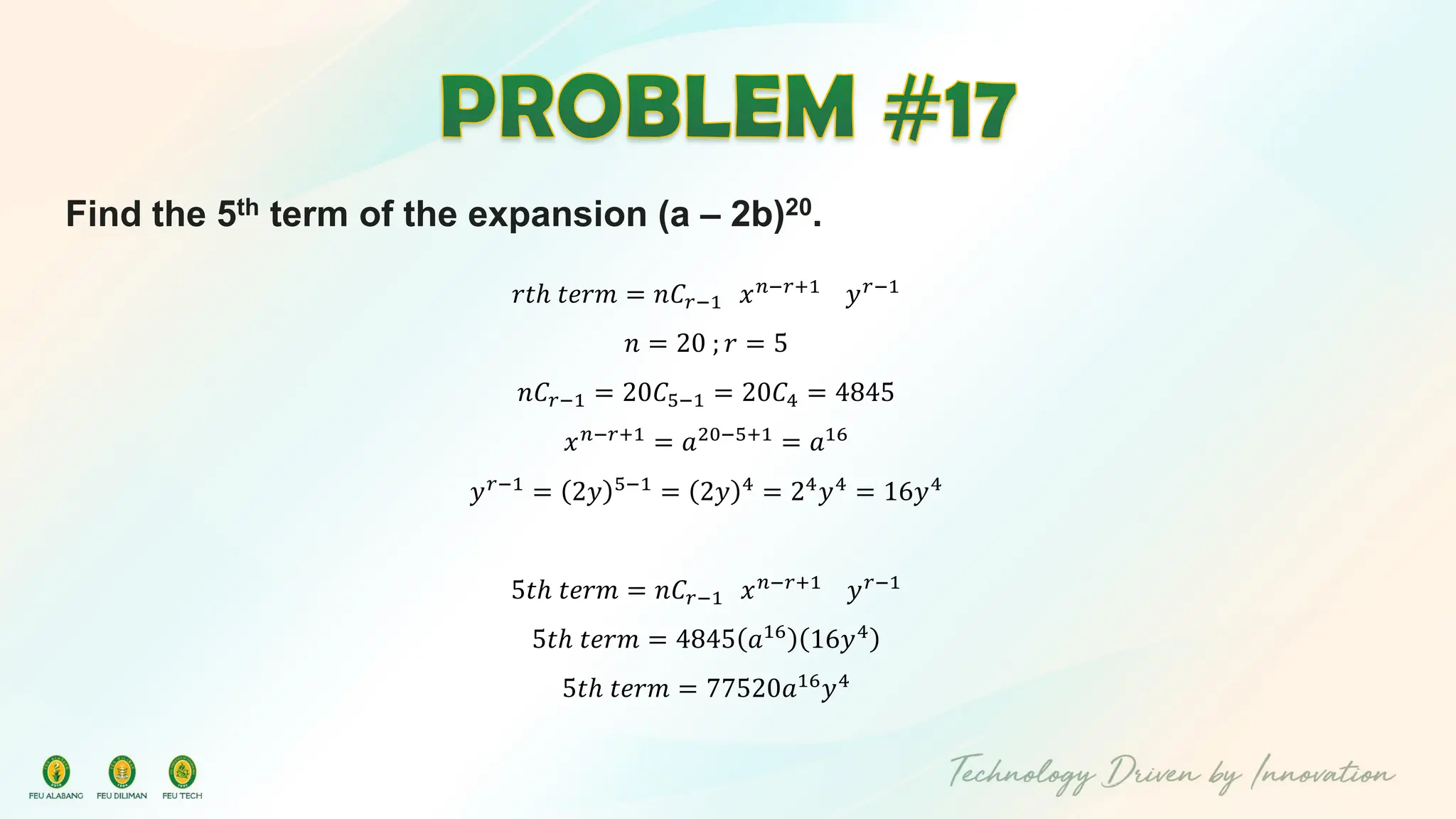
Find the 5th term of the expansion (a – 2b)20.
𝑟𝑡ℎ 𝑡𝑒𝑟𝑚 = 𝑛𝐶𝑟−1 𝑥𝑛−𝑟+1
𝑦𝑟−1
𝑛 = 20 ; 𝑟 = 5
𝑛𝐶𝑟−1 = 20𝐶5−1 = 20𝐶4 = 4845
𝑥𝑛−𝑟+1
= 𝑎20−5+1
= 𝑎16
𝑦𝑟−1
= 2𝑦 5−1
= 2𝑦 4
= 24
𝑦4
= 16𝑦4
5𝑡ℎ 𝑡𝑒𝑟𝑚 = 𝑛𝐶𝑟−1 𝑥𝑛−𝑟+1 𝑦𝑟−1
5𝑡ℎ 𝑡𝑒𝑟𝑚 = 4845 𝑎16
16𝑦4
5𝑡ℎ 𝑡𝑒𝑟𝑚 = 77520𝑎16
𝑦4
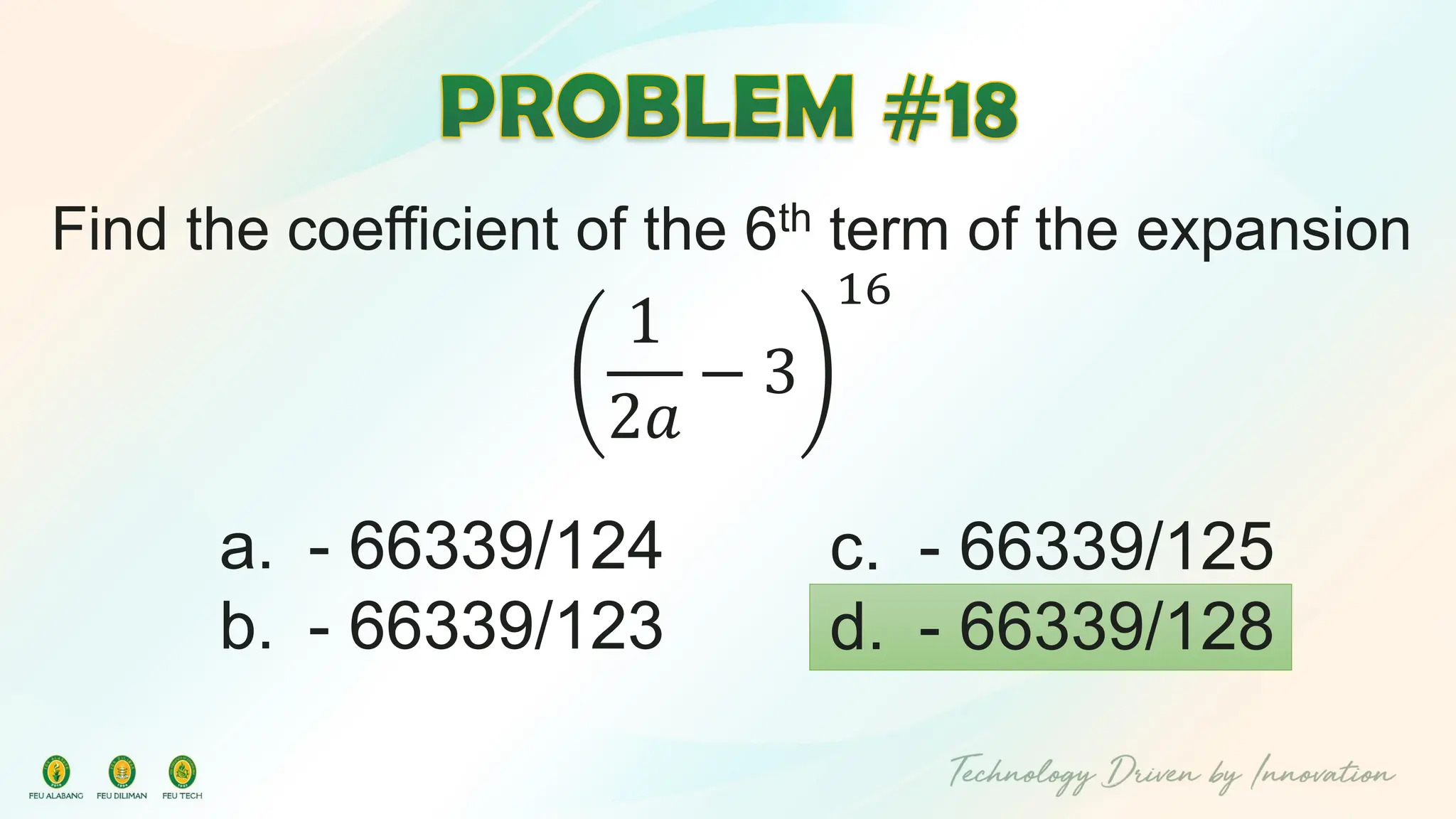
Find the coefficient of the 6th term of the expansion
1
2𝑎
− 3
16
c. - 66339/125
d. - 66339/128
a. - 66339/124
b. - 66339/123
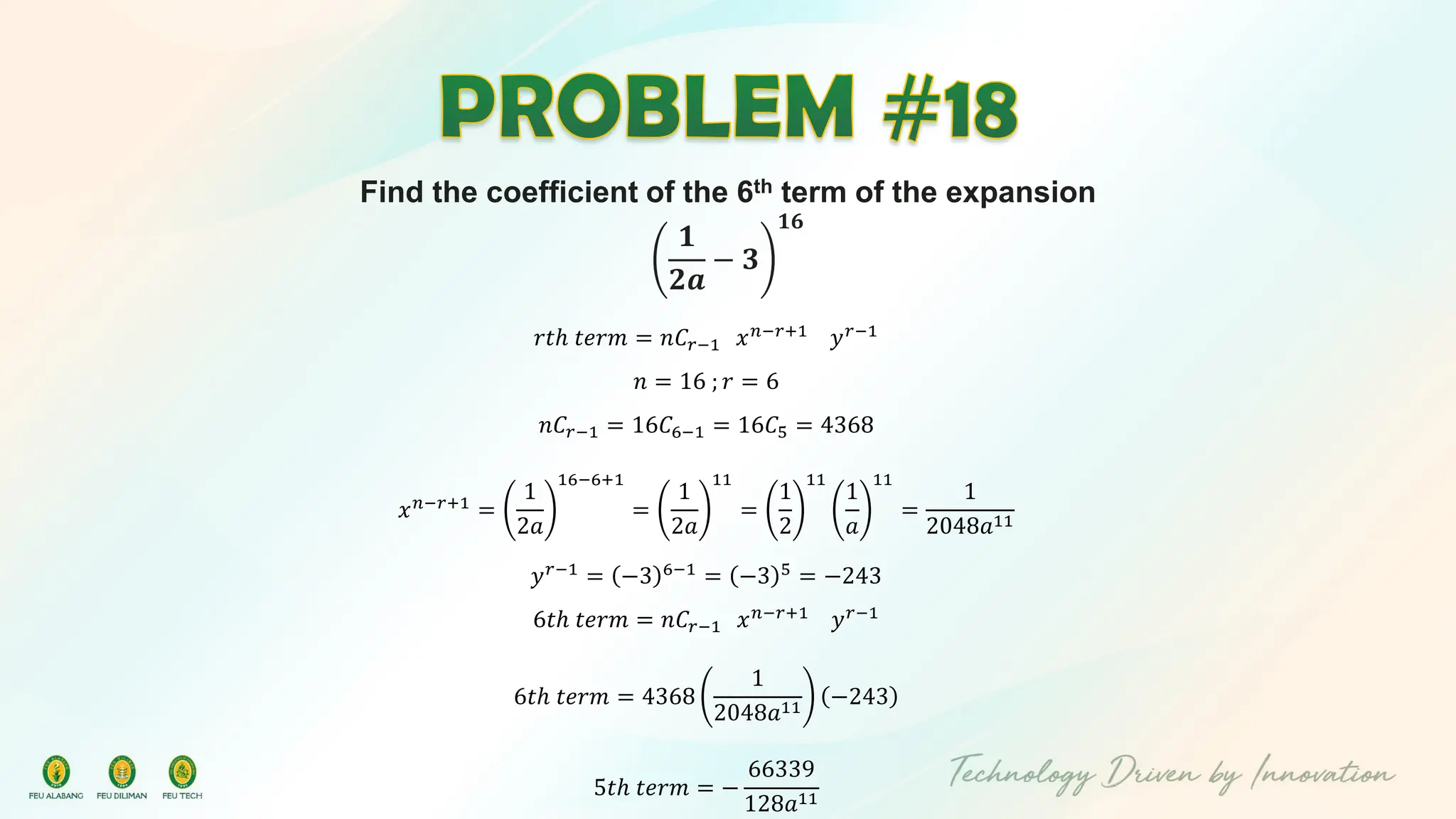
Find the coefficient of the 6th term of the expansion
𝟏
𝟐𝒂
− 𝟑
𝟏𝟔
𝑟𝑡ℎ 𝑡𝑒𝑟𝑚 = 𝑛𝐶𝑟−1 𝑥𝑛−𝑟+1
𝑦𝑟−1
𝑛 = 16 ; 𝑟 = 6
𝑛𝐶𝑟−1 = 16𝐶6−1 = 16𝐶5 = 4368
𝑥𝑛−𝑟+1
=
1
2𝑎
16−6+1
=
1
2𝑎
11
=
1
2
11
1
𝑎
11
=
1
2048𝑎11
𝑦𝑟−1
= −3 6−1
= −3 5
= −243
6𝑡ℎ 𝑡𝑒𝑟𝑚 = 𝑛𝐶𝑟−1 𝑥𝑛−𝑟+1
𝑦𝑟−1
6𝑡ℎ 𝑡𝑒𝑟𝑚 = 4368
1
2048𝑎11
−243
5𝑡ℎ 𝑡𝑒𝑟𝑚 = −
66339
128𝑎11
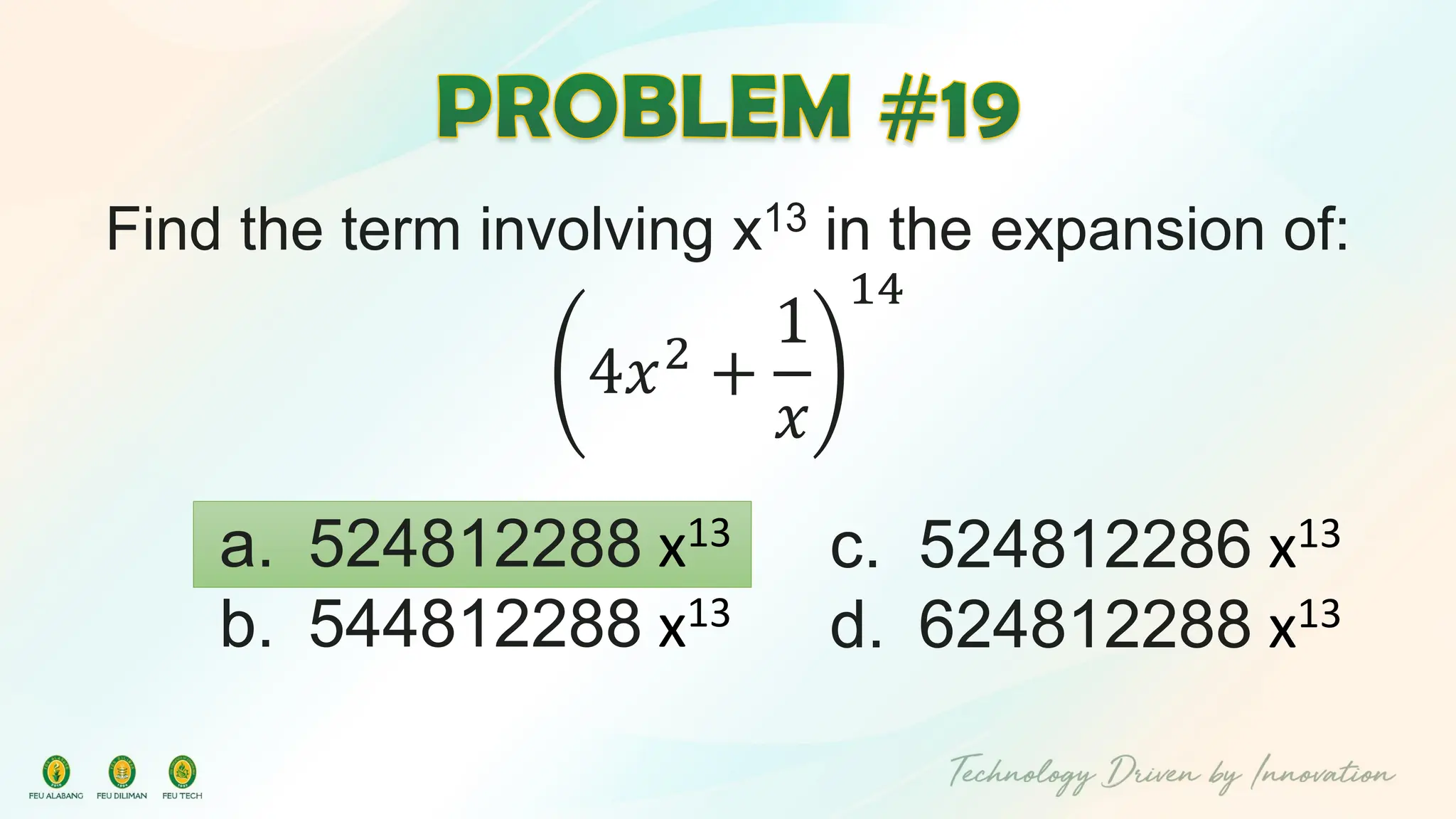
Find the term involving x13 in the expansion of:
4𝑥2
+
1
𝑥
14
c. 524812286 x13
d. 624812288 x13
a. 524812288 x13
b. 544812288 x13
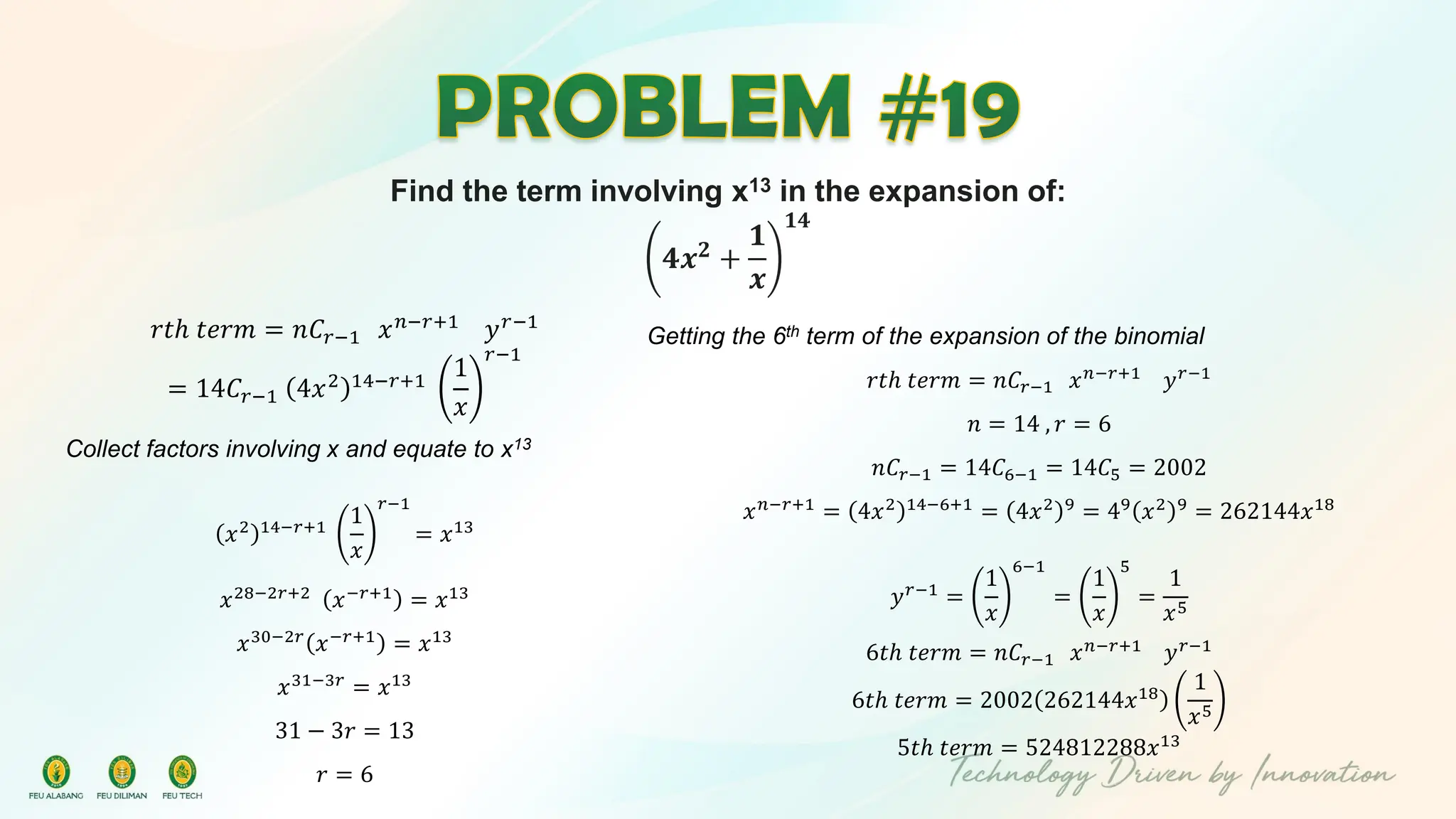
Find the term involving x13 in the expansion of:
𝟒𝒙𝟐
+
𝟏
𝒙
𝟏𝟒
𝑟𝑡ℎ 𝑡𝑒𝑟𝑚 = 𝑛𝐶𝑟−1 𝑥𝑛−𝑟+1
𝑦𝑟−1
= 14𝐶𝑟−1 4𝑥2 14−𝑟+1
1
𝑥
𝑟−1
Collect factors involving x and equate to x13
𝑥2 14−𝑟+1
1
𝑥
𝑟−1
= 𝑥13
𝑥28−2𝑟+2
𝑥−𝑟+1
= 𝑥13
𝑥30−2𝑟
𝑥−𝑟+1
= 𝑥13
𝑥31−3𝑟
= 𝑥13
31 − 3𝑟 = 13
𝑟 = 6
Getting the 6th term of the expansion of the binomial
𝑟𝑡ℎ 𝑡𝑒𝑟𝑚 = 𝑛𝐶𝑟−1 𝑥𝑛−𝑟+1
𝑦𝑟−1
𝑛 = 14 , 𝑟 = 6
𝑛𝐶𝑟−1 = 14𝐶6−1 = 14𝐶5 = 2002
𝑥𝑛−𝑟+1
= 4𝑥2 14−6+1
= 4𝑥2 9
= 49
𝑥2 9
= 262144𝑥18
𝑦𝑟−1
=
1
𝑥
6−1
=
1
𝑥
5
=
1
𝑥5
6𝑡ℎ 𝑡𝑒𝑟𝑚 = 𝑛𝐶𝑟−1 𝑥𝑛−𝑟+1
𝑦𝑟−1
6𝑡ℎ 𝑡𝑒𝑟𝑚 = 2002 262144𝑥18
1
𝑥5
5𝑡ℎ 𝑡𝑒𝑟𝑚 = 524812288𝑥13
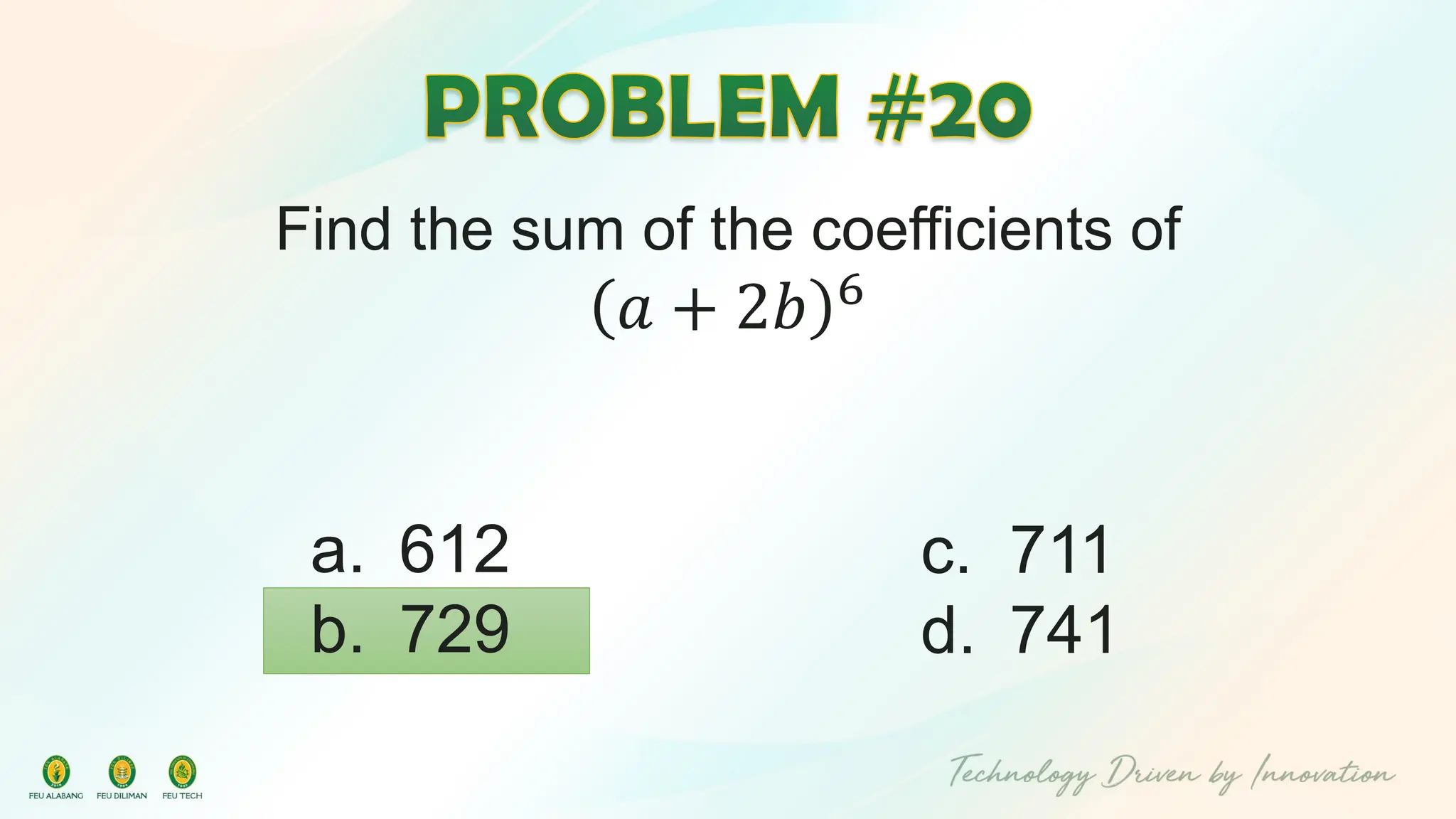
Find the sum of the coefficients of
𝑎 + 2𝑏 6
c. 711
d. 741
a. 612
b. 729
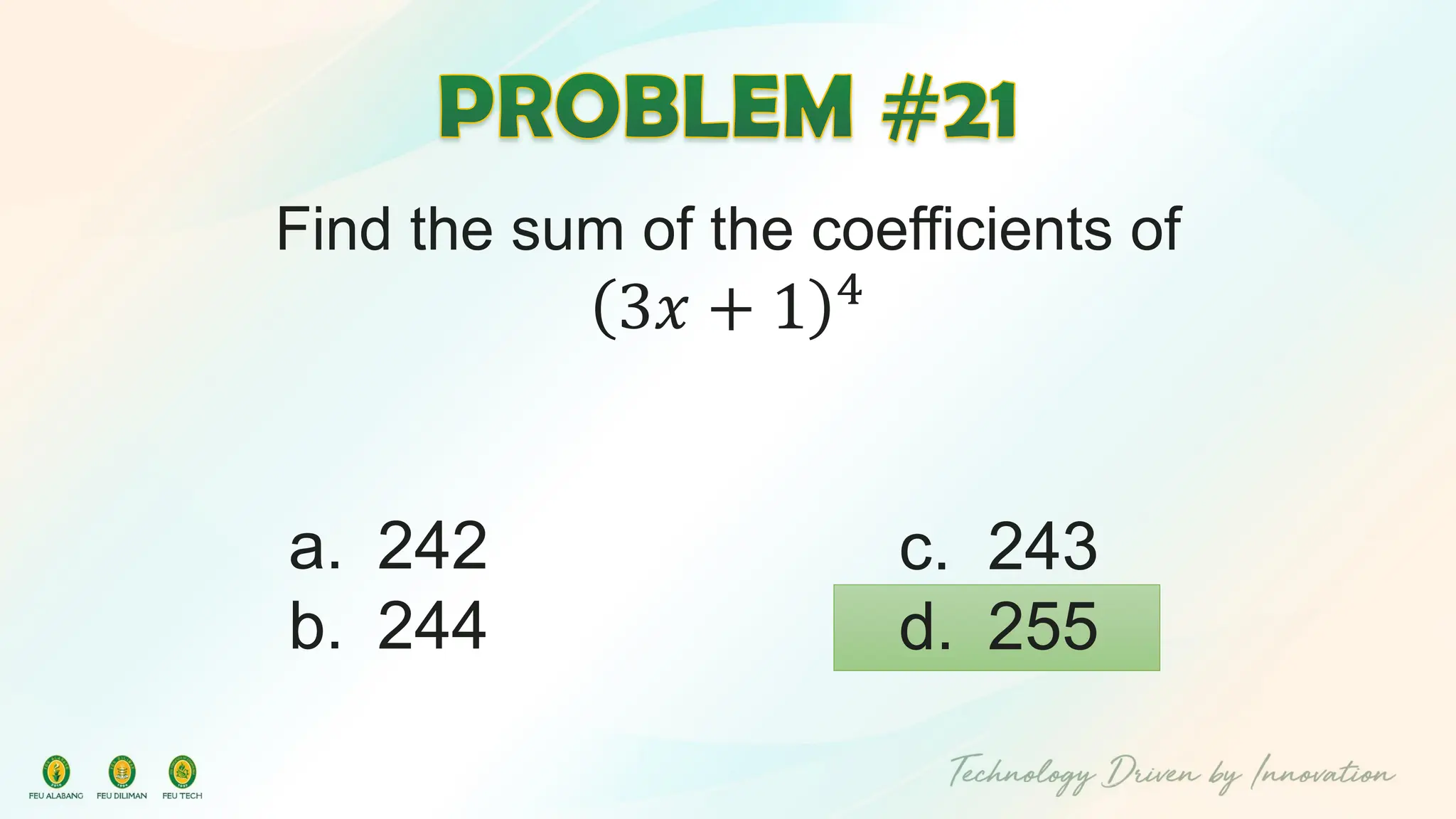
Find the sum of the coefficients of
3𝑥 + 1 4
c. 243
d. 255
a. 242
b. 244
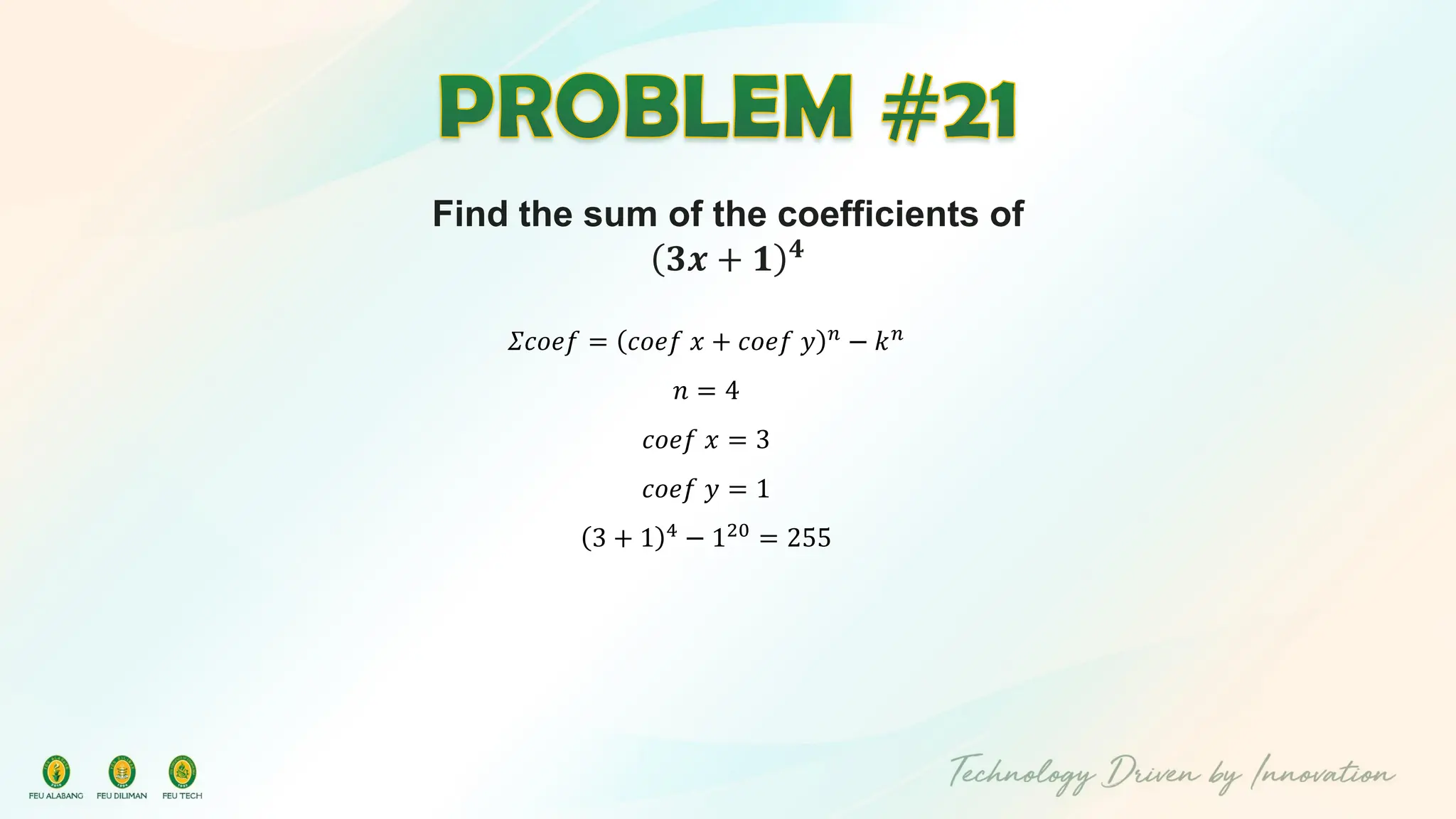
Find the sum of the coefficients of
𝟑𝒙 + 𝟏 𝟒
𝛴𝑐𝑜𝑒𝑓 = 𝑐𝑜𝑒𝑓 𝑥 + 𝑐𝑜𝑒𝑓 𝑦 𝑛
− 𝑘𝑛
𝑛 = 4
𝑐𝑜𝑒𝑓 𝑥 = 3
𝑐𝑜𝑒𝑓 𝑦 = 1
3 + 1 4
− 120
= 255
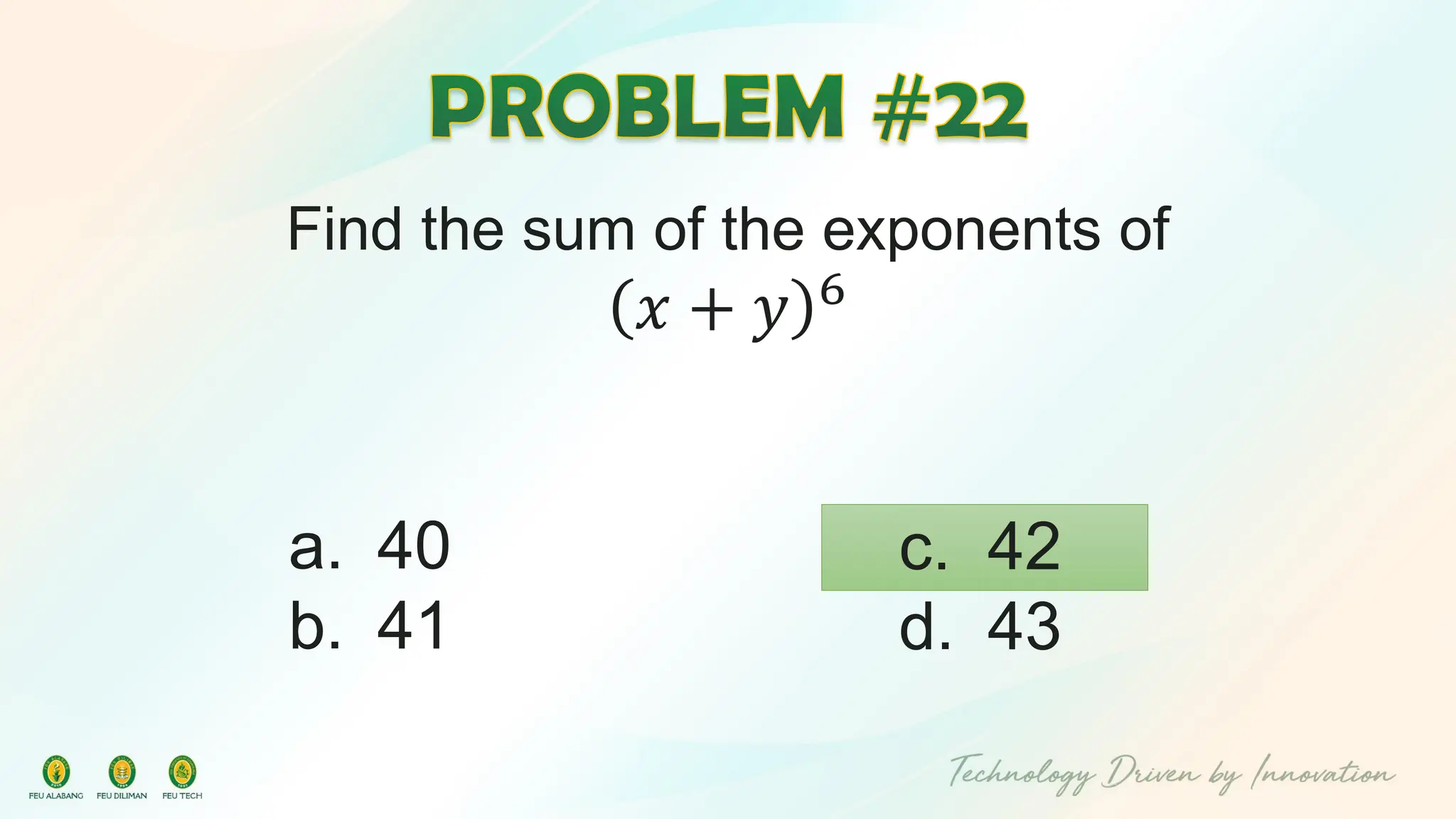
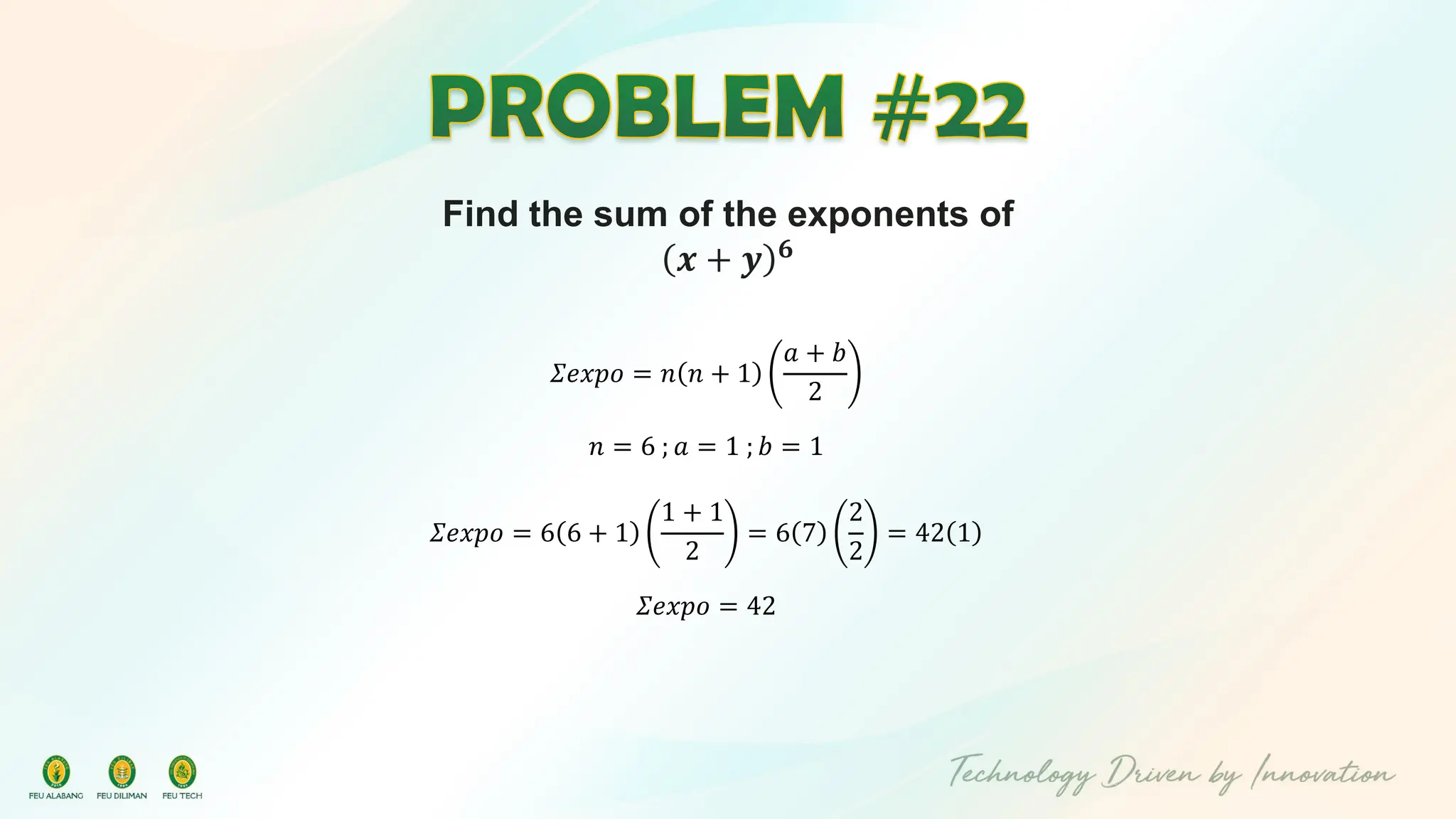
Find the sum of the exponents of
𝑥 + 𝑦 6
c. 42
d. 43
a. 40
b. 41
Find the sum of the exponents of
𝒙 + 𝒚 𝟔
𝛴𝑒𝑥𝑝𝑜 = 𝑛 𝑛 + 1
𝑎 + 𝑏
2
𝑛 = 6 ; 𝑎 = 1 ; 𝑏 = 1
𝛴𝑒𝑥𝑝𝑜 = 6 6 + 1
1 + 1
2
= 6 7
2
2
= 42 1
𝛴𝑒𝑥𝑝𝑜 = 42
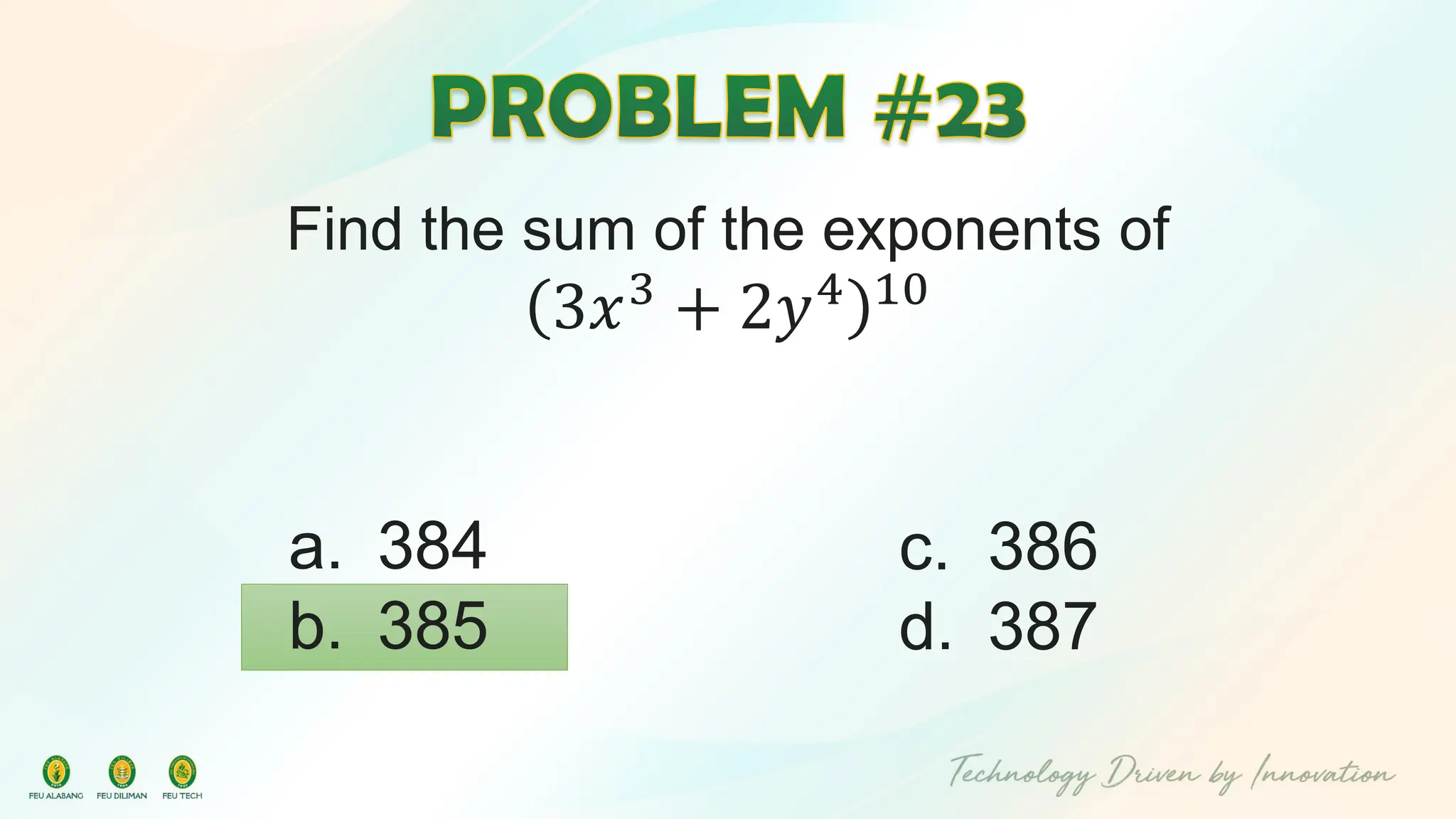
Find the sum of the exponents of
3𝑥3
+ 2𝑦4 10
c. 386
d. 387
a. 384
b. 385
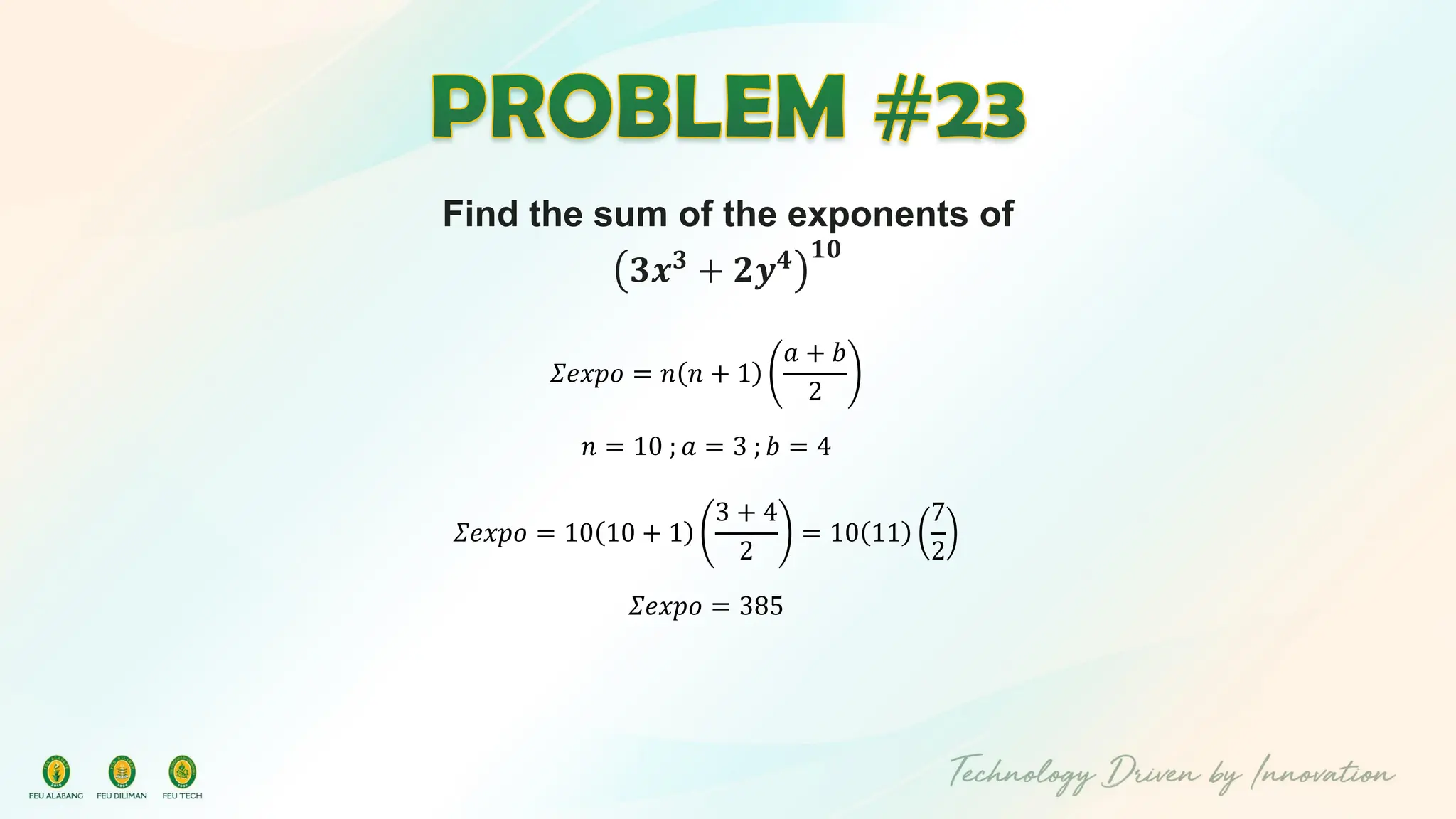
Find the sum of the exponents of
𝟑𝒙𝟑 + 𝟐𝒚𝟒 𝟏𝟎
𝛴𝑒𝑥𝑝𝑜 = 𝑛 𝑛 + 1
𝑎 + 𝑏
2
𝑛 = 10 ; 𝑎 = 3 ; 𝑏 = 4
𝛴𝑒𝑥𝑝𝑜 = 10 10 + 1
3 + 4
2
= 10 11
7
2
𝛴𝑒𝑥𝑝𝑜 = 385
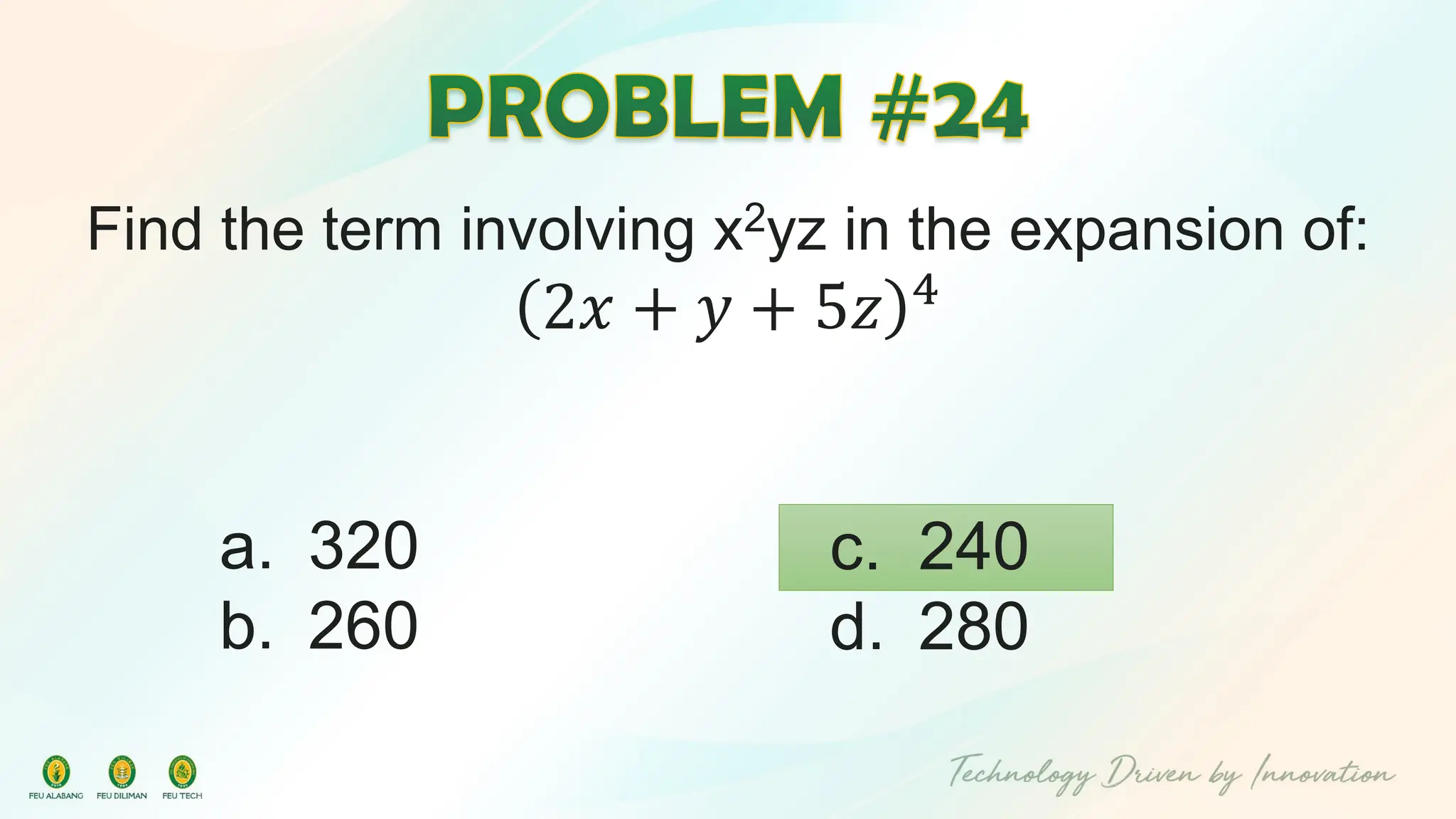
Find the term involving x2yz in the expansion of:
2𝑥 + 𝑦 + 5𝑧 4
c. 240
d. 280
a. 320
b. 260
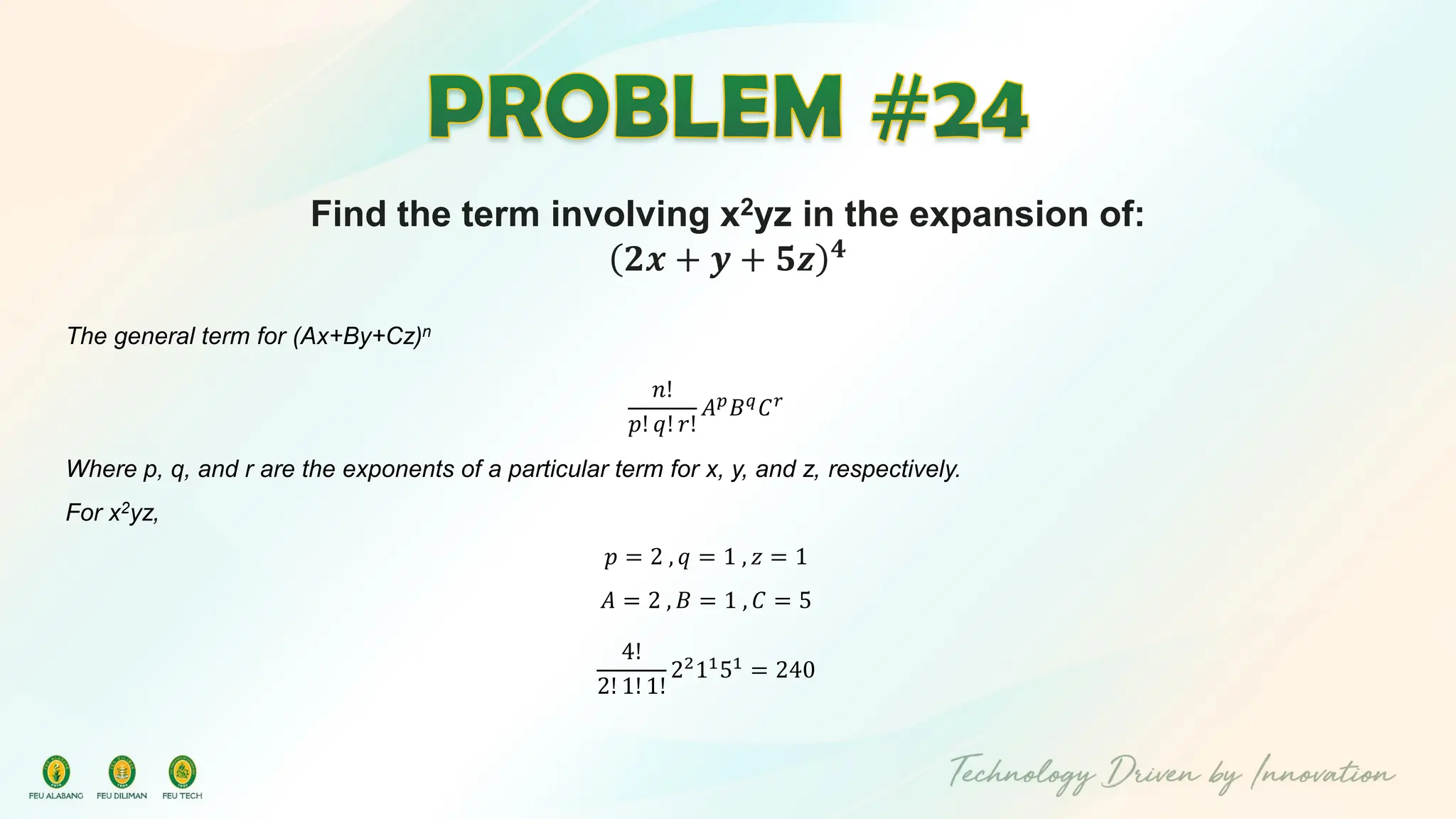
Find the term involving x2yz in the expansion of:
𝟐𝒙 + 𝒚 + 𝟓𝒛 𝟒
The general term for (Ax+By+Cz)n
𝑛!
𝑝! 𝑞! 𝑟!
𝐴𝑝
𝐵𝑞
𝐶𝑟
Where p, q, and r are the exponents of a particular term for x, y, and z, respectively.
For x2yz,
𝑝 = 2 , 𝑞 = 1 , 𝑧 = 1
𝐴 = 2 , 𝐵 = 1 , 𝐶 = 5
4!
2! 1! 1!
22
11
51
= 240
SUB-TOPIC 2
Applications of
Algebra
• To solve worded problems in algebra such as
age, work, motion, mixtures, clock, digit and
miscellaneous problems.
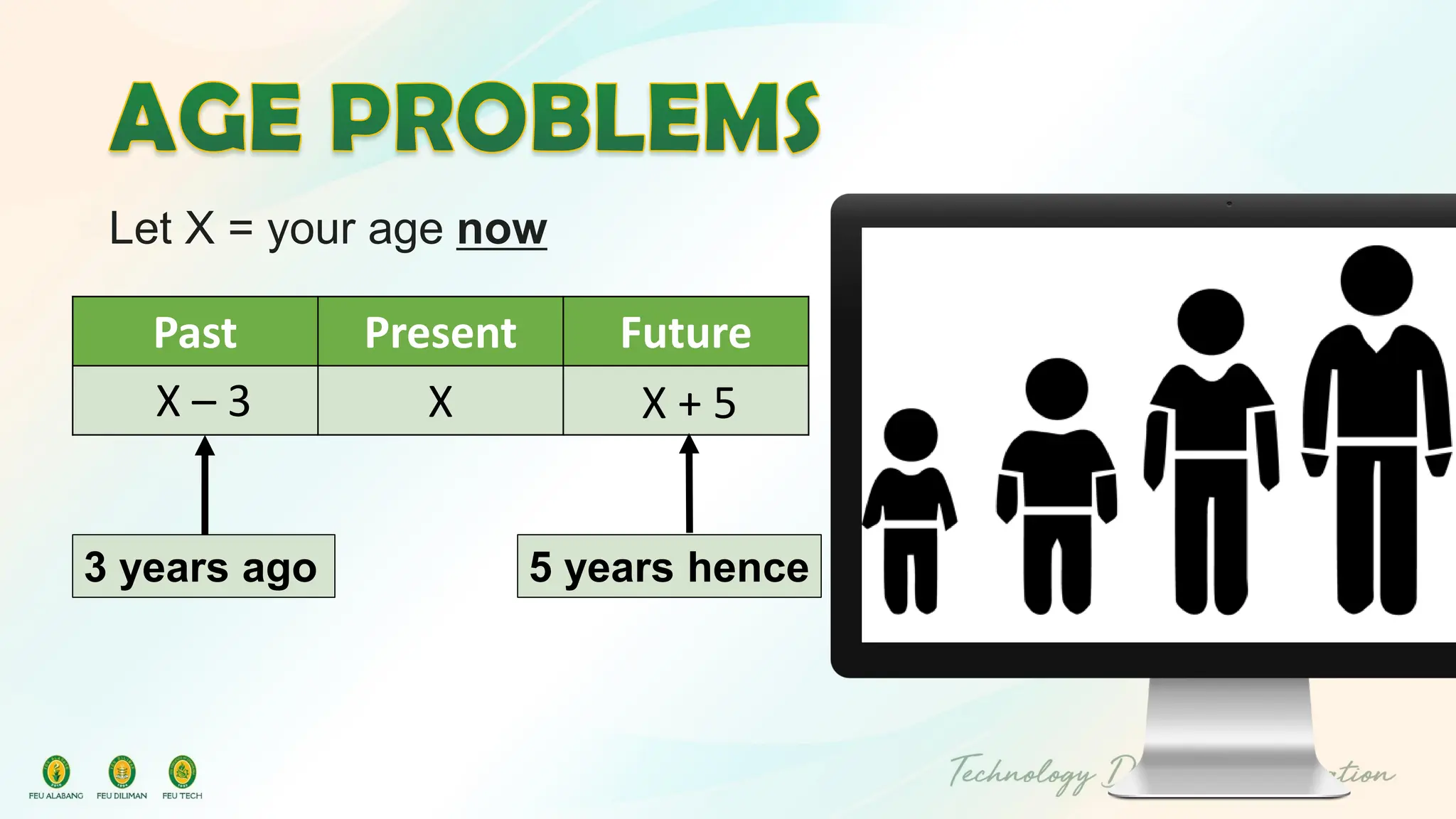
Let X = your age now
Past Present Future
X
3 years ago 5 years hence
X – 3 X + 5
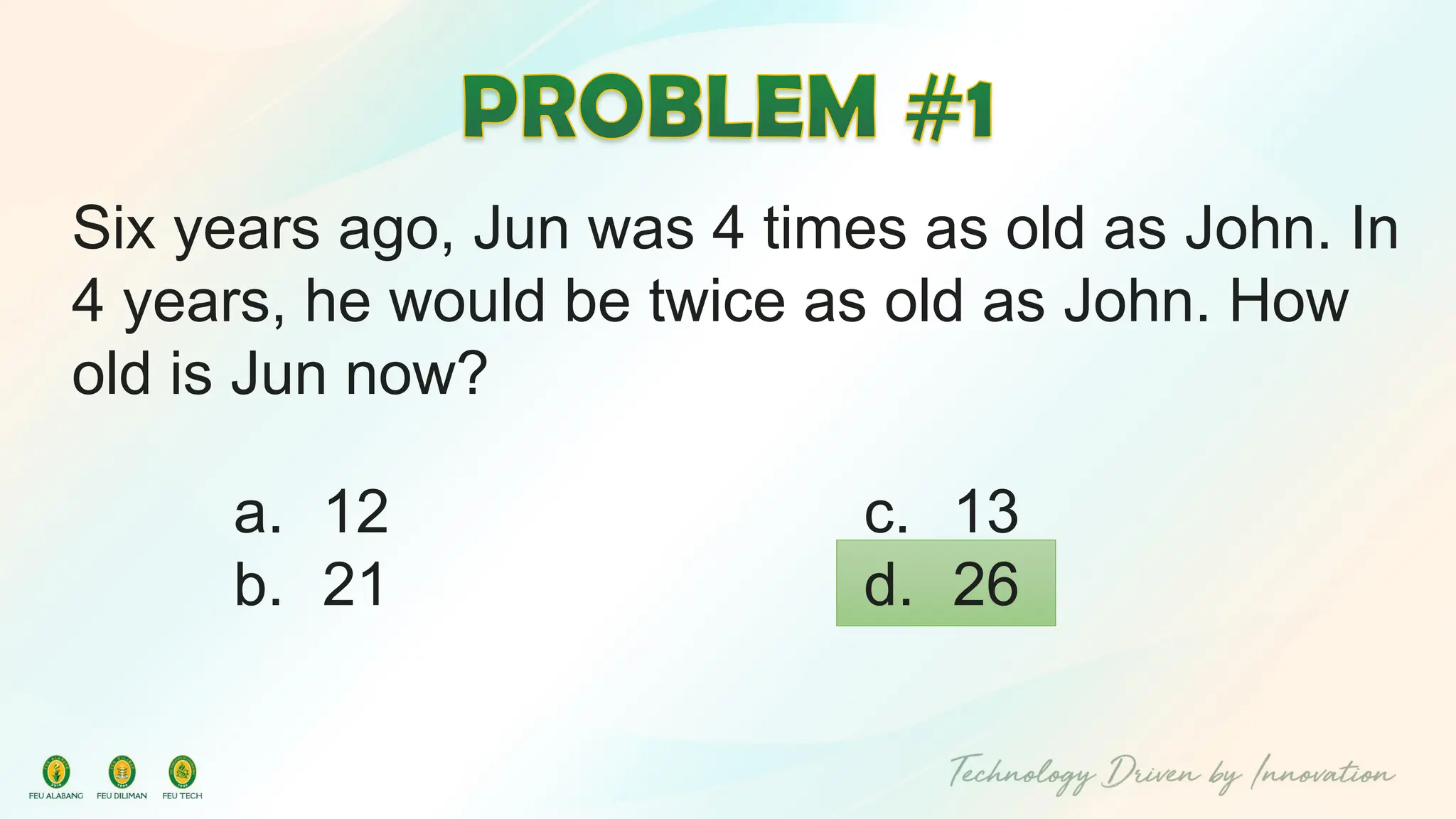
Six years ago, Jun was 4 times as old as John. In
4 years, he would be twice as old as John. How
old is Jun now?
c. 13
d. 26
a. 12
b. 21
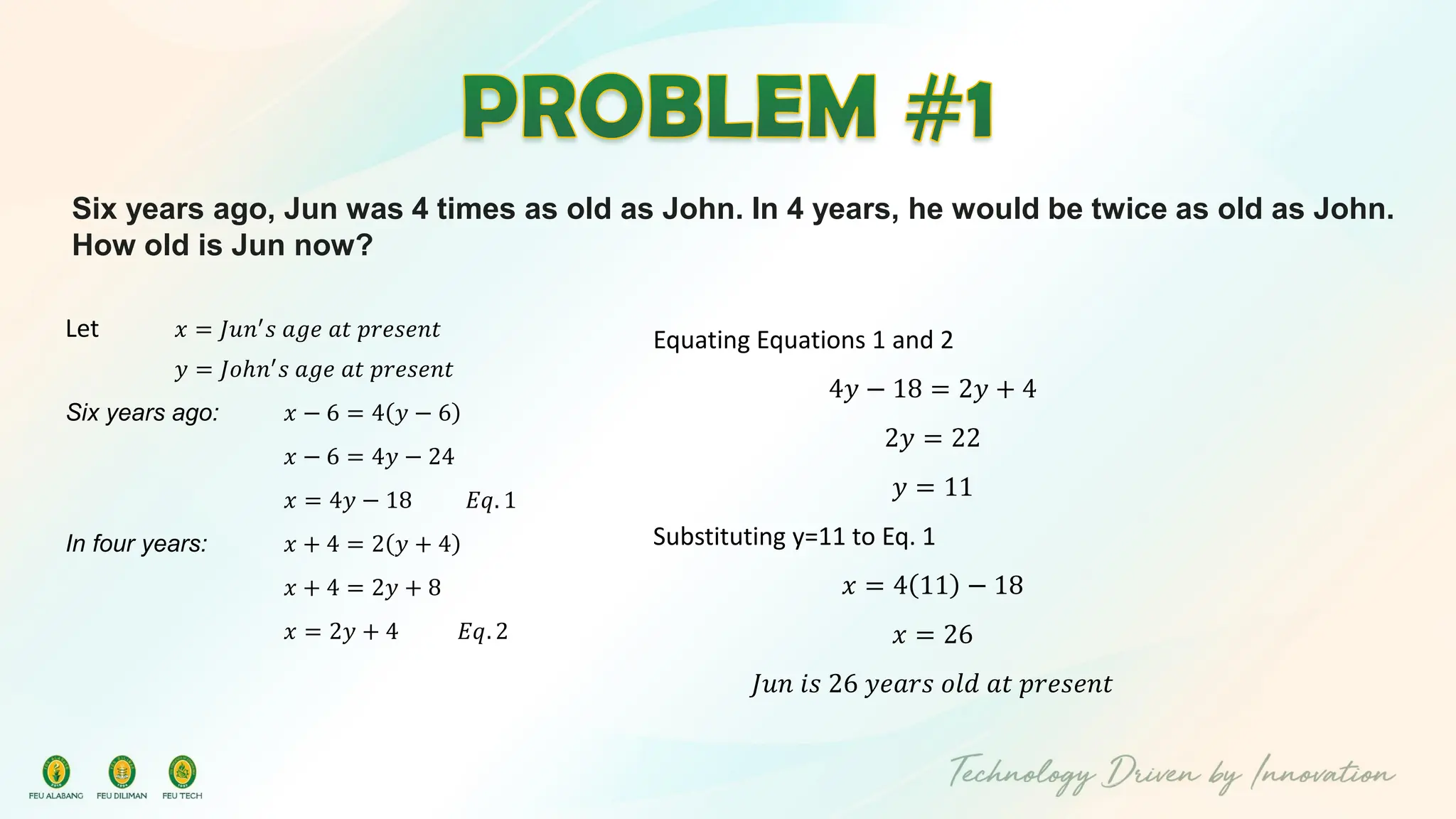
Six years ago, Jun was 4 times as old as John. In 4 years, he would be twice as old as John.
How old is Jun now?
Let 𝑥 = 𝐽𝑢𝑛′
𝑠 𝑎𝑔𝑒 𝑎𝑡 𝑝𝑟𝑒𝑠𝑒𝑛𝑡
𝑦 = 𝐽𝑜ℎ𝑛′
𝑠 𝑎𝑔𝑒 𝑎𝑡 𝑝𝑟𝑒𝑠𝑒𝑛𝑡
Six years ago: 𝑥 − 6 = 4 𝑦 − 6
𝑥 − 6 = 4𝑦 − 24
𝑥 = 4𝑦 − 18 𝐸𝑞. 1
In four years: 𝑥 + 4 = 2 𝑦 + 4
𝑥 + 4 = 2𝑦 + 8
𝑥 = 2𝑦 + 4 𝐸𝑞. 2
Equating Equations 1 and 2
4𝑦 − 18 = 2𝑦 + 4
2𝑦 = 22
𝑦 = 11
Substituting y=11 to Eq. 1
𝑥 = 4 11 − 18
𝑥 = 26
𝐽𝑢𝑛 𝑖𝑠 26 𝑦𝑒𝑎𝑟𝑠 𝑜𝑙𝑑 𝑎𝑡 𝑝𝑟𝑒𝑠𝑒𝑛𝑡
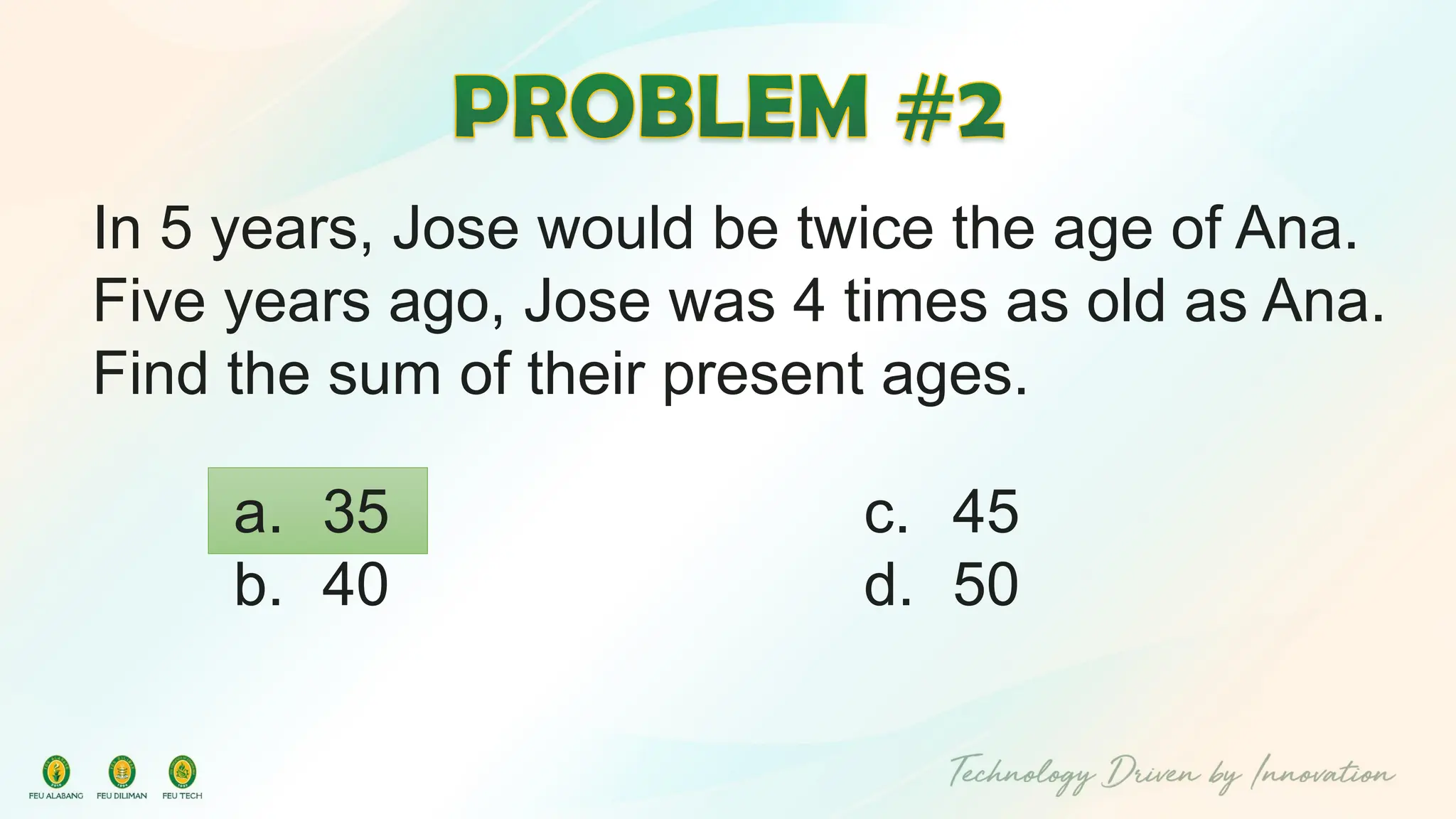
In 5 years, Jose would be twice the age of Ana.
Five years ago, Jose was 4 times as old as Ana.
Find the sum of their present ages.
c. 45
d. 50
a. 35
b. 40
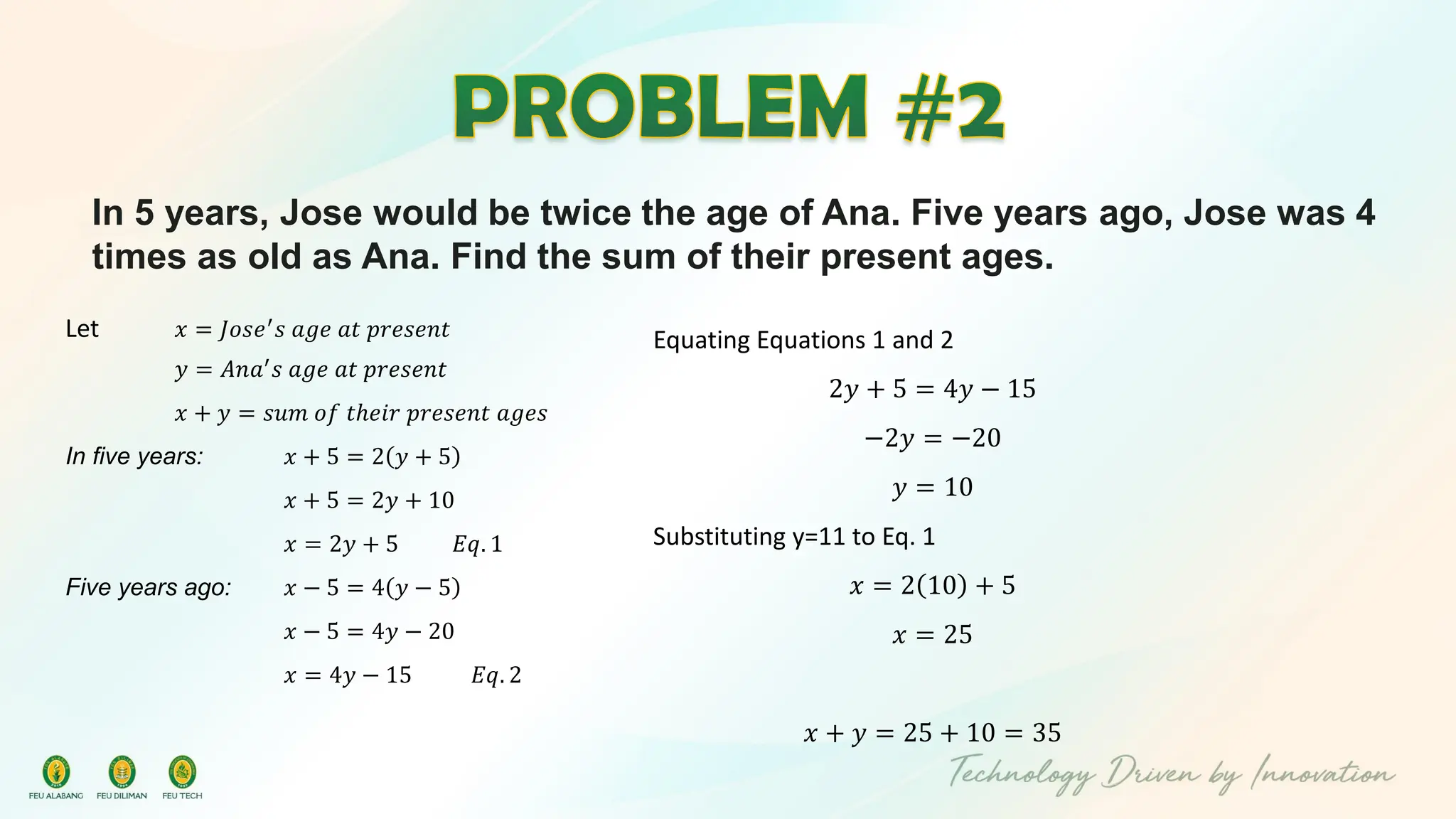
In 5 years, Jose would be twice the age of Ana. Five years ago, Jose was 4
times as old as Ana. Find the sum of their present ages.
Let 𝑥 = 𝐽𝑜𝑠𝑒′
𝑠 𝑎𝑔𝑒 𝑎𝑡 𝑝𝑟𝑒𝑠𝑒𝑛𝑡
𝑦 = 𝐴𝑛𝑎′
𝑠 𝑎𝑔𝑒 𝑎𝑡 𝑝𝑟𝑒𝑠𝑒𝑛𝑡
𝑥 + 𝑦 = 𝑠𝑢𝑚 𝑜𝑓 𝑡ℎ𝑒𝑖𝑟 𝑝𝑟𝑒𝑠𝑒𝑛𝑡 𝑎𝑔𝑒𝑠
In five years: 𝑥 + 5 = 2 𝑦 + 5
𝑥 + 5 = 2𝑦 + 10
𝑥 = 2𝑦 + 5 𝐸𝑞. 1
Five years ago: 𝑥 − 5 = 4 𝑦 − 5
𝑥 − 5 = 4𝑦 − 20
𝑥 = 4𝑦 − 15 𝐸𝑞. 2
Equating Equations 1 and 2
2𝑦 + 5 = 4𝑦 − 15
−2𝑦 = −20
𝑦 = 10
Substituting y=11 to Eq. 1
𝑥 = 2 10 + 5
𝑥 = 25
𝑥 + 𝑦 = 25 + 10 = 35
Two times the father’s age is 8 more than six
times his son’s age. Ten years ago, the sum of
their ages was 44. The age of the son is:
c. 20
d. 18
a. 49
b. 15
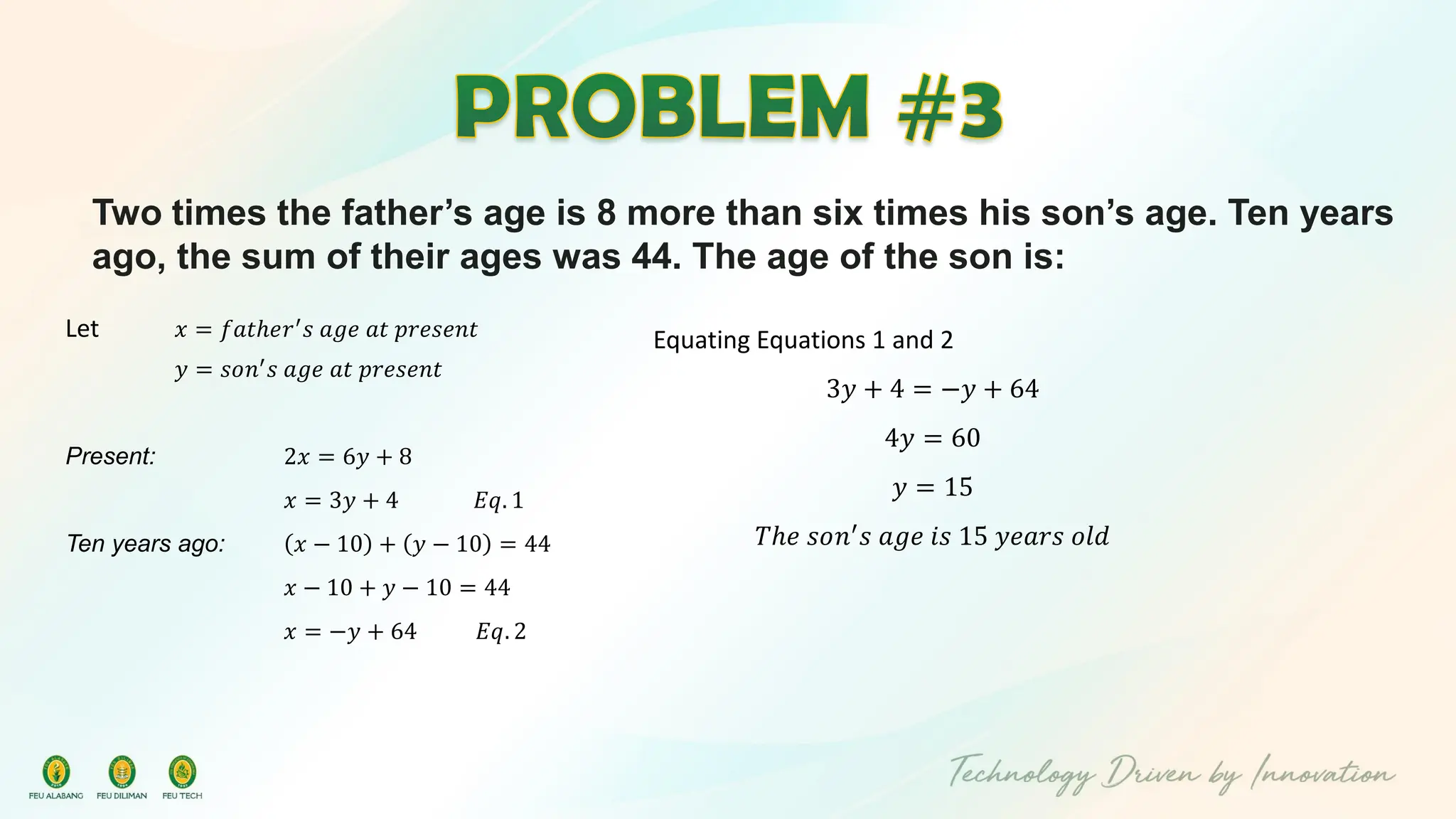
Two times the father’s age is 8 more than six times his son’s age. Ten years
ago, the sum of their ages was 44. The age of the son is:
Let 𝑥 = 𝑓𝑎𝑡ℎ𝑒𝑟′
𝑠 𝑎𝑔𝑒 𝑎𝑡 𝑝𝑟𝑒𝑠𝑒𝑛𝑡
𝑦 = 𝑠𝑜𝑛′
𝑠 𝑎𝑔𝑒 𝑎𝑡 𝑝𝑟𝑒𝑠𝑒𝑛𝑡
Present: 2𝑥 = 6𝑦 + 8
𝑥 = 3𝑦 + 4 𝐸𝑞. 1
Ten years ago: 𝑥 − 10 + 𝑦 − 10 = 44
𝑥 − 10 + 𝑦 − 10 = 44
𝑥 = −𝑦 + 64 𝐸𝑞. 2
Equating Equations 1 and 2
3𝑦 + 4 = −𝑦 + 64
4𝑦 = 60
𝑦 = 15
𝑇ℎ𝑒 𝑠𝑜𝑛′
𝑠 𝑎𝑔𝑒 𝑖𝑠 15 𝑦𝑒𝑎𝑟𝑠 𝑜𝑙𝑑
Mary is 24 years old. Mary is twice as old as Ana
was when Mary was as old as Ana is now. How
old is Ana?
c. 19
d. 20
a. 16
b. 18
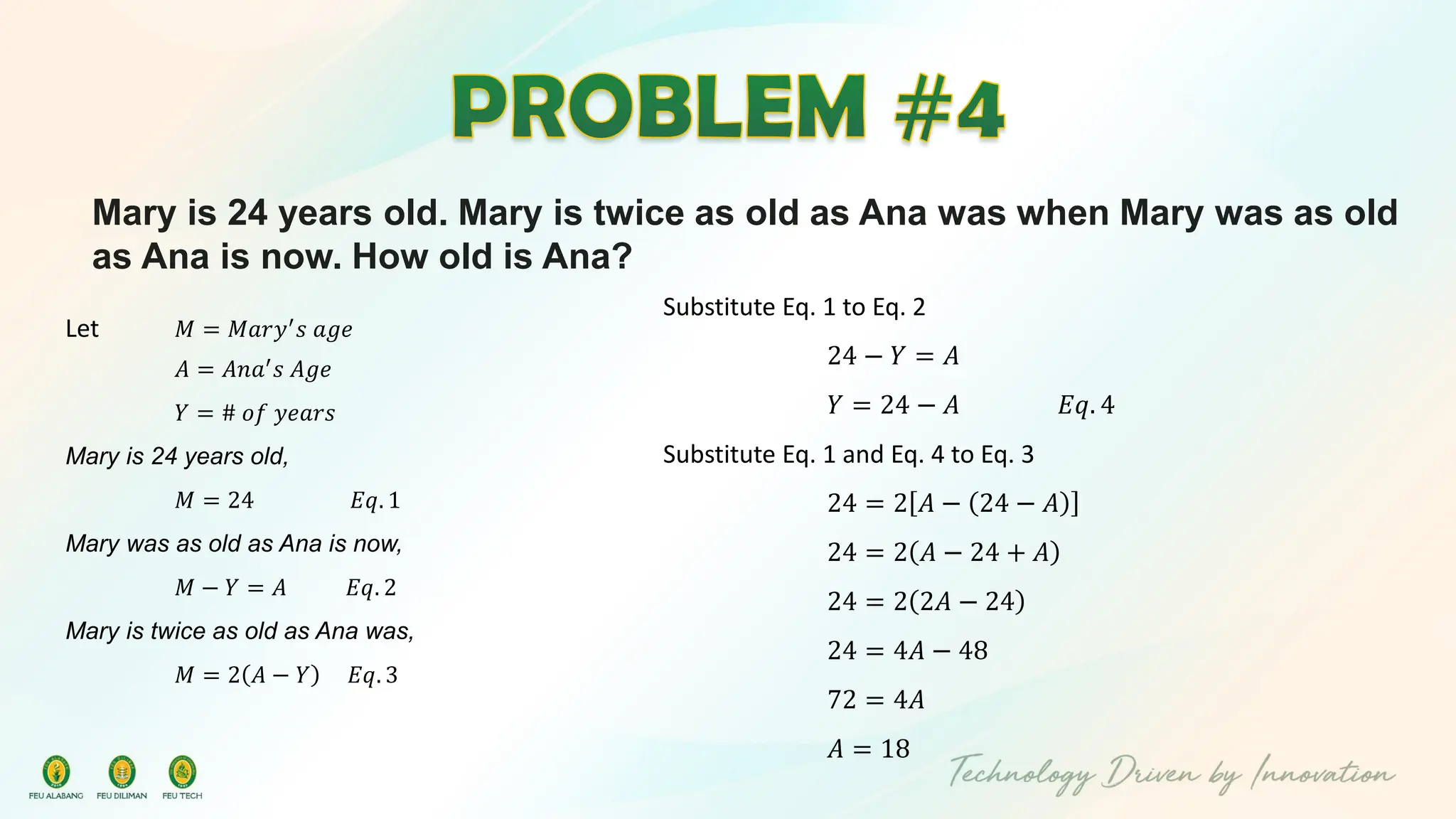
Mary is 24 years old. Mary is twice as old as Ana was when Mary was as old
as Ana is now. How old is Ana?
Let 𝑀 = 𝑀𝑎𝑟𝑦′
𝑠 𝑎𝑔𝑒
𝐴 = 𝐴𝑛𝑎′
𝑠 𝐴𝑔𝑒
𝑌 = # 𝑜𝑓 𝑦𝑒𝑎𝑟𝑠
Mary is 24 years old,
𝑀 = 24 𝐸𝑞. 1
Mary was as old as Ana is now,
𝑀 − 𝑌 = 𝐴 𝐸𝑞. 2
Mary is twice as old as Ana was,
𝑀 = 2 𝐴 − 𝑌 𝐸𝑞. 3
Substitute Eq. 1 to Eq. 2
24 − 𝑌 = 𝐴
𝑌 = 24 − 𝐴 𝐸𝑞. 4
Substitute Eq. 1 and Eq. 4 to Eq. 3
24 = 2 𝐴 − 24 − 𝐴
24 = 2 𝐴 − 24 + 𝐴
24 = 2 2𝐴 − 24
24 = 4𝐴 − 48
72 = 4𝐴
𝐴 = 18
Case 1: Different rates
Steps to solve:
1. Compute the rate of work of each
2. Setup the equation
𝒓𝒂𝒕𝒆 𝒐𝒇 𝒘𝒐𝒓𝒌 =
𝒏𝒐. 𝒐𝒇 𝒋𝒐𝒃 𝒅𝒐𝒏𝒆
𝒕𝒊𝒎𝒆 𝒕𝒐 𝒇𝒊𝒏𝒊𝒔𝒉 𝒕𝒉𝒆 𝒋𝒐𝒃
𝑾𝒐𝒓𝒌 𝒅𝒐𝒏𝒆 = 𝑾𝒐𝒓𝒌 𝑳𝒐𝒂𝒅
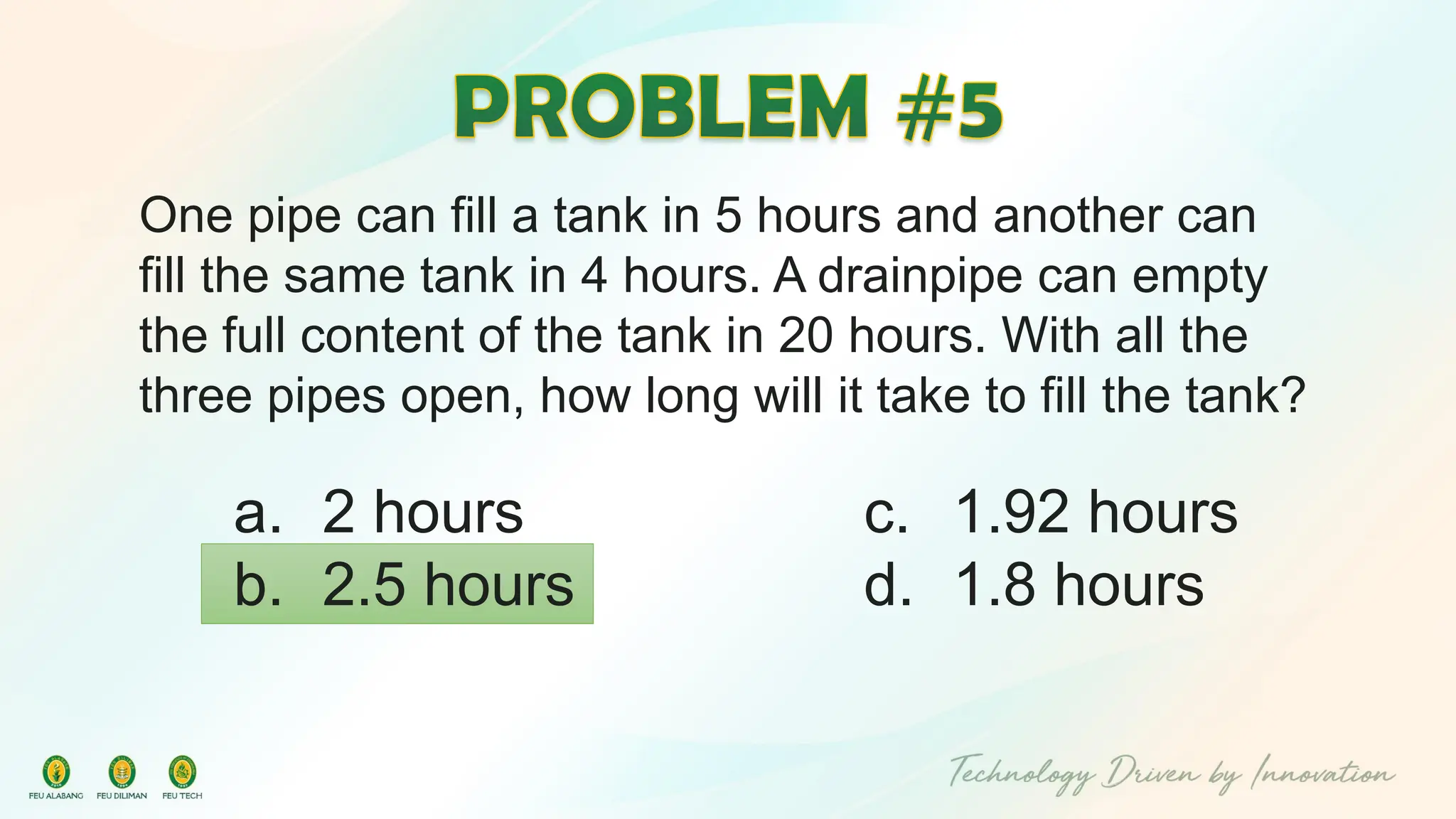
One pipe can fill a tank in 5 hours and another can
fill the same tank in 4 hours. A drainpipe can empty
the full content of the tank in 20 hours. With all the
three pipes open, how long will it take to fill the tank?
c. 1.92 hours
d. 1.8 hours
a. 2 hours
b. 2.5 hours
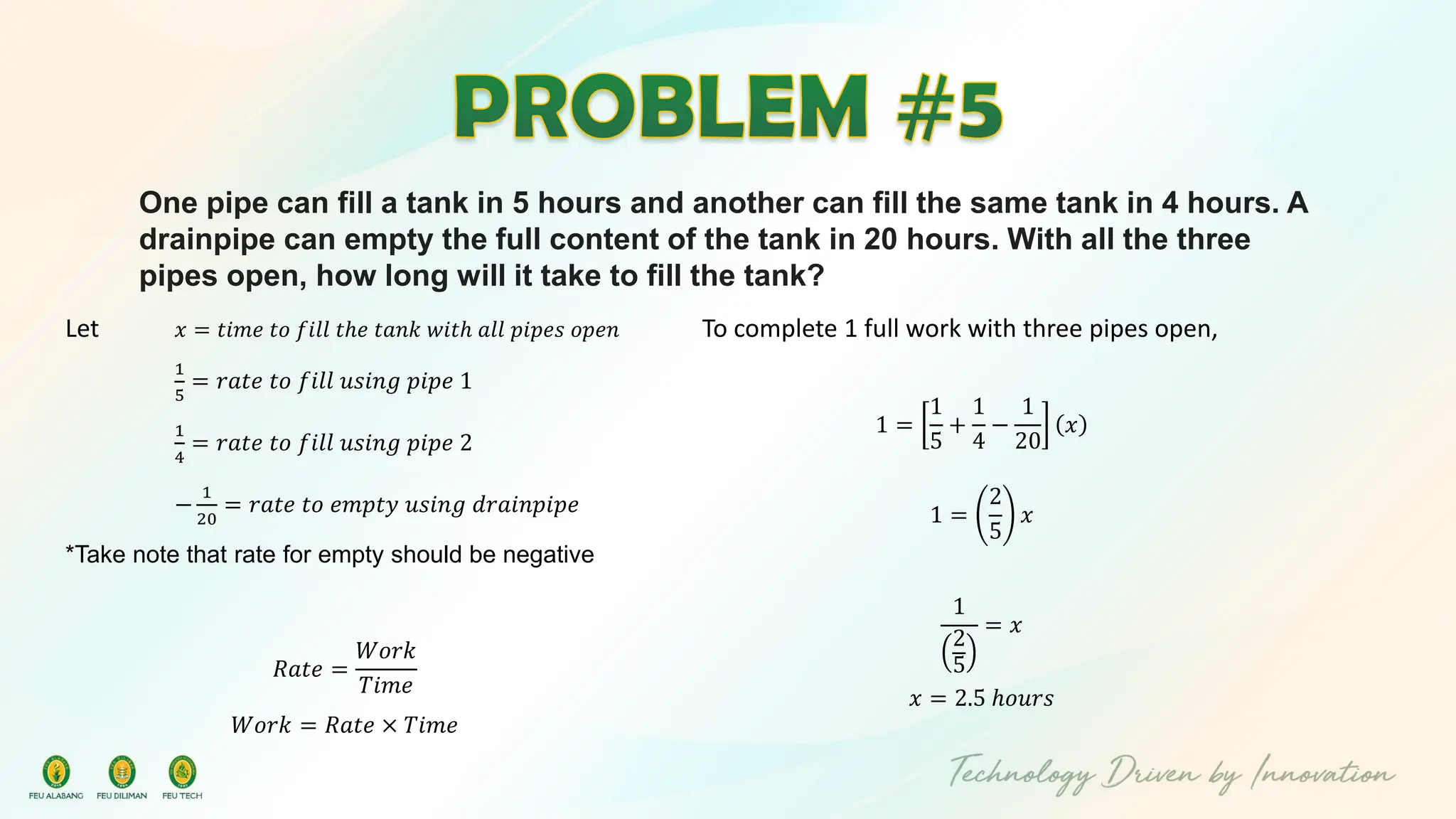
One pipe can fill a tank in 5 hours and another can fill the same tank in 4 hours. A
drainpipe can empty the full content of the tank in 20 hours. With all the three
pipes open, how long will it take to fill the tank?
Let 𝑥 = 𝑡𝑖𝑚𝑒 𝑡𝑜 𝑓𝑖𝑙𝑙 𝑡ℎ𝑒 𝑡𝑎𝑛𝑘 𝑤𝑖𝑡ℎ 𝑎𝑙𝑙 𝑝𝑖𝑝𝑒𝑠 𝑜𝑝𝑒𝑛
1
5
= 𝑟𝑎𝑡𝑒 𝑡𝑜 𝑓𝑖𝑙𝑙 𝑢𝑠𝑖𝑛𝑔 𝑝𝑖𝑝𝑒 1
1
4
= 𝑟𝑎𝑡𝑒 𝑡𝑜 𝑓𝑖𝑙𝑙 𝑢𝑠𝑖𝑛𝑔 𝑝𝑖𝑝𝑒 2
−
1
20
= 𝑟𝑎𝑡𝑒 𝑡𝑜 𝑒𝑚𝑝𝑡𝑦 𝑢𝑠𝑖𝑛𝑔 𝑑𝑟𝑎𝑖𝑛𝑝𝑖𝑝𝑒
*Take note that rate for empty should be negative
𝑅𝑎𝑡𝑒 =
𝑊𝑜𝑟𝑘
𝑇𝑖𝑚𝑒
𝑊𝑜𝑟𝑘 = 𝑅𝑎𝑡𝑒 × 𝑇𝑖𝑚𝑒
To complete 1 full work with three pipes open,
1 =
1
5
+
1
4
−
1
20
𝑥
1 =
2
5
𝑥
1
2
5
= 𝑥
𝑥 = 2.5 ℎ𝑜𝑢𝑟𝑠
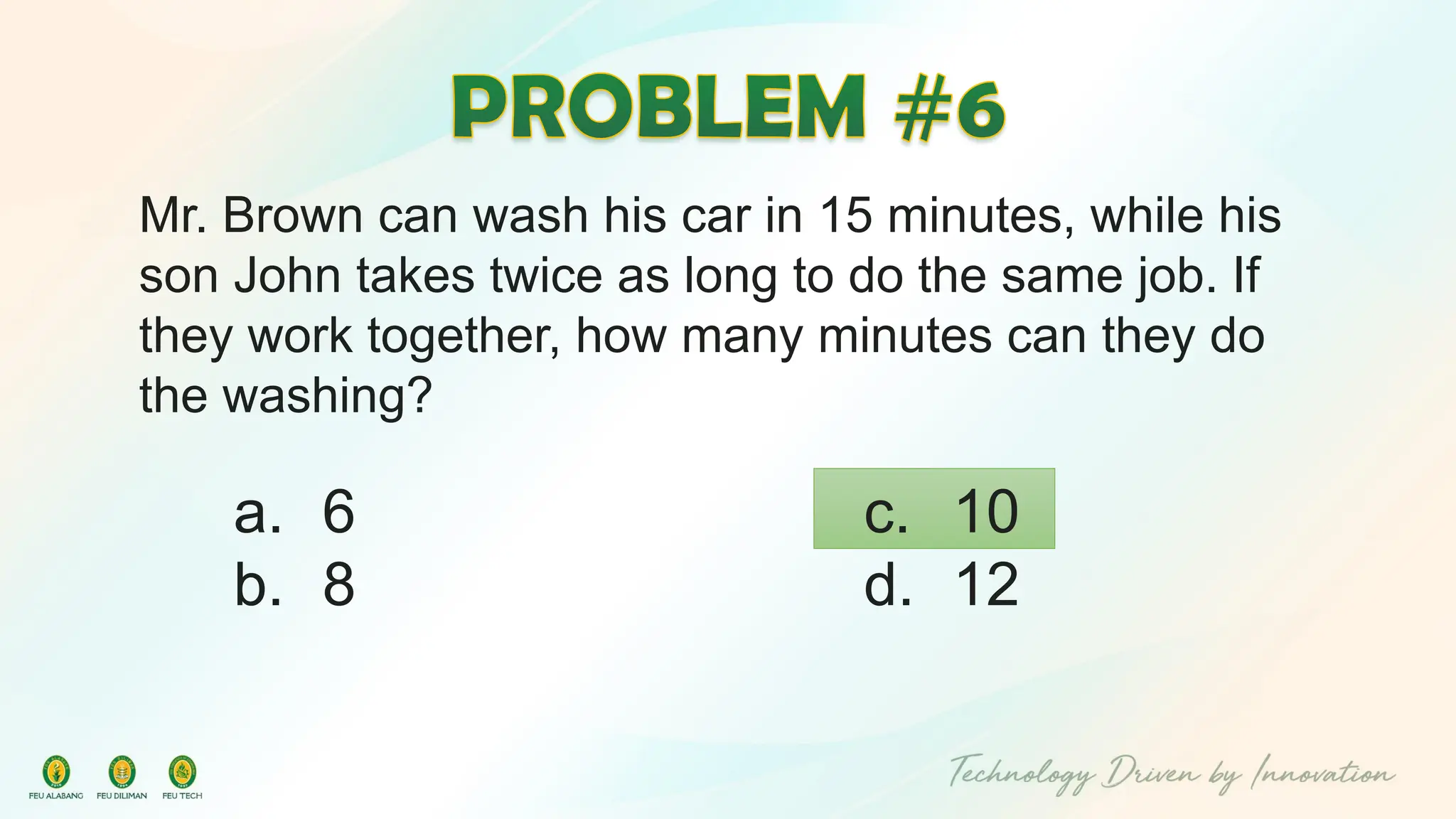
Mr. Brown can wash his car in 15 minutes, while his
son John takes twice as long to do the same job. If
they work together, how many minutes can they do
the washing?
c. 10
d. 12
a. 6
b. 8
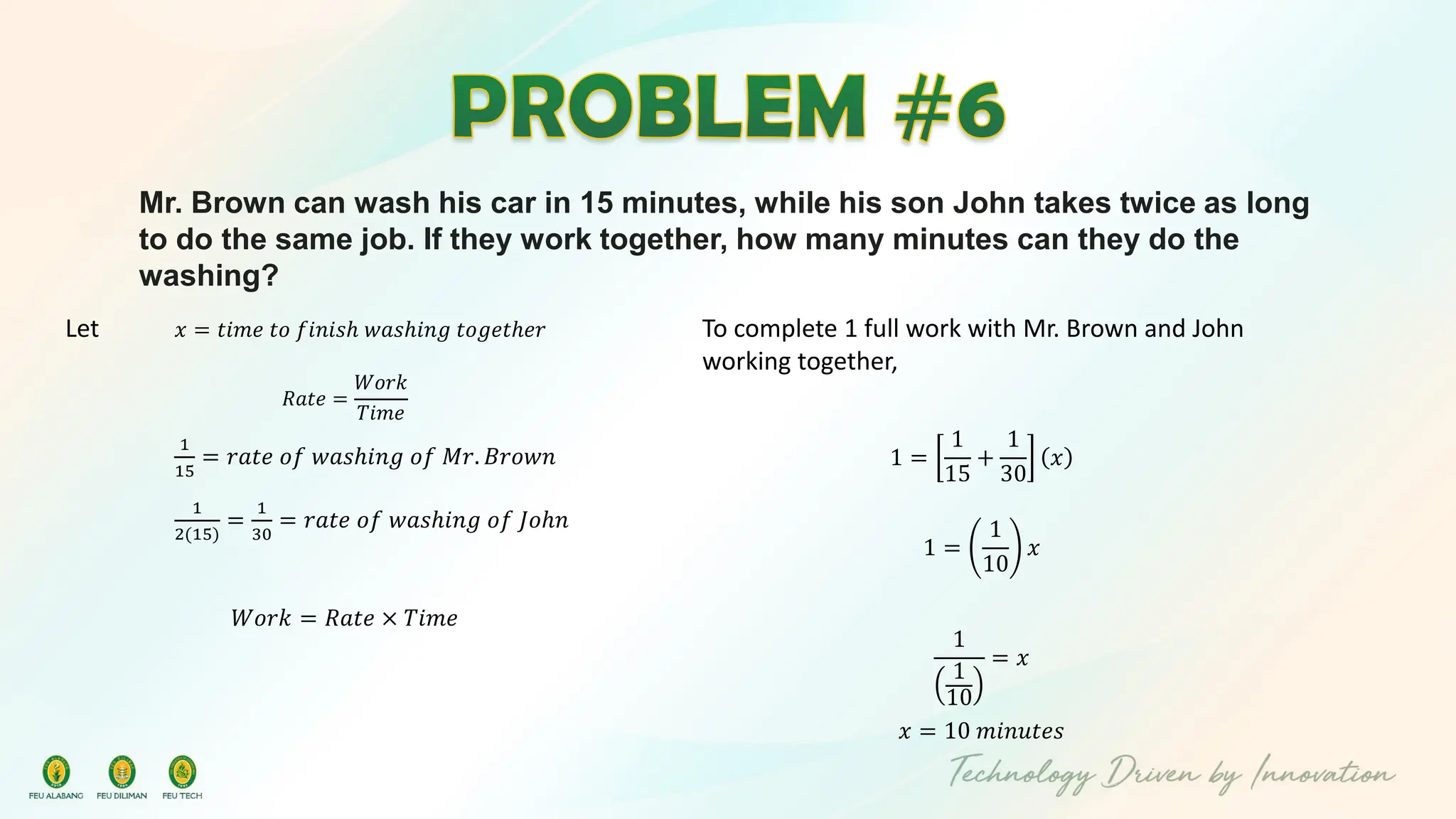
Mr. Brown can wash his car in 15 minutes, while his son John takes twice as long
to do the same job. If they work together, how many minutes can they do the
washing?
Let 𝑥 = 𝑡𝑖𝑚𝑒 𝑡𝑜 𝑓𝑖𝑛𝑖𝑠ℎ 𝑤𝑎𝑠ℎ𝑖𝑛𝑔 𝑡𝑜𝑔𝑒𝑡ℎ𝑒𝑟
𝑅𝑎𝑡𝑒 =
𝑊𝑜𝑟𝑘
𝑇𝑖𝑚𝑒
1
15
= 𝑟𝑎𝑡𝑒 𝑜𝑓 𝑤𝑎𝑠ℎ𝑖𝑛𝑔 𝑜𝑓 𝑀𝑟. 𝐵𝑟𝑜𝑤𝑛
1
2(15)
=
1
30
= 𝑟𝑎𝑡𝑒 𝑜𝑓 𝑤𝑎𝑠ℎ𝑖𝑛𝑔 𝑜𝑓 𝐽𝑜ℎ𝑛
𝑊𝑜𝑟𝑘 = 𝑅𝑎𝑡𝑒 × 𝑇𝑖𝑚𝑒
To complete 1 full work with Mr. Brown and John
working together,
1 =
1
15
+
1
30
𝑥
1 =
1
10
𝑥
1
1
10
= 𝑥
𝑥 = 10 𝑚𝑖𝑛𝑢𝑡𝑒𝑠
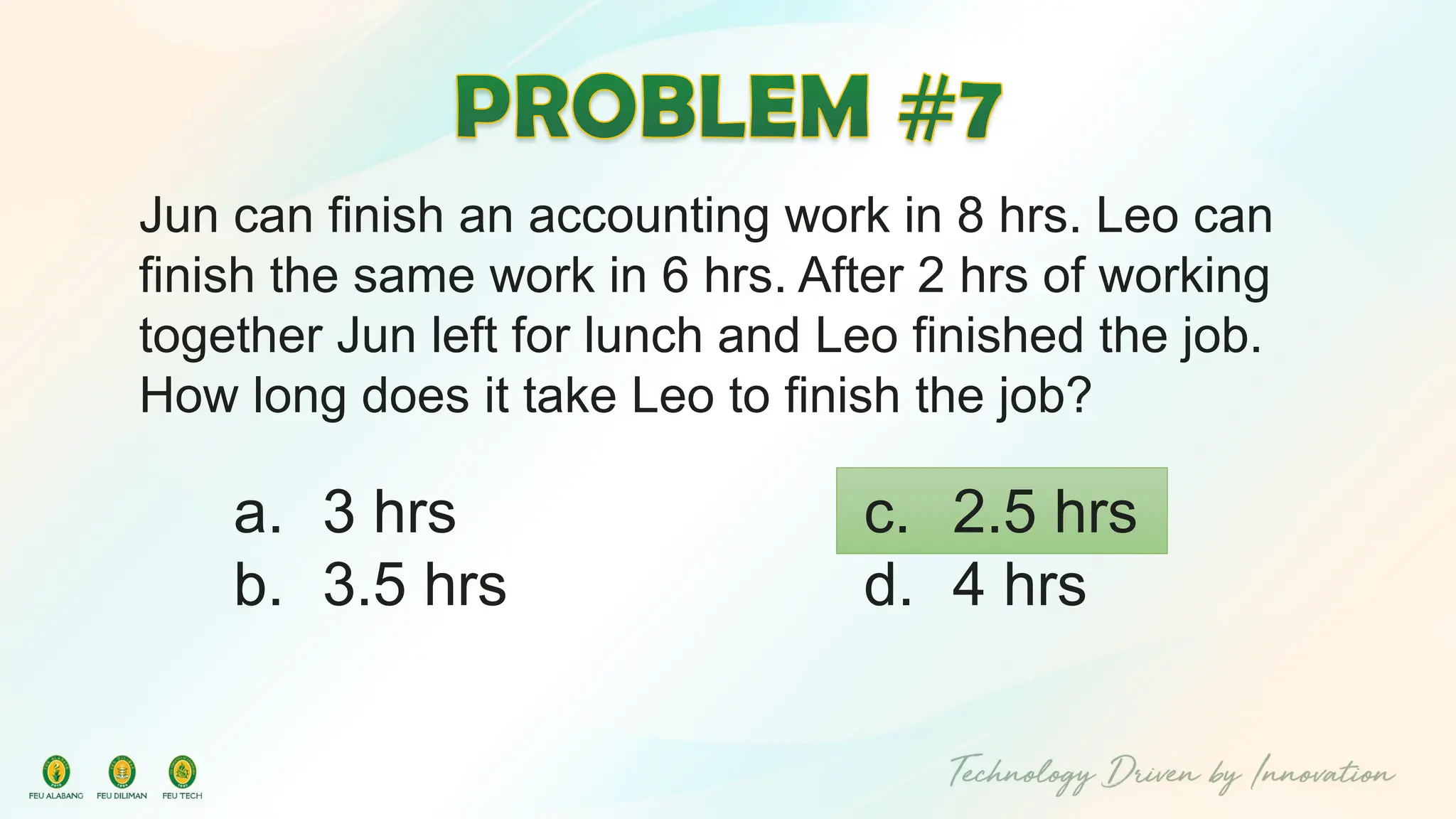
Jun can finish an accounting work in 8 hrs. Leo can
finish the same work in 6 hrs. After 2 hrs of working
together Jun left for lunch and Leo finished the job.
How long does it take Leo to finish the job?
c. 2.5 hrs
d. 4 hrs
a. 3 hrs
b. 3.5 hrs
Jun can finish an accounting work in 8 hrs. Leo can finish the same work in 6 hrs.
After 2 hrs of working together Jun left for lunch and Leo finished the job. How
long does it take Leo to finish the job?
Let 𝑥 = 𝑡𝑖𝑚𝑒 𝑓𝑜𝑟 𝐿𝑒𝑜 𝑡𝑜 𝑓𝑖𝑛𝑖𝑠ℎ 𝑎𝑓𝑡𝑒𝑟 𝐽𝑢𝑛 𝑙𝑒𝑓𝑡
𝑅𝑎𝑡𝑒 =
𝑊𝑜𝑟𝑘
𝑇𝑖𝑚𝑒
1
8
= 𝑟𝑎𝑡𝑒 𝑜𝑓 𝑤𝑜𝑟𝑘 𝑜𝑓 𝐽𝑢𝑛
1
6
= 𝑟𝑎𝑡𝑒 𝑜𝑓 𝑤𝑜𝑟𝑘 𝑜𝑓 𝐿𝑒𝑜
𝑊𝑜𝑟𝑘 = 𝑅𝑎𝑡𝑒 × 𝑇𝑖𝑚𝑒
Work done during 2 hours of working together,
𝑊𝑜𝑟𝑘1 =
1
8
+
1
6
2 =
7
12
Work done by Leo after Jun left for lunch,
𝑊𝑜𝑟𝑘2 =
1
6
𝑥
To complete the whole accounting work,
𝑊𝑜𝑟𝑘𝑡𝑜𝑡𝑎𝑙 = 1 = 𝑊𝑜𝑟𝑘1 + 𝑊𝑜𝑟𝑘2
1 =
7
12
+
1
6
x
5
12
=
1
6
𝑥
𝑥 = 2.5 ℎ𝑜𝑢𝑟𝑠
Case 2: Same rates
Steps to solve:
1. Setup the equation
𝑾𝒐𝒓𝒌 𝑳𝒐𝒂𝒅 =
𝒏𝒐. 𝒐𝒇 𝒘𝒐𝒓𝒌𝒆𝒓 × 𝒕𝒊𝒎𝒆 𝒕𝒐 𝒇𝒊𝒏𝒊𝒔𝒉
𝒏𝒐. 𝒐𝒇 𝒋𝒐𝒃 𝒓𝒆𝒒𝒖𝒊𝒓𝒆𝒅 𝒕𝒐 𝒇𝒊𝒏𝒊𝒔𝒉
𝑾𝒐𝒓𝒌 𝒅𝒐𝒏𝒆 = 𝑾𝒐𝒓𝒌 𝑳𝒐𝒂𝒅
𝑾𝒐𝒓𝒌 𝑫𝒐𝒏𝒆 =
𝒏𝒐. 𝒐𝒇 𝒘𝒐𝒓𝒌𝒆𝒓 × 𝒕𝒊𝒎𝒆 𝒕𝒐 𝒅𝒐𝒊𝒏𝒈
𝒏𝒐. 𝒐𝒇 𝒋𝒐𝒃 𝒅𝒐𝒏𝒆
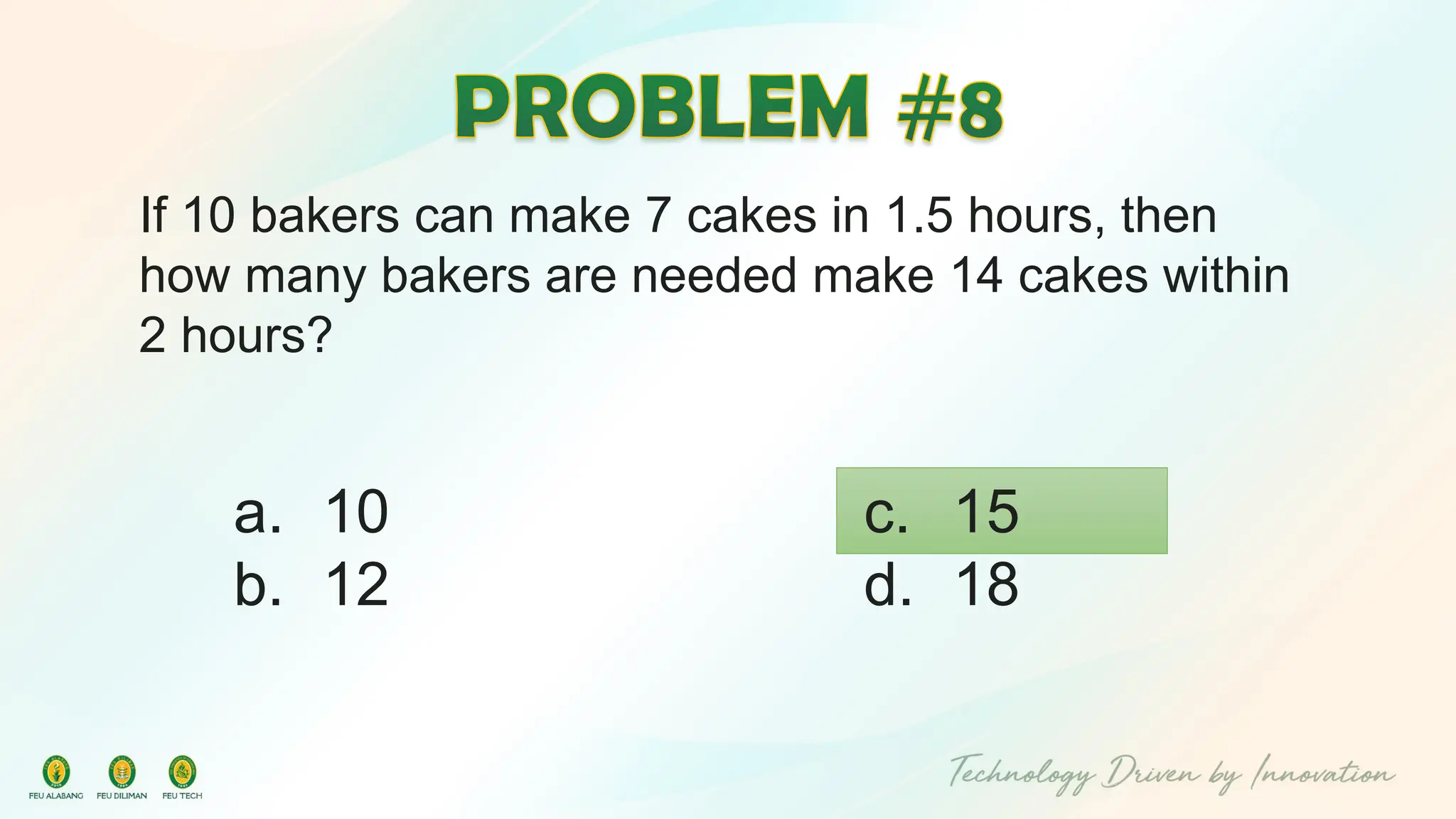
If 10 bakers can make 7 cakes in 1.5 hours, then
how many bakers are needed make 14 cakes within
2 hours?
c. 15
d. 18
a. 10
b. 12
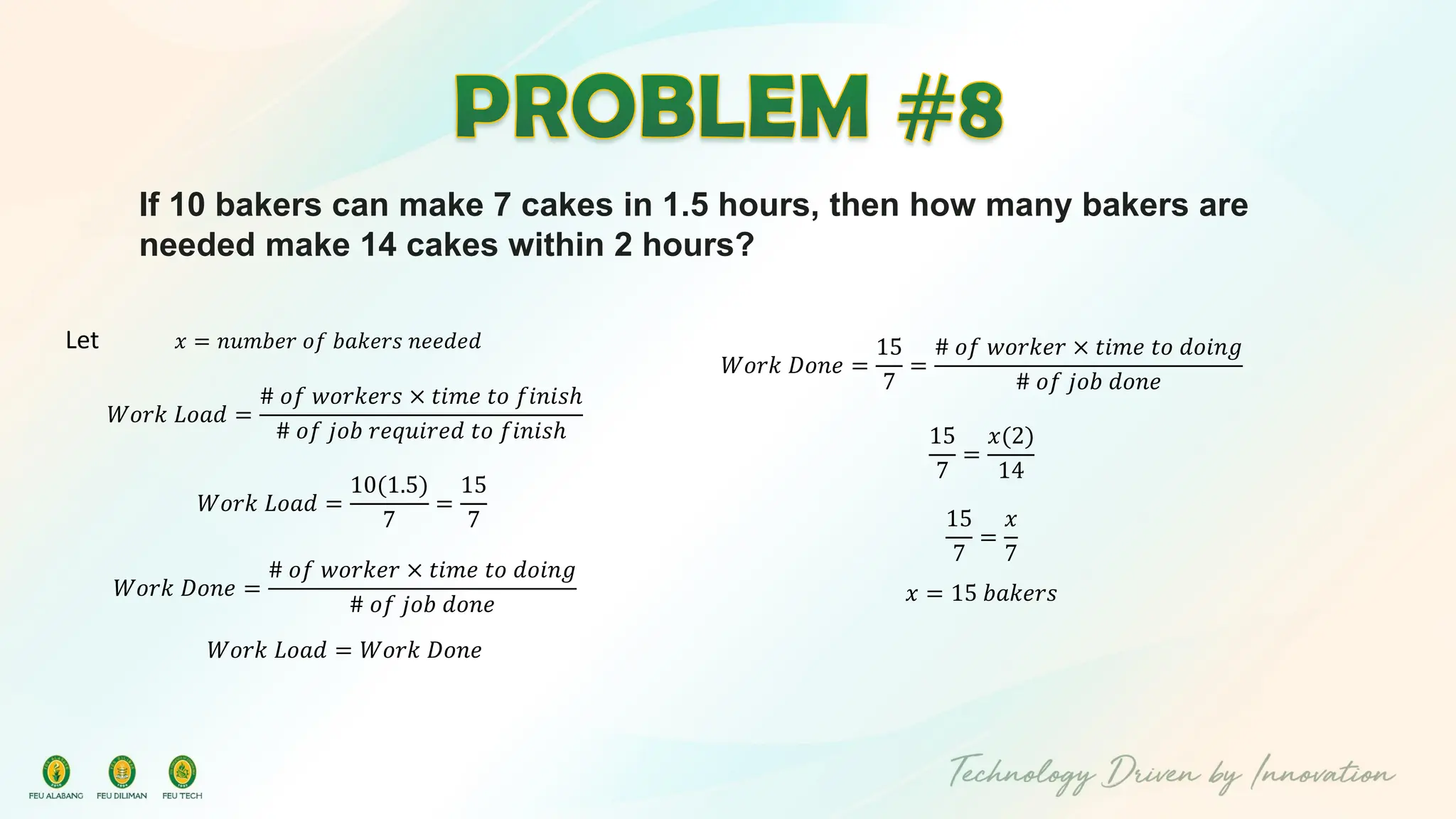
If 10 bakers can make 7 cakes in 1.5 hours, then how many bakers are
needed make 14 cakes within 2 hours?
Let 𝑥 = 𝑛𝑢𝑚𝑏𝑒𝑟 𝑜𝑓 𝑏𝑎𝑘𝑒𝑟𝑠 𝑛𝑒𝑒𝑑𝑒𝑑
𝑊𝑜𝑟𝑘 𝐿𝑜𝑎𝑑 =
# 𝑜𝑓 𝑤𝑜𝑟𝑘𝑒𝑟𝑠 × 𝑡𝑖𝑚𝑒 𝑡𝑜 𝑓𝑖𝑛𝑖𝑠ℎ
# 𝑜𝑓 𝑗𝑜𝑏 𝑟𝑒𝑞𝑢𝑖𝑟𝑒𝑑 𝑡𝑜 𝑓𝑖𝑛𝑖𝑠ℎ
𝑊𝑜𝑟𝑘 𝐿𝑜𝑎𝑑 =
10(1.5)
7
=
15
7
𝑊𝑜𝑟𝑘 𝐷𝑜𝑛𝑒 =
# 𝑜𝑓 𝑤𝑜𝑟𝑘𝑒𝑟 × 𝑡𝑖𝑚𝑒 𝑡𝑜 𝑑𝑜𝑖𝑛𝑔
# 𝑜𝑓 𝑗𝑜𝑏 𝑑𝑜𝑛𝑒
𝑊𝑜𝑟𝑘 𝐿𝑜𝑎𝑑 = 𝑊𝑜𝑟𝑘 𝐷𝑜𝑛𝑒
𝑊𝑜𝑟𝑘 𝐷𝑜𝑛𝑒 =
15
7
=
# 𝑜𝑓 𝑤𝑜𝑟𝑘𝑒𝑟 × 𝑡𝑖𝑚𝑒 𝑡𝑜 𝑑𝑜𝑖𝑛𝑔
# 𝑜𝑓 𝑗𝑜𝑏 𝑑𝑜𝑛𝑒
15
7
=
𝑥(2)
14
15
7
=
𝑥
7
𝑥 = 15 𝑏𝑎𝑘𝑒𝑟𝑠
In current of water or air
Let:
X = speed in boat/plane
Y = speed in water/air
Then:
X + Y : downstream or with the wind
X – Y : upstream or against the wind
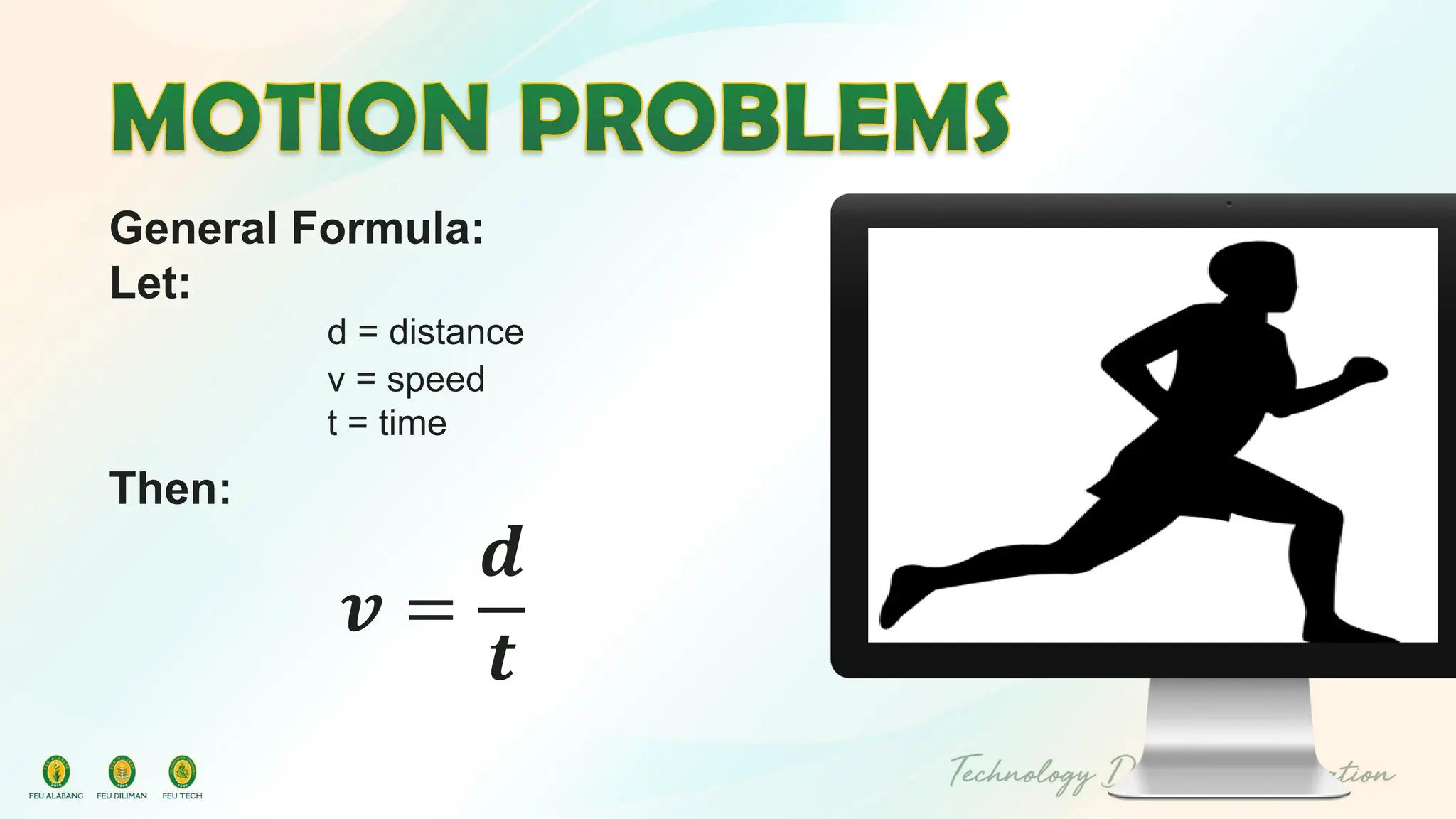
General Formula:
Let:
d = distance
v = speed
t = time
Then:
𝒗 =
𝒅
𝒕
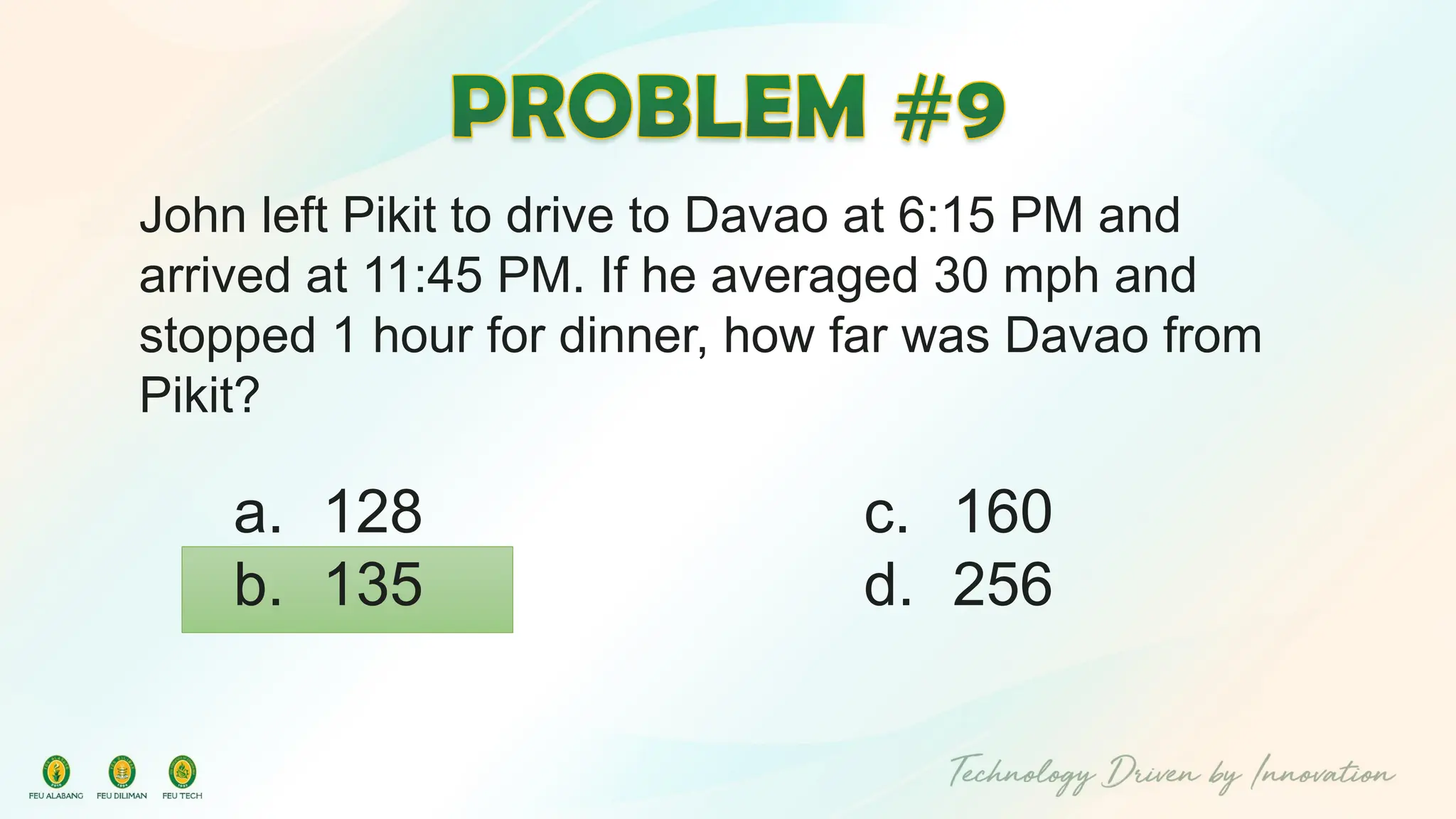
John left Pikit to drive to Davao at 6:15 PM and
arrived at 11:45 PM. If he averaged 30 mph and
stopped 1 hour for dinner, how far was Davao from
Pikit?
c. 160
d. 256
a. 128
b. 135
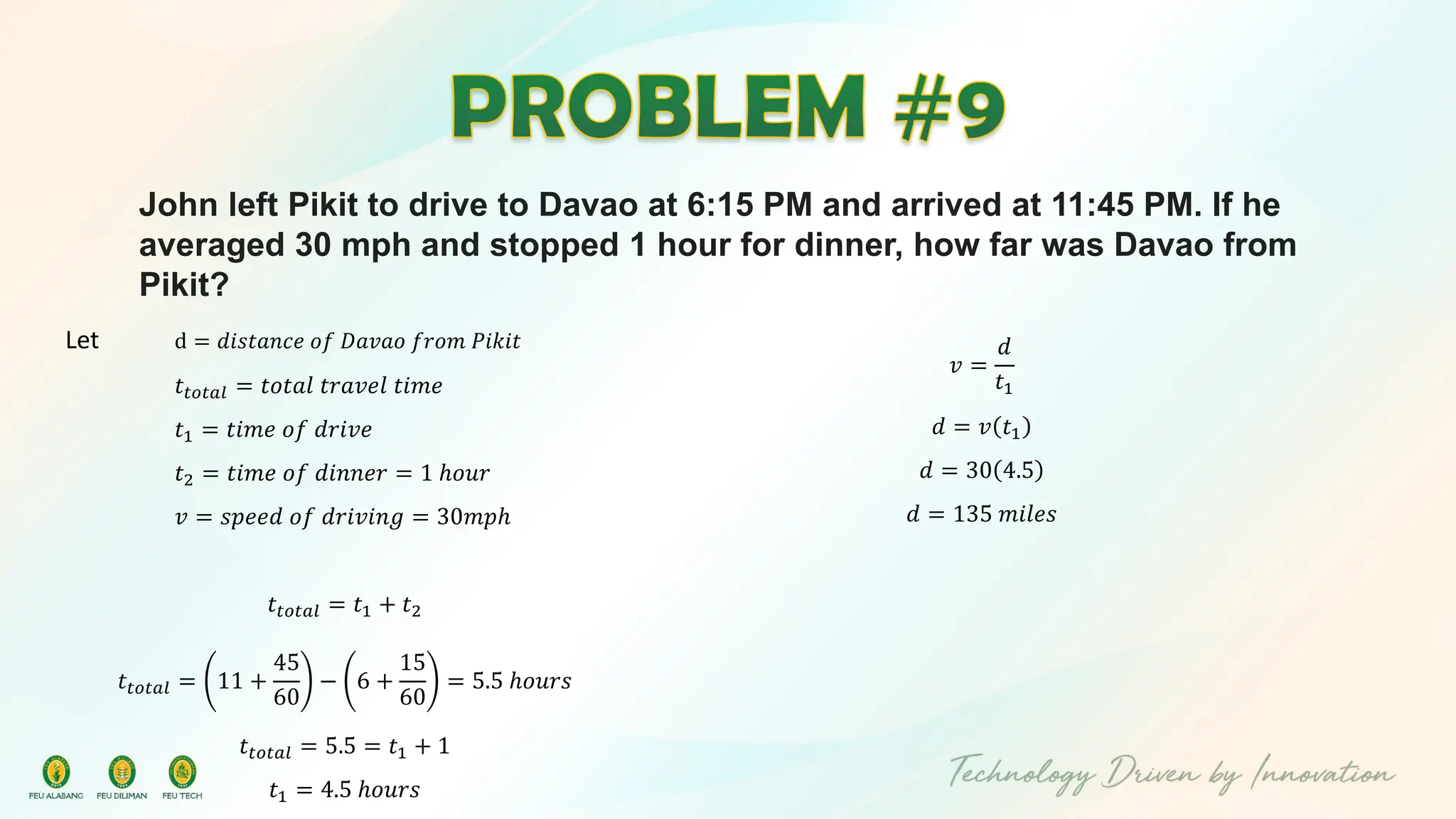
John left Pikit to drive to Davao at 6:15 PM and arrived at 11:45 PM. If he
averaged 30 mph and stopped 1 hour for dinner, how far was Davao from
Pikit?
Let d = 𝑑𝑖𝑠𝑡𝑎𝑛𝑐𝑒 𝑜𝑓 𝐷𝑎𝑣𝑎𝑜 𝑓𝑟𝑜𝑚 𝑃𝑖𝑘𝑖𝑡
𝑡𝑡𝑜𝑡𝑎𝑙 = 𝑡𝑜𝑡𝑎𝑙 𝑡𝑟𝑎𝑣𝑒𝑙 𝑡𝑖𝑚𝑒
𝑡1 = 𝑡𝑖𝑚𝑒 𝑜𝑓 𝑑𝑟𝑖𝑣𝑒
𝑡2 = 𝑡𝑖𝑚𝑒 𝑜𝑓 𝑑𝑖𝑛𝑛𝑒𝑟 = 1 ℎ𝑜𝑢𝑟
𝑣 = 𝑠𝑝𝑒𝑒𝑑 𝑜𝑓 𝑑𝑟𝑖𝑣𝑖𝑛𝑔 = 30𝑚𝑝ℎ
𝑡𝑡𝑜𝑡𝑎𝑙 = 𝑡1 + 𝑡2
𝑡𝑡𝑜𝑡𝑎𝑙 = 11 +
45
60
− 6 +
15
60
= 5.5 ℎ𝑜𝑢𝑟𝑠
𝑡𝑡𝑜𝑡𝑎𝑙 = 5.5 = 𝑡1 + 1
𝑡1 = 4.5 ℎ𝑜𝑢𝑟𝑠
𝑣 =
𝑑
𝑡1
𝑑 = 𝑣 𝑡1
𝑑 = 30 4.5
𝑑 = 135 𝑚𝑖𝑙𝑒𝑠
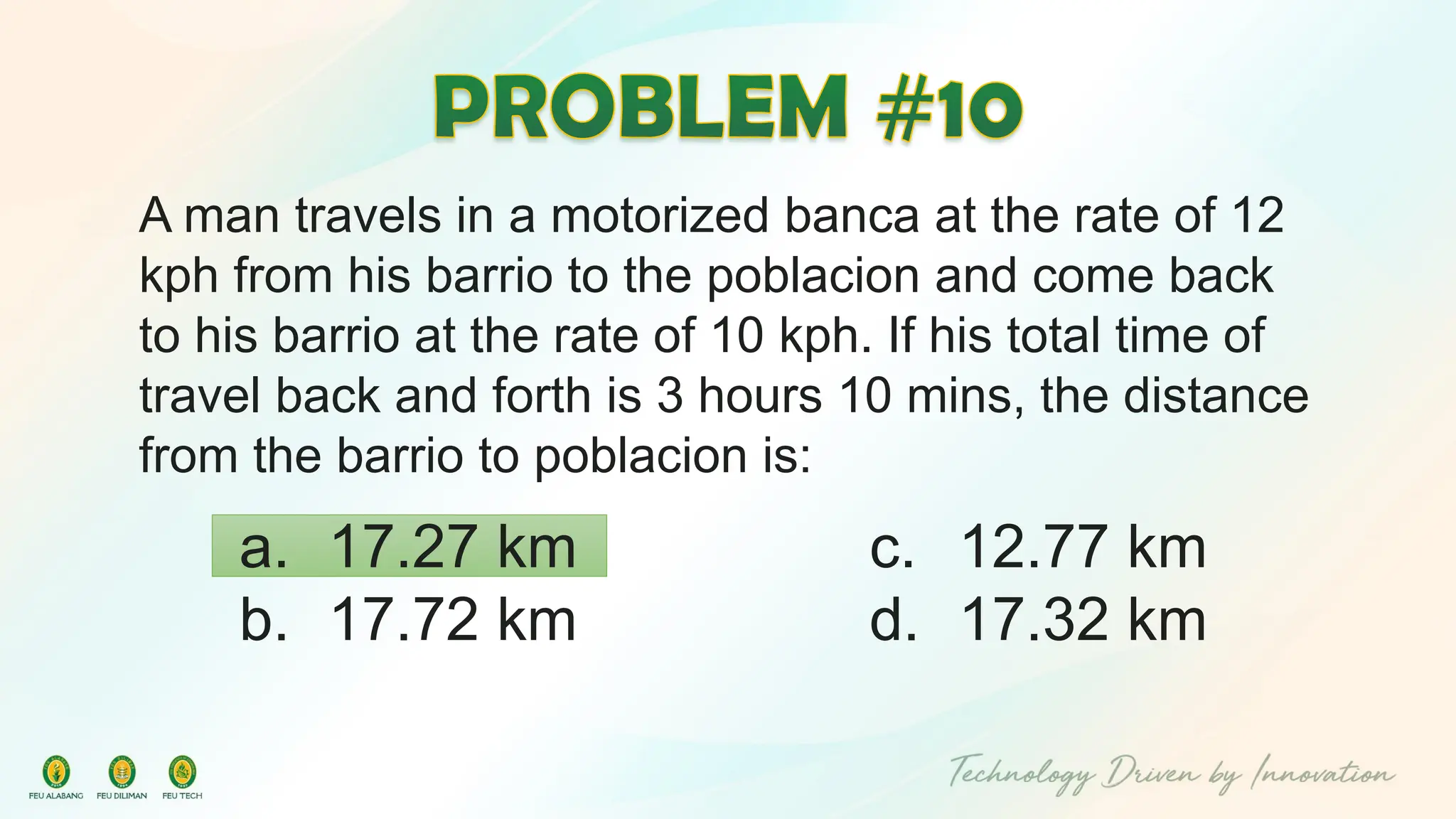
A man travels in a motorized banca at the rate of 12
kph from his barrio to the poblacion and come back
to his barrio at the rate of 10 kph. If his total time of
travel back and forth is 3 hours 10 mins, the distance
from the barrio to poblacion is:
c. 12.77 km
d. 17.32 km
a. 17.27 km
b. 17.72 km
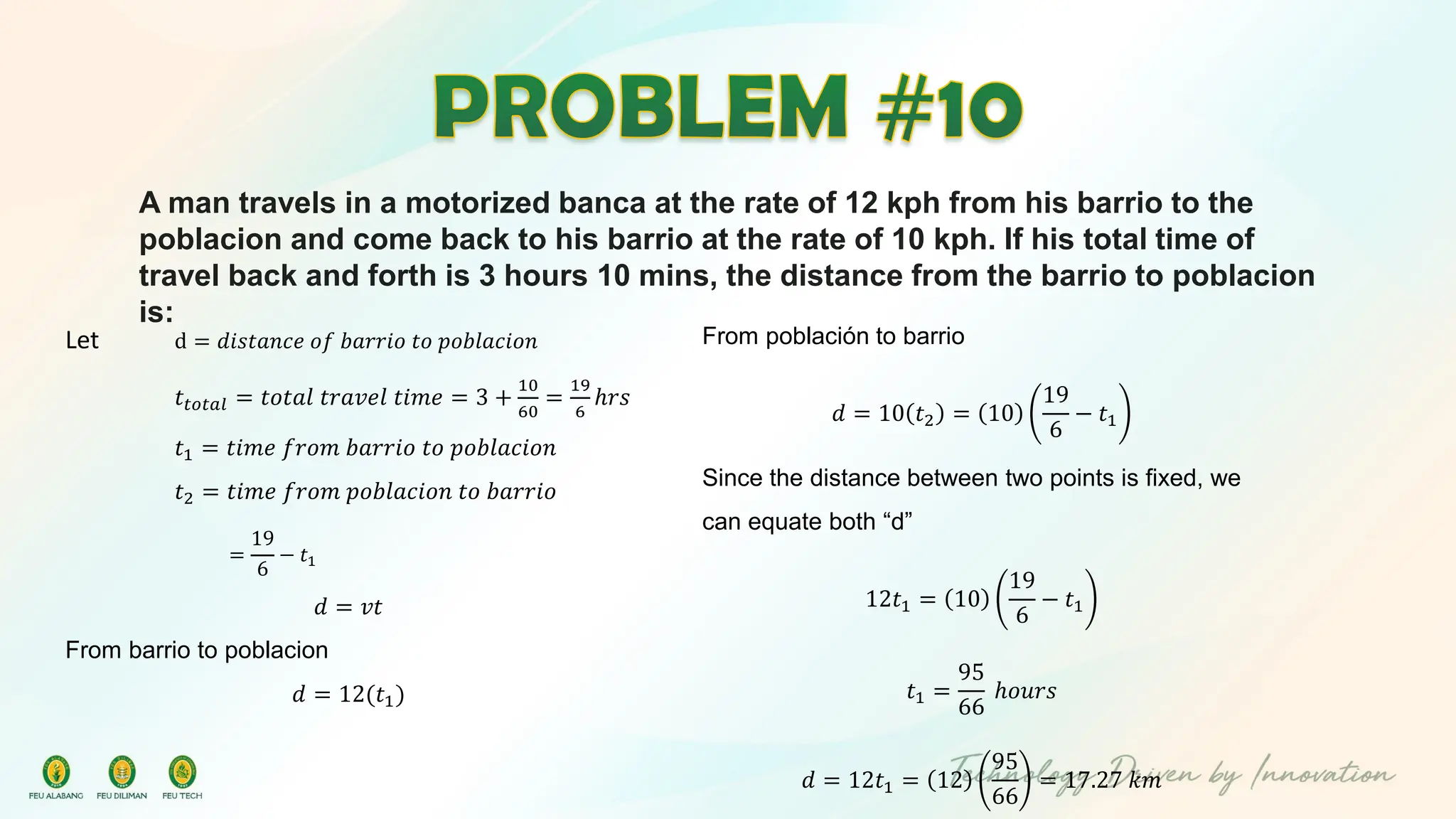
A man travels in a motorized banca at the rate of 12 kph from his barrio to the
poblacion and come back to his barrio at the rate of 10 kph. If his total time of
travel back and forth is 3 hours 10 mins, the distance from the barrio to poblacion
is:
Let d = 𝑑𝑖𝑠𝑡𝑎𝑛𝑐𝑒 𝑜𝑓 𝑏𝑎𝑟𝑟𝑖𝑜 𝑡𝑜 𝑝𝑜𝑏𝑙𝑎𝑐𝑖𝑜𝑛
𝑡𝑡𝑜𝑡𝑎𝑙 = 𝑡𝑜𝑡𝑎𝑙 𝑡𝑟𝑎𝑣𝑒𝑙 𝑡𝑖𝑚𝑒 = 3 +
10
60
=
19
6
ℎ𝑟𝑠
𝑡1 = 𝑡𝑖𝑚𝑒 𝑓𝑟𝑜𝑚 𝑏𝑎𝑟𝑟𝑖𝑜 𝑡𝑜 𝑝𝑜𝑏𝑙𝑎𝑐𝑖𝑜𝑛
𝑡2 = 𝑡𝑖𝑚𝑒 𝑓𝑟𝑜𝑚 𝑝𝑜𝑏𝑙𝑎𝑐𝑖𝑜𝑛 𝑡𝑜 𝑏𝑎𝑟𝑟𝑖𝑜
=
19
6
− 𝑡1
𝑑 = 𝑣𝑡
From barrio to poblacion
𝑑 = 12(𝑡1)
From población to barrio
𝑑 = 10 𝑡2 = 10
19
6
− 𝑡1
Since the distance between two points is fixed, we
can equate both “d”
12𝑡1 = 10
19
6
− 𝑡1
𝑡1 =
95
66
ℎ𝑜𝑢𝑟𝑠
𝑑 = 12𝑡1 = 12
95
66
= 17.27 𝑘𝑚
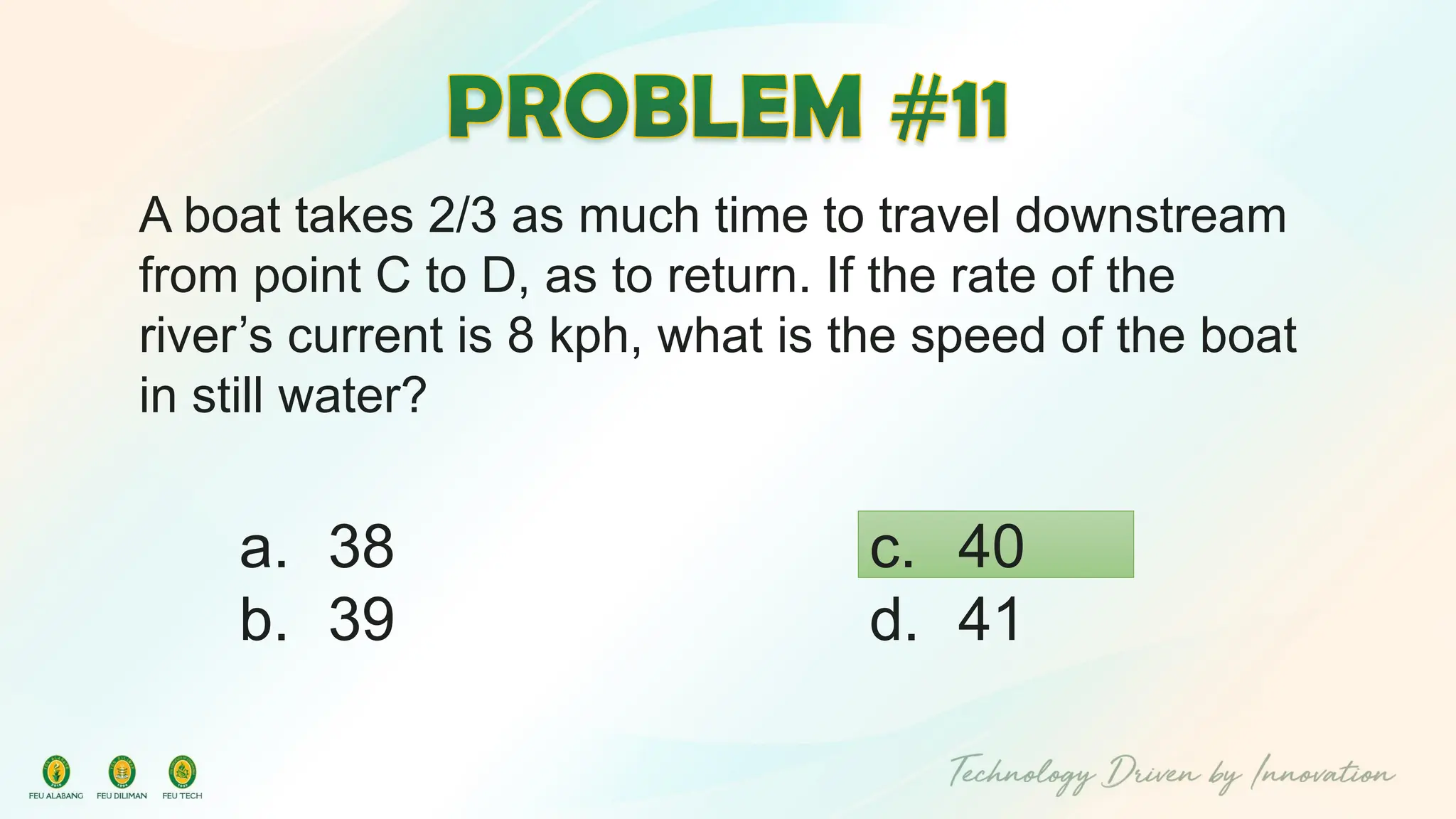
A boat takes 2/3 as much time to travel downstream
from point C to D, as to return. If the rate of the
river’s current is 8 kph, what is the speed of the boat
in still water?
c. 40
d. 41
a. 38
b. 39
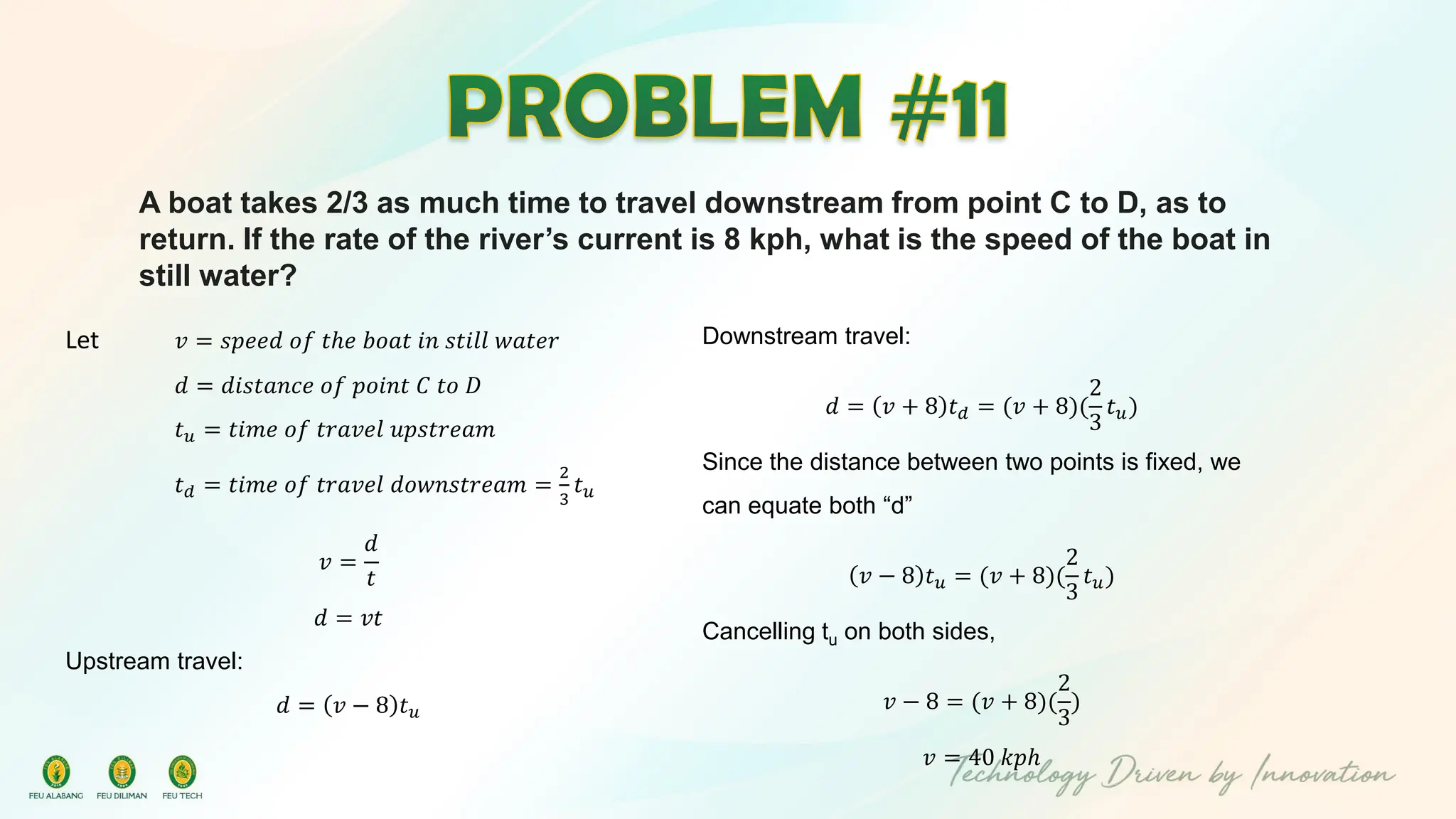
A boat takes 2/3 as much time to travel downstream from point C to D, as to
return. If the rate of the river’s current is 8 kph, what is the speed of the boat in
still water?
Let 𝑣 = 𝑠𝑝𝑒𝑒𝑑 𝑜𝑓 𝑡ℎ𝑒 𝑏𝑜𝑎𝑡 𝑖𝑛 𝑠𝑡𝑖𝑙𝑙 𝑤𝑎𝑡𝑒𝑟
𝑑 = 𝑑𝑖𝑠𝑡𝑎𝑛𝑐𝑒 𝑜𝑓 𝑝𝑜𝑖𝑛𝑡 𝐶 𝑡𝑜 𝐷
𝑡𝑢 = 𝑡𝑖𝑚𝑒 𝑜𝑓 𝑡𝑟𝑎𝑣𝑒𝑙 𝑢𝑝𝑠𝑡𝑟𝑒𝑎𝑚
𝑡𝑑 = 𝑡𝑖𝑚𝑒 𝑜𝑓 𝑡𝑟𝑎𝑣𝑒𝑙 𝑑𝑜𝑤𝑛𝑠𝑡𝑟𝑒𝑎𝑚 =
2
3
𝑡𝑢
𝑣 =
𝑑
𝑡
𝑑 = 𝑣𝑡
Upstream travel:
𝑑 = 𝑣 − 8 𝑡𝑢
Downstream travel:
𝑑 = 𝑣 + 8 𝑡𝑑 = (𝑣 + 8)(
2
3
𝑡𝑢)
Since the distance between two points is fixed, we
can equate both “d”
𝑣 − 8 𝑡𝑢 = (𝑣 + 8)(
2
3
𝑡𝑢)
Cancelling tu on both sides,
𝑣 − 8 = (𝑣 + 8)(
2
3
)
𝑣 = 40 𝑘𝑝ℎ
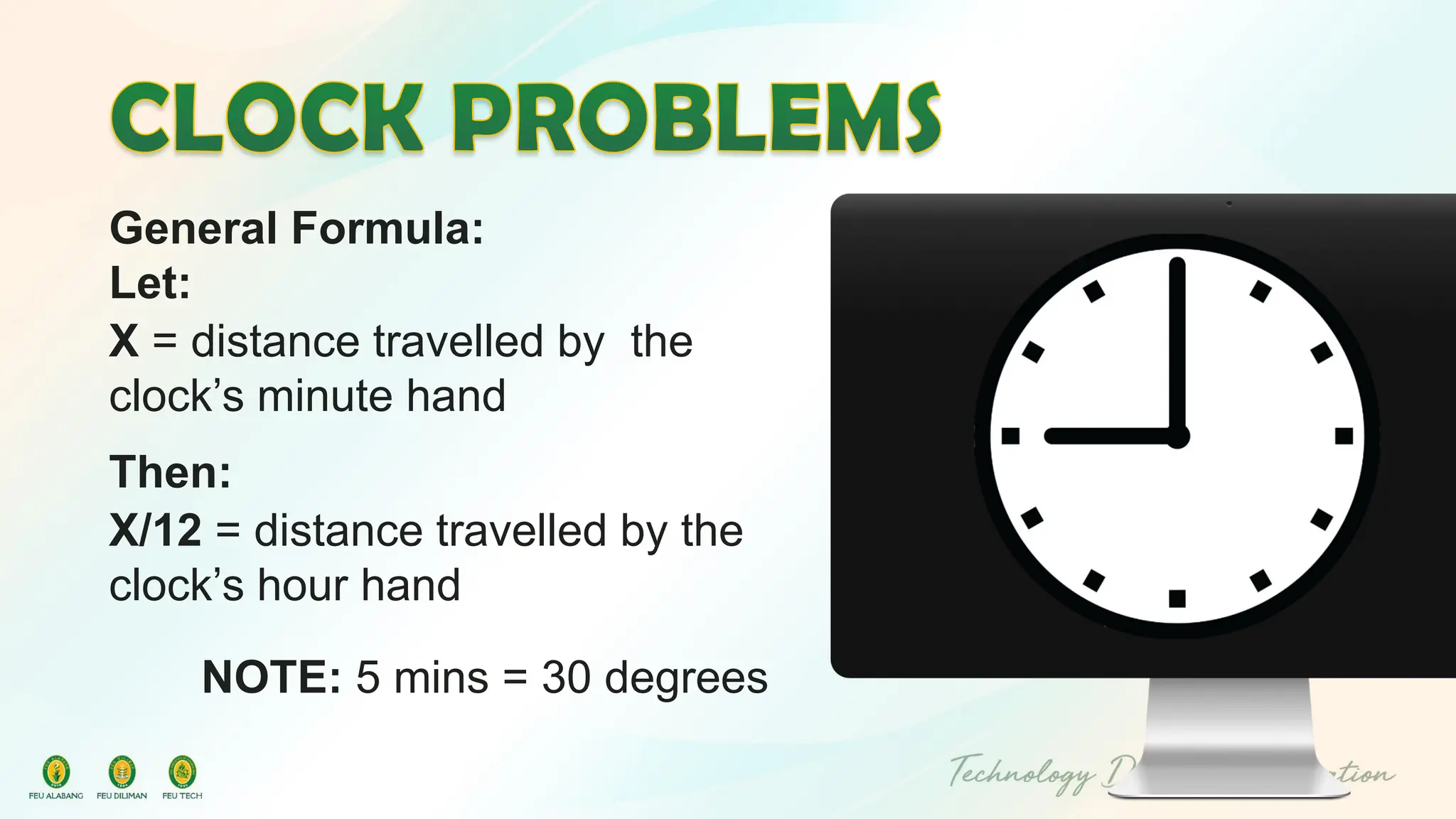
General Formula:
Let:
X = distance travelled by the
clock’s minute hand
Then:
X/12 = distance travelled by the
clock’s hour hand
NOTE: 5 mins = 30 degrees
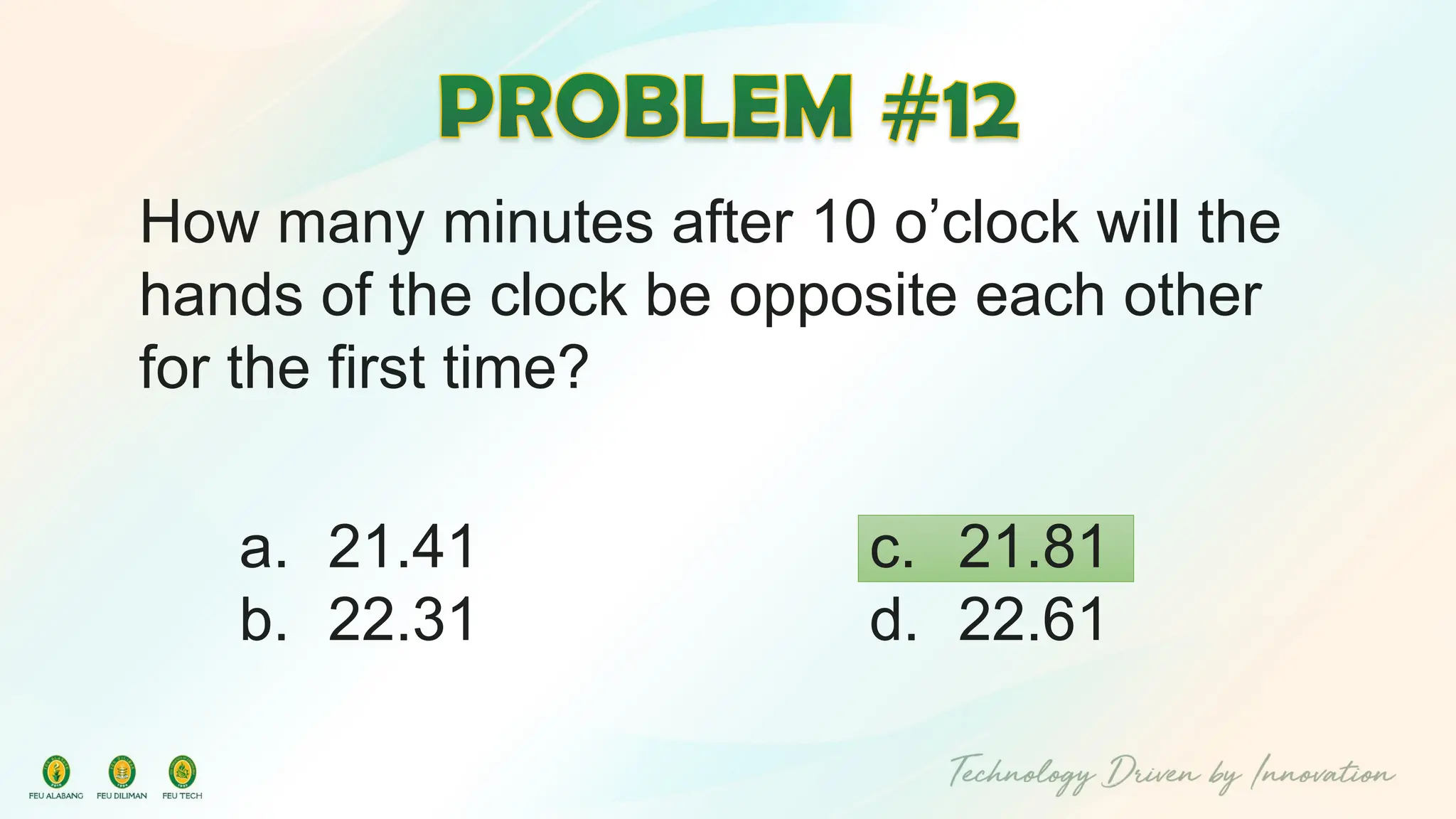
How many minutes after 10 o’clock will the
hands of the clock be opposite each other
for the first time?
c. 21.81
d. 22.61
a. 21.41
b. 22.31
How many minutes after 10 o’clock will the hands of the clock be
opposite each other for the first time?
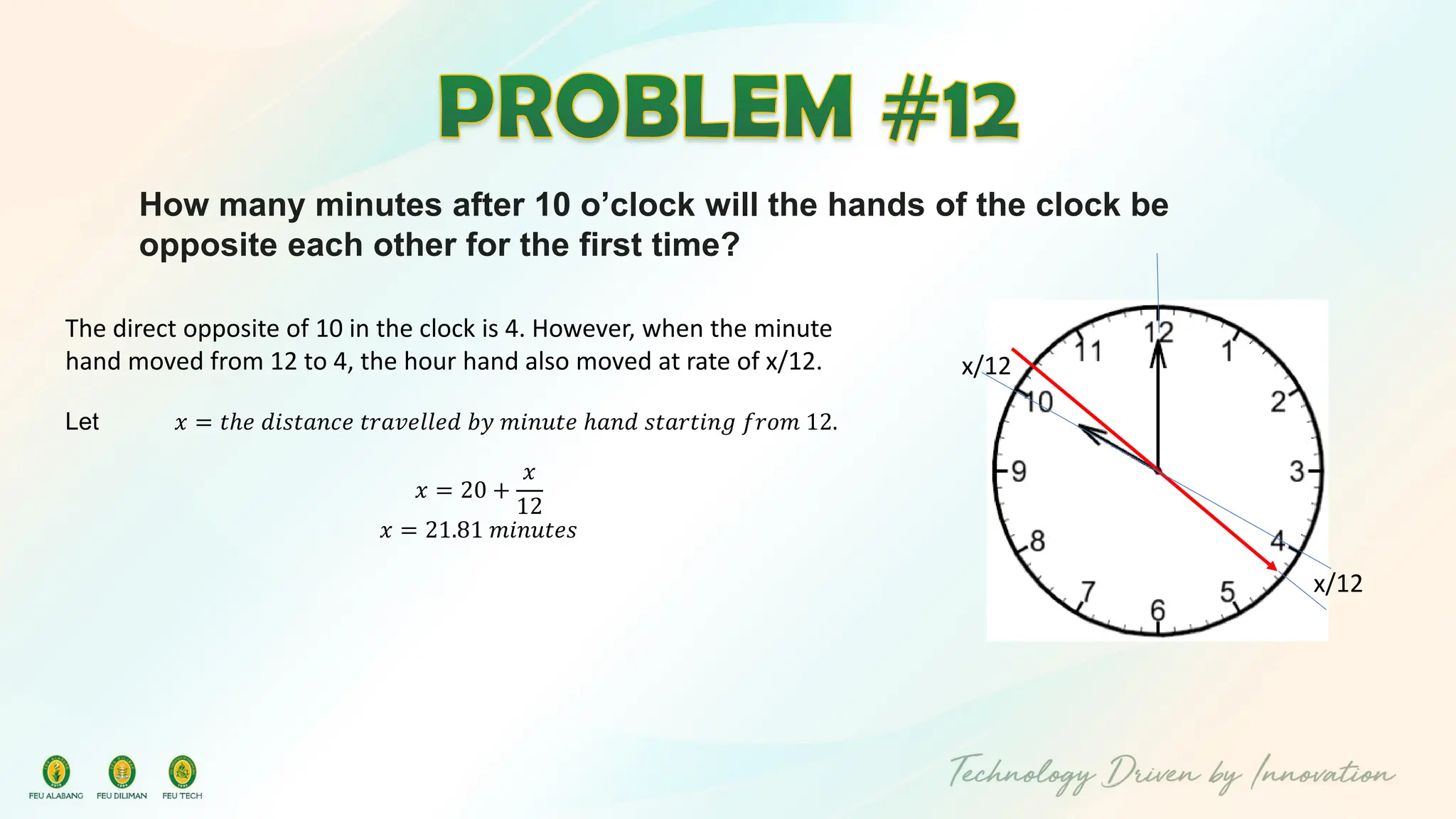
x/12
x/12
The direct opposite of 10 in the clock is 4. However, when the minute
hand moved from 12 to 4, the hour hand also moved at rate of x/12.
Let 𝑥 = 𝑡ℎ𝑒 𝑑𝑖𝑠𝑡𝑎𝑛𝑐𝑒 𝑡𝑟𝑎𝑣𝑒𝑙𝑙𝑒𝑑 𝑏𝑦 𝑚𝑖𝑛𝑢𝑡𝑒 ℎ𝑎𝑛𝑑 𝑠𝑡𝑎𝑟𝑡𝑖𝑛𝑔 𝑓𝑟𝑜𝑚 12.
𝑥 = 20 +
𝑥
12
𝑥 = 21.81 𝑚𝑖𝑛𝑢𝑡𝑒𝑠
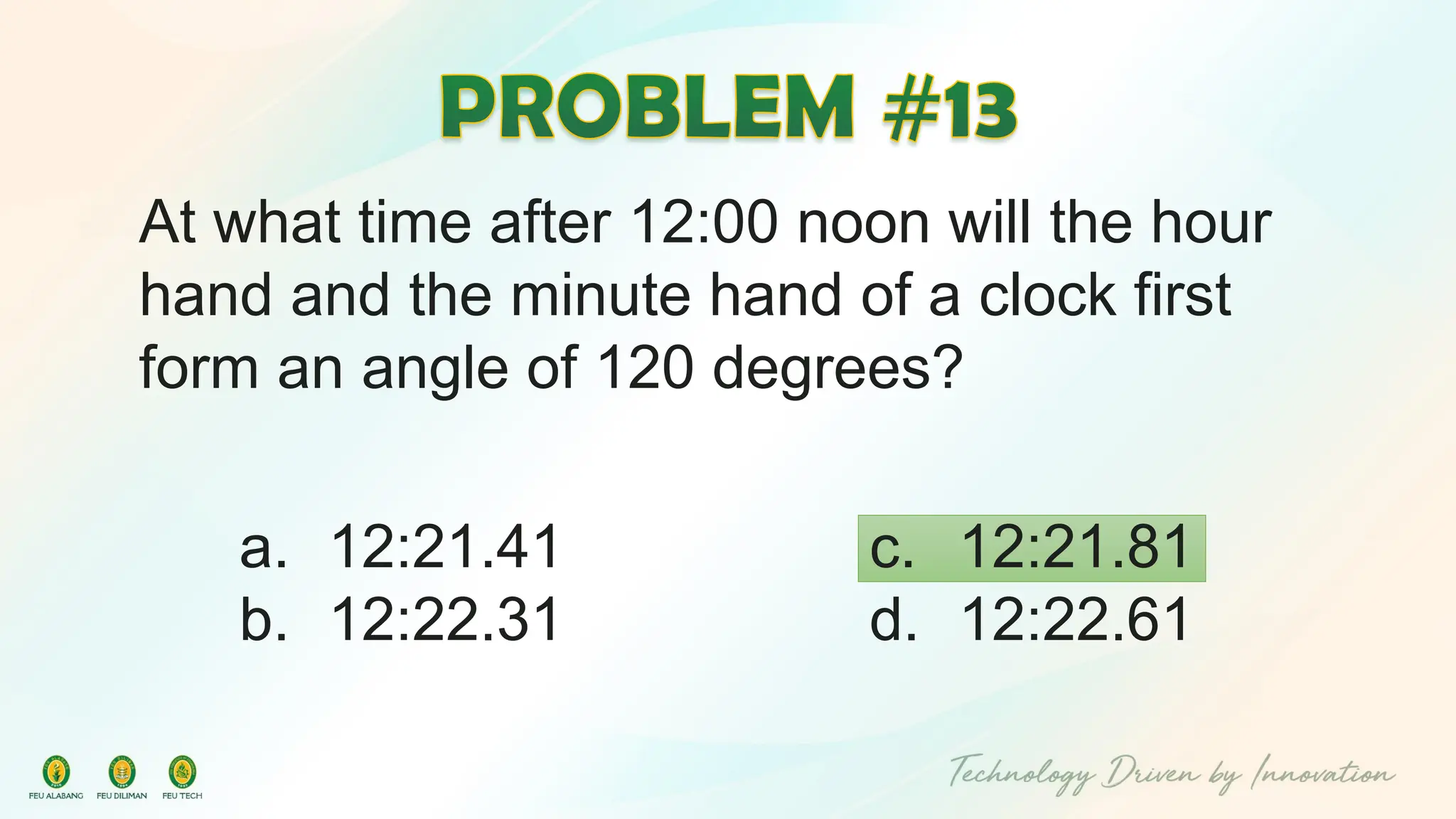
At what time after 12:00 noon will the hour
hand and the minute hand of a clock first
form an angle of 120 degrees?
c. 12:21.81
d. 12:22.61
a. 12:21.41
b. 12:22.31
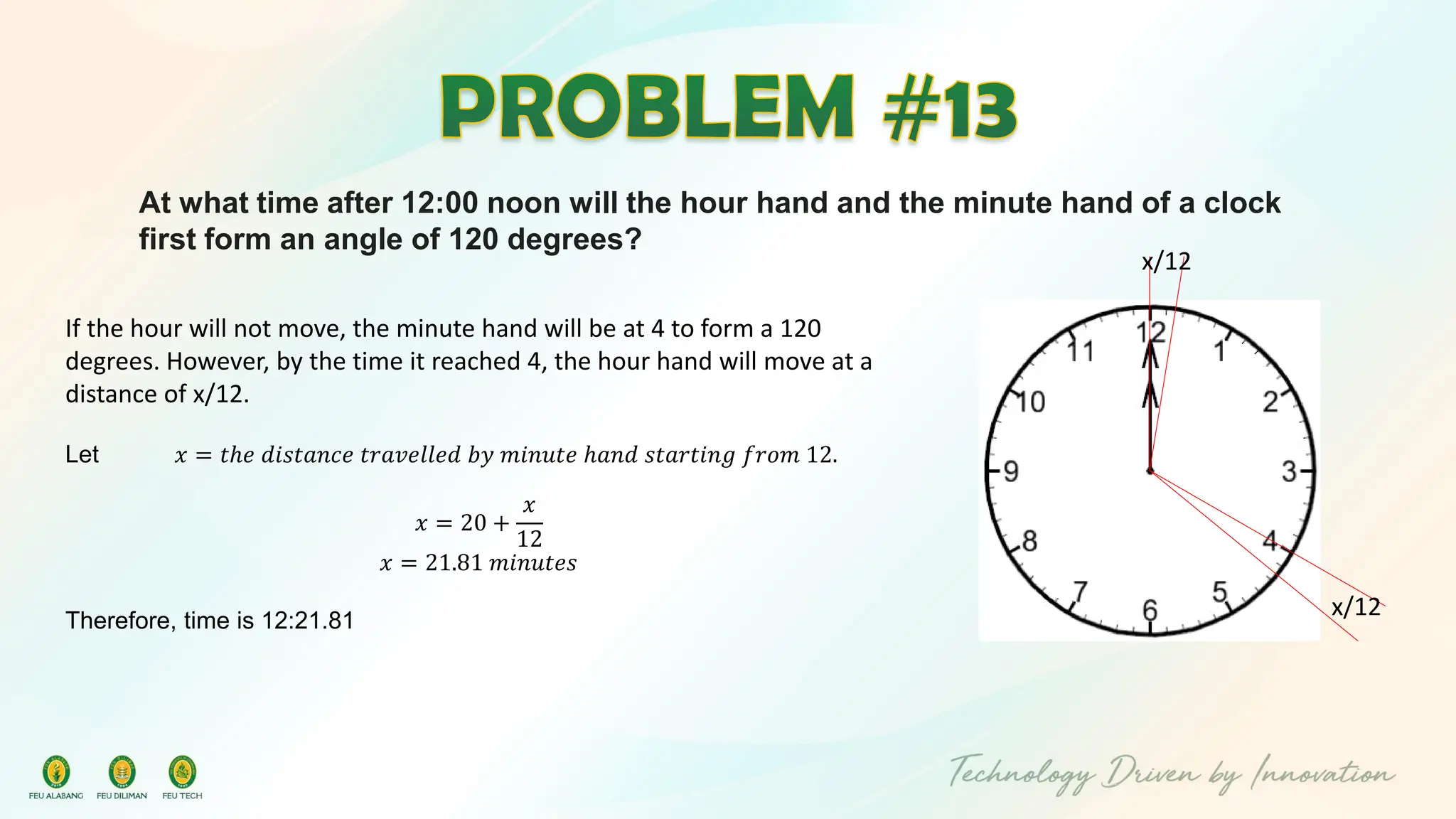
At what time after 12:00 noon will the hour hand and the minute hand of a clock
first form an angle of 120 degrees?
x/12
x/12
If the hour will not move, the minute hand will be at 4 to form a 120
degrees. However, by the time it reached 4, the hour hand will move at a
distance of x/12.
Let 𝑥 = 𝑡ℎ𝑒 𝑑𝑖𝑠𝑡𝑎𝑛𝑐𝑒 𝑡𝑟𝑎𝑣𝑒𝑙𝑙𝑒𝑑 𝑏𝑦 𝑚𝑖𝑛𝑢𝑡𝑒 ℎ𝑎𝑛𝑑 𝑠𝑡𝑎𝑟𝑡𝑖𝑛𝑔 𝑓𝑟𝑜𝑚 12.
𝑥 = 20 +
𝑥
12
𝑥 = 21.81 𝑚𝑖𝑛𝑢𝑡𝑒𝑠
Therefore, time is 12:21.81
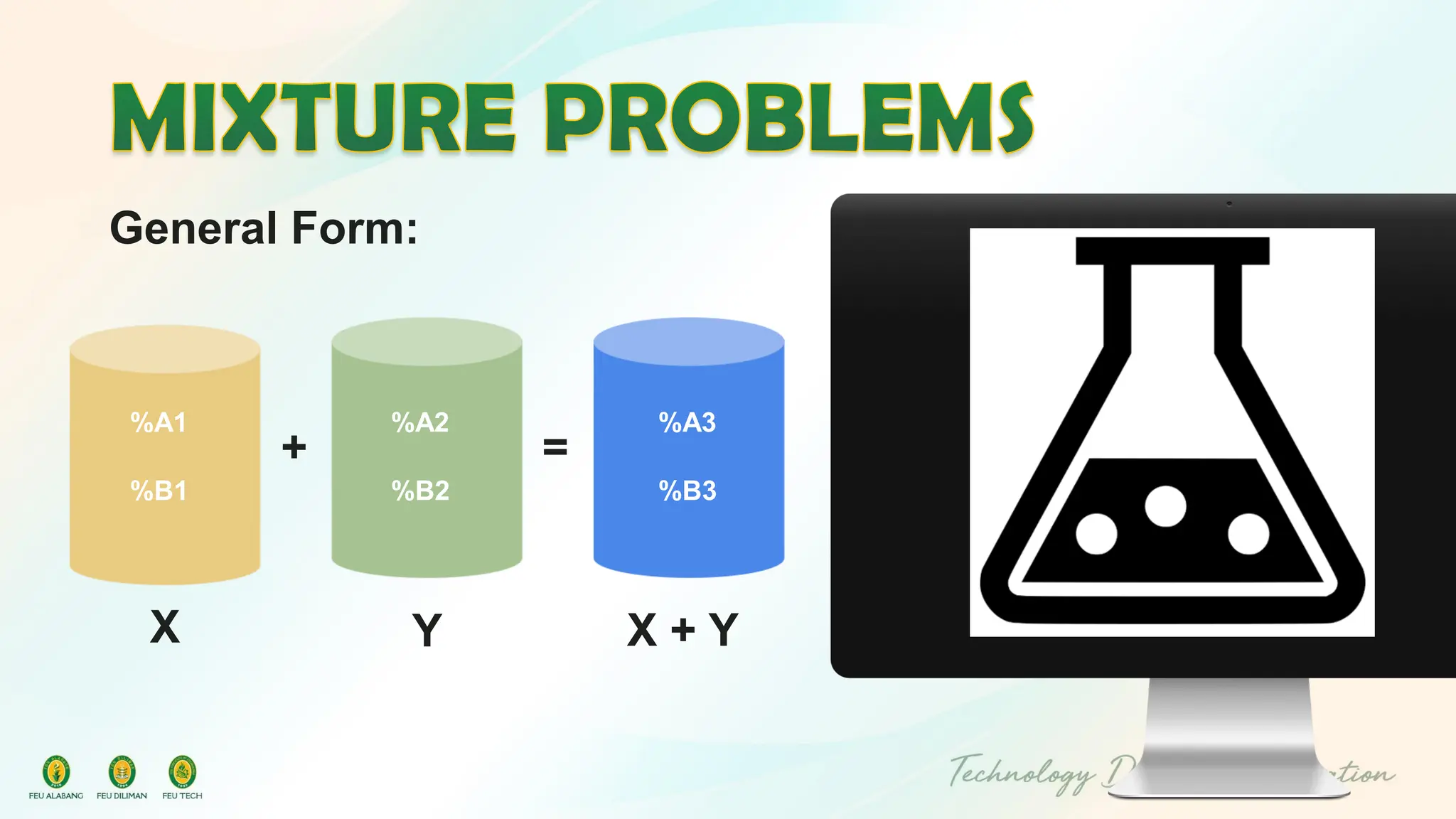
General Form:
+ =
X X + Y
Y
%A1
%B1
%A2
%B2
%A3
%B3
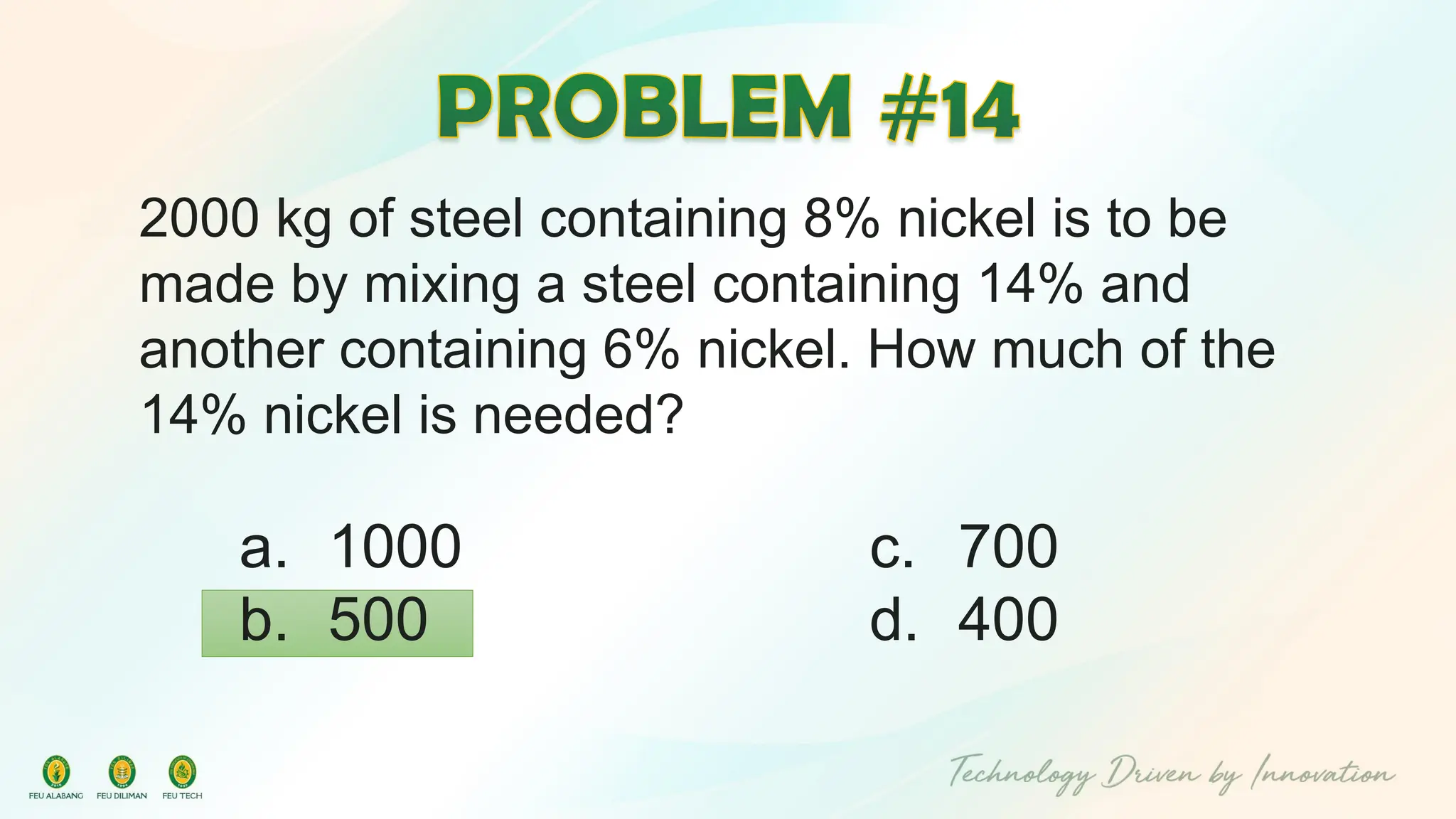
2000 kg of steel containing 8% nickel is to be
made by mixing a steel containing 14% and
another containing 6% nickel. How much of the
14% nickel is needed?
c. 700
d. 400
a. 1000
b. 500
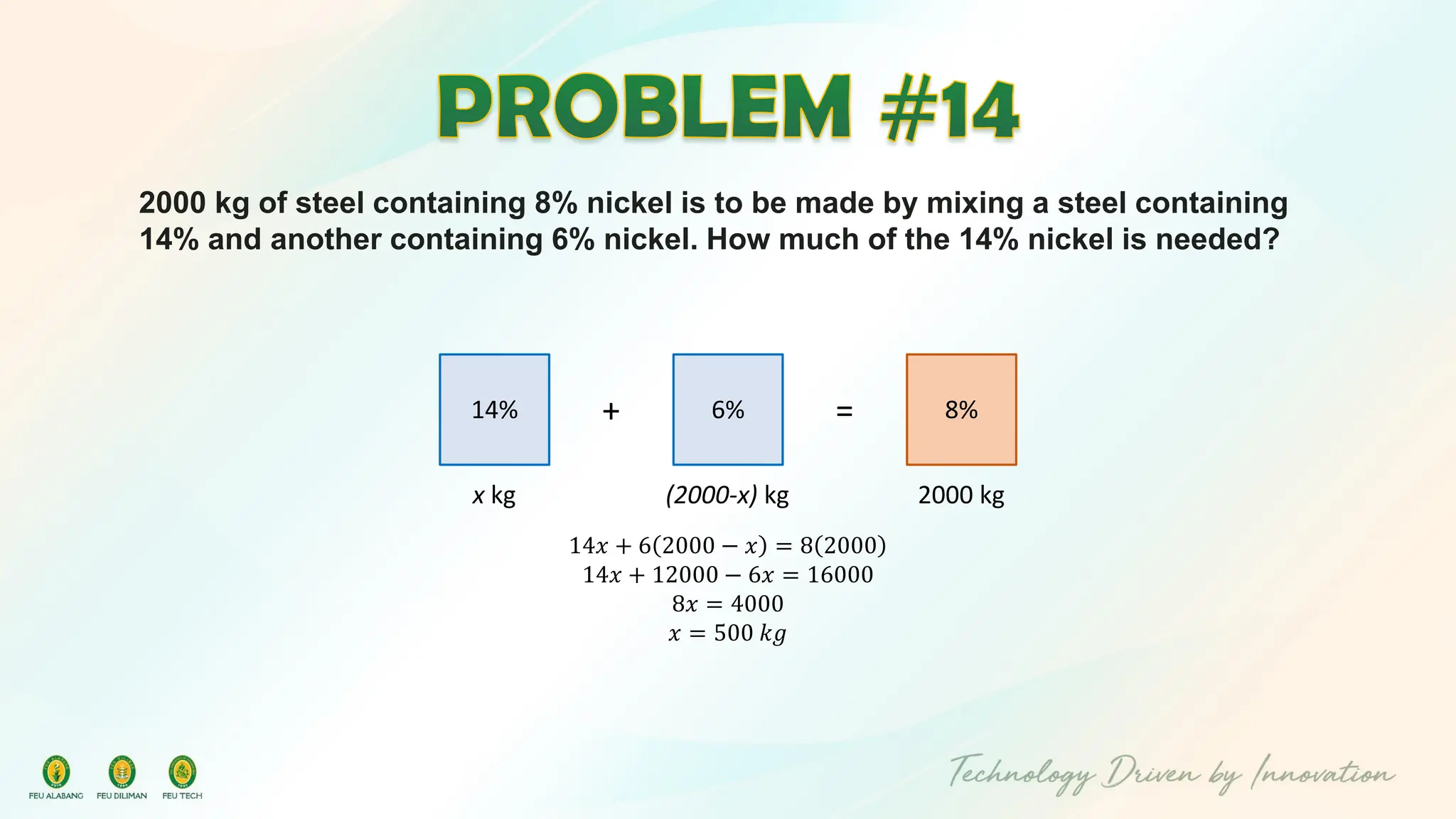
2000 kg of steel containing 8% nickel is to be made by mixing a steel containing
14% and another containing 6% nickel. How much of the 14% nickel is needed?
8%
6%
14% + =
2000 kg
x kg (2000-x) kg
14𝑥 + 6 2000 − 𝑥 = 8 2000
14𝑥 + 12000 − 6𝑥 = 16000
8𝑥 = 4000
𝑥 = 500 𝑘𝑔
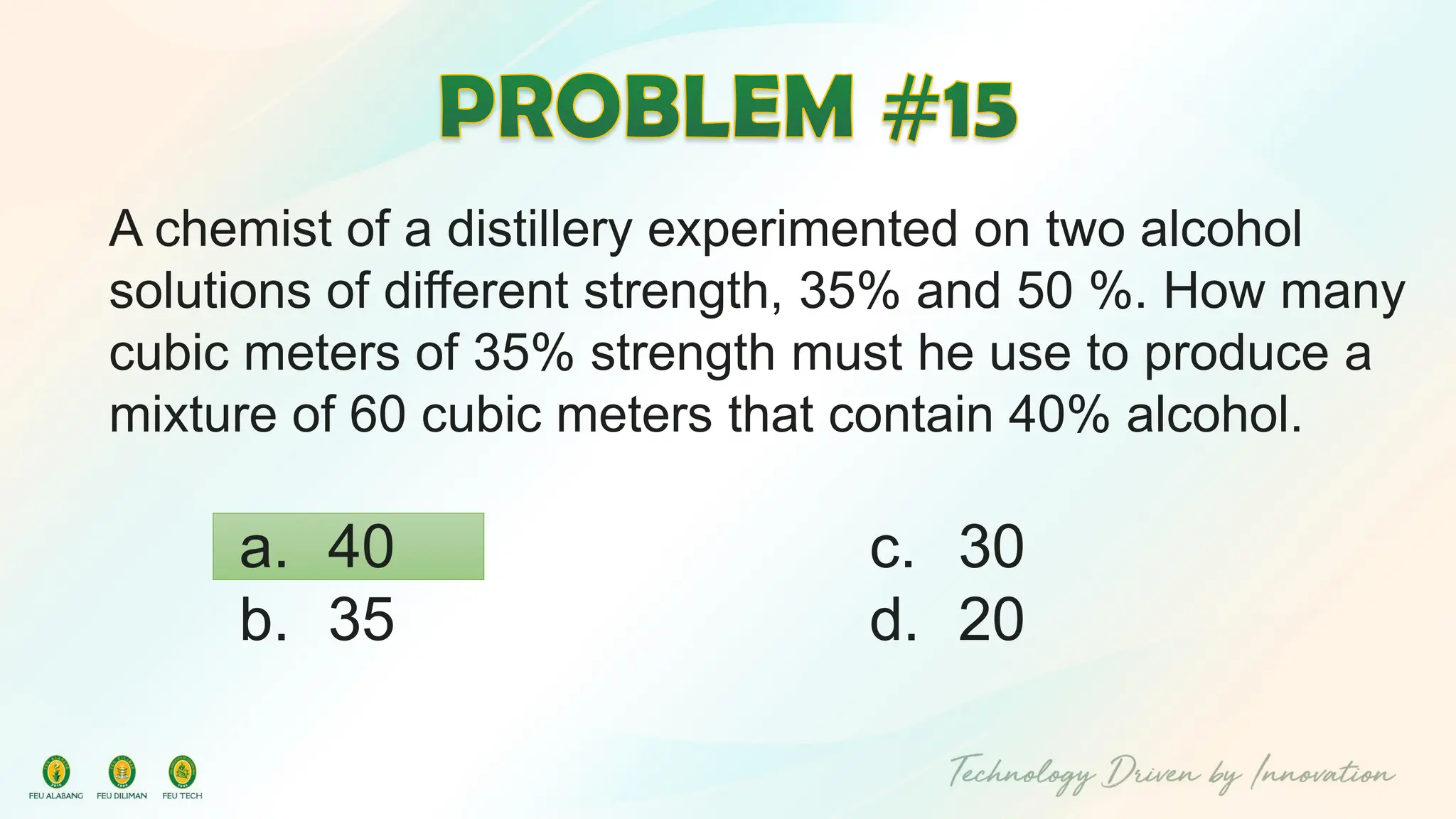
A chemist of a distillery experimented on two alcohol
solutions of different strength, 35% and 50 %. How many
cubic meters of 35% strength must he use to produce a
mixture of 60 cubic meters that contain 40% alcohol.
c. 30
d. 20
a. 40
b. 35
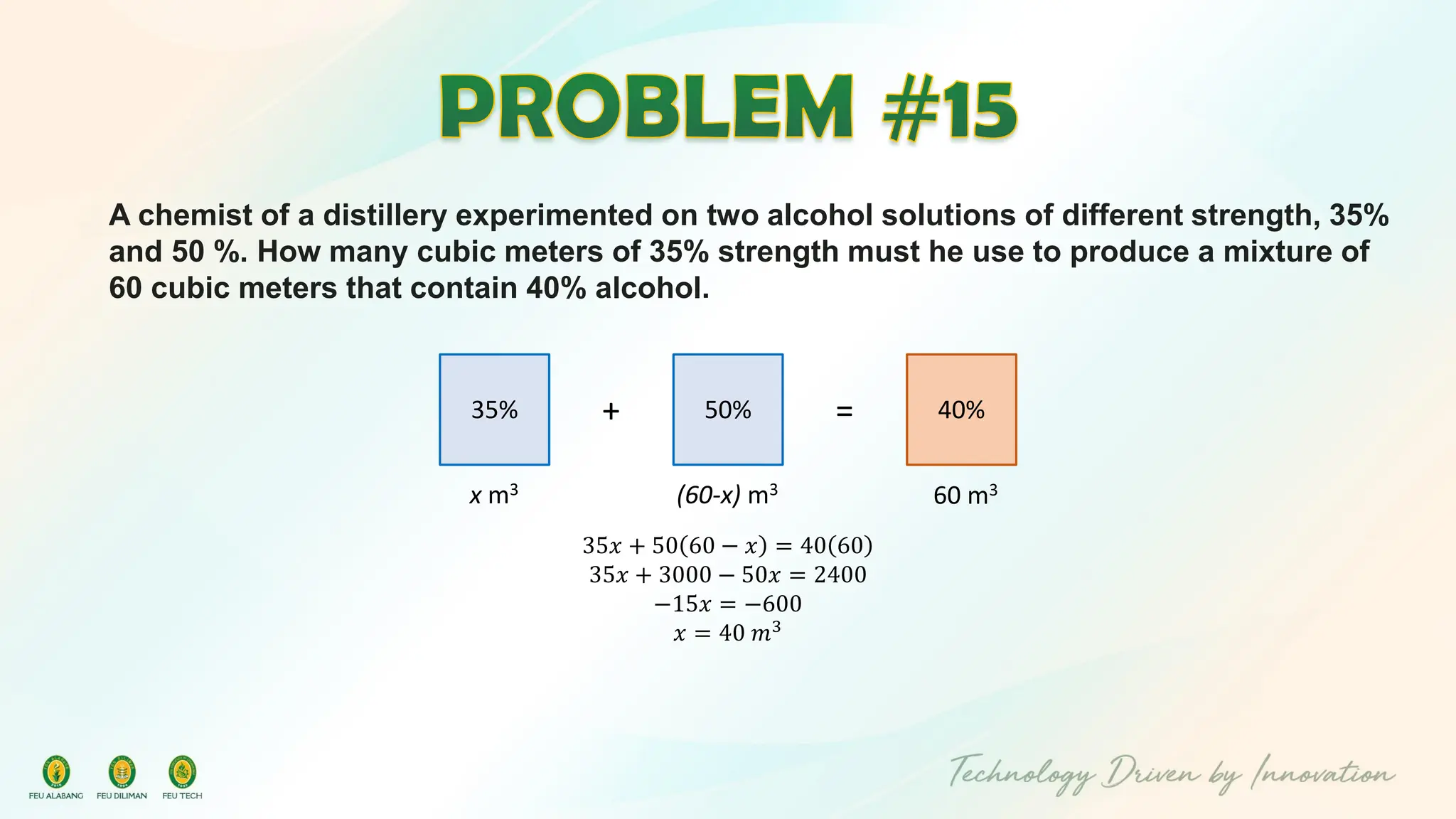
A chemist of a distillery experimented on two alcohol solutions of different strength, 35%
and 50 %. How many cubic meters of 35% strength must he use to produce a mixture of
60 cubic meters that contain 40% alcohol.
40%
50%
35% + =
60 m3
x m3 (60-x) m3
35𝑥 + 50 60 − 𝑥 = 40 60
35𝑥 + 3000 − 50𝑥 = 2400
−15𝑥 = −600
𝑥 = 40 𝑚3
Penny $0.01 Nickel $0.05 Dime $0.10
Quarter $0.25 Half Dollar $0.50
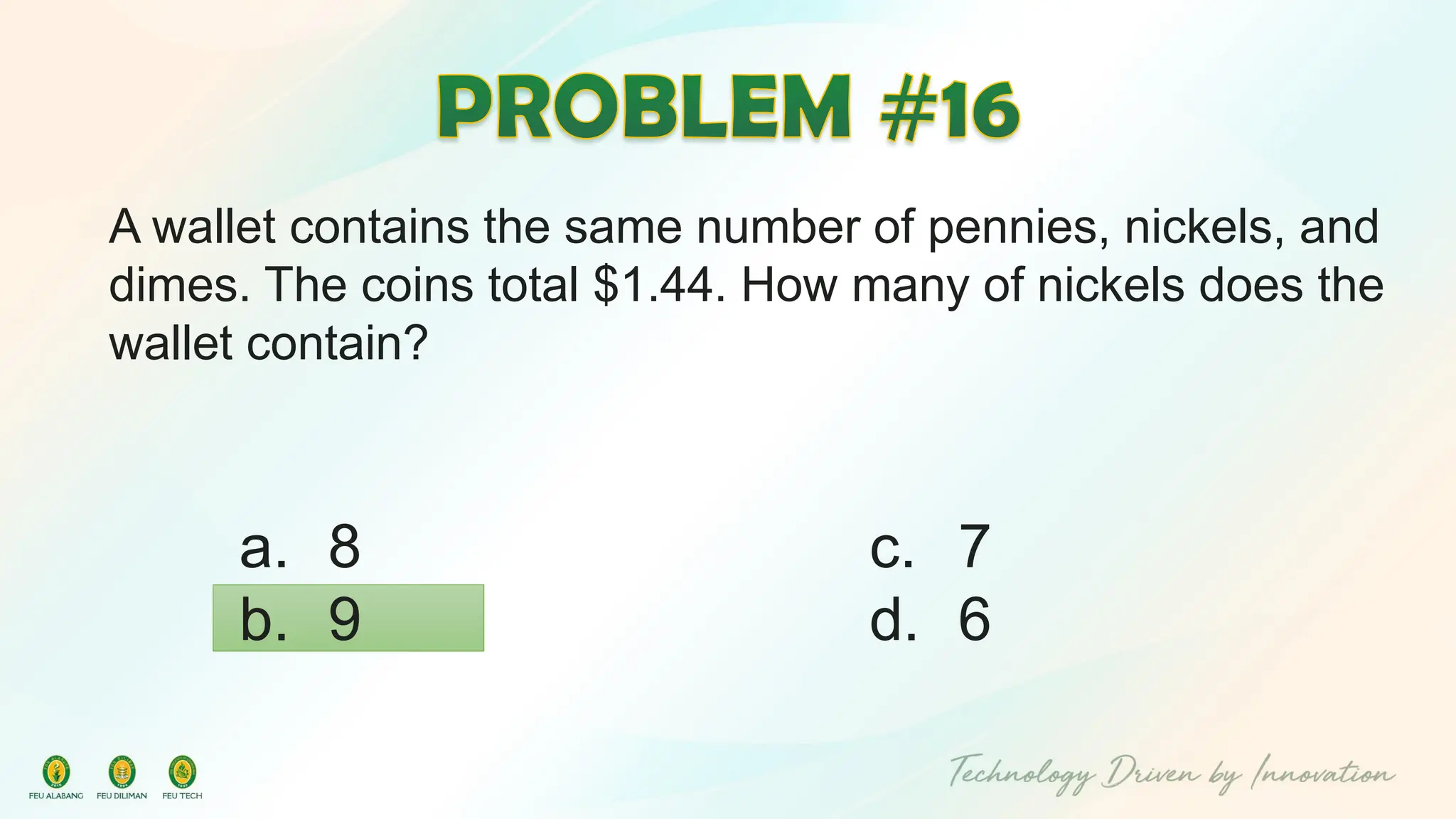
A wallet contains the same number of pennies, nickels, and
dimes. The coins total $1.44. How many of nickels does the
wallet contain?
c. 7
d. 6
a. 8
b. 9
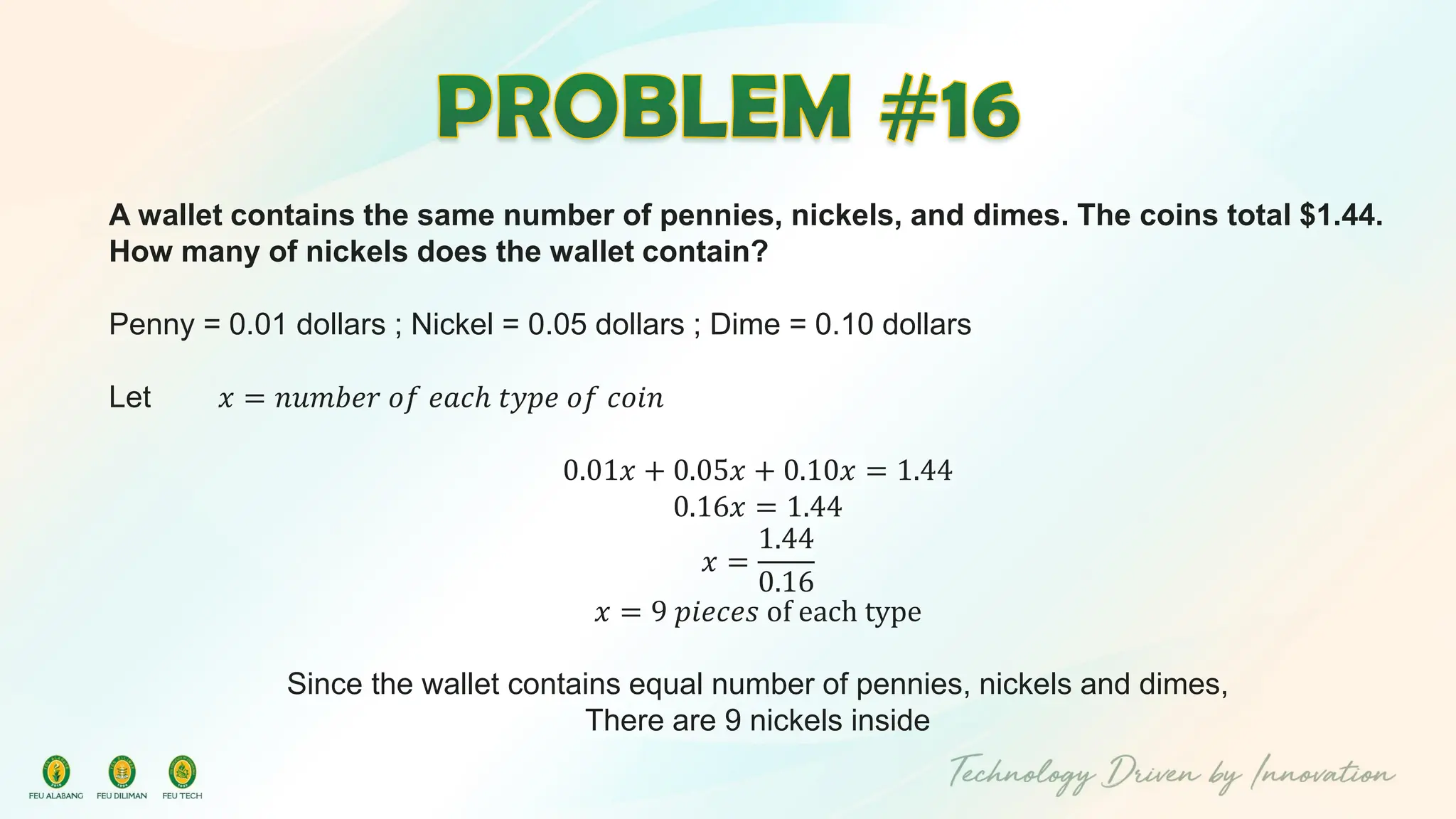
A wallet contains the same number of pennies, nickels, and dimes. The coins total $1.44.
How many of nickels does the wallet contain?
Penny = 0.01 dollars ; Nickel = 0.05 dollars ; Dime = 0.10 dollars
Let 𝑥 = 𝑛𝑢𝑚𝑏𝑒𝑟 𝑜𝑓 𝑒𝑎𝑐ℎ 𝑡𝑦𝑝𝑒 𝑜𝑓 𝑐𝑜𝑖𝑛
0.01𝑥 + 0.05𝑥 + 0.10𝑥 = 1.44
0.16𝑥 = 1.44
𝑥 =
1.44
0.16
𝑥 = 9 𝑝𝑖𝑒𝑐𝑒𝑠 of each type
Since the wallet contains equal number of pennies, nickels and dimes,
There are 9 nickels inside
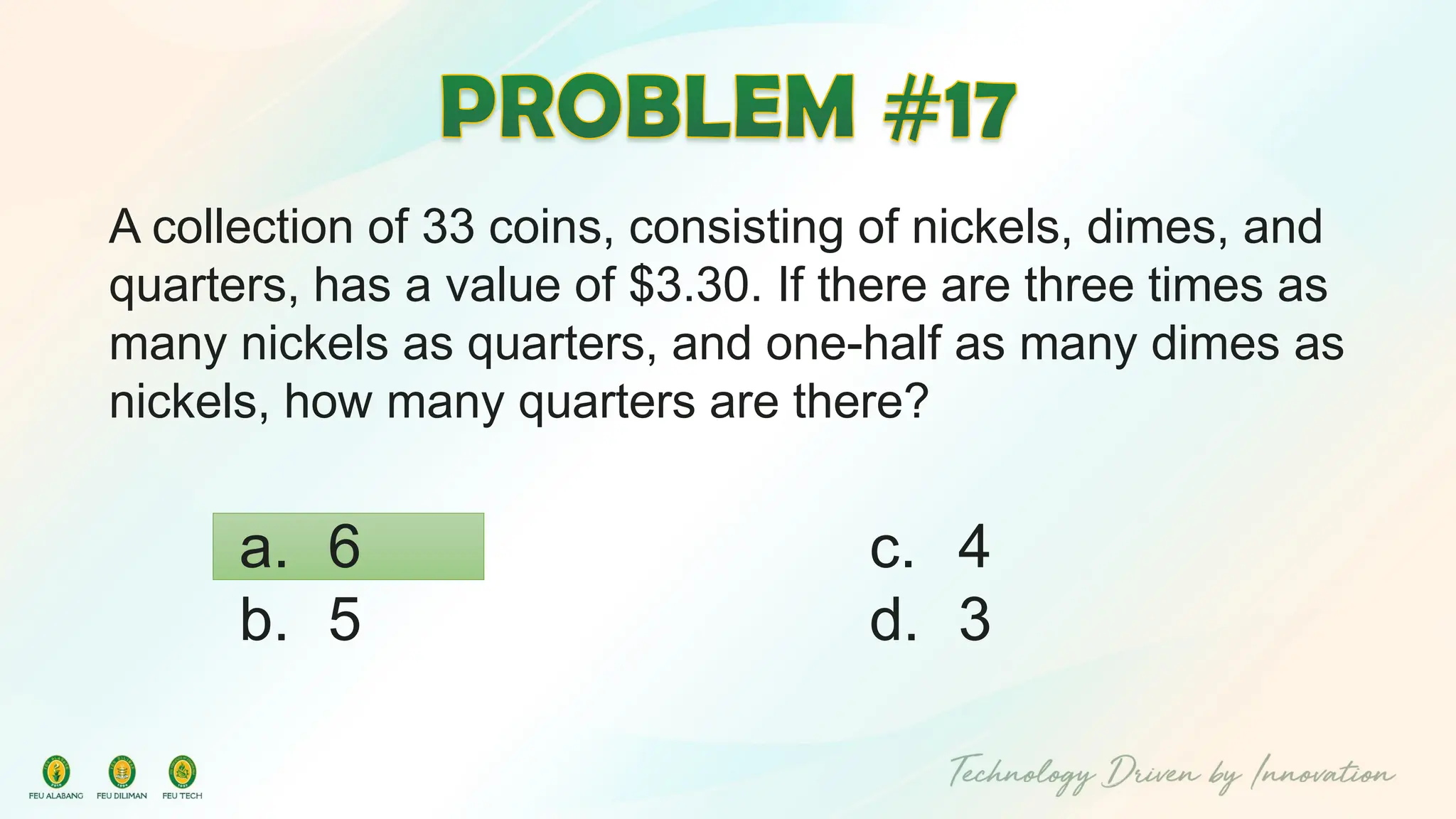
A collection of 33 coins, consisting of nickels, dimes, and
quarters, has a value of $3.30. If there are three times as
many nickels as quarters, and one-half as many dimes as
nickels, how many quarters are there?
c. 4
d. 3
a. 6
b. 5
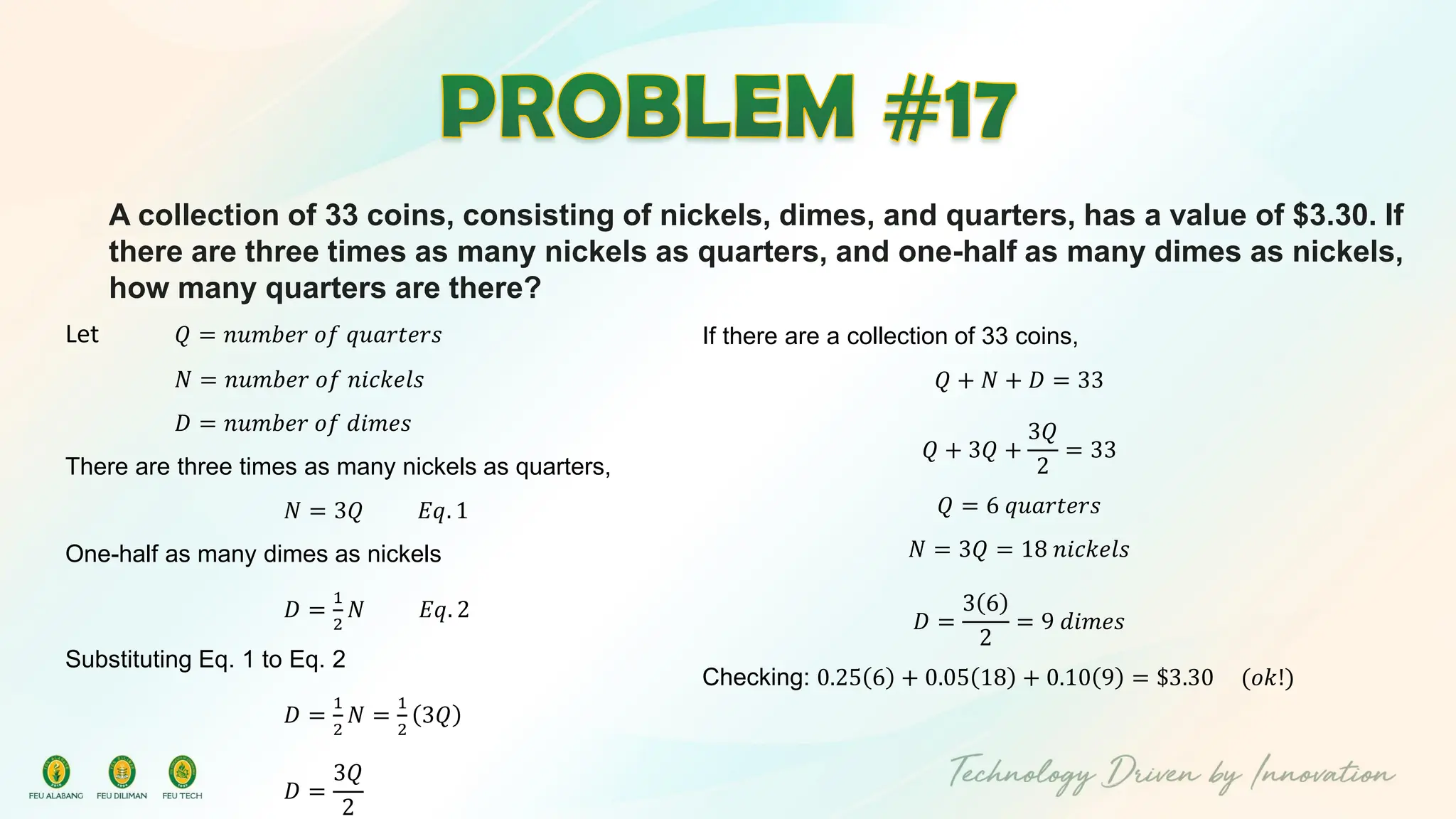
A collection of 33 coins, consisting of nickels, dimes, and quarters, has a value of $3.30. If
there are three times as many nickels as quarters, and one-half as many dimes as nickels,
how many quarters are there?
Let 𝑄 = 𝑛𝑢𝑚𝑏𝑒𝑟 𝑜𝑓 𝑞𝑢𝑎𝑟𝑡𝑒𝑟𝑠
𝑁 = 𝑛𝑢𝑚𝑏𝑒𝑟 𝑜𝑓 𝑛𝑖𝑐𝑘𝑒𝑙𝑠
𝐷 = 𝑛𝑢𝑚𝑏𝑒𝑟 𝑜𝑓 𝑑𝑖𝑚𝑒𝑠
There are three times as many nickels as quarters,
𝑁 = 3𝑄 𝐸𝑞. 1
One-half as many dimes as nickels
𝐷 =
1
2
𝑁 𝐸𝑞. 2
Substituting Eq. 1 to Eq. 2
𝐷 =
1
2
𝑁 =
1
2
3𝑄
𝐷 =
3𝑄
2
If there are a collection of 33 coins,
𝑄 + 𝑁 + 𝐷 = 33
𝑄 + 3𝑄 +
3𝑄
2
= 33
𝑄 = 6 𝑞𝑢𝑎𝑟𝑡𝑒𝑟𝑠
𝑁 = 3𝑄 = 18 𝑛𝑖𝑐𝑘𝑒𝑙𝑠
𝐷 =
3 6
2
= 9 𝑑𝑖𝑚𝑒𝑠
Checking: 0.25 6 + 0.05 18 + 0.10 9 = $3.30 (𝑜𝑘!)
Algebra 2
MISCELLANEOUS PROBLEMS
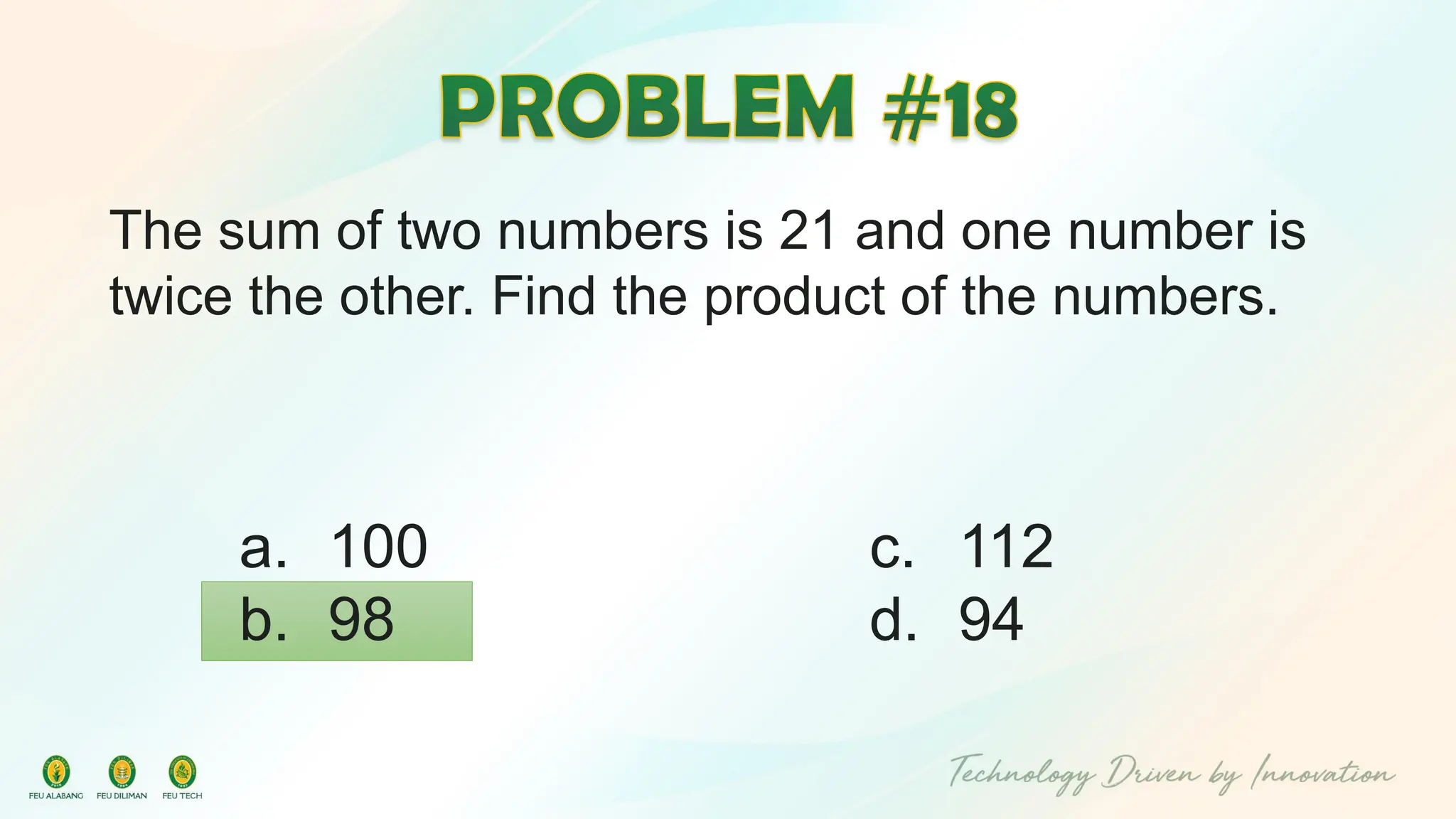
The sum of two numbers is 21 and one number is
twice the other. Find the product of the numbers.
c. 112
d. 94
a. 100
b. 98
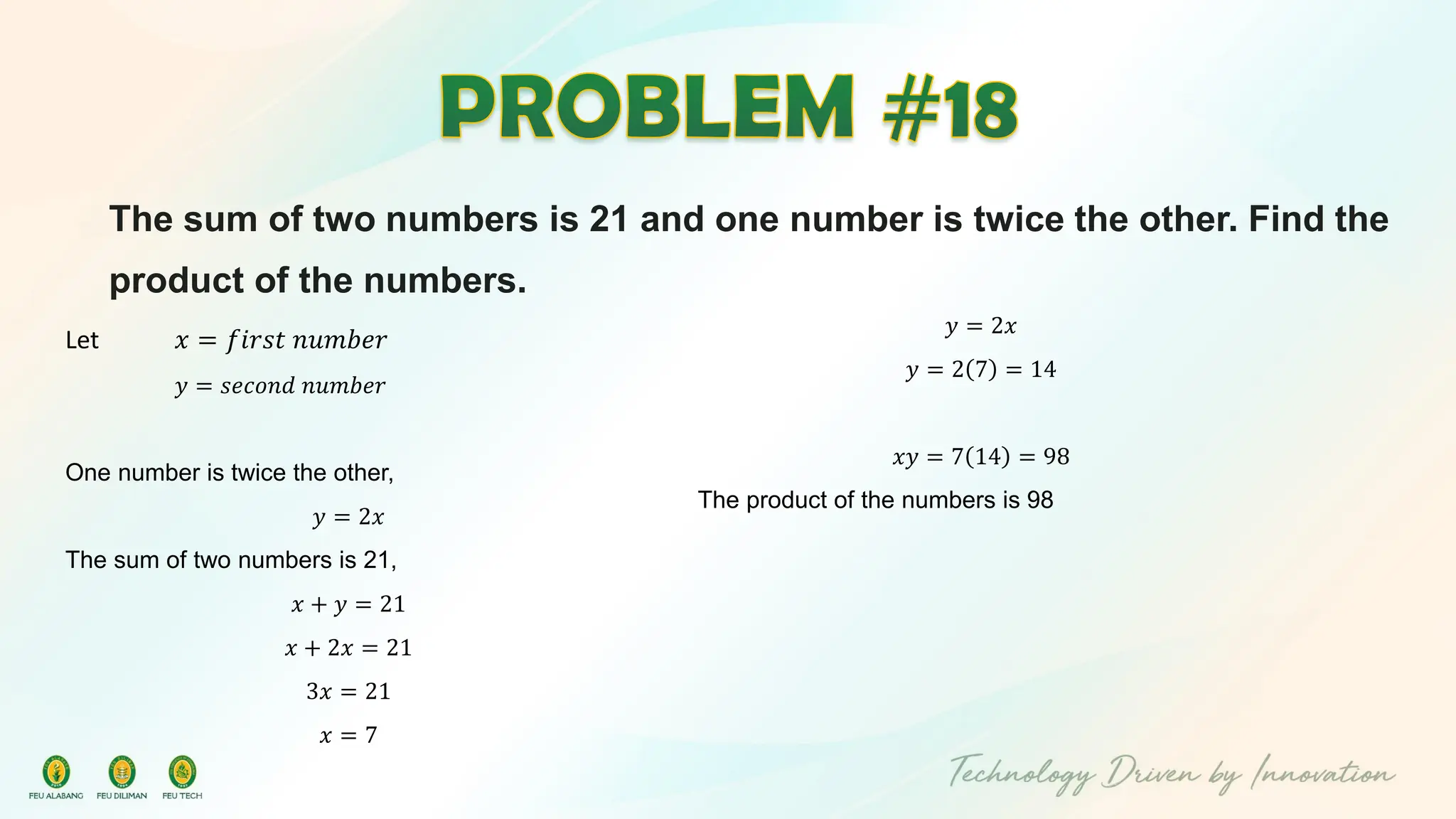
The sum of two numbers is 21 and one number is twice the other. Find the
product of the numbers.
Let 𝑥 = 𝑓𝑖𝑟𝑠𝑡 𝑛𝑢𝑚𝑏𝑒𝑟
𝑦 = 𝑠𝑒𝑐𝑜𝑛𝑑 𝑛𝑢𝑚𝑏𝑒𝑟
One number is twice the other,
𝑦 = 2𝑥
The sum of two numbers is 21,
𝑥 + 𝑦 = 21
𝑥 + 2𝑥 = 21
3𝑥 = 21
𝑥 = 7
𝑦 = 2𝑥
𝑦 = 2 7 = 14
𝑥𝑦 = 7 14 = 98
The product of the numbers is 98
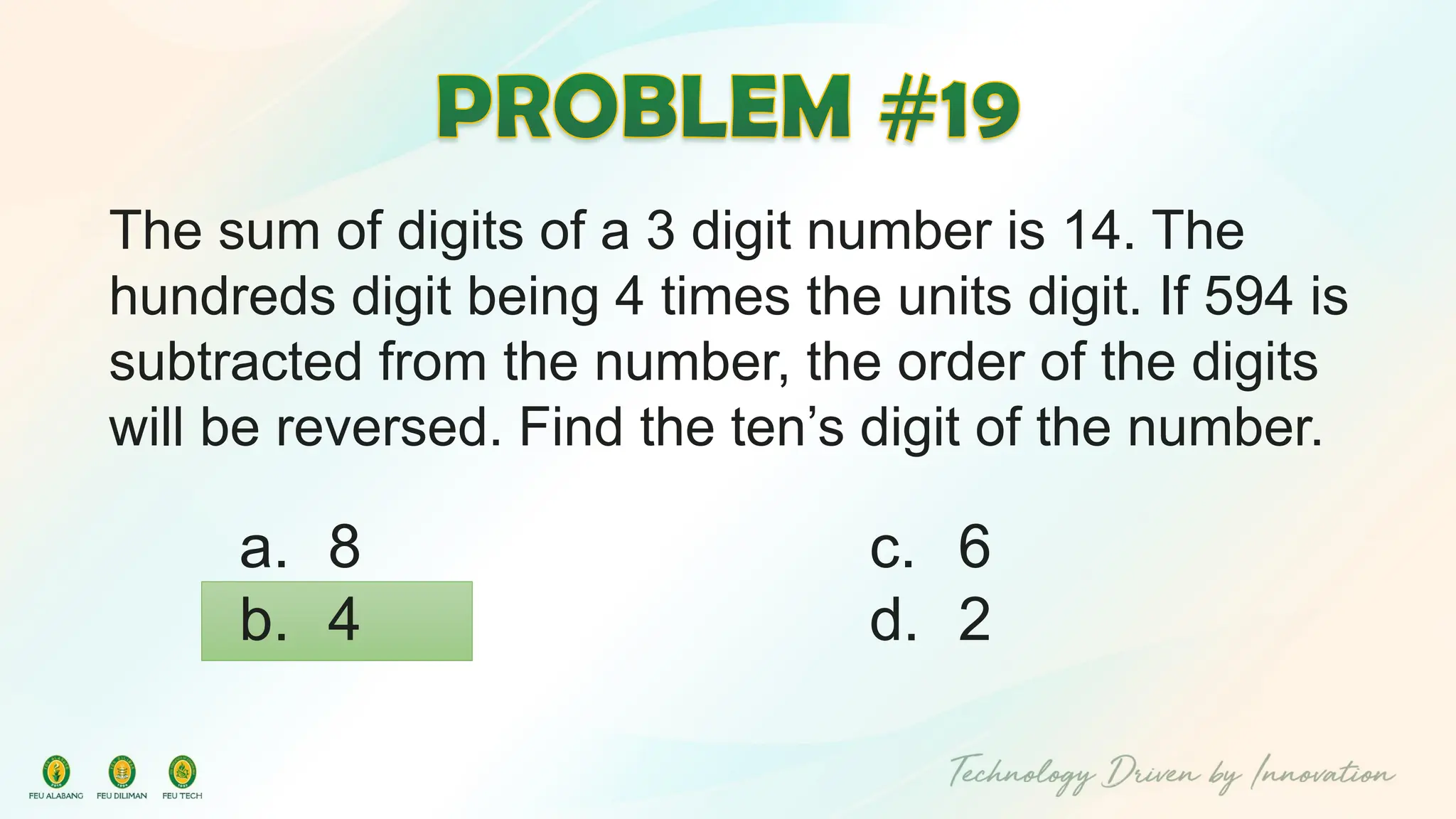
The sum of digits of a 3 digit number is 14. The
hundreds digit being 4 times the units digit. If 594 is
subtracted from the number, the order of the digits
will be reversed. Find the ten’s digit of the number.
c. 6
d. 2
a. 8
b. 4
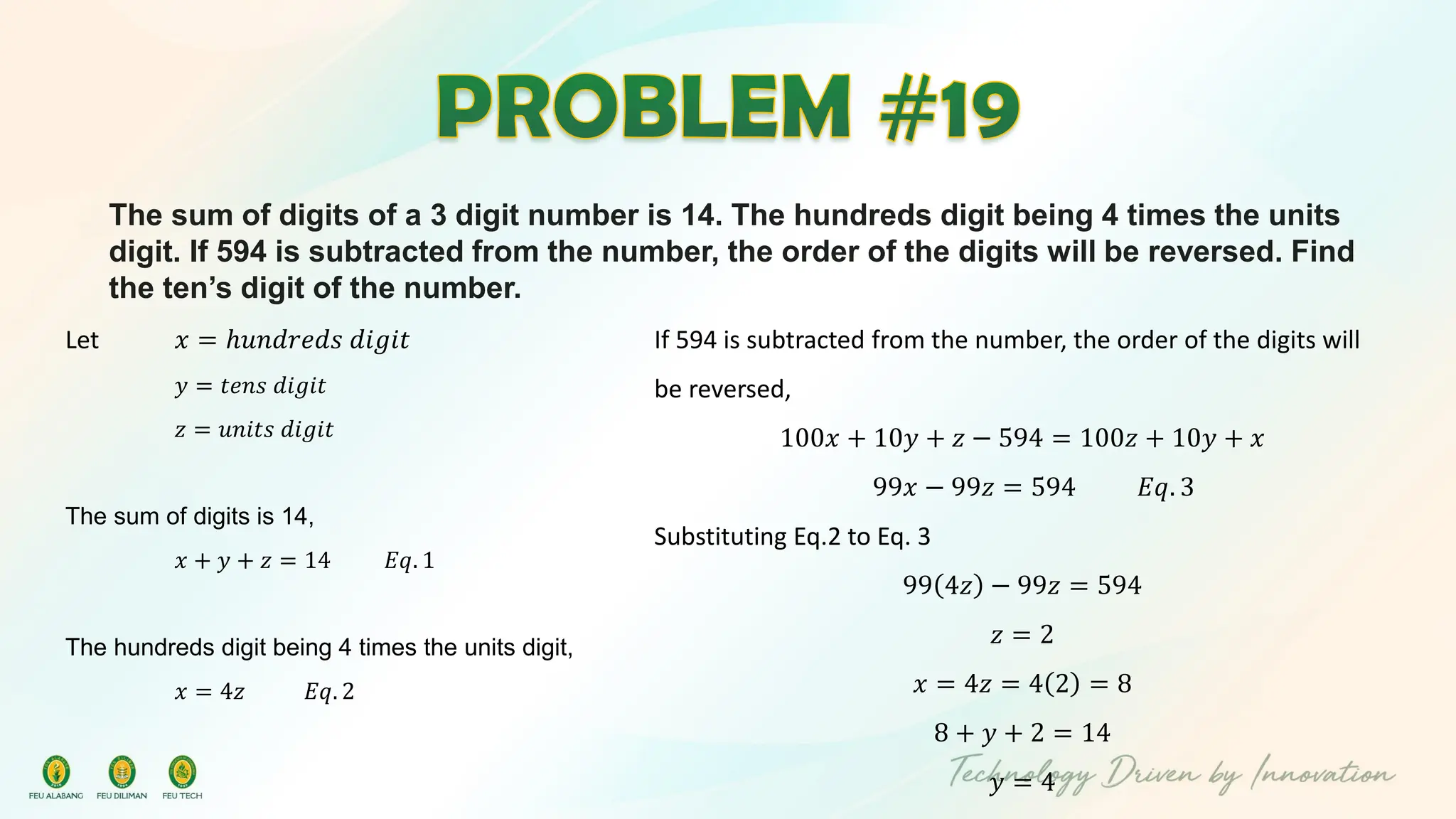
The sum of digits of a 3 digit number is 14. The hundreds digit being 4 times the units
digit. If 594 is subtracted from the number, the order of the digits will be reversed. Find
the ten’s digit of the number.
Let 𝑥 = ℎ𝑢𝑛𝑑𝑟𝑒𝑑𝑠 𝑑𝑖𝑔𝑖𝑡
𝑦 = 𝑡𝑒𝑛𝑠 𝑑𝑖𝑔𝑖𝑡
𝑧 = 𝑢𝑛𝑖𝑡𝑠 𝑑𝑖𝑔𝑖𝑡
The sum of digits is 14,
𝑥 + 𝑦 + 𝑧 = 14 𝐸𝑞. 1
The hundreds digit being 4 times the units digit,
𝑥 = 4𝑧 𝐸𝑞. 2
If 594 is subtracted from the number, the order of the digits will
be reversed,
100𝑥 + 10𝑦 + 𝑧 − 594 = 100𝑧 + 10𝑦 + 𝑥
99𝑥 − 99𝑧 = 594 𝐸𝑞. 3
Substituting Eq.2 to Eq. 3
99 4𝑧 − 99𝑧 = 594
𝑧 = 2
𝑥 = 4𝑧 = 4 2 = 8
8 + 𝑦 + 2 = 14
𝑦 = 4
SUB-TOPIC 3
Advanced Algebra
• To solve problems in progression such as
arithmetic, geometric, infinite series,
harmonic and other related problems.
• To identify determinants of matrix
• To solve problems involving complex
numbers
• To identify counting techniques such as
permutation and combination
Algebra 2
NUMBER PROGRESSIONS
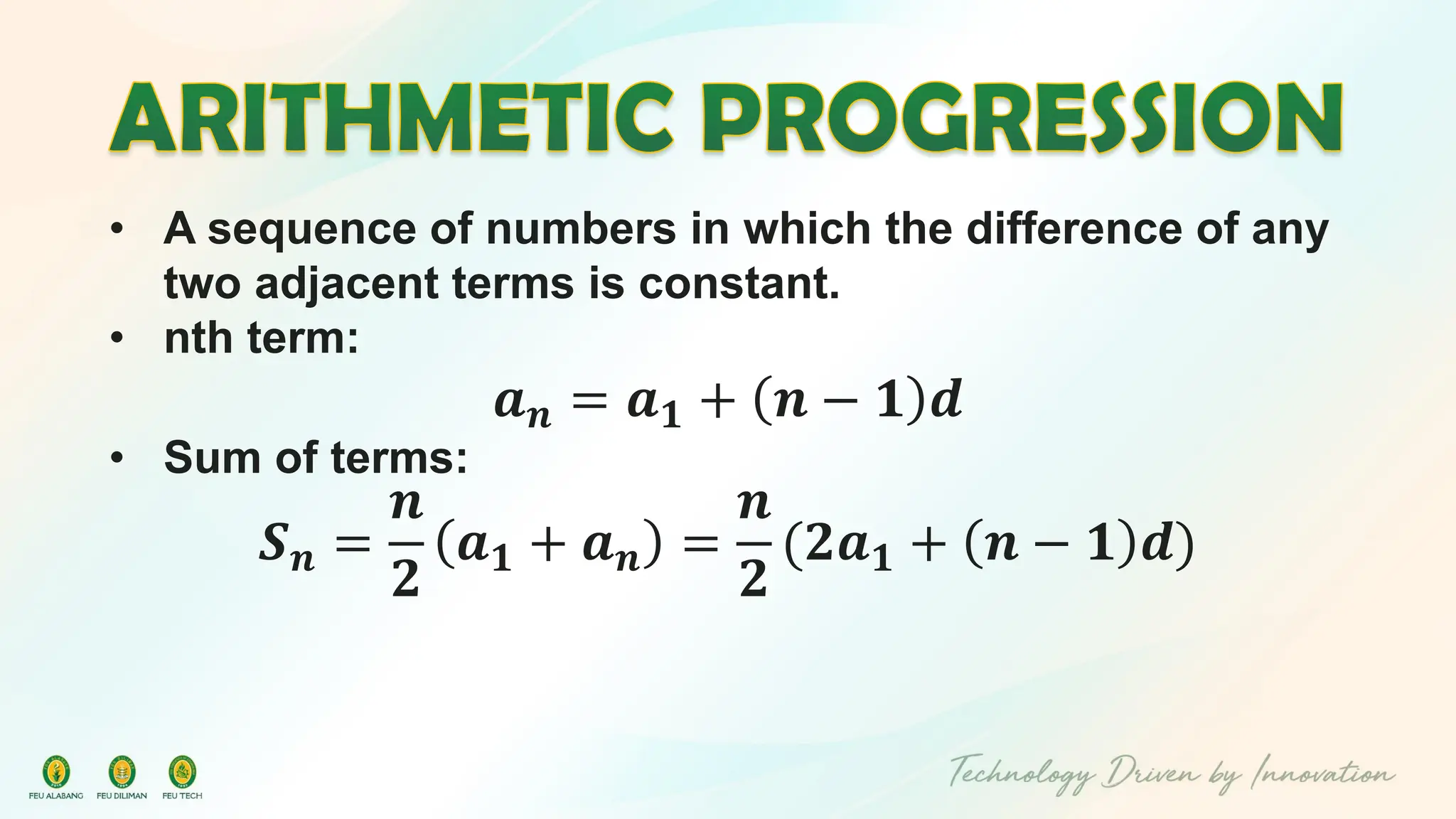
• A sequence of numbers in which the difference of any
two adjacent terms is constant.
• nth term:
𝒂𝒏 = 𝒂𝟏 + 𝒏 − 𝟏 𝒅
• Sum of terms:
𝑺𝒏 =
𝒏
𝟐
𝒂𝟏 + 𝒂𝒏 =
𝒏
𝟐
(𝟐𝒂𝟏 + 𝒏 − 𝟏 𝒅)
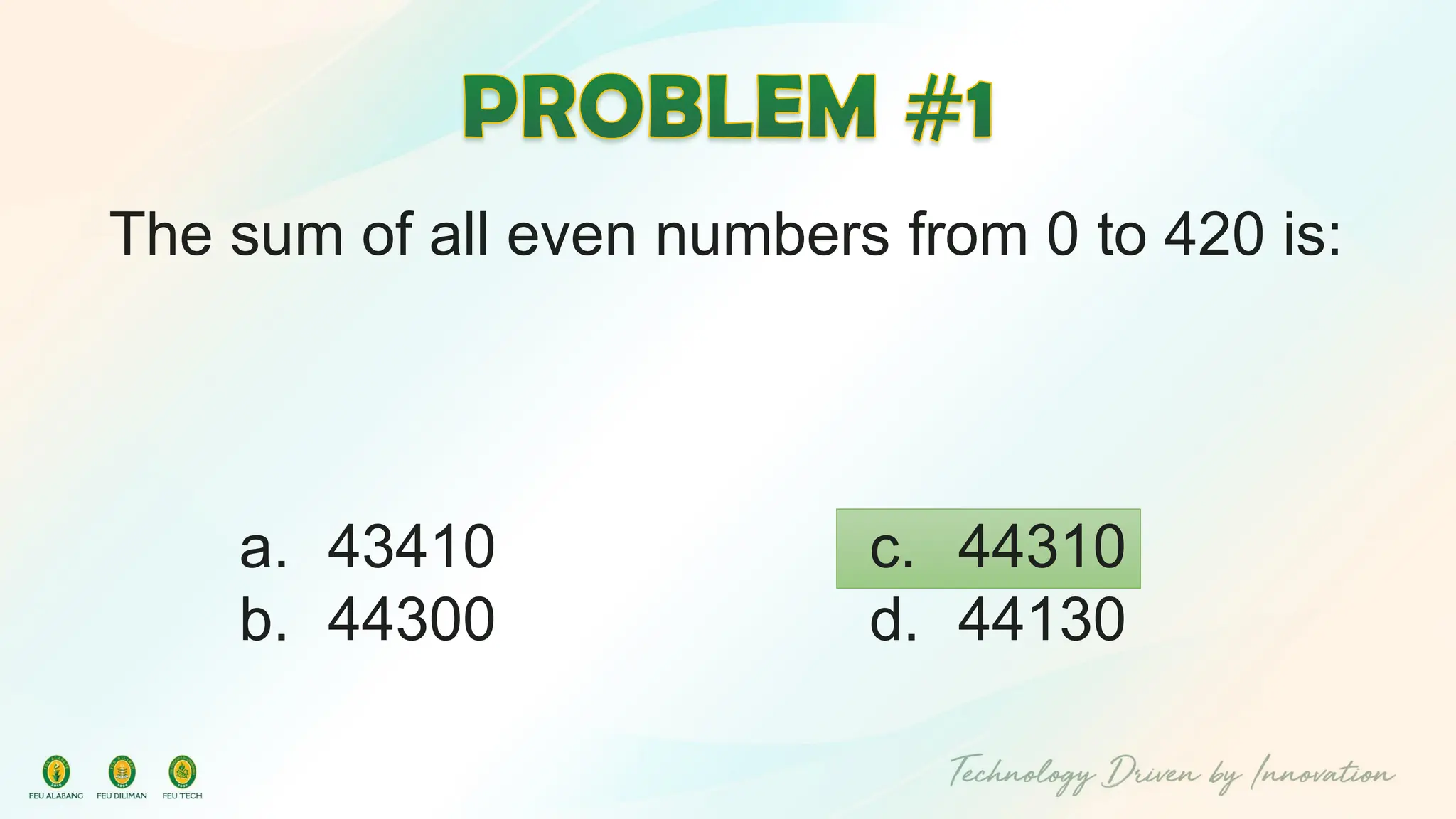
The sum of all even numbers from 0 to 420 is:
c. 44310
d. 44130
a. 43410
b. 44300
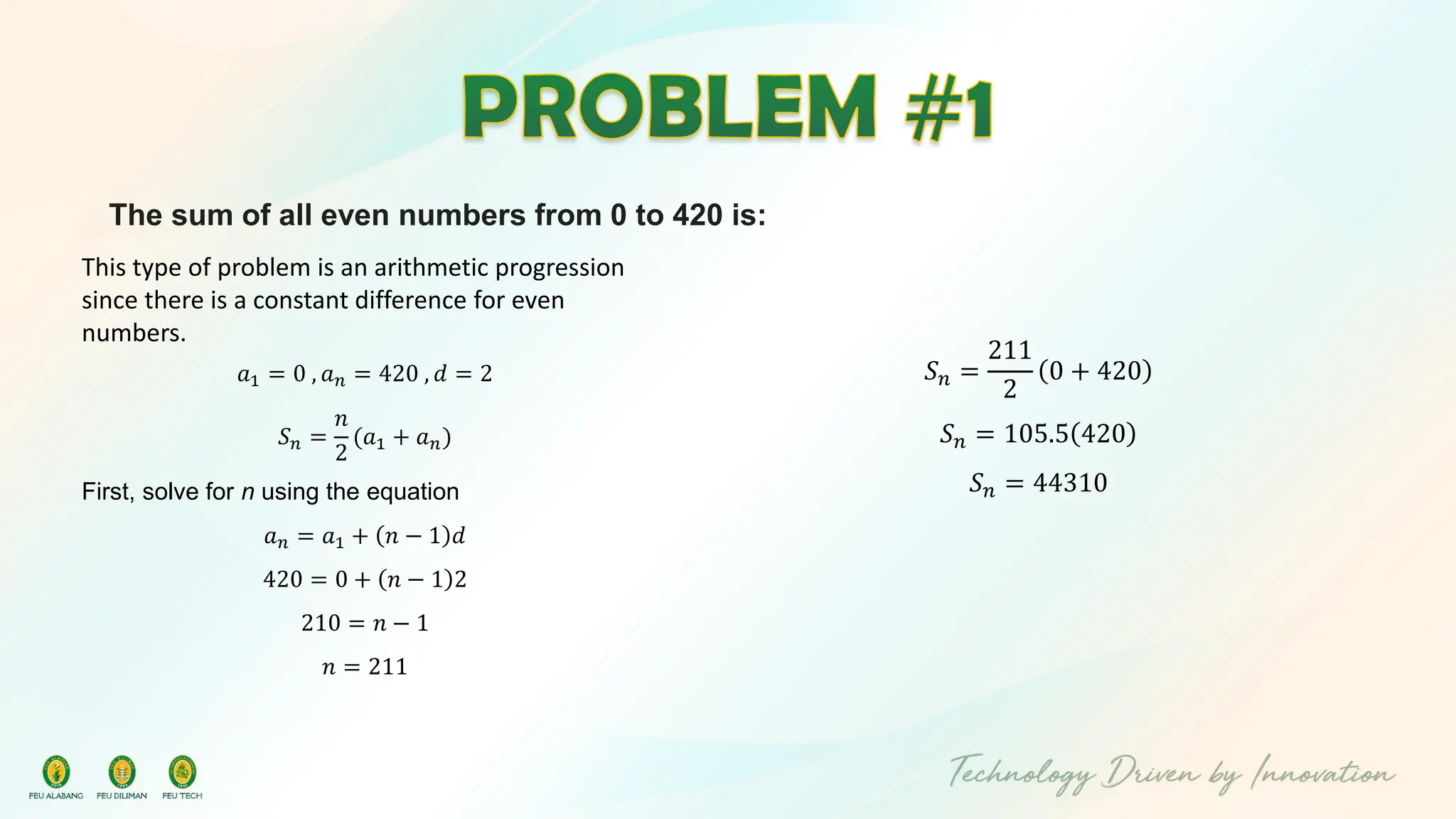
The sum of all even numbers from 0 to 420 is:
This type of problem is an arithmetic progression
since there is a constant difference for even
numbers.
𝑎1 = 0 , 𝑎𝑛 = 420 , 𝑑 = 2
𝑆𝑛 =
𝑛
2
(𝑎1 + 𝑎𝑛)
First, solve for n using the equation
𝑎𝑛 = 𝑎1 + 𝑛 − 1 𝑑
420 = 0 + 𝑛 − 1 2
210 = 𝑛 − 1
𝑛 = 211
𝑆𝑛 =
211
2
0 + 420
𝑆𝑛 = 105.5 420
𝑆𝑛 = 44310
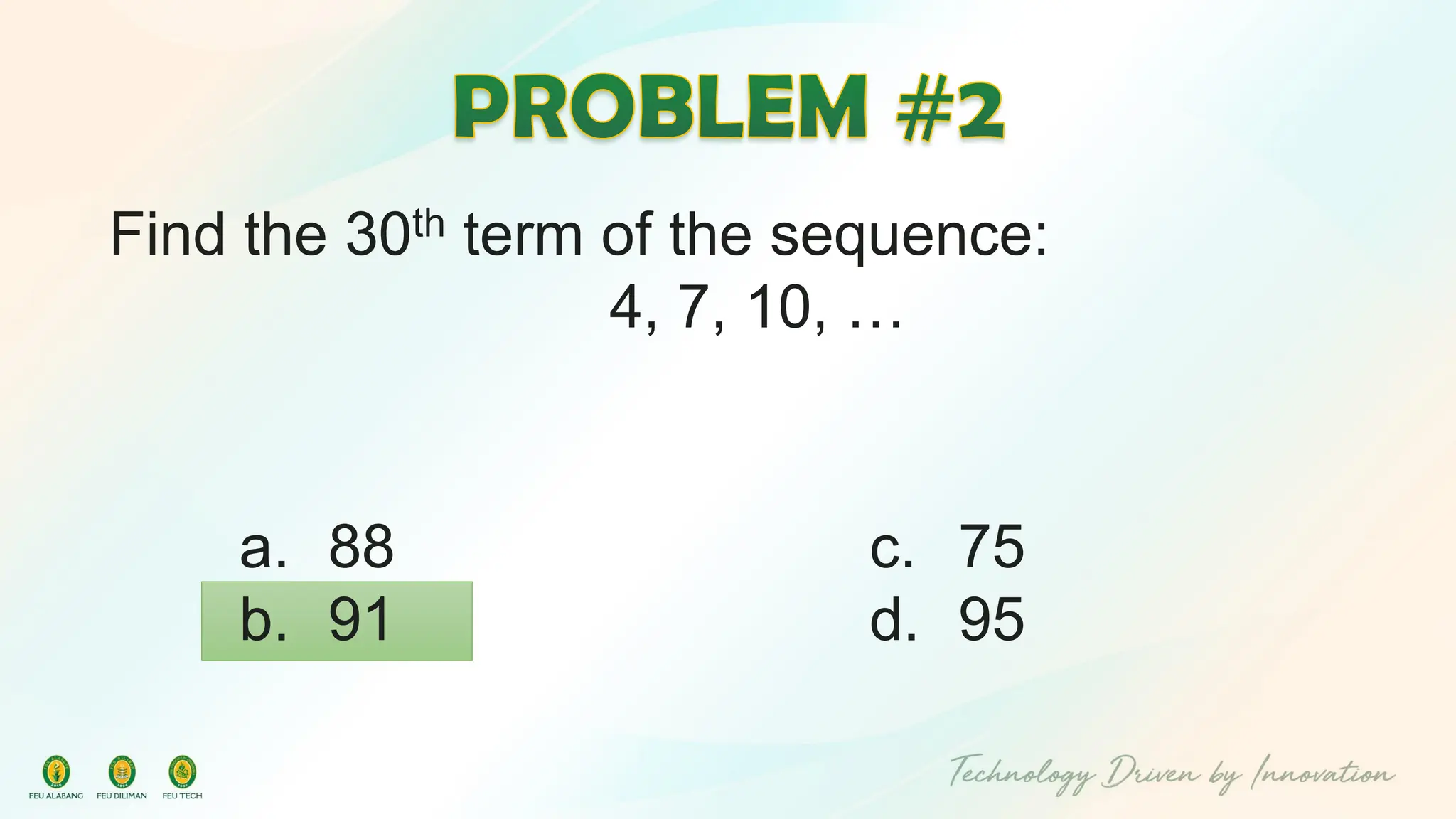
Find the 30th term of the sequence:
4, 7, 10, …
c. 75
d. 95
a. 88
b. 91
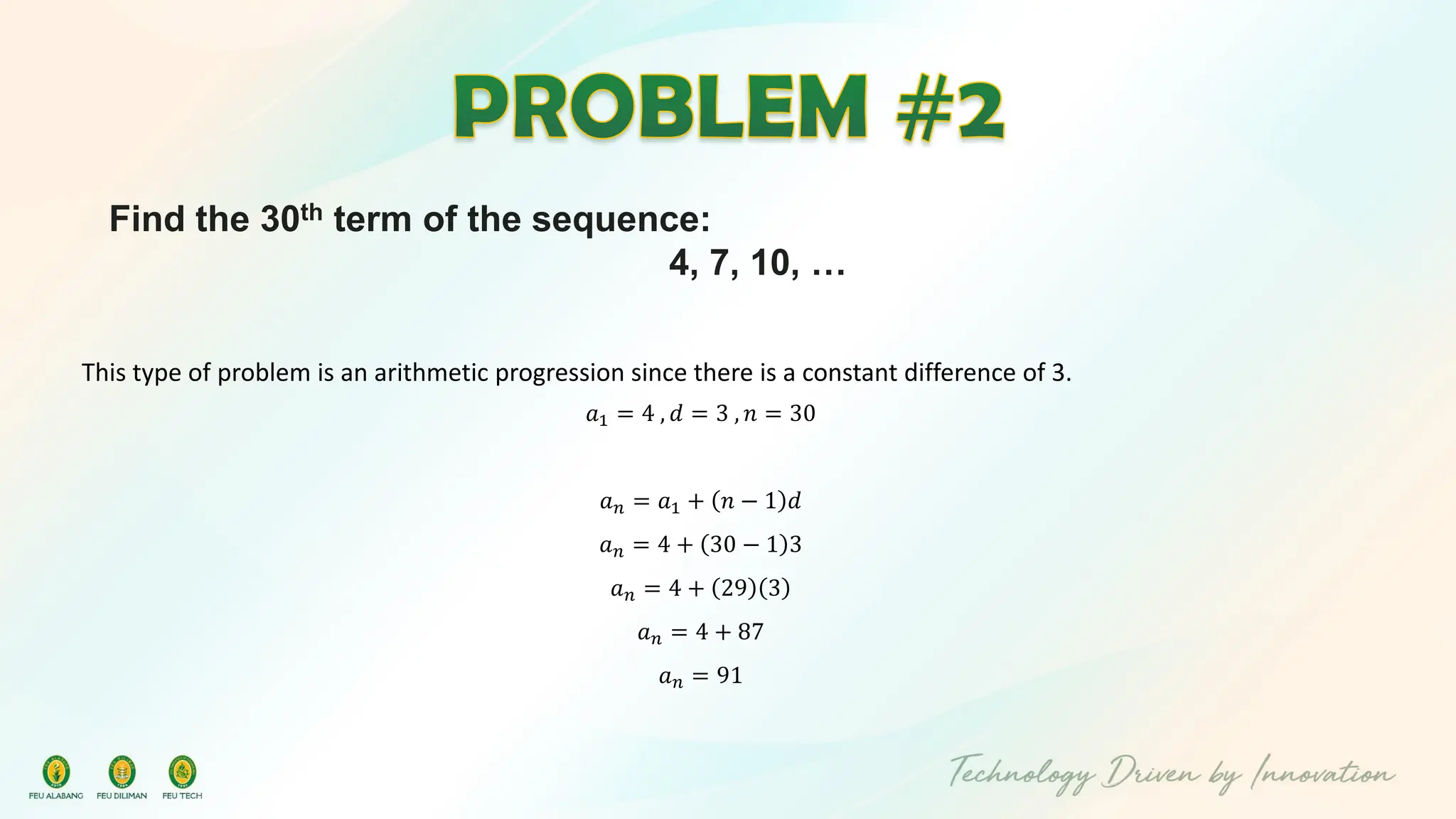
Find the 30th term of the sequence:
4, 7, 10, …
This type of problem is an arithmetic progression since there is a constant difference of 3.
𝑎1 = 4 , 𝑑 = 3 , 𝑛 = 30
𝑎𝑛 = 𝑎1 + 𝑛 − 1 𝑑
𝑎𝑛 = 4 + 30 − 1 3
𝑎𝑛 = 4 + 29 3
𝑎𝑛 = 4 + 87
𝑎𝑛 = 91
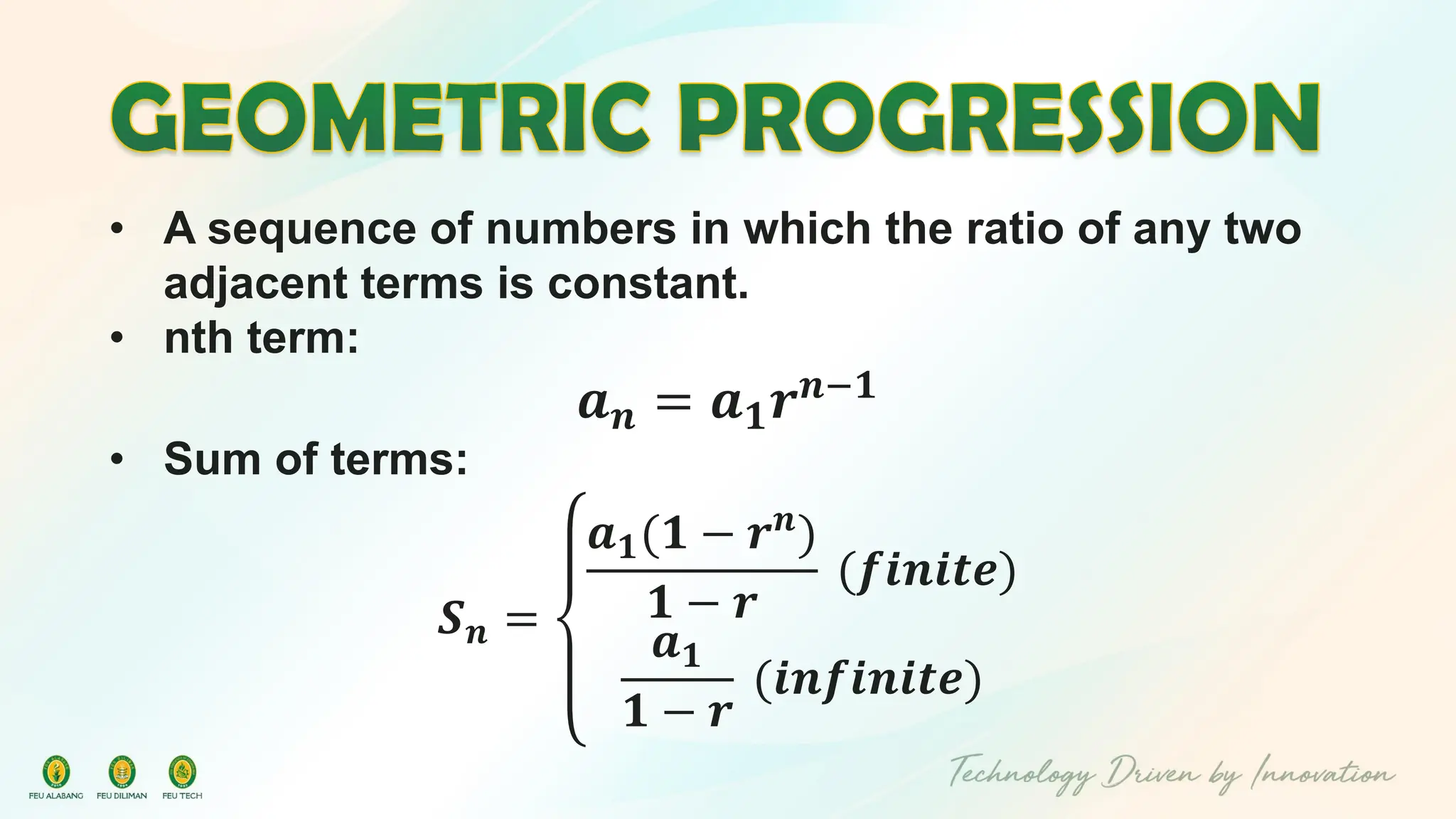
• A sequence of numbers in which the ratio of any two
adjacent terms is constant.
• nth term:
𝒂𝒏 = 𝒂𝟏𝒓𝒏−𝟏
• Sum of terms:
𝑺𝒏 =
𝒂𝟏(𝟏 − 𝒓𝒏
)
𝟏 − 𝒓
(𝒇𝒊𝒏𝒊𝒕𝒆)
𝒂𝟏
𝟏 − 𝒓
(𝒊𝒏𝒇𝒊𝒏𝒊𝒕𝒆)
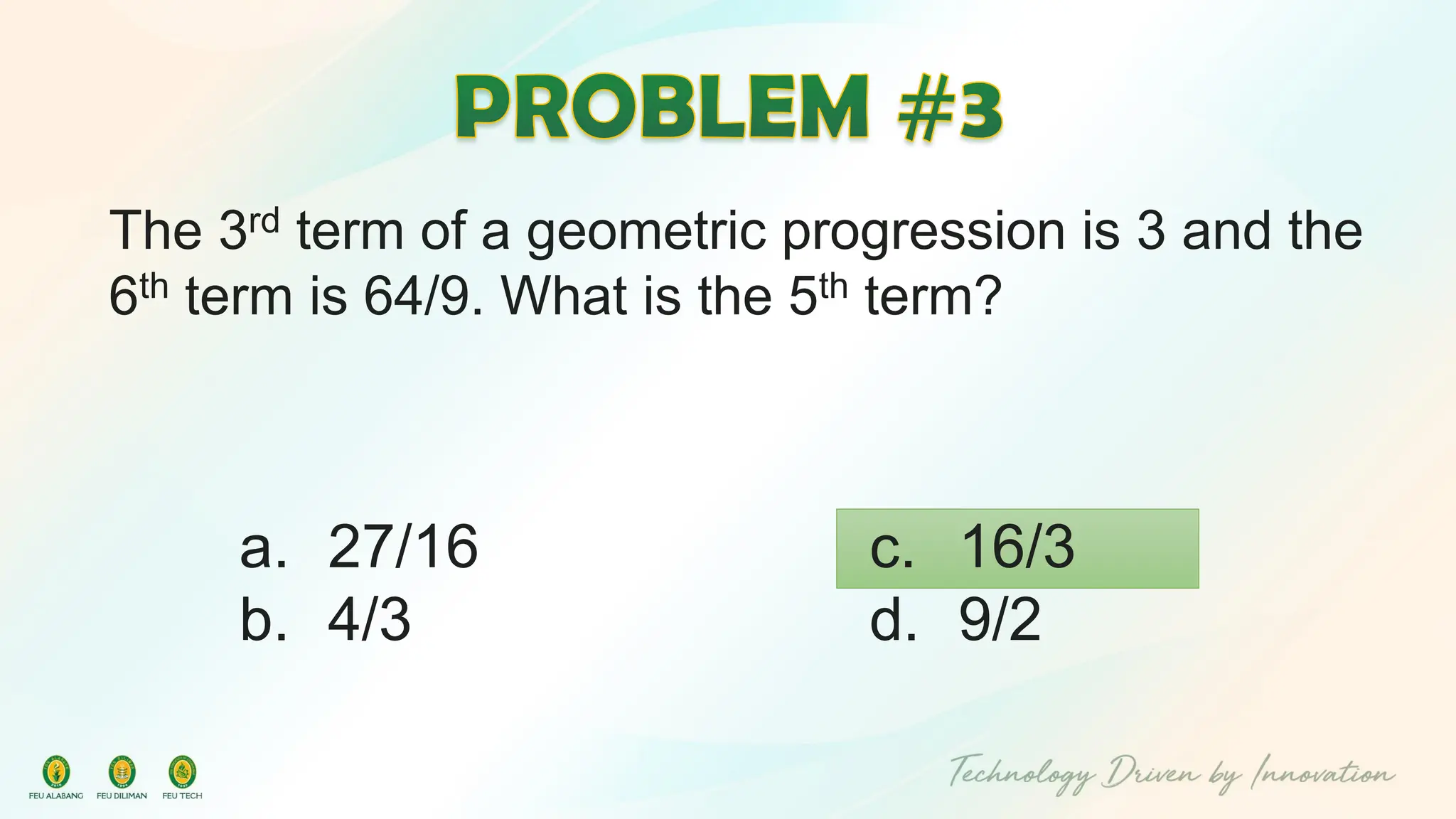
The 3rd term of a geometric progression is 3 and the
6th term is 64/9. What is the 5th term?
c. 16/3
d. 9/2
a. 27/16
b. 4/3
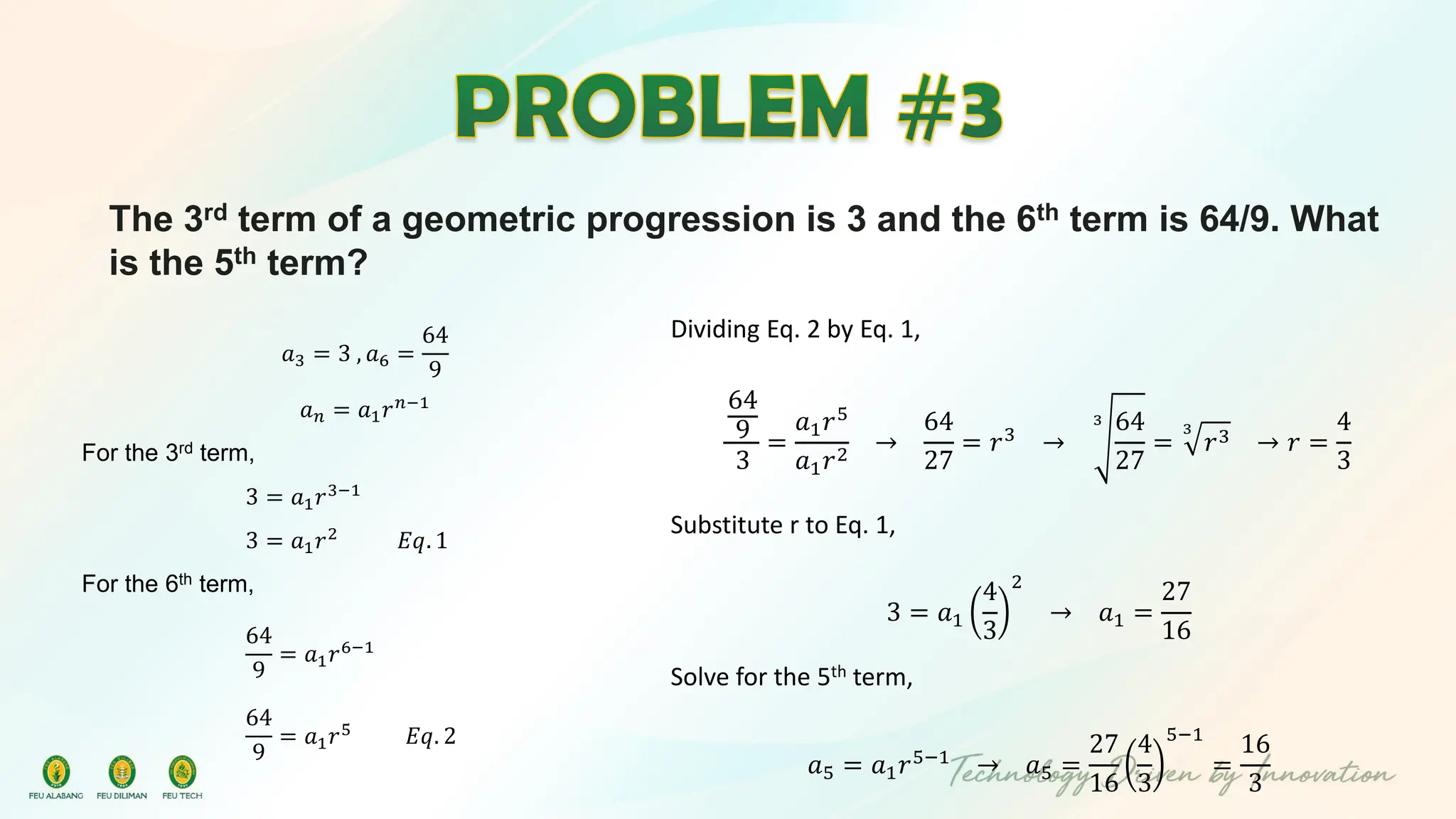
The 3rd term of a geometric progression is 3 and the 6th term is 64/9. What
is the 5th term?
𝑎3 = 3 , 𝑎6 =
64
9
𝑎𝑛 = 𝑎1𝑟𝑛−1
For the 3rd term,
3 = 𝑎1𝑟3−1
3 = 𝑎1𝑟2
𝐸𝑞. 1
For the 6th term,
64
9
= 𝑎1𝑟6−1
64
9
= 𝑎1𝑟5
𝐸𝑞. 2
Dividing Eq. 2 by Eq. 1,
64
9
3
=
𝑎1𝑟5
𝑎1𝑟2 →
64
27
= 𝑟3
→
3 64
27
=
3
𝑟3 → 𝑟 =
4
3
Substitute r to Eq. 1,
3 = 𝑎1
4
3
2
→ 𝑎1 =
27
16
Solve for the 5th term,
𝑎5 = 𝑎1𝑟5−1
→ 𝑎5 =
27
16
4
3
5−1
=
16
3
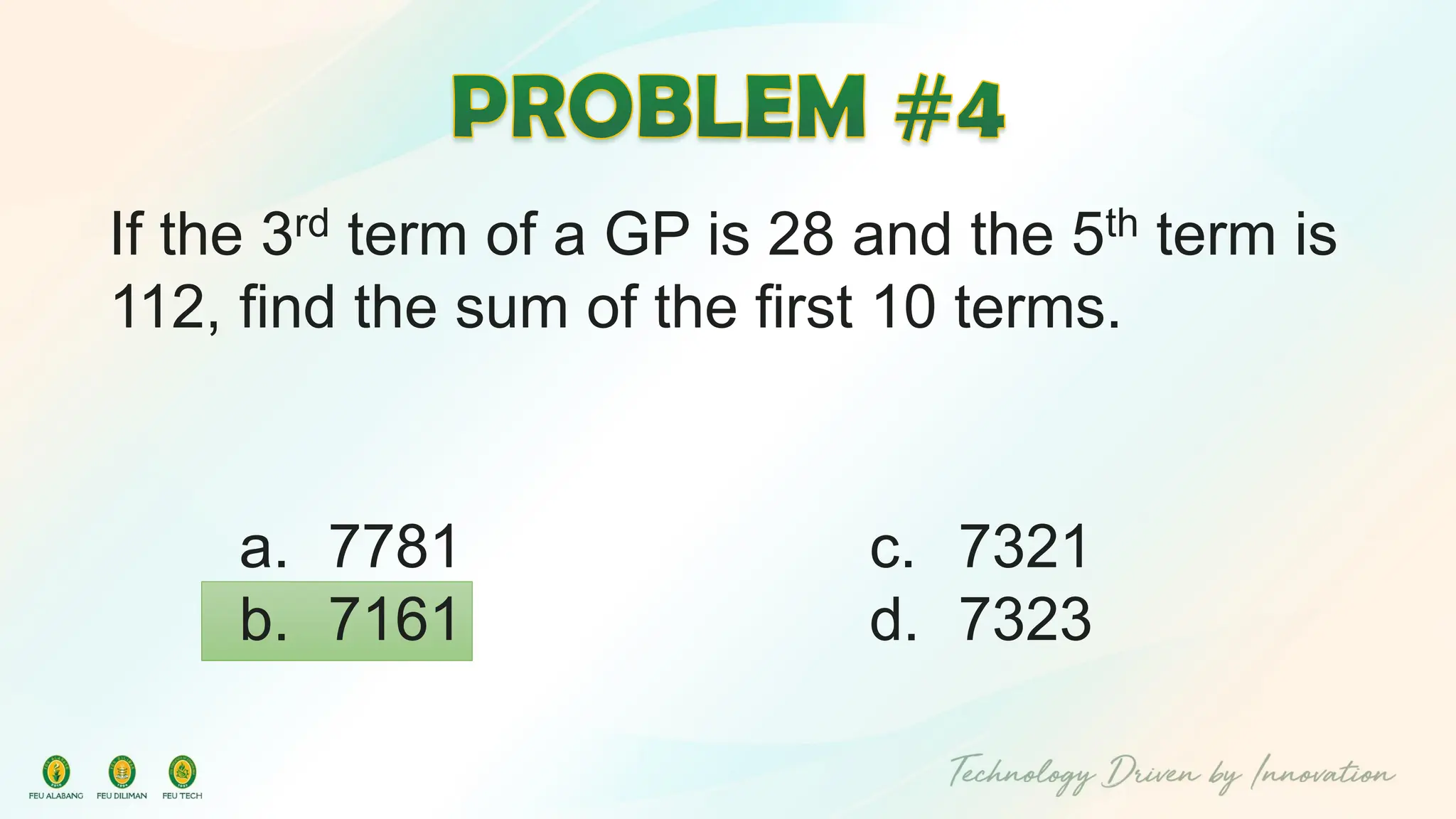
If the 3rd term of a GP is 28 and the 5th term is
112, find the sum of the first 10 terms.
c. 7321
d. 7323
a. 7781
b. 7161
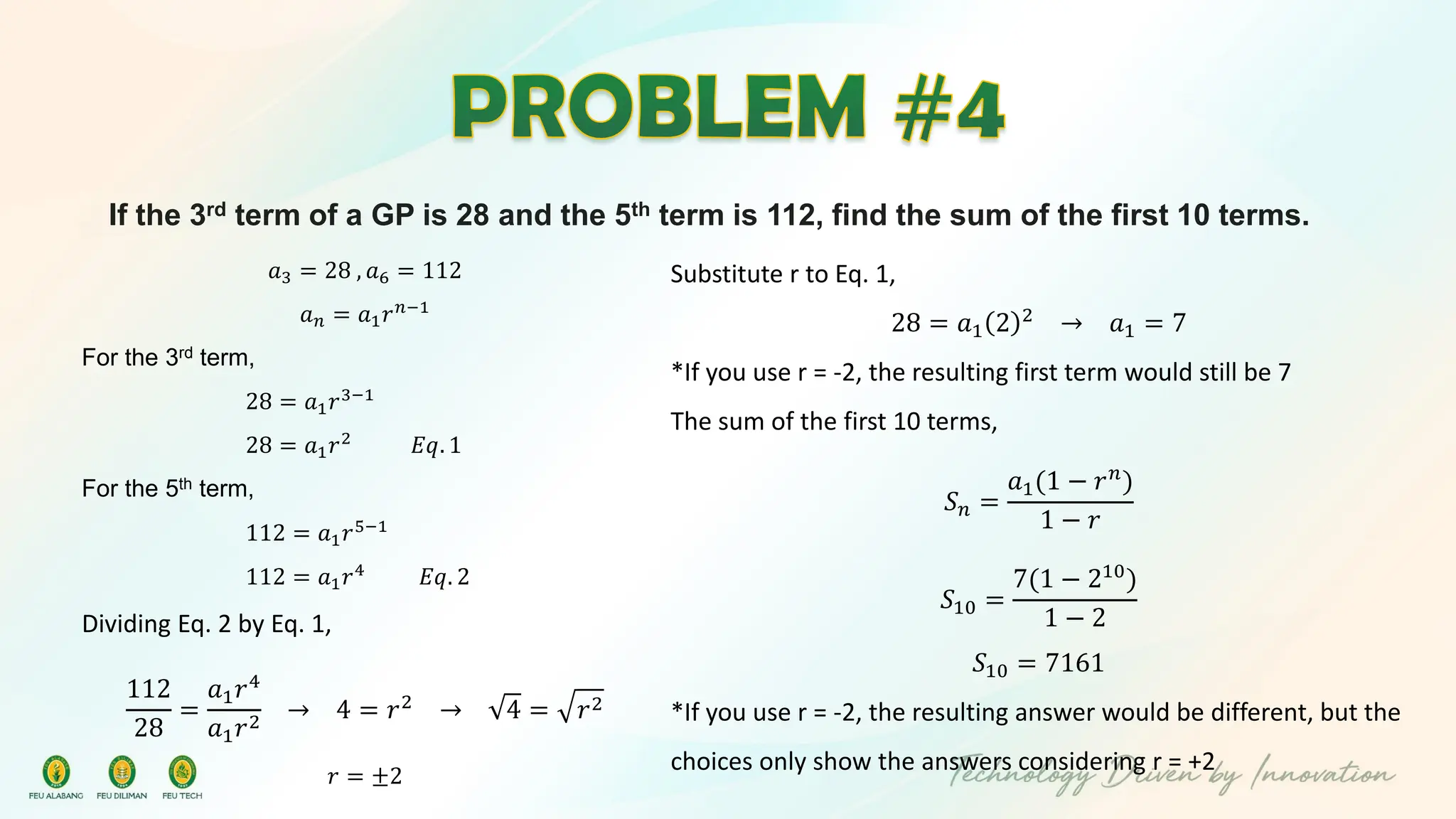
If the 3rd term of a GP is 28 and the 5th term is 112, find the sum of the first 10 terms.
𝑎3 = 28 , 𝑎6 = 112
𝑎𝑛 = 𝑎1𝑟𝑛−1
For the 3rd term,
28 = 𝑎1𝑟3−1
28 = 𝑎1𝑟2
𝐸𝑞. 1
For the 5th term,
112 = 𝑎1𝑟5−1
112 = 𝑎1𝑟4
𝐸𝑞. 2
Dividing Eq. 2 by Eq. 1,
112
28
=
𝑎1𝑟4
𝑎1𝑟2
→ 4 = 𝑟2 → 4 = 𝑟2
𝑟 = ±2
Substitute r to Eq. 1,
28 = 𝑎1 2 2
→ 𝑎1 = 7
*If you use r = -2, the resulting first term would still be 7
The sum of the first 10 terms,
𝑆𝑛 =
𝑎1(1 − 𝑟𝑛)
1 − 𝑟
𝑆10 =
7(1 − 210
)
1 − 2
𝑆10 = 7161
*If you use r = -2, the resulting answer would be different, but the
choices only show the answers considering r = +2
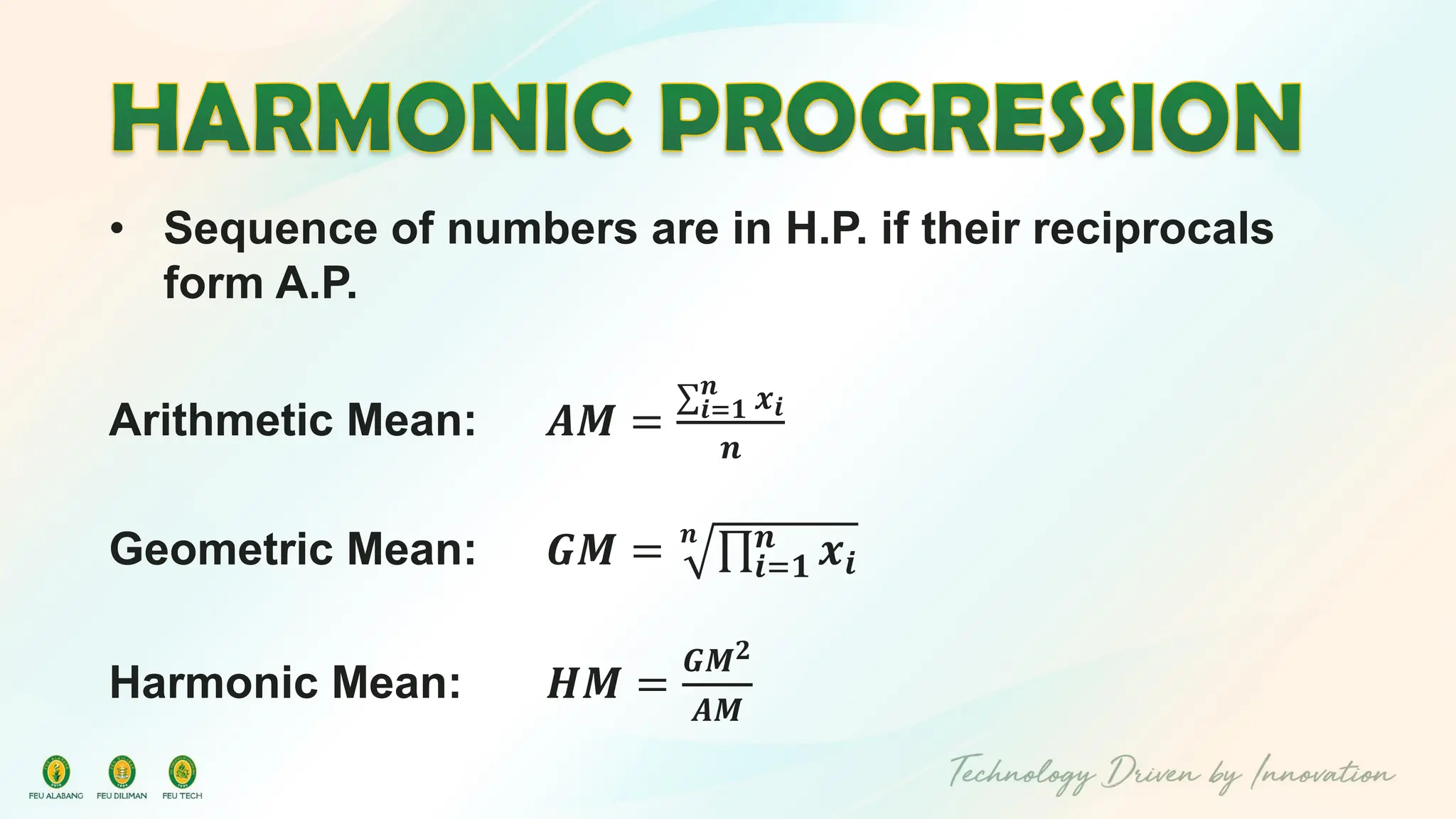
• Sequence of numbers are in H.P. if their reciprocals
form A.P.
Arithmetic Mean: 𝑨𝑴 =
σ𝒊=𝟏
𝒏
𝒙𝒊
𝒏
Geometric Mean: 𝑮𝑴 = 𝒏
ς𝒊=𝟏
𝒏
𝒙𝒊
Harmonic Mean: 𝑯𝑴 =
𝑮𝑴𝟐
𝑨𝑴
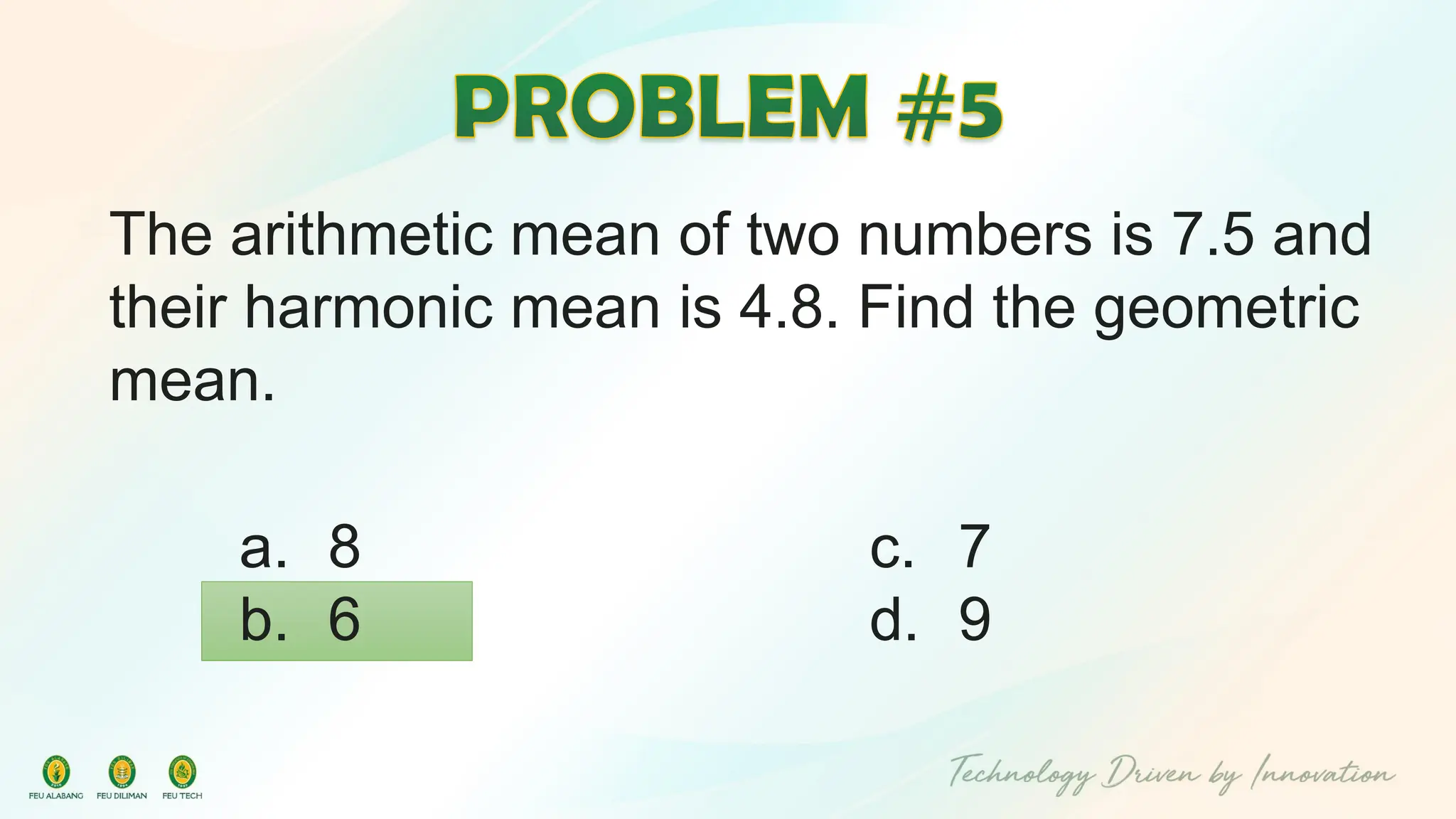
The arithmetic mean of two numbers is 7.5 and
their harmonic mean is 4.8. Find the geometric
mean.
c. 7
d. 9
a. 8
b. 6
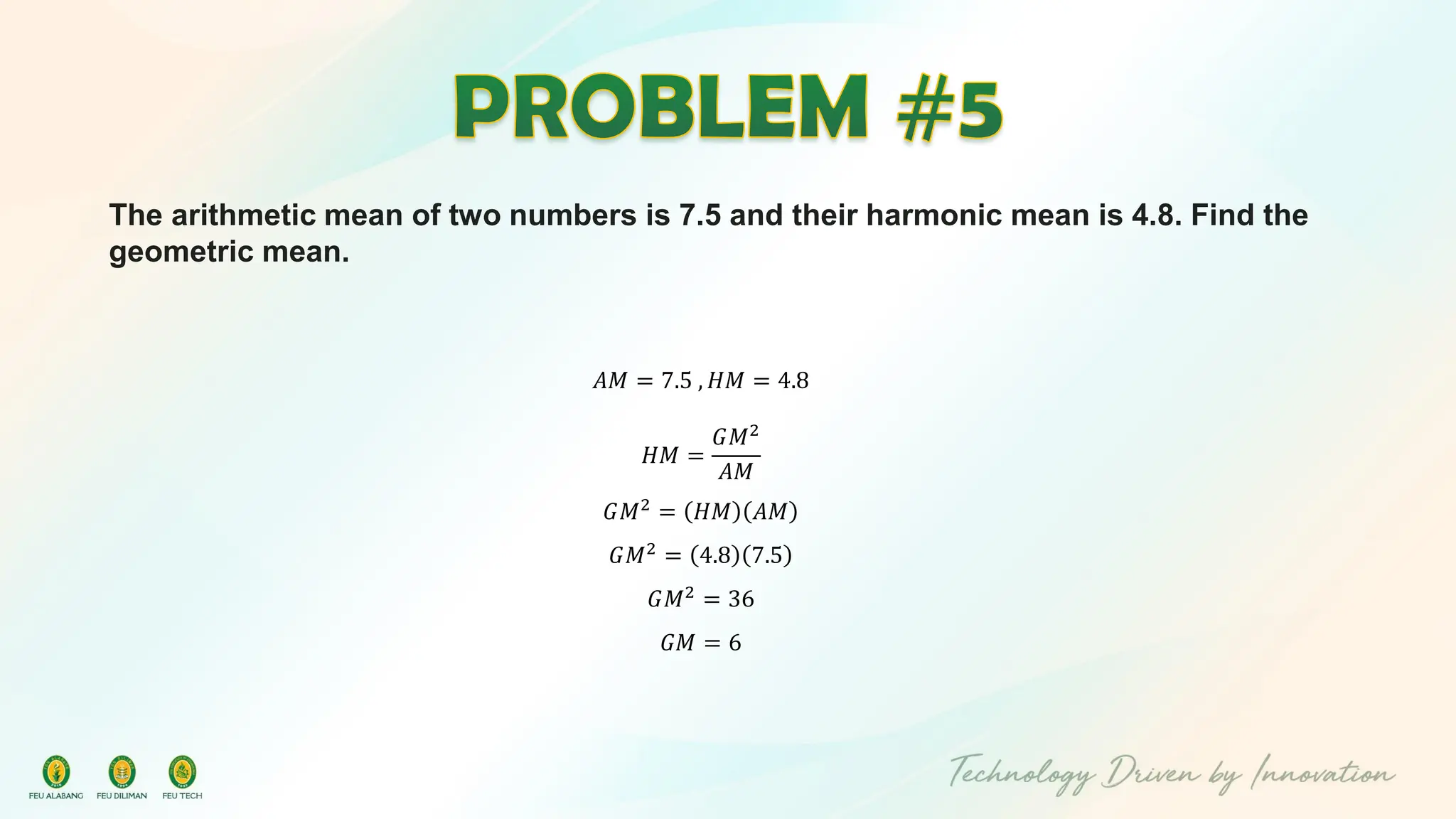
The arithmetic mean of two numbers is 7.5 and their harmonic mean is 4.8. Find the
geometric mean.
𝐴𝑀 = 7.5 , 𝐻𝑀 = 4.8
𝐻𝑀 =
𝐺𝑀2
𝐴𝑀
𝐺𝑀2
= 𝐻𝑀 𝐴𝑀
𝐺𝑀2
= 4.8 7.5
𝐺𝑀2
= 36
𝐺𝑀 = 6
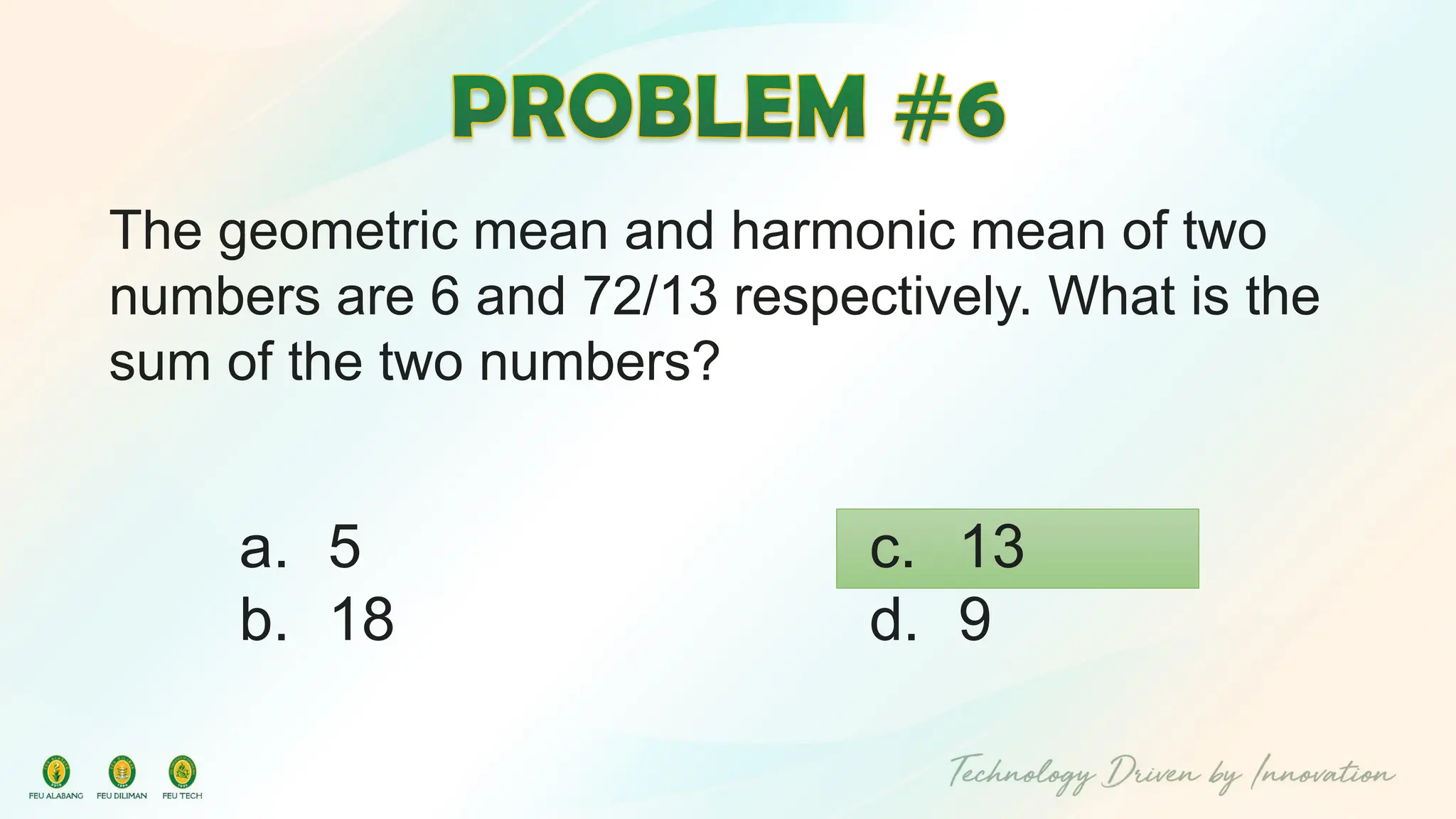
The geometric mean and harmonic mean of two
numbers are 6 and 72/13 respectively. What is the
sum of the two numbers?
c. 13
d. 9
a. 5
b. 18
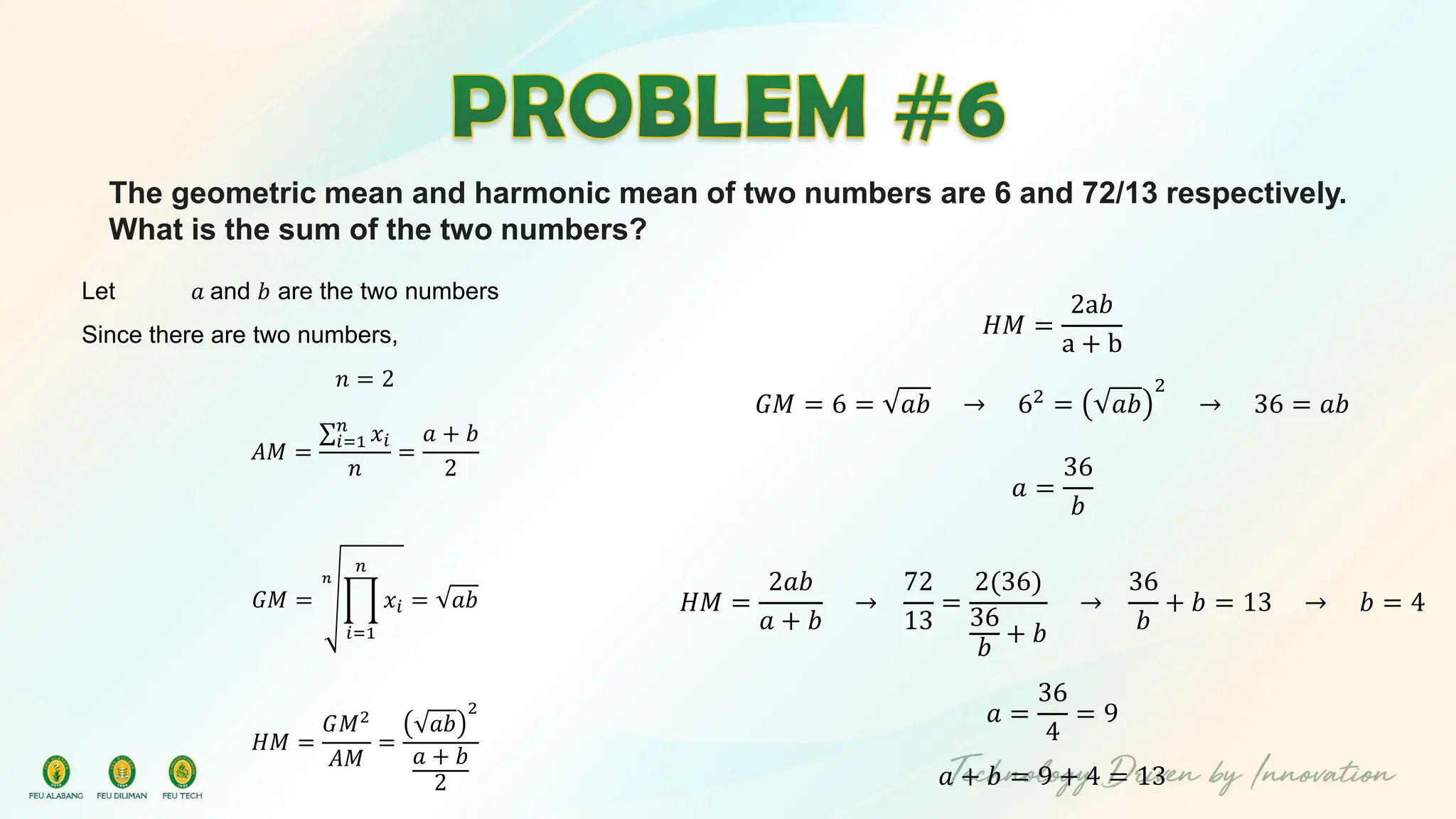
The geometric mean and harmonic mean of two numbers are 6 and 72/13 respectively.
What is the sum of the two numbers?
Let 𝑎 and 𝑏 are the two numbers
Since there are two numbers,
𝑛 = 2
𝐴𝑀 =
σ𝑖=1
𝑛
𝑥𝑖
𝑛
=
𝑎 + 𝑏
2
𝐺𝑀 =
𝑛
ෑ
𝑖=1
𝑛
𝑥𝑖 = 𝑎𝑏
𝐻𝑀 =
𝐺𝑀2
𝐴𝑀
=
𝑎𝑏
2
𝑎 + 𝑏
2
𝐻𝑀 =
2a𝑏
a + b
𝐺𝑀 = 6 = 𝑎𝑏 → 62 = 𝑎𝑏
2
→ 36 = 𝑎𝑏
𝑎 =
36
𝑏
𝐻𝑀 =
2𝑎𝑏
𝑎 + 𝑏
→
72
13
=
2(36)
36
𝑏
+ 𝑏
→
36
𝑏
+ 𝑏 = 13 → 𝑏 = 4
𝑎 =
36
4
= 9
𝑎 + 𝑏 = 9 + 4 = 13
Algebra 2
DETERMINANTS
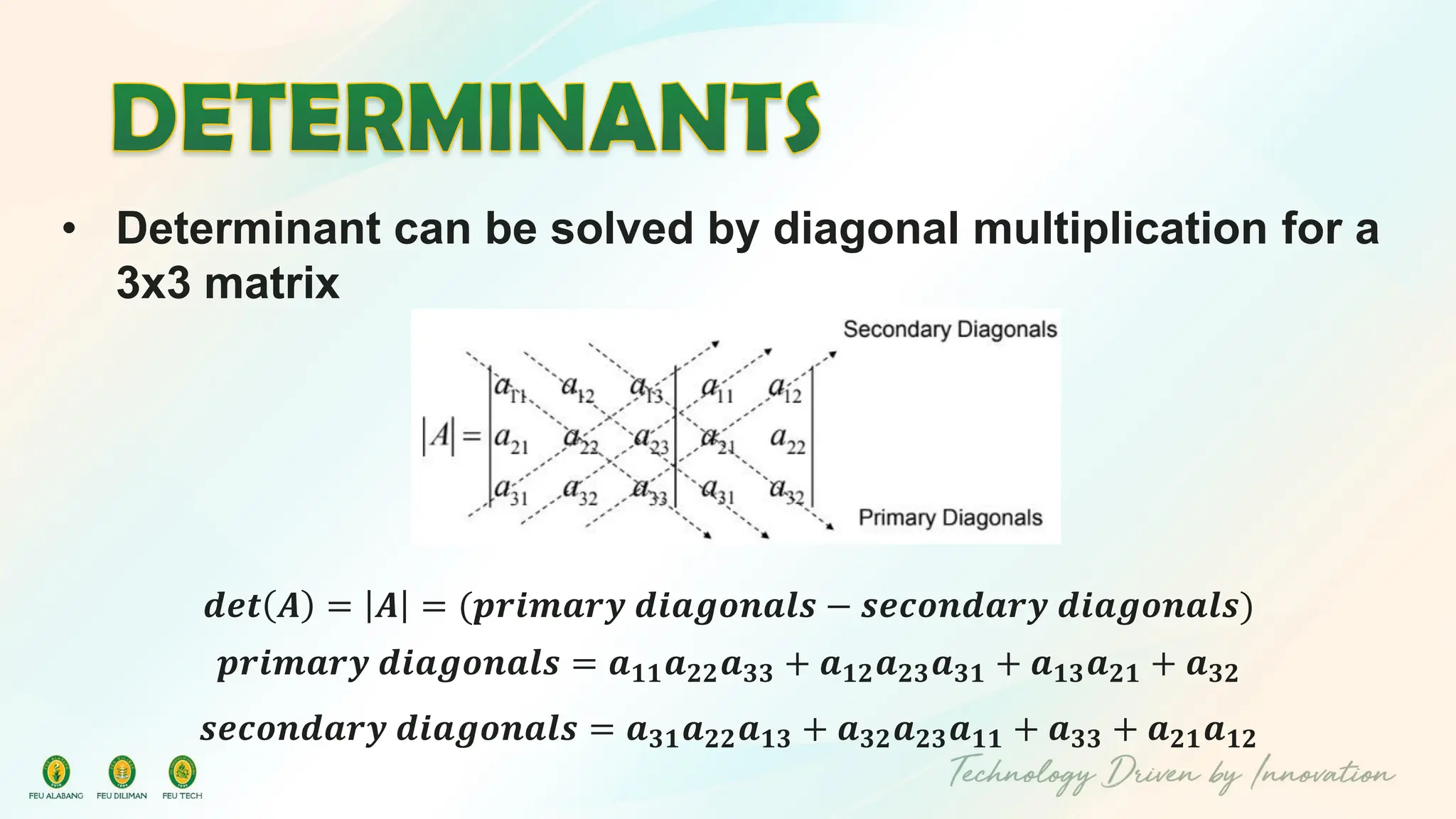
• Determinant can be solved by diagonal multiplication for a
3x3 matrix
𝒅𝒆𝒕 𝑨 = 𝑨 = (𝒑𝒓𝒊𝒎𝒂𝒓𝒚 𝒅𝒊𝒂𝒈𝒐𝒏𝒂𝒍𝒔 − 𝒔𝒆𝒄𝒐𝒏𝒅𝒂𝒓𝒚 𝒅𝒊𝒂𝒈𝒐𝒏𝒂𝒍𝒔)
𝒑𝒓𝒊𝒎𝒂𝒓𝒚 𝒅𝒊𝒂𝒈𝒐𝒏𝒂𝒍𝒔 = 𝒂𝟏𝟏𝒂𝟐𝟐𝒂𝟑𝟑 + 𝒂𝟏𝟐𝒂𝟐𝟑𝒂𝟑𝟏 + 𝒂𝟏𝟑𝒂𝟐𝟏 + 𝒂𝟑𝟐
𝒔𝒆𝒄𝒐𝒏𝒅𝒂𝒓𝒚 𝒅𝒊𝒂𝒈𝒐𝒏𝒂𝒍𝒔 = 𝒂𝟑𝟏𝒂𝟐𝟐𝒂𝟏𝟑 + 𝒂𝟑𝟐𝒂𝟐𝟑𝒂𝟏𝟏 + 𝒂𝟑𝟑 + 𝒂𝟐𝟏𝒂𝟏𝟐
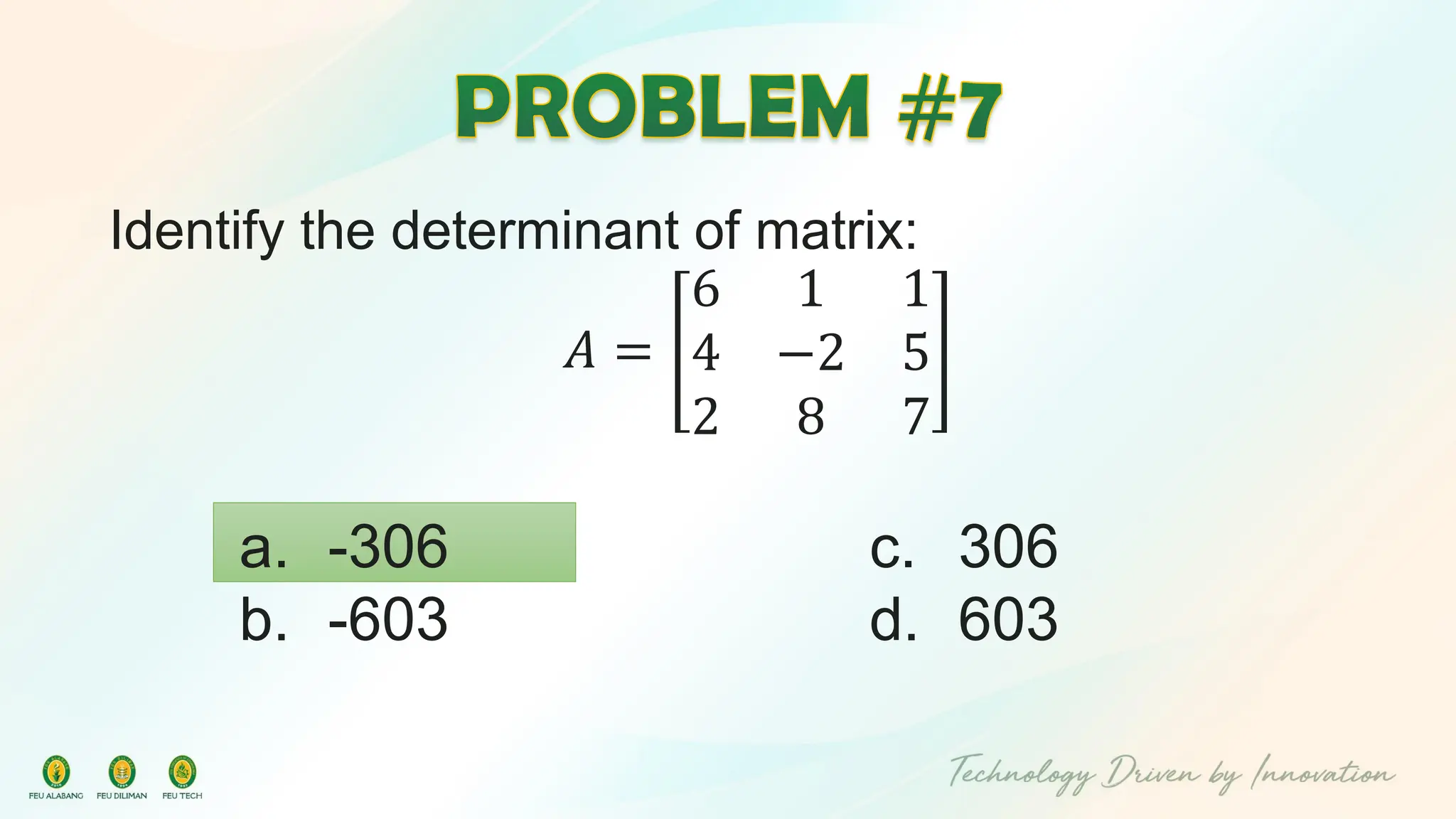
Identify the determinant of matrix:
𝐴 =
6 1 1
4 −2 5
2 8 7
c. 306
d. 603
a. -306
b. -603
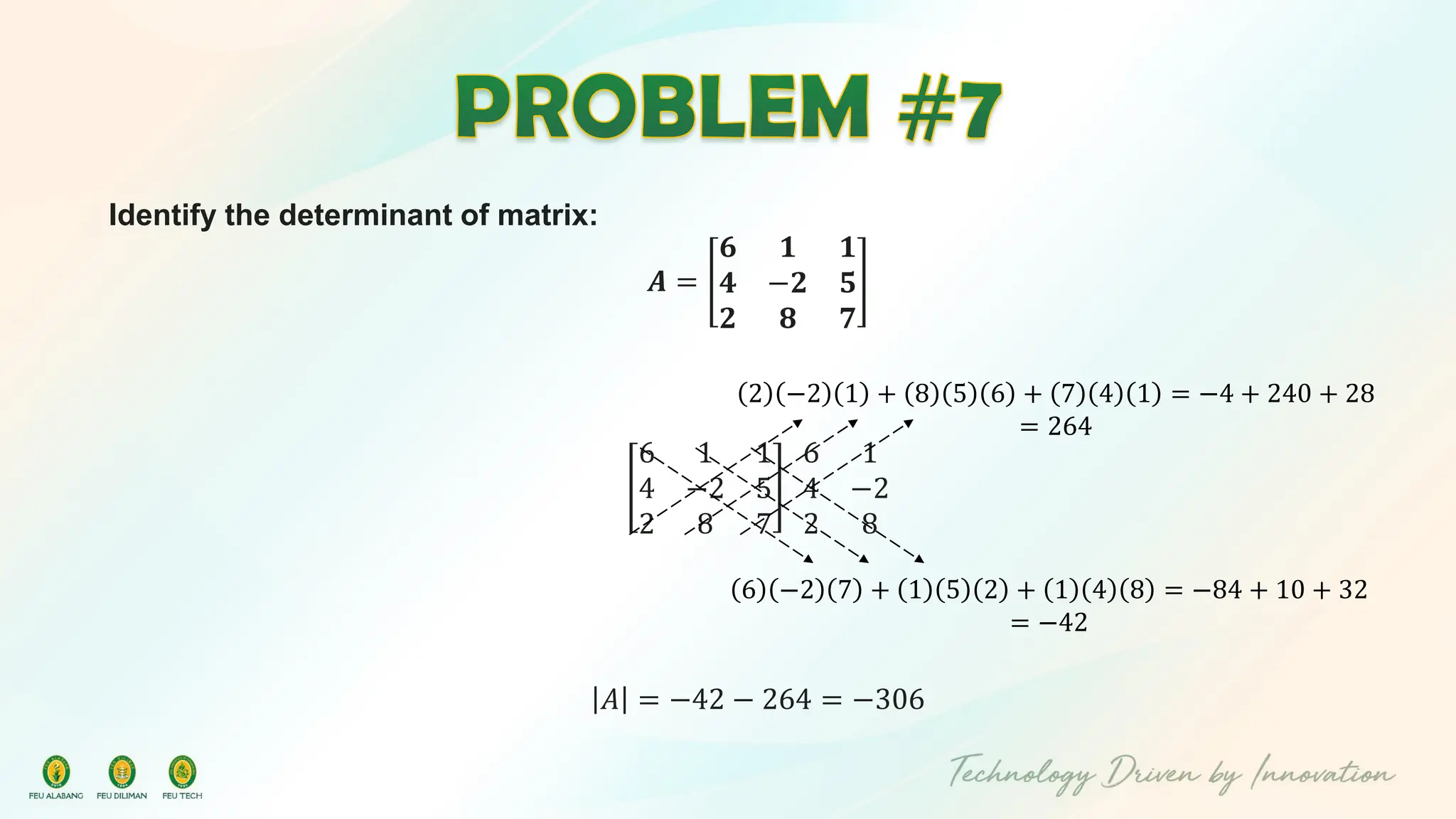
Identify the determinant of matrix:
𝑨 =
𝟔 𝟏 𝟏
𝟒 −𝟐 𝟓
𝟐 𝟖 𝟕
6 1 1
4 −2 5
2 8 7
6 1
4 −2
2 8
𝐴 = −42 − 264 = −306
6 −2 7 + 1 5 2 + 1 4 8 = −84 + 10 + 32
= −42
2 −2 1 + 8 5 6 + 7 4 1 = −4 + 240 + 28
= 264
Algebra 2
COMPLEX NUMBERS
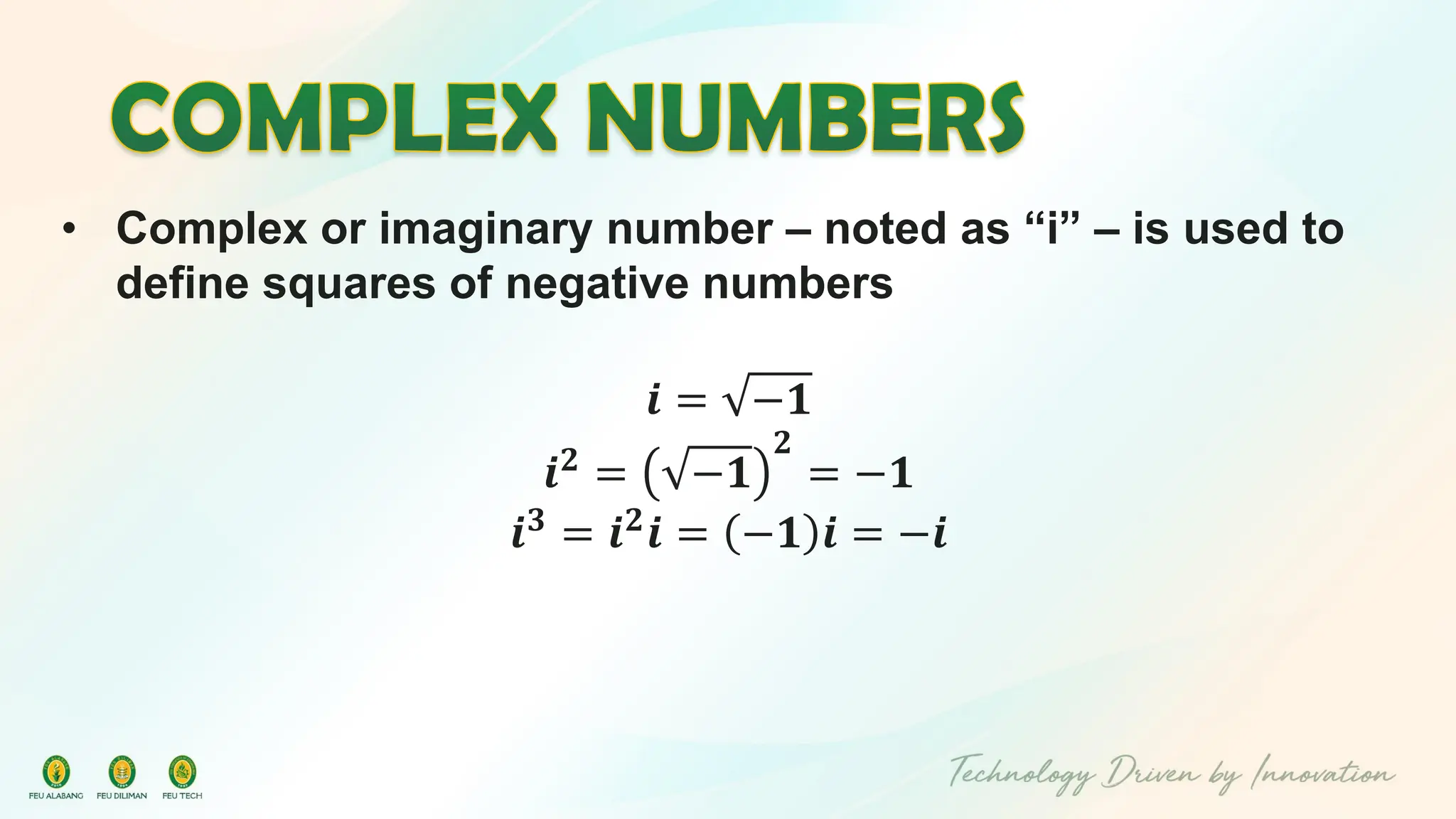
• Complex or imaginary number – noted as “i” – is used to
define squares of negative numbers
𝒊 = −𝟏
𝒊𝟐
= −𝟏
𝟐
= −𝟏
𝒊𝟑
= 𝒊𝟐
𝒊 = −𝟏 𝒊 = −𝒊
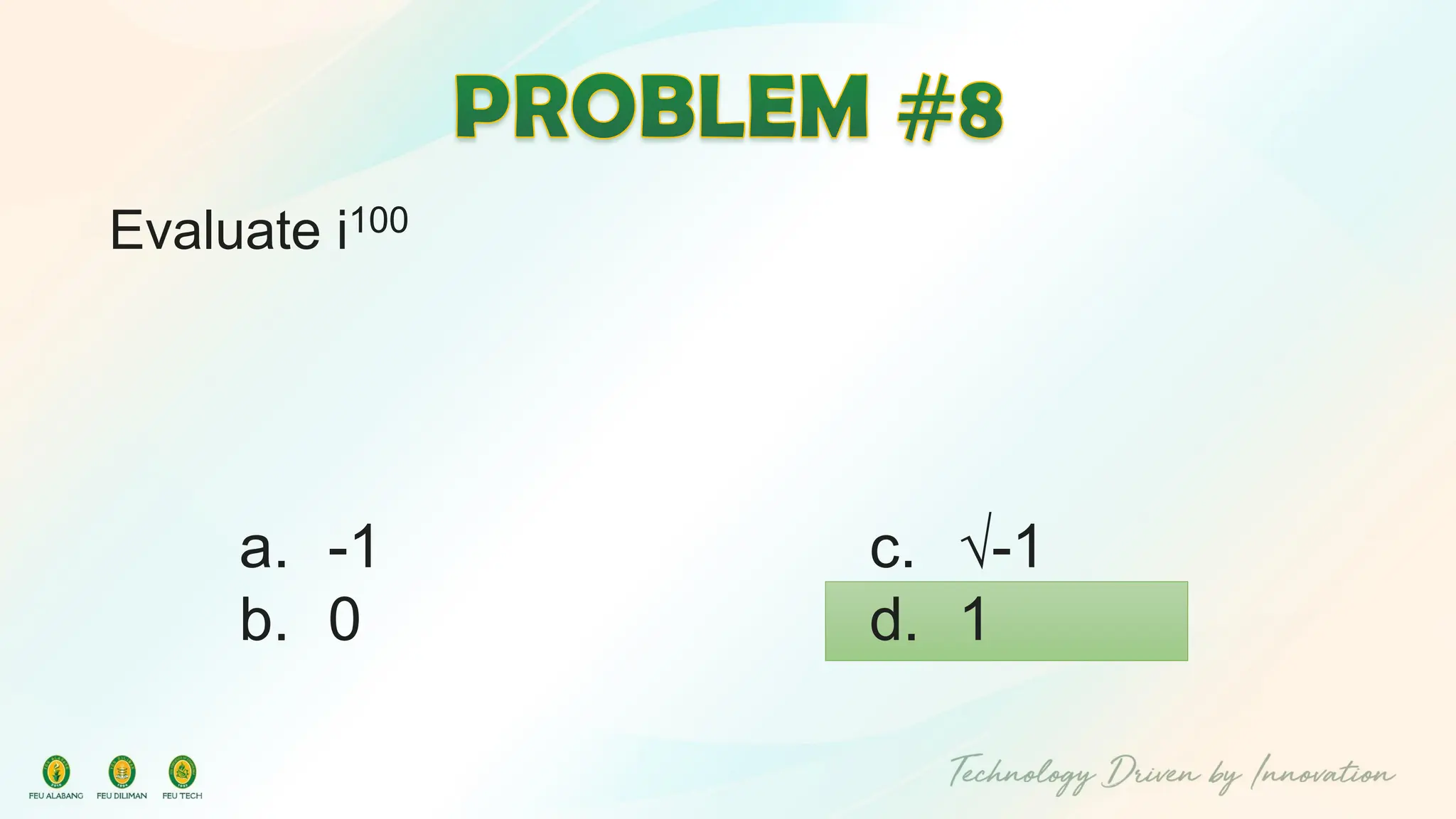
Evaluate i100
c. √-1
d. 1
a. -1
b. 0
Evaluate i100
𝑖100
= 𝑖2 50
= −1 50
= 1
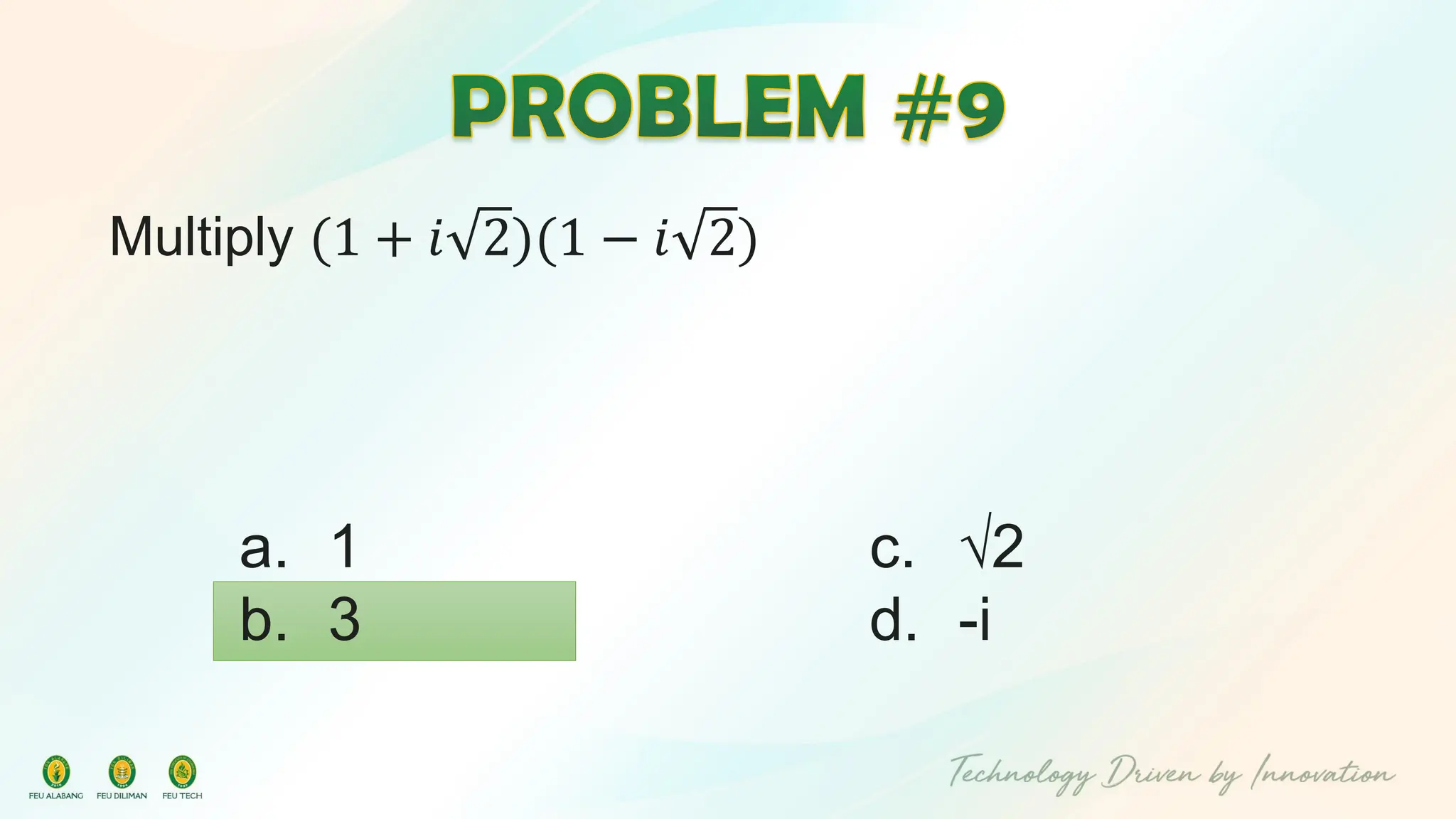
Multiply (1 + 𝑖 2)(1 − 𝑖 2)
c. √2
d. -i
a. 1
b. 3
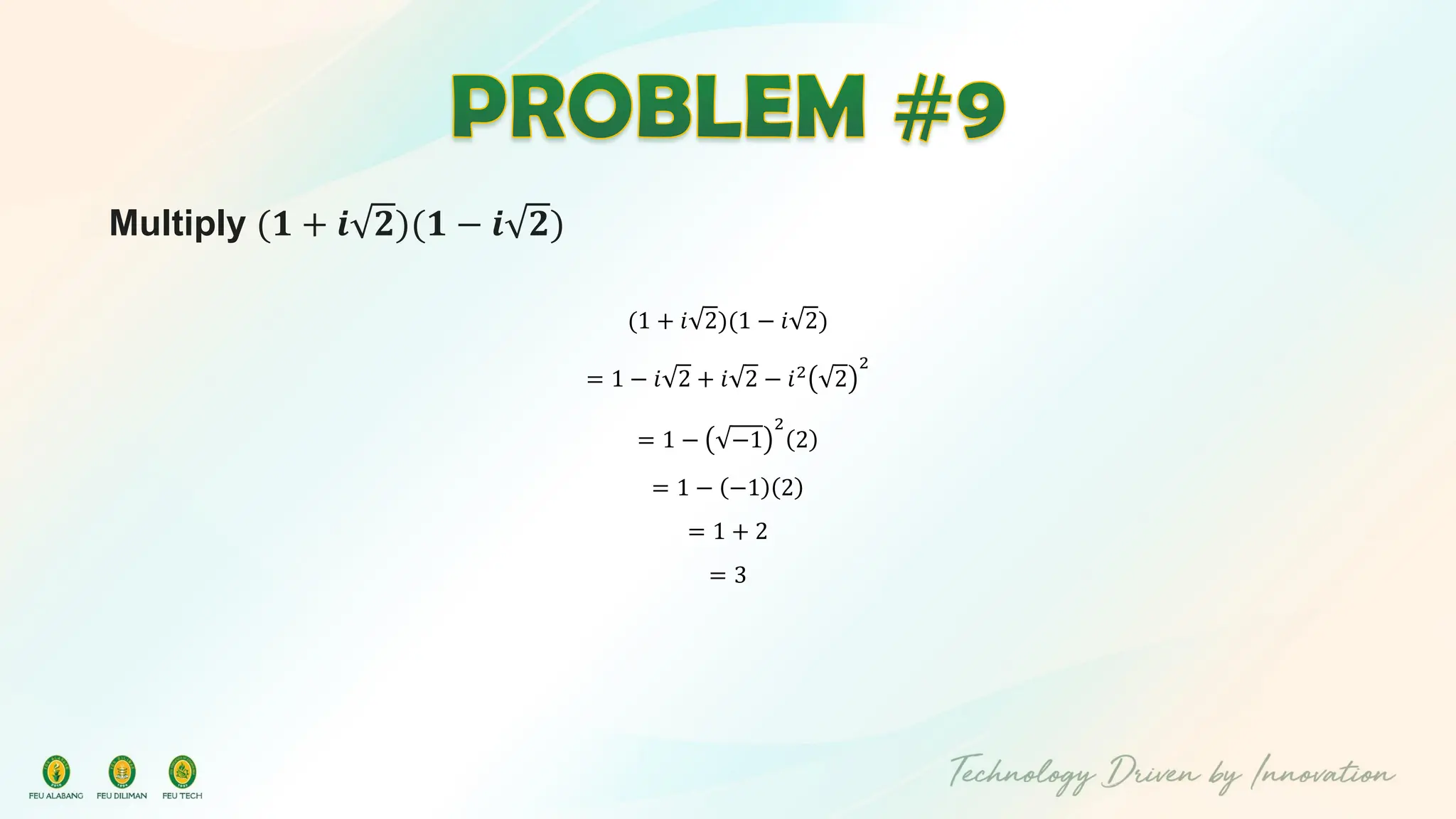
Multiply (𝟏 + 𝒊 𝟐)(𝟏 − 𝒊 𝟐)
(1 + 𝑖 2)(1 − 𝑖 2)
= 1 − 𝑖 2 + 𝑖 2 − 𝑖2
2
2
= 1 − −1
2
2
= 1 − −1 2
= 1 + 2
= 3
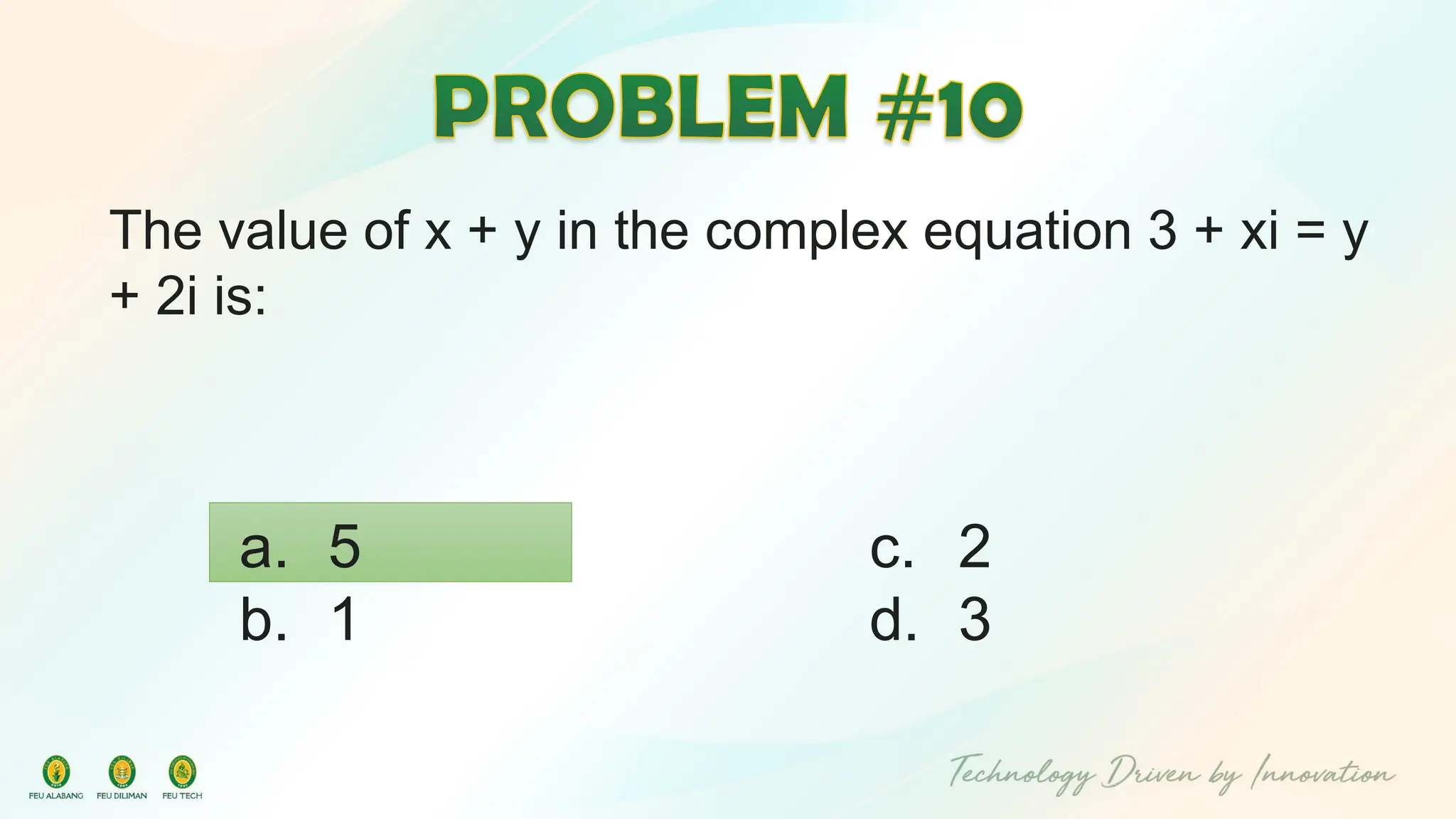
The value of x + y in the complex equation 3 + xi = y
+ 2i is:
c. 2
d. 3
a. 5
b. 1
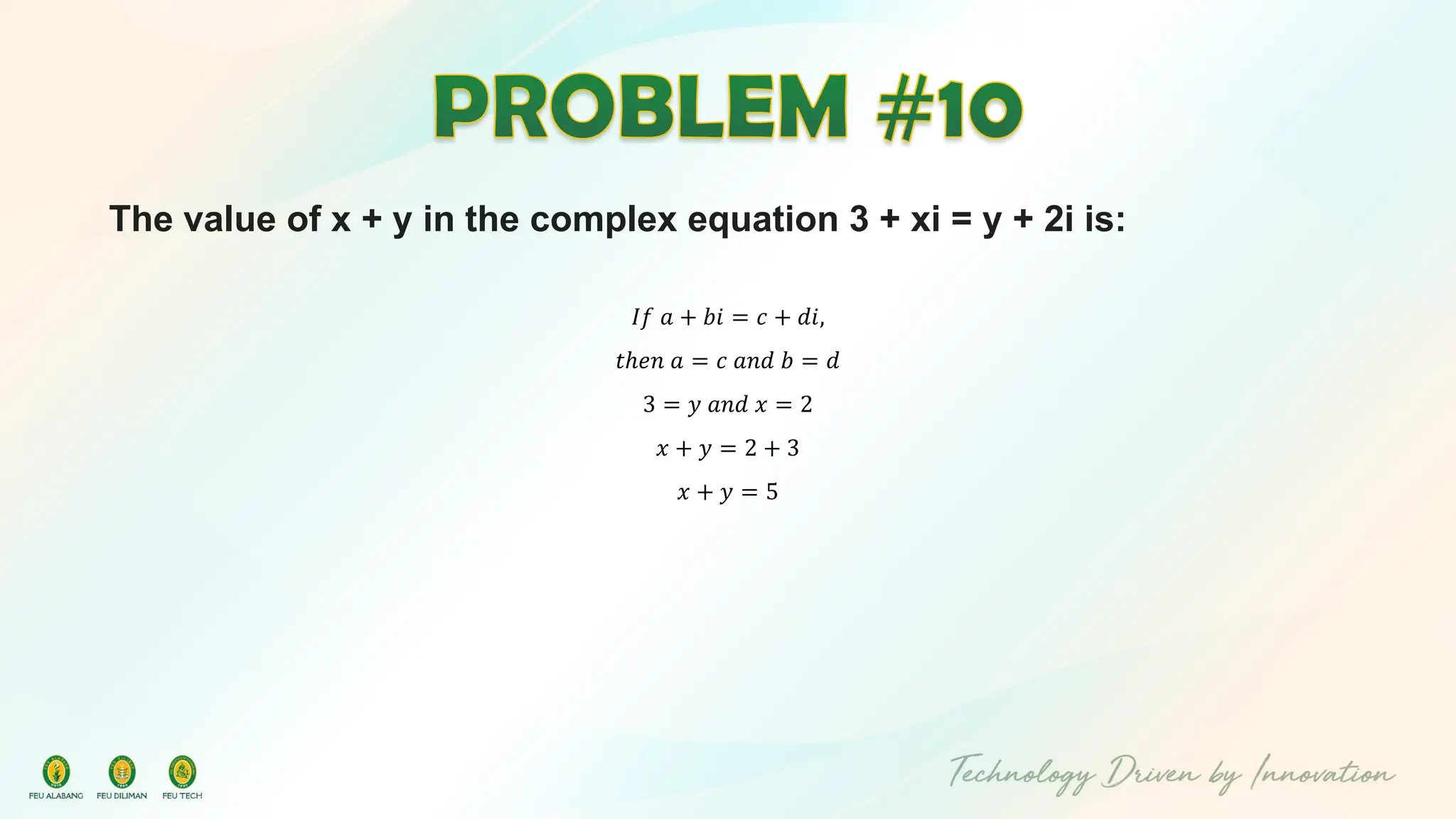
The value of x + y in the complex equation 3 + xi = y + 2i is:
𝐼𝑓 𝑎 + 𝑏𝑖 = 𝑐 + 𝑑𝑖,
𝑡ℎ𝑒𝑛 𝑎 = 𝑐 𝑎𝑛𝑑 𝑏 = 𝑑
3 = 𝑦 𝑎𝑛𝑑 𝑥 = 2
𝑥 + 𝑦 = 2 + 3
𝑥 + 𝑦 = 5
Algebra 2
COUNTING TECHNIQUES
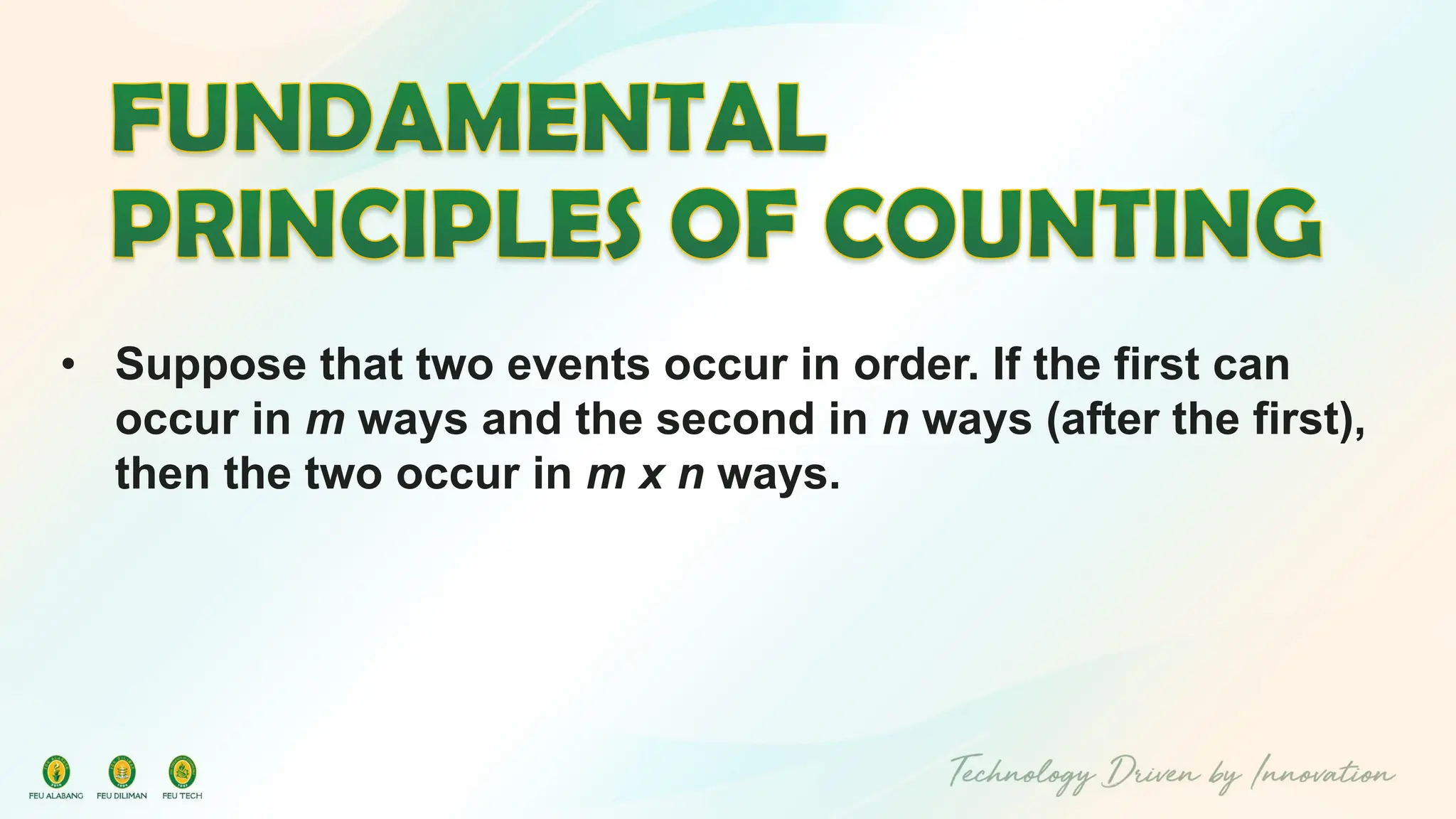
• Suppose that two events occur in order. If the first can
occur in m ways and the second in n ways (after the first),
then the two occur in m x n ways.
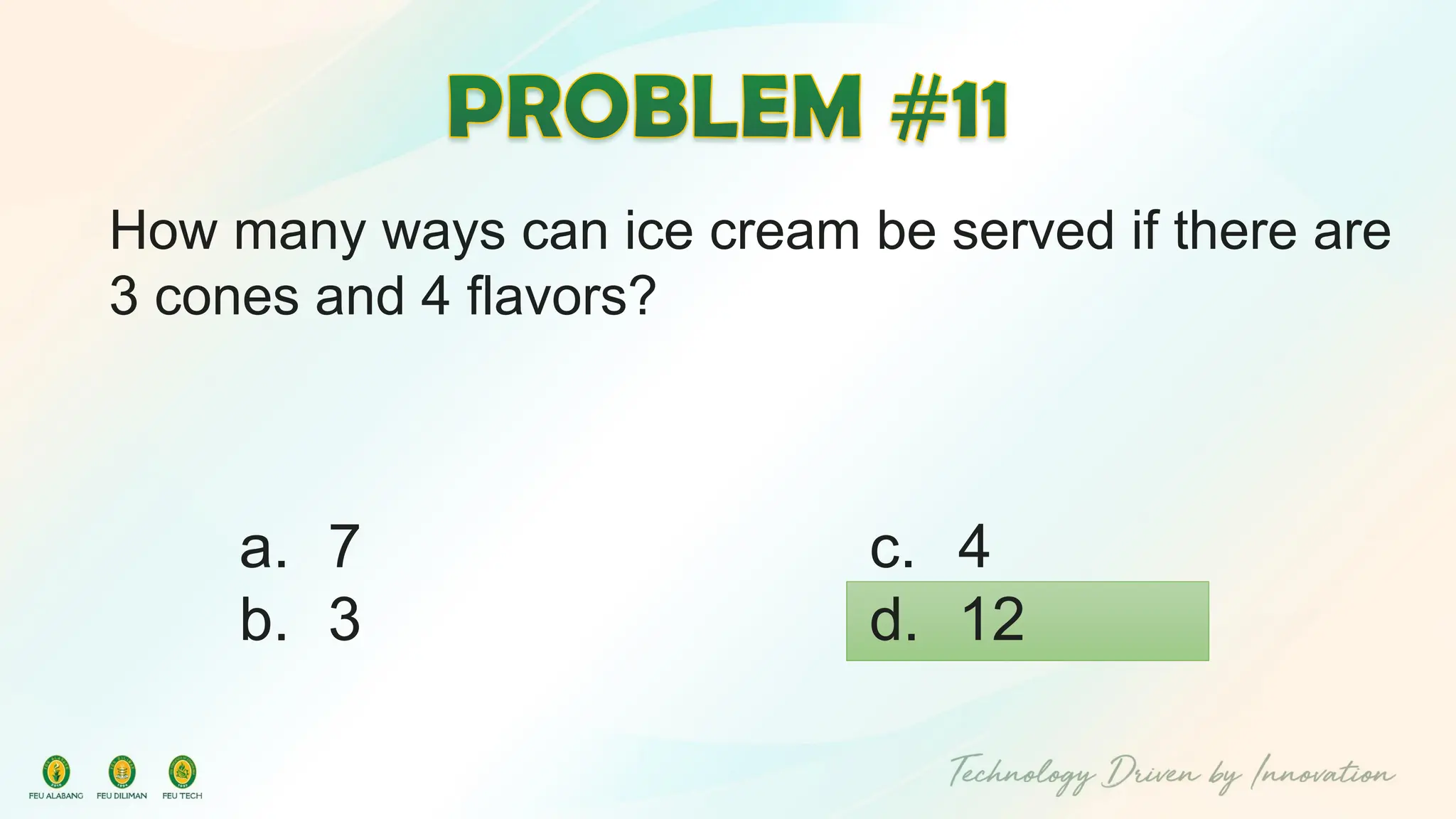
How many ways can ice cream be served if there are
3 cones and 4 flavors?
c. 4
d. 12
a. 7
b. 3
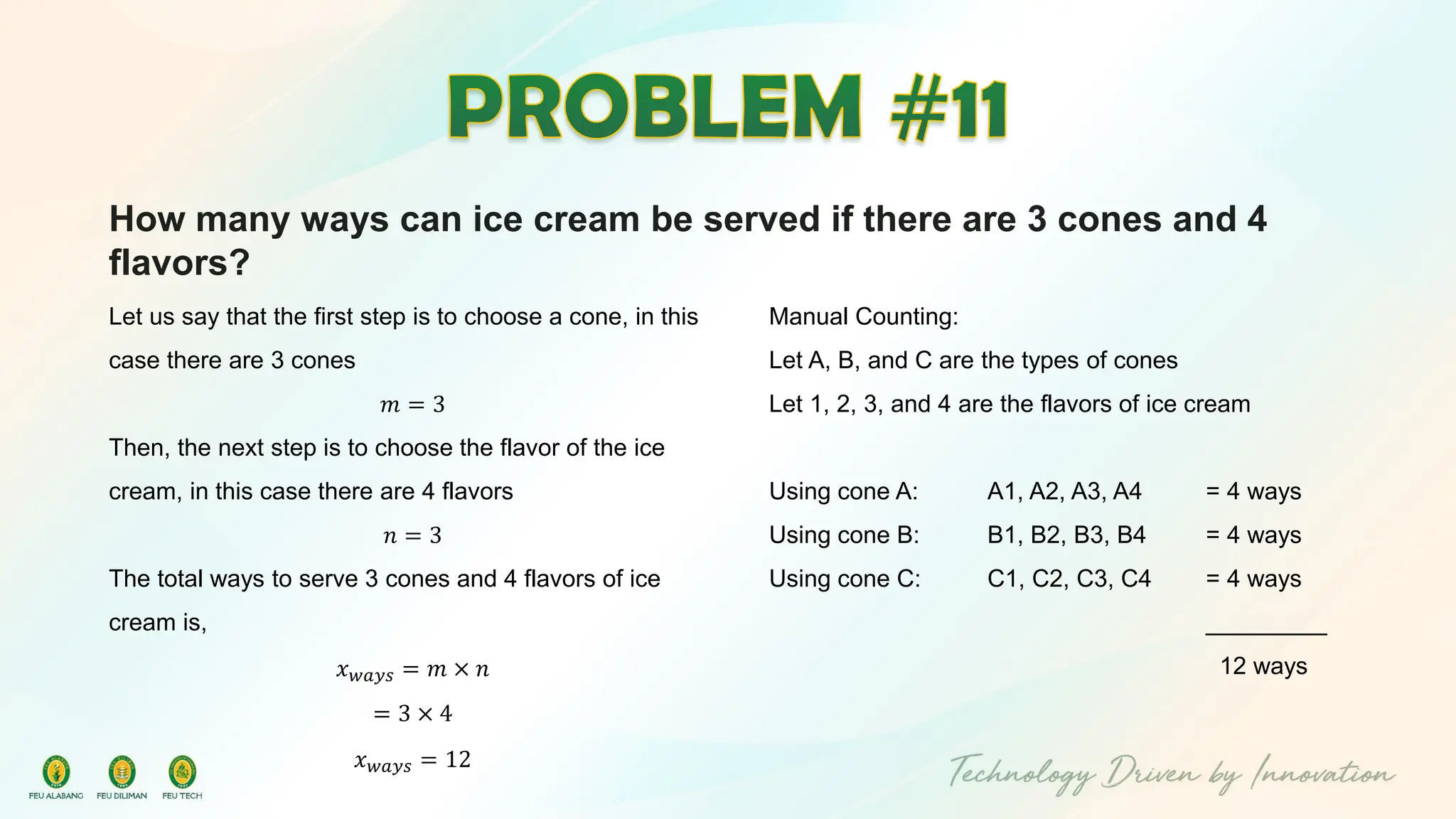
How many ways can ice cream be served if there are 3 cones and 4
flavors?
Let us say that the first step is to choose a cone, in this
case there are 3 cones
𝑚 = 3
Then, the next step is to choose the flavor of the ice
cream, in this case there are 4 flavors
𝑛 = 3
The total ways to serve 3 cones and 4 flavors of ice
cream is,
𝑥𝑤𝑎𝑦𝑠 = 𝑚 × 𝑛
= 3 × 4
𝑥𝑤𝑎𝑦𝑠 = 12
Manual Counting:
Let A, B, and C are the types of cones
Let 1, 2, 3, and 4 are the flavors of ice cream
Using cone A: A1, A2, A3, A4 = 4 ways
Using cone B: B1, B2, B3, B4 = 4 ways
Using cone C: C1, C2, C3, C4 = 4 ways
_________
12 ways
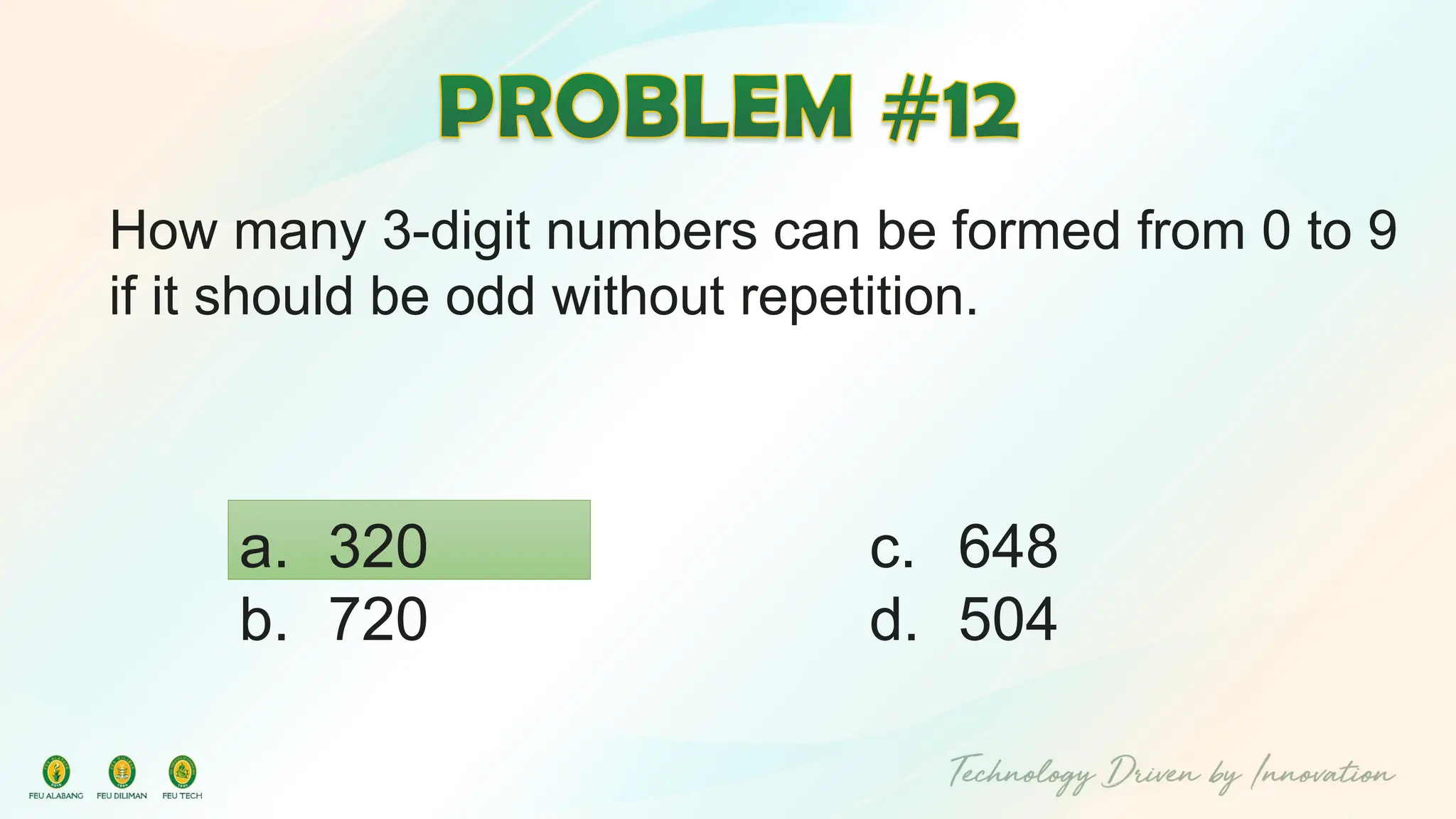
How many 3-digit numbers can be formed from 0 to 9
if it should be odd without repetition.
c. 648
d. 504
a. 320
b. 720
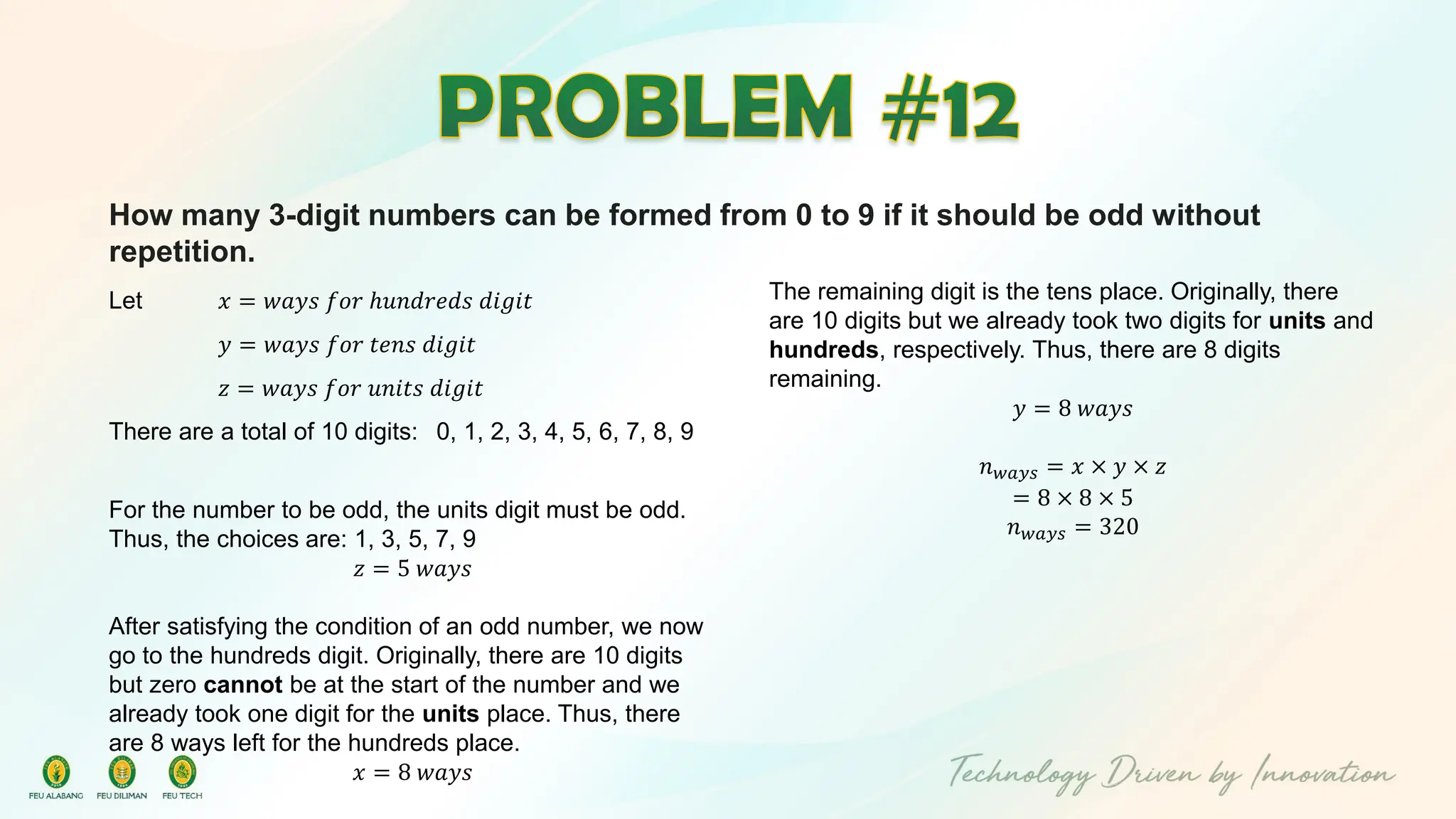
How many 3-digit numbers can be formed from 0 to 9 if it should be odd without
repetition.
Let 𝑥 = 𝑤𝑎𝑦𝑠 𝑓𝑜𝑟 ℎ𝑢𝑛𝑑𝑟𝑒𝑑𝑠 𝑑𝑖𝑔𝑖𝑡
𝑦 = 𝑤𝑎𝑦𝑠 𝑓𝑜𝑟 𝑡𝑒𝑛𝑠 𝑑𝑖𝑔𝑖𝑡
𝑧 = 𝑤𝑎𝑦𝑠 𝑓𝑜𝑟 𝑢𝑛𝑖𝑡𝑠 𝑑𝑖𝑔𝑖𝑡
There are a total of 10 digits: 0, 1, 2, 3, 4, 5, 6, 7, 8, 9
For the number to be odd, the units digit must be odd.
Thus, the choices are: 1, 3, 5, 7, 9
𝑧 = 5 𝑤𝑎𝑦𝑠
After satisfying the condition of an odd number, we now
go to the hundreds digit. Originally, there are 10 digits
but zero cannot be at the start of the number and we
already took one digit for the units place. Thus, there
are 8 ways left for the hundreds place.
𝑥 = 8 𝑤𝑎𝑦𝑠
The remaining digit is the tens place. Originally, there
are 10 digits but we already took two digits for units and
hundreds, respectively. Thus, there are 8 digits
remaining.
𝑦 = 8 𝑤𝑎𝑦𝑠
𝑛𝑤𝑎𝑦𝑠 = 𝑥 × 𝑦 × 𝑧
= 8 × 8 × 5
𝑛𝑤𝑎𝑦𝑠 = 320
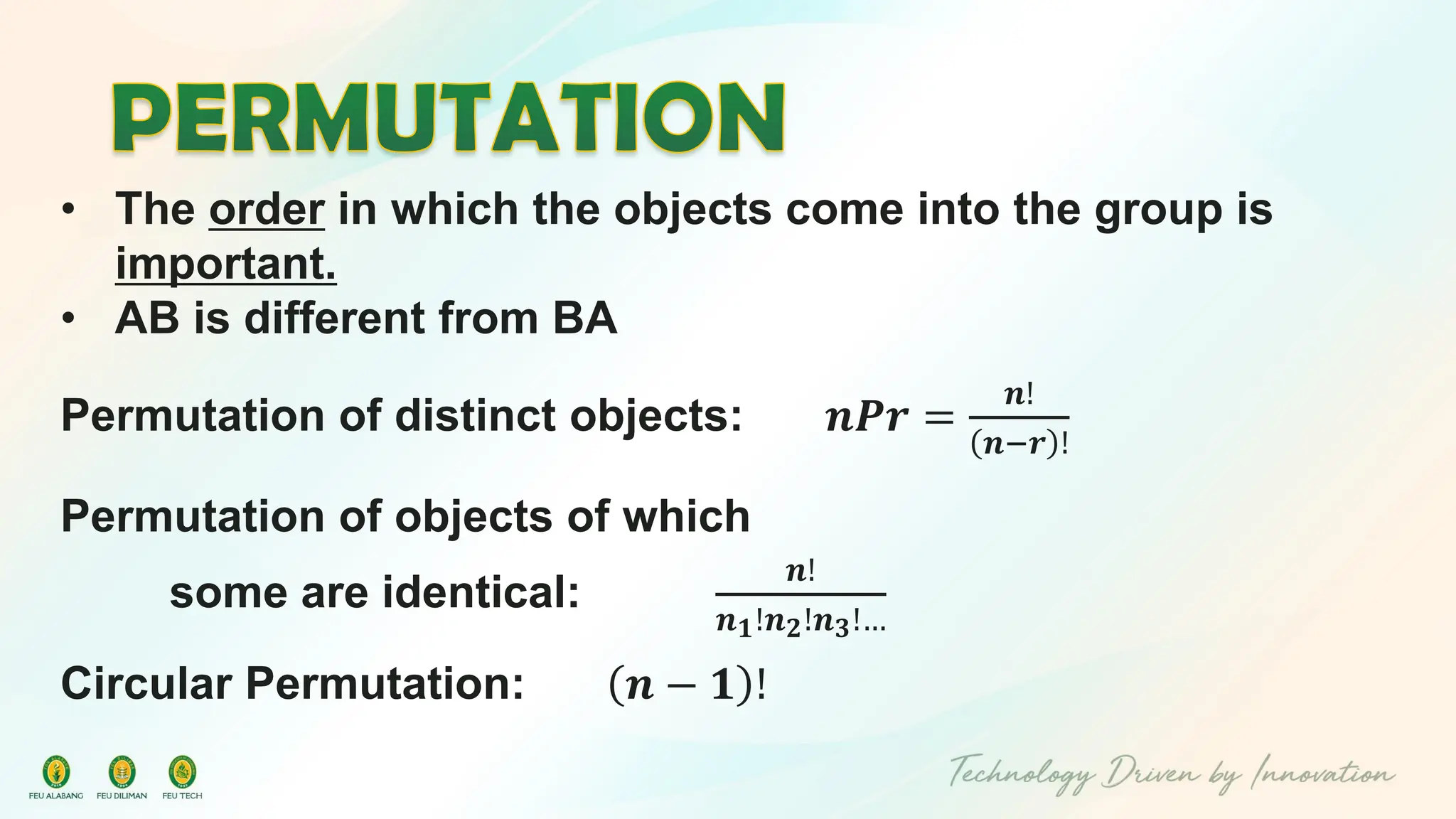
• The order in which the objects come into the group is
important.
• AB is different from BA
Permutation of distinct objects: 𝒏𝑷𝒓 =
𝒏!
𝒏−𝒓 !
Permutation of objects of which
some are identical:
𝒏!
𝒏𝟏!𝒏𝟐!𝒏𝟑!…
Circular Permutation: 𝒏 − 𝟏 !
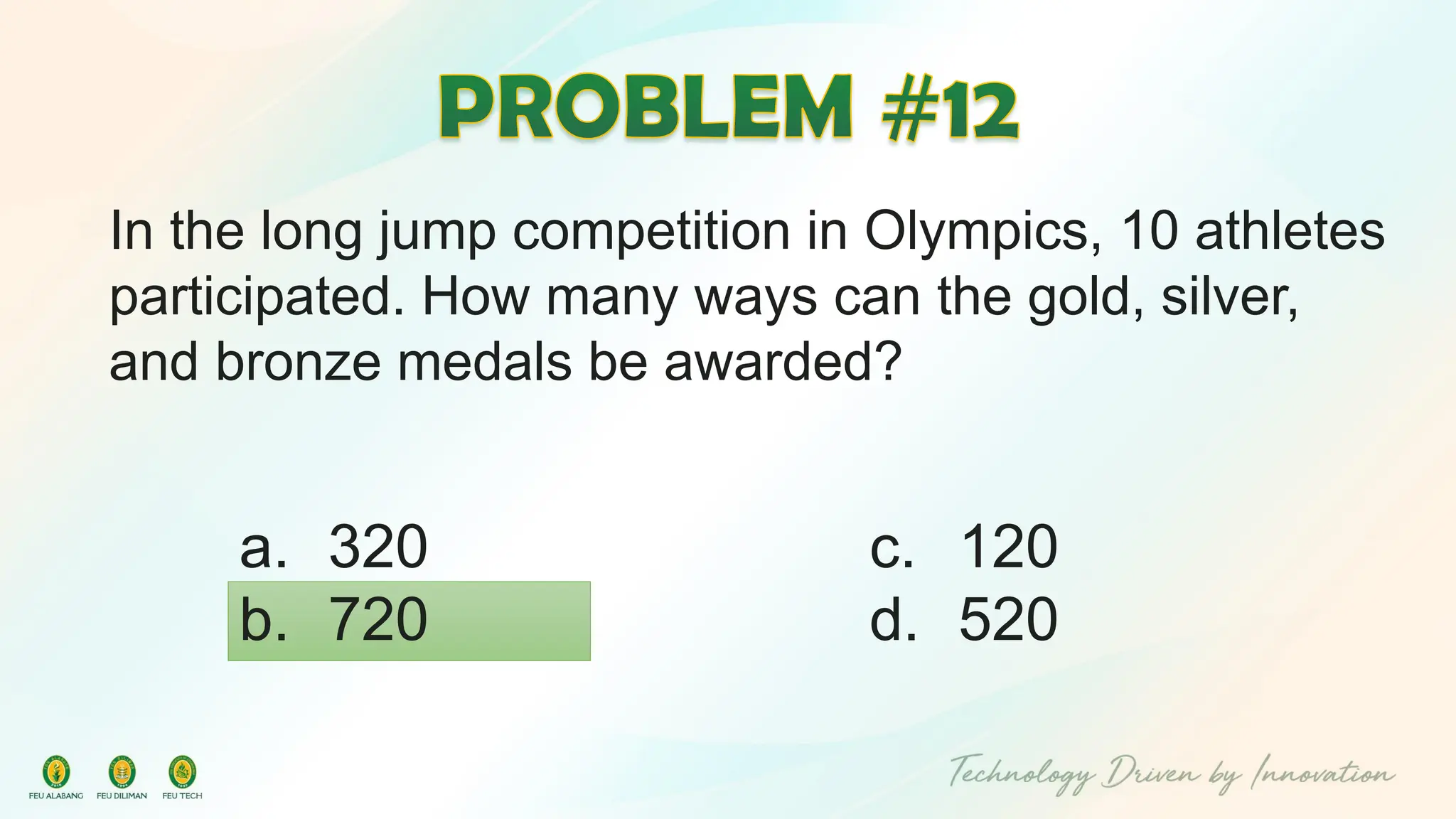
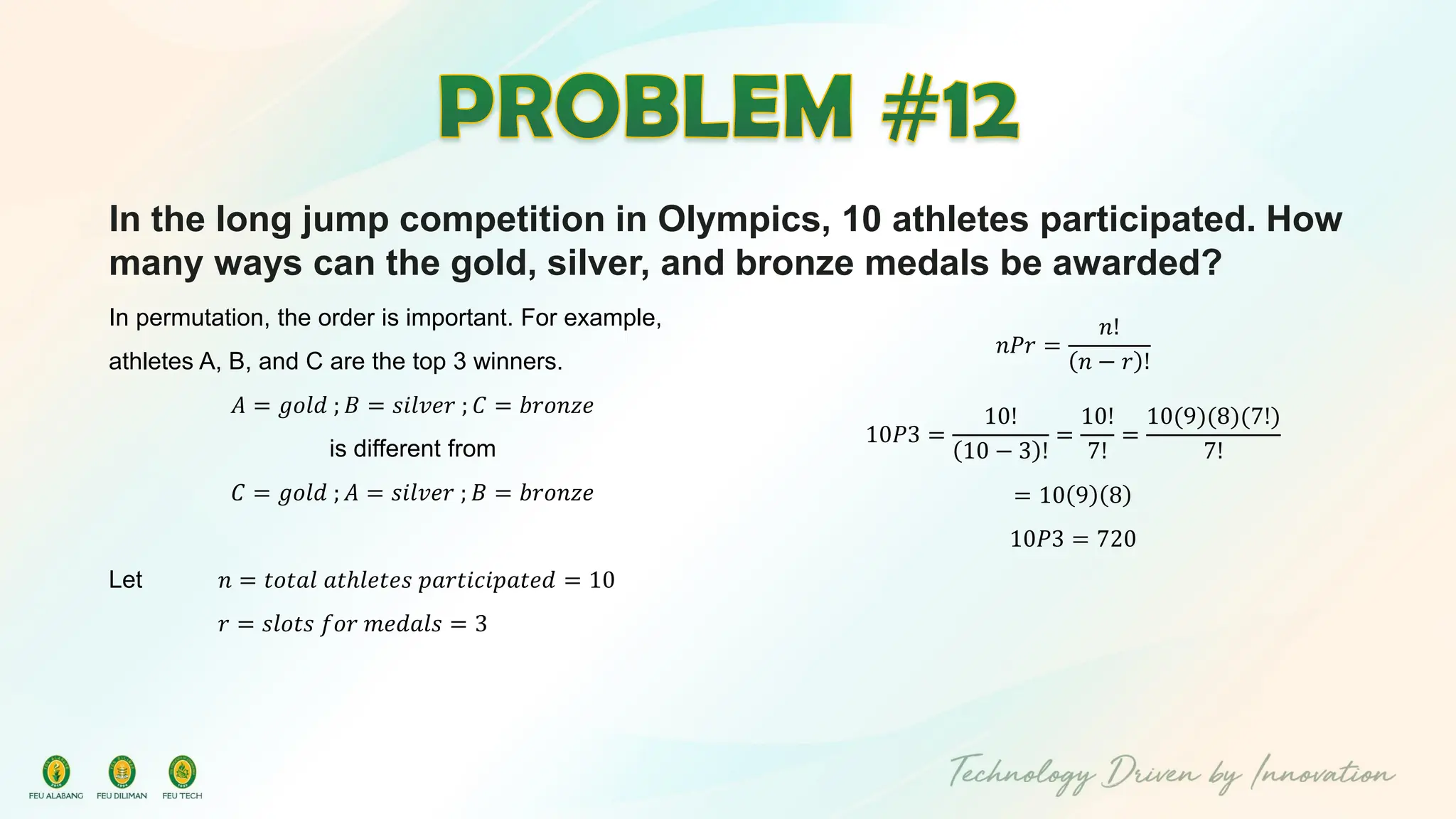
In the long jump competition in Olympics, 10 athletes
participated. How many ways can the gold, silver,
and bronze medals be awarded?
c. 120
d. 520
a. 320
b. 720
In the long jump competition in Olympics, 10 athletes participated. How
many ways can the gold, silver, and bronze medals be awarded?
In permutation, the order is important. For example,
athletes A, B, and C are the top 3 winners.
𝐴 = 𝑔𝑜𝑙𝑑 ; 𝐵 = 𝑠𝑖𝑙𝑣𝑒𝑟 ; 𝐶 = 𝑏𝑟𝑜𝑛𝑧𝑒
is different from
𝐶 = 𝑔𝑜𝑙𝑑 ; 𝐴 = 𝑠𝑖𝑙𝑣𝑒𝑟 ; 𝐵 = 𝑏𝑟𝑜𝑛𝑧𝑒
Let 𝑛 = 𝑡𝑜𝑡𝑎𝑙 𝑎𝑡ℎ𝑙𝑒𝑡𝑒𝑠 𝑝𝑎𝑟𝑡𝑖𝑐𝑖𝑝𝑎𝑡𝑒𝑑 = 10
𝑟 = 𝑠𝑙𝑜𝑡𝑠 𝑓𝑜𝑟 𝑚𝑒𝑑𝑎𝑙𝑠 = 3
𝑛𝑃𝑟 =
𝑛!
𝑛 − 𝑟 !
10𝑃3 =
10!
10 − 3 !
=
10!
7!
=
10(9)(8)(7!)
7!
= 10 9 8
10𝑃3 = 720
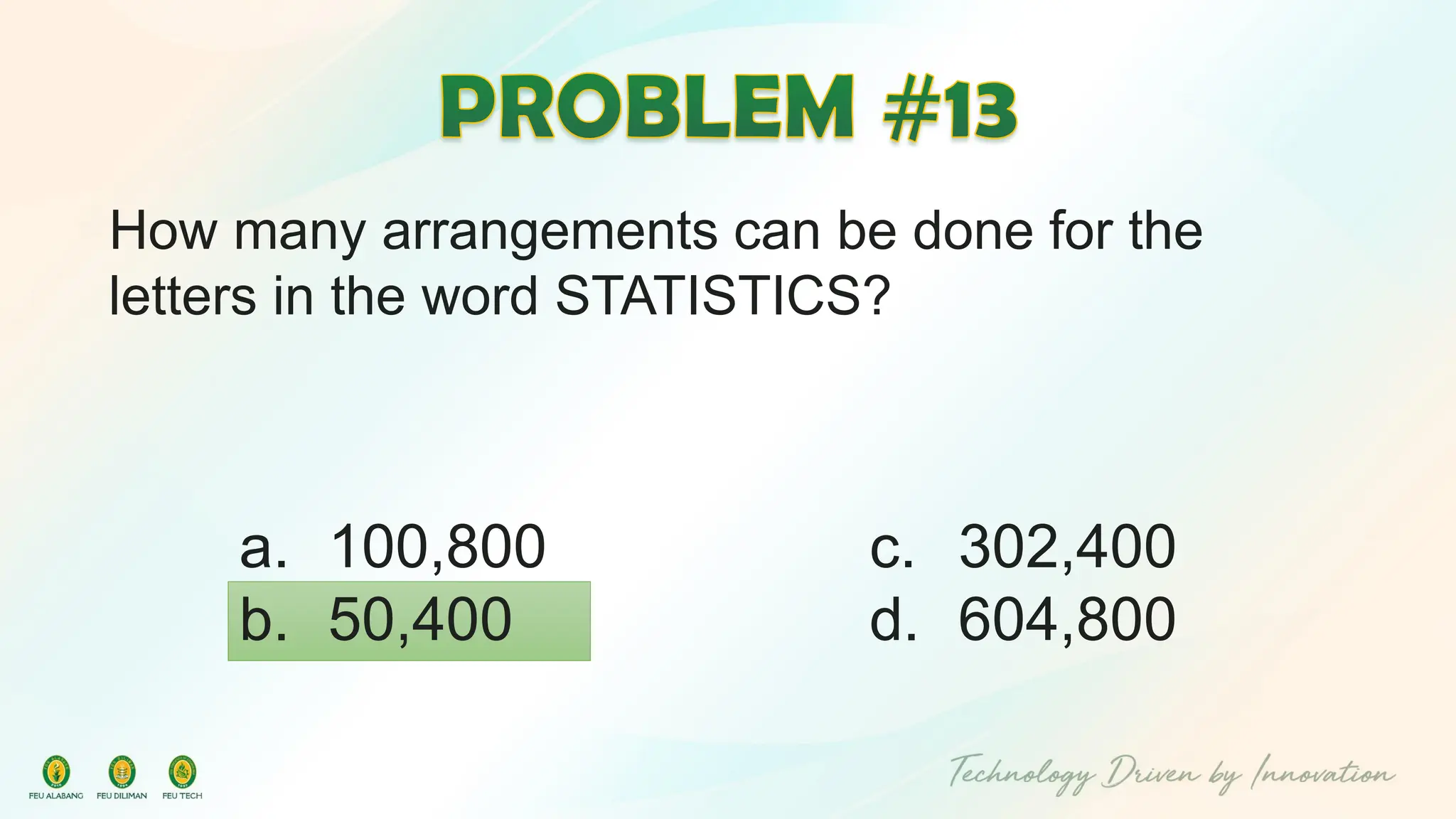
How many arrangements can be done for the
letters in the word STATISTICS?
c. 302,400
d. 604,800
a. 100,800
b. 50,400
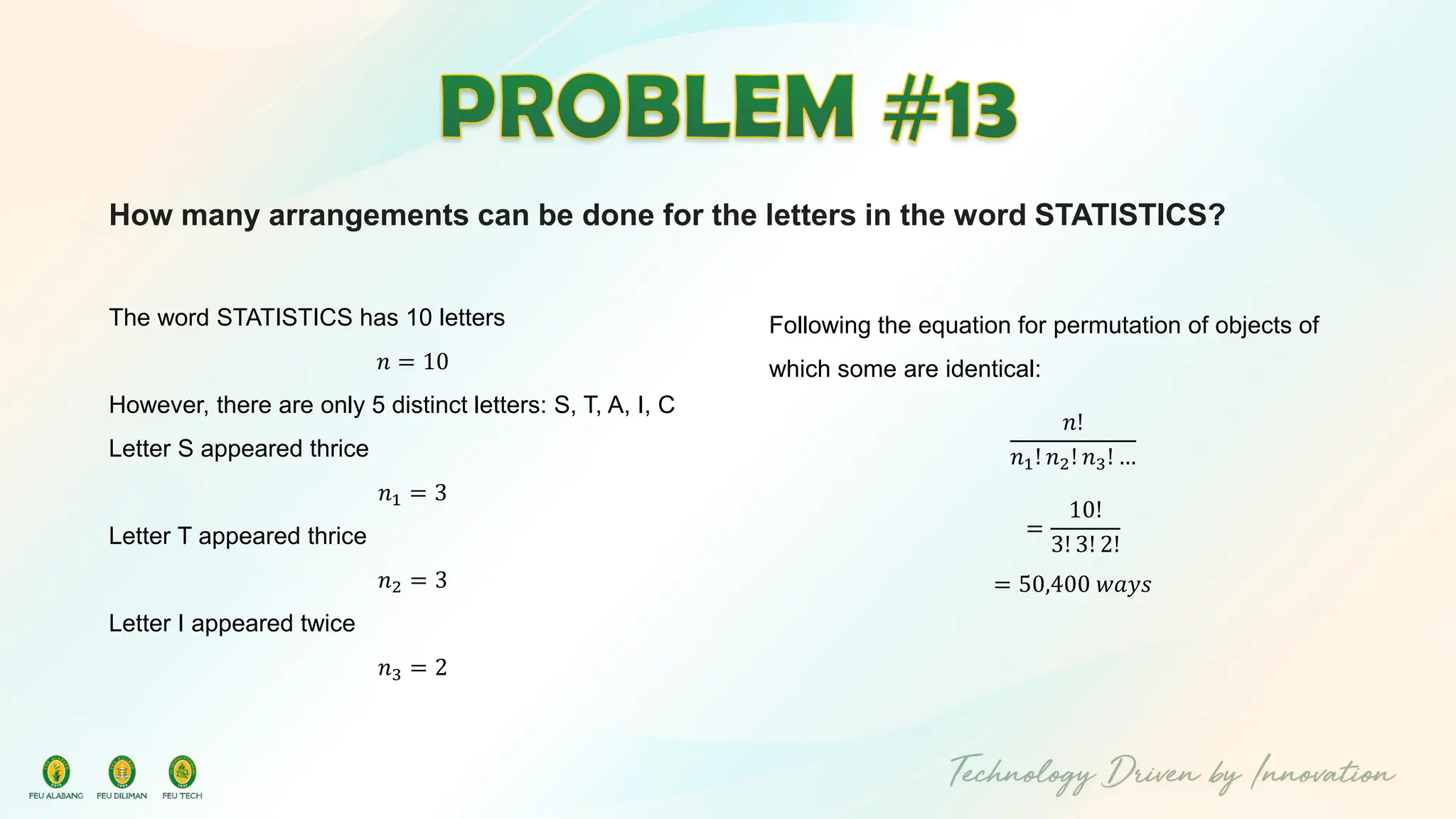
How many arrangements can be done for the letters in the word STATISTICS?
The word STATISTICS has 10 letters
𝑛 = 10
However, there are only 5 distinct letters: S, T, A, I, C
Letter S appeared thrice
𝑛1 = 3
Letter T appeared thrice
𝑛2 = 3
Letter I appeared twice
𝑛3 = 2
Following the equation for permutation of objects of
which some are identical:
𝑛!
𝑛1! 𝑛2! 𝑛3! …
=
10!
3! 3! 2!
= 50,400 𝑤𝑎𝑦𝑠
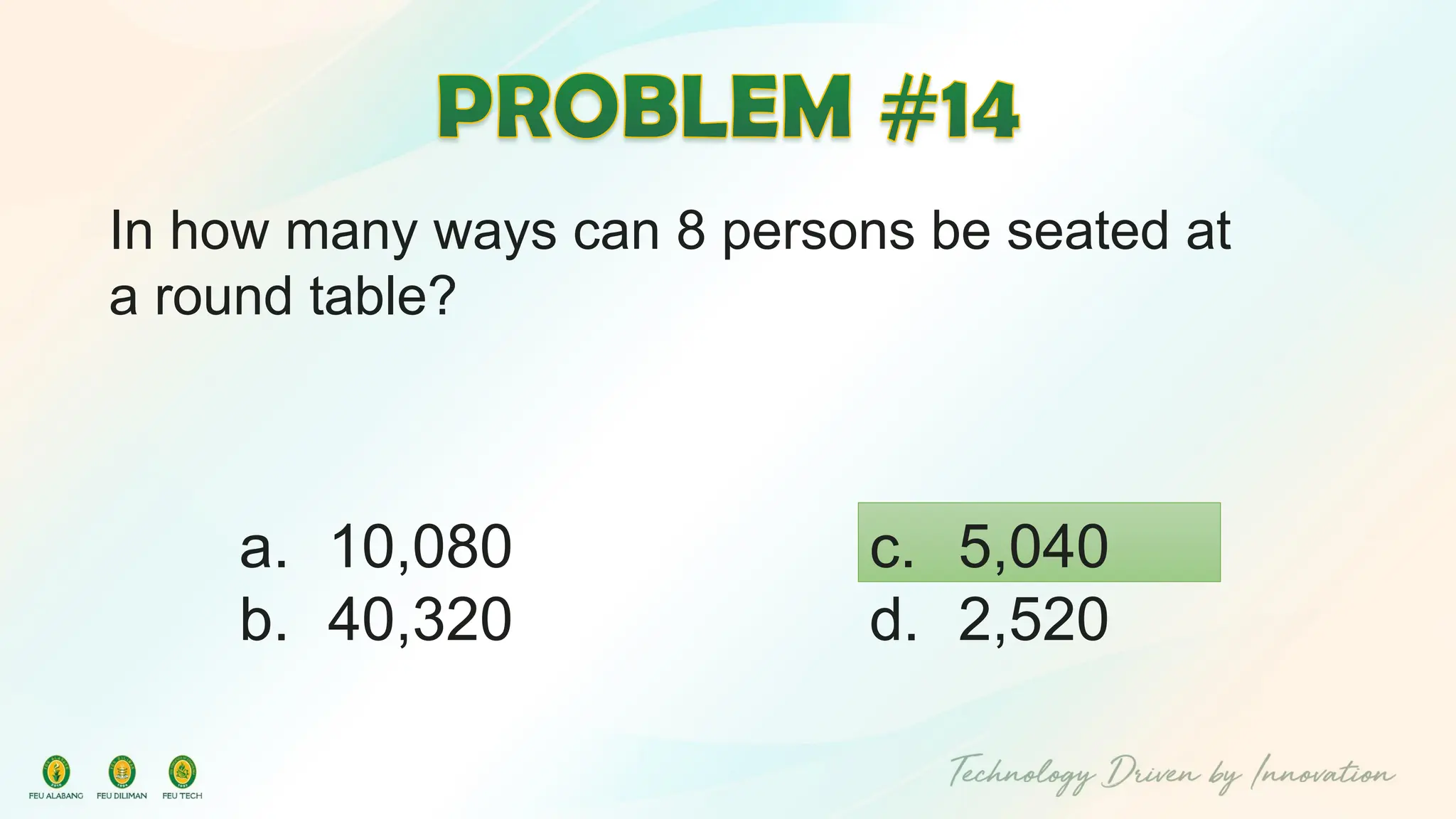
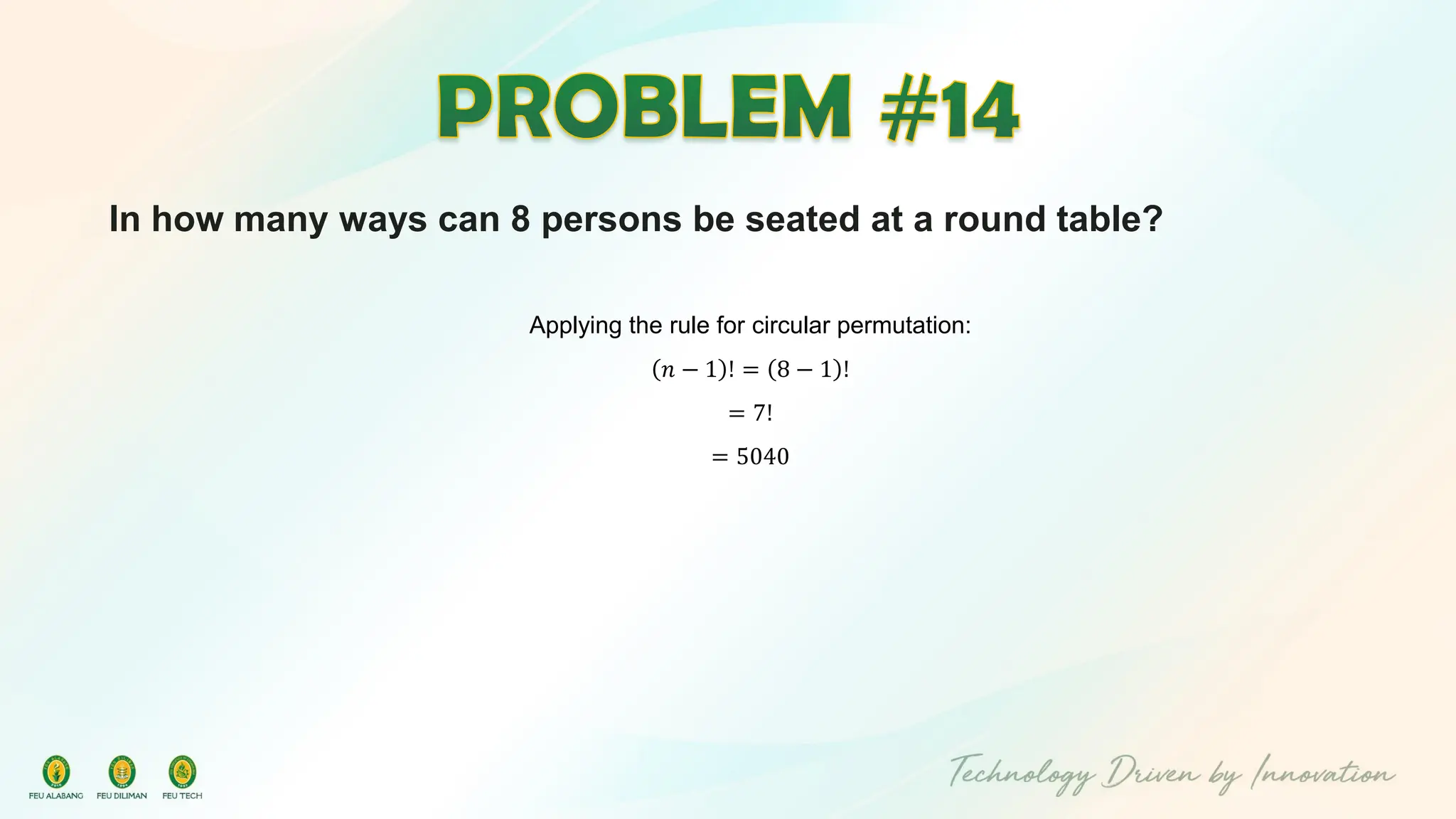
In how many ways can 8 persons be seated at
a round table?
c. 5,040
d. 2,520
a. 10,080
b. 40,320
In how many ways can 8 persons be seated at a round table?
Applying the rule for circular permutation:
𝑛 − 1 ! = 8 − 1 !
= 7!
= 5040
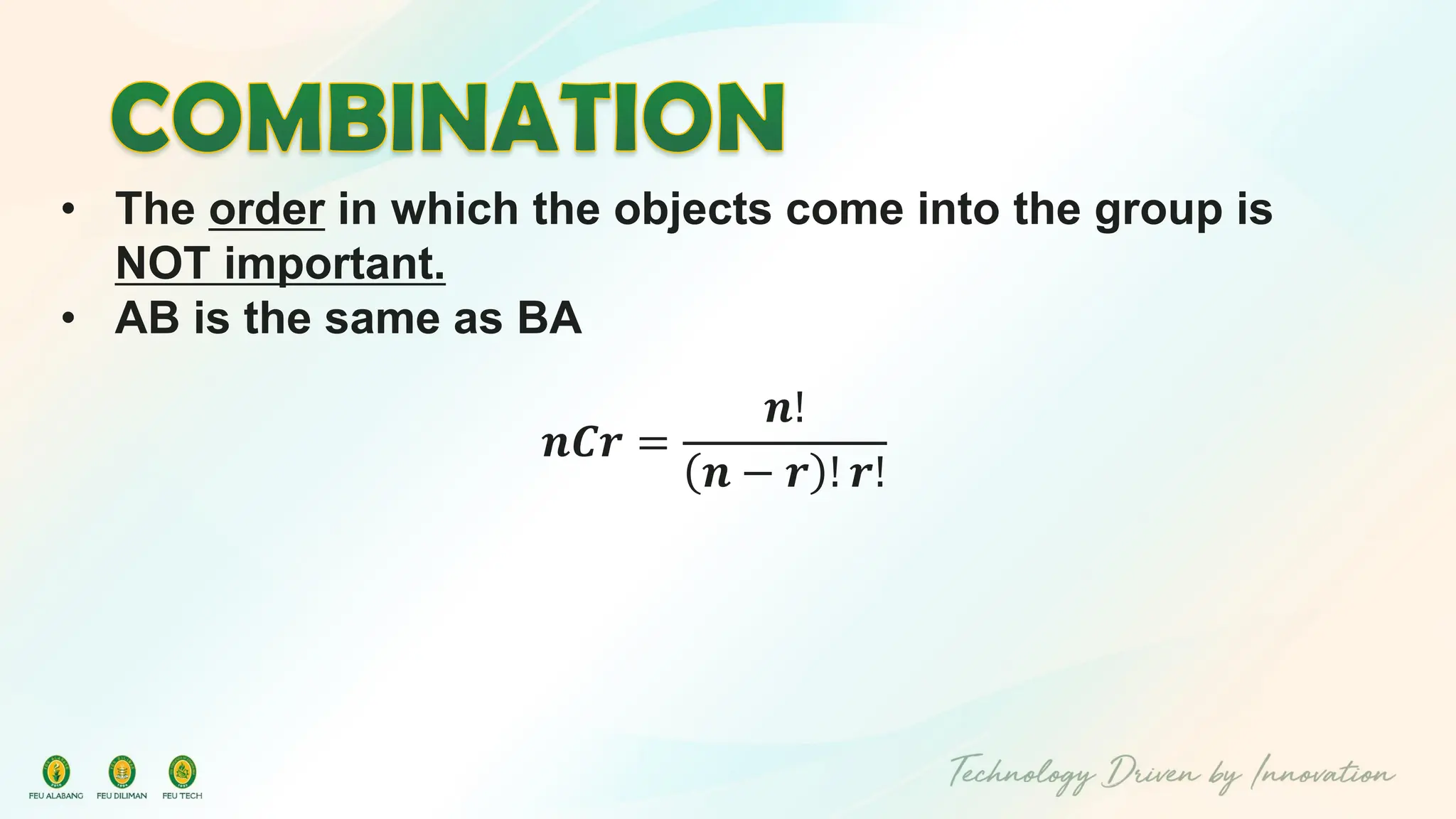
• The order in which the objects come into the group is
NOT important.
• AB is the same as BA
𝒏𝑪𝒓 =
𝒏!
𝒏 − 𝒓 ! 𝒓!
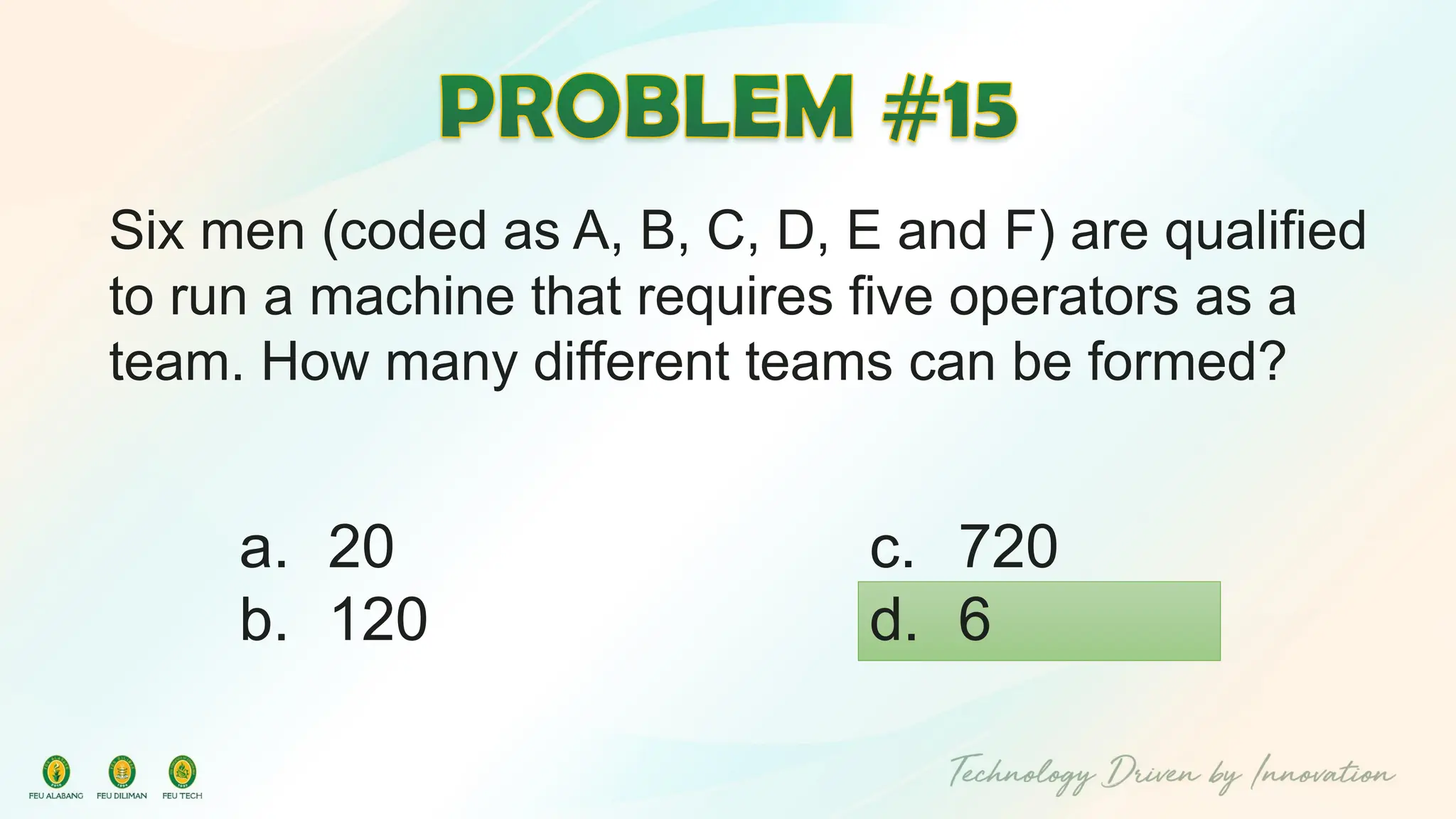
Six men (coded as A, B, C, D, E and F) are qualified
to run a machine that requires five operators as a
team. How many different teams can be formed?
c. 720
d. 6
a. 20
b. 120
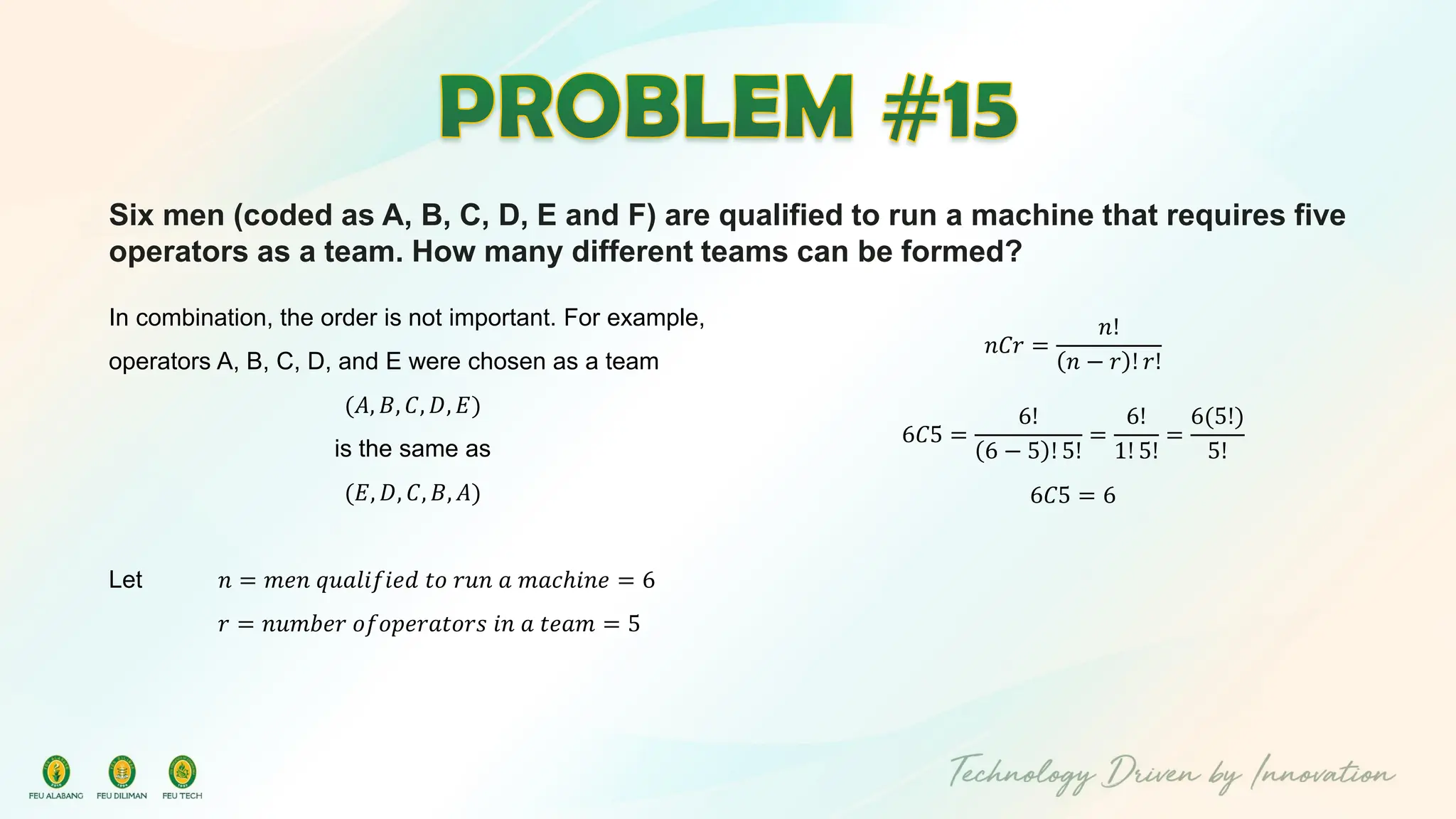
Six men (coded as A, B, C, D, E and F) are qualified to run a machine that requires five
operators as a team. How many different teams can be formed?
In combination, the order is not important. For example,
operators A, B, C, D, and E were chosen as a team
(𝐴, 𝐵, 𝐶, 𝐷, 𝐸)
is the same as
(𝐸, 𝐷, 𝐶, 𝐵, 𝐴)
Let 𝑛 = 𝑚𝑒𝑛 𝑞𝑢𝑎𝑙𝑖𝑓𝑖𝑒𝑑 𝑡𝑜 𝑟𝑢𝑛 𝑎 𝑚𝑎𝑐ℎ𝑖𝑛𝑒 = 6
𝑟 = 𝑛𝑢𝑚𝑏𝑒𝑟 𝑜𝑓𝑜𝑝𝑒𝑟𝑎𝑡𝑜𝑟𝑠 𝑖𝑛 𝑎 𝑡𝑒𝑎𝑚 = 5
𝑛𝐶𝑟 =
𝑛!
𝑛 − 𝑟 ! 𝑟!
6𝐶5 =
6!
6 − 5 ! 5!
=
6!
1! 5!
=
6(5!)
5!
6𝐶5 = 6

DO YOU HAVE ANY QUESTIONS?
SEE YOU NEXT MEETING!

Correlation: Powerpoint 1- Algebra (1).pdf

  • 1.
  • 2.
  • 3.
    • To discussthe laws of exponents and radicals. • To explain the properties of logarithms. • To find unknown using quadratic equation. • To expand binomial expression.
  • 4.
    NUMBERS Real Numbers Rational Numbers IntegersWhole Numbers Natural Numbers Irrational Numbers Imaginary
  • 5.
    • Number ofRoots of an Equation “Every rational integral equation f(x) of the nth degree has exactly ‘n’ roots” • Consider: 𝒇 𝒙 = 𝟒𝒙𝟐 + 𝟏𝟖𝒙𝟐 + 𝟖𝒙 − 𝟓 𝒇 𝒙 = 𝒙𝟗 + 𝟖𝒙𝟓 − 𝟓𝒙 + 𝟏𝟐
  • 6.
    • The RemainderTheorem “If a polynomial f(x) is divided by (x-k), the remainder is f(k)” • The Factor Theorem “If (x-k) is a factor of a polynomial the remainder is f(k)=0”
  • 7.
    The polynomial x3+ 4x2 – 3x + 8 is divided by x – 5. What is the remainder? c. 218 d. 182 a. 821 b. 812
  • 8.
    The polynomial x3+ 4x2 – 3x + 8 is divided by x – 5. What is the remainder? 𝑓 𝑥 = 𝑥3 + 4𝑥2 − 3𝑥 + 8 𝑥 − 𝑘 = 𝑥 − 5 𝑘 = 5 𝑇𝑎𝑘𝑒 𝑛𝑜𝑡𝑒 𝑡ℎ𝑎𝑡 𝑘 = 5 𝑎𝑛𝑑 𝑛𝑜𝑡 −5, 𝑤ℎ𝑖𝑐ℎ 𝑤𝑜𝑢𝑙𝑑 𝑜𝑐𝑐𝑢𝑟 𝑜𝑛𝑙𝑦 𝑖𝑓 (𝑥 − 𝑘) = (𝑥 + 5) Substituting k to f(x) 𝑓 𝑘 = 53 + 4𝑥2 − 3 5 + 8 𝑓 𝑘 = 218
  • 9.
    When the polynomial(x + 3) (x – 4) + 4 is divided by (x – k), the remainder is k. Find the value of k. c. 4 or – 2 d. – 4 or – 2 a. 4 or 2 b. 2 or – 4
  • 10.
    When the polynomial(x + 3) (x – 4) + 4 is divided by (x – k), the remainder is k. Find the value of k. 𝑓 𝑥 = 𝑥 + 3 𝑥 − 4 + 4 𝑓 𝑥 = 𝑥2 − 4𝑥 + 3𝑥 − 12 + 4 𝑓 𝑥 = 𝑥2 − 𝑥 − 8 Substituting k to f(x) 𝑓 𝑘 = 𝑘2 − 𝑘 − 8 The problem states that the remainder is k, which means that f(k)=k 𝑘 = 𝑘2 − 𝑘 − 8 0 = 𝑘2 − 2𝑘 − 8 0 = (𝑘 − 4)(𝑘 + 2) Therefore, there are two possible values of k 𝑘 − 4 = 0 𝑘 = 4 Or 𝑘 + 2 = 0 𝑘 = −2 k could be 4 or -2
  • 11.
    Find the valueof k so that (x – 3) is a factor of x4 – k2x2 – kx – 39 = 0. c. 3 d. – 3 a. – 7/3 b. 5/3
  • 12.
    Find the valueof k so that (x – 3) is a factor of x4 – k2x2 – kx – 39 = 0. 𝑓 𝑥 = 𝑥4 − 𝑘2𝑥2 − 𝑘𝑥 − 39 The “k” in the function above is just a numerical constant and different from the “k” in the remainder theorem. As such, we could change it to a different variable “z” 𝑓 𝑥 = 𝑥4 − 𝑧2 𝑥2 − 𝑧𝑥 − 39 𝑥 − 𝑘 = 𝑥 − 3 𝑘 = 3 Substitute k to f(x) 𝑓 𝑘 = 34 − 𝑧2 32 − 𝑧 3 − 39 𝑓 𝑘 = 81 − 9𝑧2 − 3𝑧 − 39 𝑓 𝑘 = −9𝑧2 − 3𝑧 + 42 For (x-3) to be a factor, the remainder should be zero. Thus, the remainder f(k) = 0 0 = −9𝑧2 − 3𝑧 + 42 Solve for the roots of the equation to get the values of z. By quadratic formula, 𝑧 = −𝑏 ± 𝑏2 − 4𝑎𝑐 2𝑎 𝑎 = −9 , 𝑏 = −3 , 𝑐 = 42 𝑧 = − 7 3 𝑜𝑟 2
  • 13.
    When a certainpolynomial p(x) is divided by (x – 1), the remainder is 12. When the same polynomial is divided by (x – 4), the remainder is 3. Find the remainder when the polynomial is divided by (x – 1)(x – 4). c. –3x+15 d. 4x – 1 a. x + 5 b. –2x–8
  • 14.
    When a certainpolynomial p(x) is divided by (x – 1), the remainder is 12. When the same polynomial is divided by (x – 4), the remainder is 3. Find the remainder when the polynomial is divided by (x – 1)(x – 4). When dividing a polynomial p(x), the resulting equation is 𝑝 𝑥 𝑥 − 𝑎 = 𝑓 𝑥 + 𝑟 (𝑥 − 𝑎) where r is the remainder To get the remainder, remove (x-a) by multiplying it on both sides 𝑝 𝑥 = 𝑥 − 𝑎 𝑓 𝑥 + 𝑟 The degree of the remainder polynomial “r” is always less than the degree of the divisor polynomial by at least 1. In this case, the divisor is (x-4)(x-1) which is a quadratic polynomial (2nd degree). Thus, the remainder is in 1st degree and in linear form “ax+b” 𝑝 𝑥 = 𝑥 − 𝑘1 𝑥 − 𝑘2 𝑓 𝑥 + 𝑟 𝑝 𝑥 = 𝑥 − 1 𝑥 − 4 𝑓 𝑥 + (𝑎𝑥 + 𝑏) Substitute k1 = 1 to p(k) 𝑝 𝑘1 = 1 − 1 1 − 4 𝑓 𝑥 + 𝑎𝑥 + 𝑏 12 = 𝑎(1) + 𝑏 Substitute k2 = 4 to p(k) 𝑝 𝑘2 = 4 − 1 4 − 4 𝑓 𝑥 + 𝑎𝑥 + 𝑏 3 = 𝑎(4) + 𝑏
  • 15.
    When a certainpolynomial p(x) is divided by (x – 1), the remainder is 12. When the same polynomial is divided by (x – 4), the remainder is 3. Find the remainder when the polynomial is divided by (x – 1)(x – 4). Solving simultaneously the two equations: 12 = 𝑎 + 𝑏 3 = 4𝑎 + 𝑏 𝑎 = −3 , 𝑏 = 15 Thus the remainder “r” in form ax+b is −3𝑥 + 15 QUICK SOLUTION: By trial and error, substitute the values of k = 1 and k = 4 from the choices and it should produce values of 12 and 3, respectively. −3𝑥 + 15 Substitute k=1 −3 1 + 15 = 12 (ok!) Substitute k=4 −3 4 + 15 = 3 (ok!)
  • 16.
    Descartes’ Rule ofSigns: • The number of positive real roots of a polynomial f(x) is either equal to the number of variations in sign of f(x) or less than that number by an even integer. • The number of negative real roots of a polynomial f(x) is either equal to the number of variations in sign of f(-x) or less than that number by an even integer.
  • 17.
    Find the leastpossible number of positive real zeros of the polynomial P(x) = 3x6 + 4x5 + 3x3 – x – 3. c. 2 d. 4 a. 1 b. 3
  • 18.
    Find the leastpossible number of positive real zeros of the polynomial P(x) = 3x6 + 4x5 + 3x3 – x – 3. For positive real roots (or real zeroes), we use P(x) 𝑃 𝑥 = 3𝑥6 + 4𝑥5 + 3𝑥3 − 𝑥 − 3 Now, looking only at the sign of the numerical constants, 𝑃 𝑥 = +3 + 4 + 3 − 1 − 3 Notice that there is only 1 changing of sign, which is from positive 3 to negative 1. Thus, there is only 1 possible positive real root.
  • 19.
    Given P(x) =3x6 + 4x5 + 3x3 – x – 3. What is the maximum number of real zeros in P(x)? c. 4 d. 6 a. 3 b. 5
  • 20.
    Given P(x) =3x6 + 4x5 + 3x3 – x – 3. What is the maximum number of real zeros in P(x)? For positive real roots (or real zeroes), we use P(x) 𝑃 𝑥 = 3𝑥6 + 4𝑥5 + 3𝑥3 − 𝑥 − 3 Now, looking only at the sign of the numerical constants, 𝑃 𝑥 = +3 + 4 + 3 − 1 − 3 Notice that there is only 1 changing of sign, which is from positive 3 to negative 1. Thus, there is only 1 possible positive real root. For negative real roots (or real zeroes), we use P(x) 𝑃 𝑥 = 3(−𝑥)6 +4(−𝑥)5 +3(−𝑥)3 −(−𝑥) − 3 𝑃 𝑥 = 3𝑥6 − 4𝑥5 − 3𝑥3 + 𝑥 − 3 Now, looking only at the sign of the numerical constants, 𝑃 𝑥 = +3 − 4 − 3 + 1 − 3 Notice that there is only 3 changing of sign. Thus, there could be 3 or 1 (3 less than an even number) possible negative real roots. However, since we are looking for maximum possible, use 3. 1 positive root + 3 negative roots = 4 maximum possible real zeroes
  • 21.
    EQUATION REMARKS an =a × a ×a ×… n factors am × an = am+n Multiplication am / an = am−n Division (am)n = amn Power (abc)n = anbncn Distribution (a)m/n = 𝑛 𝑎𝑚 Radical (a)-m = 1/am Reciprocal a0 = 1 Given a ≠ 0
  • 22.
    Properties of Radicals a1/n= 𝒏 a (a)m/n = 𝒏 a𝒎 = (𝒏 a)m 𝒏 a𝒏 = a 𝒏 a × 𝒏 b = 𝒏 ab 𝒎 𝒏 a = 𝒎𝒏 a 𝒏 a𝒏 = |a|, n = even 𝒏 a𝒏 = a, n = odd
  • 23.
    Simplify the expression: 3x– 3x-1 – 3x-2 c. 5 × 3x-2 d. 12 × 3x a. 3x-2 b. 33x-3
  • 24.
    Simplify the expression: 3x– 3x-1 – 3x-2 Using the division law of exponents: am / an = am−n 3𝑥 − 3𝑥 31 − 3𝑥 32 3𝑥 − 3𝑥 3 − 3𝑥 9 9 3𝑥 − 3 3𝑥 − 1(3𝑥 ) 9 5(3𝑥 ) 9 5(3𝑥) 32 5(3𝑥−2 )
  • 25.
    Solve for x: 3x×5x+1= 6x+2 c. 2.4154 d. 2.1544 a. 2.1455 b. 2.1445
  • 26.
    Solve for x: 3x×5x+1= 6x+2 3𝑥 5𝑥+1 = 6𝑥+2 3𝑥 5𝑥 51 = 6𝑥 62 5 ∙ 3𝑥 ∙ 5𝑥 = 36 ∙ 6𝑥 5 ∙ 3𝑥 ∙ 5𝑥 = 36 ∙ (3 ∙ 2)𝑥 5 ∙ 3𝑥 ∙ 5𝑥 = 36 ∙ 3𝑥 ∙ 2𝑥 5 ∙ 3𝑥 ∙ 5𝑥 36 ∙ 3𝑥 ∙ 2𝑥 = 1 5 36 3𝑥 3𝑥 5𝑥 2𝑥 = 1 5 36 3𝑥−𝑥 5 2 𝑥 = 1 5 36 30 2.5 𝑥 = 1 2.5𝑥 = 36 5 log2.5 2.5𝑥 = log2.5 36 5 𝑥 = 2.1544
  • 27.
    • The logarithmof a number to a given base is the power or exponent to which the base must be raised in order to produce the number. Mathematically: 𝐥𝐨𝐠𝒂 𝑵 = 𝒙 𝒂𝒙 = 𝑵
  • 28.
    Properties of Logarithms log𝑎𝑀𝑁 = log𝑎 𝑀 + log𝑎 𝑁 log𝑎 𝑀 𝑁 = log𝑎 𝑀 − log𝑎 𝑁 log𝑎 𝑀𝑛 = 𝑛 log𝑎 𝑀 log𝑎 𝑎 = 1 log𝑎 1 = 0
  • 29.
    Properties of Logarithms log𝑁𝑀 = log 𝑀 log 𝑁 log𝑎 0 = ቊ −∞ 𝑖𝑓 𝑎 > 1 +∞𝑖𝑓 𝑎 < 1 𝑎log𝑎 𝑥 = 𝑥 log10 𝑎 = log 𝑎 (𝐶𝑜𝑚𝑚𝑜𝑛) log𝑒 𝑎 = ln 𝑎 (𝑁𝑎𝑡𝑢𝑟𝑎𝑙)
  • 30.
    Solve for x: log6 + 𝑥 log 4 = log 4 + log(32 + 4𝑥 ) c. 3 d. 4 a. 1 b. 2
  • 31.
    Solve for x: log6 + 𝑥 log 4 = log 4 + log(32 + 4𝑥) log 6 + 𝑥 log 4 = log 4 + log 32 + 4𝑥 log 6 + log 4𝑥 = log 4 + log 32 + 4𝑥 log[6(4𝑥 )] = log[4(32 + 4𝑥 )] 6 4𝑥 = 4(32 + 4𝑥) 6 4𝑥 = 4 32 + 4(4𝑥) 6 4𝑥 − 4 4𝑥 = 128 2 4𝑥 = 128 4𝑥 = 64 Take logarithm on both sides: log 4𝑥 = log 64 𝑥 log 4 = log 64 𝑥 = log 64 log 4 𝑥 = 3
  • 32.
    Find x: log𝑥 27+ log𝑥 3 = 2 c. 8 d. 7 a. 9 b. 12
  • 33.
    Find x: log𝑥 27+ log𝑥 3 = 2 log𝑥(27 ∙ 3) = 2 log𝑥 81 = 2 𝑥log𝑥 81 = 𝑥2 81 = 𝑥2 81 = 𝑥2 ±9 = 𝑥 From the choices, x = 9
  • 34.
    What is thenatural logarithm of 𝑒 to the xy power? c. xy d. 2.718xy a. 1/xy b. 2.718/xy
  • 35.
    What is thenatural logarithm of 𝒆 to the xy power? ln 𝑒𝑥𝑦 log𝑒 𝑒𝑥𝑦 𝑥𝑦 log𝑒 𝑒 𝑠𝑖𝑛𝑐𝑒 log𝑎 𝑎 = 1, 𝑡ℎ𝑒𝑟𝑒𝑓𝑜𝑟𝑒 log𝑒 𝑒 = 1 𝑥𝑦 1 𝑥𝑦
  • 36.
    • General Form: 𝑨𝒙𝟐 +𝑩𝒙 + 𝑪 = 𝟎 • Solutions: 3. Quadratic Formula 4. By Calculator 1. Factoring 2. Completing the Square
  • 37.
    • Quadratic Formula: 𝒙= −𝑩 ± 𝑩𝟐 − 𝟒𝑨𝑪 𝟐𝑨 • Where: 𝑩𝟐 − 𝟒𝑨𝑪 is called the discriminant DISCRIMINANT NATURE OF ROOTS 𝑩𝟐 − 𝟒𝑨𝑪 = 𝟎 Real and equal 𝑩𝟐 − 𝟒𝑨𝑪 > 𝟎 Real and unequal 𝑩𝟐 − 𝟒𝑨𝑪 < 𝟎 Complex Conjugate
  • 38.
    • Relationship betweenroots and coefficients 𝑨𝒙𝟐 + 𝑩𝒙 + 𝑪 = 𝟎 • Let r1 and r2 be the roots of the equation. 𝒓𝟏 + 𝒓𝟐 = − 𝑩 𝑨 𝒓𝟏 × 𝒓𝟐= 𝑪 𝑨
  • 39.
    Given the equation:3x2 + 12x – 6 = 0, determine the sum of its roots. c. 4 d. 12 a. – 4 b. – 12
  • 40.
    Given the equation:3x2 + 12x – 6 = 0, determine the sum of its roots. 3𝑥2 + 12𝑥 − 6 = 0 𝐴 = 3 ; 𝐵 = 12 ; 𝐶 = −6 The sum of the roots: 𝑟1 + 𝑟2 = − 𝐵 𝐴 𝑟1 + 𝑟2 = − 12 3 𝑟1 + 𝑟2 = −4
  • 41.
    Given the equation:3x2 + 12x – 6 = 0, determine the product of its roots. c. 2 d. 6 a. – 2 b. – 6
  • 42.
    Given the equation:3x2 + 12x – 6 = 0, determine the product of its roots. 3𝑥2 + 12𝑥 − 6 = 0 𝐴 = 3 ; 𝐵 = 12 ; 𝐶 = −6 The product of the roots: 𝑟1 + 𝑟2 = 𝐶 𝐴 𝑟1 + 𝑟2 = − 6 3 𝑟1 + 𝑟2 = −2
  • 43.
    The equation whoseroots are reciprocals of the roots of 2x2 – 3x – 5 = 0 is: a. 5x2 + 3x – 2 = 0 b. 3x2 – 5x – 2 = 0 c. 5x2 – 2x – 3 = 0 d. 2x2 – 5x – 3 = 0
  • 44.
    The equation whoseroots are reciprocals of the roots of 2x2 – 3x – 5 = 0 is: 2𝑥2 − 3𝑥 − 5 = 0 𝐴 = 2 ; 𝐵 = −3 ; 𝐶 = −5 Solve for the roots of the equation to get the values of z. By quadratic formula, 𝑥 = −𝑏 ± 𝑏2 − 4𝑎𝑐 2𝑎 𝑥1 = 2.5 𝑎𝑛𝑑 𝑥2 = −1 The roots of the second equations is: 𝑥1 = 1 2.5 = 0.4 𝑎𝑛𝑑 𝑥2 = 1 −1 = −1 The second equation is 𝑥 − 0.4 𝑥 + 1 = 0 𝑥2 + 𝑥 − 0.4𝑥 − 0.4 = 0 𝑥2 + 0.6𝑥 − 0.4 = 0 Multiply both sides by 5, 𝑥2 + 0.6𝑥 − 0.4 = 0 5 5𝑥2 + 3𝑥 − 2 = 0
  • 45.
    Find k sothat 4x2 + kx + 1 = 0 will only have one real solution. c. 4 d. 2 a. 1 b. 3
  • 46.
    Find k sothat 4x2 + kx + 1 = 0 will only have one real solution. 4𝑥2 + 𝑘𝑥 + 1 = 0 𝐴 = 4 ; 𝐵 = 𝑘 ; 𝐶 = 1 For the equation to have only one real solution, the discriminant should be zero 𝐵2 − 4𝐴𝐶 = 0 𝑘2 − 4 4 1 = 0 𝑘2 − 16 = 0 𝑘2 = 16 𝑘2 = 16 𝑘 = ±4 From the choices, k = 4
  • 47.
    The roots ofthe quadratic equation are 1/3 and 1/4. What is the equation? a. 12x2 + 7x + 1 = 0 b. 12x2 + 5x – 1 = 0 c. 12x2 – 7x + 1 = 0 d. 12x2 – 7x – 1 = 0
  • 48.
    The roots ofthe quadratic equation are 1/3 and 1/4. What is the equation? 𝑥1 = 1 3 → 𝑥 − 1 3 = 0 𝑥1 = 1 4 → 𝑥 − 1 4 = 0 The equation is: 𝑥 − 1 3 𝑥 − 1 4 = 0 𝑥2 − 𝑥 4 − 𝑥 3 + 1 12 = 0 Multiply both sides by 12: 𝑥2 − 𝑥 4 − 𝑥 3 + 1 12 = 0 12 12𝑥2 − 3𝑥 − 4𝑥 + 1 = 0 12𝑥2 − 7𝑥 + 1 = 0
  • 49.
    1. The numberof terms in the expansion of (x+y)n is n+1. 2. The first term is xn and the last term is yn. 3. The exponent of x decreases linearly from n to 0. 4. The exponent of y increases linearly from 0 to n. 5. The sum of the exponent of x and y in any of the terms is equal to n. 6. The coefficient of every term follows the pascal’s triangle.
  • 50.
    • Given: 𝒓𝒕𝒉 𝒕𝒆𝒓𝒎= 𝒏𝑪𝒓−𝟏 𝒙𝒏−𝒓+𝟏 𝒚𝒓−𝟏 𝚺𝒄𝒐𝒆𝒇 = 𝒄𝒐𝒆𝒇 𝒙 + 𝒄𝒐𝒆𝒇 𝒚 𝒏 − 𝒌𝒏 𝚺𝒆𝒙𝒑𝒐 = 𝒏 𝒏 + 𝟏 𝒂 + 𝒃 𝟐 𝒙𝒂 + 𝒚𝒃 𝒏
  • 51.
    Find the 5thterm of the expansion (a – 2y)20. c. 77542a16y4 d. 97520a16y4 a. 77520a16y4 b. 87520a16y4
  • 52.
    Find the 5thterm of the expansion (a – 2b)20. 𝑟𝑡ℎ 𝑡𝑒𝑟𝑚 = 𝑛𝐶𝑟−1 𝑥𝑛−𝑟+1 𝑦𝑟−1 𝑛 = 20 ; 𝑟 = 5 𝑛𝐶𝑟−1 = 20𝐶5−1 = 20𝐶4 = 4845 𝑥𝑛−𝑟+1 = 𝑎20−5+1 = 𝑎16 𝑦𝑟−1 = 2𝑦 5−1 = 2𝑦 4 = 24 𝑦4 = 16𝑦4 5𝑡ℎ 𝑡𝑒𝑟𝑚 = 𝑛𝐶𝑟−1 𝑥𝑛−𝑟+1 𝑦𝑟−1 5𝑡ℎ 𝑡𝑒𝑟𝑚 = 4845 𝑎16 16𝑦4 5𝑡ℎ 𝑡𝑒𝑟𝑚 = 77520𝑎16 𝑦4
  • 53.
    Find the coefficientof the 6th term of the expansion 1 2𝑎 − 3 16 c. - 66339/125 d. - 66339/128 a. - 66339/124 b. - 66339/123
  • 54.
    Find the coefficientof the 6th term of the expansion 𝟏 𝟐𝒂 − 𝟑 𝟏𝟔 𝑟𝑡ℎ 𝑡𝑒𝑟𝑚 = 𝑛𝐶𝑟−1 𝑥𝑛−𝑟+1 𝑦𝑟−1 𝑛 = 16 ; 𝑟 = 6 𝑛𝐶𝑟−1 = 16𝐶6−1 = 16𝐶5 = 4368 𝑥𝑛−𝑟+1 = 1 2𝑎 16−6+1 = 1 2𝑎 11 = 1 2 11 1 𝑎 11 = 1 2048𝑎11 𝑦𝑟−1 = −3 6−1 = −3 5 = −243 6𝑡ℎ 𝑡𝑒𝑟𝑚 = 𝑛𝐶𝑟−1 𝑥𝑛−𝑟+1 𝑦𝑟−1 6𝑡ℎ 𝑡𝑒𝑟𝑚 = 4368 1 2048𝑎11 −243 5𝑡ℎ 𝑡𝑒𝑟𝑚 = − 66339 128𝑎11
  • 55.
    Find the terminvolving x13 in the expansion of: 4𝑥2 + 1 𝑥 14 c. 524812286 x13 d. 624812288 x13 a. 524812288 x13 b. 544812288 x13
  • 56.
    Find the terminvolving x13 in the expansion of: 𝟒𝒙𝟐 + 𝟏 𝒙 𝟏𝟒 𝑟𝑡ℎ 𝑡𝑒𝑟𝑚 = 𝑛𝐶𝑟−1 𝑥𝑛−𝑟+1 𝑦𝑟−1 = 14𝐶𝑟−1 4𝑥2 14−𝑟+1 1 𝑥 𝑟−1 Collect factors involving x and equate to x13 𝑥2 14−𝑟+1 1 𝑥 𝑟−1 = 𝑥13 𝑥28−2𝑟+2 𝑥−𝑟+1 = 𝑥13 𝑥30−2𝑟 𝑥−𝑟+1 = 𝑥13 𝑥31−3𝑟 = 𝑥13 31 − 3𝑟 = 13 𝑟 = 6 Getting the 6th term of the expansion of the binomial 𝑟𝑡ℎ 𝑡𝑒𝑟𝑚 = 𝑛𝐶𝑟−1 𝑥𝑛−𝑟+1 𝑦𝑟−1 𝑛 = 14 , 𝑟 = 6 𝑛𝐶𝑟−1 = 14𝐶6−1 = 14𝐶5 = 2002 𝑥𝑛−𝑟+1 = 4𝑥2 14−6+1 = 4𝑥2 9 = 49 𝑥2 9 = 262144𝑥18 𝑦𝑟−1 = 1 𝑥 6−1 = 1 𝑥 5 = 1 𝑥5 6𝑡ℎ 𝑡𝑒𝑟𝑚 = 𝑛𝐶𝑟−1 𝑥𝑛−𝑟+1 𝑦𝑟−1 6𝑡ℎ 𝑡𝑒𝑟𝑚 = 2002 262144𝑥18 1 𝑥5 5𝑡ℎ 𝑡𝑒𝑟𝑚 = 524812288𝑥13
  • 57.
    Find the sumof the coefficients of 𝑎 + 2𝑏 6 c. 711 d. 741 a. 612 b. 729
  • 58.
    Find the sumof the coefficients of 3𝑥 + 1 4 c. 243 d. 255 a. 242 b. 244
  • 59.
    Find the sumof the coefficients of 𝟑𝒙 + 𝟏 𝟒 𝛴𝑐𝑜𝑒𝑓 = 𝑐𝑜𝑒𝑓 𝑥 + 𝑐𝑜𝑒𝑓 𝑦 𝑛 − 𝑘𝑛 𝑛 = 4 𝑐𝑜𝑒𝑓 𝑥 = 3 𝑐𝑜𝑒𝑓 𝑦 = 1 3 + 1 4 − 120 = 255
  • 60.
    Find the sumof the exponents of 𝑥 + 𝑦 6 c. 42 d. 43 a. 40 b. 41
  • 61.
    Find the sumof the exponents of 𝒙 + 𝒚 𝟔 𝛴𝑒𝑥𝑝𝑜 = 𝑛 𝑛 + 1 𝑎 + 𝑏 2 𝑛 = 6 ; 𝑎 = 1 ; 𝑏 = 1 𝛴𝑒𝑥𝑝𝑜 = 6 6 + 1 1 + 1 2 = 6 7 2 2 = 42 1 𝛴𝑒𝑥𝑝𝑜 = 42
  • 62.
    Find the sumof the exponents of 3𝑥3 + 2𝑦4 10 c. 386 d. 387 a. 384 b. 385
  • 63.
    Find the sumof the exponents of 𝟑𝒙𝟑 + 𝟐𝒚𝟒 𝟏𝟎 𝛴𝑒𝑥𝑝𝑜 = 𝑛 𝑛 + 1 𝑎 + 𝑏 2 𝑛 = 10 ; 𝑎 = 3 ; 𝑏 = 4 𝛴𝑒𝑥𝑝𝑜 = 10 10 + 1 3 + 4 2 = 10 11 7 2 𝛴𝑒𝑥𝑝𝑜 = 385
  • 64.
    Find the terminvolving x2yz in the expansion of: 2𝑥 + 𝑦 + 5𝑧 4 c. 240 d. 280 a. 320 b. 260
  • 65.
    Find the terminvolving x2yz in the expansion of: 𝟐𝒙 + 𝒚 + 𝟓𝒛 𝟒 The general term for (Ax+By+Cz)n 𝑛! 𝑝! 𝑞! 𝑟! 𝐴𝑝 𝐵𝑞 𝐶𝑟 Where p, q, and r are the exponents of a particular term for x, y, and z, respectively. For x2yz, 𝑝 = 2 , 𝑞 = 1 , 𝑧 = 1 𝐴 = 2 , 𝐵 = 1 , 𝐶 = 5 4! 2! 1! 1! 22 11 51 = 240
  • 66.
  • 67.
    • To solveworded problems in algebra such as age, work, motion, mixtures, clock, digit and miscellaneous problems.
  • 69.
    Let X =your age now Past Present Future X 3 years ago 5 years hence X – 3 X + 5
  • 70.
    Six years ago,Jun was 4 times as old as John. In 4 years, he would be twice as old as John. How old is Jun now? c. 13 d. 26 a. 12 b. 21
  • 71.
    Six years ago,Jun was 4 times as old as John. In 4 years, he would be twice as old as John. How old is Jun now? Let 𝑥 = 𝐽𝑢𝑛′ 𝑠 𝑎𝑔𝑒 𝑎𝑡 𝑝𝑟𝑒𝑠𝑒𝑛𝑡 𝑦 = 𝐽𝑜ℎ𝑛′ 𝑠 𝑎𝑔𝑒 𝑎𝑡 𝑝𝑟𝑒𝑠𝑒𝑛𝑡 Six years ago: 𝑥 − 6 = 4 𝑦 − 6 𝑥 − 6 = 4𝑦 − 24 𝑥 = 4𝑦 − 18 𝐸𝑞. 1 In four years: 𝑥 + 4 = 2 𝑦 + 4 𝑥 + 4 = 2𝑦 + 8 𝑥 = 2𝑦 + 4 𝐸𝑞. 2 Equating Equations 1 and 2 4𝑦 − 18 = 2𝑦 + 4 2𝑦 = 22 𝑦 = 11 Substituting y=11 to Eq. 1 𝑥 = 4 11 − 18 𝑥 = 26 𝐽𝑢𝑛 𝑖𝑠 26 𝑦𝑒𝑎𝑟𝑠 𝑜𝑙𝑑 𝑎𝑡 𝑝𝑟𝑒𝑠𝑒𝑛𝑡
  • 72.
    In 5 years,Jose would be twice the age of Ana. Five years ago, Jose was 4 times as old as Ana. Find the sum of their present ages. c. 45 d. 50 a. 35 b. 40
  • 73.
    In 5 years,Jose would be twice the age of Ana. Five years ago, Jose was 4 times as old as Ana. Find the sum of their present ages. Let 𝑥 = 𝐽𝑜𝑠𝑒′ 𝑠 𝑎𝑔𝑒 𝑎𝑡 𝑝𝑟𝑒𝑠𝑒𝑛𝑡 𝑦 = 𝐴𝑛𝑎′ 𝑠 𝑎𝑔𝑒 𝑎𝑡 𝑝𝑟𝑒𝑠𝑒𝑛𝑡 𝑥 + 𝑦 = 𝑠𝑢𝑚 𝑜𝑓 𝑡ℎ𝑒𝑖𝑟 𝑝𝑟𝑒𝑠𝑒𝑛𝑡 𝑎𝑔𝑒𝑠 In five years: 𝑥 + 5 = 2 𝑦 + 5 𝑥 + 5 = 2𝑦 + 10 𝑥 = 2𝑦 + 5 𝐸𝑞. 1 Five years ago: 𝑥 − 5 = 4 𝑦 − 5 𝑥 − 5 = 4𝑦 − 20 𝑥 = 4𝑦 − 15 𝐸𝑞. 2 Equating Equations 1 and 2 2𝑦 + 5 = 4𝑦 − 15 −2𝑦 = −20 𝑦 = 10 Substituting y=11 to Eq. 1 𝑥 = 2 10 + 5 𝑥 = 25 𝑥 + 𝑦 = 25 + 10 = 35
  • 74.
    Two times thefather’s age is 8 more than six times his son’s age. Ten years ago, the sum of their ages was 44. The age of the son is: c. 20 d. 18 a. 49 b. 15
  • 75.
    Two times thefather’s age is 8 more than six times his son’s age. Ten years ago, the sum of their ages was 44. The age of the son is: Let 𝑥 = 𝑓𝑎𝑡ℎ𝑒𝑟′ 𝑠 𝑎𝑔𝑒 𝑎𝑡 𝑝𝑟𝑒𝑠𝑒𝑛𝑡 𝑦 = 𝑠𝑜𝑛′ 𝑠 𝑎𝑔𝑒 𝑎𝑡 𝑝𝑟𝑒𝑠𝑒𝑛𝑡 Present: 2𝑥 = 6𝑦 + 8 𝑥 = 3𝑦 + 4 𝐸𝑞. 1 Ten years ago: 𝑥 − 10 + 𝑦 − 10 = 44 𝑥 − 10 + 𝑦 − 10 = 44 𝑥 = −𝑦 + 64 𝐸𝑞. 2 Equating Equations 1 and 2 3𝑦 + 4 = −𝑦 + 64 4𝑦 = 60 𝑦 = 15 𝑇ℎ𝑒 𝑠𝑜𝑛′ 𝑠 𝑎𝑔𝑒 𝑖𝑠 15 𝑦𝑒𝑎𝑟𝑠 𝑜𝑙𝑑
  • 76.
    Mary is 24years old. Mary is twice as old as Ana was when Mary was as old as Ana is now. How old is Ana? c. 19 d. 20 a. 16 b. 18
  • 77.
    Mary is 24years old. Mary is twice as old as Ana was when Mary was as old as Ana is now. How old is Ana? Let 𝑀 = 𝑀𝑎𝑟𝑦′ 𝑠 𝑎𝑔𝑒 𝐴 = 𝐴𝑛𝑎′ 𝑠 𝐴𝑔𝑒 𝑌 = # 𝑜𝑓 𝑦𝑒𝑎𝑟𝑠 Mary is 24 years old, 𝑀 = 24 𝐸𝑞. 1 Mary was as old as Ana is now, 𝑀 − 𝑌 = 𝐴 𝐸𝑞. 2 Mary is twice as old as Ana was, 𝑀 = 2 𝐴 − 𝑌 𝐸𝑞. 3 Substitute Eq. 1 to Eq. 2 24 − 𝑌 = 𝐴 𝑌 = 24 − 𝐴 𝐸𝑞. 4 Substitute Eq. 1 and Eq. 4 to Eq. 3 24 = 2 𝐴 − 24 − 𝐴 24 = 2 𝐴 − 24 + 𝐴 24 = 2 2𝐴 − 24 24 = 4𝐴 − 48 72 = 4𝐴 𝐴 = 18
  • 78.
    Case 1: Differentrates Steps to solve: 1. Compute the rate of work of each 2. Setup the equation 𝒓𝒂𝒕𝒆 𝒐𝒇 𝒘𝒐𝒓𝒌 = 𝒏𝒐. 𝒐𝒇 𝒋𝒐𝒃 𝒅𝒐𝒏𝒆 𝒕𝒊𝒎𝒆 𝒕𝒐 𝒇𝒊𝒏𝒊𝒔𝒉 𝒕𝒉𝒆 𝒋𝒐𝒃 𝑾𝒐𝒓𝒌 𝒅𝒐𝒏𝒆 = 𝑾𝒐𝒓𝒌 𝑳𝒐𝒂𝒅
  • 79.
    One pipe canfill a tank in 5 hours and another can fill the same tank in 4 hours. A drainpipe can empty the full content of the tank in 20 hours. With all the three pipes open, how long will it take to fill the tank? c. 1.92 hours d. 1.8 hours a. 2 hours b. 2.5 hours
  • 80.
    One pipe canfill a tank in 5 hours and another can fill the same tank in 4 hours. A drainpipe can empty the full content of the tank in 20 hours. With all the three pipes open, how long will it take to fill the tank? Let 𝑥 = 𝑡𝑖𝑚𝑒 𝑡𝑜 𝑓𝑖𝑙𝑙 𝑡ℎ𝑒 𝑡𝑎𝑛𝑘 𝑤𝑖𝑡ℎ 𝑎𝑙𝑙 𝑝𝑖𝑝𝑒𝑠 𝑜𝑝𝑒𝑛 1 5 = 𝑟𝑎𝑡𝑒 𝑡𝑜 𝑓𝑖𝑙𝑙 𝑢𝑠𝑖𝑛𝑔 𝑝𝑖𝑝𝑒 1 1 4 = 𝑟𝑎𝑡𝑒 𝑡𝑜 𝑓𝑖𝑙𝑙 𝑢𝑠𝑖𝑛𝑔 𝑝𝑖𝑝𝑒 2 − 1 20 = 𝑟𝑎𝑡𝑒 𝑡𝑜 𝑒𝑚𝑝𝑡𝑦 𝑢𝑠𝑖𝑛𝑔 𝑑𝑟𝑎𝑖𝑛𝑝𝑖𝑝𝑒 *Take note that rate for empty should be negative 𝑅𝑎𝑡𝑒 = 𝑊𝑜𝑟𝑘 𝑇𝑖𝑚𝑒 𝑊𝑜𝑟𝑘 = 𝑅𝑎𝑡𝑒 × 𝑇𝑖𝑚𝑒 To complete 1 full work with three pipes open, 1 = 1 5 + 1 4 − 1 20 𝑥 1 = 2 5 𝑥 1 2 5 = 𝑥 𝑥 = 2.5 ℎ𝑜𝑢𝑟𝑠
  • 81.
    Mr. Brown canwash his car in 15 minutes, while his son John takes twice as long to do the same job. If they work together, how many minutes can they do the washing? c. 10 d. 12 a. 6 b. 8
  • 82.
    Mr. Brown canwash his car in 15 minutes, while his son John takes twice as long to do the same job. If they work together, how many minutes can they do the washing? Let 𝑥 = 𝑡𝑖𝑚𝑒 𝑡𝑜 𝑓𝑖𝑛𝑖𝑠ℎ 𝑤𝑎𝑠ℎ𝑖𝑛𝑔 𝑡𝑜𝑔𝑒𝑡ℎ𝑒𝑟 𝑅𝑎𝑡𝑒 = 𝑊𝑜𝑟𝑘 𝑇𝑖𝑚𝑒 1 15 = 𝑟𝑎𝑡𝑒 𝑜𝑓 𝑤𝑎𝑠ℎ𝑖𝑛𝑔 𝑜𝑓 𝑀𝑟. 𝐵𝑟𝑜𝑤𝑛 1 2(15) = 1 30 = 𝑟𝑎𝑡𝑒 𝑜𝑓 𝑤𝑎𝑠ℎ𝑖𝑛𝑔 𝑜𝑓 𝐽𝑜ℎ𝑛 𝑊𝑜𝑟𝑘 = 𝑅𝑎𝑡𝑒 × 𝑇𝑖𝑚𝑒 To complete 1 full work with Mr. Brown and John working together, 1 = 1 15 + 1 30 𝑥 1 = 1 10 𝑥 1 1 10 = 𝑥 𝑥 = 10 𝑚𝑖𝑛𝑢𝑡𝑒𝑠
  • 83.
    Jun can finishan accounting work in 8 hrs. Leo can finish the same work in 6 hrs. After 2 hrs of working together Jun left for lunch and Leo finished the job. How long does it take Leo to finish the job? c. 2.5 hrs d. 4 hrs a. 3 hrs b. 3.5 hrs
  • 84.
    Jun can finishan accounting work in 8 hrs. Leo can finish the same work in 6 hrs. After 2 hrs of working together Jun left for lunch and Leo finished the job. How long does it take Leo to finish the job? Let 𝑥 = 𝑡𝑖𝑚𝑒 𝑓𝑜𝑟 𝐿𝑒𝑜 𝑡𝑜 𝑓𝑖𝑛𝑖𝑠ℎ 𝑎𝑓𝑡𝑒𝑟 𝐽𝑢𝑛 𝑙𝑒𝑓𝑡 𝑅𝑎𝑡𝑒 = 𝑊𝑜𝑟𝑘 𝑇𝑖𝑚𝑒 1 8 = 𝑟𝑎𝑡𝑒 𝑜𝑓 𝑤𝑜𝑟𝑘 𝑜𝑓 𝐽𝑢𝑛 1 6 = 𝑟𝑎𝑡𝑒 𝑜𝑓 𝑤𝑜𝑟𝑘 𝑜𝑓 𝐿𝑒𝑜 𝑊𝑜𝑟𝑘 = 𝑅𝑎𝑡𝑒 × 𝑇𝑖𝑚𝑒 Work done during 2 hours of working together, 𝑊𝑜𝑟𝑘1 = 1 8 + 1 6 2 = 7 12 Work done by Leo after Jun left for lunch, 𝑊𝑜𝑟𝑘2 = 1 6 𝑥 To complete the whole accounting work, 𝑊𝑜𝑟𝑘𝑡𝑜𝑡𝑎𝑙 = 1 = 𝑊𝑜𝑟𝑘1 + 𝑊𝑜𝑟𝑘2 1 = 7 12 + 1 6 x 5 12 = 1 6 𝑥 𝑥 = 2.5 ℎ𝑜𝑢𝑟𝑠
  • 85.
    Case 2: Samerates Steps to solve: 1. Setup the equation 𝑾𝒐𝒓𝒌 𝑳𝒐𝒂𝒅 = 𝒏𝒐. 𝒐𝒇 𝒘𝒐𝒓𝒌𝒆𝒓 × 𝒕𝒊𝒎𝒆 𝒕𝒐 𝒇𝒊𝒏𝒊𝒔𝒉 𝒏𝒐. 𝒐𝒇 𝒋𝒐𝒃 𝒓𝒆𝒒𝒖𝒊𝒓𝒆𝒅 𝒕𝒐 𝒇𝒊𝒏𝒊𝒔𝒉 𝑾𝒐𝒓𝒌 𝒅𝒐𝒏𝒆 = 𝑾𝒐𝒓𝒌 𝑳𝒐𝒂𝒅 𝑾𝒐𝒓𝒌 𝑫𝒐𝒏𝒆 = 𝒏𝒐. 𝒐𝒇 𝒘𝒐𝒓𝒌𝒆𝒓 × 𝒕𝒊𝒎𝒆 𝒕𝒐 𝒅𝒐𝒊𝒏𝒈 𝒏𝒐. 𝒐𝒇 𝒋𝒐𝒃 𝒅𝒐𝒏𝒆
  • 86.
    If 10 bakerscan make 7 cakes in 1.5 hours, then how many bakers are needed make 14 cakes within 2 hours? c. 15 d. 18 a. 10 b. 12
  • 87.
    If 10 bakerscan make 7 cakes in 1.5 hours, then how many bakers are needed make 14 cakes within 2 hours? Let 𝑥 = 𝑛𝑢𝑚𝑏𝑒𝑟 𝑜𝑓 𝑏𝑎𝑘𝑒𝑟𝑠 𝑛𝑒𝑒𝑑𝑒𝑑 𝑊𝑜𝑟𝑘 𝐿𝑜𝑎𝑑 = # 𝑜𝑓 𝑤𝑜𝑟𝑘𝑒𝑟𝑠 × 𝑡𝑖𝑚𝑒 𝑡𝑜 𝑓𝑖𝑛𝑖𝑠ℎ # 𝑜𝑓 𝑗𝑜𝑏 𝑟𝑒𝑞𝑢𝑖𝑟𝑒𝑑 𝑡𝑜 𝑓𝑖𝑛𝑖𝑠ℎ 𝑊𝑜𝑟𝑘 𝐿𝑜𝑎𝑑 = 10(1.5) 7 = 15 7 𝑊𝑜𝑟𝑘 𝐷𝑜𝑛𝑒 = # 𝑜𝑓 𝑤𝑜𝑟𝑘𝑒𝑟 × 𝑡𝑖𝑚𝑒 𝑡𝑜 𝑑𝑜𝑖𝑛𝑔 # 𝑜𝑓 𝑗𝑜𝑏 𝑑𝑜𝑛𝑒 𝑊𝑜𝑟𝑘 𝐿𝑜𝑎𝑑 = 𝑊𝑜𝑟𝑘 𝐷𝑜𝑛𝑒 𝑊𝑜𝑟𝑘 𝐷𝑜𝑛𝑒 = 15 7 = # 𝑜𝑓 𝑤𝑜𝑟𝑘𝑒𝑟 × 𝑡𝑖𝑚𝑒 𝑡𝑜 𝑑𝑜𝑖𝑛𝑔 # 𝑜𝑓 𝑗𝑜𝑏 𝑑𝑜𝑛𝑒 15 7 = 𝑥(2) 14 15 7 = 𝑥 7 𝑥 = 15 𝑏𝑎𝑘𝑒𝑟𝑠
  • 88.
    In current ofwater or air Let: X = speed in boat/plane Y = speed in water/air Then: X + Y : downstream or with the wind X – Y : upstream or against the wind
  • 89.
    General Formula: Let: d =distance v = speed t = time Then: 𝒗 = 𝒅 𝒕
  • 90.
    John left Pikitto drive to Davao at 6:15 PM and arrived at 11:45 PM. If he averaged 30 mph and stopped 1 hour for dinner, how far was Davao from Pikit? c. 160 d. 256 a. 128 b. 135
  • 91.
    John left Pikitto drive to Davao at 6:15 PM and arrived at 11:45 PM. If he averaged 30 mph and stopped 1 hour for dinner, how far was Davao from Pikit? Let d = 𝑑𝑖𝑠𝑡𝑎𝑛𝑐𝑒 𝑜𝑓 𝐷𝑎𝑣𝑎𝑜 𝑓𝑟𝑜𝑚 𝑃𝑖𝑘𝑖𝑡 𝑡𝑡𝑜𝑡𝑎𝑙 = 𝑡𝑜𝑡𝑎𝑙 𝑡𝑟𝑎𝑣𝑒𝑙 𝑡𝑖𝑚𝑒 𝑡1 = 𝑡𝑖𝑚𝑒 𝑜𝑓 𝑑𝑟𝑖𝑣𝑒 𝑡2 = 𝑡𝑖𝑚𝑒 𝑜𝑓 𝑑𝑖𝑛𝑛𝑒𝑟 = 1 ℎ𝑜𝑢𝑟 𝑣 = 𝑠𝑝𝑒𝑒𝑑 𝑜𝑓 𝑑𝑟𝑖𝑣𝑖𝑛𝑔 = 30𝑚𝑝ℎ 𝑡𝑡𝑜𝑡𝑎𝑙 = 𝑡1 + 𝑡2 𝑡𝑡𝑜𝑡𝑎𝑙 = 11 + 45 60 − 6 + 15 60 = 5.5 ℎ𝑜𝑢𝑟𝑠 𝑡𝑡𝑜𝑡𝑎𝑙 = 5.5 = 𝑡1 + 1 𝑡1 = 4.5 ℎ𝑜𝑢𝑟𝑠 𝑣 = 𝑑 𝑡1 𝑑 = 𝑣 𝑡1 𝑑 = 30 4.5 𝑑 = 135 𝑚𝑖𝑙𝑒𝑠
  • 92.
    A man travelsin a motorized banca at the rate of 12 kph from his barrio to the poblacion and come back to his barrio at the rate of 10 kph. If his total time of travel back and forth is 3 hours 10 mins, the distance from the barrio to poblacion is: c. 12.77 km d. 17.32 km a. 17.27 km b. 17.72 km
  • 93.
    A man travelsin a motorized banca at the rate of 12 kph from his barrio to the poblacion and come back to his barrio at the rate of 10 kph. If his total time of travel back and forth is 3 hours 10 mins, the distance from the barrio to poblacion is: Let d = 𝑑𝑖𝑠𝑡𝑎𝑛𝑐𝑒 𝑜𝑓 𝑏𝑎𝑟𝑟𝑖𝑜 𝑡𝑜 𝑝𝑜𝑏𝑙𝑎𝑐𝑖𝑜𝑛 𝑡𝑡𝑜𝑡𝑎𝑙 = 𝑡𝑜𝑡𝑎𝑙 𝑡𝑟𝑎𝑣𝑒𝑙 𝑡𝑖𝑚𝑒 = 3 + 10 60 = 19 6 ℎ𝑟𝑠 𝑡1 = 𝑡𝑖𝑚𝑒 𝑓𝑟𝑜𝑚 𝑏𝑎𝑟𝑟𝑖𝑜 𝑡𝑜 𝑝𝑜𝑏𝑙𝑎𝑐𝑖𝑜𝑛 𝑡2 = 𝑡𝑖𝑚𝑒 𝑓𝑟𝑜𝑚 𝑝𝑜𝑏𝑙𝑎𝑐𝑖𝑜𝑛 𝑡𝑜 𝑏𝑎𝑟𝑟𝑖𝑜 = 19 6 − 𝑡1 𝑑 = 𝑣𝑡 From barrio to poblacion 𝑑 = 12(𝑡1) From población to barrio 𝑑 = 10 𝑡2 = 10 19 6 − 𝑡1 Since the distance between two points is fixed, we can equate both “d” 12𝑡1 = 10 19 6 − 𝑡1 𝑡1 = 95 66 ℎ𝑜𝑢𝑟𝑠 𝑑 = 12𝑡1 = 12 95 66 = 17.27 𝑘𝑚
  • 94.
    A boat takes2/3 as much time to travel downstream from point C to D, as to return. If the rate of the river’s current is 8 kph, what is the speed of the boat in still water? c. 40 d. 41 a. 38 b. 39
  • 95.
    A boat takes2/3 as much time to travel downstream from point C to D, as to return. If the rate of the river’s current is 8 kph, what is the speed of the boat in still water? Let 𝑣 = 𝑠𝑝𝑒𝑒𝑑 𝑜𝑓 𝑡ℎ𝑒 𝑏𝑜𝑎𝑡 𝑖𝑛 𝑠𝑡𝑖𝑙𝑙 𝑤𝑎𝑡𝑒𝑟 𝑑 = 𝑑𝑖𝑠𝑡𝑎𝑛𝑐𝑒 𝑜𝑓 𝑝𝑜𝑖𝑛𝑡 𝐶 𝑡𝑜 𝐷 𝑡𝑢 = 𝑡𝑖𝑚𝑒 𝑜𝑓 𝑡𝑟𝑎𝑣𝑒𝑙 𝑢𝑝𝑠𝑡𝑟𝑒𝑎𝑚 𝑡𝑑 = 𝑡𝑖𝑚𝑒 𝑜𝑓 𝑡𝑟𝑎𝑣𝑒𝑙 𝑑𝑜𝑤𝑛𝑠𝑡𝑟𝑒𝑎𝑚 = 2 3 𝑡𝑢 𝑣 = 𝑑 𝑡 𝑑 = 𝑣𝑡 Upstream travel: 𝑑 = 𝑣 − 8 𝑡𝑢 Downstream travel: 𝑑 = 𝑣 + 8 𝑡𝑑 = (𝑣 + 8)( 2 3 𝑡𝑢) Since the distance between two points is fixed, we can equate both “d” 𝑣 − 8 𝑡𝑢 = (𝑣 + 8)( 2 3 𝑡𝑢) Cancelling tu on both sides, 𝑣 − 8 = (𝑣 + 8)( 2 3 ) 𝑣 = 40 𝑘𝑝ℎ
  • 96.
    General Formula: Let: X =distance travelled by the clock’s minute hand Then: X/12 = distance travelled by the clock’s hour hand NOTE: 5 mins = 30 degrees
  • 97.
    How many minutesafter 10 o’clock will the hands of the clock be opposite each other for the first time? c. 21.81 d. 22.61 a. 21.41 b. 22.31
  • 98.
    How many minutesafter 10 o’clock will the hands of the clock be opposite each other for the first time? x/12 x/12 The direct opposite of 10 in the clock is 4. However, when the minute hand moved from 12 to 4, the hour hand also moved at rate of x/12. Let 𝑥 = 𝑡ℎ𝑒 𝑑𝑖𝑠𝑡𝑎𝑛𝑐𝑒 𝑡𝑟𝑎𝑣𝑒𝑙𝑙𝑒𝑑 𝑏𝑦 𝑚𝑖𝑛𝑢𝑡𝑒 ℎ𝑎𝑛𝑑 𝑠𝑡𝑎𝑟𝑡𝑖𝑛𝑔 𝑓𝑟𝑜𝑚 12. 𝑥 = 20 + 𝑥 12 𝑥 = 21.81 𝑚𝑖𝑛𝑢𝑡𝑒𝑠
  • 99.
    At what timeafter 12:00 noon will the hour hand and the minute hand of a clock first form an angle of 120 degrees? c. 12:21.81 d. 12:22.61 a. 12:21.41 b. 12:22.31
  • 100.
    At what timeafter 12:00 noon will the hour hand and the minute hand of a clock first form an angle of 120 degrees? x/12 x/12 If the hour will not move, the minute hand will be at 4 to form a 120 degrees. However, by the time it reached 4, the hour hand will move at a distance of x/12. Let 𝑥 = 𝑡ℎ𝑒 𝑑𝑖𝑠𝑡𝑎𝑛𝑐𝑒 𝑡𝑟𝑎𝑣𝑒𝑙𝑙𝑒𝑑 𝑏𝑦 𝑚𝑖𝑛𝑢𝑡𝑒 ℎ𝑎𝑛𝑑 𝑠𝑡𝑎𝑟𝑡𝑖𝑛𝑔 𝑓𝑟𝑜𝑚 12. 𝑥 = 20 + 𝑥 12 𝑥 = 21.81 𝑚𝑖𝑛𝑢𝑡𝑒𝑠 Therefore, time is 12:21.81
  • 101.
    General Form: + = XX + Y Y %A1 %B1 %A2 %B2 %A3 %B3
  • 102.
    2000 kg ofsteel containing 8% nickel is to be made by mixing a steel containing 14% and another containing 6% nickel. How much of the 14% nickel is needed? c. 700 d. 400 a. 1000 b. 500
  • 103.
    2000 kg ofsteel containing 8% nickel is to be made by mixing a steel containing 14% and another containing 6% nickel. How much of the 14% nickel is needed? 8% 6% 14% + = 2000 kg x kg (2000-x) kg 14𝑥 + 6 2000 − 𝑥 = 8 2000 14𝑥 + 12000 − 6𝑥 = 16000 8𝑥 = 4000 𝑥 = 500 𝑘𝑔
  • 104.
    A chemist ofa distillery experimented on two alcohol solutions of different strength, 35% and 50 %. How many cubic meters of 35% strength must he use to produce a mixture of 60 cubic meters that contain 40% alcohol. c. 30 d. 20 a. 40 b. 35
  • 105.
    A chemist ofa distillery experimented on two alcohol solutions of different strength, 35% and 50 %. How many cubic meters of 35% strength must he use to produce a mixture of 60 cubic meters that contain 40% alcohol. 40% 50% 35% + = 60 m3 x m3 (60-x) m3 35𝑥 + 50 60 − 𝑥 = 40 60 35𝑥 + 3000 − 50𝑥 = 2400 −15𝑥 = −600 𝑥 = 40 𝑚3
  • 106.
    Penny $0.01 Nickel$0.05 Dime $0.10 Quarter $0.25 Half Dollar $0.50
  • 107.
    A wallet containsthe same number of pennies, nickels, and dimes. The coins total $1.44. How many of nickels does the wallet contain? c. 7 d. 6 a. 8 b. 9
  • 108.
    A wallet containsthe same number of pennies, nickels, and dimes. The coins total $1.44. How many of nickels does the wallet contain? Penny = 0.01 dollars ; Nickel = 0.05 dollars ; Dime = 0.10 dollars Let 𝑥 = 𝑛𝑢𝑚𝑏𝑒𝑟 𝑜𝑓 𝑒𝑎𝑐ℎ 𝑡𝑦𝑝𝑒 𝑜𝑓 𝑐𝑜𝑖𝑛 0.01𝑥 + 0.05𝑥 + 0.10𝑥 = 1.44 0.16𝑥 = 1.44 𝑥 = 1.44 0.16 𝑥 = 9 𝑝𝑖𝑒𝑐𝑒𝑠 of each type Since the wallet contains equal number of pennies, nickels and dimes, There are 9 nickels inside
  • 109.
    A collection of33 coins, consisting of nickels, dimes, and quarters, has a value of $3.30. If there are three times as many nickels as quarters, and one-half as many dimes as nickels, how many quarters are there? c. 4 d. 3 a. 6 b. 5
  • 110.
    A collection of33 coins, consisting of nickels, dimes, and quarters, has a value of $3.30. If there are three times as many nickels as quarters, and one-half as many dimes as nickels, how many quarters are there? Let 𝑄 = 𝑛𝑢𝑚𝑏𝑒𝑟 𝑜𝑓 𝑞𝑢𝑎𝑟𝑡𝑒𝑟𝑠 𝑁 = 𝑛𝑢𝑚𝑏𝑒𝑟 𝑜𝑓 𝑛𝑖𝑐𝑘𝑒𝑙𝑠 𝐷 = 𝑛𝑢𝑚𝑏𝑒𝑟 𝑜𝑓 𝑑𝑖𝑚𝑒𝑠 There are three times as many nickels as quarters, 𝑁 = 3𝑄 𝐸𝑞. 1 One-half as many dimes as nickels 𝐷 = 1 2 𝑁 𝐸𝑞. 2 Substituting Eq. 1 to Eq. 2 𝐷 = 1 2 𝑁 = 1 2 3𝑄 𝐷 = 3𝑄 2 If there are a collection of 33 coins, 𝑄 + 𝑁 + 𝐷 = 33 𝑄 + 3𝑄 + 3𝑄 2 = 33 𝑄 = 6 𝑞𝑢𝑎𝑟𝑡𝑒𝑟𝑠 𝑁 = 3𝑄 = 18 𝑛𝑖𝑐𝑘𝑒𝑙𝑠 𝐷 = 3 6 2 = 9 𝑑𝑖𝑚𝑒𝑠 Checking: 0.25 6 + 0.05 18 + 0.10 9 = $3.30 (𝑜𝑘!)
  • 111.
  • 112.
    The sum oftwo numbers is 21 and one number is twice the other. Find the product of the numbers. c. 112 d. 94 a. 100 b. 98
  • 113.
    The sum oftwo numbers is 21 and one number is twice the other. Find the product of the numbers. Let 𝑥 = 𝑓𝑖𝑟𝑠𝑡 𝑛𝑢𝑚𝑏𝑒𝑟 𝑦 = 𝑠𝑒𝑐𝑜𝑛𝑑 𝑛𝑢𝑚𝑏𝑒𝑟 One number is twice the other, 𝑦 = 2𝑥 The sum of two numbers is 21, 𝑥 + 𝑦 = 21 𝑥 + 2𝑥 = 21 3𝑥 = 21 𝑥 = 7 𝑦 = 2𝑥 𝑦 = 2 7 = 14 𝑥𝑦 = 7 14 = 98 The product of the numbers is 98
  • 114.
    The sum ofdigits of a 3 digit number is 14. The hundreds digit being 4 times the units digit. If 594 is subtracted from the number, the order of the digits will be reversed. Find the ten’s digit of the number. c. 6 d. 2 a. 8 b. 4
  • 115.
    The sum ofdigits of a 3 digit number is 14. The hundreds digit being 4 times the units digit. If 594 is subtracted from the number, the order of the digits will be reversed. Find the ten’s digit of the number. Let 𝑥 = ℎ𝑢𝑛𝑑𝑟𝑒𝑑𝑠 𝑑𝑖𝑔𝑖𝑡 𝑦 = 𝑡𝑒𝑛𝑠 𝑑𝑖𝑔𝑖𝑡 𝑧 = 𝑢𝑛𝑖𝑡𝑠 𝑑𝑖𝑔𝑖𝑡 The sum of digits is 14, 𝑥 + 𝑦 + 𝑧 = 14 𝐸𝑞. 1 The hundreds digit being 4 times the units digit, 𝑥 = 4𝑧 𝐸𝑞. 2 If 594 is subtracted from the number, the order of the digits will be reversed, 100𝑥 + 10𝑦 + 𝑧 − 594 = 100𝑧 + 10𝑦 + 𝑥 99𝑥 − 99𝑧 = 594 𝐸𝑞. 3 Substituting Eq.2 to Eq. 3 99 4𝑧 − 99𝑧 = 594 𝑧 = 2 𝑥 = 4𝑧 = 4 2 = 8 8 + 𝑦 + 2 = 14 𝑦 = 4
  • 116.
  • 117.
    • To solveproblems in progression such as arithmetic, geometric, infinite series, harmonic and other related problems. • To identify determinants of matrix • To solve problems involving complex numbers • To identify counting techniques such as permutation and combination
  • 118.
  • 119.
    • A sequenceof numbers in which the difference of any two adjacent terms is constant. • nth term: 𝒂𝒏 = 𝒂𝟏 + 𝒏 − 𝟏 𝒅 • Sum of terms: 𝑺𝒏 = 𝒏 𝟐 𝒂𝟏 + 𝒂𝒏 = 𝒏 𝟐 (𝟐𝒂𝟏 + 𝒏 − 𝟏 𝒅)
  • 120.
    The sum ofall even numbers from 0 to 420 is: c. 44310 d. 44130 a. 43410 b. 44300
  • 121.
    The sum ofall even numbers from 0 to 420 is: This type of problem is an arithmetic progression since there is a constant difference for even numbers. 𝑎1 = 0 , 𝑎𝑛 = 420 , 𝑑 = 2 𝑆𝑛 = 𝑛 2 (𝑎1 + 𝑎𝑛) First, solve for n using the equation 𝑎𝑛 = 𝑎1 + 𝑛 − 1 𝑑 420 = 0 + 𝑛 − 1 2 210 = 𝑛 − 1 𝑛 = 211 𝑆𝑛 = 211 2 0 + 420 𝑆𝑛 = 105.5 420 𝑆𝑛 = 44310
  • 122.
    Find the 30thterm of the sequence: 4, 7, 10, … c. 75 d. 95 a. 88 b. 91
  • 123.
    Find the 30thterm of the sequence: 4, 7, 10, … This type of problem is an arithmetic progression since there is a constant difference of 3. 𝑎1 = 4 , 𝑑 = 3 , 𝑛 = 30 𝑎𝑛 = 𝑎1 + 𝑛 − 1 𝑑 𝑎𝑛 = 4 + 30 − 1 3 𝑎𝑛 = 4 + 29 3 𝑎𝑛 = 4 + 87 𝑎𝑛 = 91
  • 124.
    • A sequenceof numbers in which the ratio of any two adjacent terms is constant. • nth term: 𝒂𝒏 = 𝒂𝟏𝒓𝒏−𝟏 • Sum of terms: 𝑺𝒏 = 𝒂𝟏(𝟏 − 𝒓𝒏 ) 𝟏 − 𝒓 (𝒇𝒊𝒏𝒊𝒕𝒆) 𝒂𝟏 𝟏 − 𝒓 (𝒊𝒏𝒇𝒊𝒏𝒊𝒕𝒆)
  • 125.
    The 3rd termof a geometric progression is 3 and the 6th term is 64/9. What is the 5th term? c. 16/3 d. 9/2 a. 27/16 b. 4/3
  • 126.
    The 3rd termof a geometric progression is 3 and the 6th term is 64/9. What is the 5th term? 𝑎3 = 3 , 𝑎6 = 64 9 𝑎𝑛 = 𝑎1𝑟𝑛−1 For the 3rd term, 3 = 𝑎1𝑟3−1 3 = 𝑎1𝑟2 𝐸𝑞. 1 For the 6th term, 64 9 = 𝑎1𝑟6−1 64 9 = 𝑎1𝑟5 𝐸𝑞. 2 Dividing Eq. 2 by Eq. 1, 64 9 3 = 𝑎1𝑟5 𝑎1𝑟2 → 64 27 = 𝑟3 → 3 64 27 = 3 𝑟3 → 𝑟 = 4 3 Substitute r to Eq. 1, 3 = 𝑎1 4 3 2 → 𝑎1 = 27 16 Solve for the 5th term, 𝑎5 = 𝑎1𝑟5−1 → 𝑎5 = 27 16 4 3 5−1 = 16 3
  • 127.
    If the 3rdterm of a GP is 28 and the 5th term is 112, find the sum of the first 10 terms. c. 7321 d. 7323 a. 7781 b. 7161
  • 128.
    If the 3rdterm of a GP is 28 and the 5th term is 112, find the sum of the first 10 terms. 𝑎3 = 28 , 𝑎6 = 112 𝑎𝑛 = 𝑎1𝑟𝑛−1 For the 3rd term, 28 = 𝑎1𝑟3−1 28 = 𝑎1𝑟2 𝐸𝑞. 1 For the 5th term, 112 = 𝑎1𝑟5−1 112 = 𝑎1𝑟4 𝐸𝑞. 2 Dividing Eq. 2 by Eq. 1, 112 28 = 𝑎1𝑟4 𝑎1𝑟2 → 4 = 𝑟2 → 4 = 𝑟2 𝑟 = ±2 Substitute r to Eq. 1, 28 = 𝑎1 2 2 → 𝑎1 = 7 *If you use r = -2, the resulting first term would still be 7 The sum of the first 10 terms, 𝑆𝑛 = 𝑎1(1 − 𝑟𝑛) 1 − 𝑟 𝑆10 = 7(1 − 210 ) 1 − 2 𝑆10 = 7161 *If you use r = -2, the resulting answer would be different, but the choices only show the answers considering r = +2
  • 129.
    • Sequence ofnumbers are in H.P. if their reciprocals form A.P. Arithmetic Mean: 𝑨𝑴 = σ𝒊=𝟏 𝒏 𝒙𝒊 𝒏 Geometric Mean: 𝑮𝑴 = 𝒏 ς𝒊=𝟏 𝒏 𝒙𝒊 Harmonic Mean: 𝑯𝑴 = 𝑮𝑴𝟐 𝑨𝑴
  • 130.
    The arithmetic meanof two numbers is 7.5 and their harmonic mean is 4.8. Find the geometric mean. c. 7 d. 9 a. 8 b. 6
  • 131.
    The arithmetic meanof two numbers is 7.5 and their harmonic mean is 4.8. Find the geometric mean. 𝐴𝑀 = 7.5 , 𝐻𝑀 = 4.8 𝐻𝑀 = 𝐺𝑀2 𝐴𝑀 𝐺𝑀2 = 𝐻𝑀 𝐴𝑀 𝐺𝑀2 = 4.8 7.5 𝐺𝑀2 = 36 𝐺𝑀 = 6
  • 132.
    The geometric meanand harmonic mean of two numbers are 6 and 72/13 respectively. What is the sum of the two numbers? c. 13 d. 9 a. 5 b. 18
  • 133.
    The geometric meanand harmonic mean of two numbers are 6 and 72/13 respectively. What is the sum of the two numbers? Let 𝑎 and 𝑏 are the two numbers Since there are two numbers, 𝑛 = 2 𝐴𝑀 = σ𝑖=1 𝑛 𝑥𝑖 𝑛 = 𝑎 + 𝑏 2 𝐺𝑀 = 𝑛 ෑ 𝑖=1 𝑛 𝑥𝑖 = 𝑎𝑏 𝐻𝑀 = 𝐺𝑀2 𝐴𝑀 = 𝑎𝑏 2 𝑎 + 𝑏 2 𝐻𝑀 = 2a𝑏 a + b 𝐺𝑀 = 6 = 𝑎𝑏 → 62 = 𝑎𝑏 2 → 36 = 𝑎𝑏 𝑎 = 36 𝑏 𝐻𝑀 = 2𝑎𝑏 𝑎 + 𝑏 → 72 13 = 2(36) 36 𝑏 + 𝑏 → 36 𝑏 + 𝑏 = 13 → 𝑏 = 4 𝑎 = 36 4 = 9 𝑎 + 𝑏 = 9 + 4 = 13
  • 134.
  • 135.
    • Determinant canbe solved by diagonal multiplication for a 3x3 matrix 𝒅𝒆𝒕 𝑨 = 𝑨 = (𝒑𝒓𝒊𝒎𝒂𝒓𝒚 𝒅𝒊𝒂𝒈𝒐𝒏𝒂𝒍𝒔 − 𝒔𝒆𝒄𝒐𝒏𝒅𝒂𝒓𝒚 𝒅𝒊𝒂𝒈𝒐𝒏𝒂𝒍𝒔) 𝒑𝒓𝒊𝒎𝒂𝒓𝒚 𝒅𝒊𝒂𝒈𝒐𝒏𝒂𝒍𝒔 = 𝒂𝟏𝟏𝒂𝟐𝟐𝒂𝟑𝟑 + 𝒂𝟏𝟐𝒂𝟐𝟑𝒂𝟑𝟏 + 𝒂𝟏𝟑𝒂𝟐𝟏 + 𝒂𝟑𝟐 𝒔𝒆𝒄𝒐𝒏𝒅𝒂𝒓𝒚 𝒅𝒊𝒂𝒈𝒐𝒏𝒂𝒍𝒔 = 𝒂𝟑𝟏𝒂𝟐𝟐𝒂𝟏𝟑 + 𝒂𝟑𝟐𝒂𝟐𝟑𝒂𝟏𝟏 + 𝒂𝟑𝟑 + 𝒂𝟐𝟏𝒂𝟏𝟐
  • 136.
    Identify the determinantof matrix: 𝐴 = 6 1 1 4 −2 5 2 8 7 c. 306 d. 603 a. -306 b. -603
  • 137.
    Identify the determinantof matrix: 𝑨 = 𝟔 𝟏 𝟏 𝟒 −𝟐 𝟓 𝟐 𝟖 𝟕 6 1 1 4 −2 5 2 8 7 6 1 4 −2 2 8 𝐴 = −42 − 264 = −306 6 −2 7 + 1 5 2 + 1 4 8 = −84 + 10 + 32 = −42 2 −2 1 + 8 5 6 + 7 4 1 = −4 + 240 + 28 = 264
  • 138.
  • 139.
    • Complex orimaginary number – noted as “i” – is used to define squares of negative numbers 𝒊 = −𝟏 𝒊𝟐 = −𝟏 𝟐 = −𝟏 𝒊𝟑 = 𝒊𝟐 𝒊 = −𝟏 𝒊 = −𝒊
  • 140.
  • 141.
  • 142.
    Multiply (1 +𝑖 2)(1 − 𝑖 2) c. √2 d. -i a. 1 b. 3
  • 143.
    Multiply (𝟏 +𝒊 𝟐)(𝟏 − 𝒊 𝟐) (1 + 𝑖 2)(1 − 𝑖 2) = 1 − 𝑖 2 + 𝑖 2 − 𝑖2 2 2 = 1 − −1 2 2 = 1 − −1 2 = 1 + 2 = 3
  • 144.
    The value ofx + y in the complex equation 3 + xi = y + 2i is: c. 2 d. 3 a. 5 b. 1
  • 145.
    The value ofx + y in the complex equation 3 + xi = y + 2i is: 𝐼𝑓 𝑎 + 𝑏𝑖 = 𝑐 + 𝑑𝑖, 𝑡ℎ𝑒𝑛 𝑎 = 𝑐 𝑎𝑛𝑑 𝑏 = 𝑑 3 = 𝑦 𝑎𝑛𝑑 𝑥 = 2 𝑥 + 𝑦 = 2 + 3 𝑥 + 𝑦 = 5
  • 146.
  • 147.
    • Suppose thattwo events occur in order. If the first can occur in m ways and the second in n ways (after the first), then the two occur in m x n ways.
  • 148.
    How many wayscan ice cream be served if there are 3 cones and 4 flavors? c. 4 d. 12 a. 7 b. 3
  • 149.
    How many wayscan ice cream be served if there are 3 cones and 4 flavors? Let us say that the first step is to choose a cone, in this case there are 3 cones 𝑚 = 3 Then, the next step is to choose the flavor of the ice cream, in this case there are 4 flavors 𝑛 = 3 The total ways to serve 3 cones and 4 flavors of ice cream is, 𝑥𝑤𝑎𝑦𝑠 = 𝑚 × 𝑛 = 3 × 4 𝑥𝑤𝑎𝑦𝑠 = 12 Manual Counting: Let A, B, and C are the types of cones Let 1, 2, 3, and 4 are the flavors of ice cream Using cone A: A1, A2, A3, A4 = 4 ways Using cone B: B1, B2, B3, B4 = 4 ways Using cone C: C1, C2, C3, C4 = 4 ways _________ 12 ways
  • 150.
    How many 3-digitnumbers can be formed from 0 to 9 if it should be odd without repetition. c. 648 d. 504 a. 320 b. 720
  • 151.
    How many 3-digitnumbers can be formed from 0 to 9 if it should be odd without repetition. Let 𝑥 = 𝑤𝑎𝑦𝑠 𝑓𝑜𝑟 ℎ𝑢𝑛𝑑𝑟𝑒𝑑𝑠 𝑑𝑖𝑔𝑖𝑡 𝑦 = 𝑤𝑎𝑦𝑠 𝑓𝑜𝑟 𝑡𝑒𝑛𝑠 𝑑𝑖𝑔𝑖𝑡 𝑧 = 𝑤𝑎𝑦𝑠 𝑓𝑜𝑟 𝑢𝑛𝑖𝑡𝑠 𝑑𝑖𝑔𝑖𝑡 There are a total of 10 digits: 0, 1, 2, 3, 4, 5, 6, 7, 8, 9 For the number to be odd, the units digit must be odd. Thus, the choices are: 1, 3, 5, 7, 9 𝑧 = 5 𝑤𝑎𝑦𝑠 After satisfying the condition of an odd number, we now go to the hundreds digit. Originally, there are 10 digits but zero cannot be at the start of the number and we already took one digit for the units place. Thus, there are 8 ways left for the hundreds place. 𝑥 = 8 𝑤𝑎𝑦𝑠 The remaining digit is the tens place. Originally, there are 10 digits but we already took two digits for units and hundreds, respectively. Thus, there are 8 digits remaining. 𝑦 = 8 𝑤𝑎𝑦𝑠 𝑛𝑤𝑎𝑦𝑠 = 𝑥 × 𝑦 × 𝑧 = 8 × 8 × 5 𝑛𝑤𝑎𝑦𝑠 = 320
  • 152.
    • The orderin which the objects come into the group is important. • AB is different from BA Permutation of distinct objects: 𝒏𝑷𝒓 = 𝒏! 𝒏−𝒓 ! Permutation of objects of which some are identical: 𝒏! 𝒏𝟏!𝒏𝟐!𝒏𝟑!… Circular Permutation: 𝒏 − 𝟏 !
  • 153.
    In the longjump competition in Olympics, 10 athletes participated. How many ways can the gold, silver, and bronze medals be awarded? c. 120 d. 520 a. 320 b. 720
  • 154.
    In the longjump competition in Olympics, 10 athletes participated. How many ways can the gold, silver, and bronze medals be awarded? In permutation, the order is important. For example, athletes A, B, and C are the top 3 winners. 𝐴 = 𝑔𝑜𝑙𝑑 ; 𝐵 = 𝑠𝑖𝑙𝑣𝑒𝑟 ; 𝐶 = 𝑏𝑟𝑜𝑛𝑧𝑒 is different from 𝐶 = 𝑔𝑜𝑙𝑑 ; 𝐴 = 𝑠𝑖𝑙𝑣𝑒𝑟 ; 𝐵 = 𝑏𝑟𝑜𝑛𝑧𝑒 Let 𝑛 = 𝑡𝑜𝑡𝑎𝑙 𝑎𝑡ℎ𝑙𝑒𝑡𝑒𝑠 𝑝𝑎𝑟𝑡𝑖𝑐𝑖𝑝𝑎𝑡𝑒𝑑 = 10 𝑟 = 𝑠𝑙𝑜𝑡𝑠 𝑓𝑜𝑟 𝑚𝑒𝑑𝑎𝑙𝑠 = 3 𝑛𝑃𝑟 = 𝑛! 𝑛 − 𝑟 ! 10𝑃3 = 10! 10 − 3 ! = 10! 7! = 10(9)(8)(7!) 7! = 10 9 8 10𝑃3 = 720
  • 155.
    How many arrangementscan be done for the letters in the word STATISTICS? c. 302,400 d. 604,800 a. 100,800 b. 50,400
  • 156.
    How many arrangementscan be done for the letters in the word STATISTICS? The word STATISTICS has 10 letters 𝑛 = 10 However, there are only 5 distinct letters: S, T, A, I, C Letter S appeared thrice 𝑛1 = 3 Letter T appeared thrice 𝑛2 = 3 Letter I appeared twice 𝑛3 = 2 Following the equation for permutation of objects of which some are identical: 𝑛! 𝑛1! 𝑛2! 𝑛3! … = 10! 3! 3! 2! = 50,400 𝑤𝑎𝑦𝑠
  • 157.
    In how manyways can 8 persons be seated at a round table? c. 5,040 d. 2,520 a. 10,080 b. 40,320
  • 158.
    In how manyways can 8 persons be seated at a round table? Applying the rule for circular permutation: 𝑛 − 1 ! = 8 − 1 ! = 7! = 5040
  • 159.
    • The orderin which the objects come into the group is NOT important. • AB is the same as BA 𝒏𝑪𝒓 = 𝒏! 𝒏 − 𝒓 ! 𝒓!
  • 160.
    Six men (codedas A, B, C, D, E and F) are qualified to run a machine that requires five operators as a team. How many different teams can be formed? c. 720 d. 6 a. 20 b. 120
  • 161.
    Six men (codedas A, B, C, D, E and F) are qualified to run a machine that requires five operators as a team. How many different teams can be formed? In combination, the order is not important. For example, operators A, B, C, D, and E were chosen as a team (𝐴, 𝐵, 𝐶, 𝐷, 𝐸) is the same as (𝐸, 𝐷, 𝐶, 𝐵, 𝐴) Let 𝑛 = 𝑚𝑒𝑛 𝑞𝑢𝑎𝑙𝑖𝑓𝑖𝑒𝑑 𝑡𝑜 𝑟𝑢𝑛 𝑎 𝑚𝑎𝑐ℎ𝑖𝑛𝑒 = 6 𝑟 = 𝑛𝑢𝑚𝑏𝑒𝑟 𝑜𝑓𝑜𝑝𝑒𝑟𝑎𝑡𝑜𝑟𝑠 𝑖𝑛 𝑎 𝑡𝑒𝑎𝑚 = 5 𝑛𝐶𝑟 = 𝑛! 𝑛 − 𝑟 ! 𝑟! 6𝐶5 = 6! 6 − 5 ! 5! = 6! 1! 5! = 6(5!) 5! 6𝐶5 = 6
  • 162.
    DO YOU HAVEANY QUESTIONS?
  • 163.
    SEE YOU NEXTMEETING!