MADE BY:- MUHAMMAD SAJEEL KHAN
CLASS:- 10th ‘E’
GIVEN BY:- MR. SANDESH SIR
1.INTRODUCTION
2.GEOMETRICAL MEANING
OF ZEROES OF THE
POLYNOMIAL
3.RELATION BETWEEN
ZEROES AND COEFFICIENTS
OF A POLYNOMIAL
4.DIVISION ALGORITHM FOR
POLYNOMIAL
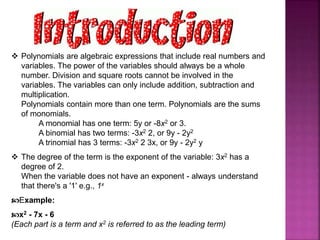
 Polynomials are algebraic expressions that include real numbers and
variables. The power of the variables should always be a whole
number. Division and square roots cannot be involved in the
variables. The variables can only include addition, subtraction and
multiplication.
Polynomials contain more than one term. Polynomials are the sums
of monomials.
A monomial has one term: 5y or -8x2 or 3.
A binomial has two terms: -3x2 2, or 9y - 2y2
A trinomial has 3 terms: -3x2 2 3x, or 9y - 2y2 y
 The degree of the term is the exponent of the variable: 3x2 has a
degree of 2.
When the variable does not have an exponent - always understand
that there's a '1' e.g., 1x
Example:
x2 - 7x - 6
(Each part is a term and x2 is referred to as the leading term)
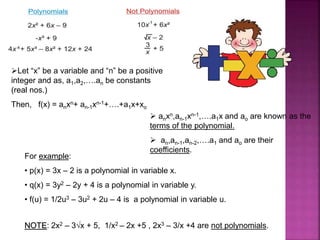
Let “x” be a variable and “n” be a positive
integer and as, a1,a2,….an be constants
(real nos.)
Then, f(x) = anxn+ an-1xn-1+….+a1x+xo
 anxn,an-1xn-1,….a1x and ao are known as the
terms of the polynomial.
 an,an-1,an-2,….a1 and ao are their
coefficients.
For example:
• p(x) = 3x – 2 is a polynomial in variable x.
• q(x) = 3y2 – 2y + 4 is a polynomial in variable y.
• f(u) = 1/2u3 – 3u2 + 2u – 4 is a polynomial in variable u.
NOTE: 2x2 – 3√x + 5, 1/x2 – 2x +5 , 2x3 – 3/x +4 are not polynomials.
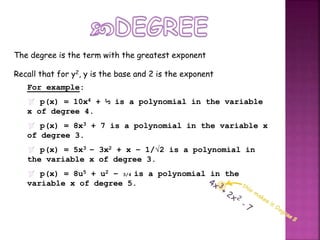
The degree is the term with the greatest exponent
Recall that for y2, y is the base and 2 is the exponent
For example:
 p(x) = 10x4 + ½ is a polynomial in the variable
x of degree 4.
 p(x) = 8x3 + 7 is a polynomial in the variable x
of degree 3.
 p(x) = 5x3 – 3x2 + x – 1/√2 is a polynomial in
the variable x of degree 3.
 p(x) = 8u5 + u2 – 3/4 is a polynomial in the
variable x of degree 5.
For example:
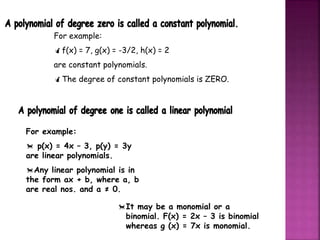
f(x) = 7, g(x) = -3/2, h(x) = 2
are constant polynomials.
The degree of constant polynomials is ZERO.
For example:
 p(x) = 4x – 3, p(y) = 3y
are linear polynomials.
Any linear polynomial is in
the form ax + b, where a, b
are real nos. and a ≠ 0.
It may be a monomial or a
binomial. F(x) = 2x – 3 is binomial
whereas g (x) = 7x is monomial.
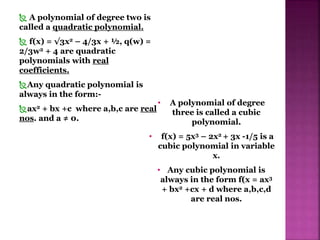
 A polynomial of degree two is
called a quadratic polynomial.
 f(x) = √3x2 – 4/3x + ½, q(w) =
2/3w2 + 4 are quadratic
polynomials with real
coefficients.
Any quadratic polynomial is
always in the form:-
ax2 + bx +c where a,b,c are real
nos. and a ≠ 0.
• A polynomial of degree
three is called a cubic
polynomial.
• f(x) = 5x3 – 2x2 + 3x -1/5 is a
cubic polynomial in variable
x.
• Any cubic polynomial is
always in the form f(x = ax3
+ bx2 +cx + d where a,b,c,d
are real nos.
A real no. x is a zero of the
polynomial f(x),is f(x) = 0
Finding a zero of the polynomial
means solving polynomial
equation f(x) = 0.
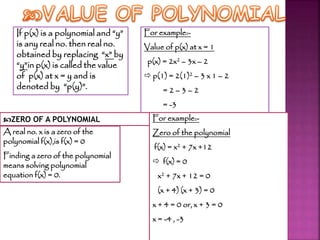
If p(x) is a polynomial and “y”
is any real no. then real no.
obtained by replacing “x” by
“y”in p(x) is called the value
of p(x) at x = y and is
denoted by “p(y)”.
For example:-
Value of p(x) at x = 1
p(x) = 2x2 – 3x – 2
 p(1) = 2(1)2 – 3 x 1 – 2
= 2 – 3 – 2
= -3
For example:-
Zero of the polynomial
f(x) = x2 + 7x +12
 f(x) = 0
x2 + 7x + 12 = 0
(x + 4) (x + 3) = 0
x + 4 = 0 or, x + 3 = 0
x = -4 , -3
ZERO OF A POLYNOMIAL
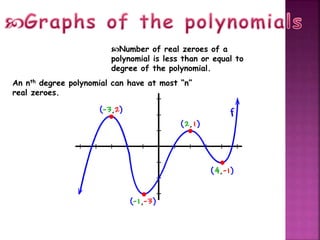
An nth degree polynomial can have at most “n”
real zeroes.
Number of real zeroes of a
polynomial is less than or equal to
degree of the polynomial.
GENERAL SHAPES OF
POLYNOMIAL FUNCTIONS
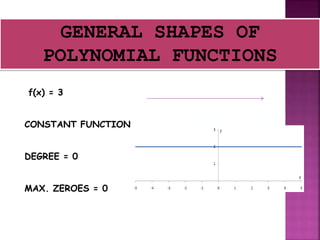
f(x) = 3
CONSTANT FUNCTION
DEGREE = 0
MAX. ZEROES = 0
GENERAL SHAPES OF
POLYNOMIAL FUNCTIONS
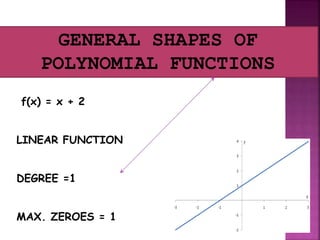
f(x) = x + 2
LINEAR FUNCTION
DEGREE =1
MAX. ZEROES = 1
GENERAL SHAPES OF
POLYNOMIAL FUNCTIONS
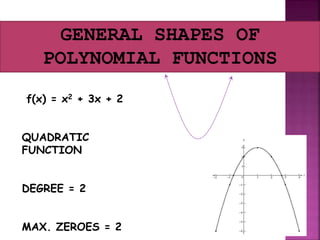
f(x) = x2 + 3x + 2
QUADRATIC
FUNCTION
DEGREE = 2
MAX. ZEROES = 2
GENERAL SHAPES OF
POLYNOMIAL FUNCTIONS
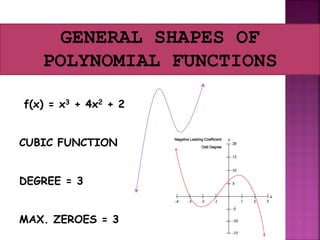
f(x) = x3 + 4x2 + 2
CUBIC FUNCTION
DEGREE = 3
MAX. ZEROES = 3
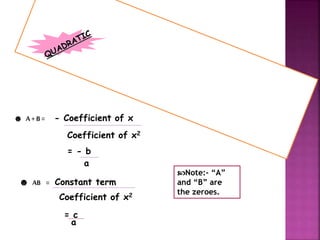
☻ A+B = - Coefficient of x
Coefficient of x2
= - b
a
☻ AB = Constant term
Coefficient of x2
= c
a
Note:- “A”
and “B” are
the zeroes.
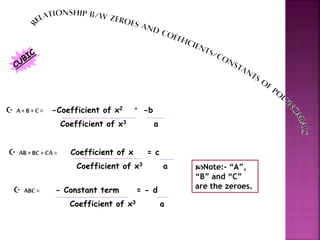
 A+ B + C = -Coefficient of x2 = -b
Coefficient of x3 a
 AB + BC + CA = Coefficient of x = c
Coefficient of x3 a
 ABC = - Constant term = - d
Coefficient of x3 a
Note:- “A”,
“B” and “C”
are the zeroes.
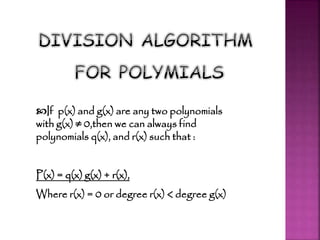
If p(x) and g(x) are any two polynomials
with g(x) ≠ 0,then we can always find
polynomials q(x), and r(x) such that :
P(x) = q(x) g(x) + r(x),
Where r(x) = 0 or degree r(x) < degree g(x)
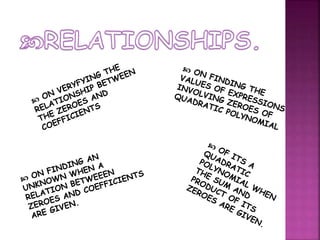
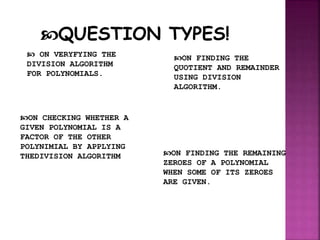
 ON VERYFYING THE
DIVISION ALGORITHM
FOR POLYNOMIALS.
ON FINDING THE
QUOTIENT AND REMAINDER
USING DIVISION
ALGORITHM.
ON CHECKING WHETHER A
GIVEN POLYNOMIAL IS A
FACTOR OF THE OTHER
POLYNIMIAL BY APPLYING
THEDIVISION ALGORITHM ON FINDING THE REMAINING
ZEROES OF A POLYNOMIAL
WHEN SOME OF ITS ZEROES
ARE GIVEN.
QUESTION TYPES!
Polynomials(10th) Simplified

Polynomials(10th) Simplified

  • 1.
    MADE BY:- MUHAMMADSAJEEL KHAN CLASS:- 10th ‘E’ GIVEN BY:- MR. SANDESH SIR
  • 2.
    1.INTRODUCTION 2.GEOMETRICAL MEANING OF ZEROESOF THE POLYNOMIAL 3.RELATION BETWEEN ZEROES AND COEFFICIENTS OF A POLYNOMIAL 4.DIVISION ALGORITHM FOR POLYNOMIAL
  • 3.
     Polynomials arealgebraic expressions that include real numbers and variables. The power of the variables should always be a whole number. Division and square roots cannot be involved in the variables. The variables can only include addition, subtraction and multiplication. Polynomials contain more than one term. Polynomials are the sums of monomials. A monomial has one term: 5y or -8x2 or 3. A binomial has two terms: -3x2 2, or 9y - 2y2 A trinomial has 3 terms: -3x2 2 3x, or 9y - 2y2 y  The degree of the term is the exponent of the variable: 3x2 has a degree of 2. When the variable does not have an exponent - always understand that there's a '1' e.g., 1x Example: x2 - 7x - 6 (Each part is a term and x2 is referred to as the leading term)
  • 4.
    Let “x” bea variable and “n” be a positive integer and as, a1,a2,….an be constants (real nos.) Then, f(x) = anxn+ an-1xn-1+….+a1x+xo  anxn,an-1xn-1,….a1x and ao are known as the terms of the polynomial.  an,an-1,an-2,….a1 and ao are their coefficients. For example: • p(x) = 3x – 2 is a polynomial in variable x. • q(x) = 3y2 – 2y + 4 is a polynomial in variable y. • f(u) = 1/2u3 – 3u2 + 2u – 4 is a polynomial in variable u. NOTE: 2x2 – 3√x + 5, 1/x2 – 2x +5 , 2x3 – 3/x +4 are not polynomials.
  • 5.
    The degree isthe term with the greatest exponent Recall that for y2, y is the base and 2 is the exponent For example:  p(x) = 10x4 + ½ is a polynomial in the variable x of degree 4.  p(x) = 8x3 + 7 is a polynomial in the variable x of degree 3.  p(x) = 5x3 – 3x2 + x – 1/√2 is a polynomial in the variable x of degree 3.  p(x) = 8u5 + u2 – 3/4 is a polynomial in the variable x of degree 5.
  • 6.
    For example: f(x) =7, g(x) = -3/2, h(x) = 2 are constant polynomials. The degree of constant polynomials is ZERO. For example:  p(x) = 4x – 3, p(y) = 3y are linear polynomials. Any linear polynomial is in the form ax + b, where a, b are real nos. and a ≠ 0. It may be a monomial or a binomial. F(x) = 2x – 3 is binomial whereas g (x) = 7x is monomial.
  • 7.
     A polynomialof degree two is called a quadratic polynomial.  f(x) = √3x2 – 4/3x + ½, q(w) = 2/3w2 + 4 are quadratic polynomials with real coefficients. Any quadratic polynomial is always in the form:- ax2 + bx +c where a,b,c are real nos. and a ≠ 0. • A polynomial of degree three is called a cubic polynomial. • f(x) = 5x3 – 2x2 + 3x -1/5 is a cubic polynomial in variable x. • Any cubic polynomial is always in the form f(x = ax3 + bx2 +cx + d where a,b,c,d are real nos.
  • 8.
    A real no.x is a zero of the polynomial f(x),is f(x) = 0 Finding a zero of the polynomial means solving polynomial equation f(x) = 0. If p(x) is a polynomial and “y” is any real no. then real no. obtained by replacing “x” by “y”in p(x) is called the value of p(x) at x = y and is denoted by “p(y)”. For example:- Value of p(x) at x = 1 p(x) = 2x2 – 3x – 2  p(1) = 2(1)2 – 3 x 1 – 2 = 2 – 3 – 2 = -3 For example:- Zero of the polynomial f(x) = x2 + 7x +12  f(x) = 0 x2 + 7x + 12 = 0 (x + 4) (x + 3) = 0 x + 4 = 0 or, x + 3 = 0 x = -4 , -3 ZERO OF A POLYNOMIAL
  • 9.
    An nth degreepolynomial can have at most “n” real zeroes. Number of real zeroes of a polynomial is less than or equal to degree of the polynomial.
  • 10.
    GENERAL SHAPES OF POLYNOMIALFUNCTIONS f(x) = 3 CONSTANT FUNCTION DEGREE = 0 MAX. ZEROES = 0
  • 11.
    GENERAL SHAPES OF POLYNOMIALFUNCTIONS f(x) = x + 2 LINEAR FUNCTION DEGREE =1 MAX. ZEROES = 1
  • 12.
    GENERAL SHAPES OF POLYNOMIALFUNCTIONS f(x) = x2 + 3x + 2 QUADRATIC FUNCTION DEGREE = 2 MAX. ZEROES = 2
  • 13.
    GENERAL SHAPES OF POLYNOMIALFUNCTIONS f(x) = x3 + 4x2 + 2 CUBIC FUNCTION DEGREE = 3 MAX. ZEROES = 3
  • 14.
    ☻ A+B =- Coefficient of x Coefficient of x2 = - b a ☻ AB = Constant term Coefficient of x2 = c a Note:- “A” and “B” are the zeroes.
  • 15.
     A+ B+ C = -Coefficient of x2 = -b Coefficient of x3 a  AB + BC + CA = Coefficient of x = c Coefficient of x3 a  ABC = - Constant term = - d Coefficient of x3 a Note:- “A”, “B” and “C” are the zeroes.
  • 17.
    If p(x) andg(x) are any two polynomials with g(x) ≠ 0,then we can always find polynomials q(x), and r(x) such that : P(x) = q(x) g(x) + r(x), Where r(x) = 0 or degree r(x) < degree g(x)
  • 18.
     ON VERYFYINGTHE DIVISION ALGORITHM FOR POLYNOMIALS. ON FINDING THE QUOTIENT AND REMAINDER USING DIVISION ALGORITHM. ON CHECKING WHETHER A GIVEN POLYNOMIAL IS A FACTOR OF THE OTHER POLYNIMIAL BY APPLYING THEDIVISION ALGORITHM ON FINDING THE REMAINING ZEROES OF A POLYNOMIAL WHEN SOME OF ITS ZEROES ARE GIVEN. QUESTION TYPES!