
Section	4.5
                Optimization	II

                V63.0121.034, Calculus	I


                  November	25, 2009


Announcements
   Final	Exam, December	18, 2:00–3:50pm

                                      .    .   .   .   .   .
Outline


  Recall


  More	examples
    Addition
    Distance
    Triangles
    Economics
    The	Statue	of	Liberty


                            .   .   .   .   .   .
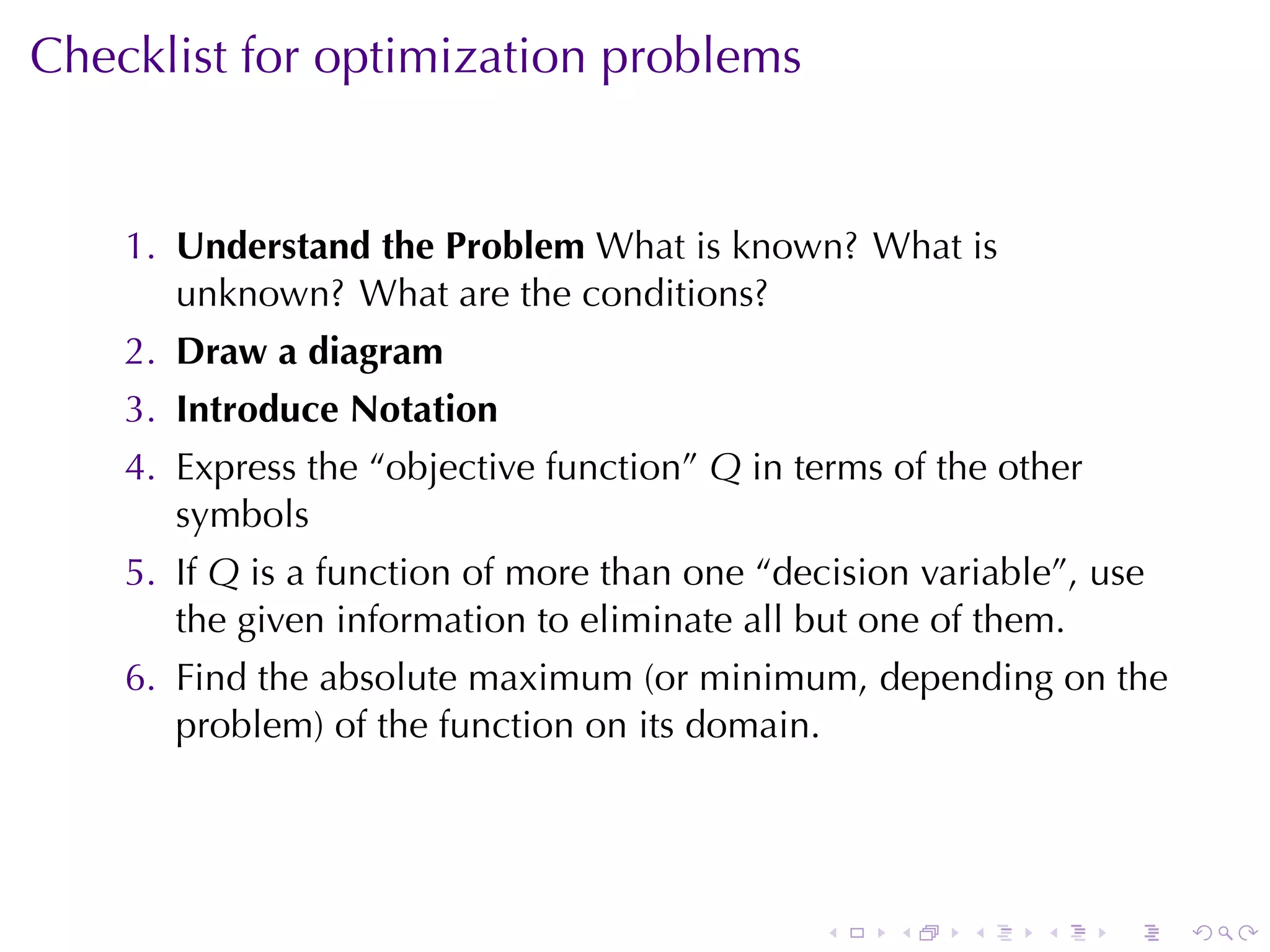
Checklist	for	optimization	problems


    1. Understand	the	Problem What	is	known? What	is
       unknown? What	are	the	conditions?
    2. Draw	a	diagram
    3. Introduce	Notation
    4. Express	the	“objective	function” Q in	terms	of	the	other
       symbols
    5. If Q is	a	function	of	more	than	one	“decision	variable”, use
       the	given	information	to	eliminate	all	but	one	of	them.
    6. Find	the	absolute	maximum	(or	minimum, depending	on	the
       problem)	of	the	function	on	its	domain.


                                               .   .    .   .     .   .
Recall: The	Closed	Interval	Method
See	Section	4.1


     To	find	the	extreme	values	of	a	function f on [a, b], we	need	to:
          Evaluate f at	the endpoints a and b
          Evaluate f at	the critical	points x where	either f′ (x) = 0 or f is
          not	differentiable	at x.
          The	points	with	the	largest	function	value	are	the	global
          maximum	points
          The	points	with	the	smallest	or	most	negative	function	value
          are	the	global	minimum	points.


                                                     .    .    .    .    .      .
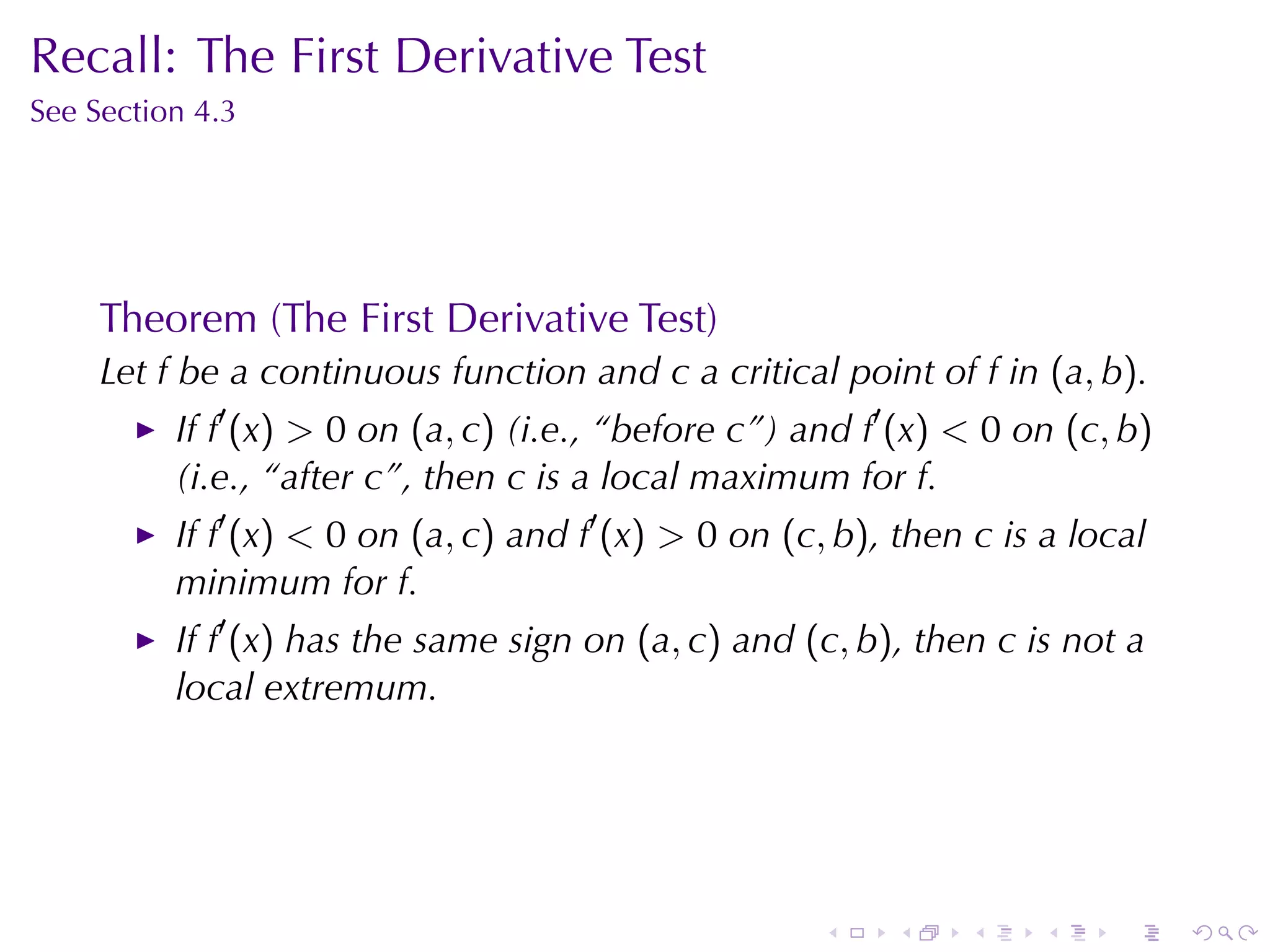
Recall: The	First	Derivative	Test
See	Section	4.3


     Theorem	(The	First	Derivative	Test)
     Let f be	a	continuous	function	and c a	critical	point	of f in (a, b).
          If f′ (x) > 0 on (a, c) (i.e., “before c”)	and f′ (x) < 0 on (c, b)
          (i.e., “after c”, then c is	a	local	maximum	for f.
          If f′ (x) < 0 on (a, c) and f′ (x) > 0 on (c, b), then c is	a	local
          minimum	for f.
          If f′ (x) has	the	same	sign	on (a, c) and (c, b), then c is	not	a
          local	extremum.


                                                      .    .    .    .    .     .
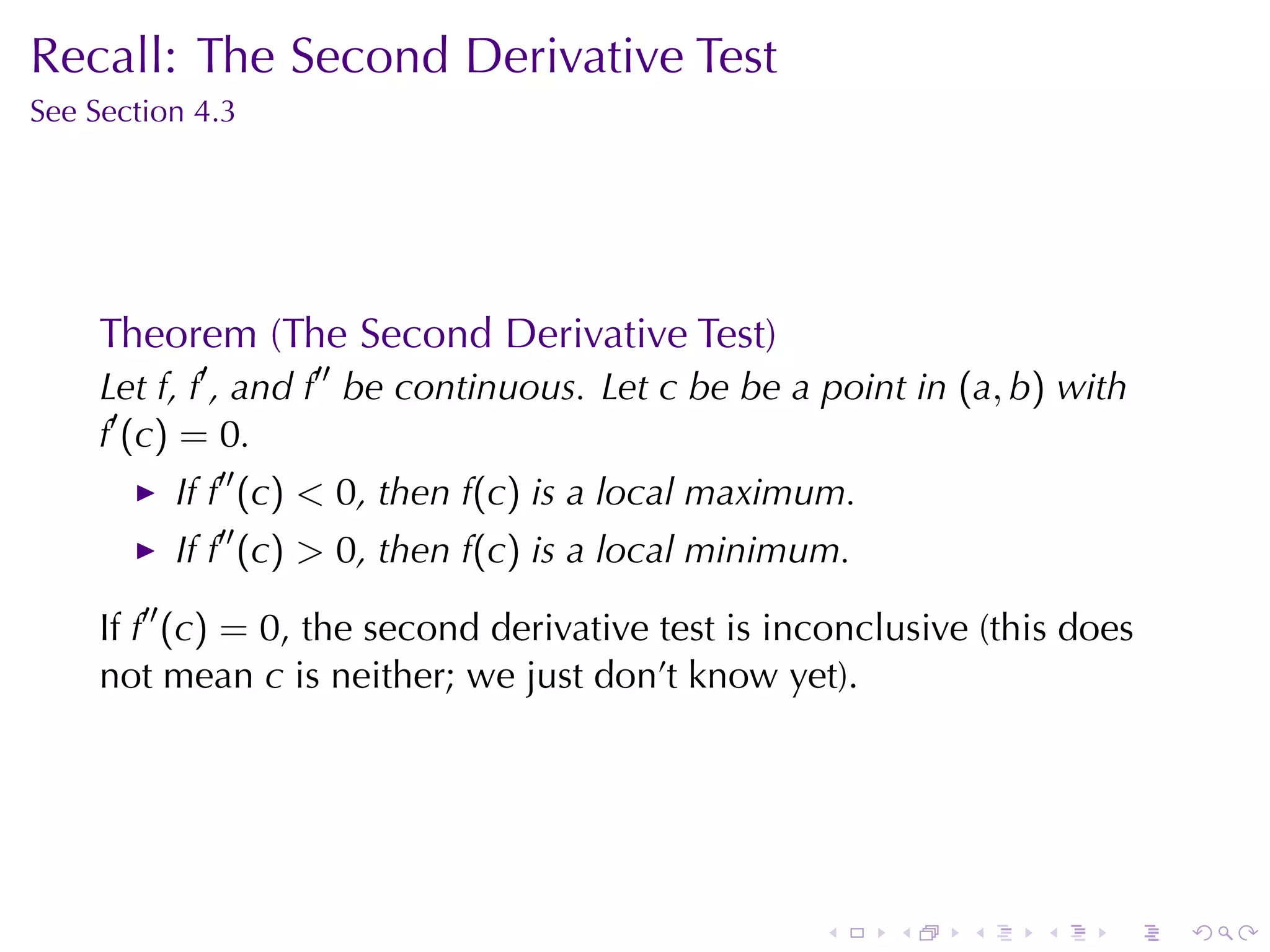
Recall: The	Second	Derivative	Test
See	Section	4.3


     Theorem	(The	Second	Derivative	Test)
     Let f, f′ , and f′′ be	continuous. Let c be	be	a	point	in (a, b) with
     f′ (c) = 0.
          If f′′ (c) < 0, then f(c) is	a	local	maximum.
          If f′′ (c) > 0, then f(c) is	a	local	minimum.

     If f′′ (c) = 0, the	second	derivative	test	is	inconclusive	(this	does
     not	mean c is	neither; we	just	don’t	know	yet).


                                                     .    .    .    .    .   .
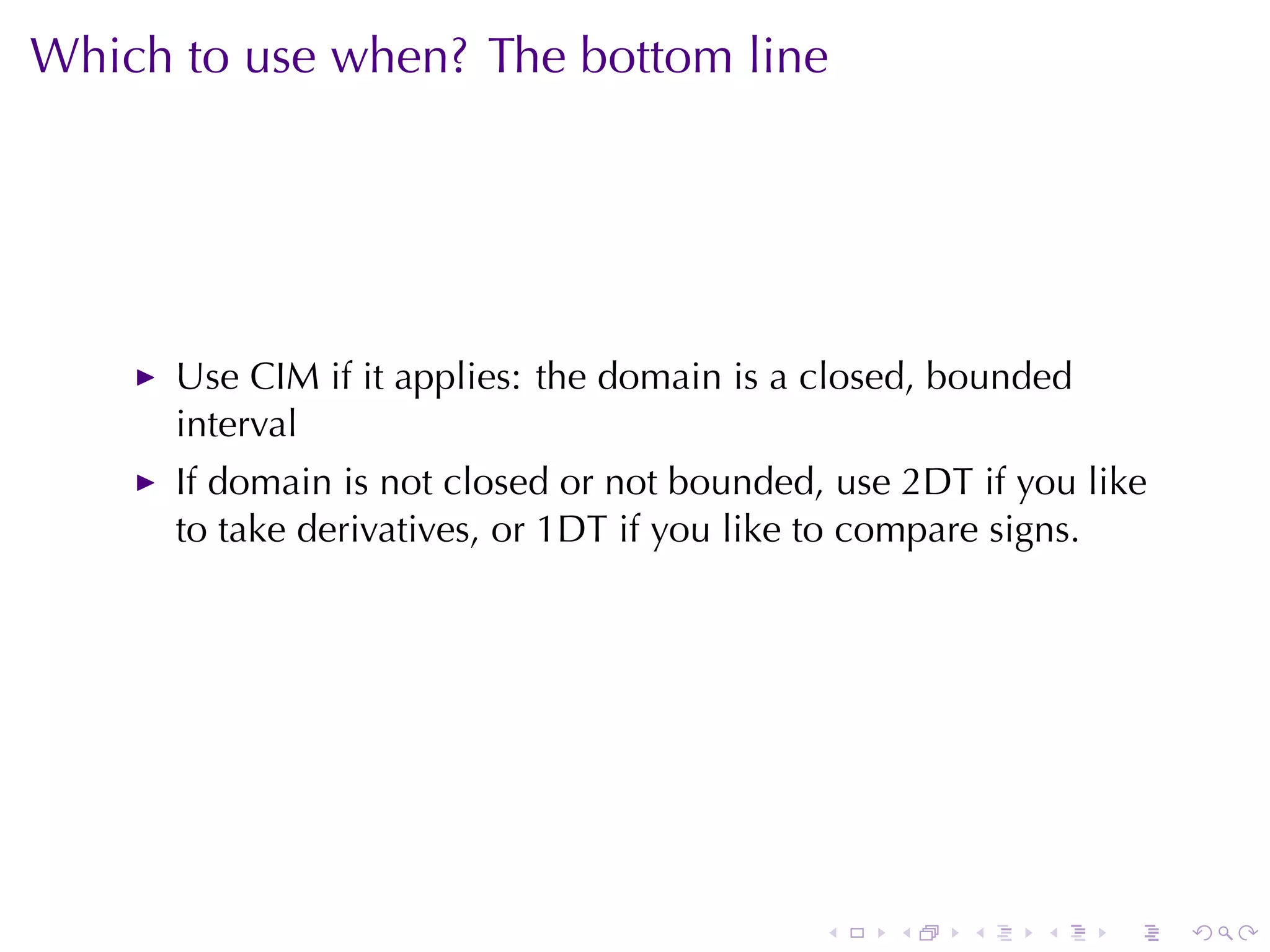
Which	to	use	when? The	bottom	line


      Use	CIM if	it	applies: the	domain	is	a	closed, bounded
      interval
      If	domain	is	not	closed	or	not	bounded, use	2DT if	you	like
      to	take	derivatives, or	1DT if	you	like	to	compare	signs.


                                             .   .    .   .    .    .
Outline


  Recall


  More	examples
    Addition
    Distance
    Triangles
    Economics
    The	Statue	of	Liberty


                            .   .   .   .   .   .
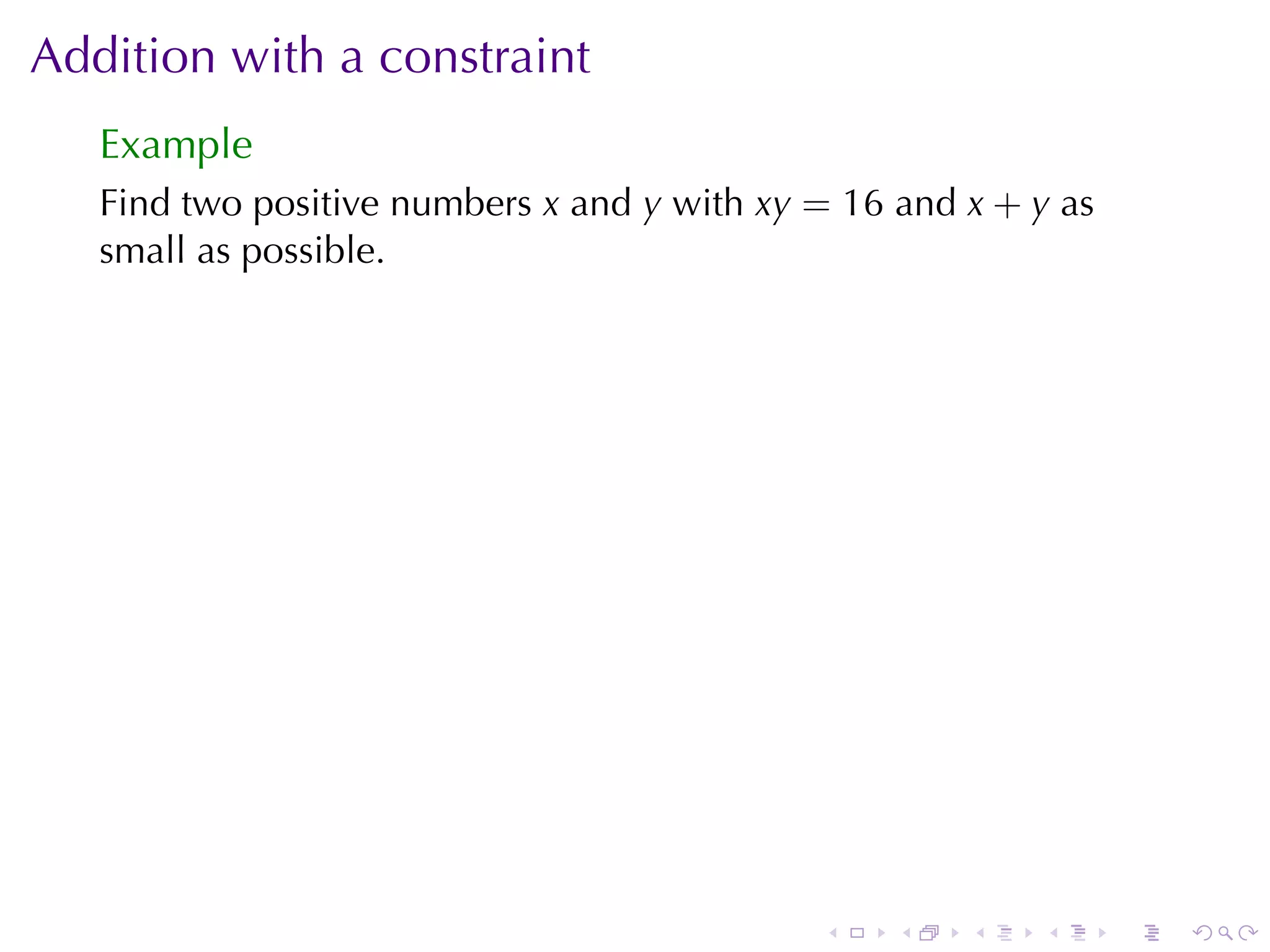
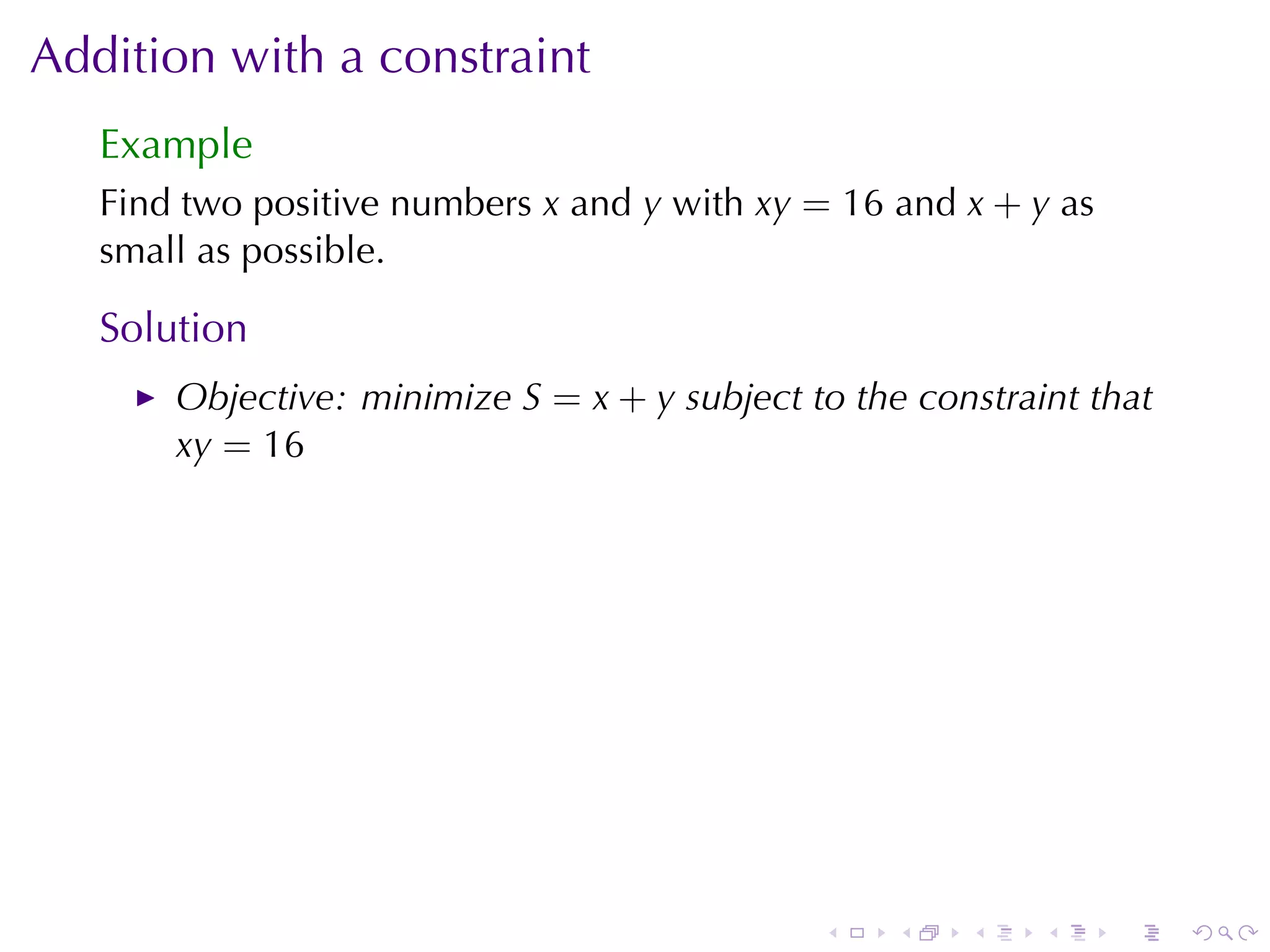
Addition	with	a	constraint
   Example
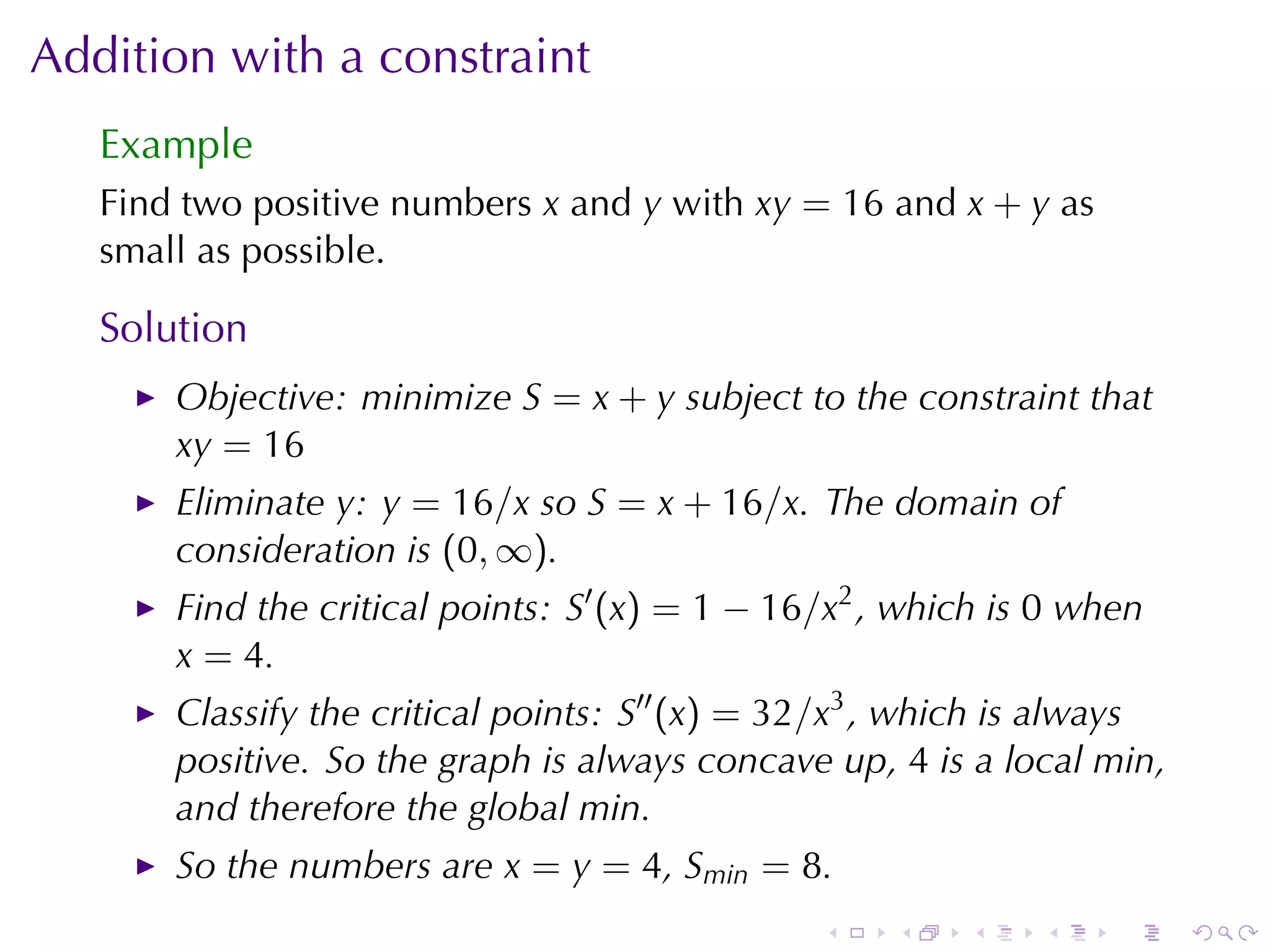
   Find	two	positive	numbers x and y with xy = 16 and x + y as
   small	as	possible.


                                             .    .   .   .      .   .
Addition	with	a	constraint
   Example
   Find	two	positive	numbers x and y with xy = 16 and x + y as
   small	as	possible.

   Solution
       Objective: minimize S = x + y subject	to	the	constraint	that
       xy = 16


                                              .    .   .    .    .    .
Addition	with	a	constraint
   Example
   Find	two	positive	numbers x and y with xy = 16 and x + y as
   small	as	possible.

   Solution
       Objective: minimize S = x + y subject	to	the	constraint	that
       xy = 16
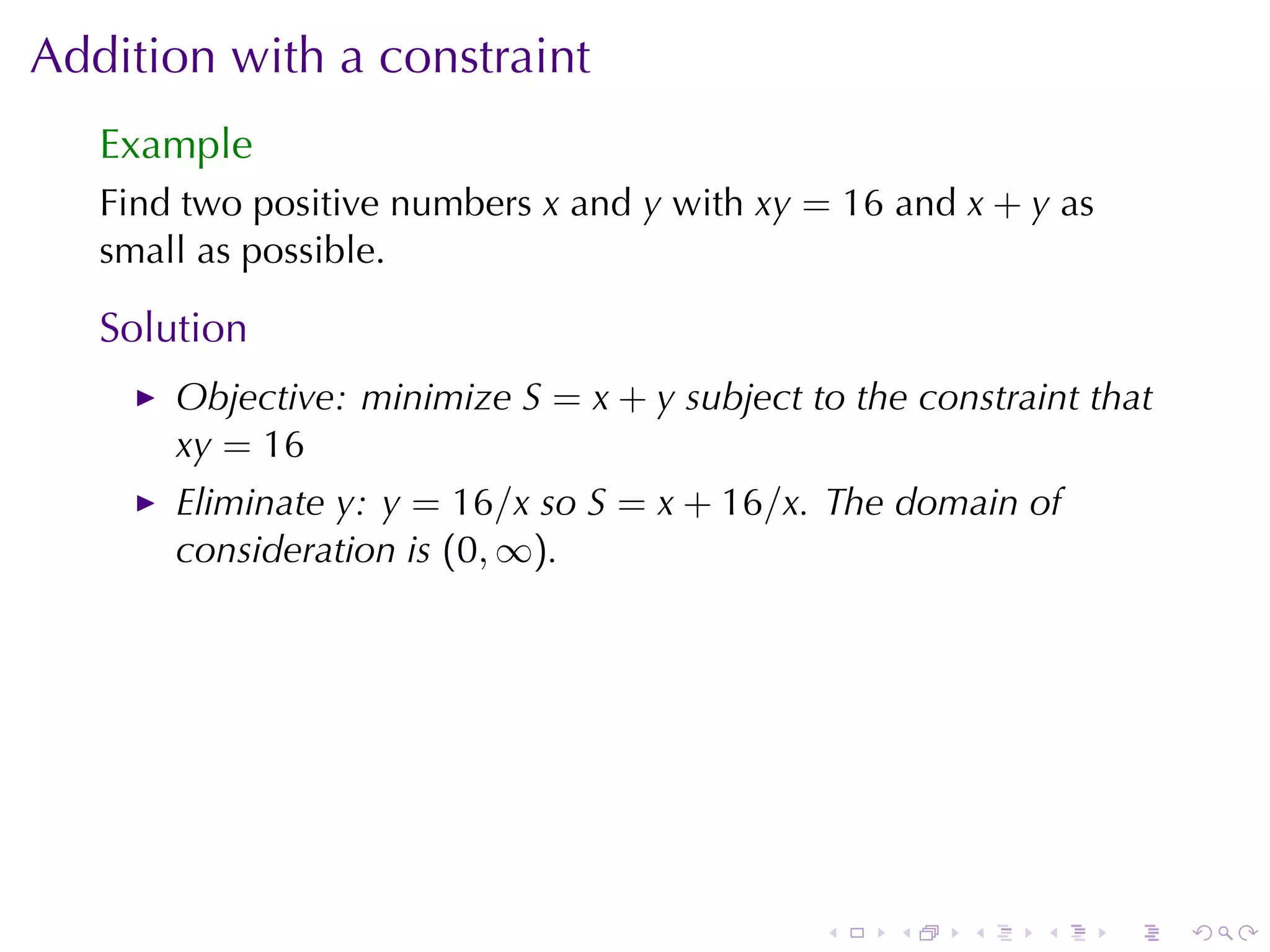
       Eliminate y: y = 16/x so S = x + 16/x. The	domain	of
       consideration	is (0, ∞).


                                              .    .   .    .    .    .
Addition	with	a	constraint
   Example
   Find	two	positive	numbers x and y with xy = 16 and x + y as
   small	as	possible.

   Solution
       Objective: minimize S = x + y subject	to	the	constraint	that
       xy = 16
       Eliminate y: y = 16/x so S = x + 16/x. The	domain	of
       consideration	is (0, ∞).
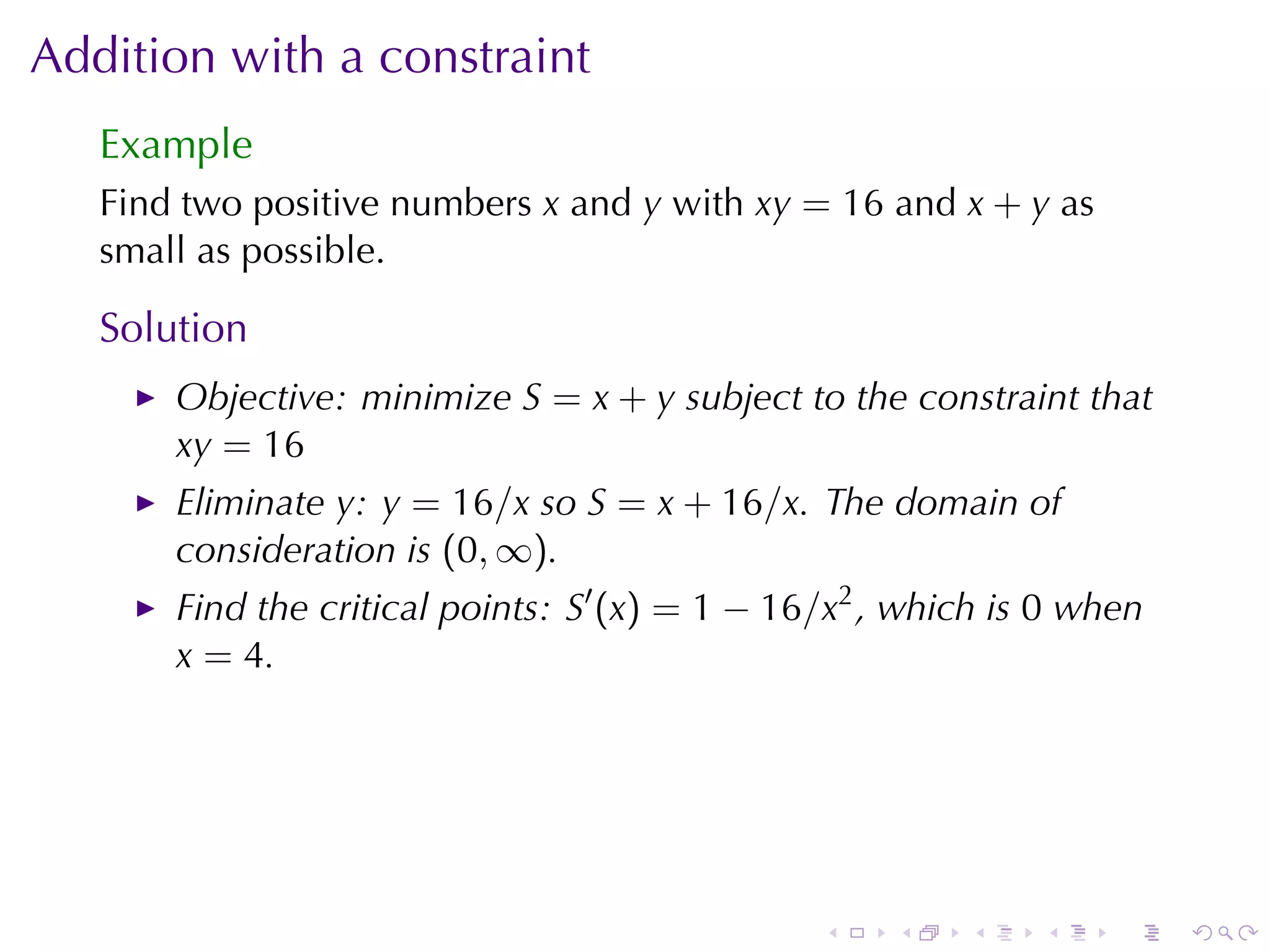
       Find	the	critical	points: S′ (x) = 1 − 16/x2 , which	is 0 when
       x = 4.


                                                .    .   .    .    .    .
Addition	with	a	constraint
   Example
   Find	two	positive	numbers x and y with xy = 16 and x + y as
   small	as	possible.

   Solution
       Objective: minimize S = x + y subject	to	the	constraint	that
       xy = 16
       Eliminate y: y = 16/x so S = x + 16/x. The	domain	of
       consideration	is (0, ∞).
       Find	the	critical	points: S′ (x) = 1 − 16/x2 , which	is 0 when
       x = 4.
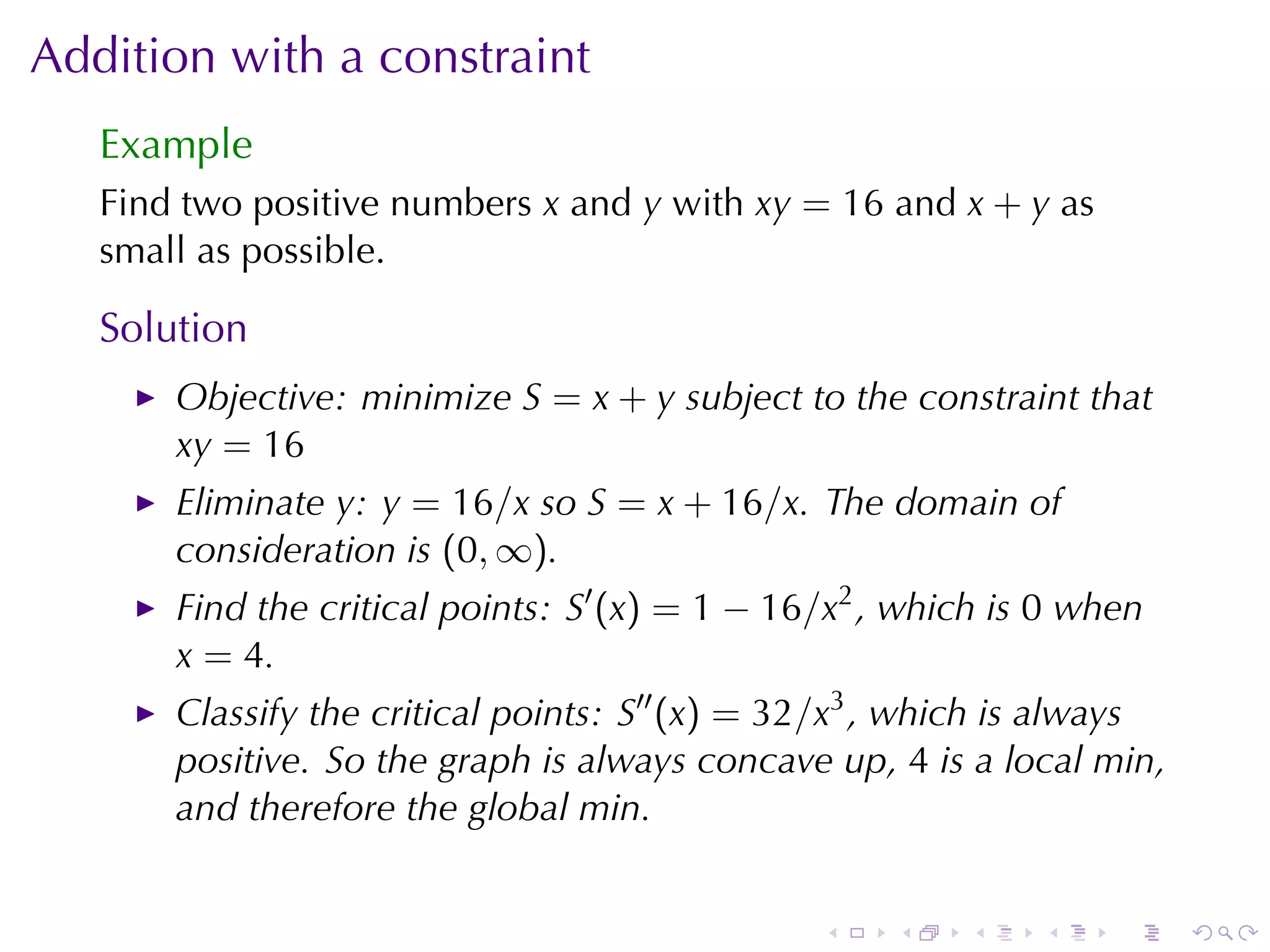
       Classify	the	critical	points: S′′ (x) = 32/x3 , which	is	always
       positive. So	the	graph	is	always	concave	up, 4 is	a	local	min,
       and	therefore	the	global	min.


                                                .    .   .    .    .     .
Addition	with	a	constraint
   Example
   Find	two	positive	numbers x and y with xy = 16 and x + y as
   small	as	possible.

   Solution
       Objective: minimize S = x + y subject	to	the	constraint	that
       xy = 16
       Eliminate y: y = 16/x so S = x + 16/x. The	domain	of
       consideration	is (0, ∞).
       Find	the	critical	points: S′ (x) = 1 − 16/x2 , which	is 0 when
       x = 4.
       Classify	the	critical	points: S′′ (x) = 32/x3 , which	is	always
       positive. So	the	graph	is	always	concave	up, 4 is	a	local	min,
       and	therefore	the	global	min.
       So	the	numbers	are x = y = 4, Smin = 8.
                                                .    .   .    .    .     .
Distance
  Example
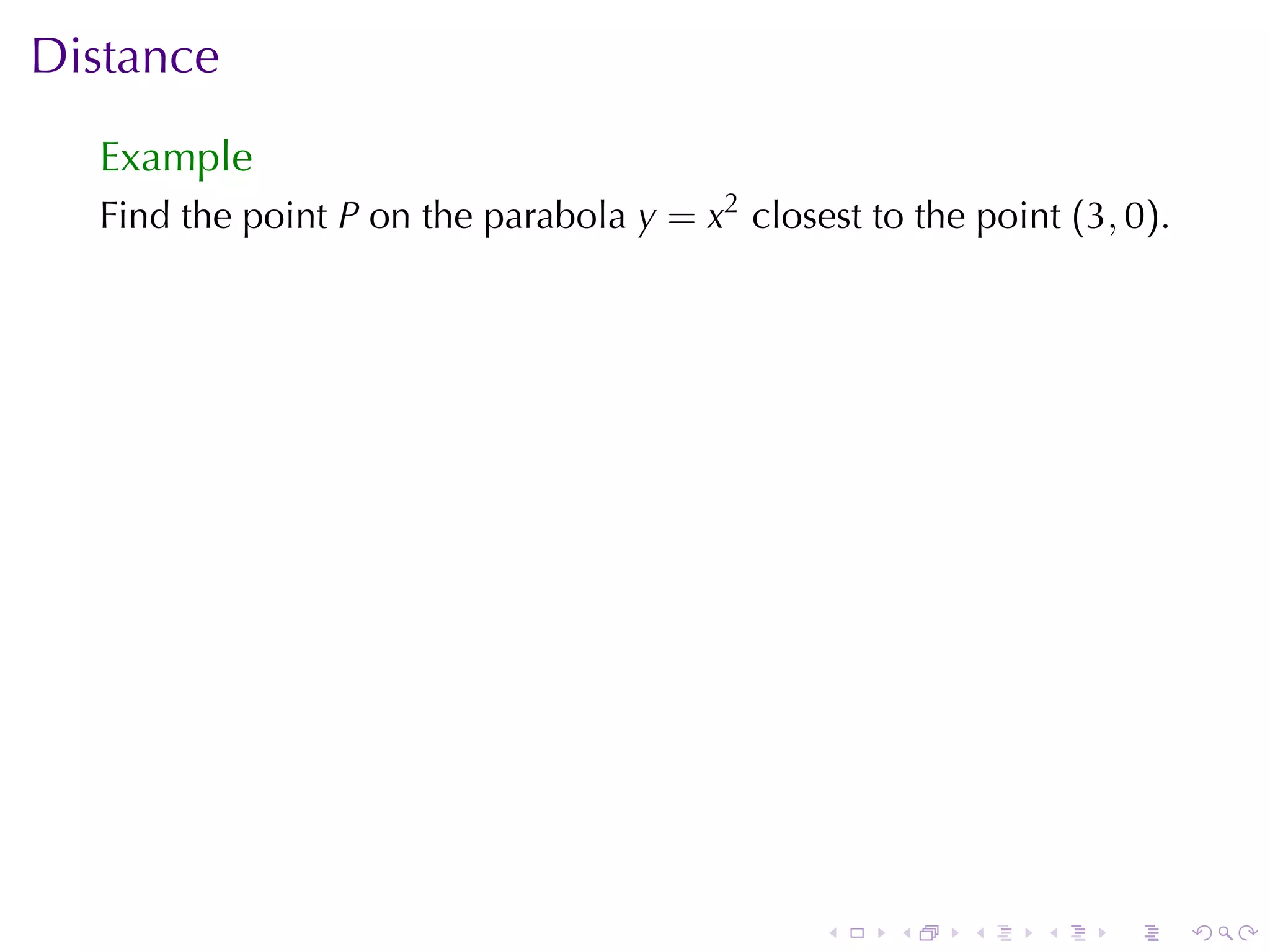
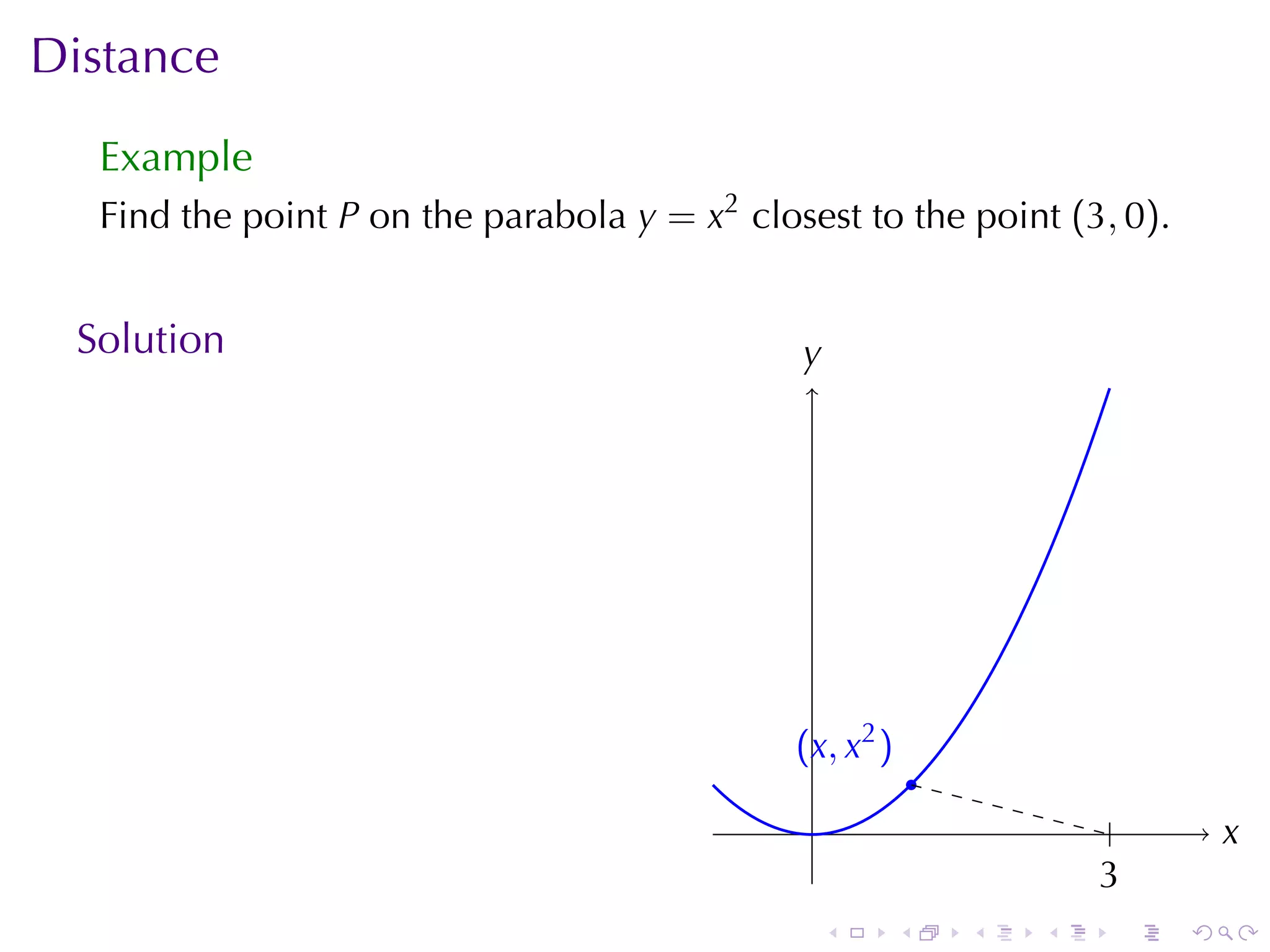
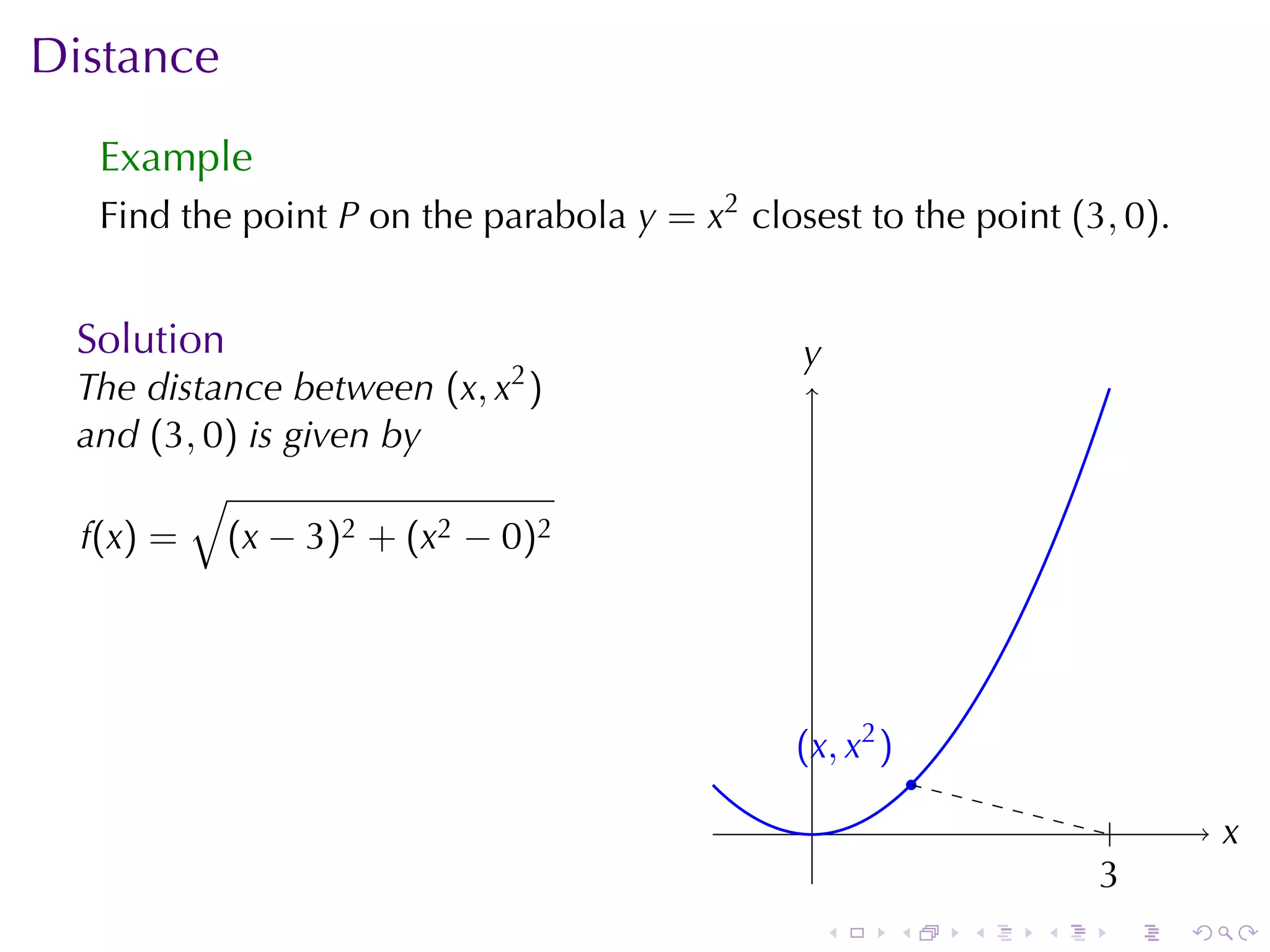
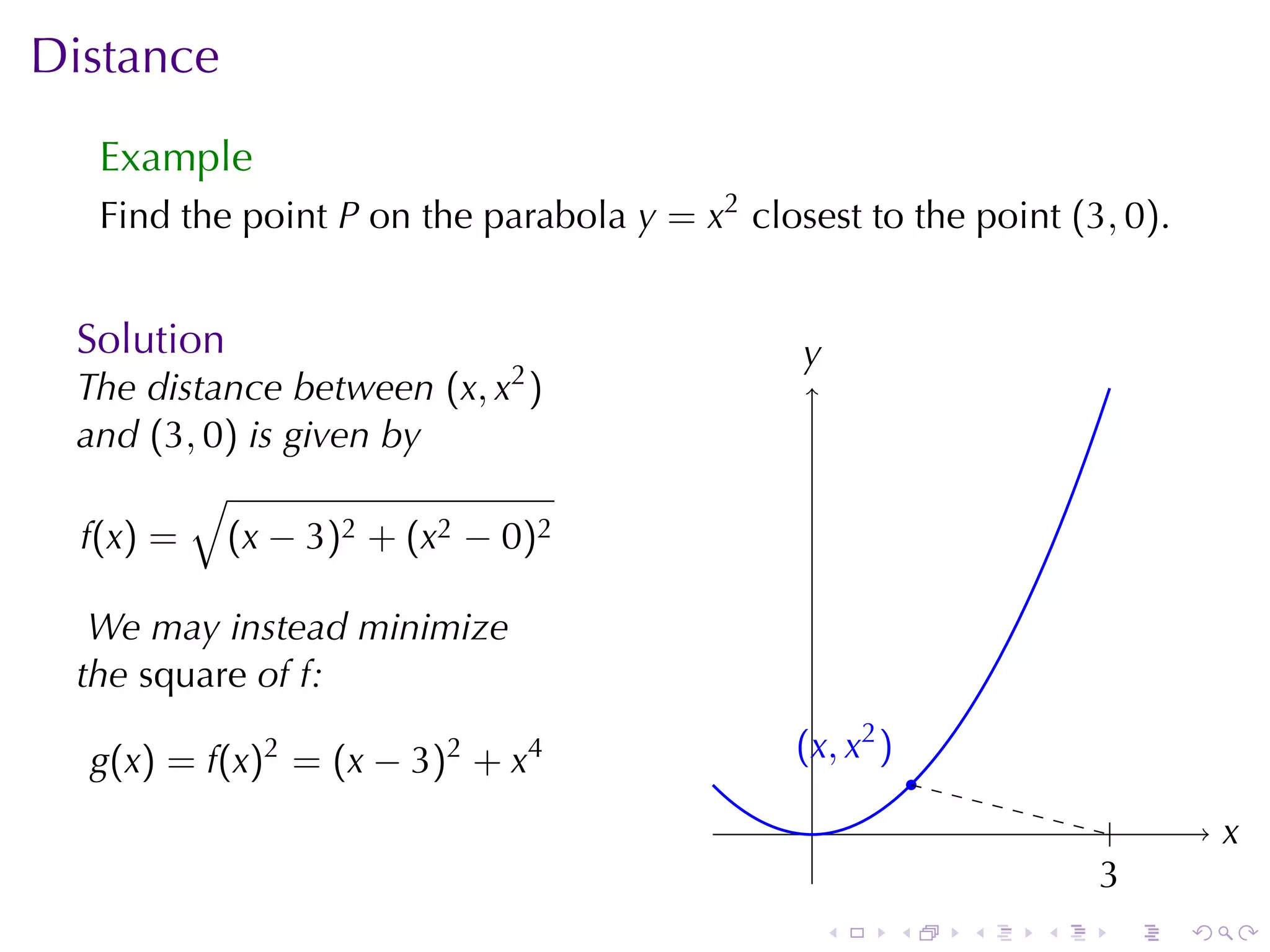
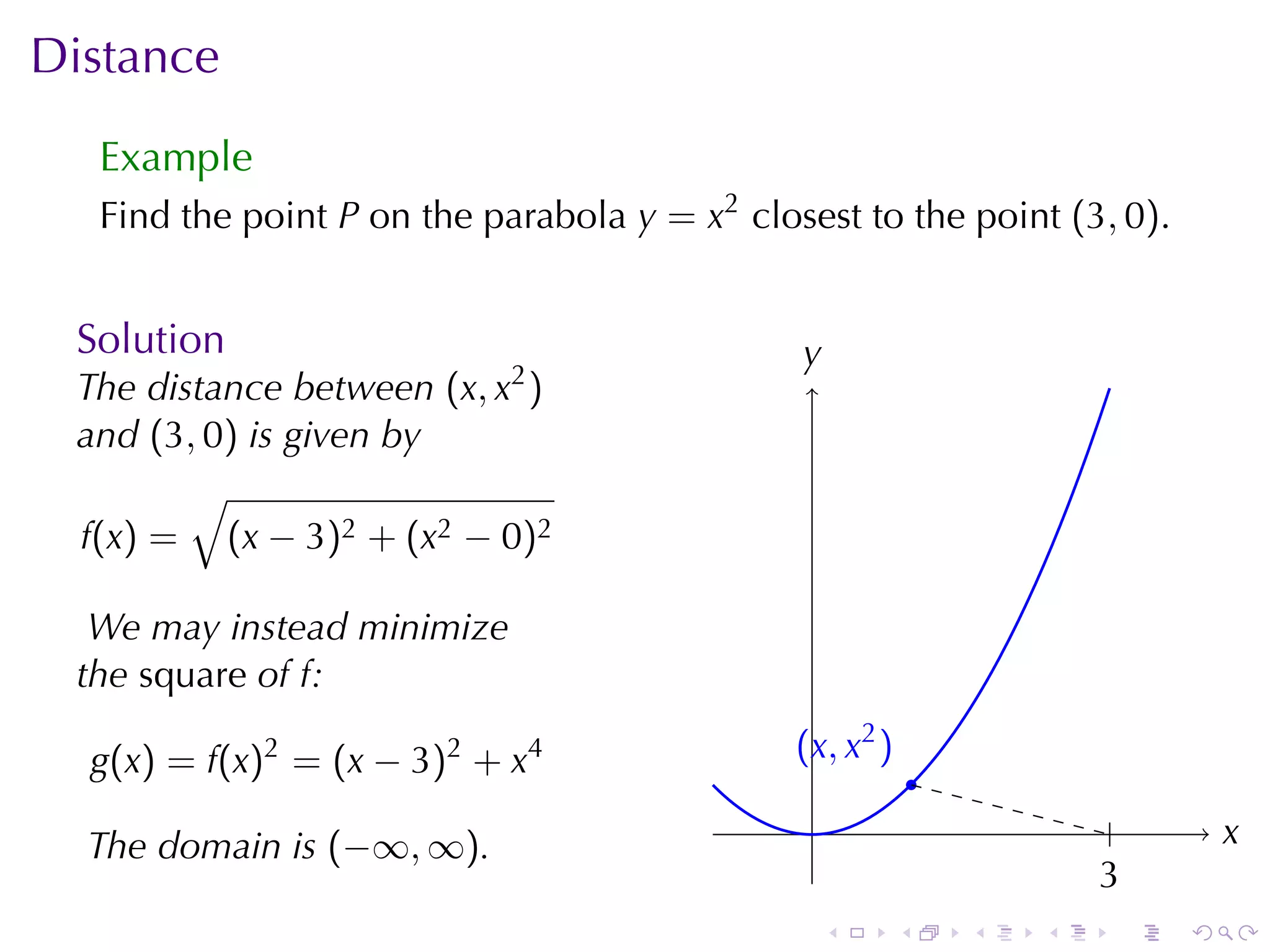
  Find	the	point P on	the	parabola y = x2 closest	to	the	point (3, 0).


                                               .    .    .   .    .      .
Distance
  Example
  Find	the	point P on	the	parabola y = x2 closest	to	the	point (3, 0).


 Solution                                     y
                                              .


                                              . x, x2 )
                                              (
                                                              .
                                               .                            .       x
                                                                                    .
                                                                          3
                                                                          .
                                                  .       .       .   .     .   .
Distance
  Example
  Find	the	point P on	the	parabola y = x2 closest	to	the	point (3, 0).


 Solution                                     y
                                              .
 The	distance	between (x, x2 )
 and (3, 0) is	given	by
        √
 f(x) = (x − 3)2 + (x2 − 0)2


                                              . x, x2 )
                                              (
                                                              .
                                               .                            .       x
                                                                                    .
                                                                          3
                                                                          .
                                                  .       .       .   .     .   .
Distance
  Example
  Find	the	point P on	the	parabola y = x2 closest	to	the	point (3, 0).


 Solution                                     y
                                              .
 The	distance	between (x, x2 )
 and (3, 0) is	given	by
        √
 f(x) = (x − 3)2 + (x2 − 0)2

  We	may	instead	minimize
 the square of f:

  g(x) = f(x)2 = (x − 3)2 + x4                . x, x2 )
                                              (
                                                              .
                                               .                            .       x
                                                                                    .
                                                                          3
                                                                          .
                                                  .       .       .   .     .   .
Distance
  Example
  Find	the	point P on	the	parabola y = x2 closest	to	the	point (3, 0).


 Solution                                     y
                                              .
 The	distance	between (x, x2 )
 and (3, 0) is	given	by
        √
 f(x) = (x − 3)2 + (x2 − 0)2

  We	may	instead	minimize
 the square of f:

  g(x) = f(x)2 = (x − 3)2 + x4                . x, x2 )
                                              (
                                                              .
                                               .                            .       x
                                                                                    .
  The	domain	is (−∞, ∞).
                                                                          3
                                                                          .
                                                  .       .       .   .     .   .
Distance	problem
minimization	step

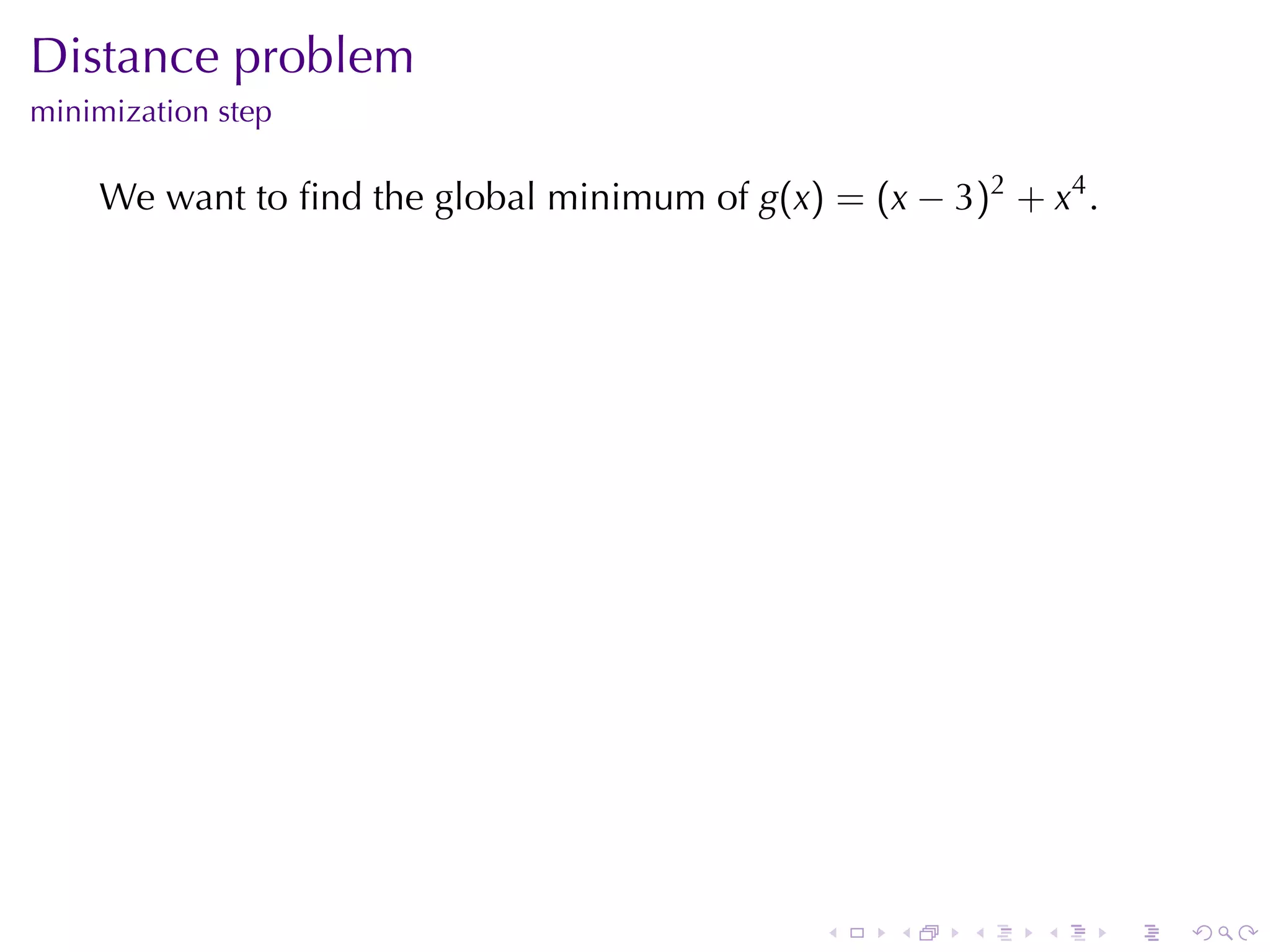
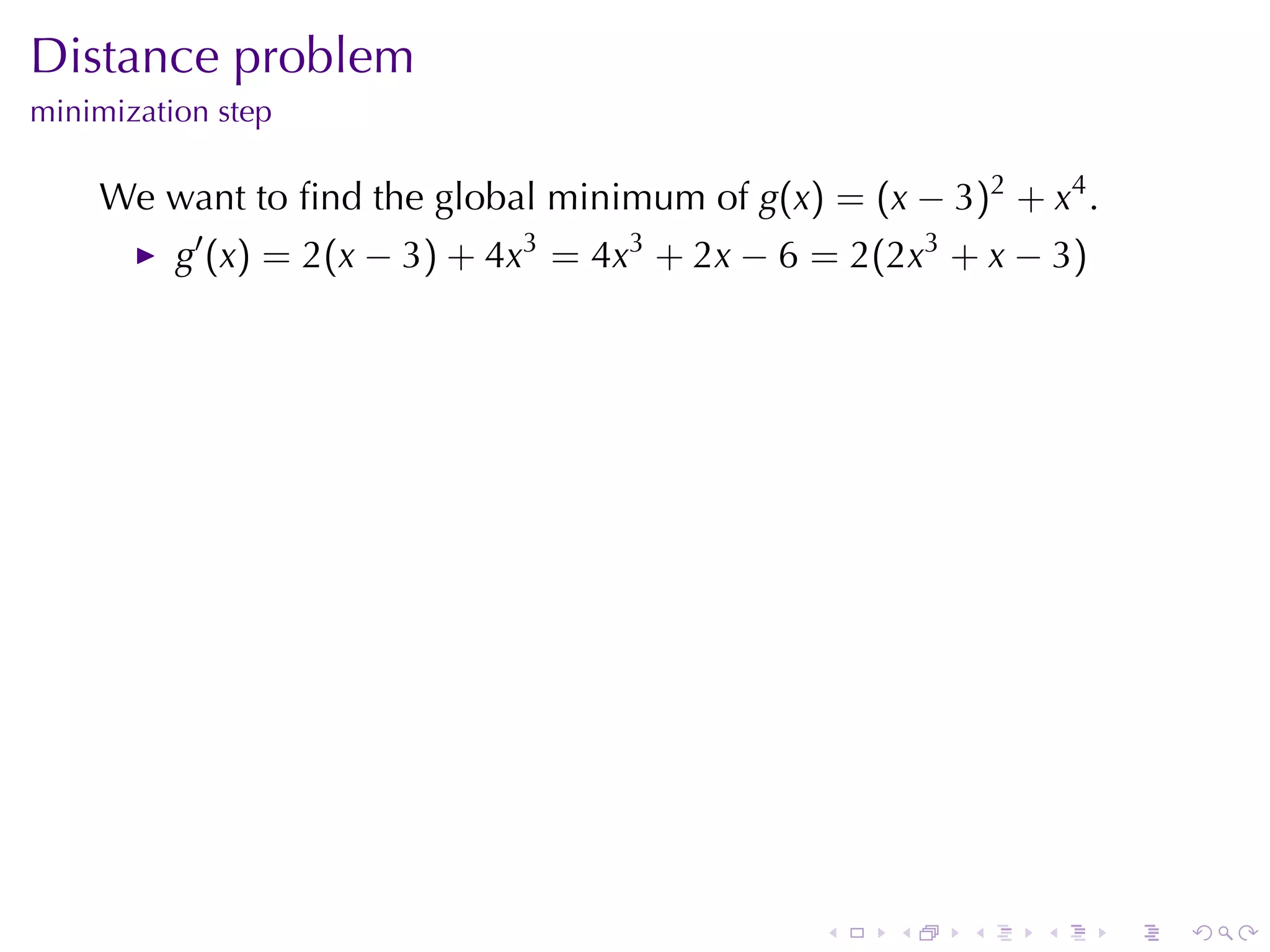
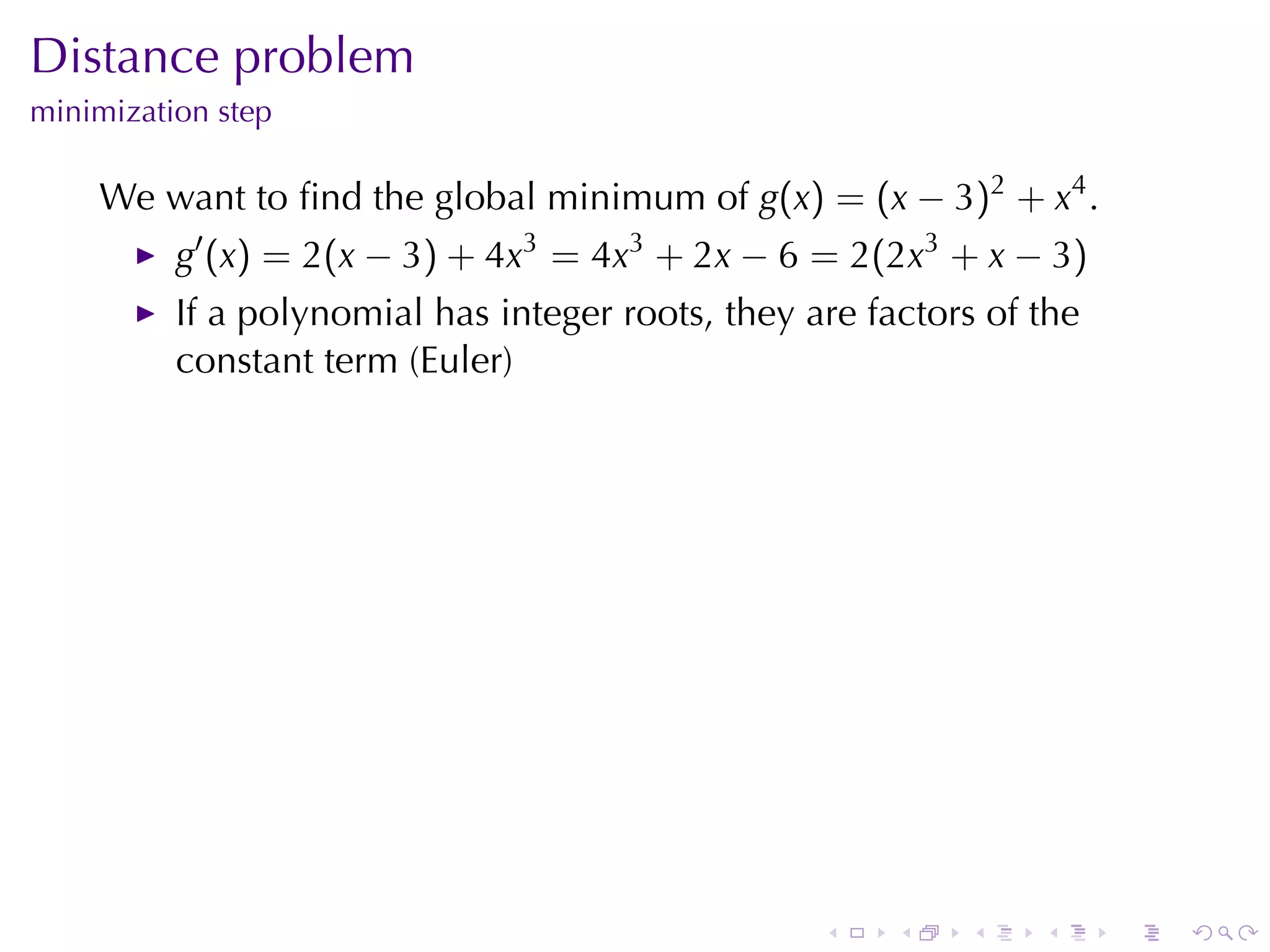
    We	want	to	find	the	global	minimum	of g(x) = (x − 3)2 + x4 .


                                              .    .   .   .      .   .
Distance	problem
minimization	step

    We	want	to	find	the	global	minimum	of g(x) = (x − 3)2 + x4 .
          g′ (x) = 2(x − 3) + 4x3 = 4x3 + 2x − 6 = 2(2x3 + x − 3)


                                                .    .   .    .     .   .
Distance	problem
minimization	step

    We	want	to	find	the	global	minimum	of g(x) = (x − 3)2 + x4 .
          g′ (x) = 2(x − 3) + 4x3 = 4x3 + 2x − 6 = 2(2x3 + x − 3)
          If	a	polynomial	has	integer	roots, they	are	factors	of	the
          constant	term	(Euler)


                                                   .    .   .    .     .   .
Distance	problem
minimization	step

    We	want	to	find	the	global	minimum	of g(x) = (x − 3)2 + x4 .
          g′ (x) = 2(x − 3) + 4x3 = 4x3 + 2x − 6 = 2(2x3 + x − 3)
          If	a	polynomial	has	integer	roots, they	are	factors	of	the
          constant	term	(Euler)
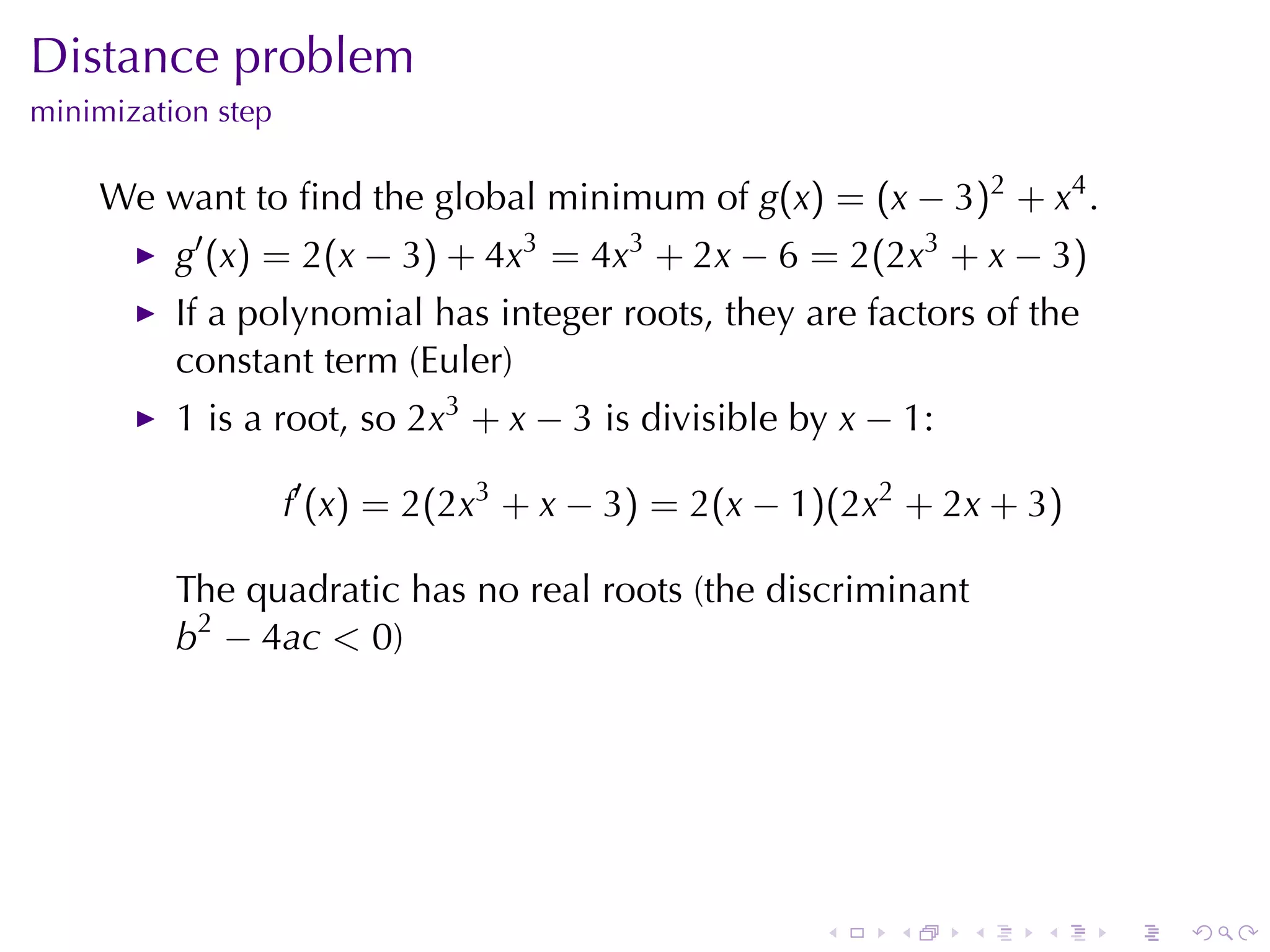
          1 is	a	root, so 2x3 + x − 3 is	divisible	by x − 1:

                    f′ (x) = 2(2x3 + x − 3) = 2(x − 1)(2x2 + 2x + 3)

          The	quadratic	has	no	real	roots	(the	discriminant
          b2 − 4ac < 0)


                                                     .   .     .   .   .   .
Distance	problem
minimization	step

    We	want	to	find	the	global	minimum	of g(x) = (x − 3)2 + x4 .
          g′ (x) = 2(x − 3) + 4x3 = 4x3 + 2x − 6 = 2(2x3 + x − 3)
          If	a	polynomial	has	integer	roots, they	are	factors	of	the
          constant	term	(Euler)
          1 is	a	root, so 2x3 + x − 3 is	divisible	by x − 1:

                    f′ (x) = 2(2x3 + x − 3) = 2(x − 1)(2x2 + 2x + 3)

          The	quadratic	has	no	real	roots	(the	discriminant
          b2 − 4ac < 0)
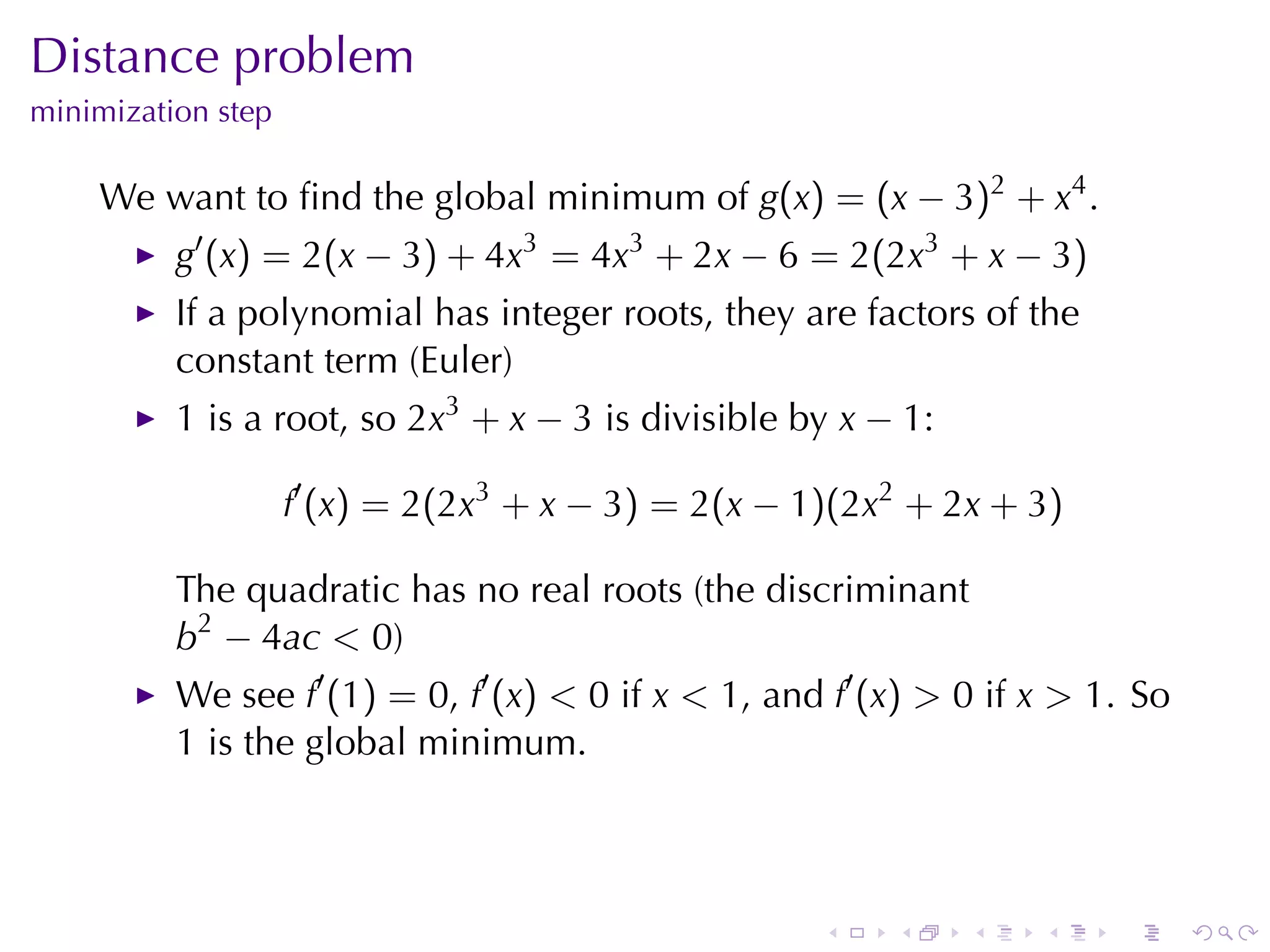
          We	see f′ (1) = 0, f′ (x) < 0 if x < 1, and f′ (x) > 0 if x > 1. So
          1 is	the	global	minimum.


                                                     .    .    .    .    .      .
Distance	problem
minimization	step

    We	want	to	find	the	global	minimum	of g(x) = (x − 3)2 + x4 .
          g′ (x) = 2(x − 3) + 4x3 = 4x3 + 2x − 6 = 2(2x3 + x − 3)
          If	a	polynomial	has	integer	roots, they	are	factors	of	the
          constant	term	(Euler)
          1 is	a	root, so 2x3 + x − 3 is	divisible	by x − 1:

                    f′ (x) = 2(2x3 + x − 3) = 2(x − 1)(2x2 + 2x + 3)

          The	quadratic	has	no	real	roots	(the	discriminant
          b2 − 4ac < 0)
          We	see f′ (1) = 0, f′ (x) < 0 if x < 1, and f′ (x) > 0 if x > 1. So
          1 is	the	global	minimum.
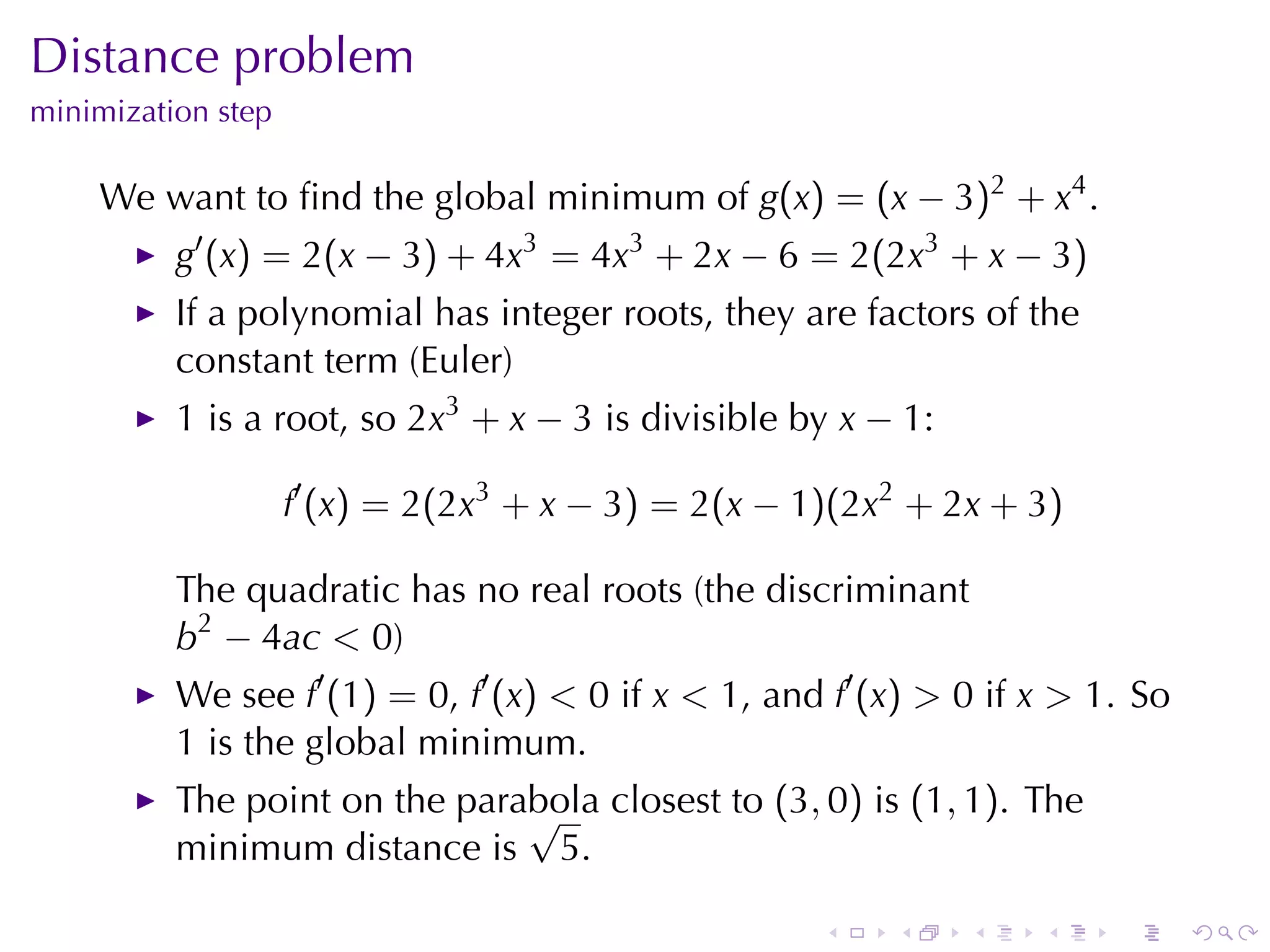
          The	point	on	the	parabola	closest	to (3, 0) is (1, 1). The
                               √
          minimum	distance	is 5.

                                                     .    .    .    .    .      .
Remark


     We’ve	used	each	of	the	methods	(CIM,	1DT,	2DT) so	far.
     Notice	how	we	argued	that	the	critical	points	were	absolute
     extremes	even	though	1DT and	2DT only	tell	you
     relative/local	extremes.


                                           .    .   .    .    .    .
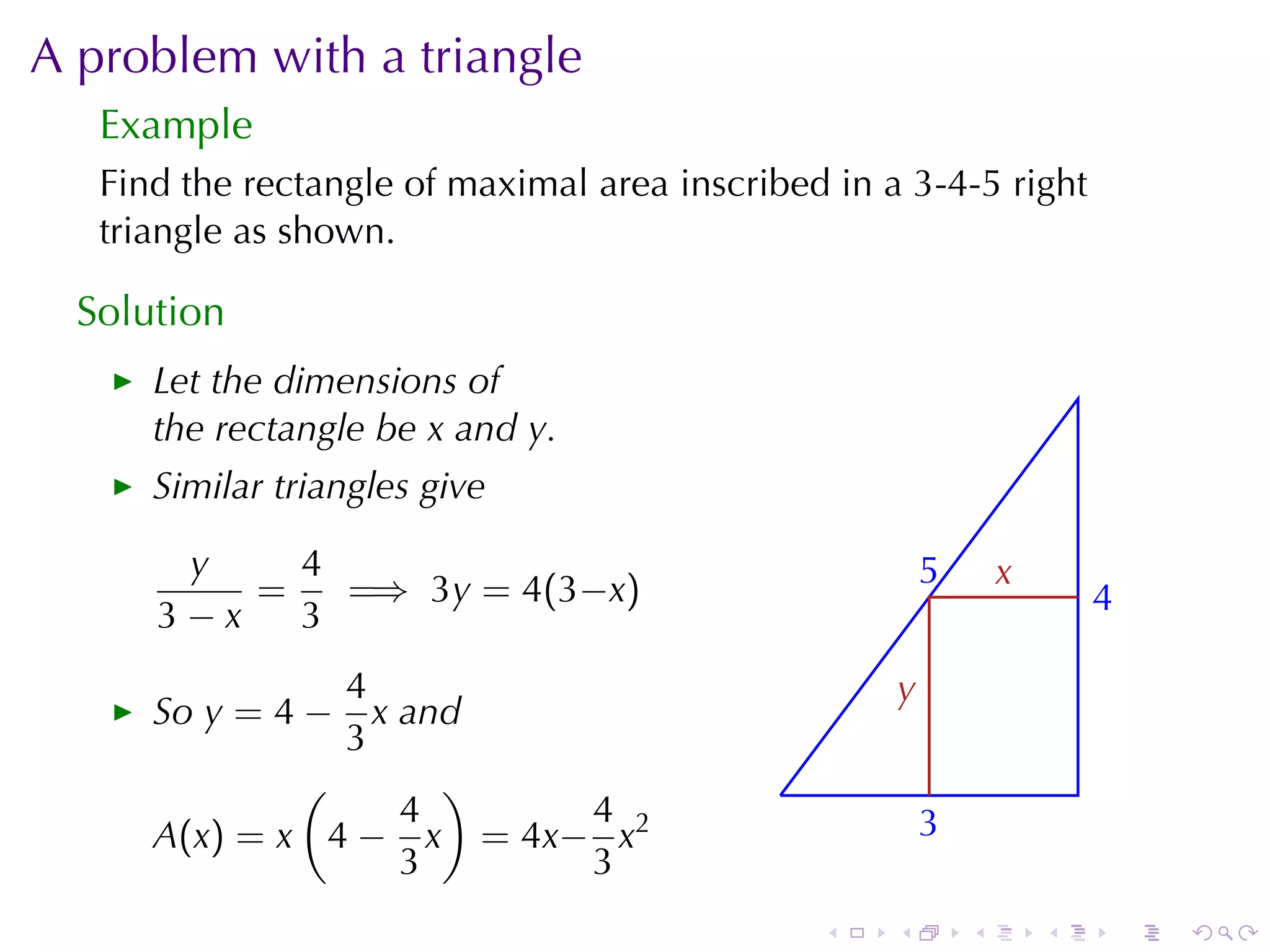
A problem	with	a	triangle
   Example
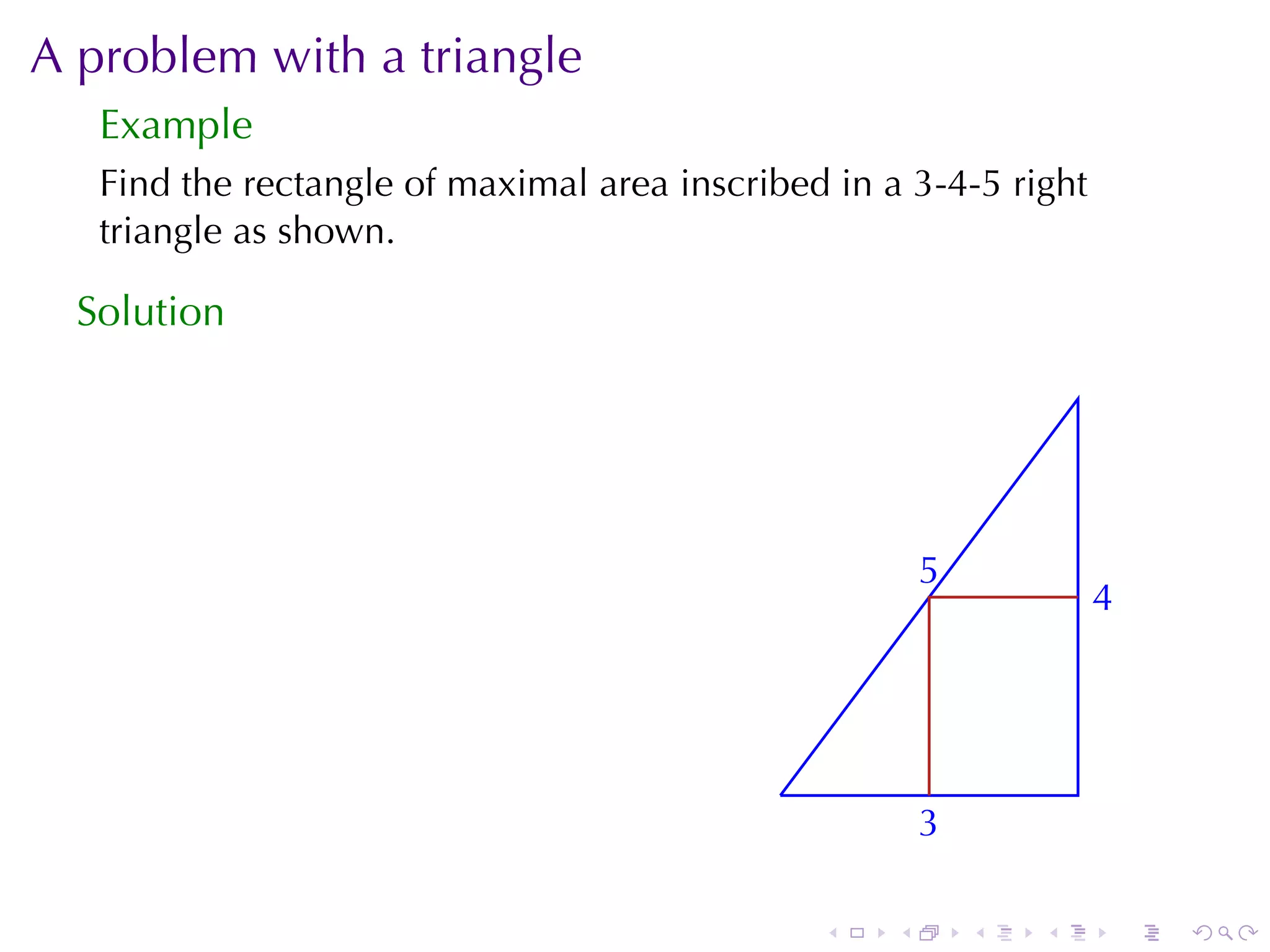
   Find	the	rectangle	of	maximal	area	inscribed	in	a	3-4-5	right
   triangle	as	shown.

  Solution


                                                         5
                                                         .
                                                                     4
                                                                     .


                                             .
                                                         3
                                                         .

                                                 .   .       .   .       .   .
A problem	with	a	triangle
   Example
   Find	the	rectangle	of	maximal	area	inscribed	in	a	3-4-5	right
   triangle	as	shown.

  Solution
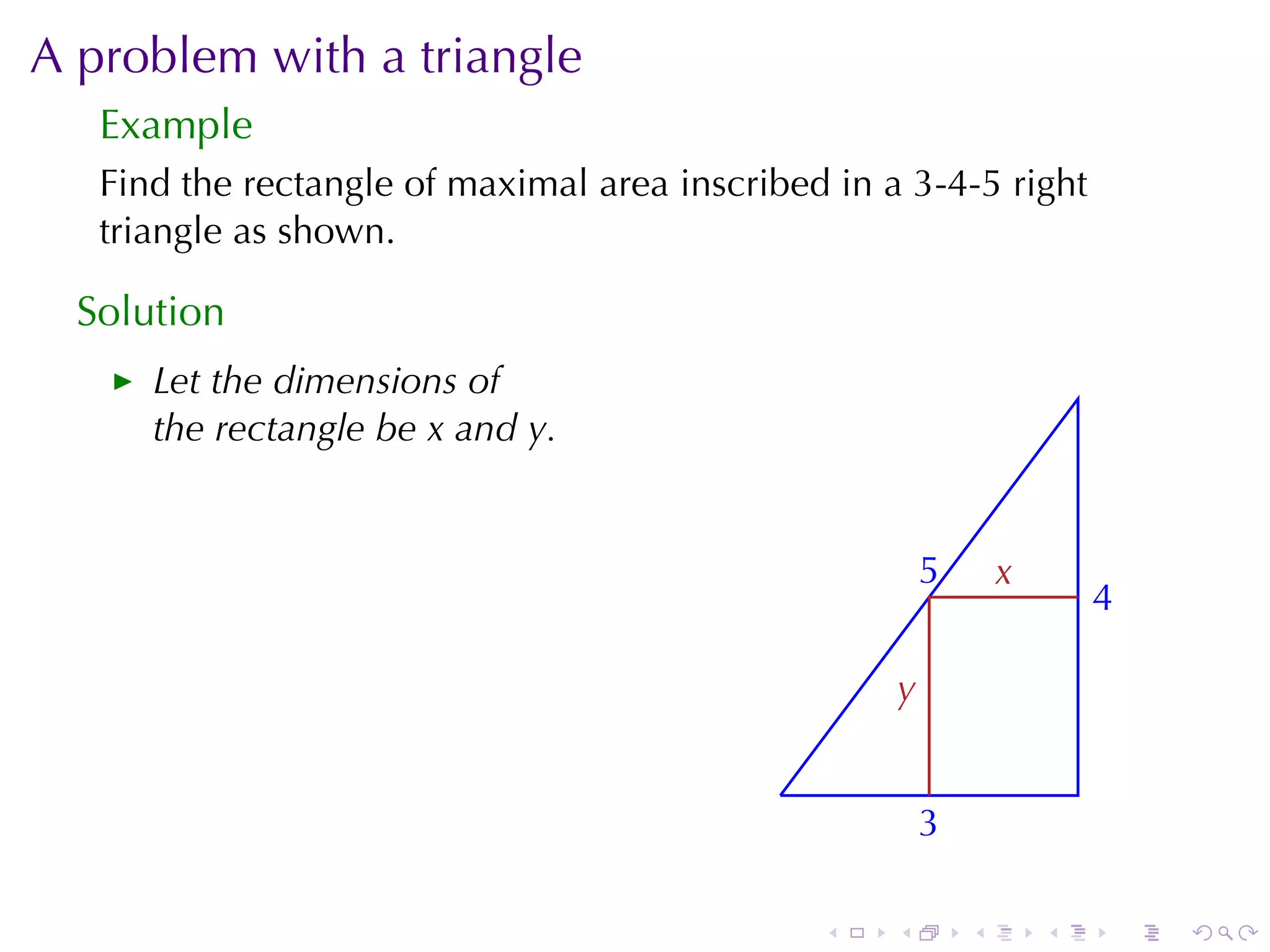
      Let	the	dimensions	of
      the	rectangle	be x and y.


                                                         5
                                                         .       x
                                                                 .
                                                                         4
                                                                         .

                                                     y
                                                     .

                                             .
                                                         3
                                                         .

                                                 .   .       .       .       .   .
A problem	with	a	triangle
   Example
   Find	the	rectangle	of	maximal	area	inscribed	in	a	3-4-5	right
   triangle	as	shown.

  Solution
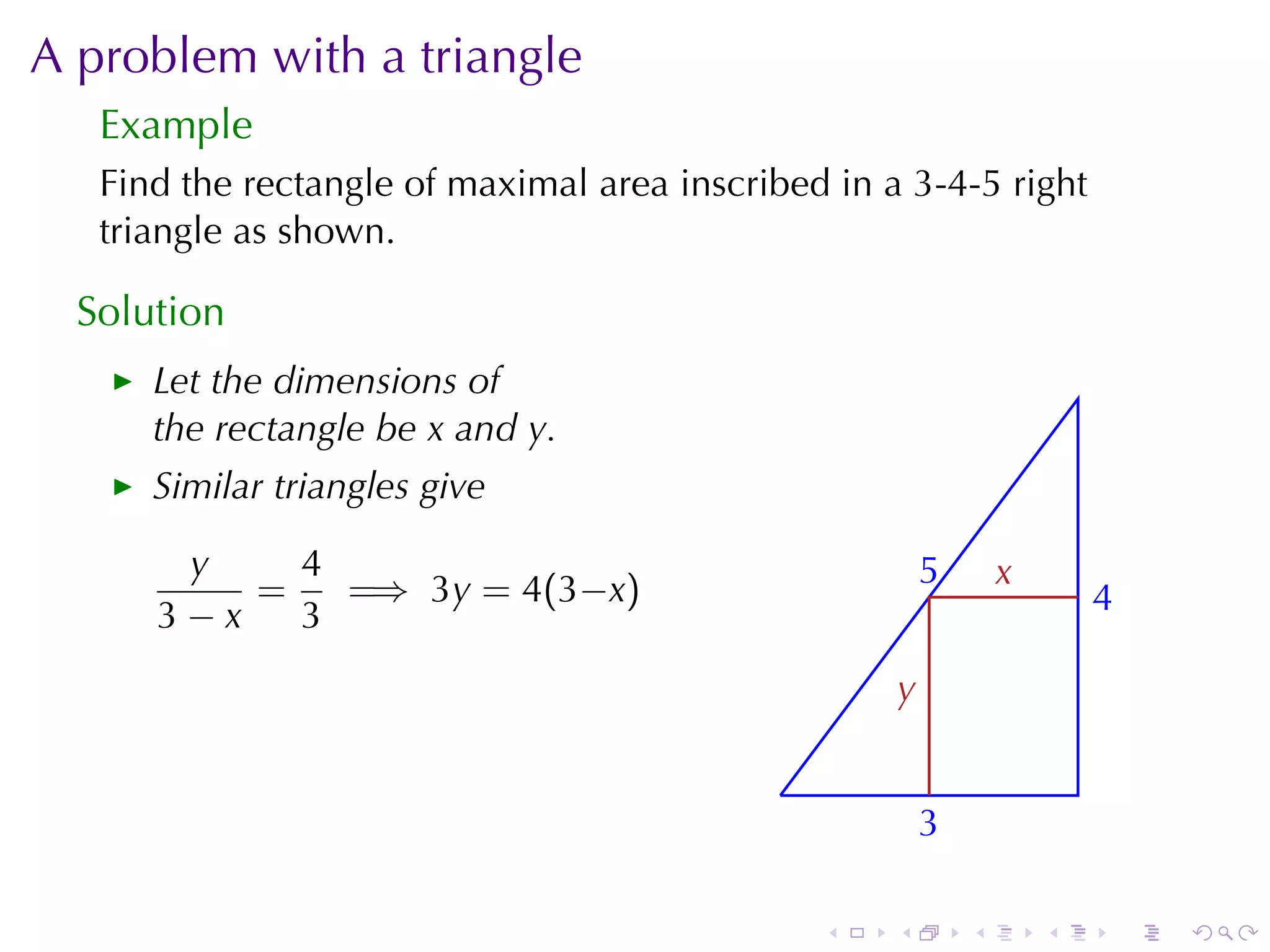
      Let	the	dimensions	of
      the	rectangle	be x and y.
      Similar	triangles	give

       y    4                                            5
                                                         .       x
                                                                 .
          =   =⇒ 3y = 4(3−x)                                             4
                                                                         .
      3−x   3
                                                     y
                                                     .

                                             .
                                                         3
                                                         .

                                                 .   .       .       .       .   .
A problem	with	a	triangle
   Example
   Find	the	rectangle	of	maximal	area	inscribed	in	a	3-4-5	right
   triangle	as	shown.

  Solution
      Let	the	dimensions	of
      the	rectangle	be x and y.
      Similar	triangles	give

       y    4                                            5
                                                         .       x
                                                                 .
          =   =⇒ 3y = 4(3−x)                                             4
                                                                         .
      3−x   3
                4                                    y
                                                     .
      So y = 4 −  x and
                3
              (       )                      .
                    4     4                              3
                                                         .
      A(x) = x 4 − x = 4x− x2
                    3     3
                                                 .   .       .       .       .   .
Triangle	Problem
maximization	step


                                                         4 2
    We	want	to	find	the	absolute	maximum	of A(x) = 4x −     x on
                                                         3
    the	interval [0, 3].


                                            .   .   .     .   .   .
Triangle	Problem
maximization	step


                                                         4 2
    We	want	to	find	the	absolute	maximum	of A(x) = 4x −     x on
                                                         3
    the	interval [0, 3].
          A(0) = A(3) = 0


                                            .   .   .     .   .   .
Triangle	Problem
maximization	step


                                                             4 2
    We	want	to	find	the	absolute	maximum	of A(x) = 4x −         x on
                                                             3
    the	interval [0, 3].
          A(0) = A(3) = 0
                      8                          12
          A′ (x) = 4 − x, which	is	zero	when x =    = 1.5.
                      3                           8


                                               .   .   .      .   .   .
Triangle	Problem
maximization	step


                                                               4 2
    We	want	to	find	the	absolute	maximum	of A(x) = 4x −           x on
                                                               3
    the	interval [0, 3].
          A(0) = A(3) = 0
                      8                            12
          A′ (x) = 4 − x, which	is	zero	when x =      = 1.5.
                      3                             8
          Since A(1.5) = 3, this	is	the	absolute	maximum.


                                                .    .   .      .   .   .
Triangle	Problem
maximization	step


                                                               4 2
    We	want	to	find	the	absolute	maximum	of A(x) = 4x −           x on
                                                               3
    the	interval [0, 3].
          A(0) = A(3) = 0
                      8                            12
          A′ (x) = 4 − x, which	is	zero	when x =      = 1.5.
                      3                             8
          Since A(1.5) = 3, this	is	the	absolute	maximum.
          So	the	dimensions	of	the	rectangle	of	maximal	area	are
          1.5 × 2.


                                                .    .   .      .   .   .
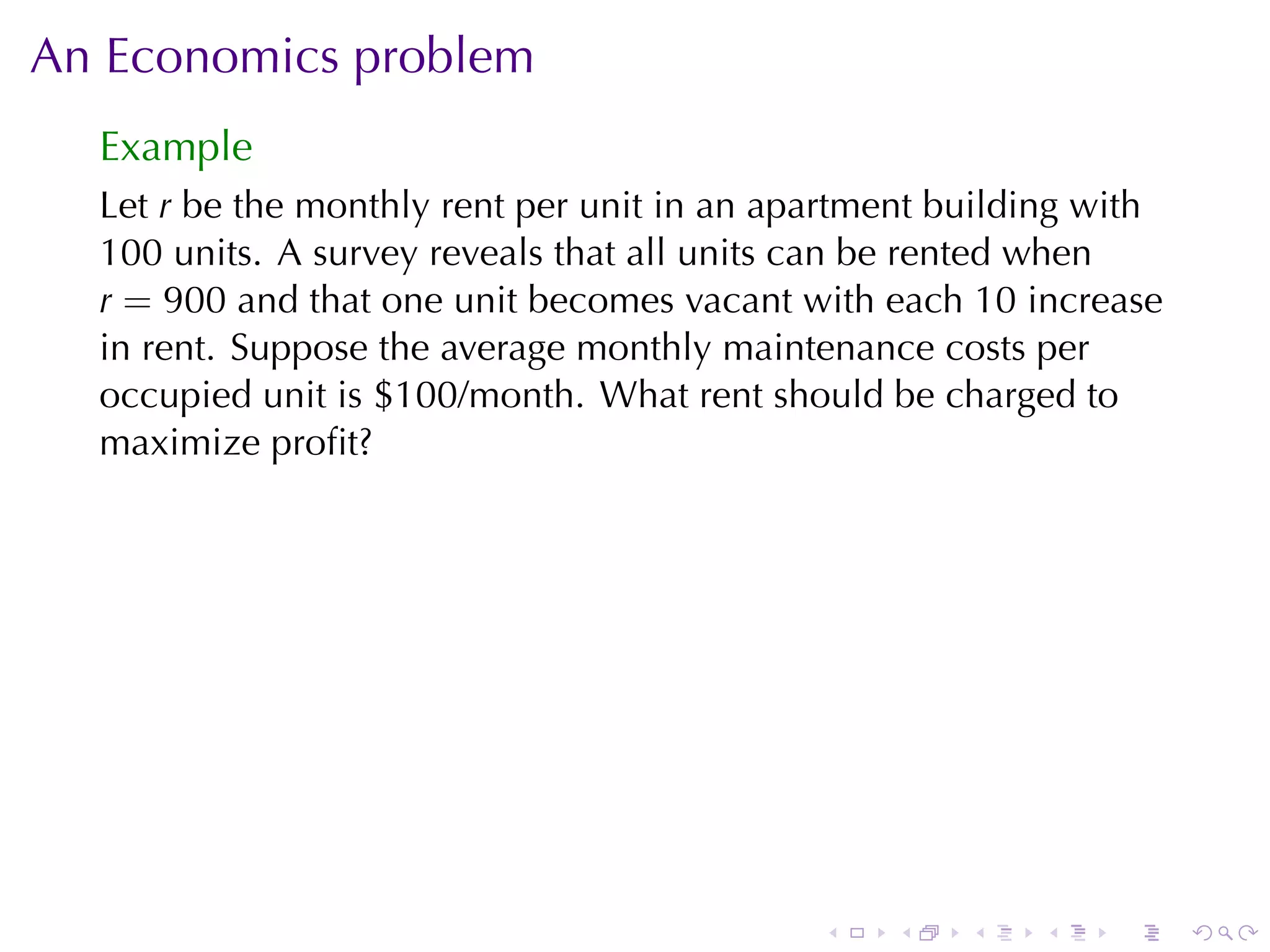
An	Economics	problem
  Example
  Let r be	the	monthly	rent	per	unit	in	an	apartment	building	with
  100 units. A survey	reveals	that	all	units	can	be	rented	when
  r = 900 and	that	one	unit	becomes	vacant	with	each 10 increase
  in	rent. Suppose	the	average	monthly	maintenance	costs	per
  occupied	unit	is	$100/month. What	rent	should	be	charged	to
  maximize	profit?


                                             .   .    .   .    .     .
An	Economics	problem
  Example
  Let r be	the	monthly	rent	per	unit	in	an	apartment	building	with
  100 units. A survey	reveals	that	all	units	can	be	rented	when
  r = 900 and	that	one	unit	becomes	vacant	with	each 10 increase
  in	rent. Suppose	the	average	monthly	maintenance	costs	per
  occupied	unit	is	$100/month. What	rent	should	be	charged	to
  maximize	profit?

  Solution
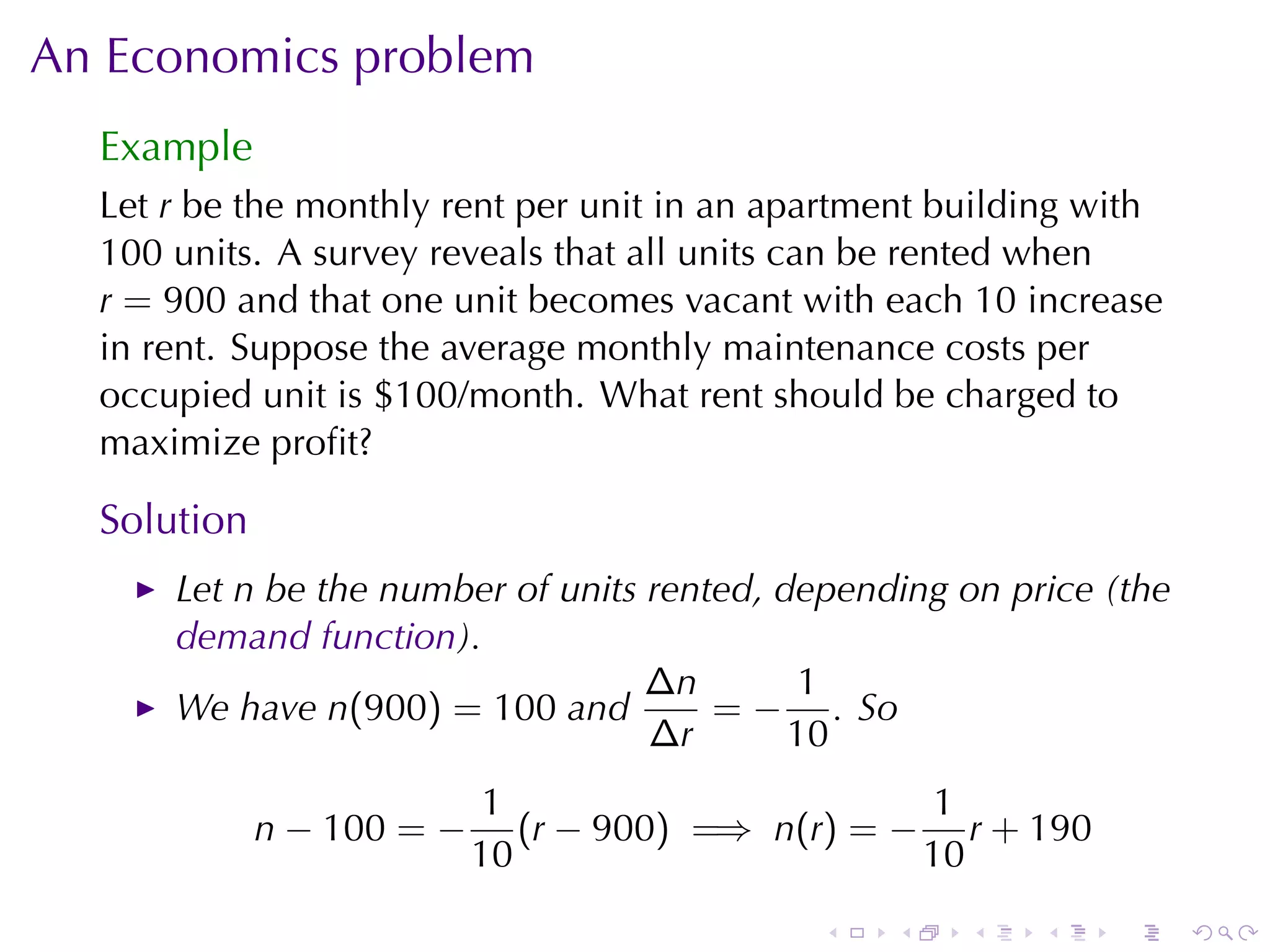
      Let n be	the	number	of	units	rented, depending	on	price	(the
      demand	function).
                                   ∆n        1
      We	have n(900) = 100 and         = − . So
                                   ∆r       10
                            1                      1
             n − 100 = −      (r − 900) =⇒ n(r) = − r + 190
                           10                      10
                                             .   .    .   .    .     .
Economics	Problem
Finishing	the	model	and	maximizing


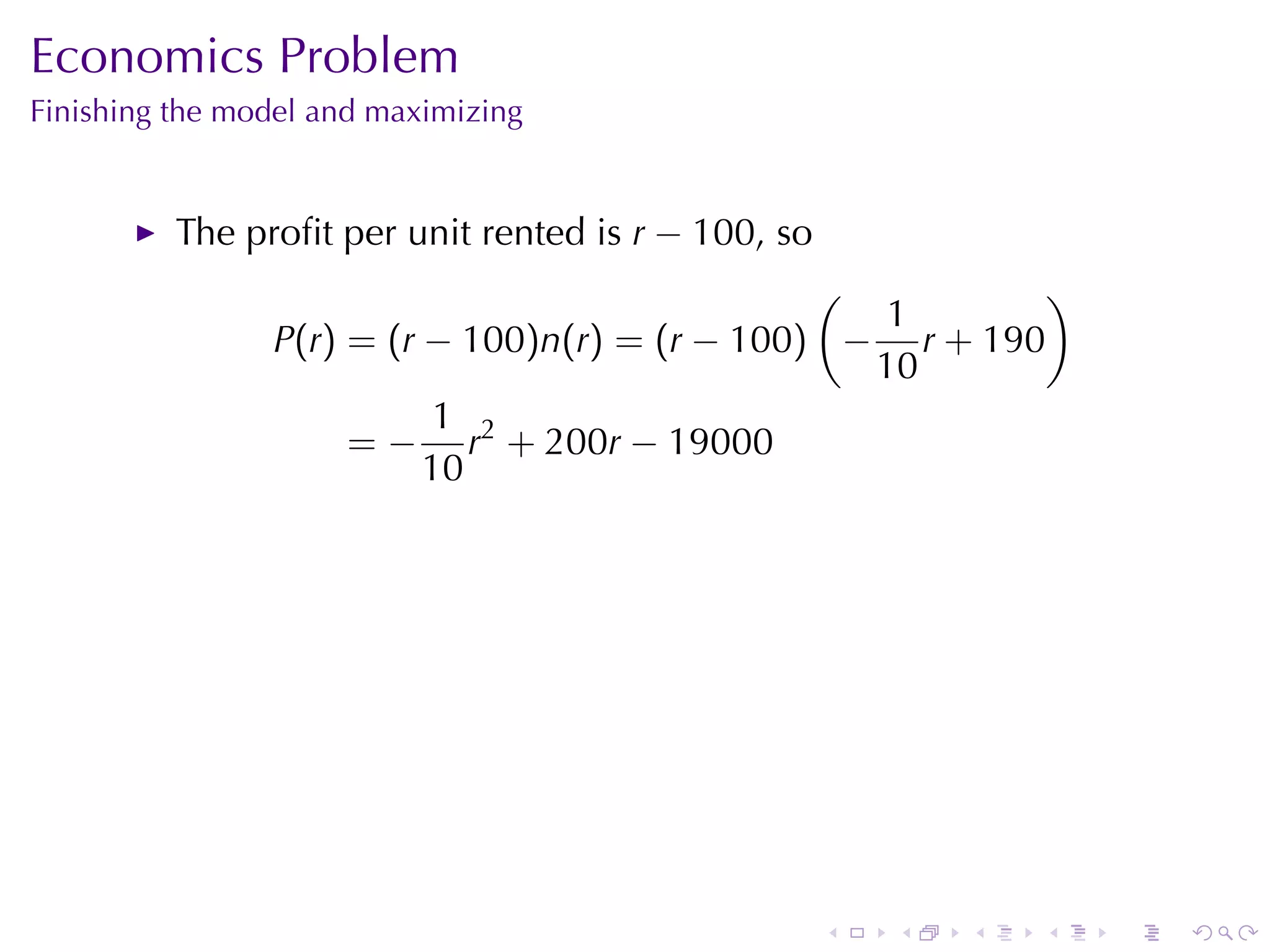
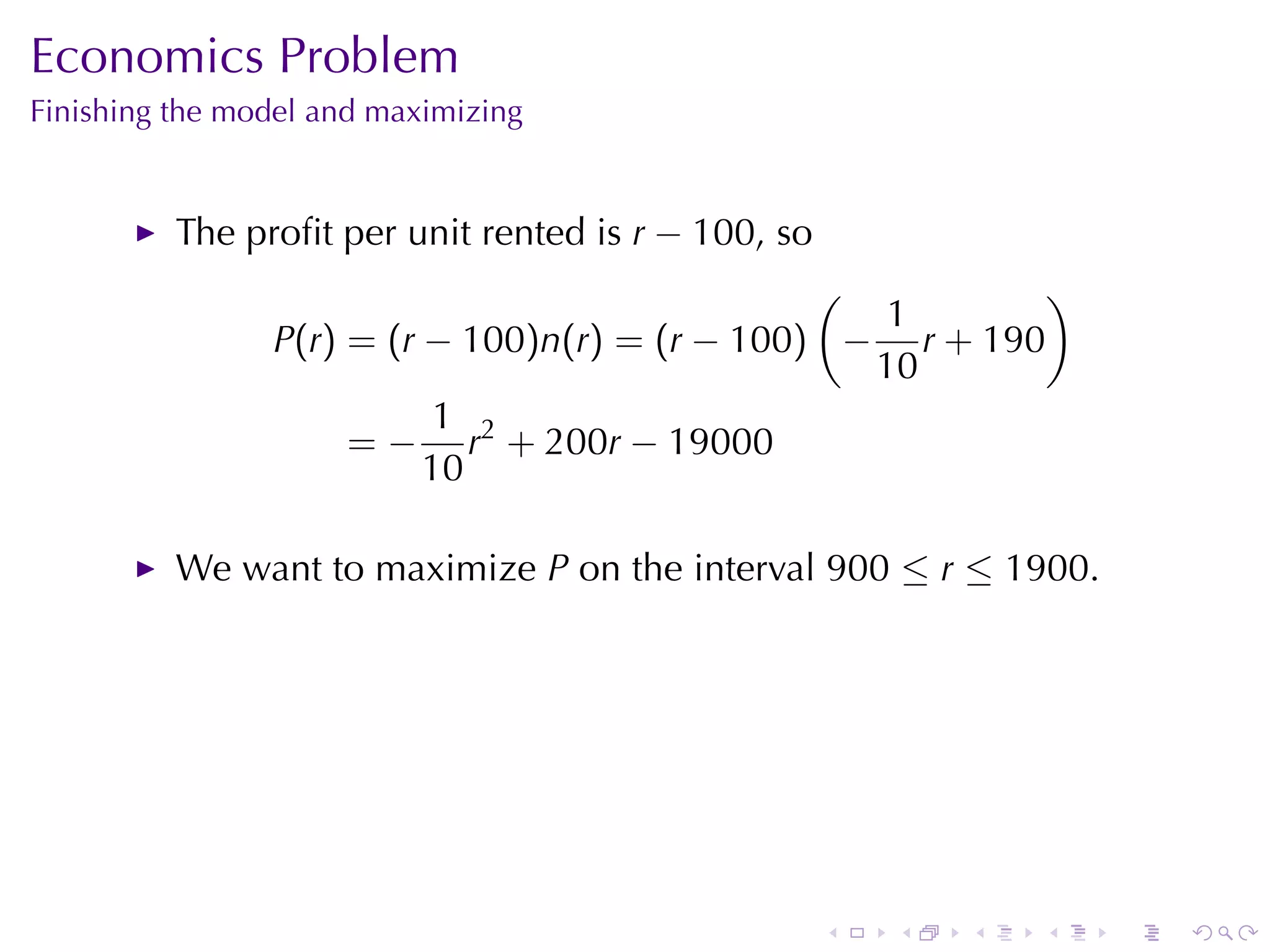
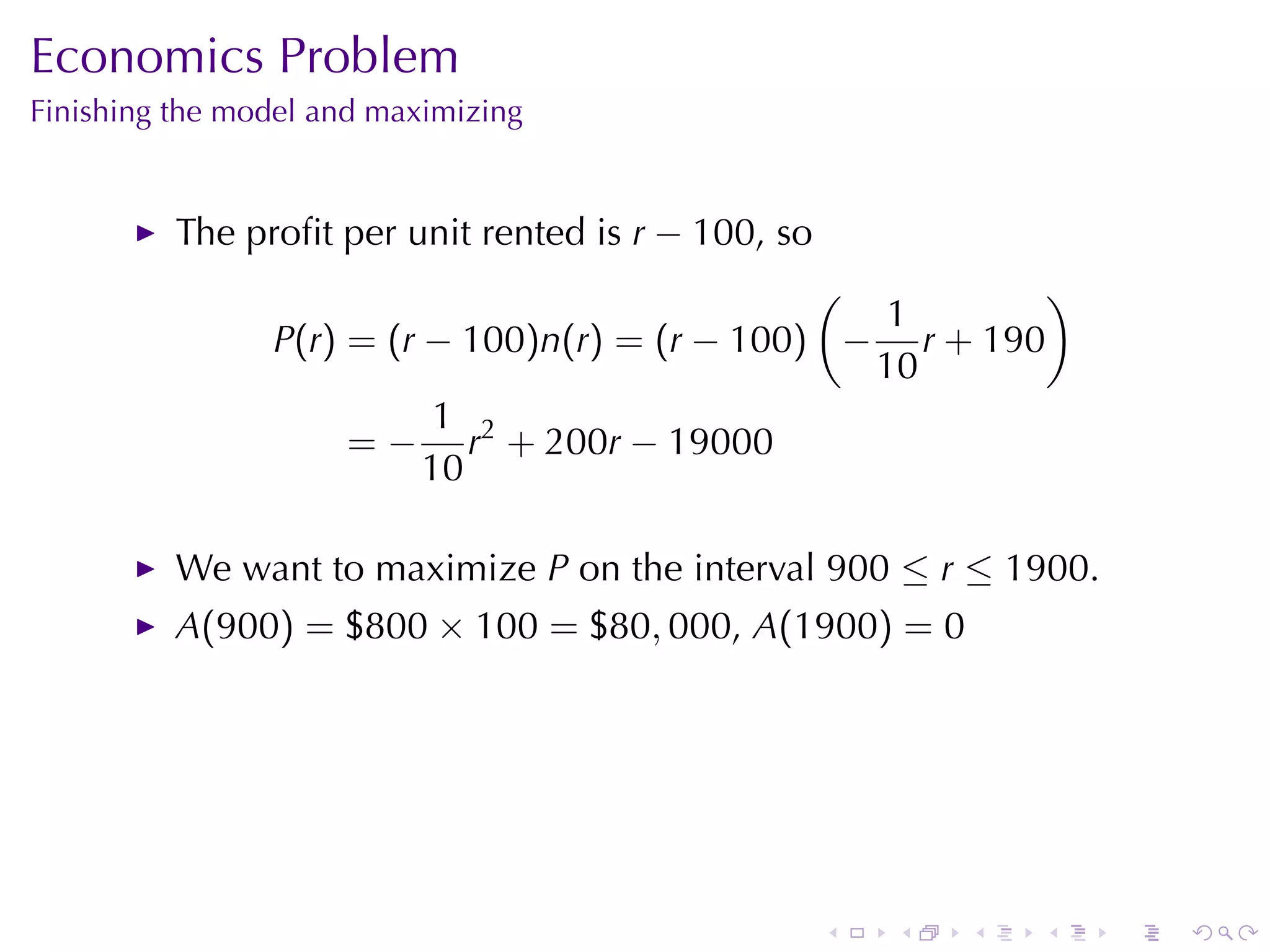
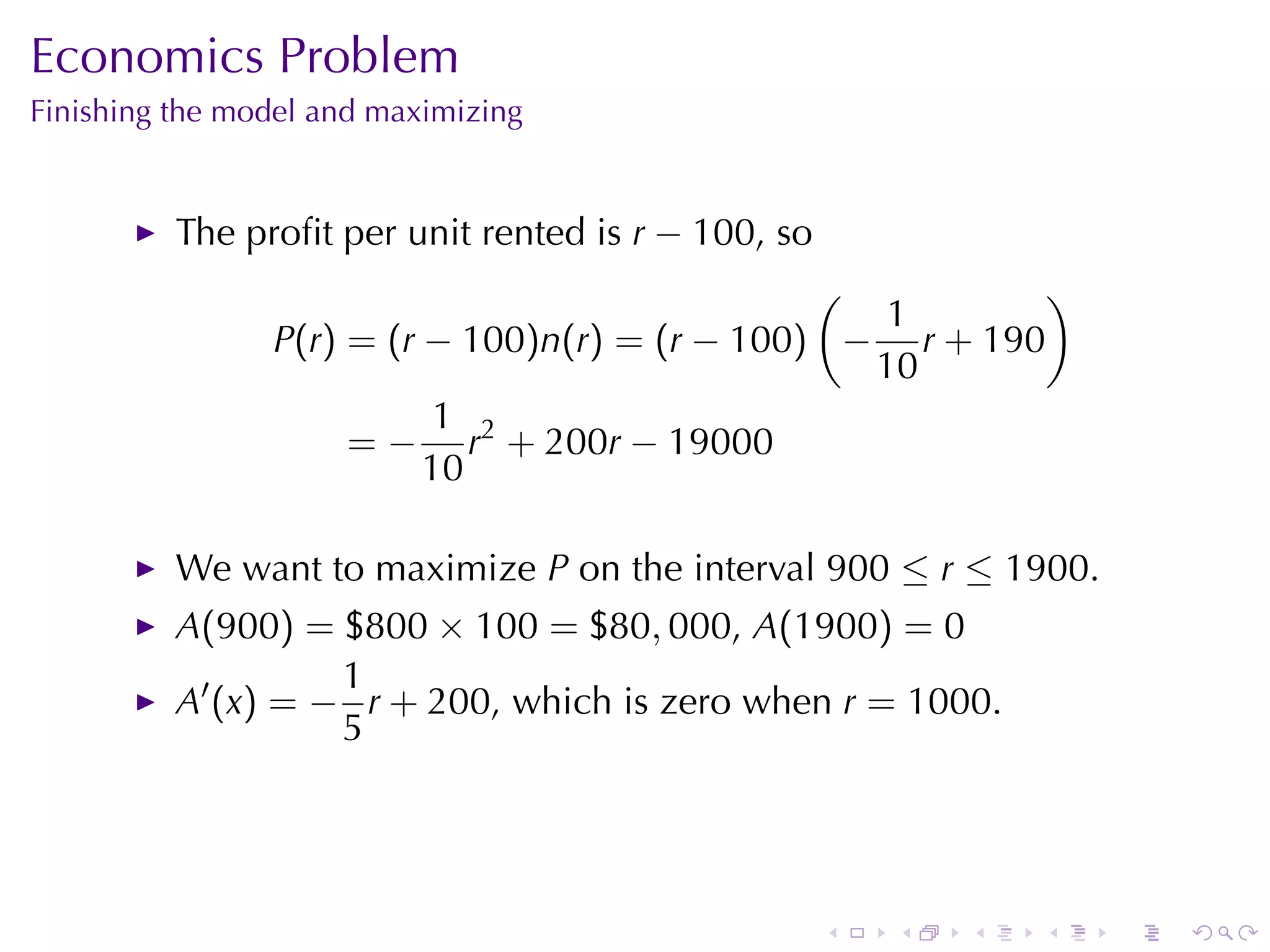
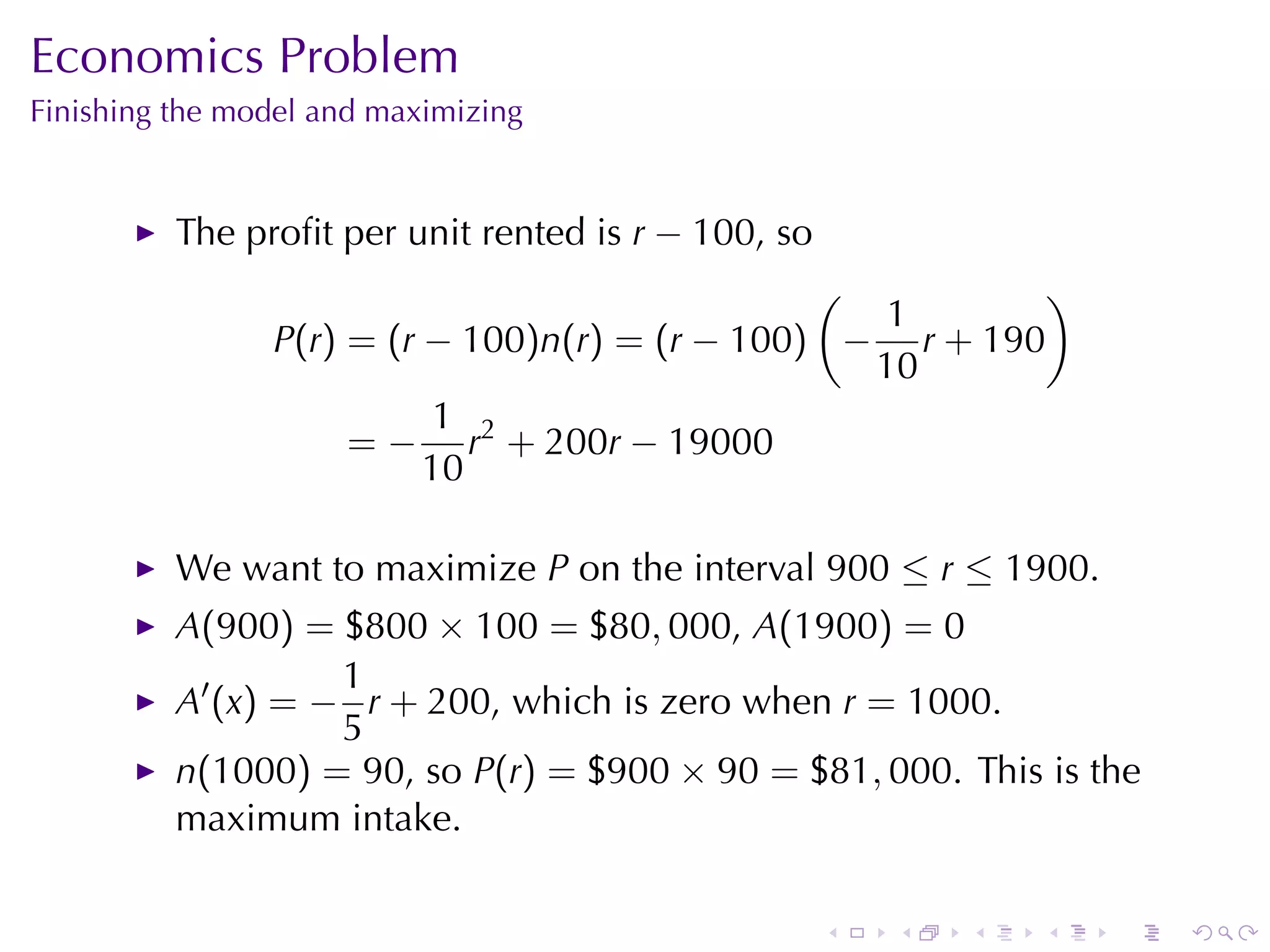
          The	profit	per	unit	rented	is r − 100, so
                                                (          )
                                                   1
                P(r) = (r − 100)n(r) = (r − 100) − r + 190
                                                  10
                           1 2
                     = − r + 200r − 19000
                          10


                                                     .   .   .   .   .   .
Economics	Problem
Finishing	the	model	and	maximizing


          The	profit	per	unit	rented	is r − 100, so
                                                (          )
                                                   1
                P(r) = (r − 100)n(r) = (r − 100) − r + 190
                                                  10
                           1 2
                     = − r + 200r − 19000
                          10

          We	want	to	maximize P on	the	interval 900 ≤ r ≤ 1900.


                                                     .   .   .   .   .   .
Economics	Problem
Finishing	the	model	and	maximizing


          The	profit	per	unit	rented	is r − 100, so
                                                (          )
                                                   1
                P(r) = (r − 100)n(r) = (r − 100) − r + 190
                                                  10
                           1 2
                     = − r + 200r − 19000
                          10

          We	want	to	maximize P on	the	interval 900 ≤ r ≤ 1900.
          A(900) = $800 × 100 = $80, 000, A(1900) = 0


                                                     .   .   .   .   .   .
Economics	Problem
Finishing	the	model	and	maximizing


          The	profit	per	unit	rented	is r − 100, so
                                                (          )
                                                   1
                P(r) = (r − 100)n(r) = (r − 100) − r + 190
                                                  10
                           1 2
                     = − r + 200r − 19000
                          10

          We	want	to	maximize P on	the	interval 900 ≤ r ≤ 1900.
          A(900) = $800 × 100 = $80, 000, A(1900) = 0
                    1
          A′ (x) = − r + 200, which	is	zero	when r = 1000.
                    5


                                                     .   .   .   .   .   .
Economics	Problem
Finishing	the	model	and	maximizing


          The	profit	per	unit	rented	is r − 100, so
                                                (          )
                                                   1
                P(r) = (r − 100)n(r) = (r − 100) − r + 190
                                                  10
                           1 2
                     = − r + 200r − 19000
                          10

          We	want	to	maximize P on	the	interval 900 ≤ r ≤ 1900.
          A(900) = $800 × 100 = $80, 000, A(1900) = 0
                    1
          A′ (x) = − r + 200, which	is	zero	when r = 1000.
                    5
          n(1000) = 90, so P(r) = $900 × 90 = $81, 000. This	is	the
          maximum	intake.

                                                     .   .   .   .   .   .
The	Statue	of	Liberty
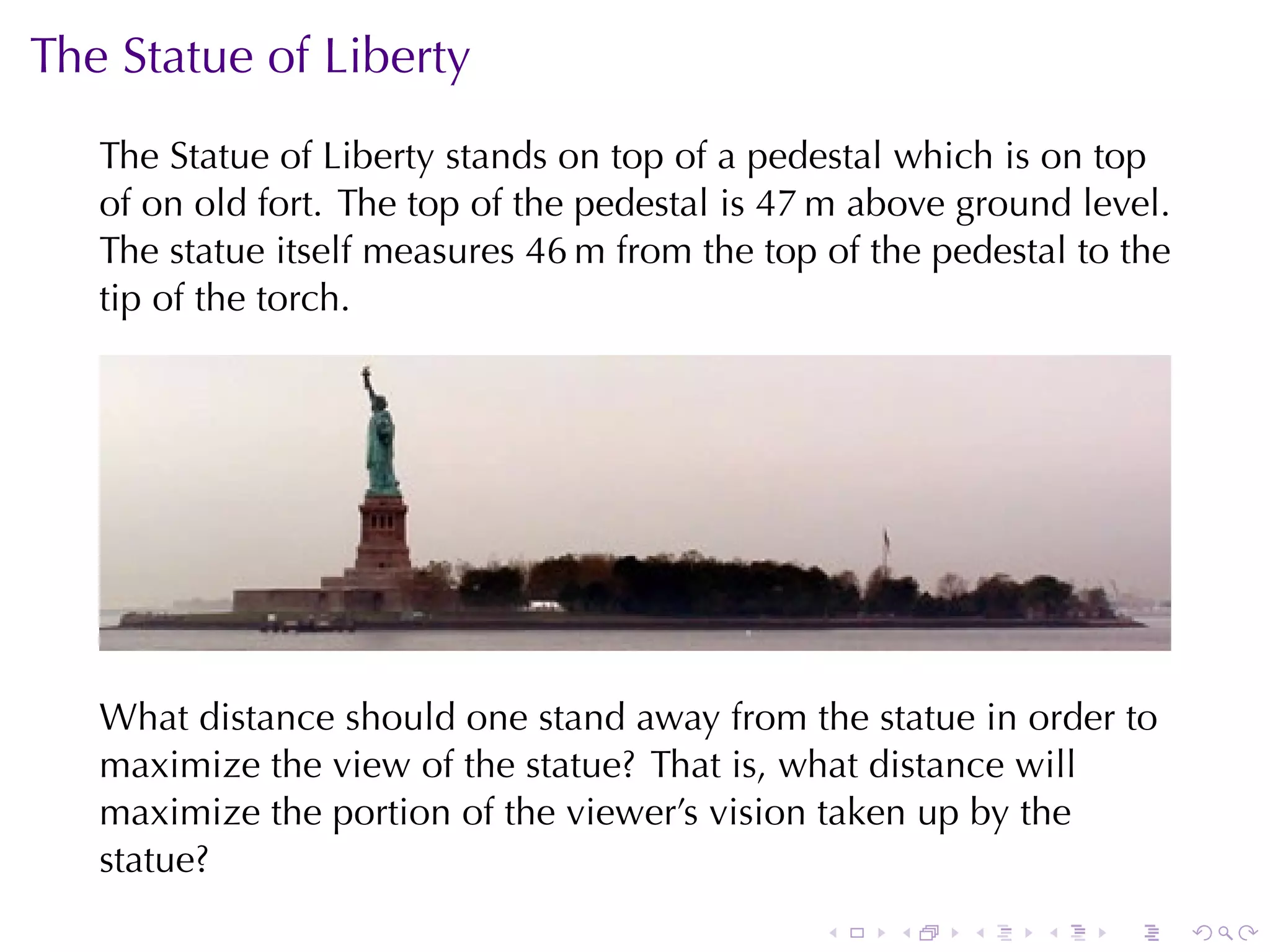
   The	Statue	of	Liberty	stands	on	top	of	a	pedestal	which	is	on	top
   of	on	old	fort. The	top	of	the	pedestal	is	47 m	above	ground	level.
   The	statue	itself	measures	46 m	from	the	top	of	the	pedestal	to	the
   tip	of	the	torch.


   What	distance	should	one	stand	away	from	the	statue	in	order	to
   maximize	the	view	of	the	statue? That	is, what	distance	will
   maximize	the	portion	of	the	viewer’s	vision	taken	up	by	the
   statue?
                                                .   .    .    .   .      .
The	Statue	of	Liberty
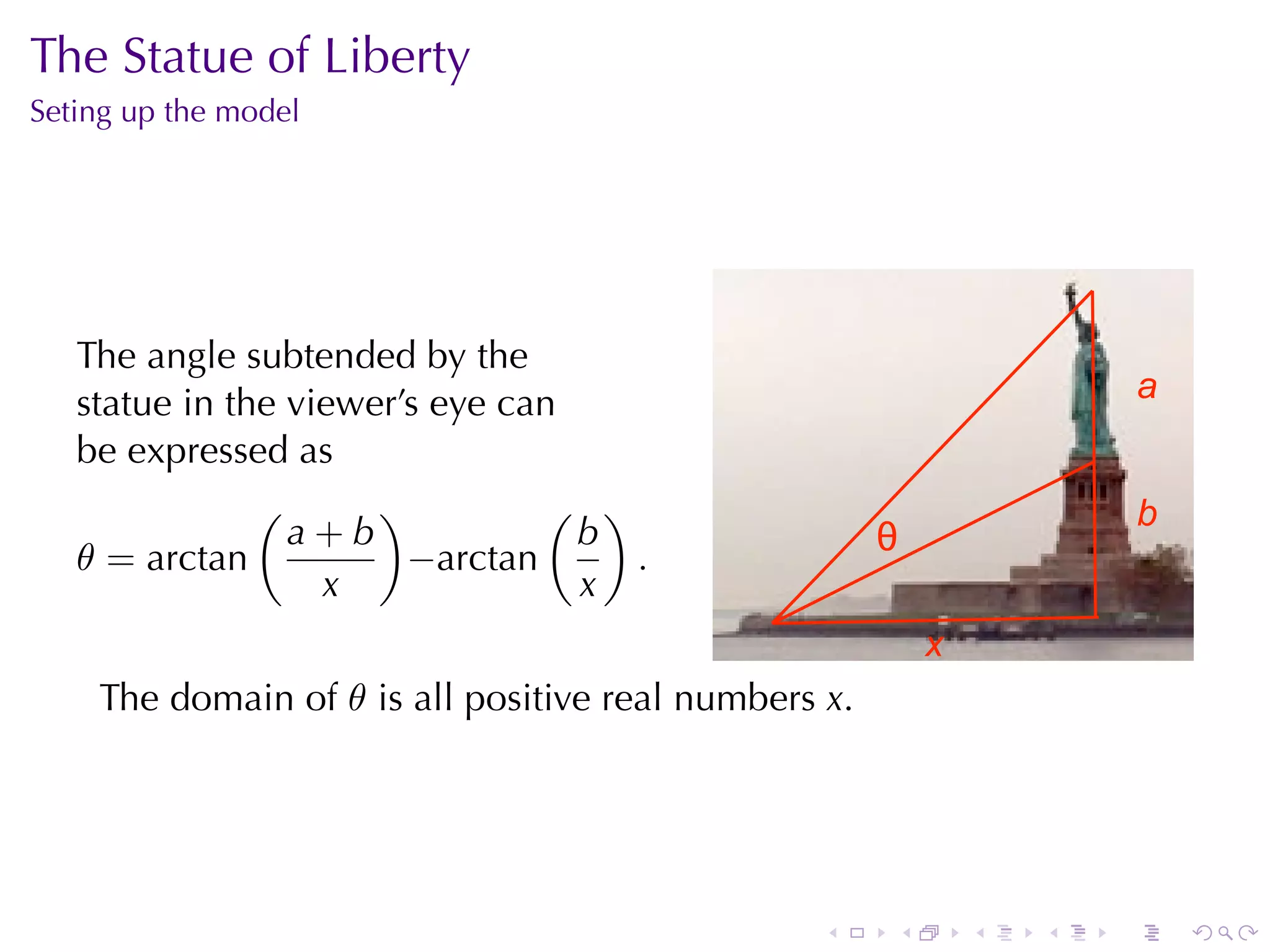
Seting	up	the	model


   The	angle	subtended	by	the
   statue	in	the	viewer’s	eye	can                                         a
   be	expressed	as
               (      )         ( )                                       b
                 a+b              b                   θ
   θ = arctan           −arctan     .
                   x              x
                                                          x
    The	domain	of θ is	all	positive	real	numbers x.


                                                 .    .       .   .   .       .
The	Statue	of	Liberty
Finding	the	derivative


                                          (          )            ( )
                                               a+b                 b
                         θ = arctan                      − arctan
                                                x                  x
     So
                dθ             1               −(a + b)            1     −b
                   =          (         )2 ·            −          ( )2 · 2
                dx                a+b             x2                 b    x
                         1+        x                         1+     x
                              b       a+b
                    =             2
                                      −
                         x2 +b            x2
                                     + (a + b ) 2
                         [ 2          ]           [        ]
                          x + (a + b)2 b − (a + b) x2 + b2
                    =
                                  (x2 + b2 ) [x2 + (a + b)2 ]


                                                               .        .   .   .   .   .
The	Statue	of	Liberty
Finding	the	critical	points


                              [                ]           [        ]
                   dθ             x2 + (a + b)2 b − (a + b) x2 + b2
                      =
                   dx                  (x2 + b2 ) [x2 + (a + b)2 ]


                                                             .       .   .   .   .   .
The	Statue	of	Liberty
Finding	the	critical	points


                              [                ]           [        ]
                   dθ             x2 + (a + b)2 b − (a + b) x2 + b2
                      =
                   dx                  (x2 + b2 ) [x2 + (a + b)2 ]

           This	derivative	is	zero	if	and	only	if	the	numerator	is	zero, so
           we	seek x such	that
                [              ]             [         ]
           0 = x2 + (a + b)2 b − (a + b) x2 + b2 = a(ab + b2 − x2 )


                                                             .       .   .   .   .   .
The	Statue	of	Liberty
Finding	the	critical	points


                              [                ]           [        ]
                   dθ             x2 + (a + b)2 b − (a + b) x2 + b2
                      =
                   dx                  (x2 + b2 ) [x2 + (a + b)2 ]

           This	derivative	is	zero	if	and	only	if	the	numerator	is	zero, so
           we	seek x such	that
                [              ]             [         ]
           0 = x2 + (a + b)2 b − (a + b) x2 + b2 = a(ab + b2 − x2 )

                                                      √
           The	only	positive	solution	is x =              b(a + b).


                                                              .      .   .   .   .   .
The	Statue	of	Liberty
Finding	the	critical	points


                              [                ]           [        ]
                   dθ             x2 + (a + b)2 b − (a + b) x2 + b2
                      =
                   dx                  (x2 + b2 ) [x2 + (a + b)2 ]

           This	derivative	is	zero	if	and	only	if	the	numerator	is	zero, so
           we	seek x such	that
                [              ]             [         ]
           0 = x2 + (a + b)2 b − (a + b) x2 + b2 = a(ab + b2 − x2 )

                                                      √
           The	only	positive	solution	is x =              b(a + b).
           Using	the	first	derivative	test, we	see	that dθ/dx > 0 if
                   √                                   √
           0 < x < b(a + b) and dθ/dx < 0 if x > b(a + b).
           So	this	is	definitely	the	absolute	maximum	on (0, ∞).

                                                              .      .   .   .   .   .
The	Statue	of	Liberty
Final	answer


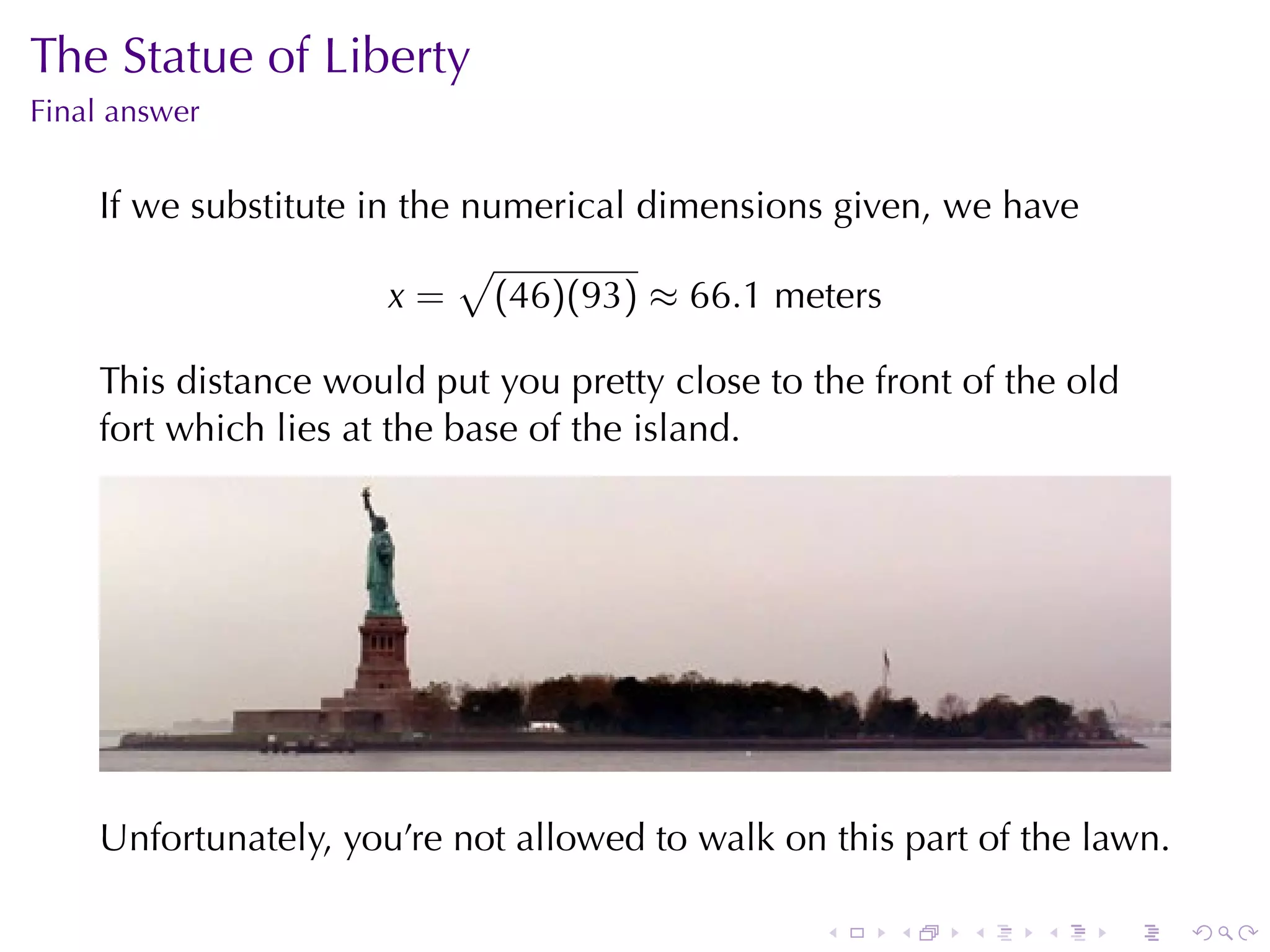
    If	we	substitute	in	the	numerical	dimensions	given, we	have
                            √
                       x = (46)(93) ≈ 66.1 meters

    This	distance	would	put	you	pretty	close	to	the	front	of	the	old
    fort	which	lies	at	the	base	of	the	island.


    Unfortunately, you’re	not	allowed	to	walk	on	this	part	of	the	lawn.

                                                 .   .    .    .   .      .
The	Statue	of	Liberty
Discussion


                     √
         The	length b(a + b) is	the geometric	mean of	the	two
         distances	measured	from	the	ground—to	the	top	of	the
         pedestal	(a)	and	the	top	of	the	statue	(a + b).
         The	geometric	mean	is	of	two	numbers	is	always	between
         them	and	greater	than	or	equal	to	their	average.


                                             .    .   .   .     .   .

Lesson 24: Optimization II

  • 1.
    Section 4.5 Optimization II V63.0121.034, Calculus I November 25, 2009 Announcements Final Exam, December 18, 2:00–3:50pm . . . . . .
  • 2.
    Outline Recall More examples Addition Distance Triangles Economics The Statue of Liberty . . . . . .
  • 3.
    Checklist for optimization problems 1. Understand the Problem What is known? What is unknown? What are the conditions? 2. Draw a diagram 3. Introduce Notation 4. Express the “objective function” Q in terms of the other symbols 5. If Q is a function of more than one “decision variable”, use the given information to eliminate all but one of them. 6. Find the absolute maximum (or minimum, depending on the problem) of the function on its domain. . . . . . .
  • 4.
    Recall: The Closed Interval Method See Section 4.1 To find the extreme values of a function f on [a, b], we need to: Evaluate f at the endpoints a and b Evaluate f at the critical points x where either f′ (x) = 0 or f is not differentiable at x. The points with the largest function value are the global maximum points The points with the smallest or most negative function value are the global minimum points. . . . . . .
  • 5.
    Recall: The First Derivative Test See Section 4.3 Theorem (The First Derivative Test) Let f be a continuous function and c a critical point of f in (a, b). If f′ (x) > 0 on (a, c) (i.e., “before c”) and f′ (x) < 0 on (c, b) (i.e., “after c”, then c is a local maximum for f. If f′ (x) < 0 on (a, c) and f′ (x) > 0 on (c, b), then c is a local minimum for f. If f′ (x) has the same sign on (a, c) and (c, b), then c is not a local extremum. . . . . . .
  • 6.
    Recall: The Second Derivative Test See Section 4.3 Theorem (The Second Derivative Test) Let f, f′ , and f′′ be continuous. Let c be be a point in (a, b) with f′ (c) = 0. If f′′ (c) < 0, then f(c) is a local maximum. If f′′ (c) > 0, then f(c) is a local minimum. If f′′ (c) = 0, the second derivative test is inconclusive (this does not mean c is neither; we just don’t know yet). . . . . . .
  • 7.
    Which to use when? The bottom line Use CIM if it applies: the domain is a closed, bounded interval If domain is not closed or not bounded, use 2DT if you like to take derivatives, or 1DT if you like to compare signs. . . . . . .
  • 8.
    Outline Recall More examples Addition Distance Triangles Economics The Statue of Liberty . . . . . .
  • 9.
    Addition with a constraint Example Find two positive numbers x and y with xy = 16 and x + y as small as possible. . . . . . .
  • 10.
    Addition with a constraint Example Find two positive numbers x and y with xy = 16 and x + y as small as possible. Solution Objective: minimize S = x + y subject to the constraint that xy = 16 . . . . . .
  • 11.
    Addition with a constraint Example Find two positive numbers x and y with xy = 16 and x + y as small as possible. Solution Objective: minimize S = x + y subject to the constraint that xy = 16 Eliminate y: y = 16/x so S = x + 16/x. The domain of consideration is (0, ∞). . . . . . .
  • 12.
    Addition with a constraint Example Find two positive numbers x and y with xy = 16 and x + y as small as possible. Solution Objective: minimize S = x + y subject to the constraint that xy = 16 Eliminate y: y = 16/x so S = x + 16/x. The domain of consideration is (0, ∞). Find the critical points: S′ (x) = 1 − 16/x2 , which is 0 when x = 4. . . . . . .
  • 13.
    Addition with a constraint Example Find two positive numbers x and y with xy = 16 and x + y as small as possible. Solution Objective: minimize S = x + y subject to the constraint that xy = 16 Eliminate y: y = 16/x so S = x + 16/x. The domain of consideration is (0, ∞). Find the critical points: S′ (x) = 1 − 16/x2 , which is 0 when x = 4. Classify the critical points: S′′ (x) = 32/x3 , which is always positive. So the graph is always concave up, 4 is a local min, and therefore the global min. . . . . . .
  • 14.
    Addition with a constraint Example Find two positive numbers x and y with xy = 16 and x + y as small as possible. Solution Objective: minimize S = x + y subject to the constraint that xy = 16 Eliminate y: y = 16/x so S = x + 16/x. The domain of consideration is (0, ∞). Find the critical points: S′ (x) = 1 − 16/x2 , which is 0 when x = 4. Classify the critical points: S′′ (x) = 32/x3 , which is always positive. So the graph is always concave up, 4 is a local min, and therefore the global min. So the numbers are x = y = 4, Smin = 8. . . . . . .
  • 15.
    Distance Example Find the point P on the parabola y = x2 closest to the point (3, 0). . . . . . .
  • 16.
    Distance Example Find the point P on the parabola y = x2 closest to the point (3, 0). Solution y . . x, x2 ) ( . . . x . 3 . . . . . . .
  • 17.
    Distance Example Find the point P on the parabola y = x2 closest to the point (3, 0). Solution y . The distance between (x, x2 ) and (3, 0) is given by √ f(x) = (x − 3)2 + (x2 − 0)2 . x, x2 ) ( . . . x . 3 . . . . . . .
  • 18.
    Distance Example Find the point P on the parabola y = x2 closest to the point (3, 0). Solution y . The distance between (x, x2 ) and (3, 0) is given by √ f(x) = (x − 3)2 + (x2 − 0)2 We may instead minimize the square of f: g(x) = f(x)2 = (x − 3)2 + x4 . x, x2 ) ( . . . x . 3 . . . . . . .
  • 19.
    Distance Example Find the point P on the parabola y = x2 closest to the point (3, 0). Solution y . The distance between (x, x2 ) and (3, 0) is given by √ f(x) = (x − 3)2 + (x2 − 0)2 We may instead minimize the square of f: g(x) = f(x)2 = (x − 3)2 + x4 . x, x2 ) ( . . . x . The domain is (−∞, ∞). 3 . . . . . . .
  • 20.
    Distance problem minimization step We want to find the global minimum of g(x) = (x − 3)2 + x4 . . . . . . .
  • 21.
    Distance problem minimization step We want to find the global minimum of g(x) = (x − 3)2 + x4 . g′ (x) = 2(x − 3) + 4x3 = 4x3 + 2x − 6 = 2(2x3 + x − 3) . . . . . .
  • 22.
    Distance problem minimization step We want to find the global minimum of g(x) = (x − 3)2 + x4 . g′ (x) = 2(x − 3) + 4x3 = 4x3 + 2x − 6 = 2(2x3 + x − 3) If a polynomial has integer roots, they are factors of the constant term (Euler) . . . . . .
  • 23.
    Distance problem minimization step We want to find the global minimum of g(x) = (x − 3)2 + x4 . g′ (x) = 2(x − 3) + 4x3 = 4x3 + 2x − 6 = 2(2x3 + x − 3) If a polynomial has integer roots, they are factors of the constant term (Euler) 1 is a root, so 2x3 + x − 3 is divisible by x − 1: f′ (x) = 2(2x3 + x − 3) = 2(x − 1)(2x2 + 2x + 3) The quadratic has no real roots (the discriminant b2 − 4ac < 0) . . . . . .
  • 24.
    Distance problem minimization step We want to find the global minimum of g(x) = (x − 3)2 + x4 . g′ (x) = 2(x − 3) + 4x3 = 4x3 + 2x − 6 = 2(2x3 + x − 3) If a polynomial has integer roots, they are factors of the constant term (Euler) 1 is a root, so 2x3 + x − 3 is divisible by x − 1: f′ (x) = 2(2x3 + x − 3) = 2(x − 1)(2x2 + 2x + 3) The quadratic has no real roots (the discriminant b2 − 4ac < 0) We see f′ (1) = 0, f′ (x) < 0 if x < 1, and f′ (x) > 0 if x > 1. So 1 is the global minimum. . . . . . .
  • 25.
    Distance problem minimization step We want to find the global minimum of g(x) = (x − 3)2 + x4 . g′ (x) = 2(x − 3) + 4x3 = 4x3 + 2x − 6 = 2(2x3 + x − 3) If a polynomial has integer roots, they are factors of the constant term (Euler) 1 is a root, so 2x3 + x − 3 is divisible by x − 1: f′ (x) = 2(2x3 + x − 3) = 2(x − 1)(2x2 + 2x + 3) The quadratic has no real roots (the discriminant b2 − 4ac < 0) We see f′ (1) = 0, f′ (x) < 0 if x < 1, and f′ (x) > 0 if x > 1. So 1 is the global minimum. The point on the parabola closest to (3, 0) is (1, 1). The √ minimum distance is 5. . . . . . .
  • 26.
    Remark We’ve used each of the methods (CIM, 1DT, 2DT) so far. Notice how we argued that the critical points were absolute extremes even though 1DT and 2DT only tell you relative/local extremes. . . . . . .
  • 27.
    A problem with a triangle Example Find the rectangle of maximal area inscribed in a 3-4-5 right triangle as shown. Solution 5 . 4 . . 3 . . . . . . .
  • 28.
    A problem with a triangle Example Find the rectangle of maximal area inscribed in a 3-4-5 right triangle as shown. Solution Let the dimensions of the rectangle be x and y. 5 . x . 4 . y . . 3 . . . . . . .
  • 29.
    A problem with a triangle Example Find the rectangle of maximal area inscribed in a 3-4-5 right triangle as shown. Solution Let the dimensions of the rectangle be x and y. Similar triangles give y 4 5 . x . = =⇒ 3y = 4(3−x) 4 . 3−x 3 y . . 3 . . . . . . .
  • 30.
    A problem with a triangle Example Find the rectangle of maximal area inscribed in a 3-4-5 right triangle as shown. Solution Let the dimensions of the rectangle be x and y. Similar triangles give y 4 5 . x . = =⇒ 3y = 4(3−x) 4 . 3−x 3 4 y . So y = 4 − x and 3 ( ) . 4 4 3 . A(x) = x 4 − x = 4x− x2 3 3 . . . . . .
  • 31.
    Triangle Problem maximization step 4 2 We want to find the absolute maximum of A(x) = 4x − x on 3 the interval [0, 3]. . . . . . .
  • 32.
    Triangle Problem maximization step 4 2 We want to find the absolute maximum of A(x) = 4x − x on 3 the interval [0, 3]. A(0) = A(3) = 0 . . . . . .
  • 33.
    Triangle Problem maximization step 4 2 We want to find the absolute maximum of A(x) = 4x − x on 3 the interval [0, 3]. A(0) = A(3) = 0 8 12 A′ (x) = 4 − x, which is zero when x = = 1.5. 3 8 . . . . . .
  • 34.
    Triangle Problem maximization step 4 2 We want to find the absolute maximum of A(x) = 4x − x on 3 the interval [0, 3]. A(0) = A(3) = 0 8 12 A′ (x) = 4 − x, which is zero when x = = 1.5. 3 8 Since A(1.5) = 3, this is the absolute maximum. . . . . . .
  • 35.
    Triangle Problem maximization step 4 2 We want to find the absolute maximum of A(x) = 4x − x on 3 the interval [0, 3]. A(0) = A(3) = 0 8 12 A′ (x) = 4 − x, which is zero when x = = 1.5. 3 8 Since A(1.5) = 3, this is the absolute maximum. So the dimensions of the rectangle of maximal area are 1.5 × 2. . . . . . .
  • 36.
    An Economics problem Example Let r be the monthly rent per unit in an apartment building with 100 units. A survey reveals that all units can be rented when r = 900 and that one unit becomes vacant with each 10 increase in rent. Suppose the average monthly maintenance costs per occupied unit is $100/month. What rent should be charged to maximize profit? . . . . . .
  • 37.
    An Economics problem Example Let r be the monthly rent per unit in an apartment building with 100 units. A survey reveals that all units can be rented when r = 900 and that one unit becomes vacant with each 10 increase in rent. Suppose the average monthly maintenance costs per occupied unit is $100/month. What rent should be charged to maximize profit? Solution Let n be the number of units rented, depending on price (the demand function). ∆n 1 We have n(900) = 100 and = − . So ∆r 10 1 1 n − 100 = − (r − 900) =⇒ n(r) = − r + 190 10 10 . . . . . .
  • 38.
    Economics Problem Finishing the model and maximizing The profit per unit rented is r − 100, so ( ) 1 P(r) = (r − 100)n(r) = (r − 100) − r + 190 10 1 2 = − r + 200r − 19000 10 . . . . . .
  • 39.
    Economics Problem Finishing the model and maximizing The profit per unit rented is r − 100, so ( ) 1 P(r) = (r − 100)n(r) = (r − 100) − r + 190 10 1 2 = − r + 200r − 19000 10 We want to maximize P on the interval 900 ≤ r ≤ 1900. . . . . . .
  • 40.
    Economics Problem Finishing the model and maximizing The profit per unit rented is r − 100, so ( ) 1 P(r) = (r − 100)n(r) = (r − 100) − r + 190 10 1 2 = − r + 200r − 19000 10 We want to maximize P on the interval 900 ≤ r ≤ 1900. A(900) = $800 × 100 = $80, 000, A(1900) = 0 . . . . . .
  • 41.
    Economics Problem Finishing the model and maximizing The profit per unit rented is r − 100, so ( ) 1 P(r) = (r − 100)n(r) = (r − 100) − r + 190 10 1 2 = − r + 200r − 19000 10 We want to maximize P on the interval 900 ≤ r ≤ 1900. A(900) = $800 × 100 = $80, 000, A(1900) = 0 1 A′ (x) = − r + 200, which is zero when r = 1000. 5 . . . . . .
  • 42.
    Economics Problem Finishing the model and maximizing The profit per unit rented is r − 100, so ( ) 1 P(r) = (r − 100)n(r) = (r − 100) − r + 190 10 1 2 = − r + 200r − 19000 10 We want to maximize P on the interval 900 ≤ r ≤ 1900. A(900) = $800 × 100 = $80, 000, A(1900) = 0 1 A′ (x) = − r + 200, which is zero when r = 1000. 5 n(1000) = 90, so P(r) = $900 × 90 = $81, 000. This is the maximum intake. . . . . . .
  • 43.
    The Statue of Liberty The Statue of Liberty stands on top of a pedestal which is on top of on old fort. The top of the pedestal is 47 m above ground level. The statue itself measures 46 m from the top of the pedestal to the tip of the torch. What distance should one stand away from the statue in order to maximize the view of the statue? That is, what distance will maximize the portion of the viewer’s vision taken up by the statue? . . . . . .
  • 44.
    The Statue of Liberty Seting up the model The angle subtended by the statue in the viewer’s eye can a be expressed as ( ) ( ) b a+b b θ θ = arctan −arctan . x x x The domain of θ is all positive real numbers x. . . . . . .
  • 45.
    The Statue of Liberty Finding the derivative ( ) ( ) a+b b θ = arctan − arctan x x So dθ 1 −(a + b) 1 −b = ( )2 · − ( )2 · 2 dx a+b x2 b x 1+ x 1+ x b a+b = 2 − x2 +b x2 + (a + b ) 2 [ 2 ] [ ] x + (a + b)2 b − (a + b) x2 + b2 = (x2 + b2 ) [x2 + (a + b)2 ] . . . . . .
  • 46.
    The Statue of Liberty Finding the critical points [ ] [ ] dθ x2 + (a + b)2 b − (a + b) x2 + b2 = dx (x2 + b2 ) [x2 + (a + b)2 ] . . . . . .
  • 47.
    The Statue of Liberty Finding the critical points [ ] [ ] dθ x2 + (a + b)2 b − (a + b) x2 + b2 = dx (x2 + b2 ) [x2 + (a + b)2 ] This derivative is zero if and only if the numerator is zero, so we seek x such that [ ] [ ] 0 = x2 + (a + b)2 b − (a + b) x2 + b2 = a(ab + b2 − x2 ) . . . . . .
  • 48.
    The Statue of Liberty Finding the critical points [ ] [ ] dθ x2 + (a + b)2 b − (a + b) x2 + b2 = dx (x2 + b2 ) [x2 + (a + b)2 ] This derivative is zero if and only if the numerator is zero, so we seek x such that [ ] [ ] 0 = x2 + (a + b)2 b − (a + b) x2 + b2 = a(ab + b2 − x2 ) √ The only positive solution is x = b(a + b). . . . . . .
  • 49.
    The Statue of Liberty Finding the critical points [ ] [ ] dθ x2 + (a + b)2 b − (a + b) x2 + b2 = dx (x2 + b2 ) [x2 + (a + b)2 ] This derivative is zero if and only if the numerator is zero, so we seek x such that [ ] [ ] 0 = x2 + (a + b)2 b − (a + b) x2 + b2 = a(ab + b2 − x2 ) √ The only positive solution is x = b(a + b). Using the first derivative test, we see that dθ/dx > 0 if √ √ 0 < x < b(a + b) and dθ/dx < 0 if x > b(a + b). So this is definitely the absolute maximum on (0, ∞). . . . . . .
  • 50.
    The Statue of Liberty Final answer If we substitute in the numerical dimensions given, we have √ x = (46)(93) ≈ 66.1 meters This distance would put you pretty close to the front of the old fort which lies at the base of the island. Unfortunately, you’re not allowed to walk on this part of the lawn. . . . . . .
  • 51.
    The Statue of Liberty Discussion √ The length b(a + b) is the geometric mean of the two distances measured from the ground—to the top of the pedestal (a) and the top of the statue (a + b). The geometric mean is of two numbers is always between them and greater than or equal to their average. . . . . . .