Momentum and
ImpulseBy:
Khristine Nikolae R. Cervas
IV-St. Jude Thaddeus
MOMENTUM
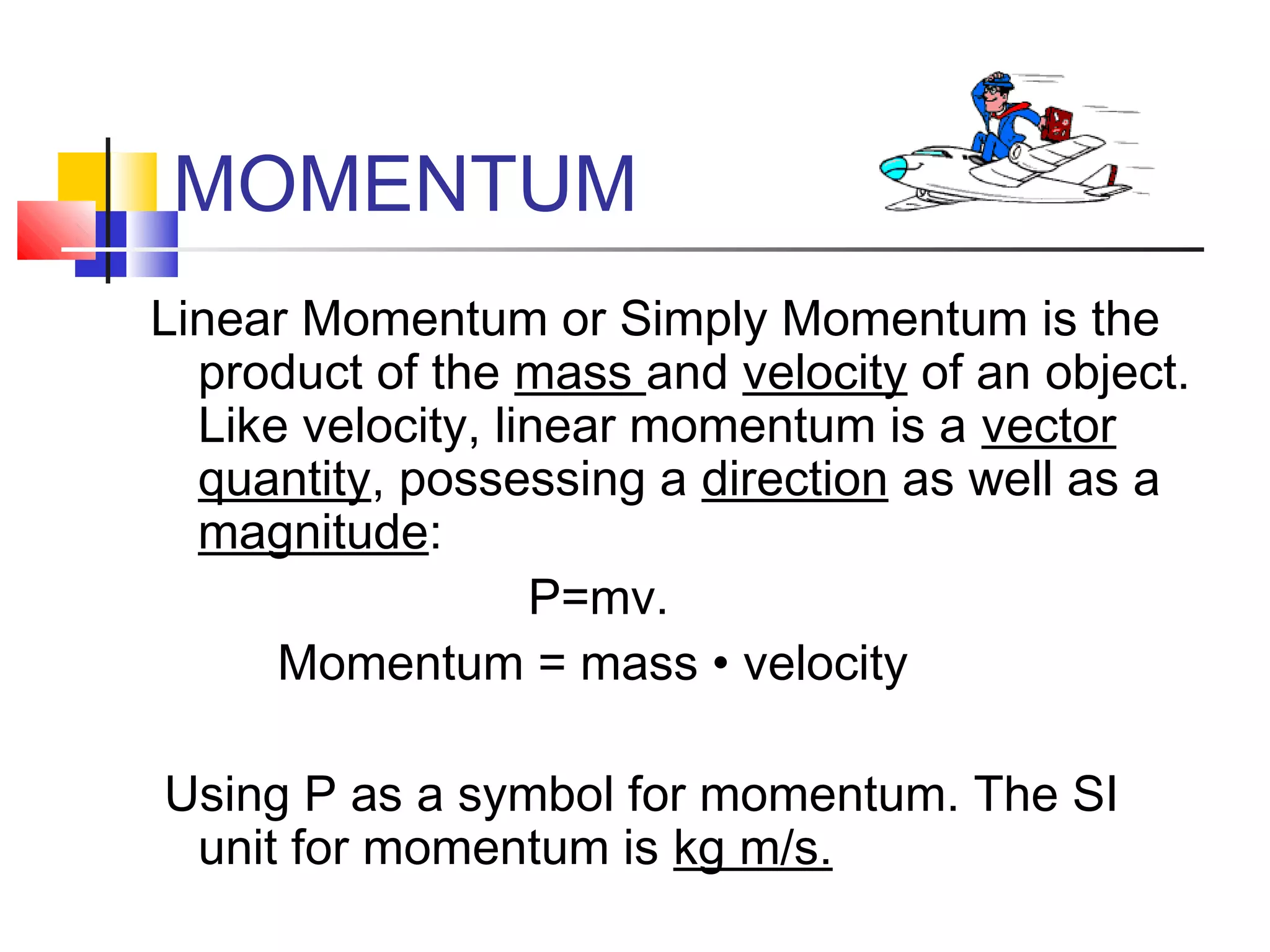
Linear Momentum or Simply Momentum is the
product of the mass and velocity of an object.
Like velocity, linear momentum is a vector
quantity, possessing a direction as well as a
magnitude:
P=mv.
Momentum = mass • velocity
Using P as a symbol for momentum. The SI
unit for momentum is kg m/s.
MOMENTUM
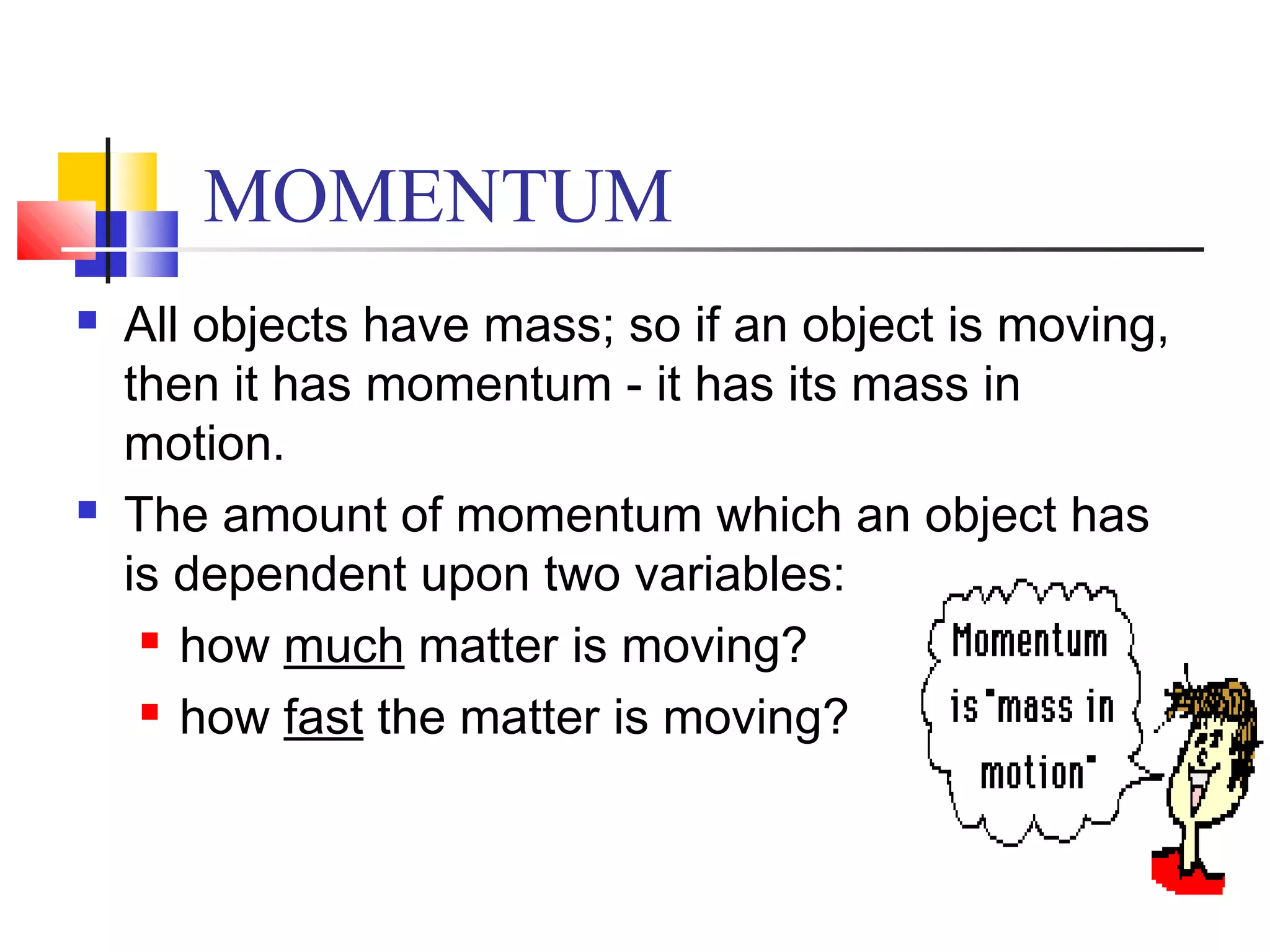
 All objects have mass; so if an object is moving,
then it has momentum - it has its mass in
motion.
 The amount of momentum which an object has
is dependent upon two variables:
 how much matter is moving?
 how fast the matter is moving?
MOMENTUM
MOMENTUM
Momentum and Inertia
 Inertia is another property of mass that
resists changes in velocity; however, inertia
depends only on mass.
 Inertia is a scalar quantity.
 Momentum is a property of moving mass
that resists changes in a moving object’s
velocity.
 Momentum is a vector quantity.
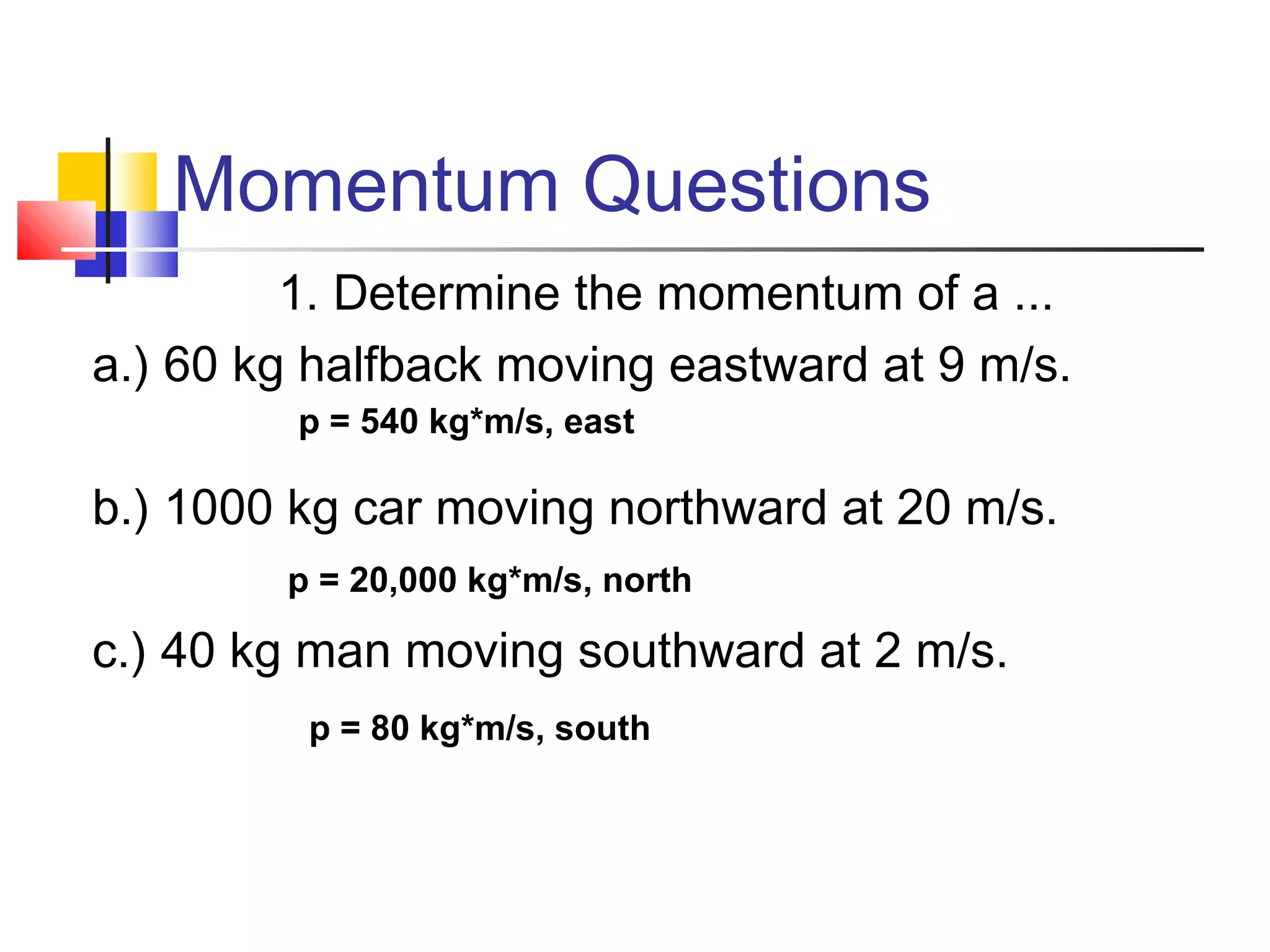
Momentum Questions
1. Determine the momentum of a ...
a.) 60 kg halfback moving eastward at 9 m/s.
b.) 1000 kg car moving northward at 20 m/s.
c.) 40 kg man moving southward at 2 m/s.
p = 540 kg*m/s, east
p = 20,000 kg*m/s, north
p = 80 kg*m/s, south
Change in Momentum
 Newton’s second
law states that the
net external force
acting on an
object is equal to
the time rate of
change of the
object’s
momentum.
net
p
F
t
∆
=
∆
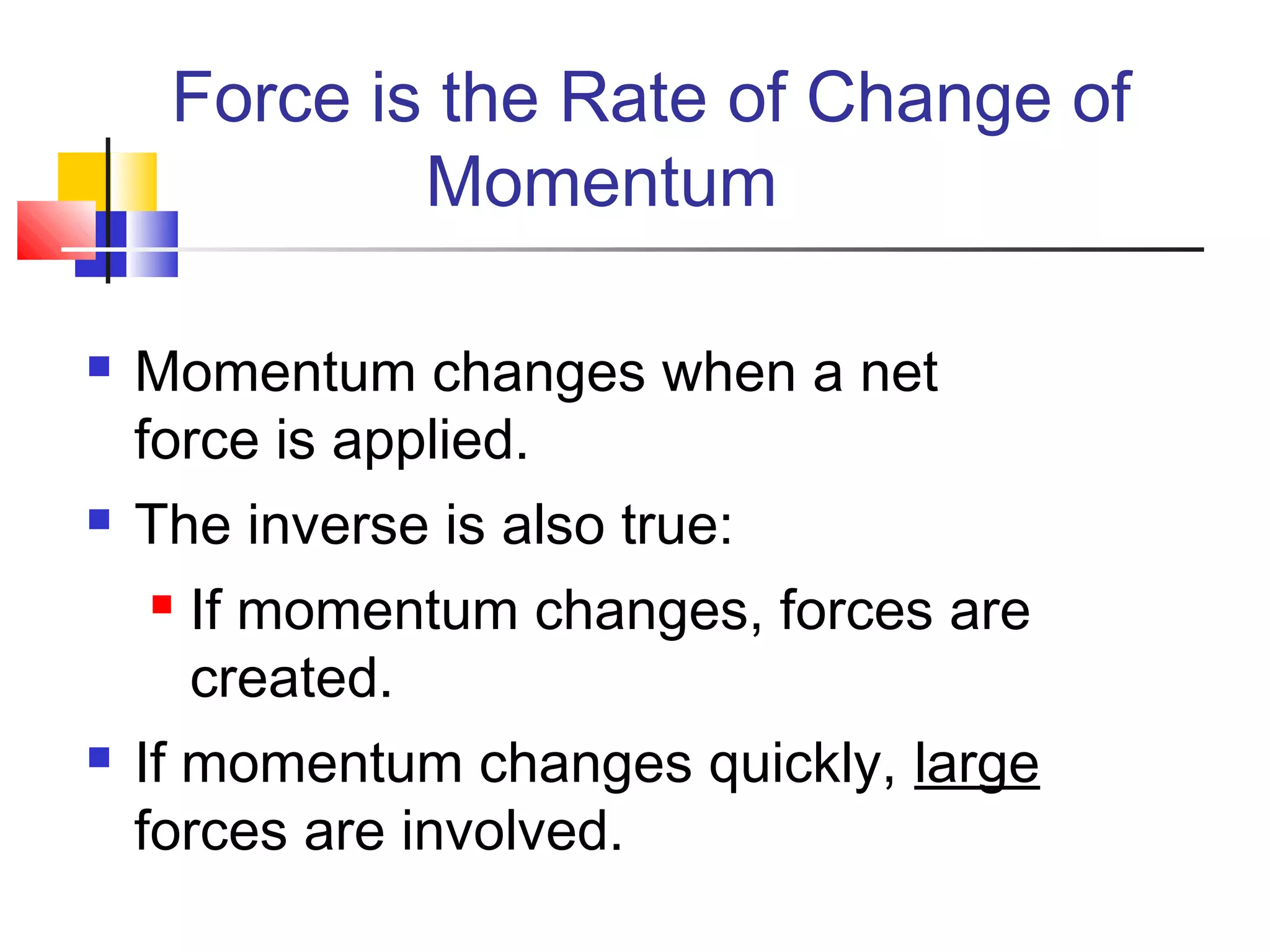
Force is the Rate of Change of
Momentum
 Momentum changes when a net
force is applied.
 The inverse is also true:
 If momentum changes, forces are
created.
 If momentum changes quickly, large
forces are involved.
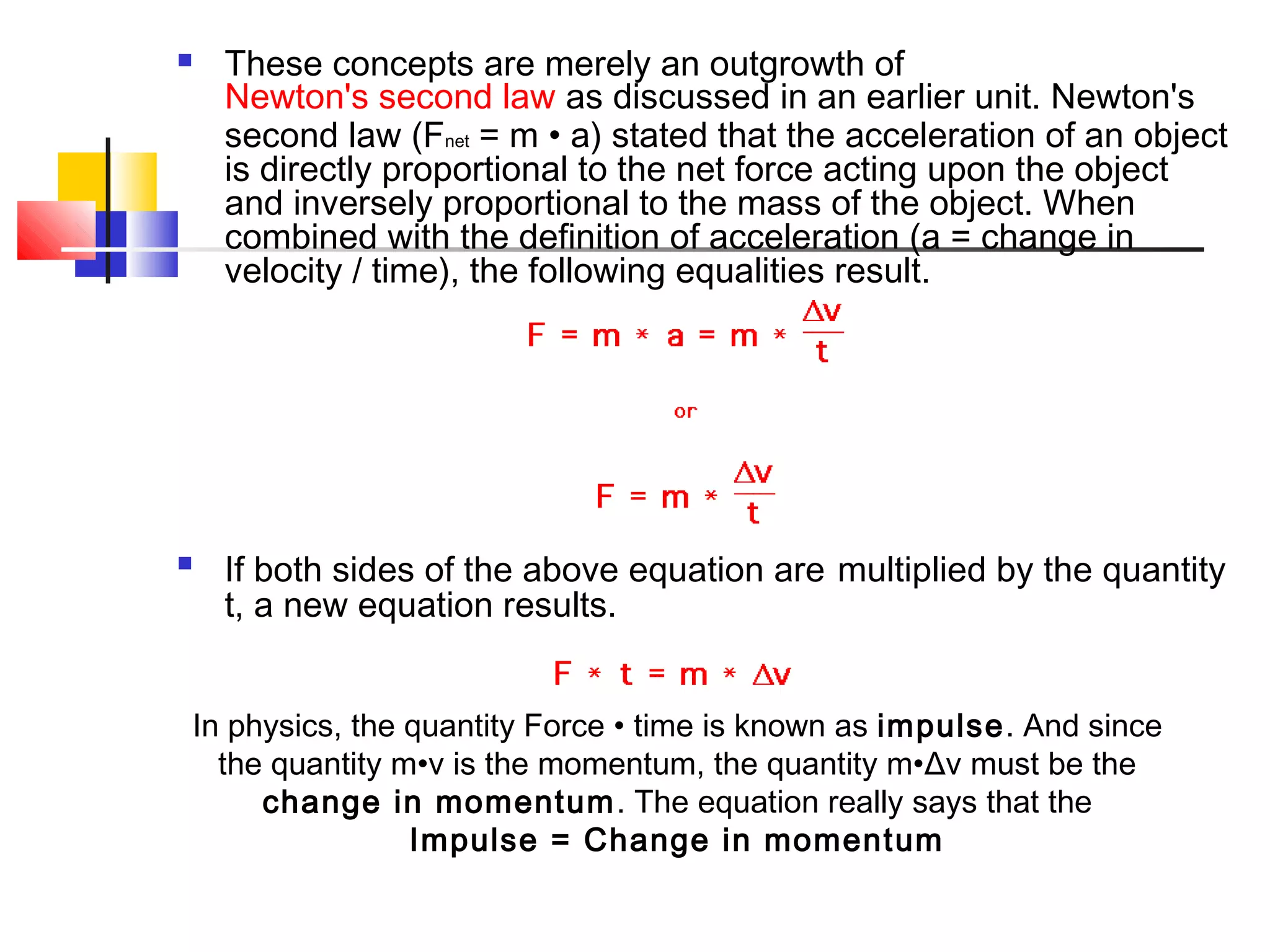
 These concepts are merely an outgrowth of
Newton's second law as discussed in an earlier unit. Newton's
second law (Fnet = m • a) stated that the acceleration of an object
is directly proportional to the net force acting upon the object
and inversely proportional to the mass of the object. When
combined with the definition of acceleration (a = change in
velocity / time), the following equalities result.

If both sides of the above equation are multiplied by the quantity
t, a new equation results.
In physics, the quantity Force • time is known as impulse. And since
the quantity m•v is the momentum, the quantity m•Δv must be the
change in momentum. The equation really says that the
Impulse = Change in momentum
Impulse - Momentum
Theorem
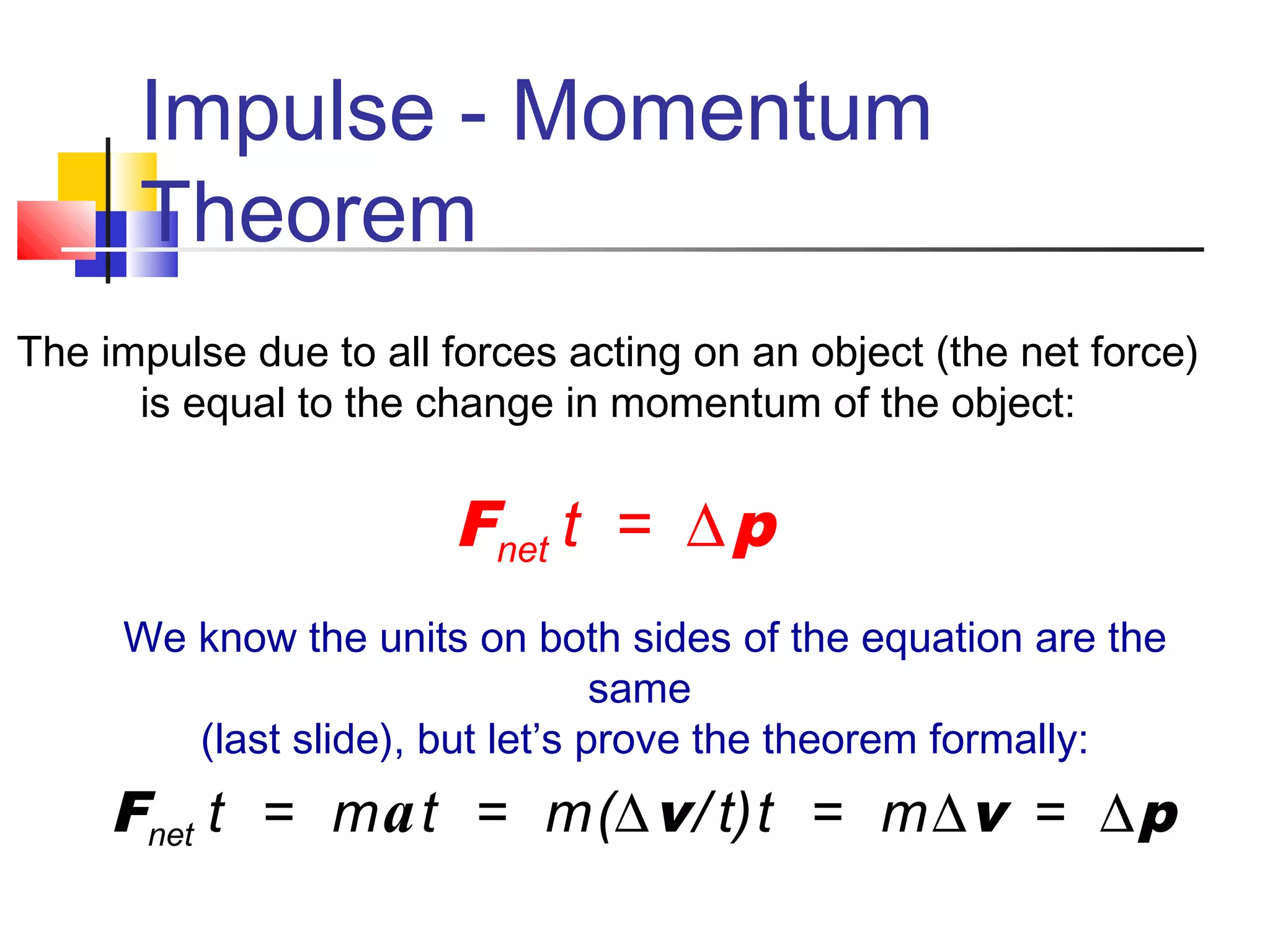
The impulse due to all forces acting on an object (the net force)
is equal to the change in momentum of the object:
Fnet t = ∆p
We know the units on both sides of the equation are the
same
(last slide), but let’s prove the theorem formally:
Fnet t = mat = m(∆v/ t)t = m∆v = ∆p
Impulse
 The product of a force and the time the
force acts is called the impulse.
 Impulse is a way to measure a change in
momentum because it is not always
possible to calculate force and time
individually since collisions happen so
fast.
Impulse
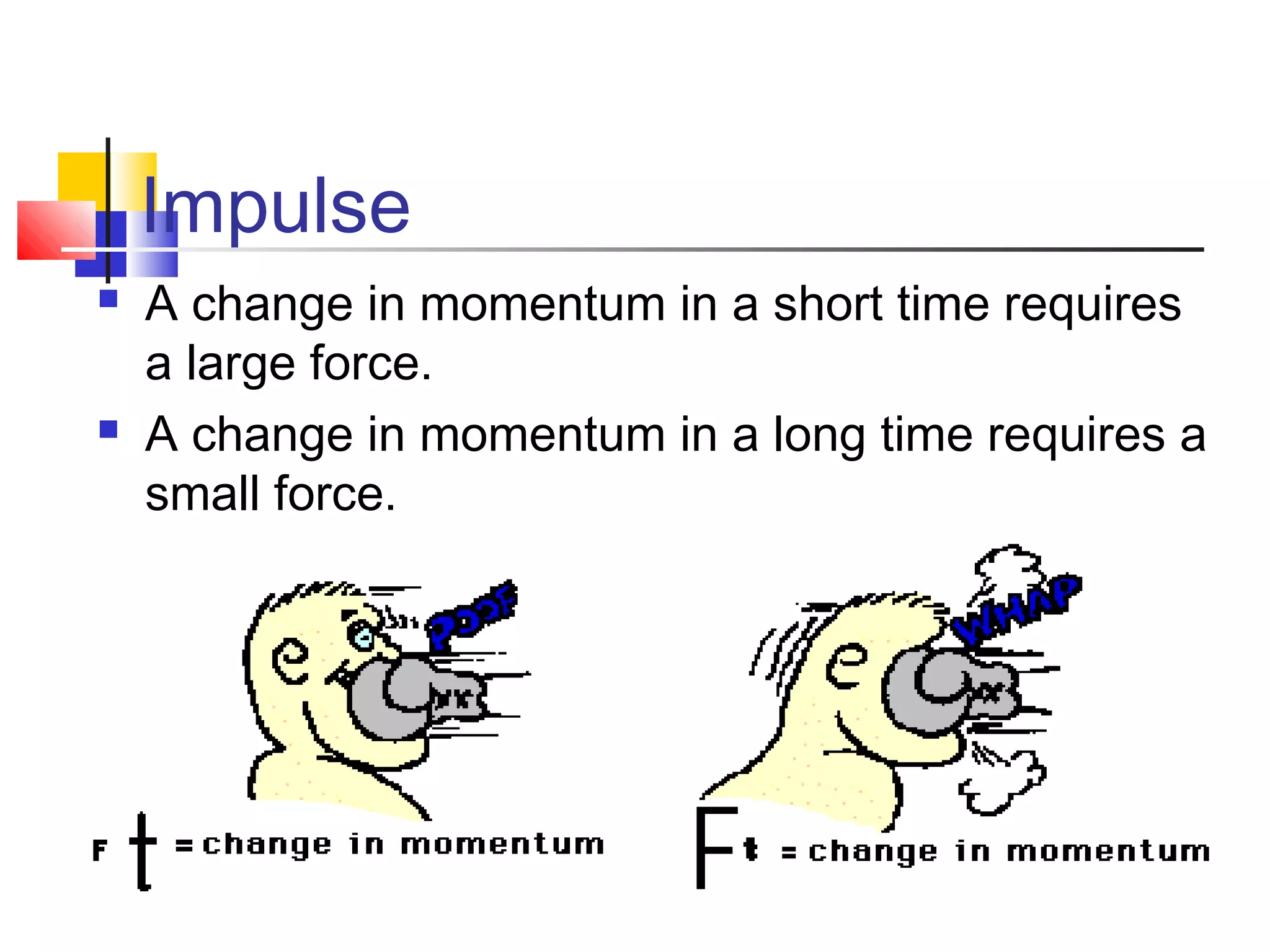
 A change in momentum in a short time requires
a large force.
 A change in momentum in a long time requires a
small force.
Force and Momentum Change
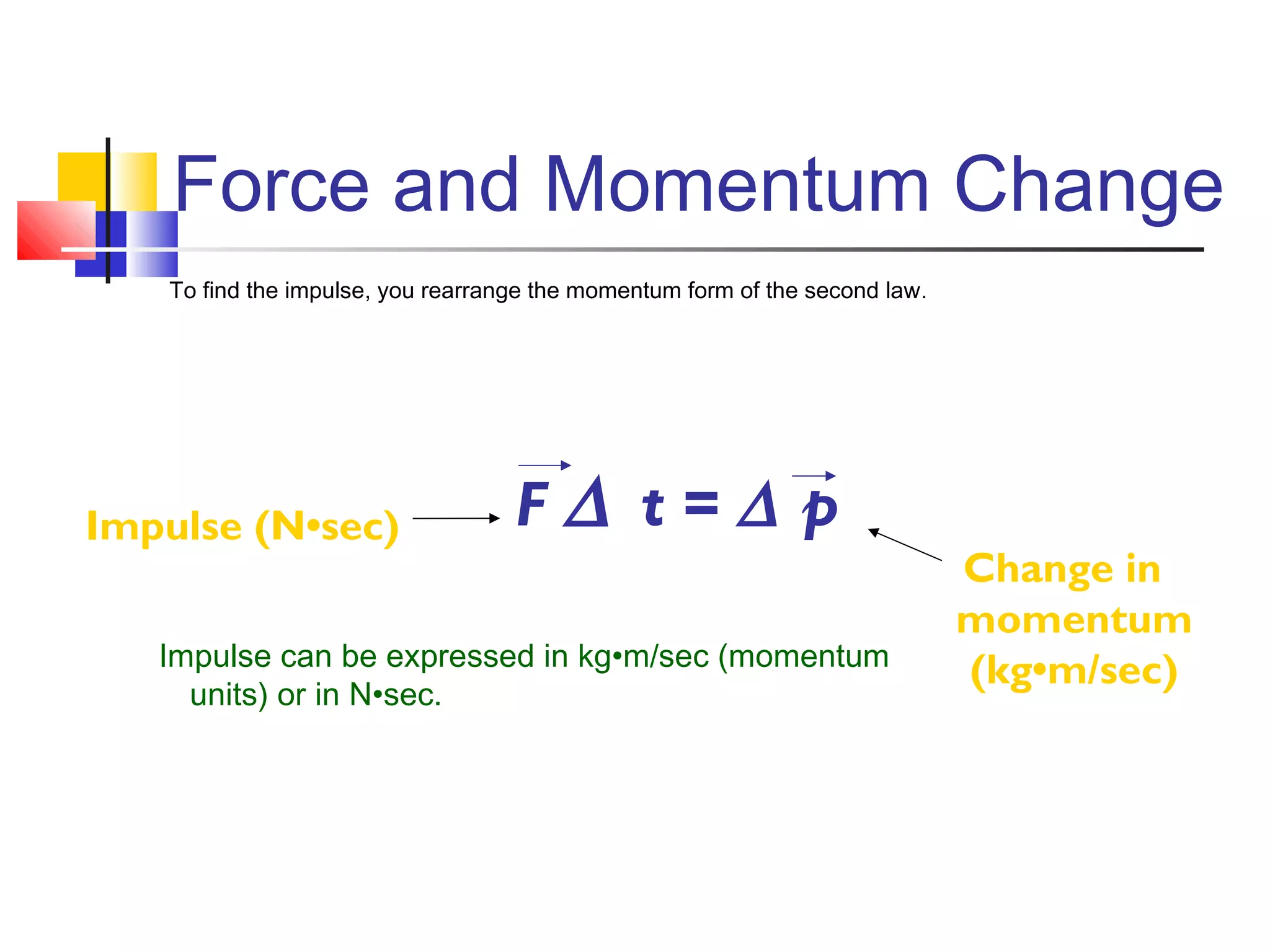
To find the impulse, you rearrange the momentum form of the second law.
Change in
momentum
(kg•m/sec)
Impulse (N•sec) F ∆ t = ∆ p
Impulse can be expressed in kg•m/sec (momentum
units) or in N•sec.
Impulse Defined
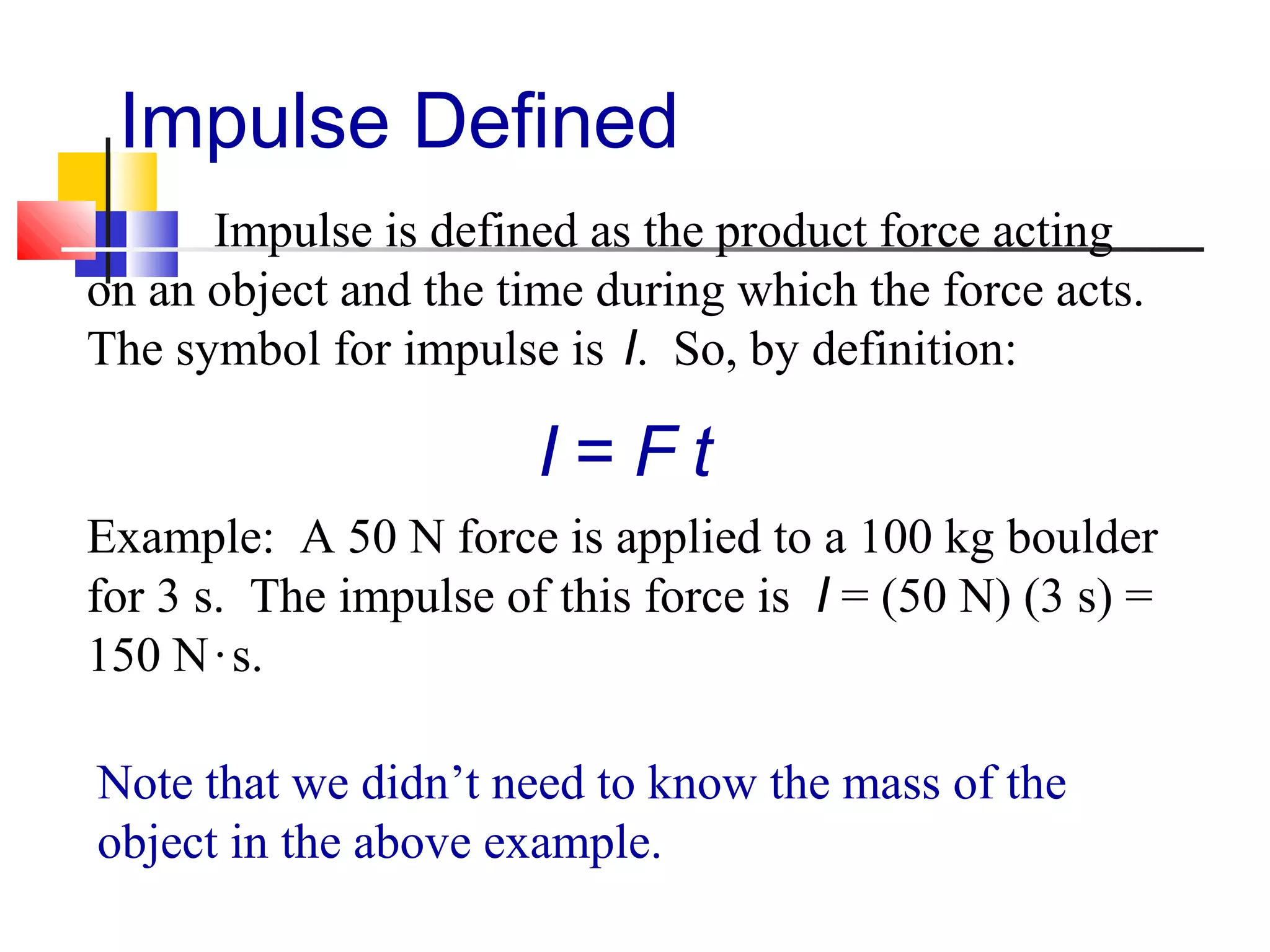
Impulse is defined as the product force acting
on an object and the time during which the force acts.
The symbol for impulse is I. So, by definition:
I = F t
Example: A 50 N force is applied to a 100 kg boulder
for 3 s. The impulse of this force is I = (50 N) (3 s) =
150 N·s.
Note that we didn’t need to know the mass of the
object in the above example.
Impulse Units
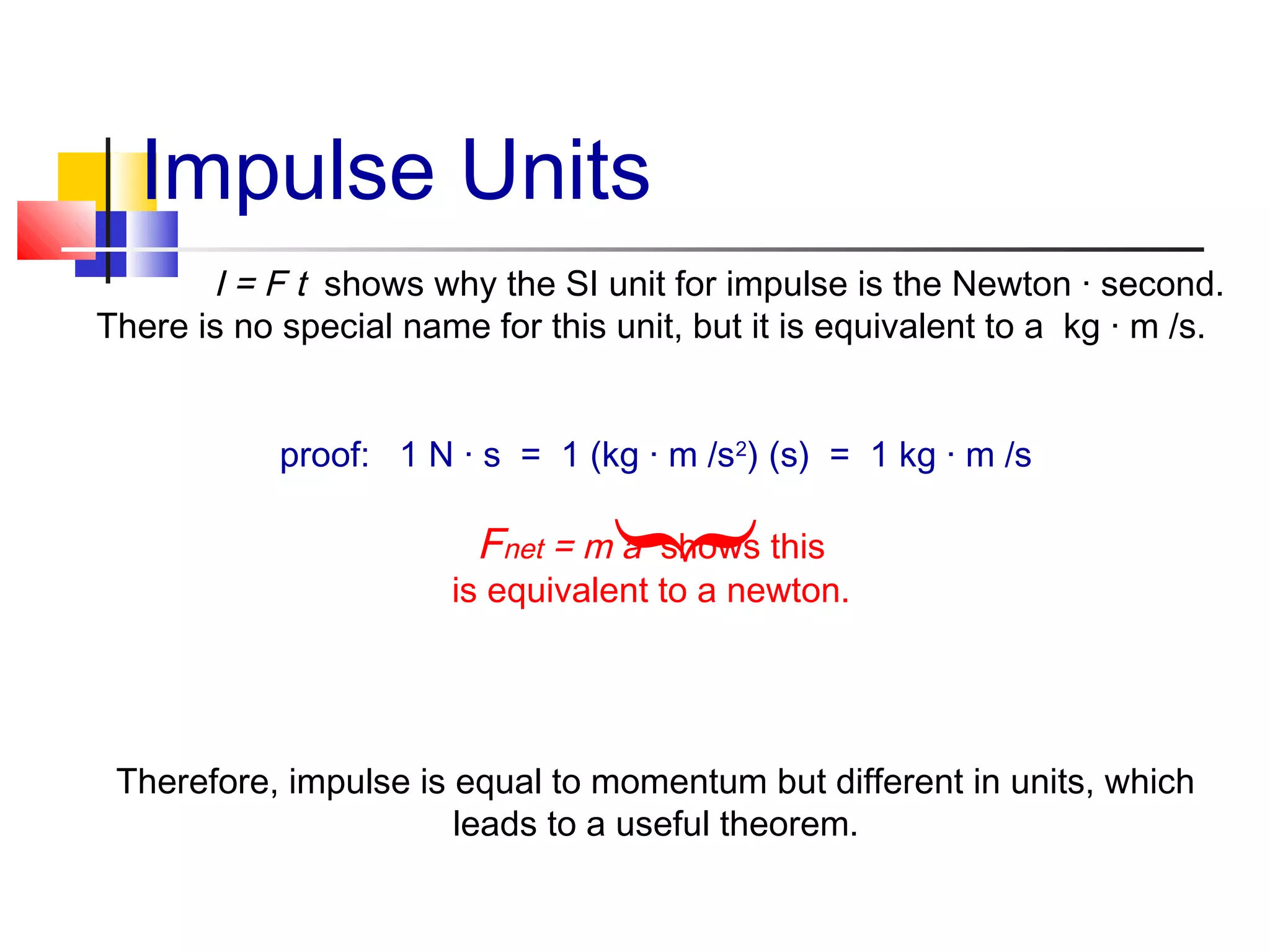
I = F t shows why the SI unit for impulse is the Newton · second.
There is no special name for this unit, but it is equivalent to a kg · m /s.
proof: 1 N · s = 1 (kg · m /s2
) (s) = 1 kg · m /s
Fnet = m a shows this
is equivalent to a newton.
Therefore, impulse is equal to momentum but different in units, which
leads to a useful theorem.
{
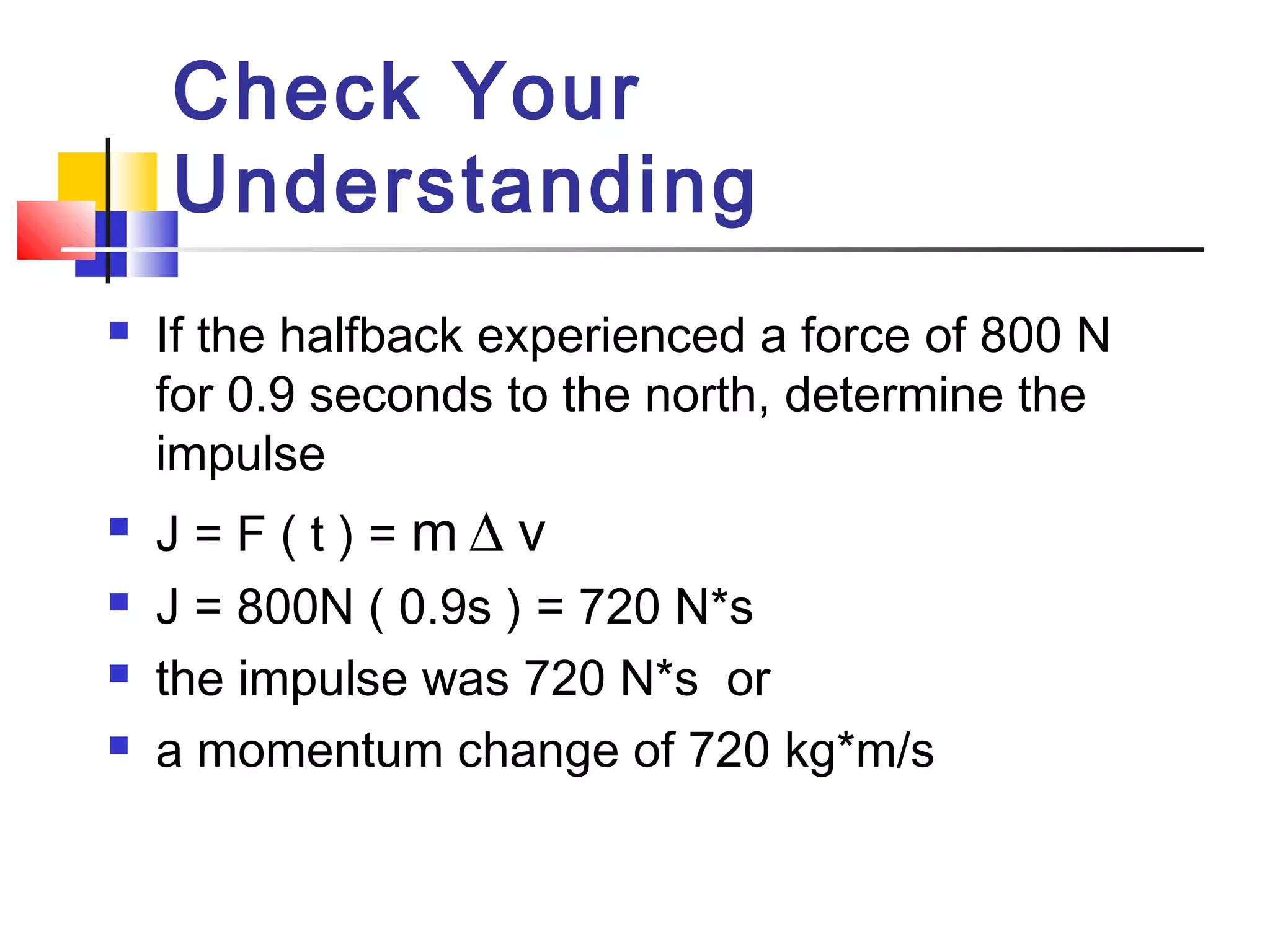
Check Your
Understanding
 If the halfback experienced a force of 800 N
for 0.9 seconds to the north, determine the
impulse
 J = F ( t ) = m ∆ v
 J = 800N ( 0.9s ) = 720 N*s
 the impulse was 720 N*s or
 a momentum change of 720 kg*m/s
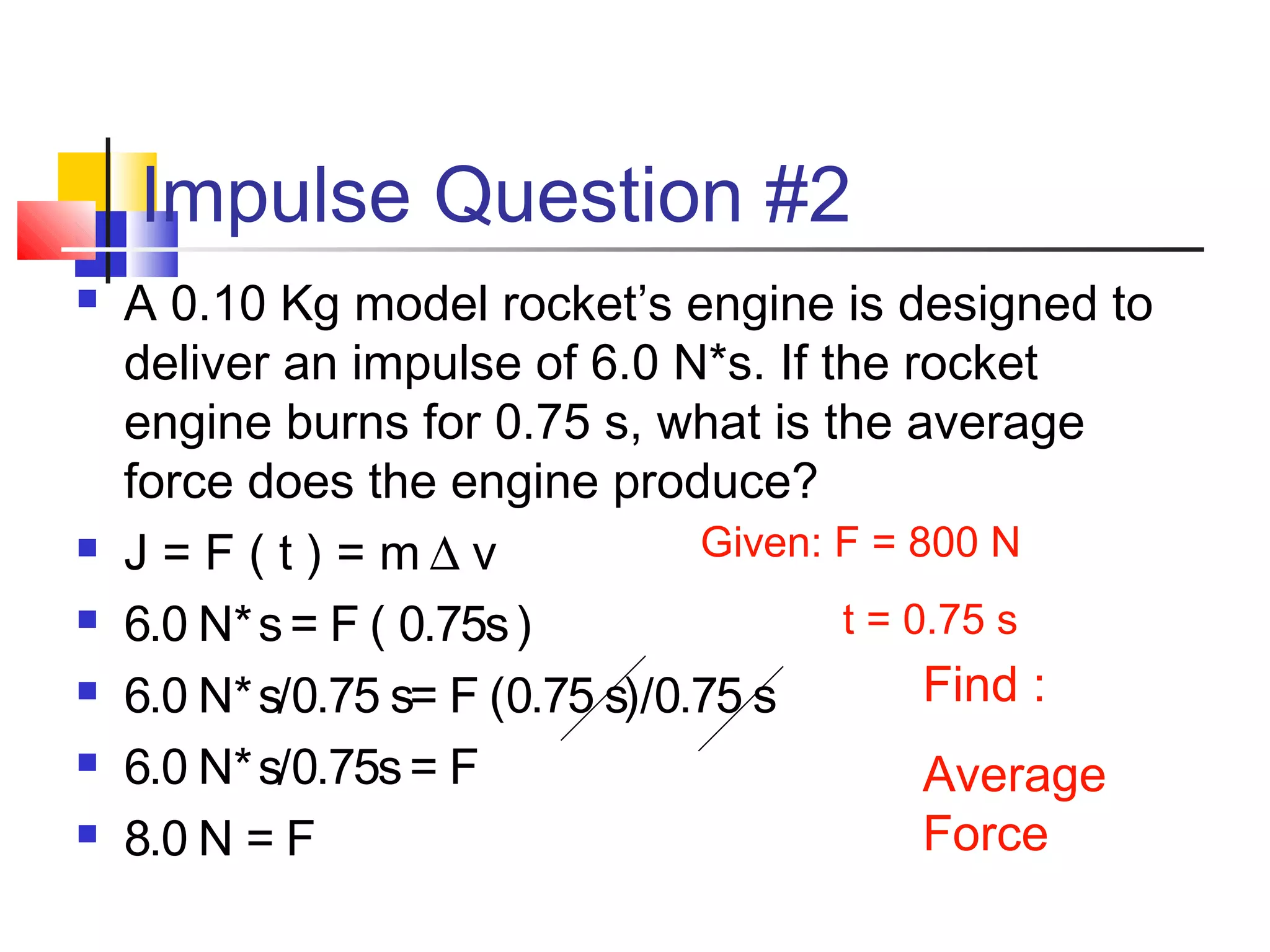
Impulse Question #2
 A 0.10 Kg model rocket’s engine is designed to
deliver an impulse of 6.0 N*s. If the rocket
engine burns for 0.75 s, what is the average
force does the engine produce?
 J = F ( t ) = m ∆ v
 6.0 N*s= F ( 0.75s)
 6.0 N*s/0.75 s= F (0.75 s)/0.75 s
 6.0 N*s/0.75s= F
 8.0 N = F
Given: F = 800 N
t = 0.75 s
Find :
Average
Force
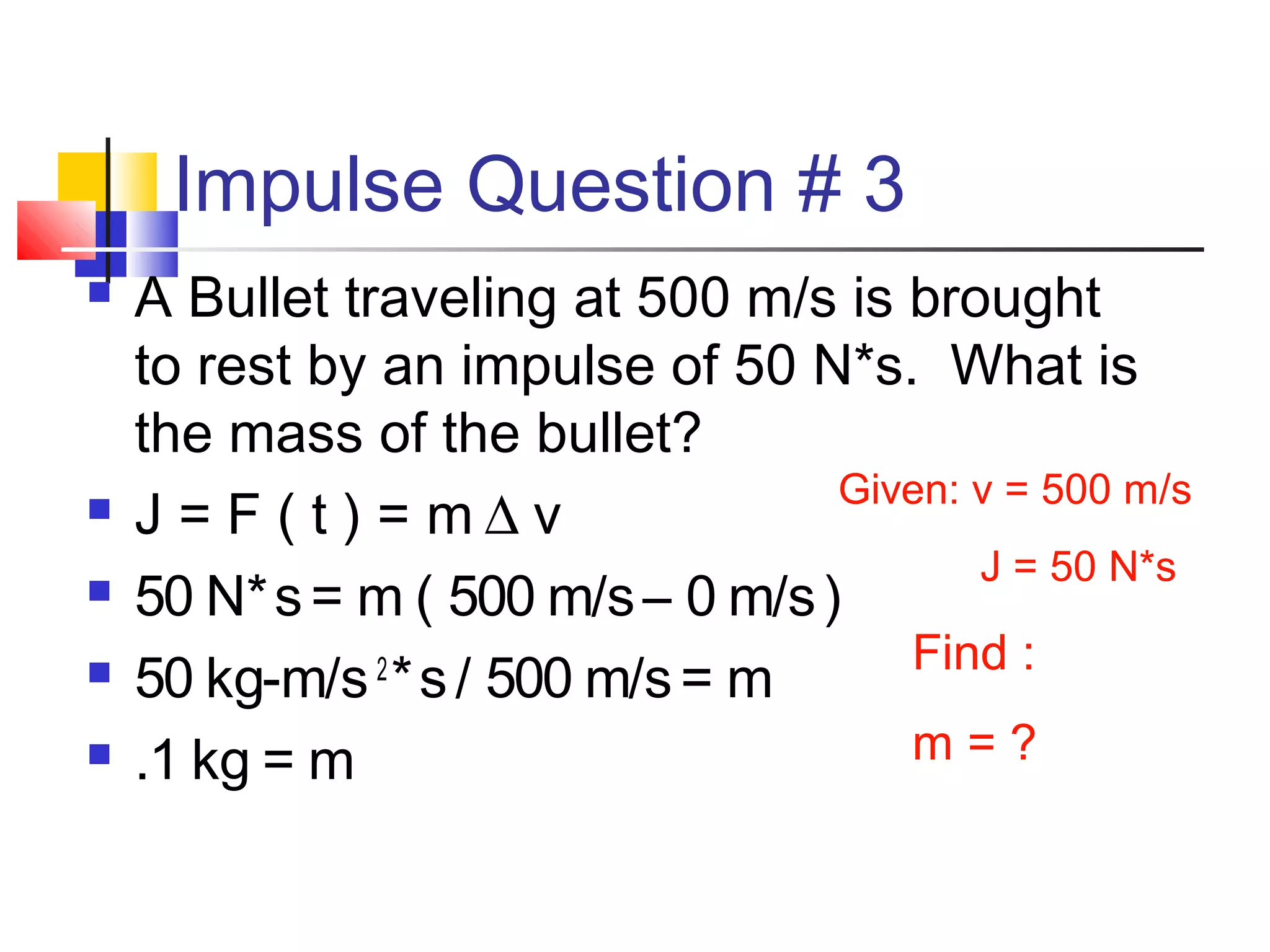
Impulse Question # 3
 A Bullet traveling at 500 m/s is brought
to rest by an impulse of 50 N*s. What is
the mass of the bullet?
 J = F ( t ) = m ∆ v
 50 N*s= m ( 500 m/s– 0 m/s)
 50 kg-m/s2
*s/ 500 m/s= m
 .1 kg = m
Given: v = 500 m/s
J = 50 N*s
Find :
m = ?

Impulse and momentum(physics)

  • 1.
    Momentum and ImpulseBy: Khristine NikolaeR. Cervas IV-St. Jude Thaddeus
  • 2.
    MOMENTUM Linear Momentum orSimply Momentum is the product of the mass and velocity of an object. Like velocity, linear momentum is a vector quantity, possessing a direction as well as a magnitude: P=mv. Momentum = mass • velocity Using P as a symbol for momentum. The SI unit for momentum is kg m/s.
  • 3.
    MOMENTUM  All objectshave mass; so if an object is moving, then it has momentum - it has its mass in motion.  The amount of momentum which an object has is dependent upon two variables:  how much matter is moving?  how fast the matter is moving?
  • 4.
  • 5.
  • 6.
    Momentum and Inertia Inertia is another property of mass that resists changes in velocity; however, inertia depends only on mass.  Inertia is a scalar quantity.  Momentum is a property of moving mass that resists changes in a moving object’s velocity.  Momentum is a vector quantity.
  • 7.
    Momentum Questions 1. Determinethe momentum of a ... a.) 60 kg halfback moving eastward at 9 m/s. b.) 1000 kg car moving northward at 20 m/s. c.) 40 kg man moving southward at 2 m/s. p = 540 kg*m/s, east p = 20,000 kg*m/s, north p = 80 kg*m/s, south
  • 8.
    Change in Momentum Newton’s second law states that the net external force acting on an object is equal to the time rate of change of the object’s momentum. net p F t ∆ = ∆
  • 9.
    Force is theRate of Change of Momentum  Momentum changes when a net force is applied.  The inverse is also true:  If momentum changes, forces are created.  If momentum changes quickly, large forces are involved.
  • 10.
     These conceptsare merely an outgrowth of Newton's second law as discussed in an earlier unit. Newton's second law (Fnet = m • a) stated that the acceleration of an object is directly proportional to the net force acting upon the object and inversely proportional to the mass of the object. When combined with the definition of acceleration (a = change in velocity / time), the following equalities result.  If both sides of the above equation are multiplied by the quantity t, a new equation results. In physics, the quantity Force • time is known as impulse. And since the quantity m•v is the momentum, the quantity m•Δv must be the change in momentum. The equation really says that the Impulse = Change in momentum
  • 11.
    Impulse - Momentum Theorem Theimpulse due to all forces acting on an object (the net force) is equal to the change in momentum of the object: Fnet t = ∆p We know the units on both sides of the equation are the same (last slide), but let’s prove the theorem formally: Fnet t = mat = m(∆v/ t)t = m∆v = ∆p
  • 12.
    Impulse  The productof a force and the time the force acts is called the impulse.  Impulse is a way to measure a change in momentum because it is not always possible to calculate force and time individually since collisions happen so fast.
  • 13.
    Impulse  A changein momentum in a short time requires a large force.  A change in momentum in a long time requires a small force.
  • 14.
    Force and MomentumChange To find the impulse, you rearrange the momentum form of the second law. Change in momentum (kg•m/sec) Impulse (N•sec) F ∆ t = ∆ p Impulse can be expressed in kg•m/sec (momentum units) or in N•sec.
  • 15.
    Impulse Defined Impulse isdefined as the product force acting on an object and the time during which the force acts. The symbol for impulse is I. So, by definition: I = F t Example: A 50 N force is applied to a 100 kg boulder for 3 s. The impulse of this force is I = (50 N) (3 s) = 150 N·s. Note that we didn’t need to know the mass of the object in the above example.
  • 16.
    Impulse Units I =F t shows why the SI unit for impulse is the Newton · second. There is no special name for this unit, but it is equivalent to a kg · m /s. proof: 1 N · s = 1 (kg · m /s2 ) (s) = 1 kg · m /s Fnet = m a shows this is equivalent to a newton. Therefore, impulse is equal to momentum but different in units, which leads to a useful theorem. {
  • 17.
    Check Your Understanding  Ifthe halfback experienced a force of 800 N for 0.9 seconds to the north, determine the impulse  J = F ( t ) = m ∆ v  J = 800N ( 0.9s ) = 720 N*s  the impulse was 720 N*s or  a momentum change of 720 kg*m/s
  • 18.
    Impulse Question #2 A 0.10 Kg model rocket’s engine is designed to deliver an impulse of 6.0 N*s. If the rocket engine burns for 0.75 s, what is the average force does the engine produce?  J = F ( t ) = m ∆ v  6.0 N*s= F ( 0.75s)  6.0 N*s/0.75 s= F (0.75 s)/0.75 s  6.0 N*s/0.75s= F  8.0 N = F Given: F = 800 N t = 0.75 s Find : Average Force
  • 19.
    Impulse Question #3  A Bullet traveling at 500 m/s is brought to rest by an impulse of 50 N*s. What is the mass of the bullet?  J = F ( t ) = m ∆ v  50 N*s= m ( 500 m/s– 0 m/s)  50 kg-m/s2 *s/ 500 m/s= m  .1 kg = m Given: v = 500 m/s J = 50 N*s Find : m = ?