Chapter 3
Vectors
Coordinate Systems
 Used to describe the position of a
point in space
 Coordinate system consists of
 a fixed reference point called the origin
 specific axes with scales and labels
 instructions on how to label a point
relative to the origin and the axes
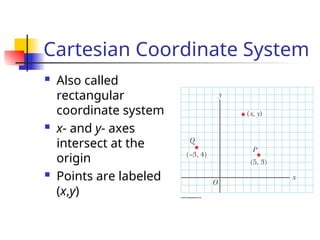
Cartesian Coordinate System
 Also called
rectangular
coordinate system
 x- and y- axes
intersect at the
origin
 Points are labeled
(x,y)
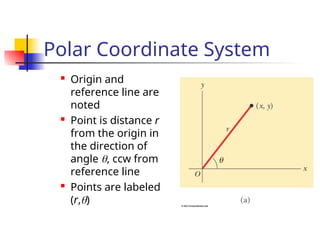
Polar Coordinate System
 Origin and
reference line are
noted
 Point is distance r
from the origin in
the direction of
angle , ccw from
reference line
 Points are labeled
(r,)
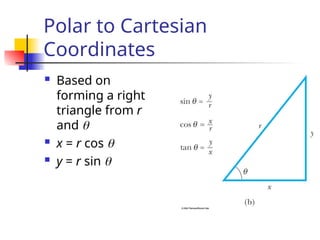
Polar to Cartesian
Coordinates
 Based on
forming a right
triangle from r
and 
 x = r cos 
 y = r sin 
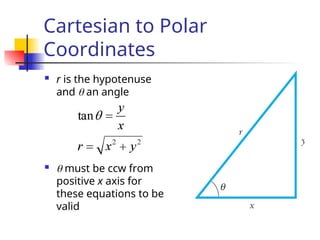
Cartesian to Polar
Coordinates
 r is the hypotenuse
and  an angle
  must be ccw from
positive x axis for
these equations to be
valid
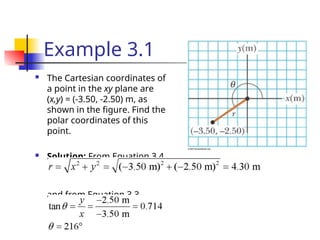
Example 3.1
 The Cartesian coordinates of
a point in the xy plane are
(x,y) = (-3.50, -2.50) m, as
shown in the figure. Find the
polar coordinates of this
point.
 Solution: From Equation 3.4,
and from Equation 3.3,
Vectors and Scalars
 A scalar quantity is completely
specified by a single value with an
appropriate unit and has no
direction.
 A vector quantity is completely
described by a number and
appropriate units plus a direction.
Vector Notation
 When handwritten, use an arrow:
 When printed, will be in bold print: A
 When dealing with just the magnitude of a
vector in print, an italic letter will be used: A
or |A|
 The magnitude of the vector has physical
units
 The magnitude of a vector is always a
positive number
A

Vector Example
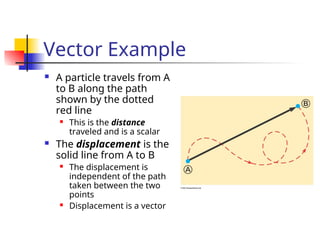
 A particle travels from A
to B along the path
shown by the dotted
red line
 This is the distance
traveled and is a scalar
 The displacement is the
solid line from A to B
 The displacement is
independent of the path
taken between the two
points
 Displacement is a vector
Equality of Two Vectors
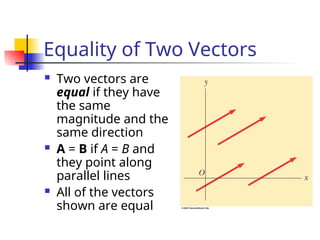
 Two vectors are
equal if they have
the same
magnitude and the
same direction
 A = B if A = B and
they point along
parallel lines
 All of the vectors
shown are equal
Adding Vectors
 When adding vectors, their directions
must be taken into account
 Units must be the same
 Graphical Methods
 Use scale drawings
 Algebraic Methods
 More convenient
Adding Vectors Graphically
 Choose a scale
 Draw the first vector with the appropriate
length and in the direction specified, with
respect to a coordinate system
 Draw the next vector with the appropriate
length and in the direction specified, with
respect to a coordinate system whose
origin is the end of vector A and parallel to
the coordinate system used for A
Adding Vectors Graphically,
cont.
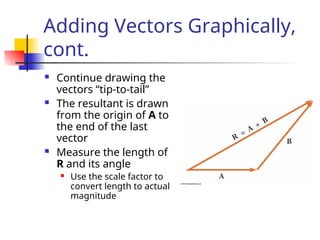
 Continue drawing the
vectors “tip-to-tail”
 The resultant is drawn
from the origin of A to
the end of the last
vector
 Measure the length of
R and its angle
 Use the scale factor to
convert length to actual
magnitude
Adding Vectors Graphically,
final
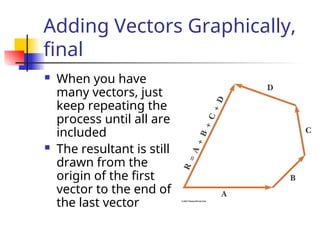
 When you have
many vectors, just
keep repeating the
process until all are
included
 The resultant is still
drawn from the
origin of the first
vector to the end of
the last vector
Adding Vectors, Rules
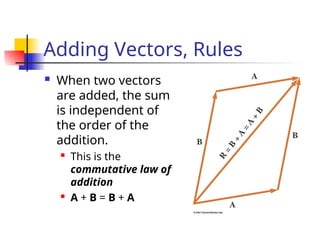
 When two vectors
are added, the sum
is independent of
the order of the
addition.
 This is the
commutative law of
addition
 A + B = B + A
Adding Vectors, Rules cont.
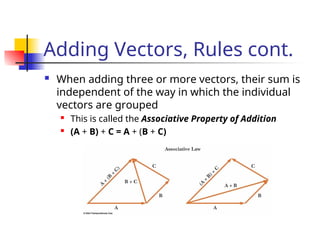
 When adding three or more vectors, their sum is
independent of the way in which the individual
vectors are grouped
 This is called the Associative Property of Addition
 (A + B) + C = A + (B + C)
Adding Vectors, Rules final
 When adding vectors, all of the
vectors must have the same units
 All of the vectors must be of the same
type of quantity
 For example, you cannot add a
displacement to a velocity
Negative of a Vector
 The negative of a vector is defined as
the vector that, when added to the
original vector, gives a resultant of
zero
 Represented as –A
 A + (-A) = 0
 The negative of the vector will have the
same magnitude, but point in the
opposite direction
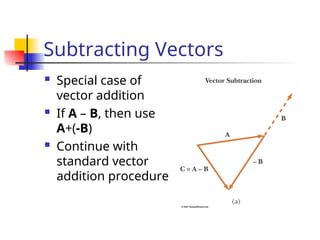
Subtracting Vectors
 Special case of
vector addition
 If A – B, then use
A+(-B)
 Continue with
standard vector
addition procedure
Multiplying or Dividing a
Vector by a Scalar
 The result of the multiplication or division
is a vector
 The magnitude of the vector is multiplied
or divided by the scalar
 If the scalar is positive, the direction of the
result is the same as of the original vector
 If the scalar is negative, the direction of the
result is opposite that of the original vector
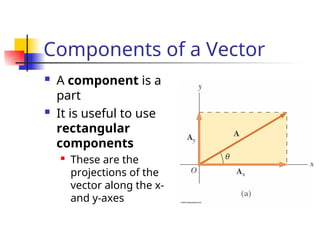
Components of a Vector
 A component is a
part
 It is useful to use
rectangular
components
 These are the
projections of the
vector along the x-
and y-axes
Vector Component
Terminology
 Ax and Ay are the component vectors
of A
 They are vectors and follow all the rules
for vectors
 Ax and Ay are scalars, and will be
referred to as the components of A
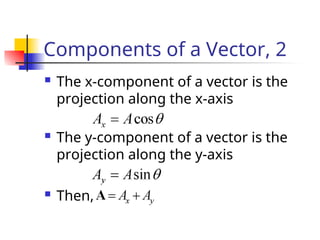
Components of a Vector, 2
 The x-component of a vector is the
projection along the x-axis
 The y-component of a vector is the
projection along the y-axis
 Then,
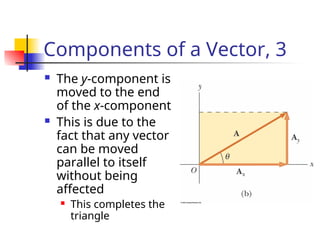
Components of a Vector, 3
 The y-component is
moved to the end
of the x-component
 This is due to the
fact that any vector
can be moved
parallel to itself
without being
affected
 This completes the
triangle
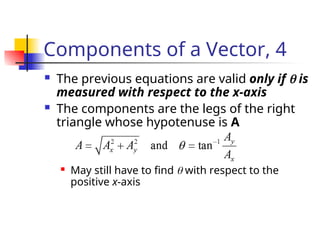
Components of a Vector, 4
 The previous equations are valid only if  is
measured with respect to the x-axis
 The components are the legs of the right
triangle whose hypotenuse is A
 May still have to find  with respect to the
positive x-axis
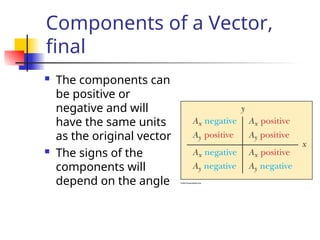
Components of a Vector,
final
 The components can
be positive or
negative and will
have the same units
as the original vector
 The signs of the
components will
depend on the angle
Trig Function Warning
 The component equations (Ax = A cos  and
Ay = A sin ) apply only when the angle is
measured with respect to the x-axis
(preferably ccw from the positive x-axis).
 The resultant angle (tan  = Ay / Ax) gives
the angle with respect to the x-axis.
 You can always think about the actual triangle
being formed and what angle you know and
apply the appropriate trig functions
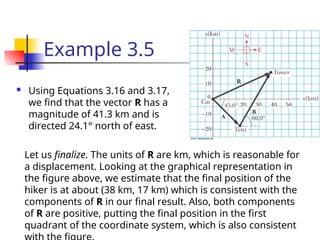
Example 3.5: Taking a Hike
 A hiker begins a trip by first walking 25.0
km southeast from her car. She stops and
sets up her tent for the night. On the
second day, she walks 40.0 km in a
direction 60.0° north of east, at which point
she discovers a forest ranger’s tower.
Example 3.5
 (A) Determine the
components of the hiker’s
displacement for each day.
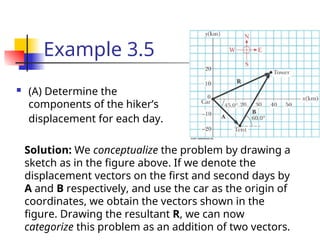
Solution: We conceptualize the problem by drawing a
sketch as in the figure above. If we denote the
displacement vectors on the first and second days by
A and B respectively, and use the car as the origin of
coordinates, we obtain the vectors shown in the
figure. Drawing the resultant R, we can now
categorize this problem as an addition of two vectors.
Example 3.5
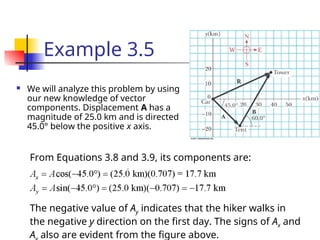
 We will analyze this problem by using
our new knowledge of vector
components. Displacement A has a
magnitude of 25.0 km and is directed
45.0° below the positive x axis.
From Equations 3.8 and 3.9, its components are:
The negative value of Ay indicates that the hiker walks in
the negative y direction on the first day. The signs of Ax and
A also are evident from the figure above.
Example 3.5
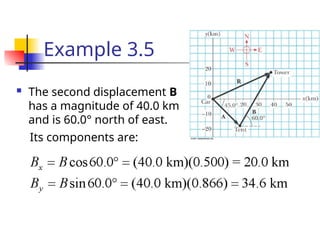
 The second displacement B
has a magnitude of 40.0 km
and is 60.0° north of east.
Its components are:
Example 3.5
 (B) Determine the components of
the hiker’s resultant displacement
R for the trip. Find an expression
for R in terms of unit vectors.
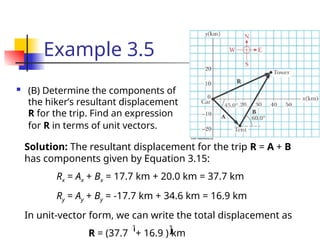
Solution: The resultant displacement for the trip R = A + B
has components given by Equation 3.15:
Rx = Ax + Bx = 17.7 km + 20.0 km = 37.7 km
Ry = Ay + By = -17.7 km + 34.6 km = 16.9 km
In unit-vector form, we can write the total displacement as
R = (37.7 + 16.9 ) km
ĵ
î
Example 3.5
 Using Equations 3.16 and 3.17,
we find that the vector R has a
magnitude of 41.3 km and is
directed 24.1° north of east.
Let us finalize. The units of R are km, which is reasonable for
a displacement. Looking at the graphical representation in
the figure above, we estimate that the final position of the
hiker is at about (38 km, 17 km) which is consistent with the
components of R in our final result. Also, both components
of R are positive, putting the final position in the first
quadrant of the coordinate system, which is also consistent
Problem Solving Strategy –
Adding Vectors
 Select a coordinate system
 Try to select a system that minimizes the
number of components you need to deal
with
 Draw a sketch of the vectors
 Label each vector
Problem Solving Strategy –
Adding Vectors, 2
 Find the x and y components of each vector
and the x and y components of the
resultant vector
 Find z components if necessary
 Use the Pythagorean theorem to find the
magnitude of the resultant and the
tangent function to find the direction
 Other appropriate trig functions may be used
vectors add, subtract, poblar, Cartesian

  • 1.
  • 2.
    Coordinate Systems  Usedto describe the position of a point in space  Coordinate system consists of  a fixed reference point called the origin  specific axes with scales and labels  instructions on how to label a point relative to the origin and the axes
  • 3.
    Cartesian Coordinate System Also called rectangular coordinate system  x- and y- axes intersect at the origin  Points are labeled (x,y)
  • 4.
    Polar Coordinate System Origin and reference line are noted  Point is distance r from the origin in the direction of angle , ccw from reference line  Points are labeled (r,)
  • 5.
    Polar to Cartesian Coordinates Based on forming a right triangle from r and   x = r cos   y = r sin 
  • 6.
    Cartesian to Polar Coordinates r is the hypotenuse and  an angle   must be ccw from positive x axis for these equations to be valid
  • 7.
    Example 3.1  TheCartesian coordinates of a point in the xy plane are (x,y) = (-3.50, -2.50) m, as shown in the figure. Find the polar coordinates of this point.  Solution: From Equation 3.4, and from Equation 3.3,
  • 8.
    Vectors and Scalars A scalar quantity is completely specified by a single value with an appropriate unit and has no direction.  A vector quantity is completely described by a number and appropriate units plus a direction.
  • 9.
    Vector Notation  Whenhandwritten, use an arrow:  When printed, will be in bold print: A  When dealing with just the magnitude of a vector in print, an italic letter will be used: A or |A|  The magnitude of the vector has physical units  The magnitude of a vector is always a positive number A 
  • 10.
    Vector Example  Aparticle travels from A to B along the path shown by the dotted red line  This is the distance traveled and is a scalar  The displacement is the solid line from A to B  The displacement is independent of the path taken between the two points  Displacement is a vector
  • 11.
    Equality of TwoVectors  Two vectors are equal if they have the same magnitude and the same direction  A = B if A = B and they point along parallel lines  All of the vectors shown are equal
  • 12.
    Adding Vectors  Whenadding vectors, their directions must be taken into account  Units must be the same  Graphical Methods  Use scale drawings  Algebraic Methods  More convenient
  • 13.
    Adding Vectors Graphically Choose a scale  Draw the first vector with the appropriate length and in the direction specified, with respect to a coordinate system  Draw the next vector with the appropriate length and in the direction specified, with respect to a coordinate system whose origin is the end of vector A and parallel to the coordinate system used for A
  • 14.
    Adding Vectors Graphically, cont. Continue drawing the vectors “tip-to-tail”  The resultant is drawn from the origin of A to the end of the last vector  Measure the length of R and its angle  Use the scale factor to convert length to actual magnitude
  • 15.
    Adding Vectors Graphically, final When you have many vectors, just keep repeating the process until all are included  The resultant is still drawn from the origin of the first vector to the end of the last vector
  • 16.
    Adding Vectors, Rules When two vectors are added, the sum is independent of the order of the addition.  This is the commutative law of addition  A + B = B + A
  • 17.
    Adding Vectors, Rulescont.  When adding three or more vectors, their sum is independent of the way in which the individual vectors are grouped  This is called the Associative Property of Addition  (A + B) + C = A + (B + C)
  • 18.
    Adding Vectors, Rulesfinal  When adding vectors, all of the vectors must have the same units  All of the vectors must be of the same type of quantity  For example, you cannot add a displacement to a velocity
  • 19.
    Negative of aVector  The negative of a vector is defined as the vector that, when added to the original vector, gives a resultant of zero  Represented as –A  A + (-A) = 0  The negative of the vector will have the same magnitude, but point in the opposite direction
  • 20.
    Subtracting Vectors  Specialcase of vector addition  If A – B, then use A+(-B)  Continue with standard vector addition procedure
  • 21.
    Multiplying or Dividinga Vector by a Scalar  The result of the multiplication or division is a vector  The magnitude of the vector is multiplied or divided by the scalar  If the scalar is positive, the direction of the result is the same as of the original vector  If the scalar is negative, the direction of the result is opposite that of the original vector
  • 22.
    Components of aVector  A component is a part  It is useful to use rectangular components  These are the projections of the vector along the x- and y-axes
  • 23.
    Vector Component Terminology  Axand Ay are the component vectors of A  They are vectors and follow all the rules for vectors  Ax and Ay are scalars, and will be referred to as the components of A
  • 24.
    Components of aVector, 2  The x-component of a vector is the projection along the x-axis  The y-component of a vector is the projection along the y-axis  Then,
  • 25.
    Components of aVector, 3  The y-component is moved to the end of the x-component  This is due to the fact that any vector can be moved parallel to itself without being affected  This completes the triangle
  • 26.
    Components of aVector, 4  The previous equations are valid only if  is measured with respect to the x-axis  The components are the legs of the right triangle whose hypotenuse is A  May still have to find  with respect to the positive x-axis
  • 27.
    Components of aVector, final  The components can be positive or negative and will have the same units as the original vector  The signs of the components will depend on the angle
  • 28.
    Trig Function Warning The component equations (Ax = A cos  and Ay = A sin ) apply only when the angle is measured with respect to the x-axis (preferably ccw from the positive x-axis).  The resultant angle (tan  = Ay / Ax) gives the angle with respect to the x-axis.  You can always think about the actual triangle being formed and what angle you know and apply the appropriate trig functions
  • 29.
    Example 3.5: Takinga Hike  A hiker begins a trip by first walking 25.0 km southeast from her car. She stops and sets up her tent for the night. On the second day, she walks 40.0 km in a direction 60.0° north of east, at which point she discovers a forest ranger’s tower.
  • 30.
    Example 3.5  (A)Determine the components of the hiker’s displacement for each day. Solution: We conceptualize the problem by drawing a sketch as in the figure above. If we denote the displacement vectors on the first and second days by A and B respectively, and use the car as the origin of coordinates, we obtain the vectors shown in the figure. Drawing the resultant R, we can now categorize this problem as an addition of two vectors.
  • 31.
    Example 3.5  Wewill analyze this problem by using our new knowledge of vector components. Displacement A has a magnitude of 25.0 km and is directed 45.0° below the positive x axis. From Equations 3.8 and 3.9, its components are: The negative value of Ay indicates that the hiker walks in the negative y direction on the first day. The signs of Ax and A also are evident from the figure above.
  • 32.
    Example 3.5  Thesecond displacement B has a magnitude of 40.0 km and is 60.0° north of east. Its components are:
  • 33.
    Example 3.5  (B)Determine the components of the hiker’s resultant displacement R for the trip. Find an expression for R in terms of unit vectors. Solution: The resultant displacement for the trip R = A + B has components given by Equation 3.15: Rx = Ax + Bx = 17.7 km + 20.0 km = 37.7 km Ry = Ay + By = -17.7 km + 34.6 km = 16.9 km In unit-vector form, we can write the total displacement as R = (37.7 + 16.9 ) km ĵ î
  • 34.
    Example 3.5  UsingEquations 3.16 and 3.17, we find that the vector R has a magnitude of 41.3 km and is directed 24.1° north of east. Let us finalize. The units of R are km, which is reasonable for a displacement. Looking at the graphical representation in the figure above, we estimate that the final position of the hiker is at about (38 km, 17 km) which is consistent with the components of R in our final result. Also, both components of R are positive, putting the final position in the first quadrant of the coordinate system, which is also consistent
  • 35.
    Problem Solving Strategy– Adding Vectors  Select a coordinate system  Try to select a system that minimizes the number of components you need to deal with  Draw a sketch of the vectors  Label each vector
  • 36.
    Problem Solving Strategy– Adding Vectors, 2  Find the x and y components of each vector and the x and y components of the resultant vector  Find z components if necessary  Use the Pythagorean theorem to find the magnitude of the resultant and the tangent function to find the direction  Other appropriate trig functions may be used