IB Chemistry Power Points

                                Topics 10 & 20
                              Organic Chemistry
www.pedagogics.ca


                    Reaction Summary
Reactions and
 Mechanisms
  SL and HL
Conc OH-, ethanol, Δ (elimination)

                                                                                                                        1o or 2o R-X
                                3o R-X


                                            Homolytic fission, UV light                                                 (substitution)         KCN

                                                                                                               SN1                                H2, Ni catalyst,


                                                                                      NaOH, Δ (substitution)
                                                                                                                                                   Δ, pressure
H2, Ni catalyst, Δ (addition)


                                                                                                               3o R-X
                                                                                                                                                    (reduction)


                                                                                                               SN2
                                                                                                               1o R-X
                                                                   (addition)
                                                                  X2 or HX, Δ


                                                                                                                                                          (condensation)
                                                                                                                                                           with R-COOH
                                             (addition)
                                          H2O, [H2SO4], Δ
                   polymerization
                      addition


                                                                               (oxidation)
                                                                              H+,Cr2O72-, Δ
                                                                                 reflux


                                                                                                                                         (condensation)
                                                                                                                                           with R-OH
SL Core
Pathways
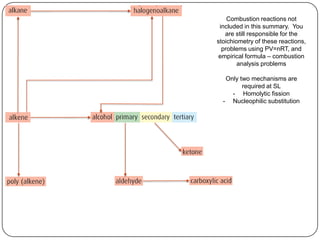
Combustion reactions not
 included in this summary. You
   are still responsible for the
stoichiometry of these reactions,
  problems using PV=nRT, and
empirical formula – combustion
        analysis problems

   Only two mechanisms are
         required at SL
     - Homolytic fission
  - Nucleophilic substitution
Homolytic fission, UV light
                              Alkane Reactions

                              Making halogenoalkanes by
                              process of homolytic fission.

                              Know what a radical is
                              Understand and memorize the
                              the 3 steps – Initiation,
                              Propagation and Termination
                              This reaction REQUIRES light
Homolytic fission, UV light
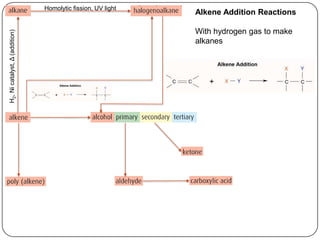
                                                              Alkene Addition Reactions

                                                              With hydrogen gas to make
H2, Ni catalyst, Δ (addition)


                                                              alkanes
Homolytic fission, UV light
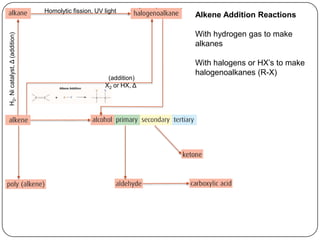
                                                                    Alkene Addition Reactions

                                                                    With hydrogen gas to make
H2, Ni catalyst, Δ (addition)


                                                                    alkanes

                                                                    With halogens or HX’s to make
                                                                    halogenoalkanes (R-X)
                                                       (addition)
                                                      X2 or HX, Δ
Homolytic fission, UV light
                                                                     Alkene Addition Reactions

                                                                     With hydrogen gas to make
H2, Ni catalyst, Δ (addition)


                                                                     alkanes

                                                                     With halogens or HX’s to make
                                                                     halogenoalkanes (R-X)
                                                        (addition)
                                                       X2 or HX, Δ
                                                                     With water to make alcohols
                                                                     (R-OH)
                                   (addition)
                                H2O, [H2SO4], Δ
Homolytic fission, UV light
                                                                         Alkene Addition Reactions

                                                                         With hydrogen gas to make
H2, Ni catalyst, Δ (addition)


                                                                         alkanes

                                                                         With halogens or HX’s to make
                                                                         halogenoalkanes (R-X)
                                                            (addition)
                                                           X2 or HX, Δ
                                                                         With water to make alcohols
                                                                         (R-OH)
                                       (addition)
                                    H2O, [H2SO4], Δ
                                                                         Monomer subunits combine to
                   polymerization


                                                                         make polymers
                      addition
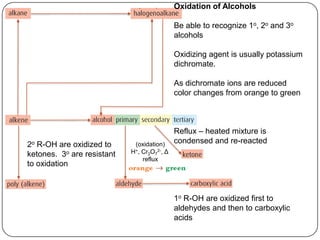
Oxidation of Alcohols

                                            Be able to recognize 1o, 2o and 3o
                                            alcohols

                                            Oxidizing agent is usually potassium
                                            dichromate.

                                            As dichromate ions are reduced
                                            color changes from orange to green


                                            Reflux – heated mixture is
2o R-OH are oxidized to      (oxidation)    condensed and re-reacted
ketones. 3o are resistant   H+,Cr2O72-, Δ
                               reflux
to oxidation


                                            1o R-OH are oxidized first to
                                            aldehydes and then to carboxylic
                                            acids
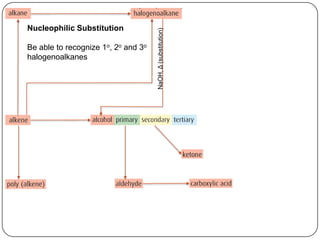
Nucleophilic Substitution


                                     NaOH, Δ (substitution)
Be able to recognize 1o, 2o and 3o
halogenoalkanes
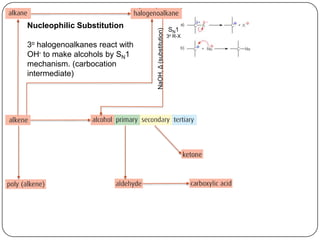
Nucleophilic Substitution                                SN1


                                NaOH, Δ (substitution)
                                                         3o R-X
3o halogenoalkanes react with
OH- to make alcohols by SN1
mechanism. (carbocation
intermediate)
Nucleophilic Substitution


                                NaOH, Δ (substitution)
1o halogenoalkanes react with
OH- to make alcohols by SN2
mechanism. (transition state)                            SN2
                                                         1o R-X
Homolytic fission, UV light

                                                                                                     SN1


                                                                            NaOH, Δ (substitution)
H2, Ni catalyst, Δ (addition)


                                                                                                     3o R-X


                                                                                                     SN2
                                                                                                     1o R-X
                                                            (addition)
                                                           X2 or HX, Δ


                                       (addition)
                                    H2O, [H2SO4], Δ
                   polymerization
                      addition


                                                                     (oxidation)
                                                                    H+,Cr2O72-, Δ
                                                                       reflux
HL
Pathways
Conc OH-, ethanol, Δ (elimination)

                                                                                                                        1o or 2o R-X
                                3o R-X


                                            Homolytic fission, UV light                                                 (substitution)         KCN

                                                                                                               SN1                                H2, Ni catalyst,


                                                                                      NaOH, Δ (substitution)
                                                                                                                                                   Δ, pressure
H2, Ni catalyst, Δ (addition)


                                                                                                               3o R-X
                                                                                                                                                    (reduction)


                                                                                                               SN2
                                                                                                               1o R-X
                                                                   (addition)
                                                                  X2 or HX, Δ


                                                                                                                                                          (condensation)
                                                                                                                                                           with R-COOH
                                             (addition)
                                          H2O, [H2SO4], Δ
                   polymerization
                      addition


                                                                               (oxidation)
                                                                              H+,Cr2O72-, Δ
                                                                                 reflux


                                                                                                                                         (condensation)
                                                                                                                                           with R-OH
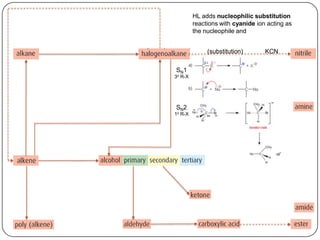
HL adds nucleophilic substitution
         reactions with cyanide ion acting as
         the nucleophile and


              (substitution)       KCN

SN1
3o R-X


SN2
1o R-X
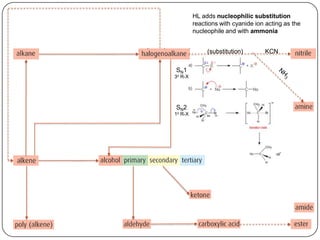
HL adds nucleophilic substitution
         reactions with cyanide ion acting as the
         nucleophile and with ammonia


              (substitution)       KCN

SN1
3o R-X


SN2
1o R-X
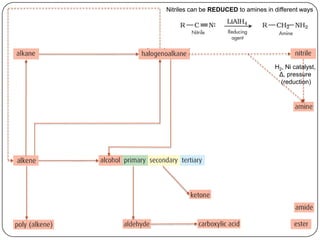
Nitriles can be REDUCED to amines in different ways


                                     H2, Ni catalyst,
                                      Δ, pressure
                                       (reduction)
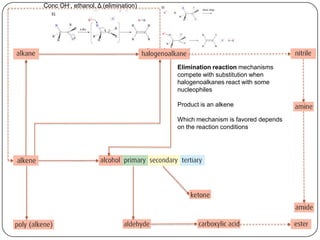
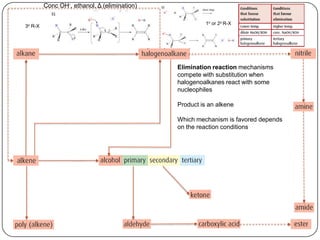
Conc OH-, ethanol, Δ (elimination)


                                     Elimination reaction mechanisms
                                     compete with substitution when
                                     halogenoalkanes react with some
                                     nucleophiles

                                     Product is an alkene

                                     Which mechanism is favored depends
                                     on the reaction conditions
Conc OH-, ethanol, Δ (elimination)

                                                        1o or 2o R-X
3o R-X


                                              Elimination reaction mechanisms
                                              compete with substitution when
                                              halogenoalkanes react with some
                                              nucleophiles

                                              Product is an alkene

                                              Which mechanism is favored depends
                                              on the reaction conditions
Condensation reactions include
Esterification – where an ester and
water are formed by the reaction
between a carboxylic acid and an
alcohol


                        (condensation)
                          with R-OH
Condensation reactions include
– where an amide and water are
formed by the reaction between a
carboxylic acid and an amine


                                        (condensation)
                                         with R-COOH
                       (condensation)
                         with R-OH
Conc OH-, ethanol, Δ (elimination)

                                                                                                                        1o or 2o R-X
                                3o R-X


                                            Homolytic fission, UV light                                                 (substitution)         KCN

                                                                                                               SN1                                H2, Ni catalyst,


                                                                                      NaOH, Δ (substitution)
                                                                                                                                                   Δ, pressure
H2, Ni catalyst, Δ (addition)


                                                                                                               3o R-X
                                                                                                                                                    (reduction)


                                                                                                               SN2
                                                                                                               1o R-X
                                                                   (addition)
                                                                  X2 or HX, Δ


                                                                                                                                                          (condensation)
                                                                                                                                                           with R-COOH
                                             (addition)
                                          H2O, [H2SO4], Δ
                   polymerization
                      addition


                                                                               (oxidation)
                                                                              H+,Cr2O72-, Δ
                                                                                 reflux


                                                                                                                                         (condensation)
                                                                                                                                           with R-OH

Topic 10 & 20 reaction summary and review

  • 1.
    IB Chemistry PowerPoints Topics 10 & 20 Organic Chemistry www.pedagogics.ca Reaction Summary
  • 2.
  • 3.
    Conc OH-, ethanol,Δ (elimination) 1o or 2o R-X 3o R-X Homolytic fission, UV light (substitution) KCN SN1 H2, Ni catalyst, NaOH, Δ (substitution) Δ, pressure H2, Ni catalyst, Δ (addition) 3o R-X (reduction) SN2 1o R-X (addition) X2 or HX, Δ (condensation) with R-COOH (addition) H2O, [H2SO4], Δ polymerization addition (oxidation) H+,Cr2O72-, Δ reflux (condensation) with R-OH
  • 4.
  • 5.
    Combustion reactions not included in this summary. You are still responsible for the stoichiometry of these reactions, problems using PV=nRT, and empirical formula – combustion analysis problems Only two mechanisms are required at SL - Homolytic fission - Nucleophilic substitution
  • 6.
    Homolytic fission, UVlight Alkane Reactions Making halogenoalkanes by process of homolytic fission. Know what a radical is Understand and memorize the the 3 steps – Initiation, Propagation and Termination This reaction REQUIRES light
  • 7.
    Homolytic fission, UVlight Alkene Addition Reactions With hydrogen gas to make H2, Ni catalyst, Δ (addition) alkanes
  • 8.
    Homolytic fission, UVlight Alkene Addition Reactions With hydrogen gas to make H2, Ni catalyst, Δ (addition) alkanes With halogens or HX’s to make halogenoalkanes (R-X) (addition) X2 or HX, Δ
  • 9.
    Homolytic fission, UVlight Alkene Addition Reactions With hydrogen gas to make H2, Ni catalyst, Δ (addition) alkanes With halogens or HX’s to make halogenoalkanes (R-X) (addition) X2 or HX, Δ With water to make alcohols (R-OH) (addition) H2O, [H2SO4], Δ
  • 10.
    Homolytic fission, UVlight Alkene Addition Reactions With hydrogen gas to make H2, Ni catalyst, Δ (addition) alkanes With halogens or HX’s to make halogenoalkanes (R-X) (addition) X2 or HX, Δ With water to make alcohols (R-OH) (addition) H2O, [H2SO4], Δ Monomer subunits combine to polymerization make polymers addition
  • 11.
    Oxidation of Alcohols Be able to recognize 1o, 2o and 3o alcohols Oxidizing agent is usually potassium dichromate. As dichromate ions are reduced color changes from orange to green Reflux – heated mixture is 2o R-OH are oxidized to (oxidation) condensed and re-reacted ketones. 3o are resistant H+,Cr2O72-, Δ reflux to oxidation 1o R-OH are oxidized first to aldehydes and then to carboxylic acids
  • 12.
    Nucleophilic Substitution NaOH, Δ (substitution) Be able to recognize 1o, 2o and 3o halogenoalkanes
  • 13.
    Nucleophilic Substitution SN1 NaOH, Δ (substitution) 3o R-X 3o halogenoalkanes react with OH- to make alcohols by SN1 mechanism. (carbocation intermediate)
  • 14.
    Nucleophilic Substitution NaOH, Δ (substitution) 1o halogenoalkanes react with OH- to make alcohols by SN2 mechanism. (transition state) SN2 1o R-X
  • 15.
    Homolytic fission, UVlight SN1 NaOH, Δ (substitution) H2, Ni catalyst, Δ (addition) 3o R-X SN2 1o R-X (addition) X2 or HX, Δ (addition) H2O, [H2SO4], Δ polymerization addition (oxidation) H+,Cr2O72-, Δ reflux
  • 16.
  • 17.
    Conc OH-, ethanol,Δ (elimination) 1o or 2o R-X 3o R-X Homolytic fission, UV light (substitution) KCN SN1 H2, Ni catalyst, NaOH, Δ (substitution) Δ, pressure H2, Ni catalyst, Δ (addition) 3o R-X (reduction) SN2 1o R-X (addition) X2 or HX, Δ (condensation) with R-COOH (addition) H2O, [H2SO4], Δ polymerization addition (oxidation) H+,Cr2O72-, Δ reflux (condensation) with R-OH
  • 18.
    HL adds nucleophilicsubstitution reactions with cyanide ion acting as the nucleophile and (substitution) KCN SN1 3o R-X SN2 1o R-X
  • 19.
    HL adds nucleophilicsubstitution reactions with cyanide ion acting as the nucleophile and with ammonia (substitution) KCN SN1 3o R-X SN2 1o R-X
  • 20.
    Nitriles can beREDUCED to amines in different ways H2, Ni catalyst, Δ, pressure (reduction)
  • 21.
    Conc OH-, ethanol,Δ (elimination) Elimination reaction mechanisms compete with substitution when halogenoalkanes react with some nucleophiles Product is an alkene Which mechanism is favored depends on the reaction conditions
  • 22.
    Conc OH-, ethanol,Δ (elimination) 1o or 2o R-X 3o R-X Elimination reaction mechanisms compete with substitution when halogenoalkanes react with some nucleophiles Product is an alkene Which mechanism is favored depends on the reaction conditions
  • 23.
    Condensation reactions include Esterification– where an ester and water are formed by the reaction between a carboxylic acid and an alcohol (condensation) with R-OH
  • 24.
    Condensation reactions include –where an amide and water are formed by the reaction between a carboxylic acid and an amine (condensation) with R-COOH (condensation) with R-OH
  • 25.
    Conc OH-, ethanol,Δ (elimination) 1o or 2o R-X 3o R-X Homolytic fission, UV light (substitution) KCN SN1 H2, Ni catalyst, NaOH, Δ (substitution) Δ, pressure H2, Ni catalyst, Δ (addition) 3o R-X (reduction) SN2 1o R-X (addition) X2 or HX, Δ (condensation) with R-COOH (addition) H2O, [H2SO4], Δ polymerization addition (oxidation) H+,Cr2O72-, Δ reflux (condensation) with R-OH