



AIR MICROBIOLOGY
SUMANGALA.C.H.
CONTENTS
1. INTRODUCTION
2. MICROFLORA OF AIR
3. AIR SAMPLING TECHNIQUES
4. AIR BORNE DISEASES
5. CONTROL OF AIRBORNE
MICROBES
Aerobiology coined by F.C.Meier in 1930.
• Study of microbes suspended in air.
• Microbes present in air as:
1. Bioaerosol: Aerosol of biological
origin.example bacteria.
2.Droplet nuclei: Dry residues formed by
evaporation of droplets coughed or sneezed
into atmosphere.
AIR MICROFLORA
In air we have allochthonous populations.
(transient)
INDOOR AIR MICROFLORA
Air inside building is indoor air.
• Common Fungi Penicillium, Aspergillus.
• Common Bacteria Staphylococcus ,Bacillus,
Clostridium
• Hospital: important indoor environment for
spread of pathogens Candida and
Mycobacterium
• Library: Cellulose degrading fungi like
Aspergillus, Penicillium, Rhizopus
Trichoderma.
OUTDOOR AIR MICROFLORA
• Air in atmosphere found outside buildings is
outside air.
• The number and kinds of microbes in air
vary from place to place depending on
human population , location etc.
• Fungi: Aspergillus, Cladosporium, Alternaria,
basidiospores and ascospores of yeasts.
• Bacteria: Bacillus,Clostridium,Micrococcus
and Staphlococcus.
AIR SAMPLING TECHNIQUES
 Based on principle of Sedimentation
a. Gravity Slide Method
 Glass slide coated with petroleum jelly and
exposed to air for 24 hrs.
 Then observed directly under microscope
for pollens and microbes.
This gives Total count.
b. Settle Plate Method
 Petriplate containing Agar medium
exposed to air for 10 mins at different
places and incubated.
 After incubation number of colonies are
counted.
 This gives Viable count.
 Impactors
Solid surface is used for particle collection.
a. Slit sampler:
Air is drawn through narrow slit and
particles are impacted on Agar medium.
 After incubation colonies are counted.
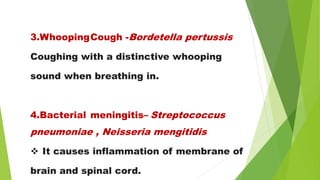
b. Burkard Spore Trap.
Air is passed through a slit orifice and
impacted on adhesive tape supported on a
clock driven drum.
Drum makes one complete revolution in
seven days.
 After seven days tape removed and cut
and observed under microscope.
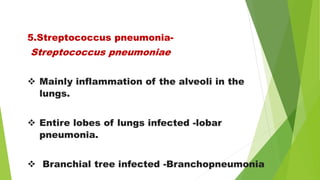
c. Rotorod
 Portable air sampler made of pair of rods
mounted on a shaft.
Battery operated motor rotates it at
constant speed.
Outer surface of rod is covered with cello
tape smeared petroleum jelly.
After exposure strips cut and observed
under microscope.
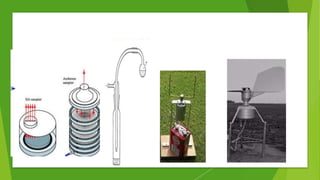
d. Andersons sampler
 This apparatus consists of series of six plates
through which air sample is passed through a
circular opening.
 Each plate has 400 holes .
 Below the perforated plate lies a Petriplate with
Agar medium .
After certain time plates are removed and
incubated and observed for the development of
colonies.
 Impingers
Air borne particles are collected by
bubbling sampled air through a liquid.
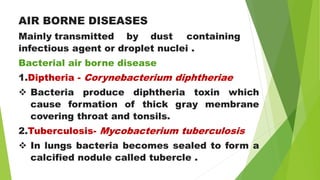
a.Porton Impinger
Narrow glass flask with a glass stopper.
Stopper bears a side arm to which suction
is applied.
Through apex of stopper an intake tube
terminate in a jet.
0.5 to 1 micrometer diameter cells
collected in porton impinger.
b . Preimpinger:
Glass bulb with half filled collecting fluid.
When connected to porton impinger
particles upto 4 micrometer diameter
penetrates the preimpinger.
 Filteration
Air is filtered through a membrane filter
and observed under microscope
or the filter disc is placed on Agar
medium and incubated and no of
colonies are counted.
AIR BORNE DISEASES
Mainly transmitted by dust containing
infectious agent or droplet nuclei .
Bacterial air borne disease
1.Diptheria - Corynebacterium diphtheriae
 Bacteria produce diphtheria toxin which
cause formation of thick gray membrane
covering throat and tonsils.
2.Tuberculosis- Mycobacterium tuberculosis
 In lungs bacteria becomes sealed to form a
calcified nodule called tubercle .
3.WhoopingCough -Bordetella pertussis
Coughing with a distinctive whooping
sound when breathing in.
4.Bacterial meningitis– Streptococcus
pneumoniae , Neisseria mengitidis
 It causes inflammation of membrane of
brain and spinal cord.
5.Streptococcus pneumonia-
Streptococcus pneumoniae
 Mainly inflammation of the alveoli in the
lungs.
 Entire lobes of lungs infected -lobar
pneumonia.
 Branchial tree infected -Branchopneumonia
Bacterial disease acquired by inhaling
particles from environment.
1.Legionellosis -Legionella pneumophila
 Spread from mist and from air conditioning
unit .
 Causes Bronchopneumonia.
2.Psittacosis -Chlamydia psittaci
 Spread from droppings of infected birds.
 Inflammatory illness of lungs.
Viral Air Borne diseases
Viral disease spread by droplet nuclei
and direct contact.
1.Influenza(Flu)
 Influenza virus classified under
orthomyxovirus .
 Virus bind through hemagglutinin on
to surface of epithelial cells in nose, throat
and lungs.
 The main target of virus are columnar
epithelial cells of respiratory tract.
2.Measles
 Rubeola virus
classified under paramyxovirus.
Virus enters through respiratory tract or
conjunctiva of eyes.
 Lesions found in skin, conjunctiva and
mucous membrane of nasopharynx
bronchi and intestinal tract.
 Kopliks spots seen.
3.German measles
Rubella virus classified under Togavirus.
 Virus transmitted under respiratory route and
replicates in nasopharynx and lymph nodes.
 Fever ,swollen lymph nodes and rashes seen.
4.Small pox
 Variola virus classified under orthopoxvirus.
 Characteristic feature rash progresses to
raised bump and pus filled blister that crust
and scab and fall after about three weeks
leaving scar.
5.Chicken pox
 Varicella virus classified in herpes family.
 Characterized by pleomorphic eruption of
skin and mucous membrane.
 Eruptions passes through stages of
macule, papule, vesicle and pustule.
6.Mumps
 Mumps virus belonging to paramyxovirus.
 Characterized by swelling of parotid
glands occasionally swelling of sub
lingual glands.
Fungal Air Borne Diseases
 Mainly occurs by inhalation of spores.
 Initial infection is in lungs and spread to
other organs by blood stream.
 Treatment is mainly Amphotericin B and
Ketaconazole.
1.Blastomycosis
Blastomycosis dermatitidis
 If only lungs involved its Pulmonary
Blastomycosis.
 Initial infection in lungs then spread to skin
where cutaneous ulcers occur.
2.Coccidiomycosis:
Coccidioides immitis
Affects lungs ,bones, skin and meninges
Some people develop painful erythematous
nodular lesions called Erythema nodosum.
3.Histoplasmosis
Histoplama capsulatum
 Disease of reticulo endothelium system
 Cause the formation of Granulomas
 Can necrotize and become calcified.
4.Cryptococcis
 Cryptococcus neoformans
 Affects lungs, spread to skin ,bones and
Central nervous systems.
 Once in central nervous system Cryptococcal
meningitis occurs.
Control of Air Borne Microbes.
1.Dust control
Dry vacuum pick up followed by application
of suitable detergent
Oiling floors ,bed clothes etc.
2.UV radiation
Germicidal lamps
250nm -260nm radiations shows
bactericidal effect.
3. Laminar Air Flow system
 Air passes through HEPA filters and
removes particles as small as
0.3micrometer.
4.Chemical techniques
 Indoor air microbial population reduced by
vapourizing or spraying of propylene
glycol, Propionolactone and triethylene
glycol.
Air microbiology ppt

Air microbiology ppt

  • 1.
  • 2.
    CONTENTS 1. INTRODUCTION 2. MICROFLORAOF AIR 3. AIR SAMPLING TECHNIQUES 4. AIR BORNE DISEASES 5. CONTROL OF AIRBORNE MICROBES
  • 3.
    Aerobiology coined byF.C.Meier in 1930. • Study of microbes suspended in air. • Microbes present in air as: 1. Bioaerosol: Aerosol of biological origin.example bacteria. 2.Droplet nuclei: Dry residues formed by evaporation of droplets coughed or sneezed into atmosphere.
  • 4.
    AIR MICROFLORA In airwe have allochthonous populations. (transient) INDOOR AIR MICROFLORA Air inside building is indoor air. • Common Fungi Penicillium, Aspergillus. • Common Bacteria Staphylococcus ,Bacillus, Clostridium • Hospital: important indoor environment for spread of pathogens Candida and Mycobacterium • Library: Cellulose degrading fungi like Aspergillus, Penicillium, Rhizopus Trichoderma.
  • 5.
    OUTDOOR AIR MICROFLORA •Air in atmosphere found outside buildings is outside air. • The number and kinds of microbes in air vary from place to place depending on human population , location etc. • Fungi: Aspergillus, Cladosporium, Alternaria, basidiospores and ascospores of yeasts. • Bacteria: Bacillus,Clostridium,Micrococcus and Staphlococcus.
  • 6.
    AIR SAMPLING TECHNIQUES Based on principle of Sedimentation a. Gravity Slide Method  Glass slide coated with petroleum jelly and exposed to air for 24 hrs.  Then observed directly under microscope for pollens and microbes. This gives Total count.
  • 7.
    b. Settle PlateMethod  Petriplate containing Agar medium exposed to air for 10 mins at different places and incubated.  After incubation number of colonies are counted.  This gives Viable count.
  • 8.
     Impactors Solid surfaceis used for particle collection. a. Slit sampler: Air is drawn through narrow slit and particles are impacted on Agar medium.  After incubation colonies are counted.
  • 9.
    b. Burkard SporeTrap. Air is passed through a slit orifice and impacted on adhesive tape supported on a clock driven drum. Drum makes one complete revolution in seven days.  After seven days tape removed and cut and observed under microscope.
  • 10.
    c. Rotorod  Portableair sampler made of pair of rods mounted on a shaft. Battery operated motor rotates it at constant speed. Outer surface of rod is covered with cello tape smeared petroleum jelly. After exposure strips cut and observed under microscope.
  • 11.
    d. Andersons sampler This apparatus consists of series of six plates through which air sample is passed through a circular opening.  Each plate has 400 holes .  Below the perforated plate lies a Petriplate with Agar medium . After certain time plates are removed and incubated and observed for the development of colonies.
  • 12.
     Impingers Air borneparticles are collected by bubbling sampled air through a liquid. a.Porton Impinger Narrow glass flask with a glass stopper. Stopper bears a side arm to which suction is applied. Through apex of stopper an intake tube terminate in a jet. 0.5 to 1 micrometer diameter cells collected in porton impinger.
  • 13.
    b . Preimpinger: Glassbulb with half filled collecting fluid. When connected to porton impinger particles upto 4 micrometer diameter penetrates the preimpinger.
  • 14.
     Filteration Air isfiltered through a membrane filter and observed under microscope or the filter disc is placed on Agar medium and incubated and no of colonies are counted.
  • 16.
    AIR BORNE DISEASES Mainlytransmitted by dust containing infectious agent or droplet nuclei . Bacterial air borne disease 1.Diptheria - Corynebacterium diphtheriae  Bacteria produce diphtheria toxin which cause formation of thick gray membrane covering throat and tonsils. 2.Tuberculosis- Mycobacterium tuberculosis  In lungs bacteria becomes sealed to form a calcified nodule called tubercle .
  • 17.
    3.WhoopingCough -Bordetella pertussis Coughingwith a distinctive whooping sound when breathing in. 4.Bacterial meningitis– Streptococcus pneumoniae , Neisseria mengitidis  It causes inflammation of membrane of brain and spinal cord.
  • 18.
    5.Streptococcus pneumonia- Streptococcus pneumoniae Mainly inflammation of the alveoli in the lungs.  Entire lobes of lungs infected -lobar pneumonia.  Branchial tree infected -Branchopneumonia
  • 19.
    Bacterial disease acquiredby inhaling particles from environment. 1.Legionellosis -Legionella pneumophila  Spread from mist and from air conditioning unit .  Causes Bronchopneumonia. 2.Psittacosis -Chlamydia psittaci  Spread from droppings of infected birds.  Inflammatory illness of lungs.
  • 20.
    Viral Air Bornediseases Viral disease spread by droplet nuclei and direct contact. 1.Influenza(Flu)  Influenza virus classified under orthomyxovirus .  Virus bind through hemagglutinin on to surface of epithelial cells in nose, throat and lungs.  The main target of virus are columnar epithelial cells of respiratory tract.
  • 21.
    2.Measles  Rubeola virus classifiedunder paramyxovirus. Virus enters through respiratory tract or conjunctiva of eyes.  Lesions found in skin, conjunctiva and mucous membrane of nasopharynx bronchi and intestinal tract.  Kopliks spots seen.
  • 22.
    3.German measles Rubella virusclassified under Togavirus.  Virus transmitted under respiratory route and replicates in nasopharynx and lymph nodes.  Fever ,swollen lymph nodes and rashes seen. 4.Small pox  Variola virus classified under orthopoxvirus.  Characteristic feature rash progresses to raised bump and pus filled blister that crust and scab and fall after about three weeks leaving scar.
  • 23.
    5.Chicken pox  Varicellavirus classified in herpes family.  Characterized by pleomorphic eruption of skin and mucous membrane.  Eruptions passes through stages of macule, papule, vesicle and pustule. 6.Mumps  Mumps virus belonging to paramyxovirus.  Characterized by swelling of parotid glands occasionally swelling of sub lingual glands.
  • 24.
    Fungal Air BorneDiseases  Mainly occurs by inhalation of spores.  Initial infection is in lungs and spread to other organs by blood stream.  Treatment is mainly Amphotericin B and Ketaconazole.
  • 25.
    1.Blastomycosis Blastomycosis dermatitidis  Ifonly lungs involved its Pulmonary Blastomycosis.  Initial infection in lungs then spread to skin where cutaneous ulcers occur. 2.Coccidiomycosis: Coccidioides immitis Affects lungs ,bones, skin and meninges Some people develop painful erythematous nodular lesions called Erythema nodosum.
  • 26.
    3.Histoplasmosis Histoplama capsulatum  Diseaseof reticulo endothelium system  Cause the formation of Granulomas  Can necrotize and become calcified. 4.Cryptococcis  Cryptococcus neoformans  Affects lungs, spread to skin ,bones and Central nervous systems.  Once in central nervous system Cryptococcal meningitis occurs.
  • 27.
    Control of AirBorne Microbes. 1.Dust control Dry vacuum pick up followed by application of suitable detergent Oiling floors ,bed clothes etc. 2.UV radiation Germicidal lamps 250nm -260nm radiations shows bactericidal effect.
  • 28.
    3. Laminar AirFlow system  Air passes through HEPA filters and removes particles as small as 0.3micrometer. 4.Chemical techniques  Indoor air microbial population reduced by vapourizing or spraying of propylene glycol, Propionolactone and triethylene glycol.