Hormones and endocrine glands Chapter 15
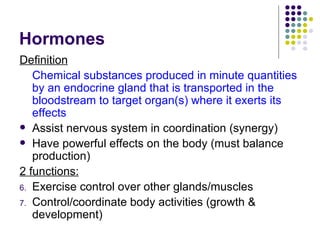
Hormones Definition Chemical substances produced in minute quantities by an endocrine gland that is transported in the bloodstream to target organ(s) where it exerts its effects Assist nervous system in coordination (synergy) Have powerful effects on the body (must balance production) 2 functions: Exercise control over other glands/muscles Control/coordinate body activities (growth & development)
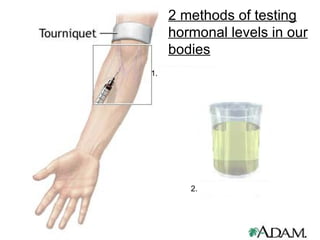
1. 2. 2 methods of testing hormonal levels in our bodies
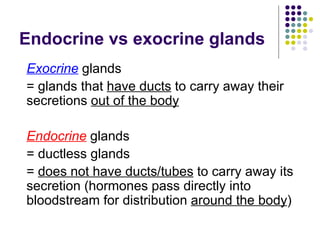
Endocrine vs exocrine glands Exocrine  glands  = glands that  have ducts  to carry away their secretions  out of the body Endocrine  glands = ductless glands =  does not have ducts/tubes  to carry away its secretion (hormones pass directly into bloodstream for distribution  around the body )
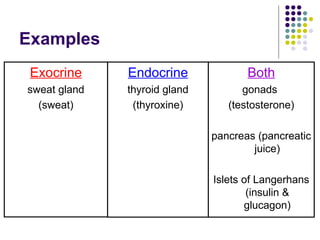
Examples Endocrine thyroid gland (thyroxine) Exocrine sweat gland (sweat) Both gonads  (testosterone) pancreas (pancreatic juice) Islets of Langerhans (insulin & glucagon)
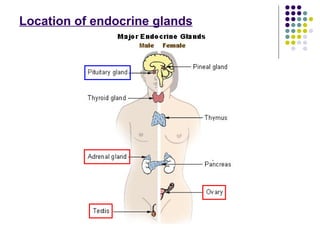
Location of endocrine glands
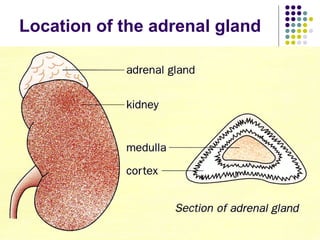
Location of the adrenal gland
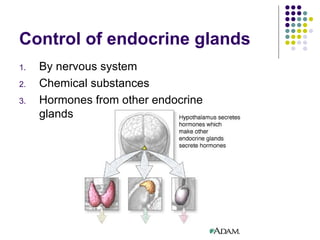
Control of endocrine glands By nervous system Chemical substances Hormones from other endocrine glands
Important pointers: Pituitary gland = “master gland”/”controller” ->  secretes a number of hormones ->  each controls particular gland activity Some glands do not function until a certain age  ->  reproductive organs (gonads) Long-term vs short-term hormones  ->  thyroxine (long-term, permanent effects)  ->  adrenaline (short-lived effects)
Important pointers: Production of hormones must be adequate and balanced ->  excessive production of certain hormones may be harmful Hormones are destroyed by the liver and excreted by the kidneys after performing their functions
Insulin
Islet of Langerhans  (in pancreas) produce insulin during increase in blood glucose concentration Effects of insulin: [overall increase in cell glucose utilization] Increased cell membrane permeability to glucose  -> increasing rate of glucose uptake by cells Cause increased oxidation of glucose during tissue respiration  Causes conversion of  EXCESS  glucose to glycogen for storage in liver and muscles
Effects of lack of secretion Blood glucose conc. rises  ->  not utilized by cells   ->  diabetes mellitus Body weakness  ->  no glycogen reserves  ->  continuous loss of weight Fat oxidation preferred  ->  formation of  ketones  (poisonous)  ->  excreted in urine ( ketonuria ) ->  death may occur
Effects of oversecretion Abnormal decrease in blood glucose conc. Shock results Coma and death ensues
Diabetes mellitus Body unable to control its blood glucose conc. within safe limits Kidney unable to reabsorb all the glucose Glucose not reabsorbed is excreted in the urine 2 main types: Type 1 Type 2
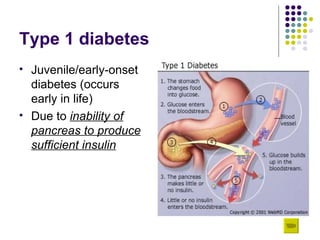
Type 1 diabetes Juvenile/early-onset diabetes (occurs early in life) Due to  inability of pancreas to produce sufficient insulin
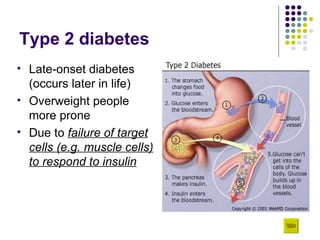
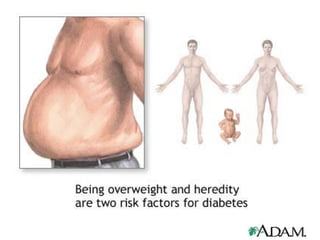
Type 2 diabetes Late-onset diabetes (occurs later in life) Overweight people more prone Due to  failure of target cells (e.g. muscle cells) to respond to insulin
 
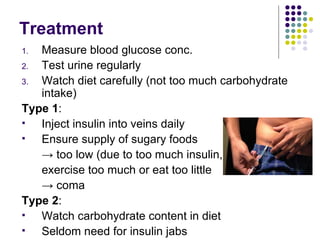
Treatment Measure blood glucose conc.  Test urine regularly Watch diet carefully (not too much carbohydrate intake) Type 1 : Inject insulin into veins daily Ensure supply of sugary foods  ->  too low (due to too much insulin,  exercise too much or eat too little  ->  coma Type 2 : Watch carbohydrate content in diet Seldom need for insulin jabs

Chapter 15 Hormones Lesson 1 - Endocrine Glands and the effects of insulin

  • 1.
    Hormones and endocrineglands Chapter 15
  • 2.
    Hormones Definition Chemicalsubstances produced in minute quantities by an endocrine gland that is transported in the bloodstream to target organ(s) where it exerts its effects Assist nervous system in coordination (synergy) Have powerful effects on the body (must balance production) 2 functions: Exercise control over other glands/muscles Control/coordinate body activities (growth & development)
  • 3.
    1. 2. 2methods of testing hormonal levels in our bodies
  • 4.
    Endocrine vs exocrineglands Exocrine glands = glands that have ducts to carry away their secretions out of the body Endocrine glands = ductless glands = does not have ducts/tubes to carry away its secretion (hormones pass directly into bloodstream for distribution around the body )
  • 5.
    Examples Endocrine thyroidgland (thyroxine) Exocrine sweat gland (sweat) Both gonads (testosterone) pancreas (pancreatic juice) Islets of Langerhans (insulin & glucagon)
  • 6.
  • 7.
    Location of theadrenal gland
  • 8.
    Control of endocrineglands By nervous system Chemical substances Hormones from other endocrine glands
  • 9.
    Important pointers: Pituitarygland = “master gland”/”controller” -> secretes a number of hormones -> each controls particular gland activity Some glands do not function until a certain age -> reproductive organs (gonads) Long-term vs short-term hormones -> thyroxine (long-term, permanent effects) -> adrenaline (short-lived effects)
  • 10.
    Important pointers: Productionof hormones must be adequate and balanced -> excessive production of certain hormones may be harmful Hormones are destroyed by the liver and excreted by the kidneys after performing their functions
  • 11.
  • 12.
    Islet of Langerhans (in pancreas) produce insulin during increase in blood glucose concentration Effects of insulin: [overall increase in cell glucose utilization] Increased cell membrane permeability to glucose -> increasing rate of glucose uptake by cells Cause increased oxidation of glucose during tissue respiration Causes conversion of EXCESS glucose to glycogen for storage in liver and muscles
  • 13.
    Effects of lackof secretion Blood glucose conc. rises -> not utilized by cells -> diabetes mellitus Body weakness -> no glycogen reserves -> continuous loss of weight Fat oxidation preferred -> formation of ketones (poisonous) -> excreted in urine ( ketonuria ) -> death may occur
  • 14.
    Effects of oversecretionAbnormal decrease in blood glucose conc. Shock results Coma and death ensues
  • 15.
    Diabetes mellitus Bodyunable to control its blood glucose conc. within safe limits Kidney unable to reabsorb all the glucose Glucose not reabsorbed is excreted in the urine 2 main types: Type 1 Type 2
  • 16.
    Type 1 diabetesJuvenile/early-onset diabetes (occurs early in life) Due to inability of pancreas to produce sufficient insulin
  • 17.
    Type 2 diabetesLate-onset diabetes (occurs later in life) Overweight people more prone Due to failure of target cells (e.g. muscle cells) to respond to insulin
  • 18.
  • 19.
    Treatment Measure bloodglucose conc. Test urine regularly Watch diet carefully (not too much carbohydrate intake) Type 1 : Inject insulin into veins daily Ensure supply of sugary foods -> too low (due to too much insulin, exercise too much or eat too little -> coma Type 2 : Watch carbohydrate content in diet Seldom need for insulin jabs