

Transportation in plants
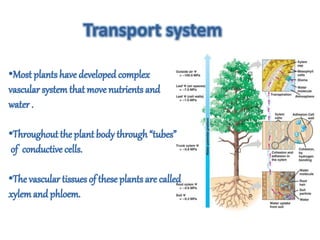
Transport system
Reason for transport system
•Unicellular organisms
They can transport materials likeoxygenand urea in and
out of their bodies.
•Multicellular organisms:
Most of the cellsinsidethe organisms are too far from
the surface of their bodies and diffusionand osmosis are too
slow to be reliedon.
A transportation systemis required for food and oxygen
to be brought efficientlyfromone placeto another.
Diffusionand osmosis would take place betweenthe
transportsystemand the cell.
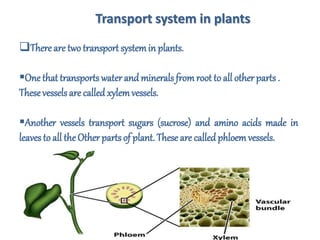
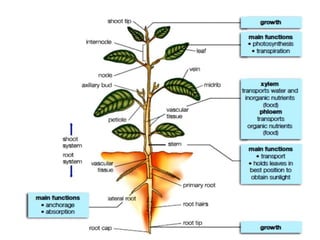
Transport system in plants
There are two transport systemin plants.
One that transports waterand minerals fromroot to all other parts .
Thesevessels are called xylemvessels.
Another vessels transport sugars (sucrose) and amino acids made in
leaves to all the Other parts of plant. These are called phloemvessels.
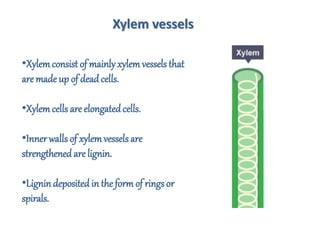
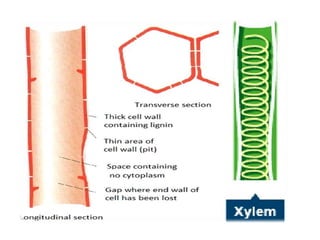
•Xylemconsist of mainly xylem vessels that
are made up of deadcells.
•Xylemcells are elongatedcells.
•Inner walls of xylemvessels are
strengthened are lignin.
•Lignindeposited in theform of rings or
spirals.
Xylem vessels
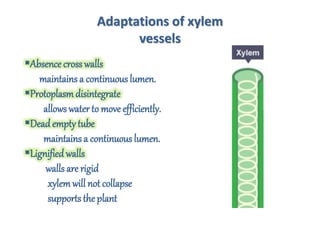
Adaptations of xylem
vessels
Absence cross walls
maintains a continuous lumen.
Protoplasmdisintegrate
allows waterto move efficiently.
Dead empty tube
maintains a continuous lumen.
Lignified walls
walls are rigid
xylemwill not collapse
supports the plant
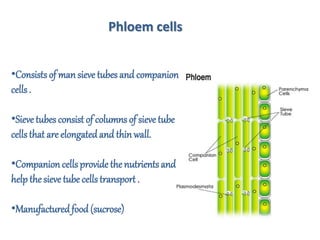
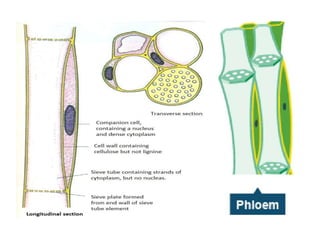
•Consists of man sieve tubes and companion
cells .
•Sievetubes consist of columns of sieve tube
cells that are elongatedand thin wall.
•Companioncellsprovide thenutrients and
help the sieve tube cells transport .
•Manufacturedfood (sucrose)
Phloem cells
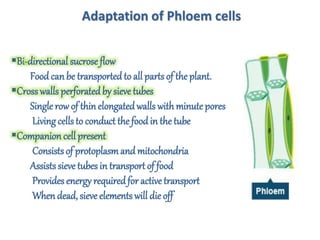
Adaptation of Phloem cells
Bi-directional sucrose flow
Food can be transported to all parts of the plant.
Crosswalls perforatedby sieve tubes
Single row of thinelongatedwalls with minute pores
Living cellsto conduct thefood in the tube
Companion cell present
Consists of protoplasmand mitochondria
Assists sieve tubes in transport of food
Provides energy requiredfor active transport
Whendead, sieve elements will die off
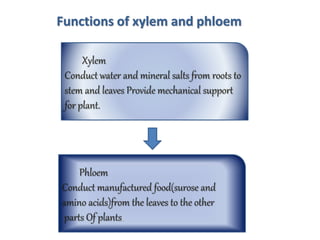
Xylem
Conduct water and mineral salts from roots to
stem and leaves Provide mechanical support
for plant.
Phloem
Conduct manufactured food(surose and
amino acids)from the leaves to the other
parts Of plants.
Functions of xylem and phloem
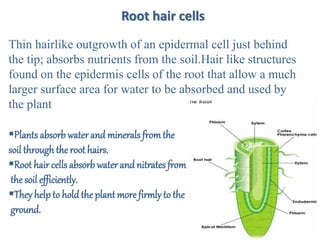
Root hair cells
Thin hairlike outgrowth of an epidermal cell just behind
the tip; absorbs nutrients from the soil.Hair like structures
found on the epidermis cells of the root that allow a much
larger surface area for water to be absorbed and used by
the plant
Plants absorb waterand minerals fromthe
soil through the root hairs.
Root hair cellsabsorb water and nitrates from
the soil efficiently.
They help to hold the plant more firmly to the
ground.
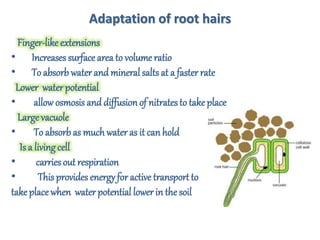
Adaptation of root hairs
Finger-like extensions
• Increases surface area to volume ratio
• To absorb waterand mineral salts at a faster rate
Lower water potential
• allow osmosis and diffusionof nitratesto take place
Large vacuole
• To absorb as much water as it canhold
Is a living cell
• carries out respiration
• This provides energyfor active transport to
take place when water potential lower in the soil
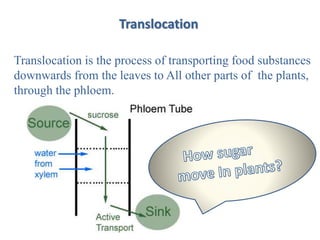
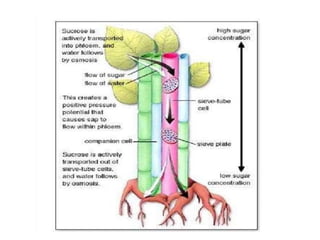
Translocation
Translocation is the process of transporting food substances
downwards from the leaves to All other parts of the plants,
through the phloem.
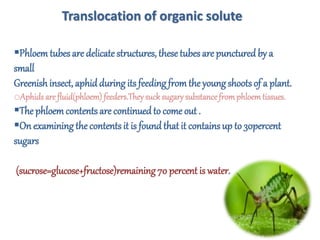
Translocation of organic solute
Phloemtubes are delicate structures, thesetubes are punctured by a
small
Greenish insect, aphidduring its feeding fromthe young shoots of a plant.
oAphids are fluid(phloem) feeders.Theysuck sugary substance fromphloem tissues.
The phloemcontents are continuedto come out .
On examining the contents it is found that it contains up to 30percent
sugars
(sucrose=glucose+fructose)remaining 70 percent is water.
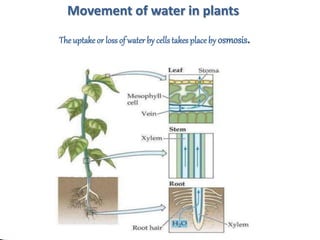
Movement of water in plants
The uptake or loss of water by cellstakes place by osmosis.
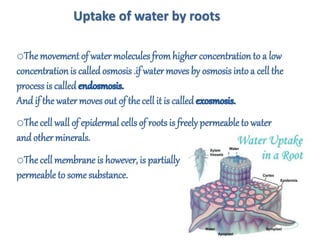
oThe movement of watermolecules fromhigher concentration to a low
concentrationis calledosmosis .if water moves by osmosis intoa cell the
processis called
And if the watermoves out of the cell it is called
Uptake of water by roots
oThe cell wall of epidermal cells of roots is freely permeable to water
and other minerals.
oThe cell membrane is however, is partially
permeable to some substance.
oThe waterwhichenters the epidermal cellsmoves along the concentration
gradient and passes throughcortex,endodermis,pericycle and ultimately to
xylemcells.
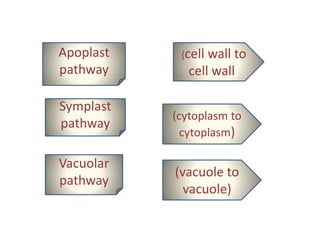
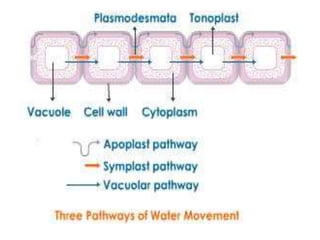
There are three pathways taken by
water to reach the xylem tissues:
Apoplast
pathway
(cell wall to
cell wall)
Symplast
pathway
(cytoplasm to
cytoplasm)
Vacuolar
pathway
(vacuole to
vacuole)
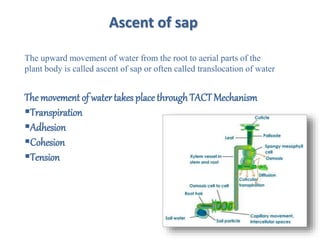
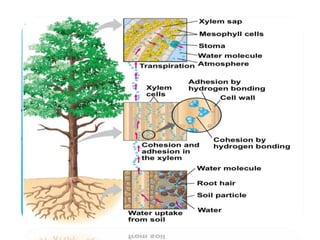
The movement of watertakes placethrough TACT Mechanism
Transpiration
Adhesion
Cohesion
Tension
Ascent of sap
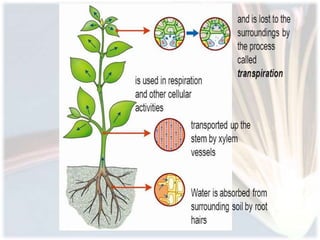
The upward movement of water from the root to aerial parts of the
plant body is called ascent of sap or often called translocation of water
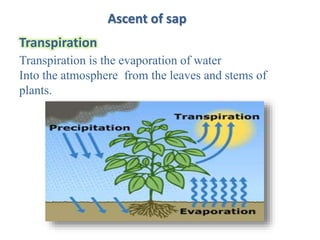
Transpiration
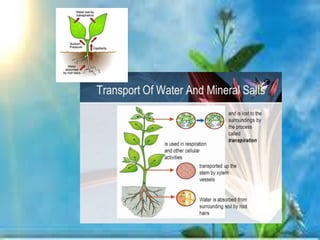
Transpiration is the evaporation of water
Into the atmosphere from the leaves and stems of
plants.
Ascent of sap
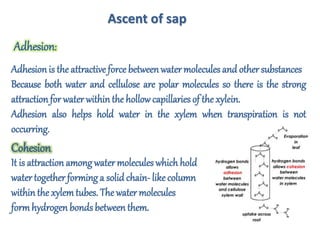
Adhesionis the attractive force betweenwater molecules and other substances
Because both water and cellulose are polar molecules so there is the strong
attractionfor waterwithinthe hollowcapillaries of the xylein.
Adhesion also helps hold water in the xylem when transpiration is not
occurring.
Adhesion:
Ascent of sap
It is attractionamong water molecules which hold
watertogether forming a solid chain- likecolumn
withinthe xylemtubes. The water molecules
formhydrogen bondsbetweenthem.
Cohesion
Tension
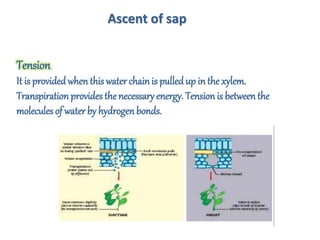
It is providedwhenthis waterchainis pulled up in the xylem.
Transpiration provides the necessary energy. Tensionis between the
molecules of water by hydrogenbonds.
Ascent of sap
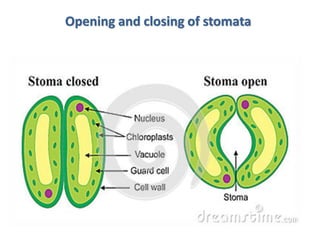
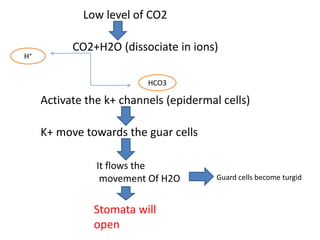
Opening and closing of stomata
Low level of CO2
CO2+H2O (dissociate in ions)
H⁺
HCO3
Activate the k+ channels (epidermal cells)
K+ move towards the guar cells
It flows the
movement Of H2O
Stomata will
open
Guard cells become turgid
ANY
Question ???
Thank You

Transportation In Plants

  • 2.
  • 3.
  • 4.
    Reason for transportsystem •Unicellular organisms They can transport materials likeoxygenand urea in and out of their bodies. •Multicellular organisms: Most of the cellsinsidethe organisms are too far from the surface of their bodies and diffusionand osmosis are too slow to be reliedon. A transportation systemis required for food and oxygen to be brought efficientlyfromone placeto another. Diffusionand osmosis would take place betweenthe transportsystemand the cell.
  • 5.
    Transport system inplants There are two transport systemin plants. One that transports waterand minerals fromroot to all other parts . Thesevessels are called xylemvessels. Another vessels transport sugars (sucrose) and amino acids made in leaves to all the Other parts of plant. These are called phloemvessels.
  • 7.
    •Xylemconsist of mainlyxylem vessels that are made up of deadcells. •Xylemcells are elongatedcells. •Inner walls of xylemvessels are strengthened are lignin. •Lignindeposited in theform of rings or spirals. Xylem vessels
  • 9.
    Adaptations of xylem vessels Absencecross walls maintains a continuous lumen. Protoplasmdisintegrate allows waterto move efficiently. Dead empty tube maintains a continuous lumen. Lignified walls walls are rigid xylemwill not collapse supports the plant
  • 10.
    •Consists of mansieve tubes and companion cells . •Sievetubes consist of columns of sieve tube cells that are elongatedand thin wall. •Companioncellsprovide thenutrients and help the sieve tube cells transport . •Manufacturedfood (sucrose) Phloem cells
  • 12.
    Adaptation of Phloemcells Bi-directional sucrose flow Food can be transported to all parts of the plant. Crosswalls perforatedby sieve tubes Single row of thinelongatedwalls with minute pores Living cellsto conduct thefood in the tube Companion cell present Consists of protoplasmand mitochondria Assists sieve tubes in transport of food Provides energy requiredfor active transport Whendead, sieve elements will die off
  • 13.
    Xylem Conduct water andmineral salts from roots to stem and leaves Provide mechanical support for plant. Phloem Conduct manufactured food(surose and amino acids)from the leaves to the other parts Of plants. Functions of xylem and phloem
  • 14.
    Root hair cells Thinhairlike outgrowth of an epidermal cell just behind the tip; absorbs nutrients from the soil.Hair like structures found on the epidermis cells of the root that allow a much larger surface area for water to be absorbed and used by the plant Plants absorb waterand minerals fromthe soil through the root hairs. Root hair cellsabsorb water and nitrates from the soil efficiently. They help to hold the plant more firmly to the ground.
  • 15.
    Adaptation of roothairs Finger-like extensions • Increases surface area to volume ratio • To absorb waterand mineral salts at a faster rate Lower water potential • allow osmosis and diffusionof nitratesto take place Large vacuole • To absorb as much water as it canhold Is a living cell • carries out respiration • This provides energyfor active transport to take place when water potential lower in the soil
  • 16.
    Translocation Translocation is theprocess of transporting food substances downwards from the leaves to All other parts of the plants, through the phloem.
  • 17.
    Translocation of organicsolute Phloemtubes are delicate structures, thesetubes are punctured by a small Greenish insect, aphidduring its feeding fromthe young shoots of a plant. oAphids are fluid(phloem) feeders.Theysuck sugary substance fromphloem tissues. The phloemcontents are continuedto come out . On examining the contents it is found that it contains up to 30percent sugars (sucrose=glucose+fructose)remaining 70 percent is water.
  • 19.
    Movement of waterin plants The uptake or loss of water by cellstakes place by osmosis.
  • 20.
    oThe movement ofwatermolecules fromhigher concentration to a low concentrationis calledosmosis .if water moves by osmosis intoa cell the processis called And if the watermoves out of the cell it is called Uptake of water by roots oThe cell wall of epidermal cells of roots is freely permeable to water and other minerals. oThe cell membrane is however, is partially permeable to some substance.
  • 21.
    oThe waterwhichenters theepidermal cellsmoves along the concentration gradient and passes throughcortex,endodermis,pericycle and ultimately to xylemcells. There are three pathways taken by water to reach the xylem tissues:
  • 22.
    Apoplast pathway (cell wall to cellwall) Symplast pathway (cytoplasm to cytoplasm) Vacuolar pathway (vacuole to vacuole)
  • 24.
    The movement ofwatertakes placethrough TACT Mechanism Transpiration Adhesion Cohesion Tension Ascent of sap The upward movement of water from the root to aerial parts of the plant body is called ascent of sap or often called translocation of water
  • 25.
    Transpiration Transpiration is theevaporation of water Into the atmosphere from the leaves and stems of plants. Ascent of sap
  • 27.
    Adhesionis the attractiveforce betweenwater molecules and other substances Because both water and cellulose are polar molecules so there is the strong attractionfor waterwithinthe hollowcapillaries of the xylein. Adhesion also helps hold water in the xylem when transpiration is not occurring. Adhesion: Ascent of sap It is attractionamong water molecules which hold watertogether forming a solid chain- likecolumn withinthe xylemtubes. The water molecules formhydrogen bondsbetweenthem. Cohesion
  • 28.
    Tension It is providedwhenthiswaterchainis pulled up in the xylem. Transpiration provides the necessary energy. Tensionis between the molecules of water by hydrogenbonds. Ascent of sap
  • 30.
  • 31.
    Low level ofCO2 CO2+H2O (dissociate in ions) H⁺ HCO3 Activate the k+ channels (epidermal cells) K+ move towards the guar cells It flows the movement Of H2O Stomata will open Guard cells become turgid
  • 33.
  • 34.