Endocrine System Introduction Chapter 17
Endocrine System Characteristics Produce hormones In minute amounts secreted into interstitial spaces Enters circulatory system Acts on target tissues at another site Regulate activities of body structures Amplitude modulated signals Frequency-modulated signals Response slower and longer duration than nervous system
Chemical Signals Intercellular: Allow one cell to communicate with other cells as hormones Autocrine Released by cells and have a local effect on same cell type from which chemical signals released as prostaglandin Paracrine Released by cells and affect other cell types locally without being transported in blood as somatostatin Pheromones Secreted into environment that modify behavior and physiology as sex pheromones
Chemical Structure of Hormones Proteins Glycoproteins Polypeptides Amino Acid derivatives Lipids Steroids Fatty acid derivatives
Control of Secretion Rate Most hormones are not secreted at constant rate Patterns of regulation Involves action of substance other than hormone on an endocrine gland Involves neural control of endocrine gland Involves control of secretory activity of one endocrine gland by hormone or neurohormone secreted by another endocrine gland Typically, but not always, negative feedback
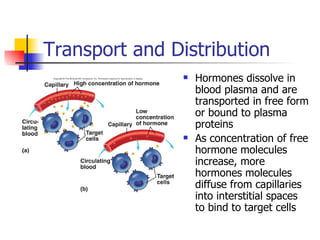
Transport and Distribution Hormones dissolve in blood plasma and are transported in free form or bound to plasma proteins As concentration of free hormone molecules increase, more hormones molecules diffuse from capillaries into interstitial spaces to bind to target cells
Transport and Distribution A large decrease in plasma protein concentration can result in loss of a hormone from the blood because free hormones are rapidly eliminated from circulation through kidney or liver Hormones are distributed quickly because they circulate in the blood
Metabolism Half-life: The length of time it takes for half a dose of substance to be eliminated from circulatory system Long half-life Regulate activities that remain at a constant rate through time Short half-life Water-soluble hormones as proteins, epinephrine, norepinephrine These hormones have a rapid onset and short duration
Excretion Hormones also eliminated by blood by excretion by Kidneys and liver Enzymatic degradation Conjugation Active transport
Hormone Interaction with  Target Tissues Hormones Ligands or chemical signals Binding site Receptor site Specificity
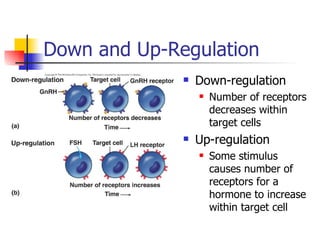
Down and Up-Regulation Down-regulation Number of receptors decreases within target cells Up-regulation Some stimulus causes number of receptors for a hormone to increase within target cell
Interactions with Target Tissues Extracellular receptors Ligand channels G-protein pathways Cellular mediators Intracellular receptor Cytoplasm Nuclear receptors

Endocrine system parta

  • 1.
  • 2.
    Endocrine System CharacteristicsProduce hormones In minute amounts secreted into interstitial spaces Enters circulatory system Acts on target tissues at another site Regulate activities of body structures Amplitude modulated signals Frequency-modulated signals Response slower and longer duration than nervous system
  • 3.
    Chemical Signals Intercellular:Allow one cell to communicate with other cells as hormones Autocrine Released by cells and have a local effect on same cell type from which chemical signals released as prostaglandin Paracrine Released by cells and affect other cell types locally without being transported in blood as somatostatin Pheromones Secreted into environment that modify behavior and physiology as sex pheromones
  • 4.
    Chemical Structure ofHormones Proteins Glycoproteins Polypeptides Amino Acid derivatives Lipids Steroids Fatty acid derivatives
  • 5.
    Control of SecretionRate Most hormones are not secreted at constant rate Patterns of regulation Involves action of substance other than hormone on an endocrine gland Involves neural control of endocrine gland Involves control of secretory activity of one endocrine gland by hormone or neurohormone secreted by another endocrine gland Typically, but not always, negative feedback
  • 6.
    Transport and DistributionHormones dissolve in blood plasma and are transported in free form or bound to plasma proteins As concentration of free hormone molecules increase, more hormones molecules diffuse from capillaries into interstitial spaces to bind to target cells
  • 7.
    Transport and DistributionA large decrease in plasma protein concentration can result in loss of a hormone from the blood because free hormones are rapidly eliminated from circulation through kidney or liver Hormones are distributed quickly because they circulate in the blood
  • 8.
    Metabolism Half-life: Thelength of time it takes for half a dose of substance to be eliminated from circulatory system Long half-life Regulate activities that remain at a constant rate through time Short half-life Water-soluble hormones as proteins, epinephrine, norepinephrine These hormones have a rapid onset and short duration
  • 9.
    Excretion Hormones alsoeliminated by blood by excretion by Kidneys and liver Enzymatic degradation Conjugation Active transport
  • 10.
    Hormone Interaction with Target Tissues Hormones Ligands or chemical signals Binding site Receptor site Specificity
  • 11.
    Down and Up-RegulationDown-regulation Number of receptors decreases within target cells Up-regulation Some stimulus causes number of receptors for a hormone to increase within target cell
  • 12.
    Interactions with TargetTissues Extracellular receptors Ligand channels G-protein pathways Cellular mediators Intracellular receptor Cytoplasm Nuclear receptors