ENDOCRINE SYSTEM
DR.NILESH KATE.
M.D.
ASSOCIATE PROFESSOR,
DEPARTMENT OF PHYSIOLOGY,
ESIC MEDICAL COLLEGE& HOSPITAL,
GULBARGA.
OBJECTIVES
Hormone : definition, classification.
Hormones general consideration.
Hormone receptors & mechanism of
action.
Measurement of hormones.
HOMEOSTASIS & CONTROLS
Successful
compensation
Homeostasis
reestablished
Failure to compensate
Pathophysiology
○ Illness
○ Death
Figure 1-5: Homeostasis
COMPARISON OF ENDOCRINE AND
NERVOUS SYSTEMS.
NERVOUS SYSTEM
“WIRED”
CHEMICAL SIGNAL AT
TARGET CELL
RAPID
BRIEF DURATION
CLOSE ANATOMICAL
PROXIMITY
ENDOCRINE SYSTEM
“WIRELESS”
CHEMICAL SIGNAL IN
BLOOD.
SLOW
LONG DURATION
SPECIFIC RECEPTORS
ENDOCRINE SYSTEM
 Hormaein-- Greek word means “to execute
or to arouse”.
Def:- Secretary product of ductless glands
which are released in catalytic amounts into
blood stream & transported to specific target
cells where they elicit physiologic,
morphologic & biochemical responses.
LOCATION OF DIFFERENT
ENDOCRINE GLANDS.
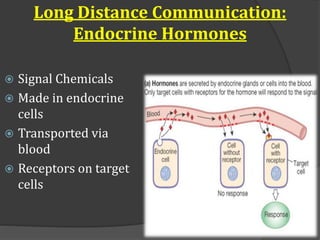
Long Distance Communication:
Endocrine Hormones
Signal Chemicals
Made in endocrine
cells
Transported via
blood
Receptors on target
cells
Figure 6-2a: Long distance cell-to-cell communication
TYPES OF HORMONES
Functional
ENDOCRINE HORMONES – Travel through the
blood to act at a site distant from the secreting cell
or gland
PARACRINE HORMONES – Act on cells near the
secreting cell
AUTOCRINE HORMONES – Act on the secreting
cell
NEUROCRINE HORMONES – Secreted by neural
cells
○ neurotransmitters
○ neurohormones
Figure 6-2b, c: Long distance cell-to-cell communication
Paracrine and Autocrine
Hormones
Local communication
Signal chemicals
diffuse to target
Example: Cytokines
Autocrine–receptor on
same cell
Paracrine–neighboring
cells
Figure 6-1c: Direct and local cell-to-cell communication
CHEMICAL CLASSIFICATION OF
HORMONES
Depending upon chemical nature
Amines or amino acid derivatives:
Proteins & Polypeptides:
Steroid hormones
Depending upon mechanism of action.
Group I hormones.
Group II hormones. : A,B,C,D.
HORMONE : GENERAL
CONSIDERATION.
Hormones chemistry, synthesis, storage &
release.
1 Amines / amino acid derivatives
2 Protein & polypeptide hormones.
3 Steroid hormones.
HORMONE TRANSPOT, PLASMA CONC,
HALF LIFE.
Hormone transport.
Unbound.
Bound .
Plasma concentrations.
Peptide hormone 10 -12 mol/ L to 10-14 mol/L
Epi / Nor Epi = 2× 10⁻¹⁰ to 13 × 10 -10
Steroid & thyroid 10-9 mol/ L & 10-6 mol/ L.
Half life.
Peptide hormone – short
Steroid, & thyroid – long.
FUNCTIONS OF HORMONES.
Regulation of biochemical reactions
Regulation of bodily process.
HORMONE DISPOSAL.
Target cell uptake & intracellular degradation.
Metabolic degradation / inactivation.
Urinary / biliary secretions.
Metabolic clearance rate (MCR):-
volume of plasma cleared per unit time.
REGULATION OF HORMONE
SECRETION.
Feedback control
Neural control.
Chronotropic control
FEEDBACK SYSTEM.
Figure 6-26: Negative and positive feedback
Figure 7-14: Negative
feedback loops in the
hypothalamicanterior
pituitary pathway
NEGATIVE FEEDBACK REFLEXES : LONG , SHORT &
ULTRASHORT LOOP.
HORMONES RECEPTORS.
Characteristics
Specificity .
Location .
○Internal
○External .
Regulation of number.
○Down regulation
○Up regulation .
STRUCTURE OF RECEPTORS.
Recognition domain.
Coupling domain.
CLASSIFICATION OF RECEPTORS.
Receptor kinase
Receptor linked kinase.
G-protein coupled receptors.
Ligand gated ion channels.
MECHANISM OF ACTION OF
HORMONES.
Through change in membrane
permeability.
Through effect on gene expression.
Through second messengers.
Through tyrosine kinase activation.
THROUGH CHANGE IN MEMBRANE
PERMEABILITY.
Hormones bind with external receptors.
Conformational change in protein of
receptors.
Opening of Na, K, Ca channel.
Movement of ions.
THROUGH EFFECT ON GENE
EXPRESSION.
Figure 7-7: Steroid hormone action
THROUGH SECOND
MESSENGERS SYSTEM.
Adenyl cyclase- cAMP system.
Guanyl cyclase –cGMP system.
Membrane phosplipase- phoapholipid
system.
Calcium- calmodulin system.
ADENYLATE CYCLASE-CAMP (Sutherland
1961)
PHOSPHOLIPASE-C-CA2+ (CONTINUED)
CA2+- calmodulin system (CONTINUED)
THROUGH TYROSINE KINASE ACTIVATION.
MEASUREMENT OF
HORMONES.
BIOASSAY.
Injecting unknown sample of
plasma in experimental
animals & observing specific
biological effect.
IMMUNOASSAY.(AG-AB
REACTION)
RADIOIMMUNOASSAY
○ Mix
Unknown sample of plasma
containing hormone + purified
specific antibody + purified
hormone tagged with
radioactive isotopes.
ELISA
○ Instead of specific antibody,
stained with suitable dye. &
intensity of colour measured by
spectrophotometer.
MEASUREMENT OF HORMONES.
CYTOCHEMICAL ASSAY.
Endocrine gland cut in
slices
Incubate in ascorbate
enriched culture
medium
Genesis of hormone
detected.
DYNAMIC TESTS.
Suppression type.
Stimulation type.
ENDOCRINE REFLEX PATHWAYS:
OVERVIEW
Figure 7-9: Hormones may have multiple stimuli for their release
PATHOLOGIES: OVER OR UNDER
PRODUCTION
Figure 7-19: Negative feedback by exogenous cortisol
PATHOLOGIES: DUE TO RECEPTORS
Figure 7-20: Primary and secondary hypersecretion of cortisol
Thank you

Endocrine system basic