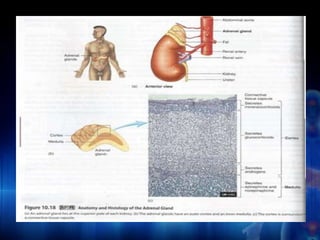
• Are two small glands located superior to each 
kidney. 
• Each adrenal gland has an inner part, called 
adrenal medulla, and outer part, called 
adrenal cortex.
Adrenal Medulla 
• Epinephrine or adrenaline is the principal 
hormone released from the adrenal medulla 
and small amounts of norepinephrine. 
• These are released in response to stimulation 
by the sympathetic nervous system. 
• Epinephrine and norepinephrine are referred 
to as fight-or-flight hormones.
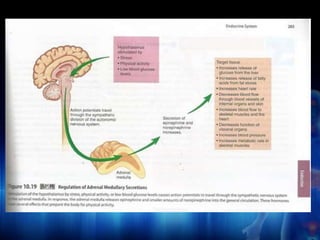
Major effects of hormones from adrenal 
medulla: 
• Increase the breakdown of glycogen to 
glucose in the liver, release of glucose into the 
blood and release of fatty acids from fat cells. 
These serves as energy sources to maintain 
the body’s increased rate of metabolism. 
• Increased heart rate, which causes blood 
pressure to rise.
Major effects of hormones from adrenal medulla: 
• Stimulation of smooth muscle in the wall off 
arteries supplying the internal organ and the skin. 
Blood flow to internal organs and the skin 
decreases, blood flow through skeletal muscles 
increases. 
• Increased blood pressure due to smooth muscle 
contraction in the walls of blood vessels in the 
internal organs and the skin. 
• Increased metabolic rate of several tissues. 
Specially in skeletal muscle, cardiac muscle, and 
nervous tissue.
In general: 
• Responses to hormones fro the adrenal 
medulla reinforce the effect of the 
sympathetic division of the autonomic 
nervous system. 
• It prepares the body for physical activity and 
to produce fight-or-flight response and other 
responses to stress.
Adrenal Cortex 
• Secretes 3 classes of steroid hormones: 
– Mineralocorticoids 
– Glucocorticoids 
– Androgens
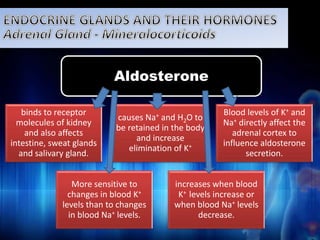
• Secreted by the outer layer of adrenal cortex 
• Helps regulate blood volume and blood levels 
of K+ and Na+
binds to receptor 
molecules of kidney 
and also affects 
intestine, sweat glands 
and salivary gland. 
Aldosterone 
causes Na+ and H2O to 
be retained in the body 
and increase 
elimination of K+ 
Blood levels of K+ and 
Na+ directly affect the 
adrenal cortex to 
influence aldosterone 
secretion. 
More sensitive to 
changes in blood K+ 
levels than to changes 
in blood Na+ levels. 
increases when blood 
K+ levels increase or 
when blood Na+ levels 
decrease.
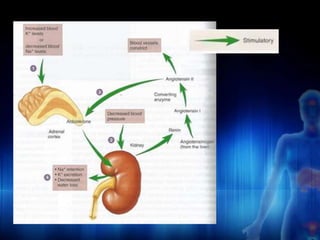
• Changes in blood pressure indirectly affect the 
rate of aldosterone secretion. 
• Low blood pressure causes the release of a 
protein molecule called renin from the kidney, 
which acts as an enzyme. 
• Renin causes a blood protein called 
angiotensinogen to be converted to 
angiotensin I.
• Angiotensin –converting enzyme causes 
angiotensinogen I to be converted to 
angiotensin II. 
• Angiotensin II causes the smooth muscle in 
blood vessels to constrict and it also increases 
aldosterone secretion. 
• Increases in blood volume causes by 
aldosterone and blood vessel constriction help 
raise blood pressure.
• Secreted by the middle layer of adrenal cortex. 
• It regulates blood nutrient levels.
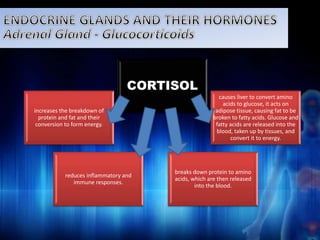
increases the breakdown of 
protein and fat and their 
conversion to form energy. 
causes liver to convert amino 
acids to glucose, it acts on 
adipose tissue, causing fat to be 
broken to fatty acids. Glucose and 
fatty acids are released into the 
blood, taken up by tissues, and 
convert it to energy. 
breaks down protein to amino 
acids, which are then released 
into the blood. 
reduces inflammatory and 
immune responses. 
CORTISOL
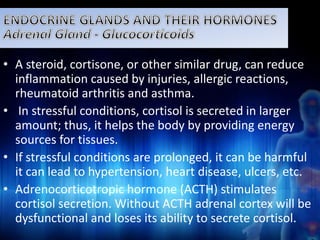
• A steroid, cortisone, or other similar drug, can reduce 
inflammation caused by injuries, allergic reactions, 
rheumatoid arthritis and asthma. 
• In stressful conditions, cortisol is secreted in larger 
amount; thus, it helps the body by providing energy 
sources for tissues. 
• If stressful conditions are prolonged, it can be harmful 
it can lead to hypertension, heart disease, ulcers, etc. 
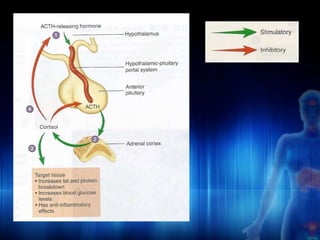
• Adrenocorticotropic hormone (ACTH) stimulates 
cortisol secretion. Without ACTH adrenal cortex will be 
dysfunctional and loses its ability to secrete cortisol.
Secreted by the inner 
layer of the adrenal 
cortex. 
Stimulates the 
development of male 
sexual characteristics. in 
adult males androgens are 
secreted by the testes. 
In adult females, 
androgens influence the 
female sex drive.
• If the secretion of sex hormones from the 
adrenal cortex is abnormally high, exaggerated 
male characteristics develop in both males 
and females. 
• This condition is most apparent in females and 
in males before puberty
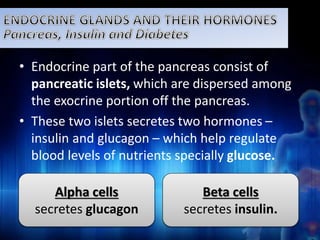
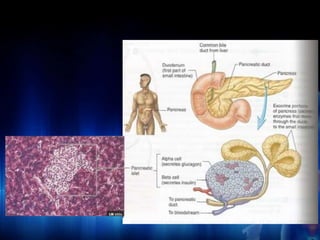
• Endocrine part of the pancreas consist of 
pancreatic islets, which are dispersed among 
the exocrine portion off the pancreas. 
• These two islets secretes two hormones – 
insulin and glucagon – which help regulate 
blood levels of nutrients specially glucose. 
Beta cells 
secretes insulin. 
Alpha cells 
secretes glucagon
• It is very important to maintain normal blood 
glucose levels. A below-normal blood glucose 
level causes the nervous system to 
malfunction because glucose is the main 
source of energy. Other tissues rapidly break 
down fats and proteins to provide an 
alternative energy source.
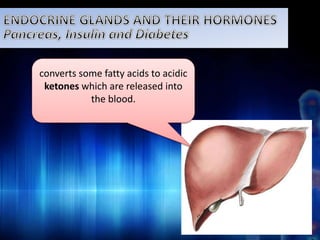
converts some fatty acids to acidic 
ketones which are released into 
the blood.
• The breakdown of fats can cause release of 
enough fatty acids and ketones that reduce 
the pH of the body fluids below a normal 
range, a condition called acidosis. 
• The amino acids of proteins are broken down 
and used by the liver to synthesize glucose.
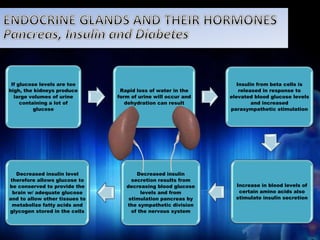
If glucose levels are too 
high, the kidneys produce 
large volumes of urine 
containing a lot of 
glucose 
Rapid loss of water in the 
form of urine will occur and 
dehydration can result 
Insulin from beta cells is 
released in response to 
elevated blood glucose levels 
and increased 
parasympathetic stimulation 
Increase in blood levels of 
certain amino acids also 
stimulate insulin secretion 
Decreased insulin 
secretion results from 
decreasing blood glucose 
levels and from 
stimulation pancreas by 
the sympathetic division 
of the nervous system 
Decreased insulin level 
therefore allows glucose to 
be conserved to provide the 
brain w/ adequate glucose 
and to allow other tissues to 
metabolize fatty acids and 
glycogen stored in the cells
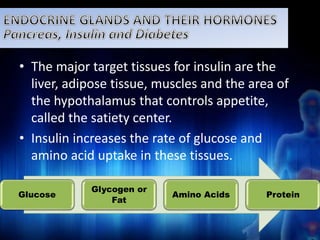
• The major target tissues for insulin are the 
liver, adipose tissue, muscles and the area of 
the hypothalamus that controls appetite, 
called the satiety center. 
• Insulin increases the rate of glucose and 
amino acid uptake in these tissues. 
Glucose 
Glycogen or 
Fat 
Amino Acids Protein
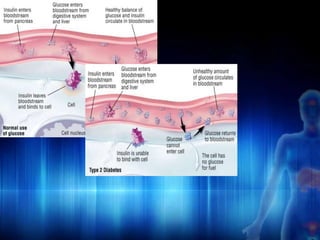
Diabetes mellitus – has many causes: 
• Type 1 diabetes mellitus occurs when too 
little insulin is secreted from pancreas. Tissues 
cannot take up glucose effectively causing 
blood sugar levels to become very high, a 
condition called hyperglycemia. 
• Type 2 diabetes mellitus is caused by 
insufficient numbers of insulin receptors on 
target cells or by defective receptors.
• Because glucose enter the cells of the satiety 
center of the brain, the satiety center 
responds as if there were too little blood 
glucose, causing an exaggerated appetite. 
• The excess glucose in the blood in excreted in 
the urine, making the urine volume much 
greater than normal. 
• Because of this the person has a tendency to 
become dehydrated and thirsty.
• Fats and proteins are broken down to provide an 
energy source for metabolism because levels of 
blood glucose is not in a normal range, thus 
causing malfunction in the nervous system. 
• When too much insulin is injected or when a 
person is injected with insulin who has not eaten 
after the injection, blood glucose levels become 
very low thus making the brain malfunction 
because it depends primarily on glucose for an 
energy source, this condition is called insulin 
shock.
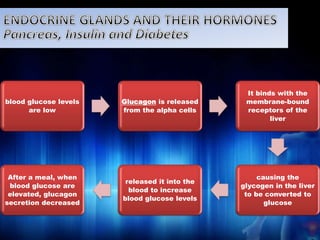
blood glucose levels 
are low 
Glucagon is released 
from the alpha cells 
It binds with the 
membrane-bound 
receptors of the 
liver 
causing the 
glycogen in the liver 
to be converted to 
glucose 
released it into the 
blood to increase 
blood glucose levels 
After a meal, when 
blood glucose are 
elevated, glucagon 
secretion decreased
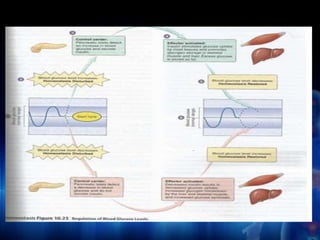
blood glucose 
levels 
Insulin 
secretion 
Glucagon 
secretion 
blood glucose 
levels 
Glucagon 
secretion 
Insulin 
secretion
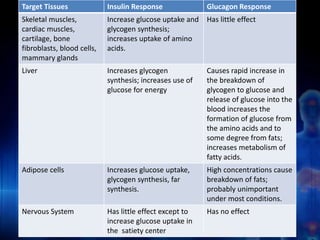
Target Tissues Insulin Response Glucagon Response 
Skeletal muscles, 
Increase glucose uptake and 
Has little effect 
cardiac muscles, 
glycogen synthesis; 
cartilage, bone 
increases uptake of amino 
fibroblasts, blood cells, 
acids. 
mammary glands 
Liver Increases glycogen 
synthesis; increases use of 
glucose for energy 
Causes rapid increase in 
the breakdown of 
glycogen to glucose and 
release of glucose into the 
blood increases the 
formation of glucose from 
the amino acids and to 
some degree from fats; 
increases metabolism of 
fatty acids. 
Adipose cells Increases glucose uptake, 
glycogen synthesis, far 
synthesis. 
High concentrations cause 
breakdown of fats; 
probably unimportant 
under most conditions. 
Nervous System Has little effect except to 
increase glucose uptake in 
the satiety center 
Has no effect
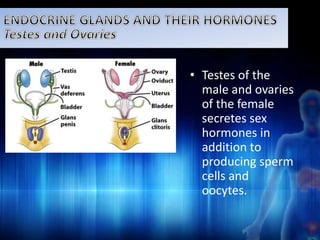
• Testes of the 
male and ovaries 
of the female 
secretes sex 
hormones in 
addition to 
producing sperm 
cells and 
oocytes.
Testosterone is the main sex 
hormone in the male which is 
secreted by the testes. It is 
responsible for the growth and 
development of the male 
reproductive structures, 
muscle enlargement, growth of 
body hair, voice changes, and 
the male sexual drive.
In the female, there are two sex 
hormones secreted by the ovary: 
estrogen and progesterone. 
Together these hormones contribute 
to the development of female sexual 
characteristic and female 
reproductive structures. Such as the 
enlargement of the breast and the 
distribution of fats which influences 
the shape of the hips, breasts, and 
thighs. Female menstrual cycle is also 
controlled by the sex hormones.
• Luteinizing Hormone (LH) and Follicle-stimulating 
Hormone (FHS) stimulate the 
secretion of hormones from the ovaries and 
testes. Hypothalamus controls the rate of LH 
and FHS, in turn, LH and FHS controls the 
secretion of hormones from the ovaries and 
testes.
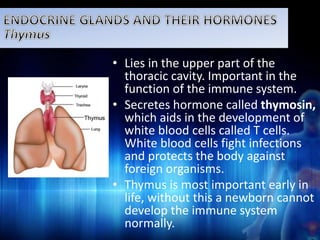
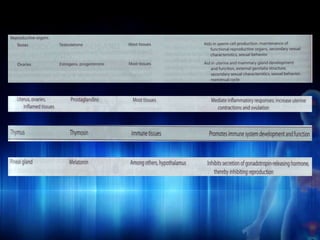
• Lies in the upper part of the 
thoracic cavity. Important in the 
function of the immune system. 
• Secretes hormone called thymosin, 
which aids in the development of 
white blood cells called T cells. 
White blood cells fight infections 
and protects the body against 
foreign organisms. 
• Thymus is most important early in 
life, without this a newborn cannot 
develop the immune system 
normally.
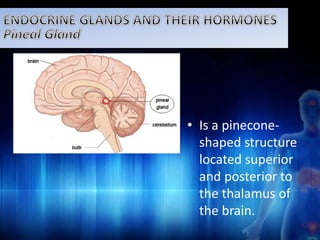
• Is a pinecone-shaped 
structure 
located superior 
and posterior to 
the thalamus of 
the brain.
• Produces a hormone called melatonin. 
• This decreases the release of hypothalamic-releasing 
hormones and secretion of LH and 
FHS thus melatonin inhibits the functions of 
reproductive system.
• Animal studies show that the amount of 
available light controls the rate of melatonin 
secretion. In short, less light increases 
melatonin secretion and more light decreases 
melatonin secretion. 
• Some evidence suggest that melatonin plays 
an important role in the onset of puberty in 
humans.
Endocrine system 3
Endocrine system 3
Endocrine system 3

Endocrine system 3

  • 1.
    • Are twosmall glands located superior to each kidney. • Each adrenal gland has an inner part, called adrenal medulla, and outer part, called adrenal cortex.
  • 3.
    Adrenal Medulla •Epinephrine or adrenaline is the principal hormone released from the adrenal medulla and small amounts of norepinephrine. • These are released in response to stimulation by the sympathetic nervous system. • Epinephrine and norepinephrine are referred to as fight-or-flight hormones.
  • 4.
    Major effects ofhormones from adrenal medulla: • Increase the breakdown of glycogen to glucose in the liver, release of glucose into the blood and release of fatty acids from fat cells. These serves as energy sources to maintain the body’s increased rate of metabolism. • Increased heart rate, which causes blood pressure to rise.
  • 5.
    Major effects ofhormones from adrenal medulla: • Stimulation of smooth muscle in the wall off arteries supplying the internal organ and the skin. Blood flow to internal organs and the skin decreases, blood flow through skeletal muscles increases. • Increased blood pressure due to smooth muscle contraction in the walls of blood vessels in the internal organs and the skin. • Increased metabolic rate of several tissues. Specially in skeletal muscle, cardiac muscle, and nervous tissue.
  • 6.
    In general: •Responses to hormones fro the adrenal medulla reinforce the effect of the sympathetic division of the autonomic nervous system. • It prepares the body for physical activity and to produce fight-or-flight response and other responses to stress.
  • 8.
    Adrenal Cortex •Secretes 3 classes of steroid hormones: – Mineralocorticoids – Glucocorticoids – Androgens
  • 9.
    • Secreted bythe outer layer of adrenal cortex • Helps regulate blood volume and blood levels of K+ and Na+
  • 10.
    binds to receptor molecules of kidney and also affects intestine, sweat glands and salivary gland. Aldosterone causes Na+ and H2O to be retained in the body and increase elimination of K+ Blood levels of K+ and Na+ directly affect the adrenal cortex to influence aldosterone secretion. More sensitive to changes in blood K+ levels than to changes in blood Na+ levels. increases when blood K+ levels increase or when blood Na+ levels decrease.
  • 11.
    • Changes inblood pressure indirectly affect the rate of aldosterone secretion. • Low blood pressure causes the release of a protein molecule called renin from the kidney, which acts as an enzyme. • Renin causes a blood protein called angiotensinogen to be converted to angiotensin I.
  • 12.
    • Angiotensin –convertingenzyme causes angiotensinogen I to be converted to angiotensin II. • Angiotensin II causes the smooth muscle in blood vessels to constrict and it also increases aldosterone secretion. • Increases in blood volume causes by aldosterone and blood vessel constriction help raise blood pressure.
  • 14.
    • Secreted bythe middle layer of adrenal cortex. • It regulates blood nutrient levels.
  • 15.
    increases the breakdownof protein and fat and their conversion to form energy. causes liver to convert amino acids to glucose, it acts on adipose tissue, causing fat to be broken to fatty acids. Glucose and fatty acids are released into the blood, taken up by tissues, and convert it to energy. breaks down protein to amino acids, which are then released into the blood. reduces inflammatory and immune responses. CORTISOL
  • 16.
    • A steroid,cortisone, or other similar drug, can reduce inflammation caused by injuries, allergic reactions, rheumatoid arthritis and asthma. • In stressful conditions, cortisol is secreted in larger amount; thus, it helps the body by providing energy sources for tissues. • If stressful conditions are prolonged, it can be harmful it can lead to hypertension, heart disease, ulcers, etc. • Adrenocorticotropic hormone (ACTH) stimulates cortisol secretion. Without ACTH adrenal cortex will be dysfunctional and loses its ability to secrete cortisol.
  • 18.
    Secreted by theinner layer of the adrenal cortex. Stimulates the development of male sexual characteristics. in adult males androgens are secreted by the testes. In adult females, androgens influence the female sex drive.
  • 19.
    • If thesecretion of sex hormones from the adrenal cortex is abnormally high, exaggerated male characteristics develop in both males and females. • This condition is most apparent in females and in males before puberty
  • 20.
    • Endocrine partof the pancreas consist of pancreatic islets, which are dispersed among the exocrine portion off the pancreas. • These two islets secretes two hormones – insulin and glucagon – which help regulate blood levels of nutrients specially glucose. Beta cells secretes insulin. Alpha cells secretes glucagon
  • 22.
    • It isvery important to maintain normal blood glucose levels. A below-normal blood glucose level causes the nervous system to malfunction because glucose is the main source of energy. Other tissues rapidly break down fats and proteins to provide an alternative energy source.
  • 23.
    converts some fattyacids to acidic ketones which are released into the blood.
  • 24.
    • The breakdownof fats can cause release of enough fatty acids and ketones that reduce the pH of the body fluids below a normal range, a condition called acidosis. • The amino acids of proteins are broken down and used by the liver to synthesize glucose.
  • 25.
    If glucose levelsare too high, the kidneys produce large volumes of urine containing a lot of glucose Rapid loss of water in the form of urine will occur and dehydration can result Insulin from beta cells is released in response to elevated blood glucose levels and increased parasympathetic stimulation Increase in blood levels of certain amino acids also stimulate insulin secretion Decreased insulin secretion results from decreasing blood glucose levels and from stimulation pancreas by the sympathetic division of the nervous system Decreased insulin level therefore allows glucose to be conserved to provide the brain w/ adequate glucose and to allow other tissues to metabolize fatty acids and glycogen stored in the cells
  • 26.
    • The majortarget tissues for insulin are the liver, adipose tissue, muscles and the area of the hypothalamus that controls appetite, called the satiety center. • Insulin increases the rate of glucose and amino acid uptake in these tissues. Glucose Glycogen or Fat Amino Acids Protein
  • 27.
    Diabetes mellitus –has many causes: • Type 1 diabetes mellitus occurs when too little insulin is secreted from pancreas. Tissues cannot take up glucose effectively causing blood sugar levels to become very high, a condition called hyperglycemia. • Type 2 diabetes mellitus is caused by insufficient numbers of insulin receptors on target cells or by defective receptors.
  • 29.
    • Because glucoseenter the cells of the satiety center of the brain, the satiety center responds as if there were too little blood glucose, causing an exaggerated appetite. • The excess glucose in the blood in excreted in the urine, making the urine volume much greater than normal. • Because of this the person has a tendency to become dehydrated and thirsty.
  • 30.
    • Fats andproteins are broken down to provide an energy source for metabolism because levels of blood glucose is not in a normal range, thus causing malfunction in the nervous system. • When too much insulin is injected or when a person is injected with insulin who has not eaten after the injection, blood glucose levels become very low thus making the brain malfunction because it depends primarily on glucose for an energy source, this condition is called insulin shock.
  • 31.
    blood glucose levels are low Glucagon is released from the alpha cells It binds with the membrane-bound receptors of the liver causing the glycogen in the liver to be converted to glucose released it into the blood to increase blood glucose levels After a meal, when blood glucose are elevated, glucagon secretion decreased
  • 32.
    blood glucose levels Insulin secretion Glucagon secretion blood glucose levels Glucagon secretion Insulin secretion
  • 33.
    Target Tissues InsulinResponse Glucagon Response Skeletal muscles, Increase glucose uptake and Has little effect cardiac muscles, glycogen synthesis; cartilage, bone increases uptake of amino fibroblasts, blood cells, acids. mammary glands Liver Increases glycogen synthesis; increases use of glucose for energy Causes rapid increase in the breakdown of glycogen to glucose and release of glucose into the blood increases the formation of glucose from the amino acids and to some degree from fats; increases metabolism of fatty acids. Adipose cells Increases glucose uptake, glycogen synthesis, far synthesis. High concentrations cause breakdown of fats; probably unimportant under most conditions. Nervous System Has little effect except to increase glucose uptake in the satiety center Has no effect
  • 35.
    • Testes ofthe male and ovaries of the female secretes sex hormones in addition to producing sperm cells and oocytes.
  • 36.
    Testosterone is themain sex hormone in the male which is secreted by the testes. It is responsible for the growth and development of the male reproductive structures, muscle enlargement, growth of body hair, voice changes, and the male sexual drive.
  • 37.
    In the female,there are two sex hormones secreted by the ovary: estrogen and progesterone. Together these hormones contribute to the development of female sexual characteristic and female reproductive structures. Such as the enlargement of the breast and the distribution of fats which influences the shape of the hips, breasts, and thighs. Female menstrual cycle is also controlled by the sex hormones.
  • 38.
    • Luteinizing Hormone(LH) and Follicle-stimulating Hormone (FHS) stimulate the secretion of hormones from the ovaries and testes. Hypothalamus controls the rate of LH and FHS, in turn, LH and FHS controls the secretion of hormones from the ovaries and testes.
  • 39.
    • Lies inthe upper part of the thoracic cavity. Important in the function of the immune system. • Secretes hormone called thymosin, which aids in the development of white blood cells called T cells. White blood cells fight infections and protects the body against foreign organisms. • Thymus is most important early in life, without this a newborn cannot develop the immune system normally.
  • 40.
    • Is apinecone-shaped structure located superior and posterior to the thalamus of the brain.
  • 41.
    • Produces ahormone called melatonin. • This decreases the release of hypothalamic-releasing hormones and secretion of LH and FHS thus melatonin inhibits the functions of reproductive system.
  • 42.
    • Animal studiesshow that the amount of available light controls the rate of melatonin secretion. In short, less light increases melatonin secretion and more light decreases melatonin secretion. • Some evidence suggest that melatonin plays an important role in the onset of puberty in humans.