ANATOMICAL POSITIONS
As mentioned before, we must come up with a common
language or vocabulary that is universally accepted (or a
language accepted world wide) so that we can all understand
the same principles when we describe things that relate to the
human body.
Just think- imagine a doctor coming from Europe and doing an
operation on someone in Canada with another doctor but they
both use different terms to describe the human body? It
wouldn’t work too well would it!

2
THE ANATOMICAL POSITION
ANATOMICAL POSITION: Anatomists and physiologists view the human body in
this standard starting point
DESCRIPTION:

-

#1. Standing in upright standing position

-

#2. Face and feet pointing forward

-

#3. Arms hanging at the sides with palms facing forward

WHY?:

•

Starting reference point for describing the human body

•

Universally accepted

•

Used in all anatomical descriptions

3
DIRECTIONAL TERMS

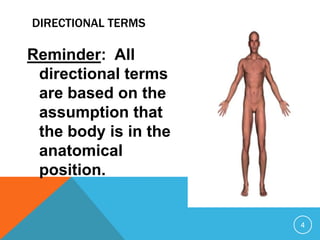
Reminder: All
directional terms
are based on the
assumption that
the body is in the
anatomical
position.

4
LATERAL AND MEDIAL
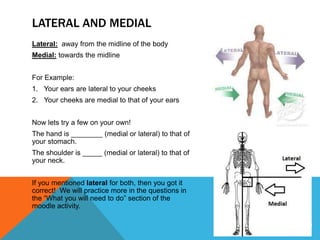
Lateral: away from the midline of the body
Medial: towards the midline
For Example:
1. Your ears are lateral to your cheeks
2. Your cheeks are medial to that of your ears
Now lets try a few on your own!
The hand is ________ (medial or lateral) to that of
your stomach.
The shoulder is _____ (medial or lateral) to that of
your neck.
If you mentioned lateral for both, then you got it
correct! We will practice more in the questions in
the “What you will need to do” section of the
moodle activity.

5
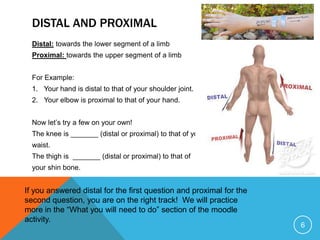
DISTAL AND PROXIMAL
Distal: towards the lower segment of a limb
Proximal: towards the upper segment of a limb
For Example:
1. Your hand is distal to that of your shoulder joint.
2. Your elbow is proximal to that of your hand.
Now let’s try a few on your own!
The knee is _______ (distal or proximal) to that of your
waist.
The thigh is _______ (distal or proximal) to that of
your shin bone.

If you answered distal for the first question and proximal for the
second question, you are on the right track! We will practice
more in the “What you will need to do” section of the moodle
activity.

6
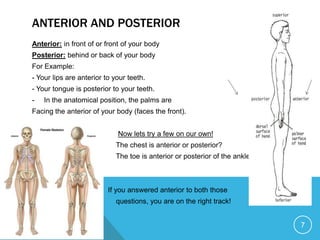
ANTERIOR AND POSTERIOR
Anterior: in front of or front of your body
Posterior: behind or back of your body
For Example:
- Your lips are anterior to your teeth.
- Your tongue is posterior to your teeth.
-

In the anatomical position, the palms are

Facing the anterior of your body (faces the front).
Now lets try a few on our own!
The chest is anterior or posterior?
The toe is anterior or posterior of the ankle?

If you answered anterior to both those
questions, you are on the right track!

7
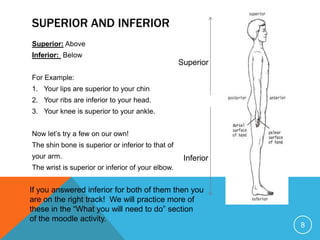
SUPERIOR AND INFERIOR
Superior: Above
Inferior: Below

Superior
For Example:
1. Your lips are superior to your chin
2. Your ribs are inferior to your head.
3. Your knee is superior to your ankle.
Now let’s try a few on our own!
The shin bone is superior or inferior to that of
your arm.

Inferior

The wrist is superior or inferior of your elbow.

If you answered inferior for both of them then you
are on the right track! We will practice more of
these in the “What you will need to do” section
of the moodle activity.

8
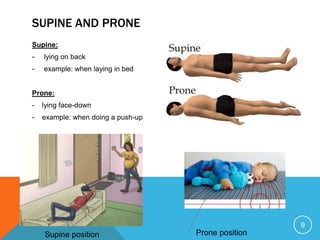
SUPINE AND PRONE
Supine:
-

lying on back

-

example: when laying in bed

Prone:
-

lying face-down

-

example: when doing a push-up

9

Supine position

Prone position
ANATOMICAL POSITIONS
So you have just reviewed the first set of anatomical positions! Here are the terms you have
just looked at and will get familiar with them as we will use them to describe human
positions.
1. The Anatomical Position- person standing erect with palms, feet, and head facing forward.
2. lateral- away from the midline of body
3. medial- towards midline of body
4. distal- to farther end of limb
5. proximal- closer end of limb
6. anterior- front of something or facing the front
7. posterior- behind something or facing the back
8. superior- above
9. inferior- below
10. supine- laying on back
11. prone- laying face-down (or usually on stomach)

Noticed how you learned all these terms but I grouped them based on opposites? For
example lateral and medial, distal and proximal, anterior and posterior etc. This will
help you understand and learn the terms. When you are not sure of one, try and think
of the opposite and then it may help you recall what the term or direction is. We will app
these terms in many cases so that you have practice and become familiar with it. 10

1 anatomical positions

  • 2.
    ANATOMICAL POSITIONS As mentionedbefore, we must come up with a common language or vocabulary that is universally accepted (or a language accepted world wide) so that we can all understand the same principles when we describe things that relate to the human body. Just think- imagine a doctor coming from Europe and doing an operation on someone in Canada with another doctor but they both use different terms to describe the human body? It wouldn’t work too well would it! 2
  • 3.
    THE ANATOMICAL POSITION ANATOMICALPOSITION: Anatomists and physiologists view the human body in this standard starting point DESCRIPTION: - #1. Standing in upright standing position - #2. Face and feet pointing forward - #3. Arms hanging at the sides with palms facing forward WHY?: • Starting reference point for describing the human body • Universally accepted • Used in all anatomical descriptions 3
  • 4.
    DIRECTIONAL TERMS Reminder: All directionalterms are based on the assumption that the body is in the anatomical position. 4
  • 5.
    LATERAL AND MEDIAL Lateral:away from the midline of the body Medial: towards the midline For Example: 1. Your ears are lateral to your cheeks 2. Your cheeks are medial to that of your ears Now lets try a few on your own! The hand is ________ (medial or lateral) to that of your stomach. The shoulder is _____ (medial or lateral) to that of your neck. If you mentioned lateral for both, then you got it correct! We will practice more in the questions in the “What you will need to do” section of the moodle activity. 5
  • 6.
    DISTAL AND PROXIMAL Distal:towards the lower segment of a limb Proximal: towards the upper segment of a limb For Example: 1. Your hand is distal to that of your shoulder joint. 2. Your elbow is proximal to that of your hand. Now let’s try a few on your own! The knee is _______ (distal or proximal) to that of your waist. The thigh is _______ (distal or proximal) to that of your shin bone. If you answered distal for the first question and proximal for the second question, you are on the right track! We will practice more in the “What you will need to do” section of the moodle activity. 6
  • 7.
    ANTERIOR AND POSTERIOR Anterior:in front of or front of your body Posterior: behind or back of your body For Example: - Your lips are anterior to your teeth. - Your tongue is posterior to your teeth. - In the anatomical position, the palms are Facing the anterior of your body (faces the front). Now lets try a few on our own! The chest is anterior or posterior? The toe is anterior or posterior of the ankle? If you answered anterior to both those questions, you are on the right track! 7
  • 8.
    SUPERIOR AND INFERIOR Superior:Above Inferior: Below Superior For Example: 1. Your lips are superior to your chin 2. Your ribs are inferior to your head. 3. Your knee is superior to your ankle. Now let’s try a few on our own! The shin bone is superior or inferior to that of your arm. Inferior The wrist is superior or inferior of your elbow. If you answered inferior for both of them then you are on the right track! We will practice more of these in the “What you will need to do” section of the moodle activity. 8
  • 9.
    SUPINE AND PRONE Supine: - lyingon back - example: when laying in bed Prone: - lying face-down - example: when doing a push-up 9 Supine position Prone position
  • 10.
    ANATOMICAL POSITIONS So youhave just reviewed the first set of anatomical positions! Here are the terms you have just looked at and will get familiar with them as we will use them to describe human positions. 1. The Anatomical Position- person standing erect with palms, feet, and head facing forward. 2. lateral- away from the midline of body 3. medial- towards midline of body 4. distal- to farther end of limb 5. proximal- closer end of limb 6. anterior- front of something or facing the front 7. posterior- behind something or facing the back 8. superior- above 9. inferior- below 10. supine- laying on back 11. prone- laying face-down (or usually on stomach) Noticed how you learned all these terms but I grouped them based on opposites? For example lateral and medial, distal and proximal, anterior and posterior etc. This will help you understand and learn the terms. When you are not sure of one, try and think of the opposite and then it may help you recall what the term or direction is. We will app these terms in many cases so that you have practice and become familiar with it. 10