Introduction
Human Anatomy
Human Body
It is composed
of:
• head.
• neck.
• trunk: thorax
& abdomen.
• extremities:
arms, hands,
legs and feet.
Anatomy Physiology
Histology Embryology
The study of human
body involves
Anatomy
Anatomy is the science of the
structure and function of the body.
Clinical anatomy is the study of the
macroscopic structure and function of
the body as it relates to the practice
of medicine and other health
sciences.
Basic anatomy is the study of the
minimal amount of anatomy
consistent with the understanding of
the overall structure and function of
the body.
Descriptive Anatomic Terms
It’s important to medical health
personal to have a knowledge and
understanding of the basic anatomic
terms. Without anatomic terms, one
cannot accurately discuss or record
the abnormal function of the joint,
the action of the muscles, the
alteration in the position of organs or
exact position of swelling or the
tumor.
Terms related to the position
All descriptions of the human body
are based the assumption that the
person is standing erect with upper
limbs by the sides, the face and palms
of the hands are directed forward.
This called Anatomic Position.
Anatomic
Position
person is standing
erect
upper limbs by the
sides
the face and palms
of the hands are
directed forward
Planes
The various parts of the body are described
in relation to certain imaginary planes:
• Median or Sagittal Plane: This is a
vertical plane passing through the center of
the body dividing it into equal right and left
halves.
• Coronal Planes: These planes are
imaginary vertical planes at right angle to
median plane. These planes are divides the
body into anterior and posterior portions.
• Horizontal or Transverse Planes: These
planes are at a right angle to both median
and coronal planes. These planes are
divides the body into superior and inferior
portions.
Median
(Sagittal)
Plane.
Coronal
Plane.
Horizontal
(Transverse)
Plane.
Anterior and Posterior
The term Anterior and Posterior are used
to indicate the front and back of the body.
Superior and Inferior
The terms Superior and Inferior denote
levels relatively high or low with reference
to the upper and lower ends of the body.
Medial and Lateral
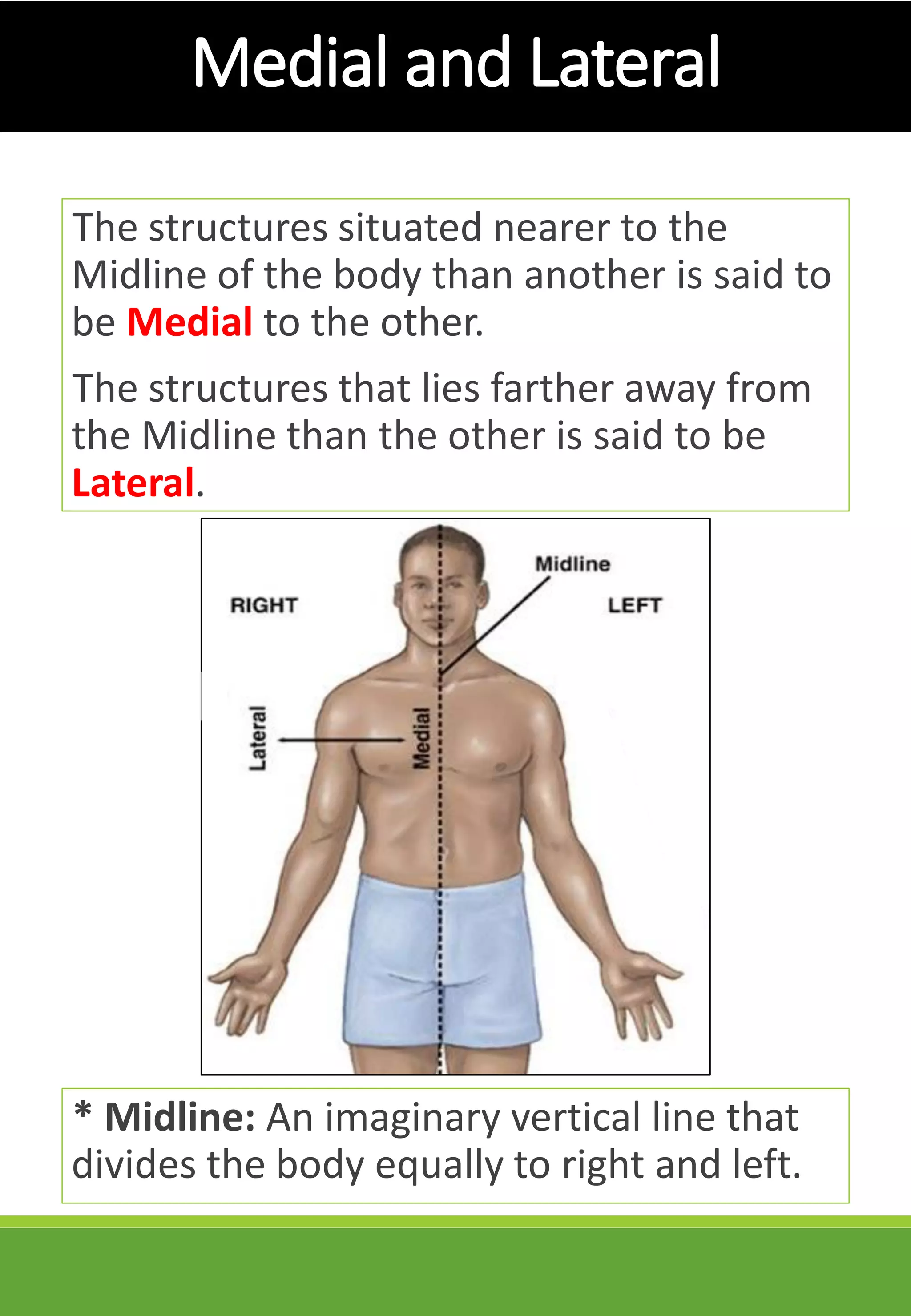
The structures situated nearer to the
Midline of the body than another is said to
be Medial to the other.
The structures that lies farther away from
the Midline than the other is said to be
Lateral.
* Midline: An imaginary vertical line that
divides the body equally to right and left.
In describing the hand, the terms palmer and
dorsal surfaces are used instead of anterior
and posterior, while in describing foot, the
terms planter and dorsal surfaces are used
rather than lower and upper surfaces.
In the hand
Palmer surface =
anterior surface
dorsal surface =
posterior surface
In the foot
planter surface =
lower surface
dorsal surface =
upper surface
Proximal and Distal
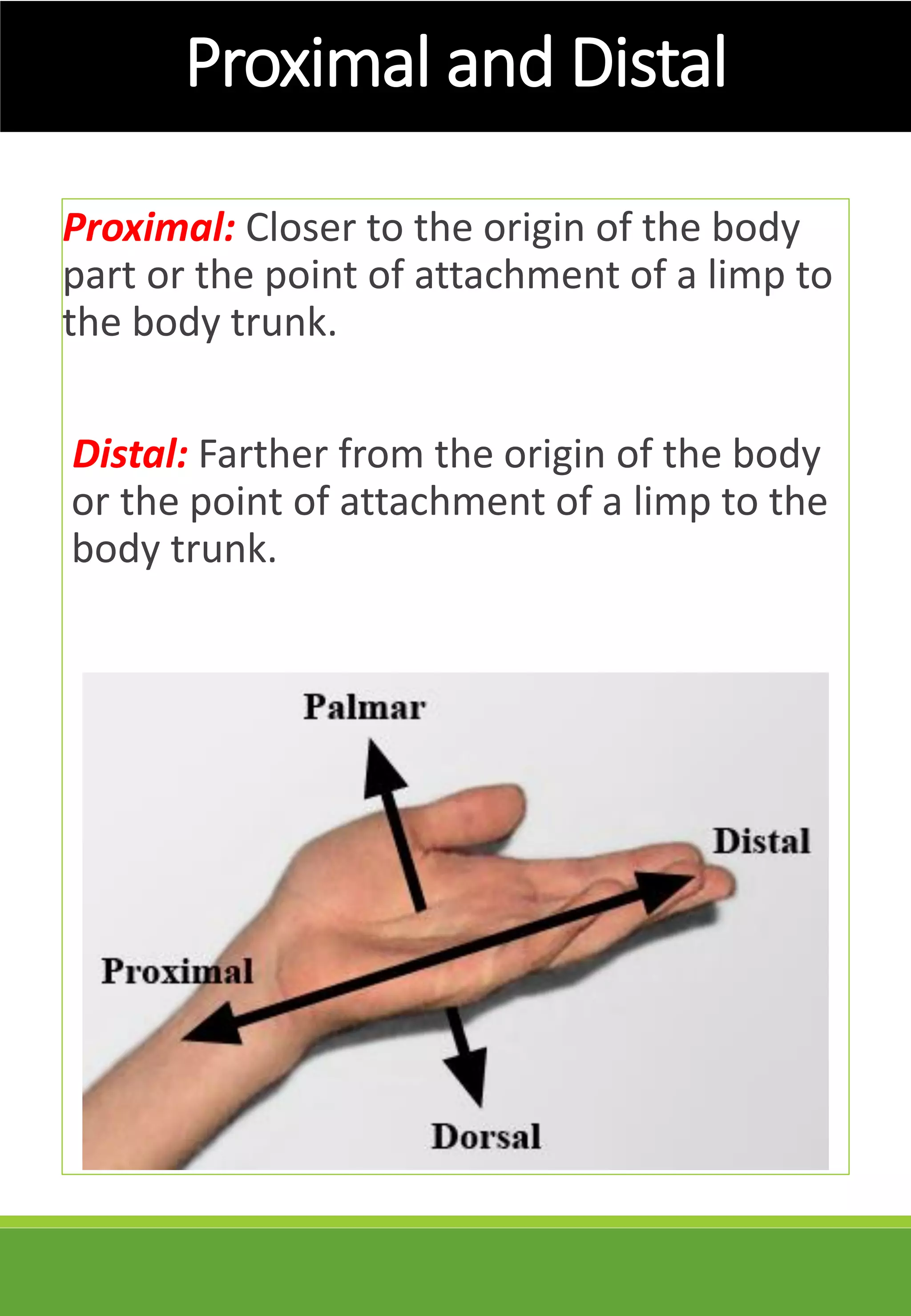
Proximal: Closer to the origin of the body
part or the point of attachment of a limp to
the body trunk.
Distal: Farther from the origin of the body
or the point of attachment of a limp to the
body trunk.
Proximal and Distal
Superficial and Deep
Superficial: Refer to a structure being
closer to the surface of the body than
another one.
Deep: Indicate to a structure closer to the
core of the body than another one.
Superficial and Deep
Internal and External
The terms Internal and External are used to
describe the relative distance of the
structure from the center of an organ or
cavity, for example, the internal carotid
artery is located inside the skull while the
external carotid artery is located outside
the cranial cavity.
Ipsilateral and Contralateral
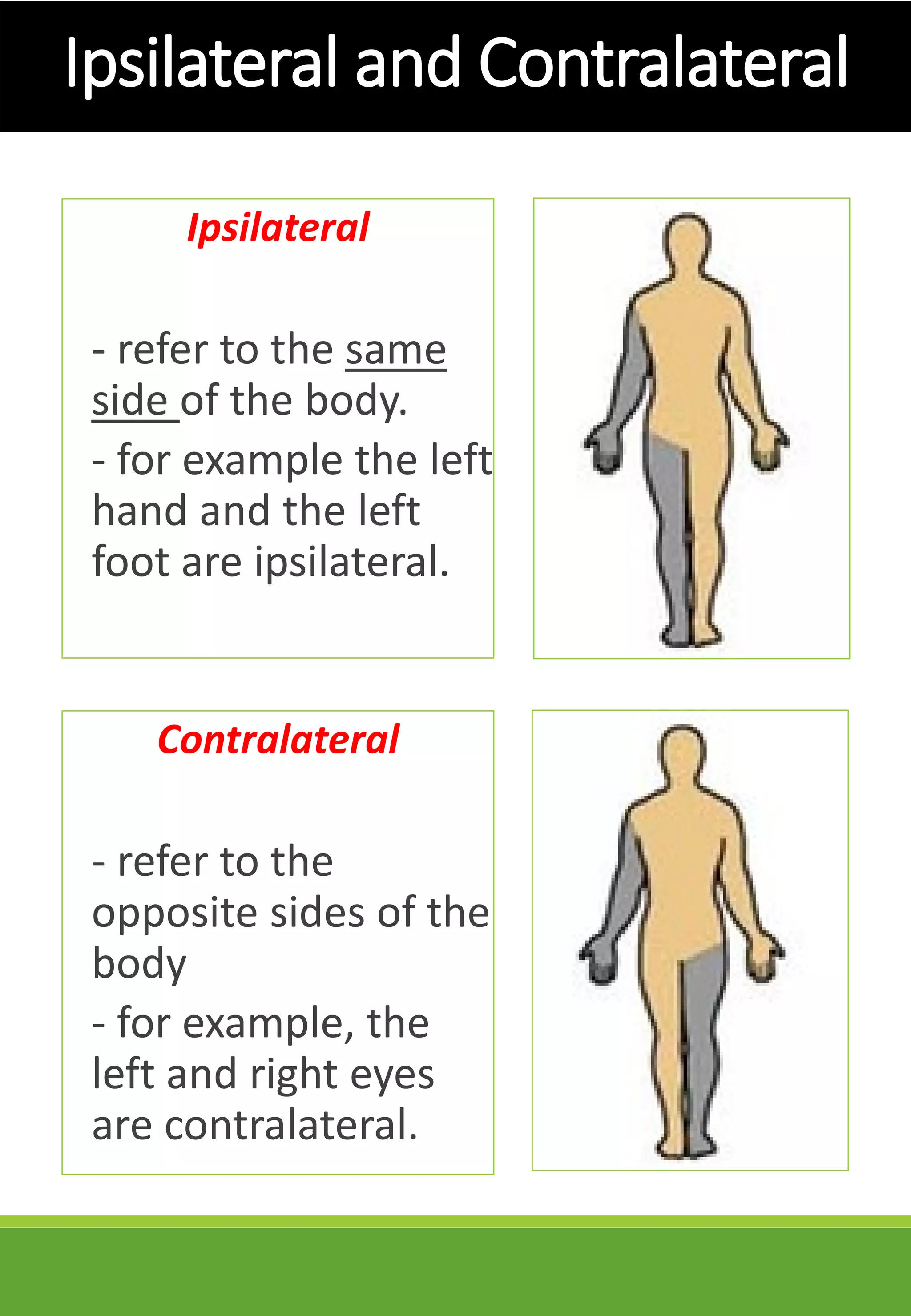
Ipsilateral
- refer to the same
side of the body.
- for example the left
hand and the left
foot are ipsilateral.
Contralateral
- refer to the
opposite sides of the
body
- for example, the
left and right eyes
are contralateral.
Supine and Prone Position
Supine position in which the body is laying
on the back while in Prone Position the
body is lying but the face is directed
downward.
Definition
Term
Near the front
Anterior (ventral)
Near the back
Posterior (dorsal)
Upward, or near the head
Superior (cranial)
Downward, or near the feet
Inferior (caudal)
Toward the midline or median plane
Medial
Farther from the midline or median plane
Lateral
Near the roots of the limbs
Proximal
Away from the roots of the limbs
Distal
Closer to the surface
Superficial
Farther from the surface
Deep
Divides body into equal right and left parts
Median plane or
Midsagittal plane
Divides body into unequal right and left parts
Paramedian or
Parasagittal plane
Divides body into equal or
unequal anterior and posterior parts
Frontal (coronal)
plane
Divides body into equal or unequal superior
and inferior parts (cross sections)
Transverse plane
Terms Related to Movement
A site where two or more bones come
together is known as a joint.
Some joints have no movements like
the structure of the skull while some
of them have movement like knee
joint.
Flexion and Extension
Flexion: Is being a joint or decreasing the
angle between two bones, this movement
that takes place in a sagittal plane.
For example, flexion of the elbow joint
approximates the anterior surface of the
forearm to the anterior surface of the arm.
It is usually an anterior movement, but it is
occasionally posterior as in the case of
knee joint.
Extension: Means straightening the joint or
increasing the angle between two bones
and usually takes place in a posterior
direction.
Abduction and Adduction
Abduction
Is a movement of a body part away from
the midline of the body in the coronal
plane.
Adduction
Is a movement of a body part toward the
midline of the body.
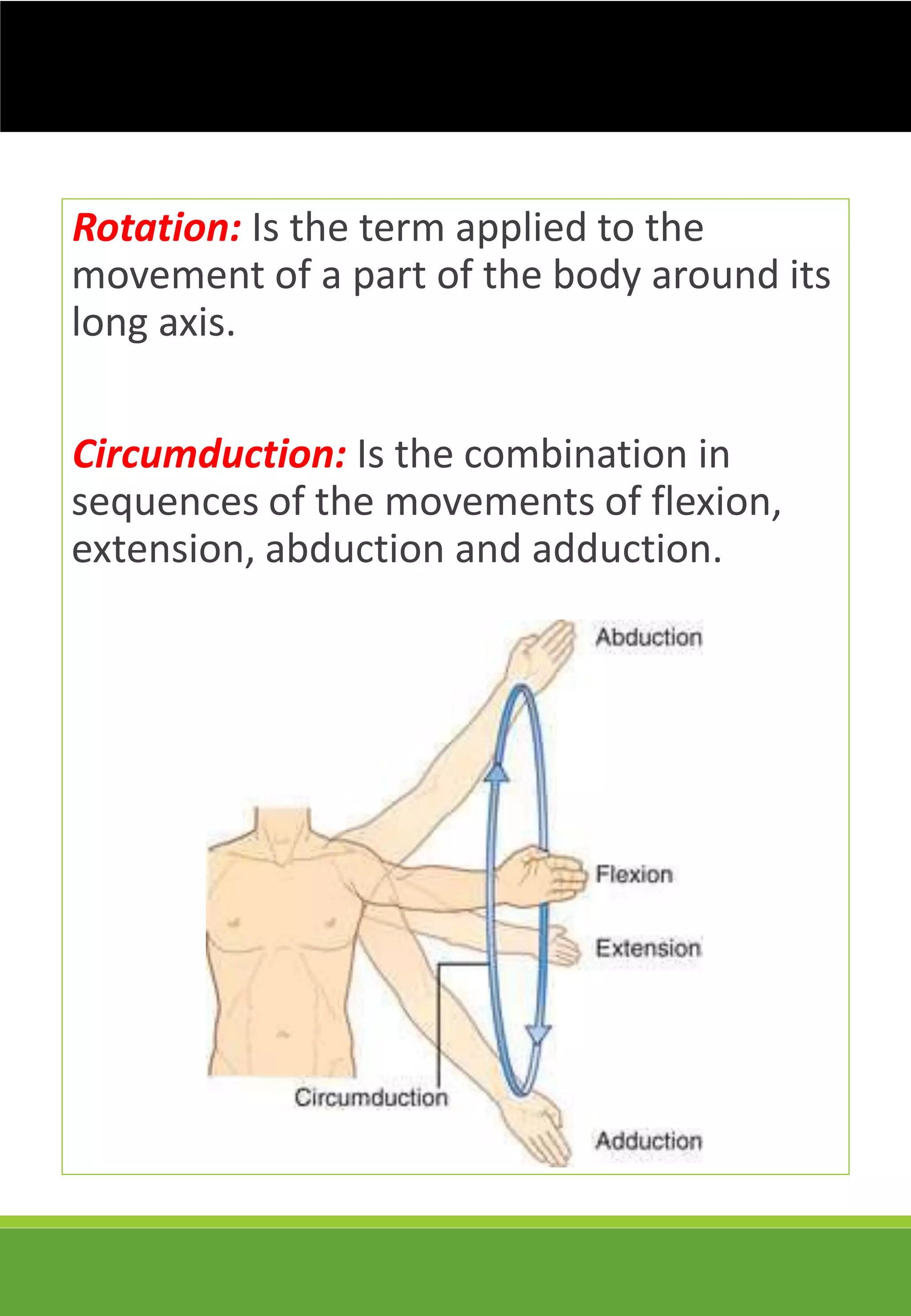
Rotation: Is the term applied to the
movement of a part of the body around its
long axis.
Circumduction: Is the combination in
sequences of the movements of flexion,
extension, abduction and adduction.
Inversion and Eversion
Inversion
Is the movement of the foot so that the
sole faces in a medial direction.
Eversion
Is the opposite movement inversion.
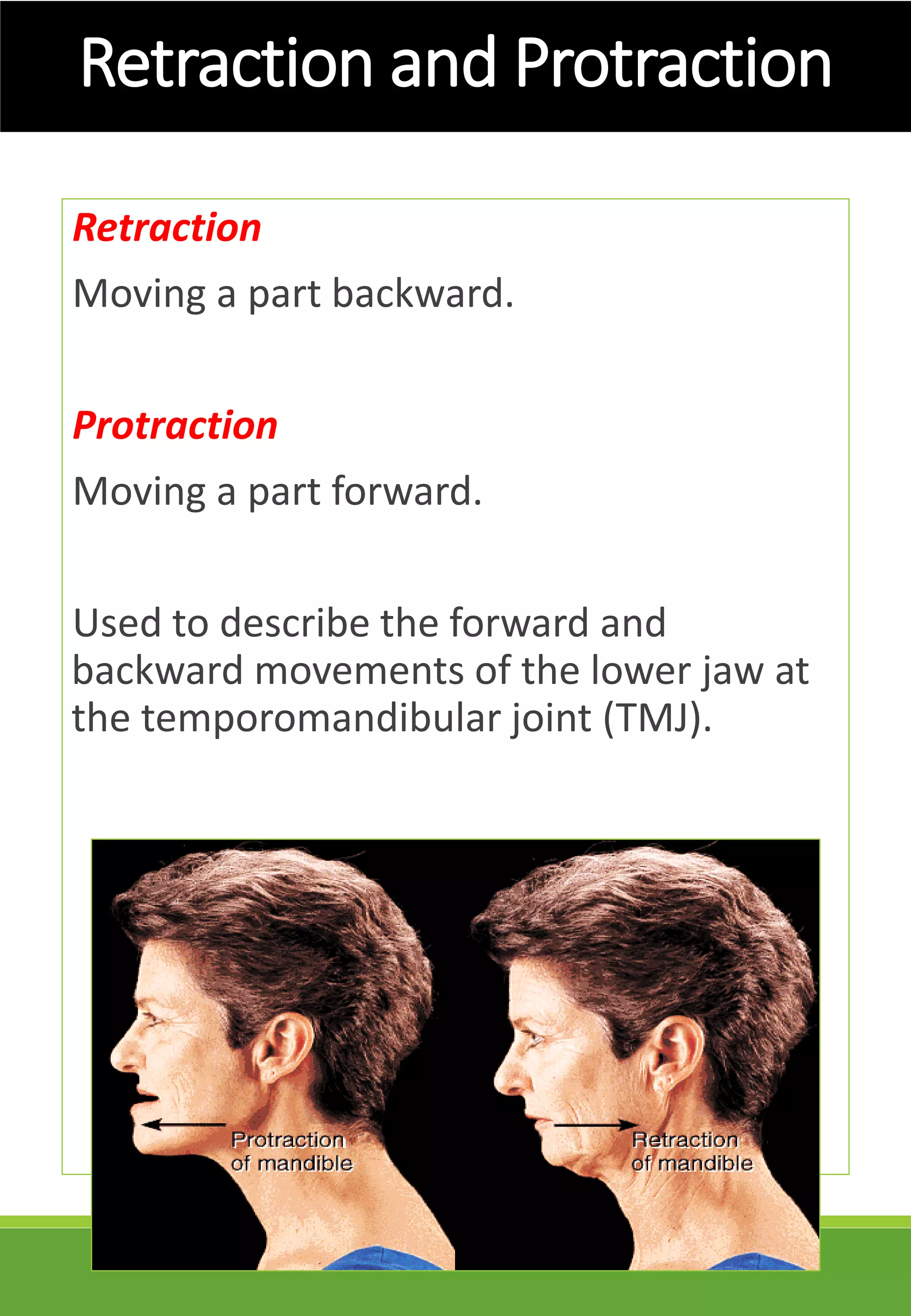
Retraction and Protraction
Retraction
Moving a part backward.
Protraction
Moving a part forward.
Used to describe the forward and
backward movements of the lower jaw at
the temporomandibular joint (TMJ).
Definition
Term
Is being a joint or decreasing the angle
between two bones
Flexion
Means straightening the joint or increasing the
angle between two bones
Extension
Is a movement of a body part away from the
midline, in the coronal plane
Abduction
Is a movement of a body part toward the
midline of the body.
Adduction
Movement of a part of the body around its
long axis.
Rotation
Is the combination in sequences of the
movements of flexion, extension, abduction
and adduction.
Circumduction
Movement of the foot so that the sole faces in
a medial direction.
Inversion
Is the opposite movement inversion.
Eversion
Moving a part backward
Retraction
Moving a part forward
Protraction
Foramen: Round or elliptical hole in the
bone through which blood vessels, nerves
or ligaments pass.
Fissure: Channel-like cleft or crack for
passing of blood vessels and/or nerves.
Fossa: A shallow depression (the word
suggest “ditch” or “trench”). Such
depression in the surface of the bones
often receive another articulating bone
with which a joint is formed.
Notch: A V-like depression in the margin or
edge of a flat area of bone.
Other terms
THANK
YOU

Introduction to Human Anatomy

  • 1.
  • 2.
    Human Body It iscomposed of: • head. • neck. • trunk: thorax & abdomen. • extremities: arms, hands, legs and feet. Anatomy Physiology Histology Embryology The study of human body involves
  • 3.
    Anatomy Anatomy is thescience of the structure and function of the body. Clinical anatomy is the study of the macroscopic structure and function of the body as it relates to the practice of medicine and other health sciences. Basic anatomy is the study of the minimal amount of anatomy consistent with the understanding of the overall structure and function of the body.
  • 4.
    Descriptive Anatomic Terms It’simportant to medical health personal to have a knowledge and understanding of the basic anatomic terms. Without anatomic terms, one cannot accurately discuss or record the abnormal function of the joint, the action of the muscles, the alteration in the position of organs or exact position of swelling or the tumor.
  • 5.
    Terms related tothe position All descriptions of the human body are based the assumption that the person is standing erect with upper limbs by the sides, the face and palms of the hands are directed forward. This called Anatomic Position. Anatomic Position person is standing erect upper limbs by the sides the face and palms of the hands are directed forward
  • 7.
    Planes The various partsof the body are described in relation to certain imaginary planes: • Median or Sagittal Plane: This is a vertical plane passing through the center of the body dividing it into equal right and left halves. • Coronal Planes: These planes are imaginary vertical planes at right angle to median plane. These planes are divides the body into anterior and posterior portions. • Horizontal or Transverse Planes: These planes are at a right angle to both median and coronal planes. These planes are divides the body into superior and inferior portions.
  • 8.
  • 9.
    Anterior and Posterior Theterm Anterior and Posterior are used to indicate the front and back of the body.
  • 10.
    Superior and Inferior Theterms Superior and Inferior denote levels relatively high or low with reference to the upper and lower ends of the body.
  • 11.
    Medial and Lateral Thestructures situated nearer to the Midline of the body than another is said to be Medial to the other. The structures that lies farther away from the Midline than the other is said to be Lateral. * Midline: An imaginary vertical line that divides the body equally to right and left.
  • 12.
    In describing thehand, the terms palmer and dorsal surfaces are used instead of anterior and posterior, while in describing foot, the terms planter and dorsal surfaces are used rather than lower and upper surfaces. In the hand Palmer surface = anterior surface dorsal surface = posterior surface In the foot planter surface = lower surface dorsal surface = upper surface
  • 13.
    Proximal and Distal Proximal:Closer to the origin of the body part or the point of attachment of a limp to the body trunk. Distal: Farther from the origin of the body or the point of attachment of a limp to the body trunk.
  • 14.
  • 15.
    Superficial and Deep Superficial:Refer to a structure being closer to the surface of the body than another one. Deep: Indicate to a structure closer to the core of the body than another one.
  • 16.
  • 17.
    Internal and External Theterms Internal and External are used to describe the relative distance of the structure from the center of an organ or cavity, for example, the internal carotid artery is located inside the skull while the external carotid artery is located outside the cranial cavity.
  • 18.
    Ipsilateral and Contralateral Ipsilateral -refer to the same side of the body. - for example the left hand and the left foot are ipsilateral. Contralateral - refer to the opposite sides of the body - for example, the left and right eyes are contralateral.
  • 19.
    Supine and PronePosition Supine position in which the body is laying on the back while in Prone Position the body is lying but the face is directed downward.
  • 20.
    Definition Term Near the front Anterior(ventral) Near the back Posterior (dorsal) Upward, or near the head Superior (cranial) Downward, or near the feet Inferior (caudal) Toward the midline or median plane Medial Farther from the midline or median plane Lateral Near the roots of the limbs Proximal Away from the roots of the limbs Distal Closer to the surface Superficial Farther from the surface Deep Divides body into equal right and left parts Median plane or Midsagittal plane Divides body into unequal right and left parts Paramedian or Parasagittal plane Divides body into equal or unequal anterior and posterior parts Frontal (coronal) plane Divides body into equal or unequal superior and inferior parts (cross sections) Transverse plane
  • 21.
    Terms Related toMovement A site where two or more bones come together is known as a joint. Some joints have no movements like the structure of the skull while some of them have movement like knee joint.
  • 22.
    Flexion and Extension Flexion:Is being a joint or decreasing the angle between two bones, this movement that takes place in a sagittal plane. For example, flexion of the elbow joint approximates the anterior surface of the forearm to the anterior surface of the arm. It is usually an anterior movement, but it is occasionally posterior as in the case of knee joint. Extension: Means straightening the joint or increasing the angle between two bones and usually takes place in a posterior direction.
  • 23.
    Abduction and Adduction Abduction Isa movement of a body part away from the midline of the body in the coronal plane. Adduction Is a movement of a body part toward the midline of the body.
  • 24.
    Rotation: Is theterm applied to the movement of a part of the body around its long axis. Circumduction: Is the combination in sequences of the movements of flexion, extension, abduction and adduction.
  • 25.
    Inversion and Eversion Inversion Isthe movement of the foot so that the sole faces in a medial direction. Eversion Is the opposite movement inversion.
  • 26.
    Retraction and Protraction Retraction Movinga part backward. Protraction Moving a part forward. Used to describe the forward and backward movements of the lower jaw at the temporomandibular joint (TMJ).
  • 27.
    Definition Term Is being ajoint or decreasing the angle between two bones Flexion Means straightening the joint or increasing the angle between two bones Extension Is a movement of a body part away from the midline, in the coronal plane Abduction Is a movement of a body part toward the midline of the body. Adduction Movement of a part of the body around its long axis. Rotation Is the combination in sequences of the movements of flexion, extension, abduction and adduction. Circumduction Movement of the foot so that the sole faces in a medial direction. Inversion Is the opposite movement inversion. Eversion Moving a part backward Retraction Moving a part forward Protraction
  • 28.
    Foramen: Round orelliptical hole in the bone through which blood vessels, nerves or ligaments pass. Fissure: Channel-like cleft or crack for passing of blood vessels and/or nerves. Fossa: A shallow depression (the word suggest “ditch” or “trench”). Such depression in the surface of the bones often receive another articulating bone with which a joint is formed. Notch: A V-like depression in the margin or edge of a flat area of bone. Other terms
  • 31.