Class:1
MANSOOR ANI NAJEEB
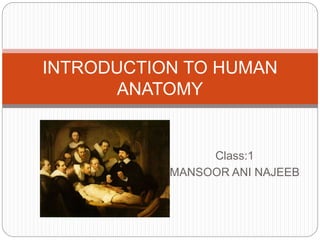
INTRODUCTION TO HUMAN
ANATOMY
Learning Objectives
Introduction to anatomy
Various systems
Vital Organs
Senses
Pathological conditions
What is ANATOMY ????
 Anatomy (from the Greek word anatomia, from ana:
separate, and temnein, to cut open.)
 Is a branch of biology and medicine that is the
consideration of the structure of living things
 Anatomy –The study of structure
 Macroscopic (Gross)
 Regional, Systemic
 Microscopic
 Cytology (Cells), Histology (Tissues)
 Developmental
 Embryology
 Physiology –The study of function
Directional Terms
 Directional terms describe the positions of
structures relative to other structures or locations
in the body.
 Superior
 Inferior
 Anterior
 Posterior
 Medial
 Lateral
 Proximal
 Distal
 Superficial
 Deep
SKELETAL SYSTEM
BONES
 Bones are rigid organs that form part of
the endoskeleton of vertebrates.
 They function to move, support, and protect the
various organs of the body, produce red and white
blood cells and store minerals.
 Because bones come in a variety of shapes and
have a complex internal and external structure they
are lightweight, yet strong and hard, in addition to
fulfilling their many other functions.
 Osseous tissue, also called bone tissue, that gives it
rigidity and a honeycomb-like three-dimensional
internal structure.
 Other types of tissue found in bones
include marrow, endosteum and periosteum,nerves, b
lood vessels and cartilage.
 There are 206 bones in the adult human body and
270 in an infant
Functions
Bones have eleven main functions:
Mechanical
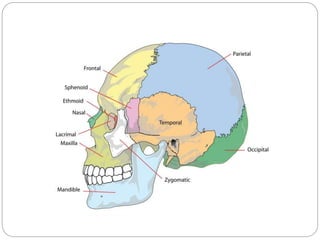
 Protection — Bones can serve to protect internal
organs, such as the skull protecting the brain or
the ribs protecting the heart and lungs.
 Shape — Bones provide a frame to keep the
body supported.
 Movement — Bones, skeletal,
muscles, tendons, ligaments
 Sound transduction — Bones are important in the
mechanical aspect of overshadowed hearing
Synthetic
 Blood production — The marrow, located within
the medullary cavity of long bones, produces
blood cells in a process called haematopoiesis.
Metabolic
 Mineral storage — Bones act as reserves of
minerals important for the body, most
notably calcium and phosphorus.
 Growth factor storage — Mineralized bone matrix
stores important growth factors such as insulin-
like growth factors.
 Fat Storage — The yellow bone marrow acts as a
storage reserve of fatty acids.
 Acid-base balance — Bone buffers the blood against
excessive pH changes by absorbing or
releasing alkaline salts.
 Detoxification — Bone tissues can also store heavy
metals and other foreign elements, removing them
from the blood and reducing their effects on other
tissues.
 Endocrine organ — Bone
controls phosphate metabolism by releasing fibroblast
growth factor - 23 (FGF-23), which acts on kidneys to
reduce phosphate reabsorption. Bone cells also
release a hormone called osteocalcin, which
contributes to the regulation of blood sugar (glucose)
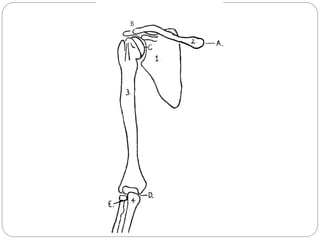
BONES OF UPPER LIMB
 Clavicle
 Scapula
 Humerus
 Radius
 Ulna
 Carpal bones
 Metacarpals
 Phalanges
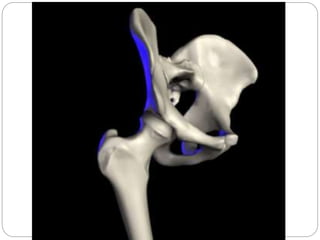
BONES OF LOWER LIMB
 hip bone (1)
 femur (1)
 patella (1)
 tibia (1)
 fibula (1)
 tarsals (8)
 metatarsals (5)
 proximal phalanges (5)
 intermediate phalanges (5)
 distal phalanges (4)
 Cervical: 7 vertebrae (C1–C7)
C1 is known as "atlas" and supports
the head, C2 is known as "axis", C7 is
known as "vertabra prominens"
 Thoracic: 12 vertebrae (T1–T12)
 Lumbar: 5 vertebrae (L1–L5)
 Sacral: 5 (fused) vertebrae (S1–S5)
 Coccygeal: 4 (3–5) (fused) vertebrae
(Tailbone)
THANK YOU

Introduction to anatomy.pptx

  • 1.
  • 2.
    Learning Objectives Introduction toanatomy Various systems Vital Organs Senses Pathological conditions
  • 3.
    What is ANATOMY????  Anatomy (from the Greek word anatomia, from ana: separate, and temnein, to cut open.)  Is a branch of biology and medicine that is the consideration of the structure of living things  Anatomy –The study of structure  Macroscopic (Gross)  Regional, Systemic  Microscopic  Cytology (Cells), Histology (Tissues)  Developmental  Embryology  Physiology –The study of function
  • 4.
    Directional Terms  Directionalterms describe the positions of structures relative to other structures or locations in the body.  Superior  Inferior  Anterior  Posterior  Medial  Lateral  Proximal  Distal  Superficial  Deep
  • 5.
  • 6.
    BONES  Bones arerigid organs that form part of the endoskeleton of vertebrates.  They function to move, support, and protect the various organs of the body, produce red and white blood cells and store minerals.  Because bones come in a variety of shapes and have a complex internal and external structure they are lightweight, yet strong and hard, in addition to fulfilling their many other functions.  Osseous tissue, also called bone tissue, that gives it rigidity and a honeycomb-like three-dimensional internal structure.  Other types of tissue found in bones include marrow, endosteum and periosteum,nerves, b lood vessels and cartilage.  There are 206 bones in the adult human body and 270 in an infant
  • 7.
    Functions Bones have elevenmain functions: Mechanical  Protection — Bones can serve to protect internal organs, such as the skull protecting the brain or the ribs protecting the heart and lungs.  Shape — Bones provide a frame to keep the body supported.  Movement — Bones, skeletal, muscles, tendons, ligaments  Sound transduction — Bones are important in the mechanical aspect of overshadowed hearing
  • 8.
    Synthetic  Blood production— The marrow, located within the medullary cavity of long bones, produces blood cells in a process called haematopoiesis. Metabolic  Mineral storage — Bones act as reserves of minerals important for the body, most notably calcium and phosphorus.  Growth factor storage — Mineralized bone matrix stores important growth factors such as insulin- like growth factors.
  • 9.
     Fat Storage— The yellow bone marrow acts as a storage reserve of fatty acids.  Acid-base balance — Bone buffers the blood against excessive pH changes by absorbing or releasing alkaline salts.  Detoxification — Bone tissues can also store heavy metals and other foreign elements, removing them from the blood and reducing their effects on other tissues.  Endocrine organ — Bone controls phosphate metabolism by releasing fibroblast growth factor - 23 (FGF-23), which acts on kidneys to reduce phosphate reabsorption. Bone cells also release a hormone called osteocalcin, which contributes to the regulation of blood sugar (glucose)
  • 12.
    BONES OF UPPERLIMB  Clavicle  Scapula  Humerus  Radius  Ulna  Carpal bones  Metacarpals  Phalanges
  • 15.
    BONES OF LOWERLIMB  hip bone (1)  femur (1)  patella (1)  tibia (1)  fibula (1)  tarsals (8)  metatarsals (5)  proximal phalanges (5)  intermediate phalanges (5)  distal phalanges (4)
  • 19.
     Cervical: 7vertebrae (C1–C7) C1 is known as "atlas" and supports the head, C2 is known as "axis", C7 is known as "vertabra prominens"  Thoracic: 12 vertebrae (T1–T12)  Lumbar: 5 vertebrae (L1–L5)  Sacral: 5 (fused) vertebrae (S1–S5)  Coccygeal: 4 (3–5) (fused) vertebrae (Tailbone)
  • 23.