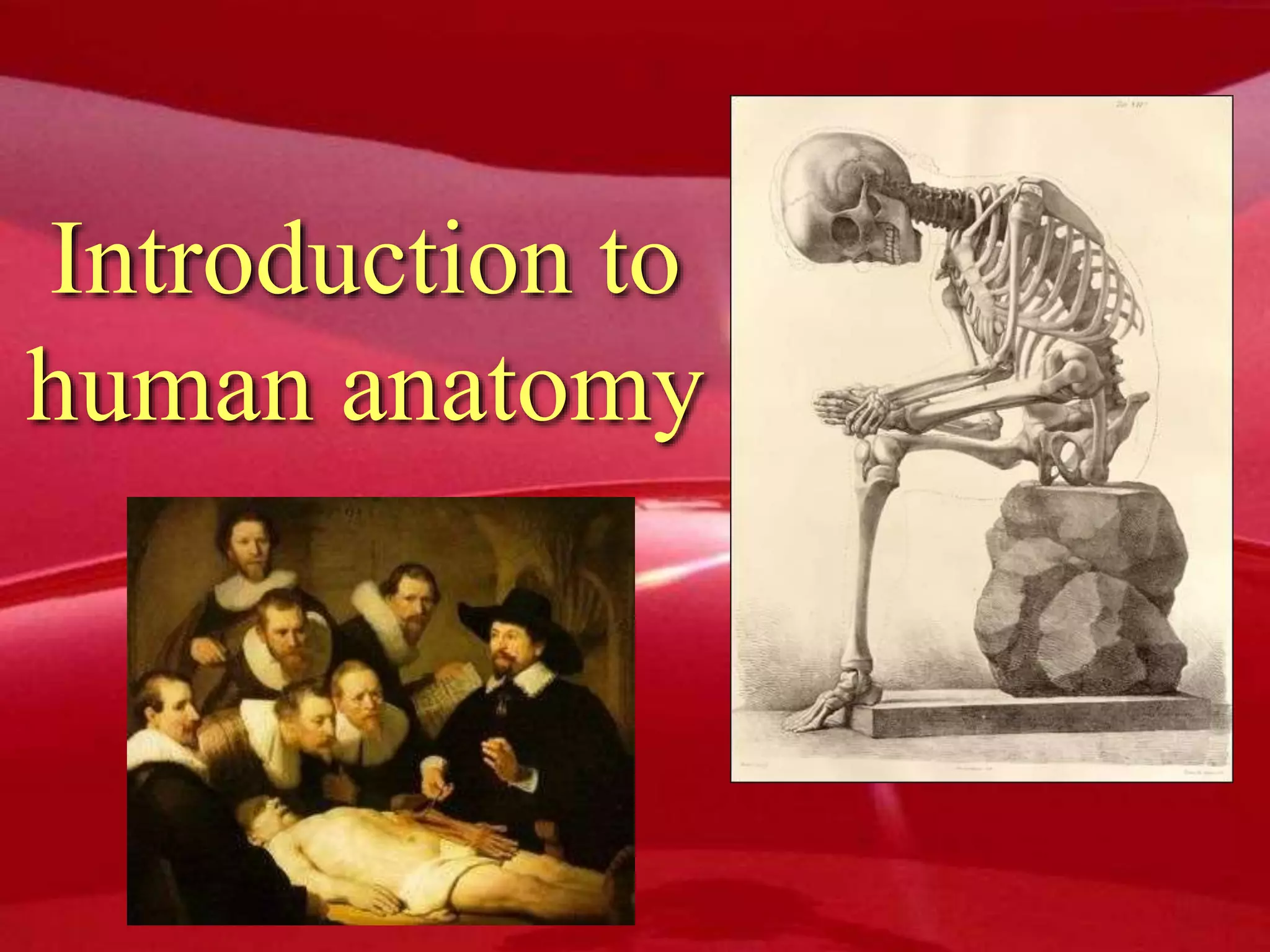
Introduction to
human anatomy
Anatomy
• Definition - anatome = up (ana) + cutting (tome)
• Disciplines of anatomy
– Macroscopic
– Microscopic
– Developmental
– Neuroanatomy
• Approach to study of gross anatomy
Upper extremity Back
Head and neck Thorax
Abdomen Pelvis and perineum
Lower extremity
Why do you need to study anatomy?
• A doctor should be able to localize
symptoms and signs
– Pains
– Lumps/bumps
– Withdrawing of blood & giving injections
– Basic medical procedures
Why do you need to study anatomy?
• Surgeons need to know what they cut
– Where to cut
– How to find the structures/organs
– Relationship of structures/organs
– Normal variations
Basis for Terminology
• Terms informative
• Nomina anatomica
• Use of eponyms
Use correct terminology on exams; avoid nonspecific,
general terms, like “front,” “up,” and “behind.”
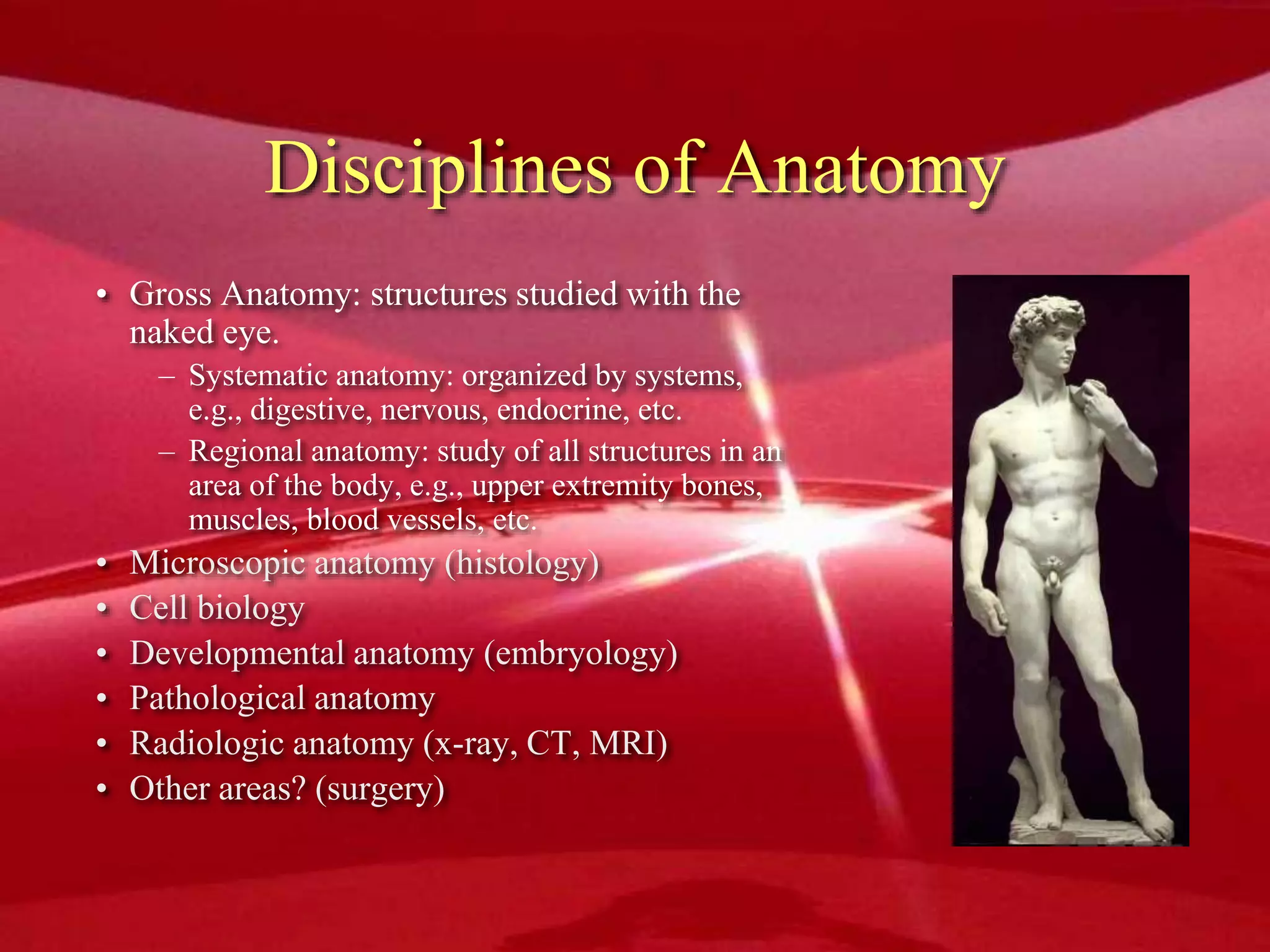
Disciplines of Anatomy
• Gross Anatomy: structures studied with the
naked eye.
– Systematic anatomy: organized by systems,
e.g., digestive, nervous, endocrine, etc.
– Regional anatomy: study of all structures in an
area of the body, e.g., upper extremity bones,
muscles, blood vessels, etc.
• Microscopic anatomy (histology)
• Cell biology
• Developmental anatomy (embryology)
• Pathological anatomy
• Radiologic anatomy (x-ray, CT, MRI)
• Other areas? (surgery)
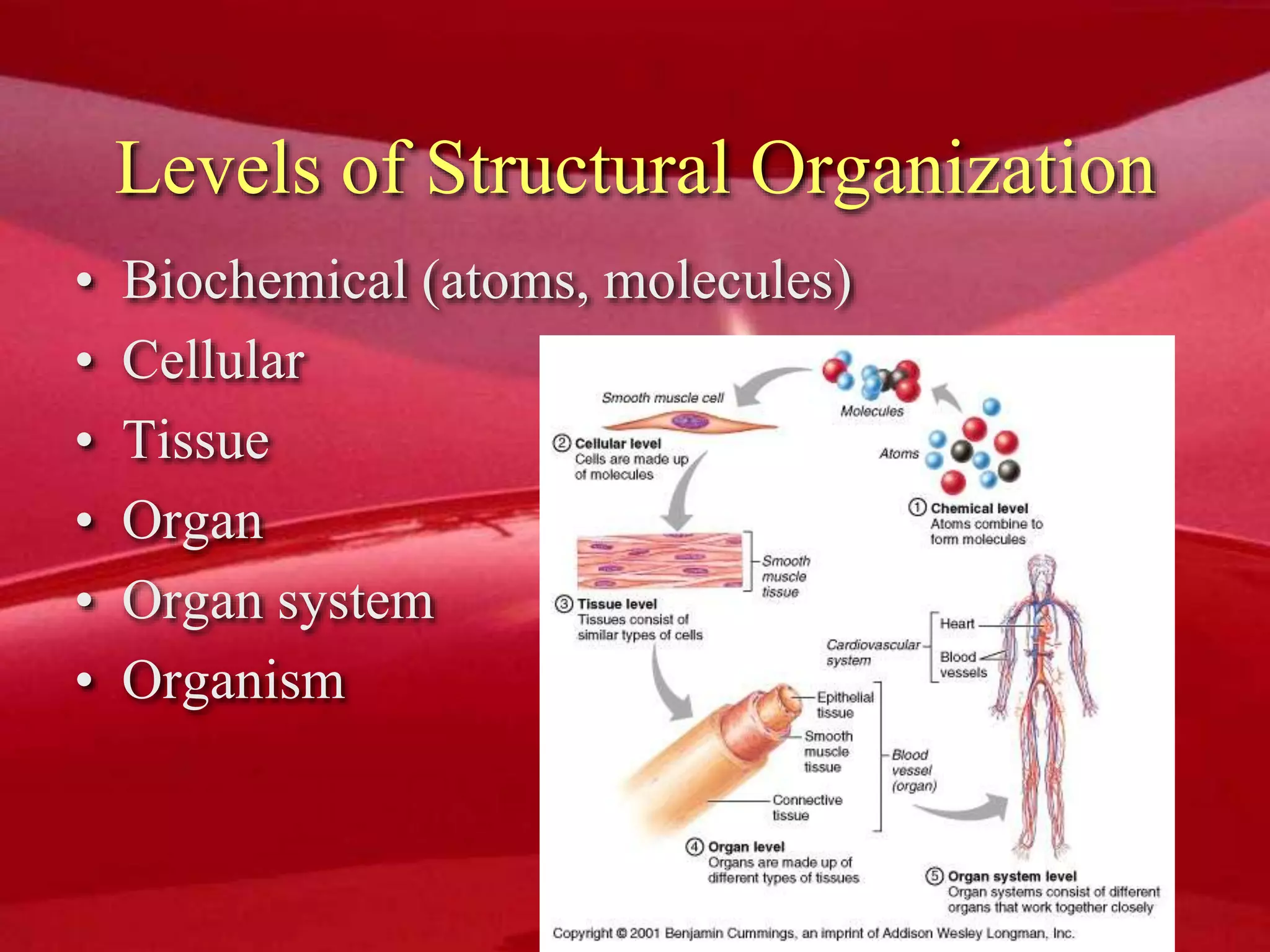
Levels of Structural Organization
• Biochemical (atoms, molecules)
• Cellular
• Tissue
• Organ
• Organ system
• Organism
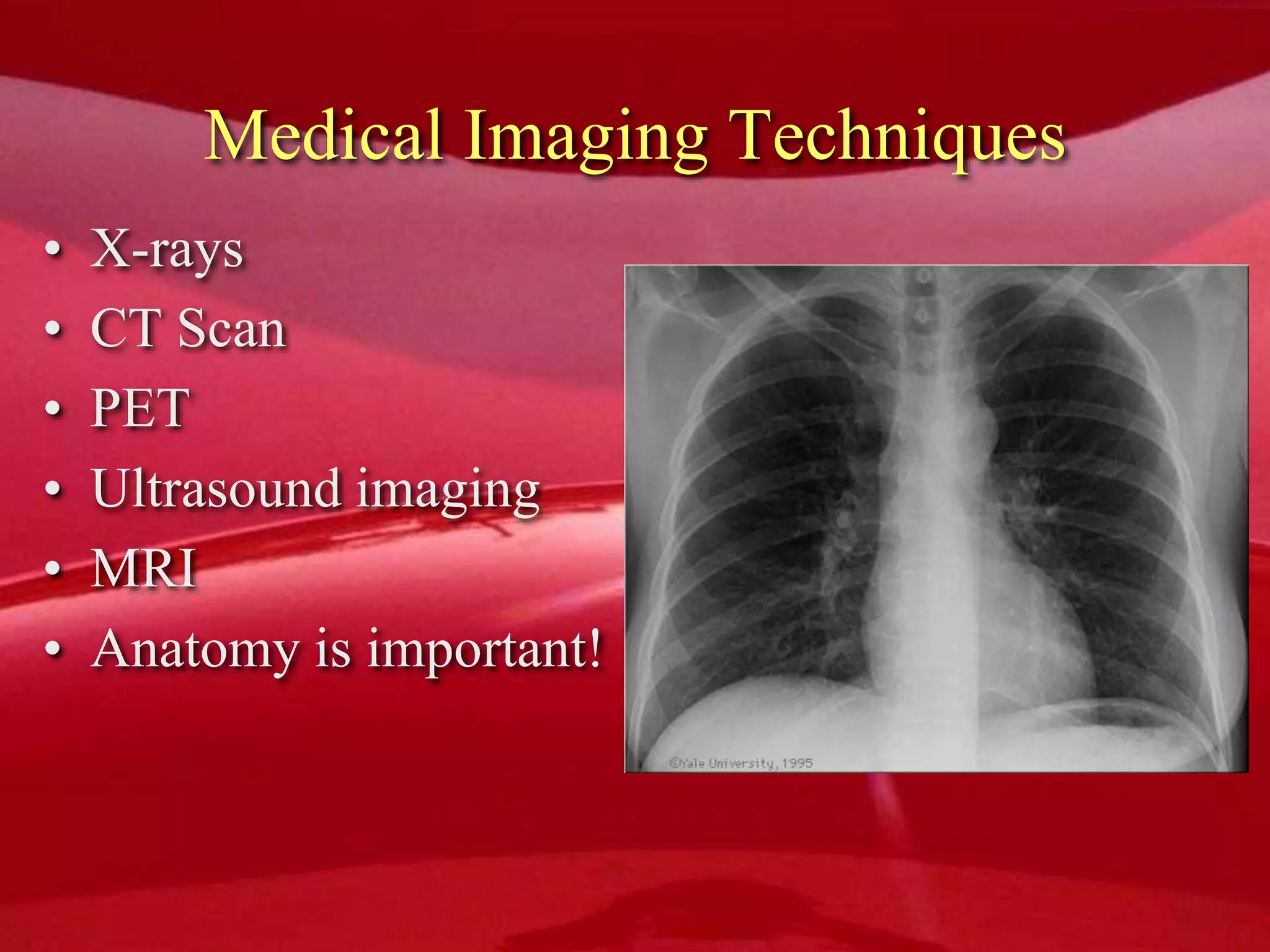
Medical Imaging Techniques
• X-rays
• CT Scan
• PET
• Ultrasound imaging
• MRI
• Anatomy is important!
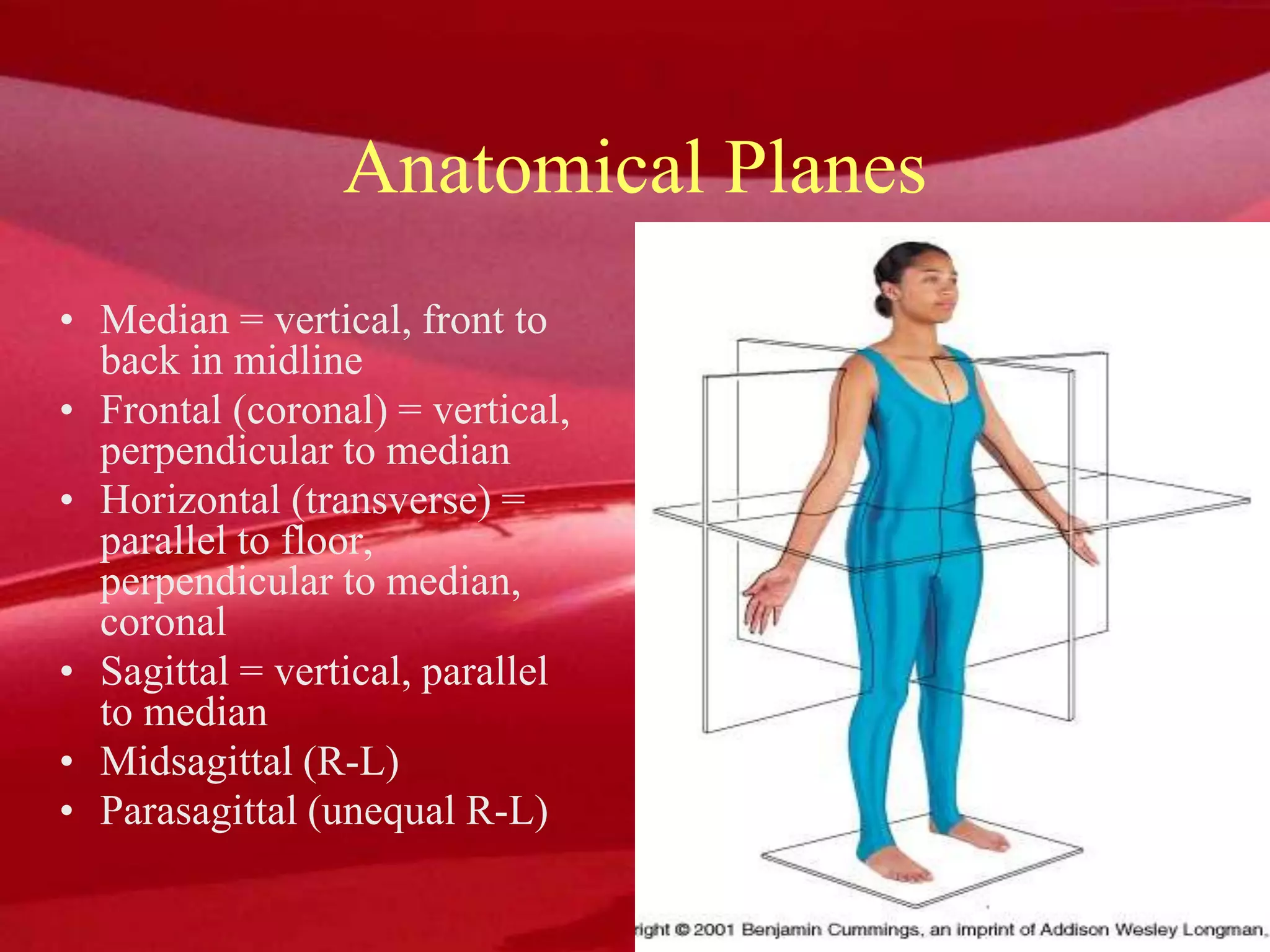
Anatomical Planes
• Median = vertical, front to
back in midline
• Frontal (coronal) = vertical,
perpendicular to median
• Horizontal (transverse) =
parallel to floor,
perpendicular to median,
coronal
• Sagittal = vertical, parallel
to median
• Midsagittal (R-L)
• Parasagittal (unequal R-L)
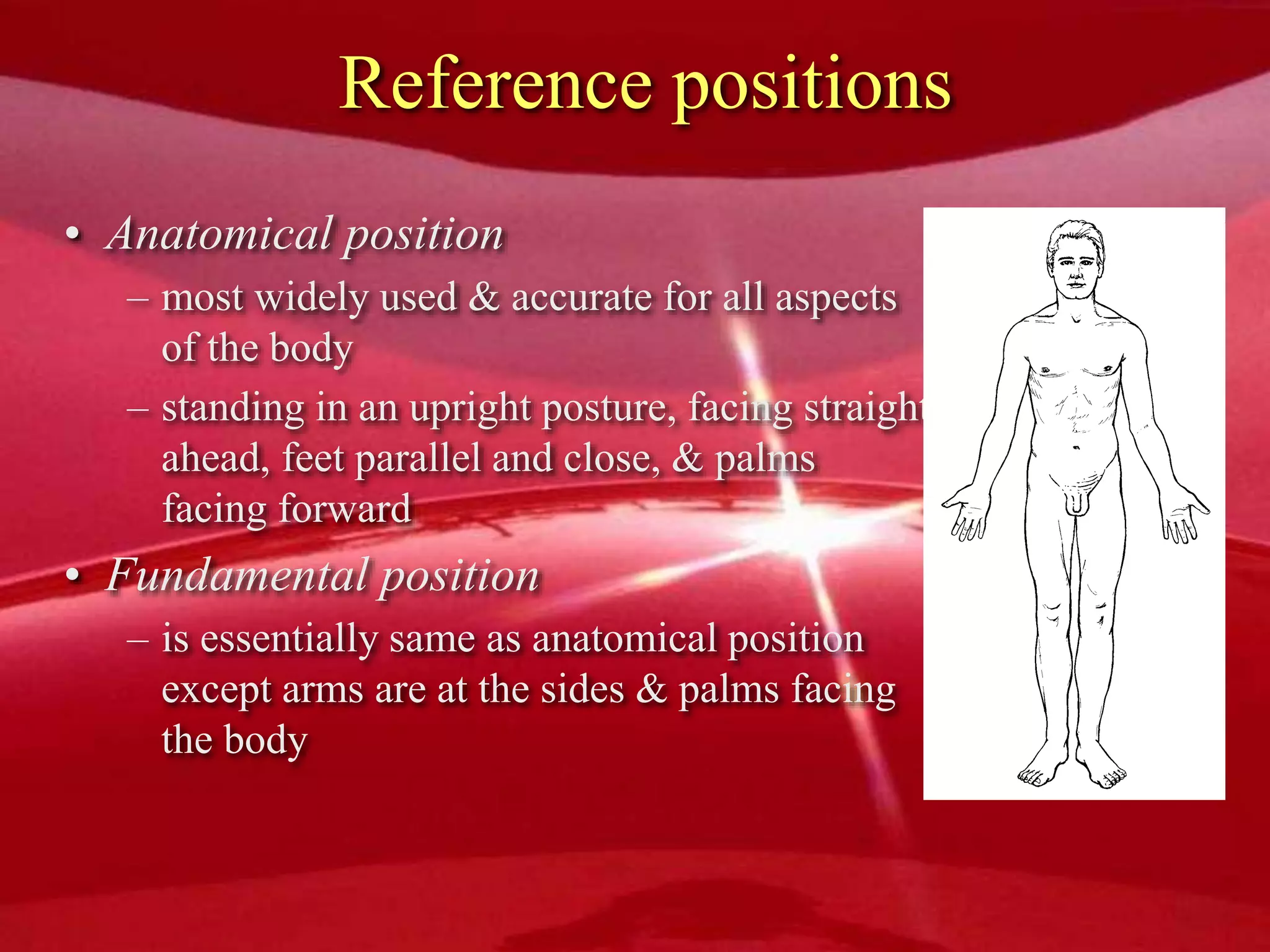
Reference positions
• Anatomical position
– most widely used & accurate for all aspects
of the body
– standing in an upright posture, facing straight
ahead, feet parallel and close, & palms
facing forward
• Fundamental position
– is essentially same as anatomical position
except arms are at the sides & palms facing
the body
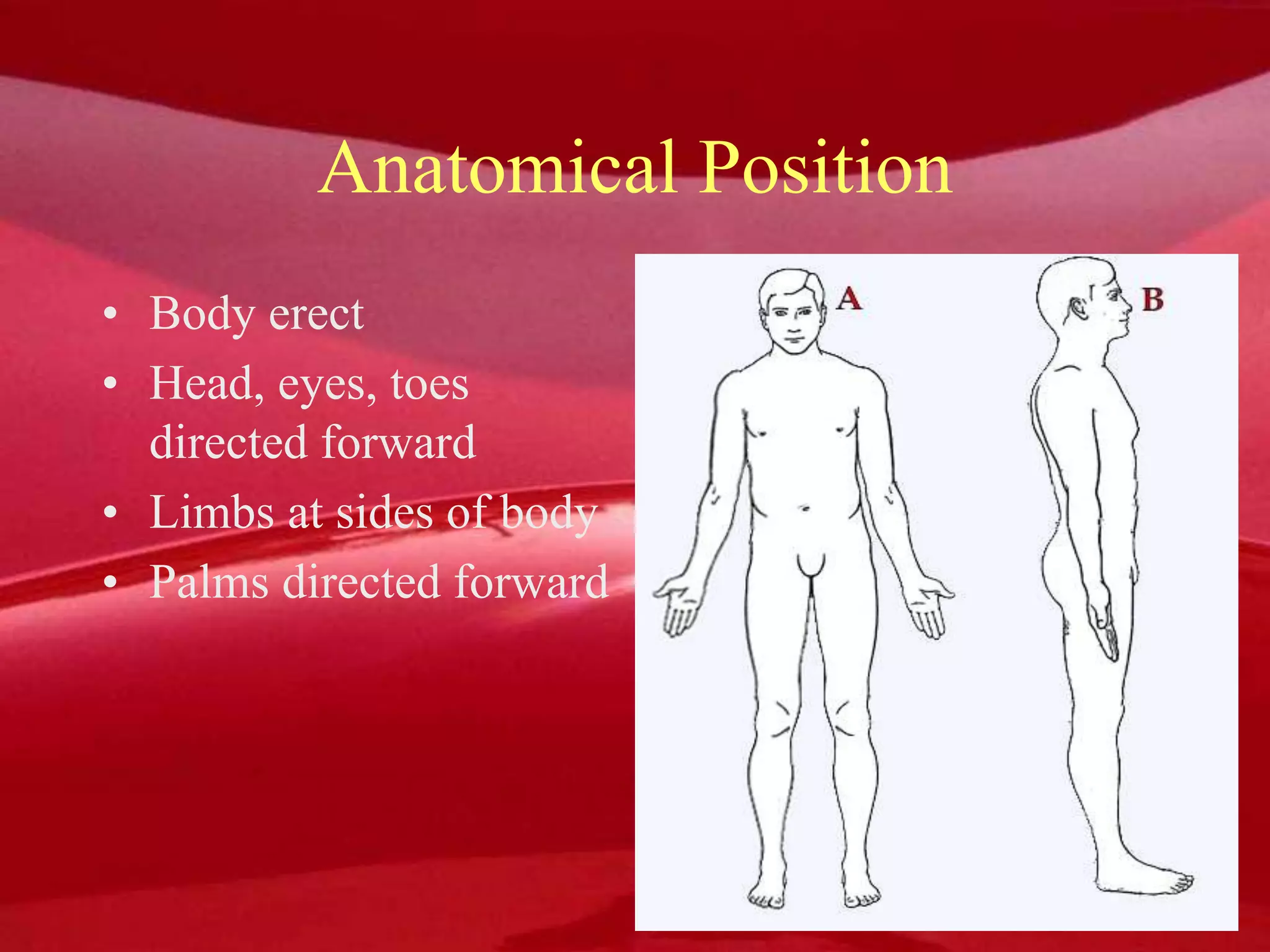
Anatomical Position
• Body erect
• Head, eyes, toes
directed forward
• Limbs at sides of body
• Palms directed forward
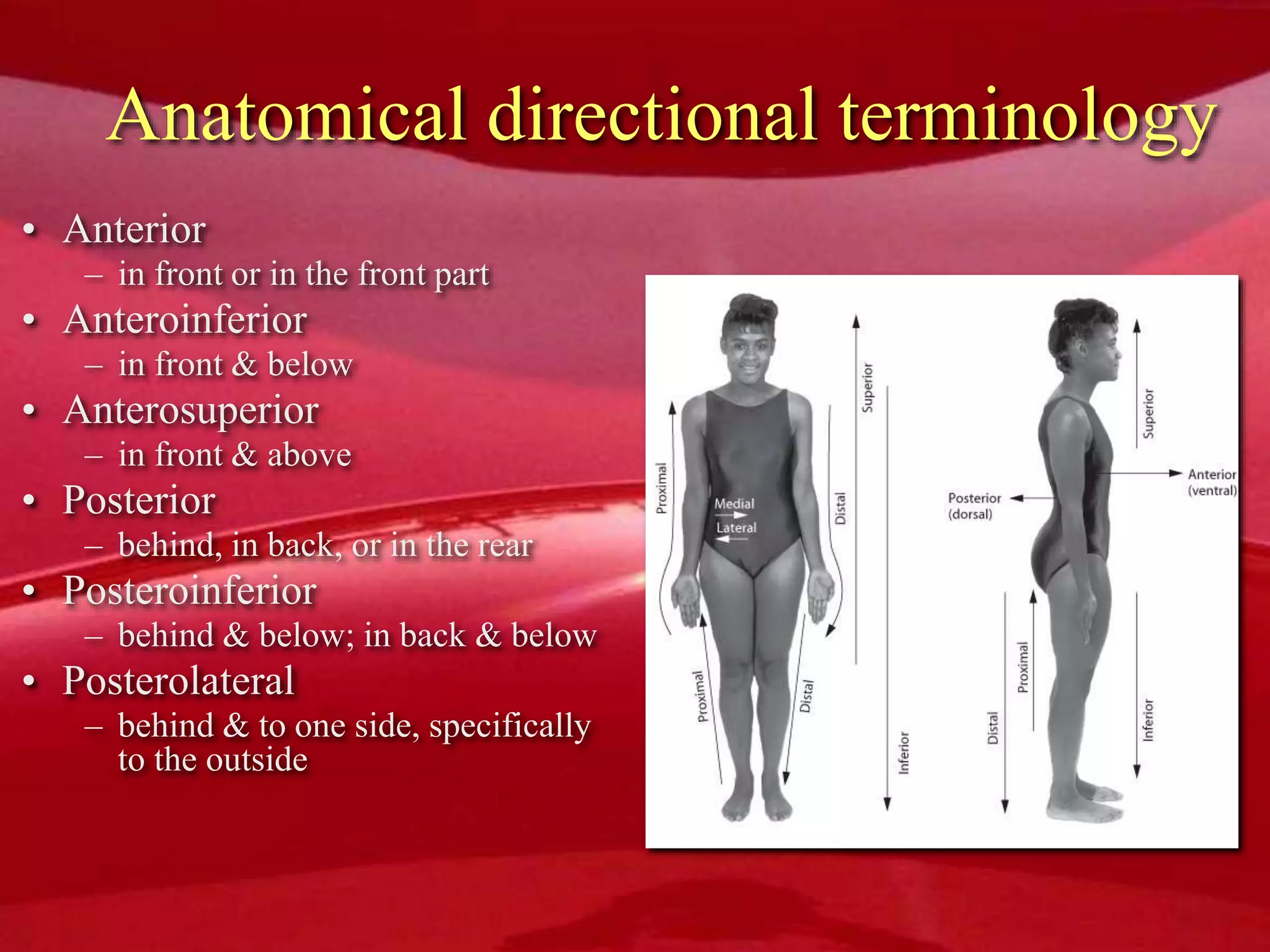
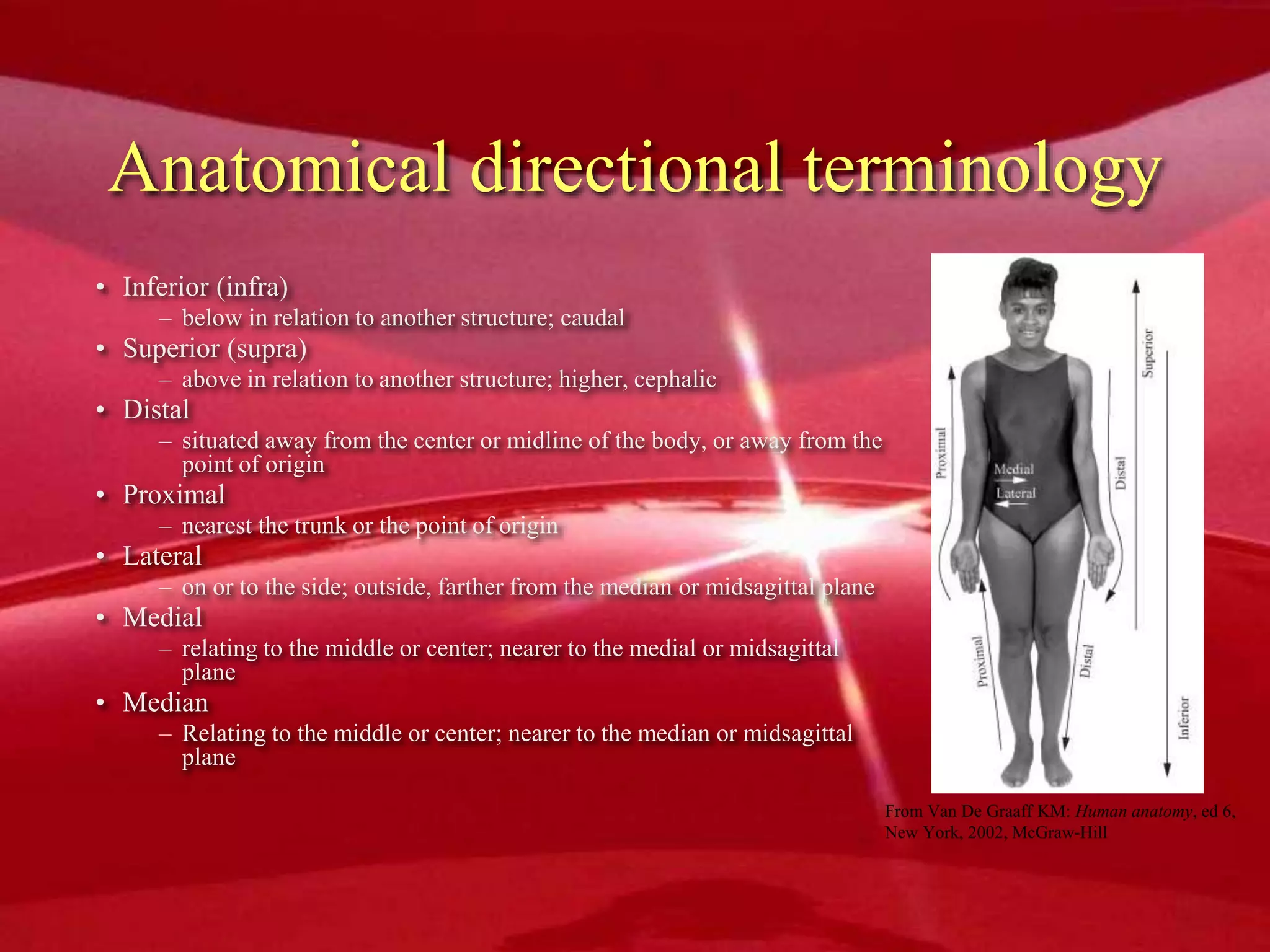
Anatomical directional terminology
• Anterior
– in front or in the front part
• Anteroinferior
– in front & below
• Anterosuperior
– in front & above
• Posterior
– behind, in back, or in the rear
• Posteroinferior
– behind & below; in back & below
• Posterolateral
– behind & to one side, specifically
to the outside
Anatomical directional terminology
• Contralateral
– pertaining or relating to the opposite side
• Ipsilateral
– on the same side
• Bilateral
– relating to the right and left sides of the body or
of a body structure such as the right & left
extremities
Anatomical directional terminology
• Inferior (infra)
– below in relation to another structure; caudal
• Superior (supra)
– above in relation to another structure; higher, cephalic
• Distal
– situated away from the center or midline of the body, or away from the
point of origin
• Proximal
– nearest the trunk or the point of origin
• Lateral
– on or to the side; outside, farther from the median or midsagittal plane
• Medial
– relating to the middle or center; nearer to the medial or midsagittal
plane
• Median
– Relating to the middle or center; nearer to the median or midsagittal
plane
From Van De Graaff KM: Human anatomy, ed 6,
New York, 2002, McGraw-Hill
Anatomical directional terminology
• Caudal
– below in relation to another structure; inferior
• Cephalic
– above in relation to another structure; higher, superior
• Deep
– beneath or below the surface; used to describe relative
depth or location of muscles or tissue
• Superficial
– near the surface; used to describe relative depth or
location of muscles or tissue
Anatomical directional terminology
• Prone
– the body lying face downward; stomach lying
• Supine
– lying on the back; face upward position of the body
• Dorsal
– relating to the back; being or located near, on, or toward the back,
posterior part, or upper surface of
• Ventral
– relating to the belly or abdomen, on or toward the front, anterior part of
• Volar
– relating to palm of the hand or sole of the foot
• Plantar
– relating to the sole or undersurface of the foot
Directional Terms
•Toward the upper part
•Superior Cephalic
•Toward the lower part
•Inferior Caudal
•Front
•Ventral Anterior
•Back
•Dorsal Posterior
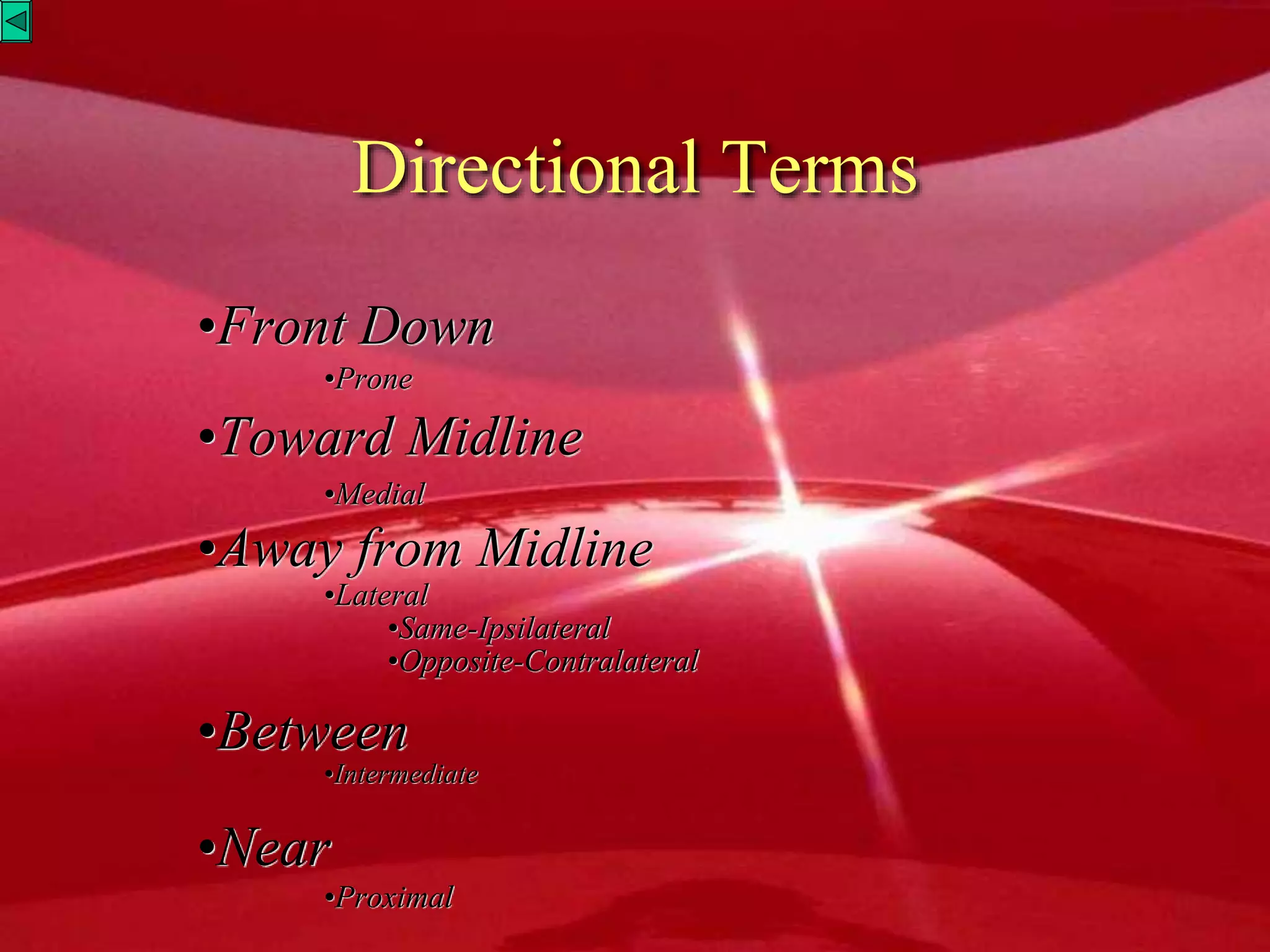
Directional Terms
•Front Down
•Prone
•Toward Midline
•Medial
•Away from Midline
•Lateral
•Same-Ipsilateral
•Opposite-Contralateral
•Between
•Intermediate
•Near
•Proximal
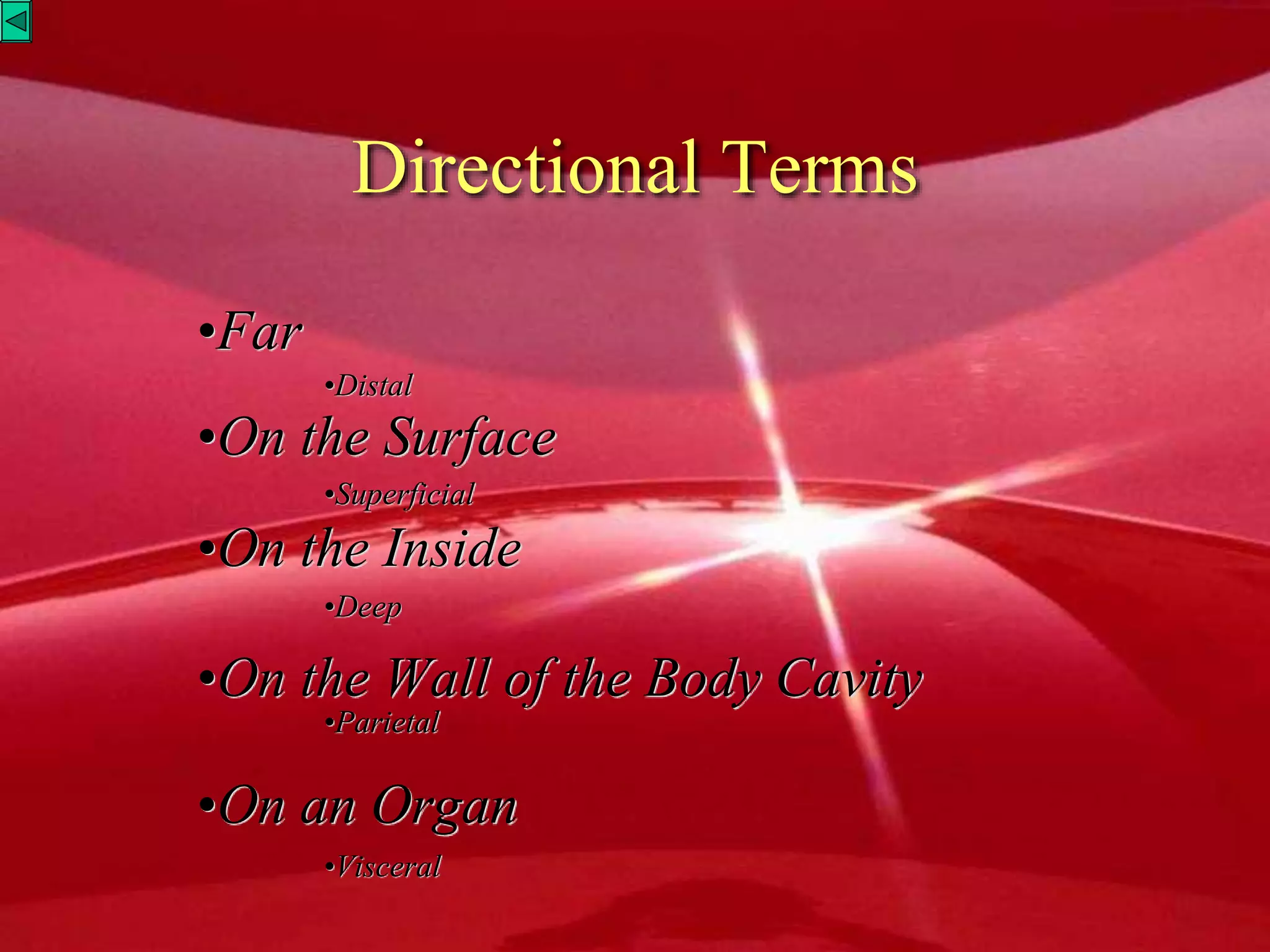
Directional Terms
•Far
•Distal
•On the Surface
•Superficial
•On the Inside
•Deep
•On the Wall of the Body Cavity
•Parietal
•On an Organ
•Visceral
The Skeleton
• Consists of
– Bones, cartilage, joints, and ligaments
• Composed of 206 named bones grouped into
two divisions
– Axial skeleton (80 bones)
– Appendicular skeleton (126 bones)
The Axial Skeleton
• Formed from 80
named bones
• Consists of skull,
vertebral column,
and bony thorax
Figure 7.1a
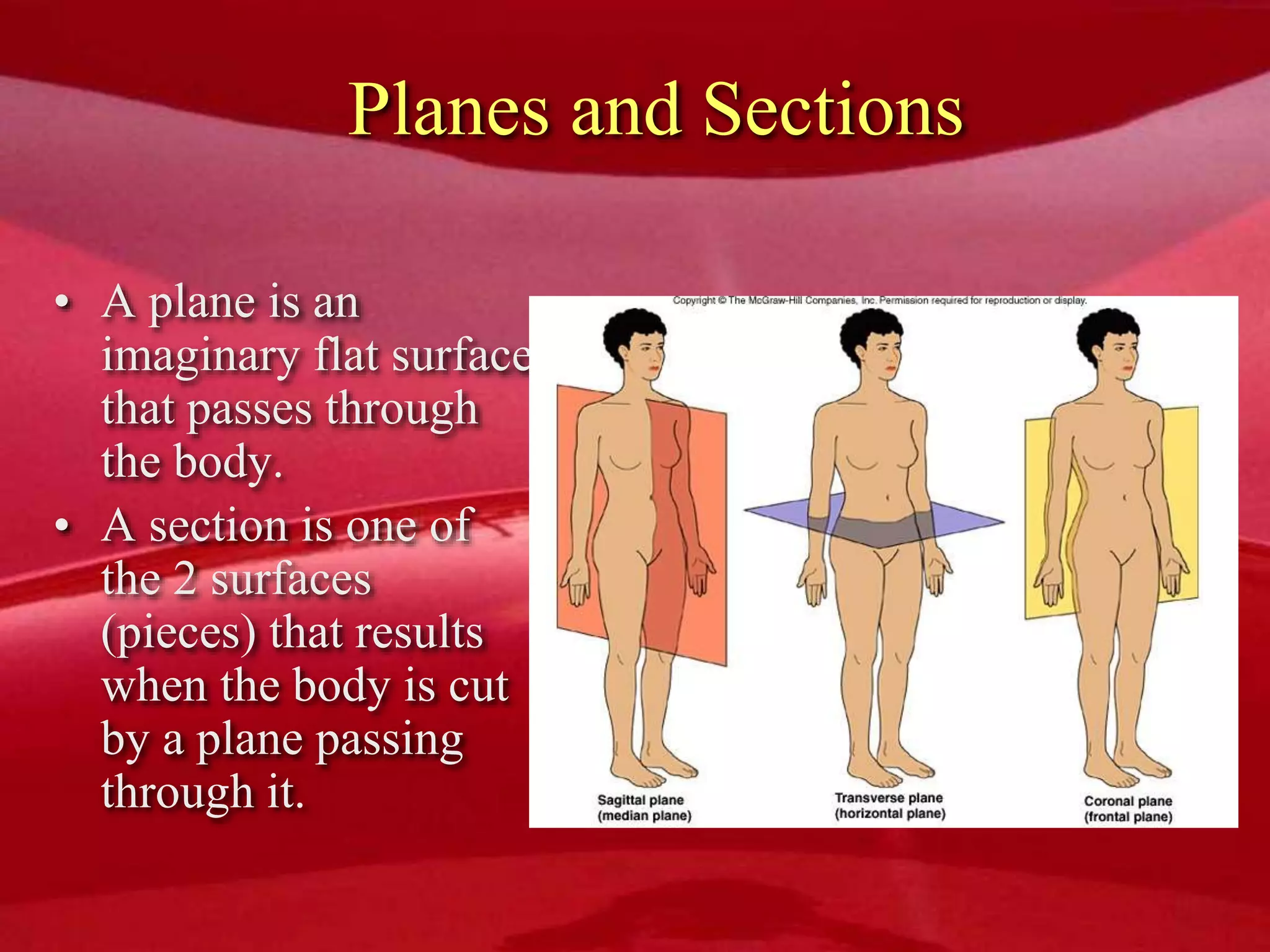
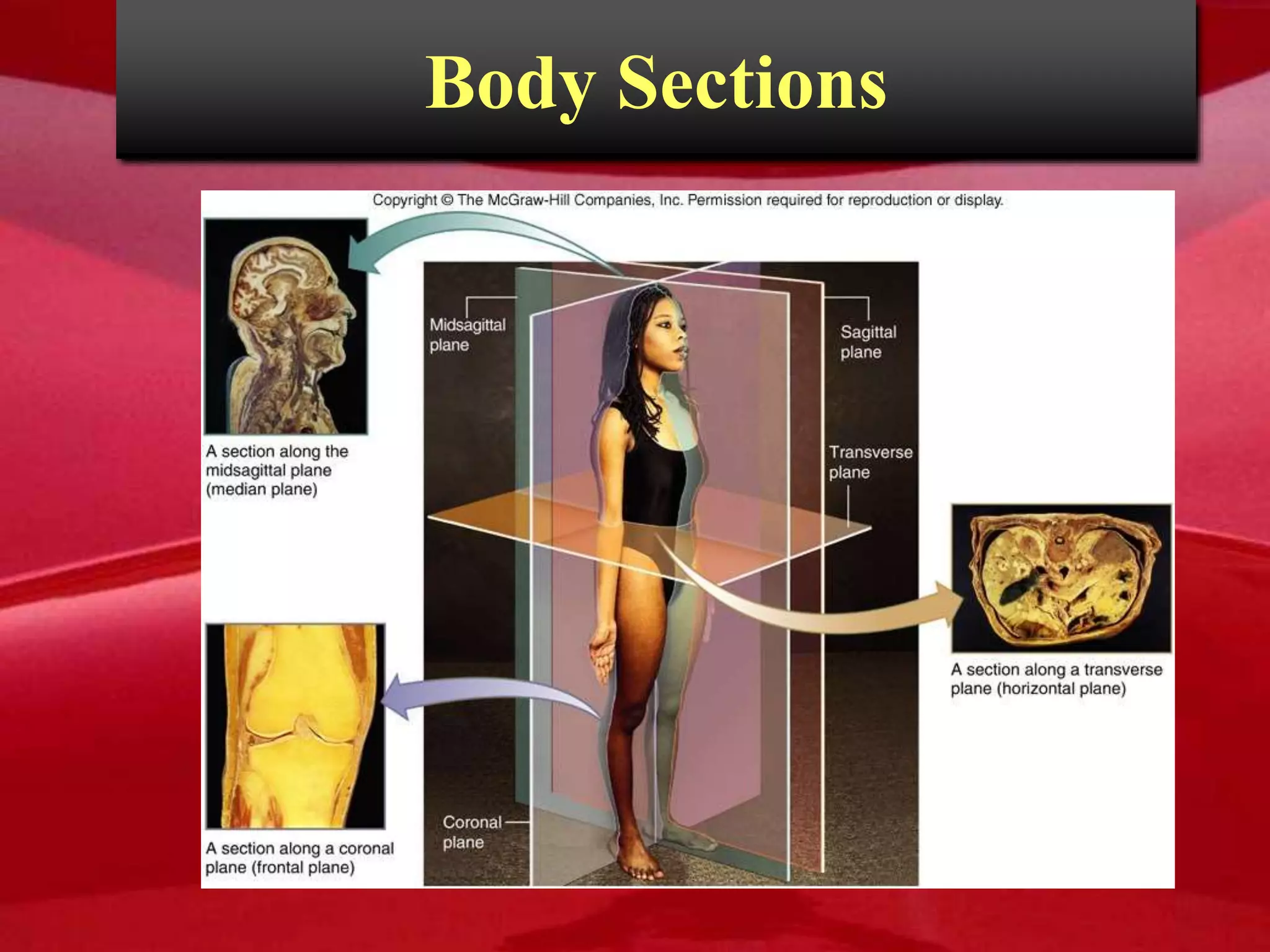
Planes and Sections
• A plane is an
imaginary flat surface
that passes through
the body.
• A section is one of
the 2 surfaces
(pieces) that results
when the body is cut
by a plane passing
through it.
Transverse
plane Coronal
plane
Coronal plane
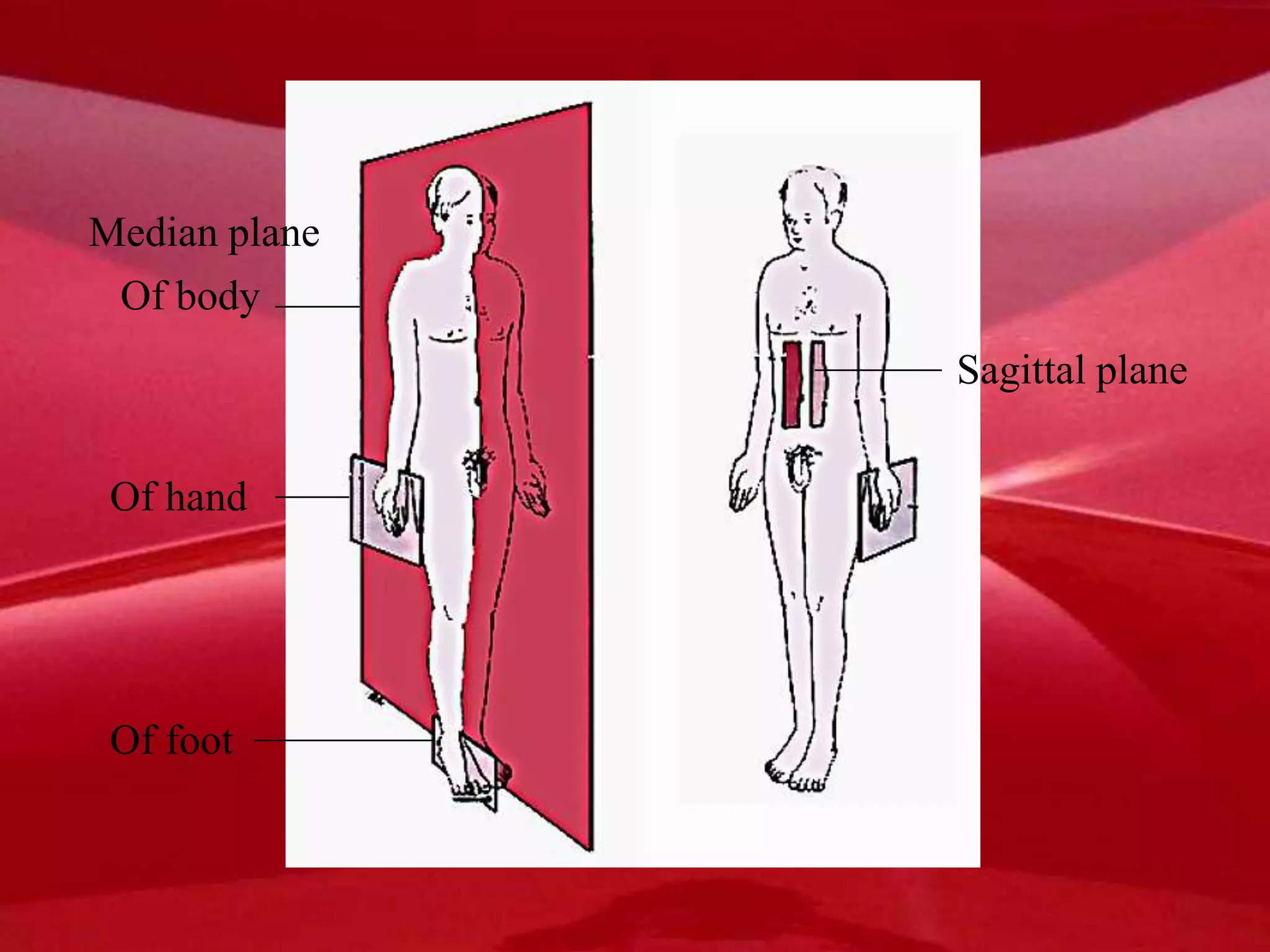
Median plane
Of body
Of hand
Of foot
Sagittal plane
Sagittal Plane
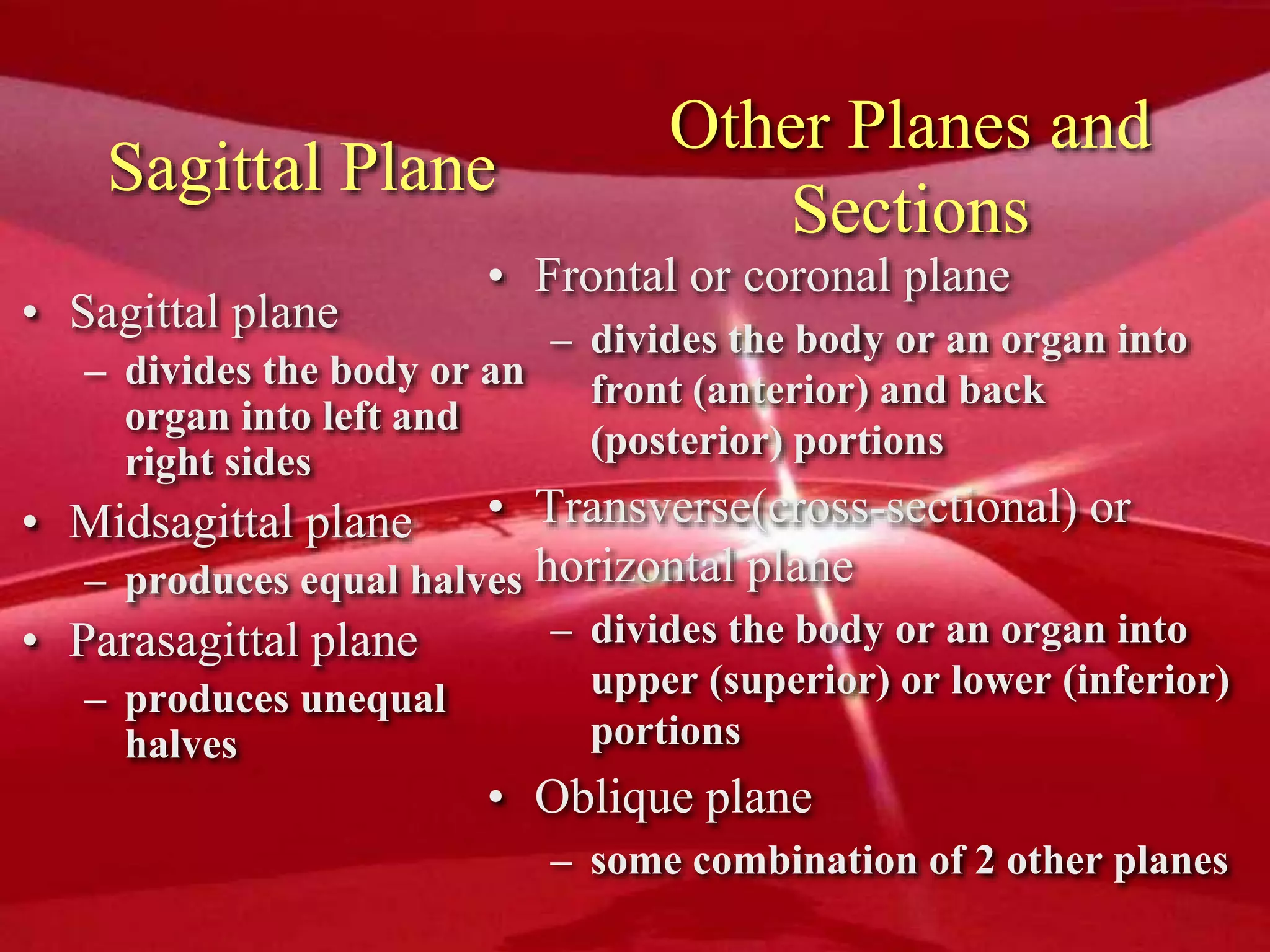
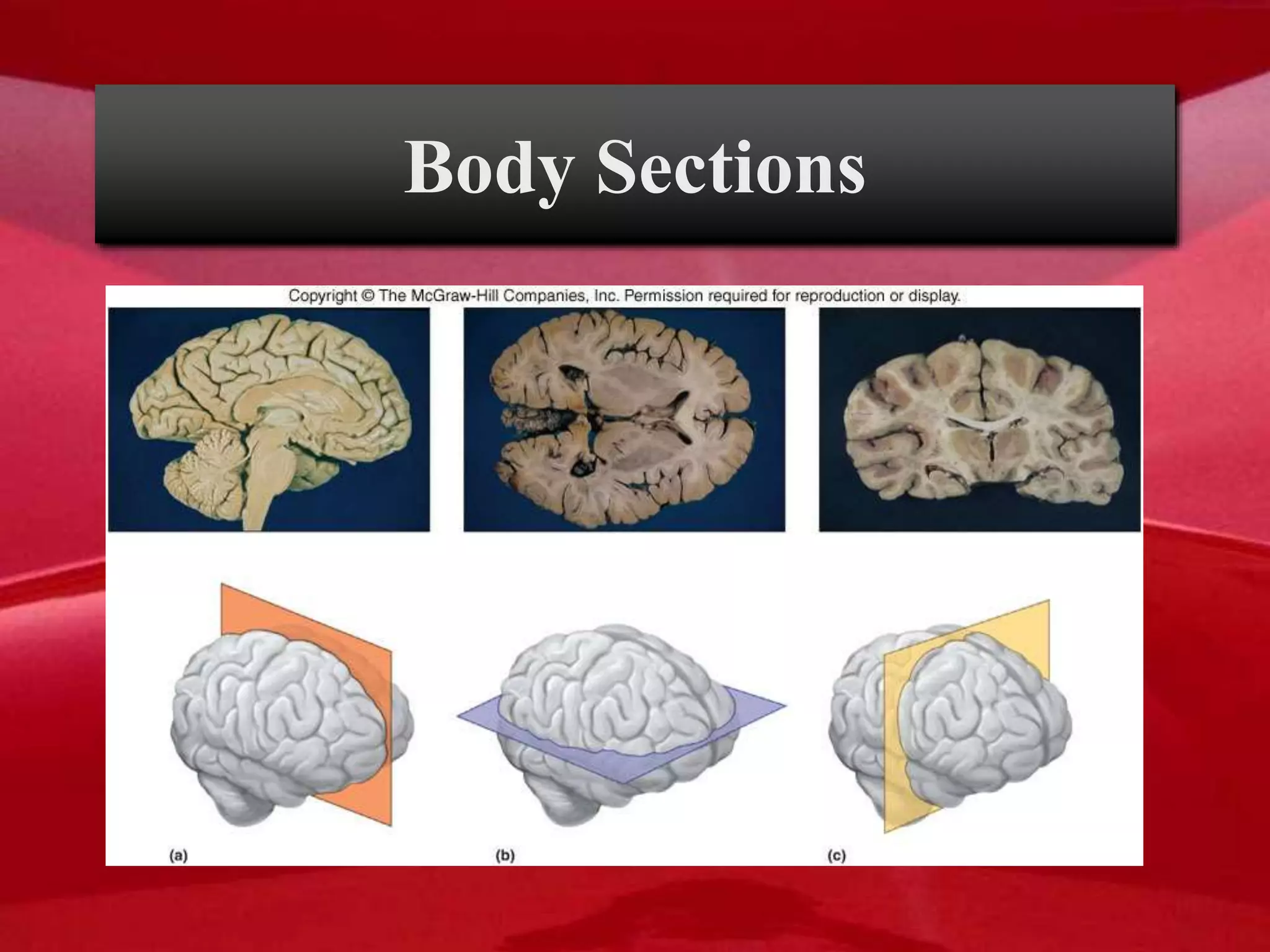
• Sagittal plane
– divides the body or an
organ into left and
right sides
• Midsagittal plane
– produces equal halves
• Parasagittal plane
– produces unequal
halves
Other Planes and
Sections
• Frontal or coronal plane
– divides the body or an organ into
front (anterior) and back
(posterior) portions
• Transverse(cross-sectional) or
horizontal plane
– divides the body or an organ into
upper (superior) or lower (inferior)
portions
• Oblique plane
– some combination of 2 other planes
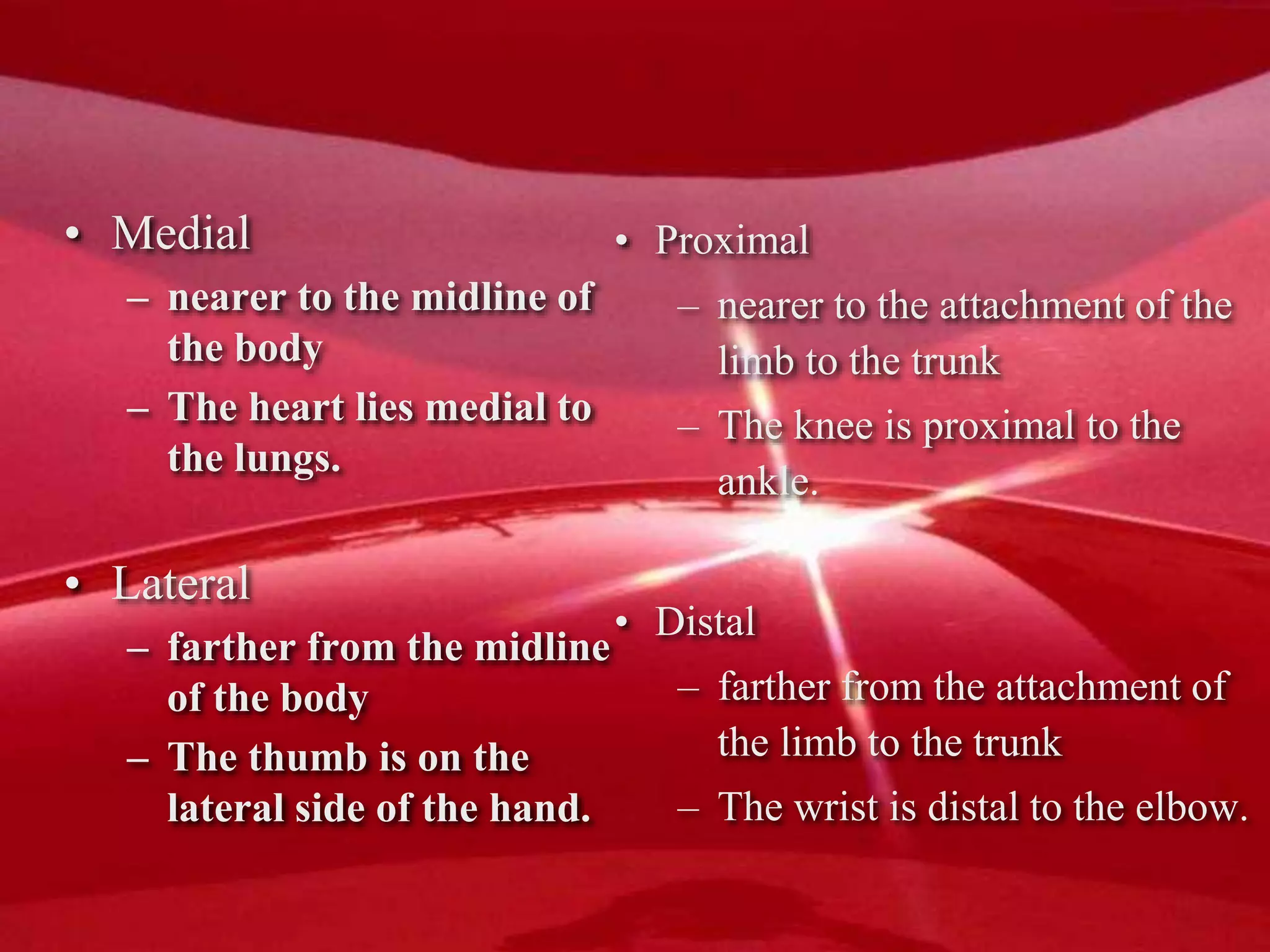
• Medial
– nearer to the midline of
the body
– The heart lies medial to
the lungs.
• Lateral
– farther from the midline
of the body
– The thumb is on the
lateral side of the hand.
• Proximal
– nearer to the attachment of the
limb to the trunk
– The knee is proximal to the
ankle.
• Distal
– farther from the attachment of
the limb to the trunk
– The wrist is distal to the elbow.
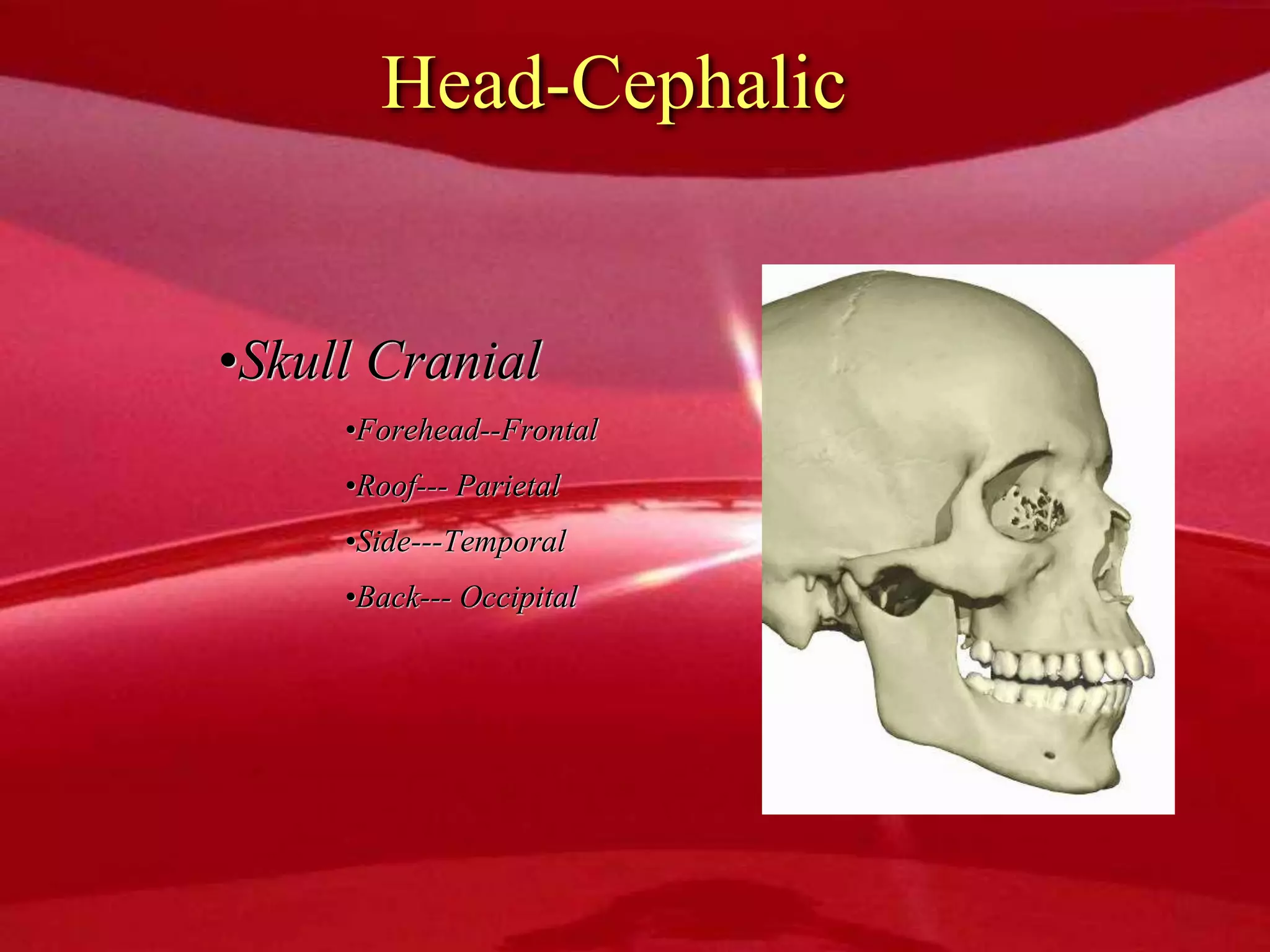
Head-Cephalic
•Skull Cranial
•Forehead--Frontal
•Roof--- Parietal
•Side---Temporal
•Back--- Occipital
Head-Cephalic
• Face Facial
• Eye---Ocular, orbital
•Nose---Rhino, nasal
•Ear---Otic
•Mouth---Oral
•Cheek----Buccal
•Chin---Mental
Neck-Cervical
Area between shoulder and base of skull.
Includes 7 neck vertebrae.
“C” collar used for whiplash.
Trunk
• Front Ventral Anterior
• Chest---Thoracic, pectoral
•Collar Bone---Clavicular
•Shoulder---Acromial
•Breast bone---Sternal
•Belly---Abdominal
•Navel---Umbilical
•Pelvis---Pelvic
•Pubis---Pubic
• Back Dorsal Posterior
•Backbone---Vertebral
•Loin---Lumbar
•Tail Bone---Sacral, Coccygeal
Arm-Upper Extremity
•Armpit--- Axillary
•Upper Arm---Brachial
•Forearm---Antebrachial
•Wrist---Carpal
•Hand---Manual
•Palm---Metacarpal,volar
•Front of Elbow---Antecubital
•Back of Elbow---Cubital Olecranal
•Back of hand---Dorsal
•Finger---Digital,Phalangeal
•Thumb---Pollex
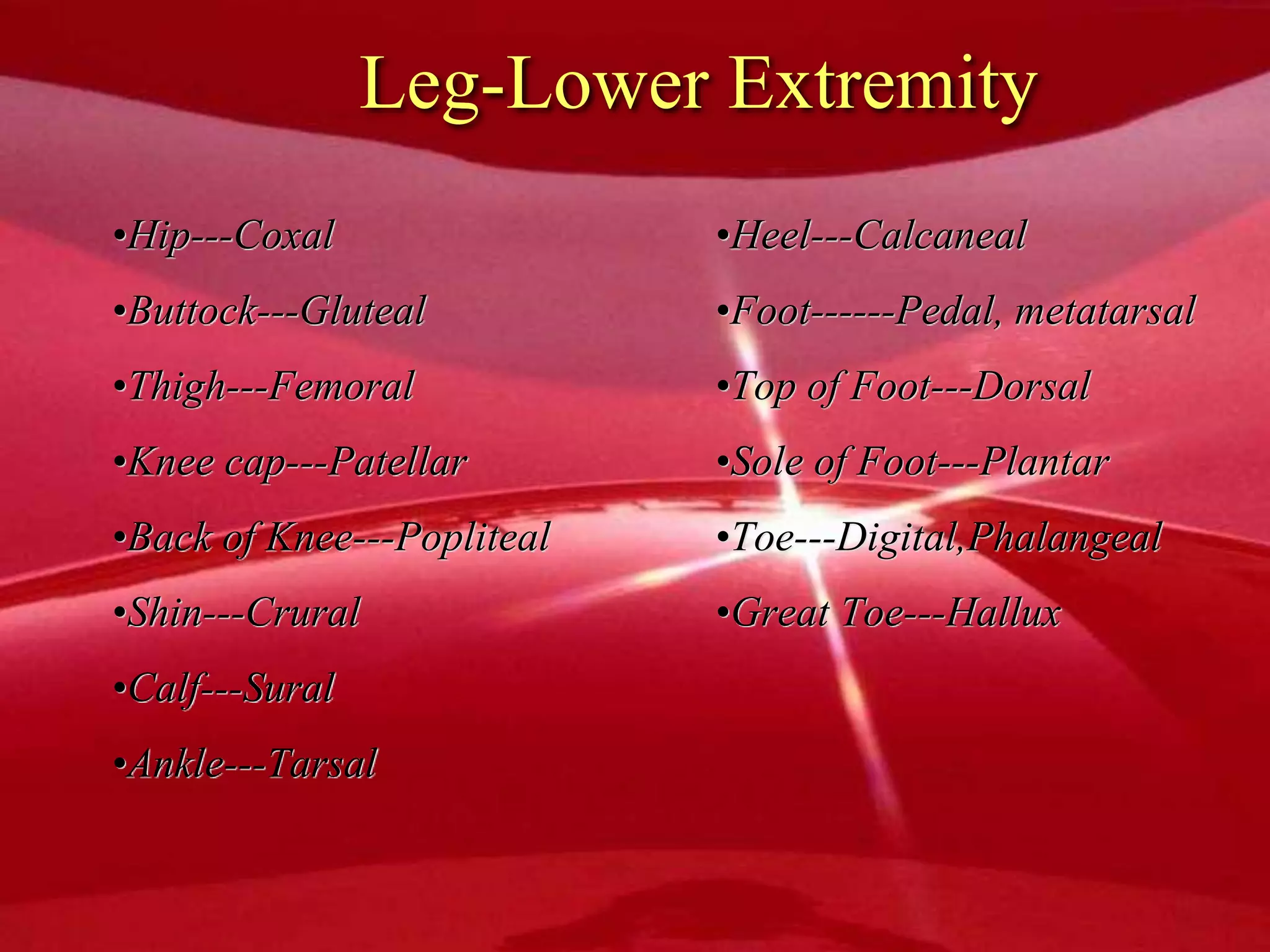
Leg-Lower Extremity
•Hip---Coxal
•Buttock---Gluteal
•Thigh---Femoral
•Knee cap---Patellar
•Back of Knee---Popliteal
•Shin---Crural
•Calf---Sural
•Ankle---Tarsal
•Heel---Calcaneal
•Foot------Pedal, metatarsal
•Top of Foot---Dorsal
•Sole of Foot---Plantar
•Toe---Digital,Phalangeal
•Great Toe---Hallux
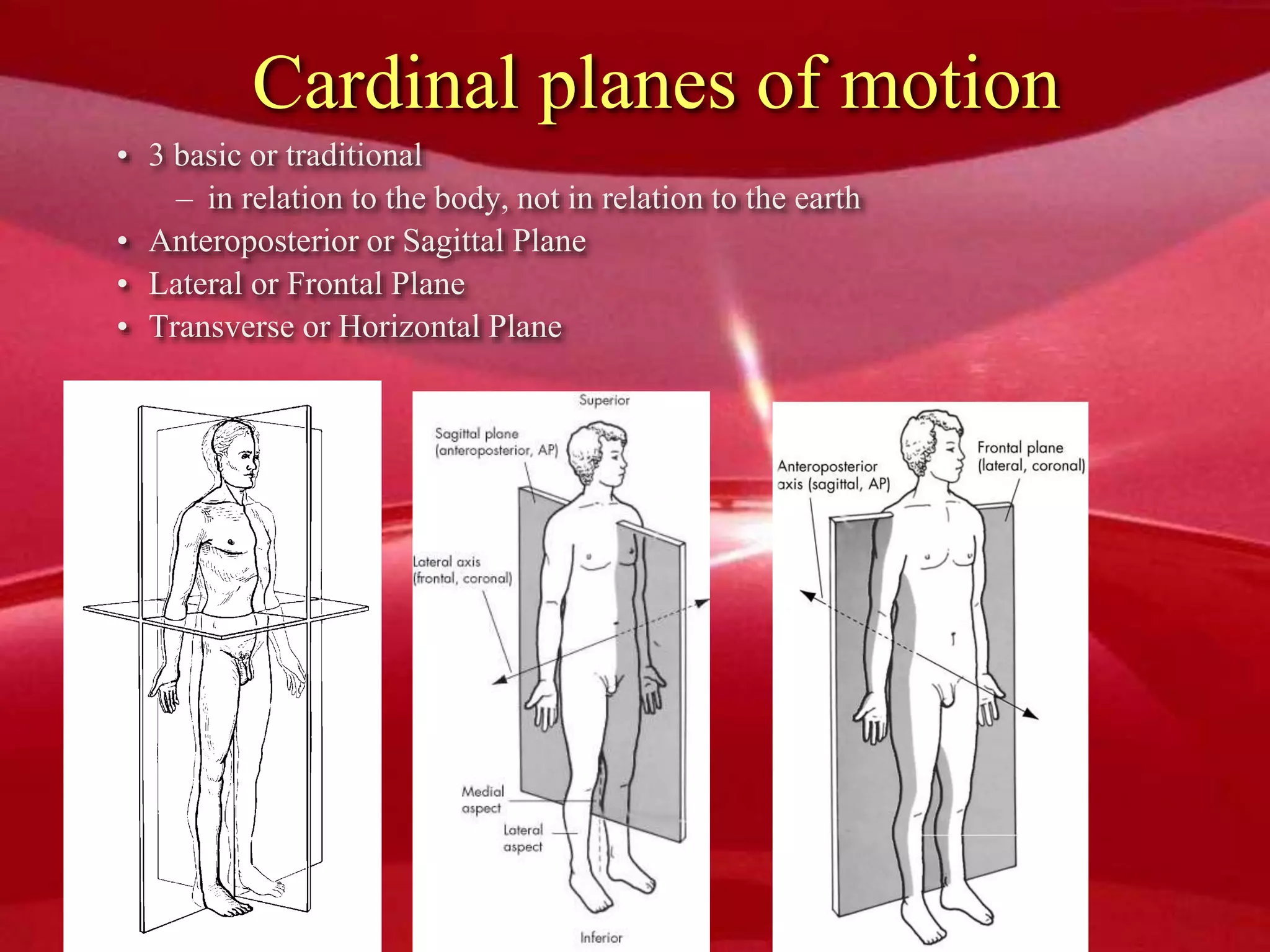
Cardinal planes of motion
• 3 basic or traditional
– in relation to the body, not in relation to the earth
• Anteroposterior or Sagittal Plane
• Lateral or Frontal Plane
• Transverse or Horizontal Plane
Body Sections
Body Sections
Body Regions
Regional Terms Used for Places

Anatomy introduction

  • 1.
  • 2.
    Anatomy • Definition -anatome = up (ana) + cutting (tome) • Disciplines of anatomy – Macroscopic – Microscopic – Developmental – Neuroanatomy • Approach to study of gross anatomy Upper extremity Back Head and neck Thorax Abdomen Pelvis and perineum Lower extremity
  • 3.
    Why do youneed to study anatomy? • A doctor should be able to localize symptoms and signs – Pains – Lumps/bumps – Withdrawing of blood & giving injections – Basic medical procedures
  • 4.
    Why do youneed to study anatomy? • Surgeons need to know what they cut – Where to cut – How to find the structures/organs – Relationship of structures/organs – Normal variations
  • 5.
    Basis for Terminology •Terms informative • Nomina anatomica • Use of eponyms Use correct terminology on exams; avoid nonspecific, general terms, like “front,” “up,” and “behind.”
  • 6.
    Disciplines of Anatomy •Gross Anatomy: structures studied with the naked eye. – Systematic anatomy: organized by systems, e.g., digestive, nervous, endocrine, etc. – Regional anatomy: study of all structures in an area of the body, e.g., upper extremity bones, muscles, blood vessels, etc. • Microscopic anatomy (histology) • Cell biology • Developmental anatomy (embryology) • Pathological anatomy • Radiologic anatomy (x-ray, CT, MRI) • Other areas? (surgery)
  • 7.
    Levels of StructuralOrganization • Biochemical (atoms, molecules) • Cellular • Tissue • Organ • Organ system • Organism
  • 8.
    Medical Imaging Techniques •X-rays • CT Scan • PET • Ultrasound imaging • MRI • Anatomy is important!
  • 9.
    Anatomical Planes • Median= vertical, front to back in midline • Frontal (coronal) = vertical, perpendicular to median • Horizontal (transverse) = parallel to floor, perpendicular to median, coronal • Sagittal = vertical, parallel to median • Midsagittal (R-L) • Parasagittal (unequal R-L)
  • 10.
    Reference positions • Anatomicalposition – most widely used & accurate for all aspects of the body – standing in an upright posture, facing straight ahead, feet parallel and close, & palms facing forward • Fundamental position – is essentially same as anatomical position except arms are at the sides & palms facing the body
  • 11.
    Anatomical Position • Bodyerect • Head, eyes, toes directed forward • Limbs at sides of body • Palms directed forward
  • 12.
    Anatomical directional terminology •Anterior – in front or in the front part • Anteroinferior – in front & below • Anterosuperior – in front & above • Posterior – behind, in back, or in the rear • Posteroinferior – behind & below; in back & below • Posterolateral – behind & to one side, specifically to the outside
  • 13.
    Anatomical directional terminology •Contralateral – pertaining or relating to the opposite side • Ipsilateral – on the same side • Bilateral – relating to the right and left sides of the body or of a body structure such as the right & left extremities
  • 14.
    Anatomical directional terminology •Inferior (infra) – below in relation to another structure; caudal • Superior (supra) – above in relation to another structure; higher, cephalic • Distal – situated away from the center or midline of the body, or away from the point of origin • Proximal – nearest the trunk or the point of origin • Lateral – on or to the side; outside, farther from the median or midsagittal plane • Medial – relating to the middle or center; nearer to the medial or midsagittal plane • Median – Relating to the middle or center; nearer to the median or midsagittal plane From Van De Graaff KM: Human anatomy, ed 6, New York, 2002, McGraw-Hill
  • 15.
    Anatomical directional terminology •Caudal – below in relation to another structure; inferior • Cephalic – above in relation to another structure; higher, superior • Deep – beneath or below the surface; used to describe relative depth or location of muscles or tissue • Superficial – near the surface; used to describe relative depth or location of muscles or tissue
  • 16.
    Anatomical directional terminology •Prone – the body lying face downward; stomach lying • Supine – lying on the back; face upward position of the body • Dorsal – relating to the back; being or located near, on, or toward the back, posterior part, or upper surface of • Ventral – relating to the belly or abdomen, on or toward the front, anterior part of • Volar – relating to palm of the hand or sole of the foot • Plantar – relating to the sole or undersurface of the foot
  • 17.
    Directional Terms •Toward theupper part •Superior Cephalic •Toward the lower part •Inferior Caudal •Front •Ventral Anterior •Back •Dorsal Posterior
  • 18.
    Directional Terms •Front Down •Prone •TowardMidline •Medial •Away from Midline •Lateral •Same-Ipsilateral •Opposite-Contralateral •Between •Intermediate •Near •Proximal
  • 19.
    Directional Terms •Far •Distal •On theSurface •Superficial •On the Inside •Deep •On the Wall of the Body Cavity •Parietal •On an Organ •Visceral
  • 20.
    The Skeleton • Consistsof – Bones, cartilage, joints, and ligaments • Composed of 206 named bones grouped into two divisions – Axial skeleton (80 bones) – Appendicular skeleton (126 bones)
  • 21.
    The Axial Skeleton •Formed from 80 named bones • Consists of skull, vertebral column, and bony thorax Figure 7.1a
  • 22.
    Planes and Sections •A plane is an imaginary flat surface that passes through the body. • A section is one of the 2 surfaces (pieces) that results when the body is cut by a plane passing through it.
  • 23.
  • 24.
    Median plane Of body Ofhand Of foot Sagittal plane
  • 25.
    Sagittal Plane • Sagittalplane – divides the body or an organ into left and right sides • Midsagittal plane – produces equal halves • Parasagittal plane – produces unequal halves Other Planes and Sections • Frontal or coronal plane – divides the body or an organ into front (anterior) and back (posterior) portions • Transverse(cross-sectional) or horizontal plane – divides the body or an organ into upper (superior) or lower (inferior) portions • Oblique plane – some combination of 2 other planes
  • 26.
    • Medial – nearerto the midline of the body – The heart lies medial to the lungs. • Lateral – farther from the midline of the body – The thumb is on the lateral side of the hand. • Proximal – nearer to the attachment of the limb to the trunk – The knee is proximal to the ankle. • Distal – farther from the attachment of the limb to the trunk – The wrist is distal to the elbow.
  • 27.
  • 28.
    Head-Cephalic • Face Facial •Eye---Ocular, orbital •Nose---Rhino, nasal •Ear---Otic •Mouth---Oral •Cheek----Buccal •Chin---Mental
  • 29.
    Neck-Cervical Area between shoulderand base of skull. Includes 7 neck vertebrae. “C” collar used for whiplash.
  • 30.
    Trunk • Front VentralAnterior • Chest---Thoracic, pectoral •Collar Bone---Clavicular •Shoulder---Acromial •Breast bone---Sternal •Belly---Abdominal •Navel---Umbilical •Pelvis---Pelvic •Pubis---Pubic • Back Dorsal Posterior •Backbone---Vertebral •Loin---Lumbar •Tail Bone---Sacral, Coccygeal
  • 31.
    Arm-Upper Extremity •Armpit--- Axillary •UpperArm---Brachial •Forearm---Antebrachial •Wrist---Carpal •Hand---Manual •Palm---Metacarpal,volar •Front of Elbow---Antecubital •Back of Elbow---Cubital Olecranal •Back of hand---Dorsal •Finger---Digital,Phalangeal •Thumb---Pollex
  • 32.
    Leg-Lower Extremity •Hip---Coxal •Buttock---Gluteal •Thigh---Femoral •Knee cap---Patellar •Backof Knee---Popliteal •Shin---Crural •Calf---Sural •Ankle---Tarsal •Heel---Calcaneal •Foot------Pedal, metatarsal •Top of Foot---Dorsal •Sole of Foot---Plantar •Toe---Digital,Phalangeal •Great Toe---Hallux
  • 33.
    Cardinal planes ofmotion • 3 basic or traditional – in relation to the body, not in relation to the earth • Anteroposterior or Sagittal Plane • Lateral or Frontal Plane • Transverse or Horizontal Plane
  • 34.
  • 35.
  • 36.
  • 37.